As if the college sports world weren’t crazy enough with roster limitations and rising numbers in the transfer portal, a new trend that isn’t really new but is accelerating involves coaches telling players they will have little chance to play as motivation for the player to leave and open up a roster spot.
That’s how a coach escapes bad publicity for chasing off a player. But maybe the coach is being honest in their evaluation? It’s all part of the strange happenings taking place.
When one door closes, opportunity knocks on another. I want to thank all my family, friends, teammates and coaches who have reached out to me since learning of my involuntary decommittment. I know I will find a new home soon and it will be better than before.@IowaPremierFP
Check out social media to see the growing number of high school and junior college players suddenly searching for new schools this summer by saying, “My recruitment is back open” or announcing an “involuntary decommitment.”
Just this week, Ole Miss is facing criticism after a longtime high school baseball commit from Iowa who has been battling cancer for three years, Brett Harris, said he had his baseball scholarship pulled.
College baseball, in particular, is being disrupted. Members from the high school class of 2027 are being forced to reopen their recruitment as schools take into consideration a new NCAA rule giving players five years of eligibility across five years.
Braden Ruiz, a Mater Dei High graduate who played shortstop at Cypress College, signed with Oregon last January. Last month he asked for his release from Oregon.
“It was the vibe I was getting,” Ruiz said. “They said I could still go up there and give it a shot. The conversations were they didn’t seem interested as before. I decided to decommit. The coach who recruited me ended up leaving Oregon a week later.”
Ruiz played with a hamstring injury at Cypress College last season.
“It’s all about performance,” he said. “If you’re not performing, it makes the coaches think differently.”
Ruiz has come to understand how college sports has become a business.
“They pretty much can do whatever they want,” he said. “They can pull your offer or in the conversations tell you you’re not wanted anymore. But it’s part of their job. They need to win to keep their job.”
Mater Dei coach Richard Mercado said he’s advising parents and players “if a school is giving out NIL money, it’s a business. You’re not going there to be friends with the coach. It’s a business relationship. They have to win immediately and with limited roster spots. They can’t be wrong.”
Players being pushed away to open a scholarship spot is not new. It’s happened in all sports. College baseball coaches have been engaged in a balancing act for years. Remember the days when Division I schools were limited to 11.7 scholarships. Players were being given partial scholarships and coaches had to project who might leave or stay after the amateur draft. Now college programs can offer full scholarships (think SEC), but rosters dropped to a maximum 34 players last season, forcing coaches to revise and regroup.
Add the impact of no more transfer restrictions and it’s understandable there’s uncertainty. The word loyalty is going to cease to exist in many programs.
So what’s the advice to players and parents?
Betting on yourself still works. If someone doesn’t want you, find someone who does.
“Everybody’s journey is different,” Ruiz said. “You can commit early or late. I would say people who commit now will make it on campus. Their past season was probably good. People performing better more recently have a better chance of playing.”
Do research to find programs that stick with old-fashioned rules and commitments and maybe mention academics.
On Thursday, Ruiz signed with New Mexico State. He’s one of the fortunate ones finding a school with a roster opening this summer before Saturday’s amateur draft begins. He’ll have three years of eligibility left. He’s finally healthy and can’t wait for the day he gets to play against Oregon.
If he becomes a standout, who knows, maybe the Ducks will want him again in this new world of college athletics.
While every World Cup introduces viewers to new young stars, this tournament featured eight players who were older than 40 — one more than the number of over-40 players in the previous 22 World Cups combined.
Among them were Portugal’s Cristiano Ronaldo, 41, and Mexico’s Memo Ochoa, 40, who were playing in their sixth World Cups alongside Argentina’s Lionel Messi, a relative youngster at 39. No one has played in more men’s World Cups.
But while Ronaldo and Ochoa have gone home, Messi will be playing in his third semifinal in four tournaments Wednesday when Argentina, the reigning champion, faces England at Mercedes-Benz Stadium in Atlanta.
The newfound longevity of elite soccer players has been made possible by advances in sports medicine, diet and analytics that measure everything from biomechanics and heart rate to muscular output and sleep cycles, all in real time. And injuries that once ended careers can now be repaired through outpatient procedures.
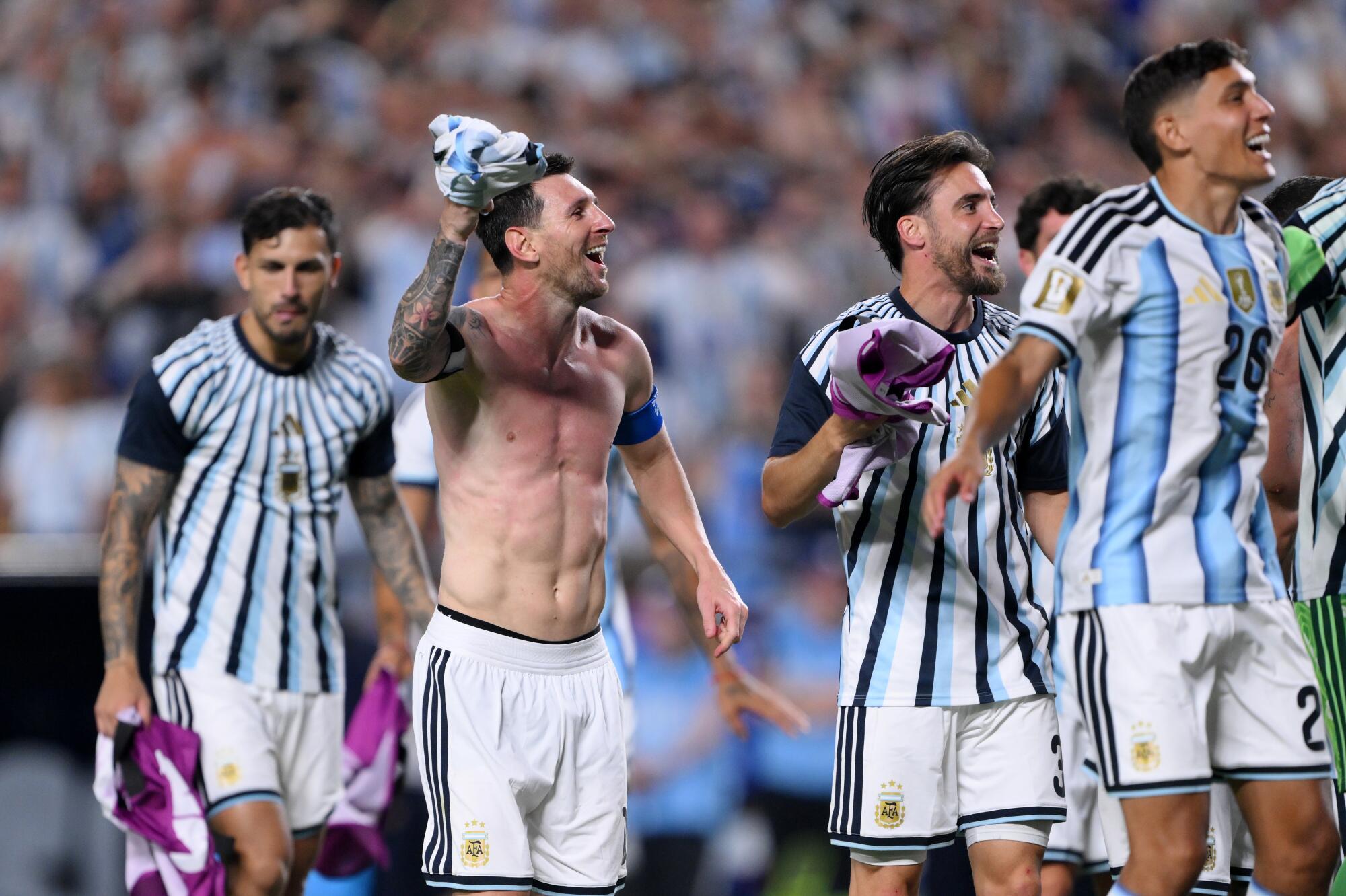
Argentina star Lionel Messi holds his jersey up and celebrates with teammates after a World Cup quarterfinal win over Switzerland on Saturday in Kansas City, Mo.
(David Ramos / Getty Images)
“Over the past 10, 20 years, the sports science within the game has changed a lot,” said Liam Anderson, an exercise physiologist at the University of Birmingham in England, who has worked as an applied practitioner in top-flight professional soccer for more than a decade.
“Players are now definitely more aware of their bodies and I think the professionalism has changed quite a lot as well. But they’re also in tune with the things which are helping them recover, manage their training load and ultimately stay fitter and healthier for longer.”
Gone are the days when chain-smoking Dutch legend Johan Cruyff would light up a cigarette on the bench, French world champion Zinedine Zidane would smoke in the locker room and George Best would party and drink so hard he would disappear for days at a time.
“There’s a couple of reasons,” Dr. Michael Joyner, a specialist in the physiology of elite athletes at the Mayo Clinic, said of the growing lifespan of soccer players. “The first is that people just make a lot more money and as a result, there’s tremendous incentive to keep playing. The second is people are taking much better care of themselves.”
“You just don’t hear about people like George Best anymore,” said Joyner, speaking for himself and not the clinic where he works.
“Diet is huge,” Anderson added. “High-protein diets and fueling with carbohydrates for matches. Nutritional strategies have changed considerably in the last 10-15 years.”
And those diets are tailored by position since a midfielder, who may run more than seven miles in a match, burns more calories than a goalkeeper.
As the eldest player in Major League Soccer, Diego Chara has had to make some concessions to age.
“It’s a little detailed,” said Chara, a midfielder with the Portland Timbers. “Talking about recovery time, it maybe takes a little bit longer than before. Nutrition. Working in the gym, it’ll be longer than other players.”
But if Chara, 40, is an old man in a league where the average age is younger than 26, he would have been something of whippersnapper in this summer’s World Cup.
The Portland Timbers’ Diego Chará passes the ball under pressure from the Columbus Crew’s Wessam Abou Ali on Feb. 21in Portland, Ore.
(Amanda Loman / Associated Press)
Soccer isn’t the only sport in which 40 is the new 30.
Serena Williams returned to Wimbledon this summer at age 44 and at least half a dozen athletes 40 and older showed up at the Milan-Cortina Olympics last February hoping to medal. Four of them succeeded, including American Elana Meyers Taylor, 41, who became the oldest athlete to win an individual gold in Winter Olympics history in the women’s monobob.
It isn’t unheard of for athletes to be golden in their golden years. Ted Williams hit .316 at 41 and Gordie Howe played 80 games and had 41 points in his final NHL season at 52. Nolan Ryan threw a no-hitter and pitched 173 innings at 44 while Tom Brady quarterbacked the Tampa Bay Bucs to a Super Bowl title at 43.
But if those age-defying performances were outliers, playing into your mid-40s and even early 50s may soon become, if not common, at least less unusual.
“People are just staying in better shape, taking care of themselves,” Joyner said. “Career-changing or career-ending injuries are no longer career-ending injuries. It just goes on and on, all of this stuff combined.”
American Serena Williams, 44, serves against Australian Maya Joint during a match at Wimbledon on June 30.
(Cameron Spencer / Getty Images)
State-of-the-art training centers and access to top-line sports medicine have also become more accessible, even in poor countries.
“The elite level has spread and really become global, as opposed to where there used to be pockets,” Joyner said. “The opportunities to compete are so great.”
Few team sports are as physically demanding as soccer, though, which makes both the growing number of seasoned citizens and their performances noteworthy. Messi has averaged nearly a game a week for club and country during the past 23 years, yet he entered the semifinals of this tournament tied for the scoring lead with France’s Kylian Mbappé, who is 12 years younger.
Ronaldo has played even more games yet he became the oldest player to score in a World Cup knockout game when his penalty kick helped eliminate Croatia and midfielder Luka Modric, who will be 41 in less than two months.
“They’ve probably lost a little bit off the top, but their experience and their mind make up for that,” said Scott Trappe, a professor of human bioenergetics at Ball State. “So the overall package of them as a sports person is really they’re contributing at a high level. I think we’re going to continue to see this movement.
Portugal’s Cristiano Ronaldo celebrates scoring a World Cup group stage goal against Uzbekistan on June 23 in Houston.
(Charlotte Wilson / Getty Images)
“They like playing the sport and as long as they can and contribute and they make these teams, they’re going to do it. I don’t see the trend going away.”
And that will not only change the way we think of sports and athletes, it will completely rewrite the record book. Messi, for instance, entered the semifinals of this World Cup as the tournament’s all-time leading scorer with 21 goals. But that was just one ahead of Mbappé, who could appear in another three or four World Cups.
“No question,” Trappe said. “You look what’s going on in pro cycling. We’ve got some guys in their upper 30s competing in the Tour de France, but we also have a teenager competing. So this lifespan, what used to be a five- to eight-year period for cycling at the at the highest levels is turning out to be, you know, double or triple that.”
Both Messi and Ronaldo have benefited from how they play as well, walking rather running for long stretches of the game to conserve energy for the burst they need to lose a defender. It’s a strategy Mbappé, Norway’s Erling Haaland and other young players have adopted and if they do that over enough games, the wear and tear it saves could add years to the end of their careers.
“We are expanding. The age will start moving up a little bit further up and players’ careers will definitely be longer,” Anderson said. “The sort of normal distribution of playing age will begin to move forward and that experience within the squad will be key.’
Argentina’s Lionel Messi dribbles the ball during the World Cup quarterfinal match against Switzerland on Saturday in Kansas City, Mo.
(Charlie Riedel / Ap Photo/charlie Riedel)
Consider Wednesday’s semifinalists. In its quarterfinal win, Argentina used six players older than 32 and two — Messi and defender Nicolas Otamendi — who are over 38. The spine of England’s team runs from goalkeeper Jordan Pickford through defender John Stones to striker Harry Kane, who are all 32.
“We’re coming up with new ways on how to improve and maximizing potential,” Anderson said. “God gave us what we are and it’s maximizing that, not necessarily changing that.”
That knowledge won’t stay in the stadiums and locker rooms for long, expanding to others who choose to adopt the same wellness discipline as professional athletes.
“It cycles down,” Trappe said. “We’re studying that in the lab at a pretty high level. This sort of healthy lifestyle in terms of functionality and extending into our later years and having a higher quality life, there’s data starting to emerge there.
“These types of things are going to trickle into that for sure.”
Welcome back to the Lakers newsletter, where we’ve reached the “statement” portion of the summer.
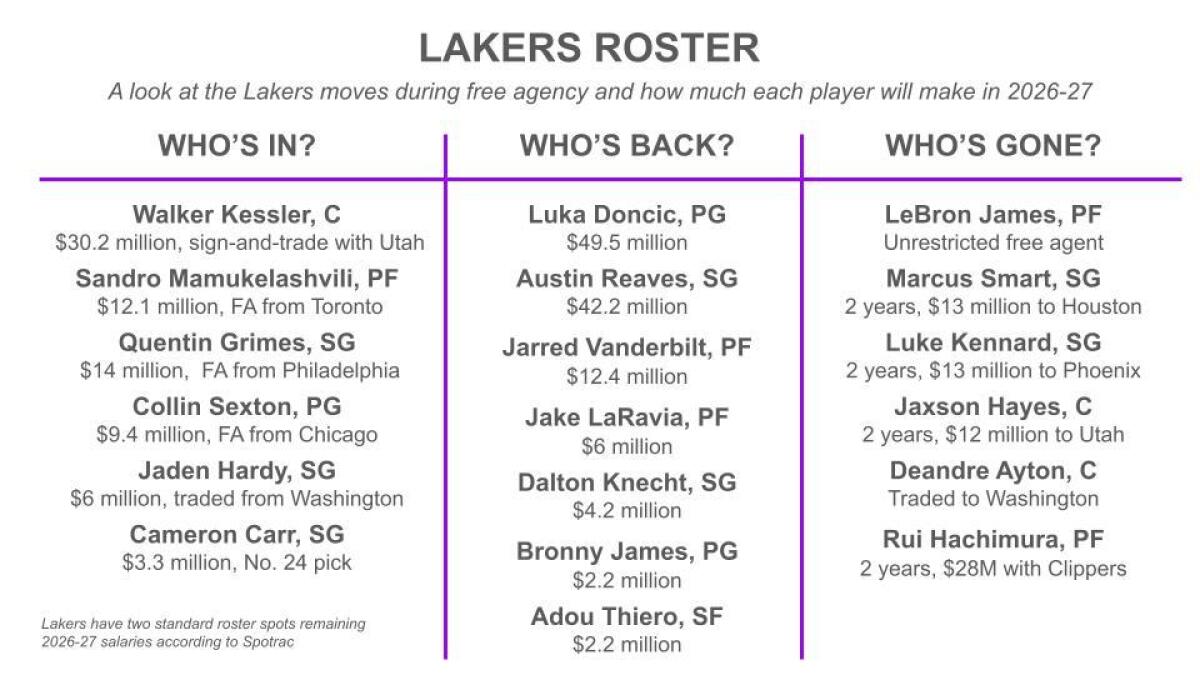
After a busy wave of free agency, the Lakers made many of their offseason moves official this week: Jaden Hardy, Sandro Mamukelashvili, Quentin Grimes, Walker Kessler, Collin Sexton and Kevon Looney are in; Austin Reaves is back; Deandre Ayton is out to Washington.
The onslaught of announcements, photo ops and new social media graphics bring us one step closer to our opening day roster. With the veteran pieces in place, we’ll take a look at how the young players are shaping up.
All things Lakers, all the time.
Get all the Lakers news you need in Thuc Nhi Nguyen’s weekly newsletter.
By continuing, you agree to our Terms of Service, which include arbitration and a class action waiver. You agree that we and our third-party vendors may collect and use your information, including through cookies, pixels and similar technologies, for the purposes set forth in our Privacy Policy such as personalizing your experience and ads.
Summer league showtime
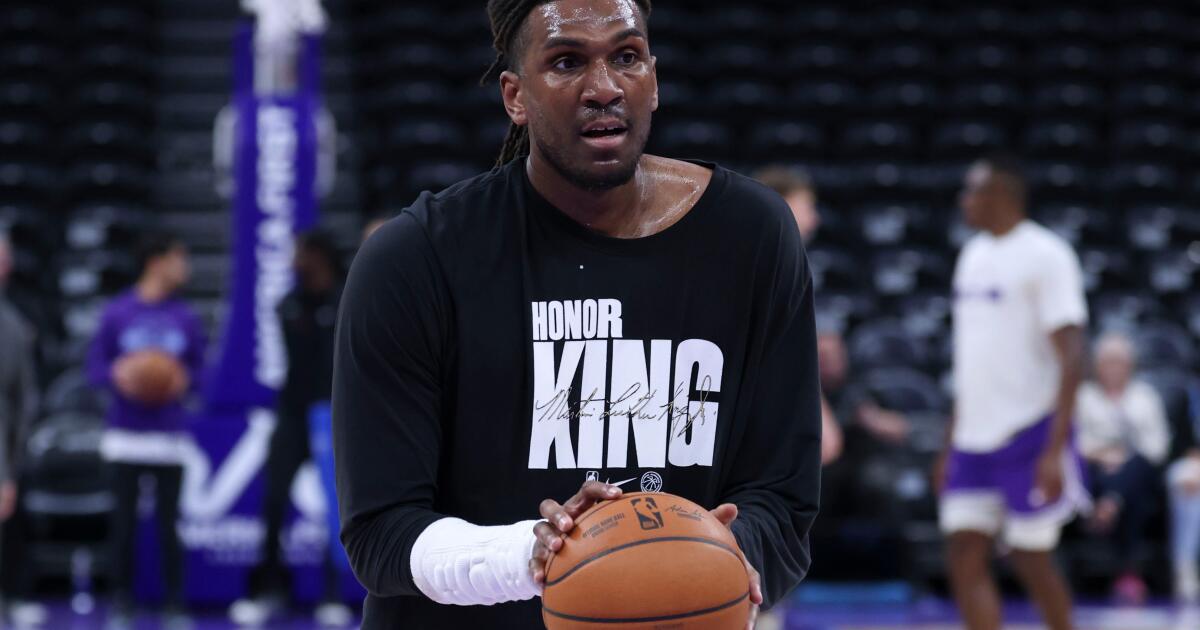
Adou Thiero hurt his right wrist on a hard fall during the Lakers’ second summer league game this month. The bigger injury risk might be slamming his hand too hard on a dunk.
In his second season and his first summer league, Thiero wants to break into the rotation for the new-look Lakers. The high-flying forward’s progression after an injury-plagued rookie season is one of the key stories of the Lakers’ summer league.
Thiero did not make the strongest summer impression. During the first game at the California Classic in San Francisco, the 22-year-old looked like he was playing in fast-forward. Not in a good way.
Going three-for-10 from the field with nine points and multiple out-of-control drives to the rim, Thiero did not look like the returning NBA player on the Lakers’ summer league roster. He missed the team’s last game in San Francisco because he took a hard fall in the prior game.
Two months after he last played in a competitive game, Thiero said he was just so eager to play in the California Classic that he needed to “take it back a couple of notches and slow my game down.”
Thiero slowed down and soared higher in Las Vegas, where he had 20 points, four rebounds, three steals, two blocks and no turnovers in the Lakers’ Las Vegas summer league opener. The tape on his right wrist didn’t hold him back from slamming dunk after dunk after (windmill) dunk against the Oklahoma City Thunder.
“Gotta put on a show,” Thiero said on the Amazon Prime broadcast of his windmill dunk. “Lakeshow for a reason.”
Thiero, who is still working on improving his three-point shot, could add an athletic, energetic boost to the Lakers offense. With Walker Kessler filling the much-needed lob-catching center role, the Lakers have potential to be one of the league’s best offenses. Luka Doncic and Austin Reaves are just that good.
It’s on the defensive end that young players, including Thiero and rookie Cameron Carr, will need to prove their value. The Lakers, who added Ziaire Williams on a one-year deal Monday in their 15th roster spot, are looking for more defense on the wing.
Thiero said he has had conversations with the Lakers coaching staff about growing into an aggressive point-of-attack defender. His instructions are to “cause havoc,” he said. Thiero has delivered with a team-high nine steals during four summer league appearances.
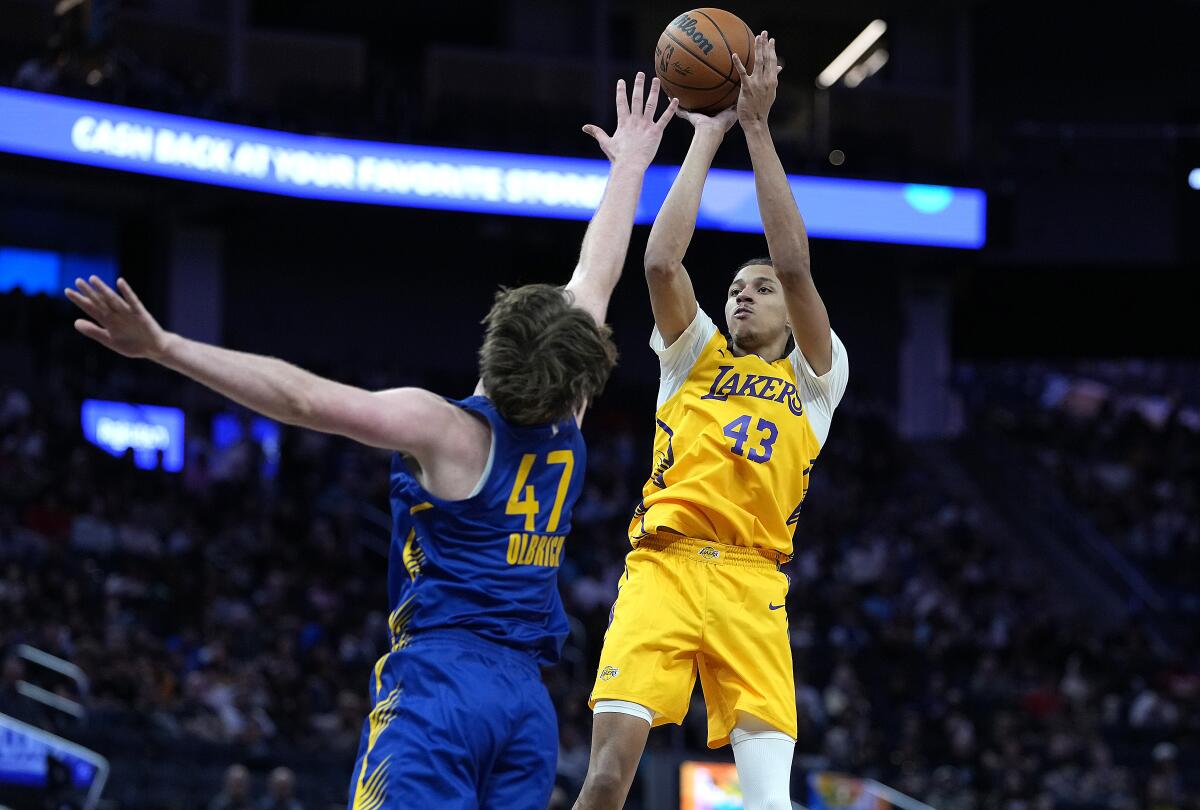
Cameron Carr shoots over Lachlan Olbrich of the Golden State Warriors during a summer league game.
(Thearon W. Henderson / Getty Images)
Carr has four blocks, including several on jump shots. With a 38-inch vertical and an 8-foot-8 standing reach, Carr used his length and athleticism to lead Baylor with 45 blocks last season.
But as he makes the transition to the NBA level, Carr said there’s still a lot for him to learn. The 184-pound guard plans to make the weight room his second home. He can get deflections but gets beat on drives. Catching up on the court starts with catching up to the speed of the game mentally.
“[In the NBA] they kind of rely on being smarter up top, and so it’s just trying to be ahead of everybody, trying to be ahead of the play, and be in the same space they’re in. We all flow as one,” Carr told reporters in Las Vegas. “I feel like right now, I’m a little bit behind because I’m a little bit younger. I mean, this is my first time practicing, this is the first time playing with them, so it was a little bit just trying to catch up.”
On offense, Carr is already showing important skills that could earn him a rotation spot. His jumper is pure and smooth. He went 11 for 32 from three-point range in his first four summer league appearances, averaging 17 points. He missed the second game in Las Vegas because of a minor thumb injury. At 6-foot-5 with a high, consistent release, Carr had Stan Van Gundy gushing about his shooting on the Amazon Prime broadcast in Las Vegas.
While eyes are fixated on the two most recent draft picks, the Lakers’ leading summer league scorer is unheralded Arthur Kaluma.
The South Bay Lakers forward had a standout 34-point performance against the Dallas Mavericks and is averaging 20 points in four summer league appearances. In Vegas, he’s shooting 76.2% from the field and 59% overall this summer.
Kaluma averaged 14.6 points and 4.9 rebounds for the South Bay Lakers last season. The 6-7 forward is a versatile scorer who can stretch the floor with his three-point shot. He shot 37% from three-point range in the G League last season and made six of 10 threes against the Mavericks in his summer league statement.
The 24-year-old, like many of his summer league teammates, is battling for his NBA dreams. Each team is allowed up to three two-way players at a time, and the Lakers have already announced their maximum allotment. Guard Chris Mañon, who finished second in G League defensive player of the year voting last season, re-signed, and rookies Peter Suder and AK Okereke got their first professional contracts.
But that doesn’t mean all three are locked in for the season. Last year, the Lakers waived Christian Koloko five months after re-signing the center to a two-way deal to add Drew Timme in his spot.
“The G can get grimy, you know what I’m saying?” Kaluma said to reporters in Las Vegas. “It’s a time where everybody is trying to fight for a position and there is a certain hunger that you have to have in order to be successful in the G. And I feel like that drive that I had my first year in it pushed me into this summer to really get better and work on my game and come here and have the opportunity to perform.”
These summer league games don’t officially count. For many in the league, the annual pilgrimage to Las Vegas is more about off-court schmoozing than the on-court product.
But with players trying to make a name for themselves and fighting for their jobs, don’t tell anyone these games don’t matter.
“In these summer league settings, there’s 29 other teams that are looking and watching these games,” Lakers summer league coach Ty Abbott said, “and this is opportunities for all of them. So there’s no room to not take a game seriously. Every possession matters, every rep, every drill, every practice.”
Poll results
Last week, we asked if you would like to see the Lakers retire LeBron James’ jersey. Here are the results:
Yes: 32 No: 54
Programming update
Summer league is winding down and I’ll be on vacation this week so the Lakers newsletter will rest for at least one week. Thus no new poll question for now. But if you like the polls — or have poll questions you want to ask your fellow newsletter subscribers — email me your thoughts at thucnhi.nguyen@latimes.com.
Favorite thing I ate this week
The bánh cuốn đặc biệt plate at Bánh Cuốn Lưu Luyến in Garden Grove.
(Thuc Nhi Nguyen / Los Angeles Times)
My Instagram algorithm has been feeding me unrelenting videos of Vietnamese food and this is the rare instance in which I’m not mad at social media platforms tracking my movements. At least they’re delivering something I want.
After being subjected to dozens of videos of people making Vietnamese steamed rice rolls (bánh cuốn), I decided to hunt some down for myself at Bánh Cuốn Lưu Luyến in Garden Grove. The bánh cuốn đặc biệt — a combination plate with plain steamed rice sheets, sheets stuffed with ground pork and mushroom and pieces filled with shrimp — satisfied my internet FOMO cravings. Every plate is complete with an egg roll, tofu, ham, mung beach shrimp cake and vegetables. I think even my mom would approve of this restaurant.
ARLINGTON, Texas — Before it could rise in the World Cup, France first had to fall.
And the fall was spectacular.
In 2010, four years after reaching the final for the second time in three World Cups, the players revolted against coach Raymond Domenech during the tournament. In response, the managing director of the country’s soccer federation resigned in disgust, and the team left South Africa winless after scoring just once in three games.
That matched France’s worst World Cup performance in 76 years. The team, outsiders agreed, had become impossible to coach.
Four years later France made the quarterfinals, beginning a streak in which it has reached the final eight in four consecutive World Cups for the first time. If France, ranked No. 1 in the world, beats Spain in the semifinals Tuesday — Bastille Day in France, a patriotic holiday that is the equivalent of the Fourth of July in the U.S. — it will advance to the final for a third straight time.
Only Brazil and Germany have done that.
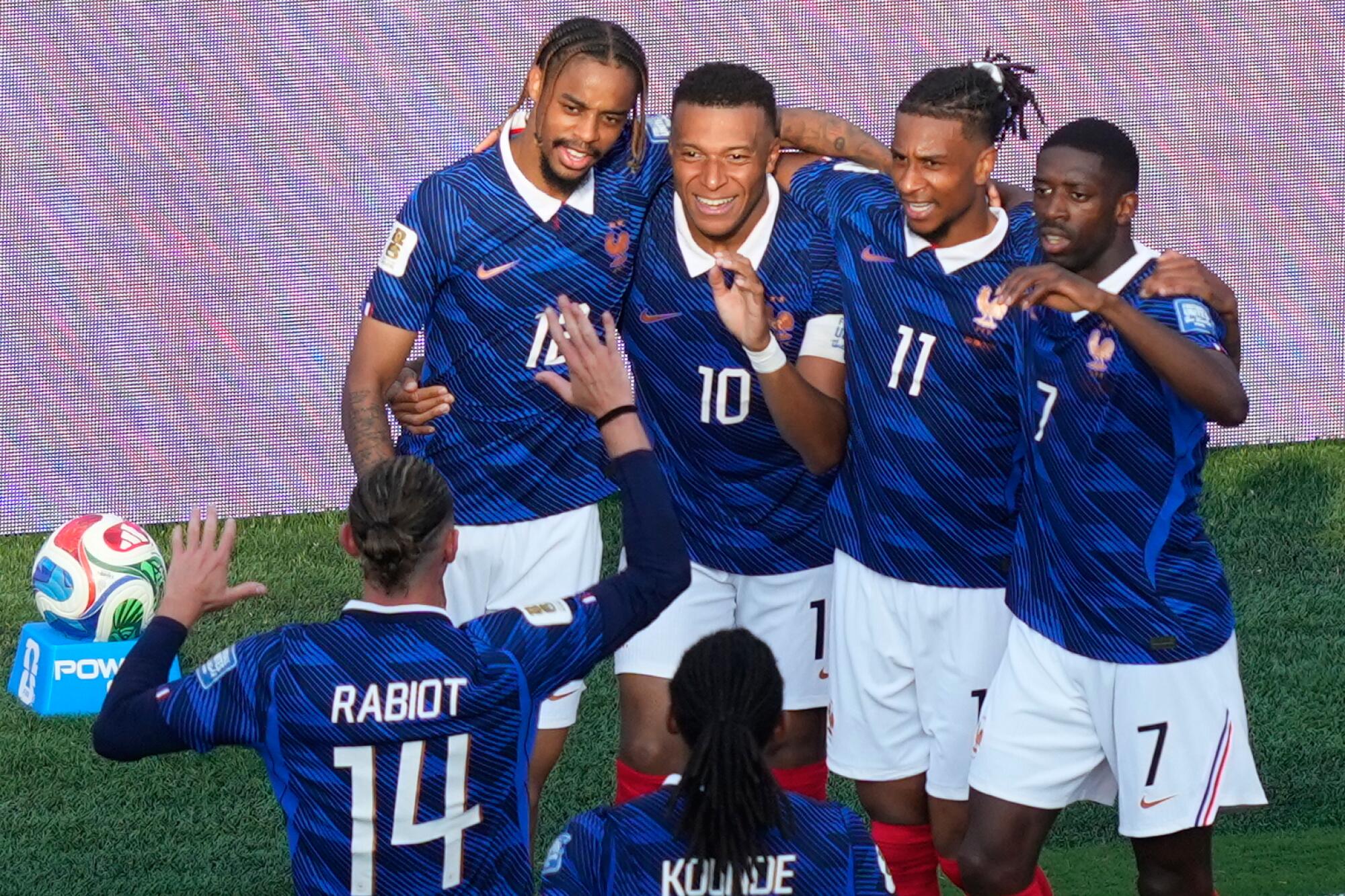
France’s Kylian Mbappé (10) celebrates with teammates after scoring against Sweden.
(Yuki Iwamura / Associated Press)
The base for that success was laid a generation before the collapse in South Africa, when a series of poor performances led the French Football Federation to create a series of 16 government-subsidized academies known as Centres de Formation. The main training center opened in 1988 in Clairefontaine, about 30 miles southwest of Paris, and many players from the 1998 championship team — including Zinedine Zidane, Thierry Henry and Robert Pires — passed through its doors.
“What is true about French football is that they started building academies very early and structuring them very early,” said Rudi Garcia, who played 10 seasons in France before becoming a coach of the Belgium national team. “A lot of the good work that’s being done by French football in general is due to the academies.”
But if Clairefontaine set the foundation, Didier Deschamps, the coach who took over the “uncoachable” team in 2012, built much of what went on top.
“It’s not luck,” Henry said on Fox. “This guy is a serial winner. I can also tell you how hard it is to have a lot of alphas and make sure that only one will be the alpha.”
Deschamps was a lunch-bucket player, a hard-working defensive midfielder who excelled at winning back possession in a 16-year career that included captaining France to both a World Cup and European Championship before he retired to become a coach, guiding Monaco to the Champions League final in his first stop. If he has a super power, both as a captain and coach, it’s his ability to manage big egos and get them to buy into the team concept. He did that first as captain of the star-studded 1998 squad and has been even better at it as the coach.
“The collective spirit,” Deschamps said, “is our strength.”
France coach Didier Deschamps celebrates with William Saliba after a World Cup quarterfinal win over Morocco.
(Lars Baron / Getty Images)
“He’s got credit in the bank,” added former World Cup goalkeeper Kasper Schmeichel, another Fox analyst. “Who can question him? His record speaks for itself as a player and as a coach.”
About that record: Deschamps heads into Tuesday’s semifinal with 20 wins and just two losses in 25 matches as a World Cup coach. He has won more World Cup games and more knockout-stage games, 11, than any other manager. And he was unbeaten in the tournament as a player, going 6-0-1.
Add those wins together and Deschamps, 57, has been on the field or in the technical area for 26 of France’s 48 World Cup victories. Before him, France never had won a World Cup.
By Sunday, the French could be lifting the trophy for the third time in 28 years. Only Brazil has won that many titles in a shorter span. And this team could be France’s best.
All that is thanks in large part to the FFF and government investment in the Centres de Formation. France is now the greatest developer of elite soccer talent in the world. Of the 1,248 players chosen to play for the 48 teams in this World Cup, 99 — nearly 8% — were developed in France, according to Opta. At least 13 teams in this tournament had at least one French-born player, among them Spain and Cape Verde. No other country comes close.
There are several reasons for that. The Ile-de-France region, which includes Paris, is home to large communities of working-class immigrants from the country’s former colonies. Eleven of the 26 players on this French team came from these banlieues, as they are called, among them captain Kylian Mbappé, who has the most goals in the last two World Cups.
The talent pool there is so deep, France probably could have fielded a B team in this World Cup and made it to the quarterfinals. And because the competition to make the national team is great, it raises the level of play for everyone.
For those who fall short, their immigrant backgrounds allow them to play for other countries. For example Riyad Mahrez, a former African player of the year, was born in Clichy, France, but plays for Algeria, while Senegal’s Ibrahim Mbaye is from Trappes.
“It’s quite an incredible pool of talent in a relatively small area,” Hubert Fournier, technical director of the French Football Federation, told the New York Times. “There’s a high concentration of players with very well-structured clubs. And then everyone draws from this Ile-de-France pool because afterwards they go to other clubs; they don’t all stay in Ile-de-France.”
The energy and diversity of the banlieues also fuels the national team. Nine of the 11 starters in France’s win over Morocco either immigrated to France or are the children of immigrants from Madagascar, Lebanon, French Guiana and Cameroon, Guinea-Bissau and elsewhere.
And Deschamps, who grew up in modest circumstances in Basque country, is the one who has made all those disparate parts work together. If France wins its next two games, he’ll become the second man to coach two World Cup champions.
But when asked for the secret to his success after France’s quarterfinal win over Morocco, a team with six French natives, Deschamps praised the French team, one thought to be uncoachable when he took over.
“Having great, great players, excellent players. My credit goes to the players,” said Deschamps, whose team hasn’t given up a goal in its three knockout-stage wins. “But maybe I do my job well.
“The human aspect is of paramount importance. I am extremely happy on a personal level as well as seeing my players enjoy themselves.”
LAS VEGAS — From the time Austin Reaves joined the Lakers in 2021 as an undrafted prospect, his basketball life centered around playing with a savant in LeBron James.
Reaves was stunned when he heard about James’ decision while playing golf in Lake Tahoe. Nearly two weeks later, Reaves says he still is trying to process the development.
“I kind of was thinking about it last night when I got here,” Reaves said Monday in his first news conference since re-signing. “Starting the season without him being on the team is going to be different for me. He’s kind of all I’ve ever known. Just him being around, joking around, acting like he’s 15. But that’s his decision and like I said in Tahoe, anytime I’ve talked about it, I got nothing but love and respect for him and yeah, let’s play some golf soon.”
The contract Reaves signed was the richest in NBA history for an undrafted player. At 28 and entering his sixth season, Reaves wanted to stay in L.A.
“I wanted to be a Laker the whole time. We had that period from when the season ended until the first [of July] to get something done and we figured it out before then,” he said. “My heart was in L.A. the whole time.”
Reaves will become one of the de facto leaders of the Lakers along with Luka Doncic. The two once again will be one of the most dynamic backcourts in the NBA.
“Obviously my relationship with the guys that were on the team last year,” Reaves said of why he wanted to stay. “And then Luka. I mean, he’s one of my best friends on this planet. Talk to him almost every single day. He sends me videos of his golf swing and asks me what he can do to get better and I tell him I’m not a coach.”
The Lakers have overhauled the roster: All the players who started alongside Reaves in the playoffs last spring are gone. With the signing of former Brooklyn Nets forward Ziaire Williams on Monday, the Lakers have nine new players, all of them arriving either via trades, free agency or the draft.
“They’re good,” Reaves said of the moves. “Obviously, I’ve been with the guys that are leaving for a couple years and with Bron for five years and I hate to see guys like that go. But the pieces that are coming in, I’m very excited about and I’m happy to get started today and see where it goes.”
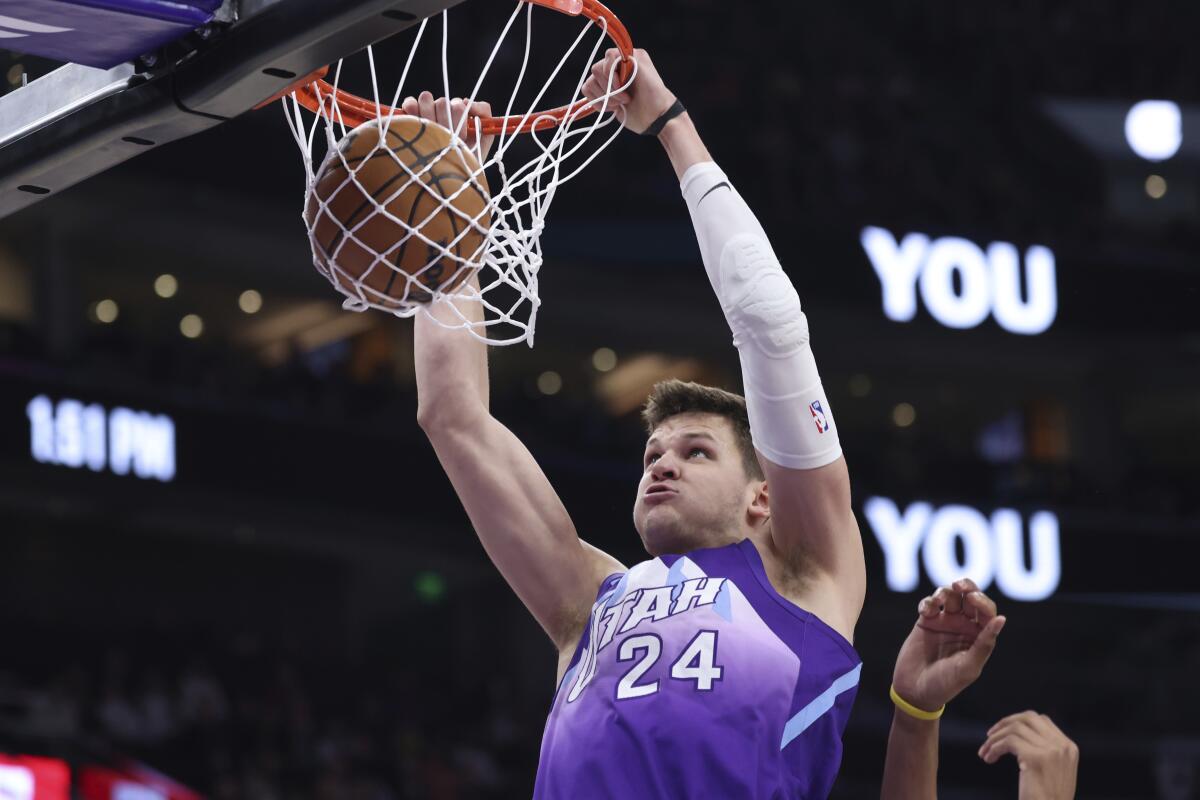
Walker Kessler dunks during a game between the Utah Jazz and Cleveland Cavaliers on March 23.
(Rob Gray / Associated Press)
One of those new players is Walker Kessler, a 7-foot-2 center the Lakers felt fit best around Doncic and Reaves because he’s a lob threat, rim-protector and good defender and is developing his three-point shooting.
The Lakers got him from the Utah Jazz in a trade and then signed him to a four-year, $130-million contract. The Lakers sent out two unprotected first-round picks (2031, 2033) and two first-round pick swaps (2028, 2030).
Kessler, who played only five games last season after having surgery to repair a torn labrum in his left shoulder, is aware the Lakers paid a big price to get him.
“It definitely makes you feel a certain way when you know an organization believes in you,” Kessler said Monday in his introduction. “And I think what they’ve invested, they’re showing that belief in a monetary value, not just with money, but like you said, assets. And for me, I’m somebody that if I know that they have that belief in me, I’m gonna run through a brick wall for them. That’s just how I’ve been wired my whole life and it definitely makes it a lot easier to go out there and compete for a team.”
Power forward Sandro Mamukelashvili could become a fan favorite, in part because of the tattoo he has on his lower left leg — a No. 24 in honor of Kobe Bryant.
Mamukelashvili, who signed a four-year, $52-million deal, averaged 11.2 points last season with the Toronto Raptors and shot 52.3% from the field, including 38.9% from three-point range.
“I got a Mamba Mentality tattoo. I just love his mindset,” Mamukelashvili said. “Growing up, I used to always say, “Mah-moo Mentality!’ So, I know it’s a little far from each other. But we are getting closer.”
When guard Collin Sexton, another new Laker, was drafted by the Cleveland Cavaliers in 2018, James left and signed with the Lakers. When Sexton signed a two-year, $19-million deal with the Lakers this month, James left again.
Sexton could only laugh about missing out on playing with James.
“He’s just leaving every time I arrive,” Sexton said, laughing. “That’s what it is. No, but one of the other coaches made the same joke yesterday. It’s cool, I know. I’ve always wanted to team up with him for sure, but it’s definitely cool knowing him and just having normal conversations and stuff, so that’s cool.”
Sexton averaged 15.4 points and shot 48.5% last season with Chicago and Charlotte. He’s ready for whatever role coach JJ Redick and the Lakers want for him.
“They believe in me,” he said. “And I just feel like at the end of the day, whenever a coach believes in you and like he said, he’s going to be hard on me and yelling and screaming at me. So, I like that. I think that’s what gets the best from me.”
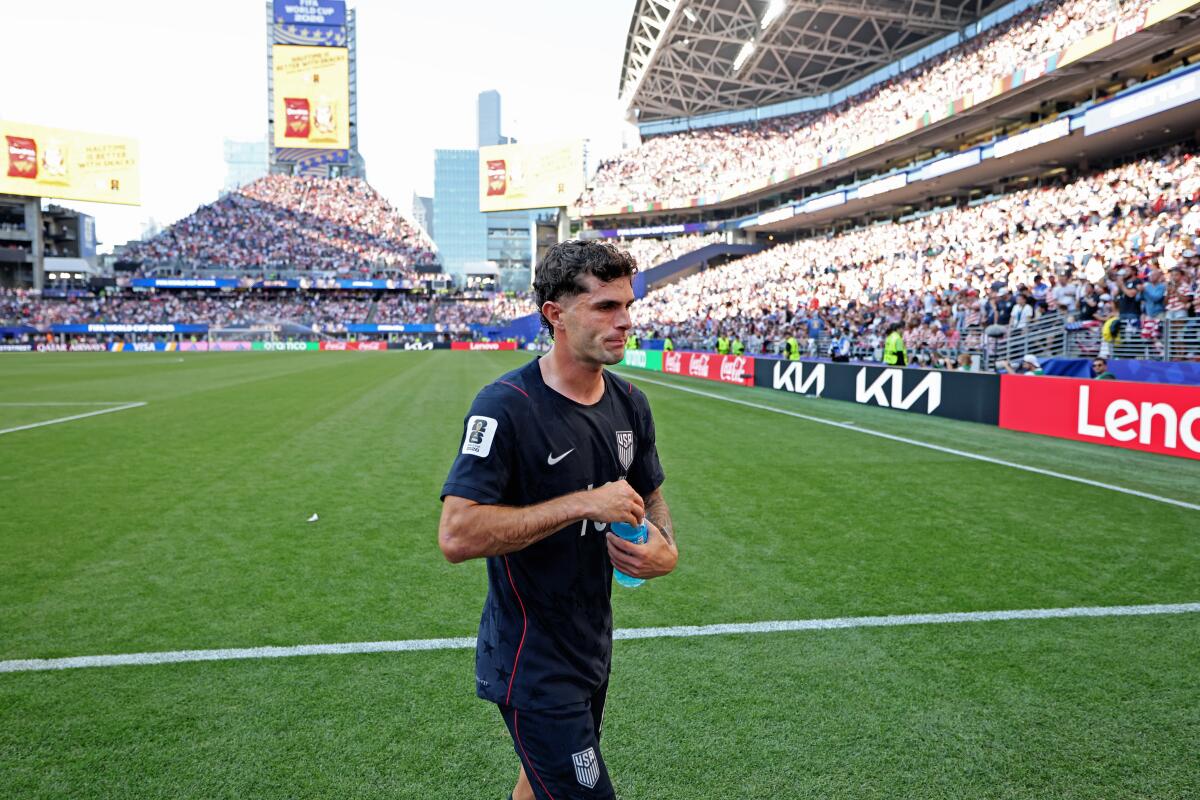
U.S. forward Christian Pulisic heads to the locker room at halftime during the loss to Belgium.
(Allen J. Schaben / Los Angeles Times)
More Americans are playing for bigger clubs and having more success in Europe than ever before, but that pipeline has yet to produce a true superstar. Many of the teams that have had success in this tournament have at least one player — Mbappé, Haaland, Lionel Messi, Harry Kane — who can change the game on their own.
The U.S. doesn’t have anyone who would be sure to start on any of the World Cup semifinalists and until it does, closing the gap will be difficult.
“We are USA and [we’re] competing against Belgium, Portugal,” Pochettino said last March. “I think for sure Belgium and Portugal have [players] in the top 100. We don’t.”
He is right. When the Guardian published its annual list of the world’s top players last winter, Christian Pulisic, the top American, didn’t make the top 100. And he didn’t play a full game in this tournament, missing one to injury, leaving three early and entering another as a late second-half substitute. He played just 223 minutes — 19 more than Ricardo Pepi — and finished with one assist.
Landon Donovan was arguably the closest thing to a game-changing player the U.S. had, so it’s no surprise he scored key goals in the team’s most important World Cup games in the last 32 years: one against Algeria in stoppage time in 2010 that allowed the Americans to finish atop their group for the first time since 1930, and another against Mexico in the round of 16 in 2002, sending the team to the quarterfinals for the only time.
If those are structural things that have long held U.S. Soccer back, there also were issues specific to this team, a supposed Golden Generation whose core was formed in the wake of the failure to qualify for the 2018 World Cup.
The talent was undeniable, which led to great expectations. But what has this generation accomplished? Two round-of-16 exits in the World Cup, one Gold Cup title in the last four tournaments — the team’s worst stretch this century — a fourth-place finish in the last Nations League and a group-stage departure in the last Copa América.
Impressive wins over Paraguay and Australia to start the World Cup gave the Golden Generation a bit of a shine and suggested progress. But when the Americans met a top-10 team in Belgium, the matchup proved a mismatch.
“We want to have higher hopes,” Pulisic said. “We want to be able to go and compete with some of the best in the world. We just still have that next step to climb.”
Against Belgium, that step looked as steep as Mt. Everest.
A thick early morning marine layer on Saturday in Huntington Beach left players, coaches and fans arriving for the Battle at the Beach seven-on-seven passing tournament feeling cool and energized. New Servite coach Rick Garretson later joked that back at his former home in Arizona, the temperature was over 100 degrees.
Ray Fenton, the new head coach at Orange Lutheran after earning coach of the year honors at Los Alamitos, didn’t have to wear a hat to cover his shaved head. Neither sun nor one of the most talent-laden group of teams in the tournament history could disrupt where Fenton appears to be taking the Lancers.
“Are we playing selflessly or selfishly? Are we good teammates or not?” Fenton said about what he wanted to learn in the Lancers’ only appearance this summer in a passing competition.
Let’s just say the progress is impressive. Fenton brought along his up-tempo, no-huddle offense from Los Alamitos, and quarterbacks Ezrah Brown and Reagan Toki were executing it in midseason form. Looking on in street clothes was 6-foot-5, 305-pound offensive tackle Lucas Rhoa, a Texas commit who can’t wait to throw his weight around when the pads come on. The Lancers won their first four matches, including an opening win over two-time defending champion Mission Viejo.
They made it to the semifinals until a roadblock sent the Lancers home. St. John Bosco came in as the tournament favorite, and from start to finish, the Braves looked better than each opponent. It was only a matter whether coach Jason Negro was going to use his backups to spread playing time.
The Braves knocked off Corona Centennial in the championship game. Tustin won the other division title.
Junior quarterback Koa Malau’ulu, in his third year as a St. John Bosco starter, has new bulging biceps from his many hours in the weight room. The hard work shows. The ball is coming out quicker from his hand. His priority this summer has been trying to build chemistry with a new group of receivers.
“They’re all coachable,” Malau’ulu said.
Junior DJ Tubbs, one of the few returnees, remains a go-to target. “He may not be big but plays big,” Malau’ulu said.
St. John Bosco has six top defensive backs, giving the Braves options for the coming season.
One of the best players in California and the nation, Cathedral Catholic’s Honor Fa’alave-Johnson, a USC commit, got to show off his speed.
Corona Centennial, which doesn’t usually perform well in passing competitions (the Huskies like to let their running game set up the pass), started the morning 4-0 and didn’t lose until its final game. Making the final means the Huskies could be very good this fall. The only other times they reached the Edison final was in 2015 when they won the Division 1 title and 2008 when they were undefeated state champs.
New quarterback Jaden Jefferson has lots of weapons at the receiver position, including his former Cathedral teammate Quentin Hale. Sophomore defensive back Koti Fultz had a big day on defense.
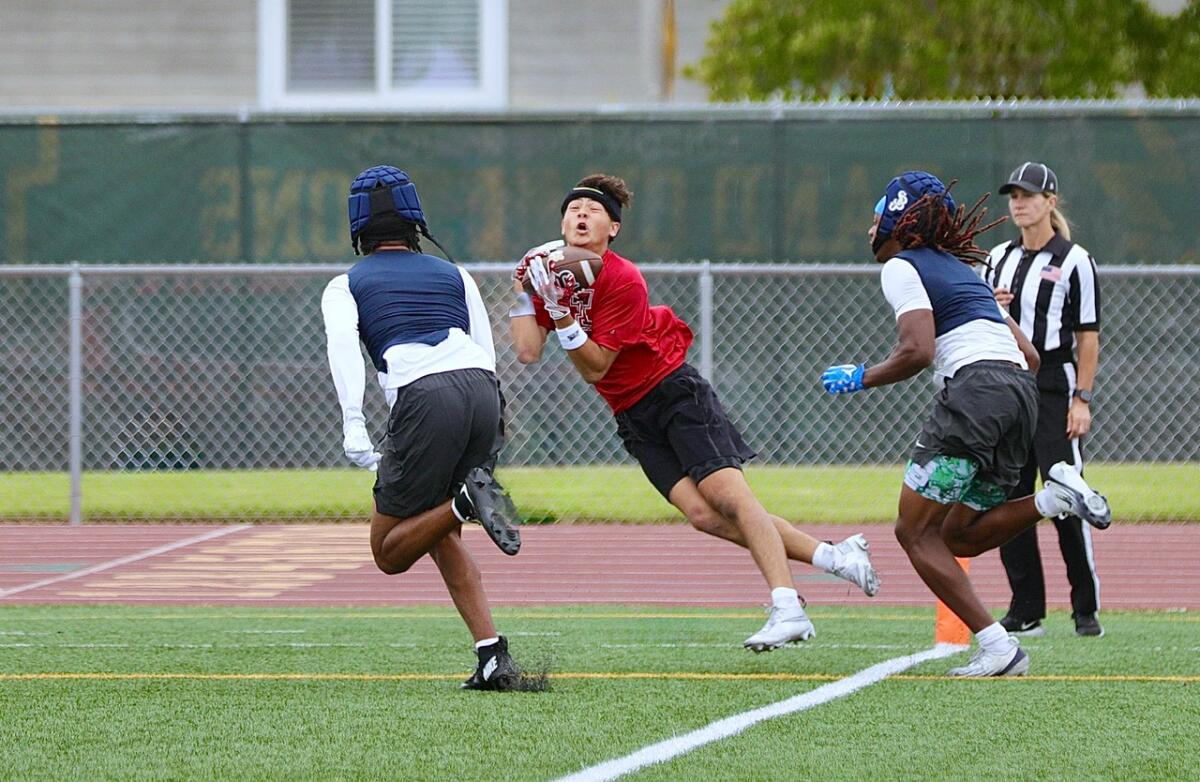
Hayden Koo of Tustin makes catch between two St. John Bosco defenders.
(Steve Galluzzo / For The Times)
Palos Verdes has a four-year starter at quarterback, Ryan Rakowski, and he’s going to cause many problems for defenses this fall with his knowledge and accuracy.
Long Beach Poly, making its debut under first-year coach Travon Patterson, will have lots of options on defense because of its standout cornerbacks in Donte Wright and JuJu Johnson.
Tustin is loaded with skill-position players.
San Clemente won the Ocean View tournament. Culver City took its own tournament championship.
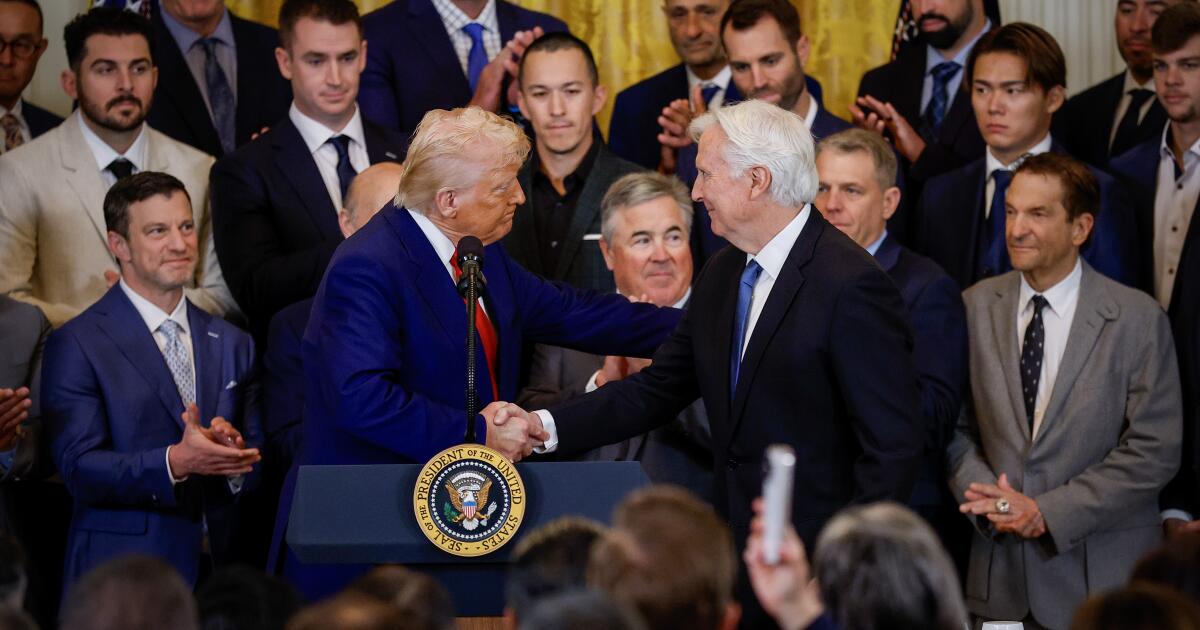
I am a lifetime resident of Los Angeles and my family has always rooted for the Dodgers. Last year we gave them a pass when they went to visit Trump at the White House. This year after Trump’s attack on our community we cannot accept the Dodgers visiting Trump again. Dave Roberts should know that the first obligation of a patriot is to stand up against tyranny. Shame on him and any other Dodger who goes to the White House this year. I will be canceling my Spectrum service. I’m not playing with the future of our democracy.
Felipe Caceres Los Angeles
If the Dodgers kowtow to Donald Trump yet again, Angelenos should consider boycotting the team for the rest of the season. Yes, they are an exceptional team and might return to the World Series yet again. However, other great athletes, such as the recent U.S. women’s Olympic hockey team, have displayed their courage and integrity in refusing to bow down to that dangerous tyrant.
By serving, as too many others continue to do, to support and enable the thug, they are enabling him in his inhumane and destructive policies and actions. As well, Trump invaded L.A., and the Dodgers did little to support the city they allegedly represent. If they return, it is more than a slap in the face of every sane and thoughtful Angeleno.
Barry Cutler Palm Desert
I have always paid for the Dodgers’ games on mlb.tv, but this year when the Dodgers did not decline the White House visit, I did not. I was holding out hope they wouldn’t squeeze a visit in on their road trip after the All-Star Game and I’d get half a season. Instead I’m listening to the games on the radio. I’ve heard the players say things like “you never know when this might happen again” or “it’s tradition.” I don’t get either one of those excuses. Is Mookie Betts going to ask Trump why he posted the picture of the Obamas as monkeys? Or any of the players going to stand up for anything?
How about be like the women’s Olympic hockey team and stand up for what is right? Don’t be a pawn for another photo op for this dysfunctional White House. Please?
Marnie Jernagan Fresno
Columnist Bill Plaschke wants to impose his political views on us and the Dodgers. Let each player decide if he wants to go to the White House, and if some players don’t want to go, then fine — don’t go. But why should all the players be confined to Plaschke’s view of politics?
David Waldowski Laguna Woods
I was a huge Dodgers fan until last year when they visited the White House. What a happy crowd they looked, even presenting President Trump with his own jersey, No. 47. That wasn’t enough? They’re off again, with Dave Roberts talking about “respecting the highest office in the land, it doesn’t matter who’s in office” while Clayton Kershaw, who presented the jersey is so “excited to go” again. Roberts had previously talked about it being a tradition. Nothing about this White House or this president is traditional, and not going is not making a “political” stand. It would be a stand for decency and normalcy. While visiting the East Wing maybe they can present Trump with the inaugural Baseball Peace Prize. Shame on the Dodgers!
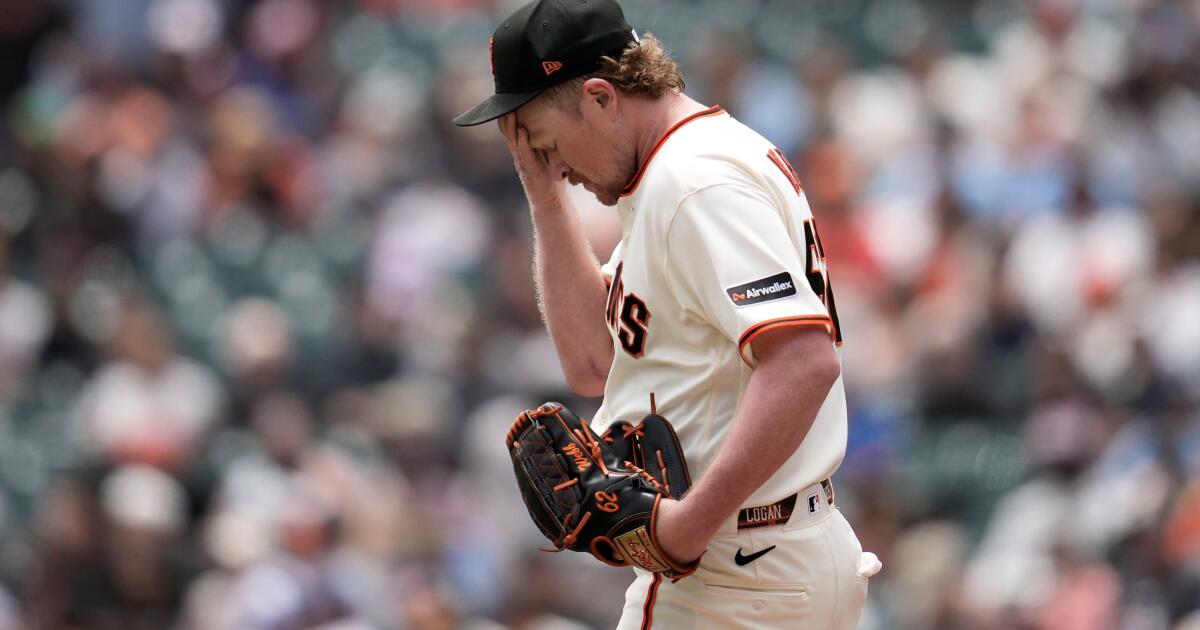
Logan Webb has long been a bright spot amid San Francisco Giants chaos and dysfunction. Now he’s gone dark, deleting his X.com account after exchanging volleys with a radio reporter.
The right-hander who led the National League in innings pitched each of the last three seasons gave up five runs Wednesday in the first inning of the Giants’ 10-0 loss to the Toronto Blue Jays, including surrendering the first grand slam of his career.
Webb settled down and tossed six scoreless innings thereafter. But the Giants were well on their way to dropping to 39-54, 21.5 games behind the first-place Dodgers. Blue Jays starter Dylan Cease took a no-hitter into the ninth inning before Heliot Ramos singled for the Giants’ lone hit.
Jack Loder, a clearly exasperated digital content producer for the Giants’ flagship station KNBR, posted a two-minute video on X shortly after the game that singled out Webb for criticism.
“People say, ‘How do you blame Webb when the offense didn’t do anything?’” Loder said. “Yes, the offense didn’t do anything. I’m spreading the blame here. Maybe they do something if it’s 0-0 or 1-0. When someone is supposed to be your ace, you think they are going to give you the best chance to win every week….
“I’ve really appreciated his Giant tenure, but there’s always been a little bit lacking. I wish he was a little bit more of an ace. Because Lord knows this team has needed him in so many instances the last few years.”
Loder then accurately predicted that Webb “might be searching his name on Twitter after the game, which is never a great look.”
Webb commented on Loder’s video soon thereafter: “You know what’s sad is they allow people like you in the locker room.”
Loder, in turn, posted Webb’s response, adding, “If you’re wondering where the Giants are at mentally after a 10-0 loss to fall to 16 games under .500.”
Webb responded to another reporter’s comment in the thread and to at least two Giants fans, telling one, “Honestly you probably don’t know anything about anything some loser on the couch that couldn’t make his little league team.”
Later in the evening, Webb deleted his account and has not reactivated it. Perhaps reporters may speak to him next at the All-Star Game. He is representing the Giants for the third year in a row.
Near the end of his video, Loder broadened his criticism: “The veterans — the highest-paid guys — let this team down, let the franchise down, let the fans down.”
Six Giants players are being paid more than $20 million this season: First baseman Rafael Devers ($25 million), third baseman Matt Chapman ($25 million), starter Robbie Ray ($25 million), Webb ($23 million), outfielder Jung Hoo Lee ($22 million) and shortstop Willy Adames ($21 million).
Only Chapman (2.5 WAR) has been worth even two wins above replacement, and he is on the injured list.
Giants woes have extended beyond the field. Four pitchers pushed back against the team’s annual Pride Night in June, with three writing Bible verses next to the rainbow-tinted logo on their caps and the fourth declining to wear the colorful cap at all. MLB informed them that they were in violation of uniform protocols, triggering a culture skirmish between one of the nation’s most vibrantly diverse and queer cities and Republican politicians who asserted that the players’ actions were an expression of religious freedom protected by the Constitution.
The response from Giants president and Hall of Fame catcher Buster Posey was considered inadequate. He refused to discuss the players’ actions or the team’s response, telling reporters, “I’ll take baseball questions.”
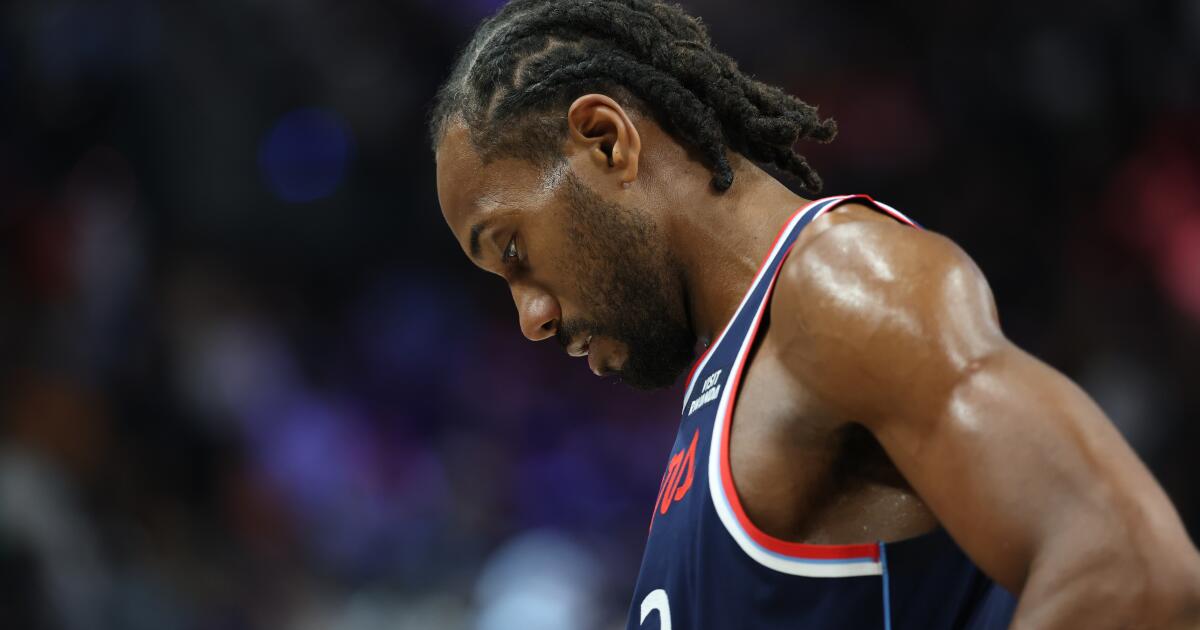
The Toronto Raptors have put the brakes on acquiring Kawhi Leonard from the Clippers, announcing Thursday that the trade is on hold until the NBA investigation into whether the Clippers circumvented salary cap rules is complete.
“The NBA league office informed us that as a result of the ongoing investigation involving the Clippers, we would assume the risk of any potential outcome of the investigation impacting Kawhi,” the Raptors said. “In light of this, we will wait until the league’s investigation is complete.”
The trade sent Leonard to Toronto for forward Brandon Ingram, shooting guard Gradey Dick, two first-round draft picks, a pick swap and two second-round picks. Leonard has spent the last seven seasons with the Clippers after leading the Raptors to the 2019 NBA championship.
The probe was triggered in September when the “Pablo Torre Finds Out” podcast aired an episode detailing a contract Leonard received from Aspiration, a self-described “socially-conscious and sustainable banking services and investment products” firm. Clippers owner Steve Ballmer invested $60 million in the now-defunct company that in turn agreed to pay Leonard $28 million for endorsements he never fulfilled.
The investigation is being conducted by Wachtell Lipton, a high-powered New York law firm the NBA has frequently used when attempting to determine off-the-court wrongdoing by team owners, players or referees. There is no timetable for its conclusion, and the league had no comment Thursday.
Ballmer invested $50 million in Aspiration in September 2021. A month later, the Clippers announced a $300-million sponsorship deal with the company. Ballmer nearly granted Aspiration naming rights to the team’s new $2-billion venue as well, but instead chose financial services firm Intuit.
Two years later when Aspiration was experiencing severe financial difficulties, Ballmer made an additional $10 million investment and Clippers co-owner Dennis Wong — Ballmer’s former college roommate — invested $1.99 million in Aspiration nine days before Leonard received a $1.75 million payment from the company. Leonard ultimately was paid $21 million of the $28 million agreed upon in his contract with Aspiration.
Leonard averaged 25.1 points, 6.4 rebounds, 4.1 assists and 1.7 steals over six seasons with the Clippers and was selected to four All-Star teams, four All-NBA teams and two All-Defensive teams while in L.A. Leonard averaged a career-high 27.9 points while playing 65 games last season.
“The Raptors remain eager to bring Kawhi back to Toronto and look forward to a swift resolution for our players, our organization, and our fans,” the Raptors said.
The Ducks have matched the Philadelphia Flyers’ offer sheet for center Leo Carlsson, keeping their rising young star at an extraordinary cost.
The Ducks announced their decision Thursday on the 21-year-old Carlsson, who is now the NHL’s highest-paid player under the five-year, $90-million deal extended by the Flyers one week ago.
Carlsson signed the Flyers’ offer sheet as a restricted free agent after a year of fruitless negotiations with Anaheim general manager Pat Verbeek, whose typical hardline approach in contract talks with his restricted free agents backfired tremendously this time.
Carlsson’s new contract is worth much more than the league expected he would get as a restricted free agent, and the $18 million average annual value is significantly more than he had already indicated he would accept. The deal surpasses the salary of Minnesota’s Kirill Kaprizov, who would have been the NHL’s highest-paid player at $17 million.
The Flyers failed to land their long-sought No. 1 center in unusual fashion by swiping Carlsson, but the attempt showed general manager Danny Briere’s determination to improve his roster at all costs. The Ducks would have received four first-round draft picks from Philadelphia if they hadn’t matched the offer sheet.
Future negotiations will reveal whether Briere significantly skewed the NHL’s valuations of young talent by offering more than nearly all observers thought Carlsson could get. The structure of Philadelphia’s offer sheet also front-loaded Carlsson’s contract with costly signing bonuses in another departure from many NHL contracts.
Although the Ducks retained their most important young player, Verbeek’s inability to get a deal done before he was forced into it by Philadelphia will compromise Anaheim’s roster-building efforts this season and for years to come. The embattled general manager has had a rough summer immediately after the Ducks ended their seven-season playoff drought with a second-round run that had stamped them as a future contender in the Western Conference.
After keeping the Ducks’ payroll well under the salary cap during his tenure, Verbeek will be spending owner Henry Samueli’s money at the limit of the cap next season after making anachronistic decisions and signaling vulnerability to the league while he managed his crop of young talent.
The league’s salary cap is currently at $104 million and is expected to rise in the coming years.
Verbeek still hasn’t signed 41-goal scorer Cutter Gauthier, a restricted free agent who is not eligible to receive an offer sheet. He signed defenseman Pavel Mintyukov to a five-year, $36 million deal last week, again going well over the expected market rate for a restricted free agent who isn’t on Carlsson’s level of talent, but was widely rumored to be on the verge of signing an offer sheet.
Verbeek also parted ways with four key defensemen from last season’s team — Jacob Trouba, captain Radko Gudas, Olen Zellweger and late-season rental John Carlson — and hasn’t replaced them with any significant signings beyond journeyman Nick Jensen. The Ducks also traded Mason McTavish, a key component of their team for several seasons, to St. Louis for draft picks after the center regressed last season.
With this pricey deal for Carlsson, the Ducks’ history of antagonistic negotiations with their free agents has become the defining feature of Verbeek’s front office.
Trevor Zegras, Jamie Drysdale and McTavish all held out of training camp in recent years when they couldn’t get a deal done with Verbeek, who eventually signed all three — and later traded them all away. Verbeek did two of those deals with the Flyers, gaining praise for sending Drysdale in a package for Gauthier, but getting criticism from Ducks fans for giving up on the high-scoring Zegras last summer.
Carlsson was the No. 2 choice in the 2023 draft behind Connor Bedard, and he has emerged as one of the NHL’s top young playmakers.
Although he didn’t produce points at a rate commensurate with his new salary during his first three seasons, almost everyone believes Carlsson can become one of the best centers in hockey, so his deal might eventually look downright affordable.
He scored 67 points in 70 games last season despite being limited for a lengthy stretch by a leg injury, and he added 11 points in 12 games during his first postseason experience.
Carlsson is expected to be an unrestricted free agent when this contract ends in 2031, putting him in line for another massive payday at just 26 years old.
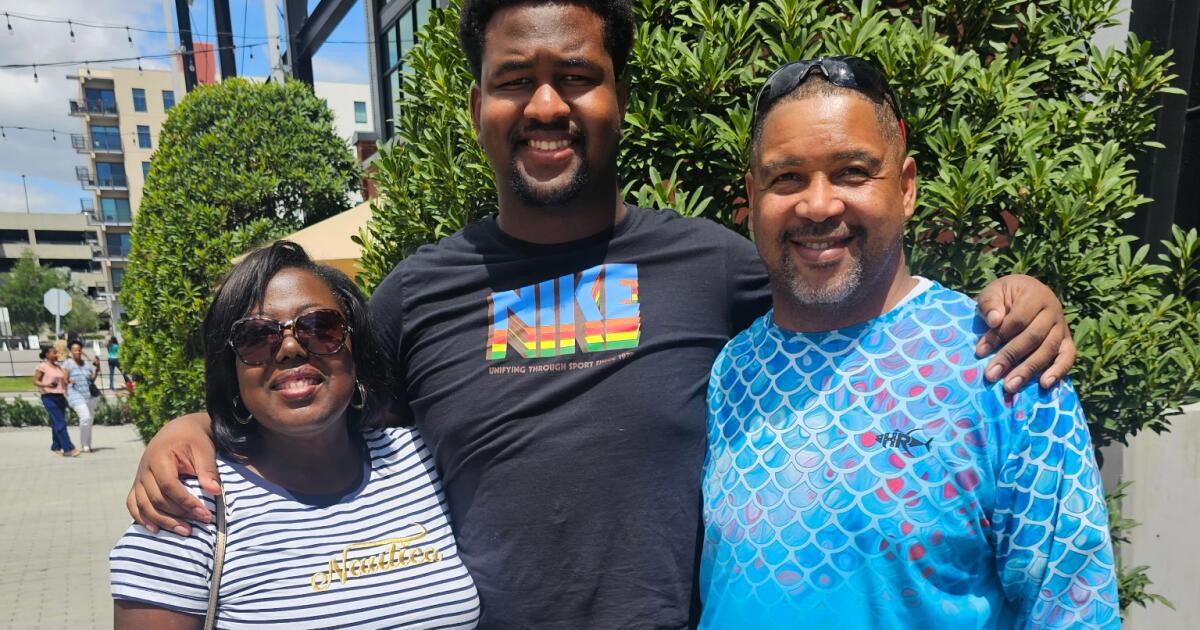
It has taken two years, but the parents of the late Calvin “CJ” Dickey Jr. have finally been able to express appreciation for the efforts of authorities in the Pennsylvania attorney general’s office. Still, they are a long way from what they might consider a satisfactory resolution.
Dickey died after collapsing during the first day of Bucknell University football training camp in July 2024. The freshman lineman was put through rigorous drills by strength and conditioning coach Mark Kulbis, according to the attorney general’s office, even though Kulbis knew Dickey had sickle cell trait. The medical condition can increase the risk of serious injury or death following extreme exertion.
Dickey, 18, was taken to the hospital and died two days later.
Kulbis, who left Bucknell in January 2025, has been charged with felony aggravated hazing and misdemeanor counts of involuntary manslaughter, reckless endangerment and hazing, according to the attorney general’s office. Bail was set at $10,000.
“The facts show this was an intentional, deliberate hazing perpetrated by a coach who knew CJ’s health condition made him vulnerable to extreme workouts,” Atty. Gen. Dave Sunday said in a statement. “The facts show this defendant received information about CJ’s health condition, along with training about NCAA anti-hazing standards, and disregarded that information. This is an extraordinary tragedy, worsened by the fact that CJ’s death was preventable.”
Reached by the Associated Press on Tuesday, Dickey’s father, Calvin Sr., said that he and his wife, Nicole, are “at the point where we’re just glad that someone is being held responsible for our son’s death. We just want to see the process through, and we’re going to leave it to the attorney general to continue following the evidence.”
Dickey’s parents filed a lawsuit in April 2025 against Bucknell and its athletic staff, alleging that CJ’s death was the result of a hazing ritual for freshmen players.
“While the University will not comment on pending litigation, we again extend heartfelt sympathies to CJ’s family, and we will continue to focus on our most important priority — the health and safety of all Bucknell students,” Bucknell told ESPN in a statement.
According to an autopsy report issued by Montour County, Dickey was diagnosed with “exercise collapse associated with sickle cell trait,” rhabdomyolysis and acute renal failure.
With rhabdomyolysis, kidneys become strained when proteins and electrolytes from damaged muscle tissue are released into the bloodstream. Studies have shown that sickle cell trait can be fatal when coupled with rhabdomyolysis.
In the lawsuit, Dickey’s parents alleged that Bucknell athletic trainers and coaches knew their son had sickle cell trait and failed to take steps to ensure precautions were in place.
“We have asked repeatedly for not just a high-level overview of what happened that day, but for the details, the specific fully transparent details,” Nicole Dickey told NPR shortly after the lawsuit was filed. “We’ve reached the point with Bucknell where we do not feel that we’re going to get that. The only path for us to get that truth is to file the civil lawsuit.”
More than a year later, the charges brought against Kulbis created another path that Dickey’s parents hope lead to a resolution.
“We do this for CJ, for every young man on that team, and anyone who comes after him, and anyone at any university,” Nicole Dickey told ESPN. “This is a longer, harder path, and I am ready for it. My boy is worth it.”
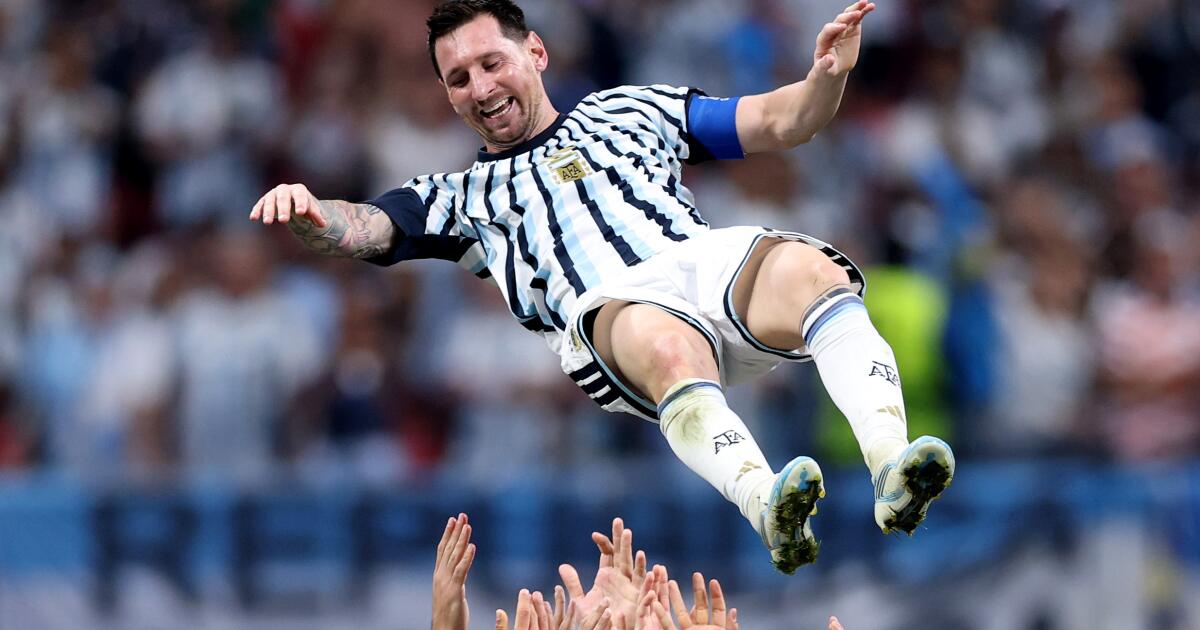
Everyone knew going in that Lionel Messi would be the narrative centerpiece of the 2026 World Cup. Easily the most recognized name in the competition, Messi is considered by many to be the greatest soccer player of all time and, as the captain of 2022 winner Argentina, he is the reigning World Cup champ. At 18, he scored his first World Cup goal in 2006 and has competed in every World Cup since. He celebrated his 39th birthday before this year’s knockout rounds began, so it’s not unreasonable to assume that this will be his last.
No matter what Messi did, or failed to do, it would be News. Everyone with even a passing interest in the event knew this. Including me.
But I didn’t expect to completely fall for the guy. He’s a professional male athlete, for heaven’s sake, and I don’t emotionally invest in professional male athletes. Admire some of them, sure; watch with bated breath and then scream in astonishment when they pull off some amazing feat or another, absolutely. But the only athletes that have ever touched my heart have been women — Nadia Comăneci; Billie Jean King and the Title IX-sparking stars of women’s tennis; Dorothy Hamill; Brandi Chastain and 1999 Women’s World Cup winners; Venus and Serena Williams; Simone Biles; Caitlin Clark.
But here I am, at age 62, truly, madly, deeply in love with Lionel Messi.
I know, I know, me and half the world. Which normally would serve as an effective prophylactic. I am habitually wary of super-intense fandoms and the men who inspire them; stadiums filled with people chanting a single name inevitably set off internal alarm bells. As I have asked several times in columns throughout the years, how many “heroes” must we watch falter under pressure or be exposed for decidedly unheroic acts before we wise up and get out of the pedestal-placement business?
Yet here I am, stalking him on Instagram, up all hours flicking through interviews and career highlight clips. (I even watched the Apple TV docuseries “Messi Meets America”!) Here I am, literally praying to God, who clearly has more important things to do, for Argentina to advance and screaming Messi’s name every time he scores, assists or pretty much does anything at all.
In a matter of weeks, I have become addicted not just to watching the man play but seeing how he reacts when a shot is made or a game won.
Every World Cup player is happy when they or their team scores, but Messi is delighted. Like a kid seeing a puppy under the tree on Christmas morning. Like he cannot believe this wonderful thing that has just happened even if he was the one who sweat and ran and defied physics to make it happen.
His smile is infectious and even when he is running toward the stands, arms spread wide, after making some impossible shot or other, it never seems self-congratulatory. He is simply filled with joy and wants to spread it around. The field, the stadium, the world.
And his hugs. Long, deep, radiating emotion, utterly unself-conscious. Everyone needs to find someone who hugs them like Messi hugs people — teammates, coaches, opposing players, young fans. I could watch videos of him hugging his mentor and former teammate Ronaldinho or Argentina coach Lionel Scaloni all day long. (I’m not saying I have, nor am I saying I haven’t.)
Sometimes the hype gets a bit nauseating — former teammates who claim he never makes a mistake, commentators who refer to him as superhuman (despite the fact that he has missed as many penalty kicks as he has made in this World Cup). Whether Messi himself agrees that he is the GOAT is none of my business, but he doesn’t act like many sports stars who have received similar adulation. He doesn’t peacock, he doesn’t preen; he is visibly angry with himself when he doesn’t produce. He isn’t perfect — in various past games, he has gotten into heated disputes and shoving matches and famously (and many believe deservedly) taunted Netherlands coach Louis van Gaal during World Cup 2022. But for a man who has been such a star for so long, he presents himself as simply a player among players. The captain, certainly, but not the most important person on the field.
That is the most lovable, and superhuman, thing about him.
It feels pretty basic, not to mention embarrassing, to have a sudden summer crush on Messi, but I don’t care. He’s married to his childhood sweetheart, has three adorable sons and a picture of his mother tattooed on his back. He lets his teammates hoist him in the air and allows sports commentators to regularly (and lovingly) refer to him as “Little Messi.” He gets angry sometimes, but in this tournament he has yet to noticeably hector the refs or rumble with his opponents. He wants to win, obviously, but his joy comes from playing the game well rather than defeating another team.
That’s why, despite my newfound addiction to Messi delight, the moment I loved him best was when he didn’t celebrate at all. In the round of 32, Argentina (No. 2 in FIFA rankings) seemed guaranteed a win over Cape Verde (67). But even with Messi’s early goal, the game was a nail-biter, with Cape Verde scoring two brilliant goals while their goalie Vozinha made eight saves, including four shots (one of them a free kick) from Messi. After Argentina won in additional playing time, there was none of the usual jubilation. Instead, a subdued Messi walked to the midfield to shake hands with his opponents, a sign of exhaustion, no doubt, but also of respect. He hugged Vozinha and told him that his country should be proud of him.
The exuberance was back Tuesday, however, when, after trailing Egypt for most of the round of 16 game, Argentina managed to pull off the comeback of the tournament, going from a 0-2 deficit to a 3-2 win after the 79th minute, with Messi scoring the tying goal.
This time, the smiles, the hugs, the radiant joy filling Atlanta Stadium could have powered the entire state of Georgia. This time, Messi was so happy, he wept.
So did I. The World Cup is over in less than two weeks, and France and Spain are currently the 1-2 favorites to win the thing. My love for Messi is, after all, just a summer romance.
And as with any summer romance, I want it to last forever.
The Lakers got their backup big man when Kevon Looney signed a one-year, $3.9-million deal on Tuesday, people not authorized to speak publicly told The Times.
The 6-foot-9 Looney won three championships with the Golden State Warriors, in 2017, 2018 and 2021. He played last season with the New Orleans Pelicans. Looney, 30, is an 11-year veteran who went to UCLA. He’s a strong rebounder, very good defender and sets solid screens for teammates.
Looney will be the backup behind starter Walker Kessler, who was acquired in a trade from the Utah Jazz and agreed to a four-year, $130-million deal. The Lakers traded last season’s starting center, Deandre Ayton, and backup Jaxson Hayes signed with the Jazz.
The Lakers now have a 14-man roster and have room for another player.
Jonathan Kuminga is a player the Lakers are after, according to people with knowledge of the situation who said L.A. is looking at a two-year, $20-million deal for Kuminga, the sort of athletic wing player the Lakers need to start at small forward.
He has the size (6-7) and is young (23). He averaged 12.2 points and 5.6 rebounds and shot 33.3% from three-point range last season while playing for the Warriors and Atlanta Hawks.
Welcome back to The Times’ Lakers newsletter, where it’s been a, uh, busy week.
Over a short seven days, the Lakers confronted their past, welcomed their present and got a glimpse at their future. Starting with LeBron James officially filing for divorce last Tuesday, the Lakers transformed into almost a completely new team overnight.
But did they turn into a better team?
All things Lakers, all the time.
Get all the Lakers news you need in Thuc Nhi Nguyen’s weekly newsletter.
By continuing, you agree to our Terms of Service, which include arbitration and a class action waiver. You agree that we and our third-party vendors may collect and use your information, including through cookies, pixels and similar technologies, for the purposes set forth in our Privacy Policy such as personalizing your experience and ads.
Hello to a new era
The relationship was characterized by passive aggression, cryptic tweets and small slights that added up to a big, if not inevitable, breakup. After such a complicated tenure, at least LeBron James’ Lakers career ended with clarity.
By informing the team before free agency started that he would not be returning next season, James offered a clean break when both sides needed it. The 41-year-old, who is still the best unrestricted free agent on the market, will keep the rest of the league hostage. The Lakers can move forward in peace.
They didn’t take long to find their rebound star.
The Lakers went all-in to get center Walker Kessler. Not just with the four-year, $130-million contract — which is longer than many of the other deals signed this month — but with the draft capital. When a simple offer sheet wouldn’t have been enough to pry the restricted free agent away from Utah, the Lakers threw in two first-round picks (2031, 2033) and two first-round swaps (2028, 2030). They don’t control their own first-round pick until 2032, meaning there aren’t many exit ramps if things go wrong.
But, on the other hand, what if they go right?
Kessler, 24, is seen as a “perfect” fit for the Luka Doncic-Austin Reaves Lakers, a league source told my colleague Broderick Turner. He’s an elite rim protector, averaging 2.4 blocks per game in his four-year NBA career. He led the NBA in offensive rebounds in 2024-25 and ranked fourth in rebounding rate, according to Basketball Reference.
He’s what Doncic asked for.
The concern might be more about an unproven track record. He only played five games last season because of a shoulder injury. He finished third in rookie of the year voting in 2023 but has only one full-time starting season. Even then, he played only 58 games in 2024-25.
It’s a big bet for a player who hasn’t even approached an All-Star conversation.
(Thuc Nhi Nguyen / Los Angeles Times)
Six of the Lakers’ top nine players from last season are gone. The Lakers started reloading their draft assets by trading Deandre Ayton on Friday, shipping the big man to Washington for Jaden Hardy and second-round draft picks in 2031 and 2032. Hardy, like new free agent addition Quentin Grimes, is another Doncic teammate from Dallas.
With Ayton’s departure, the Lakers are on the hunt for a backup center. They have two remaining roster spots and are still in the mix to add a two-way wing defender. Rookie Cameron Carr is showing in summer league that he could be an immediate three-point threat. He has some work to do in the weight room and needs more reps to be ready on the defensive end to fill the three-and-D responsibility Rui Hachimura held.
Hachimura was the last of the Lakers’ unrestricted free agents to settle on a new home. The 6-foot-8 forward was a valuable asset to the Lakers and maybe wasn’t appreciated enough for his willingness to accept different roles, even moving to the bench briefly during an important contract year.
Hachimura, who made about $18 million last season, got looks from across the league but agreed to a two-year, $28-million deal with the Clippers on Monday.
Even for some NBA players, moving is prohibitively inconvenient.
Goodbye to the old
Outsiders looked at James’ initial move to the Lakers as something that went beyond basketball reasons. Perhaps the breakup was the same way.
Doncic, Reaves and James could have been as competitive as any trio in the league, evidenced by the short, successful glimpses we saw last season. The basketball could have been beautiful.
But if James would have played out his career with the Lakers, there always would have been an awkward pall over the final years. This relationship wasn’t serving either party anymore. He was right that it was simply time to move on.
On paper, he leaves behind a historic chapter of an unparalleled career. Already a Hall of Famer before he came to L.A., James won the Lakers’ 17th NBA championship, ending a 10-year title drought for the franchise. He broke the NBA’s all-time scoring record while wearing a Lakers jersey in front of a sold-out Lakers crowd.
In the hearts of Lakers fans, the legacy is complicated. Fans never got to create the everlasting joyful memories we saw at the Knicks championship parade or, if you’ve been watching soccer, in this month’s FIFA World Cup. Perhaps the Lakers faithful will never forgive him for his role in the disastrous Russell Westbrook trade that set the organization back for years. James, for all his personal accolades and cultural influence, still stands no chance against the spirit of Kobe Bryant, especially after Bryant’s shocking death in 2020.
The comparisons were unrelenting. But James never shied away from them.
“Truly a honor to wear the [purple and gold],” James wrote on Twitter with purple and yellow heart emojis, responding to a kind statement from Lakers governor Jeanie Buss. “… Hope I made a few proud during my stint.”
Most breakups are hard. The end of this relationship, at least, is a rare instance when you can smile both because it’s over and because it happened.
Poll results
Last week, we asked which unrestricted free agent would you most like to keep. Ultimately, no one gets their wish; all have signed elsewhere. There were 39 total votes, with several submitting two names, but for the sake of this count, I only took each ballot’s first choice.
Here are the results:
Rui Hachimura: 23
Marcus Smart: 9
Luke Kennard: 5
Jaxson Hayes: 1
“Marcus Hachimura”: 1
New question
Last week’s poll didn’t have a particularly long shelf life. The first wave of free agency swept up almost all the available Lakers players within hours. This new question could fuel debate to outlast all of our natural lives: Would you like to see the Lakers retire LeBron James’ jersey? Slide into my inbox (thucnhi.nguyen@latimes.com) to vote!
—Yes
—No
Favorite thing I ate this week
The special combination bánh mì (bánh mì đặc biệt) from San Francisco’s L&G Vietnamese Sandwich.
(Thuc Nhi Nguyen / Los Angeles Times)
When I was young(er), my parents went grocery shopping at the Vietnamese store Saturday mornings, and on his way out the door, my dad would poke his head into my room and ask simply, “One or two?” He was asking how many Vietnamese sandwiches I wanted for lunch.
Bánh mì remains my ultimate comfort food, and I liked the special combination bánh mì (bánh mì đặc biệt) from San Francisco’s L&G Vietnamese Sandwich so much that I went twice in three days. It had all the right Vietnamese cold cuts with the perfect pate and mayo ratio, and for an $11.50 deal, I even risk the caffeine-fueled heart palpitations to add a Vietnamese iced coffee.
The high school football season is more than a month away, but fans seeking an early preview of teams with top quarterbacks, top receivers and top defensive backs have come to appreciate the annual Edison Battle at the Beach seven-on-seven passing tournament that is taking place on Saturday.
It’s the unofficial kickoff to teams getting serious because so many quality teams compete from 9 a.m. through the early afternoon in Huntington Beach, with food, music and lots of banter among parents. You know how much players like to rise up against players with better “star” rankings than them, and this is the tournament to see it play out.
It’s not about wins and losses — it’s about players testing themselves against great competition. This tournament has built credibility by showcasing teams competing at a high level, then shaking hands afterward.
Schedule for Edison passing tournament on July 11. My official start to high school football season. It’s that entertaining. pic.twitter.com/RsoSfcoCCy
Mission Viejo has won the last two tournaments at Edison, but the Diablos are spending the summer trying to figure out who will start at quarterback. Sophomore Brett Burnor and senior Nash McElree, a transfer from Texas, are competing. Could coach Chad Johnson really alternate quarterbacks like he did two years ago with Luke Fahey and Drai Trudeau?
“You never know,” he said.
The Trinity League is represented by St. John Bosco, Santa Margarita, Orange Lutheran, JSerra and Servite. Corona Centennial and its new quarterback, Jaden Jefferson, a transfer from L.A. Cathedral, is entered, along with San Diego’s likely No. 1 team, Cathedral Catholic, which boasts the No. 1 player in the state in USC commit Honor Fa’alave-Johnson. His appearance alone should attract plenty of Trojans fans, particularly for the 10:30 a.m. game against the likely No. 1 team in California, St. John Bosco.
Palos Verdes has four-year starter Ryan Rakowski at quarterback and standout defensive back Jalen Flowers. Rancho Cucamonga gets to show off many of its top skill-position players.
One interesting trend is that this tournament will feature some very good tight ends, a position that has become increasingly important in college football and the NFL but not so much in high school football in the era of spread offenses.
Mission Viejo’s Johnson said he has three tight ends with college offers, another rarity. He could join the Rams with his three-tight-end formation. He intends to use them against defenses that use odd-number fronts this fall. One of his most improved players is tight end Luke Karby, a Duke commit. Another is Arizona commit Max Markofski, who is 6 feet 4 and 228 pounds. Santa Margarita has tight end Luke Gazzaniga, a Kansas commit. Jaylin Smalls of Rancho Cucamonga is 6-4, 230 pounds and moving up recruiting boards.
July 11. Hayden Koo of Tustin vs. Bosco defensive backs at Edison. Bring the cameras. Let’s see who wins the battle. https://t.co/hthFjAJYgZ
This is the first opportunity for early clues as to how first-year coaches are doing at JSerra, Los Alamitos, Servite, Orange Lutheran, Long Beach Poly and Oaks Christian.
One of the always-interesting scenes is Edison coach Jeff Grady refusing to take the easy road when making the bracket, so he scheduled his team to open up against St. John Bosco at 9 a.m., perhaps hoping the Braves show up a little sleepy. Running back Maliq Allen has returned to the Braves after spending the spring at Inglewood.
Ocean View also is hosting a 32-team passing tournament in Huntington Beach on Saturday. San Clemente, San Juan Hills, Huntington Beach, Downey and Carson are the teams to watch.
Fearsome duo
Long Beach Poly might have the most decorated cornerback duo in JuJu Johnson, a UCLA commit, and Donte Wright, a Miami commit. Just watching them cover receivers on Saturday at Edison should be a highlight in itself. Johnson was injured last season, but few have raised their profile in the offseason more than him.
Poly is in Pool C and the duo gets to take on receivers from Capistrano Valley, San Diego Lincoln, Servite and Santa Margarita.
King/Drew fearing no one
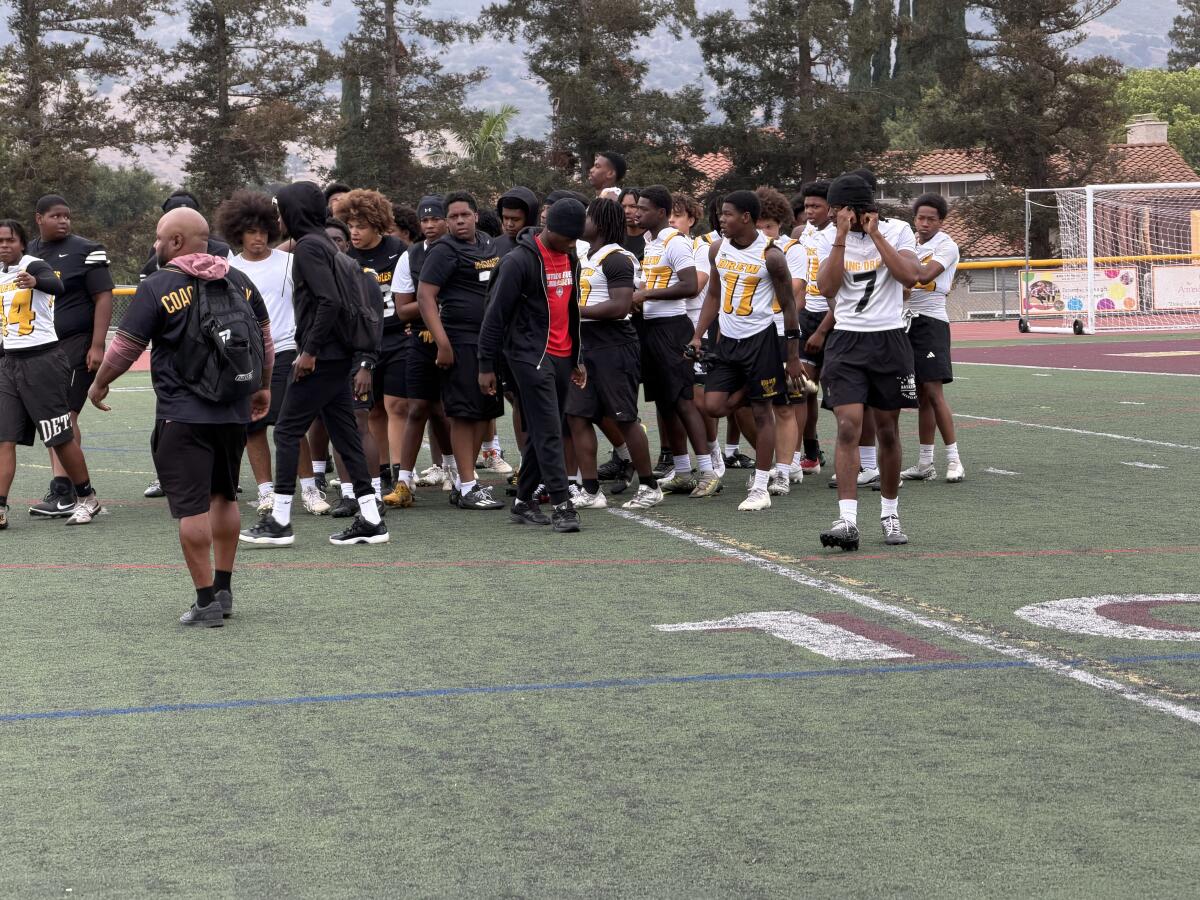
King/Drew players participating in the Simi Valley tournament.
(Eric Sondheimer / Los Angeles Times)
This has been a fruitful summer for King/Drew of the City Section. The Golden Eagles have been driving around willing to play seven-on-seven against top Southern Section opponents, including visits to West Hills and Simi Valley.
It’s the same strategy Carson and Birmingham have taken to prepare for City Section play during the regular season. If you can compete with Southern Section teams, then you’ll do just fine against City Section opponents.
Makeo Smith, a 6-4, 265-pound sophomore lineman, figures to receive lots of attention after contributing as a freshman.
NEW YORK — More than half of the WNBA ‘s 180 players didn’t submit their ballots for All-Star starters ahead of this month’s game in Chicago, a person familiar with the balloting told the Associated Press on Friday.
The person spoke on condition of anonymity because of the sensitive nature of the voting. It’s unclear why so many players didn’t cast their votes. However, the Sparks were one of the teams that didn’t have all of its players vote due to some operational errors.
“Players were sent ballots via email,” the Sparks said in a statement. “Some players indicated that they didn’t receive the email or weren’t aware of it until after the voting period had closed. That’s something we take responsibility for as an organization, and we’ll have a more robust process going forward.”
Fan vote accounts for 50% of the overall vote while players and a media panel each are 25%. It’s been that way since 2017.
New York Liberty guard Sabrina Ionescu said her team has never had an issue getting players to submit their ballots.
“We always vote. But I do think especially if they’re weighed as much as they are, like teams should be making sure that their players are voting like it is important. There should never just be a team that like, doesn’t get the ballot. …That’s something that every player should be getting the opportunity. And if the player doesn’t want to vote, then that’s on them.”
The league announced the All-Star starters on Thursday.
ESPN was the first to report the lack of ballots.
Like the media, each player is given a link to a voting site as well as an individual username and password. Those are supplied by the league to the teams who distribute them to the players.
Sparks guard Kelsey Plum was lower in the player balloting than she was from the media and fans. She is second in the WNBA in scoring, but has only played in a dozen games because of injuries. She was 12th among players votes after ranking sixth by the fans and fifth by media.
She finished seventh in the voting overall for the guards. Even if the Sparks had all voted, it wouldn’t have been a guarantee that Plum moved up to the top four spots. In the past, players have said that they have either voted for their entire team on the ballot or for friends or college teammates, which has led to some skewed results. Some do take it seriously and pick who they think are the best players.
Fever star Caitlin Clark finished 11th in player balloting. She was named an All-Star starter because she placed second in the fan vote and third in the media rankings.
PHILADELPHIA — The Philadelphia Flyers are prepared to pay Ducks center Leo Carlsson the highest annual salary at $18 million since the salary cap era began in 2005, now giving the Ducks seven days to match the offer.
The Flyers tendered the five-year, $90-million offer sheet to Carlsson on Friday, which would require four of the Flyers’ first-round draft picks in each of the next four seasons as compensation.
The Ducks have seven days to exercise their right of first refusal on the player, per the NHL collective bargaining agreement.
The offer sheet comes 14 years after the Flyers, under previous management, offer-sheeting Nashville defenseman Shea Weber for $110 million over 14 years, which the Predators matched.
The 21-year-old Carlsson had 29 goals, 38 assists for 67 points in 70 games last season with the Ducks. He added 11 points in 12 playoff games to help lead the Ducks to the second round.
A native of Karlstad, Sweden, Carlsson has 141 points (61 goals, 80 assists) in 201 regular-season games with the Ducks. The 6-foot-3, 208-pound center was selected by the Ducks second overall in the 2023 draft.
The Minnesota Wild in September signed Kirill Kaprizov to an eight-year, $136 million extension, giving him the richest contract in NHL history.
Kaprizov will count $17 million against the salary cap beginning next season, through 2034. That’s the highest annual average salary of any player since the league’s cap era began in 2005, surpassing Edmonton’s Leon Draisaitl at $112 million over eight years, a $14 million annual average. Alex Ovechkin’s 13-year, $124-million contract signed with Washington in 2008 was previously the highest total value.
Diogo Jota was with Portugal in spirit on the eve of the one-year anniversary of his death.
After the team’s dramatic 2-1 win over Croatia on Thursday in a World Cup knockout game, Portugal’s players posed for a group photo in the middle of the field at Toronto Stadium. Team captain Cristiano Ronaldo stood front and center, looking serious amid many beaming teammates and holding up a red No. 21 jersey in Jota’s honor.
Ronaldo then put on the shirt and became emotional as he slowly walked across the field acknowledging the cheers from the crowd.
Cristiano Ronaldo puts on a Diogo Jota shirt to honor his late Portugal teammate ❤️
“It’s a special day, for our Jota, who is up there illuminating us,” Ronaldo later told Portugal’s Sport TV. “We know he’s present with us and it only made sense to win today to honor him in the best way.”
Ronaldo posted the team photo on X and wrote: “We won for ourselves, for Diogo, and for Portugal!!! LET’S GO!!!!”
The 41-year-old superstar tied the game at 1-1 on a penalty kick in the 68th minute, and teammate Goncalo Ramos headed in the eventual game-winner during stoppage time More drama was to follow, however, as an apparent Croatian goal disallowed for offside just before the final whistle.
After the intense finish, Ramos spoke of his late teammate.
“We think about him every day,” Ramos told Fox Sports of Jota. “It’s even more special to win this game in this day. And he gives us strength every day and for every game.”
Jota’s image was shown on the big screen during the playing of Portugal’s national anthem before the game.
Cristiano Ronaldo, left, celebrates with Portugal teammate Diogo Jota during a Euro 2020 qualifying match in Luxembourg in November 2019.
(Francisco Seco / Associated Press)
Some Portugal fans rose to their feet during the 21st minute (in honor of Jota’s jersey number), unveiling a banner featuring the beloved player’s image and releasing balloons that featured his jersey number.
Just after midnight July 3, 2025, Jota and his brother, André Silva, died in a single-car crash, near Zamora, Spain. Jota was 28, and Silva was 25. A player known as a clinical finisher, Jota played nearly 50 games for Portugal. He made the 2022 World Cup squad but was unable to play because of injury.
Jota also played for Liverpool FC, scoring 65 goals in 182 games for the Reds. On Wednesday, the team unveiled a memorial dedicated to “Jota and Silva at its Anfield Stadium. The monument, designed by sculptor Emma Rodgers, is named “Forever 20,” in honor of Jota’s Liverpool jersey number.
“Today, as every day, we remember Diogo Jota and André Silva, who tragically passed away one year ago,” the team wrote Friday on X. “Through immeasurable loss and incalculable pain, the impact they made and the legacies they left behind — not only within the footballing world, but in the hearts and minds of so many around the world — has shone through over the last 12 months.
“All of our love, support, thoughts and prayers continue to be with Diogo and André’s families, friends and all those whose lives were touched by them. Forever in our hearts, forever our number 20.”
For much of an international career that began a decade ago at the age of 19, Oyarzabal has not enjoyed much of the limelight.
He missed out on the 2022 World Cup in Qatar with a ruptured anterior cruciate ligament (ACL) in his left knee.
But four years later – and before a World Cup debut – he was in the form of his life with 12 goals in 12 international appearances.
The double against Austria extended that run to 17 in his last 16 starts, with four goals at this tournament.
“His last two seasons, since he recovered, are the best of his career,” added Balague.
“Four goals in the World Cup – our most decisive player, no doubt.”
Spain memorably played without a recognised striker at Euro 2012, but Oyarzabal is now very much the focal point of their attacks with two excellent finishes against Austria.
“Sometimes people are in doubt about Spain because of the centre-forward, but Oyarzabal is doing the job,” former Spain defender Cesar Azpilicueta told BBC One.
“A few years ago, Oyarzabal was playing a bit more on the right wing and he has transitioned more into the middle.”
Since the start of last year, the only European player with more international goals than Oyarzabal is Norway striker Erling Haaland with 22.
He also became the first Spanish player to score twice in a World Cup knockout match since Emilio Butragueno against Denmark in the last 16 of the 1986 tournament.
The statistics are impressive, but it is not to say he is overshadowed by Lamine Yamal, with the 18-year-old playing a key role in Oyarzabal being able to shine.
The Barcelona forward’s excellent ball control and dribbling skills clearly unsettles defences and pulled the Austrian defenders towards him to create more space for Oyarzabal.
“When you have someone in your team like Lamine Yamal who attracts so much attention, you know you will get more space,” said former Germany midfielder Thomas Hitzlsperger.
“Oyarzabal uses that space, gets the ball, and scores goals.”
Corona High baseball coach Andy Wise has pulled off the most intriguing acquisition of the summer season.
Former Dodgers relief pitcher Joe Kelly, a Corona graduate, is joining the program as an assistant coach to help guide pitchers.
Known for his quirky personality and ability to thrive under pressure, Kelly has followed the program in recent years after retiring as a player and jumped at the chance to help the pitchers, Wise said.
“My conversations with him over the years have been incredible,” Wise said. “What an asset for the pitching staff and the whole program. He’s got the time and he’s got a lot of kids. He’s not going to be here six days a week. He’s excited.”
The plan came together after Wise went up to Northern California to speak with a group of players with Kelly.
“No stress, no pressure, anything you might help us with would be awesome,” Wise said he told him.
Wise said Kelly has been following the team in person and on GameChanger and offering ideas.
Just having around a 13-year former MLB pitcher should be inspiring to players next season.
“Joe is Joe and I expect him to be Joe,” Wise said.
SANTA CLARA, Calif. — Mauricio Pochettino’s team continues to do things in this summer’s World Cup that no U.S. team has ever done before.
Its three wins are the most in a single tournament. So are the 10 goals in four games. It has the best goal differential ever and its two shutouts ties a record.
Yet all that means absolutely nothing to the players.
“They’re great milestones,” captain Tim Ream said. “But I don’t think anybody’s even once mentioned the different things that we’re doing. We’re focused on what we’re doing daily on the training ground, because that puts us in the best possible position to to put these performances.
“So yeah, not aware or even worried about records that we’re breaking.”
Well, except for maybe one.
With Wednesday’s gritty 2-0 over Bosnia and Herzegovina, a game the U.S. finished with just 10 men, the Americans won a game in the World Cup knockout stage for just the second time. That sends them on to a round-of-16 meeting with Belgium on Monday in Seattle where a win would be — you guessed it — historic.
“It’s cool and it’s great and it’s an accomplishment,” midfielder Weston McKennie said of the records. “But at the same time, we have high expectations for ourselves. That’s what we expect of ourselves, what we expect of our team.
“We just want to focus on Belgium now and continue to try to make history.”
That chore got a good deal more difficult because of an unwanted team record that was also set Wednesday. When Folarin Balogun scored a goal late in the first half then drew a red card early in the second, he became the first American — and third player ever — to get one of each in the same World Cup knockout game.
“Cool record,” defender Chris Richards said.
But while the goal, Balogun’s third of the tournament, proved to be all the U.S. needed to beat Bosnia, the red card — which cannot be appealed according to U.S. Soccer — means he’s suspended for the game with Belgium.
“It’s just so unfortunate, honestly,” Christian Pulisic said. “Looking back at it, it seems so harsh. I just told him he’s done so much for us, and now we’ve got his back.”
The red card came in the 64th minute with the U.S. protecting a 1-0 lead built on Balogun’s goal just before the intermission. The American striker was battling hulking Bosnia defender Tarik Muharemovic for a loose ball when he inadvertently raked Muharemovic’s right calf with his studs up, then landed on his ankle, twisting it awkwardly.
Brazilian referee Raphael Claus did not flash either card before stopping play at the behest of the video assistant referee. But after consulting a slow-motion reply, Claus gave Balogun a red card for a dangerous challenge.
“For me, never is this a red card,” said Pochettino, now the winningest U.S. coach in World Cup history. “Watching after on TV, never was [it his] intention to step up on the player. That was a normal action in football.”
Maybe. But Claus sent Balogun off just the same, leaving the U.S. to protect a one-goal advantage for the final 30 minutes while playing a man down. It was probably the sternest test the Americans have faced in the tournament.
“It would be easy to have an excuse if they did score,” McKennie said. “But that’s not the type of team we are.”
For Ream, the challenge was actually no challenge at all.
“Would it be weird if I downplayed this and said [I] wasn’t even fazed by it?” he said. “It didn’t feel like we were down a man. We were still able to carve out chances and we were still able to keep hold of the ball. Everybody knew their roles.
“It felt really calm and felt really, really easy and simple for us in that moment.”
And that allowed another hero to shrug off the pain of his own wounds and step up big.
Early in the second half a Bosnian player stomped on Malik Tillman, shredding his boot and cutting his right foot (but not drawing a red card). During the hydration break, Tillman was able to change shoes and in the 82nd minute, his white sock turning red with blood, he found himself standing over a free kick just outside the Bosnian penalty area.
“I’ve been dreaming about this game. I’ve been dreaming about, yeah, maybe taking a free kick and scoring,” said Tillman, who bent the ball off the gloved right hand of Bosnian keeper Nikola Vasilj and into the net for his first World Cup goal. “I trained for this in our practices and then it actually came true.”
So did the team’s dreams of reaching the round of 16, only now they’re arriving without their leading scorer, who will have to watch the Belgium game from the stands. Balogun’s absence, however, creates opportunity for others, with Haji Wright and Ricardo Pepi the most likely candidates to take his place.
And if this U.S. team has proven anything, it’s proven that it loves nothing more than embracing opportunities to prove people wrong.
“We’re going to miss him for the next game but we know that if it’s Pepi or Haji, whoever, is going to step up next and they’re going to do the job just as well as he did,” Richards said of Balogun. “One thing about this team is we’re really a big family and we’re shown it this whole tournament.
“Coming in, there was a lot of question marks about our whole team in general. Game by game we started to put ourselves right. Because we knew we had it the whole time.”