“I thought it was sort of a distasteful joke, and unfortunately, that is overshadowing a lot of the success of just women at the Olympics carrying for Team USA and having amazing gold medal feats,” Knight said Wednesday during an appearance on ESPN’s “SportsCenter.”
On Feb. 19, the U.S. defeated Canada 2-1 in overtime for a third gold medal in women’s hockey; the team won gold in 1998 and 2018. Three days later, the U.S. men’s hockey team also won gold by defeating Canada 2-1 in overtime.
After the men’s game, Trump addressed the U.S. players by phone in the locker room, extending an invitation for them to attend his State of the Union address two days later and adding a seemingly dismissive comment about the women’s team.
“I must tell you, we’re gonna have to bring the women’s team, you do know that,” Trump said during the call. By not inviting the other American gold medal hockey team, the president said, “I do believe I’d probably be impeached.”
Trump’s comment was met with loud laughter in the locker room. But Knight said she and her teammates aren’t spending much time thinking about the remark.
“We’re just trying to focus on celebrating the women in our room, the extraordinary efforts and continue to celebrate three gold medals in program history, as well as the double gold for both men’s and women’s at the same time and really not detract from that with a distasteful joke,” Knight, who has won two gold medals and three silvers in five Olympics with the U.S. team, said.
“It was unfortunate, but yeah, I think really focusing on celebrating all great things that have come out of the Olympics and feeling the love and the support and getting back in our respective communities and sharing this journey with them, that’s what it’s all about and that’s what makes this moment super special.”
The majority of the men’s team met with Trump at the White House on Tuesday before being honored at the State of the Union address, where they received a bipartisan standing ovation lasting about two minutes. During his address, Trump announced that goalie Connor Hellebuyck will receive the Presidential Medal of Freedom, the nation’s highest civilian honor.
The women’s team confirmed in a statement Monday that it declined an invitation to attend the State of the Union address “due to the timing and previously scheduled academic and professional commitments following the Games.” Trump said during the address that the women’s team would be visiting the White House “very soon.”
Amid the controversy over Trump’s locker room comment, hip-hop legend Flavor Flav invited the women’s hockey team to a special event celebrating their achievement in Las Vegas. He later extended the invitation to “ALL Female US Olympians and Paralympian medalists” for the “She’s Got Game Weekend” from July 16-19.
“It was definitely super special, after everything that’s been going around online, to have someone step up like that and really go to bat for us,” forward Alex Carpenter said of Flav’s invitation during a Seattle Torrent news conference on Wednesday. “I think we’re fully gonna take advantage of that and go have some fun and celebrate like we deserve to.”
U.S.men’s team member Jeremy Swayman told reporters at Boston Bruins practice Wednesday that the laughter heard in the locker room following Trump’s comment does not reflect how the players feel about the women’s team and its accomplishments.
“Yeah, we should have reacted differently,” Swayman said. “We are so excited for the women’s team, we have so much respect for the women’s team, and to share that gold medal with them is something that we’re forever grateful for. And now that we’re home we get to share that together forever and see the incredible support we have from the USA and share in this incredible gold medal.”
Jack Hughes, who scored the winning goal for the U.S. men against Canada, said the men’s players were caught “in the moment” during the president’s call that came during the middle of their victory celebration.
“Obviously it is what it is now, but we have so much respect for the women’s team and they have so much respect for us,” Hughes told reporters after his New Jersey Devils’ 2-1 loss to the Buffalo Sabres on Wednesday night. “We’re all just proud Americans and we’re happy that we both swept the Olympics.”
Knight said she thinks there is “a genuine level of support and respect” between the U.S. men’s and women’s players and called the moment a “sort of a quick lapse” by the men’s players.
“I think the guys were in a tough spot,” Knight said. “So it’s a shame that this storyline and narrative is kind of blown up and overshadowing that connection and genuine interest in one another and cheering one another on.
“I think this is just a really good learning point to really focus on, you know, how we talk about women, not only in sport, but in industry.”
Discussion about the call wasn’t the only criticism of the White House from the world of Team USA hockey.
On Thursday, men’s player Brady Tkachuk said he was unhappy that the White House shared a video on TikTok that made it appear he disparaged Canadians while using profanity. The video, which also features hockey footage and part of an interview with Hughes, carries a note saying it “contains AI-generated media.”
“It’s clearly fake because it’s not my voice and not my lips moving. … I know that those words would never come out of my mouth,” Tkachuk told reporters.
He added: “I would never say that. That’s not who I am.”
The White House did not immediately respond to a request for comment from the Associated Press.
Tkachuk also denied being the voice heard shouting “close the northern border” during the team’s call with Trump.
As he watched the Boston Celtics play from the stands of TD Garden, one noise kept catching Adel Djellouli’s ear.
“This squeaking sound when players are sliding on the floor is omnipresent,” he said. “It’s always there, right?”
Squeaky shoes are part of the symphony of a basketball game, when rubber soles rasp against the hardwood floors as players jab step, cut and pivot and defenders move their feet to stay in front of their assignment.
Returning home from the game, Djellouli wondered how that sound was produced. And as a materials scientist at Harvard University, he had a way to find out.
Djellouli and colleagues slid a sneaker against a smooth glass plate over and over. They recorded the squeaks with a microphone and filmed the whole thing with a high-speed camera to see what was happening under the shoe.
In a study published Wednesday in the journal Nature, they described what they found. As the shoe works hard to keep its grip, tiny sections of the sole change shape as they momentarily lose then regain contact with the floor thousands of times per second — at a frequency that matches the pitch of the loud squeak we hear.
“That squeaking is basically your shoe rippling, or creating wrinkles that travel super fast. They repeat at a high frequency, and this is why you get that squeaky noise,” Djellouli said.
The grip patterns on the soles may also play a role. When researchers slid blocks of flat, featureless rubber against the glass, they saw a series of chaotic, disorganized ripples but didn’t hear squeaks.
The ridge-like designs on the bottom of your shoes may organize the bursts to produce a clear, high-pitched sound.
Other researchers have studied these kinds of bursts before, but this sneaker study examines friction happening at much faster speeds. And for the first time, it links the speedy pulses with the squeaking sound they produce.
These insights don’t just serve to satisfy the curiosity of a basketball fan. They could also help answer important practical questions. “Friction is one of the oldest and most intricate problems in physics,” wrote physicist Bart Weber in an editorial accompanying the new research. Yet, despite its practical importance, he wrote, “it is difficult to predict and control.”
Understanding friction better could help scientists better understand how the Earth’s tectonic plates slide and grind during earthquakes, for example, or to save energy by reducing friction and wear.
It could also help eliminate moments off the court when squeaky shoes can be a little awkward or embarrassing, such as in a quiet office hallway.
This research doesn’t offer a fix, though the internet has plenty of advice that may be risky, including rubbing soap or a dryer sheet on the soles. But some of the insights from the study could help to design squeak-free shoes in the future.
For example, one additional experiment found that changing the thickness of the rubber could make the squeak sound lower or higher in pitch. In the future, could we fine-tune our shoes to squeak in a pitch so high we can’t even hear it?
“We can now start designing for it,” said Weber, who is with the Advanced Research Center for Nanolithography and the University of Amsterdam, in an interview. “We can start making interfaces that either do it if we want to hear this sound, or don’t do it if we don’t want to hear it.”
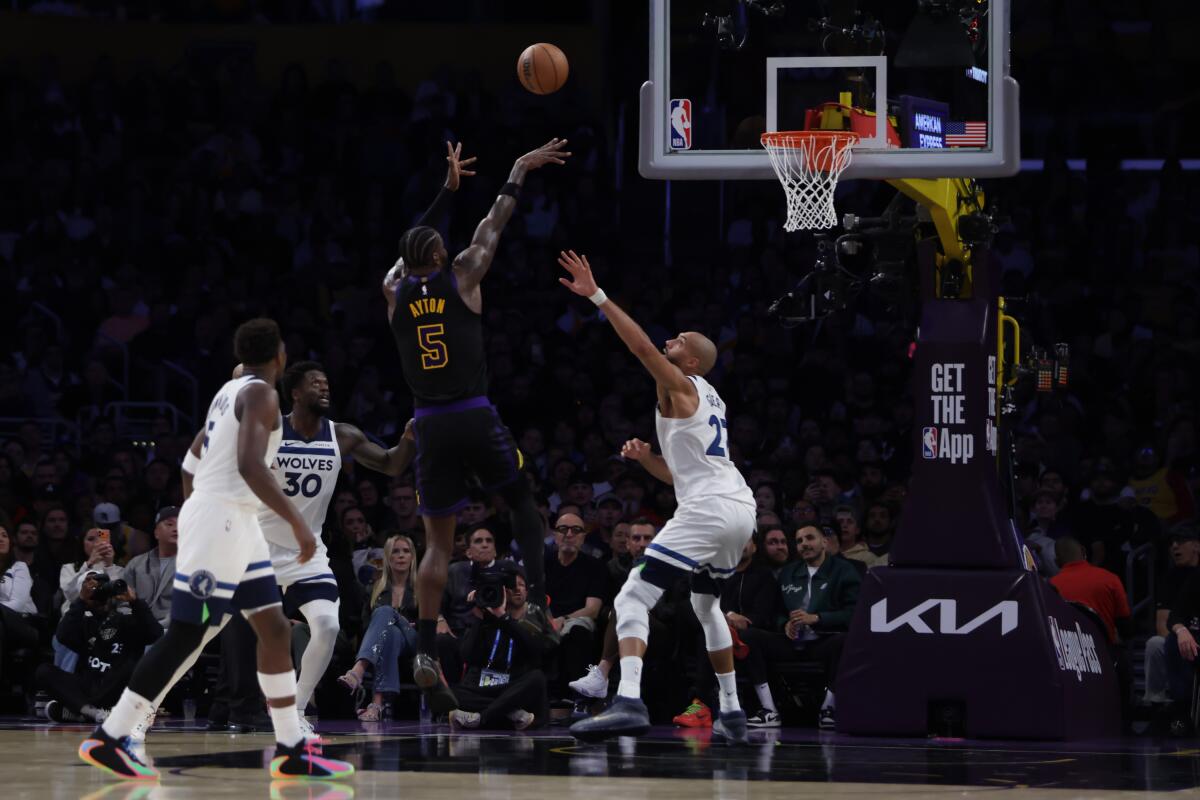
Welcome back to the Lakers newsletter, where we dive into how to get the best out of big man Deandre Ayton and hear iconic Lakers coach Pat Riley praise current Lakers coach JJ Redick and his team.
The conundrum that is Deandre Ayton is now living with the Lakers.
All things Lakers, all the time.
They see the talent and skills. But they still are searching for the right ways to maximize what Ayton can offer.
They see the passion and love for the game. They want to get that out of Ayton on a consistent basis.
They see his sensitivity. They know that to bring out the best in Ayton takes patience and constant encouragement.
When the Lakers watched film of their loss to the Boston Celtics on Sunday, Redick used lines like “there’s positive trends” with Ayton and lines like “he could be better” in certain instances.
That is the paradox of Ayton.
As the Lakers enter the stretch run of the season with 26 games remaining, they need Ayton to play at a higher level more frequently if they are to be successful.
Against the Celtics, Ayton had just four points on two-for-six shooting. He had seven rebounds, one assist and one blocked shot.
“There’s positive trends,” Redick said after practice Monday. “We did watch some film today. There was some real positive trends defensively. I think his spirit and engagement and stuff has been really good. I think for all the guys, if he has a smaller player on him, that’s an advantage for us. Let’s just get him the ball. I think it’s just thematically across the team, we have to pass it to each other more and trust each other more. …
“There was a clip last night or a play last night, Jaylen Brown goes to the floor. We’ve got a five-on-four and he [Ayton] goes at about 20% speed where it’s clearly a man-down situation. So in terms of him running and putting pressure on the rim and offensive rebounding, particularly against switches and smaller players, he could be better there.”
However, Redick, his staff and Ayton’s teammates want to be clear that they support him at all times.
Earlier this season, Redick gave his 7-foot center a T-shirt featuring Ayton’s face combined with the likeness of a lion.
“We want him to be the lion,” Redick said then.
“I have his back,” Redick said Monday. “These guys, we try to make them understand my job is to help the Lakers try to win basketball games. And so nothing is ever personal. If he doesn’t close a game, it’s not personal. It’s because I think there’s a better option. And that’s not just true for him personally. There’s essentially three guys on our team that if they’re on the lineup, they’re going to close games and everybody else [will rotate]. We talked about that today.”
Ayton is producing the lowest averages of his NBA career in points (13.0), rebounds (8.4) and minutes (28.1). His field-goal attempts (8.9) and makes (5.9) are lows too, but he’s shooting a career-high 66.6%.
“He’s done OK,” said Marcus Smart, who sits next to Ayton in the ’ locker room. “You know, he definitely could be better; we all could. But the thing I love about it is he understands it and he’s working. We all are trying to figure it out; this is new to everybody. He’s doing his best, but he understands it’s another notch that we need him to go to, and we’re going to try to get him there and help with that. But he knows he’s got to do his part as well.”
Ayton plays on a team with three dominant ballhandlers in Luka Doncic, LeBron James and Austin Reaves, and it is their job to feed the 7-footer. Getting Ayton activated has been a positive for the Lakers. When he doesn’t get the touches, Ayton hasn’t been as productive.
Still, NBA scouts say Ayton can do a little more himself. He can run harder on the fast break, seal his man down low and play with force, roll to the basket with a purpose, use his athleticism to his advantage and play defense and rebound at a higher level.
Ayton came into the NBA with high expectations, the first overall pick in the 2018 draft, even going ahead of Doncic. Over five seasons with the Phoenix Suns, Ayton was a double-double machine, averaging 16.7 points and 10.4 rebounds. He shot the ball more, averaging 12.5 field goal attempts per game. He averaged 12.8 in two seasons in Portland.
With the Lakers, he’s had to adjust his game.
“I’m sure it’s a big adjustment,” Smart said. “It was an adjustment for me when I came in … The type of player I was in college and coming in and the way I played both offensively and defensively, [now I’m] taking a more defensive approach more than offensive. So it definitely can be frustrating and it’s definitely a challenge because you still value and look at the opportunity that you have to be that person. But unfortunately, sometimes the circumstances don’t call for it. That’s the hard part, understanding that early. Like I said, we all could do better at that because we all want to win. Deandre is doing the best he can, and we appreciate that. We love it too because he also uses that to motivate himself, which can be a good thing.”
Riley praises Redick, Lakers
A statue of former Lakers coach Pat Riley is unveiled outside Crypto.com Arena.
(Greg Beacham / Associated Press)
After Pat Riley had his statue unveiled Sunday on Star Plaza outside of Crypto.com Arena, he took time to praise Redick.
Riley led the Lakers to four NBA championships in the ‘80s, his coaching style a big part of the Showtime era. He likes what he sees out of Redick and the Lakers.
“I love JJ. I really do,” Riley said. “I competed against him. My teams competed against him, you know, in various teams that he played with. He’s a fiery guy. He could shoot the hell out of the ball. He was tough as nails, you know. I don’t know. Sometimes I look back and I remember myself at that time and I looked at JJ and I think they picked the right person [for the Lakers job]. There’s just a quality about him, I think, that goes above and beyond.
“And they have a hell of a team for him right here, right now with Doncic and Reaves and obviously with LeBron. And so I think Rob [Pelinka, president of basketball operations] will continue with the new ownership to build that team and to complement those players. But they have a great opportunity and I think JJ will be a great coach for it.”
On tap
Tuesday vs. Orlando (30-26), 7:30 p.m.
The Magic are a deep and versatile team, with six players who score in double figures. Paolo Banchero leads them in scoring (21.5) and rebounds (8.4) and is second in assists (5.0). He’s shooting 45% from the field. Desmond Bane is one of three Orlando players averaging more than 20 points at 20.1, making 48.3% of his shots and 38.8% of his threes. He just dropped 36 in a win over the Clippers on the second night of a back-to-back.
Thursday at Phoenix (33-25), 7 p.m. PST
Injuries are starting to take a toll on the Suns. Dillon Brooks has a broken left hand and reportedly is out four to six weeks. This comes on the heels of All-Star Devin Booker missing at least one week because of a right hip strain and fellow guards Grayson Allen (ankle/knee) and Jordan Goodwin (calf) also dealing with injuries.
Saturday at Golden State (30-27), 5:30 p.m.
The Warriors don’t have All-Star guard Stephen Curry (knee) and forward Jimmy Butler (torn ACL), leaving them without a lot of offensive firepower. The Warriors have been leaning on guard Brandin Podziemski to keep them afloat. He is averaging 12.1 points per game.
Sunday vs. Sacramento (12-46), 6:30 p.m.
The Kings have the worst record in the NBA. They have three players with season-ending surgeries — De’Andre Hunter (eye), Domantas Sabonis (knee) and Zach LaVine (hand).
Status report
Jaxson Hayes: right ankle injury
Redick said Hayes, who left Sunday’s game, got an MRI on Monday that showed his ankle had “a little bruise.” Hayes, the backup center, is day to day, Redick said. The Lakers listed Hayes as doubtful for Tuesday night’s game against the Magic at Crypto.com Arena.
“We’ll see how he feels tomorrow morning,” Redick said..
Favorite thing I ate this week
Risotto col codeghin e la peara from Tre Risotti Trattoria.
(Thuc Nhi Nguyen / Los Angeles Times)
Ciao! It’s Thuc Nhi checking in a final time from the Olympics. My final dinner of the Games had to honor northern Italy, so instead of just pizza or pasta, I went searching specifically for risotto. In Verona, before the closing ceremony, I asked the server at Tre Risotti Trattoria what the most popular risotto was and she suggested the risotto col codeghin e la peara (risotto with sausage and pepper sauce). She didn’t miss. The salty, creamy bite with the crunchy crouton around the plate was the ideal way to end my third Olympics Games. Arrivederci!
How does Mick Cronin survive this, sending his own player off the court after hustling hard on defense to get a piece of the ball but unfortunately too much contact and drew a foul. Does he not constantly rip his team for weak defense?
Steven Jamerson, you deserved better from your coach and I won’t be surprised if your teammates and UCLA’s decision-makers agree going forward. Except …. he just recently got an extension. Way to go, Martin Jarmond.
Ron Mortvedt San Bernardino
How can UCLA’s combustible coach possibly demand discipline, hold his players responsible, or blame them for failing to take accountability when, night after night, he’s the most unhinged person in the building? Hey Mick, as my grandma used to say, “When you point a finger at someone, three point back at you.”
Steve Ross Carmel
Bill Plaschke nailed it in his column today. Mick Cronin just seems to be angry all the time prowling the sidelines. What does that look like to a kid still playing in high school? How AD Martin Jarmond gave him an extended contract with a $22.5-million buyout is beyond me. It’s going to cost UCLA to move on from him. It would be a lot easier if he only starts throwing chairs.
Paul Atkinson Ventura
The sky has fallen! For the first time I can remember I agree with something Bill Plaschke has written!
Julian Pollok
Palm Desert
As a lifelong fan and proud alumnus, I believe it’s time for UCLA to seriously evaluate the direction of its men’s basketball program. Why would we want a head coach who appears angry every time he’s in the spotlight? Leadership sets the tone, and right now that tone feels tense and joyless. Players want to compete for someone who inspires them and makes them better — not someone whose public demeanor seems rooted in frustration.
Watching from the outside, it often looks like the team is playing tight rather than confident, and that reflects leadership. Mick Cronin has had success and deserves credit for that, but UCLA basketball is bigger than any one résumé; if the standard is sustained excellence and a culture players are proud to represent, then it’s fair to question whether this is the right long-term fit for the program.
Stepping into Jr. Market boutique in Highland Park is like entering a 1980s time warp. Built into a refurbished shipping container, it’s filled with everything from tiny Walkman-style portables to colorful, number-flip clock radios and, naturally, boomboxes of all sizes. Few are more imposing than the TV the Searcher, a Sharp boombox from the early ‘80s that features a built-in, 5-inch color television.
“Try lifting it, it’s really heavy,” warns Spencer Richardson, the shop’s owner. Indeed, the machine is at least 15 pounds without the 10 D batteries that power the unit. He adds, “I don’t think you’re taking this to the beach so you could watch TV while you listen to music.”
An affable, hyper-knowledgeable proprietor in his early 30s, Richardson repairs and resells analog music technology from the 1980s or earlier. In bringing these rehabbed players back into circulation, he’s helping others rediscover a musical format once left for dead. While his hobby-turned-side hustle started as “a gateway to discover sounds” that he otherwise would not have heard, it now attracts curious customers willing to drop $100-plus for a vintage Technics RS-M2 or My First Sony Walkman. His customers include older baby boomers and Gen X‑ers nostalgic for the players of their childhood, but most have been millennials like himself, drawn to something tactile and analog in an era when everything else disappears into the digital ether.
A rare Technics RS-M2 stereo radio tape deck. “I’ve worked on a lot of tape players and this one shouts quality inside and out,” Richardson writes on Instagram.
(Spencer Richardson)
Unlike turntables, which have become increasingly high-tech thanks to the “vinyl revival” of the last 20 years, almost all cassette players in current production rely on the same, basic tape mechanism from Taiwan, Richardson explains. Though cassette culture is enjoying its own period of rediscovery — albeit on a far smaller scale — he hasn’t seen a market emerge for newly engineered tape decks. And he’s fine with that.
“I’m not one of those people that’s like, ‘Why don’t they make good new tape players?’” he says. “No one needs to make it better. You’re still better off buying a refurbished one from the time when they made them.”
That’s where he steps in.
Richardson works on a Nakamichi tape deck out of his repair studio in downtown L.A.
(Genaro Molina / Los Angeles Times)
It’s easy to forget that when cassettes debuted in the mid-1960s, the technology was groundbreaking. Not only were the players far more portable than turntables but unlike records, tapes were resilient to being tossed about. Even more profoundly, cassettes democratized access to the act of recording itself since cassette technology required minimal infrastructure and cost.
“I think about how incredible it must have been for people to realize they could just put whatever they wanted onto a tape, dub it, give it to a friend,” says Richardson.
Entire genres of music, especially in the developing world, became far more accessible across borders. In some countries, big records are still released on cassette. “I have a Filipino release of Kanye West’s ‘College Dropout’ on tape,” Richardson says.
The constraints of the technology guided the listening experience. Because skipping songs on a player was a hassle, most people sat with cassette albums as a track-by-track, linear journey, the antithesis to the algorithmic, shuffle-centric playlists ubiquitous on today’s streaming platforms. It’s a pace that Richardson appreciates.
“I want things to be intentional and slow,” he says. “I don’t need them to be optimized.”
He learned how to repair gear by watching YouTube videos, perusing old manuals and through trial and error.
(Genaro Molina / Los Angeles Times)
Born in the early 1990s, Richardson grew up in Santa Monica and the Pacific Palisades, where his mother’s home was lost in the L.A. wildfires last year. He’s just old enough to remember cassettes as a child: “My mom had books on tape like ‘Winnie the Pooh,’ but I wasn’t out buying tapes.” Fast forward to the mid-2010s and he was working at the now-defunct Touch Vinyl in West L.A. “Back in 2014, we started this little in-store tape label,” he explained. “Bands would come to play, and we’d duplicate 10 tapes and give them away or sell them.” Richardson slowly began collecting cassettes but after the store closed a few years later, he realized how hard it was to find people to service his tape players.
Finally, once the pandemic hit in 2020 and everyone was stuck at home, he decided to learn how to repair his gear by watching YouTube.“I was just fascinated by the videos, absorbing soldering techniques and tools you might need,” he said. With no formal engineering background, Richardson began collecting information online, perusing old manuals, learning through trial and error. “You just need to get your hands in there and be like, ‘Oh, OK, I see how this works,’ or maybe I don’t see how this works, and I’m just going to bang my head against the wall, and then a year later, try again.” His first successful repair was for his Teac CX-311, a compact stereo cassette player/recorder that he still owns. “It has some quirks but runs well.”
A few years later, Richardson’s girlfriend, Faith, suggested he start selling his players online via an Instagram account — jrmarket.radio — originally created for a short-lived internet station. Tim Mahoney, his childhood friend and a professional photographer, shot the units against a plain white backdrop, as if for an art catalog. A community of enthusiasts quickly found his account and Richardson began selling pieces online and via pop-ups. In 2024, the owners of vintage clothing store the Bearded Beagle invited him to take over the parking lot space behind their new location on Figueroa St. Opening a brick-and-mortar store hadn’t been his ambition but Richardson accepted the opportunity: “I never envisioned opening my own physical store. It’s hard enough to have a retail space in Los Angeles to sell something that’s very niche.”
Jr. Market operates as a shop Thursday through Saturday in Highland Park.
(Spencer Richardson)
Jr. Market — whose name is inspired by Japanese convenience stores known as “junior markets” — isn’t trying to appeal to audiophiles though Richardson does stock studio-quality recording decks. He primarily looks for players with appealing visual design, most of them made in Japan where Richardson has been traveling to since graduating high school. Through those trips, he’s learned where to source pristinely-kept gear, including his best-selling Corocasse: a bright red plastic cube of a radio/tape player, introduced by National in 1983. He also keeps an eye out for the unique Sanyo MR-QF4 from 1979, an elongated boombox with four speakers, designed to play either horizontally or flipped into a vertical tower.
The store also stocks a small selection of portable record players, including a Viktor PK-2, a whimsical, plastic-bodied three-in-one turntable, tape player and AM radio that looks like something designed by a modernist artist for Fisher-Price. That went to local author and historian Sam Sweet, who visited the store with no intention of buying anything and left with the Viktor, which now sits on his writing desk. “Spencer’s part of a grand tradition of workshop tinkerers and specialty mechanics,” Sweet says. “The refurbished devices he sells are as much a reflection of his ethos and expertise as they are treasures of the past.”
Last year, Imma Almourzaeva, an Echo Park art director, came to the store and purchased a massive 1979 Sony “Zilba’p” boombox, which is nearly 2 feet wide and over a foot tall, with wood veneer panels to boot. Almourzaeva, who grew up in Russia in the ‘90s, wanted a player that offered “the tactile feel of my childhood and bringing it back into my daily routine, something familiar, something warm.” The Zilba’p is the largest boombox Richardson has carried and Almourzaeva said, “It’s aesthetically a showstopper. Maybe I have a Napoleon complex because I’m pretty small too. It’s like ‘go big or go home’ for me.” She shared that she recently bought a Soviet-era boombox from Richardson for her brother for Christmas. “It turned out my mom grew up using the same brand of stereo,” Almourzaeva says. Richardson had told her that Soviet boomboxes are “very DIY, more funky and finicky.”
Refurbishment is one of Richardson’s specialties, including repairing customer units, each of them a puzzle he enjoys solving. No matter if a player is sparse or feature-packed, the simple act of playing a cassette creates a sense of calm and focus for him. “You’re not distracted, because it doesn’t do anything else,” he says. In a time where every “smart” device is marketed with dizzying arrays of features, that simplicity can feel downright revolutionary.
That was the toughest thing to watch. That was what seared into the mind. That’s what made you want to fire Mick Cronin on the spot.
It was a look of embarrassment. It was a look of confusion. It was the look of a young man who had just been cruelly pushed around by someone with more power.
Mick Cronin is a classic bully, and the fact that UCLA continues to empower him with new contracts and no questions is misguided malfeasance.
So, he wins games. He doesn’t win enough to compensate for incidents like Tuesday night in East Lansing, Mich., where Cronin became perhaps the first college coach in history to eject his own player from the game and order him to the locker room in the middle of the game.
Yes, Cronin holds players accountable. That’s fine, as long as he also holds himself accountable, but that didn’t happen when, after his team was beaten by 23 points by Michigan State in a second consecutive humiliating loss, he publicly criticized Jamerson for the hard foul that led to the ejection incident and then wrongly assailed a reporter for allegedly raising his voice during postgame questioning.
Cronin has become a walking viral video. He has become a nightly uncomfortable wince. He has become an embarrassment to a university athletic department that prides itself on winning with class.
Mick Cronin is light years from the aura of Coach, and if UCLA cared a whit about the legacy of its legend, it would care that his flame has been completely snuffed by this unworthy keeper.
Wooden’s home is now decorated with a pyramid of poop, and one wonders how many humiliations will be required to convince administrators to clean things up.
UCLA coach Mick Cronin extends his arms and complains while watching the Bruins lose to Michigan State Tuesday in East Lansing, Mich.
(Rey Del Rio / Getty Images)
Cronin quietly signed a new five-year contract last summer that includes a $22,5 million buyout if he is fired this spring. That figure drops to $18 million, then $13.5 million, then $9 million, then $4.5 million in coming years. No wonder the Bruins didn’t publicize the deal at the time. It was another Martin Jarmond mistake, and now the entire university is going to pay the price.
It’s hard to see UCLA canning Cronin in the next couple of years because of those buyouts, which means this mess of a program is going to be increasingly hard to watch.
What happened Tuesday should scare away any of the remaining top prospects who would want to play for this berating blowhard. His usual postgame rants don’t compare to what happened on that Michigan State court, where he picked on the wrong kid in the worst possible fashion.
By all accounts, Jamerson is a dream player, one filled with resilience and gratitude. The former Crespi High star initially wanted to play for Michigan State, but he couldn’t make the team, even as a walk-on, so he tried to become a student manager, and failed at that, too. After spending a year there as a student, he transferred to University of San Diego, where he spent three seasons strengthening his game before eventually transferring to UCLA. This season he has spent most of his time on the bench, playing about 11 minutes per game for the Bruins while supplying rebounding and defense and energy.
It was this fire that led him to give chase to Michigan State’s Carson Cooper in the final five minutes of a game that UCLA currently trailed by 27. Cooper went up for a fast break dunk and Jamerson knocked him to the floor. It was ruled a Flagrant 1 excessive foul, but not a dangerous Flagrant 2 foul, so Jamerson was not ejected from the game.
At least, that’s what he thought.
Moments later Cronin was grabbing the kid’s shirt and leading him to the baseline, where he ordered an assistant coach to remove him from the court area and banish him to the locker room.
Jamerson’s dreams of a solid return to a school that snubbed him were shattered. His night ended amid a storm of laughing students and obscene gestures.
UCLA coach Mick Cronin shouts toward the bench while sending Steven Jamerson II to the locker room after the player was called for a foul Tuesday at Michigan State.
(Rey Del Rio / Getty Images)
It was just awful, and so avoidable. Why couldn’t Cronin have just sent Jamerson to the end of the bench? Considering it wasn’t a Flagrant 2, why did he even have to take him out of the game? Why did he have to make an example of a player who was understandably overeager on what could have been one of the triumphant nights of his life?
“Steve’s a good kid. He made a bad decision. But if you want to be a tough guy, you need to do it during the game, for a blockout, for a rebound,” said Cronin afterward.
“So, I was thoroughly disappointed; the guy was defenseless in the air. I know Steve was trying to block the shot, but the game’s a 25-point game. You don’t do that.”
That point could have been made without humiliation. But Cronin wasn’t done, later admonishing a reporter for what he considered a dumb question, then scolding the reporter for allegedly raising his voice at him.
The question was about the student section’s harassment of former Spartan Xavier Booker, which seemed like a legitimate query considering Booker had a terrible game. But what was really baffling was Cronin’s claim that the questioner was raising his voice.
Listen to the video. No voices were raised. It was just Cronin once again being a bully. You want a raised voice? Here, I’ll raise my voice in words that Cronin will hopefully understand.
CHILL OUT! SHOW RESPECT! HONOR WOODEN!
If the coach doesn’t grow up and the program doesn’t rapidly improve — for a third straight year they’re barely a tournament team — there needs to be another ejection.
It would be the most expensive firing in UCLA history. It would be worth every penny.
It’s 6 a.m. at Loyola High. Students are supposed to be asleep unless they’re on the swim team doing early morning laps at the pool. So why in the name of beach, surf and sunshine is the volleyball team practicing in the gym?
Welcome to February’s gym crunch time, when winter sports teams such as basketball are busy with playoffs and spring sports teams such as volleyball are gearing up for the start of their season.
“It’s pretty brutal,” said 6-foot-8 volleyball standout Blake Fahlbusch, who would prefer surfing in the morning and practicing volleyball in the afternoon.
Veteran coach Michael Boehle, sipping coffee, understands the routine is only temporary and does his best to get his players focused on their early morning routine.
The Cubs begin their season next week with the motivation that they have “unfinished business.”
Last year at one point they were the best team in Southern California, but there were too many distractions and too many obstacles to overcome. Players lost their home in the Palisades fire. Boehle found out he had prostate cancer. A well-known classmate, Braun Levi, was killed by a suspected drunken driver.
Boehle, feeling refreshed and excited after surgery removed the cancer, thinks the chemistry is better. Fahlbusch, a USC commit, is a candidate for best in the Southland because of his size and athleticism.
JP Wardy, a 6-4 Pepperdine commit, arrived from Newport Harbor to play his final year at Loyola, the school he was set to attend as a freshman until he moved to San Diego for family reasons.
It’s rise and shine for Loyola volleyball players during a 6 a.m. practice session.
(Eric Sondheimer / Los Angeles Times)
“It feels great to be back,” Wardy said. “I missed being at Loyola. I feel growing up, this was supposed to be the school I would go to.”
Loyola’s libero, Matt Kelly, is the brother of UCLA standout Sean Kelly. He’s committed to Loyola Chicago and considering how well his big brother serves, practicing against him has gotten Matt ready for anything. There’s also 6-6 Lucas Posell, a Princeton commit with a 4.7 grade-point average.
The usual title contenders should be the teams to watch with Loyola — Mira Costa, Redondo Union, Huntington Beach, Corona del Mar and Newport Harbor.
Mateo Fuerbringer of Mira Costa is a UCLA commit.
(Mira Costa)
There’s lots of top players, from juniors Teddy Mandelbaum and Mateo Fuerbringer of Mira Costa, both UCLA commits, to Taylor Boice of Redondo Union, a UC Irvine commit. Mira Costa has also added Jake Newman, a transfer from Mater Dei.
Boehle will be coaching in his 28th year, having won seven Southern Section championships. The Cubs have won every Mission League title since sharing the crown with Harvard-Westlake in 2007 and haven’t lost a league match since that season.
Loyola students cheer on the Loyola boys volleyball team during a match against Mira Costa on March 21, 2025.
(Steve Galluzzo / For The Times)
The annual Loyola-Mira Costa nonleague match that brings out fans en masse is set for March 20 at Mira Costa.
The Cubs open their season on Feb. 24 at home against Newport Harbor, so Wardy will be waving across the net to his former teammates.
As for his early impressions of his new team, Wardy said, “We’re good. I’m excited. Practices are competitive, which I really like because it helps us getting better.”
On the cusp of what promises to be a bitter showdown with major league owners, the players’ union has no leader. Tony Clark, the executive director of the Major League Baseball Players Assn., resigned under pressure Tuesday.
Why did Clark resign?
Clark and the union had engaged separate attorneys as federal authorities investigated alleged financial improprieties within the MLBPA, an affiliated licensing company and an affiliated youth sports venture.
The union also commissioned an investigation, initially focused on those allegations, that uncovered an “inappropriate relationship” between Clark and an employee, a person familiar with the matter confirmed to The Times, with the eight-man MLBPA player leadership team advising Clark that he should depart. The employee was his sister-in-law, the person confirmed.
The allegations remain under federal investigation, meaning that player leaders determined Clark could have been a liability on at least two fronts as players and owners head toward what is expected to be the most contentious collective bargaining in the sport in 31 years.
The Athletic first reported Clark had resigned; ESPN first reported on the relationship.
Who will replace Clark as the union leader?
The MLBPA issued a statement late Tuesday saying player leaders had met Tuesday. Players planned to canvass their peers scattered across spring training camps, then meet again Wednesday, with the possibility of voting on a new executive director then.
That could be either a permanent hire or an interim hire; the latter would reflect the urgency of the upcoming labor negotiation. Although the collective bargaining agreement does not expire until Dec. 1, Commissioner Rob Manfred said last week he expected talks on a new deal to start soon after opening day.
Bruce Meyer, the union’s deputy executive director and lead negotiator, would be the most logical successor. The MLBPA hired Meyer away from the NHLPA in 2018, one year into a bargaining agreement in which Clark and union negotiators were widely viewed as being badly beaten by Manfred and league negotiators.
No. It just acknowledged his resignation.
Is Meyer’s ascension a foregone conclusion?
Bruce Meyer in 2022
(Richard Drew / Associated Press)
Likely, yes, but not foregone. In 2021, with Meyer as lead negotiator and pushing for a better deal even as a 162-game season was threatened, players voted to accept the deal on the table. The union promoted Meyer into his current position in 2022.
In 2024, ESPN reported a majority of player representatives supported the replacement of Meyer with Harry Marino, who had unionized minor league players. Ultimately, Clark stuck with Meyer.
At this late date, however, internal bargaining preparations are underway, and Meyer is now a veteran of MLB negotiations. The goal is to “keep everything as stable as we can this year,” Angels pitcher Brent Suter told reporters. Suter is one of eight players on the union’s player leadership team.
Does this mean the players are divided and the owners are united?
No, and not that simple in any case.
On what looms as the core bargaining issue — the potential adoption of a salary cap — Clark and Meyer were aligned. Clark was the union voice calling a cap “institutionalized collusion,” with Meyer filling in the details of why the MLBPA believed a cap would not necessarily enhance parity and could leave players liable to receive a shrinking percentage of revenue over time.
Manfred has argued the current system helps elite players while squeezing the salaries and the jobs of the so-called middle class.
The owners currently appear united on pushing for a salary cap. If at some point they believe they have to do what the NHL did to get a cap — that is, lose an entire season — the interests of the large-market owners and the small-market owners could diverge.
What does this mean in terms of a potential lockout?
Nothing, really. Within the game, a lockout is considered all but inevitable.
Manfred has said he views a lockout as a negotiating tool. If MLB locks out players Dec. 1, no games are lost. If a lockout remains in place April 1, regular-season games could be lost.
In the last collective bargaining negotiation, owners locked out players in December, and a new deal was reached in March, preserving a 162-game season that started one week late.
Canada’s Yuvraj Samra became the first player from an associate nation to make a T20 World Cup century but it was not enough to stop them sliding to an eight-wicket defeat byt New Zealand, who confirmed their place in the Super 8 phase.
Samra made 110 off 65 balls in a knock which featured 11 fours and six sixes as his stunning innings helped Canada post 173-4.
The teenager had brought up his hundred off 58 balls as he eclipsed the previous top score by an associate player – 94 not out by the USA’s Aaron Jones against Canada at the last World Cup.
At 19 years and 141 days, he also became the youngest-ever T20 World Cup centurion, beating Pakistan Ahmed Shehzad’s (22 years and 127 days) against Bangladesh in 2014.
Samra was eventually dismissed by Jacob Duffy – caught in the deep behind square by Glenn Phillips – and left to a standing ovation at the MA Chidambaram Stadium in Chennai
“I manifested this moment ever since we qualified for the World Cup. Every single day, I dreamed about scoring a hundred on this stage,” said Samra, who is named after ex-India batter Yuvraj Singh.
“To do it here, in my first appearance [in Chennai], and as the youngest player in this World Cup – it’s truly a dream come true.”
Canada captain Dilpreet Bajwa, who shared a 116-run stand with Samra for the first wicket, added: “Hats off to Yuvraj, he finished with a hundred in this match and it’s a proud moment for him and all Canadians.”
Kiwi seamers Matt Henry, Kyle Jamieson, Jimmy Neesham and Duffy all claimed one wicket apiece.
New Zealand had a brief wobble early in the chase when they lost openers Tim Seifert and Finn Allen in quick succession and slipped to 30-2.
However, Canada’s bowlers were unable to press home the advantage and an unbroken 146-run stand for the third wicket between Rachin Ravindra and Phillips got them home with 29 balls to spare.
Phillips top-scored with a brutal 76 not out of 36 balls while Ravindra finished unbeaten with 59 off 39 deliveries.
New Zealand’s victory sent them through and eliminated Canada in addition to the UAE and Afghanistan.
Figures from data science firm Signify, the International Tennis Federation (ITF) and Women’s Tennis Association (WTA) show that in 2024, about 8,000 abusive, violent or threatening messages were sent publicly to 458 tennis players through their social media accounts, with many stemming from betting.
Aiava cited the “hate or death threats” and commentary on “my body, my career, or whatever they want to nitpick”.
She went on to criticise “a sport that hides behind so-called class and gentlemanly values”.
“Behind the white outfits and traditions is a culture that’s racist, misogynistic, homophobic and hostile to anyone who doesn’t fit the mould,” added Aiava.
She also said she was grateful for the opportunity to travel the world and make friends but admitted: “It also took things from me. My relationship with my body. My health. My family. My self-worth.
“Would I do it all again? I really don’t know, but one thing this sport taught me is that there is always a chance to start fresh.”
Tennis officials have not yet commented on Aiava’s post.
NBA commissioner Adam Silver believes teams are tanking more aggressively than in recent years and is considering many possible remedies to ensure real competition, from taking away draft picks to making wholesale changes to the draft and the lottery.
Silver immediately addressed the hottest topic in NBA circles Saturday in his annual address during All-Star Weekend at Intuit Dome, making it clear the NBA will do almost anything to make sure its teams earnestly compete.
Last Thursday, the league issued a $500,000 fine to the Utah Jazz and a $100,000 penalty to the Indiana Pacers for sitting healthy players, believing their apparent tanking actions compromised the league’s competitive integrity.
“Are we seeing behavior that is worse this year than we’ve seen in recent memory? Yes, is my view,” Silver said. “Which was what led to those those fines, and not just those fines, but to my statement that we’re going to be looking more closely at the totality of all the circumstances this season in terms of teams’ behavior, and very intentionally wanted teams to be on notice.”
Silver knows strong words and six-figure fines might not be nearly enough to compel struggling teams to commit to real competition instead of improving their odds in what’s expected to be one of the deepest drafts in recent history — and that’s why the NBA is looking at stronger solutions.
“The league is 80 years old, it’s time to take a fresh look at this and to see whether that’s an antiquated way of going about doing it,” Silver said of draft process. “Ultimately, we need a system to fairly distribute players. It’s in the players’ interest as well as the teams’ that you have a level of parity around the league. There’s only so many jobs and so many cities, but we’ve got to look at some fresh thinking here. I mean, what we’re doing, what we’re seeing right now, is not working.”
The NBA’s competition committee is reexamining the structure of the draft lottery for ways to minimize the upside of tanking, Silver said. The commissioner also acknowledged the fines could be followed by the revocation of draft picks from tanking teams.
“There is talk about every possible remedy now to stop this behavior,” Silver said.
Yet Silver also acknowledged the essential dilemma at the heart of this problem, one that has bedeviled the league since the 1960s: A team’s draft position is significantly tied to its chances of building a winner.
“It’s so clear that the incentives are misaligned,” Silver said. “My caveat is, and this is where teams are in a difficult place … that the worst place to be, for example, is a middle-of-the-road team. Either be great or be bad, because then [being bad] will help you with the draft. In many cases, you have fans of those teams, it’s not what they want to pay for, to see poor performance on the floor, but they’re actually rooting for their teams, in some cases, to be bad to improve their draft chances.”
But Silver intends to remind every team that tanking is a betrayal of its relationship with fans, both in their home cities and around the world.
In other topics covered by Silver on Saturday:
Expansion grows closer
The NBA still expects to make decisions on expansion this year, starting with more discussions at the Board of Governors meeting next month. The league won’t vote on expansion then, but Silver expects to know whether the league will move on to talk with potential owners.
Silver acknowledged Seattle and Las Vegas are the obvious candidates for expansion and said the league wants to make a decision soon: “I don’t want to tease cities or mislead anyone.”
Clippers investigation
Silver said he has been told the Clippers have been cooperative with the external investigation into their possible circumvention of the salary cap through a suspicious endorsement deal for Kawhi Leonard with a now-bankrupt company.
Silver firmly stated that the investigation and its findings were not purposely delayed while the Clippers host All-Star weekend. Wachtell Lipton, the Manhattan law firm conducting the investigation, has no deadline to produce its findings.
Prediction markets
The NBA is “paying an enormous amount of attention” to the rise of prediction markets, particularly after Milwaukee superstar Giannis Antetokounmpo sparked concern with his investment in Kalshi. Silver didn’t find fault with Antetokounmpo — whose shares are a “minuscule” position, according to Silver — but acknowledged the looming specter of the gambling industry without suggesting a solution.
“It concerns me in the totality of all this betting that we need a better handle, no pun intended, on all the different activity that’s happening out there,” Silver said.
Silver also acknowledged the overwhelming size of this task, given that roughly 80 countries allow betting on the NBA while billions more are wagered illegally.
Europe calling
The NBA’s desire to open a European league in partnership with FIBA remains strong, and it still would love to start in October 2027, but Silver acknowledged many hurdles remain.
The league still is working with the players union to determine whether active players will be allowed to invest in NBA Europe franchises — something that would be welcomed by many top players, including Antetokounmpo.
“If there’s an opportunity that comes across my desk to be an owner in sports, I would consider it 100%,” the Greek star said Saturday. “In the real NBA, I don’t know if I have that type of money … but I love basketball, and anywhere that I can be involved with it, I would love it.”
Arsenal‘s players rotate positions to make it difficult for opponents to pick them up. They aim to maintain the balance of the side while playing in this fluid manner. Zubimendi, like the others, vacates his position based on the movements of team-mates.
By dropping into a deep position against Chelsea, Bukayo Saka opened up space on the right flank to allow Zubimendi to push into this area. Rice, the far-side midfielder, filled in at defensive midfield, ensuring Arsenal‘s shape remained similar, only with different players arriving in each zone.
It is unusual to see a defensive midfielder make such adventurous runs off the ball but it appears to be the next step on from the more popular use of roaming full-backs, such as Riccardo Calafiori, Nuno Mendes and Marc Cucurella.
The logic is that the players often tasked with marking defensive players are unlikely to defend them as closely. Finding defensive players who possess attacking quality to contribute in the final third is a rarity but Zubimendi has the skillset to punish teams in this way.
Defences set up in a low block will often drop even deeper when faced with a winger or forward trying to run in-behind. It leads to space opening up in front of the defence, rather than in the box.
Arsenal spend large parts of the game looking to unlock deep defences. This allows Zubimendi to arrive into a position to receive a pass, without being picked up, before executing on the idea he has in his head immediately. This could be a precise through ball or a dinked chip over the top – riskier passes that pose new questions for deep defences.
Alternatively, when Zubimendi sits at the base of midfield, Rice is free to push up and rotate with the attackers, knowing there is protection behind him.
And the England man will likely feel safe to play freely after seeing his 5ft 9in team-mate beat 6ft 6in Newcastle striker Nick Woltemade to a header earlier this season.
Meanwhile, Zubimendi’s willingness to shoot from distance provided Arsenal with the much-needed opening goal against Nottingham Forest and Sunderland, after which more space opened up for the Gunners with their opposition forced to play more adventurously.
Arteta said “if the space is not in one place, it will be somewhere else” – and against deep defences, long shots have become an increasingly viable tactic this season.
Signing Zubimendi, therefore, could not have been more timely.
On a holiday celebrating love and affection, thousands of enthusiastic basketball fans showed up at Intuit Dome to cheer for their favorite NBA players in a trifecta of skills competitions on the eve of the league’s 75th annual All-Star Game.
Getting Saturday off to a scintillating start was the three-point contest — one of All-Star Weekend’s most coveted prizes since Larry Bird won the initial contest in 1986 as well as the next two.
Portland’s Damian Lillard joined Bird and Craig Hodges (1990-92) as the only three-time winners with a stunning exhibition in the final round, ending up with a score of 29 — two better than runner-up and 2018 champion Devin Booker of Phoenix. Lillard equaled the best final-round score, set by Karl-Anthony Towns in 2022.
“I came out here excited to do it,” said Lillard, a nine-time All-Star who is sitting out this season after surgery to repair a torn Achilles tendon last May. “I can’t say I knew I’d win but I came in confident. This is my sixth time doing it … this felt like a game to me.”
Lillard went second in the finals and watched anxiously from the bench as it looked like Booker would overtake him before missing his last three shots from the corner.
“At the end I was at his mercy but it worked out,” said Lillard, who won with 24 points in 2023 and 26 in 2024. “I was once a fan too — as a kid I went to the All-Star Game in Oakland— and fans want to see their guys. That’s what made me want to be a part of it.”
In the first round, eight players had 70 seconds to shoot 27 balls from five designated spots on the court. Booker posted the highest score (30, one shy of the record) and also making the finals with 27 points each were Lillard and Charlotte rookie Kon Knueppel. Donovan Mitchell (24), Norman Powell (23), Jamal Murray (18), Tyrese Maxey (17) and Bobby Portis Jr. (15) were eliminated.
Next up was the shooting stars competition, which returned to All-Star Weekend after a 10-year hiatus and featured four teams, each consisting of two current NBA players and one retired “legend.”
Jalen Brunson, Towns and Allan Houston led Team Knicks to a 47-38 triumph over Team Cameron, made up of Duke alums Jalen Johnson, Knueppel and Corey Maggette, a former Clipper.
“This was cool and the game’s become more and more international,” said Brunson, who got passes from his dad, Rick, a New York assistant coach. “Basketball is a universal language. Winning’s always fun, not just beating a team from Duke.”
In the semifinals, Team Knicks beat Team Harper (Dylan Harper of San Antonio, Ron Harper Jr. of Boston and their father, five-time NBA champion Ron Harper) while Team Cameron beat Team All-Star (Scottie Barnes of Toronto, Chet Holmgren of Oklahoma City and three-time All-Star Richard Hamilton).
From left, Rick Brunson, Allan Houston, Jalen Brunson and Karl-Anthony Towns hold the winners’ trophies after the shooting stars competition.
(Jae C. Hong / Associated Press)
Was it a case of the old guy carrying the young guys?
“He did his job,” Towns joked about Houston, who played for the Knicks from 1996 to 2005 and serves as general manager of their G League team.
Shooting stars was a regular feature from 2004 to 2015 and originally featured an NBA player, a WNBA player and a retired player on each team shooting from four locations. This year, each team had 70 seconds to score points by shooting from seven areas worth anywhere from two to four points.
Rounding out the Valentine’s Day festivities was the crowd-pleasing slam-dunk contest, showcasing the individuality and athleticism of its four first-time participants: Lakers center Jaxson Hayes, San Antonio forward Carter Bryant, Miami forward Keshad Johnson and Orlando rookie guard Jase Richardson.
The 6-foot-6 Johnson, who measured a 42-inch vertical leap at the 2024 draft combine, ultimately raised the gold trophy following a final round total of 97.4. He made a side-to-side move at the rim on his penultimate attempt, then sprinted the length of the court and soared for a windmill jam on his last effort.
“Everyone make some noise,” the jubilant Johnson told the roomful of reporters afterward. “It’s a dream. I beat the odds. Every year I watched the dunk contest and I learned from all the people before me.”
Slam dunk winner Keshad Johnson goes between the legs while dunking.
(Ronaldo Bolanos / Los Angeles Times)
Bryant settled for second with 93 despite a perfect score of 50 after he bounced the ball off the floor, under his leg for a one-handed stuff that drew thunderous applause on his first try before making a less-difficult 360-degree dunk with time running out on his second attempt.
“I really wanted him to finish that last one,” Johnson said. “Both of us are from U of A [Arizona], so we wanted to put on a show and we did.”
In the opening round all four players attempted two dunks, receiving a score between 40 and 50 per try. Bryant (94.8) and Johnson (92.8) qualified for the final dunk-off, in which both got two more attempts.
“Dunking is an art and it’s kind of hard to come up with new stuff,” said Johnson, an Oakland native who leaped over Bay Area rapper E-40 on his first dunk. “My goal is to just be myself and put my own flavor in it.”
Spurred on by the hometown crowd, Hayes was third at 91.8 while Richardson, the son of two-time winner Jason Richardson, was last at 88.8.
Judging were former champions Nate Robinson, Dominique Wilkins, Brent Barry, former Lakers center Dwight Howard and fans on the NBA app.
Lakers center Jaxson Hayes rises for a tomahawk dunk.
(Allen J. Schaben / Los Angeles Times)
Julius Irving won the first dunk contest in 1976, the year before the ABA-NBA merger. Robinson (2006, 2009, 2010) and Mac McClung are the only three-time winners. McClung, the previous champion and only player to win three years in a row, announced in January he would not defend his title.
That opened the door for a new winner in Johnson.
“Being undrafted and in the G League and being the underdogs at San Diego State… I’ve learned how to dream dreams,” said Johnson, who keyed the Aztecs’ surprising run to the NCAA tournament’s Sweet 16 in 2023 before transferring to Arizona. “I’m so grateful to be here. I’m from Oakland, the West Coast is home to me and I felt like the fans were with me.”
Hilary Knight won’t let Trump’s ‘distasteful joke’ ruin Olympic gold
U.S. women’s hockey star Hilary Knight wasn’t a fan of a comment that President Trump made about her team days after it claimed Olympic gold at the Milan-Cortina Games.
“I thought it was sort of a distasteful joke, and unfortunately, that is overshadowing a lot of the success of just women at the Olympics carrying for Team USA and having amazing gold medal feats,” Knight said Wednesday during an appearance on ESPN’s “SportsCenter.”
On Feb. 19, the U.S. defeated Canada 2-1 in overtime for a third gold medal in women’s hockey; the team won gold in 1998 and 2018. Three days later, the U.S. men’s hockey team also won gold by defeating Canada 2-1 in overtime.
After the men’s game, Trump addressed the U.S. players by phone in the locker room, extending an invitation for them to attend his State of the Union address two days later and adding a seemingly dismissive comment about the women’s team.
“I must tell you, we’re gonna have to bring the women’s team, you do know that,” Trump said during the call. By not inviting the other American gold medal hockey team, the president said, “I do believe I’d probably be impeached.”
Trump’s comment was met with loud laughter in the locker room. But Knight said she and her teammates aren’t spending much time thinking about the remark.
“We’re just trying to focus on celebrating the women in our room, the extraordinary efforts and continue to celebrate three gold medals in program history, as well as the double gold for both men’s and women’s at the same time and really not detract from that with a distasteful joke,” Knight, who has won two gold medals and three silvers in five Olympics with the U.S. team, said.
“It was unfortunate, but yeah, I think really focusing on celebrating all great things that have come out of the Olympics and feeling the love and the support and getting back in our respective communities and sharing this journey with them, that’s what it’s all about and that’s what makes this moment super special.”
The majority of the men’s team met with Trump at the White House on Tuesday before being honored at the State of the Union address, where they received a bipartisan standing ovation lasting about two minutes. During his address, Trump announced that goalie Connor Hellebuyck will receive the Presidential Medal of Freedom, the nation’s highest civilian honor.
The women’s team confirmed in a statement Monday that it declined an invitation to attend the State of the Union address “due to the timing and previously scheduled academic and professional commitments following the Games.” Trump said during the address that the women’s team would be visiting the White House “very soon.”
Amid the controversy over Trump’s locker room comment, hip-hop legend Flavor Flav invited the women’s hockey team to a special event celebrating their achievement in Las Vegas. He later extended the invitation to “ALL Female US Olympians and Paralympian medalists” for the “She’s Got Game Weekend” from July 16-19.
“It was definitely super special, after everything that’s been going around online, to have someone step up like that and really go to bat for us,” forward Alex Carpenter said of Flav’s invitation during a Seattle Torrent news conference on Wednesday. “I think we’re fully gonna take advantage of that and go have some fun and celebrate like we deserve to.”
U.S.men’s team member Jeremy Swayman told reporters at Boston Bruins practice Wednesday that the laughter heard in the locker room following Trump’s comment does not reflect how the players feel about the women’s team and its accomplishments.
“Yeah, we should have reacted differently,” Swayman said. “We are so excited for the women’s team, we have so much respect for the women’s team, and to share that gold medal with them is something that we’re forever grateful for. And now that we’re home we get to share that together forever and see the incredible support we have from the USA and share in this incredible gold medal.”
Jack Hughes, who scored the winning goal for the U.S. men against Canada, said the men’s players were caught “in the moment” during the president’s call that came during the middle of their victory celebration.
“Obviously it is what it is now, but we have so much respect for the women’s team and they have so much respect for us,” Hughes told reporters after his New Jersey Devils’ 2-1 loss to the Buffalo Sabres on Wednesday night. “We’re all just proud Americans and we’re happy that we both swept the Olympics.”
Knight said she thinks there is “a genuine level of support and respect” between the U.S. men’s and women’s players and called the moment a “sort of a quick lapse” by the men’s players.
“I think the guys were in a tough spot,” Knight said. “So it’s a shame that this storyline and narrative is kind of blown up and overshadowing that connection and genuine interest in one another and cheering one another on.
“I think this is just a really good learning point to really focus on, you know, how we talk about women, not only in sport, but in industry.”
Discussion about the call wasn’t the only criticism of the White House from the world of Team USA hockey.
On Thursday, men’s player Brady Tkachuk said he was unhappy that the White House shared a video on TikTok that made it appear he disparaged Canadians while using profanity. The video, which also features hockey footage and part of an interview with Hughes, carries a note saying it “contains AI-generated media.”
“It’s clearly fake because it’s not my voice and not my lips moving. … I know that those words would never come out of my mouth,” Tkachuk told reporters.
He added: “I would never say that. That’s not who I am.”
The White House did not immediately respond to a request for comment from the Associated Press.
Tkachuk also denied being the voice heard shouting “close the northern border” during the team’s call with Trump.
The Associated Press contributed to this report.
Source link
A Boston Celtics game-inspired friction test finally pinned down the sneaker squeak
As he watched the Boston Celtics play from the stands of TD Garden, one noise kept catching Adel Djellouli’s ear.
“This squeaking sound when players are sliding on the floor is omnipresent,” he said. “It’s always there, right?”
Squeaky shoes are part of the symphony of a basketball game, when rubber soles rasp against the hardwood floors as players jab step, cut and pivot and defenders move their feet to stay in front of their assignment.
Returning home from the game, Djellouli wondered how that sound was produced. And as a materials scientist at Harvard University, he had a way to find out.
Djellouli and colleagues slid a sneaker against a smooth glass plate over and over. They recorded the squeaks with a microphone and filmed the whole thing with a high-speed camera to see what was happening under the shoe.
In a study published Wednesday in the journal Nature, they described what they found. As the shoe works hard to keep its grip, tiny sections of the sole change shape as they momentarily lose then regain contact with the floor thousands of times per second — at a frequency that matches the pitch of the loud squeak we hear.
“That squeaking is basically your shoe rippling, or creating wrinkles that travel super fast. They repeat at a high frequency, and this is why you get that squeaky noise,” Djellouli said.
The grip patterns on the soles may also play a role. When researchers slid blocks of flat, featureless rubber against the glass, they saw a series of chaotic, disorganized ripples but didn’t hear squeaks.
The ridge-like designs on the bottom of your shoes may organize the bursts to produce a clear, high-pitched sound.
Other researchers have studied these kinds of bursts before, but this sneaker study examines friction happening at much faster speeds. And for the first time, it links the speedy pulses with the squeaking sound they produce.
These insights don’t just serve to satisfy the curiosity of a basketball fan. They could also help answer important practical questions. “Friction is one of the oldest and most intricate problems in physics,” wrote physicist Bart Weber in an editorial accompanying the new research. Yet, despite its practical importance, he wrote, “it is difficult to predict and control.”
Understanding friction better could help scientists better understand how the Earth’s tectonic plates slide and grind during earthquakes, for example, or to save energy by reducing friction and wear.
It could also help eliminate moments off the court when squeaky shoes can be a little awkward or embarrassing, such as in a quiet office hallway.
This research doesn’t offer a fix, though the internet has plenty of advice that may be risky, including rubbing soap or a dryer sheet on the soles. But some of the insights from the study could help to design squeak-free shoes in the future.
For example, one additional experiment found that changing the thickness of the rubber could make the squeak sound lower or higher in pitch. In the future, could we fine-tune our shoes to squeak in a pitch so high we can’t even hear it?
“We can now start designing for it,” said Weber, who is with the Advanced Research Center for Nanolithography and the University of Amsterdam, in an interview. “We can start making interfaces that either do it if we want to hear this sound, or don’t do it if we don’t want to hear it.”
Ramakrishnan writes for the Associated Press.
Source link
Lakers are trying to unlock the greatness in Deandre Ayton
Welcome back to the Lakers newsletter, where we dive into how to get the best out of big man Deandre Ayton and hear iconic Lakers coach Pat Riley praise current Lakers coach JJ Redick and his team.
The conundrum that is Deandre Ayton is now living with the Lakers.
All things Lakers, all the time.
They see the talent and skills. But they still are searching for the right ways to maximize what Ayton can offer.
They see the passion and love for the game. They want to get that out of Ayton on a consistent basis.
They see his sensitivity. They know that to bring out the best in Ayton takes patience and constant encouragement.
When the Lakers watched film of their loss to the Boston Celtics on Sunday, Redick used lines like “there’s positive trends” with Ayton and lines like “he could be better” in certain instances.
That is the paradox of Ayton.
As the Lakers enter the stretch run of the season with 26 games remaining, they need Ayton to play at a higher level more frequently if they are to be successful.
Against the Celtics, Ayton had just four points on two-for-six shooting. He had seven rebounds, one assist and one blocked shot.
“There’s positive trends,” Redick said after practice Monday. “We did watch some film today. There was some real positive trends defensively. I think his spirit and engagement and stuff has been really good. I think for all the guys, if he has a smaller player on him, that’s an advantage for us. Let’s just get him the ball. I think it’s just thematically across the team, we have to pass it to each other more and trust each other more. …
“There was a clip last night or a play last night, Jaylen Brown goes to the floor. We’ve got a five-on-four and he [Ayton] goes at about 20% speed where it’s clearly a man-down situation. So in terms of him running and putting pressure on the rim and offensive rebounding, particularly against switches and smaller players, he could be better there.”
However, Redick, his staff and Ayton’s teammates want to be clear that they support him at all times.
Earlier this season, Redick gave his 7-foot center a T-shirt featuring Ayton’s face combined with the likeness of a lion.
“We want him to be the lion,” Redick said then.
“I have his back,” Redick said Monday. “These guys, we try to make them understand my job is to help the Lakers try to win basketball games. And so nothing is ever personal. If he doesn’t close a game, it’s not personal. It’s because I think there’s a better option. And that’s not just true for him personally. There’s essentially three guys on our team that if they’re on the lineup, they’re going to close games and everybody else [will rotate]. We talked about that today.”
Ayton is producing the lowest averages of his NBA career in points (13.0), rebounds (8.4) and minutes (28.1). His field-goal attempts (8.9) and makes (5.9) are lows too, but he’s shooting a career-high 66.6%.
“He’s done OK,” said Marcus Smart, who sits next to Ayton in the ’ locker room. “You know, he definitely could be better; we all could. But the thing I love about it is he understands it and he’s working. We all are trying to figure it out; this is new to everybody. He’s doing his best, but he understands it’s another notch that we need him to go to, and we’re going to try to get him there and help with that. But he knows he’s got to do his part as well.”
Ayton plays on a team with three dominant ballhandlers in Luka Doncic, LeBron James and Austin Reaves, and it is their job to feed the 7-footer. Getting Ayton activated has been a positive for the Lakers. When he doesn’t get the touches, Ayton hasn’t been as productive.
Still, NBA scouts say Ayton can do a little more himself. He can run harder on the fast break, seal his man down low and play with force, roll to the basket with a purpose, use his athleticism to his advantage and play defense and rebound at a higher level.
Ayton came into the NBA with high expectations, the first overall pick in the 2018 draft, even going ahead of Doncic. Over five seasons with the Phoenix Suns, Ayton was a double-double machine, averaging 16.7 points and 10.4 rebounds. He shot the ball more, averaging 12.5 field goal attempts per game. He averaged 12.8 in two seasons in Portland.
With the Lakers, he’s had to adjust his game.
“I’m sure it’s a big adjustment,” Smart said. “It was an adjustment for me when I came in … The type of player I was in college and coming in and the way I played both offensively and defensively, [now I’m] taking a more defensive approach more than offensive. So it definitely can be frustrating and it’s definitely a challenge because you still value and look at the opportunity that you have to be that person. But unfortunately, sometimes the circumstances don’t call for it. That’s the hard part, understanding that early. Like I said, we all could do better at that because we all want to win. Deandre is doing the best he can, and we appreciate that. We love it too because he also uses that to motivate himself, which can be a good thing.”
Riley praises Redick, Lakers
A statue of former Lakers coach Pat Riley is unveiled outside Crypto.com Arena.
(Greg Beacham / Associated Press)
After Pat Riley had his statue unveiled Sunday on Star Plaza outside of Crypto.com Arena, he took time to praise Redick.
Riley led the Lakers to four NBA championships in the ‘80s, his coaching style a big part of the Showtime era. He likes what he sees out of Redick and the Lakers.
“I love JJ. I really do,” Riley said. “I competed against him. My teams competed against him, you know, in various teams that he played with. He’s a fiery guy. He could shoot the hell out of the ball. He was tough as nails, you know. I don’t know. Sometimes I look back and I remember myself at that time and I looked at JJ and I think they picked the right person [for the Lakers job]. There’s just a quality about him, I think, that goes above and beyond.
“And they have a hell of a team for him right here, right now with Doncic and Reaves and obviously with LeBron. And so I think Rob [Pelinka, president of basketball operations] will continue with the new ownership to build that team and to complement those players. But they have a great opportunity and I think JJ will be a great coach for it.”
On tap
Tuesday vs. Orlando (30-26), 7:30 p.m.
The Magic are a deep and versatile team, with six players who score in double figures. Paolo Banchero leads them in scoring (21.5) and rebounds (8.4) and is second in assists (5.0). He’s shooting 45% from the field. Desmond Bane is one of three Orlando players averaging more than 20 points at 20.1, making 48.3% of his shots and 38.8% of his threes. He just dropped 36 in a win over the Clippers on the second night of a back-to-back.
Thursday at Phoenix (33-25), 7 p.m. PST
Injuries are starting to take a toll on the Suns. Dillon Brooks has a broken left hand and reportedly is out four to six weeks. This comes on the heels of All-Star Devin Booker missing at least one week because of a right hip strain and fellow guards Grayson Allen (ankle/knee) and Jordan Goodwin (calf) also dealing with injuries.
Saturday at Golden State (30-27), 5:30 p.m.
The Warriors don’t have All-Star guard Stephen Curry (knee) and forward Jimmy Butler (torn ACL), leaving them without a lot of offensive firepower. The Warriors have been leaning on guard Brandin Podziemski to keep them afloat. He is averaging 12.1 points per game.
Sunday vs. Sacramento (12-46), 6:30 p.m.
The Kings have the worst record in the NBA. They have three players with season-ending surgeries — De’Andre Hunter (eye), Domantas Sabonis (knee) and Zach LaVine (hand).
Status report
Jaxson Hayes: right ankle injury
Redick said Hayes, who left Sunday’s game, got an MRI on Monday that showed his ankle had “a little bruise.” Hayes, the backup center, is day to day, Redick said. The Lakers listed Hayes as doubtful for Tuesday night’s game against the Magic at Crypto.com Arena.
“We’ll see how he feels tomorrow morning,” Redick said..
Favorite thing I ate this week
Risotto col codeghin e la peara from Tre Risotti Trattoria.
(Thuc Nhi Nguyen / Los Angeles Times)
Ciao! It’s Thuc Nhi checking in a final time from the Olympics. My final dinner of the Games had to honor northern Italy, so instead of just pizza or pasta, I went searching specifically for risotto. In Verona, before the closing ceremony, I asked the server at Tre Risotti Trattoria what the most popular risotto was and she suggested the risotto col codeghin e la peara (risotto with sausage and pepper sauce). She didn’t miss. The salty, creamy bite with the crunchy crouton around the plate was the ideal way to end my third Olympics Games. Arrivederci!
In case you missed it
With Pat Riley watching, Lakers routed by Celtics in rivalry game
Plaschke: During statue unveiling, Pat Riley reminds the disjointed Lakers of keys to winning
Statue outside Lakers’ arena is another first for Pat Riley, the consummate coach
Luka Doncic and Lakers hold off Clippers after Kawhi Leonard exits late
Lon Rosen to take over business operations for the Lakers
Until next time…
As always, pass along your thoughts to me at thucnhi.nguyen@latimes.com, and please consider subscribing if you like our work!
Source link
Letters: Apology or not, UCLA coach Mick Cronin must go
How does Mick Cronin survive this, sending his own player off the court after hustling hard on defense to get a piece of the ball but unfortunately too much contact and drew a foul. Does he not constantly rip his team for weak defense?
Steven Jamerson, you deserved better from your coach and I won’t be surprised if your teammates and UCLA’s decision-makers agree going forward. Except …. he just recently got an extension. Way to go, Martin Jarmond.
Ron Mortvedt
San Bernardino
How can UCLA’s combustible coach possibly demand discipline, hold his players responsible, or blame them for failing to take accountability when, night after night, he’s the most unhinged person in the building? Hey Mick, as my grandma used to say, “When you point a finger at someone, three point back at you.”
Steve Ross
Carmel
Bill Plaschke nailed it in his column today. Mick Cronin just seems to be angry all the time prowling the sidelines. What does that look like to a kid still playing in high school? How AD Martin Jarmond gave him an extended contract with a $22.5-million buyout is beyond me. It’s going to cost UCLA to move on from him. It would be a lot easier if he only starts throwing chairs.
Paul Atkinson
Ventura
The sky has fallen! For the first time I can remember I agree with something Bill Plaschke has written!
Julian Pollok
Palm Desert
As a lifelong fan and proud alumnus, I believe it’s time for UCLA to seriously evaluate the direction of its men’s basketball program. Why would we want a head coach who appears angry every time he’s in the spotlight? Leadership sets the tone, and right now that tone feels tense and joyless. Players want to compete for someone who inspires them and makes them better — not someone whose public demeanor seems rooted in frustration.
Watching from the outside, it often looks like the team is playing tight rather than confident, and that reflects leadership. Mick Cronin has had success and deserves credit for that, but UCLA basketball is bigger than any one résumé; if the standard is sustained excellence and a culture players are proud to represent, then it’s fair to question whether this is the right long-term fit for the program.
Michael Gesas
Beverly Hills
Source link
In a frenetic digital era, he’s helping Angelenos rediscover the classic cassette player
Stepping into Jr. Market boutique in Highland Park is like entering a 1980s time warp. Built into a refurbished shipping container, it’s filled with everything from tiny Walkman-style portables to colorful, number-flip clock radios and, naturally, boomboxes of all sizes. Few are more imposing than the TV the Searcher, a Sharp boombox from the early ‘80s that features a built-in, 5-inch color television.
“Try lifting it, it’s really heavy,” warns Spencer Richardson, the shop’s owner. Indeed, the machine is at least 15 pounds without the 10 D batteries that power the unit. He adds, “I don’t think you’re taking this to the beach so you could watch TV while you listen to music.”
An affable, hyper-knowledgeable proprietor in his early 30s, Richardson repairs and resells analog music technology from the 1980s or earlier. In bringing these rehabbed players back into circulation, he’s helping others rediscover a musical format once left for dead. While his hobby-turned-side hustle started as “a gateway to discover sounds” that he otherwise would not have heard, it now attracts curious customers willing to drop $100-plus for a vintage Technics RS-M2 or My First Sony Walkman. His customers include older baby boomers and Gen X‑ers nostalgic for the players of their childhood, but most have been millennials like himself, drawn to something tactile and analog in an era when everything else disappears into the digital ether.
A rare Technics RS-M2 stereo radio tape deck. “I’ve worked on a lot of tape players and this one shouts quality inside and out,” Richardson writes on Instagram.
(Spencer Richardson)
Unlike turntables, which have become increasingly high-tech thanks to the “vinyl revival” of the last 20 years, almost all cassette players in current production rely on the same, basic tape mechanism from Taiwan, Richardson explains. Though cassette culture is enjoying its own period of rediscovery — albeit on a far smaller scale — he hasn’t seen a market emerge for newly engineered tape decks. And he’s fine with that.
“I’m not one of those people that’s like, ‘Why don’t they make good new tape players?’” he says. “No one needs to make it better. You’re still better off buying a refurbished one from the time when they made them.”
That’s where he steps in.
Richardson works on a Nakamichi tape deck out of his repair studio in downtown L.A.
(Genaro Molina / Los Angeles Times)
It’s easy to forget that when cassettes debuted in the mid-1960s, the technology was groundbreaking. Not only were the players far more portable than turntables but unlike records, tapes were resilient to being tossed about. Even more profoundly, cassettes democratized access to the act of recording itself since cassette technology required minimal infrastructure and cost.
“I think about how incredible it must have been for people to realize they could just put whatever they wanted onto a tape, dub it, give it to a friend,” says Richardson.
Entire genres of music, especially in the developing world, became far more accessible across borders. In some countries, big records are still released on cassette. “I have a Filipino release of Kanye West’s ‘College Dropout’ on tape,” Richardson says.
The constraints of the technology guided the listening experience. Because skipping songs on a player was a hassle, most people sat with cassette albums as a track-by-track, linear journey, the antithesis to the algorithmic, shuffle-centric playlists ubiquitous on today’s streaming platforms. It’s a pace that Richardson appreciates.
“I want things to be intentional and slow,” he says. “I don’t need them to be optimized.”
He learned how to repair gear by watching YouTube videos, perusing old manuals and through trial and error.
(Genaro Molina / Los Angeles Times)
Born in the early 1990s, Richardson grew up in Santa Monica and the Pacific Palisades, where his mother’s home was lost in the L.A. wildfires last year. He’s just old enough to remember cassettes as a child: “My mom had books on tape like ‘Winnie the Pooh,’ but I wasn’t out buying tapes.” Fast forward to the mid-2010s and he was working at the now-defunct Touch Vinyl in West L.A. “Back in 2014, we started this little in-store tape label,” he explained. “Bands would come to play, and we’d duplicate 10 tapes and give them away or sell them.” Richardson slowly began collecting cassettes but after the store closed a few years later, he realized how hard it was to find people to service his tape players.
Finally, once the pandemic hit in 2020 and everyone was stuck at home, he decided to learn how to repair his gear by watching YouTube.“I was just fascinated by the videos, absorbing soldering techniques and tools you might need,” he said. With no formal engineering background, Richardson began collecting information online, perusing old manuals, learning through trial and error. “You just need to get your hands in there and be like, ‘Oh, OK, I see how this works,’ or maybe I don’t see how this works, and I’m just going to bang my head against the wall, and then a year later, try again.” His first successful repair was for his Teac CX-311, a compact stereo cassette player/recorder that he still owns. “It has some quirks but runs well.”
A few years later, Richardson’s girlfriend, Faith, suggested he start selling his players online via an Instagram account — jrmarket.radio — originally created for a short-lived internet station. Tim Mahoney, his childhood friend and a professional photographer, shot the units against a plain white backdrop, as if for an art catalog. A community of enthusiasts quickly found his account and Richardson began selling pieces online and via pop-ups. In 2024, the owners of vintage clothing store the Bearded Beagle invited him to take over the parking lot space behind their new location on Figueroa St. Opening a brick-and-mortar store hadn’t been his ambition but Richardson accepted the opportunity: “I never envisioned opening my own physical store. It’s hard enough to have a retail space in Los Angeles to sell something that’s very niche.”
Jr. Market operates as a shop Thursday through Saturday in Highland Park.
(Spencer Richardson)
Jr. Market — whose name is inspired by Japanese convenience stores known as “junior markets” — isn’t trying to appeal to audiophiles though Richardson does stock studio-quality recording decks. He primarily looks for players with appealing visual design, most of them made in Japan where Richardson has been traveling to since graduating high school. Through those trips, he’s learned where to source pristinely-kept gear, including his best-selling Corocasse: a bright red plastic cube of a radio/tape player, introduced by National in 1983. He also keeps an eye out for the unique Sanyo MR-QF4 from 1979, an elongated boombox with four speakers, designed to play either horizontally or flipped into a vertical tower.
The store also stocks a small selection of portable record players, including a Viktor PK-2, a whimsical, plastic-bodied three-in-one turntable, tape player and AM radio that looks like something designed by a modernist artist for Fisher-Price. That went to local author and historian Sam Sweet, who visited the store with no intention of buying anything and left with the Viktor, which now sits on his writing desk. “Spencer’s part of a grand tradition of workshop tinkerers and specialty mechanics,” Sweet says. “The refurbished devices he sells are as much a reflection of his ethos and expertise as they are treasures of the past.”
Last year, Imma Almourzaeva, an Echo Park art director, came to the store and purchased a massive 1979 Sony “Zilba’p” boombox, which is nearly 2 feet wide and over a foot tall, with wood veneer panels to boot. Almourzaeva, who grew up in Russia in the ‘90s, wanted a player that offered “the tactile feel of my childhood and bringing it back into my daily routine, something familiar, something warm.” The Zilba’p is the largest boombox Richardson has carried and Almourzaeva said, “It’s aesthetically a showstopper. Maybe I have a Napoleon complex because I’m pretty small too. It’s like ‘go big or go home’ for me.” She shared that she recently bought a Soviet-era boombox from Richardson for her brother for Christmas. “It turned out my mom grew up using the same brand of stereo,” Almourzaeva says. Richardson had told her that Soviet boomboxes are “very DIY, more funky and finicky.”
Refurbishment is one of Richardson’s specialties, including repairing customer units, each of them a puzzle he enjoys solving. No matter if a player is sparse or feature-packed, the simple act of playing a cassette creates a sense of calm and focus for him. “You’re not distracted, because it doesn’t do anything else,” he says. In a time where every “smart” device is marketed with dizzying arrays of features, that simplicity can feel downright revolutionary.
Source link
UCLA must eject Mick Cronin if he can’t respect his players
It was the look on Steven Jamerson II’s face.
That was the toughest thing to watch. That was what seared into the mind. That’s what made you want to fire Mick Cronin on the spot.
It was a look of embarrassment. It was a look of confusion. It was the look of a young man who had just been cruelly pushed around by someone with more power.
Mick Cronin is a classic bully, and the fact that UCLA continues to empower him with new contracts and no questions is misguided malfeasance.
So, he wins games. He doesn’t win enough to compensate for incidents like Tuesday night in East Lansing, Mich., where Cronin became perhaps the first college coach in history to eject his own player from the game and order him to the locker room in the middle of the game.
Yes, Cronin holds players accountable. That’s fine, as long as he also holds himself accountable, but that didn’t happen when, after his team was beaten by 23 points by Michigan State in a second consecutive humiliating loss, he publicly criticized Jamerson for the hard foul that led to the ejection incident and then wrongly assailed a reporter for allegedly raising his voice during postgame questioning.
Cronin has become a walking viral video. He has become a nightly uncomfortable wince. He has become an embarrassment to a university athletic department that prides itself on winning with class.
John Wooden would be ashamed.
Mick Cronin is light years from the aura of Coach, and if UCLA cared a whit about the legacy of its legend, it would care that his flame has been completely snuffed by this unworthy keeper.
Wooden’s home is now decorated with a pyramid of poop, and one wonders how many humiliations will be required to convince administrators to clean things up.
UCLA coach Mick Cronin extends his arms and complains while watching the Bruins lose to Michigan State Tuesday in East Lansing, Mich.
(Rey Del Rio / Getty Images)
Cronin quietly signed a new five-year contract last summer that includes a $22,5 million buyout if he is fired this spring. That figure drops to $18 million, then $13.5 million, then $9 million, then $4.5 million in coming years. No wonder the Bruins didn’t publicize the deal at the time. It was another Martin Jarmond mistake, and now the entire university is going to pay the price.
It’s hard to see UCLA canning Cronin in the next couple of years because of those buyouts, which means this mess of a program is going to be increasingly hard to watch.
What happened Tuesday should scare away any of the remaining top prospects who would want to play for this berating blowhard. His usual postgame rants don’t compare to what happened on that Michigan State court, where he picked on the wrong kid in the worst possible fashion.
By all accounts, Jamerson is a dream player, one filled with resilience and gratitude. The former Crespi High star initially wanted to play for Michigan State, but he couldn’t make the team, even as a walk-on, so he tried to become a student manager, and failed at that, too. After spending a year there as a student, he transferred to University of San Diego, where he spent three seasons strengthening his game before eventually transferring to UCLA. This season he has spent most of his time on the bench, playing about 11 minutes per game for the Bruins while supplying rebounding and defense and energy.
It was this fire that led him to give chase to Michigan State’s Carson Cooper in the final five minutes of a game that UCLA currently trailed by 27. Cooper went up for a fast break dunk and Jamerson knocked him to the floor. It was ruled a Flagrant 1 excessive foul, but not a dangerous Flagrant 2 foul, so Jamerson was not ejected from the game.
At least, that’s what he thought.
Moments later Cronin was grabbing the kid’s shirt and leading him to the baseline, where he ordered an assistant coach to remove him from the court area and banish him to the locker room.
Jamerson’s dreams of a solid return to a school that snubbed him were shattered. His night ended amid a storm of laughing students and obscene gestures.
UCLA coach Mick Cronin shouts toward the bench while sending Steven Jamerson II to the locker room after the player was called for a foul Tuesday at Michigan State.
(Rey Del Rio / Getty Images)
It was just awful, and so avoidable. Why couldn’t Cronin have just sent Jamerson to the end of the bench? Considering it wasn’t a Flagrant 2, why did he even have to take him out of the game? Why did he have to make an example of a player who was understandably overeager on what could have been one of the triumphant nights of his life?
“Steve’s a good kid. He made a bad decision. But if you want to be a tough guy, you need to do it during the game, for a blockout, for a rebound,” said Cronin afterward.
“So, I was thoroughly disappointed; the guy was defenseless in the air. I know Steve was trying to block the shot, but the game’s a 25-point game. You don’t do that.”
That point could have been made without humiliation. But Cronin wasn’t done, later admonishing a reporter for what he considered a dumb question, then scolding the reporter for allegedly raising his voice at him.
The question was about the student section’s harassment of former Spartan Xavier Booker, which seemed like a legitimate query considering Booker had a terrible game. But what was really baffling was Cronin’s claim that the questioner was raising his voice.
Listen to the video. No voices were raised. It was just Cronin once again being a bully. You want a raised voice? Here, I’ll raise my voice in words that Cronin will hopefully understand.
CHILL OUT! SHOW RESPECT! HONOR WOODEN!
If the coach doesn’t grow up and the program doesn’t rapidly improve — for a third straight year they’re barely a tournament team — there needs to be another ejection.
It would be the most expensive firing in UCLA history. It would be worth every penny.
Source link
Loyola’s volleyball team wants to return to championship ways
It’s 6 a.m. at Loyola High. Students are supposed to be asleep unless they’re on the swim team doing early morning laps at the pool. So why in the name of beach, surf and sunshine is the volleyball team practicing in the gym?
Welcome to February’s gym crunch time, when winter sports teams such as basketball are busy with playoffs and spring sports teams such as volleyball are gearing up for the start of their season.
“It’s pretty brutal,” said 6-foot-8 volleyball standout Blake Fahlbusch, who would prefer surfing in the morning and practicing volleyball in the afternoon.
Veteran coach Michael Boehle, sipping coffee, understands the routine is only temporary and does his best to get his players focused on their early morning routine.
The Cubs begin their season next week with the motivation that they have “unfinished business.”
Last year at one point they were the best team in Southern California, but there were too many distractions and too many obstacles to overcome. Players lost their home in the Palisades fire. Boehle found out he had prostate cancer. A well-known classmate, Braun Levi, was killed by a suspected drunken driver.
Boehle, feeling refreshed and excited after surgery removed the cancer, thinks the chemistry is better. Fahlbusch, a USC commit, is a candidate for best in the Southland because of his size and athleticism.
JP Wardy, a 6-4 Pepperdine commit, arrived from Newport Harbor to play his final year at Loyola, the school he was set to attend as a freshman until he moved to San Diego for family reasons.
It’s rise and shine for Loyola volleyball players during a 6 a.m. practice session.
(Eric Sondheimer / Los Angeles Times)
“It feels great to be back,” Wardy said. “I missed being at Loyola. I feel growing up, this was supposed to be the school I would go to.”
Loyola’s libero, Matt Kelly, is the brother of UCLA standout Sean Kelly. He’s committed to Loyola Chicago and considering how well his big brother serves, practicing against him has gotten Matt ready for anything. There’s also 6-6 Lucas Posell, a Princeton commit with a 4.7 grade-point average.
The usual title contenders should be the teams to watch with Loyola — Mira Costa, Redondo Union, Huntington Beach, Corona del Mar and Newport Harbor.
Mateo Fuerbringer of Mira Costa is a UCLA commit.
(Mira Costa)
There’s lots of top players, from juniors Teddy Mandelbaum and Mateo Fuerbringer of Mira Costa, both UCLA commits, to Taylor Boice of Redondo Union, a UC Irvine commit. Mira Costa has also added Jake Newman, a transfer from Mater Dei.
Boehle will be coaching in his 28th year, having won seven Southern Section championships. The Cubs have won every Mission League title since sharing the crown with Harvard-Westlake in 2007 and haven’t lost a league match since that season.
Loyola students cheer on the Loyola boys volleyball team during a match against Mira Costa on March 21, 2025.
(Steve Galluzzo / For The Times)
The annual Loyola-Mira Costa nonleague match that brings out fans en masse is set for March 20 at Mira Costa.
The Cubs open their season on Feb. 24 at home against Newport Harbor, so Wardy will be waving across the net to his former teammates.
As for his early impressions of his new team, Wardy said, “We’re good. I’m excited. Practices are competitive, which I really like because it helps us getting better.”
Source link
Q&A: What’s next for MLB players after union chief Tony Clark quit?
On the cusp of what promises to be a bitter showdown with major league owners, the players’ union has no leader. Tony Clark, the executive director of the Major League Baseball Players Assn., resigned under pressure Tuesday.
Why did Clark resign?
Clark and the union had engaged separate attorneys as federal authorities investigated alleged financial improprieties within the MLBPA, an affiliated licensing company and an affiliated youth sports venture.
The union also commissioned an investigation, initially focused on those allegations, that uncovered an “inappropriate relationship” between Clark and an employee, a person familiar with the matter confirmed to The Times, with the eight-man MLBPA player leadership team advising Clark that he should depart. The employee was his sister-in-law, the person confirmed.
The allegations remain under federal investigation, meaning that player leaders determined Clark could have been a liability on at least two fronts as players and owners head toward what is expected to be the most contentious collective bargaining in the sport in 31 years.
The Athletic first reported Clark had resigned; ESPN first reported on the relationship.
Who will replace Clark as the union leader?
The MLBPA issued a statement late Tuesday saying player leaders had met Tuesday. Players planned to canvass their peers scattered across spring training camps, then meet again Wednesday, with the possibility of voting on a new executive director then.
That could be either a permanent hire or an interim hire; the latter would reflect the urgency of the upcoming labor negotiation. Although the collective bargaining agreement does not expire until Dec. 1, Commissioner Rob Manfred said last week he expected talks on a new deal to start soon after opening day.
Bruce Meyer, the union’s deputy executive director and lead negotiator, would be the most logical successor. The MLBPA hired Meyer away from the NHLPA in 2018, one year into a bargaining agreement in which Clark and union negotiators were widely viewed as being badly beaten by Manfred and league negotiators.
No. It just acknowledged his resignation.
Is Meyer’s ascension a foregone conclusion?
Bruce Meyer in 2022
(Richard Drew / Associated Press)
Likely, yes, but not foregone. In 2021, with Meyer as lead negotiator and pushing for a better deal even as a 162-game season was threatened, players voted to accept the deal on the table. The union promoted Meyer into his current position in 2022.
In 2024, ESPN reported a majority of player representatives supported the replacement of Meyer with Harry Marino, who had unionized minor league players. Ultimately, Clark stuck with Meyer.
At this late date, however, internal bargaining preparations are underway, and Meyer is now a veteran of MLB negotiations. The goal is to “keep everything as stable as we can this year,” Angels pitcher Brent Suter told reporters. Suter is one of eight players on the union’s player leadership team.
Does this mean the players are divided and the owners are united?
No, and not that simple in any case.
On what looms as the core bargaining issue — the potential adoption of a salary cap — Clark and Meyer were aligned. Clark was the union voice calling a cap “institutionalized collusion,” with Meyer filling in the details of why the MLBPA believed a cap would not necessarily enhance parity and could leave players liable to receive a shrinking percentage of revenue over time.
Manfred has argued the current system helps elite players while squeezing the salaries and the jobs of the so-called middle class.
The owners currently appear united on pushing for a salary cap. If at some point they believe they have to do what the NHL did to get a cap — that is, lose an entire season — the interests of the large-market owners and the small-market owners could diverge.
What does this mean in terms of a potential lockout?
Nothing, really. Within the game, a lockout is considered all but inevitable.
Manfred has said he views a lockout as a negotiating tool. If MLB locks out players Dec. 1, no games are lost. If a lockout remains in place April 1, regular-season games could be lost.
In the last collective bargaining negotiation, owners locked out players in December, and a new deal was reached in March, preserving a 162-game season that started one week late.
Source link
T20 World Cup: Canada’s Yuvraj Samra becomes first associate player to make century and youngest in history as New Zealand win to reach Super 8s
Canada’s Yuvraj Samra became the first player from an associate nation to make a T20 World Cup century but it was not enough to stop them sliding to an eight-wicket defeat byt New Zealand, who confirmed their place in the Super 8 phase.
Samra made 110 off 65 balls in a knock which featured 11 fours and six sixes as his stunning innings helped Canada post 173-4.
The teenager had brought up his hundred off 58 balls as he eclipsed the previous top score by an associate player – 94 not out by the USA’s Aaron Jones against Canada at the last World Cup.
At 19 years and 141 days, he also became the youngest-ever T20 World Cup centurion, beating Pakistan Ahmed Shehzad’s (22 years and 127 days) against Bangladesh in 2014.
Samra was eventually dismissed by Jacob Duffy – caught in the deep behind square by Glenn Phillips – and left to a standing ovation at the MA Chidambaram Stadium in Chennai
“I manifested this moment ever since we qualified for the World Cup. Every single day, I dreamed about scoring a hundred on this stage,” said Samra, who is named after ex-India batter Yuvraj Singh.
“To do it here, in my first appearance [in Chennai], and as the youngest player in this World Cup – it’s truly a dream come true.”
Canada captain Dilpreet Bajwa, who shared a 116-run stand with Samra for the first wicket, added: “Hats off to Yuvraj, he finished with a hundred in this match and it’s a proud moment for him and all Canadians.”
Kiwi seamers Matt Henry, Kyle Jamieson, Jimmy Neesham and Duffy all claimed one wicket apiece.
New Zealand had a brief wobble early in the chase when they lost openers Tim Seifert and Finn Allen in quick succession and slipped to 30-2.
However, Canada’s bowlers were unable to press home the advantage and an unbroken 146-run stand for the third wicket between Rachin Ravindra and Phillips got them home with 29 balls to spare.
Phillips top-scored with a brutal 76 not out of 36 balls while Ravindra finished unbeaten with 59 off 39 deliveries.
New Zealand’s victory sent them through and eliminated Canada in addition to the UAE and Afghanistan.
Source link
Destanee Aiava: Tennis ‘racist, misogynistic, homophobic’ says player
Figures from data science firm Signify, the International Tennis Federation (ITF) and Women’s Tennis Association (WTA) show that in 2024, about 8,000 abusive, violent or threatening messages were sent publicly to 458 tennis players through their social media accounts, with many stemming from betting.
Aiava cited the “hate or death threats” and commentary on “my body, my career, or whatever they want to nitpick”.
She went on to criticise “a sport that hides behind so-called class and gentlemanly values”.
“Behind the white outfits and traditions is a culture that’s racist, misogynistic, homophobic and hostile to anyone who doesn’t fit the mould,” added Aiava.
She also said she was grateful for the opportunity to travel the world and make friends but admitted: “It also took things from me. My relationship with my body. My health. My family. My self-worth.
“Would I do it all again? I really don’t know, but one thing this sport taught me is that there is always a chance to start fresh.”
Tennis officials have not yet commented on Aiava’s post.
Source link
Adam Silver says NBA seeking ‘every possible remedy’ to stop tanking
NBA commissioner Adam Silver believes teams are tanking more aggressively than in recent years and is considering many possible remedies to ensure real competition, from taking away draft picks to making wholesale changes to the draft and the lottery.
Silver immediately addressed the hottest topic in NBA circles Saturday in his annual address during All-Star Weekend at Intuit Dome, making it clear the NBA will do almost anything to make sure its teams earnestly compete.
Last Thursday, the league issued a $500,000 fine to the Utah Jazz and a $100,000 penalty to the Indiana Pacers for sitting healthy players, believing their apparent tanking actions compromised the league’s competitive integrity.
“Are we seeing behavior that is worse this year than we’ve seen in recent memory? Yes, is my view,” Silver said. “Which was what led to those those fines, and not just those fines, but to my statement that we’re going to be looking more closely at the totality of all the circumstances this season in terms of teams’ behavior, and very intentionally wanted teams to be on notice.”
Silver knows strong words and six-figure fines might not be nearly enough to compel struggling teams to commit to real competition instead of improving their odds in what’s expected to be one of the deepest drafts in recent history — and that’s why the NBA is looking at stronger solutions.
“The league is 80 years old, it’s time to take a fresh look at this and to see whether that’s an antiquated way of going about doing it,” Silver said of draft process. “Ultimately, we need a system to fairly distribute players. It’s in the players’ interest as well as the teams’ that you have a level of parity around the league. There’s only so many jobs and so many cities, but we’ve got to look at some fresh thinking here. I mean, what we’re doing, what we’re seeing right now, is not working.”
The NBA’s competition committee is reexamining the structure of the draft lottery for ways to minimize the upside of tanking, Silver said. The commissioner also acknowledged the fines could be followed by the revocation of draft picks from tanking teams.
“There is talk about every possible remedy now to stop this behavior,” Silver said.
Yet Silver also acknowledged the essential dilemma at the heart of this problem, one that has bedeviled the league since the 1960s: A team’s draft position is significantly tied to its chances of building a winner.
“It’s so clear that the incentives are misaligned,” Silver said. “My caveat is, and this is where teams are in a difficult place … that the worst place to be, for example, is a middle-of-the-road team. Either be great or be bad, because then [being bad] will help you with the draft. In many cases, you have fans of those teams, it’s not what they want to pay for, to see poor performance on the floor, but they’re actually rooting for their teams, in some cases, to be bad to improve their draft chances.”
But Silver intends to remind every team that tanking is a betrayal of its relationship with fans, both in their home cities and around the world.
In other topics covered by Silver on Saturday:
Expansion grows closer
The NBA still expects to make decisions on expansion this year, starting with more discussions at the Board of Governors meeting next month. The league won’t vote on expansion then, but Silver expects to know whether the league will move on to talk with potential owners.
Silver acknowledged Seattle and Las Vegas are the obvious candidates for expansion and said the league wants to make a decision soon: “I don’t want to tease cities or mislead anyone.”
Clippers investigation
Silver said he has been told the Clippers have been cooperative with the external investigation into their possible circumvention of the salary cap through a suspicious endorsement deal for Kawhi Leonard with a now-bankrupt company.
Silver firmly stated that the investigation and its findings were not purposely delayed while the Clippers host All-Star weekend. Wachtell Lipton, the Manhattan law firm conducting the investigation, has no deadline to produce its findings.
Prediction markets
The NBA is “paying an enormous amount of attention” to the rise of prediction markets, particularly after Milwaukee superstar Giannis Antetokounmpo sparked concern with his investment in Kalshi. Silver didn’t find fault with Antetokounmpo — whose shares are a “minuscule” position, according to Silver — but acknowledged the looming specter of the gambling industry without suggesting a solution.
“It concerns me in the totality of all this betting that we need a better handle, no pun intended, on all the different activity that’s happening out there,” Silver said.
Silver also acknowledged the overwhelming size of this task, given that roughly 80 countries allow betting on the NBA while billions more are wagered illegally.
Europe calling
The NBA’s desire to open a European league in partnership with FIBA remains strong, and it still would love to start in October 2027, but Silver acknowledged many hurdles remain.
The league still is working with the players union to determine whether active players will be allowed to invest in NBA Europe franchises — something that would be welcomed by many top players, including Antetokounmpo.
“If there’s an opportunity that comes across my desk to be an owner in sports, I would consider it 100%,” the Greek star said Saturday. “In the real NBA, I don’t know if I have that type of money … but I love basketball, and anywhere that I can be involved with it, I would love it.”
Source link
Martin Zubimendi: Is midfielder Arsenal’s best player?
Arsenal‘s players rotate positions to make it difficult for opponents to pick them up. They aim to maintain the balance of the side while playing in this fluid manner. Zubimendi, like the others, vacates his position based on the movements of team-mates.
By dropping into a deep position against Chelsea, Bukayo Saka opened up space on the right flank to allow Zubimendi to push into this area. Rice, the far-side midfielder, filled in at defensive midfield, ensuring Arsenal‘s shape remained similar, only with different players arriving in each zone.
It is unusual to see a defensive midfielder make such adventurous runs off the ball but it appears to be the next step on from the more popular use of roaming full-backs, such as Riccardo Calafiori, Nuno Mendes and Marc Cucurella.
The logic is that the players often tasked with marking defensive players are unlikely to defend them as closely. Finding defensive players who possess attacking quality to contribute in the final third is a rarity but Zubimendi has the skillset to punish teams in this way.
Defences set up in a low block will often drop even deeper when faced with a winger or forward trying to run in-behind. It leads to space opening up in front of the defence, rather than in the box.
Arsenal spend large parts of the game looking to unlock deep defences. This allows Zubimendi to arrive into a position to receive a pass, without being picked up, before executing on the idea he has in his head immediately. This could be a precise through ball or a dinked chip over the top – riskier passes that pose new questions for deep defences.
Alternatively, when Zubimendi sits at the base of midfield, Rice is free to push up and rotate with the attackers, knowing there is protection behind him.
And the England man will likely feel safe to play freely after seeing his 5ft 9in team-mate beat 6ft 6in Newcastle striker Nick Woltemade to a header earlier this season.
Meanwhile, Zubimendi’s willingness to shoot from distance provided Arsenal with the much-needed opening goal against Nottingham Forest and Sunderland, after which more space opened up for the Gunners with their opposition forced to play more adventurously.
Arteta said “if the space is not in one place, it will be somewhere else” – and against deep defences, long shots have become an increasingly viable tactic this season.
Signing Zubimendi, therefore, could not have been more timely.
Source link
Damian Lillard wins 3-point title, Keshad Johnson wins dunk contest
On a holiday celebrating love and affection, thousands of enthusiastic basketball fans showed up at Intuit Dome to cheer for their favorite NBA players in a trifecta of skills competitions on the eve of the league’s 75th annual All-Star Game.
Getting Saturday off to a scintillating start was the three-point contest — one of All-Star Weekend’s most coveted prizes since Larry Bird won the initial contest in 1986 as well as the next two.
Portland’s Damian Lillard joined Bird and Craig Hodges (1990-92) as the only three-time winners with a stunning exhibition in the final round, ending up with a score of 29 — two better than runner-up and 2018 champion Devin Booker of Phoenix. Lillard equaled the best final-round score, set by Karl-Anthony Towns in 2022.
“I came out here excited to do it,” said Lillard, a nine-time All-Star who is sitting out this season after surgery to repair a torn Achilles tendon last May. “I can’t say I knew I’d win but I came in confident. This is my sixth time doing it … this felt like a game to me.”
Lillard went second in the finals and watched anxiously from the bench as it looked like Booker would overtake him before missing his last three shots from the corner.
“At the end I was at his mercy but it worked out,” said Lillard, who won with 24 points in 2023 and 26 in 2024. “I was once a fan too — as a kid I went to the All-Star Game in Oakland— and fans want to see their guys. That’s what made me want to be a part of it.”
In the first round, eight players had 70 seconds to shoot 27 balls from five designated spots on the court. Booker posted the highest score (30, one shy of the record) and also making the finals with 27 points each were Lillard and Charlotte rookie Kon Knueppel. Donovan Mitchell (24), Norman Powell (23), Jamal Murray (18), Tyrese Maxey (17) and Bobby Portis Jr. (15) were eliminated.
Next up was the shooting stars competition, which returned to All-Star Weekend after a 10-year hiatus and featured four teams, each consisting of two current NBA players and one retired “legend.”
Jalen Brunson, Towns and Allan Houston led Team Knicks to a 47-38 triumph over Team Cameron, made up of Duke alums Jalen Johnson, Knueppel and Corey Maggette, a former Clipper.
“This was cool and the game’s become more and more international,” said Brunson, who got passes from his dad, Rick, a New York assistant coach. “Basketball is a universal language. Winning’s always fun, not just beating a team from Duke.”
In the semifinals, Team Knicks beat Team Harper (Dylan Harper of San Antonio, Ron Harper Jr. of Boston and their father, five-time NBA champion Ron Harper) while Team Cameron beat Team All-Star (Scottie Barnes of Toronto, Chet Holmgren of Oklahoma City and three-time All-Star Richard Hamilton).
From left, Rick Brunson, Allan Houston, Jalen Brunson and Karl-Anthony Towns hold the winners’ trophies after the shooting stars competition.
(Jae C. Hong / Associated Press)
Was it a case of the old guy carrying the young guys?
“He did his job,” Towns joked about Houston, who played for the Knicks from 1996 to 2005 and serves as general manager of their G League team.
Shooting stars was a regular feature from 2004 to 2015 and originally featured an NBA player, a WNBA player and a retired player on each team shooting from four locations. This year, each team had 70 seconds to score points by shooting from seven areas worth anywhere from two to four points.
Rounding out the Valentine’s Day festivities was the crowd-pleasing slam-dunk contest, showcasing the individuality and athleticism of its four first-time participants: Lakers center Jaxson Hayes, San Antonio forward Carter Bryant, Miami forward Keshad Johnson and Orlando rookie guard Jase Richardson.
The 6-foot-6 Johnson, who measured a 42-inch vertical leap at the 2024 draft combine, ultimately raised the gold trophy following a final round total of 97.4. He made a side-to-side move at the rim on his penultimate attempt, then sprinted the length of the court and soared for a windmill jam on his last effort.
“Everyone make some noise,” the jubilant Johnson told the roomful of reporters afterward. “It’s a dream. I beat the odds. Every year I watched the dunk contest and I learned from all the people before me.”
Slam dunk winner Keshad Johnson goes between the legs while dunking.
(Ronaldo Bolanos / Los Angeles Times)
Bryant settled for second with 93 despite a perfect score of 50 after he bounced the ball off the floor, under his leg for a one-handed stuff that drew thunderous applause on his first try before making a less-difficult 360-degree dunk with time running out on his second attempt.
“I really wanted him to finish that last one,” Johnson said. “Both of us are from U of A [Arizona], so we wanted to put on a show and we did.”
In the opening round all four players attempted two dunks, receiving a score between 40 and 50 per try. Bryant (94.8) and Johnson (92.8) qualified for the final dunk-off, in which both got two more attempts.
“Dunking is an art and it’s kind of hard to come up with new stuff,” said Johnson, an Oakland native who leaped over Bay Area rapper E-40 on his first dunk. “My goal is to just be myself and put my own flavor in it.”
Spurred on by the hometown crowd, Hayes was third at 91.8 while Richardson, the son of two-time winner Jason Richardson, was last at 88.8.
Judging were former champions Nate Robinson, Dominique Wilkins, Brent Barry, former Lakers center Dwight Howard and fans on the NBA app.
Lakers center Jaxson Hayes rises for a tomahawk dunk.
(Allen J. Schaben / Los Angeles Times)
Julius Irving won the first dunk contest in 1976, the year before the ABA-NBA merger. Robinson (2006, 2009, 2010) and Mac McClung are the only three-time winners. McClung, the previous champion and only player to win three years in a row, announced in January he would not defend his title.
That opened the door for a new winner in Johnson.
“Being undrafted and in the G League and being the underdogs at San Diego State… I’ve learned how to dream dreams,” said Johnson, who keyed the Aztecs’ surprising run to the NCAA tournament’s Sweet 16 in 2023 before transferring to Arizona. “I’m so grateful to be here. I’m from Oakland, the West Coast is home to me and I felt like the fans were with me.”
Source link