The 79th Tony Awards telecast kicked off with a bang by giving out two major awards in the first 30 minutes — and before viewers could blink both John Lithgow and Laurie Metcalf had each won the third Tony Award of their careers.
Lithgow won best performance by an actor in a leading role in a play for his portrayal of the controversial, beloved British author Roald Dahl in Mark Rosenblatt’s poignant drama “Giant,” directed by Nicholas Hytner. Times theater critic Charles McNulty called Lithgow’s performance “at once terrifying and never anything less than human,” and “one of the bravest” of the Broadway season.
Lithogow’s win, however, was far from assured. He was in the running against Nathan Lane in the season’s most talk-about show’s “Death of a Salesman,” and many bets were surely placed on the latter to sweep.
Lithogow is among a cadre of accomplished film and television actors who have a deep love of the stage. His first Tony win came for best featured actor in a play for his 1972 Broadway debut in “The Changing Room.” His second came 30 years later in 2002 when he he won for best actor in a musical for “Sweet Smell of Success.”
Metcalf won best featured actress for her portrayal of Willie Loman’s protective wife, Linda Loman, in “Death of a Salesman.” This is Metcalf’s third win in less than a decade, and was not a surprise as she has inherited “Helen Hayes’ mantle of First Lady of the American Theater,” according to McNulty.
Perhaps that explains her perfunctory, somewhat rote speech — which still didn’t detract from the joy of her win. Viewers know a towering talent when they see one.
Lithgow, to the contrary, was clearly stunned — and deeply honored.
“I’ve had dozens and dozens of static, ecstatic moments on stage, but I have to tell you right now, this moment has got to be one of the best,” he said as he held his award.
Guillermo “Memo” Ochoa has experienced nearly everything a Mexican soccer player could imagine. World Cups, titles, criticism, adulation, impossible saves and nights when he practically carried the weight of an entire national team on his own. But at 40, the legendary Guadalajara-born goalkeeper seems to be looking toward the end of his career with a different kind of calm. No drama. No exaggerated nostalgia. Like someone who knows exactly what he has achieved and what he still wants to give to Mexican soccer before saying goodbye.
The Mexican goalkeeper recently confirmed that the 2026 World Cup will be the last of his career with the Mexican national team and likely also as a professional soccer player, thus closing a career that will place him on a list reserved for few names in soccer history.
If he manages to play at least one minute in this summer’s tournament hosted by Mexico, the United States and Canada, Ochoa will have appeared in six World Cups — a feat he would share only with figures like Lionel Messi and Cristiano Ronaldo. Though the goalkeeper himself makes it clear that he never puts himself on the same level as those legends.
“Being on that exclusive list would of course be fantastic on a personal level, but it would be even nicer and more interesting if people remember in the future that a Mexican shares that list with them,” Ochoa said.
Mexican goalkeeper Guillermo Ochoa lays down and collects the ball during a friendly against Australia at the Rose Bowl on May 30.
(Ronaldo Bolanos/Los Angeles Times)
“They’re light years ahead of me in terms of what they’ve done in their careers, the goals they’ve scored, the titles they’ve won. I don’t compare myself to them at all. But the best thing would be if, one day, we could see a Mexican on that list.”
After being left out of some recent call-ups with the Mexican national team and facing doubts about his future beyond the 2022 World Cup in Qatar, the veteran goalkeeper found a second soccer life in Europe.
First came the opportunity to play in Italy’s Serie A with US Salernitana 1919 and later he continued his career in Cyprus with AEL Limassol, staying physically sharp and keeping alive the possibility of reaching another World Cup.
“After the World Cup in Qatar, I thought to myself, ‘Let’s see what happens.’ Then the chance to play in Italy’s Serie A came up and I thought, ‘I’m not that far off anymore; I’m very close to the next World Cup,’” said Ochoa, who previously played for Club América.
“That’s when my mind said, ‘I can make it, I feel good, I’m in good shape, let’s go for it.’ But this is going to be my last one. Now there’s no turning back.”
Mexican goalkeeper Guillermo Ochoa directs his teammates during a corner kick against Australia at the Rose Bowl on May 30.
(Ronaldo Bolanos/Los Angeles Times)
Ochoa spoke about the announcement without a solemn tone. His history with Mexico spans practically an entire generation of fans. He made his professional debut with Club América in 2004 and appeared in his first World Cup two years later in Germany. Since then, he has gone from a young backup to an absolute icon for El Tri on the World Cup stage.
During the 2014 World Cup in Brazil, he delivered perhaps the most iconic performance of his career, becoming a hero against the host nation and stopping everything Neymar and company threw at him in Fortaleza. Four years later, in Russia, he delivered another memorable night in Mexico’s victory over Germany, stopping the reigning world champions. And in Qatar, he added another iconic moment by stopping Polish star Robert Lewandowski’s penalty kick.
Now, as Ochoa prepares for what could be his final World Cup on home soil, he insists that the goal is to maintain that level of excellence.
“That’s the standard, that’s the bar,” he said of his historic performances. “The intention is to be at that level. If I’m on the field, I have to do it. I have to be ready to perform at that level. And if I’m not called upon to do so, I’ll help and support.”
Because although his name remains one of the most important in the recent history of Mexican soccer, the starting spot no longer belongs to him. Mexican coach Javier Aguirre has publicly insisted that Ochoa will have to compete for minutes like any other player.
“I have to earn it,” Ochoa recently told reporters.
Meanwhile, the veteran goalkeeper also enjoys the chance to look back and laugh at all the stories from his nearly two decades of World Cup training camps.
Because behind the serious figure who stands between the posts lies a player who has experienced practically everything at the World Cups.
“We’ve been through it all,” he recalled with a laugh.
He spoke of animals climbing through the windows at training camps and impromptu matches on Brazilian beaches.
“In South Africa, we had to use golf carts. You have no idea the races we had in those carts that people didn’t see. We ended up with the carts overturned all over the training camp,” he recalled. “In Brazil, we’d have friendly matches on the beach after some games. It’s been so many years that it’s not hard to remember so many things — good, bad, silly — but it’s been a lot of fun.”
The combination of longevity, outgoing personality and historic performances made Ochoa one of the most recognizable Mexican soccer players of the last two decades. For many fans outside Mexico, the surname Ochoa is synonymous with the World Cup.
Mexican goalkeeper Guillermo Ochoa plays a ball during a training session on March 26.
(Marco Ugarte / Associated Press)
Even among international fans, there is special recognition of the Mexican goalkeeper due to his ability to rise to the occasion on the biggest stages.
But far from getting caught up in nostalgia, Ochoa is beginning to envision what comes after retirement.
While he admits it will be practically impossible to completely detach himself from soccer, he said there are important things to accomplish off the field.
“Stepping away from soccer is difficult. My name and my image are associated with soccer,” he acknowledged.
“There are many projects ahead. I’m someone who likes to make long-term agreements and plans. When you share values and goals, it’s easier to work together.”
For now, however, he said his full focus is solely on the World Cup.
“We can’t get distracted by other things,” he said. “The least the national team and the upcoming tournament deserve is for us to be 100% focused on that.”
Mexico arrives at the World Cup with enormous expectations and a lot of pressure as one of the tournament’s hosts. And although the spotlight will naturally fall on a new generation of players, Ochoa represents a bridge between different eras of Mexican soccer.
From the young, long-haired goalkeeper who appeared in Germany 2006 to the veteran leader who now seeks to cap his career at home, Ochoa has built a career that would be difficult for any Mexican soccer player to replicate.
An imperfect career, yes, but also one of profound resilience.
It is fitting that his farewell comes with one more World Cup — the stage where he became a legend.
WNBA games are being officiated differently this season and it’s been a struggle for the Sparks to adapt.
After complaints about the league being too physical last season, the WNBA created a task force of coaches and general managers to develop more consistent officiating.
Foul calls have been up so far this season, with officials focused on freedom of movement or letting offensive players move without being knocked away from the ball.
“It’s hard, especially when you’ve been playing for a certain way for a long time and then having to switch it up more often, in my opinion, as a defender, but it just is what it is,” Sparks guard Ariel Atkins said. “So, yeah, you just have to adjust.”
Across the league, teams are averaging 20.9 fouls per game. Last season, it was 17.5 per game. The Sparks are fouling 22.0 times per contest, the fifth most in the WNBA.
The Connecticut Sun led the WNBA last season with 19.6 fouls per contest. In 2026, 10 of the 15 teams are averaging more than 20 fouls against them per contest.
“I’m cool with it, as long as it’s called the same for 40 minutes, like both ways,” Sparks coach Lynne Roberts said. “I think the officials have been given a tough task that’s hard, but I think they’ve done a decent job of being pretty consistent with it. Players, coaches, you just have to adjust, and I think the one thing that I’d like to see us get better at is just [being] not so reactive, just have a little more toughness, in terms of not responding. That’s how they’re going to call it — we got to move on to the next play.”
The increase in calls seems to have given teams more room to score, as intended, despite more starts and stops to game flow.
Entering Sunday, four teams had offensive ratings more than 110 after Minnesota’s 109.5 was the best in the league in 2025. Indiana leads the league in pace at 99.50 after the Sparks led the league last season at 96.84. Five teams are working at a pace of 97 or higher, which would have placed last year’s Sparks at sixth.
One of the Sparks’ offseason priorities was improving their league-worst defense, but that’s been more difficult than ever with how the game is being called.
Sparks forward Cameron Brink blocks a shot from Toronto’s Laura Juskaite during a game on May 15.
(Jeff Lewis / Associated Press)
“Getting used to it as a player, kind of understanding the flow of the game, that’s probably the toughest part for me,” Atkins said. “There’s no real flow or like rhythm to it, right? I’m hoping that the corner turns or we both adjust on both sides.”
The Sparks’ pace is on track to be similar to last season at 97.67 — fifth in the WNBA — through nine games. Their offensive rating of 107.9 is eighth in the WNBA, but they’ve played half of their games without league-leading scorer Kelsey Plum.
Defensively, though, they haven’t made much of an adjustment. They have a league-worst 114.1 defensive rating.
Cameron Brink’s 4.0 fouls per game are the fifth most in the WNBA, and Atkins’ 3.6 also ranks among the bottom 10 players in the league. Plum is at 3.1 just below Atkins, Dearica Hamby isn’t far behind at 3.1 and Erica Wheeler is at 2.9, giving the Sparks the most players in the league in the bottom 30 on a single team.
“It’s hard, I think, on a defensive end, especially when you’re somebody that enjoys the physicality and you like to lean into it,” Hamby said.
The Sparks already had an uphill climb to improve on the league’s worst defense, but as they continue to adjust to the way games are being officiated, it’s all the more difficult.
Add it to the list of things the 4-6 squad needs to work on to climb back near the top of the WNBA.
“I try to not center officiating as a part of my experience,” Nneka Ogwumike said. “I know it’s part of the game, and something we can’t control, but I do think we can do better in our response to it.”
Nothing could possibly generate a headline Tuesday night when the worst American League team — the Angels — played host to the perhaps the worst National League team — the Colorado Rockies.
Except. . .
This.
A fly ball conked Angels right fielder Jo Adell on the head and bounced over the fence for a home run, reminding fans of José Canseco’s similar gaffe 33 years ago.
The ball caromed back into the outfield and Rumfield momentarily stopped at second base. But the umpires confirmed the home run, coupling Adell with Canseco in numerous social media posts.
Canseco, the steroids-fueled, defensively challenged left fielder of the Texas Rangers, made a similar blunder on May 26, 1993, when a ball hit by Cleveland’s Carlos Martínez bounced off his head and over the wall.
Mike Trout presumably has witnessed every possible blooper, blunder and boo-boo in 16 seasons with the woeful Angels. The center fielder stood only a few feet from Adell when this one occurred and did not make himself available for comment afterward.
To his credit, Adell faced reporters.
“It looks like I’ve never played in the field before, which is disappointing, because it’s beyond the truth,” he said. “I’m the only one that really knows what happened. I was out there, and it happened to me, so it is what it is.
“It was kind of the icing on the cake, because I was [expletive] all the way around the whole day today.”
Adell was hitless in four at-bats, striking out twice, in the 8-2 loss that dropped the Angels to 23-39, the worst record in the AL.
The play was emblematic of Adell’s seven-year career with the Angels, who made him a first-round draft pick in 2017. At first blush, his lifetime Wins Above Replacement of 0.3 would indicate that he’s little better than the fictional minor league “replacement player” to which MLB players are compared in calculating the statistic.
Yet Adell’s physical tools and occasional highlights scream stardom. He shouldn’t be an ordinary Jo. The antithesis of the embarrassing episode Tuesday night came less than two months ago when he robbed the Seattle Mariners of three home runs in one game.
“It was the Jo Show,” Angels manager Kurt Suzuki said at the time. “This guy works as hard as anybody I’ve ever been around. His work ethic, attention to detail, his desire to improve every single day. To see him do that, I don’t believe you’ll see that again.”
Suzuki, who was Adell’s teammate in 2021 and 2022, likely never thought he would see a fly ball bounce off the outfielder’s head and into the stands, the Jo Show shifting to Oh, No!
“I saw the play, but for me, Jo’s made great strides defensively from when I played with him,” Suzuki said Tuesday. “And obviously, he had the night he robbed three home runs. It was a tough play tonight, but at the same time, the strides that he’s made defensively have been great.”
Adell was considered a defensive liability early in his career and was saddled with a four-base error in 2020 when a fly ball hit his glove and went over the fence. But he steadily improved and became a Gold Glove Award finalist in 2024.
That didn’t stop the “Tarps Off” throng of shirtless fans at Angel Stadium from chanting Adell’s name after the gaffe against the Rockies. For his sake, they likely will revert to imploring Angels owner Arte Moreno to “sell the team” soon enough.
Adell might have to stay away from social media forever, but he would like to forget the ball bouncing off his head as soon as possible.
“That’s what we have to do,” he said. “I mean, there’s really no other way around it. Let it fester and tumble over, but these are plays I’ve made hundreds and thousands of times. I’ve got to just keep going, and as a team, we’ve got to keep going.”
California’s decision to redraw its congressional map to flip as many as five House seats to Democrats in November is poised to play a big and potentially decisive role in the nation’s broader, bare-knuckle fight for control of Congress.
Tuesday’s primary races — where the top two candidates will advance to November runoffs — won’t determine which Republicans are ousted in most cases, but they will provide an important first look at voter sentiment and bring the fall’s most crucial head-to-head contests into focus.
“There will be some real cues and signals about what to expect,” said Christian Grose, a redistricting scholar and political science professor at USC. “We’re going to know how strong the Democrats’ chances are going to be based on who advances.”
As one example, Grose pointed to the redrawn 22nd Congressional District in the Central Valley, where incumbent Rep. David Valadao (R-Hanford) is facing challenges from moderate Assemblymember Jasmeet Kaur Bains (D-Delano) and progressive college professor Randy Villegas.
Grose said Bains is probably a stronger challenger than Villegas in a district that’s still a reach for Democrats — even if “either one could probably beat Valadao if 2026 is a big Democratic wave.”
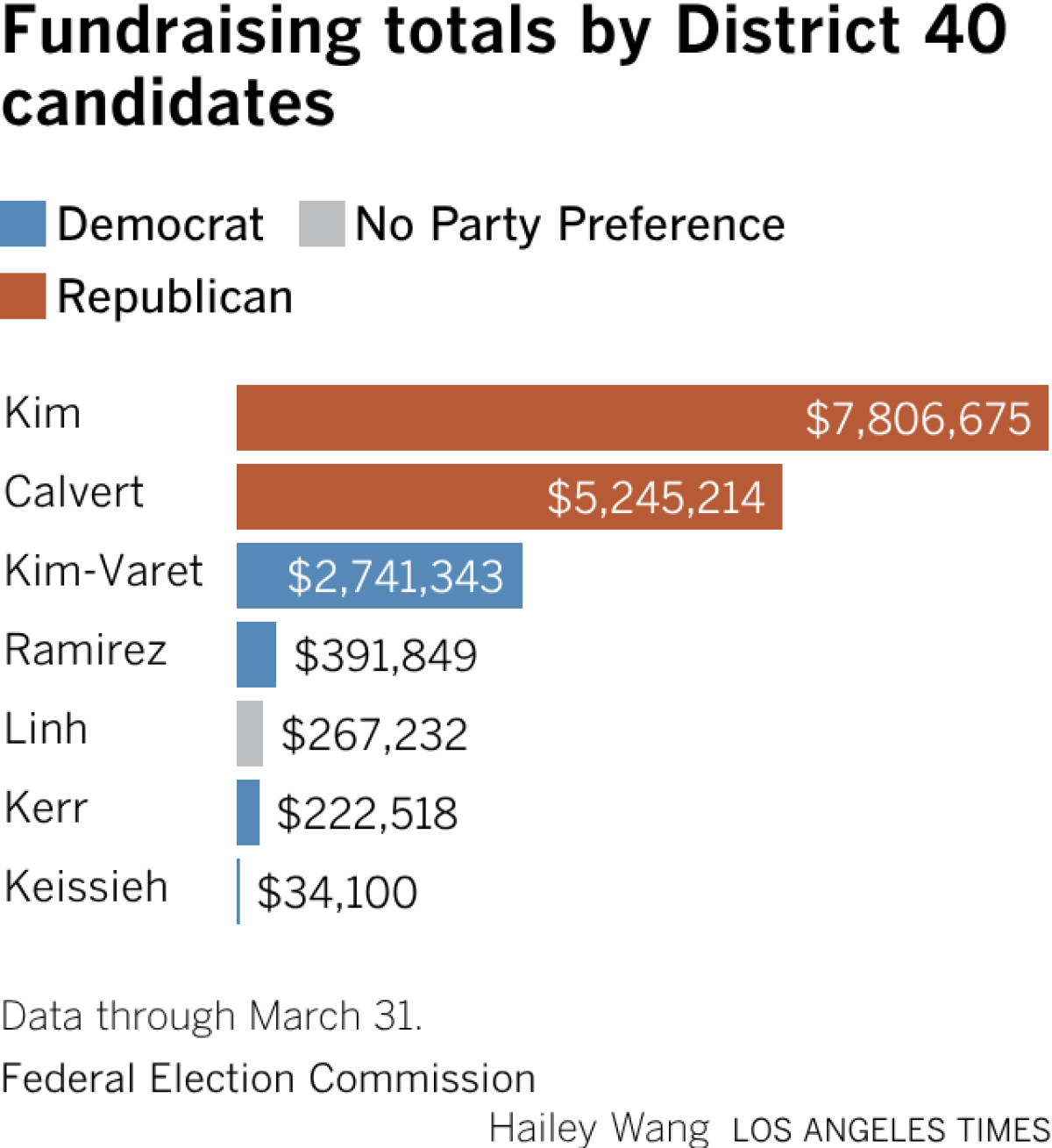
Grose will also be closely watching the race between incumbent Reps. Young Kim (R-Anaheim Hills) and Ken Calvert (R-Corona) in the redrawn Congressional District 40, which covers a swath of inland Orange County and portions of San Bernardino and Riverside counties, including parts of Kim’s and Calvert’s current districts.
The district race wasn’t designed to deliver Democrats a seat, but will produce “one of the first casualties for Republicans from the new map” — months before other expected ousters — if Kim and Calvert don’t both advance.
The national picture
The redistricting war was prompted by President Trump’s unprecedented pressuring of Republican-controlled states to redraw their maps mid-decade for partisan advantage in order to retain control of Congress, given his sinking approval ratings and a history of midterm voters punishing the president’s party.
The war ratcheted up — with more Republican states suddenly considering map changes — after a U.S. Supreme Court decision in April that weakened the 1965 Voting Rights Act and its long-standing protections for majority-Black districts in the South.
Republicans have now acted to redraw congressional maps in Alabama, Florida, Louisiana, Missouri, North Carolina, Ohio and Tennessee, with varying degrees of success, while a battle in Utah could add a single additional Democratic seat there. Attempts in other states have failed, including by the GOP in South Carolina and Democrats in Virginia.
Experts say the net result from the flurry of redistricting will probably be a gain of a handful or more seats for Republicans — but in a year when Democrats are expected to make gains more broadly, leaving control of the House up for grabs. California’s new map is “a huge deal” precisely because that math is so close, said David Wasserman, senior editor and elections analyst for the independent, nonpartisan Cook Political Report.
“Democrats are modest favorites for House control based on the political environment, but also because of California,” Wasserman said in an interview with The Times. “Picking up these four or five seats is a prerequisite to Democrats getting the majority.”
California seats in play
California has 52 seats in the U.S. House of Representatives, by far the most of any state. With their new map, California Democrats are hoping to increase their 43 House seats to 48. That would leave just four seats represented by members of the GOP despite Republicans accounting for a quarter of the state electorate.
But that outcome isn’t guaranteed.
Paul Mitchell, a Democratic redistricting expert who devised California’s new map, said the reconfigured congressional districts had to create a pathway for new Democrats to win additional seats without undermining incumbent Democrats’ reelection. And the result is a map with three pretty safe pickups for Democrats, and two districts that are “100% on the table, ready for Democrats to win,” but will nonetheless “require shoe-leather and grit.”
The redrawn congressional district boundaries enacted by Proposition 50 promise to shake up at least three seats, experts said.
Congressional District 1: Held by the late Rep. Doug LaMalfa (R-Richvale) for 13 years until his death in January, the district is currently rural and conservative, stretching from the Sacramento outskirts through Redding to the Oregon border and California’s northeastern corner. Under the state’s new congressional district map, it loses some of its rural reaches and picks up liberal coastal communities, and favors a Democrat such as state Sen. Mike McGuire, who is one of the leading candidates.
Congressional District 3: The seat is currently held by Rep. Kevin Kiley (I-Rocklin) and stretches from the Sacramento suburbs through Lake Tahoe and south along the Nevada border. Under the new map, it holds more tightly to the Sacramento suburbs, favoring a Democrat.
The changes were enough to convince an incumbent Democrat, Rep. Ami Bera (D-Elk Grove), to leave his current district — Congressional District 6, which includes the city of Sacramento and the suburbs of Roseville and Rocklin in Placer County — and run in District 3 instead.
Meanwhile, Kiley did the reverse. He quit the Republican Party, became an independent and announced he would be leaving District 3 and running instead in District 6 — the one Bera is leaving — against a slate of new Democratic challengers.
Congressional District 41. The seat is now held by Calvert, a 17-term incumbent, and currently stretches from Corona to the Coachella Valley. The new map made the district more liberal, losing voters in Riverside County and gaining them in Los Angeles County, and Calvert decided to run instead in Kim’s redrawn but still Republican-leaning Congressional District 40 that is just to the west.
The two toughest flips for Democrats, experts said, are Congressional District 22, Valadao’s heavily Latino district in the Central Valley, followed by Congressional District 48 in San Diego and Riverside counties, where Rep. Darrell Issa (R-Bonsall) decided to retire rather than run for reelection.
Valadao is viewed as especially vulnerable because of his recent support for Medicaid cuts, but he has proved resilient in the past. Meanwhile, his two leading Democratic challengers, Bains and Villegas, are in a bitter fight, with Bains receiving Democratic establishment support and Villegas winning endorsements from prominent progressives.
In Issa’s district, moderate Republican San Diego County Supervisor Jim Desmond is running against several infighting Democrats, including San Diego Councilwoman Marni von Wilpert and former Obama labor official Ammar Campa-Najjar.
Not new, or over
Jeff Wice, a New York Law School professor who was involved in California redistricting efforts in 2010, said the state “has long played hardball politics on redistricting,” including when then-Rep. Phil Burton, a powerful San Francisco Democrat, bragged more than 40 years ago that the complex congressional boundaries he’d crafted for Democrats were his “contribution to modern art.”
But in five decades studying redistricting, Wice said he has never seen such “politically driven, partisan politics” as are occurring now across the nation, which he said have “no root in law, reason or fairness” — and are only likely to continue.
“This state-by-state war is far from over, and may continue all the way through 2030,” he said. “A lot of it depends on the outcome of this November’s election.”
Wasserman said the country has “entered an era of no-holds-barred redistricting,” and he also sees redistricting efforts continuing — including in California, where they would present a distinct threat to the state’s few remaining Republicans.
Michael Li, senior counsel in the Democracy Program at the Brennan Center for Justice at NYU Law, said California is a “big part of the story” this election cycle, thanks to Proposition 50. “Democrats in California proved to be very determined and resourceful and managed to get that done, and right now California is the big offset to Republican gerrymandering around the country,” he said.
But what will come of it all — in California and across the country — is still to be determined.
“When you’re gerrymandering, you’re making a bet that you know what the politics of the future will look like, and it’s hard to predict,” he said. “It’s a high-risk, high-reward venture.”
The success of D-day, a pivotal moment in World War II, partially hinged on the weather forecast. The Allied invasion of Normandy, France, on June 6, 1944, was planned for months as the American and British forces held practice operations in England.
Enormous efforts were made to mislead the Germans about what was coming. The operation was originally scheduled for June 5 but the day before, James Stagg, a meteorologist and group captain in the Royal Air Force, advised the American commander, Dwight D. Eisenhower, to wait for better conditions.
This lesser-known decision is the premise of “Pressure,” a new movie from filmmaker Anthony Maras. It’s an adaptation of David Haig’s play of the same name, in which the playwright himself portrayed Stagg. Haig, who co-wrote the “Pressure” screenplay with Maras, compares it to “The Imitation Game.”
“Some of these heroes who affect history from the sidelines just stay in the sidelines until somebody does research, discovers them lurking and finds they are so quietly heroic that it’s irresistible as a story,” Haig says, speaking via Zoom from London.
Haig began writing a version of the script shortly after the play debuted at the Royal Lyceum Theatre in Edinburgh in May 2014. It moved to the West End in 2018, and opened in North America at Toronto’s Royal Alexandra Theatre in 2023. Maras came onboard after making his 2018 film “Hotel Mumbai,” also based on a true story.
“When I first read the play and the script, I was bowled over by how, with this one decision, so many lives were changed,” Maras says, on a video call from Los Angeles. “Not just the lives of the men on the beach but throughout the Allied world. When you think of a war story, you think of men and now women on the field, but there is so much more to it behind the scenes.”
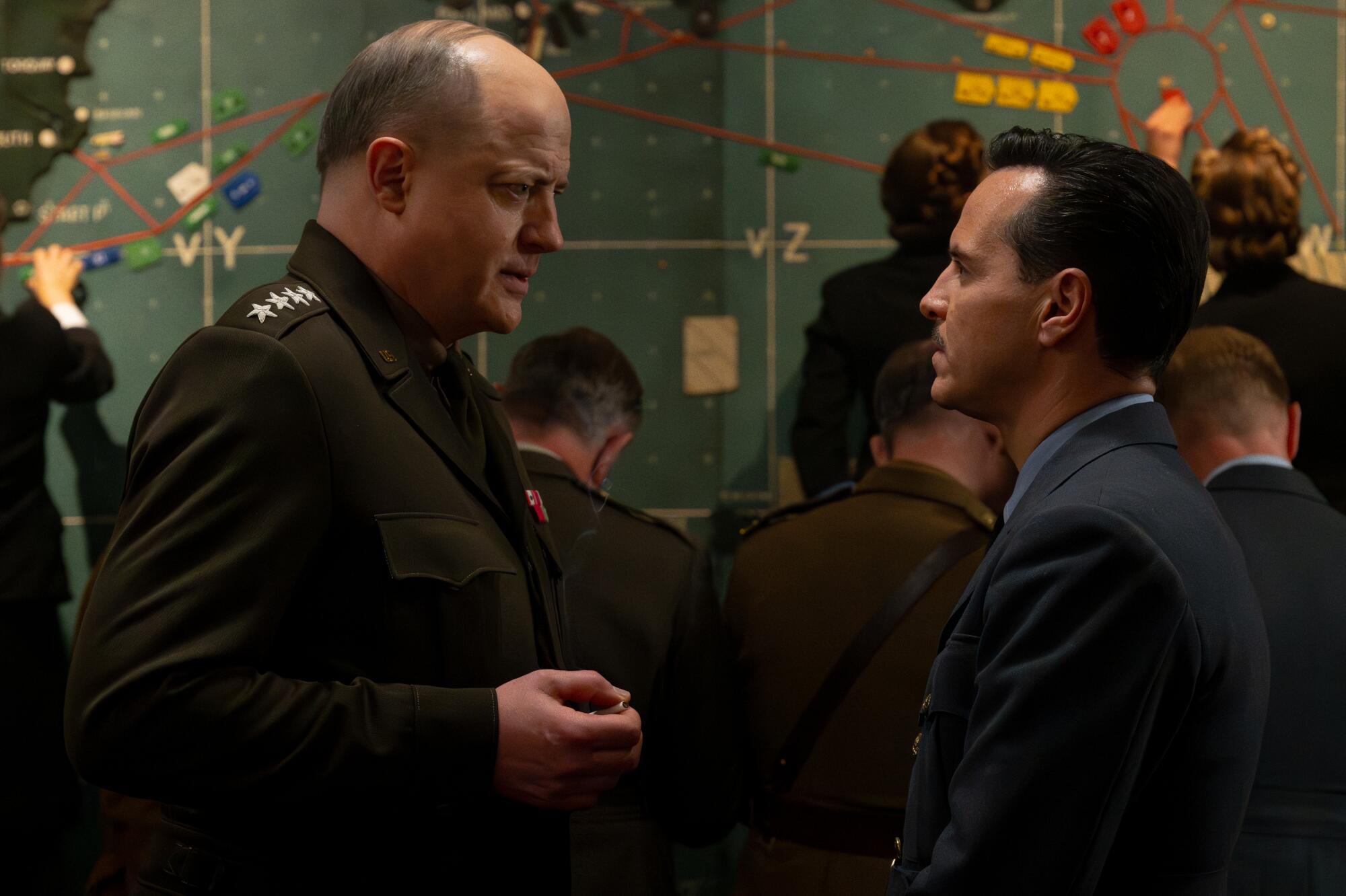
The film expands Haig’s play and includes additional characters and sequences, including the actual D-day invasion. It stars Andrew Scott as Stagg, Brendan Fraser as Eisenhower, Kerry Condon as Eisenhower’s secretary Kay Summersby, Chris Messina as U.S. Air Force meteorologist Irving P. Krick and Damian Lewis as senior British army officer Bernard Montgomery.
Both Haig and Maras strove to be as historically accurate as possible, even including archival footage from the war. “It is inevitably heightened, as any stage play or film is,” Haig says. “But it is very true.”
“It is absolutely as true as we could get it within the confines of a two-hour runtime,” Maras adds. “We took great lengths to try and be as accurate to the history but also to the deeper story as possible.”
Here’s what is true and what is dramatized in “Pressure.”
The importance of the weather
Brendan Fraser, left, and Andrew Scott in the movie “Pressure.”
(Alex Bailey / Focus Features / StudioCanal)
D-day, secretly known as Operation Overlord, was timed based on several factors, including the weather, the tides and the moonlight. Because the assault was multipronged, with Allied forces coming by sea, land and air, they required good visibility at night and a high tide to ensure less distances between the boats and the defending Germans.
“There were hundreds of meters between low tide and high tide,” Maras says. “So depending on where the boats landed, you either had 50 meters until you made it to the dunes and then the bunkers, or you had to make it 300 meters if it was low tide.”
A clear forecast with low winds and no rain was essential.
“The landing craft were antiquated and flat-bottomed,” Haig says, “and if they had gone on May 5 with the storms that Stagg anticipated coming in with the jet stream, those landing craft would have capsized. The war wouldn’t have been lost, although we do posit that it might have been in the film. In reality, failure would have elongated [the war] and caused countless extra deaths.”
To shoot “Pressure,” the filmmakers used real charts and meteorological instruments. The production design team re-created the famous D-day map from the Allied headquarters in Southwark House. The real one was made in two pieces by separate manufacturers to ensure secrecy.
“When you see that map, it’s a little bit mismatched and our team re-created that,” Maras says. “We got the paper they used to draw the maps from the same mill they used for those maps 80 years ago. A lot of effort was put into the minutiae that adds to the accuracy.”
Exercise Tiger
The film opens with a depiction of an Allied training operation called Exercise Tiger, which took place over several months on England’s Slapton Sands. Because many of the soldiers were young and untested, the Allied leaders wanted to prepare them for the sights and sounds of battle.
“They did a whole series of exercises to try and get together a full-scale dress rehearsal of what D-day would be,” Maras says.
These rehearsals, still widely unknown and spanning from late 1943 through April 1944, involved dangerous friendly fire and suffered from serious coordination errors, resulting in the real-life deaths of at least 700 American and British soldiers.
“That was an absolute disaster and yet we remember D-day as one of the great military triumphs in history,” Haig says.
Maras wanted the film to begin with this moment to emphasize the headspace of the Allied leaders.
“How do you establish what the true consequences of failure are for a story like this?” Maras says. “When we’re in the war room with all of those commanders and officers, they know what the implications of their words mean because they’ve seen it. They’ve lived it. The image of the blood in the water and the young men in that water was to tattoo in the audience’s brain that if these commanders mess up, this could happen again.”
Eisenhower, in particular, felt the magnitude of D-day. “He wrote two letters on the eve of D-day: what happens in success and what happens in failure,” Maras says. “He was sleeping two hours a night. He was a nervous wreck.”
Stagg vs. Krick
In the film, Scott’s Stagg arrives at Southwark House from Dunstable four days before D-day is planned. He is confronted by the American meteorologist Krick, who disagrees with him about the potentially disastrous forecast. Krick believes sun and calm seas are on the horizon thanks to historical analogue charts, but Stagg, using more comprehensive prediction methods, thinks a major storm is coming.
“In actuality, Stagg came onboard in about November 1943 and got to Southwark House a few months earlier,” Maras says. “His transfer came a few months earlier, not a few days earlier. The contours of the relationships between Stagg and Krick and the others are accurate, but they took place in a more compressed timeline.”
Both Stagg and Krick have recounted their version of events in various books, both claiming they were right about the weather. Although Haig and Maras imagine their dialogue and how these conflicts may have played out, the conflicts were real.
“They both adhered to their own meteorological vision,” Haig says, explaining the differences in prediction models from continent to continent. “In the United States, Krick’s system of weather forecasting was viable. If you come to the U.K., you can’t rely on the weather for more than five minutes, so that method doesn’t apply.”
Adds Maras, “They thought, ‘The weather is going to be good. We should hold our nerve and go.’ There was a rhetorically violent disagreement between him and the others.”
In the film, Krick claims that he has never inaccurately predicted the weather ahead of a battle, using his successes in North Africa as evidence. This was technically true.
“He was very good at his job within the context of certain geographical landscapes,” Haig says. “He didn’t make a mistake in North Africa. When Eisenhower challenges Stagg, he says, ‘This man never got it wrong.’ And he didn’t. In the whole of the North African campaign, Krick was spot on.”
After Stagg convinces the leaders to postpone D-day, he is vindicated by a deluge of rain that arrives while everyone is attending church at Southwark House on June 5. There was a church on site, although this moment in the film was dramatized.
“Whether it began raining precisely at that moment I have my doubts,” Haig says. “But it has the framework of truth.”
Ike and Kay
Andrew Scott and Kerry Condon in the movie “Pressure.”
(Alex Bailey / Focus Features / StudioCanal)
Kay Summersby had been an ambulance driver during the Blitz. The film hints at a less-than-professional relationship between Eisenhower and his personal secretary. She was certainly with Eisenhower at Southwark House, although there is less evidence that she had any kind of association with Stagg.
“The biggest fictional thing I did with both the play and the film was to join the third point of the triangle so you’ve got Stagg, Eisenhower and Kay,” Haig says. “The link between Stagg and Kay historically would be tenuous.”
There are differing opinions about Eisenhower and Kay’s relationship. “We know that they were extremely close and they shared a trustful bond,” Maras says. “There are many photos of them together. She was definitely a big force in Ike’s life at that time, and we wanted to pay respect to that.”
“Whatever one’s interpretation of the relationships that she inhabits within the story, her influence was substantial,” Haig adds.
After seeing Peter Jackson’s 2018 World War I documentary “They Shall Not Grow Old,” Maras had the idea to use colorized archival footage in “Pressure.”
“In the D-day sequence at the end, there are various real-life shots of the soldiers landing on the beaches,” Maras says. “We were able to cut between the archival [material] and our footage to increase the scope. And it wasn’t just to get the scale. Yes, we have shots of massive flotillas and ships and trucks, but sometimes it was just for a glance of a soldier where you can see death in his eyes.”
The team ultimately acquired more than 50 hours of archival footage. They hired research editors to go through it and, after a few days, Maras asked if any of the editors could recommend additional crew to help.
Then a man named James Stagg showed up to work. “Stagg’s grandson, 80 years later, walked into our offices and helped edit the archival movie footage that we put in his grandfather’s film,” Maras says.
Stagg’s wife
Andrew Scott in the movie “Pressure.”
(Alex Bailey / Focus Features / StudioCanal)
The play doesn’t include scenes with Stagg’s wife, Elizabeth, but Haig purposefully bookends the film with the couple together. “When he arrives at Southwark House as a terse, brusque, tricky man, you’ve already experienced his level of affection with his wife and that’s really important contextually,” Haig says. “You’re waiting for the end when he goes back to see her and the baby.”
At the time when Stagg went to Southwark House, his wife was pregnant. Stagg was not allowed to make phone calls to her because of the secrecy surrounding D-day. In reality, the hospital where she gave birth was not bombed, as it is in the movie.
“The bombing of the hospital was more reflective of the times that Stagg and his wife had gone through in the lead up to D-day,” Maras says. “That element is to encapsulate that Stagg was fearing for his wife. As he walks down this corridor, he is faced with: Is she alive? Is she dead?”
Truth to power
Ultimately, Stagg tells a room full of military leaders that they have to pause on D-day because of the weather — a truthful inclusion. It was important to Maras to emphasize how he stood up to power.
“Here’s a protagonist who’s not afraid to speak his mind and has the courage to get up in front of a room full of the most powerful military on Earth at that point and tell them something they don’t want to hear,” Maras says.
“When Eisenhower was passing on the baton of leadership at the inauguration for JFK, JFK asked, ‘What gave you the edge on D-day?’ Eisenhower said, ‘We had better meteorologists than the Germans.’ He had the wisdom to trust in the experts. It’s worth heeding that lesson from history.”
Joy Behar is trading her usual spot at “The View’s” roundtable for the spotlight in one of London’s West End theaters.
The comedian, who is one of the talk show’s longest-running hosts, is taking a temporary leave from the daytime program to take her play, “My First Ex-Husband,” overseas for the first time. The 83-year-old TV personality announced her break on Tuesday, on the podcast, “Behind the Table,” a companion program of “The View.”
“I fly to Paris this week, and then I go take the Chunnel to London after a week, and I’ll be in London a second week doing my play, ‘My First Ex-Husband,’ at the Boulevard Theatre in the West End,” Behar said on the podcast.
Behar confirmed she has already pre-taped several installments of “The Weekend View,” ahead of her absence. She will miss the next two weeks of tapings. Her last appearance on the weekday edition of the show is Thursday.
In Behar’s absence, several “View” regulars will step in. Brian Teta, the show’s producer, said on the podcast that Sheryl Underwood, Kara Swisher and Ana Navarro will make appearances in the coming weeks. Whoopi Goldberg, another one of the talk show’s staple personalities, will also be coming in on Fridays, which is her usual day off.
“I don’t think she knows yet, but I’ll let her know that she’s going to be here,” Teta joked of Goldberg’s new responsibility.
Behar’s play, “My First Ex-Husband,” first debuted off-Broadway in New York in 2025. The comedian wrote the show over the span of 12 years. The story follows a rotating cast who tell chaotic stories about past relationships. The play is set to debut in the coming weeks, according to Behar. She and Jackie Hoffman will be two American narrators for the show, while two British actresses perform the scenes.
The Southern Section finalized its championship schedule for softball this week, and the Division 1 final between La Mirada and JSerra will take place Friday at 7 p.m. at Bill Barber Park in Irvine.
La Mirada is 26-4 and will be facing JSerra pitcher Liliana Escobar, the best in the Southland. La Mirada lost to JSerra 5-2 on March 7. The Matadores have been led by Riley Hilliard, who’s hitting .577 with 10 home runs.
JSerra (24-8), which began the school year winning the Southern Section flag football championship, is trying to end the year on top behind the arm of Escobar, who has 252 strikeouts in 146 innings. The top hitter has been sophomore catcher Annabel Raftery.
The Division 2 final will match Mater Dei against Whittier Christian on Friday at 4 p.m.
The Southern Section is waiting for the baseball semifinals to be played on Tuesday before announcing dates and times. The only certainty is the Division 1 final will be played on Friday at 7 p.m. at Cal State Fullerton unless either of the finalists has a scheduling issue on that date.
This is a daily look at the positive happenings in high school sports. To submit any news, please email eric.sondheimer@latimes.com.