plans

Heathrow Airport bosses warn plans for third runway could be delayed by FOUR years due to major planning rows & issues

HEATHROW Airport bosses have warned plans for a third runway could be delayed by four years due to major planning rows.

The Government’s ambition had been to see flights take off from a new runway in London by 2035.

Aerial view of a British Airways Boeing 747 taxiing at Heathrow Airport Terminal 5 in London, UK.
Heathrow Airport bosses have warned plans for a third runway could be delayed by four years Credit: Alamy Stock Photo

But airport bosses are believed to have told ministers that the deadline is not possible and won’t be ready until 2039, reports The Times.

The initial target had been set by then-Chancellor Rachel Reeves in January 2025 – but it was considered an ambitious goal at the time.

Ms Reeves used a major speech on infrastructure to announce the Government would be supporting the third runway project as a means of growing the economy, and also said it would create 100,000 jobs.

But London Heathrow has said they aim to “secure planning permission” by 2029 and “once achieved, the runway will be open within a decade”.

FOOTIE TO FOODIE

I stayed at UK hotel owned by ex-Man City ace – he even cooks your brekkie


DEAD CHEAP

Top UK holiday parks for Halloween fun at October half term from £2.75pp a night

Its bosses believe it could be delivered more quickly, but that this may require further regulatory red tape to be removed beyond reforms that the Government has already made to planning law.

A spokesperson said: “It’s right that ambitious targets were set; the sooner expansion begins, the sooner the whole UK will benefit. Our focus has always been to secure planning permission by 2029.

“Once achieved, the runway will be open within a decade – and the benefits of expansion can be felt from today. At least 108,000 new jobs and billions invested in supply chains in every part of the country.

“This is a national project, 100% privately financed, which will support growth today and secure the UK’s position in the global economy once the runway opens.”

Meanwhile, the Department for Transport said the timeline for the plans “has always been ambitious”.

Gary Smith, General Secretary of GMB, said: “This is a deliverable, workable and practical timeline for Heathrow expansion that unlocks over 100,000 jobs.

“We need to put an end to decades of talk and lost benefits for working people across the country and get cracking.”

Transport Secretary Heidi Alexander insisted the project could go ahead in a way that would not fall foul of climate change commitments.

The Climate Change Committee, the expert panel that advises the Government, said earlier this month the expansion of Heathrow airport cannot go ahead unless the aviation industry is forced to clean up its emissions.

The cost of international flights might have to increase by hundreds of pounds by 2050 to pay for measures that will help the airline sector cut its carbon pollution to zero overall, known as net zero, the committee said.

Ms Alexander told the Daily Telegraph the committee had set out “one view” but there was “more than one pathway to meeting our climate mate change obligations”.

“We do remain committed to net zero, and we’re updating some of our wider decarbonisation plans in transport as well,” she said.

“But the UK’s climate change targets are ultimately economy-wide targets, and we really need to look holistically at how emissions are reduced across the economy as a whole.”

She said an expanded Heathrow could be “the country’s front door” to tourists from China and India.

The Heathrow proposals involve building a 3,500-metre runway and requires a new M25 tunnel and bridges to be built 130 metres west of the existing motorway.

It is estimated to cost £33 billion, including £1.5 billion on re-routing the motorway which would also see nearby villages demolished.

The government had previously rejected a proposal from Arora Group, led by hotel tycoon Surinder Arora, to build the third runway.

The Arora plan had proposed a shorter, 2,800-metre runway that would not require diverting the M25.

The new 3,500 metre runway will be in the northwest of the airport, and will eventually welcome up to 276,000 new flights a year.

This takes the annual flights from 480,000 to 756,000, with as many as 30 new flight routes a day.

A Department for Transport spokesperson said: “There is currently no live planning application for a third runway, and we cannot comment on ongoing consultation processes or prejudice them in a way that will only delay progress.

“The timeline has always been ambitious.

“We’ll continue to work with promoters, including Heathrow, and all other stakeholders at pace to ensure the right framework is in place for which a planning application for a third runway could be considered.”

Source link

Lithuania has evacuation plans in face of Russia threats, PM says

Germany – a fellow Nato ally – pledged to permanently station a combat-ready brigade in Lithuania in 2023 as a response to the changing security situation in Europe.

It is expected to be operational by 2027 and to number about 5,000 soldiers and civilian employees, though it has failed to recruit enough personnel voluntarily and is now turning to compulsory assignments to fill some positions.

The majority of troops will be based in Rūdninkai, near the Suwałki Gap – a line that borders Lithuania and Poland and also links Belarus with Russia’s Kaliningrad.

Nato said that as of December last year it had more than 5,000 troops stationed in Lithuania.

The origins of last week’s drone incident over Lithuania have not been confirmed, however Defence Minister Robertas Kaunas told Newshour that it had come from the direction of Belarus.

UK Defence Secretary Wes Streeting said: “Thanks to the swift and professional actions of Lithuanian and Italian forces, Nato once again demonstrated our readiness to protect our airspace.

“We stand united, around the clock, in defence of every inch of Nato territory.”

Moscow did not comment on the incident.

Military drone incursions have become increasingly common across Europe since the beginning of Russia’s full-scale of invasion of Ukraine.

Residents in Lithuania’s capital Vilnius were also forced to take shelter in May after a drone alert was triggered, briefly grounding flights and rail travel.

Nato jets have scrambled multiple times to shoot down stray Ukrainian drones that have crossed into fellow Baltic countries Estonia and Latvia this year.

Ukraine has blamed the stray drones on Russian electronic warfare, technology designed to change the flight paths of Ukrainian drones.

Lithuania, Estonia and Latvia all joined Nato in 2004, becoming signatories to the Article 5 provision that states “an armed attack against one Nato member shall be considered an attack against all members”.

Source link

What’s the US–China AI ‘hotline’ that Trump plans to pitch to Xi Jinping? | Technology News

The United States wants a new “notification mechanism” with China to warn each other when an artificial intelligence incident becomes serious enough to threaten national security.

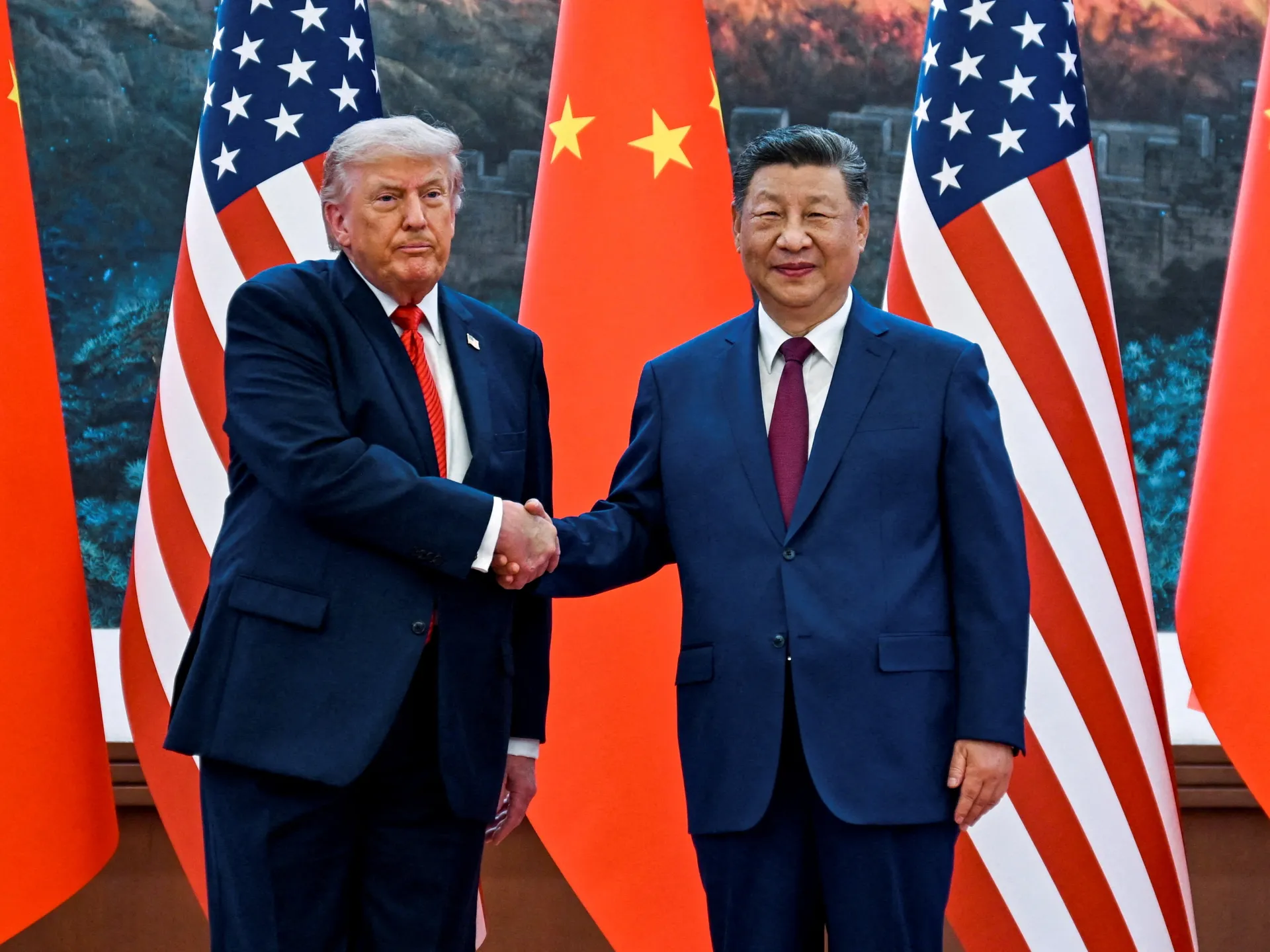
The proposal, effectively an “AI hotline”, was discussed on Sunday during talks in New York between US Treasury Secretary Scott Bessent and Chinese Vice Premier He Lifeng, ahead of a summit between US President Donald Trump and Chinese President Xi Jinping in Washington this week.

Recommended Stories

list of 3 itemsend of list

The two leaders are expected to consider establishing a broader US-China dialogue on AI, including the proposed notification system, around which details remain limited.

The initiative comes amid an intensifying contest for AI supremacy between the world’s top two economies, together with increasing warnings from tech giants that guardrails are necessary around the ever-growing technology.

So, what do we know about this so-called hotline, and where is the AI battle between the US and China headed?

What did the US say about this mechanism?

US Treasury Secretary Bessent said Washington had proposed creating a US-China AI dialogue, with particular focus on national security and a notification system covering “common goals and common threats”.

“We think that, just like with any cross-border activity, that moving from opaque to more transparency between the number one and the number two AI powers in the world is very important,” Bessent told reporters after Sunday’s discussions.

Trump’s science and technology adviser Michael Kratsios told Fox News on Sunday that the “key thing” Washington wants to discuss is “avoiding shared risks”.

Exactly what would trigger a notification has not been publicly revealed.

“The US and China absolutely need to be able to share information with each other as threats evolve. This seems like an obvious win for both sides,” Scott Singer, co-director of the China AI Initiative at the Carnegie Endowment for International Peace, told Al Jazeera.

“The relationship needs guardrails to keep citizens of both countries safe, and this is a productive first step.”

How did China respond?

Beijing has so far said very little.

China’s official Xinhua news agency acknowledged that He and Bessent discussed issues related to AI, but did not say whether Beijing had accepted Washington’s proposed notification mechanism.

Xinhua said the officials held “frank, in-depth and constructive exchanges” on economic and trade issues.

He and China’s chief trade negotiator Li Chenggang left Sunday’s talks without speaking to reporters.

What other ‘hotlines’ do the US and China have?

The proposed AI mechanism would not be the first time a special crisis channel was established between Washington and Beijing.

In 1997, former US President Bill Clinton and his then Chinese counterpart Jiang Zemin agreed to create a “direct secure telephone link” between their respective countries.

The two countries have had a military hotline since 2008, designed to allow senior defence officials to communicate during potentially dangerous incidents. It gives both sides 48 hours to respond, though US officials have complained that sometimes no one picks up.

After the US shot down a suspected Chinese surveillance balloon in 2023, then-US Defense Secretary Lloyd Austin sought a call with his Chinese counterpart, but Beijing declined the request.

Why now, and what concerns are there around AI?

Earlier this month, Anthropic’s CEO Dario Amodei warned in an essay that AI capabilities have been advancing rapidly, and he proposed pacing the development of frontier models to give governments and researchers more time to manage their risks.

“Given the accelerating rate of AI capability development, it’s my worry that in 6–12 months such a swarm could be capable of taking over the entire internet with a persistent botnet (potentially causing hundreds of billions of dollars in damage), and that the scale of damage would continue to increase from there if AI becomes more powerful without the necessary guardrails,” he wrote.

His assertions were endorsed by his rivals – OpenAI CEO Sam Altman and SpaceX founder and Tesla CEO Elon Musk.

Meanwhile, Trump has repeatedly argued that the US must maintain its advantage over China and has resisted calls from technology executives for a slowdown in AI development. He has said that “whoever wins AI, wins”.

Carnegie Endowment’s Singer does not expect the “fierce competition for AI to slow down”.

“It has the potential to confer tremendous economic and strategic advantage to both countries. But even competitors can find space to cooperate,” he noted.

“Competition and cooperation can coexist. The key for right now is for both sides to act in their own self-interest. Finding some basic areas for cooperation flows very naturally from that.”

Where is the US-China AI war headed?

The US remains ahead in several of the most important features of the AI race, but China has been closing the gap.

American companies continue to dominate private investment and production of leading AI models. According to Stanford University’s 2026 AI Index Report, US companies invested $285.9bn in AI in 2025, compared with $12.4bn in China.

The US also has an advantage in the most advanced semiconductors needed to train cutting-edge models.

However, Chinese companies have demonstrated that they can produce resilient AI models despite US restrictions on their access to the most advanced AI chips.

In January, the release of Chinese AI startup DeepSeek made headlines after it was built using only a fraction of the money its competitors had spent on their own AI programmes. Share prices of US tech companies plummeted.

China possesses advantages in other areas of the AI supply chain, most notably in the production of critical rare earth minerals used in advanced technology and in generating more than twice as much electricity as the US, giving it access to the huge amounts of relatively cheap power needed to operate AI data centres.

What is the Xi-Trump summit about?

Xi’s state visit to the US will take place from Wednesday to Friday, with Trump expected to welcome him at Joint Base Andrews in Maryland.

Trump has said he expects to discuss “almost everything” with the Chinese leader.

Trade remains a central issue, with Beijing and Washington having yet to reach a lasting settlement on tariffs, which have dominated Trump’s relationship with China in his second term as president.

Last month, Trump’s White House accused dozens of countries of helping China to illegally bypass US tariffs.

Meanwhile, the US Congress last week passed a bill that gives Trump sweeping powers to impose sanctions on Russia’s crude exports as well as steep tariffs on buyers of Russian energy, a measure that will impact Moscow’s biggest customers, China and India.

Trump’s war with Iran is also expected to feature. Beijing ranks among Iran’s key economic allies, purchasing a large share of Tehran’s oil exports and attempting to broker an end to the near seven-month-old US-Israel war on Iran.

Other long-standing disputes hang over the summit, including China’s dominance of rare-earth supplies and Taiwan.

The US AI proposal could represent a rare area where the two rivals may find a way to hammer out a deal, experts say.

“I think establishing a permanent channel exclusively focused on AI would genuinely be a major victory. AI has been caught up in the broader ebbs and flows of the US-China relationship, and the 2024 dialogue failed because frontier AI risks got mixed in with other issues,” Singer said.

“This time looks like it might be different, and having an AI risk channel is a necessary precondition to mutually beneficial cooperation.”

Source link

Air Force Announces New Plans To Take Over Defending Its Own Bases From Aerial Attack

Faced with a growing threat to their bases and personnel from missiles and drones and some recent hard-learned lessons, two top Air Force officials on Monday announced plans to increase protection. The statements were made during the Air & Space Forces Air, Space and Cyber Symposium that TWZ is attending. They were delivered as the service is seeking to improve its organic ability to defend its bases and has developed new doctrine to do so. 

The war against Iran exposed gaps in how the U.S. can provide effective, sustained air defenses for its foreign installations and there are major concerns about a future fight against a peer competitor like China or Russia. Drone incursions at home have raised alarms about domestic base protection as has the war between Russia and Ukraine.

The following video shows a fatal Iranian attack on Muwaffaq Salti Air Base in Jordan in July.

“For decades, American air and space power has often operated from a position of sanctuary. Those days are over,” Air Force Chief of Staff Gen. Kenneth S. Wilsbach said during a keynote speech. “We can no longer treat point defense as a side hustle. We must make it a core function of air and space power.”

He acknowledged the widespread damage Iran caused to U.S. bases and suggested that lack of base defense played a large role.

“So, if we had more robust base defense, perhaps those bases wouldn’t have been as damaged as they were,” the general admitted. “Look at Israel; they have a significantly layered, very robust defense of their country, and they didn’t take that many hits. Very few, in fact, and that shows you what a good defensive system can do, which can help you to operate not quite with impunity, but almost, and you can just keep generating air power, and your defensive systems take care of the incoming.”

TEL AVIV, ISRAEL - JUNE 18: Israel's 'Iron Dome' air defense system responds to incoming Iranian ballistic missiles as seen from Tel Aviv, Israel on June 18, 2025. (Photo by Mostafa Alkharouf/Anadolu via Getty Images)
Israel’s ‘Iron Dome’ air defense system responds to incoming Iranian ballistic missiles as seen from Tel Aviv, Israel on June 18, 2025. (Photo by Mostafa Alkharouf/Anadolu via Getty Images) Anadolu

Wilsbach offered some concrete suggestions about how to make improvements. 

“First, we will establish the point defense weapon system, bringing together kinetic and non-kinetic capabilities to secure our air bases,” the general said. He did not offer any specifics. 

While Wilsbach offered no details about what a point defense weapons system would entail, we recently wrote that the Air Force is seeking an anti-aircraft gun system to help defend its air bases around the world from drones and cruise missiles. Introduced via a Request for Information (RFI) recently posted on the government’s contracting website, the gun system concept is part of a larger Air Force effort to play a greater role in air base defense via ground-based air defenses (GBADs). This role is largely performed by the U.S. Army, most notably with surface-to-air missile systems like Patriot and the Humvee-based Avenger system. The Terminal High Altitude Area Defense (THAAD) system can also provide broader area defense against incoming ballistic missiles. Other short-range systems optimized to swat down drones and even incoming rockets include the Centurion Counter-Rocket, Artillery, Mortar (C-RAM) system, Coyote counter-drone interceptors and more.

The Air Force currently has no such systems. Now it is set on changing that.

The Air Force is also looking at directed energy weapons like lasers for force protection and especially for defending bases overseas. While gaining traction across the services due in large measure to the much lower cost of delivering effects, these systems are still works in progress.

A U.S. Army Terminal High Altitude Area Defense (THAAD) in Guam. (U.S. Army)

It’s one thing to have equipment, but another to have experts that know how to use it, Wilsbach noted.

“Second, we have established a new career field of point defense airmen,” he added. “This new career field will be operational in two years. Together, these two new initiatives will strengthen our defenses, reinforce our ability to generate air and space power under fire, and protect our greatest advantage: our airmen and guardians.”

“Protecting the force and generating combat power are inseparable,” Wilsbach explained. “We need our airmen trained, equipped, and ready to fight from the opening moments of a conflict.”

“Don’t you think we ought to have them at every base?” he suggested when asked about point defenders during a media engagement at the symposium. “Because if every base is going to be threatened, we have to have somebody that knows how to defend it. So, obviously, that’s a long-term objective. But what I’ll tell you for right now is we’re going to develop the career field and push it forward to the critical bases that need protecting most, and then we’ll expand it beyond there.”

Airmen assigned to the 319th Reconnaissance Wing, prepare to execute a Point Defense Battle Lab exercise on the flightline at Grand Forks Air Force Base, North Dakota, Feb. 13, 2026. The PDBL serves as a hub for collaboration, pushing boundaries in Couter-small Unmanned Aircraft System capabilities, ensuring the Air Force maintains tactical superiority against evolving threats, and is a key part of the service’s effort to develop and evaluate advanced technologies to defend installations from sUAS threats. (U.S. Air Force photo by Airman 1st Class Emma Teel)
Airmen assigned to the 319th Reconnaissance Wing prepare to execute a Point Defense Battle Lab exercise on the flightline at Grand Forks Air Force Base, North Dakota, Feb. 13, 2026. (U.S. Air Force photo by Airman 1st Class Emma Teel) Airman Emma Funderburk

Though he wants the Air Force to come up with new defensive systems and personnel with the know-how to operate them, Wilsbach is not quite as sold on building out hardened aircraft shelters (HAS). This is his long-standing position that he reiterated on Monday.

“If you know where you’re going to fight from, hardened shelters aren’t that bad of an idea,” the general posited. “Deeply buried are even better. But if you are like us, and we don’t necessarily know where we’re going to fight from, if you build a hardened shelter and you don’t happen to be there, then you perhaps wasted that money.”

“So, given a resource-constrained environment, I would like to put my dollars in systems that can go anywhere in the world and protect you with basically the same level of security by shooting down incoming rounds versus making a hardened shelter that is impervious to an attack,” Wilsbach explained. “You have to put it 200 or 300 feet underground. Any hardened shelter that you show me that’s above the ground, I can blow up. So unless it’s really deeply buried, and then if it is, it’s expensive. And so that’s my logic: the best bang for the buck.”

An F-16 in a shelter.
A U.S. Air Force F-16 Fighting Falcon, assigned to the 480th Fighter Squadron, sits inside a hardened aircraft shelter during exercise Turbo Weasel at Spangdahlem Air Base, Germany, April 14, 2025. (U.S. Air Force photo by Senior Airman Demi M. Ebert) Senior Airman Demi M. Ebert

To speed up the fielding of defensive systems, the service is interested in building out a procurement process specifically designed to develop weapons and other equipment needed to defend bases.

“How do you make sure that [airmen] have the kit they need to do the job?” Air Force Secretary Troy Meink asked rhetorically at a separate symposium session.

The Air Force, he said, is considering creating a new base defense Portfolio Acquisition Executive (PAE). The service created PAEs at the beginning of the year as part of an overhaul of its acquisition process ordered by Defense Secretary Pete Hegseth. 

“The creation of PAEs is a central element of that direction,” according to an Air Force memo on the topic. “By organizing acquisition leadership around portfolios of capability, rather than discrete programs alone, the Department seeks to improve integration, decision speed, and outcome-focused execution across the acquisition enterprise.”

(U.S. Air Force)

Meink acknowledged that there are challenges to creating a new PAE, most notably the overhead cost of establishing a new office with its associated personnel and infrastructure.

“Probably not going to do it right away, but obviously I think we’re on a path to something like that in the future,” the secretary suggested. “But there definitely has to be a continually increasing focus on making sure we can defend our airmen and guardians wherever they are in the world. This is not just an overseas problem; it’s a U.S. problem as well.”

Though we have been raising the alarm for years about the need for domestic base protection, the issue came into sharp focus in December 2023 after Langley Air Force Base in Virginia was beset by mysterious drone incursions for much of that month. The nature of those flights, which we were the first to report, remains publicly unknown. Since then there have been incursions at several other bases in the U.S., including Barksdale Air Force Base in Louisiana, home of B-52 Stratofortress bombers and nuclear weapons storage facilities, and a key part of the airborne leg of America’s nuclear triad. There have also been numerous incursions over U.S. bases in Europe, many of which we were the first to report.

As we noted earlier in this story, the U.S. is already facing a challenge defending against Iranian threats. A war with China would be more devastating and, when it comes to the Air Force protecting its bases, require more robust defenses and a lot more of them at many more locations. At the same time, the Air Force is still very early in the process of taking on more responsibility for protecting its assets.

Meanwhile, the Army has its issues when it comes to air defense. Its existing Patriot battalions have already been shown to be worryingly inadequate to meet heavy existing operational demands, something TWZ has been calling attention to for years now. We have also been raising concerns for a long time about its lack of SHORADS.

For the Air Force, recognizing the problem and taking steps to fix it are important steps. Whether these are the right approaches is something we will keep an eye on.

Contact the author: howard@twz.com

Howard is a Senior Staff Writer for TWZ. He writes frequently about conflict, focusing heavily on the Middle East and Ukraine, and interviews with military and intelligence officials and industry leaders from around the globe. He lives near Tampa, Florida, home of U.S. Central Command, U.S. Special Operations Command.


Source link

Very grand garden centre with country’s best afternoon tea unveils huge makeover plans

A HUGE estate with beautiful grounds, tea room and even a museum could be set to completely transform.

Waterperry Gardens in Oxford has submitted plans for a complete change-up including the building of a brand-new tea room additions to the courtyard.

Waterperry Gardens is an estate with a huge house, gardens, and tea room Credit: Alamy
New designs have been submitted for a new tea room with enormous windows Credit: Cowper Griffith Architects / South Oxfordshire District Council

Waterperry Gardens is a popular spot thanks to its beautiful ornamental gardens, award-winning tea rooms, garden shop, gift barn, gallery and museum.

It even has an outdoor amphitheatre for opera, theatre and music with performances through the summer months.

It’s visited year-round thanks to its various flower and plant displays with lots saying it’s still worth a trip out of season in autumn.

One visitor said: “We have visited Waterperry several times and in the early autumn the aster borders are at their best.”

TOP STAYS

Best-rated UK hotels as voted for by guests – with rooms from just £31 a night


ISLE BE GOING

Sun Travel’s favourite islands from Europe’s Caribbean to a £2 wine paradise

Another added: “Lovely little place. Great gardens (even in late October there was still plenty of colour). Nice cafe. Good shop and gallery.”

A third wrote: “This is difficult to describe how wonderful these gardens are. Even at the beginning of September they were full of bloom.”

But the Waterperry Gardens could well transform as it submits plans to build a brand new home for its tea room – and reconfigure the site.

The plans say “there is an urgent need to replace the existing catering building with a new facility that serves both the current and future needs of the site“.

The building which houses the tearooms was a former laboratory which has “exceeded its lifespan.”

A new design by Cowper Griffith Architects revealed a much brighter building with large windows.

Visitors say that the gardens are worth visiting all year-round Credit: Getty
Collage of travel items including a plane, sunscreen, passport, suitcase, and plane tickets, advertising The Sun's travel Instagram account.

Other plans include relocating the car park to the west of the picnic lawn and seating on a courtyard between the museum and the new building.

These proposals are currently in its consultation period – so there’s plenty of time to see Waterperry Gardens as it is now.

Anyone visiting will definitely want to pop into its award-winning tea room.

Last year it won Afternoon Tea of the Year 2025 by the Garden Centre Catering Awards.

The redevelopment reveals new building and courtyard seating Credit: Cowper Griffith Architects / South Oxfordshire District Council
The new plans are in the consultation phase Credit: Cowper Griffith Architects / South Oxfordshire District Council

At lunchtimes it serves up jacket potatoes , soups, salads and homemade cakes.

It also has two afternoon tea options; Waterperry Tea or Celebration Tea.

Each comes with a selection of cakes, homemade jam, scones and clotted cream, sandwiches and mini vegetarian quiche tart, along with loose leaf tea, coffee or Prosecco.

Visitors can also pop into its on-site museum which reveals what rural life was like 100 years ago, and kids can enjoy the play outdoor play area too.


Source link

Aaron Donald plans to play for Rams; Puka Nacua has hip injury

Aaron Donald said Friday that he planned to make his season debut for the Rams against the New York Giants on Monday night, but star receiver Puka Nacua’s status is more hazy because of a hip injury.

Donald, 35, rejoined the Rams after ending a two-year retirement. The three-time NFL defensive player of the year did not travel to Australia for the season-opening defeat by the San Francisco 49ers, but he has participated in several 11-on-11 drills this week.

Asked if he would play on Monday, Donald said, “That’s the plan.”

Donald’s plan? Or the Rams’?

“I think that’s all of our plan,” he said. “We have a conversation, we figure it out.”

Donald said he felt as if he had never been away.

“Kind of getting in the groove of things, understanding everything a lot better out there playing a lot more free, a lot more loose and looking more like myself to me,” he said.

Nacua, who was sidelined for a few weeks during the preseason because of a psoas injury, caught five passes for 74 yards against the 49ers and practiced on Thursday. The psoas is involved in hip movement, so it is not clear whether Nacua’s absence was caused by the same injury or a new one.

Nacua was scheduled to speak with reporters on Friday, but did not do so because he did not practice. Coach Sean McVay is scheduled to speak with reporters on Saturday.

Regardless, the Rams are expected to get a boost from Donald, an eight-time All-Pro.

Edge rusher Byron Young played with Donald as a rookie in 2023. Now he will be playing alongside him again.

“He hasn’t missed a beat,” Young said.

Source link

Russia’s plans may include strikes against Ukraine’s allies, Poland says | Russia-Ukraine war News

Warsaw also says it has scrambled military planes in response to a Russian attack in western Ukraine, close to its border.

Polish Prime Minister Donald Tusk says that intelligence information suggests Russia plans to launch drone and missile attacks against countries supporting Ukraine.

Warsaw’s leader outlined the assessment during an address to parliament on Thursday, saying that the attacks will be meant to weaken NATO’s ability to act collectively in response.

Recommended Stories

list of 4 itemsend of list

“According to intelligence assessments, Russia’s plan … includes hybrid drone and missile strikes against countries supporting Ukraine, including Poland,” Tusk said.

European countries suspect Moscow of being behind a series of acts of sabotage in recent months to put pressure on the allies, especially Germany, helping Kyiv in its bid to resist Russia’s full-scale invasion – something the Kremlin has vigorously denied.

“These potential strikes would be quote-unquote ‘accidental’ in nature, intended to paralyse or at least weaken the resolve of NATO states to invoke the relevant NATO provisions in the event of aggression against a member country,” Tusk added.

He did not elaborate on which intelligence agencies had provided the warning.

He also said such attacks by Russia could coincide with “political changes in certain European countries granting power – or at least a powerful voice – to those who, increasingly invoking noble slogans of peace, pacifism and needless casualties, will call for peace – or rather, the total capitulation of Ukraine”.

Tusk appeared to be referring to the advance of more Russia-friendly parties such as Alternative for Germany (AfD) and National Rally in France.

Air raid near border with Poland

Earlier on Thursday, Poland said it had scrambled military planes in response to a Russian attack in western Ukraine, close to the Polish border.

Airports in Rzeszow and Lublin were temporarily closed, and residents of two eastern regions of Poland received air raid warnings. Local media reported that sirens had sounded and that pupils in some schools had sought shelter.

“Very close to the Polish border, not far from Dorohusk, a petrol station was most likely attacked again,” Tusk said.

On Sunday, a Russian drone hit a passenger train in Ukraine, just two kilometres (1.6 miles) from the Polish border.

Defence Minister Wladyslaw Kosiniak-Kamysz said Poland was strengthening airspace protection.

“We have increased F-16 and helicopter activity, and are reinforcing our air defence and rapid response systems,” he wrote on X.

Tusk said he would visit Ukrainian President Volodymyr Zelenskyy on Friday to discuss cooperation within the Integrated Anti-Ballistic Missile Coalition, a group of European countries developing an air defence system with Ukraine as a cheaper alternative to the US-built Patriot.

Source link

Arab News | Amnesty urges Algeria to abandon death penalty plans after wildfires

TUNIS: Amnesty International urged Algeria’s government on Tuesday to abandon plans to resume executions after it pledged to give the death penalty to those responsible for wildfires following deadly blazes last month.

Algeria struggled to put out fires that swept through its northeast and killed 12 people last month, according to an official tally, while witnesses spoke of dozens of deaths.

A member of a civil protection unit battles a wildfire in a mountainous area near the town of Al Hachimia, Bouira Province, on July 21, 2026. (AFP)

The North African country has not carried out executions since 1993 but has handed down the death sentence in some instances, including terror-related cases, without carrying it out.

Last month President Abdelmadjid Tebboune ordered the justice minister to amend the penal code to impose the death penalty for people who start wildfires after the deadly blazes.

“Algeria’s authorities must immediately abandon any plans to expand the scope of the death penalty or resume executions after more than three decades without carrying one out,” Amnesty said in a statement.

It also called for the country to impose an official moratorium “as a first step toward fully abolishing the death penalty.”

Tebboune also said that people sentenced to death should be executed right after exhausting their right to appeal.

The government began looking at draft penal code amendments this month.

Tebboune said “child abductors and abusers” would also be included in the expanded death penalty plans.

Forest fires occur regularly in northern Algeria during the summer, but climate change is amplifying their impact by causing increasingly frequent droughts and intense heat.

But Tebboune alleged that there was “something criminal” about the recent blazes.

Amnesty also said “credible sources have since reported significantly higher casualties” than the official tally in the latest wildfires, “including over 70 deaths in a single municipality.”

More than 30 people were killed in July 2023 when fires tore through thousands of hectares of forests and farmland in Algeria, as well as hundreds of homes.

In 2023, Algeria handed the death penalty to more than 50 people — some in absentia — over the lynching of a 38-year-old man who was falsely accused of starting deadly forest fires two years earlier.

Source link

Arab News | Trump administration plans $2.8 billion munitions sale to Israel, sources say

WASHINGTON: President Donald Trump’s administration is planning to sell to Israel a munitions package worth $2.8 billion, which will include tens ​of thousands of highly destructive 2,000-pound bombs, according to a US official familiar with the sale.

The planned sale, which has been informally communicated to relevant congressional committees who weigh in on large arms sales, includes 20,000 MK 84s and 20,000 BLU-117s, the official, speaking on ‌the condition ‌of anonymity, said.

News of ​the ‌package ⁠was first ​reported ⁠by the Washington Post.

The State Department and the Israeli embassy did not immediately respond to a request for comment.

US public support for Israel has fallen since the Gaza war began in 2023, particularly among Democrats. A June Quinnipiac University ⁠poll found 48 percent of voters and ‌66 percent of Democrats ‌believe the United States is too ​supportive of Israel, up ‌from 16 percent and 20 percent when the question ‌was first asked in 2017.

The 2,000-pound bombs have been regularly used by Israel in Gaza as well as in Lebanon, drawing scrutiny from rights experts. More ‌than 73,000 Palestinians have been killed in Israel’s military campaign, according to ⁠Gaza health authorities. ⁠A UN inquiry determined that Israel had committed genocide in Gaza, a charge Isarel rejects.

Israel calls its actions self-defense, after Hamas-led militants killed 1,200 people and took more than 250 hostages in an October 2023 attack.

The US and Israel attacked Iran on February 28. Iran responded with its own strikes on Israel and Gulf states that host US bases. ​US-Israeli strikes on ​Iran and Israeli attacks in Lebanon have killed thousands and displaced millions.


Source link

US Supreme Court rejects Trump’s plans on postal ballots: Why it matters | Courts News

The United States Supreme Court has rejected Donald Trump’s bid to restrict voting by mail ahead of the November midterm elections, in a setback to the US president’s efforts to change rules governing elections.

The ruling on Monday by the conservative supermajority court allows states to continue sending out mail ballots as they have done for years, dealing a blow to Trump’s plans to stop the ballots before the elections and halting possible last-minute legal actions as voting begins in some states.

Recommended Stories

list of 4 itemsend of list

Trump has repeatedly cast doubt on the security of mail-in voting, citing debunked claims of widespread election fraud associated with it. That is despite the president voting by mail himself, including during the 2024 election.

Mail ballots, in place for decades, have been found to increase voter turnout and currently account for a third of all votes cast in the US.

Here’s what we know about the legal challenge to overturn them:

President Trump speaks at the Republican National Midterm Convention in Dallas, Texas, US, September 9, 2026
President Trump speaks at the Republican National Midterm Convention in Dallas, Texas, US, September 9, 2026 [Evan Vucci/Reuters]

What are mail-in votes?

Voting by post works by sending ballots to the homes of registered voters, who then mail them back before a deadline.

Eight states, several of them Democratic-leaning – California, Colorado, Hawaii, Nevada, Oregon, Utah, Vermont and Washington – as well as the District of Columbia, allow all elections to be conducted entirely by mail.

Others only allow smaller elections to be conducted by mail.

Although there are cases of forgery or repeat voting, they are rare and amount to just four in 10 million mailed votes, according to the Brookings Institution.

What has Trump said about the mail-in votes?

Trump falsely blamed his 2020 presidential election loss on mail-in voting fraud. He and his supporters also opposed changes made during the COVID pandemic to expand mail-in voting.

During the 2020 Republican National Convention, Trump called mail-in voting changes “the greatest scam in the history of politics”.

His attempt to push the SAVE America Act, which calls for sweeping voting laws, has stalled in the US Senate. The bill, passed in the House of Representatives in February, faces opposition over concerns that millions of voters will be disenfranchised.

How did Trump target mail-in votes?

In March 2026, Trump signed an executive order directing the US Postal Service to take control of mail voting by designing new envelopes with special barcodes that would allow the federal government to ensure ballots are only from eligible voters.

For the midterms, that move would force all states to adopt a uniform envelope style in a short time.

The order also required states to provide the US Postal Service with a list of eligible voters ahead of elections. Several government departments, including Homeland Security and US Citizenship and Immigration Services, would also have the voters’ lists.

The postal agency was additionally empowered to deny mailed ballots if they did not comply with new standards or were not associated with registered voters on the states’ lists.

What happened to the order?

Democrats and activists challenged the order in several courts, resulting in a series of back-and-forth rulings between May and August.

US District Judge Indira Talwani imposed an injunction against the rule in June on the basis that it likely violated the US Constitution. Talwani also noted in her injunction that Trump’s executive order would be impossible to apply when the midterms were already so close.

But her ruling was overturned by the conservative-majority Supreme Court in late August in a temporary judgement.

The Supreme Court had not decided at the time whether Trump’s move was constitutionally legal. Rather, it only sided with the Trump administration on procedural grounds after the administration argued that Democrats sued too soon.

What does the latest judgement mean?

In the latest and final decision, the Supreme Court refused to lift Judge Talwani’s injunction.

In a brief written order that did not go into detail, the court noted that the administration was likely to fail in its push to restrict mail-in votes ahead of the midterms.

Justice Brett Kavanaugh, who was appointed by Trump, voted with the majority against the administration, though he indicated he could support the policy at a later stage. Two judges, Samuel Alito and Clarence Thomas, dissented.

Critics have long warned that restricting mail-in ballots could disenfranchise some voters who typically rely on this method.

It could also disrupt the delivery of mailed votes, as some states, including Alabama, North Carolina and Wisconsin, have begun sending in midterm ballots.

Source link

Texas landowners ask a court to stop Trump’s Big Bend wall plans

Landowners, ranchers and business owners in the Big Bend region of Texas along with a nonprofit organization dedicated to protecting the region’s landscape and heritage are suing to stop the Trump administration’s plans to build a wall and other border infrastructure through the remote section of the state.

The lawsuit, filed by Conserve Big Bend and with the support of dozens of landowners, comes as the administration is ramping up a $46-billion effort to line the roughly 2,000-mile southern border with a collection of 30-foot steel bollard walls, vehicle barriers and technology intended to keep out smugglers and migrants.

In Texas, the effort has run up against numerous lawsuits and bipartisan opposition from sheriffs, elected officials, tour guides, environmental groups and landowners.

Officials backing the wall “were woefully unprepared for the hornet’s nest they stirred up because they had no idea how much we love this place,” said David Keller, an archaeologist and historian who specializes in the Big Bend and lives in the region.

“For us, the Big Bend is not an empty place on the map,” he said. “It is our home.”

As part of its wall-building efforts, the administration has waived numerous regulations and statutes designed to protect the environment, archaeology or wildlife, on the basis that there’s an urgent need to protect the border in what Homeland Security has called areas of “high illegal entry.”

But in the lawsuit announced Monday, the plaintiffs argue that when it comes to the Big Bend region, that’s not an accurate description. They’ve cited historical statistics issued by Customs and Border Protection showing how few people cross the border in Big Bend compared with other areas along the U.S.-Mexico border.

Big Bend has about 500 miles of border with Mexico — roughly one quarter of the length of the border from the Pacific Ocean to the Gulf of Mexico. But the region only accounted for about 1% of arrests, according to the lawsuit’s stats.

The plaintiffs are arguing that the Department of Homeland Security is misusing powers from Congress that allow the secretary broad authority to waive regulations in order to build border walls or other infrastructure in areas where there are large numbers of people trying to cross into the country illegally.

“That determination is legally and factually unsound and unsupported,” the plaintiffs wrote.

The lawsuit filed Monday is the latest in efforts to slow or stop the administration’s plans in Texas and elsewhere.

The biggest outcry has come over Customs and Border Protection’s plans for the Big Bend National Park, which sits in a far southwestern corner of Texas where the Rio Grande separates the U.S. from Mexico.

The park’s remote and rugged location, its steep limestone canyon walls and crystal clear starry night views attract visitors from around the world. The government has said in court hearings that no final plans have been decided for what will be built in the park but plans made public so far have included building a new road, installing detection technology and barriers to stop vehicles from crossing the border.

When bulldozers were spotted clearing land in the park in August, people across the state were outraged. CBP Commissioner Rodney Scott temporarily paused construction-related activity in the park but many activists and residents would like to see even more changes to the administration’s plans in the broader Big Bend region.

Native American groups have argued that the construction could inhibit their ability to practice their faith and is damaging important religious sites while environmentalists worry the wall will cause flooding or keep animals from migrating.

Landowners who’ve lived and worked along the Rio Grande for years have questioned how they’ll feed livestock or water their crops if they can’t access the river.

Santana writes for the Associated Press.

Source link

Aquino Wows Capitol, Vows Not to Flinch : She Tells Congress of Plans to Seek Peace With Rebels

Philippine President Corazon Aquino, given a rousing reception, told a joint meeting of Congress today that if she fails to negotiate peace with communist guerrillas threatening her government she will not flinch from “taking up the sword of war.”

“I will not stand by and allow an insurgent leadership to spurn our offer of peace and kill our young soldiers and threaten our new freedom,” Aquino said.

Aquino was greeted in the House chamber by enthusiastic applause and cheers from the members of Congress, many of whom sported yellow flowers in their lapels. Aquino wore her trademark yellow suit, like the ones she wore so often during her campaign for the presidency earlier this year.

Many visitors in the gallery, and several members as well, chanted “Cory, Cory, Cory” for half a minute as she entered the chamber.

Several members later said her speech had been so well received that it could mean more U.S. aid for her nation. Speaker Thomas P. (Tip) O’Neill said it was the best he had ever heard on Capitol Hill.

‘Hit a Home Run’

Senate Republican leader Bob Dole said he told Aquino she had “hit a home run” with Congress, and said she replied: “I hope the bases were loaded.” Impressed senators and House members called her speech “brilliant,” “eloquent,” “magnificent” and “moving.”

She opened her speech with a tribute to her husband, Benigno S. Aquino Jr., a human rights activist whose murder in Manila in 1983 after years of exile in the United States swelled the widespread disenchantment with the government of Ferdinand E. Marcos and eventually led to his downfall.

Her husband’s death “was my country’s resurrection in the courage and faith by which alone they could be free again,” she said. “And so began the revolution that has brought me to democracy’s most famous home, the United States.”

Aquino’s speech underscored her policy of negotiating with the communist New People’s Army guerrilla movement and, if the talks fail, waging a vigorous war against the insurgents.

“I must explore the path of peace to the utmost, for at its end, whatever disappointment I meet there, is the moral basis for laying down the olive branch of peace and taking up the sword of war,” she said.

“Still, should it come to that, I will not waver from the course laid down by your great liberator,” a reference to Abraham Lincoln and his determination to fight the Civil War.

‘Whatever It Takes’

“Like Lincoln, I understand that force may be necessary before mercy,” she said. “Like Lincoln, I don’t relish it, yet I will do whatever it takes to defend the integrity and freedom of my country.”

She said the aim of the negotiations is “to bring the insurgents down from the hills and, by economic progress and justice, show them that for which the best intentioned among them fight.” Persuading the guerrillas to stop fighting will be accomplished by “political initiatives and local reintegration programs.”

She said her predecessor, Marcos, set aside democratic rights to wage a war against “a communist insurgency that numbered less than 500.

“Unhampered by respect for human rights, he went at it with hammer and tongs. By the time he fled, that insurgency had grown to more than 16,000.

“I think there is a lesson here to be learned about trying to stifle a thing with the means by which it grows.”

Source link

Six Nations: No plans for Ireland Six Nations game in US – IRFU

Italy, who play their home Six Nations fixtures at Rome’s 70,000-seater Stadio Olimpico, also distanced themselves from the possibility of taking a game across the Atlantic.

“The United States has all the potential to be a major market for the growth of our sport: in this respect, Italy was ahead of its time by playing a test match against Ireland in Chicago back in 2018,” said a spokesman for the Italian Rugby Federation (FIR).

“An event like the one between South Africa and the All Blacks – one of the greatest rivalries on the international calendar – can serve as an exciting preview of the upcoming Men’s and Women’s Rugby World Cups in 2031 and 2033.

“At present, however, there are no discussions between FIR and other stakeholders on the possibility of a Six Nations test taking place in the US.”

In an interview with the Daily Telegraph, external and The Times, external, Gilpin said: “This isn’t a live discussion of an Italy v Ireland game, but why we use that as an example is because you’ve got two fantastic fanbases in the US of Irish and Italian fans.

“If you could take a Six Nations game to the right place, to a Boston or to a New York, where there’s a lot of those fanbases, you can definitely drive the economics.

“Now, you’re going to have Irish fans and Italian fans in those respective home countries saying: ‘Hang on a minute, you know, we want to see our country play?’

“The counter-argument to that [is] it’s still Irish and Italian fans getting the chance to watch their team, so they’re just not the ones who live in Ireland and Italy on this occasion. But that’s a balancing piece we’ve got to work through.”

Ireland have previously enjoyed two well-attended games in the US against New Zealand.

They memorably beat the All Blacks for the first time when the teams met in front of a capacity 60,000-strong crowd at Chicago’s Soldier Field in 2016, with a 2025 rematch which they lost also proving a similar commercial success.

Source link

Tourists in England face nightly levy on hotel and Airbnb-style stays under new plans | Travel & leisure

Holidaymakers will face a nightly levy on hotel and Airbnb-style stays across large parts of England in a move welcomed by many mayors but described as risking “irreparable harm” to the tourism industry.

Regions across England will be able to charge an uncapped “tourist tax” on overnight stays to potentially generate tens of millions of pounds that would then be spent in those areas.

The move will bring England into line with many European nations and the US, where holidaymakers have for years been paying overnight visitor levies.

However, tourism and hospitality bosses warned it would have a “hugely damaging” impact on an industry already under pressure from a rise in tax and employment costs.

UKHospitality, the industry’s trade body, said a 5% overnight levy across England could result in 33,000 job losses and a £2bn hit to the economy, with regions more reliant on tourism, such as the Lake District, being worst affected.

The owner of Premier Inn, Britain’s biggest hotel chain, said it would be “hugely damaging” and urged ministers to “avoid inflicting what could be irreparable harm on this large and vital sector of the economy”.

The proposal for an overnight levy was backed by Keir Starmer’s government in November and is similar to a scheme running in Scotland.

Angela Rayner, the housing secretary, outlined the details behind the levy to England’s regional mayors in a meeting at No 10 North in Manchester on Thursday.

Under the proposal, which is expected to be introduced as a bill in parliament within months, mayors will be given the power to decide what is best for their area, but ministers do not expect the levy to become overly expensive.

Allen Simpson, the chief executive of UKHospitality, said the plans would put jobs at risk in some communities, and that the new tourism tax in Edinburgh was “already having damaging effects”. He told BBC Radio 4’s Today programme holidays in the UK were “already more expensive” than they appeared because of higher VAT.

“What we’re talking about here is an open-ended power for mayors to set tourism taxes at any level they want,” said Simpson. “And remember that if you go to Paris, if you go to Rome, if you go to Berlin, you’re paying a small tourism tax, but it’s capped.”

He added: “It will be the case that you’ll have holiday parks which can’t open in the shoulder seasons, and of course people who go on holiday will just have that little bit less money in their pocket.”

skip past newsletter promotion


The overnight visitor levy was outlined in the king’s speech in May, but legislation was not brought forward before Starmer stood down as prime minister. Andy Burnham is likely to pitch the policy as part of his wider devolution agenda. No 10 has previously said local leaders would be “able to set out plans for how revenues will be invested by March 2028”.

As mayor of Greater Manchester, Burnham introduced the city visitor charge in April 2023 – a £1 per room per night fee – to pay for measures aimed at attracting more tourists. Last year other mayors, including Sadiq Khan in London, wrote a letter to the culture secretary, Lisa Nandy, and the then chancellor, Rachel Reeves, urging the government to introduce a visitor levy.

Sources from the London mayor’s office said a plan to make the payment a percentage rather than a flat fee was welcome. No decisions had been made on the design of the scheme or how revenues would be allocated, they said, but any levy would not be more than 5% of accommodation costs. “This will really help us support London’s growth and our offer to visitors,” they said.

Edinburgh became the first city in Scotland to introduce a tourist tax, at 5% in July, after the Scottish parliament passed a law last year granting councils the power to implement their own visitor levies. In Wales, councils will have the power to charge £1.30 a person a night in tax for most accommodation from April 2027.

But UKHospitality, which represents thousands of restaurants, hotels and pubs, has said a levy of 5% would be one of the highest tourist tax rates in Europe and hit households continuing to struggle with the cost of living. It has written to Burnham urging him instead to consider plans for a “holiday bonus”, under which central government revenues would be devolved to local authorities based on the number of visitors they attract.

Tourist taxes are common in Europe and the rest of the world, and are used in cities such as New York, Barcelona and Venice to fund local services.

Source link

Arab News | Muslim nations say Israel’s Gaza expulsion plans threaten Trump peace

RIYADH: Eight Islamic and Arab countries on Sunday condemned Israeli plans for the removal of Palestinians from the Gaza Strip saying the designs, voiced by ministers, jeopardise a US-backed peace in the territory.

Israeli Defence Minister Israel Katz said Wednesday the government had plans to remove Palestinians from Gaza but was waiting for US approval on where to displace the territory’s population.

A day later, Israel’s National Security Minister Itamar Ben Gvir said the plan aimed to remove 250,000 Palestinians from Gaza in the first year, followed by the rest of the roughly two million residents over the following six years.

The foreign ministers of Saudi Arabia, Egypt, Jordan, the United Arab Emirates, Qatar, Pakistan, Indonesia and Turkey said they condemned in “the strongest terms” the “plans and mechanisms they proposed aimed at forcibly expelling Palestinians from their land”.

“Such measures directly challenge international efforts to achieve peace, particularly President Donald Trump’s comprehensive plan to end the conflict in Gaza, which includes a firm rejection of forced displacement,” they added referring to a US-backed, October 2025 peace plan for Gaza.

On Saturday the US ambassador to Israel Mike Huckabee, a staunch supporter of Israel and Israeli settlers in the occupied West Bank, denied there was an Israeli plan to force Palestinians out of Gaza.

Source link

Shohei Ohtani injury scare could alter Dodgers’ October plans

Dodgers manager Dave Roberts sent a text message to Shohei Ohtani on Wednesday night informing him that he wasn’t going to be in the lineup Thursday in the series finale against the Cardinals.

Ohtani responded with a salute emoji, Roberts said.

“At the end of the day, he wants to be in there,” Roberts said. “But I’m not going to just put him in there because of the name on the back of his jersey.”

That could be a push-and-pull situation for the rest of the season, as Ohtani continues to manage lingering pain in his right biceps and left knee.

The uncertainty surrounding Ohtani’s health — even though Roberts called an injured list stint “unlikely” — raises questions about the team’s plans.

It’s difficult to fully map out the Dodgers’ rotation plans without knowing whether Ohtani will pitch again this season. And the offense won’t be at its best until he has shaken his slump — Ohtani has just two hits in his last six games after hitting just .241 in August.

“I think great players always feel that their X percentage is better than the next person and they want to be available,” Roberts said. “There is a kind of trusting the player versus taking it out of their hands.

“I’ve had a lot of practice with Clayton [Kershaw]. And Shohei, I think it’s just more of trying to weigh the downside and what potential harm that could do for him and the ballclub versus it’s something that is what it is. That’s just trying to get as much information as we can from the training staff and hear what Shohei has to say.”

Ohtani, who was not made available to speak to reporters before the game Thursday, has not given an interview in over two weeks. He declined requests for comment through a Dodgers spokesperson twice last weekend.

Though Ohtani’s left knee has been the biggest impediment in his return to pitching — his last pitching start was July 3, and his throwing program has stalled twice since receiving an injection to address swelling and soreness — his right biceps is now a problem.

Ohtani reported that the area from his biceps to his neck was bothering him Wednesday night, Roberts said. That was why he kept shaking out his arm.

“It feels like an ebb-and-flow type thing,” general manager Brandon Gomes said of Ohtani’s biceps issue, which has flared at least two other times this season. “It’s hard to recover in August and September, so it’s like just being mindful of if he needs a day here and there, and having those conversations. He’s just one of one, and you can’t say, ‘Well, this guy feels this, therefore Sho’s going to be the same.’ So we have to treat it as a unique case.”

Shohei Ohtani strikes out against the St. Louis Cardinals at Dodger Stadium.

Shohei Ohtani strikes out against the St. Louis Cardinals in the 10th inning Wednesday night at Dodger Stadium.

(Ronaldo Bolaños / Los Angeles Times)

Both the biceps and knee injuries have lingered for months. But Ohtani hasn’t missed two games in a row all season, let alone landed on the IL.

“I think it’s just really hard to say, ‘Hey, we’re gonna knock something out in X amount of days,’” Gomes said. “But l think not having Shohei in the lineup for 10 days, or whatever it would be, is something that we would prefer not to do, and it really hasn’t even been something that we’ve discussed.”

Gomes also pushed back on the assumption that Ohtani’s struggles at the plate are connected to his physical ailments, even though the two have coincided.

“I just think there’s also just ebbs and flows of the season, and what to attribute things to and what not to is just too hard to say,” Gomes said. “We haven’t had any indication that he’s not feeling good enough physically to go out and play.

“I also think he’s a victim of his own greatness, of … if Shohei struggles for a bit and then it’s up in arms. Like I said, I don’t think there’s anything overly concerning at this point. We’ll continue to monitor and have conversations and see how he feels.”

If the Dodgers don’t put Ohtani on the IL, giving him consecutive days off could make sense. Roberts said he’ll make that decision Friday, after discussions with Ohtani and the training staff.

The Dodgers also have put off a decision regarding whether Ohtani should pitch again this season. But Roberts said this latest development would be “part of the math.”

Said Gomes: “Once again, we’ve got to see how he continues to feel. At some point, if it’s a, ‘Hey, the upside outweighs the downside,’ then we shut it down. Doc has said this, we’ll continue to say it: We’re not going to … compromise [his offensive performance]. But right now, not feeling that that’s necessarily a thing. We just don’t have enough information to feel strongly on that.”

Though it’s not a huge sample size, Ohtani restarted his throwing progression with catch play on Aug. 8. In 23 games since then, he’s posted a .704 OPS during his worst offensive month of his season.

The addition of left-hander Tarik Skubal at the trade deadline also took some of the pressure off Ohtani to return to pitching.

“It was an opportunity that our guys saw, and grateful that a deal was worked out,” Roberts said. “You look at where Shohei’s at, and Roki [Sasaki is] throwing a bullpen tomorrow but on the IL with the blister, so having a [frontline] starter [in Skubal] is huge. And then also getting to know the player, and how he has already impacted our guys, we’re very fortunate.”

Source link

Guy Ritchie shares plans for The Gentleman season 2 as Theo James gives Meghan Markle casting update

Guy Ritchie is back on Netflix this week with his big name cast for Season Two of hit series The Gentleman

Guy Ritchie admitted the success of his drugs thriller The Gentlemen “surprised” him and made him work even harder on the follow up series. The Gentlemen became a global success when the series launched in March 2024, having reached the global Top 10 in over 90 countries and securing the number one spot in 75. Between 2024-2025 the series generated 100 million views globally.

Speaking at a London press conference to launch the second season of The Gentlemen, Creator, Writer and Executive Producer Ritchie said: “We were quite surprised by the interest that season one provoked. And then of course the challenge is how do you keep this live and interesting.

“We have paid more attention to the second season but our principle challenge is to evoke an unpredictable but enough of the same world where we were stimulated. And the audience would feel they were given enough of something new, but a meal that they were anticipating. We are trying to thread the needle of something new and provocative and something that is also familiar enough.”

The award-winning filmmaker also discussed the difficulties of trying to come up with a story which was “new and provocative” whilst also being “familiar enough”.

“The scripts, to some degree, write themselves as characters do,” Ritchie added. “Once characters have been given a voice, it’s odd how they can unfurl their characteristics and subsequently the drama that thereby follows.”

The first season followed aristocratic Eddie Horniman, played by Theo James, who inherits the family estate and discovers that it is home to a huge weed empire. In a separate interview with other media, actor Theo was asked about the rumours of Meghan Markle making her acting comeback in Season Three, which is yet to begin filming.

“I think that is just a rumour,” Theo responded. “I don’t even know the practicalities of how one would make that happen.”

Ritchie and other cast were not asked about Meghan possible involvement at the drama’s main global press conference, despite questions being submitted on the subject.

Manda Levin, Netflix ’s scripted chief in the UK, cryptically said last week “all bets are off” when asked about Meghan.

The Gentlemen also stars Skins actress Kaya Scodelario, who plays Susie Glass. Susie teamed up in business with Eddie in the first series and is the daughter of Ray Winstone’s character Bobby Glass. On working with Winstone, 34-year-old Kaya said: “Some days I’d go home, having spent 12 hours on set honestly feeling like I’ve grown as an actor.

“Working with Ray really is a masterclass. I’ve also learned how funny and kind Ray is and that you can be both this sort of scary East End guy and also a feminist. But then Ray’s the father of three daughters so what do you expect?”

The second series begins a year on from when Eddie and Susie joined forces to work together in Bobby’s criminal empire overseas. But Bobby is making some dubious decisions which seem to be increasingly unsound and the duo have to decide what to do next.

There is also a growing tension between the pair when it comes to business.

Other cast members who attended the premiere in London’s Guildhall included Vinnie Jones, Joely Richardson, Hugh Bonneville and Chris Eubanks Jnr.

* The Gentlemen Season 2 launches September 3/today.

Source link

The inheritance of colonisation plans and the US administrations – Middle East Monitor

At the start of Israel’s genocide in Gaza, the Israeli government made no secret of its intention to forcibly transfer Palestinians from the enclave and urged the international community to support its plans for what it called ‘resettlement’.

“Europe has a long history of assisting refugees fleeing conflicts,” Danny Danon and Ram Ben Barak wrote in 2023 in an op-ed for the Wall Street Journal. Describing participation in forced transfer as “a moral imperative”, Danon and Ben Barak suggested that countries accept as much as 10,000 people each to “alleviate the crisis”.

Had the suggestion been accepted by enough countries, Israel would have been granted its current greatest wish – to ethnically cleanse Gaza in full complicity with the international community. As things stand, the international community refused the Israel suggestion on grounds of breaking international law, while getting on board with Israel committing genocide. The real reason behind the stance, however, was that governments would rather witness large-scale massacres of Palestinians from a distance than accept refugees.

US President Donald Trump is now promoting Israel’s strategy. “You’re talking about probably a million and half people, and we just clean out that whole thing. You know, over the centuries it’s had many, many conflicts, that site. And I don’t know, something has to happen,” Trump said during a 20-minute meeting with reporters on Air Force One.

OPINION: Israel’s use of domicide to further its colonial endeavours

“It’s literally a demolition site right now. Almost everything is demolished and people are dying there,” Trump added, in his usual vague rhetoric. “So I’d rather get involved with some of the Arab nations and build housing at a different location where they can maybe live in peace for a change.”

Trump raised the idea with Jordan’s King Abdullah II and Egypt’s President Abdel Fatah Al-Sisi. Gaza was deemed “interesting” – for real investment purposes, of course. One must not forget Jared Kushner’s plans for Gaza – beachfront properties. And, while the Biden administration dragged its feet on forced displacement, the genocide happened under its watch and with full collaboration. Which means that the previous administration paved the way for Trump to echo what Israel insisted upon since the start of the genocide – Palestinians are slated for displacement, one way or another.

Israeli Finance Minister, Bezalel Smotrich, stated he will be working “to prepare an operational plan and ensure the realisation of President Trump’s vision.” But it’s best to call it the Israel vision, even if Trump is the President promoting forced transfer as a humanitarian necessity. The Israeli vision is colonial, fits in with genocide and the concept of Zionism’s Greater Israel. Real estate investments facilitate the Zionist concept. And what better way to promote rebuilding Gaza, even if for Palestinians, rebuilding Gaza means the total opposite?

As Palestinians return to their homes, Trump’s suggestion of forced transfer should be considered incitement to ethnic cleansing. The world is obliged to heed what is happening right after the ceasefire and the gradual return of Palestinian refugees to Gaza. Palestinians want to remain – it is their right – and that is all that matters.

OPINION: Could the head of the world’s highest court be a judge with Zionist tendencies?

The views expressed in this article belong to the author and do not necessarily reflect the editorial policy of Middle East Monitor.

Source link

U.S. military has no plans to send troops to the polls in November, top general says

The highest-ranking officer in the U.S. military says there are no plans to send troops to polling places during November’s midterm congressional elections, addressing concerns among Democrats that the Trump administration could use the military to interfere with the vote.

Gen. Dan Caine, chairman of the Joint Chiefs of Staff, made the statement in a letter to Michigan Democratic Sen. Elissa Slotkin, who recently asked Caine and Defense Secretary Pete Hegseth to confirm they won’t send troops to the polls.

“The Joint Force has no plans to send Federal military personnel or Federalized members of the National Guard to polling places during the 2026 elections,” Caine said in the letter to Slotkin, which was obtained Monday by the Associated Press. “Likewise, the Joint Force has no plans to use such personnel to seize ballots, voting machines, or other election-related material.”

Caine, who advises Hegseth and President Trump on military matters, also wrote: “I have neither received nor anticipate receiving any unlawful order concerning the role of the Joint Force in the upcoming November 2026 midterm elections.”

Anxiety among Democrats that the Trump administration could try to meddle in the midterm elections has grown, particularly after the president deployed federal agents in Democrat-led states over the objections of local leaders.

Slotkin told the AP earlier in August that Trump has been laying the groundwork to claim the elections were stolen. She noted that Trump contemplated using the military to seize voting machines after his loss in 2020 and has deployed the National Guard to cities against the wishes of Democratic leaders. He also deployed active-duty Marines to Los Angeles during his immigration crackdown in 2025.

Federal law prohibits the deployment of armed federal forces to election locations unless “necessary to repel armed enemies of the United States.” If any element of the military were to get involved, it would probably be the National Guard under state control.

White House Chief of Staff Susie Wiles denied in a Vanity Fair interview last year that Trump would use the military to suppress voting in the midterms.

Sonja Thrasher, Slotkin’s press secretary, said Hegseth has not replied to the letter asking him to confirm troops won’t be deployed to the polls in November. Slotkin had asked for a response by last Thursday.

The Pentagon did not immediately respond to an email from the AP asking for the status of Hegseth’s response to Slotkin. The Pentagon previously said it would respond directly to the senator.

Slotkin asked Hegseth during an April congressional hearing if he would follow orders to seize ballots. Hegseth called the question a “gotcha hypothetical,” but said, “I’ve never been ordered to do anything illegal, and I won’t.”

In 2020, Gen. Mark Milley, then-chairman of the Joint Chiefs of Staff, responded to a similar letter from Slotkin, then a congresswoman.

“I believe deeply in the principle of an apolitical U.S. military,” Milley wrote. “In the event of a dispute over some aspect of the elections, by law U.S. courts and the U.S. Congress are required to resolve any disputes, not the U.S. military.”

Finley writes for the Associated Press.

Source link

US plans to sanction another bank to keep economic pressure on Iran | US-Israel war on Iran News

Washington has recently stepped up efforts to economically pressure Tehran amid the deadlocked truce talks.

Washington plans to impose sanctions on another bank this week as it steps up its campaign to economically isolate Tehran amid the deadlocked truce talks, the US Treasury chief has said.

In an interview with The Associated Press news agency on Sunday, Treasury Secretary Scott Bessent declined to name the bank to be targeted by sanctions.

Recommended Stories

list of 3 itemsend of list

The announcement comes just days after Washington said it would cut off the United Arab Emirates’s operations of Basque Misr from the US financial system after accusing Egypt’s second-biggest bank of doing business with the Iranian government.

“This is going to be financial violence if we have to,” Bessent told AP on Sunday. “We are showing people that we know who you are, you know who you are, and this has got to stop.”

⁠In an interview with the Reuters news agency, Bessent said the next step may be cutting off an institution entirely from the dollar-based financial system.

“You’re going ⁠to see a lot ⁠more of these every week,” he said on Sunday, ahead of a Group of 20 finance leaders ⁠meeting in Asheville, North Carolina. “We’re starting with the banks, and we’re telling ⁠the banks it’s not OK ⁠to have Iranian money and to aid the regime.”

The US has stepped up efforts to economically pressure Tehran to submit to Washington’s demands, a campaign dubbed “Operation Economic Outcast”, amid the stalled truce talks between both parties.

Last week, the Treasury Department imposed new sanctions on nearly 60 individuals and entities that Washington accused of being part of networks helping Iran generate oil revenue, procure weapons and conduct cyber-operations.

Iran, however, has rejected the latest US sanctions, with Minister of Finance and Economic Affairs Ali Madanizadeh saying they will fail.

Violence in the conflict resumed on Sunday, the first time since late July, with Iran launching missiles at two US bases in Jordan following a US attack on Larak Island in southern Iran.

Cooperation against Iran

Bessent is preparing to host the meeting of the G20’s finance leaders, where he will huddle individually with his counterparts from the world’s major and developing economies to encourage cooperation against Iran.

The US Treasury chief also told AP that he would speak to his Chinese counterparts at the meeting and “all options are on the table” in terms of sanctioning Beijing for its continued trade with Tehran. 

But he rejected the idea that the US was reluctant to confront China, calling it “a completely false narrative that the media picked up on”.

He insisted that Beijing and Washington agreed on the need to reopen the Strait of Hormuz and prevent Iran from developing a nuclear weapon.

Source link

The ‘diva demands’ halting Saturdays comeback despite big money offer after one member was ‘ghosted’ over reunion plans

THEY’VE spent years dodging questions and dishing out the classic “never say never” when asked about a reunion for The Saturdays.

Now it looks like Frankie Bridge and Rochelle Humes might have finally found a way to make everyone happy – and The Sun can exclusively reveal when and how.

The Saturdays are closer than ever to getting back on stage – but fans might have to make do with a one-off performance Credit: WireImage
Rochelle, who shares three children with fellow pop star Marvin Humes, isn’t keen on the idea of a full-scale comeback Credit: Getty Images for the NTA’s

There are always rumours that the girl group – who went on hiatus in 2014 – will perform at Mighty Hoopla festival and we can reveal Frankie and Rochelle, both 37, are closer than ever to making it happen. 

Earlier this year This Morning host Rochelle revealed her son Blake, five, is desperate to see his mum on stage and just this month Loose Women panellist Frankie confirmed she would be up for the LBGTQ pop bonanza, saying “the gays deserve it”. 

A well-placed insider said: “It’s getting to the point now where Frankie and Rochelle are close to saying yes just so everyone stops asking them about it. 

“A Saturdays set at Mighty Hoopla would go down a storm and but looks like that’s about as much as they’d be prepared to commit to.

Mum-of-two Frankie, who is married to former footballer Wayne Bridge, has said many times she feels ‘too old’ to be a pop star Credit: Dave Benett/Getty Images
Una – who shares two children with ex-husband Ben Foden – has confessed the other girls ‘ghosted’ her when she suggested getting back together Credit: Getty Images for BAFTA

“Offers have been made, there have been talks and – while it’s far from confirmed – for the first time it looks like everyone is keeping an open mind.” 

The Saturdays line-up also included Vanessa White, Una Healy and Mollie King and when asked about their decision to go their separate ways more than a decade ago, Rochelle recently told Jamie Laing on his Good Company podcast that it came down to money. 

She said: “For a period of [time], music artists were making money touring. 

“The tours and the brand deals were where you would make your money. The records weren’t for us.

The Saturdays sold eight million records and scored 13 top 10 hits between 2008 and 2014 Credit: Getty Images
Frankie gave the strongest indication yet that she’s open to a one-off return this month Credit: Getty Images

“So we’d be the face of a shampoo and all have our own scent – that’s where we’d make our money. Those brand deals were really important to us and so was the touring.”

Meanwhile Frankie has repeatedly stated in recent years that she feels “too old” to be a pop star, firmly telling OK! Magazine previously: “I don’t think it will happen.” 

So it is no surprise that it’s Frankie and Rochelle, who first shot to fame as members of S Club Juniors in 2001, are the ones calling the shots on if and when a Saturdays comeback takes place – and they’ve made their conditions clear. 

Our insider added: “Frankie and Rochelle have been pop stars since they were 12 so they’re comfortable with that chapter being closed now. 

“If they say yes to a reunion gig, they’ve made it clear they’re not interested in recording new music or going on the road again. Their families come first.”

In a stark contrast to the attitudes of Frankie and Rochelle, Una, 44, has been championing a full-scale return for The Saturdays pretty much since they announced their hiatus. 

But she’s not had it easy. Speaking to Patrick Kielty on The Late Late Show previously, Una confirmed that The Saturdays had made a pact that they would only reunite if all five members were on board – and she was having trouble convincing everyone. 

She said: “They all went very quiet on me. I put it out there to them [in their WhatsApp group chat], when Girls Aloud were back together [in 2023], I was like, ‘we should be doing it again’. 

“There was just silence. I thought to myself, ‘tumbleweed’. So I sent a gif of tumbleweed into the group chat and there were still tumbleweeds. They didn’t even do a little laughing emoji back. That was a bit, ‘ouch’. You know?”

We’re told that, for now at least, Una is taking what she can get – and pinning her hopes on the Mighty Hoopla coming off.

“Just to have everyone nearly on the same page for a one-off gig is more than Una expected to happen,” our source said.

“But they all know that one performance will never be enough for her and it won’t be long until she’s back to her old tricks in the group chat.”

Watch this space.

Source link