Swiss voters reject a proposed population cap that would cap the country’s population at 10 million. The plan, championed by the right-wing Swiss People’s Party, was supported by 45% of voters.
Viewers of Love Island were left stunned by the latest recoupling news after Sam made his moves with the latest two bombshells to enter the villa
Love Island had a surprise recoupling(Image: ITV/Love Island)
Love Island fans were quick to have their say about the latest recoupling drama. A surprising text sent shockwaves through the villa, with Yasmin telling them all they must gather around the fire pit immediately.
Bombshells Namibia and Victoria were given the option to pick first, with both new arrivals having been flirting with Sam. And Namibia immediately chose Sam, leaving Victoria frowning. And she threw a spanner into the works as she chose Ope, despite him making it known he was all eyes on Angelista.
Ope hugged the bombshell before sulking back into the chair. Angelista looked fuming before the episode ended. But despite Ope’s reaction, fans claimed he would have been ecstatic on the inside.
On X, formerly known as Twitter, one user wrote: “Ope acting like he’s going to the electric chair being picked by Victoria when I know he’s gassed on the inside.”
Another added: “Ope wanted this so why is he huffing and puffing??? fool.” And a third said: “Ope with this bad acting.” Earlier in the episode fans watched at Sam wasted no time exploring his options and try to move on from his friendship couple with Robyn. And it all appeared to be going well.
As he pulled Namibia for a chat, he asked her: “Would you say I’m your favourite in here?” And he was met with a positive response as she teased: “Yeah, you’re up there.”
He picked up on the flirty vibes and admitted he fancied her. He went on to reveal if it was up to him, he would recouple with her.
When Victoria later asked of any bold moves he was planning, he decided to take her on a private tour of their living space. The duo ended up on the famous terrace and locked eyes on each other.
As they reflect on their time in the Villa, Sam confessed that the arrival of the two Bombshells was a welcome surprise.Victoria later asked him which of the bombshell has made him happier.
“When you like something you’ve got to go for it… and I like you,” Sam said. And the pair locked lips, much to Namibia’s dismay. He admitted to the boys that he “kind of f***ed up” with his actions, looking concerned.
But the triangle continued the following afternoon after Sam invited Namibia to the Hideaway away from prying eyes.
While tucked away, he told her: “I still fancy you the most in here, I think you’re beautiful.” But the moment was quickly clocked by Victoria. Away from the group, Sam made his move after telling Victoria he won’t be kissing Namibia again.
LOVE ISLAND CONTINUES TOMORROW AT 9PM ON ITV2 AND ITVX
Nvidia Chief Executive Jensen Huang, left, and Naver founder and board Chairman Lee Hae-jin greet attendees at Naver’s 1784 headquarters in Seongnam, south of Seoul, on Monday. Photo by Asia Today
June 8 (Asia Today) — Naver said Monday it will work with Nvidia to build a gigawatt-scale artificial intelligence factory, starting from its hyperscale data center in Sejong.
Naver founder and board Chairman Lee Hae-jin and Chief Executive Choi Soo-yeon met Nvidia Chief Executive Jensen Huang at Naver’s 1784 headquarters in Seongnam, south of Seoul, to discuss a joint business road map and global expansion strategy.
Huang greeted employees and visitors at the building, saying, “I love Naver.” He also joined a Naver Webtoon event and wrote, “Don’t worry! I have GPUs!” in a blank space on a display.
Naver and Nvidia said they agreed to pursue a joint project to build a large-scale global AI factory. The partnership goes beyond technology cooperation, covering demand development, investment and infrastructure construction across the value chain.
Naver will participate as a core partner sharing business results and risks.
The project will be based at Gak Sejong, Naver’s hyperscale data center. Naver plans to begin operating 55 megawatts of infrastructure in the first half of 2027, expand to 100 megawatts later that year and reach 200 megawatts in 2028. The company ultimately aims to build gigawatt-scale AI infrastructure.
Naver plans to use Gak Sejong to serve AI demand not only in South Korea but also in Asia, the Middle East and Europe.
The cooperation centers on combining Naver’s data-center and GPU cluster operation capabilities with Nvidia’s DSX platform. Nvidia DSX integrates chips, servers, software and data-center operating technologies for AI factories. The platform is designed to lower AI model training and inference costs and speed up infrastructure deployment.
Naver plans to use the technology to expand AI infrastructure services for companies, governments and industrial clients.
The companies also plan to broaden technical cooperation. Naver has been improving its HyperCLOVA X AI model by using Nvidia’s open large language model Nemotron. It is also working to develop a “Seoul world model” by combining Nvidia’s Cosmos world foundation model with Naver’s street-view and spatial modeling technologies.
The cooperation is expected to expand into physical AI, robotics and digital twins.
The meeting marked another step in the companies’ existing partnership. Lee and Huang met last year during the Asia-Pacific Economic Cooperation summit in Gyeongju to discuss cooperation on physical AI platforms.
Naver 1784 is considered a showcase for robotics, digital twins and cloud technologies. Huang was expected to review areas for expanded cooperation during his visit.
Naver is seeking to move beyond its role as an internet services company and become a global AI infrastructure provider. Huang recently introduced Naver Cloud as a key partner in the global AI ecosystem during Nvidia GTC Taipei 2026. Naver said it plans to accelerate its sovereign AI and AI data-center businesses through cooperation with Nvidia.
Naver shares also rose Monday. The stock closed at 279,000 won, or about $181, up 9.20% from the previous trading session, according to the Korea Exchange. Market analysts attributed the gain to investor expectations for the large-scale AI factory project and Naver’s global AI infrastructure expansion.
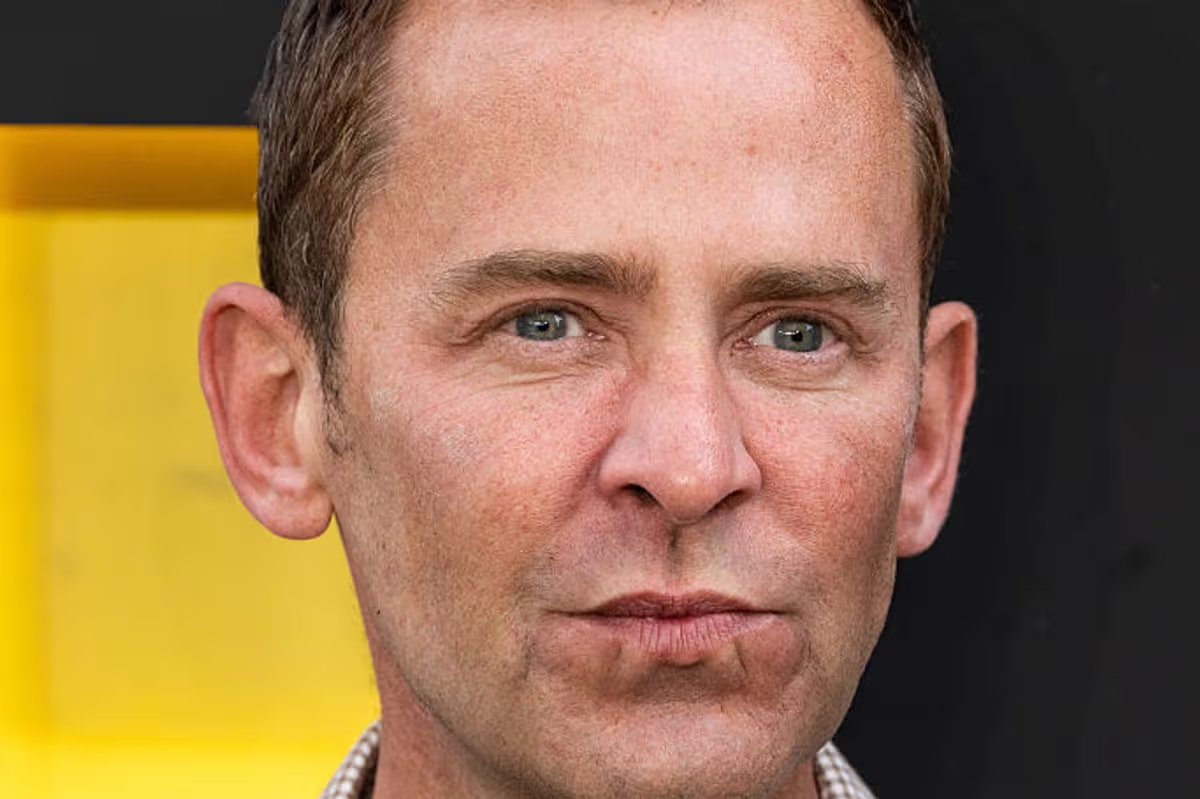
EXCLUSIVE: Scott Mills was axed from the BBC earlier this year after new evidence came to light about a historical alleged sexual offences – but this might not be the end of the former radio DJ
Scott Mills is set to sue the BBC for unfair dismissal(Image: Jeff Spicer/Getty Images)
Axed star Scott Mills has seen a flurry of support this week as his husband Sam Vaughan returned to Instagram to mark their two-year anniversary.
In his first post since the DJ’s shock sacking, Sam posted a sweet picture of him and his husband from their wedding day, captioning the post with a white heart emoji and the words “2 years.”
Stars including Zoe Ball, Rylan Clark and Sara Cox reacted to the post, with former colleauge Zoe writing: “Love you,” in the comments, followed by four red heart emoji’s. Rylan and Sarah also posted hearts in the comments section.
It comes as the Mirror exclusively revealed that Scott is set to sue the BBC for unfair dismissal after his surprise sacking. The DJ has enlisted top lawyers to lodge a case against the BBC. It’s understood he will claim that he disclosed the full details of the cop probe – including the accuser’s age – to BBC Radio 1 bosses at the time.
Content cannot be displayed without consent
The BBC has previously said that they knew about the investigation but that “new information” came to light which sources claim was the fact the accuser was under 16. But it’s understood Mills will argue that this was all raised at the time to Radio 1. A source said: “It’s going to get very messy indeed.”
Mills was interviewed by police in 2018 under caution after being accused of serious sexual offences against a boy under the age of 16. A full file was sent to the CPS, who said there was not enough evidence to charge him.
In April, Mills released a statement through his lawyers claiming he had been the subject of “rumour and speculation” since his sacking and that he had “co-operated fully” with the police investigation into the allegations.
As Scott gears up for a battle with the Beeb and his partner returns to social media, questions have been raised on when the DJ could make a career return. “I think Scott Mills’ route back into the spotlight will depend on whether the public see his departure as a temporary setback or as a sign that his broadcasting career has reached a crossroads,” Mayah Riaz, a PR to the stars, tells the Mirror.
“Historically, we have seen that established presenters who have a strong personal brands and years of goodwill behind them are often afforded a second act. This is especially true when they have built up a loyal audience and have industry support over many years,” she said.
The expert noted the significance of the public show of support towards Scott’s husband Sam as it highlights that the star still has a network of influential friends and colleagues who are willing to publicly stand by him. She said this can help “soften the narrative” and “remind people of the affection that exists for a personality.”
The DJ has lost a number of gigs since being axed by the BBC, including podcast roles on Race Across the World and Pop Top 10 with Rylan Clark. Mills was also dropped as a patron of children’s cancer charity Neuroblastoma UK and “stepped back” from his role as an ambassador for the MS Society UK.
His regular panto work, which reportedly made him £600,000 in the last three years, has also been cut. Imagine Theatre, which got Scott involved in Jack And The Beanstalk shows, said there are no plans to work with the presenter for the 2026/2027 season. It said the decision was taken before he was fired by the BBC.
If Scott was to make a comeback, Mayah suggests it won’t be through a “grand relaunch”. Instead, it could be through a project that reminds his audience why they connected with him in the first place.
She explained: “Talent and familiarity remain powerful currencies in broadcasting. It goes without saying that authenticity will be key. The public are increasingly sceptical of overly polished comeback campaigns and media-managed statements.”
Mayah says the public respond “far more positively to resilience, humility and genuine passion for the work” and the biggest mistake Scott Mills could make is to come across “desperate to reclaim the spotlight”. She added: “The strongest celebrity comebacks are those that give people something new to talk about.”
Mills previously issued a statement via lawyers thanking his well-wishers. He said: “I wish to thank from the bottom of my heart all those who have reached out to me with kindness, my former colleagues, and my beloved listeners, who I greatly miss.”
On the police probe, he said: “The recent announcement that I am no longer contracted to the BBC has led to the publication of rumour and speculation. In response to this the Metropolitan Police has made a statement, which I confirm relates to me.
“An allegation was made against me in 2016 of a historic sexual offence, which was the subject of a police investigation in which I fully co-operated and responded to in 2018.” He added: “Since the investigation related to an allegation that dates back nearly 30 years and the police investigation was closed seven years ago, I hope that the public and the media will understand and respect my wish not to make any further public comment on this matter.”
The South Korean flag flies over Cheong Wa Dae in Seoul. Photo by Asia Today
June 5 (Asia Today) — South Korea’s presidential office said Friday there has been no major change in the plan to build nuclear-powered submarines in South Korea as Seoul and Washington resume talks on nuclear cooperation and wartime operational control.
A senior Cheong Wa Dae official told reporters that recent security talks between South Korea and the United States were “very productive and useful.”
“There has been no major change in the position that nuclear-powered submarines will be built in South Korea,” the official said.
The official said the two sides discussed uranium enrichment, spent fuel reprocessing and nuclear-powered submarines. The talks also included what the official described as an “umbrella” consultation framework.
“We have not set a target deadline, but we will move quickly and try to produce concrete results by the end of the year,” the official said.
South Korea and the United States held formal talks in Seoul this week on follow-up discussions related to Seoul’s push for nuclear-powered submarines and expanded rights for uranium enrichment and spent fuel reprocessing. The talks followed earlier bilateral agreements on nuclear cooperation and submarine development.
On enrichment and reprocessing, the senior official said Seoul and Washington need “several new frameworks of agreement.”
“We intend to make progress, including by revising what needs to be revised,” the official said.
The official said talks on enrichment and reprocessing are now moving into a full-fledged phase.
“These discussions are based on trust in South Korea’s denuclearization, so there are no additional denuclearization conditions,” the official said.
Asked about coordination between Seoul and Washington on the timing of South Korea’s recovery of wartime operational control, the official said the two allies do not have a significant difference of opinion.
“Efforts to meet the conditions have continued for more than 10 years, and several years ago there was even an assessment that the conditions had been more than 90% met,” the official said. “Because there is little difference in views on the conditions, we can coordinate and align them.”
The official said the two sides also do not differ sharply on the timing of the transfer.
“There is a gap of a little over a year, about one year-plus,” the official said. “We do not see that gap as something that cannot be adjusted.”
In response, the MoD spokesman said that, since coming to power in July 2024, the government had signed more than 1,400 major defence contracts, adding it was providing “a generational increase in defence spending… ensuring no return to the hollowed out armed forces of the past”.
A federal judge sided with California and other Democratic states on Friday in a preliminary injunction that blocked the Trump administration’s attempt to condition food benefits on compliance with the president’s policies on gender and immigration.
Twenty states and the District of Columbia filed a lawsuit in March against the Trump administration in U.S. District Court in Massachusetts, arguing that the “unlawful” and “unconstitutional” funding requirements are vague and designed to force policies on states.
Billions in federal funding are ultimately at stake, including money for school lunch programs that provide meals to 30 million children nationwide and food stamps that support about 40 million Americans living in low-income households.
“As the Trump Administration tries to use essential programs and billions in funding as leverage to advance their hateful, discriminatory agenda, California continues to fight to uphold the law and ensure that our communities can continue to access the funding they need to thrive,” said California Atty. Gen. Rob Bonta in a statement.
The policy shift from the United States Department of Agriculture marks another effort by the president to force left-leaning states to submit to his positions on hot-button political and cultural issues to receive government funding. California’s current budget relies on $174.5 billion in federal dollars, or roughly one-third of the overall state budget funds.
The funding conditions from the USDA relate to gender ideology, women and girls’ sports and immigration, according to the lawsuit.
States argue that the conditions do not explain what activities are prohibited for entities that receive grants. The USDA did not cite any law allowing the organization to impose anti-discrimination policies that go beyond federal law, the suit states.
The states that joined the lawsuit contend that they are left with the “unlawful” choice of adhering to the conditions or risk losing up to $74 billion in collective federal assistance from the USDA.
U.S. District Judge Myong Joun approved a preliminary injunction Friday and is expected to issue a memorandum later explaining the decision, according to the Associated Press.
The appeal of getting a free, quick, well-structured travel plan is easy to see, and something that is causing travel agents another Covid-sized thing to worry about
How good are bots at planning holidays?(Image: Getty Images)
Places that don’t exist. Events on the wrong day. Attractions miles apart.
Holiday itineraries designed by AI appear helpful and comprehensive, but are actually riddled with mistakes and old information that could ruin your holiday, analysis of them has found.
More and more people are turning to large language models (LLMs) to plan their trips away. One study puts the number of people who have turned to a bot for holiday inspiration at 40%.
The appeal of getting a free, quick, well-structured travel plan is easy to see, and it’s another Covid-sized thing travel agents have to worry about.
But how good are the robots at the delicate art of holiday planning?
I asked the four biggest LLMs to design weekend break itineries for four destinations, and then called on local experts in those places to assess their work. This is what we found.
Grok’s suggestions of a walk through Westminster is good, but better if you have a guide point out the smaller details, such as “gas lamps, torch snuffers, fire protection badges”.
The alternative river cruise and London Eye are solid bets for first-timers in the city, but other aspects of the itinerary are less well thought through.
Jonnie argues that the itinerary is far too busy. “I’m a big fan of spending some time people watching. Soaking things in rather than rushing around, and because of the amount in this itinerary, visits to The Tower of London or Westminster Abbey are really rushed,” he said.
The biggest mistake is including the Changing the Guard, which starts at 10:43am at St James’s Palace and doesn’t run on Saturdays.
He concluded: “I know this is a generic itinerary for first-time visitors, but I think London has so much more to offer. Loads of small museums, house museums, places of interest for all interests. They would also leave, not really knowing London.”
Claude
Although Claude breaks the itinerary down into activities and eating, offering the reader a little more freedom, its work left Jay Allen from Unseen Japan incredibly cold.
“Overall, this itinerary lacks any context, history, and rich cultural detail that our customers love hearing about on our tours,” Jay says.
The itinerary is full of old information. For example, Tsukiji is no longer the location of a wholesale fish market. It moved to Toyosu several years ago.
“Why did the original market arise in Tsukiji in the first place? None of this rich detail and historic background is included. Even if it were, this info would be drawn from general public sources, not from the rich background that our tour guides – most of whom have degrees in Japanese Studies or years working as journalists in Japan – can provide,” Jay adds.
The Saturday covers little ground and is too geographically spread out, missing “so much rich detail of the Tsukiji/Asakusa shitamachi area”, according to Jay.
Many suggested destinations are “trite”, “well known” or just “commercial”, such as the Starbucks in Shibuya Scramble. “You can get a much better view of the scramble, eg, from the bar at the top of the Magnet building – and you’d be fighting fewer crowds,” Jay notes.
“If you look at the second day, the itinerary gives you no suggestions of cool art galleries and small, uniquely Japan clothing shops to stop (such as the Ura-Harajuku area off the Main Street, where independent fashion still reigns), nor does it tell you about the less-crowded Brahms’ Path that runs alongside the packed Takeshita Street.”
The restaurant recommendations “are the same five places everyone else is going” and are hard to get tables at, as opposed to the real gems that require “a basic working knowledge of Japanese”.
Jay concludes: “Claude is giving you the wisdom of the crowds. That can be helpful in some cases. In this case, it equates to a bland, ordinary vacation that will likely prove an exercise in frustration for most travelers.”
Google AI
Amy Siegal, a luxury travel advisor based in NYC, praised Google AI for highlighting some “iconic spots”, but argued that only “a human expert knows the ins and outs of these places – what time of day to go where, and in which order they’d work best.”
On day one, Amy suggests arriving at TKTS earlier in the day to have more choice of shows and seats, and to avoid the line.
Saturday’s itinerary has too much “darting around”. She suggests it could be arranged more smoothly, with more interesting food options chosen.
Sunday is packed full of landmarks and history, which is good, but the order is wrong. “I would incorporate some lesser-known landmarks and eateries,” Amy added.
ChatGPT
Vicky Reeves, who is the director of The Real Algarve villa company, applauded ChatGPT for picking out some “amazing places” in its “very good overview,” but argued it failed to consider flow, how much is possible to fit in, and the weather.
“Understanding seasonality is important because this itinerary would feel very different in August compared to November and that is something an agent or guide would pick up on. I also think it’s a bit ambitious and that’s really down to a lack of practical knowledge and insight,” Vicky explained.
“For example, the plan suggests exploring Lagos, visiting Ponta da Piedade and potentially heading to Sagres before flying home. That’s fine if you’ve got a late return flight, but an agent or guide would check to make sure that everything was possible without adding stress or risking your flight home. Benagil is also another good example. It’s one of the Algarve’s most iconic attractions, but during peak season, travel times and parking can be difficult, and tours often need booking well in advance, which isn’t really considered at all.
“The AI did pick out some amazing places, but I do think it’s missing a personal feel. It doesn’t suggest any hidden beaches or lesser-known spots because that’s much harder for AI to uncover. That insight can really make all the difference in making a trip feel unique.”
In conclusion
What is most striking about the itineraries is how comprehensive and well thought out they seem – particularly Claude’s – but how riddled with issues they are once a closer look has been taken.
ChatGPT suggesting an event that doesn’t take place on the requested day is a rookie mistake that could disrupt a trip, while Claude not realising a famous fish market has moved is similarly clumsy.
All the AIs seem too ambitious when it comes to the number of activities and the distance between each.
Certainly, the bots are great if you’re looking for a broad overview of a place, but they lack the precision you’d want to fully rely on its suggestions, and the depth of knowledge a local guide can provide that can bring a place to life.
HALF of pet owners plan their entire holiday around their furry friends, a study has revealed.
A poll of 2,000 cat and dog owners found 26 per cent are ditching trips abroad in favour of staying in the UK and taking their pet with them – as stricter rules on pet travel to the EU have recently come into force.
Sign up for the Travel newsletter
Thank you!
‘Pet Set Go’, Britain’s first pop-up travel agency for adventurous pets by Carnilove, opens in Chipping NortonCredit: Alex Morton/PinPepThe new venture will help pet owners find their perfect holidayCredit: Alex Morton/PinPepMore than half of Brits go on holiday with their petsCredit: Alex Morton/PinPepA third of Brits have previously had to change or cancel a holiday due to a lack of pet-friendly optionsCredit: Alex Morton/PinPep
More than half (54 per cent) decide to holiday with their animal offspring because they enjoy their company, while 39 per cent feel happier knowing they’ve given their pet a new experience.
When searching for somewhere to stay, 33 per cent like to ensure there are pet-friendly pubs and restaurants nearby, and 30 per cent will factor in how long the journey is going to be.
In response to these findings, pet food maker Carnilove has opened a pop-up travel agent ‘Pet Set Go’, where owners can get travel tips and advice on travelling with their pet, as a third have previously had to change or cancel a holiday due to a lack of pet-friendly options.
Owners can visit the travel agency at 21 West Street, Chipping Norton until June 4th at 5pm, or explore the five travel guides and expert advice online.
Cara Whitehouse, pet travel expert, said: “We’re seeing a massive shift in the UK when it comes to furry friend-friendly holidays.
“Pet parents no longer want a holiday where their pet is just ‘tolerated’ – they’re now at the heart of the adventure.
“By uncovering these incredible ‘hidden gem’ locations, from the sweeping dunes of Anglesey to the rugged, raw plateaus of the Cairngorms, we’re helping owners match destinations to their pet’s unique character.
“As international travel with pets gets tougher, we’re glad to help match more fuss-free destinations to a pet’s requirements to support their natural spirit.”
The study also found the biggest challenges of holidaying with pets include a limited choice of places to eat or drink (19 per cent), and restrictions on beaches, walks or attractions (19 per cent).
Nearly four in 10 (38 per cent) say no additional pet fees would make them more likely to book an animal-included holiday.
Trusted reviews from other owners (34 per cent) and access to pet friendly activities (26 per cent) were also considered important.
Of those planning a UK holiday with their pet this summer, the Lake District (24 per cent), Yorkshire Dales (21 per cent) and Cornwall (18 per cent) are among the top-rated destinations.
Colin Rodger, managing director at Carnilove, said: “We launched the ‘Pet Set Go’ agency because an active, adventurous life isn’t just a luxury for our pets: it’s a necessity to ignite their true spirit.
“Our research shows that owners are willing to go the extra mile to ensure their four-legged friends are part of the pack, but every great expedition requires the right fuel.
“By pairing our meat-first, potato and grain-free recipes with expert travel advice, we’re helping pet parents support the vitality and natural strength needed for a lifetime of shared memories on the trail.”
The OnePoll.com study also found 54 per cent claim holidaying with their pet gives them both a much-needed wellness boost.
A third even notice a significant boost in their animal’s mood several weeks after returning home, with 30 per cent saying they show more ‘vitality’ or ‘spirit’.
What’s more, 37 per cent of those with kids believe their pet’s needs are just as important as their children’s.
Izzy Judd, a brand partner, said: “Our home is always a bit of a whirlwind with three children, but our pets are such a huge part of our family’s heartbeat.
“We’ve always found that the best way to hit ‘reset’ is to take a trip together, so I’m happy to be part of ‘Pet Set Go’ because I know first-hand the ‘wellness boost’ you get from a shared adventure.
“It isn’t always easy to plan, but fuelling our pets with the right nutrition and being able to take them on our family holidays makes all the difference in creating those special core memories together.”
Strictly Come Dancing is reportedly going to be unrecognisable by the time it returns to screens later this year, after bosses have decided to give the show a makeover
Daniel Bird Assistant Celebrity and Entertainment Editor
22:40, 04 Jun 2026
Strictly is to undergo a major transformation(Image: BBC)
Strictly Come Dancing is undergoing a major makeover. The BBC dancing programme is set to return to screens later this year with three new hosts following the departure of Tess Daly and Claudia Winkleman.
And Tess and Claudia aren’t the only people who’ve left; a string of professional stars have also departed, making way for new names to take to the dancefloor. But that’s not the only shake-up: sources say the show will look completely unrecognisable by the time it returns in autumn.
The dance floor is likely to undergo a makeover, with bosses currently deciding whether to change the iconic backdrop, which has become extremely familiar to viewers. The current studio, the George Lucas studio at Elstree, is made up of bright coloured panels, lights and some screens.
But sources claim this could switch to larger screens that display visuals during routines. “It was natural that bosses look at giving the show a whole new look as it enters a new era, but they aren’t ditching the traditional presentation of the show, just the way it is delivered,” a source told The Sun.
The source went on to add: “It’s going to get a more sleek, impressive set, but it will still be all about fun, glitz and sparkles. They aren’t trying to turn it into the set of Star Wars. But it would have been strange not to have made some change to the look of the show, given that the programme is starting a new chapter with so many other new elements.”
The publication claims that the new set has been compared to the shake-up The X Factor underwent in 2009, which saw the show’s backdrop made up entirely of large screens.
The rumoured new set-up has recently been seen across the UK tour of Strictly: The Professionals, and bosses have decided to keep the staircase and band, but the rest of the display was on giant green screens. The Clauditorium is said to remain the same.
With three hosts rather than two, there will also be a new backstage element of the programme. Emma Willis, comic Josh Widdicombe and professional dancer Johannes Radebe are the new faces of Strictly and will make their presenting debut in the autumn.
Another change this year is that Janette Manrara won’t be returning to the front spin-off show, It Takes Two. Manrara was also widely rumoured to be facing the axe, and has now confirmed she has left the series.
In a video posted on her YouTube account, she said: “Strictly Come Dancing has changed hugely, and I am no longer a part of It Takes Two or the main show. I’ll still be involved in other ways. But that just means that I’m free to pursue and do many other projects that I’ve always wanted to do and never really thought about doing.
“Strictly is all I’ve known for the last 14 years so it is a bit like, ‘Oh, we’re going into a different world, a different space, how are we going to navigate that?'”
The Mirror approached Strictly Come Dancing for comment.
WASHINGTON — Initial efforts in the Senate failed Thursday to block the $1.8-billion fund that the Trump administration has sought to establish to pay people who claim the government wronged them, though further attempts were likely to come Thursday afternoon.
Republicans narrowly voted down a Democratic amendment to ban the payout fund and then Democrats killed a Republican amendment, which would have prohibited the use of federal money for the fund but would have sent $1.7 billion to the Justice Department’s fraud division.
It was the second effort in Congress to rebuke President Trump in two days, following the House vote Wednesday to rein in Trump’s war powers in Iran.
The dueling amendments were proposed by Senate Minority Leader Chuck Schumer (D-N.Y.) and Sen. Thom Tillis (R-N.C.). They were attached to the reconciliation bill that would fund Immigration and Customs Enforcement and the Border Patrol, a high priority for Republicans.
The votes came as the Senate began a “vote-a-rama,” during which lawmakers were expected to propose a stream of amendments to the immigration bill on various topics.
The Trump administration’s plan for the payment fund — widely seen as a way for Trump to compensate his political allies, including those who participated in the Jan. 6, 2021, attack on the Capitol — set off particular ire from some GOP lawmakers.
The plan has fueled growing unrest within parts of Trump’s party over his governance, compounded by the president’s endorsement of primary challengers to Sens. John Cornyn (R-Texas) and Bill Cassidy (R-La.), as well as Rep. Thomas Massie (R-Ky.), which angered some Republican senators.
Cassidy, who lost his primary and has since voiced strong opposition to Trump’s $1.8-billion fund, became a key player in the Thursday votes, voting down Schumer’s amendment but supporting Tillis’.
On Wednesday, Cassidy joined with Sen. Cory Booker (D-N.J.) to argue in a court filing that the $1.8-billion fund circumvents Congress’ authority and violates the Constitution’s spending and appropriations clauses.
“It is an unconstitutional attempt to spend the People’s money without Congressional approval,” Cassidy and Booker wrote in an amicus brief filed in the federal court case challenging the fund.
The fund was created by the Justice Department to settle a lawsuit brought by Trump against the Internal Revenue Service over the leak of his tax returns. Trump and his sons agreed to drop their personal lawsuit against the government in exchange for the creation of the $1.776-billion fund. Critics immediately questioned the plan, and it drew a rare backlash from Republicans.
In late May, GOP senators derailed plans to vote on the immigration bill over their displeasure with the payout fund and with Trump’s desire to use taxpayer funds for his planned White House ballroom. Senate Republicans removed the ballroom funding from the immigration package Wednesday, another setback for Trump.
The Trump administration sought to back away from its plans for the fund this week, following bipartisan outcry and a federal court ruling that temporarily blocked any payouts from the fund. Acting Atty. Gen. Todd Blanche said Tuesday the administration would end its plans to move ahead with the concept.
But Trump on Wednesday told reporters he didn’t know whether the fund was dead, calling it “a beautiful thing.”
After Schumer proposed the first amendment to ban the fund Thursday morning, the Senate came to a standstill as three key Republican senators deliberated. Schumer framed his effort to ban the fund Thursday as a way to force a referendum on Trump’s plan.
The amendment “offers Republicans a choice: Do you support Donald Trump’s $2 billion taxpayer-funded slush fund, or do you want to protect the American people and their paychecks?” Schumer said on the Senate floor before the vote.
Sen. Bernie Moreno (R-Ohio) urged Republicans to reject the amendment, saying Democrats were planning to “play so many games” on Thursday during the marathon session.
“We are going to fund immigration enforcement and border patrol, and I urge my Republican colleagues to stay united on that singular mission,” Moreno said.
The amendment failed after Cassidy voted against it. Republican Sens. Susan Collins of Maine, Jon Husted of Ohio and Dan Sullivan of Alaska voted in favor.
Schumer’s amendment was uniformly supported by Democrats, including California Sens. Adam Schiff and Alex Padilla.
Tillis, who also voted against Schumer’s amendment, immediately proposed his amendment. Sen. Jeff Merkley (D-Oregon) urged Democrats to oppose it, saying that the proposal would create “a new slush fund” by giving the money to the Justice Department.
“We heard over the last 48 hours that the acting attorney general said that this fund’s not moving forward. All this amendment does is codify what I believe the policy of the DOJ is,” Tillis said on the floor before voting began on his amendment. “This [fund] is unpopular, this administration has said they’re not moving forward with it; this is an opportunity for us to put it to bed.”
Responded Merkley: “Taking one slush fund and eliminating it and then creating a new slush fund still under control of the attorney general is not the way to go. The way to go is to get rid of these slush funds altogether.”
Trump has faced a recent string of failures, including the House vote Wednesday, a court ruling to remove his name from the Kennedy Center and a record-low approval rating among Americans as concern rises about economic issues, gas prices and Trump’s war with Iran.
On Wednesday, Trump lashed out against the four Republicans who backed the House war powers resolution, calling it “an unpatriotic thing” to do and calling the vote “meaningless.”
“They’re GRANDSTANDERS! They should be ashamed of themselves. MAGA!!! President DJT,” Trump wrote.
Times staff writer Ana Ceballos, in Washington, contributed to this report.
Hundreds have rallied in Albania against plans by a Jared Kushner-linked investment firm to develop Albania’s Sazan Island and parts of a protected national park into a luxury seaside resort. Anger was fuelled by comments by Kushner’s wife, Ivanka Trump, describing Sazan as a ‘private island’ they ‘discovered’.
A provision in a bill before the United States Congress could tie the American and Israeli militaries far more closely together, deepening their cooperation on weapons research, production and technology.
The proposal, titled the “United States-Israel Defense Technology Cooperation Initiative,” appears as Section 224 of the House Armed Services Committee’s version of the fiscal year 2027 National Defense Authorization Act (NDAA), the annual US defence policy bill.
Recommended Stories
list of 2 itemsend of list
The measure is still at an early stage. The NDAA is passed by Congress each year to set US military policy and authorise defence programmes and spending levels.
If enacted, the provision could mark a major change in one of the world’s closest military relationships, shifting the two countries from a partnership centred largely on American military aid towards one in which their defence industries are more deeply intertwined.
Section 224 would require the US defence secretary to appoint an “executive agent”: a single official to coordinate military cooperation between the US and Israel.
That work would cover joint research and development, the shared production of weapons, and the linking of military systems and data.
“What Congress is trying to do now is find different ways of entrenching the relationship so deep in America’s own defence industrial base that it’s impossible to root it out,” Josh Paul, a former US State Department official and founder of the advocacy group A New Policy, said about the controversial provision.
“A new section of law in the National Defense Authorization Act (NDAA) would give Israel unprecedented access to American technology and would force the United States military to integrate Israeli defence technologies into our own critical military supply chain, giving Israel incredible leverage over America’s own defence priorities,” he added in a video posted on social media on Friday.
The two countries already build missile defence systems together, such as the Iron Dome.
The bill would extend their joint work into many more areas of modern warfare, from artificial intelligence (AI) to drones and cyber operations.
In February, US and Israeli forces attacked Iran together, triggering five weeks of war; Iran struck back at Israel and at US bases in the Gulf before a ceasefire took hold in April.
Israel is also facing genocide allegations in a case brought by South Africa at the International Court of Justice, the UN’s top court, over its war on Gaza.
Decades of support
The bill must first clear the House Armed Services Committee, which is due to take it up in early June, and then pass the full House and the Senate.
It was proposed by the committee’s Republican chairman, Mike Rogers, and its most senior Democrat, Adam Smith, giving it support from both main parties, even as opinion polls suggest growing opposition among American Democrats and some Republicans to further military support for Israel.
The US has supported Israel’s military for decades.
Since 2008, US law has required Washington to protect Israel’s “qualitative military edge”, keeping its forces stronger and more advanced than those of any rival in the region, on the grounds that a small country must rely on better weapons rather than greater numbers.
Under the current aid deal signed during the administration of former President Barack Obama, Washington provides Israel with about $3.8bn a year in military assistance. The 10-year agreement runs through 2028.
Israel is the largest recipient of US foreign aid since 1948, almost all of it now military and worth well over $300bn when adjusted for inflation.
The nature of that support may now be changing. Israeli Prime Minister Benjamin Netanyahu said recently that he wants to end Israel’s reliance on US military aid within 10 years, saying his country had “come of age”.
Closer cooperation between the two defence industries, rather than cash, would likely fit that goal.
THEY are set to release their new album Foreign Tongues in July — and it seems The Rolling Stones could also be heading to foreign shores.
After abandoning plans to hit the road on a UK and European tour this summer, I can reveal that Start Me Up hitmakers Mick Jagger, Keith Richards and Ronnie Wood are now looking into playing five nights in Buenos Aires, Argentina, next year.
Sign up for the Showbiz newsletter
Thank you!
The Rolling Stones could be heading to foreign shoresCredit: GettyFrom left: Keith Richards, Charlie Watts, Ronnie Wood, Mick Jagger and Bill WymanCredit: Getty
A source told me: “The band are discussing options for a residency.
“They love the thrill of doing a huge stadium tour around the globe, but the physical demands are immense.
“A residency would mean they can still bring their best to the fans, without the toll that comes with travelling.”
This summer would have been the rockers’ first string of live performances since their Hackney Diamonds tour in the States in 2024 — which sold almost one million tickets.
The band will release their new 14-track album on July 10 after recording it at Metropolis Studios in Chiswick, West London, over four intense weeks.
It features a cover of the song You Know I’m No Good by Amy Winehouse, who Mick performed with at the Isle of Wight Festival in 2007, four years before she died aged 27.
The track Hit Me In The Head includes old recordings in LA with the late Stones drummer Charlie Watts, who died in 2021, aged 80.
Earlier this month, at the launch in New York, Mick confirmed the newrecord spans a number of genres, saying: “We have the ability to do ballads, country and dance music.”
He added: “It’s not stuck in one particular style.”
I can’t wait to hear it.
FROM 10 TO THE ONE
Influencer Tallulah MetcalfeCredit: InstagramDanny Bretherton is dating influencer TallulahCredit: Instagram
DECEMBER 10 are the latest Gen-Z heartthrobs – but Danny Bretherton is set to break fans’ hearts, as I can reveal he is dating influencer Tallulah Metcalfe.
The singer has even introduced her to his family in Chorley, Lancs.
A source said: “Danny has been spending lots of time with Tallulah. He is very family-orientated so taking her to meet his family was a big deal.”
This month, Tallulah shared a TikTok of her and Danny dancing in the street to his band’s song Infinity (123), captioned: “Look who I bumped into.”
Seems Danny has a new No1.
BIOPIC BOYLE
Susan Boyle is working on a biopic, I have heardCredit: Michael Schofield
The model, who married comic Jack Whitehall last month, is believed to be in talks with a company to make a film about living with Type 1 diabetes, which she was diagnosed with in 2021.
A source said: “Roxy has been amazing at raising awareness of living with the chronic condition.
“She now wants to delve deeper and speak to experts.”
Shakira’s miami mini break
Shakira looked her very zest as she stepped out in a bright orange outfitCredit: BackGrid
SHAKIRA looked her very zest as she stepped out in a bright orange outfit.
The Colombian singer flaunted her toned legs in a mini dress at Miami Swim Week.
She was attending an event on Thursday for her haircare brand Isima.
We’ll soon be humming Shakira’s track Dai Dai, the official anthem for the 2026 Fifa World Cup that she made with Burna Boy.
KELLY SET FOR MIGHTY COMEBACK
Kelly Osbourne is preparing for her first performance since dad Ozzy died last yearCredit: Instagram/kellyosbourne
The TV presenter and singer will join headliners Scissor Sisters at Mighty Hoopla festival in South London’s Brockwell Park today.
A source said: “Kelly is excited to get back on stage and doing it with the Scissor Sisters is a huge honour.”
Black Sabbath legend Ozzy passed away last July, with Kelly and her mum Sharon Osbourne honouring him at The Brit Awards.
Kelly and Sharon accepted the Lifetime Achievement gong for Ozzy at Manchester’s Co-Op Live arena in February.
Speaking to Biz on Sunday’s Emily at the ceremony, Kelly said: “A Lifetime Achievement award is such an honour, I couldn’t think of anyone else more deserving.
“It’s bittersweet.”
I am sure Ozzy would be proud of Kelly today.
Heidi hi, Nat & Nic
Nicole Appleton and Natalie Appleton attend the Mighty Hoopla in Brockwell Park, London
HALF of All Saints performed as Appleton at the Mighty Hoopla yesterday.
Nicole and Natalie Appleton took to the stage at the festival in Brockwell Park, South East London, in their typical cool girl style of tracksuits.
Nicole said: “Guys, you have to realise it’s been quite a long time that Nat and I have sung as Appleton.
“But we are so emotional that it’s our first festival.”
Nicole, left, and Natalie, right, were joined by their pal and ex-Sugababes member Heidi Range, centre, for a surprise performance.
The duo release Ready To Begin next month, and their Appleton EP will be out in September.
Welcome back, ladies.
It’s go for pro with ex
Professor Green is back with his ex Karima McAdamsCredit: GettyKarima shared an Instagram snap of the lad with Pro Green – real name Stephen Manderson – referring to the chart star as her ‘partner’Credit: Instagram
HE failed to find The One on Channel 4’s Celebs Go Dating, but it seems Professor Green is back with his ex Karima McAdams.
I am told the couple who have five-year-old son Slimane, have been taking things slowly after their split in 2024.
Karima shared an Instagram snap of the lad with Pro Green – real name Stephen Manderson – referring to the chart star as her “partner”.
Explaining her little boy had a suspected wrist fracture after falling from a zipwire, she said: “Son is coming back in plaster and partner medium rare.” Looks like the rapper is back in the game . . .
Coronation Street fans think they have figured out why Idris Nazir is keen on a romance with Leanne Battersby, and it could be linked to a past villain on the ITV soap
13:00, 29 May 2026Updated 13:01, 29 May 2026
Fans of Coronation Street think newcomer Idris Nazir is targeting Leanne Battersby(Image: ITV)
Fans of Coronation Street think newcomer Idris Nazir is targeting Leanne Battersby in a new twist.
Leanne met Idris this week, while it soon emerged they had actually met years earlier. Idris is related to Leanne’s late ex Kal Nazir, but that hasn’t stopped the pair pursuing a romance.
Corrie had revealed Idris would be Leanne’s new love interest before he debuted, and then this week we saw them kiss. Amid Idris’ cousin Alya Nazir being unimpressed by their blossoming romance, some fans think Idris has a motive.
Viewers are theorising that Idris is targeting Leanne on behalf of someone else, and perhaps he knows a past Corrie villain. A new theory has predicted that Idris is “in cahoots with” Harvey Gaskell, who was sent to prison after Leanne helped the police put him behind bars.
Harvey escaped and tried to kill Leanne, actually murdering Sam Blakeman’s mother Natasha in a case of mistaken identity. Harvey then went back to prison.
But fans are wondering if there is more to Idris’ sudden arrival and his interest in Leanne. With it heavily teased he is involved in some dodgy dealings, a theory being shared online is that Idris could be working for Harvey, and targeting Leanne for him.
Taking to social media, one viewer posted: “I know that Idris is a wrongun but, does anyone else think that he might be in cahoots with Harvey and that’s why he’s coming onto Leanne?” A fan replied: “Never thought of that!!!”
Another said: “Oooooh never thought of that it’s not gonna be good news whatever.” A further post read: “Good theory and Leanne said she knew him from somewhere – could have been one of Harvey’s henchmen.”
A further fan confessed: “I really hope not! Couldn’t stand Harvey, hated when they kept bringing him back!” A final fan said: “I’ve just seen someone saying on Facebook they think Idris could be connected to Harvey and that’s why he’s wanting to be with Leanne.
“Might be a bit of a stretch but it could explain why after about 3 hours they’re pursuing a romance, so fast when they barely know each other, AND he’s related to her late partner, all a bit weird.”