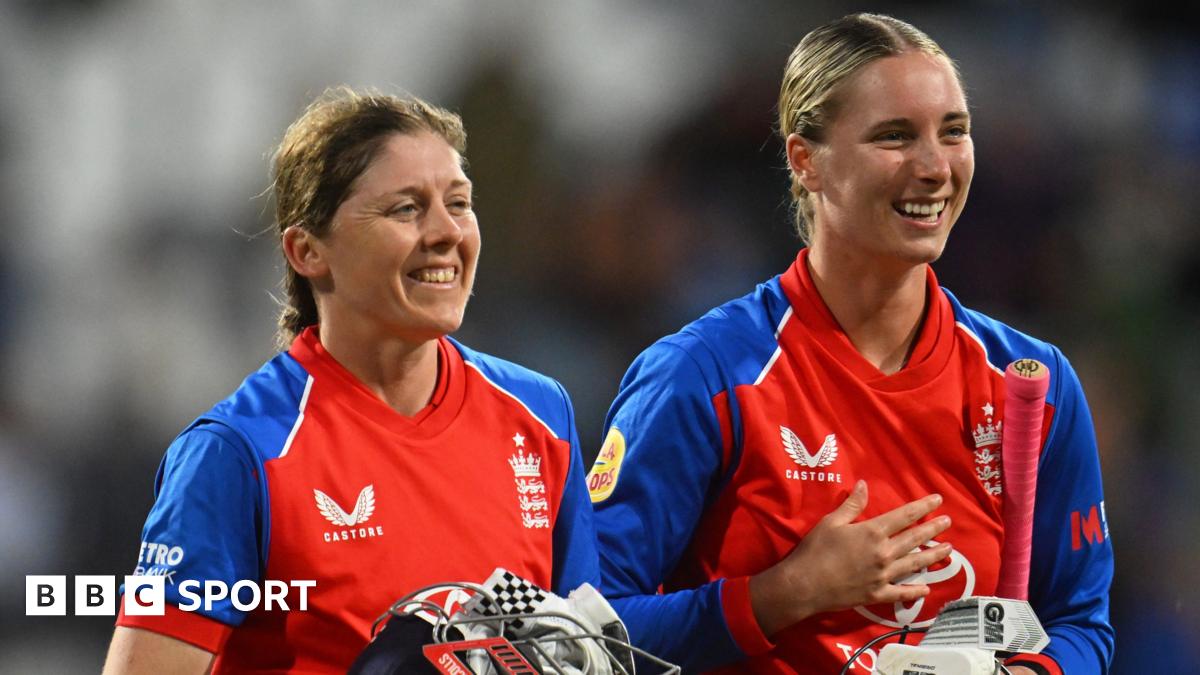
Charlotte Edwards says there was never any doubt around Heather Knight’s place in England’s World Cup side as the former captain returned to form in a series-clinching win in the third T20 against India.
Knight, 35, made a magnificent unbeaten 70 as England emphatically chased 181 to win the series 2-1, after she had endured a lean start to the summer.
But under pressure in the series decider, Knight, who became England women’s most-capped cricketer last month, was at her fluent best with 10 fours in a 42-ball knock.
“It’s been quite interesting listening to some of the press this week,” head coach Edwards told BBC Sport.
“I think the more that people have been writing her off, the more I just knew she was going to put in a performance like this.
“I spoke to her after her record game [at Chelmsford] about her character and how that is one of her biggest attributes, and we saw that in abundance tonight.
“It was really lovely for her to have that performance going into the World Cup, but there were no doubts in our dressing room about Heather.”
Knight added 137 for the fourth wicket in a flawless stand with Alice Capsey, who made 81 off 43. The pair toyed with India’s wilting bowlers throughout, with Knight reverse-sweeping and scoring cannily behind square while Capsey struck beautifully straight down the ground.
It is easy to forget Capsey is still only 21 years old, having burst on to the English cricket scene as a teenager, and it was a knock that has surely cemented her place in Edwards’ starting XI for the World Cup opener against Sri Lanka on 12 June.
Edwards said it was the best she had seen Capsey play, and praised her work ethic over the winter.
“To play the way she did from that position [38-3], I couldn’t be prouder,” Edwards added.
“We spoke to her at the start of the winter about the areas we wanted her to work on and she has worked so, so hard. Now she’s bearing the fruits of that and there’s nothing more satisfying than to win a game of cricket for England in that manner.”
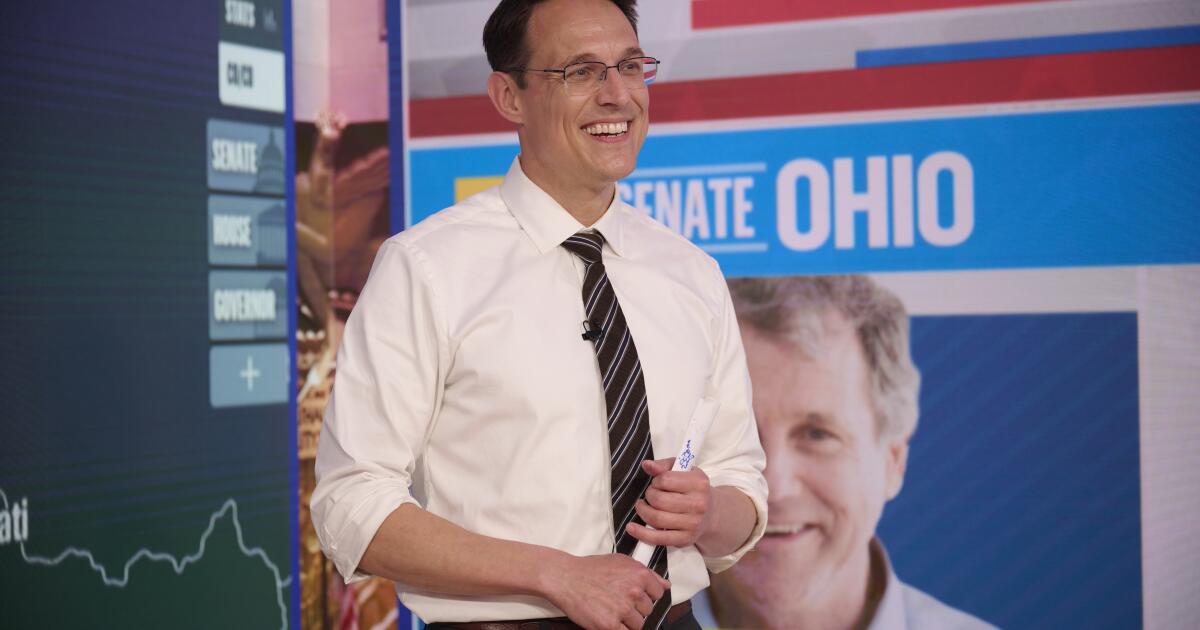
After the polls close in California on Tuesday, NBC News data analyst Steve Kornacki will just be getting started.
Since December, the khacki-clad vote-counting guru has been going live and uninterrupted on streaming platforms to provide results and analysis of every special election and even some state Senate contests.
The stream — called the Kornacki Cam — provides unadulterated number-crunching without any pundits weighing in. Rather than getting updates that last a few minutes, Kornacki provides continuous real time results until the last available total is counted.
“This all happens in full view,” Kornacki said Monday in a phone interview. “The audience gets to see the whole thing. They get to see the buildup, the anticipation, the payoff.”
In the 10 Kornacki Cam sessions streamed by NBC News so far, 20 million viewers have sampled on YouTube alone. The coverage — consisting of Kornacki, his Big Board, his producer and a Stedicam operator — is also available on NBCNews.com, the NBC News app and the division’s social media accounts on Instagram, Facebook and TikTok.
The Kornacki Cam will focus on the primaries for Los Angeles mayor, California and several Congressional districts, shortly after the state’s polls close at 8 p.m. Pacific.
In a Monday chat with The Times, here are the trends Kornacki says he’ll be looking for on the night.
Polling in mayoral races is typically pretty unreliable. What do you make of the contest based on what you’ve seen?
You don’t always have super-competitive mayoral elections and they’re not all created equal. It’s not quite like a presidential election so you just don’t have a wealth of data to draw on for expectations either.
I’ve seen the polling you’ve seen. It suggests that of the three candidates, (Mayor Karen Bass, reality TV star Spencer Pratt and City Council member Nithya Raman) Bass is in the best position to get into the runoff. It also suggests that Spencer Pratt has had the most positive movement in the last month or so of the campaign. But we go in knowing there will be volatility and I’m open to any and all possibilities.
Spencer Pratt is an unusual candidate who has been able to take up a lot of oxygen in the race. Is there a hidden vote for him that people might not be eager to admit to pollsters?
You can look at the city and know where to look for whether Pratt is having a big night. The San Fernando Valley is gonna be more than a third of the vote, probably close to 40%. If he gets in the general election, he wants to be winning there by a big margin. If it’s not happening there for Pratt, I don’t think it’s happening anywhere else. Karen Bass is going to rely on central and south L.A., with probably a third of the vote coming out of those two places. Those should be her bulwarks. The Westside, I think could be more of a toss-up. There’s a fair chunk of the vote there.
We don’t do a ton of mayoral races around the country. So we’re still trying to figure out exactly how detailed we’re going to be able to zoom in, at the neighborhood level and the precinct level.
Turnouts usually are low for Los Angeles mayoral races. Will this year be different?
This mayoral race has received a lot more national attention than 2022. So my thought is that the turnout would be higher, just based on that. But this is something that is resonating nationally because Pratt has that celebrity factor. The number was 646,000 (total votes) for 2022. So that’s something we’ll be following — are we trending over or under that?
And what will be the best indicators for the gubernatorial race?
The place that I kind of got circled here is Orange County. In the last two sort of major statewide elections, it was the first to report out vote. At 8:06 p.m local time in California, in 2024, Orange County reported out half of its vote, right? So you’re getting, you know, you’re getting hundreds of thousands of votes, potentially, from this enormous county within, potentially within 10 minutes of polls closing. There were a couple others — the Central Valley, and we got a we got a good chunk of Merced and Fresno quickly.
So how long are we going to have to wait for a result on Tuesday night?
One of the other things that just surrounds everything in California, whether it’s the mayor’s race, or governor’s race, or anything else, is nothing is definitive in the first hour or so after the polls close. We’re probably realistically looking at a days or even weeks-long process of getting all the vote counted.
I know it drives many people nuts. Without editorializing on that, it’s just a fact that they can get out of about two-thirds of their vote on election night, and if the races aren’t clear and definitive, then you’re generally in for a pretty long haul.
We do know in California that they’re not going (to count) nonstop until they get a result. They’re going to then start doing updates as they process and count the remaining vote by mail, which is usually a considerable pile in a lot of these places. The vote by mail in California can continue coming in for seven days after the election.
So do you think your coverage reflects a shift in what the consumer wants? We already know how fragmented the audience is. Are there now enough political junkies who want the pure uncut stuff?
I’ve been doing this about 20 years, and when I would tell people that I reported on politics for a living, they either moved away from me or changed the subject. And now, you know, I found the last, you know, 10 years or something, has just totally changed. People come up to me, even if they don’t know I work in politics, and they want to talk politics. Everybody seems into it whatever side they’re on.
With former Biden Cabinet secretary Xavier Becerra surging in recent polls, the two candidates battling to win the second spot in this week’s primary and advance to the November election highlighted the strategic reasons why they believe voters ought to support them.
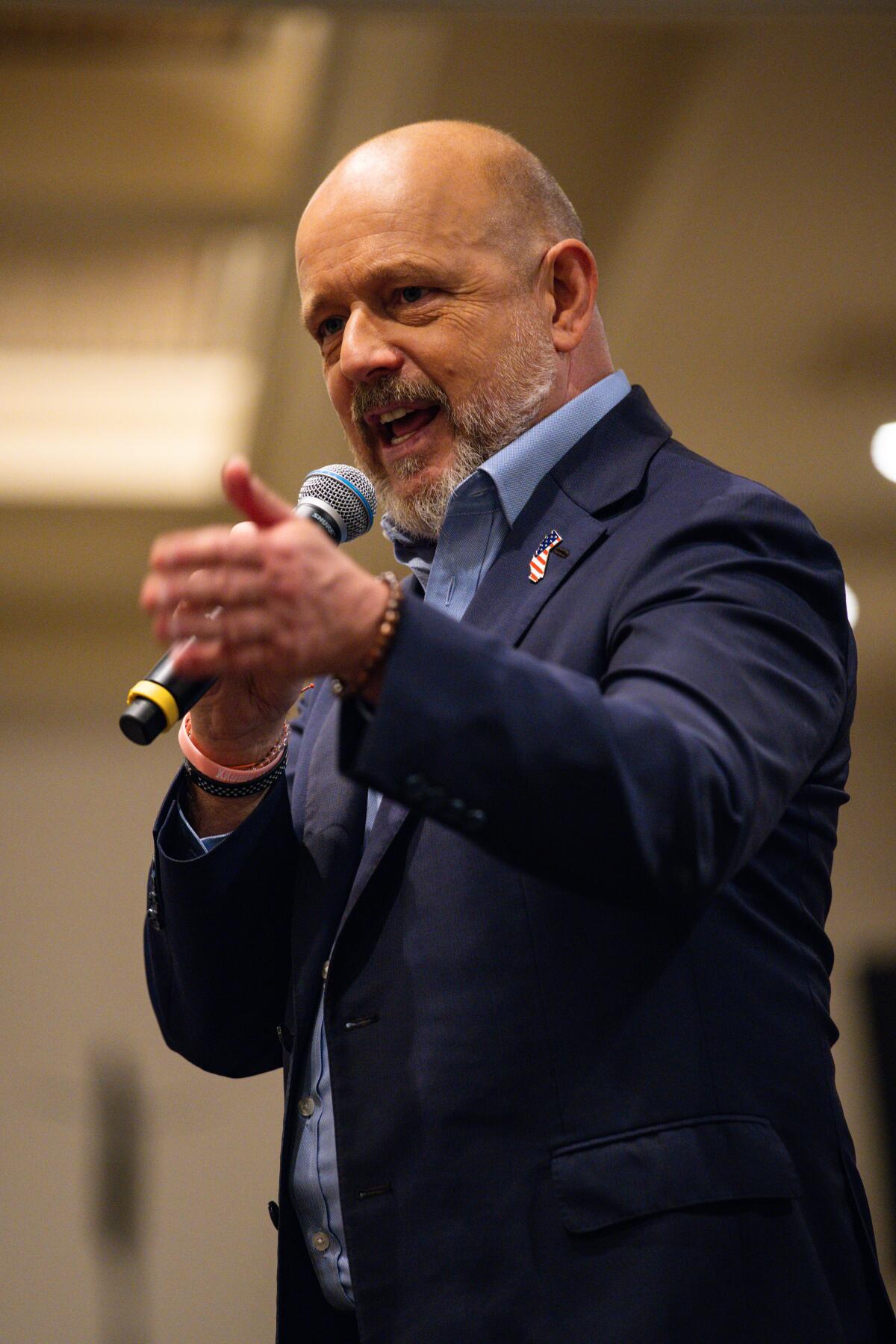
Republican Steve Hilton — a former conservative commentator who rocketed past his main GOP rival, Riverside County Sheriff Chad Bianco, after President Trump endorsed him in April — urged voters to back him to avoid the possibility of two Democrats facing off in November.
“I want us to fight like we are third. We aren’t going to let this slip away,” Hilton told a few hundred people at the Santa Monica Hilton Hotel & Suites on Sunday morning.
Steve Hilton surged ahead of his GOP rival, Riverside County Sheriff Chad Bianco, after receiving an endorsement from the president.
(Kayla Bartkowski/Los Angeles Times)
The former British political strategist once led the polls, but has slipped slightly behind Becerra. Not too far behind Hilton is billionaire hedge fund founder turned climate change activist Tom Steyer, a Democrat.
During his hour and a half appearance, Hilton veered between his oft-repeated criticisms about 16 years of Democrat-led rule in California to jabs at the top Democrats in the race.
Steyer’s nonstop advertising blitz is “one reason alone to defeat him,” while Becerra is the “living embodiment of more of the same.”
“Our secret weapon? The Democrat candidates,” Hilton said to chuckles.
Asked why voters shouldn’t back Bianco, Hilton said it was simple math. Only the first- and second-place finishers in the June 2 primary will advance to the general election, regardless of party affiliation.
“Every vote for Chad Bianco is a vote for two Democrats in the top two,” he said.
If a GOP gubernatorial candidate fails to make the November ballot, it would depress the Republican vote, harming the party’s down-ballot candidates, as well as handicap a Republican-led ballot initiative that would require voters to show government-issued ID to cast ballots.
California gubernatorial candidate Tom Steyer takes a picture with a volunteer during a Get Out the Vote rally at Los Angeles Trade Technical College on Sunday.
(Eric Thayer/Los Angeles Times)
Steyer, who has spent a record-breaking $216 million of his wealth on his gubernatorial bid, argued that he is the only candidate in the race who is not beholden to special interests. He hammered Becerra for the support he has received from corporations including Meta, Airbnb, Uber and Chevron. Steyer argued that Becerra, if elected governor, would be more responsive to special interests than financially strapped Californians.
“We’ve seen it in this race. Chevron cuts you a check and you look the other way when they hike prices at the pump. Meta gives you money and your AI plan starts sounding like ChatGPT,” Steyer, sporting a ball cap labeling himself a “class traitor,” told more than 500 supporters at a community college near downtown Los Angeles on Sunday afternoon. “That’s the story of Xavier Becerra.”
Corporations, along with labor unions and interest groups including the California Assn. of Realtors, have spent more than $18.7 million to boost Becerra as of Sunday, according to the election spending tracker California Target Book.
“These companies may be selfish, but they’re not stupid. They don’t give hundreds of thousands of dollars to get someone elected unless they know he’s going to be on their side,” Steyer said.
Though Steyer earned his fortune in part through past investments in private prisons, fossil fuels and private equity, his supporters described him as a reformed billionaire who stepped away from those industries more than a decade ago.
Francesca Fiorentini, a comedian and podcaster, compared Steyer to Charles Dickens’ fictional miser Ebenezer Scrooge.
“At the end of ‘A Christmas Carol,’ nobody turns to Ebenezer and is like, ‘No, I’m not gonna accept your gifts.’ No, they welcome him. They might clown him a little bit, but we need to welcome someone like Tom Steyer,” Fiorentini said. “Tom Steyer is actually listening, he actually cares, he’s actually changing his belief system and he’s acting accordingly.”
Though he mainly went after Becerra, Steyer also made sure to criticize Hilton.
“You are not voting for who’s on the ballot, you’re voting for the California that comes after,” Steyer said. “The California that Steve Hilton is running on sounds exactly like what Trump wants: higher prices, lower wages, and less freedom.”
His campaign underscored his attacks against Becerra by having a handful of supporters dressed as zombies speak outside of Becerra’s Sunday evening rally in Long Beach. Waving signs naming businesses that have supported Becerra, they wore lanyards describing “Big Oil,” “Big Tech” and other corporate sectors as Becerra’s “bestie.”
At a raucous rally, elected officials, labor leaders and reproductive rights advocates were among the speakers who introduced Becerra, who attacked Steyer and Hilton, though not by name.
“We are not going to let a billionaire or Trump’s handpicked candidate take over this state,” he told more than 1,000 people at the city’s convention center. “We are not going to let them gut Medicaid while Californians work hard to build a future. We are not going to let them buy an election…. Not here, not in this state, not on our watch.”
Becerra seemed in awe as he stood in front of the packed room.
“Look around this room. One of our opponents has a billion dollars in a checkbook,” he said. “We have something better… We don’t have the money, but we have the movement. We don’t have the money, but we’ve got the momentum. And in this state, if you’ve got the momentum, you run across the finish line, and you win, baby, you win.”
Becerra also released a new video that ostensibly attacks Hilton as “Trump’s favorite” — a thinly veiled effort to prop up Hilton among Republicans to ensure he finished ahead of Steyer in the primary. Given that Democratic voters outnumber Republicans by almost 2 to 1, Becerra would much rather face Hilton than Steyer in the general election.
Newsom’s campaign employed this strategy to boost GOP businessman John Cox in the 2018 gubernatorial election, as did then-Rep. Adam Schiff against Republican Steve Garvey in Schiff’s successful 2024 U.S. Senate race.
Billionaire Tom Steyer has argued that he is the only candidate not beholden to special interests.
(Eric Thayer/Los Angeles Times)
Steyer launched an ad this weekend titled “Risky” that implies Becerra could face criminal charges related to the acts of two former advisors who have plead guilty to federal charges related to stealing campaign funds from a dormant Becerra campaign account.
Becerra’s campaign called the ad defamatory in a cease and desist letter sent to the Steyer campaign on Saturday.
Becerra, Hilton and Steyer, the front-runners in the race, barnstormed the state in the final days before the June 2 primary. They devoted much of their attention to voters in Southern California, which is home to many of the state’s 23.2 million registered voters. Lower-polling candidates also stumped in the Southland — San José Mayor Matt Mahan greeted diners at Grand Central Market in downtown Los Angeles, and former Orange County Rep. Katie Porter kicked off a union canvassing event in Orange on Saturday.
Unlike recent contests to lead the nation’s most populous state, this year’s gubernatorial contest failed to energize the electorate. Despite a crowded field of candidates with notable resumes, as well as record-breaking spending by Steyer and independent-expenditure committees. Californians only recently tuned in.
Political experts of both parties believe voters malaise was due to fatigue about the nation’s political polarization, as well as Trump administration policies such as federal tariffs that drove up prices everywhere and some that disproportionately affected California, such as immigration raids. Southern Californians were also reeling from the devastating wildfires in the Pacific Palisades and Altadena and last year’s special election to redraw the state’s congressional boundaries.
Earlier this year, Democratic leaders worried that their voters would splinter among their candidates, creating a scenario where two Republicans advanced to the general election. They controversially urged their party’s candidates to assess their viability, effectively urging several low-polling candidates to drop out of the race.
Democratic turnout also prompted concerns. As of May 22, mail ballots returned by Democrats were 9.2% lower compared with the 2022 gubernatorial primary, while ballots returned by Republicans were 11.6% higher, according to Political Data Intelligence. But the return rates are shifting — as of Friday, Democrats were 7% behind their 2022 return rate, while Republicans were 6.8% higher.
The most recent polls suggest that the prospect of two Republicans advancing to the general election is nonexistent, and there is now a slim chance that two Democrats win the top two spots in the June 2 primary.
When Craig Ferguson left CBS’ “The Late Late Show” in December 2014, fulfilling a pledge made public the previous April, it was assumed by some that it had something to do with not being offered the chair being vacated by his illustrious lead-in, David Letterman. (Stephen Colbert, you may be aware, was named the new “Late Show” host.) Others simply couldn’t believe anyone would just walk away from such a job, which Ferguson had held for two weeks shy of 10 years, because, even in the less prestigious 12:30 time slot it seemed like a prize — but mostly because he was so good at it.
“That’s one of the odd things about that particular genre of television,” he told me in 2016. “The minute I started at 12:30, the question became when and do you want and how are you going to get 11:30? But I never wanted 12:30, never mind 11:30. Why is that a thing?”
Ferguson went on to other things. He’s hosted game shows (currently the CW’s “Scrabble,” with puckish energy); toured as a stand-up (he’s on the road into June); hosted a history-themed panel show, “Craig Ferguson: Join or Die”; launched “Joy, a Podcast,” which is as close as he’s come to the confessional freestyling of “The Late Late Show”; and published “Riding the Elephant: A Memoir of Altercations, Humiliations, Hallucinations & Observations.”
His latest show, premiering Saturday on CNN, is “American on Purpose,” which shares a title with his first memoir, a reference to the Scottish-born Ferguson becoming an American citizen. Timed generally to the 250th anniversary of the United States, it finds Ferguson in a five-episode crazy quilt of observations, interviews, inquiries, stunts, games and documentary vignettes forming a comical, but not unserious, somewhat wayward look at American ideas and ideals — freedom of speech, capitalism, patriotism, individualism and immigration. It’s a vision wide enough to include monster trucks, lowriders, underground comedy, Miami street art, Texas barbecue and haggis tacos, dreamed up by Ferguson and executed by celebrity chef Marcus Samuelsson.
Ferguson, a Scotsman, having haggis tacos on “American on Purpose.”
(CNN)
“You know me,” Ferguson said when we spoke over video call recently. “Less format is better for me always.”
His caveat to the producers was that he wouldn’t “make an anti-American show. I wouldn’t make a show pointing out everything that’s wrong. I feel that’s a market that’s heavily catered to. I’m not a f—ing idiot, I’m not making propaganda, I won’t make a jingoistic show. But I want to make a show which is celebratory,” Ferguson says. “And I want to be clear that the show I make for CNN will be the same as if I was making it for Fox News. It has to be my point of view, which is upbeat without being dumb — I hope. I feel like we got pretty close.” This conversation has been condensed and edited for clarity.
A good friend of mine, an Englishman, recently became an American citizen and had only wonderful things to say about the naturalization ceremony, the diversity of his fellow new Americans, and the graciousness of the people conducting it. What was your experience?
My ceremony was in Pomona fairgrounds in 2008. And I think it was 2,000 of us; I think it was 1,999 new Mexican Americans and one new Scottish American. And it was f—ing wonderful. And it is moving. I kind of wish it for my friends who are born here, American citizens, because you have to remove your everyday, “Oh my God, did you see the news today” cynicism, and remember what this place is about — freedom, second chances, third chances, escape, representation, individualism, different ideas coexisting in one country, wildly different points of view somehow managing to get along. That is f—ing beautiful. What I still feel as an immigrant American is a certain gratitude that doesn’t leave you. I’m not blind to the faults of the United States. Show me a country that doesn’t have faults. We talk about the bloody past. Show me a country that doesn’t have a bloody past. Humans have a bloody past. I’m not saying there’s nothing wrong, but I’m not looking at that in this show. I’m looking at what makes me feel great about this place, and it is a great place, an aspirational place. To my mind, we are still the big foam finger number one. I don’t think there’s anyone can touch us for … unusualness. We’re really unusual.
It’s a very optimistic show. Is that how you feel personally about the future of the country, and humanity?
Like most people, I have my moods. I got a real boost of optimism [hanging out] with very clever academics who kind of guard the Declaration of Independence in Philadelphia. And you say to them, “People say the country’s never been this divided.” They always laugh. They laugh at the idea it’s never been as bad as this, the rhetoric has never been this hateful. They’re like, “It’s always been like this. It’s always been an argument. The whole point of this place is that it is an argument.” The guys who started this country, some of them hated each other with just as much venom and outrage and indignance as political players hate each other today. I find that quite encouraging. Like I said, I’m not blind to the fact that there are issues and faults and deep things to worry about. But that’s not what this show’s about. It’s as if I was a musician, and I decided to write a happy song. People say, “Why aren’t you sad?” I’m like, “Well, I get that sometimes, but this song is a happy song, this is a rock song. I’ll do a power ballad later on.” It’s not terrible to to do something upbeat every now and again.
What did you discover in the course of making the show?
There were many things, actually. In L.A., I did a kind of run around with the guys who make the lowrider cars, and the community and the story of how that came about are really fascinating, a kind of parallel run of the rise of the automobile in America, but how it was taken on by the Mexican culture. Another that really stuck with me was in the Everglades, when I was with the Gladesman there, finding out that a large percentage of them [were descended from] displaced Scottish peasants, cleared out of the Highlands to make room for sheep for the landowners; they went to Canada, and they drifted all the way down to the southern tip of the United States. These guys there could trace their ancestry back to 100 miles from where I grew up. Americans would be kicked out of most of the countries of the world. So it makes us awesome. I mean, 40% of this country can trace themselves through Ellis Island, through that administration building in New York. That’s insane.
Ferguson at Venice Beach in a segment on the show.
(CNN)
When did you get interested in history?
In Scotland, we’re surrounded by it all the time. There’s a lot of stuff still lying around from a long time ago. American history became interesting to me because it was so attached to Scotland. The Scottish Enlightenment is really kind of the origin story of the Declaration of Independence. Knowing that the philosophy that was coming out of Edinburgh in the 1700s was directly feeding into what these guys were doing, it felt like the continuation of a certain strain of Scottish history. It didn’t end with “Highlander” or “Shrek.”
There’s a road movie element to the series. Do you take trips around the country on your own time?
All the time. I don’t think you can know the United States unless you’ve driven across it at least a couple of times. If you can take a car from New Orleans to Northeastern Maine, Florida to Washington state, it’s worth doing. One of the things that was in the engine for me when I started this [series] was, I’ve seen over the years a lot of — probably more in Britain than in America — lazy kind of pseudo-intellectual documentaries where somebody will say, “Well, you know, the thing about America is…” Well, which America are you talking about? And they will go and get some guy that lives on his boat in Fort Lauderdale with a hat that’s got “Who Farted?” written on it and tell you that’s America. That guy’s there and he’s awesome, but it’s not the whole story. You know what I mean? It’s like saying “Well, you know, Hitler was a vegetarian.” That’s true, he was. But it’s not really the whole f—ing story, is it?
At this year’s Sundance Film Festival, filmmaker William D. Caballero won the NEXT Special Jury Award for Creative Expression for his intensely personal, multimedia feature debut, “TheyDream.” During his acceptance speech, he made a powerful statement.
“In case ICE were ever to harm me or kill me, this film will serve as the truth of who I am, and who my family is, before Fox News or this administration ever makes us out to be the villain[s],” he recalls paraphrasing during a recent interview.
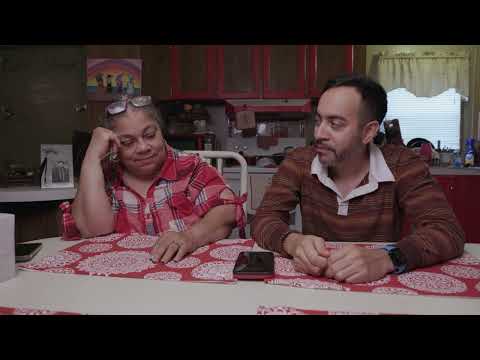
Blending live action footage with different animation techniques — as well as the 3-D-printed miniatures that have been a fixture of Caballero’s work for more than a decade — “TheyDream” honors the filmmaker’s Puerto Rican loved ones, particularly his mother, Milly.
She collaborated with him in the making of this one-of-a-kind portrait of loss, resilience and shared healing. Their heartfelt exchanges throughout this process are also shared on-screen.
“Seeing her light up and become transformed throughout was just invigorating, because it allowed us to talk about heavy things and bond throughout the process of creating a story that’s personal [for us] both,” Caballero says. “It’s like, ‘Let’s guide each other and instead of me taking your stories and making magic with them, let’s make this magic together.’”
The brilliantly unconventional piece of autobiographical storytelling will screen as the closing night film of the Los Angeles Latino International Film Festival (LALIFF) on Sunday. Recently, John Leguizamo and Ben DeJesus joined the film as executive producers.
Starting with his 2013 short film “How You Doin,’ Boy? Voicemails From Gran’pa,” Caballero has used miniatures to immortalize his loved ones. That bite-sized introduction to his Boricua grandfather’s humorous wisdom evolved into the HBO Latino show, “Gran’pa Knows Best.”
“When I started working on ‘Gran’pa Knows Best,’ I knew that 3-D printing was this new technique,” he says. “But I’d never seen anyone that looked or sounded like my grandfather in it. I realized that it could be a really creative method to preserve his voice and his story. “
Then came the 2017 short “Victor & Isolina” about his grandparents’ relationship, and more recently in 2022, he debuted “Chilly and Milly,” which focused on his parents. Some of the sets from these shorts, tiny replicas of places familiar to Caballero, and a few of the miniature characters were reused in “TheyDream.”
“Being able to create these things in miniature is almost like getting back in touch with the idea of play,” Caballero explains. “As a child, you invent lots of stories all the time. But now as an artist, I’m able to tell stories that touch upon reality and painful memories, but also hopes and dreams in a way that hearkens back to the innocence of childhood.”
Filmmaker William D. Caballero will screen “TheyDream” on Sunday at the Los Angeles Latino International Film Festival (LALIFF).
(William D. Caballero)
“TheyDream” is a culmination of the eclectic and nimble artistic practice that Caballero has developed since he studied digital art at the Pratt Institute in Brooklyn.
“I’d always just been attracted to new ways of expressing myself and expressing stories. And I say this both in a way that brings me pride, but also brings me a bit of a headache, because I don’t think I’ll ever be a conventional filmmaker,” he says, laughing.
Still, working outside the margins of traditional moviemaking requires great adaptability.
When Caballero received funding for “TheyDream” in 2021, the money wasn’t enough to conceive it as he had originally envisioned it: entirely told with 3-D-printed figures in physical sets. The lack of resources forced him to rethink his approach, and he opted for hiring two Puerto Rican animators, Julisse Tinoco and Frank Martinez, each of whom animate in distinct styles, to help him create some of the sequences needed.
“This all goes back to the resourcefulness that I learned when I was young,” Caballero says. “When you’re born Latino and low-income in this society, you can’t let yourself be written off or you’re already defeated before you even begin.”
Caballero grew up in housing projects in New York City, and later in a trailer in his grandmother’s backyard in Fayetteville, N.C. Both of his parents were disabled.
Filmmaker William D. Caballero poses as his father for a reference shot in the making of his 2026 film “TheyDream.”
For Caballero, he says the arts have provided an escape that he “needed in order to survive and not feel weighed down by American consumerism, by poverty and by feeling trapped.” Whenever grief has perturbed him, Caballero has processed it through creativity.
With “TheyDream,” he wished to extend that vehicle for self-reflection to his mother. The film addresses complicated familial bonds and his mother’s experience caring for others.
“Throughout the years, we’ve lost several of my family members that we were both close to, but my mother especially,” he says. “She feels their absence much stronger than I do. I live in Los Angeles, my mother still lives in North Carolina. Knowing that she was alone in the mobile home, it just made me feel like, ‘That can’t be good for her.’”
His mother, he says, deals with self-esteem issues because her identity has for so long been reduced to being a caretaker for elderly relatives, who, inevitably, pass away — leaving her feeling like a failure. In reality, it was thanks to her devotion that they added years of life.
Caballero’s mother was at the Sundance premiere of “TheyDream,” where she witnessed how others saw her through the film she helped her son craft.
“I wanted her to feel like, ‘Mom, look at all these people that are clapping for you. They’re clapping for you because you are a hero. You deserve to hold yourself high and be strong and know that there’s something incredible in your story that’s indicative of the stories of many low-income Americans, regardless of race,’” Caballero says, visibly moved.
A prolific and highly regarded artist (he is a 2018 Guggenheim Fellow), Caballero has several other projects in the works that he’s trying to shop around. One of them is an episodic series titled “Second Fiddle,” about a 15-year-old Latino boy who gets accepted to a prestigious summer youth orchestra camp — and whose overbearing mother decides she’s going to stay in the camp with him.
Caballero’s mother, Milly, got the animated treatment in “TheyDream.”
“I never saw a Latino playing violin on TV or the big screen. I didn’t see any quirky, nerdy, artsy Latino kids like I was,” he says. “And I felt in my core that [it] was just wrong and something that I could change.”
Another project, “Raúl Playing Game,” is “an adult version of Pixar’s ‘Inside Out,’ ” that takes place in the mind of a closeted bisexual man. Caballero himself is bisexual. In 2022, “Raúl Playing Game” was selected for the LALIFF Inclusion Fellowship, which provided support for a short film version that serves as proof of concept for a potential TV show.
“I always wanted to make sure that I was telling authentic stories even if not necessarily always positive stories,” he says. “I’m very happy that I never lost track of that. Because I do believe that we need to tell our own stories, in our own unique voices, before someone else does it for us.”
Just one of the nine Supreme Court justices thought it was appropriate for Roger Goodell — whose primary job as NFL commissioner is to protect the league — to decide whether the NFL’s hiring practices are still racist.
And it happens to be the same justice whose close friend is an NFL owner.
In fact, the friendship between Justice Brett Kavanaugh and Arizona Cardinals owner Michael Bidwill dates back decades, to high school. So when President Trump nominated Kavanaugh for the highest court in the land, Bidwill used the team’s official website to advocate for his confirmation. Not sure how the “stick to sports” crowd feels about it, considering how they react when players express opinions, but it felt like an overreach to me.
Obviously when a decision related to NFL owners came before the court, Kavanaugh should have recused himself. But by now we’re used to justices ignoring their own ethics rules. What I find most disturbing in this instance is Kavanaugh’s dissent.
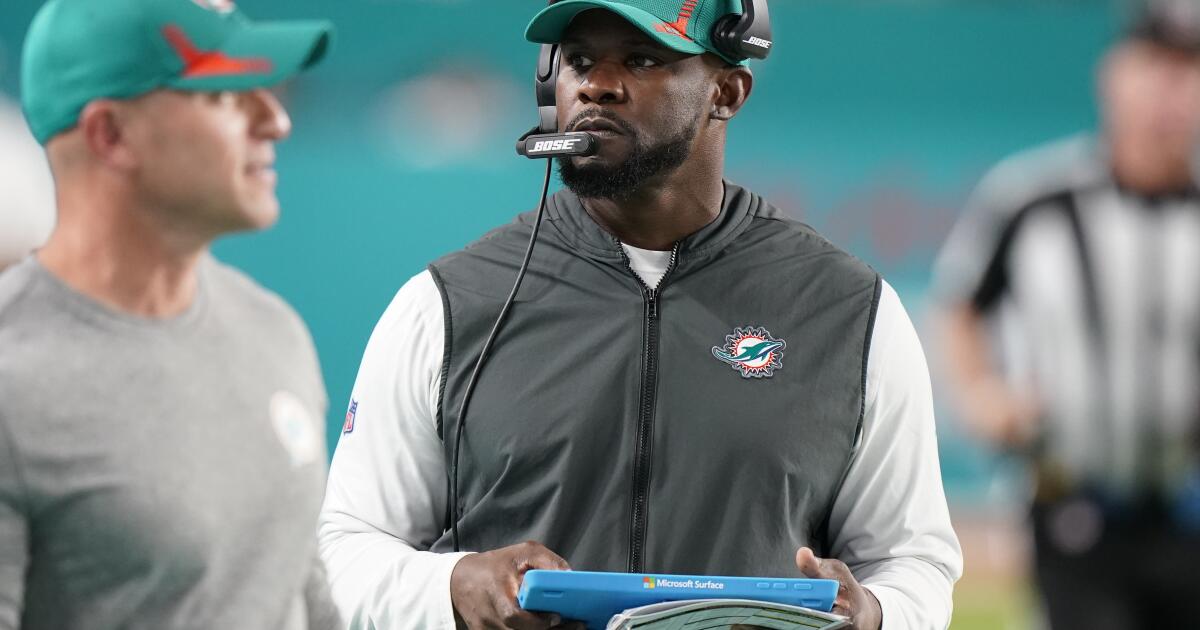
Here’s how the hiring discrimination case came to be: Former New England Patriots head coach Bill Belichick texted the wrong Brian with congratulations for getting the New York Giants’ head coaching job, according to a lawsuit filed by former Dolphins head coach and former Patriots assistant coach Brian Flores, who is Black. In the 2022 suit, Flores said the Giants interviewed him for their vacant head coaching job under disingenuous circumstances. How can we tell? Because Belichick’s congratulations came three days before Flores’ interview with the Giants. The team had apparently already decided to hire Brian Daboll, who is white.
The NFL has spent the last three-plus years attempting to settle the dispute through NFL-controlled arbitration and fought to keep it out of court. The league lifted its appeal to the Supreme Court after failing to get Goodell in position to handle it via the lower courts.
In addition to the damning text exchange, Flores also has history on his side.
During one 60-season stretch, the NFL had no Black head coaches. To address the glaring discrepancy, the league established the “Rooney rule” in 2003, requiring teams to interview at least two minority candidates for head coach and other senior management vacancies.
Prior to that, most teams interviewed only white men.
The results have been mixed.
Yes, more minority candidates get interviewed now — perhaps after a white man has quietly been chosen for the job, but still … they get interviewed.
And yes, Tony Dungy and Mike Tomlin, both of whom are Black, not only got hired but also led their franchises to Super Bowl victories after the rule was put into place.
Still, two decades into the Rooney-rule era, roughly a third of the league’s owners had never hired a minority to lead their team. This includes the century-old New York Giants, who after firing Daboll at the end of the season, hired another white man to take his place. This is the backdrop of the discrimination lawsuit filed by Flores.
And still Kavanaugh felt this case could be handled internally by the organization that allowed it to happen.
Even Clarence Thomas, a judge known for ruling againstanything that helps Black people, thought the NFL should have to defend itself in court.
Consider this: The year before Flores filed his suit, the NFL settled a different discrimination lawsuit for $1 billion. That case arose because for decades, to help determine the payout from a concussion settlement between retired players and the league, the NFL used “race norming” — a methodology that assumes Black players are less intelligent than white players, making it more difficult for Black men to prove brain damage than white men. In a league that is roughly 70% nonwhite, the racist practice saved the billionaire owners millions.
Or how about this: After the Supreme Court ruled that Duke Power Co. used a controversial cognitive test to prevent Black employees from getting higher-paying jobs back in the 1970s, the NFL began using it. The league kept it in place until 2022.
And still Kavanaugh felt the league should handle Flores’ case.
I’m not sure what factors the justice was considering before his dissent, but it could not have been league history.