Horror maestro Kiyoshi Kurosawa pivots to samurai intrigue
To know Japanese filmmaker Kiyoshi Kurosawa’s work is to feel his love for danger.
Inexplicable malevolence, dread-filled moods and worrisome behavior haunt his genre-speckled oeuvre, from 1997’s unnerving serial-killer freak-out “Cure” through his vengeance-fueled internet cautionary tale “Cloud” from two years ago.
“What makes for good movies is a plot driven forward progressively through things that actively happen,” the 71-year-old director says recently over Zoom from his home in Tokyo, using a translator. “Audiences need to be drawn to this idea of: What will happen next?”
His fans don’t necessarily get an explanation for the unease Kurosawa sometimes generates, but it’s part of the draw. That mindset has made him a horror maestro for over three decades. Outside that genre, he enjoys a reputation for being an acutely psychological chronicler of contemporary anxieties, as in his award-winning 2008 drama of job loss and family secrets, “Tokyo Sonata.”
Now, though, Kurosawa has not only made his first film set prior to Japan’s modernizing Meiji era — a category of feudal period dramas known as jidaigeki — but an old-fashioned murder mystery to boot, complete with solutions to satisfy the most die-hard Agatha Christie reader.

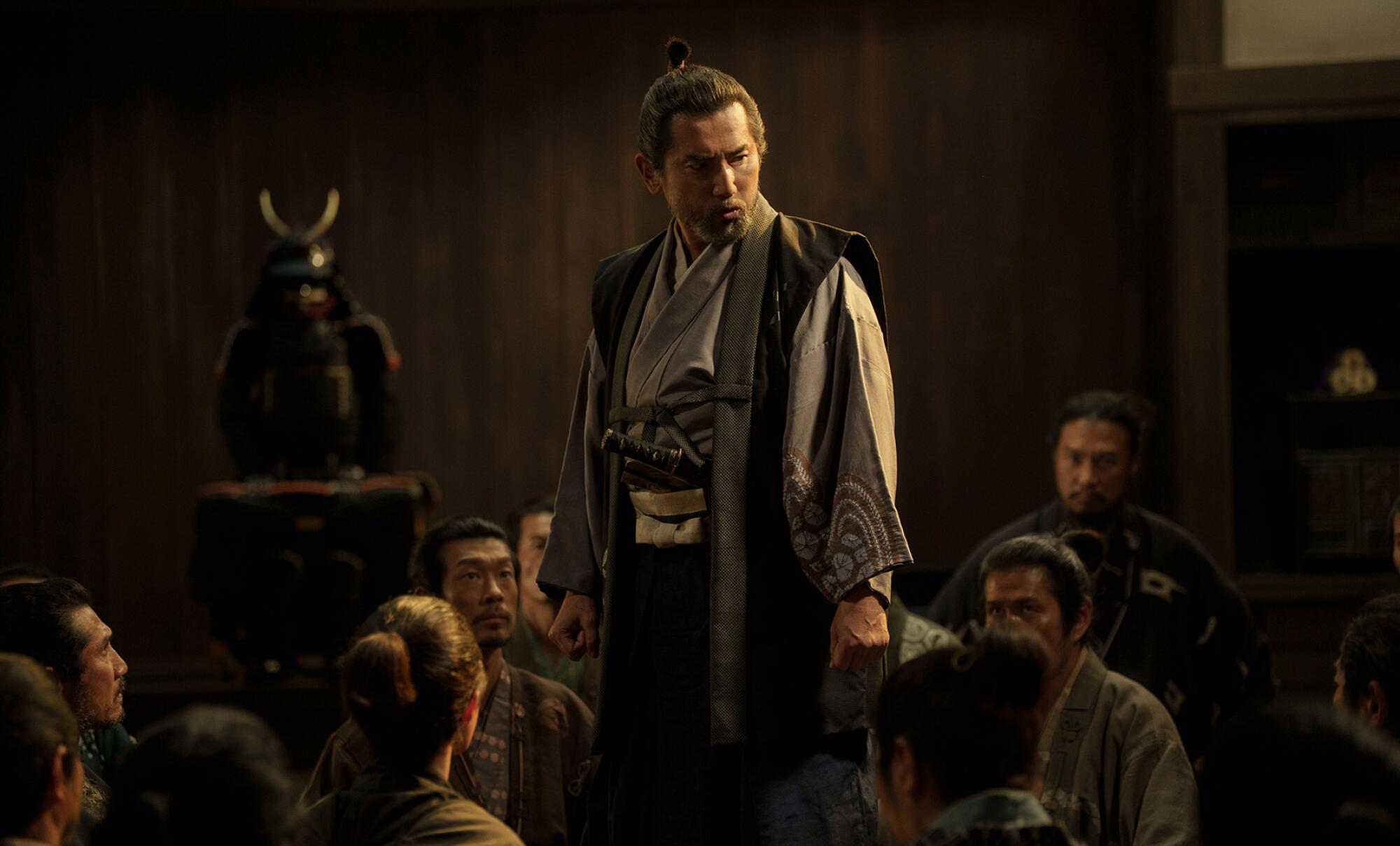
Masahiro Motoki in the movie “The Samurai and the Prisoner.”
(Janus Films)
“The Samurai and the Prisoner,” which Kurosawa adapted from Honobu Yonezawa’s acclaimed 2021 novel (it recently premiered at Cannes), unfolds during the fractured Sengoku period in the 16th century, the same era as one of his favorite jidaigekis, “Throne of Blood,” directed by his unrelated namesake, Akira Kurosawa. In a besieged mountainside castle, rebellious Lord Murashige (Masahiro Motoki), trying to consolidate disparate clans of warriors, engages in a battle of wills with his nemesis’ emissary, Kanbei (Masaki Suda), whom he’s imprisoned. But when a succession of murders threatens to undermine his leadership, Murashige turns to his crafty hostage for help.
The result, broken up into seasons and marked by an impending sense of doom, is a multipart puzzle box as intricately folded and tucked as the traditional clothing on display. But it’s also a savvy, deliberative portrait of leadership in a fractured time, with a unique takeaway: Knowing oneself is as essential to the job as knowing who one’s friends and enemies are.
Kurosawa had always wanted to make a jidaigeki — the furthest he’d ever gone into the past was his World War II film “Wife of a Spy” — and yet creating one from scratch sounded too difficult and expensive. But the book’s scenario of a put-upon samurai leader compelled to unravel a series of puzzles to keep his castle’s unity appealed to his taste in a particular crime-solver: someone representing a wider system of responsibility and codes, rather than the classic American private eye.
“I’m drawn to police detectives, not private detectives,” he says, pointing to the duty-bound, badge-wearing protagonist in “Cure,” a Criterion-anointed classic now held in the same pantheon of serial killer tales as “Seven” and “Manhunter.”
“Police are part of an organization, with orders from above that make them responsible for figuring out the crime. If they could, they’d love to live their life peacefully without conflict, but they can’t because of their profession.” He considers his disinterest in gumshoes working on their own a quintessentially Japanese perspective. “Why try to solve a mystery and in the process end up in all these horrible situations, when you can just quit?” he asks with a wry smile.

Masaki Suda in the movie “The Samurai and the Prisoner.”
(Janus Films)
In “Samurai,” Murashige hews closer to someone overwhelmed by responsibility. Says Kurosawa, “Murashige is neither a police or private detective. It’s that he is in a minor position of power, but to maintain order, he must let go of that power to solve the mystery. It’s not curiosity leading him. The chain of mysteries is a trial he must go through.”
It’s a gauntlet made thornier whenever Murashige, who believes in mercy over violence, engages with Kanbei, chained in a dungeon but with a dangerous mind nonetheless. “In that era, hierarchy was incredibly important, very visible,” says Kurosawa. “If one person is standing, the rest must be kneeling. With Kanbei and Murashige, there is always a shifting of the power, and when they begin to see eye to eye, suddenly we don’t know who holds the power.”
To play the wily Kanbei, Kurosawa enlisted his young “Cloud” star Suda, whom he calls a genius. Directing Suda was its own destabilizing experience, he says.
“He had an almost demonic, devil-like quality and it was hard to tell if the lines he was saying as Kanbei were truths for the character or complete lies — or if he didn’t know,” recalls Kurosawa. “It was mesmerizing to me, his words becoming something that we increasingly can’t trust.”
His interest in Murashige, meanwhile, a real-life tactician fictionalized here as an under-the-gun leader presented with myriad problems, poses the question: Did Kurosawa make a film about directing films? “I never thought about that, but that might be,” he considers. “I’m constantly having to ask things of people, ordering people around, sometimes negotiating. But filmmaking is something I love. There are times when I wish I could escape those scenarios, but I can’t. I’m always held back by that sense of responsibility. That’s how I’ve been working for decades. It’s the first time I’m probably saying that out loud, but the various contradictions I hold within myself as director are reflected in Akira Murashige.”

Yuriko Yoshitaka, left, and Masahiro Motoki in the movie “The Samural and the Prisoner.”
(Janus Films)
Kurosawa is a late bloomer as an auteur. His breakthrough, “Cure,” hit Japanese theaters when he was 42. But he’d been directing features since 1983, first, Japan’s homeground adult movies called “pink films,” then, in the 1990s, direct-to-video yakuza gangster films known as “V-cinema.” (That’s “V” as in video.)
“It was a good training ground,” he remembers. “They had to be under 90 minutes, had limited shoot days, had to use certain actors, had to have scenes with yakuza. I learned that when you keep to the constraints you’re given, there’s also a kind of freedom. I had no personal interest in yakuza but I had to think: What’s the most unique yakuza I could come up with?”
With V-cinema behind him, Kurosawa came to exemplify the J-horror phenomenon with 2001’s “Pulse,” an ultra-disturbing, early tech apocalypse about online ghosts that was infamously bought by Harvey Weinstein and held from American release for years so it could be remade. Moving on from the trauma of his Hollywood flirtation, he’d distinguish himself with festival awards and a varied career.
But Kurosawa isn’t exactly precious about his filmography. “If possible, I’d love to forget all of my past works and go forward with new films with a completely fresh perspective,” he says. “However, I realize that often I’m repeating past themes. I think of this as something that’s very unfortunate.”
That doesn’t mean he won’t ever return to the horror genre, which he still likes and tries to keep up with. “I have a feeling viewers wouldn’t find scary what I find scary,” he worries, with a smile. “But it excites me that young directors are exploring the genre’s possibilities.”
Kurosawa can sound philosophical about the challenge each new film represents. Making one means coming from “a place of zero, from nothing.” As he puts it, “What one wants to do is a pretty unstable concept. You could want something today and not tomorrow. So instead of chasing that, I should be considering: What is correct?”
There is a professorial tone to Kurosawa. He taught for 18 years at Tokyo University of the Arts, including to future Oscar winner Ryusuke Hamaguchi (“Drive My Car”).
“I’ve probably said something similar to my students,” he acknowledges, adding that he and Hamaguchi were closer to likeminded friends than to student-teacher. “But in filmmaking, he never listened to a single thing I said. I would tell him to make adjustments and he was always concrete in what he wanted to do. And I thought that was very admirable.”
Now, they’re festival peers — both had films at Cannes this year — and Kurosawa’s cinematographer on “Samurai” was Sasaki Yasuyuki, who had previously worked with Hamaguchi. Kurosawa takes the opportunity for a friendly jab. “I thought, ‘I’m going to steal him away from Hamaguchi.’ And I was successful!”
Now, when he meets younger fans and budding filmmakers, their enthusiasm excites him, though it seems to cause him some consternation. Apparently, a lot of people pirate his films so they can be completists. “They tell me this happily,” he says. “I have mixed feelings about this, because they shouldn’t be doing that, but there’s a sparkle in their eye, and I have to accept they really wanted to see my films. So while carrying these complex feelings, I tell them, ‘Thank you.’”
Kurosawa is also of two minds regarding what he frequently hears from Japanese film students, that their goal is getting into top festivals, winning awards and securing global recognition.
“Maybe they need to interrogate what’s in front of them more closely,” he says. “I question it a bit.” He pauses. “I want to say, ‘Have you thought about making a 90-minute yakuza film first?’”