To combat rising fuel prices, a UK holiday park is offering to reimburse guests through its newly launched ‘Fuel Cover’ scheme this summer
09:05, 26 May 2026Updated 09:06, 26 May 2026
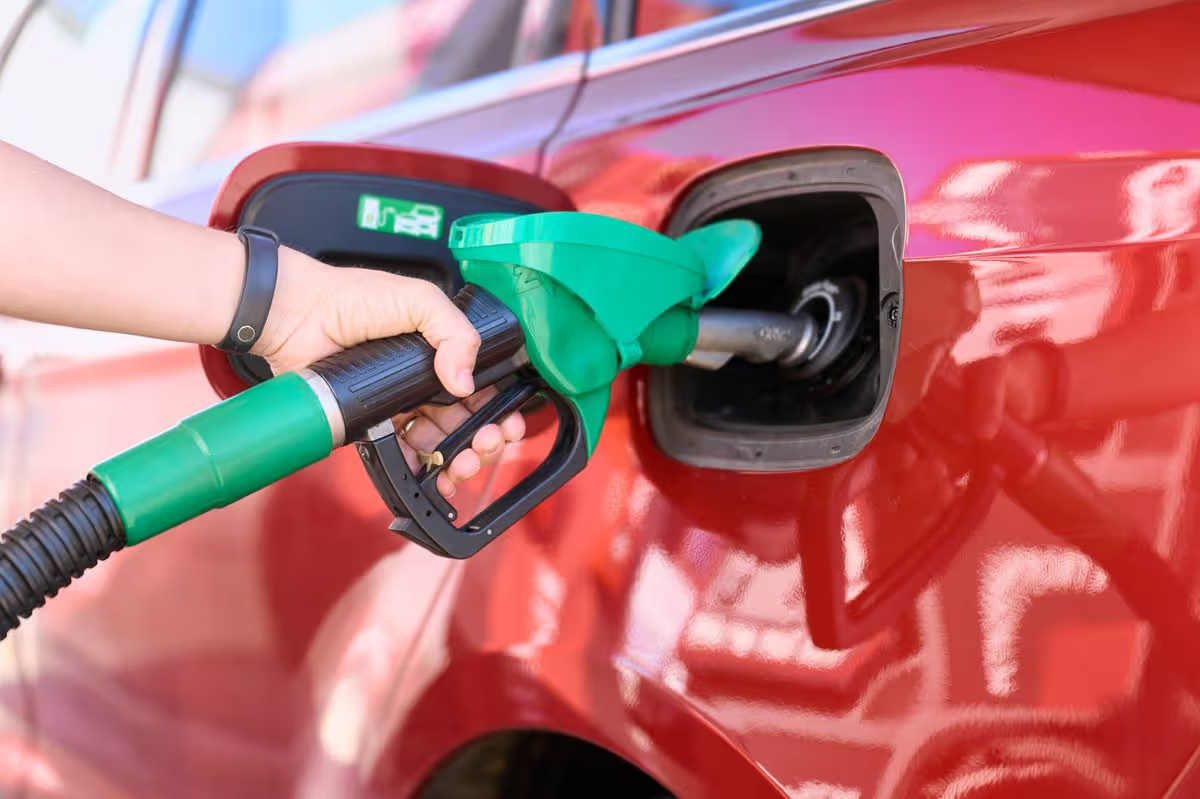
Holidaymakers are looking for ways to save costs(Image: Getty Images)
One of Britain’s largest holiday park operators is offering to reimburse fuel costs for guests travelling to their locations, as prices keep climbing. With oil prices at their highest level since 2022 because of tensions in the Middle East, petrol, diesel, and aviation fuel prices are being transferred to consumers.
As a results, Hoseasons is offering to refund the money spent getting to their sites this summer, through its recently introduced ‘Fuel Cover’. It comes after research revealed 15.4 million Brits (28%) have altered holiday plans this year because of increasing costs.
Nearly six in 10 of the 2,000 adults surveyed said the expense of going away, including travel, fuel, and spending while there, are deterring them from booking a trip this summer.
“UK breaks remain a hugely popular option for families looking for flexibility, value and quality time together, giving people the chance to properly switch off and reconnect closer to home,” Simon Altham, chief operating officer for the brand said.
“We know rising travel costs are becoming a bigger consideration for many holidaymakers this summer. Fuel, in particular, can quickly add to the overall cost of a trip, especially for families travelling during peak holiday periods.
“That’s why we wanted to help ease some of that pressure and support people continuing to take the UK breaks they were already planning this summer.”
The research, carried out on behalf of the brand, revealed that 7.6 million (27%) of those planning a UK holiday admitted they will cover shorter distances for a domestic getaway this year, with those driving expecting to spend an average of £68 on fuel.
Amongst those still intending to take a break, 26% have set a reduced overall budget for their trip, while 23% are seeking self-catering accommodation. Similarly, many stated they are actively hunting for cashback or money-saving deals prior to booking.
Two thirds believe holiday firms need to do more to encourage people to book trips in the current climate.
Hoseasons customers can claim back up to £75 in fuel costs through its new Fuel Cover initiative per booking between 20 May and 30 August for travel before 30 September. Bookings must be made by phone and quoting the code “FUEL75”.
Simon Altham from Hoseasons said: “Travel costs are one of the biggest considerations for holidaymakers at the moment. Fuel, in particular, can quickly become one of the biggest extra costs for families travelling during peak holiday periods.
“That’s why we’ve designed the offer to ease some of the pressure and help families make the most of their summer breaks.”
From castles and coastlines to moorland views, we drove the Northumberland 250 in an electric car to see how easy it was to manage the rural route
Octavia Lillywhite Acting beauty and wellness editor
07:30, 10 May 2026
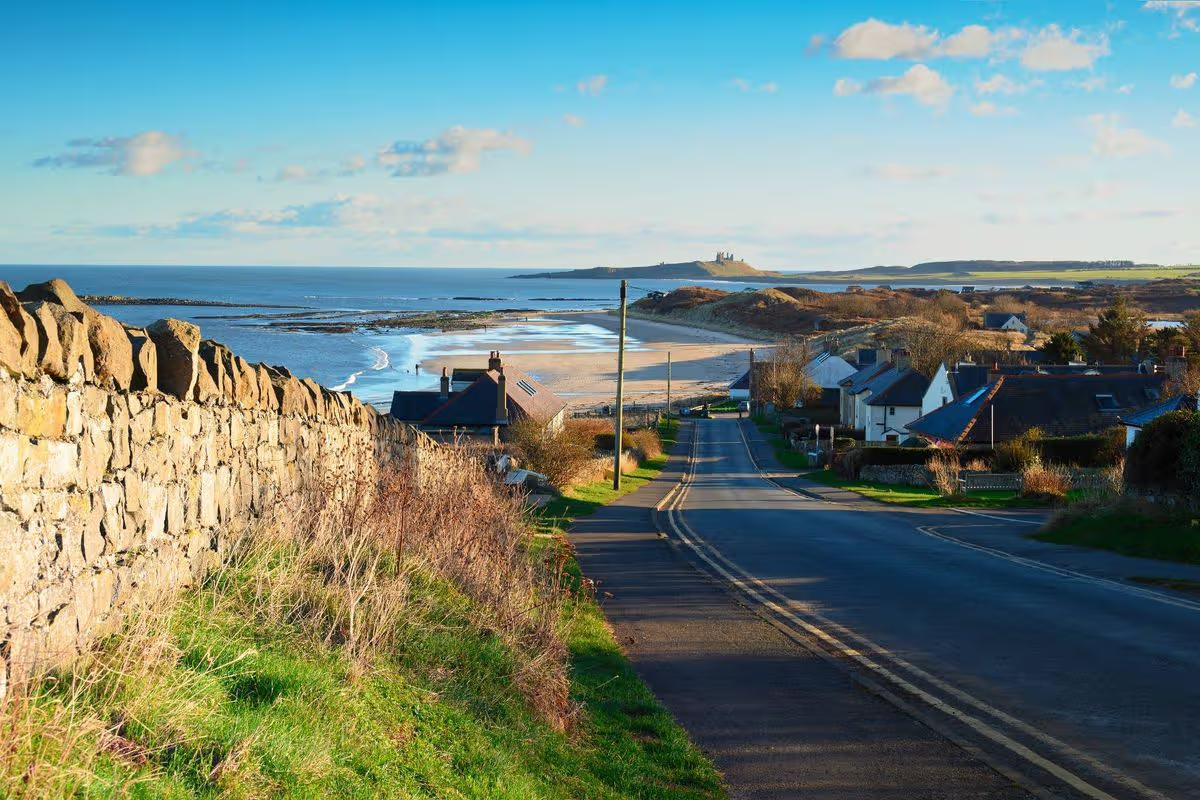
Possibly the most beautiful road trip in the country, with amazing views all along the route(Image: Getty Images/iStockphoto)
‘We’re driving the Northumberland 250,’ I told my husband. He looked at me cautiously.
‘It’s the most spectacular route in England, past more than 20 castles, up the Northumberland coast and over the Lindisfarne causeway – which you can only drive at low tide. Then it nips over to Scotland, to a town where Mary Queen of Scots stayed, and back down through England’s biggest forest and the UK Dark Sky Reserve, and along Hadrian’s Wall.’
‘That does actually sound brilliant,’ he said.
‘We’re doing it in an electric car so we can see how easy it is.’
‘Oh no,’ he said.
With petrol prices rocketing, a road trip feels like a luxury too far at the moment, and I liked the environmental appeal of not bringing our exhaust fumes all the way north with us. But we don’t actually have an electric car so – confident that we would find enough charging points – we borrowed one.
Our Škoda Enyaq was a nippy SUV, that made short work of brine-soaked causeways, forest track off-roading and 20% hills, even with junctions at the top (oh, hill starts with an electric engine – where have you been all my life?). It promised as much as 300 miles on a full charge but, bearing in mind that most road trips end up at at least double the loop mileage, we plotted two charging points every day, and kept our fingers crossed that they would a) be working, and b) not have petrol cars parked in them.
Electric car charging on a UK road trip: what to expect
Charging electric cars is still a bit of a lottery – slightly different at every machine. You never rock up at a petrol station forecourt and wonder, ‘how does this pump work, then?’ – but you do with chargers. Most have an app you have to download to use them, so there are moments standing in the rain trying to get signal. A saving grace is other electric car users who are amazingly helpful. Less helpful are petrol drivers who park on the charging spaces.
Charging anxiety got me once, as I poured over the map on our way to Jedburgh, where only one charger showed as working, and nothing else was reachable, but it turned out fine – it was a fast charger so we only had to wait 15 minutes for the previous car to top up before we could.
The Northumberland 250 route: castles, coast and countryside
Northumberland has so many castles. One could get castle-fatigue if they weren’t so incredibly impressive. Bamburgh makes a play for Most Spectacular Castle Anywhere. Alnwick is where Harry Potter learns to fly his Nimbus 2000. Lindisfarne is so remote it becomes an island twice a day. Most deserve at least half a day to do them (and their entrance fee) justice, so my advice is pick one or two and see the rest in passing.
Dunstanburgh was my favourite – a mighty, atmospheric ruin we saw on a sunset walk from the fishing village of Craster. It felt like going back in time – there wasn’t another soul about. But I also loved smaller, free-to-visit places like Edlingham and Twizzel. In Alnwick we skipped the castle in favour of super-sized cherry scones at the Strawberry Lounge café and at Bamburgh we marvelled at the fortress from the beach, but visited The Potted Lobster for lunch instead (one of my best decisions: the Smoked Haddock Chowder).
Holy Island (Lindisfarne) took a little planning around tide times and we arrived in a rainstorm (a rare letdown in a sunny trip). Too wet to even leave the car, we returned the next day to see it in sunshine – the causeway was worth driving four times.
Leaving the coast at Berwick-upon-Tweed I worried the best was behind us, but the drive only got more beautiful. We skipped back and forth over the Scottish border, and headed through Kielder Forest along the 12-mile off-road track, Forest Drive, then down to the wide horizons of the North Pennines.
Where to stay on the Northumberland 250: hotels, lodges and pubs
Picking our pitstops was one of the highlights of the trip. I favoured places with EV charging, but in the end, we only plugged-in for one overnight, fast-charging instead in towns where we lunched. There is a charger on Holy Island, for instance, and one at Kielder Castle – remoteness is no obstacle. I loved the pace this brought to the trip, forcing stops in places we’d normally have driven straight through. It meant we discovered little gems, like Fountain Cottage Café in Bellingham.
We stayed in the lakeside lodge at Blossom Plantation (no EV charging), and drank cava in the hot tub under the stars. The Most Northerly Hotel in England, Marshall Meadows just beyond Berwick, is a ritzy venue and country house hotel. The Pheasant Inn at Kielder Water is everything you could want from a cosy fireside pub, family run with home cooking by Robin, favouring local ingredients – some from their own garden.
I finished the trip with three revelatory resolutions. One, that Northumberland was an epic holiday destination, offering far more than you can pack into five days. Two, that driving the route in an electric car is not only possible, but adds something unexpected – a more thoughtful way to travel. And three, that my next car will be electric.
The Northumberland 250 Itinerary: 5-day trip breakdown
Day 1
Newcastle to Dunstanburgh, via Alnwick, Warksworth and Craster
Highlights and stops: Edlingham Castle (free), Alnwick town for cream tea at The Strawberry Louge, Warkworth Castle, Alnmouth village and beach, Caster village and walk to Dunstanburgh Castle.
Dunstanburgh to Berwick-up-Tweed, via Bamburgh and Lindisfarne
Highlights and stops: Holy Island causeway / Lindisfarne (first thing, due to tide times), Bamburgh Castle, beach and lighthouse, lunch at The Potted Lobster. Berwick-up-Tweed for fish and chips.
Overnight: Marshall Meadows Manor House Hotel, Scottish Border
Day 3
Berwick to Kielder Water, via Twizel, Jedburgh and the Kielder Forest Drive (with a quick return visit to Lindisfarne first thing)
Highlights and stops: Norham Castle, Kirk O’Steil church, Twizel Caslte and river walk to Twizel Viaduct, Jedburgh town, Hindhope Linn waterfall, Kielder Forest Drive
‘Unfortunately, it’s very likely that many people’s holidays will be affected, either by flight cancellations or very, very expensive tickets’
13:55, 22 Apr 2026Updated 14:53, 22 Apr 2026
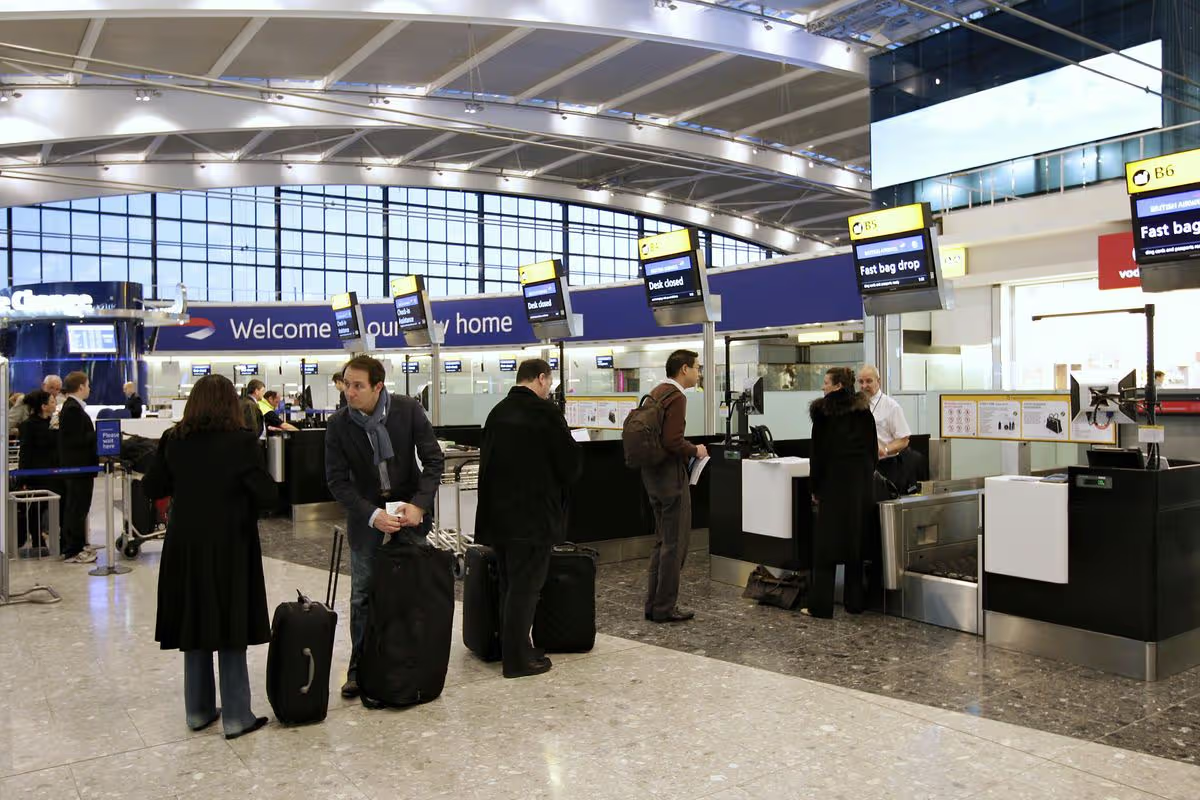
Passengers have been told ‘it’s very likely that many people’s holidays will be affected’ by the European Union(Image: Getty Images)
The EU has issued a warning that Europe faces a “very serious crisis” as aviation fuel supplies begin to dwindle due to the conflict in Iran, and holidaymakers may need to alter their summer travel plans.
“Unfortunately, it’s very likely that many people’s holidays will be affected, either by flight cancellations or very, very expensive tickets,” Dan Jorgensen, the EU energy commissioner, told Sky News. “Even if we do everything we can do, if the jet fuel is not there, then it’s not there.”
Jorgensen added: “[Currently] it is primarily a crisis of prices and not yet a crisis of supply, but unfortunately we cannot be sure to prevent a crisis of supply, especially on jet fuel in the future, if the crisis continues.”
The International Energy Agency has cautioned that significant supply problems could emerge within the next five to six weeks.
Airlines are already implementing measures to curb demand: the Lufthansa Group, among Europe’s largest airline operators, has confirmed the scrapping of 20,000 flights over the coming months. Meanwhile, other carriers are hiking ticket prices on long-distance routes to offset rising fuel costs.
“If we had peace tomorrow and the Strait of Hormuz opens, I think we will manage without that happening, but I have to say that even in the best-case scenario, the price crisis will still last for quite some time,” Jorgensen warned.
“Gas infrastructure has been ruined to a degree that will take years to rebuild and this means for months and maybe years yet we will see much higher prices than we had before this crisis started.”
The head of Italy’s Civil Aviation Authority told Sky News that people should consider spending their summer holidays in their home countries.
“In the past petrol prices have reached and exceeded more than $100 without any significant side effects on air travel but this time, the psychological effect is having a destructive effect on passengers,” Pierluigi di Palma warned. “It is best to recommend holidays nearby, rediscovering beautiful places in our country. “For those who still want to risk taking a long trip, it’s a good idea to consider special insurance that can provide reassurance regarding a guaranteed refund in the event of a delayed or cancelled flight.”
The EU has unveiled a raft of measures aimed at curbing the impact of the energy crisis, including proposals to accelerate the rollout of renewable energy sources and incentives for households to install clean energy solutions such as heat pumps and solar panels. The bloc is also pushing member states to slash tax on electricity, in a bid to encourage more motorists to make the switch to electric vehicles.
A group representing British Airways, easyJet, Jet2, Loganair, Ryanair, TUI, UPS and Virgin Atlantic has given a stark warning to ministers about holidays this summer. According to ITV News, Airlines UK has told passengers, ‘you can forget your holidays’ according to Good Morning Host Susanna Reid.
The letter, which has gone to ministers and the Civil Aviation Authority, calls on the government and officials to change the rules to bring down passenger duty, allow more night flights, and also to scrap compensation for cancelled or delayed flights.
Presenter Susanna said: “You can forget about your summer holidays. That is the stark warning issued to some air passengers hoping to fly abroad this year. With the war in Iran doubling the price of jet fuel, airlines say they face having to increase fairs or cut flights altogether.”
Co host Ed Balls added: “UK operators are now calling on the government to bring in emergency measures. In a confidential letter seen by ITV News, they’re asking for help to protect fuel supplies, reduce taxes on tickets, and waive strict rules. on compensating passengers.”
ITV said airlines are urging the government to step in to protect business travel, holiday flights and freight operations from the economic fallout of the war in the Middle East. A confidential briefing document submitted to ministers and the aviation regulator, the Civil Aviation Authority, seen by ITV News, warns that if the disruption “continues or worsens,” airlines will be forced to cut flights and push up fares.
The document, from Airlines UK, which represents British Airways, easyJet, Jet2, Loganair, Ryanair, TUI, UPS and Virgin Atlantic, warns that jet fuel costs have doubled, with fuel accounting for around a third of airline operating costs.
Correspondent Nick Dixon said: “Airlines are now at the stage where they are monitoring their reserves of jet fuel very carefully, very closely. There’s no indication just yet of any immediate cancelled flights or fuel shortages, but the airlines clearly need a backup plan in the longer term. And they are pushing for that. Now, some of the airlines have already taken steps. Lufthansa, the European airline, has cancelled thousands of its short-haul flights in an effort to conserve jet fuel. EasyJet, Virgin Airlines, as well as others, have expressed a lot of concern about the coming weeks.
“Virgin Atlantic has cancelled one of its long-haul routes. EasyJet has said, really, beyond the next few weeks into mid-May, they’re not entirely clear on what they will do for jet. Let’s just take a look at what the airlines are asking from the government in this letter that you mentioned.”
In terms of the changes the airlines want, he said: “So firstly, they want to relieve or reduce air passenger duty to help bring down the cost of travel generally and holidays during this period. Allow for nighttime flights to keep things moving if the schedules are disrupted, and also to scrap compensation for cancelled or delayed flights caused by fuel shortages. All of that, of course, would have a huge impact. on passengers.
“What most passengers want to know is, will my holiday flight be affected? It may well be that if the airlines win concessions from the government, we start to see some tactical flight cancellations of what would otherwise be loss-making departures. Well, the Department for Transport has said that it’s continuing to work with fuel suppliers, with airlines, and international counterparts on our contingency emergency planning to ensure that people keep moving and businesses are supported while the conflict is ongoing. But it’s all quite vague really at the moment and very concerning for passenger passengers who have either spent hundreds if not thousands on flights or are looking to plan uh trips throughout the summer.”