Petro

Venezuela’s Rodríguez and Colombia’s Petro Hold Talks on Security, Trade, Energy

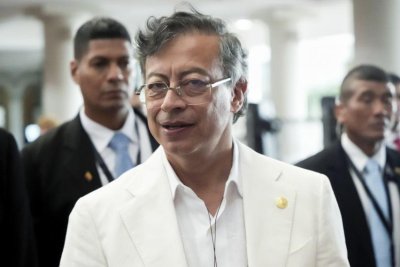
Petro was the first head of state to visit Caracas since the January 3 US attacks. (Presidential Press)

Caracas, April 24, 2026 (venezuelanalysis.com) – Venezuelan Acting President Delcy Rodríguez hosted Colombian President Gustavo Petro for bilateral talks in Caracas on Friday. 

The meeting marked the first official visit by a head of state since the kidnapping of President Nicolás Maduro during a US military operation on January 3.

Following talks at Miraflores Presidential Palace, Rodríguez said both governments committed to tackling organized crime along their shared border, one of the longest in the region at over 2,200 kilometers.

“We have undertaken a very serious and concrete approach to combating criminal groups and transnational crime,” she said, announcing the development of joint military plans and “immediate” mechanisms for intelligence sharing in a new level of security cooperation.

Petro, for his part, stated that both countries would work toward the “liberation of border communities” through coordinated military, police, and social action.

“Building a fully coordinated common effort to free border populations from mafias engaged in various illegal economies,” he said, accusing irregular groups of human trafficking, drug trafficking, and illegal gold trade activities.

The leaders also agreed on economic initiatives aimed at supporting Venezuelan and Colombian populations in border regions. Petro expressed hope that these efforts would help reintegrate the two territories and boost food security.

The joint action commitments come amid escalating violence in the Catatumbo region of Colombia’s Norte de Santander department, which borders Venezuela’s Táchira state, where clashes between armed groups have displaced thousands in recent weeks.

Armed organizations operating in the area include the National Liberation Army (ELN), the Estado Mayor Central (EMC) and the Segunda Marquetalia, both descendants of the former FARC, and the Clan del Golfo, among others.

Friday’s talks also included the neighboring nations’ trade relations. Rodríguez highlighted discussions on “import substitution” between the two countries.

“It makes no sense for Colombia or Venezuela to look to other regions or hemispheres for what we can produce within our own territories,” she said, noting that bilateral trade currently stands at approximately $1.2 billion per year.

The leaders further addressed electrical interconnection projects for western Venezuela, a region heavily affected by blackouts, as well as reopening a pipeline that would allow Venezuela to export natural gas to Colombia and beyond.

Rodríguez and Petro also discussed the revival of air connectivity to boost tourism, including the development of multi-destination travel initiatives.

Present at the private meeting were Colombia’s foreign minister Rosa Villavicencio and defense minister Pedro Sánchez, alongside Venezuela’s foreign minister Yván Gil and Interior Minister Diosdado Cabello. The presidential summit followed an earlier meeting of the two countries’ Neighborhood and Integration Commission, with bilateral working groups established for a number of areas, including trade, energy and defense. 

A prior meeting scheduled between Rodríguez and Petro on the border in early March was suspended due to security concerns.

Rodríguez hosts new US chargé d’affaires

Venezuelan Acting President Delcy Rodríguez also welcomed the Trump administration’s new chargé d’affaires to Venezuela John Barrett at the presidential palace on Friday.

Alongside Cabello and Gil, Rodríguez held a private meeting that reportedly focused on energy and a “long-term cooperation agenda.” For its part, the US embassy in Caracas stated that Barrett will continue implementing Washington’s “three-phase plan” for the Caribbean nation.

Barrett recently replaced Laura Dogu, who had been on the post since January. A career diplomat, he last served as chargé d’affaires in Guatemala, where he was accused of interference in magistrate elections in March.

Washington and Caracas fast-tracked a diplomatic rapprochement following the January 3 military strikes and kidnapping of Maduro. In March, the White House recognized Rodríguez as Venezuela’s sole leader, while the acting president recently thanked Trump and Secretary of State Marco Rubio for their “good disposition” in establishing “cooperation” between the two countries.

The diplomatic reengagement and US recognition have likewise led to a resumption of ties between Caracas and the International Monetary Fund (IMF).

Edited and with additional reporting by Ricardo Vaz in Caracas.

Source link

Historic but not enough? Colombia’s Gustavo Petro defends cocaine seizures | Drugs News

Pushing back on Washington

Petro, however, has highlighted his interdiction efforts as a means of refuting Trump’s claims that he has allowed cocaine to flow unchecked.

The subject reportedly came up during a call between the two heads of state in January. Petro suggested that Trump had been unfamiliar with the amounts of cocaine Colombia has seized.

“The United States doesn’t know anything about that,” he told CBS News after the call.

At other times, Petro has leaned on his interdiction record to push back on Trump’s hardline anti-narcotics policy.

In September, Trump and his allies announced a campaign to bomb boats suspected of carrying drugs, arguing the strategy was more efficient than interdiction.

“Interdiction doesn’t work,” US Secretary of State Marco Rubio said. “What will stop them is when you blow them up, when you get rid of them.”

Since then, the US military has bombed 47 boats, killing at least 163 people. Petro has condemned the strikes as “murders”, arguing they violate due process and international law.

He has also held up his own interdiction strategy as a more effective model.

When Colombia and the US led a joint maritime operation in February that resulted in nearly 10 tonnes of cocaine seized, Petro touted the outcome as proof that anti-narcotics efforts need not be lethal.

“The Colombian Navy seized the submarine without killing anyone,” Petro said during a cabinet meeting.

Still, experts have pointed out that Petro has bent to US demands in other areas.

While Petro had pledged not to target coca farmers, he announced in December that security forces would deploy drones to spray crops with glyphosate, an herbicide.

That plan — to forcibly eradicate coca crops by air — faced strong local opposition due to concerns over the herbicide’s health and environmental impacts.

Rueda said the move, which has yet to be implemented, signalled that Petro, like many presidents before him, had yielded to US pressure.

“The US government always wins,” said Rueda. “It always has more power over us, and we end up having to give in — and so does Petro.”

Whether Petro’s decision holds weight with his electoral base is less certain. While protests initially erupted in coca-growing regions, they subsided after meetings with his administration.

Rueda suspects officials reassured protesters they wouldn’t carry out the fumigations, which could have cost Petro in the upcoming elections.

“Petro’s decision highlights his inconsistencies when it comes to the policy he put forward,” Rueda said. “But in the end, the fumigations never happened, so the political impact likely wasn’t as significant as it could have been.”

Source link

Ecuador hikes tariffs to 100% on Colombia, Petro recalls envoy

Colombian President Gustavo Petro ordered the immediate return of his ambassador from Quito after Ecuador decided to raise tariffs on Colombia to 100% on May 1. Photo by Mauricio Duenas Castaneda

April 10 (UPI) — Ecuador raised tariffs to 100% on imports from Colombia, and Colombian President Gustavo Petro ordered the immediate return of his ambassador from Quito.

This represents a new escalation of the diplomatic and trade crisis between the two countries, according to an Ecuadorian statement and remarks from both leaders.

Ecuador said it will implement the tariff increase May 1, according to the Ministry of Production, Foreign Trade and Investment. It argued that Colombia has not taken concrete steps to curb drug trafficking and organized crime along the shared border.

“It is not possible to reach agreements with someone who does not have the same commitment to fighting narco-terrorism,” Ecuadorian President Daniel Noboa said Thursday night.

Petro described the tariff increase as “a monstrosity” and announced immediate measures.

“Our ambassador to Ecuador must return immediately,” he wrote on X, where he also called for a Cabinet meeting at the border between the two countries.

The Colombian president also defended his anti-drug policy.

“The president of Ecuador insults the Colombian government that has seized more cocaine than in the entire history of the world,” he said.

Ecuador’s decision marks a new critical point in a dispute that has intensified in recent months and is affecting bilateral trade, energy cooperation and diplomatic channels, according to local media reports.

Negotiations between the two countries within the Andean Community of Nations are suspended, Ecuador’s foreign minister Gabriela Sommerfeld said.

Relations deteriorated further after Petro’s recent statements about former Ecuadorian Vice President Jorge Glas, whom he described as a “political prisoner” and to whom Colombia granted nationality. Glas is serving corruption sentences in Ecuador.

The case dates to 2024, when Noboa’s government ordered his capture inside the Mexican embassy in Quito — an operation that led to a break in diplomatic relations between the two countries.

Ecuador maintains that tightening its trade policy also responds to the need to strengthen security along the roughly 373-mile shared border, where networks linked to drug trafficking, arms smuggling, human trafficking and illegal mining operate.

The Ecuadorian government estimates these efforts imply additional spending of about $400 million.

Since the start of the trade dispute, Colombia has responded with reciprocal measures, including tariffs on Ecuadorian imports and suspending energy sales to Ecuador, which in 2024 experienced power outages of up to 14 hours per day.

The economic impact is raising concerns in both countries.

In Colombia, business groups have called for de-escalation, while in Ecuador, companies in the pharmaceutical and cosmetics sectors have reported disruptions due to restrictions on Colombian imports, according to local media.

The figures reflect the scale of the exchange. In 2025, Colombia exported $1.846 billion in goods to Ecuador, making it its sixth-largest trading partner and second destination for non-mining, non-energy exports. Ecuador, exported about $857 million to Colombia, in a trade balance historically favorable to Bogotá.

Colombia’s National Business Council warned that with a 30% tariff, losses for exporters could reach $750 million annually and affect 82% of bilateral trade. With the increase to 100%, the impact would be far greater.

The new increase by Noboa “definitively closes any possibility of trade between Colombia and Ecuador,” Javier Díaz, president of the National Association of Foreign Trade, said to Clarín, Argentina’s largest newspaper.

On the Ecuadorian side, Pablo Cerón, a transport representative in the border province of Carchi, described the decision as “unilateral, improvised, misguided.”

The bilateral crisis comes at a politically sensitive time in Colombia, just months before general elections.


Source link

Colombia’s Petro asks Brazil to extend Pix payment system

Colombian President Gustavo Petro called for regional integration of the Pix system, and he criticized international financial control mechanisms, particularly the U.S. Office of Foreign Assets Control, for enforcing economic sanctions. Photo by Mauricio Duenas Castaneda/EPA

April 6 (UPI) — Colombian President Gustavo Petro asked Brazil to extend its instant payment system Pix to Colombia and questioned U.S. financial sanctions in a message posted on X, amid Washington investigations into the Brazilian system.

In his post, Petro called for regional integration of the Pix system and criticized international financial control mechanisms, particularly the Office of Foreign Assets Control, the U.S. Treasury agency responsible for enforcing economic sanctions.

“I ask Brazil to extend the Pix system to Colombia and hopefully stop considering the OFAC list, which no longer works,” Petro wrote Saturday.

The message comes after the U.S. government last week published the 2026 National Trade Estimate Report on Foreign Trade Barriers, which mentions the Pix system.

The report includes concerns from U.S. companies that the system, operated by Brazil’s central bank, may have regulatory advantages over foreign private competitors such as Visa and Mastercard.

Pix has gained popularity for allowing fast and free transfers, which has generated tensions over its impact on the traditional financial system.

In the same message, Petro criticized the international sanctions system. “OFAC only serves to persecute political opposition and domesticate them around the world. It is an aberrant system of political control,” he said.

He also contended that drug trafficking has managed to evade these mechanisms.

“Drug trafficking mocks it, and they stay in Dubai, where they buy residency for about $4,000 and live in luxury,” he added.

The message also included references to international politics and armed conflicts. Petro said that “no war is good” and said he had asked U.S. President Donald Trump to stop ongoing conflicts.

“His circle wants blood and leads him to make mistakes all the time,” he wrote.

Petro also criticized Israeli Prime Minister Benjamin Netanyahu, whom he accused of committing crimes against humanity in Gaza and Iran, and called for him to be tried.

Petro added that the homicide rate in Colombia has decreased, adding he hopes the trend is not temporary.

So far, the Brazilian government has not publicly responded to the request.


Source link

Colombia’s President Gustavo Petro under investigation in US for drug ties | Donald Trump News

Colombia’s President Gustavo Petro has been named in two separate criminal investigations led by prosecutors in the United States.

The New York Times was the first to report the existence of the two probes on Friday, citing sources familiar with the proceedings.

Recommended Stories

list of 3 itemsend of list

Media reports indicate that Petro is not personally the target of the investigations, which focus on drug-smuggling in Latin America.

But according to the Times, US attorneys in Brooklyn and Manhattan are looking into whether Petro met with drug traffickers and solicited donations from them for his 2022 presidential campaign. Al Jazeera has not independently verified the Times report.

By Friday afternoon, Petro had issued a statement denying the claims, which threaten to reopen the rift between the US and Colombia.

“In Colombia, there is not a single investigation into my relationship with drug traffickers, for one simple reason: I have never in my life spoken with a drug trafficker,” Petro wrote on the social media platform X.

He added that he told campaign managers to never accept donations from bankers or drug traffickers.

The investigations in the US, he argued, would ultimately exonerate him, and he blamed Colombia’s right-wing opposition for stirring controversy.

“So, the proceedings in the US will help me to dismantle the accusations of the Colombian far right, which is indeed closely linked to Colombian drug traffickers,” Petro said.

Petro has not been charged with any crimes, and the investigations are in their initial stages, according to the Times.

But experts say the timing of the report is significant, as it comes barely two and a half months before Colombia is set to hold a closely watched presidential election on May 31.

“If this would have happened a week before the first round, it would be election interference,” Sergio Guzman, director at Colombia Risk Analysis, a security think tank, told Al Jazeera.

“This seems to be more of a warning that shows how the US could influence the outcome of the election.”

Petro, Colombia’s first left-wing president, is limited to a single term in office, but the election is likely to be a referendum on his four years in office.

It will also be a test for Petro’s Historic Pact coalition, whose candidate, Ivan Cepeda, is currently leading in the polls.

Ivan Cepeda
Colombian presidential candidate Ivan Cepeda speaks at a rally in support of current President Gustavo Petro on February 3 [Nathalia Angarita/Reuters]

But United States President Donald Trump has repeatedly sought to boost the prospects of right-wing candidates in Latin America. He and Petro have been at loggerheads since Trump returned to office in January 2025.

Their feud came to a head in January after the US attacked Venezuela and abducted its president, Nicolas Maduro.

Shortly afterwards, a reporter asked if the US would take military action against Colombia. Trump replied: “It sounds good to me.”

To cool tensions, Trump and Petro held a call afterwards and agreed to meet.

Petro then visited the White House in early February to mend his often-combative relationship with Trump. While there, the Colombian delegation interacted with their counterparts, including Secretary of Defense Pete Hegseth and Secretary of State Marco Rubio.

Republican Senator Bernie Moreno, a longtime critic of Petro’s government, was also in attendance. Guzman believes the senator’s presence was significant.

“We don’t have a lot of straightforward answers about what were the commitments during that meeting, but Bernie Moreno did say that he wanted Petro not to be as involved in elections,” Guzman told Al Jazeera.

“And guess what? Petro is fully involved in the elections.”

The meeting also addressed collaborative efforts to combat drug trafficking, an issue core to Trump’s foreign policy.

Both presidents walked away from the meeting in good spirits, with Petro sharing a photo signed by Trump that read, “Gustavo – a great honor. I love Colombia.”

But Petro and Trump have long been at odds over how to tamp down on narcotics smuggling.

Colombia, the region’s largest producer of cocaine, has been criticised by the Trump administration for what it sees as soft-on-crime policies, including negotiations with armed groups.

Petro, meanwhile, has denounced the US for its lethal tactics, calling them tantamount to murder.

The US, for instance, has bombed at least 46 alleged drug boats and vessels in the Caribbean Sea and eastern Pacific Ocean. Some of the 159 people killed were Colombian citizens.

The US has also floated the idea of conducting military attacks in Latin America against suspected drug traffickers, and it recently began joint operations against gangs in Ecuador, Colombia’s neighbour.

A screen shows Colombian President Gustavo Petro and U.S. President Donald Trump shaking hands, as people attend a rally, called by the Colombian government, in support of Petro during his ongoing visit to the U.S., at Plaza Bolivar in Bogota, Colombia, February 3, 2026. REUTERS/Nathalia Angarita
A screen shows Colombian President Gustavo Petro and US President Donald Trump shaking hands at Plaza Bolivar in Bogota, Colombia, on February 3 [Nathalia Angarita/Reuters]

Analysts say actions like these have Latin American leaders on edge.

Trump’s aggressive manoeuvres suggest that the US president is willing to jeopardise “the sovereignty and peace of every nation” in his campaign against illicit drugs, according to Rodrigo Pombo Cajiao, a constitutional law professor at the Pontificia Universidad Javeriana.

Pombo Cajaio pointed to the US abduction of Venezuelan President Nicolas Maduro on January 3. Maduro was a longtime adversary of Trump, and he is currently being held in prison in New York on drug-related charges.

“Every political leader in the region has been put on notice” after that abduction, Pombo Cajiao said.

“As the world’s leading producer of cocaine, Colombia found itself at high risk of judicial prosecution” from the US, he added.

Currently, Petro’s Historic Pact is leading May’s presidential race. A GAD3 poll released this week suggested Cepeda is ahead in the polls with 35 percent voter approval, ahead of far-right candidate Abelardo de la Espriella, who had 21 percent.

Source link