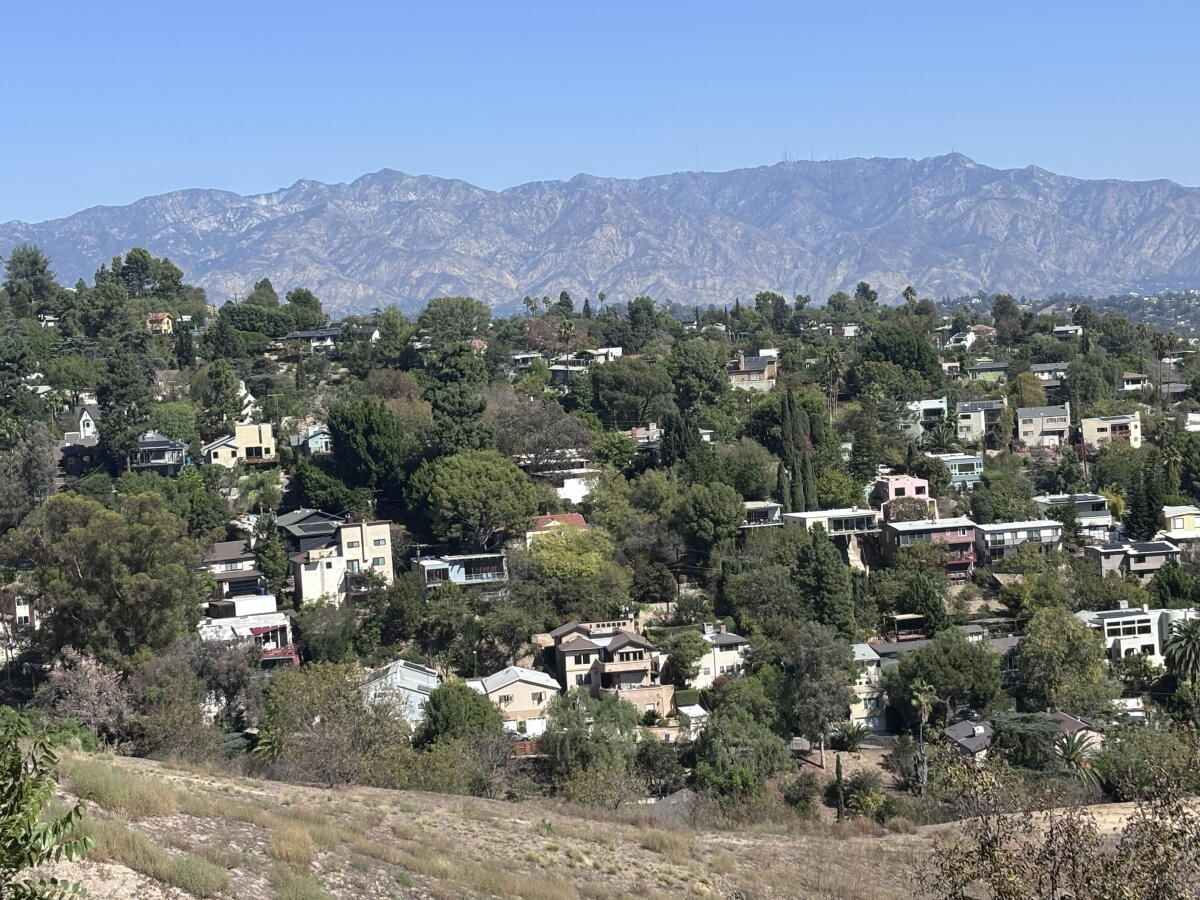
The City Council passed two film-friendly measures, one that creates free permits for so-called micro-shoot productions and another that limits parking fees on city-owned lots, yards and civic properties and staging areas to $1 a day, regardless of the size of the project.
The city currently charges $450 a day for base camp parking at city-owned parks and $100 to $300 a day for crew parking, according to FilmLA.
“Both efforts advanced today aim to support independent shoots and attract aspiring storytellers to our city,” Councilmember Adrin Nazarian, who introduced the initiatives, said in a statement. “As we work to protect established productions, we must also uphold Los Angeles’ reputation as a hub for the next generation of filmmakers. People need to believe that this is still the town to turn their filmmaking dreams into reality.”
Micro-shoot permits refer to sets with up to 10 filmmakers on site that have a minimal community impact. Under this new ordinance, student filmmakers, documentary crews and ultra-low-budget projects will be able to obtain free permits. City departments soon will report back to the Council on how they plan to implement this.
The idea behind the $1 permits is to turn more areas of L.A. into homes for all kinds of productions.
Nazarian is chairman of the Council’s recently formed Ad Hoc Committee on Film, Entertainment and the Creative Industry, aimed at making filming in L.A. more accessible.
“The stark reality is that California is on the brink of losing its position as the nation’s premier destination for production spending,” Nazarian said during a City Council meeting this month. “While we retain the Hollywood name, the data makes it urgently clear, crisis-level clear, that Los Angeles is fast losing its footing as the center of film and television production.”
I was trying to discern whether I’d made a wrong turn when I heard a loud whoosh next to me. Somehow, I’d missed the red-tailed hawk perched on a small tree, watching me from an arm’s length away.
That was one of many delightful surprises I encountered as I developed a 6.7-mile urban hike that I will share in this edition of The Wild, our weekly outdoors newsletter.
You are reading The Wild newsletter
Sign up to get expert tips on the best of Southern California’s beaches, trails, parks, deserts, forests and mountains in your inbox every Thursday.
By continuing, you agree to our Terms of Service, which include arbitration and a class action waiver. You agree that we and our third-party vendors may collect and use your information, including through cookies, pixels and similar technologies, for the purposes set forth in our Privacy Policy such as personalizing your experience and ads.
Back in May, I published a 13.5-mile urban hike (see map) that connects trails along the Arroyo Seco and in Elephant Hill Open Space, Ascot Hills, Lincoln Park, Flat Top Park and Ernest E. Debs Park. I wanted to celebrate our local hillsides but also showcase natural areas that remain under threat of development.
I have wanted to expand the route ever since I published it. I got motivated, though, when I saw that the Mountains Recreation and Conservation Authority, or MRCA, will receive a $200,000 grant in Proposition 4money to develop a trail connecting open spaces in Northeast L.A.
MRCA will consider how to connect Elephant Hill Open Space with other land that it owns and manages, including Elyria Canyon and Rainbow Canyon, along with parks and open spaces owned by other public agencies.
The view from Kite Hill, a high point in Mount Washington, from near North Avenue 37.
(Jaclyn Cosgrove / Los Angeles Times)
“We’ve been thinking about connectivity in Northeast L.A. for a while, the idea being that we connect the protected hilltops and canyons creating access to the Arroyo Seco, which ties up to the Angeles National Forest and down to the L.A. River,” said Sarah Kevorkian, deputy chief of wildfire resilience at MRCA, noting that there’s great energy and momentum built by community members who want to see their neighborhood open spaces protected.
I am eager to see what MRCA and its partners develop. Based on what I’ve experienced, urban hiking trails can lead to better connection among neighbors and a deeper appreciation for nature nearest to us. In the interim, I developed the trail below that envisions what a regional connector trail could look like.
The total extension to the River to the Hilltops route is about 9.4 miles when you include the three “connector” trails that I indicate via a dotted blue line on the map. In total, the full route is now about 23 miles. Below, I explain the heart of the extension through Cypress Park and Mount Washington, which is about 6.7 miles without the connectors, including the two that would take you to the larger original trail. I made this route in a “Choose Your Own Adventure” style, hoping to inspire folks to (legally!) explore their city, hence the flexibility (and complications in explaining mileage).
Some quick logistics before I dive into the route:
I developed the route using CalTopo, an online mapping software with a desktop site and mobile app. You can download the CalTopo app onto your phone and follow the route there; you can also download the trail from CalTopo to use on your Garmin or other device. I also uploaded it to my AllTrails profile.
In May, I dubbed the original trail “River to the Hilltops” in CalTopo and on AllTrails. Afterward, a reader suggested “Jewel Necklace” as a name. What do you think?
I haven’t marked everywhere you can find a restroom or water, but will try to add those as time allows. Please plan accordingly, as some stretches run through neighborhoods or open spaces where there isn’t much nearby.
There is no single place to start this route, although this newsletter will focus on the latest extension. You can start and stop this route in several spots though.
Trail access and conditions can change. Please follow all posted signage (and contact me if you encounter major issues).
This route travels through several neighborhoods. Please refrain from using Bluetooth speakers and anything else that would be disruptive to residents.
There are several places along the route where you will walk in the street of a neighborhood because it lacks sidewalks; please use caution!
At several junctures along the suggested route, you will have an option to take a different path that will essentially get you to the same place. Do what’s best for you, and most important: Have fun, be safe and don’t trespass!
A red-tailed hawk flies over Bob Scholfield Park in Mount Washington.
(Jaclyn Cosgrove / Los Angeles Times)
Now let’s talk more about the route (full map here).
To begin this extension into the neighborhoods of Mount Washington and, briefly, Cypress Park, I started at the Lincoln/Cypress Metro station off the A Line (previously, and forever in our hearts, the Gold Line). The station has a series of stairs and ramps that you can take down to West Avenue 26, which borders the station on its eastern-ish side.
You’ll quickly turn right (or northeast) onto Lacy Street, passing Lacy Street Neighborhood Park. I chose this option because, as you’ll see after about a quarter of a mile on Lacy, it leads to a pedestrian bridge.
A pedestrian path that leads to a bridge taking walkers and hikers over the 110 Freeway.
(Jaclyn Cosgrove / Los Angeles Times)
It is not a well-marked or particularly welcoming pedestrian bridge, but it exists nonetheless. You’ll see a narrow walkway lined with a green metal fence topped with spikes and, later, razor wire. Did I mention it’s not terribly welcoming?
Head over the 110 Freeway via this bridge, and turn right onto Arroyo Seco Avenue and then soon left on Amabel Street. But appreciate this little jaunt, as it’s the last bit of flat walking for a bit.
A pedestrian bridge over the 110 Freeway near Cypress Park.
(Jaclyn Cosgrove / Los Angeles Times)
Cross over North Figueroa Street, and trudge up the hill before you, which has an average grade of about 15%. You’ll pass a neighborhood sign for Mount Washington as you bear left on Isabel Street before making a quick right (north) turn onto Glenalbyn Drive. Continue northeast onto Beech Street and feel as amazed as I was when it becomes a dirt path.
As I trotted through here, I enjoyed watching a kettle of turkey vultures soaring high above the homes perched on the hillside, looking for a fine carrion brunch.
Rather than continuing on the dirt path that heads southeast, I headed up Montalvo Street. Be careful here, as there is no sidewalk. I headed north onto Andalusia Street, or Avenue on some maps, and then further northwest onto West Avenue 37.
A gate was installed on West Avenue 37 in the late 1980s to block rowdy visitors from driving to and partying on Kite Hill in Mount Washington. The route remains open to pedestrians.
You’ll soon arrive at Kite Hill, which The Times described in 1988 as “a scenic Mt. Washington location popular with kite-flyers by day and partying teenagers by night.”
The rambunctious youths were so noisy, L.A. City Council spent $1,200 — about $3,500 in today’s money — to install gates to prevent vehicle traffic. The route remains open to pedestrians.
“It’s like the Hollywood Bowl up there, but it goes on all night,” resident Bob Cummings, a real estate agent who had lived on Mount Washington for 18 years, told The Times in 1988. “It’s like a cancer that started. We’re asking for the city’s surgeons to cut it out.”
When I visited Monday, I saw no evidence of kites or parties, but I did appreciate the glorious views of our local hillsides and San Gabriel Mountains.
One perk of walking the Mount Washington leg of the route is the Halloween decor you’ll spy along the way.
(Jaclyn Cosgrove / Los Angeles Times)
At the juncture of West Avenue 37 and San Rafael Avenue, you have two options in terms of the route I’ve charted out: You can continue northwest on West Avenue 37, where you’ll quickly be frolicking in Elyria Canyon, or you can take San Rafael Avenue and a short winding path down to Rainbow Canyon, which is also lovely.
Although I designed this leg of the River to the Hilltops route to start at the Lincoln/Cypress Metro stop and end at the Southwest Museum Metro station, you can also turn it into a loop, as you’ll see on the map.
For the purposes of this newsletter, I’m going to explain the route via the first option, continuing northwest on West Avenue 37 and then right (or northwest) onto Killarney Avenue for about 400 feet until you turn right onto some wooden, dirt-covered steps. You’ve reached Elyria Canyon Park!
Wooden stairs lead down into Elyria Canyon Park, where hikers will find several species of native shrubs and trees.
(Jaclyn Cosgrove / Los Angeles Times)
Be mindful as you take the steps, as the loose dirt can be slippery. You will have lovely views of L.A. and its landscapes as you meander past native shrubs and trees, including black sage, toyon and wild cucumber. This 35-acre park “boasts one of the finest examples of California black walnut woodland in Southern California,” according to the Mountains Recreation and Conservation Authority, which manages the land.
That’s one reason that a 1996 Times story dubbed this park “a living example of the Los Angeles of 200 years ago.”
There are multiple routes, and I won’t discourage you from exploring beyond what I’ve mapped out, which from the map, you can see is a quick loop, passing through the park (including Akuutet Learning Nursery and the surrounding neighborhood. If you find yourself needing a snack break, you’re in luck. (I will admit that I wanted the same while in Elyria Canyon and took a short walk over to Little Barn Coffee House, one of my favorite spots in L.A.)
The path through Elyria Canyon travels through the 35-acre park that features a California black walnut woodland.
(Jaclyn Cosgrove / Los Angeles Times)
After the loop, you’ll head out of the canyon onto Elyria Drive and then make a left back onto San Rafael Avenue, which you’ll take for about a third of a mile. Continue north past San Rafael Avenue and Danforth Drive onto Sea View Avenue. In about a third of a mile, Sea View will transform into a dirt path as you enter Bob Scholfield Park (per the name etched into a rock under a tree).
Two red-tailed hawks flew overhead as I entered this charming stretch of the walk. I chatted with another hiker and petted his Great Pyrenees dog, as I grew up with the breed and have a soft spot for these giant fluffy goobers.
After following this dirt path as it curves around, you will return to a paved Sea View Drive. Head southeast, and you’ll quickly find yourself at Moon Canyon Park.
Moon Canyon Park in L.A.
(Jaclyn Cosgrove / Los Angeles Times)
Developers had wanted to construct 18 homes and a parking lot in this 4.5-acre canyon, but the L.A. City Council instead set aside $550,000 to preserve it, according to a 2003 Times story.
“I couldn’t be happier because the canyon will be left open,” resident Sharon Roesler, a member of a group opposing developing the canyon, said at the time. “We don’t have enough of these places to go to in Los Angeles.” (If you want to learn more about restoration efforts here, you can visit the Friends of Moon Canyon website, which is working to restore the canyon.)
You will walk southeast down a pleasant dirt path through the canyon, noticing those restoration efforts, before you hit pavement for just a moment and then immediately bear right onto West Pheasant Drive, another dirt path.
A Chevy van parked ahead on the trail.
(Jaclyn Cosgrove / Los Angeles Times)
I was enjoying my hike when I followed the bend of West Pheasant Drive and noticed a van parked ahead. Now, I’ve seen enough horror movies that I quickly started to write the opening scene to my demise.
EXT. DIRT HIKING TRAIL
“JAC, a well-meaning but unfortunately oblivious hiker, spots a vintage camper van on the trail. They have no idea what lurks ahead.”
Thankfully, there was nothing other than a funky DIY project lurking in the distance. I approached the van to find a cardboard sign attached (which, again, sounds creepier than it was).
“The process is as WiLD as the circumstances!” it read. “This van is unable to leave the road (you may have noticed 🙂 ) so we are resituating it to optimize space (something special, incoming!).”
A narrow dirt path called West Pheasant Drive on some maps.
(Jaclyn Cosgrove / Los Angeles Times)
After you pass the van art project, you’ll soon reach a nest of streets, as each has a bird name. You will turn right from West Pheasant onto Quail Drive and then quickly left onto Dove Drive. Follow Dove Drive southeast and quickly take a hard right (northwest) onto Glenalbyn Drive, followed by a hard left (southeast) onto Mavis Drive and then soon a right on Frontenac Avenue, then left on West Avenue 46 to head into the park area around the Carlin G. Smith Recreation Center.
You’ll pass through a gate and meander down the path, with an optional side quest to have a friend push you on the tire swing. After shenanigans, walk through the basketball court to where the path continues in the court’s southeast corner.
This route, when I traversed it, was loose and narrow. If it feels too sketchy, take the road or use a trekking pole if you’ve brought one. No reason to turn an ankle after you’ve had an otherwise splendid day!
At the end of this rustic route, take West Avenue 45 down to the Rainbow Canyon Test Plot, a publicly owned area where volunteers are readily restoring the canyon with native plants and shrubs. There is a pleasant little trail from the test plot that goes through the canyon. You will take it up to West Avenue 44.
A previous walker left a message on a utility pole to remind us of one reason we hike.
(Jaclyn Cosgrove / Los Angeles Times)
From here, you can either use the connector trail I’ve mapped out or head down West Avenue 44 to Marmion Way and the Southwest Museum Metro stop.
That is the end of the Mount Washington trail extension, but doesn’t have to be the end of your day. If you’re feeling adventurous, I have mapped out a connector route through Sycamore Grove Park that will take you to the Arroyo Seco and Debs Park — and beyond that!
The total route now includes about 23 miles of urban hiking. Where should I extend the route next? I’d love your feedback on how to connect our public lands.
3 things to do
The Devil’s Punchbowl Natural Area sits near the San Gabriel Mountains.
(Jaclyn Cosgrove / Los Angeles Times)
1. Be with the bats near Pearblossom L.A. County Parks and Recreation will host Bat Weekend on Saturday and Sunday, from 4 to 7 p.m. both days, at the Devil’s Punchbowl Natural Area near Pearblossom. Guests can participate in crafts and a night walk and visit educational booths. Learn more at the park’s Instagram page.
2. Seek out scares in Culver City Walk ‘n Rollers will host a Halloween-themed bike ride from 5:30 to 8 p.m. Sunday in Culver City. Cyclists will travel five miles on city streets and bike paths, exploring the best Halloween decor in the area. Riders will meet at Village Well Books + Coffee. Register at eventbrite.com.
3. Blend science and the spooky in Orange SoCal Science Hikes will host a Halloween-themed evening hike from 6 to 9 p.m. Saturday through Irvine Regional Park in Orange. Participants will first try to spot diurnal animals as they hike 2.5 miles, and then after, meet at a faux campfire for ghost stories. Costumes welcome, as long as you can hike in them. Register at eventbrite.com.
The must-read
Finley Kilgo pauses during a birdwatching bike ride through the Arcata Marsh and Wildlife Sanctuary at the northern end of the Humboldt Bay Trail. The trail could eventually become part of the Great Redwood Trail.
(Andrew Cullen / For The Times)
Advocates of the Great Redwood Trail, a proposed 307-mile route that follows defunct railroad lines, say the route could become as epic a bucket-list trip as other great multi-day scenic trails. But at what cost? Times staff writer Lila Seidman spoke to Perry Lincoln, a member of the Wailaki Tribe, who said he and other Indigenous people in the area have been left out of the planning process for a hiking trail that cuts through their ancestral land. “We’re barely getting access to these areas ourselves, but we’re going to allow outside communities to have full access to these places?” Lincoln’s daughter Tisanche Warren said. “That doesn’t seem fair.” About 40% of the trail is complete, with major efforts planned to clean up railroad pollution and restore fish habitat. The Kinest’e Community Coalition, composed of Lincoln and other tribal members and their allies, continues its fight to not only have a say in the project but also to reroute the trail to protect sacred sites, including graves.
Happy adventuring,
P.S.
Are you interested in getting into mountain biking? Or do you want to find a community of mountain bikers? The California Mountain Biking Coalition will host Rally for the Trails, a gathering of the Southern California cycling and trails community from 5:30 to 7:30 p.m. Friday at the Cub House in San Marino. You’ll learn from guest speakers, watch short films and learn about local ride events. Plus, you can meet volunteers from several local outdoors groups. Sounds like a great way to meet new pals!
For more insider tips on Southern California’s beaches, trails and parks, check out past editions of The Wild. And to view this newsletter in your browser, click here.
Three weeks after the autumnal equinox, it finally feels like fall.
Well, kind of.
This past weekend, Southern Californians breathed a collective sigh of relief as an oppressive heat wave broke. Temperatures in L.A. dropped 31 degrees, from 104 degrees on Oct. 4 to one week later, a high of 73 degrees, according to observed weather data.
I felt like a climatological grim reaper when, in the midst of my friends celebrating the drop in temperature, I told them it was temporary, as it was expected to get hot. Again. (I’m great at parties!)
But, even still, I want to help you get outdoors — safely. In this week’s edition of The Wild, our weekly outdoors newsletter, I will share three excellent L.A. hikes that each offer something different — great views or shade, for example — with caveats about the best time to go.
You are reading The Wild newsletter
Sign up to get expert tips on the best of Southern California’s beaches, trails, parks, deserts, forests and mountains in your inbox every Thursday.
By continuing, you agree to our Terms of Service, which include arbitration and a class action waiver. You agree that we and our third-party vendors may collect and use your information, including through cookies, pixels and similar technologies, for the purposes set forth in our Privacy Policy such as personalizing your experience and ads.
The first caveat is: The National Weather Service issued a red flag watch and warning, which signals an increased risk of fire danger, for much of L.A. and Ventura counties from Thursday morning through Saturday evening. It includes the San Gabriel and Santa Monica mountains. As a result, parks within Santa Monica Mountains National Recreation Area will be closed Thursday through Saturday. The closure applies to land managed by California State Parks, the National Park Service, the Santa Monica Mountains Conservancy and Mountains Recreation and Conservation Authority.
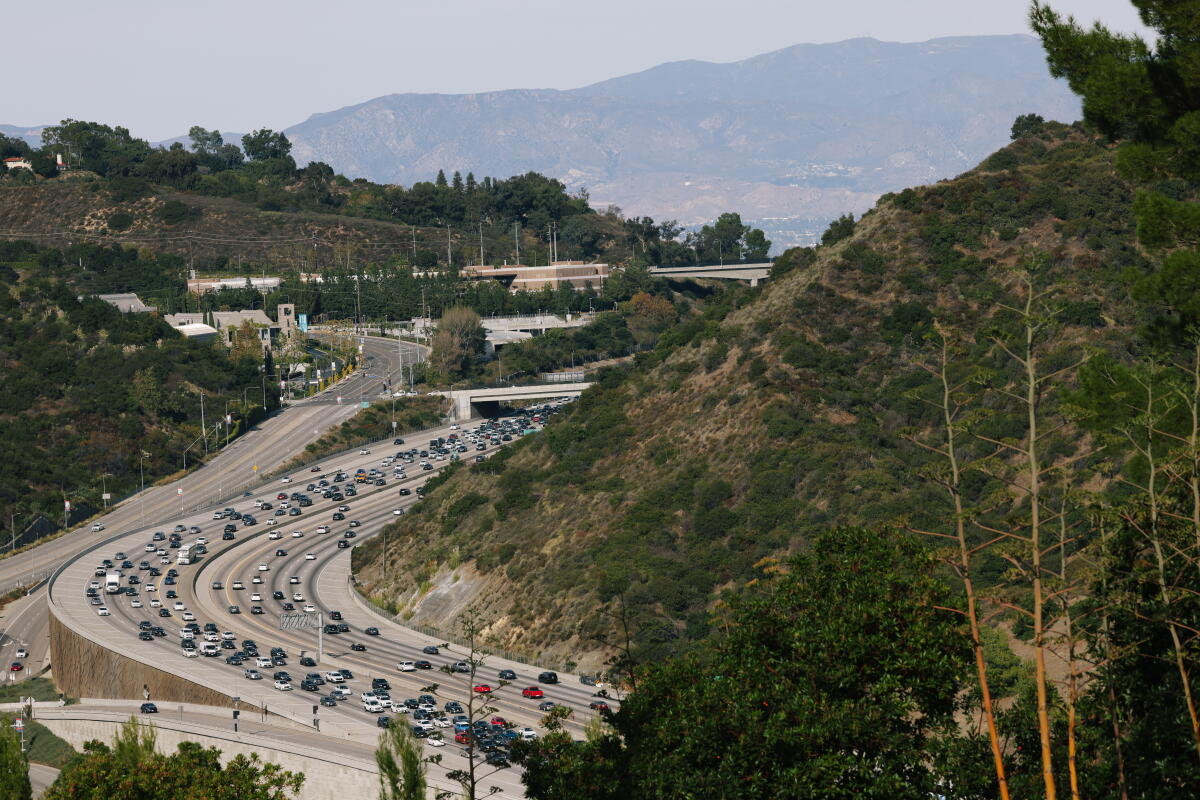
Daniel Swain, UC Agriculture and Natural Resources climate scientist, told my Times colleagues Terry Castleman and Rong-Gong Lin II in a recent story that the greater fire risk will be in communities and natural areas west of the 405 Freeway, as east of the 405 recently saw rain.
The 405 Freeway passes through several areas with hillsides covered in dense shrubs and trees.
(Dania Maxwell / Los Angeles Times)
“West of that point, almost no rain fell at all, and in early October we had a record-breaking heat wave,” Swain said. “East of the 405 in Southern California, the fire risk is lower because it recently rained.”
Bearing that in mind, two of the hikes below are east of the 405 and the third is an urban hike. All three avoid long drives far into the mountains. The two hikes closest to the foothills have large parking areas and clear exits. The urban hike usually offers clear views that should allow hikers to spot a fire near them and evacuate quickly.
Several children balance on rocks as they cross a segment of the Arroyo Seco near Pasadena.
(Jaclyn Cosgrove / Los Angeles Times)
1. A shady hike along a flowing river
Gould Mesa via Gabrielino Trail Distance: About 4 miles out and back Elevation gained: About 300 feet Difficulty: Easier end of moderate Dogs allowed: Yes Nearest to: Pasadena, La Cañada Flintridge and Altadena Accessible alternative: The first mile of this trail is paved. See notes below.
The Gabrielino National Recreation Trail is a 28.8-mile journey from Chantry Flat Recreation Area north of Sierra Madre all the way to the Ventura Street & Windsor Avenue trailhead near the Hahamongna Watershed Park in La Cañada Flintridge. It is a multi-use trail for hikers, mountain bikers and horse riders.
The trail has several beautiful sections, including from its western entrance in Hahamongna to the Gould Mesa Trail Camp. This segment is mostly shaded and great for a morning stroll, especially before 11 a.m. Saturday and Sunday.
To begin your hike, you’ll park at a large free dirt lot near the backside of NASA’s Jet Propulsion Lab. If hiking in a wheelchair or seeking an accessible paved path, I recommend parking at this smaller paved lot, as that’s where the paved portion of the trail begins. (Please leave this lot for folks seeking the accessibility alternative, as it’s smaller than the large dirt lot — and both are free!)
You can either take the paved trail or an unofficial dirt trail that follows the Arroyo Seco before leading you to the official trail. Either way, it’s primarily a mix of flat path and gentle inclines along the Arroyo Seco, shaded by coast live oaks, bay laurels and sycamore trees. After hiking about two miles, you’ll reach the Gould Mesa Trail Camp, where you can set up a picnic at one of the campground’s tables, or cool off along the creek.
And if you’d like to go a bit farther, you can continue onward to the Paul Little Picnic Site or the Brown Mountain Dam waterfall (see map). Regardless of where you stop, I promise you’ll be treated to a stunning landscape and likely hear the chirp and squawk of scrub jays, California quail and more.
The San Gabriel Mountains become blanketed in golden light in the early evening in Dunsmore Canyon in Deukmejian Wilderness Park, a Glendale park.
This 2.6-mile hike through the 709-acre Deukmejian Wilderness Park in Glendale will offer you not only great views of the surrounding cities but also an opportunity to spend time among healthy native trees and plants, including California buckwheat, black sage and California sagebrush (which you should smell).
You’ll park in a lot near the Stone Barn Nature Center. Several signs are usually posted around the lot warning visitors about when the park will close, and a staff member will lock the gate. I think that’s serious, so take note.
You’ll start your hike on Dunsmore Canyon Trail, headed northeast up a straight gravel path covered on both sides with thick ceanothus, yerba santa and more.
Although some hikes, like this path in Dunsmore Canyon in Glendale, may appear exposed during the day, you might find they’re shadier in the morning or evening, depending on their local topography.
(Jaclyn Cosgrove / Los Angeles Times)
Just 0.2 miles in, there’s a massive old coast live oak where kids could easily create an imaginary forest kingdom under its large branches.
As you continue to climb, you might hear Dunsmore Creek, which runs parallel to the trail. Remember to turn around as you gain elevation, as this trail rewards you with substantial views of Glendale and the Crescenta Valley soon after you start. All the while, you have the San Gabriel Mountains right in front of you, including Mt. Lukens, which you can hike to from the same park.
Half a mile in, you have the option to continue on the Dunsmore Canyon Trail or Le Mesnager Trail to make a shorter loop. Le Mesnager Trail includes a lookout point at about 2,750 feet, a great spot for sunset as long as you don’t get locked in! As you meander down the trail, you’ll find a nice shady canopy and continued views of the city below.
Given our weekend temperatures, this trail is best in the morning or evening. I personally prefer the latter, when golden hour paints the mountains a deep gold to red.
If you plan to hike it in the evening, though, keep the park hours in mind. It is open until 8 p.m. until Monday, when its hours shift to closing at 7 p.m., which remains until Daylight Saving Time ends Nov 1. This is relevant if you plan to park in the lot. Otherwise, you can walk out of the park and back to your car. Regardless, have fun!
Visitors reach the Baldwin Hills Scenic Overlook by climbing the Culver City Stairs.
(Myung J. Chun / Los Angeles Times)
3. An urban hike near a great picnic area
Culver City Stairs to Baldwin Hills Scenic Overlook Distance: 1.4 miles Elevation gained: About 350 feet Difficulty: Moderate Dogs allowed? Only on the paved road, not on trails Accessible alternative: Discovery Park and Bluff Creek Trail
This 1.4-mile out-and-back jaunt up 282 concrete steps, known locally as the Culver City Stairs, takes hikers to the stunning Baldwin Hills Scenic Overlook. From here, you’ll have one of L.A.’s most breathtaking — kind of literally — city views.
To begin, you’ll take the Baldwin Hills Scenic Overlook entrance off Jefferson Boulevard. You’ll follow a dirt path briefly east, follow a switchback to the west and soon find stairs. Head straight up, pausing to breathe and appreciate the views. The stairs vary in height, from about 3 to 20 inches, so it’s good to take your time.
At the top, you’ll have panoramic views that, on a clear day, include the Pacific Ocean. To return, you can either head back down the steps or take the meandering dirt trail down.
Culver City is expected to be cooler on Sunday than Saturday, with an expected high of 85 degrees. Why not make it a morning trek followed by brunch?
Regardless of where you go, I hope you have a safe and meaningful time on our public lands!
3 things to do
1. Prance up to a giant pumpkin in Norco The L.A. Fright Club will host a 1.6-mile moderate hike at 9 a.m. Sunday to Pumpkin Rock in Norco. Guests should wear comfortable hiking shoes and bring water. Costumes encouraged. Learn more, including how to register, at the club’s Instagram page.
2. Make marvelous marsh pics in Irvine The California Native Plant Society’s Orange County chapter will host a beginner nature photography course at 5:30 p.m. Thursday at the Duck Club at the San Joaquin Marsh in Irvine. At 5:30 p.m., photographer Bob Allen will guide attendees on a short walk in the marsh, followed by a presentation and discussion of technique at 7 p.m. Learn more at the organization’s Instagram page.
3. Witness the cosmos near Palm Springs The San Bernardino Valley Amateur Astronomers will host a star party from 8 to 10 p.m. Saturday at the Whitewater Preserve northwest of Palm Springs. Gates will open at 7:30 p.m. and close at 8:05 p.m. No late entry. Learn more at the preserve’s Instagram page.
The must-read
An Eastern box turtle at the Turtle Conservancy in Ojai.
(Julie Leopo / For The Times)
The 90-acre Turtle Conservancy in Ojai was founded in 2005 as a research center and advocate for turtle habitat. But over the past 10 years, its mission has shifted in response to illegal turtle poaching, prompting the small nonprofit to take in 810 turtles — more than 400 of which they received in the past six months. What should the conservancy do once it has the turtles? That question remains heavily debated (and underfunded), an issue covered in a recent Times story by writer Stuart Miller. “It’s so easy to pluck an animal out of the wild, but when you want to put one back there’s more roadblocks,” said conservancy founder Eric Goode. “Can we find a happy medium? Because the best thing for these turtles is not to keep them in holding areas for too long.”
Happy adventuring,
P.S.
Would you like to help scientists better understand where native species are thriving in L.A. County? Or how about researchers who are tracking where invasive species are taking up loads of space? The L.A. Nature Quest is a monthlong challenge that runs through Oct. 31. The L.A. Public Library helps host the challenge, which asks participants to download the citizen science app iNaturalist and then document the natural world in their neighborhood. This year, quest organizers are especially hoping people will pay attention to “cold spots,” where there is little to no data on habitat in an L.A. neighborhood. Check out the map at lapl.org to see how you can help.
For more insider tips on Southern California’s beaches, trails and parks, check out past editions of The Wild. And to view this newsletter in your browser, click here.
I miss the ease with which I used to hop into my car, gear and dog loaded, and head to the Mt. Waterman trailhead deep in Angeles National Forest for a day of serenity and adventure. It was one of my go-to happy places.
But the segment of Angeles Crest Highway to reach the trailhead has been closed since last December when heavy rain destroyed several sections of the roadway. I could technically reach the trail by taking the closed highway 3.8 miles on foot from the closure’s start to the trailhead, or the Pacific Crest Trail for part of the way. But as I said, I miss the ease of it all.
This winter, Southern California is expected to be pummeled by a “super” El Niño that could bring record-breaking amounts of rain — and maybe snow — to the region. I have been worried about whether storms will blast away the progress that construction crews have made repairing Angeles Crest Highway, a 66-mile stretch of California 2 through the San Gabriel Mountains, along with causing more damage.
In anticipation of further closures of California 2 in the San Gabriel Mountains, I have compiled a list of trails that would be most inaccessible should the roadway close. I hope you can use the list below to either hike trails you’ve never tried or haven’t visited in a while.
You are reading The Wild newsletter
Sign up to get expert tips on the best of Southern California’s beaches, trails, parks, deserts, forests and mountains in your inbox every Thursday.
By continuing, you agree to our Terms of Service, which include arbitration and a class action waiver. You agree that we and our third-party vendors may collect and use your information, including through cookies, pixels and similar technologies, for the purposes set forth in our Privacy Policy such as personalizing your experience and ads.
First, let’s talk about the current state of California 2.
Over the last four years, the route has seen multiple months-long closures after storms blasted out massive chunks of roadway, leading to lengthy repairs.
Since January, the California Department of Transportation and its contractors have worked on three emergency projects on Angeles Crest Highway. The work stretches over nearly 30 miles and includes about 40 places identified as needing to be repaired. The projects are noted below by postmile value, a numerical identifier used by state and federal officials to identify precise locations on a specific route:
From Postmile 79.2 in L.A. County to Postmile 1 in San Bernardino County; construction completed: 80%; anticipated completion date: Winter 2026/27
From Postmile 55 to 66.39; construction completed: 40%; anticipated completion date: Summer 2027
From Postmile 64 to 74.3; construction completed: 20%; anticipated completion date: Winter 2027/28
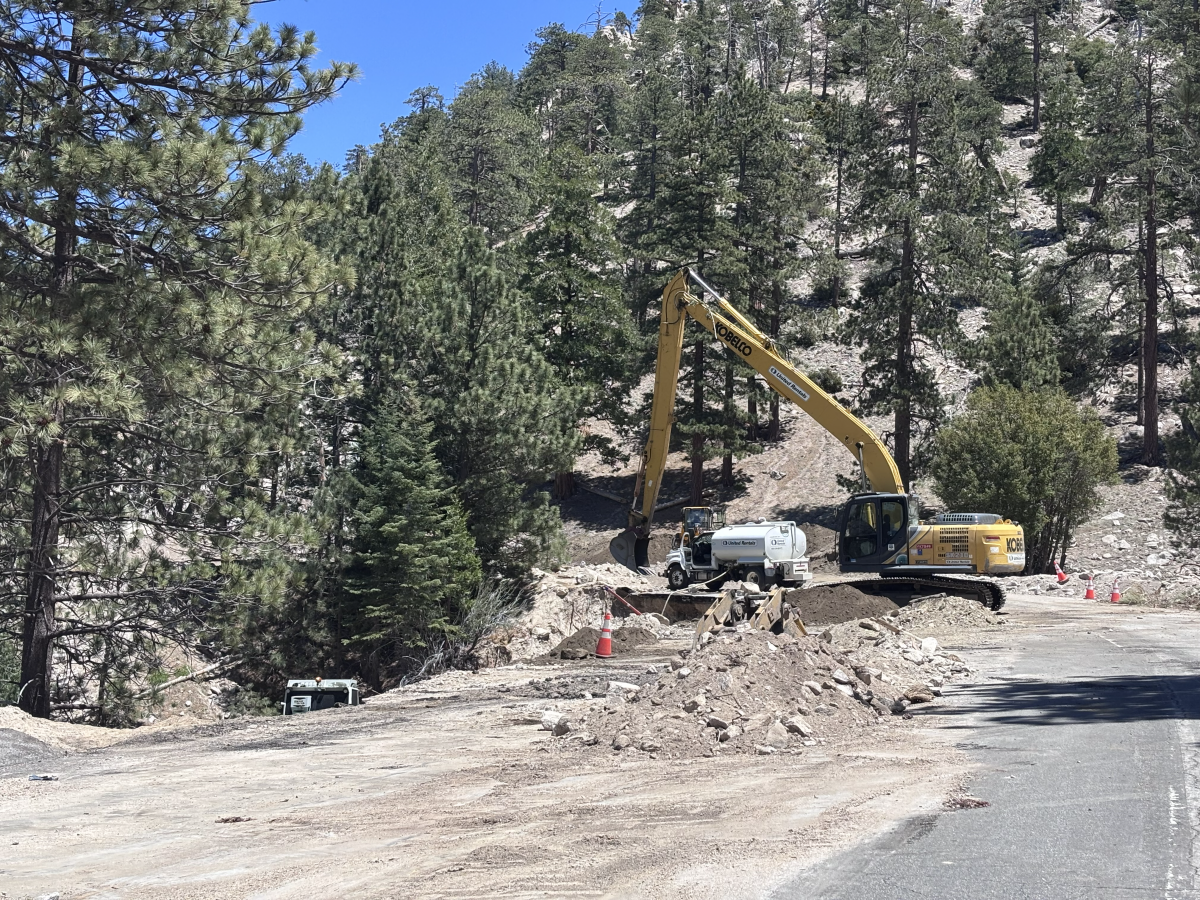
Crews have and will continue installing K-rail barriers around washed-out shoulders and road; repairing eroded slopes and embankments under the road; reconstructing shoulders and slopes to their “original design grades,” which is a feat of engineering I’m personally impressed by; and installing erosion control measures to better ensure a future storm does not cause the exact same issues that prompted previous repairs, according to a Caltrans fact sheet of the project.
Caltrans spokesperson Eric Menjivar said in an email Tuesday that at least some of the repairs are on hold as the agency obtains supplemental funding through an internal review process to finish the repairs.
Contractors have continued work to prep the roadway for El Niño, he said, including slope erosion control work.
An excavator works to repair a segment of Angeles Crest Highway.
(Jaclyn Cosgrove / Los Angeles Times)
In terms of the timing of when we will start to see rainfall, it could be as early as this month.
“Forecasters say there’s a 75% chance this latest El Niño — a climate pattern characterized by warmer ocean waters in the central and eastern tropical Pacific — will be stronger than any other since 1950,” Times staff writer Iris Kwok wrote. “There is a 98% chance that El Niño will be ‘very strong’ for the three-month period ending in December, according to the National Oceanic and Atmospheric Administration’s Climate Prediction Center.”
That’s why I wanted to dig into which trails would be most affected by a California 2 closure. Below, I’ve listed trails that are primarily accessed using a trailhead off the route, while also noting how hikers might still reach a peak or vantage point using another option.
I am not suggesting where damage will or won’t occur, but rather encouraging you to get out on these trails soon — especially if they’ve been on your list for a while — while it remains easy enough to drive to their trailheads. Additionally, we cannot predict how our trails will fare during a significant El Niño winter.
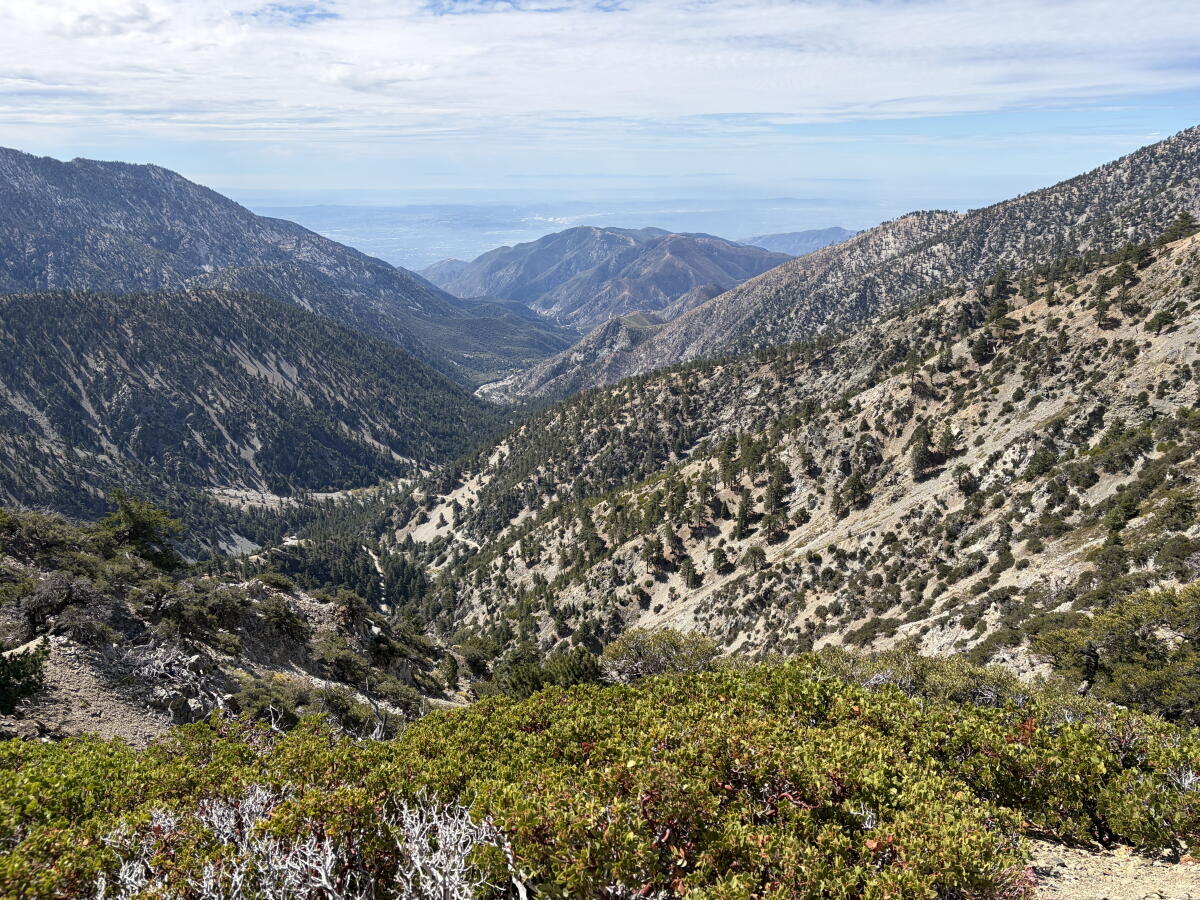
A sweeping view of Angeles Crest Highway and the San Gabriel Mountains from the Hoyt Mountain trail.
(Jaclyn Cosgrove / Los Angeles Times)
Here are trails primarily accessed off California 2:
The Gabrielino Trail is a multiuse trail frequented by hikers, bikers and horseback riders.
(Jaclyn Cosgrove / Los Angeles Times)
Grizzly Flat Trail: A challenging 7.4-mile out-and-back route where you climb up and then down the mountainside, reaching the Stonyvale picnic area where you can have a lunch break before clambering back up the mountain.
Hoyt Mountain via Grizzly Flat: A 4.6-mile steep jaunt up to Hoyt Mountain, a 4,415(ish)-foot peak in the front range of the San Gabriel Mountains in Angeles National Forest. There are multiple routes to reach it (see map), which you can read about in a previous Wild.
Switzer Falls and picnic area: The 4.6-mile Switzer Falls hike, one of the most popular in the forest, is primarily reached via the Switzer picnic area off California 2; note that my distance includes walking down from the parking area adjacent to the road, as the gate has been closed recently because of bear activity; if that trailhead became inaccessible, Switzer Falls could be reached off the Gabrielino Trail, but it’s a much longer hike (about 20 miles one way from Azusa, or about 8.8 miles one way from near Pasadena).
One cascade of Switzer Falls.
(Brian van der Brug / Los Angeles Times)
Colby Canyon Trail: This difficult 9.2-mile out-and-back trail takes hikers to Strawberry Meadow, a flat area in the San Gabriels with nice views. Note: Do not attempt to use the mountaineering route to reach Strawberry Peak. There is an option, as noted on the map, to also hike to Josephine Peak during the same excursion.
Strawberry Peak Trail: This 7-mile out-and-back route takes hikers to the highest peak in the front range of Angeles National Forest. Said to resemble an upside-down strawberry, the summit is reached through a moderately strenuous hike that offers great views of the surrounding mountains. The route is exposed and should not be attempted on warm weather days.
Mt. Wilson area: If California 2 shuts down before Mt. Wilson Red Box Road, which leads to the Mt. Wilson Observatory, several trails will be either inaccessible or much more challenging to reach. That includes reaching Mt. Disappointment, Mt. Deception or Mt. Markham. Hikers would technically be able to access those peaks by first summiting Mt. Wilson, but that requires a 7-mile journey up Little Santa Anita Canyon where you gain about 4,800 feet. There’s a limited number of people who want to hike more after that.
Redbox to Valley Forge: A beautiful 4.8-mile out-and-back trek to Valley Forge Trail Camp via the Gabrielino Trail, where hikers can go farther in multiple directions should they choose.
The Vetter Mountain lookout tower in Angeles National Forest.
(Jaclyn Cosgrove / Los Angeles Times)
Vetter Mountain Lookout: A 5(ish)-mile round trip that includes a stop at a fire lookout where you will get sweeping views of the surrounding peaks and valleys.
Devils Canyon Trail: A 5.8-mile out-and-back stretch down 1,400 feet into a shaded canyon where a seasonal stream runs.
Mt. Hillyer from Chilao via Silver Moccasin Trail: A 6(ish)-mile journey in a corner of the San Gabriel Mountains that has both high desert vibes and pine trees — and boulders! (One of my favorites.)
Three Points to Sulphur Springs: This is a 7.4-mile out-and-back hike along the Pacific Crest Trail where you reach Sulphur Springs Trail Camp. The camp sits at 5,300 feet and features about six tent-camping sites. Its campsites are shaded by tall pine trees, ideal for hanging a hammock. It has vault toilets but no potable water or bear boxes.
And more!
There are obviously others, including some I’m not listing because I know they’re not in great condition. Additionally, several hikes remain accessible under the current closures only by hiking or biking to them. That includes the Burkhart Trail, Cloudburst Summit to Cooper Canyon Trail Camp, Throop Peak, and, as mentioned, the Mt. Waterman Trail.
I found a few hikes I’ve never done thanks to this week’s Wild. I hope it serves a similar purpose for you. Let me know if you get out there and where you go! If you received this newsletter as an email, you can simply reply, and your messages come right to me. See you out there!
3 things to do
Skaters meander through Little Tokyo during a previous CicLAvia event.
(CicLAvia Los Angeles)
1. Dilly-dally through downtown L.A. CicLAvia will host a 6.5-mile open streets event from 9 a.m. to 4 p.m. Sunday via a route that connects Echo Park, downtown L.A., Chinatown, Little Tokyo, the Arts District and Boyle Heights. Guests are welcome to walk, bike or use other people-powered mobility devices to traverse the route. See rules for e-bikes. Learn more at ciclavia.org.
2. Craft local clay in L.A. Clay artist Evelyn Hernández will host from 10 a.m. to 1 p.m. Sunday a hike through Griffith Park and teach participants along the way to identify clay and earthen pigments in their natural habitat. Attendees will also create a ceramic piece using locally processed clay. Tickets are $48.05 to $63.63 based on your economic ability to pay. Register at events.humanitix.com.
3. Haunt the hillsides near Atwater Village Dance Quest will host a Halloween-themed silent disco from 9:30 to 10:30 a.m. Saturday through Griffith Park. Attendees will dance along a 1.5-mile loop trail while wearing headphones with a curated playlist. Halloween costumes and flair welcomed and encouraged. Suggested donation of $15 to $25. Register at eventbrite.com.
The must-read
George Jensen records audio of geese and ducks during a Los Angeles Field Recording meetup at the Sepulveda Basin Wildlife Reserve.
(Kayla Bartkowski / Los Angeles Times)
One of the best parts of hiking is the unexpected sounds that nature provides, from the crunch of your boots on the sandy soil to the surprisingly thunderous sounds a covey of quail makes as it leaves a shrub (which has maybe scared a certain outdoors journalist more than once). And because L.A. has a club for truly everyone, there’s now a place nature sound lovers can go to really appreciate what they find outdoors, the Los Angeles Field Recording Club. “I feel like now everything’s so … doctored. But when you’re recording, this is what’s really happening. You’re hearing real sound. You’re engaged with the world in a real way,” said George Jensen, founder of the Los Angeles Field Recording Club.
Happy adventuring,
P.S.
Everyone is looking for a way to escape this heat wave, including the black bears of the San Gabriel Mountains. Wildlife photographer Robert Martinez shared a video this week of one of our ursine neighbors taking a dip into cool water deep in Angeles National Forest. The bear even takes time to exfoliate, using what appears to be a concrete barrier to scratch its back. Now that’s self-care!
For more insider tips on Southern California’s beaches, trails and parks, check out past editions of The Wild. And to view this newsletter in your browser, click here.
This summer, Southern California hiker Mark Orr spotted a hazard he struggled to stop thinking about: a crumbling, narrowing section of the Devil’s Backbone Trail near Mt. Baldy.
Orr wanted to help.
In early August, he trekked about 5.6 miles from the trailhead near Manker Flat campground to the site, hauling 85 pounds of gear with him over two trips. Orr first spent two hours digging out a wider route and then built what he dubbed an “anti-erosion fence” by installing 30-inch rebar stakes, stainless steel wire, clamps, aluminum flashing and zip ties. A few weeks later, Orr posted a video documenting his work to his YouTube channel, where he’d previously shared about hiking and other DIY projects. In the video, which Orr has since made private, he said he’d never performed trail work.
A view from Baldy Road leading up the Mt. Baldy Notch in the San Gabriel Mountains.
(Jaclyn Cosgrove / Los Angeles Times)
The people of the internet were initially grateful. “I can’t imagine doing this in my backyard let alone at 9,350 ft. You are THE MAN,” one YouTube user wrote. “I’ve hiked the backbone dozens of times and will remember you with gratitude every time I come across this section,” another person said. One person said his son was one of the three people who died while hiking the Backbone Trail in late December, and he wanted to connect with Orr.
But, as the video’s view count ticked up, concern over Orr’s work mounted into rage.
Two camps developed: Those who lauded Orr’s efforts and those who felt he should be held accountable for what they argued was damage to the trail. “I give this guy an A+ on his intentions and effort,” a Reddit user wrote on a post about Orr’s video. “If a section is dangerous, it should ‘look’ dangerous. To make it look safe, creates a bigger hazard as people will come to rely/trust in what is actually a DIY retaining wall. What happens when that eventually gives way? What if someone is hurt/killed as a direct result of this DIY project?”
You are reading The Wild newsletter
Sign up to get expert tips on the best of Southern California’s beaches, trails, parks, deserts, forests and mountains in your inbox every Thursday.
By continuing, you agree to our Terms of Service, which include arbitration and a class action waiver. You agree that we and our third-party vendors may collect and use your information, including through cookies, pixels and similar technologies, for the purposes set forth in our Privacy Policy such as personalizing your experience and ads.
In this edition of The Wild, our weekly outdoors newsletter, I will report out the current status of the trail where Orr completed his work. I will discuss how we got here — where an individual, not the U.S. Forest Service, tackled a trail repair — and where we go from here, including how you can do your part without upsetting half the outdoors corner of the internet and violating federal policy.
First, let’s talk about Mt. Baldy and how people usually get there.
A segment of the Devil’s Backbone Trail that hikers take to the Mt. Baldy summit.
(Jaclyn Cosgrove / Los Angeles Times)
Mt. San Antonio, commonly referred to as Mt. Baldy for its appearance, is a 10,064-foot peak in the San Gabriel Mountains and is the highest point in Los Angeles County.
Outside of winter, when much of the trail can become covered in snow and ice, most hikers reach Mt. Baldy via two routes. They start near the Manker Flat campground and walk Falls and Baldy roads until they either turn north-ish onto the Baldy Bowl Trail, often referred to as the “Ski Hut” route because hikers pass the Sierra Club’s green building, or hikers continue on Baldy Road until they reach the Mt. Baldy Notch. From here, hikers start the Devil’s Backbone Trail first by trekking up a fire road and then taking on a grueling, narrow 1.9(ish)-mile jaunt that gains about 1,500 feet and always makes me question my life choices about halfway through.
The Devil’s Backbone is named as such because of its shape, including segments where hikers walk a narrow stretch with steep drop-offs on both sides. This steepness is part of what makes it susceptible to erosion — and why only serious, well-equipped mountaineers should traverse it during the winter.
The Devil’s Backbone Trail, per the U.S. Forest Service, is 3.24 miles long, starting at Baldy Notch and ends at Mt. Baldy Summit.
(Jaclyn Cosgrove / Los Angeles Times)
On Sunday, I headed up Baldy Road to see how Orr’s repairs were holding. I am active in the r/socalhiking Reddit community, where I first learned of the story, and had already seen images showing a hole developing at the start of Orr’s repairs.
But no one had pinpointed exactly where they were.
Once I reached the Devil’s Backbone, a hiker warned me about a particularly steep and narrow section he’d just traversed.
“Is this the part with the repairs?” I asked.
“No, that part is way up, and it is already breaking down,” he told me.
I then chatted with two high schoolers coming back from summiting Baldy, one of whom hopes to attend a University of California school to study environmental science. “A little bit of rain,” and it’s gone, he said of Orr’s repairs.
A segment of a repair performed by a local hiker that has started to fail.
(Jaclyn Cosgrove / Los Angeles Times)
Just over a mile into the Devil’s Backbone, I spotted the shiny aluminum of Orr’s anti-erosion fence. And I spotted the hole where fill dirt has fallen through. Before Orr started his work, the trail was narrow — his work did widen the route, but how long will it hold?
Alan Coles, a trail crew leader with the San Gabriel Mountains Trailbuilders, which maintains routes in the backcountry and Baldy area, told me the answer is probably not long, especially given the rain and snow we could get this winter from El Niño.
A segment of the Devil’s Backbone Trail where a hiker attempted to widen and repair the crumbly trail.
(Jaclyn Cosgrove / Los Angeles Times)
“Taking another look at the video, the problem with the trail may be due to a buildup of material washing down from above,” said Coles, who has 35 years of trail maintenance experience. “Often the best solution is to dig it out and lower the trail to the original alignment, which will also widen it. The problem with the repair is that the hardware he installed would make that difficult. In time, the material he used will come apart, and those stakes will get more exposed, leading to problems with people tripping on them, especially if there is snow.”
Coles said to begin work in Angeles National Forest, he must submit a list of trails that his organization wants to work on to the U.S. Forest Service. The agency’s archaeologist, biologist and other technical experts will review his list. If there are any issues with a particular trail that Coles has identified needs repairs — like if an endangered species is known to live in a creek next to the trail — the Forest Service could deny his request, thus leaving the trail unmaintained.
A hiker walks near the hole created by unauthorized repairs performed in early August.
(Jaclyn Cosgrove / Los Angeles Times)
Coles said the Devil’s Backbone Trail is a “very difficult repair” for a lot of reasons, including its high altitude and the need for a crew to get permission to use the fire roads to shorten the distance they have to haul their gear. Coles said hikers often ask him when his crew will work on the Three T’s Trail, as the route has several downed trees and other issues, and his crew faces similar access issues.
Coles said he sympathizes with Orr’s reasoning for repairing the trail: People died in that area.
“His heart’s in the right place, but it really needs to be done with someone who says, ‘OK, here’s how you properly do a repair like that,’” Coles said.
It’s impossible when thinking about Orr’s repairs not to think about the old adage of, “The road to hell is paved with good intentions,” and the brutal irony is that, once you reach the Devil’s Backbone, you’re going to need more than that.
Two hikers navigate down the Devil’s Backbone Trail after summiting Mt. Baldy, the highest point in L.A. County.
(Jaclyn Cosgrove / Los Angeles Times)
When I spoke to Orr after my hike, he said he hopes that he can join the trail crew to remove what he did and repair the trail properly.
“The first thing is, it was nothing but well intentions by somebody who loves the mountain and wants it to be safer for everybody,” Orr said. “I totally get that my first crack at this, I didn’t do everything right, and I’m actively working with the San Gabriel Mountains Trailbuilders to get it right before this winter.”
The final challenge, though, will be getting officials at the U.S. Forest Service to approve the work plan. A spokesperson at Angeles National Forest did not respond to my request for a comment or an interview for this story.
Orr’s trail repairs come at a time when outdoors lovers are feeling particularly protective of public lands. The Trump administration has continued its efforts to peel back layers of environmental protections, like the Roadless Rule, raising the alarm of park advocates who fear not even Yosemite is safe from development.
The sunset as viewed Sunday on a trail often referred to as the “Ski Hut” route.
(Jaclyn Cosgrove / Los Angeles Times)
At the same time, the U.S. Forest Service and National Park Service have both seen massive staffing cuts during Trump’s second term, and this comes after decades of underfunded trail construction and repair.
In the early 1980s, “each of the five Angeles Forest districts had a full-time, paid trail crew of eight to 10 members. Now there are only summertime crews with three to four members. Forest Service officials and the agency’s critics agree that if it were not for the volunteer corps of 700 trail builders, the mountain paths would not be repaired for years,” according to a 1993 Times story.
Those crews, Coles said, were one of the casualties from a swath of federal budget cuts in the 1980s. A 1986 Times story noted that, in just four years, “the amount of federal money allocated for trail maintenance nationwide and in Southern California … dropped about 50%.”
“For the most part, without the volunteers, you wouldn’t have a trail system today,” Angeles National Forest official Don Gilliland told The Times in 1993.
The sun goes down, casting orange and pink hues through the clouds above the San Gabriel Mountains near Mt. Baldy Village.
(Jaclyn Cosgrove / Los Angeles Times)
The agency continues to rely heavily on volunteers. The U.S. Forest Service estimates that it has about $10.8 billion in deferred maintenance, including $241 million in deferred trail maintenance and almost $70 million in trail-bridge deferred maintenance, according to a recent budget document.
In an analysis of that backlog of work, officials with the U.S. Government Accountability Office heard from one regional official who told them that the trail maintenance program “is held together by Band-Aids and baling wire.”
If you’d like to be part of that baling wire, you can join Orr in joining a local trail crew. There are several who service the San Gabriel Mountains and their foothills.
It is easy to read about Orr’s efforts and point out the obvious mistakes he made. It’s another thing to take action, whether that’s donating to local trail crews or volunteering on their work days. I’ll see you out there, focusing on the latter.
3 things to do
A coyote drinks water puddling near the golf course at Griffith Park.
(Mel Melcon / Los Angeles Times)
1. Document dicots and deer in L.A. The Los Angeles Public Library, along with other city agencies, will launch this year’s L.A. Nature Quest at 9 a.m. Saturday at the Griffith Park Visitor Center. The L.A. Nature Quest is an annual monthlong effort to document as much of L.A.’s flora and fauna as possible using iNaturalist, a citizen science app. Attendees will be guided by rangers and other experts in a morning of outdoor exploration and nature journaling. Downloading iNaturalist beforehand is recommended. Register at eventbrite.com.
2. Sit down and spy birds in Pasadena The Pasadena Audubon Society will host a seated birding experience at 8 a.m. Saturday on the Gamble House lawn (4 Westmoreland Place in Pasadena). Guests should bring water, sunscreen, a lawn chair or blanket, and a hat. Participants can bring their own binoculars, but there will be some to loan out for those without. Register at eventbrite.com.
3. Marvel at mushrooms in Monrovia Monrovia’s Canyon Park Nature Center will host the opening reception for the Mushrooms of the San Gabriel Mountains at 10 a.m. Sunday. Mycologist Aaron Tupac will share with guests about how and why they photographed the specimens shown in the exhibit, along with sharing information about our local fungi populations. Learn more at Tupac’s Instagram page.
The must-read
Biologists collect olive ridley sea turtle eggs from nests on Southern California beaches.
(Huntington Beach Police Dept.)
In mid-September, two heart-shaped olive ridley sea turtles made history when they dug nests on Seal and Huntington beaches, marking the first documented natural sea turtle nests on the U.S. West Coast. Times staff writer Corinne Purtill wrote that biologists and cheloniophiles barely had time to celebrate before realizing that these nests were at risk of being destroyed by incoming storm surges and high tides. Biologists recovered just over 200 eggs. “We had to make some quick decisions,” said biologist Jonathan Snyder of the U.S. Fish and Wildlife Service at the Aquarium of the Pacific in Long Beach on Friday. “This is the decision that we made, and I think it’s the best one for species recovery.”
Happy adventuring,
P.S.
Montrose Search and Rescue recently highlighted the perils of taking the wrong route to hike Strawberry Peak. Strawberry Peak, visible from several L.A. hikes, is the highest point in the front range of the San Gabriel Mountains. Montrose Search and Rescue recently rescued hikers, though, who’ve ended up on the mountaineering route. Their video highlights how crucial it is to know your route before you go — and to ensure you have a physical map with you in case you get lost. Stay safe out there, folks! (And don’t hike Strawberry Peak right now — it’s too hot.)
For more insider tips on Southern California’s beaches, trails and parks, check out past editions of The Wild. And to view this newsletter in your browser, click here.