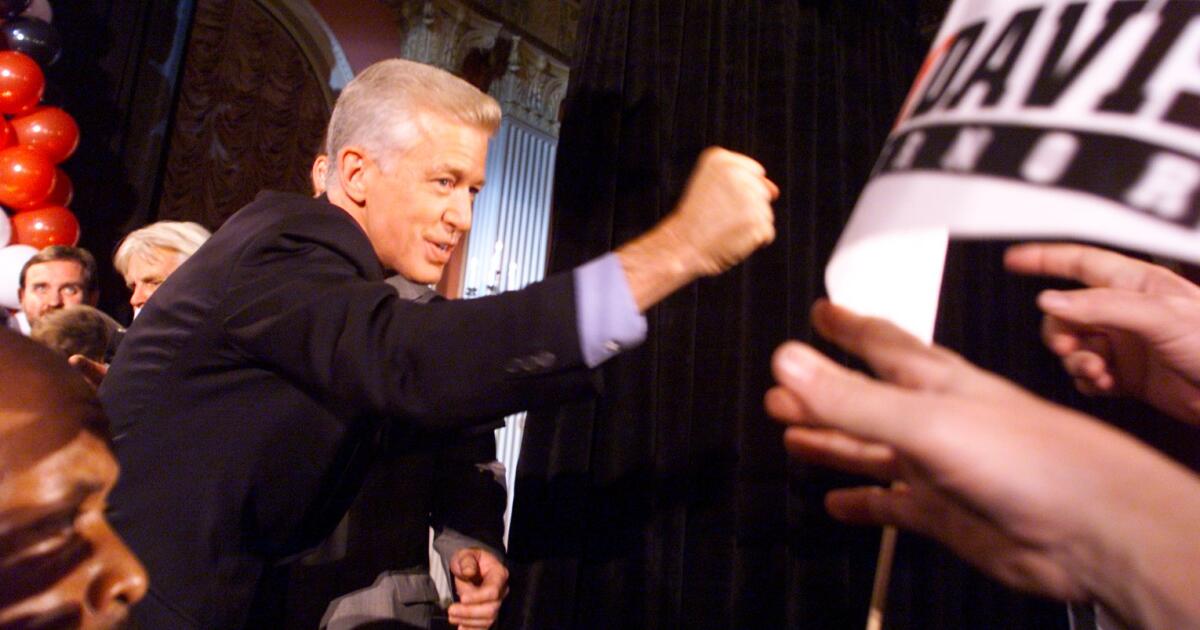
The outcome was one few anticipated, with Gray Davis romping to victory in the Democratic primary, then winning the governorship in a landslide.
Less than three months before the June primary, Davis had been running dead last, behind two well-heeled Democrats and the eventual GOP nominee. The number of people who told him to quit would have filled the L.A. Coliseum, Davis recalled this week. But he never considered dropping out; the pressure only made him more determined.
“Sometimes it’s meant to be. Sometimes you get every break,” Davis said. “Sometimes it’s not meant to be and you get no breaks.”
His bottom line: “Anything can happen.”
Of course, no two campaigns are the same.
This gubernatorial contest is being conducted under a system in which the top two vote-getters, regardless of party, will advance to a November runoff. In 1998, California held an “open primary,” under rules later voided by the Supreme Court. All candidates appeared on the same ballot, with the top finishers in each party guaranteed a spot in November.
Beyond that, the world has vastly changed: politically, socially, culturally. (Google is now one of the most valuable companies on the planet, pulling in a record $403 billion in revenue in fiscal 2025.)
Voter attitudes are different. One of Davis’ greatest assets was his position as lieutenant governor; that currency — incumbency and government know-how — no longer trade at the same high value.
The media landscape has fractured — back then newspapers set the political agenda, fewer than half of voters were online and streaming was something mostly done by water. Californians aren’t nearly as tuned in to the governor’s race as they were then.
“There’s a sideshow going on internationally and nationally and people are like, ‘Oh, right, there’s a governor’s race happening,’” said Paul Maslin, who was Davis’ pollster and is now working for Democratic gubernatorial hopeful Betty Yee. “Whereas in ‘98, that was clearly the big act in town.”
Having said all that, luck and an opportune break or two are still key ingredients to political success, as Davis suggested.
Feinstein, the state’s senior U.S. senator, had nearly been elected governor in 1990 and her lengthy deliberations froze out other potentially strong contenders. Had Feinstein run, she very probably would have blown away the field and made history by becoming the state’s first female governor.
Davis also greatly benefited when a federal court tossed out strict contribution limits, allowing him to go from collecting bite-size donations to much greater sums. Though he was vastly outspent by his two rich Democratic opponents, multimillionaire Al Checchi and then-Rep. Jane Harman, the decision allowed Davis to remain competitive and eventually pay for the statewide ad blitz that is indispensable in California.
Checchi, in particular, barraged voters with an unrelenting flood of ads. (Shades of the omnipresent Tom Steyer.) In one of them, a spot attacking Harman, Checchi included a photo of the lieutenant governor — and not a bad-looking one at that. The glimpse reminded voters that Davis, who was husbanding his resources for a late advertising push, was still in the race. He enjoyed a significant boost in polls.
Still, Checchi and Harman saw each other as the main opponent and their strategists acted — and tailored their advertising and campaign messaging — accordingly. The result was “a murder-suicide, as the term went at the time,” said Garry South, who managed Davis’ campaign. “They decided to focus so much fire on each other and ignore us that we simply slipped through the hole.”
Davis can well relate to those gubernatorial hopefuls in the position he once was — dissed, dismissed and bumping along near the bottom of horse-race polls. Speaking from his law office in Century City, he had this simple advice:
“Follow your heart,” he said. “Do what you think is right.”
“It’s fine for someone else to tell you you should get out, but that’s not their business,” Davis said. “You’re the candidate, and if you think for whatever reason you want to stay in the race, you should stay in the race.”
But Davis isn’t too worried about that happening. Moreover, he said, it’s easy for those watching from the sidelines to take potshots and offer unsolicited — and not particularly empathetic — advice.
“They’re not running for office,” he said. “Other people are putting themselves on the line. … [If] people have the wherewithal, the courage and the dedication it takes to put themselves in a position to run for office, if they really believe it’s the right thing to do, they should. They should follow their dream.”
Besides which, you never know what might happen come June.
Less than 30 years after “13 Going On 30” made legions of young millennials want to be “big-time magazine editors,” the classic rom-com is getting a reboot.
Jennifer Garner, who starred in the 2004 original as the 30, flirty and thriving Jenna Rink opposite Mark Ruffalo’s Matt “Matty” Flamhaff, is executive producing the project. “People We Meet on Vacation” star Emily Bader and Logan Lerman, known for “Oh, Hi!” and “Perks of Being a Wallflower,” will star in the reboot.
Brett Haley, who directed Netflix’s “People We Meet on Vacation,” will reunite with Bader to helm the project.
In a statement to “Deadline,” Haley said, “‘13 Going On 30’ is one of those rare, perfect films. Funny, emotional, deeply human, with unforgettable performances from Jennifer Garner, Mark Ruffalo, and Judy Greer. I’m a longtime fan, so stepping into this reimagining comes with tremendous responsibility.”
“Jennifer Garner being on board as an executive producer, after playing such a big part of what made the original special, is especially meaningful,” Haley continued. “I also couldn’t be more excited to reunite with Emily Bader after ‘People We Meet on Vacation.’ She and the amazingly talented Logan Lerman are a magical pairing. I feel incredibly lucky to be trusted with something that means so much to so many people.”
In case you missed it (or were living under a rock in 2004), our former Los Angeles Times film critic Manohla Dargis wrote of the film: “Another iteration on the apparently indestructible body-switching premise, ‘13 Going On 30’ closely adheres to the essential gimmick and learning curve introduced to superior effect in the 1988 hit ‘Big.’
“After a disastrous birthday party and a foolish wish to become ‘30, flirty and thriving’ (some alliterative propaganda she’s read in a fashion magazine), Jenna wakes one morning to discover that she’s metamorphosed into an older, taller, somewhat curvier version of herself. Now played by Garner, the wild-eyed teenager comes face to face with a wish fulfillment of a life that comes with a designer Manhattan apartment, an executive position at a slick women’s magazine, a hockey-star boyfriend who likes to strip to Vanilla Ice, and row upon row of designer shoes.”
While mum’s the word on plot specifics, the script for the reboot is by Hannah Marks, who penned and directed “Mark, Mary, & Some Other People,” with revisions by Flora Greeson, who wrote “The High Note.”
Once news of the reboot broke online, social media chatter picked up, with fans speculating which eras the film may be set in. If, like the original, the protagonist wakes up as a 30-year-old in today’s modern world, some worry the flick won’t be as lighthearted as the original.
One user on Threads said, “The concept of a 13 Going on 30 where a teenager in 2009 now wakes up in THIS reality in her 30s feels like horror not romcom.”
WASHINGTON — President Trump said Tuesday that Iran wants to “make a deal” with the United States to end the war in the Middle East, saying that negotiations are ongoing with the conflict in its fourth week.
Iran has publicly denied that talks are happening. But Trump told reporters during an Oval Office event that negotiations are underway and being led by Vice President JD Vance and Secretary of State Marco Rubio.
“I’d like to think we are in a good bargaining position,” Trump said.
Trump said he remains skeptical of Tehran’s intentions, saying he doesn’t necessarily “trust them,” but indicated that he is encouraged to continue talks after receiving what he described as a “very big present worth a tremendous amount of money” from Iran.
“I am not going to tell you what the present is,” Trump told reporters. But he said it was a “significant prize” related to “oil and gas” that signaled to him that he was “dealing with the right people.”
Conflicting messages over the diplomatic efforts between Washington and Tehran come as Pakistan has offered to host peace talks in Islamabad aimed at ending the hostilities, which have killed more than 2,400 people, further destabilized the Middle East and disrupted global oil markets.
“Pakistan welcomes and fully supports ongoing efforts to pursue dialogue to end the WAR in Middle East, in the interest of peace and stability in region and beyond,” Prime Minister Shehbaz Sharif wrote on X.
Any potential talks between the United States and Iran would face significant challenges. Key U.S. demands — particularly related to Iran’s ballistic missile and nuclear programs — remain difficult to resolve, even though Trump claims Iran has already agreed to concessions related to its ability to have nuclear weapons.
It is also unclear who within Iran’s leadership would be willing to negotiate, especially as Israel has vowed to keep targeting Iranian leaders after killing several already.
Trump has not publicly responded to Pakistan’s offer to act as an in-between for the United States and Iran. He also sidestepped a question about a New York Times report that said the Saudi crown prince, Mohammed bin Salman, has been pushing him to continue the war against Iran.
The president instead expressed confidence in his senior advisors handling the negotiations with Iran. He did not specify who U.S. officials are engaging with, but insisted they are “talking to the right people.”
When asked by a reporter why he had agreed to a cease-fire with the Iranians, Trump said: “They are talking to us, and they’re making sense.”
As the talks continue, Trump said that the United States is “way ahead of schedule” in its war with Iran, a nation that he said was so battered that it had no choice but to come to the negotiating table. Iran, however, showed on Tuesday that it still has firepower as it fired a new wave of missiles at Israel, Iraq and other gulf nations.
Iran fired at least 10 waves of missiles at Israel. In Tel Aviv, a missile with a 220-pound warhead slammed into a street in the city center, blowing out windows of an apartment building and sending smoke billowing. Four people suffered minor wounds, rescue worker Yoel Moshe said.
In Kuwait, power lines were hit by air defense shrapnel, causing partial electricity outages for several hours. Bahrain said it was attacked with missiles and drones, and that an Emirati soldier serving with its forces had been killed. The United Arab Emirates said air defense systems responded to similar attacks, and Saudi Arabia said it destroyed Iranian drones targeting its oil-rich Eastern Province.
Israel pounded Beirut’s southern suburbs, saying that it was targeting infrastructure used by the Iran-linked Hezbollah militant group, and carried out an extensive series of strikes on Iranian “production sites,” without providing more information.
On Tuesday, Defense Minister Israel Katz said Israel intended to seize Lebanon’s south Lebanon to a create a “security zone.”
Speaking at an assessment meeting with the Israeli military’s chief of staff, Katz said the military would control up to the Litani River, a waterway that runs through south Lebanon, meeting the Mediterranean some 20 miles north of the border with Israel.
“Hundreds of thousands of residents of southern Lebanon who evacuated northward will not return south of the Litani River until security for the residents of the north [of Israel] is ensured,” he said.
His words were the clearest articulation yet of Israel’s plans in Lebanon, going far beyond the “limited and targeted ground operations” announced by the Israeli military earlier this month.
Lebanon, meanwhile, took steps to undercut Tehran’s influence in the country and its support for Hezbollah. In a statement released on X on Tuesday, Lebanese Foreign Minister Youssef Raggi said the government was expelling Iranian Ambassador Mohammad Reza Shibani and declared him persona non grata. He gave Shibani until Sunday to leave the country.
Hezbollah condemned the move and called it a “grave national and strategic mistake.” Political figures aligned with the group also issued public statements urging the Iranian ambassador to ignore the decision.
In Washington, Trump said he would like to find a resolution that would avoid further casualties and damage to critical infrastructure in the region.
“If we can end this without more lives being down, without knocking out $10-billion electric plants that are brand new and the apple of their eye, I’d like to be able to do that,” he said. “But they can’t have certain things.”
Defense Secretary Pete Hegseth, meanwhile, told reporters that he would rather “negotiate with bombs.”
“The president has made it clear that you will not have a nuclear weapon. The War Department agrees,” Hegseth said. “Our job is to ensure that, and so we’re keeping our hand on that throttle, as long and as hard as is necessary to ensure the interests of the United States of America are achieved on that battlefield.”
His comments came as thousands of U.S. Marines were on their way to the region, raising speculation that the U.S. may try to seize Kharg Island, which is vital to Iran’s oil network. The U.S. bombed the Persian Gulf island more than a week ago, hitting its defenses but saying it had left oil infrastructure intact.
The Pentagon declined to comment on the deployment.
Ceballos and Quinton reported from Washington. Times staff writer Nabih Bulos in Beirut contributed to this report.
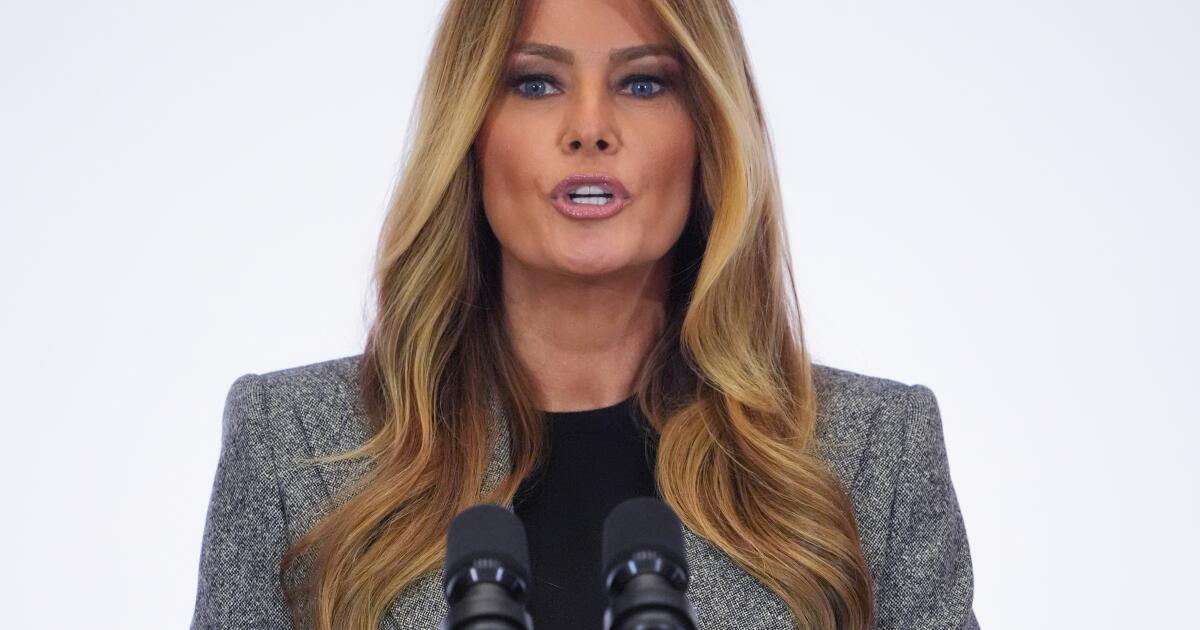
WASHINGTON — Melania Trump on Tuesday called on nations to work together to improve access to education and technology for children around the world, delivering her plea as she addressed a gathering of her counterparts from more than 40 countries.
The first lady’s Fostering the Future Together initiative, which she announced last year, and an inaugural two-day summit that she opened Tuesday are examples of how Melania Trump has expanded her portfolio to embrace global issues.
“As people we dream. As leaders we progress. As nations we will build,” she said in opening remarks. “Beginning today, let’s accelerate our new global alliance, this bond, to positively impact the progress of our children.”
She called on participants to host regional meetings, conduct research studies, begin new partnerships and collaborate with another member country “to cultivate the skills young people need to be successful in this rapidly evolving world.”
She said the goal of empowering children will be achieved by creating innovative programs, advocating for supportive education policies, sponsoring tech-focused legislation and building strong public-private partnerships.
“This room is filled with extraordinary human capital,” the first lady said. She urged the leaders seated around a large U-shaped table in a State Department auditorium to “harness it to elevate your children, to empower your people and to accelerate your economies.”
The gathering included technology companies such as Microsoft, Google and OpenAI.
Among those participating were Olena Zelenska, the spouse of Ukrainian President Volodymyr Zelensky, and Sara Netanyahu, the wife of Israeli Prime Minister Benjamin Netanyahu.
The first lady announced the Fostering the Future Together initiative during the U.N. General Assembly session last fall.
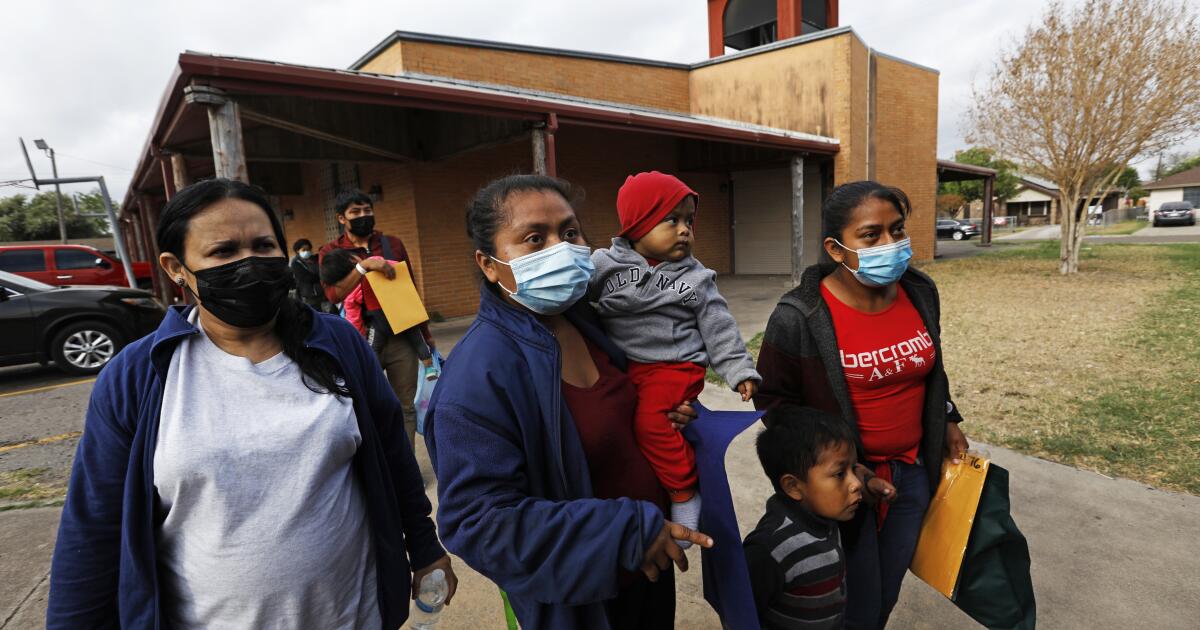
WASHINGTON — The Trump administration urged the Supreme Court on Tuesday to rule that it may block migrants from applying for asylum at ports of entry along the southern border.
The administration’s lawyers argued that the right to asylum, which arose in response to Nazi Germany and the Holocaust, does not extend to those who are stopped just short of a border post in California, Arizona or Texas.
They pointed to part of the immigration law that says a non-citizen who “arrives in the United States … may apply for asylum.”
“You can’t arrive in the United States while you’re still standing in Mexico. That should be the end of this case,” Vivek Suri, a Justice Department attorney, told the court.
Immigration rights advocates called this claim “perverse” and illogical. They said such a rule would encourage migrants to cross the border illegally rather than present themselves legally at a border post.
The justices sounded divided and a bit uncertain over how to proceed. But the conservative majority is nonetheless likely to uphold the administration’s broad power over immigration enforcement.
Several of the justices noted, however, the Trump administration is not currently enforcing a “remain in Mexico” policy.
Liberal Justices Sonia Sotomayor and Ketanji Brown Jackson questioned why the court would make a major decision on immigration and asylum with no immediate, practical impact.
The case posed a fundamental clash between the government’s need to manage surges at the border and the moral and historic right to offer asylum to those fleeing persecution.
In 1939, more than 900 Jewish refugees who were fleeing Nazi Germany aboard the MS St. Louis were turned away by Cuba and the United States. They were forced to return to Europe and more than 250 of them died in the Holocaust.
The worldwide moral reckoning spurred many nations, including the United States, to adopt new laws which offer protection to those fleeing persecution.
In the Refugee Act of 1980, Congress said that non-citizens either “physically present in the United States” or “at a land border or port of entry” may apply for asylum.
To be eligible for asylum, a non-citizen had to demonstrate a well-founded fear of persecution in their home country due to their race, religion, nationality, membership in a particular social group, or political opinion.
Only a small percentage of applicants win their asylum claims, and only after years of litigation.
But faced with overwhelming surge of migrants, the Obama administration in 2016 adopted a “metering” policy that required people to wait on the Mexican side of the border.
The Trump and Biden administrations maintained such policies for a time.
In a 2-1 decision, the 9th Circuit Court of Appeals agreed in 2024.
“To ‘arrive’ means ‘to reach a destination,’” Judge Michelle Friedland wrote for the appeals court. “A person who presents herself to an official at the border has ‘arrived.’”
The Trump administration appealed.
Solicitor Gen. D. John Sauer said the “ordinary meaning of ‘arrives in’ refers to entering a specific place, not just coming close to it. An alien who is stopped in Mexico does not arrive in the United States.”
On Tuesday, the Justice Department attorney said the court should reverse the 9th Circuit and uphold the government’s broad power to block migrants approaching the border.
“I can’t predict the next border surge,” Suri said.
“For more than 45 years, Congress has guaranteed people arriving at our borders the right to seek asylum, consistent with our international treaty obligations,” said Kelsi Corkran, Supreme Court director of the Institute for Constitutional Advocacy and Protection, who argued the case. “Yet this administration believes that Congress gave it discretion to completely ignore those requirements, and turn back those who are seeking refuge from persecution at its whim.”
“The people turned away at our border are fleeing rape, torture, kidnapping, and death threats. You cannot tell families running for their lives to go back and wait in danger because their suffering is inconvenient,” said Nicole Elizabeth Ramos, border rights project directo at Al Otro Lado which was the plaintiff in the case. “We brought this case because the United States made a legal and moral commitment to protect people fleeing persecution.”
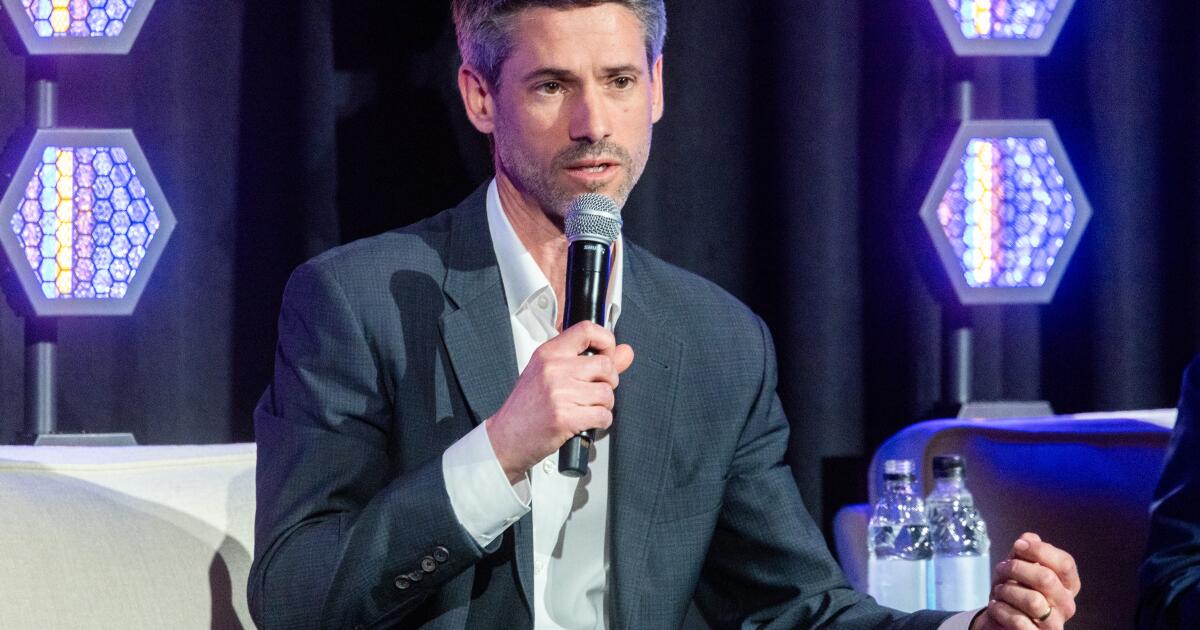
When he entered the race for California governor, San José Mayor Matt Mahan pitched himself as a pragmatic Democrat who would prioritize improving residents’ quality of life and government efficiency.
He unveiled a key part of that promise on Tuesday with an expansive plan to reform state government, including tying pay raises for elected officials and other top leaders to improvements on key issues, and pledging not to approve any tax increase until the state proves “that we can deliver better outcomes with the dollars we already have.”
Mahan also delivered a blistering rebuke of ballooning state spending — which, as he often points out on the campaign trail, has increased nearly 75% over the last six years. In 2020, amid the COVID-19 pandemic and accompanying economic uncertainty, California lawmakers approved a no-frills state budget that came in at $202 billion. Gov. Gavin Newsom’s latest spending proposal is nearly $349 billion.
“We have fallen into this lazy, reflexive mindset of always going back to voters and telling them that the only solution to every problem is a tax increase or a new bond or a new rule coming down from Sacramento,” Mahan said in an interview. “We need to step back and take a really hard look at our existing spending and increase the level of transparency and accountability in government.”
His eight-page plan includes ways to measure and track accountability, some of which are drawn from policies in other states. They include lobbying reforms, following up on audit recommendations and overhauling the state’s digital infrastructure and its procurement process — services Mahan described as “clunky and cumbersome.”
He also proposed a “California Performance Review,” inspired by a similar effort in Texas throughout the 1990s, that would review state agencies and solicit input from employees to eliminate waste and inefficiencies.
But near the top of the list is a proposal to tie pay raises for state officials including the governor, lawmakers and thousands of gubernatorial appointees to “measurable outcomes” in areas such as reducing homelessness and unemployment.
“People in the real world don’t get raises if they don’t do a good job,” Mahan said, “and I think it should be the same for the politicians and senior administrators who are allocating budgets, leading projects, making the big decisions on behalf of the people of California.”
Though the benchmarks would be created with input from the state Legislature, Mahan floated one example: reducing unsheltered homelessness by 5% to 10% within one year, something he said he’s accomplished three years in a row in San José.
It’s a solution one might expect from a former entrepreneur and mayor of a city in the heart of Silicon Valley. Mahan made a similar proposal at the local level last year, but it was rejected by the City Council.
“Tying pay to performance is nothing short of revolutionary in government. It’s a private-sector model that is overdue,” said former state Sen. Steve Glazer (D-Orinda), a Mahan supporter who sponsored several bills aiming to increase transparency in government.
Dozens of tech company executives are backing Mahan in the race for governor and have collectively donated millions to his campaign, as well as two independent expenditure committees supporting him.
That has raised concerns from some voters, and criticism from some of Mahan’s opponents, that he would be beholden to their interests and veto future regulations on tech or artificial intelligence companies.
Mahan has sought to dispel those concerns, arguing that he believes AI and social media platforms should be regulated. Of his plan to overhaul state information technology systems and infrastructure, he said that “whenever we spend public dollars, we have to run open, transparent and competitive procurement processes that ensure best value for the taxpayers.”
Though Mahan did not specify how he would link government outcomes to pay raises, state lawmakers have largely panned his campaign and are unlikely to get on board. The change probably would also require voter approval.
Currently, annual raises for elected officials are determined by a citizen commission that was added to the California Constitution in 1990. Changing how that panel works or imposing limits on when it can approve raises would require a constitutional amendment, which requires voter sign-off.
But Mahan contended it would be one of the fastest ways to fix a system that he says works for special interests at the expense of working people.
“I’m under no illusion that this will be easy, but I think it’s a necessary realignment of incentives,” he said. “We have to make ourselves as accountable to the people as we possibly can be.”
Comedians Jo Koy and Gabriel “Fluffy” Iglesias are used to delivering big laughs on large stages. But in the world of major L.A. venues, there’s big, there’s massive, and then there’s SoFi Stadium.
The show starring both comedians was billed as a record-breaking feat for stand-up when they sold out the 70,000-seater. Though the pressure to fill up the stadium was off, it still remained to be seen how the two comics would make their most dedicated fans laugh from more than a football field away. By that criteria, Saturday night was definitely a win.
Kicking off the early portion of the show at 7 p.m., fans were already filling the seats as opening acts from Iglesias’ camp, including Matt Golightly, Joey Guila, Alfred Robles, Martin Moreno (who celebrated his 58th birthday on stage) and ventriloquist funnyman Jeff Dunham got the crowd warmed up for about an hour before Iglesias took the stage first.
Comedians Jo Koy and Fluffy perform Saturday at SoFi Stadium.
(Christina House / Los Angeles Times)
It was almost 8 p.m. when Iglesias emerged following a video skit playing on the jumbo screens and the stadium’s massive halo scoreboard with his funny misadventures of a routine doughnut run at Randy’s Donuts that turned into the plot of “Sons of Anarchy” spinoff “Mayans M.C.” featuring lead actors Emilio Rivera, a.k.a. Miguel Golindo, and Clayton Cardenas, known for playing Angel Reyes. Reyes caused the first major eruption of noise in the crowd by pressing a detonation device that triggered columns of smoke that filled the stage as Fluffy made his entrance in a white flat cap and custom Los Angeles button-up to greet the sold-out stadium.
“Thank you for being here, all I have to say is we did it!” Iglesias proclaimed as the crowd cheered.
Pointing and waving to fans in the nosebleeds, he took time to embrace the moment that topped his previous triumph of performing at Dodger Stadium.
Fluffy takes the stage at SoFi Stadium in Inglewood.
(Christina House / Los Angeles Times)
Though the stage couldn’t have been bigger, both comedians used their ability to make a large event feel intimate by drawing the crowd in through storytelling and making them feel like they were part of a conversation. Iglesias set the tone of his set right away by telling us about the chisme (a.k.a. salacious gossip) surrounding his newly married stepson that weaved into stories about his travels all over the world including his controversial stop at the Riyadh Comedy Festival.
Iglesias also took a pause to relate one other historic fact about the two stadiums in L.A. he’s now been able to sell out.
Santino Villalovos of Tracy, Calif., shows his Fluffy tattoo during the Jo Koy and Fluffy show at SoFi Stadium.
(Christina House / Los Angeles Times)
“The two biggest shows in comedy were Dodger Stadium and SoFi Stadium. … And what did they both have in common? They both featured a Mexican,” he said.
Even though he thought about retiring as a comedian after filling up Dodger Stadium (twice) to film his special “Stadium Fluffy,” Iglesias said the SoFi show inspired him to keep pushing himself. And alongside Koy he knew they could do it.
Fans react to special guest Jamie Foxx during Jo Koy’s performance at SoFi Stadium in Inglewood on Saturday.
(Christina House / Los Angeles Times)
“Jo I know you’re in the back, thank you for trusting me man, we did it brother. And I’ll say it in front of an entire stadium, love you. Things like this for me is a huge deal because it inspired me and gave me another reason to keep doing what I love to do. And tomorrow I’m gonna be in the same situation I was after Dodger Stadium — what am I gonna do now? But until then I’m enjoy the hell outta tonight and I still have more stories to share with you.”
Fluffy’s most controversial (and true) bit of the night was breaking the news to his fans that his name is mentioned in the Epstein files, which sent collective shock through the stands.
“I’ve never been to the island, I’ve never been on the plane and I have never met Jeffrey Epstein,” he clarified.
Fans light up SoFi Stadium during Fluffy’s set on Saturday.
(Christina House / Los Angeles Times)
The comedian said that according to reports in the Epstein files, the late convicted pedophile apparently tried to buy tickets to his show at an Improv in West Palm Beach, Fla., in 2014 but was told by his assistant via email that both his shows were sold out.
“Jeffrey Epstein, one of the most diabolical human beings to ever walk the face of the earth. Had the ability to connect with politicians, with influencers, with celebrities. He put people in very compromising positions. He got people on planes. He put people on islands. He was involved in trafficking. He was able to accomplish all these evil, crazy things, but at the end of the day, he still couldn’t get tickets to see my show,” Iglesias said.
Jo Koy reveals himself with the Jabbawockeez at SoFi Stadium.
(Christina House / Los Angeles Times)
After a brief intermission, things transitioned to Jo Koy’s portion of the show featuring warm-up sets from TikTok skitmaster King Bach and longtime friend and stand-up star Tiffany Haddish, who came to the stage looking ready for the red carpet with a flowing silk dress, hair blowing in the man-made wind to deliver her brand of high-energy stories about becoming a real estate tycoon in South-Central.
When it was Koy’s turn to enter the stadium, he slipped in undercover, dressed as one of the Jabbawockeez — the legendary masked hip-hop dance troupe that danced onstage to a medley of West Coast hip-hop dressed in red with acrobatic swagger. At the end of a brief routine, Koy unmasked himself as one of the dancers, eliciting cheers from the crowd as his son helped him change onstage into his regular attire, Dodgers hat and a jean jacket.
Jo Koy performs at SoFi Stadium in Inglewood on Saturday.
(Christina House / Los Angeles Times)
Always a man of the people, his set also reminded us that he’s also a man of the pets, specifically dogs, launching into a long bit that felt worthy of a slightly more adult version of a Pixar movie. But beyond jokes and stories, Koy kept coming back to the idea that laughter, more than fame, marketing or money, is what helped the comedians’ big plans for SoFi come together.
“This place is full, all the way to the top, people laughing and having a good time. I know there’s a lotta s— going happening in the world right now but guess what, we don’t wanna hear it right now. We came to have a good f— time. I’m not here to debate s—, everybody’s in here, everything they said wasn’t supposed to happen happened. Look around, every f— color of the rainbow is in SoFi Stadium tonight.”
Jamie Foxx, left, sings with Jo Koy at SoFi Stadium.
(Christina House / Los Angeles Times)
The vibe of the set was all about escaping the problems of everyday life. For most of the night that was taken care of by comedy. And sometimes that escapism was aided by the power of R&B. Twice during the night Koy shocked the crowd with special guest sing-alongs, first with Babyface coming out to serenade the crowd with a brief yet un-relenting hit fest he wrote and/or sang including “Can We Talk,” the ‘90s hit he wrote for Tevin Campbell, and the Boyz II Men anthems “I’ll Make Love to You” and “End of the Road.”
The second surprise came courtesy of Jamie Foxx, who popped out in shades and 10-gallon hat to sing the Ray Charles homage-driven hook of Kanye West’s “Gold Digger.”
Aside from any historic accolades, Saturday night was the culmination of a show that was a year in the making and a victory lap for the careers of two comics who’ve been in the game for decades. It was also a moment where comedy’s past met its stadium-size future in the L.A. comedy world. Though it’s hard to say when the next big comedian will have enough fans to fill a stadium in L.A., Saturday didn’t feel like it was the last time comedy fans will show up to fill SoFi for a pair of comedians who put in the work to make themselves a team worth rooting for.
March 23 (UPI) — A Colombian Air Force C-130 Hercules aircraft crashed Monday in the southern department of Putumayo while transporting military personnel, with the number of casualties still unknown, authorities said.
Defense Minister Pedro Sánchez confirmed the accident and said the cause remains under investigation. Initial reports indicate the aircraft was carrying about 100 people, including members of Colombia’s armed forces and National Police.
“Military units are already at the scene; however, the number of victims and the causes of the accident have not yet been precisely determined,” Sánchez said on X.
Con profundo dolor informo que un avión Hércules de nuestra @FuerzaAereaCol sufrió un trágico accidente mientras despegaba de Puerto Leguízamo (Putumayo), cuando transportaba tropas de nuestra Fuerza Pública.
Unidades militares ya se encuentran en el lugar de los hechos; sin…— Pedro Arnulfo Sanchez S. Orgullosamente Colombiano (@PedroSanchezCol) March 23, 2026
Gen. Carlos Silva, commander of the Colombian Aerospace Force, said the aircraft was carrying “114 passengers on board and 11 crew members.” He also said that “48 injured people have already been rescued,” though he cautioned that the figure is preliminary, France24 reported.
A witness at the crash site told local radio station La FM that several injured people had been evacuated.
“We are in a rural area where the plane went down and we are collecting the injured. About 10 to 15 people have been taken out. We are transporting them in police vehicles and local residents are helping move people on motorcycles,” the witness said.
Pobladores de la zona aseguraron que hay, al menos, una decena de heridos, que están siendo evacuados con ayuda del Ejército, la FAC y la Policía. pic.twitter.com/PONeOtZLgg— La FM (@lafm) March 23, 2026
Early reports indicate the aircraft may have experienced difficulties during takeoff and failed to gain proper altitude, according to Noticias Caracol.
The aircraft, identified as FAC 1016, was carrying troops from the Army’s 27th Jungle Brigade. The personnel were traveling from Puerto Leguízamo to Puerto Asís as part of a troop rotation, and the plane was expected to return to Bogotá.
President Gustavo Petro addressed the incident on X, expressing concern over possible casualties.
“I hope we do not have deaths in this horrific accident that should not have happened,” Petro said.
He added that his administration has sought to modernize the military’s equipment but has faced bureaucratic obstacles.
“If civilian or military administrative officials are not up to this challenge, they must be removed,” he said.
Petro also said his government has worked to modernize the country’s strategic air fleet and has requested the immediate purchase of helicopters and transport aircraft to expand troop mobility, particularly in regions affected by the grounding of Russian-made helicopters.
He said, contrary to some media reports, the military has been losing operational capacity for more than 15 years and that his administration is committed to fully modernizing its equipment.
LONDON — Years before the rise of Instagram, Banksy figured out that the key to real influence lay in not being famous, exactly, but in being anonymous.
The mystery of his identity has long been part of the value of his art, which for decades and across continents defied authority from public walls and self-shredded on the auction block. Now, Banksy’s apparent unmasking by the Reuters news agency has generated talk about whether the works themselves retain their cultural and financial value.
It also raises the question: Why pop the balloon of his mystique in the first place? Many Banksy fans mourned the loss of the mystery and lashed out at the news outlet. One said it was like being told without warning that Santa Claus doesn’t exist.
“I feel like they are telling me how a magic trick is done,” said Thomas Evans, a Denver-based artist on Instagram. “Sometimes I just want to enjoy the magic trick.”
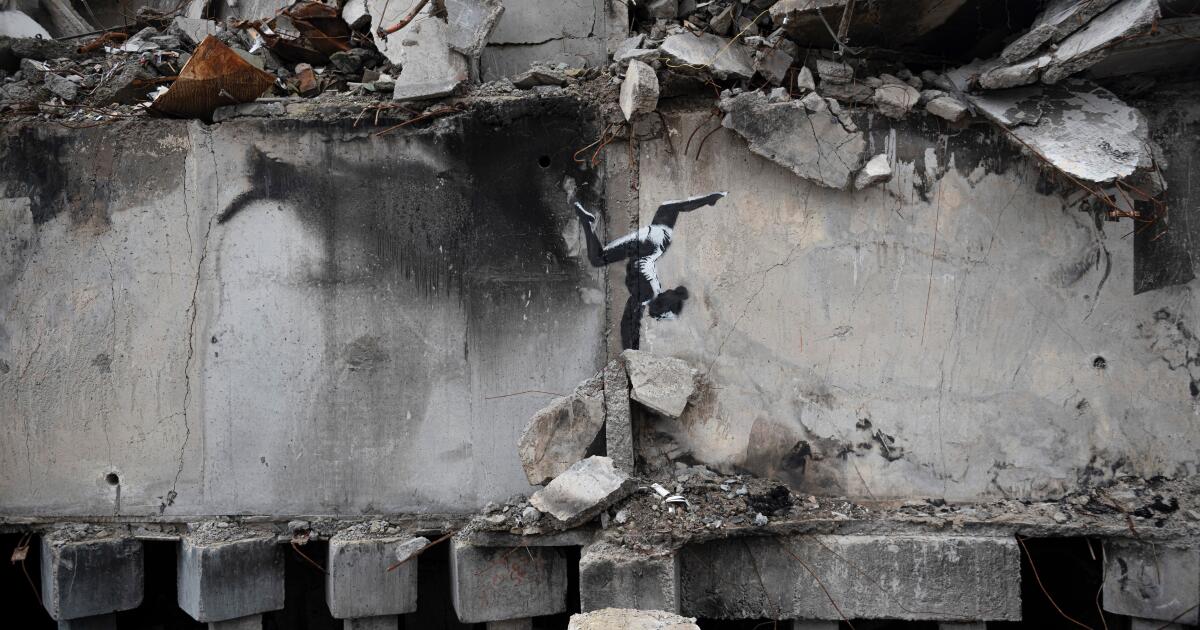
But some art experts say the murals and the message will survive Banksy’s naming because his appeal wasn’t driven solely by his anonymity. He and his works — dark and mischievous — stand as witnesses to injustice, oppression and inequality around the world, from the artist’s native England to walled-off Bethlehem in the occupied West Bank and war-ravaged Ukraine. Subtract his anonymity, they say, and the work still inspires reflection and discussion.
“People buy his works because they absolutely love it,” said Acoris Andipa, director of the Andipa gallery in London. “The main feedback that I get is that they really, frankly, don’t care if they know who he is.”
Naming the ghost — and the backlash — is engagement, too
Banksy, long thought to have been born Robin Gunningham around 1972, grew out of a tradition of street artists who viewed the undercover act of posting their art in public as a subversive form of expression. The postindustrial landscape of his native Bristol was his canvas and gallery. The walls of London, New York and elsewhere gave him a global stage just before the rise of social media.
Banksy’s apparent identity has been an open secret among protective fellow artists, and long been easy to find online for those who wanted to know. The Daily Mail reported in 2008 “compelling evidence suggesting” that was the artist’s birth name. It has been published by other news outlets, including the Associated Press in 2016, as part of their coverage of the detective work.
Reuters reported recently that after the Daily Mail’s story, Banksy changed his legal name to David Jones — the second most-popular name in Britain. It’s also the given name of the late David Bowie, whose Ziggy Stardust rock ‘n’ roll avatar inspired a 2012 Banksy painting of Queen Elizabeth II.
Bansky’s lawyer didn’t respond to a request for comment, and the artist’s spokeswoman declined to participate in this story.
Reuters pieced together that a David Jones traveled to Ukraine with a well-known associate of Banksy’s in late 2022 — just before the artist’s work began appearing on buildings that had been bombed by Russia. Banksy later confirmed that he’d created seven murals in the war zone, including one of a child flipping over a grown man who is wearing a black belt. Russian President Vladimir Putin practices judo.
There’s evidence that even some in the establishment he was protesting have accepted Banksy. They didn’t arrest him, for example, after the Royal Courts of Justice removed a Banksy stencil depicting a judge in a traditional wig and gown beating an unarmed protester with a gavel. Some street artists groused that they might be arrested for creating such graffiti — but when it’s a Banksy, it’s art.
The artist wasn’t always so elusive
On Sept. 17, 2000, a Robin Gunningham was arrested for defacing a Marc Jacobs billboard atop a building on Hudson Street in New York.
In a handwritten signed confession, he described the work on the night in question: “I had been out drinking at a nightclub with friends when I decided to make a humorous adjustment to a billboard on top of the property,” he wrote in court records unearthed by Reuters and confirmed by the AP. “I painted eyeshadow a new mouth and a speach bubble” on the photo of a male model. He was charged with a misdemeanor.
The artist doesn’t need an alleged naming to make news. He created multiple works in London in 2025, and grabbed headlines elsewhere for having his art sold or auctioned for millions. But Banksy has courted a public image centered around morality, justice and guerrilla tactics — he’s often likened to Robin Hood or Batman.
“Banksy woz ere,” he wrote with his animal murals at the London Zoo, which were removed in 2024.
Still, along with the sadness, there’s ample speculation in the art world and on social media that the artist himself orchestrated this round of naming. He didn’t deny the Reuters story.
That “would be very much in line with his practice of stunts and satire,” observed Madeleine White, the senior sales and acquisitions consultant at London’s Hang-Up Gallery. “As they say, ‘All publicity is good publicity.’”
She noted, however, that the backlash is directed at the media — not the artist, or the potency of his work. Reuters says it opted to publish some, but not all, of the information its reporters uncovered about Banksy’s identity, because he is a public figure, whatever his name — and he’s had an outsize influence on public events and discourse. What’s more, much of his work has been done on other people’s property.
Connected to world events
Named or not, Banksy’s stardom lives, art experts say.
It endures in the wonder of his ability to erect new art under the noses of authorities well into the age of social media and ubiquitous surveillance cameras. It appeals because his spectacle and wit draw people in and the settings — the hulk of bombed buildings, for example, or Israel’s towering wall at the border of the West Bank — invite them to reflect. Now, fans are on the lookout for how and whether he’ll respond to the news of Robin Gunningham and David Jones.
Joe Syer, a Banksy expert and founder of MyArtBroker, said that the artist has always responded to world events. “And that’s where the real relevance, and value, sits,” he said.
“If anything, Banksy’s anonymity has functioned less as a celebrity device and more as a way to keep the work universally accessible, detached from personality, ego, or biography,” Syer said in an email. “It allows the work to sit in public space, politically and culturally, without being anchored to an individual in the way the mainstream press often frames it.”
Christopher Banks, founder of the New York-based Objects of Affection Collection, reads Banksy’s naming “not as a biographical event, but as a structural stress test” of the artist’s system of managing his absence.
“Banksy’s best works carry their meaning without the author. He was there,” Banks wrote, citing the artist’s murals in Ukraine and his solidarity with the war’s victims.
“The name matters less than the presence. The presence was always what the work was about.”
Kellman writes for the Associated Press. AP writer Michael Sisak in New York contributed to this report.
A soccer star has accused a pop star of making the daughter of a movie star cry.
Chappell Roan — who, in recent years, called out fans’ “creepy behavior” and said she “pumped the brakes” on fame to protect her own privacy — was accused over the weekend by soccer star Jorginho of rough treatment of his family.
Roan (letting up on the brakes?) headlined Lollapalooza Brazil over the weekend, and Jorginho was in attendance along with his wife and child. While there, as outlined by People, the footballer said the 11-year-old was thrilled to see the singer while they were dining at their São Paulo hotel. The girl walked by the 28-year-old “Pink Pony Club” singer’s table “to confirm it was her, smiled, and went back to sit with her mum. She didn’t say anything, didn’t ask for anything,” he wrote.
Jorginho of Brazil’s Flamengo celebrates after scoring his side’s second goal, from the penalty spot, during the Recopa Sudamericana second leg final soccer match against Argentina’s Lanus in Rio de Janeiro, Thursday, Feb. 26, 2026.
(Bruna Prado/AP)
Jorginho alleged that, after the girl sat down, a “large security guard” came over and interrupted their breakfast to generally make their lives miserable. The guard allegedly told the girl’s mother “she shouldn’t allow [her] daughter to ‘disrespect’ or ‘harass’ other people.”
The girl was “extremely shaken and cried a lot,” said Jorginho, a player for the Brazilian club Flamengo whose legal name is Jorge Luiz Frello Filho.
Jorginho knows what it’s like to be famous and have fans. (Jude Law also has a little experience in that department.)
Jorginho told his nearly 5 million Instagram followers that he knew what it was like when fans didn’t respect boundaries, and “[w]hat happened there was not that.”
On Sunday, Roan responded on Instagram. She said the guard was not her personal security and that no one — including a starry-eyed 11-year-old girl — had bothered her.
“I did not ask the security guard to go up and talk to this mother and child. … They did not come up to me. They weren’t doing anything.”
“I do not hate people who are fans of my music. I do not hate children.”
She expressed her regrets to the girl and her mom. A representative for the artist did not immediately respond to The Times’ request for further comment.
Roan has shown that she’s not afraid to speak out when she does feel a fan has overstepped. This incident comes after an episode this month in Paris when the singer filmed herself in selfie mode as a swarm of people shouted behind her.
“I’m just trying to go to dinner,” she tells the camera in a video captured by an onlooker, “and I’ve asked these people several times to get away from me.”
Even as she calmly reprimands them, one man continues to ask for her autograph.
HAVANA — Reggaeton boomed in a neighborhood bar in Old Havana on a recent night, when, suddenly, the music stopped and everything went dark.
The customers groaned. Another blackout.
A U.S. blockade on oil shipments to Cuba has plunged the island into its worst energy crisis in modern history. The country’s already cratering economy now teeters on the verge of collapse, with vehicles idled by a lack of gas, hospitals forced to cancel surgeries and millions living without a steady supply of electricity and water.
It is the result of a calculated pressure campaign by President Trump, whose administration is negotiating with Cuba’s leaders over the future of the communist-ruled Caribbean island.
People fed up with rolling blackouts have staged sporadic protests in recent days, banging pots and shouting slogans against the government, rare demonstrations in a country known for repressing dissent.
Some power outages hit isolated areas, but in recent weeks Cuba has experienced three island-wide blackouts. The most recent one struck Saturday night and continued into Sunday.
Two men sell food from a cart in front of the Kempinski hotel Friday night in Havana.
As Havana and Washington hash out a possible deal — which is likely to include some form of economic opening, and perhaps limited changes to Cuba’s leadership — many people here say they feel like pawns in a geopolitical game beyond their control.
Some, like those at the bar, who kept drinking in the dark after the power vanished, say they have little choice but to adjust to a life where flushing a toilet, cooking a pot of rice or riding a bus to work is now considered a luxury.
“The U.S. is trying to punish the Cuban government,” said one customer, named Rolando. “But it’s the people who are suffering.”
Cuba’s struggles long predate the oil embargo. For years, Cubans have complained of food shortages, crumbling public services and political repression. Demographers say Cuba is undergoing one of the world’s fastest population declines — a 25% drop in just four years — as birth rates fall and emigration soars.
Cuban President Miguel Díaz-Canel blames “genocidal” economic, financial and trade restrictions imposed by the United States in the decades since Fidel Castro’s army toppled the U.S.-backed dictator Fulgencio Batista in 1959.
1
2
1.Young people play dominoes in the streets of Old Havana.2.A woman reacts to her granddaughter at a bar in Old Havana.(Natalia Favre/For The Times)
But many Cubans blame their own leaders for mismanaging the economy — and straying from the ideals of Castro’s revolution. They were raised to believe in an implicit social contract, which maintained that while Cubans might not have luxuries or be allowed all civil liberties, they would always have free education and healthcare, a place to sleep and enough to eat.
“The pact has failed,” said Juan Carlos Albizu-Campos Espiñeira, an economist at the Christian Center for Reflection and Dialogue in Havana.
He faults the government for soaring inflation and a misguided investment strategy that pumped money into the tourism industry while neglecting fundamental sectors like industry and healthcare.
“This is the worst moment in Cuba’s history,” he said. “But things were really bad before this.”
The Vedado neighborhood in Havana.
Life has long been challenging for Pablo Barrueto, 63, who works mornings at a construction site and now spends afternoons filling plastic jugs from a tap on the street and hauling them up narrow stairwells to neighbors who have been without water for weeks.
His two jobs barely enough cover food for him and his partner, Maribel Estrada, 55, who earns $5 monthly as a security guard at a state-run museum.
The pair, who live in a cramped studio apartment in a crumbling colonial-era building, can’t afford butter or mayonnaise, so breakfast is a piece of plain bread. Barrueto said he often goes to bed hungry. It has been years since he has tasted pork or beef.
“I work so hard,” said Barrueto, who on a recent afternoon was cooking beans in a pair of tattered jeans. “But I don’t see the fruits of my labor.”
Pablo Barrueto, center, fills water containers from a public tap after more than 17 days without running water.
Estrada has developed ulcers on her legs, but the doctor who prescribed her antibiotics said she wouldn’t be able to find them on the empty shelves of state-run pharmacies. On the black market, the medication was being sold for more than what Estrada makes in a month.
“If I lived in another country, my legs wouldn’t look like this,” she said, rolling up her pants to show the chronic sores on her calves.
Estrada said she was reaching a point where she would accept anything that would improve her life, even U.S. intervention.
“If things don’t get better, they should just hand over the country to Trump,” she said.
The U.S. has long played a major role in Cuban history, from its involvement in the island’s war of independence from Spain to the heavy hand of American companies in Cuba’s sugar industry. Washington repeatedly backed unpopular leaders who protected U.S. interests, including Batista, whose corrupt and repressive regime sparked support for the Cuban Revolution.
For decades, the island was celebrated by U.S. critics worldwide as a scrappy symbol of anti-imperialism and a utopic experiment in socialism. But in recent years, amid a government crackdown on dissent, some of that support has faded.
A man holds his ration book and cash while waiting to collect his daily bread in Havana.
The Trump administration’s bellicose new push to dominate Latin America with tariffs and military intervention has scared allies who in the past might have come to Cuba’s rescue.
Mexico, Brazil and Colombia, all led by leftists, have declined to provide emergency fuel shipments in recent months out of fear of angering Trump.
The current crisis was set in motion on Jan. 3, when the U.S. launched a surprise attack on Venezuela, killing 32 Cuban security guards stationed there — in addition to scores of Venezuelan troops and civilians — and capturing President Nicolás Maduro.
As the U.S. seized control of Venezuela’s oil industry, the impacts immediately rocked Cuba, which had long relied on subsidized oil shipments from Maduro’s regime.
Cuba’s leaders say the country has not received a single fuel shipment in three months, debilitating an economy that depends on oil to generate the electricity.
There is little relief in sight.
An employee of a MIPYME sells vegetables and other goods to a customer Friday in Havana.
A state-owned Russian oil tanker loaded with 750,000 barrels of crude is currently crossing the Atlantic. It’s unclear whether the U.S. will try to stop the ship from reaching Cuba, where the oil, once refined, could provide Havana with energy for several weeks.
At the same time, the “Nuestra América” humanitarian convoy is in the process of delivering more than 20 tons of critical supplies to Cuba, some of which will arrive by boat in the coming days.
David Adler, a general coordinator of Progressive International, a global leftist group that helped organize the flotilla, said he hoped the delivery of medicine, food, baby formula and solar panels would highlight the severity of Trump’s restrictions on Cuba.
“We’re beginning to come to grips with the fact that there will be mothers and children and elderly and sick people who will die simply as a result of this senseless and cruel and criminal policy,” Adler said. “Why are we inflicting such cruel punishment on a country that does not represent any threat to the United States?”
In Cuba, where many fear the prospect of no electricity come summer, with its muggy heat and swarms of disease-carrying mosquitoes, people are getting creative. With virtually no public transport and few drivers able to find — or afford — gas that costs more than $5 a gallon, many people have resumed riding bicycles. Others have fashioned electric-powered scooters into slow-moving taxis.
Young people talk in the street in central Havana.
One man in the small town of Aguacate made headlines after he modified his 1980 Fiat Polski to run on charcoal, the same fuel many people here are now cooking with.
Camila Hernández, who works at Havana’s airport, had hoped to celebrate her 21st birthday at home with friends, eating and dancing. “It would have been wonderful,” she said.
But it had been weeks without regular electricity in the home she shares with her parents and boyfriend. His family’s home had power — but lacked water.
To avoid yet another night sitting in the darkness, she marked her birthday by strolling to the Paseo del Prado, an iconic boulevard not far from the waterfront cooled by a light sea breeze.
Her boyfriend’s mother, Yusmary Salas, 47, said poor living conditions were testing her patience. “I can’t even go to the bathroom without planning how I will flush the toilet,” she said. She said she is hungry for change, but has no idea what shape it will take.
Trump insists he “can do whatever I want” in Cuba, and recently said he expects to have the “honor” of “taking Cuba in some form.”
Pablo Barrueto carries a water container up to his home in Old Havana.
Such talk rattles many here who grew up in a country where government buildings still bear the revolutionary motto: “Homeland or death, we will prevail.”
Salas said she hopes that whatever comes next is peaceful, and that Cubans, long a proud people, have their dignity restored. And their power restored, too.
At the darkened bar in Old Havana, workers scrambled to light candles and serve beer that, without refrigeration, would soon go warm. Someone with a battery-powered speaker hit “play” on a song, the 2004 Daddy Yankee hit “Gasolina.”
“Dáme más gasolina!” they sang together. “Give me more gasoline!”
The violence began after 18-year-old settler Yehuda Sherman was killed after reportedly being hit by a vehicle driven by a Palestinian while on his quad bike.
JUNEAU, Alaska — The tiny Alaska Native village of Beaver is about 40 minutes — by plane — from the nearest city. Its roughly 50 residents rely on weekday flights for mail and many of their basic supplies, including groceries and Amazon deliveries of everyday household items.
Air service plays an outsize role in the nation’s most expansive state, where most communities rely on flights for year-round access. Planes also play a crucial role in elections, getting voting materials and ballots to and from rural precincts such as Beaver and delivering ballots for thousands of Alaskans who vote by mail — some in places where in-person voting is not available.
The vast distances and relative isolation of so many communities make Alaska unique and are why its residents have a significant interest in arguments taking place Monday before the U.S. Supreme Court.
Many here worry that a case from Mississippi challenging whether ballots received after election day can be counted in federal elections could end Alaska’s practice of accepting late-arriving ballots. Alaska counts ballots if they are postmarked by election day and received within 10 days, or 15 days for overseas voters in general elections.
“These processes have been in place for a long time just to ensure that our ballots are counted,” said Rhonda Pitka, a poll worker and first chief in Beaver, which sits along the Yukon River 110 miles north of Fairbanks.
If the court decides ballots in all states must be received by election day, she said, “they’ll be disenfranchising thousands of people — thousands of people in these rural communities. It’s just basically saying that their votes don’t count, and that’s a real shame.”
The Supreme Court will hear arguments as the U.S. Senate is debating legislation being pushed by President Trump that would require people to show proof of citizenship to register to vote — an onerous burden for many — and a photo ID to cast a ballot.
Most Republicans argue that the bill is necessary to shore up voting integrity, but Democrats and voting rights advocates — and Alaska Republican U.S. Sen. Lisa Murkowski — contend that it amounts to voter suppression. Studies have consistently shown that voting fraud is exceedingly rare in the U.S., and courts have struck down similar measures after finding they prevented eligible voters from casting ballots.
Some ballots already arrive late
Alaska is one of 14 states that allow all mailed ballots postmarked by election day to arrive days or weeks later and be counted, according to the National Conference of State Legislatures and the Voting Rights Lab. An additional 15 provide grace periods for military and overseas ballots.
But Alaska’s geography, weather and great distances between communities — Alaska is more than twice the size of Texas, the nation’s second-largest state — raise the stakes for voters. The unusual way the state counts its votes also makes a grace period important, advocates say.
Under Alaska’s ranked-choice system for general elections, workers in small rural precincts call in voters’ first choices to a regional election office. All ballots, however, ultimately are flown to the state Division of Elections in the capital, Juneau. There, the races not won outright are tabulated to determine a winner.
Even with Alaska’s current 10-day grace period, ballots from some villages in 2022 were not fully counted because of mail delays. They arrived too late for tabulations in Juneau, 15 days after election day.
If the Supreme Court rules that ballots cannot be counted if they arrive at election offices after election day, many Alaska voters could be affected. About 50,000 Alaskans voted by mail in the 2024 presidential election.
“I think there’s probably no other state where this ruling could have a more detrimental impact than ours,” Murkowski, her state’s senior senator, said in an interview.
Murkowski sees the case — a challenge by the Republican National Committee and others to Mississippi’s allowance of late-arriving ballots — as an effort to end voting by mail nationwide.
‘Seeing a level of voter intimidation’
The RNC argues that such grace periods improperly extend elections for federal office, but Mississippi responded that no voting occurs after election day — only the delivery and counting of already completed ballots.
Taken together, Murkowski said, the Trump-backed voting bill and the Supreme Court case could discourage people from voting.
“I think we’re seeing a level of voter intimidation, I’ll just say it,” she said. “I feel very, very strongly that the effort that we should be making at the federal level is to do all that we can to make our elections accessible, fair and transparent for every lawful voter out there.”
Alaska’s other congressional members, Rep. Nick Begich and Sen. Dan Sullivan, both Republican allies of Trump who are seeking reelection this year, support the SAVE America Act now before the Senate. But they also said they want to ensure that ballots properly cast on or before election day get counted.
“We’ll see what the courts choose to do on that issue, but I do think that we need to allow for time for ballots to come in from the rural parts of our state,” Begich said during a recent visit to Juneau.
Alaska officials highlight challenges to the court
A court filing in the Mississippi case by Alaska Atty. Gen. Stephen Cox and Solicitor Gen. Jenna Lorence did not take sides but outlined geographic and logistical challenges to holding elections in Alaska.
In Atqasuk, on Alaska’s North Slope, poll workers counted votes on election night in 2024, tallies they would normally relay by phone to election division officials. But the filing said they could not get through and “chose what they saw as the next best solution — they placed the ballots and tally sheets into a secure package and mailed them to the Division, who did not receive them until nine days later.”
The filing seeks clarity from the Supreme Court, particularly around what it means for ballots to be received by election day.
While it is clear when a ballot is cast, “when certain ballots are actually ‘received’ is open to different interpretations, especially given the connectivity challenges for Alaska’s far-flung boroughs,” Cox and Lorence wrote.
Effect on Alaska Native voters
Lawyers with the Native American Rights Fund and Great Lakes Indigenous Law Center said in filings with the court that limited postal service in rural areas means that some ballots might not be postmarked until they reach Anchorage or Juneau, which can take days.
In the 2022 general election, between 55% and 78% of absentee ballots from the state House districts spanning from the Aleutian Islands up the western coast to the vast North Slope arrived at an election office after election day, they wrote. Statewide, about 20% of all absentee ballots in that election were received after election day.
Requiring ballots to be received by election day, they warned, would “disproportionately disenfranchise” Alaska Native voters. The lawyers represent the National Congress of American Indians, Native Vote Washington and the Alaska Federation of Natives.
Michelle Sparck, director of Get Out the Native Vote, a nonpartisan voting rights advocacy group affiliated with the Alaska Federation of Natives, worries about creating confusion and fear among voters.
She sees the case before the Supreme Court and the Republican SAVE Act as “a multipronged attempt to take control or wrest control of elections away from states.” Alaska, she said, already has enough inherent barriers for many voters.
“There is a minute record of election fraud — not at the rate that requires this heavy-handed response through the legislature and the Supreme Court,” she said.
If you’re looking for something to watch that not only will make you laugh, but will also leave you on the edge of your seat with plot twists, TV fans recommend one particular four-series show
Alan Johnson Social News Reporter
10:33, 22 Mar 2026
TV fans recommend watching a four-series comedy that’s full of plot twists (stock)(Image: Getty)
Television viewers have been busy debating which programme has the “biggest plot twist” and it appears there’s one show that stands out from the rest. The question was posed in Reddit’s ‘Watchever’ community after a user looked for inspiration as to what shows they should check out next.
“What TV show had the biggest plot twist you never saw coming?” they asked. “What’s a TV show that completely shocked you with a plot twist you didn’t expect at all?” The Reddit user elaborated: “The kind that makes you pause and think, ‘Wait… what just happened?’ For many people, shows like Mr. Robot or Westworld had moments like that. Which one got you the most?”
It prompted several people to point out a four-series sitcom that first aired in 2016 and is currently available to stream on Netflix.
“This is as good of a place as any for my regular reminder for people who haven’t seen The Good Place to give it a try,” one person declared.
“The concept seems a little cheesy at first, until you realise that it’s actually about way more than what it seems like in the first season. And aside from the deeper philosophical stuff, it’s really f***ing funny.”
A second agreed, joking:“The Good Place… then The Good Place… then The Good Place again.”
A third fan suggested: “You need to go on the journey the characters go on. That’s the great thing about The Good Place; the show doesn’t give the characters the answers, they figure them out.
“And as a result it isn’t preachy about the philosophical stuff, even though the show definitely has a point that they wanted to get across about mortality.”
Whilst a fourth Reddit user praised: “It’s a sitcom structured like a mystery box drama, ending each episode with a cliffhanger. It’s easy to binge because of this. And unlike dramatic mystery box shows, the ending is amazing.”
However, a fifth who was sceptical at first confessed: “I didn’t watch The Good Place until it was on Netflix and from the first episode I thought something was off and kept looking for little hints here and there but never really anything that really stuck out on the first watch.
“Now on the second watching… I have noticed a lot more.”
The comedy stars Kristen Bell as Eleanor Shellstrop, Ted Danson as Michael and William Jackson Harper as Chidi Anagonye.
Netflix’s synopsis states: “Due to an error, self-absorbed Eleanor Shellstrop arrives at the Good Place after her death. Determined to stay, she tries to become a better person.”
On IMDb, meanwhile, the show boasts a very impressive score of 8.2 out of 10 following 219,000 reviews.
Millions of people have rung in the ancient Persian New Year, Nowruz, as war grips the Middle East. The 3,000-year-old Zoroastrian-rooted celebration marks the beginning of spring in the northern hemisphere and is celebrated by 300 million people in Iran and Central Asia.
Kountry Wayne likens the dream he’s currently living to an old sitcom that has made the world laugh for decades. “I feel like I’m the new version of ‘Beverly Hillbillies,’” he says. “I’m in Hollywood — I’m here, but I’m still not here, so I just think that’s the most country thing about me.” To his point, the comedian born DeWayne Colley has definitely hit the big time after getting his start in comedy in 2014 (trying his skills as a rapper before that) by working on his stage craft and cooking up Southern-fried viral skits inspired by his small-town Georgia roots. Fast-forward 12 years and his growing empire includes independent movies (including his upcoming film “That’s Her,” which he financed himself), a flood of both dramatic and comedy-driven short skits featuring a wide range of actors, a debut Netflix special (2023’s “A Woman’s Prayer”) and now his latest hour, “Nostalgia,” premiering Monday on Prime Video.
By spending a new hour looking back at a bygone period, specifically the ’90s, when Wayne grew up, the 38-year-old comedian is bringing a fresh approach to the Def Comedy Jam era that he hopes resonates with comedy fans of his generation and younger fans who found him through TikTok and had no idea he even did stand-up. As someone whose comedy career has skyrocketed over the last several years, Wayne’s sights continue to be set toward future opportunities to bring relatable humor to the masses who have that country cousin who walks, talks and jokes just like him.
This interview has been edited for length and clarity.
What does the word “Nostalgia” mean to you?
A good feeling. It means bringing people together through laughter like the good old shows back in the day — “Saved by the Bell,” “Family Matters.” It just is that feeling, whatever that feeling was that we couldn’t put in a jar, I wanted to bring that in my special to just make everybody laugh and forget about the stuff that’s always gonna be here — bills and drama and violence. Just take a break, have fun, and take the breaks we used to take when we used to watch those TV shows in the ’90s.
By the shows you mentioned, I know we’re about the same age. We grew up with the same TV sitcoms and yet still valued being outside, which feels like a foreign concept today.
Yeah, it’s that feeling of all those movies. Man, “Clueless,” when I see that movie, to this day, I still got crushes on all [those girls]. I always wanted to go to the high school in “Saved by the Bell.” So I just want to give that feeling that I felt, because a lot of the new generation didn’t get to experience those shows and those feelings. So even for the younger generation, I want them to be able to experience that through my special.
What was small–town life in Millen, Ga., like for you as a funny kid growing up?
I was so poor, it wasn’t nothing really funny. The town was so small — one [stop]light, the elementary school, high school, all in one school. You had to joke your way to make you think that you weren’t there. You kind of had to escape through jokes. So I just made people laugh wherever I was. No matter how serious the situation is, I can’t do anything about it. I might as well laugh. I remember the lights went off one time when we were eating cereal. I was like, “Mama, hey, come on. I can’t see — I can’t see the milk, the cereal, the bowl. And you’re telling me I need to do my work. I think you need to go to work.” In a small town, you had to laugh because there was nothing else, there was no opportunity.
“In a small town, you had to laugh because there was nothing else, there was no opportunity,” Kountry Wayne said about growing up in Millen, Ga.
(Christina House / Los Angeles Times)
You gravitated to music early in life, becoming a rapper before you did stand-up. What was it about performing that helped you forget about the troubles that were going on around you?
I always felt like I was onstage already, so by the time I actually got onstage, the lights never did nothing to me, or the fame and all of that. Because I’m just so thankful to be able to do stand-up and have people come and watch me do it. I never had time to really feel the fame and all of that. So I just think everything I went through in that small town helped me. Everything is a small town to me. Hollywood is still a small town to me, because whoever I know, that’s who I know; whoever I don’t know, I just don’t know ’em. Because in that small town, you were so far away from the big cities like Atlanta, New York, L.A. I was three hours from Atlanta [growing up], so I think that really helped me to get where I’m at today to do comedy the way I do it.
Just keep it “kountry.”
Yeah, keep it kountry. Man, oh, that’s the next [title of a new special].
What do you feel like is the most country aspect of you as someone who’s now a popular comedian?
My family — all my family around me. You come to my house. It’s an uncle, daddy, a sister, brother, kids everywhere. I feel like I’m the new version of “Beverly Hillbillies.” I’m in Hollywood, I’m here, but I’m still not here, so I just think that’s the most country thing about me. If you meet my family, you understand. They don’t say shrimp, we say “scrimps” or “o’er dere” [instead of] “over there.” With my accent, imagine it’s 10 times worse with my family. So I think I remind people that everybody in L.A., New York got a cousin somewhere in Mississippi, because a lot of us are from the South anyway. So I just think I remind people of simple, country people.
With the Southern flavor you bring to comedy, I kind of liken it to hip-hop, when it comes to the regional styles of different comics. How does that play into creating a special that brings the South to the world?
It’s crazy that you say that [you] think about hip-hop when I do that. I’m gonna be me so much that people who don’t know me are gonna be interested in me, because it’s different than everybody else. I feel like I’m a really country person with that Southern drawl or the way I talk. I talk like them uncles and all of that. So I just feel like it’s gonna make everybody feel at home. I didn’t try to switch it up. I’m gonna be me because I feel like, deep down, everybody knows [someone like] me somewhere. They’re gonna relate to me in some kind of way, and it feels safe because I’m being me. I’m not out there being fake, this how I talk. I’m a country boy. I’m not from the big city, and this is what I’m giving the world. And those who love it, I appreciate it. Those who don’t love it, I still love you.
“I think I remind people that everybody in L.A., New York got a cousin somewhere in Mississippi, because a lot of us are from the South anyway,” said Kountry Wayne.
(Christina House / Los Angeles Times)
Being a dad to 10 kids is something that’s been a part of your storyline in comedy and that people have gravitated to. How does your ability to survive and make it all work play into your comedy?
Child support would really make you very, very funny. It actually plays a lot into it, because if it wasn’t for those kids, I don’t think I’d stand out as much as I am. Because we’ve heard every joke, everybody’s been funny. Come on, man, we’ve seen Jim Carrey, we’ve seen Eddie Murphy, we’ve seen Dave Chappelle. Funny has already been done. So I think what helps me stand out is my story with my kids and my family. It’s funny, but it’s still OK. This is a different perspective than we see with all those kids, the mothers, you know, but he’s not with the mothers, but he’s there with the kids, and you take care of the mothers. It’s so much of a unique situation that I think that’s what makes it stand out.
Who’s your funniest kid?
[My daughter] Honest. Honest is the funniest person in my life. Her name’s Honest, but she lies — she makes up all these stories about what happened at school. [She’ll say,] “I got arrested today.” I’ll be like, “Honest, you did get arrested?” [She’ll say,] “Well, they was about to arrest me, but they didn’t.” She reminds me of me, but she is just a little bit more witty because she don’t got no trauma like I did. I come from poverty. She’s rich. She goes to this Christian school full of white people, and she thinks she’s a white baby now. The white girls have this clip they put on their hair. She bought her clip. Now her hair not floating like theirs. Her hair is definitely stiff. I’m like, “Honest, you don’t need that clip!” She’s in dancing. She don’t go to practice. When she goes to the dance recitals, it’s clear that she can’t dance and we always ask her, “Do you know the dance?” Every time she gets there, she says, “Yeah,” but she gets there and she’s always watching the other kids. She was the only one [who’s] off.
She is so funny. I put her in the skits. She says the wittiest things. She asked me one day — I got a lot of kids — and she said, “Daddy, which one of your kids you love the most?” She said, “Do you love all your kids?” I said, “Yeah, I love all of y’all.” She said, “Well, come here. Let me talk to you right quick.” She took me to a picture I had in my man cave, “She said, ‘Well, why all of us [not in the picture]?’”… She’s my comedian.
Speaking of the skit-producing pipeline/network you‘ve developed over the last several years, how has that been instrumental to your comedy career, and also your career as sort of a producer in developing content?
I think that content helped me more [with] being known as a producer and a filmmaker and an actor. So I think it helped my acting career, the first part of my life, and all the skits helped my comedy because it was just me being funny, but the skits I put out now help people look at me more as a businessman, an entrepreneur and an actor. And it’s crazy, some people now even know me from the skits. And when they come to the [stand-up] show, they’re going to be shocked. A lot of my fans who met me when I started writing the storylines, when they see this [“Nostalgia”] special they’re like, “He never showed us that!” Because that person I am onstage, I don’t be that on social media anymore, so you have to go watch me on stand-up to give that energy that I give. But my Day 1 fans met that guy. These fans I’ve made over the last four or five years were probably equivalent to my Day 1 fans. It’s a large fan base but they don’t even know that I could [do] stand-up like that.
Comedian Kountry Wayne holds up his gold neck chain with his mom’s face on it.
(Christina House / Los Angeles Times)
That’s nostalgic in a way. I’m thinking of a TV dad like Bob Saget, who was so different when you saw him do stand-up. You’re like, “Wow, Danny Tanner is filthy!” That’s great that you can kind of separate the two personas. What do you feel is next for you in comedy?
To bring that to the big screen, for sure. All my talents and gifts that I worked on, in a way, [have] gotten better. I put the work in, I’m ready to show it on the screen. I think it’s happening organically, like the special [on] Amazon, that’s organic. I had one on Netflix now they wanted me to do one at Amazon, and I just want to show the world what I’ve been working on, and the time, energy I put into a broader scale … So I’m just excited, and I feel like a kid again, because I got so many responsibilities and kids I take care of. It took a while for me to get back to this point where I could just be an artist. Because I wanted to be an artist, but then I had a lot of kids, so I had to be a provider. But now I’m in a position where all that is handled, so I feel like a kid again when it comes to the art.
In a week rife with drama involving “The Secret Lives of Mormon Wives” cast, two stars of the hit reality series appear to be going their separate ways officially.
Jessi Draper and Jordan Ngatikaura’s marriage is coming to an end after five years, with the latter filing for divorce in Utah, according to TMZ, which cited court documents. The estranged pair married in October 2020 and share two children. Ngatikaura is also the father to a teenage daughter from a previous relationship.
A representative for Draper did not immediately respond to a request for comment Friday. Ngatikaura, who also did not respond to The Times’ request for comment, issued a statement about his filing to TMZ and People.
He told the outlets his decision to divorce Draper “comes with a heavy heart” and said he is grateful for their time together. Ngatikaura plans to prioritize his children, “ensuring they feel loved, supported, and protected through this transition,” according to People. He said in his statement that he is seeking privacy for his family.
Before Ngatikaura’s divorce filing, the pair’s marital struggles had become public. In November, Draper broke her silence on allegations she had cheated on Ngatikaura and admitted to having an “emotional affair” with “Vanderpump Villa” star Marciano Brunette. At the time, Draper spoke to People about the “emotional abuse” she said she faced from her husband — he took “full accountability for the pain I caused Jessi” — and said, “We both made mistakes for sure.”
The spouses had agreed to a 90-day separation and to work things out together in therapy, People reported last year.
News of the “Secret Lives of Mormon Wives” divorce comes as the franchise reckons with star Taylor Frankie Paul, who faces new allegations of domestic abuse against her on-again, off-again partner Dakota Mortensen. Paul, who was arrested and charged in 2023 for a separate dispute involving Mortensen, was tapped to lead the latest season of “The Bachelorette” set to premiere Sunday, but that all came to a screeching halt earlier this week.
As Utah’s Draper City Police Department confirmed it was investigating alleged incidents of domestic violence involving Paul and Mortensen, TMZ published video Thursday of Paul kicking and throwing chairs at Mortensen in a 2023 dispute while one of her children was in the same room. ABC, home network of “The Bachelor” and “The Bachelorette,” acted swiftly and pulled the plug on Paul’s upcoming season.
“In light of the newly released video just surfaced today, we have made the decision to not move forward with the new season of ‘The Bachelorette’ at this time, and our focus is on supporting the family,” Disney said in a statement Thursday.
“Taylor is very grateful for ABC’s support as she prioritizes her family’s safety and security,” read a portion of a statement provided by a representative for Paul. The statement went on to say Paul had suffered “extensive mental and physical abuse as well as threats of retaliation.”
Amid the fresh allegations, Paul has seen brand deals fall to the wayside and production on “Mormon Wives” pause pending a decision on her status as a cast member, according to a person briefed on the situation.
Times staff writer Yvonne Villarreal contributed to this report.
WASHINGTON — The Justice Department sent a subpoena to former FBI Director James Comey as part of an investigation into whether former law enforcement and intelligence officials waged a years-long conspiracy against President Trump, according to people familiar with the matter.
The grand jury subpoena was issued last week by the U.S. attorney’s office for the Southern District of Florida, according to the people, who asked not to be identified speaking about an ongoing investigation.
The subpoena seeks information about Comey’s role in putting together an intelligence assessment about Russia’s interference in the 2016 presidential election, according to the people.
The U.S. attorney’s office has previously sent subpoenas to other former U.S. officials. The office is conducting a sweeping investigation into whether former U.S. officials allegedly took actions to sabotage Trump starting in 2016 through his indictment over the handling of classified documents in 2023.
The new subpoena, reported earlier by Axios, marks an escalation of Justice Department efforts targeting Comey in particular, who Trump has repeatedly said should be investigated.
Comey was previously indicted by a grand jury at the request of the U.S. attorney for the Eastern District of Virginia for allegedly lying to senators during a congressional hearing — a claim that Comey has denied. The indictment was dismissed after a federal judge ruled that the U.S. attorney was unlawfully appointed. The Justice Department is appealing the ruling.
A lawyer for Comey declined to comment Thursday. The U.S. attorney’s office in Miami didn’t immediately respond to a request for comment.
Trump and Comey have had a contentious relationship. Trump fired Comey as FBI director in 2017 during his first term as president. Since then, Comey and Trump have publicly criticized each other.
March 20 (UPI) — At least five people were injured Friday after a Delta Air Lines flight hit severe turbulence on its final approach to Sydney, Australia.
Delta told the BBC that Flight 41 from Los Angeles with 160 passengers and crew on board “encountered brief turbulence” as it landed at Sydney Airport, injuring four flight attendants.
The Airbus A350 touched down “safely and normally,” said a Delta spokesperson.
Three of the injured were taken to hospital by ambulance crews waiting on the tarmac after sustaining what paramedics determined were “musculoskeletal and lower back concerns.”
“I believe five were assessed; in total three were transported to Royal Prince Alfred Hospital with minor injuries,” said Lisa Frow, manager of NSW Ambulance’s Mascot station.
Delta said none of those hurt were passengers, but Australian media listed two 71-year-olds, a 60-year-old-woman and a 37-year-old woman among the injured.
In July, more than two dozen passengers aboard a Delta Air Lines Airbus A330 were hospitalized after it was buffeted by “significant turbulence” en route from Salt Lake City to Amsterdam.
The flight diverted and landed safely at Minneapolis-Saint Paul International Airport with 25 passengers taken to area hospitals.
In June, five people were injured when an American Airlines Airbus A321 hit “unexpected turbulence on flight from Miami to Durham, N.C.
Three flight attendants and two passengers were taken to the hospital.
Passengers reported an unconscious man, a flight attendant with a broken arm and another burned by hot water from a drinks cart.
The American Airlines incident is under investigation by the Federal Aviation Administration, as is standard for incidents where there are injuries.
In May 2024, one person died and 71 were injured, seven critically, aboard a Singapore Airlines flight from London to Singapore that ran into unexpected extreme turbulence when it was at cruise altitude.
The flight deck declared an emergency, but landed the Boeing 777 safely at Bangkok’s Suvarnabhumi International Airport. Health officials determined that Briton, Geoff Kitchen, died of a suspected heart attack.
The incident prompted Singapore Airlines to revise its seat belt policy so that it would no longer provide hot beverage or meal service when the fasten seatbelt sign was illuminated
While strong or severe turbulence — where disturbed air pitches an aircraft violently upward or downward, creating G-forces of up to 1.5 — is on the increase, it remains extremely rare, with only one in 7,000 flights affected.
However, experts warned that flying was likely to become rougher more often in the future due to climate change as temperature changes and shifting wind patterns impact atmospheric conditions.
Founder of the Women’s Tennis Association and tennis great Billie Jean King (C) smiles with representatives after speaking during an annual Women’s History Month event in celebration of the 50th anniversary of Title IX in Statuary Hall at the U.S .Capitol in Washington on March 9, 2022. Women’s History Month is celebrated every March. Photo by Bonnie Cash/UPI | License Photo
The photos currently flooding my social media stream are like a highlight reel of the life of Chicana civil rights icon Dolores Huerta.
The famous 1960s-era black-and-white shot of her looking like a bohemian in sweatshirt and black paints while she holds up a sign proclaiming “HUELGA” in the grape fields of California’s Central Valley.
Chanting at the front of picket lines, strands of gray in her hair, in the 1980s.
Beaming as President Obama awarded her the Presidential Medal of Freedom in 2012 for a lifetime of good work that expanded beyond the United Farm Workers union she co-founded.
What’s especially popular is admirers posting pictures of themselves with her — at protests, during art gallery openings, in classrooms, even dancing. It’s the type of public outpouring one usually sees when a celebrity dies. Sadly, there is grief involved in people sharing their encounters with her right now.
Someone didn’t die. But something did.
Earlier this week, Huerta’s disclosed to the New York Times that fellow Chicano civil rights icon Cesar Chavez raped her during the 1960s. It was part of a story that also interviewed two women who claimed the United Farm Workers co-founder sexually abused them when they were young teens in the 1970s.
One of the posts I saw soon after the story’s publication was an Instagram portrait Maricela Cueva took when the two met a few years ago during a conference in Burbank.
“Standing with Dolores Huerta,” said Cueva, president of the public relations firm VPE Communications, “means honoring her legacy in the farmworker movement as well as the victims who had the courage to come forward and acknowledging the personal sacrifices behind it.”
Former West Covina Mayor Brian Calderón Tabatabei shared on the platform formally known as Twitter a photo of him shaking hands with Huerta in Berkeley at a Working Families Party gathering for elected leaders in 2024, where she joined breakout sessions and listened to the next generation of leaders.
“I look at the folks who posted pictures and we are all children of the movement,” said Tabatabei, who’s also an El Monte High ethnic studies teacher. He kicks off each school year with a shout-out to Huerta. “She lived with that pain so we could be in these spaces. So we don’t have to be quiet.”
Together, the photos stand as a communal family album. It’s a show of love and solidarity to Huerta — but also a challenge to ourselves. Many of us immediately believed the longtime activist not just because of her stature, but because we’re sadly too familiar with the script playing out in real time.
A Latina abused by a trusted, powerful man. A terrible secret kept to not make him look bad and ruin his life. A need for the victim to consistently praise the abuser to others no matter what. A life of service in the form of sacrifice. Eternal grace masking an unimaginable pain.
Her story is the story of too many women I know and you know — and maybe the story of you.
Steely resolve in the face of suffering is not new in the Huerta story. For decades, reporters, activists, historians and others who formed the narrative of Chicano civil rights treated her as a modern-day Mary Magdalene — a woman who found purpose by following a man. Chavez was positioned as the Christlike figure who toiled for all of us at great personal cost and thus anointed the face of the farmworkers movement. Meanwhile, he and others relegated Huerta to sidekick status, both in the trenches and in the public — and the image makers followed his lead.
She found more prominence after his death in 1993, but Chavez’s shadow loomed over her for too long. Huerta became one of Chavez’s fiercest defenders even after revelations about his autocratic ways became public — but what else was she supposed to do when people tied so much of her identity to him?
Through it all, Huerta showed up not just for la causa but for those of others. People in Bakersfield, where Huerta lives, know she’s a supporter of arts and live music — she was seen dancing with family members at a Mardis Gras party just last month, gladly taking photos with well-wishers. I have run into her at my wife’s restaurant in Santa Ana, at movie theaters in Los Angeles, during online fundraisers for museums. My favorite memory is the time we both spoke to students at a high school summer conference. Afterward, the organizers told me her speaking fee was a pittance compared to that of a famous Latina author who demanded $25,000 for an hour-long chat.
That’s why Huerta’s recent revelations hit particularly hard — unlike the long-sainted Chavez, she always seemed more like one of us. Huerta has cycled through the stages of life in the public eye in a way that has seen Latinos relate to her over the decades as our daughter, our sister, our aunt. Our mother, grandmother and now great-grandmother in the winter of her years.
We all know women in one of those roles who suffered the same violations Huerta did. The same dismissals and insults. Who never spoke about their ignominies because they were afraid we wouldn’t be there for them.
Huerta was once one of them.
“I believed that exposing the truth,” Huerta wrote in a short essay, “would hurt the farmworker movement I have spent my entire life fighting for.”
By coming forward now, she’s speaking up for every woman who has kept their abuse private, every woman overlooked in favor of a man, every relative told to keep secrets lest they embarrass the family, every woman attacked for finally speaking up. By posting all those photos of Huerta — by herself, in a crowd, with others — people are publicly and unconsciously saying:
We can do better for the girls and women in our lives. We must do better.
“I have kept this secret long enough,” she concluded in her essay. “My silence ends here.”
May we all hear the Dolores Huertas in our lives. May we finally stand by them.
Local resident says casualties include mourners at funeral and children playing nearby.
Published On 19 Mar 202619 Mar 2026
A drone attack launched from Sudan has killed 17 people in Chad, according to the Chadian government, which has pledged to retaliate against any further strikes as the civil war in the neighbouring nation rages on.
A spokesman for the Chadian government announced the death toll on Thursday from the attack on the border town of Tine, which had been targeted despite “various firm warnings addressed to the different belligerents in the Sudan conflict and the closure of the border”.
Recommended Stories
list of 3 itemsend of list
It occurred as mourners gathered at a house on Wednesday for a funeral, according to a local resident quoted by the Reuters news agency, who reported there were two explosions and casualties included mourners and children playing nearby.
Local government sources said it was not immediately clear who was behind the attack, according to Reuters.
Chadian President Mahamat Idriss Deby called a meeting of the defence and security council on Wednesday night, ordering the army to “retaliate starting from tonight to any attack coming from Sudan”, according to a presidency statement.
Early on Thursday, the government said Chad had strengthened its security presence at the border and could potentially carry out operations on Sudanese territory.
Sudan’s paramilitary Rapid Support Forces (RSF) denied involvement in a post on Telegram, blaming the Sudanese army.
Porous border
The conflict in Sudan between its military and the RSF began in April 2023. The war has killed tens of thousands of people and displaced more than 12 million – nearly one million of them fleeing under fire to Chad, according to the United Nations.
The border between Chad and Sudan, which is nearly 1,400km (870 miles) long and located in a desert region, is porous and difficult to control.
Almost the entirety of Darfur, a vast region in western Sudan bordering Chad, has been captured by the RSF. The last major city there under the military’s control, el-Fasher, was seized by the RSF in October. The UN has accused the paramilitary group of carrying out massacres with “hallmarks of genocide”.
On February 21, the RSF claimed control of the border town of Tina, which is separated from Tine in Chad only by a narrow stream bed that is dry most of the time.
Chad closed its eastern border with Sudan last month after clashes linked to the war killed five Chadian soldiers. Its government said the move was aimed at preventing “any risk of the conflict spreading”.
Drones a key weapon of war
Drones have become a key weapon used by both Sudan’s military and the RSF.
The Sudanese army has received Iranian-made drones and Turkish and Russian military support.
The RSF, which has no air force of its own, has been equipped through a network of supply routes reportedly running through Chad and other transit states with reports pointing to the United Arab Emirates as a key supporter, an allegation that Abu Dhabi denies.
In the first two months of 2026, the Armed Conflict Location and Event Data project recorded 198 strikes by both sides, at least 52 of which caused civilian casualties. The attacks killed 478 people.