San Pedro fish market gets boost from social media
On the balcony of a pink dockside building in San Pedro, a neon sign reading “Saturday Morning Fish Market” glows in the darkness. There’s a quiet stillness in the harbor — the only sounds are of the occasional gull and car whirring by. That is, until 1 a.m. rolls around.

Doors open at 1:30 a.m. at the Saturday Morning Fish Market.
This is when people begin to gather outside the roll-up door, some carrying backpacks ready to be filled.
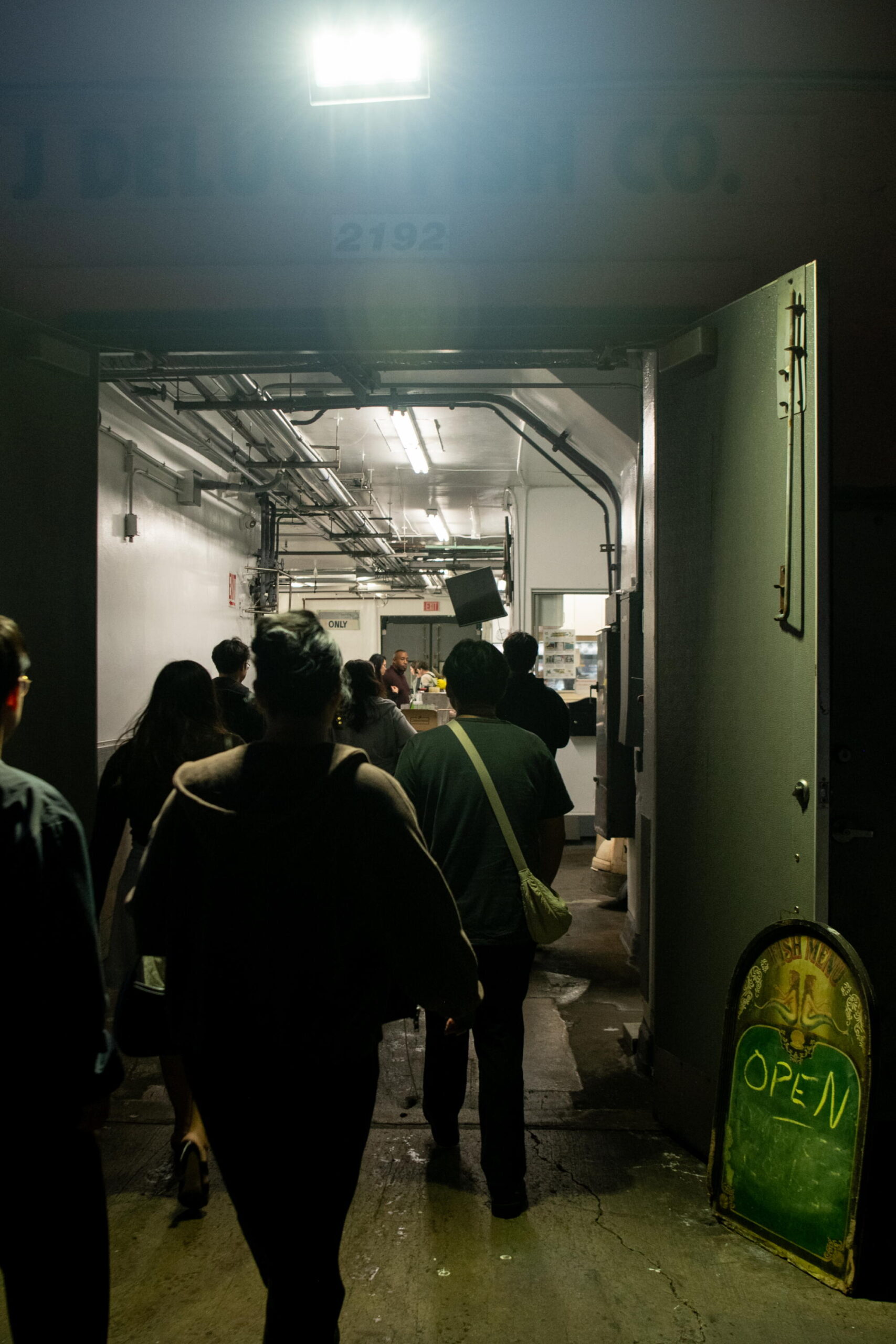
At 1:30 a.m., a man in an orange apron lifts the door, releasing rays of white light onto the customers. They file inside, stepping onto the wet floor, eager to see the night’s beauties: freshly caught fish, filleted, deboned, washed and thrown onto thick mountains of crushed ice.
Shellfish, sardines, squid, mackerel and a market favorite, glowing salmon filets, sit on display. One employee pulls out crabs with a small net before letting a customer take their pick of the lot. Machines whir in an adjacent room, where fish are processed. Out back, sea lions bark, hoping for scraps.

-
Share via
The Saturday Morning Fish Market, more formally known as J Deluca Fish Co., has existed for some time — owner John DeLuca claims a variation of the business began operating as early as the late ‘60s. As a child, DeLuca would greet his grandfather when he’d return to the San Pedro port with his catch, perhaps a fresh tuna or a bass to sell. For decades, the wholesale seafood distributor would open its market to the public just once a week — from 1:30 to 7:30 a.m. on Saturdays — usually seeing a smattering of mostly locals, the seafaring type, who might be shopping around after a late-night shift.


1. Harikrishnan Babuchandran holds up his fresh fish. 2. Customers can watch their fish be processed. 3. The fish that’s for sale changes from week to week. (Linnea Stephan / For The Times)

The Saturday Morning Fish Market in San Pedro has existed in some form since the late ‘60s but thanks to social media, flocks of new customers are wanting in on the late-night seafood-buying adventure.
Neither DeLuca nor his son and co-owner, Chris, could have predicted the San Pedro institution would experience the boom in popularity it’s seeing now, especially in an industry that’s struggled over the past two decades.
Thanks to social media, the market is witnessing an unprecedented revival. At its pre-pandemic peak, it would get around 800 to 1,000 customers on a typical Saturday morning. Nowadays, up to 2,000 people walk through the doors, according to Chris, many of whom are visiting for the first time.

Owners John and Chris DeLuca.
Regarding Instagram and TikTok, where posts giving a glimpse of the late-night fish market have gone viral, John, 73, says, “I know absolutely zero.”
To his credit, he does exhibit some understanding of its effect. And he’s glad for it. “People that live within walking distance never knew we existed. Now they do, and it’s got nothing to do with me,” he says, grinning.
What’s most notable is the number of young people roaming around the market well before the crack of dawn, Chris says. The business has changed a lot since his “father’s generation,” and social media unlocked access to a new audience.
“I think people like those hidden gems and people like that fresh seafood experience,” he says.
Between rows of sea bass and salmon, the energy is buzzing. Abdul Fahwami, dressed in jeans and flip-flops, visits the fish market at least once or twice a month, depending on how many people he‘s having over at his house that week.
“Every time we come here, we buy a minimum of between 100 and 200 pounds,” he says. “Red snapper is one of the best fish.”

Branzino is a favorite among customers and employees.
He smiles as he watches employees process his fish on a long table. First, blades run against the fish scales, removing them in quick fashion. Then, there’s a swift slice across its belly, starting at a hole near the tail and ending up near the gill plate. Finally, the guts are removed and filets are cut, skin optional.
Prices change week in and week out, and depend on supply. While prices are typically 10% to 40% less than at stores, market representative Joe Castelao says the team values the “quality of our products” over “trying to cater to bargain finders.” Another advantage for customers is the ability to buy seafood in bulk, which often isn’t possible at your standard, local grocer.
On this day, there wasn’t much branzino, the fish Fahwami came early to look for. “I found only 11 pieces,” he says. “I took all of it!”
Not far away, a man named Terry Jackson waits in line; he’s wearing black overalls and swaying side to side, eager to advance.

Customer Terry Jackson at the Saturday Morning Fish Market.
“It’s definitely worth waking up a little late — or a little early, you could say,” he says. “The quality of the fish is good, plus the pricing.”
His fish of choice? “Tuna, my new favorite is tuna!” he says, proudly raising a plastic bag full of bright red filets.
Briskly pacing across the market floor are team members Mike and George Stahl, a father-son duo both wearing orange aprons and gloves.
Mike got into the seafood business about two decades ago. At the time, he lived in Florida and often purchased products from J Deluca Fish Co. By 2018, he’d moved his family out to California and started working at the market.
He says his favorite part is the variety of duties. “No two days are the same,” he says. “One day I could be selling a couple containers of squid, the next day I could be meeting face to face with someone at a conference on the other side of the country.”

Staff member George Stahl helps a patron.
He brought in his son George during the pandemic. As George explains, “We were bored and didn’t have anything to do at home so my dad said, ‘Why don’t you come down and put some boots on and start working?’”
George has become somewhat of a micro-celebrity around the market, frequently appearing in its Instagram posts. However, his time with the company might be temporary — he’s currently in school and plans to be a physical therapist at some point.
While the market is riding a wave of success, John doesn’t gloss over the grim outlook of the fishing and seafood industry as a whole. He says the industry has taken a hit over the years, between restrictions, overfishing and changing regulations.

“It’s a dying business,” John says, bleakly. “There’s very few seiners down here because it’s very difficult to make a living [fishing].
But for now, they’re able to survive. They watch as customers walk out of the market into the wee hours of the morning, proudly grasping their bags of the day’s freshest catch.
“A lot of things have gone the opposite direction,” John says. “But we’re still here.”

The fish market’s blue neon sign shines through the night.