participant

Why Angelenos are meditating at Hollywood Forever Cemetery

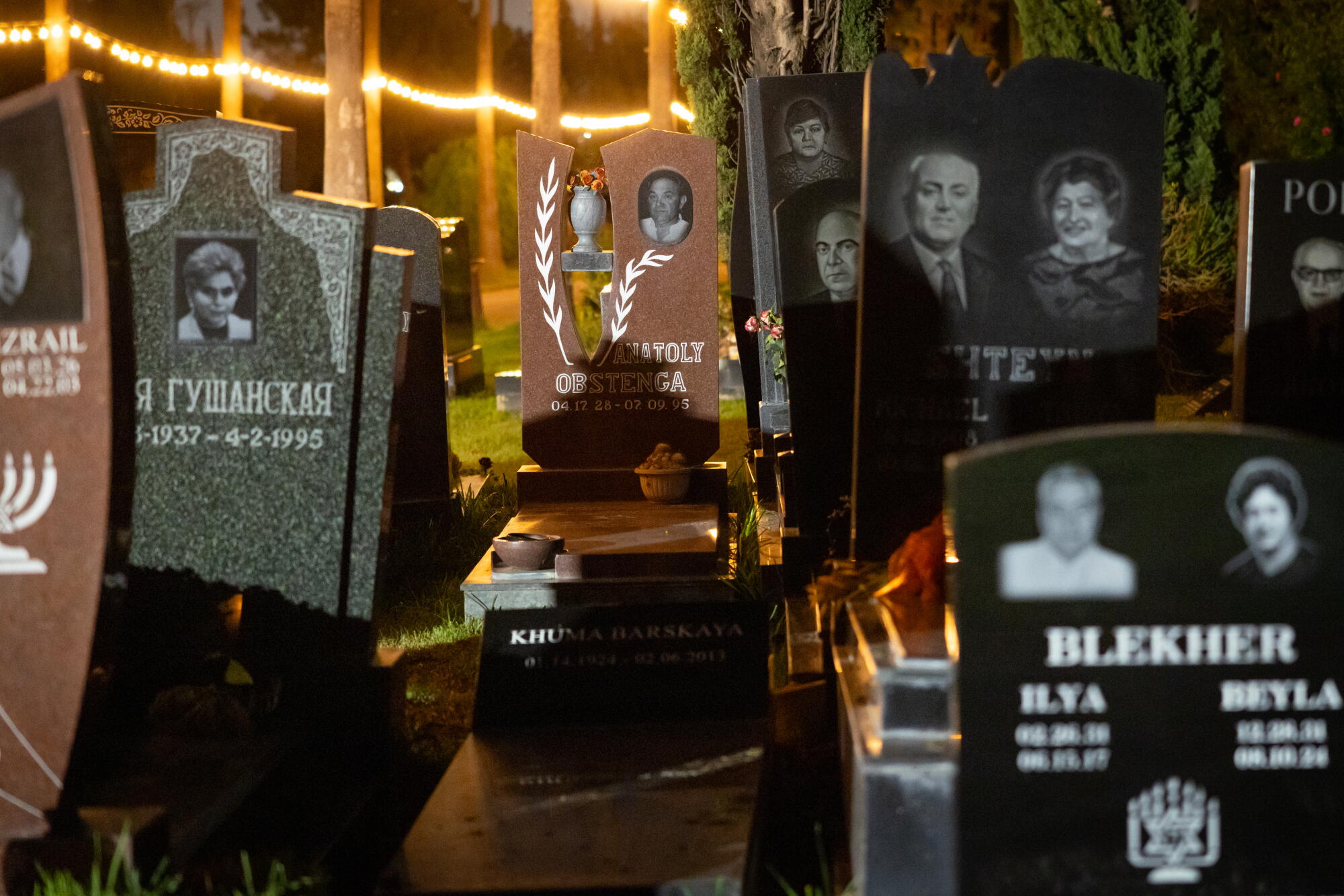
Everyone is going to die. Acknowledging this — and reminding oneself daily of one’s mortality — is a core tenet of Buddhist teachings. Few places make that reminder more vivid than Hollywood Forever Cemetery, the iconic Los Angeles graveyard where more than 90,000 people are buried.

Inside the Masonic Lodge on the cemetery grounds, beneath chandeliers, dozens of people search for stillness with a meditation class. In an ornate Italian Renaissance-style room, participants sit scattered across couches and cushions, cross-legged with their eyes closed. The room is silent.

Headstones at Hollywood Forever Cemetery.

Headstones at Hollywood Forever Cemetery.

Nico Cary is one of the meditation group leaders at Hollywood Forever Cemetery.

Nico Cary is one of the meditation group leaders at Hollywood Forever Cemetery.

For meditation teacher Nico Cary, the cemetery is an ideal backdrop for mindfulness and a lesson in impermanence. “It is quite grounding and an extension of some of the practice we do,” Cary says.

Beth Kaiserman, who regularly attends the meditation group, sees the cemetery as a chance to demystify death. “It’s accepting it as part of life. We’re coming out of our lives to come to this meditation. We’re walking by these gravestones that have been here for so long,” she says. Death, in her mind, doesn’t have to be taboo. “It is a big part of the practice to hopefully come to some level of acceptance that it’s just part of the cycle.”

Practicing meditation at Hollywood Forever is a privilege, explains Cary. The cemetery is not simply a place where people come to mourn; it is a place where relatives return to remember, honor and love those who have died.

Hollywood Forever is, quite literally, livelier than most cemeteries. The grounds are home to a colony of roughly 60 abandoned cats that has attracted a group of loyal caretakers, as well as dozens of peafowl roaming freely. The cemetery is also the final resting place of Hollywood legends, including Cecil B. DeMille, Judy Garland and the rock group the Ramones, where fans leave offerings. Since 2002, Cinespia has hosted outdoor screenings of iconic films at the cemetery during the summer, drawing hundreds of people to the grounds. The cemetery also hosts summer concerts.

“It feels pretty special to be somewhere, on land that’s so cared for, and that so many people come to share love, really — to remember their loved ones, to honor their ancestors,” Cary says.

For more than eight years, Insight LA has brought meditation to Hollywood Forever every Monday night, with a revolving list of teachers leading sessions in the Masonic Lodge. The class is donation-based, as is traditional in the Buddhist practice. Often, the teachers will lead a guided walking meditation through the cemetery grounds.

Insight LA, a Buddhist teaching nonprofit that was founded in 2002 by Trudy Goodman, is based in Santa Monica but also has a retreat house in Benedict Canyon for daylong events.

Members of a weekly meditation group at Hollywood Forever Cemetery participate in a guided session

Members of a weekly meditation group at Hollywood Forever Cemetery participate in a guided session inside the Masonic lodge.

“We have yearlong programs. We have residential retreats. We have weekly drop-in meditation classes, and then we have the Hollywood Forever group too,” says Melissa McKay, the executive director at Insight LA.

According to McKay, the benefits of meditation are striking. “Put simply: It decreases stress, bringing calm and clarity, becoming more aware of oneself,” she says. “It decreases the negativity of the mind, self-hatred, the fears, the spiraling judgment — all of that. It increases the positive sides of our mind: our compassion, care, friendliness, clarity.”

A 2026 UC San Diego study confirms that just seven days of meditation can create molecular changes in the brain linked to stress relief, enhanced neuroplasticity and natural pain relief. The study also shows that meditation can positively affect the immune system and metabolism.

James Rokel practices mindfulness while walking alongside tombstones.

James Rokel practices mindfulness while walking alongside tombstones.

Despite the backdrop, meditation is not just about facing death, McKay says — it’s about learning how to live consciously. One participant, Jared Swanson, thinks of the meditation group as a school for emotional awareness.

“There was a moment where I realized I was in a lot of cycles — relational cycles — and wanted change,” says Swanson. He has been integrating the mindful practices into his life. “I think it’s a desire to be more responsible for my life, to be more present and responsible for my actions and choices,” he says.

Meditation nights attendees range from curious first-time visitors to seasoned veterans who have been practicing Buddhism for over two decades. Cary says the practice can benefit people regardless of their experience level.

“The intentional space to be with ourselves is so nourishing,” says Cary. “Then we practice. You add in a practice on top of that and magical things start to happen.”

Cary leads the group in 30 minutes of silence before a lesson. Participants settle into their cushions. He invites them to rock gently back and forth, a movement he calls “grandmother wisdom,” the kind of care one might offer a crying child. He poses a question for reflection: “What are you trusting right now?”

Walking near gravestones

Insight LA has brought meditation to Hollywood Forever Cemetery every Monday night for nearly 10 years; a walking meditation is often involved.

Nicki Katz, who has been attending the meditations for two years, enjoys the practice of sitting in the quiet. Last year, she attended a 10-day silent retreat, only to accidentally break her silence by excitedly greeting a bunny during a picnic. “I come back to the body and the present awareness of allowing my mind to find some sense of gratitude,” says Katz. She explains that silence also helps her become more intentional with her words.

Tonight’s lesson is on truthfulness and embodying loving kindness. Lessons vary from week to week. “Oftentimes, it’s what the teacher is feeling or what’s come up for them in their practice,” says Cary.

For Monday meditation, the teaching group has assigned the 10 paramis (spiritual virtues) of Buddhism, which explore topics like generosity, wisdom and patience. “We’ve been going into that all year, so each month is one of the paramis,” says Cary.

“The intentional space to be with ourselves is so nourishing,” says meditation leader Nico Cary.

“The intentional space to be with ourselves is so nourishing,” says meditation leader Nico Cary.

To begin the lesson, he reads a letter he wrote to the president at 5 years old, cautioning him of the perils of nuclear war. The letter is met with snaps and giggles, as a 5-year-old Cary warns of imminent death. “Apparently I was a peculiar child with a morbid sensibility, preoccupied with nuclear war,” he says, smiling. “It makes a lot of sense as to why I became a Buddhist.”

Cary begins to speak about the current moment and how he believes truth has become distorted and refracted in the age of social media. “Trauma is a distortion of reality,” he says. He then invites group members to consider love and kindness in their daily practice.

As the session winds down, participants spring to their feet to discuss the evening. The Masonic Lodge bursts into chatter — the silence abandoned. Tonight, the cemetery is alive.
Source link

Dead Internet Theory is a Y2K-era party that celebrates ‘old tech’

What happened to the future we were promised? The vision that grew out of the 1990s techno-utopianism, when the internet was still a place of freedom and experimentation. Where are the infinite possibilities the early years of the millennium afforded, when social media meant AOL Instant Messenger and GeoCities, when our cellphones were not yet smart, and when personal tech evoked whimsy and excitement rather than anxiety and dread?

On a recent night in L.A., that digital optimism still existed. Here, at a clothing store on La Brea Avenue in the Fairfax District, something that felt lost was rediscovered. People were huddling around to play 1999’s “Crazy Taxi” on a Sega Dreamcast, or 2005’s “Tekken 5” on a PlayStation 2. They were surfing a perfectly re-created Y2K-era internet, and navigating an early version of Apple’s Photo Booth to snap selfies with a first-generation iSight webcam.

Paizley Lee created Dead Internet Theory to bring guests back to an era when tech evoked excitement rather than dread.

Paizley Lee created Dead Internet Theory to bring guests back to an era when tech evoked excitement rather than dread.

(Jason Armond / Los Angeles Times)

Yes, almost everyone was staring at screens, but almost no one was looking at their phone. Instead, the room felt alive and buzzing with energy. Technology was creating human connection rather than isolation.

Welcome to Dead Internet Theory, an event hosted by game designer Paizley Lee that’s both a celebration of vintage tech and a place to build community. The name is a tongue-in-cheek reference to the theory that the internet today is mostly bots, AI slop and corporate algorithms, while the human element is quickly disappearing from the web.

Lee started the event earlier this year after seeing how her friends reveled in hacking old hardware but had nowhere to show off their reimagined contraptions. She said Dead Internet Theory is a space to highlight “artists who don’t see the light of day,” a cyberpunk show-and-tell of sorts. “There’s a world of knowledge that comes from that person that can share and collaborate with another artist, and that’s really the future that we were promised, right then and there,” Lee said. “It’s the ‘Hey, look at what I made, look at what I’m interested in, and let’s share that.’ ”

Benjamin Palmer shows his project called Pan and Scan at a Y2K party called Dead Internet Theory.

Benjamin Palmer shows his project called Pan and Scan.

(Jason Armond / Los Angeles Times)

One of those artists sharing his work was Dan Ruth. Atop a low credenza, he displayed a black, leather suitcase that housed inside of it an old laptop attached to an external zip drive. On the laptop’s screen was a menu of various banned books — the Unabomber’s manifesto and “The Anarchist Cookbook” among them. Ruth had recently bought the trademark rights to the digital storage systems iOmega, Zip and Jaz. “They were what we all used in the ‘90s to transfer larger files,” he explained of the era before online storage and transfer infrastructure like Google Drive.

With his setup at the event, participants could choose whatever banned book they wanted and write it to a physical Zip disk (about the size of a saltine cracker) to keep forever. If Ruth’s installation is a bit provocative, his message is less controversial. At a time when servers are being shut down, physical media is being digitized out of existence, and the subscription model is supplanting personal ownership, Ruth believes this is a way to have data autonomy.

Guests play retro video games.

Guests play retro video games.

(Jason Armond / Los Angeles Times)

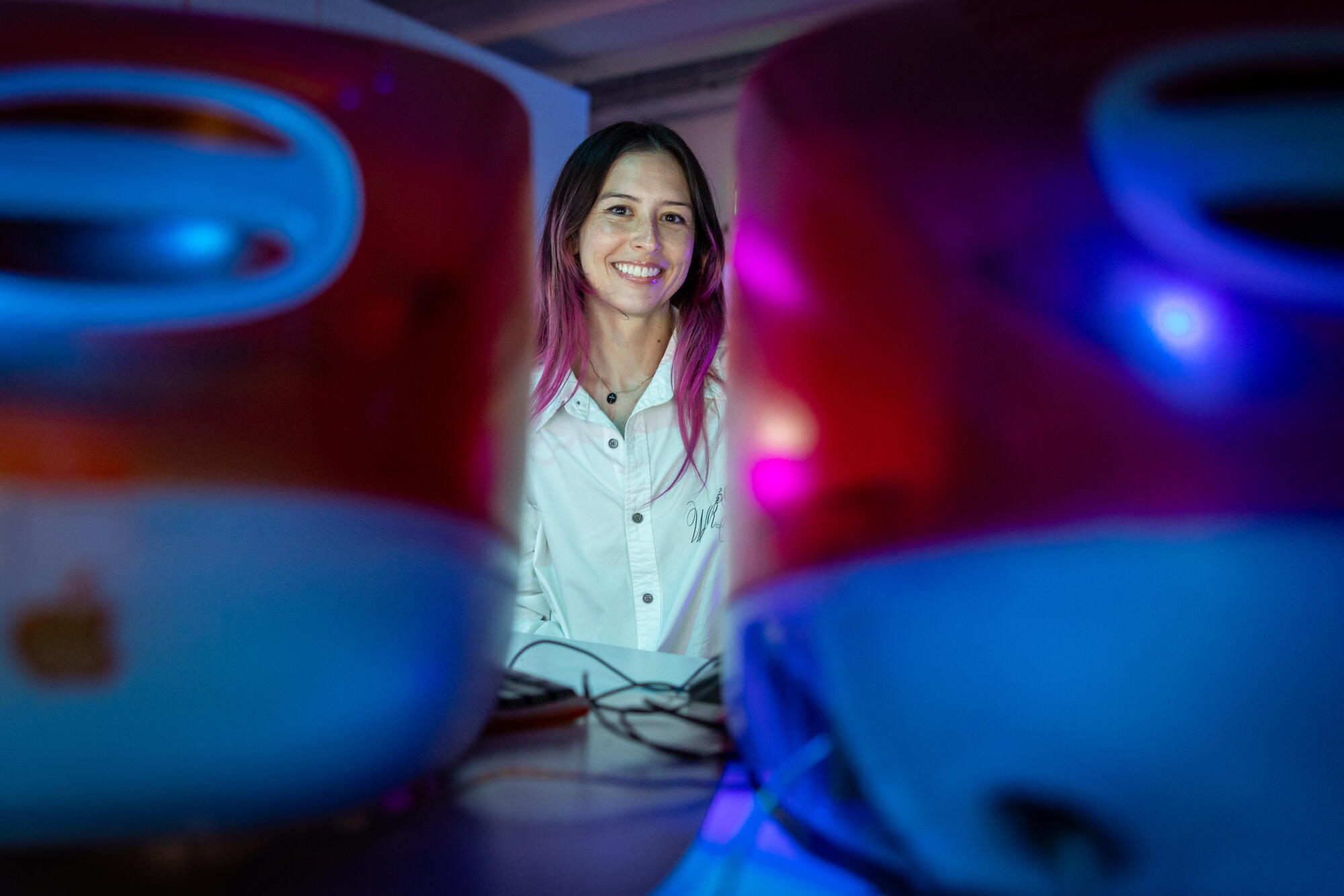
Lee’s own contribution to the evening is the full rainbow of Apple’s iMac G3 computers — those bubbly, teardrop-shaped desktops that debuted in 1998 to the famous “iCandy” ads displaying their colorful shells, and TV commercials scored to the Rolling Stones’ “She’s Like a Rainbow.” Over several months and multiple trips, Lee drove across the country collecting the G3s in their core five colors. And it wasn’t easy. She recalled sleeping in her car in the parking lot of a Cracker Barrel for a few nights because she had spent all her money on acquiring the computers.

It was the people Lee met in the months of gathering the G3s, however, that made it worth it: a single dad who collected vintage iMacs to bond with his son, an elementary school teacher who held onto the old computers because the school was going to destroy them.

“I met these really witchy, cool, queer programmers from MIT in Medford, Massachusetts, who invited me back for MIT Swap Fest, where I found Indigo,” said Lee, referring to another G3 color not part of the core five. “I met a guy who used to work in broadcast, and his wife just died of cancer. His mom moved in, and she has been trying to support him in getting rid of old things and not holding on to them too much.” Human moments made possible almost by the accident of holding onto a computer longer than most.

Lee’s pursuit of old tech hardware has always been, at its root, a means to meeting new people, hearing their stories and creating a relationship with them. “I care about people a lot,” she said. “I think every single person that touches any of my projects knows that I really care about people feeling good.”

Paizley Lee spent months collecting the full rainbow of iMac G3s.

Paizley Lee spent months collecting the full rainbow of iMac G3s.

(Jason Armond / Los Angeles Times)

With a mouse, Jaimie Wan clicks into the past.

With a mouse, Jaimie Wan clicks into the past.

(Jason Armond / Los Angeles Times)

When Lee finally acquired all five original colors (blueberry, strawberry, lime, tangerine and grape), plus all the additional colors (ruby, indigo, snow, graphite, sage and three limited edition colors), she began booting up the G3s computers to make sure they still worked. In the process, she discovered the forgotten digital detritus left on their hard drives: old resumes, photo albums, Word documents.

“It’s somebody’s life,” she said. “It feels weird to do anything with it, but it also feels weird to alter it.” In the end, she kept the old files and built a replica of the early ‘00s internet to live beside them on the computers. At Dead Internet Theory events, participants are given free reign to the G3s and slowly find clues Lee has left on their desktops that lead into a mystery game she created.

Back at the event, people flocked to the bank of iMac G3 computers. They clicked around, laughing, their eyes lighted up. “It’s really a trip seeing the old MacBooks,” said Shannon Stack after navigating one of the relics. “I remember having those in my elementary school classroom. Now, these are archival pieces. It’s freaky!”

Lee herself hovered around the computer bank, watching people interact with them and discovering the random documents left behind or playing one of Apple’s preset games. She asked a couple who had been tinkering around for over half-an-hour if they wanted a hint to her mystery. “No!” they respond excitedly.

While Dead Internet Theory has only been held in Los Angeles, Lee’s dream is to take it on the road. “I’ve got kids in Seattle, in Nashville, in Dallas that are emailing me and going, please bring it here,” she explained. The only thing stopping her was money, but that changed recently. A few weeks after the event on La Brea, she was approached by a sponsor. Now she’s making a tour happen, first with a pop-up event in New York City on Wednesday.

The event has become a place to gather and build community.

The event has become a place to gather and build community.

(Jason Armond / Los Angeles Times)

Recently, as Lee began driving across the country to set up, she stopped at a bed and breakfast near Red Lodge, Mont. When she learned the innkeeper had an old blueberry iMac G3 in her basement, she asked to take a look.

“I spent an hour getting her back on,” Lee said of rebooting the machine to give the innkeeper access. “And the face she made when it came back to life — literally priceless.”

The woman browsed through old photos of her daughters, their old school projects and other files forgotten over time. Afterward, the innkeeper gave Lee the computer, telling her it deserves a second life.

Source link