owner

Kim Kardashian’s Met Gala outfit spray-painted in KENT as ‘proud’ garage owner tells all about ‘top secret’ 13-hour job

KIM Kardashian’s Met Gala megaboobs were spray-painted at an auto repair shop in Kent — and its owner said tonight it was an “honour”.

Martyn Smith, 55, spent 13 hours on the orange fibreglass creation at his garage in Lydd on Romney Marsh.

Kim Kardashian’s Met Gala megaboobs were spray-painted in Kent Credit: Splash
Auto repair shop owner Martyn Smith said it was an ‘honour’ to work on the outfit Credit: SWNS
Martyn spent 13 hours on the orange fibreglass creation Credit: SWNS
The breastplate before it was painted Credit: SWNS

He felt “very proud” at seeing reality star Kim, 45, wear it in New York this week.

The Brit garage owner was asked to do the “top-secret” breastplate paint job — and was only told it was for Kim when he finished.

He said he agreed to drop work after being approached at his auto repair shop on a Kent industrial estate by two local artists.

Against the clock, he spent 13 hours prepping and spraying the orange fibreglass piece, worn two weeks later by Kim at the Met Gala.

Read more on Kim Kardashian

RACY LOOK

Kim Kardashian’s tribute to X-rated movie in pointy boob dress at Met Gala


price cut

Staggering amount Kim Kardashian’s hairdresser charges for a haircut revealed

Martyn, who runs MPS Body & Paint, would not say what he charged — but it was “in the hundreds not the ­thousands”.

He added: “When I saw it, I felt very proud and honoured. I only had 24 hours to do it.”

The breastplate was co-created by Kent artists Patrick Whitaker and Keir Malem, who then went to ­Martyn after he had repaired their car a few years earlier.

The dad of two, who works at the auto business with sister Nicki Hill, 50, said: “It looked great, but it had imperfections and tiny air holes which I had to fill with stopper.

Kim Kardashian wearing the breastplate at the Met Gala on Monday night Credit: Getty
Martyn was asked to do the ‘top-secret’ breastplate paint job Credit: SWNS

“It had mould lines which I had to smooth out, before re-priming it and rubbing it down. It then needed a base coat and a lacquer top coat.

“With drying times, it was a lengthy process, but I knew it had to be perfect. I worked all day on it until 8.30pm.

“It was kept hush-hush as they told me it was top secret.

“I thought it might be for Madonna or Gal Gadot given the design.

The 55-year-old was only told it was for Kim Kardashian when he had finished Credit: SWNS
Martyn runs MPS Body & Paint in Kent Credit: SWNS

“When they collected it they finally told me it was for Kim Kardashian.”

Martyn said he knew the name but was more of a fan of her boyfriend, F1 great Sir Lewis Hamilton.

Meanwhile, Nicki discovered Kim would be at the Met Gala on Monday night — her daughter Elli-Jane’s 20th birthday.

“She stayed up to watch it and said: “I was falling asleep as it was late and Elli-Jane shouted, ‘Mum, mum she’s wearing it’.

“She was bouncing up and down with excitement and then I was quite emotional.”

Martyn, who had gone to bed, said his paint job looked “fantastic” when he saw photos the next day, and the reaction since has been “crazy”.

He would welcome similar work but added: “I don’t know many people who have got a breastplate really.”

Source link

If Padres can sell for $3.9 billion, are we closer to an Angels sale?

I’d heard Arte Moreno had told people recently that he thought the Angels could command $4 billion. He might sell the team. He might not. But the figure seemed ambitious, since no major league team ever had sold for even $3 billion.

Until Friday, that is, when the Wall Street Journal first reported the San Diego Padres were about to be sold for $3.9 billion.

The new owners: a group led by Jose Feliciano of Santa Monica-based Clearlake Capital, which manages more than $90 billion in assets, and his wife, Kwanza Jones. In 2022, Feliciano and Dodgers co-owner Todd Boehly led the investment group that bought Chelsea of the Premier League for $5.2 billion.

The new money should enable the Padres to build upon the legacy of late owner Peter Seidler, who simply disregarded the fact that San Diego ranks as one of the smallest media markets in the major leagues. He spent to win, and the Padres have made the playoffs four times in the past six years — after making the playoffs five times in their first 51 years.

The fans rewarded him, packing Petco Park. As of Friday, the Padres had the second-best record and second-highest attendance in the major leagues. The Dodgers, of course, had the best record and the highest attendance.

The party most immediately interested in the Padres’ sale price? The players’ union, since Commissioner Rob Manfred has cited sluggish appreciation in sale prices as one reason to pursue cost controls on player salaries, whether through a salary cap or some other restriction. In recent years, the owners of the Angels, Minnesota Twins and Washington Nationals all have put their teams on the market without completing a sale.

But Moreno should be interested, too. He turns 80 this summer.

The comparison with the Padres only goes so far. In San Diego, in a city without a team in the NFL, NBA or NHL, the Padres are virtually unchallenged for dollars from fans and corporate sponsors.

And, in San Diego, the Padres play in Southern California’s best ballpark, one the team has turned into a year-round events center, with major concerts in the stadium itself and smaller ones within a delightful park beyond center field.

Could Moreno get $4 billion without a resolution to the long-running ballpark stalemate in Anaheim? It sounds borderline insane to consider that the only available team in America’s second-largest market might not be worth as much as the team that just sold in America’s 30th-largest market.

In Anaheim, however, two deals that would have anchored the Angels there for decades collapsed, and the 60-year-old stadium is in serious need of renovation or replacement. A buyer likely would have to account for the billion-dollar cost of a new ballpark and might ask for a credit against the purchase price, effectively lowering how much profit Moreno could make on the sale.

Any potential buyer should be keeping a close eye on a bill slowly winding its way through the state legislature this year. That bill, if enacted into law, would give the city the ability to loosen development restrictions on the stadium property for a team owner willing to call the team the Anaheim Angels.

Still, even without that legal assist, there should be no shortage of parties interested in acquiring two rarely available assets in one transaction: an MLB team in the Los Angeles market, and a 150-acre site perfect for the mixed-use development coveted by owners in every sport these days.

Golden State Warriors owner Joe Lacob, who once worked as a peanut vendor at Angel Stadium, lost out in the Padres’ bidding and could take another run at the Angels.

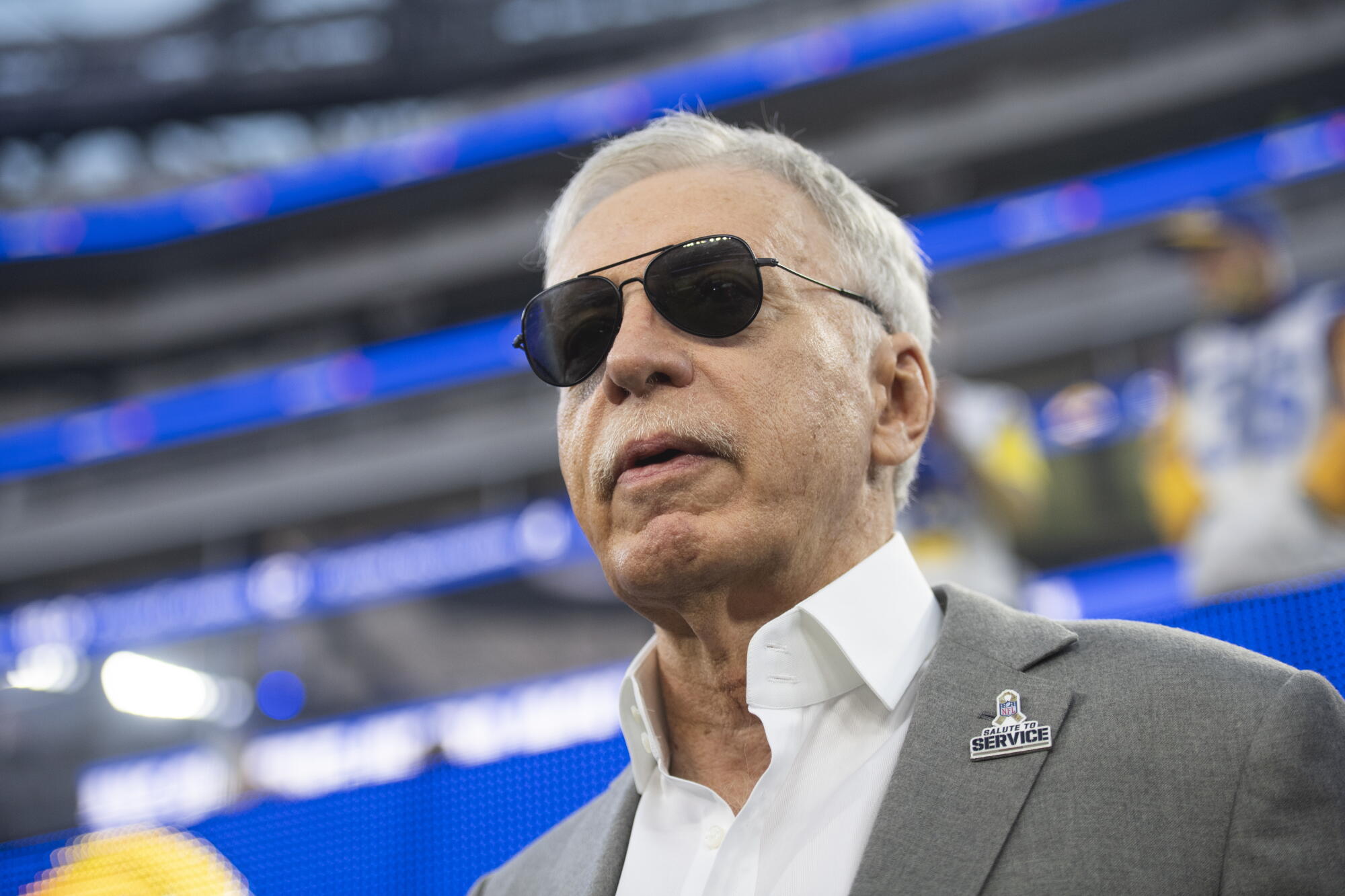
Rams owner Stan Kroenke, who lost out in the Dodgers’ bidding in 2012, surrounded the Rams’ Inglewood stadium and Woodland Hills training site with major development and could consider replicating those successes in Anaheim.

Ducks owner Henry Samueli has denied interest in the Angels, but he could consider extending and complementing his OC Vibe development across the 57 Freeway — and his hockey team already wears the Anaheim name.

That assumes, of course, that Moreno opts to sell. He enjoys owning a team and, in a season in which the Angels are one-half game out of first place entering Friday in what appears to be a weak American League West, there is no hurry.

It is considered more likely that Moreno waits until after a new collective bargaining agreement is reached next year to determine whether to sell. All I can tell you for sure Friday is what one baseball official texted me when I asked for reaction to the Padres’ sale: “Great news for the Angels.”

Source link

English pub owner adds entire observatory to beer garden so punters can see the Milky Way

Landlord standing in front of The Poltimore Inn pub.

A landlord fascinated by the space and the sky set up an observatory – in the back garden of his pub.

Alan Boddington, 67, first took interest in the space when looking at the moon with his uncle using a brass telescope on top of a coalbunker.

The country pub has an observatory in its gardenCredit: SWNS
Pub landlord Alan Boddington of the Poltimore Inn, Devon, is fascinated with spaceCredit: SWNS
His fascination was further sparked when watching Neil Armstrong landed on the moon in 1969Credit: SWNS

His fascination was further sparked when watching Neil Armstrong landing on the moon in 1969 during the Apollo 11 mission.

When he took over The Poltimore Inn, he saw an opportunity to build an observatory in back garden of the pub.

Located in the village of North Malton, Devon, the pub is on the edge of Exmoor National Park – Europe’s first ever dark sky reserve.

Minimal light pollution and cloudless nights mean thousands of stars and astronomical sights such as the Milky Way can be spotted.

COUNT ME IN

English county with some of the best pubs & beaches wants MORE tourists


BEACHY KEEN

Brits pack out beaches & parks as temps hit 26C on hottest day of the year

He said: “When a cloud comes over it means you can pop into the pub, have a pint and maybe sit by the fire to warm up.

“Once the sky clears you can come out with your pint and appreciate the dark sky.

“Takes a little while for your eyes to adjust but we have got red lighting all the way down to the observatory.

“It’s an unusual thing to have a pub with an observatory but also with our accommodation we can give people the opportunity to look at the Dark Sky.

Mr Boddington bought the Poltimore Inn in October 2012 from a large pub chain.

With his “long term” love for space he saw a potential to create an observatory outside the pub.

Five years ago he set up with observatory and it was funded by himself.

The telescopes costed around £10,500 and the building which was self-built was £27,000.

On a cloudless night it is possible to see the milky way, thousands of stars and astronomical sights from the Exmoor National Park.

He said: “I was introduced to the moon as a 9-year-old when my uncle brought over his telescope and set it up for me to have a look at the moon.

“The moon project Apollo went off and it was one of those things that your parents let you stay up for.

“I still have a lot of the newspaper cuttings.

“When it came to setting up the pub I thought it would be the ideal opportunity for me, with the Exmoor Dark Sky, to take advantage and also enjoy my hobby.”

Within the observatory, there is a permanently Polar and star aligned Meade LX200 12-inch telescope and a new era “smart” telescope in the Unistellar Ev-Scope.

There are also numerous other manual telescopes and Skywatcher Dobsonians for beginners.

It features an electronic roll off roof, a private outdoor decking observation area, as well as private amenities, plus tea and coffee making facilities.

He continued: “This has been a great boost to go from being youngster to seeing the Apollo to seeing this venture Artemis going off and going looping round the moon is amazing.

“Also the technology that is gone with it – we are going to be looking at tremendous pictures for the next six months as they are released.

“The Darkside of the Moon is something that we don’t generally see and I think we will have a lot of surprises from that.

“Also the eclipses will show us different details. We are really pleased to see the astronauts coming back safely and leave safely.

“I hope it really stimulates the whole space idea in Europe, in England and with the scientists in this country.”

The building of the Poltimore Inn Observatory helps him share his passion for astronomy and space exploration.

The Poltimore Inn Observatory holds regular monthly events run by astronomers Jo and Pete Richardson.

The primary school in North Malton also visits the observatory as part of their education.

He hopes his observatory keeps inspiring both young and old about the space and the sky.

To get to know more about The Poltimore Inn visit their website here.

Source link

Erewhon to open at LACMA’s new David Geffen Galleries

Want to sip on Hailey Bieber’s Strawberry Glaze Skin Smoothie after staring at Vincent van Gogh’s “Tarascon Stagecoach”? Los Angeles County Museum of Art has got you covered.

The museum announced Tuesday that it has partnered with Erewhon, the high-end L.A. health food chain and retailer, on a cafe located on the ground level of its new David Geffen galleries. The cafe, which has outdoor seating beside Alexander Calder’s fountain sculpture, “Three Quintains (Hello Girls),” will open Sunday for LACMA members visiting the David Geffen Galleries. The general public can get in on the coveted buffalo cauliflower when the new building opens to the public on May 4 — with the partnership continuing through the summer. No definite closure has been announced, so it’s possible the collaboration continues.

“We’re so proud to partner with LACMA, a meaningful milestone as our first museum collaboration,” said Tony Antoci, CEO and owner of Erewhon, and Josephine Antoci, president and owner of Erewhon in a statement. “It really feels like a celebration of Los Angeles, bringing Erewhon and LACMA together to nourish and inspire the community we love.”

The collaboration between the store, which enjoys a cult-like following, with one of the city’s most anticipated new cultural offerings is expected to draw an eager crowd. Guests can grab a ticket to the museum, or simply enjoy a drink while strolling around the museum’s 3.5 acres of new park space, and taking in a variety of newly installed public artwork including Jeff Koons’ towering topiary sculpture, “Split Rocker.”

Two additional drinking and dining options — a wine bar and a restaurant — will open later this year, but no establishments have been named yet for those spots.

Erewhon at LACMA will be open during museum hours.

Source link

For Angels fans, new team ownership and winning are top priorities

The Angels celebrated their 2026 home opener on Friday, and the fans booed the ceremonial first pitch.

Magic Johnson, the Dodgers’ co-owner and the foremost winner in Los Angeles sports history, threw out the ceremonial first pitch before the Dodgers’ opener. Jeff Kent, just elected to the Hall of Fame, did the honors for the San Francisco Giants.

In Anaheim, John Carpino tossed the first pitch, even with popular alumni such as Torii Hunter and Tim Salmon in the house. Carpino is the Angels’ president, retiring Monday after 16 years in that role and 23 years in all as a loyal executive under Angels owner Arte Moreno.

Moreno thought it would be lovely for Carpino to throw out the first pitch and, under different circumstances, it would have been.

The fans can deal with the aging stadium, the recent lack of marquee signings and the longest playoff drought in the major leagues, but not with Moreno’s spring comment to the Orange County Register that surveys show affordability is the fans’ top priority and “believe it or not, winning is not in their top five.”

So Carpino, as a proxy for Moreno, was booed loudly. Then a few modest choruses of “sell the team” broke out.

Behind the Angels’ dugout, Dave and Chris Bloye of Upland wore red T-shirts. His shirt listed five priorities, in order: Affordability, good experience, safety, peanuts, fan surveys. Her shirt listed five priorities too, starting with “sell the team.” The Bloyes said they have had season tickets for more than 20 years.

“We’ve never had a survey,” Chris Bloye said.

Moreno is competitive, a hardcore fan who regularly attends even spring training games. Perhaps he did not mean his words to come out the way they did.

Moreno declined an interview request from The Times at the owners’ meetings in February. A team spokesman said last week that Moreno would pass on an opportunity to clarify his remarks about fan priorities.

But, if those were indeed the priorities, they would have been reflected by the fans that showed up more than six hours before game time for the free fan festival the Angels throw before the home opener every year.

Surely, the man in the jersey that read “FAN SINCE 81” and the Angels tattoo on his left leg would be here win or lose.

Angels fans stand in front of the stadium before the team's home opener.

Angels fans stand in front of the stadium before the team’s home opener against the Seattle Mariners on Friday night.

(Ronald Martinez / Getty Images)

Yes, Jose Bocanegra of Chino said, he would be. But for Moreno to say winning was not a top fan priority?

“That’s crazy,” Bocanegra said. “If you’re not in it to win it, then what are we doing?”

How about the fan in the Nolan Ryan jersey? He held his 7-year-old daughter atop his shoulders. She wore a Mike Trout jersey, smiled broadly, and clutched a cup of ice cream.

His name was Nate Ryan, from Hemet. He and his daughter attend Dodgers and Angels games, but they particularly like visits to Angel Stadium. His daughter loves the rally monkey and the free games in the Pac-Man arcade, and he appreciates Moreno’s focus on affordability.

“The Angels are more economical,” Ryan said. “We have a good time.”

At Angel Stadium, $44 gets you four tickets, four hot dogs, and four drinks. At Dodger Stadium, $45 gets you a parking space.

Ryan had one more thing to say.

“I’d like to see a new owner,” Ryan said.

Jarod Venegas of Corona dressed in a white wrap, wearing a red cap topped by a gold halo. He was about to spend nine innings as — you guessed it — an angel in the outfield.

“I believe we have a team that can be the best,” he said.

What exactly do you mean by best?

“I mean World Series champions,” he said.

Venegas had something to say about fan priorities.

“Winning is our No. 2 priority,” he said. “No. 1 is getting a new owner.”

Johnny Estrada of Corona wore a T-shirt with eight lines on the back. All eight lines read the same: “Sell the team.”

He said he loves the team, supports the players, and does not believe Moreno chose his words poorly.

“I don’t necessarily feel it came out wrong,” Estrada said. “I feel he hasn’t cared for a while.”

Anaheim Mayor Ashleigh Aitken, who remains irked by Moreno branding the team with a Los Angeles name, has been a season-ticket holder far longer than she has been mayor. She’ll give Moreno a pass on his comments.

“I think it was a misstep,” Aitken said. “I’m willing to give him the benefit of the doubt. He knows that winning, for a true fan, is one of the most important things. Winning is a priority for our players. Winning is a priority to the loyal fan base.”

Even more so, perhaps, to the casual fans, the ones that determine whether the Angels sell three million tickets in any given year.

The Angels sold 2.6 million tickets last year, a testament to the strength of the market amid a second consecutive last-place finish.

The "Big A" sign outside Angel Stadium on Friday during the team's home opener.

The “Big A” sign outside Angel Stadium on Friday during the team’s home opener.

(Ronald Martinez / Getty Images)

However, attendance has fallen 20% over the past 20 years, a span that includes one postseason series victory and the current streaks of 10 seasons with losing records and 11 seasons without a playoff appearance.

Friday’s home opener was sold out. However, as of Friday afternoon, resale markets listed tickets for as little as $7 for Saturday’s game and $4 for Sunday’s game.

This is a great fan base, to me much more frustrated than angry, waiting to erupt in joy. The fan festival was dominated by fans wearing “sell” jerseys but a variety of Trout jerseys — home white, road gray, alternate red, City Connect, All-Star, World Baseball Classic, even one from the Salt Lake Bees.

Trout’s loyalty has been reciprocated by the fans. Moreno could feel that love too, with a renewed commitment to the excellence the Angels he displayed in his first decade as owner.

In 2002, the year before Moreno bought the team, the stadium was rocking with thunder sticks as the Angels won the World Series. Thunder sticks are so loud that they were banned at the World Baseball Classic finals, even as drums, trumpets and cowbells were permitted.

In Anaheim, the thunder sticks were glorious. Moreno does not want to sell at the moment, so best to demonstrate a dedication to returning October to the Angels’ schedule, lest their fans take home their giveaway calendars from the home opener and start the countdown to “wait ‘til next year.”

Source link

Taix French restaurant demolition: Why L.A.’s creative scene is mourning a landmark

On March 29, Taix as we know it closes forever. The iconic French restaurant originally opened downtown in 1927 and relocated to its current chalet on Sunset Boulevard in 1962. It’s a grim reminder of L.A.’s insatiable appetite to destroy its own heritage and especially devastating to a certain milieu of writers and artists, myself very much included. Since it announced its closure, I’ve been visiting as often as I can to say farewell, not only to the charmingly shabby faux-1920s interiors, but to the many lives I’ve lived at its tables. First as a young guitarist when a bandmate worked the bar’s soundboard, next with the Chinatown artist scene, then with Semiotext(e)’s avant-garde lit circle, later through firecracker romances and heartbreaks during the art party Social Club, recently floating through the louche carnival of Gay Guy Night and now with the circus of beatniks from my reading series Casual Encountersz.

  • Share via

It’s difficult to explain why this cavernous and windowless restaurant means so much, so I’ve tried to list everything I love about Taix.

I love that they don’t play music. I love the 1960s bathrooms. I love the bottomless tureens of soup. I love the complimentary crudité from the pre-pandemic era. I love the cold pats of butter. I love that you can always get a table, no matter how many people roll in. I love the free refills on Diet Cokes. I love the 80-year-old couples on dates. I love how the dim lighting makes everyone seem chic. I love the frayed carpeting. I love the fake votive candles. I love the icy martinis. I love the corner booth beside the fireplace. I love the smoked mirrors and tin-plate ceilings in the elegant back dining rooms. I love the small fortune I’ve spent there picking up the check for many strippers, poets and bohemians. I love its rundown glamour, which miraculously evokes Old Hollywood, Belle Époque and trashy Americana all at once. I unironically love the food, which isn’t spectacular, but is very comforting. I love how a waitress once ran off with a friend of mine and slept on my couch for a week. I love how my wife generally hates eating at restaurants but loves eating at Taix. I love how every L.A. artist I know has their own singular version of this list.

The only thing I don’t love about Taix is that its owners are tearing it down to erect soulless condos. I know the city needs housing, but not like this. I hope we’ll all find a new place to call home again soon.

Taix shaped me as a writer and artist, along with so many others, which is why before the new owners demolish this cultural institution, I asked other creatives what the Echo Park landmark means to them.

Chris Kraus.

Chris Kraus.

(Ariana Drehsler / For The Times)

Chris Kraus, writer, artist and co-editor of the independent press Semiotext(e): When I moved to L.A. in 1995, Taix was the go-to place, with its deep banquettes, cuisine bonne-femme and its nightly prix-fixe specials. Mostly it was police officers and their wives who went there. Sylvère Lotringer and I went often, for him it was a little reprieve from the non-Frenchness of L.A. He could order in French and exchange pleasantries with an elderly French waiter who seemed to live there. Years later, when Sylvère moved to Ensenada and was less active with Semiotext(e), Taix was the site of our “Annual General Meetings” — Hedi El Kholti, Sylvère and I would have dinner together and Hedi would catch Sylvère up on all the forthcoming publications and projects. Taix was a place to run into people unexpectedly. About a decade ago, when the bar was refreshed, it changed again and I kind of lost track of it.

Rachel Kushner, novelist: I dined at Taix probably once per week for 23 years. It hurts so much that it is closing. I simply stopped going, so that I could begin to grieve, and also to avoid every last random tourist standing by the host station, on their phone, and the glum possibility of being seated in the second dining room, a.k.a “the Morgue” as my friend Benjamin Weissman put it. I want to protect my memories of the special occasions I enjoyed in this perennial special occasion establishment … I want to remember Bernard, a cheerful Basque from Biarritz who worked there 60 years, got progressively trashed over the course of his shift, went to Bakersfield on Sundays to party with his sheep-herding countrymen, came back Wednesdays sunburned and happy. The old valets who were let go during the pandemic. I used to give them a Christmas bonus every year, as a thanks for letting me park my classic out front. Look, I was born in Taix. I mean, in a way. I nursed my newborn in Taix. He grew up there. People who criticize the food are losers, and will never understand. The steak frites are great. The panna cotta, discontinued after the pandemic, was my favorite. The Louis Martini Cabernet was reliable. (Bernard told me the wine cellar downstairs took up the entire footprint of the main restaurant. Don’t know if that’s true.) Meanwhile, I can’t put my arm around a memory. All the smart girls know why. It doesn’t mean I didn’t try.

Cord Jefferson, writer and director: When I started going to Taix, in 2004, you could still gamble at the bar. They sold keno slips and lottery tickets, and whenever Powerball got over $100 million, I’d buy a ticket with my pint. Where else can you do all that while simultaneously watching a game and eating a tourte de volaille? Taix was where I watched the heroic Zinedine Zidane headbutt the gutless Marco Materazzi in the saddest World Cup final ever. When France lost that afternoon, my favorite server, Phillipe, cried. Phillipe’s teeth were often as wine-stained as his customers’. He’d bum me cigarettes in the parking lot and speak abusively about the ways the neighborhood was changing. I’m happy Phillipe is not around to see the digital renderings of what they plan to erect once they demolish the Taix chateau: another condo building with all the charm of a college dorm. It’s a damn shame what’s happening to Taix. I wish I had more money so I could buy it and keep it around, but I never won the Powerball.

John Tottenham, novelist and poet: It’s a shame that Taix is closing, not only because other plans will now have to be made for my funeral reception, but because it was the last civilized watering hole in the neighborhood. There isn’t anywhere else that one can walk into and immediately satisfy the social instinct among a convivial and refreshingly diverse clientele in what is becoming an increasingly homogenized locality. It has been the nexus of my social life for over 20 years, and is simply irreplaceable.

Jade Chang.

Jade Chang.

(Ariana Drehsler / For The Times)

Jade Chang, novelist: I’d only known Taix as a raucous bardo of a French restaurant, then there was a memorial service for Alex Maslansky, my beloved friend Max’s brother, owner of Echo Park’s best bookstore, Stories. Alex was a beautiful and beleaguered soul, born worried, born romantic, difficult and hopeful and apparently a shockingly good poker player. The room was packed with music people and book people, sober friends and poker friends, packed with the gorgeous girls who’d always loved him, our collective sorrow potent and sweet enough to pull the walls in around us tight as we said goodbye and goodbye.

Alexis Okeowo, New Yorker staff writer: I was a late discoverer of Taix, stumbling upon it when I moved to a bungalow just above Sunset during the pandemic from New York. I seemed to only see writer friends there. I met up with a journalist for drinks and then ran into a new writer friend at the bar. I later had a big, spontaneous dinner with TV writer friends and then a birthday celebration in the dining rooms that ended in two friends escorting me home, sick and happy off a mostly-martini meal and the selfies I took in the bathroom with the iconic pink and gold wallpaper. Every time, there was talk about ideas and gossip and so, so much laughter.

Alberto Cuadros, writer/curator and co-founder of the Social Club: About 10 years ago, Max Martin and I started Social Club as a weekly social salon at Taix. We thought of it as a kind of Beuysian social sculpture, it was a weekly ritual, and over time it became something of an institution in the L.A. art world. Everyone knew where to go in L.A. on a Wednesday if they wanted to meet interesting people or find friends. I even met my wife there who was visiting from Montreal.

Siena Foster-Soltis, playwright: Taix felt like one of the few remnants of the L.A. I grew up in and love so dearly.

Ruby Zuckerman.

Ruby Zuckerman.

(Ariana Drehsler/For The Times)

Ruby Zuckerman, writer and co-founder of the reading series This Friday: Taix is the only restaurant in L.A. that doesn’t lose its mind if new friends drop in halfway through dinner or if you stay at your table for hours after you stopped ordering. That kind of flexibility leads to spontaneous nights where what started off as an intimate hang expands into an all-out party. As a writer, that flexibility has allowed me to meet editors, collaborators and readers, drawn together by pure fun rather than networking. One of my favorite nights involved getting in a physical altercation with novelist John Tottenham after he stole my phone to send prank texts to my boyfriend. I’ll miss taking selfies in the bathroom.

Blaine O’Neill, DJ and events organizer: I always say Taix is the “People’s Country Club.” It is exceptional because of the staff who understand the importance of hospitality, and the scale of the space is humane. You’re able to evade feeling pinched by the noose of transactional cosmopolitanism.

Tif Sigfrids, gallerist and publisher Umm…: Taix was a cultural nexus. A space with broad range. It went from being the dark bar I read books and day-drank at in my 20s to the place where I rented a private room to host my son’s first birthday party. It’s where I watched Barack Obama get elected twice, the Lakers win back-to-back championships, and where I indulged in countless night caps and an unreasonable amount of all-you-can-eat split pea soup. You never knew what kind of hot jock, wasted poet or other type of intrigue you might run into there. You can’t make a place like Taix up. It’s a place that just miraculously happens.

Kate Wolf, writer and editor: Though I have been going to Taix for nearly 20 years, embarrassingly, it was only in the last year that I realized the building wasn’t from the 1920s. Those smoke-stained mirrors, that tin ceiling, the drapery and light fixtures are in fact set-dressed — ersatz! Which of course only makes me love the place more. Taix’s history, and its spot in the city’s cultural firmament, cannot be denied. But what really makes it so special are the people who work there and the clientele, not its past. This point is perhaps my only hope in losing what is my favorite restaurant in Los Angeles. That by some divine grace, we will all find each other again in another spot, designed to a different decade than the horror-filled present, and fill it with the same warmth, the same bottomless soup bowl, the same cheer.

Hedi El Kholti, artist and co-editor Semiotext(e): Taix is where we would end up after every reading since 2004 when I started working at Semiotext(e). I have memories of being there with Kevin Killian, Dodie Bellamy, Gary Indiana, Michael Silverblatt, Colm Tóibín, Rachel Kushner and Constance Debré among others … Taix has that particular anachronistic vibe that made L.A. so charming when I moved here in 1992, one of these places that time forgot. It was odd when it became really hip in the last 10 years. It made me think of what Warhol wrote about Schrafft’s restaurant when it had been redesigned to keep up with the fashion of the moment and had consequently lost its appeal. “If they could have kept their same look and style, and held on through the lean years when they weren’t in style, today they’d be the best thing around.”

Loren is the founding editor of the art and literary conceptual “tabloid” On the Rag and curator of the reading series Casual Encountersz.


Source link

Dodgers owner Mark Walter: ‘We’ve got to have some parity’

On their way into the clubhouse Thursday, Dodgers players were greeted by the World Series championship trophies they won in 2024 and 2025. In center field, Dodgers fans were greeted by oversize replicas of those trophies, the better for taking a selfie.

On social media, the Dodgers unveiled their Opening Day hype video. These were the first words: “What’s wrong with being the bad guy?” At Dodger Stadium, the threepeat hype video was a movie trailer with this tag line: “Great sequels build legendary trilogies.”

To the rest of that country, all that winning and all that spending makes the Dodgers the bad guys. For more than a year, the owners of other major league teams have telegraphed their desire to restrain all that spending, preferably through a salary cap.

How does the owner of the Dodgers feel?

Does baseball truly have a problem?

Sit down, Dodgers fans. You might expect the owner of the Colorado Rockies to say that revenue disparity among teams is so great that competitive balance has been destroyed, and he did.

You might not expect Dodgers owner Mark Walter to say this:

”Here’s what the problem is: Money helps us win. We can’t win all the time. We’ve got to have some parity,” Walter told me.

“So we’ve got to come up with something that will give us some parity.”

Don’t take this the wrong way: Walter will always want to win. But the owners, Walter included, are increasingly united in the belief that revenue disparity is the primary explanation why a small-market team has not won the World Series in 11 years.

The Dodgers are making more money from Uniqlo in naming rights this season than some teams are making from local television rights and the Dodgers also are making 10 times as much on their SportsNet LA deal.

The Dodgers generated an estimated $850 million in revenue last season, according to Forbes. Their opening day opponent, the Arizona Diamondbacks, generated an estimated $324 million.

If Walter were to support the pursuit of a salary cap, the owners’ vote could be unanimous. For now, negotiations with the players’ union have not started. There is no formal owners’ proposal on the table, so there is nothing for Walter to approve or reject.

“We’ll have to see what it is,” Walter said.

The players’ union does not dispute the revenue disparity. The union believes the owners should solve that issue among themselves, by sharing more revenue and adding incentives for lower-revenue teams that win. The union also believes “competitive balance” is a fig leaf for “cost control that increases owner profits.”

In the NFL, which has a salary cap, either the Kansas City Chiefs or the New England Patriots has played in the AFC championship in each of the last 15 years.

And, even if the Dodgers are the bad guys, they are not bad for business. The Dodgers hold five of the top 12 spots on baseball’s list of best-selling jerseys: Shohei Ohtani at No. 1, Yoshinobu Yamamoto at No. 2, Mookie Betts at No. 5, Freddie Freeman at No. 7 and Kiké Hernandez at No. 12.

The last two World Series, in which the Dodgers beat the New York Yankees and Toronto Blue Jays, juiced television ratings across the country and around the world. The World Baseball Classic dominated headlines and social media content at what is usually a sleepy time for baseball.

All of that momentum would be at risk if owners shut down the sport in “salary cap or bust” collective bargaining, crossing their fingers that players would surrender as soon as they started missing paychecks next spring.

It is against that backdrop that Dodgers manager Dave Roberts encouraged fans to appreciate this season opener. With potential armageddon looming in negotiations for a new collective bargaining agreement, who knows when the next season might actually open?

“I understand that,” Roberts said Thursday, “in the sense of, this is where the CBA is at, as far as the expiration. And I do agree: Enjoy it, because nothing is guaranteed. It’s going to be a great year and I hope everyone pours their spirits and their joy into this season, because it’s going to be a great one. We’ll just figure out where it goes after that.”

And, if it goes haywire after that, the Dodgers inevitably will be blamed.

“That,” Roberts said with a laugh, “seems like it’s always been the case recently.”

What would Walter tell Dodgers fans concerned that what might be in the best interest of baseball might not be in the best interest of the Dodgers?

“I don’t want to hurt us,” Walter said. “We’ll be fine.”

With whatever happens?

“Yeah,” he said. “We’ll be good.”

Source link

Contributor: MLB’s biggest rivalry this season will be players vs. owners

The Major League Baseball Players Assn. is arguably the strongest union in the United States whose members include some of the most conservative athletes in professional sports. The owners of Major League Baseball’s 30 teams, who made their wealth through the workings of free enterprise capitalism, want to limit what players can be paid. This apparent political and philosophical irony will most likely lead to a shutdown of baseball at the end of this season.

Wednesday is opening day for the 162-game major league season. The 2025 season ended Nov. 1 with an 11-inning Dodgers victory over the Toronto Blue Jays in what was one of the most mesmerizing World Series ever. Last season, the Dodgers attracted more than 4 million fans for the first time. The Dodgers weren’t alone. More than 71 million fans attended major league games — the third straight season of growth. Over the last decade, league revenue has increased 33%.

And yet, despite all this good news about the health of baseball’s finances, team owners have threatened to lock the players out — essentially an ownership strike — at the end of this season over terms of a new collective bargaining agreement soon to be negotiated with the players union.

Major League Baseball, unlike the NFL, the NBA and the NHL, does not have a hard salary cap that limits what teams can spend on players. This is the key issue for the 30 team owners and Commissioner Rob Manfred, who argues that the system is “broken.” Small-market teams can’t effectively compete, Manfred insists, with economic behemoths like the Dodgers and Yankees. But over the past 10 seasons, 14 teams have made it to the World Series, so the league is not dominated by only a few big spenders.

Major leaguers and fans have weathered five player strikes and four owner lockouts since 1972. The 1994-95 strike lasted 232 days, canceling more than 900 games, including the World Series. Unlike in the NFL, where top players like San Francisco 49ers quarterback Joe Montana crossed a picket line during the 1987 NFL Players Assn. strike, unionized baseball players have remained united. So far, no star players have been strikebreakers in baseball. Both Paul Skenes of the Pittsburgh Pirates and Tarik Skubal of the Detroit Tigers — the 2025 Cy Young Award winners for their respective leagues — also serve in players union leadership roles.

A recent report analyzing major league ballplayers’ political affiliation found that among those who live in states that allow public access to voter registration records, nearly 54% of the players were Republicans compared with 8% Democrats. Why does a rightward-leaning membership retain such strong union loyalties?

For Miami Marlins pitcher Pete Fairbanks, who is also a member of the players union leadership, it comes down to recognizing that they stand on the shoulders of players who challenged the baseball establishment.

“If you look at the history of the union, we’ve had a foundation set for us,” Fairbanks said. “They fought for players’ rights and for the general betterment of the whole and it’s the job of the veteran players to pass that history on to the younger players.”

Marvin Miller, a former Steelworkers Union leader, revolutionized the players’ union and baseball when he led the association from 1966 to 1982. He told the New York Times in 1999 that he was “irked” that many players did not know that it was the union that made their enormous salaries and benefits, arbitration and free agency possible. “When you don’t know your history, you tend to relive it,” Miller said.

Miller, who died in 2012, was a labor history buff who realized that highly skilled workers often developed elaborate ethical codes that promoted solidarity with other employees.

Bruce Meyer, the current executive director of the players association, puts the union’s fractious history with the owners at the center of his communications with players. He spent weeks talking with union members during spring training in Florida and Arizona, emphasizing the importance of unity in the ranks. “The bottom line is that our players have always been of the view that they are fighting not just for themselves but for their teammates and for the players that come after them,” Meyer said.

Manfred’s strategy as commissioner of Major League Baseball has been to talk directly with the players himself, especially the lower-earning younger players who he claims are being shortchanged. He argues that “10% of our players make 72% of the money,” numbers that Meyer disputes.

The commissioner is essentially telling players that their union has engaged in malpractice, losing touch with its own members while the economics of baseball changed around them. Meyer regards Manfred’s attempt to divide players as “standard management-labor tactics.”

Top agent Scott Boras said that, unlike in the NFL, baseball’s open salary system works for players because “your talent allows you to earn what you can earn without taking money from anybody else’s pocket.”

Paradoxically, the union has embraced the principles of Adam Smith: Let the free market work. No one forced the Dodgers to pay Shohei Ohtani $700 million. Good for Ohtani, great for Dodger fans. And this year, the Japanese clothing retailer Uniqlo will be a field sponsor at Dodger Stadium. The owners, who embrace team revenue sharing and luxury taxes and demand restrictions on salary competition, sound like socialists.

When labor-management disputes interrupt baseball, many fans undoubtedly feel like they are victims of a squabble between “millionaires and billionaires.” Ryan Long, a 26-year-old minor league pitcher in the Baltimore Orioles system and a union leader, thinks the players association should try to understand how regular working people feel about a potential lockout. “Whether it’s people selling hot dogs at stadiums or cleaning rooms at local hotels, the union should help in whatever way it can for other workers who may be hurt if baseball shuts down,” he said.

In late February at the Yankees spring training field in Tampa, I spoke with season ticket holder Richard Barnitt, who wore a shirt designed like a baseball, looking like he could be scuffed up and pitched. “There has to be some kind of cap because the Dodgers and the New York Mets had unlimited money,” he said. Another fan, Carlos Rodriquez, an airplane mechanic living in Tampa, disagreed. “I don’t think a salary cap would be fair to the players,” he said. “The players association does magical work for those guys.”

If locked out, the players are going to want support from fans, to whom a salary cap might sound reasonable. Owners will do what owners do: maximize profits and franchise values. The players union should find ways to show the fans they are not forgotten.

During a previous owners lockout, the association created a million-dollar fund to help pay the bills of stadium concession workers who were thrown out of work. They can do the same again, letting fans know that they understand that most Americans struggle paycheck to paycheck. And maybe Ohtani can chip in a couple hundred bucks — like former Dodger Mike Piazza did decades ago — for each home run.

Kelly Candaele produced the documentary “A League of Their Own,” about his mother’s years playing in the All-American Girls Professional Baseball League.

Source link

NASCAR owner Michael Jordan falls out of NBA top 5 in all-time scoring

Michael Jordan didn’t seem too upset.

Hours after Kevin Durant knocked him out of the top five on the NBA’s all-time scoring list , Jordan was all smiles as he walked to Victory Lane to greet Tyler Reddick after the driver’s win Sunday at Darlington Raceway.

Reddick — who drives for 23XI Racing, which is co-owned by Jordan and veteran driver Denny Hamlin — joined NASCAR Hall of Famers Dale Earnhardt and Bill Elliott as the only Cup Series drivers to win four of the first six races in a season.

To do so, Reddick had to overcome a malfunctioning battery and a large deficit in the final 50 laps. Afterward, Jordan jumped the track’s safety barrier to greet Reddick and his team with some hard high fives and enthusiastic cheers.

“I think the key to him winning was just keeping his head,” Jordan said after the race. “We just had to get the car right, and I think he did an unbelievable job. I just wanted everything to be good, because once he gets back out there, then I feel like his competitive juices are going to carry him all the way to the end. He earned it all week, and I’m real proud of the team.”

Earlier this year, Reddick became the first NASCAR driver to start the season with three consecutive wins. He stands atop Cup Series standings, leading second-place Ryan Blaney of Team Penske by 95 points. Reddick’s 23XI teammate Bubba Wallace is currently in third place.

One night earlier, Durant scored 27 points in the Houston Rockets’ 123-122 victory over the Miami Heat to overtake Jordan for fifth place on the NBA’s all-time leading scorer list. In his 18th season, Durant has 32,294 points — two more than Jordan, who played 13 seasons for the Chicago Bulls and two for the Washington Wizards. Durant and the Rockets play the Bulls in Chicago on Monday.

Jordan has yet to comment publicly on the matter, but Durant had plenty of praise for the man considered by many to be basketball’s GOAT on Saturday during his postgame news conference.

“It’s kind of crazy passing him up because he’s meant so much to the game,” said Durant, who passed Wilt Chamberlain and Dirk Nowitzki on the scoring list earlier this season and now trails only Kobe Bryant, Karl Malone, Kareem Abdul-Jabbar and all-time leader LeBron James.

“I’ve been inspired by all of these players that I’m either coming close to or passing up, and MJ is in a world of his own,” Durant added. “He’s in a galaxy of his own as somebody that I look up to, respect and who basically shaped the game for me.”

Durant also pointed out that Jordan would have scored many more points had he not taken multiple seasons off during the span of his playing career.

“He left a few, I want to say, thousand or so points on the table, too, with the amount of games he missed,” Durant said. “… He scored points quickly, man. So he set the bar high, and it’s pretty cool to reach that bar.”

The Associated Press contributed to this report.

Source link

The Hotel Inspector’s Alex Polizzi issues ultimatum to owner after spotting ‘problem’

Alex Polizzi made a return to our TV screens and helped a family transform their budget bed and breakfast

The Hotel Inspector’s Alex Polizzi was quick to issue an ultimatum to some hotel owners as she spotted a big problem. During Thursday’s (March 19) episode of the Channel 5 hit show, Alex was in the sprawling commuter town of Horley, to check into Gatwick Turret.

The budget bed and breakfast is run by 62-year-old Ram, 61-year-old Anj and their 37-year-old son, Rai. The 10-bedroomed Victorian guest house is just a mile down the road from Gatwick Airport, where over 250,000 flights carry up to 46 million passengers every year.

It seems like a great location for a hotel as a lot of people will be needing somewhere to stay before or after their getaways. However there is a lot of competition as Gatwick Turret is one of over 100 hotels, including big chain brands, fiercely vying for their business.

As the hotel owners wrestle with high overheads in a highly competitive market, the family have no choice but to run the hotel almost single-handedly to keep staffing costs down.

And Rai has a lot on his hands as the running of the hotel has recently been passed down to him and it’s all on him to turn things around for Mum and Dad and find a way of making a profit.

Alex knew she had a lot to do to help transform the hotel as she found mismatched décor and too many running costs. And before she could even get stuck in she was quick to spot a problem as she discovered that despite their hard work, the business is barely breaking even and the family are struggling to pay themselves.

Alex asked: “Tell me about what it cost you to put on a room?” Rai explained: “Each room costs around £4.20 for the linen. The tea, coffee tray, a bottle of water…”

Before he could finish his sentence, Alex jumped in: “It’s expensive water. I wouldn’t put a very expensive bottle of water in the room. So what does it cost?” Rai continued: “£3.20.”

Alex explained: “Adding to cost per room are roughly £6 on housekeeping, £9 towards the £350,000 pound mortgage, £24 on utilities and taxes and £9 commission for those pesky online booking sites.”

She continued: “So, the grand total of that, my dears, is £56. Lucky lucky you, all this work and all this headache and you’re making a profit of about £4 a night per year – not quite enough for retirement.”

Alex admitted: “There is obviously a problem.” She then asked: “Do you pay yourselves? Rai revealed: “A £1,000 each.” It was clear Alex was stunned as she gasped: “A £1,000 each a month. Gosh darling, I mean, I’m surprised the government allows it, you’re not even making minimum wage.”

Alex gave the owners an ultimatum as she later added: “So we either need to make more money or sell it off.”

After an intense few days of renovations and small changes, Alex managed to help the family turn things around and business seems to be heading in the right direction as Rai revealed that they are now making an extra £140 a week with their breakfast room and they managed to get some positive press.

You can stream The Hotel Inspector on Channel 5

Source link

Owner of $1 million hockey puck that won U.S. Olympic gold in dispute

U.S. hockey star Jack Hughes might have lost more than a couple of teeth during the gold-medal-winning victory against Canada at the Milan-Cortina Olympics last month.

The puck that Hughes smacked into the net in overtime to give the United States its first men’s Olympic hockey gold since the 1980 “Miracle on Ice” was seemingly forgotten amid the raucous celebration.

But this week, the Hockey Hall of Fame began displaying that puck along with the one Megan Keller knocked into the net in overtime to give the U.S. women’s team gold in Milan. The International Ice Hockey Federation apparently secured the frozen vulcanized rubber disks immediately after the games and handed them to the Hall of Fame located in Toronto.

Hughes is happy “his” puck surfaced but believes he is the rightful owner of a piece of memorabilia that David Kohler, president of SCP Auctions, estimated might be worth $1 million.

“I don’t see why Megan Keller or I shouldn’t have those pucks,” Hughes told ESPN. “I’m trying to get it. Like, that’s [B.S.] that the Hockey Hall of Fame has it, in my opinion. Why would they have that puck?”

Hughes might not like the answer. The provenance of the puck is similar to that of a basketball or football used in a notable moment. It is dissimilar to a historic home run because a baseball leaves the field of play, and the owner becomes the fortunate fan.

“Because of the increasing value of memorabilia, ownership of items has become standardized over the last decade or so,” said an expert who agreed to speak anonymously because they work in the acquisition of such items. “Whoever purchased the puck owns it. Jerseys belong to the team, shoes and gloves to the player, the puck to whoever supplied it to the Olympics.”

That would be the International Ice Hockey Federation, the governing body of the Olympics hockey tournament. The IIHF employees who immediately secured those precious pucks amid gold-medal bedlam apparently did their job well.

“The puck was designated for archival preservation with the Hockey Hall of Fame to ensure its long-term safekeeping and historical recognition,” an IIHF spokesperson said.

The pucks are featured in an “Olympics ‘26” display that also contains a hockey stick used by Brady Tkachuk of the U.S. team and a U.S. jersey worn by four-time Olympian Hilary Knight.

It might strike some as odd that the display is in Canada, where fans are mourning the loss to the United States, but that’s been the location of the Hall of Fame since it was established in 1943. HOF president Jamie Dinsmore said in a statement that the display contains “donated items,” although it is unclear whether the IIHF has donated or merely loaned the pucks to the HOF.

“The Olympics ’26 display will help ensure that these unforgettable Olympic moments are preserved for our guests from around the world to experience,” Dinsmore said.

Meanwhile, Hughes told ESPN he wants the puck to become the property of one particular fan — his father, who collects memorabilia for him and his brothers Quinn and Luke. All three play in the NHL.

“I wouldn’t even want it for myself. I’d want it for my dad. I know he’d just love, love having it,” Hughes said. “When I look back in my career, I don’t collect too many things for myself, but my dad’s a monster collector for the three of us. I know he would have a special place for it.”

Or it could be sold at auction, where certainly it would pay for any dental work Hughes needs after getting teeth knocked out during the gold-medal game. Various auction houses have estimated the value of the puck to be from $40,000 to $1 million.

Should he acquire the puck, though, Hughes might not even consider selling it. The first pick of the 2019 NHL draft, he signed an eight-year, $64 million contract extension with the New Jersey Devils four years ago.

Source link