outcomes

These are the possible midterm outcomes for House and Senate

Americans are heading to the polls Tuesday in a historic set of midterm elections that will determine which party controls the chambers of Congress for the remainder of President Trump’s time in office.

Democrats appear poised to make significant gains, with polling showing the party up between 7 and 11 points on the generic ballot. Republicans are braced for losses but hoping to hang on to Senate control.

The night’s big question is whether a true wave will materialize for Democrats and how sizable it might be — how many U.S. House seats the party can flip, whether it can secure a Senate majority and whether Democrats take control of a majority of governorships.

The first polls close at 3 p.m. PST in parts of Kentucky and Indiana, and more Eastern states follow at 4 p.m. Here’s a rundown of the possible outcomes and what to watch as Tuesday unfolds.

Who could control Congress?

  • Blue House, red Senate: Democrats could win a House majority — either substantial or modest — while Republicans retain the Senate.

    Split control of Congress would give House Democrats the ability to launch investigations into the Trump administration and block Republican legislative priorities. Senate Republicans would be able to scuttle legislation coming out of the House and continue approving Cabinet and judicial appointments, including to any openings on the Supreme Court. Legislative gridlock — and possible government shutdowns — would be likely.

  • Total Democratic control: A larger “blue wave” could occur, sweeping up House seats for Democrats and tipping key Senate races in their favor to hand Democrats a majority in both chambers. The Senate majority would likely be very narrow and could come down to a single race.

    Democrats would be able to block Senate confirmation of Cabinet and judicial appointments. They would be able to pass legislation, but Trump would hold veto power and the Democrats would be unlikely to secure veto-proof majorities on partisan priorities.

  • Wild cards: Most analysts agree there is very little chance that Republicans will keep House control.

    The potential for civic unrest looms over the election. If results in one or more races are contested by a losing party — as Trump and his allies have suggested is possible — the potential exists for prolonged uncertainty or a constitutional crisis.

When will we know the outcome?

The House majority could become clear before the night is over. The Senate majority could require a longer wait, particularly if it comes down to Alaska, which along with Hawaii is the last state to close polls, at 9 p.m. PST.

If the Democrats take the House, their full margin of victory likely won’t be clear Tuesday night. Some key swing races are in states that have slower ballot counts, including California and Pennsylvania.

If a blue wave does not materialize and the race for the House majority narrows, how each party makes out could take longer to ascertain.

Which races will provide early clues?

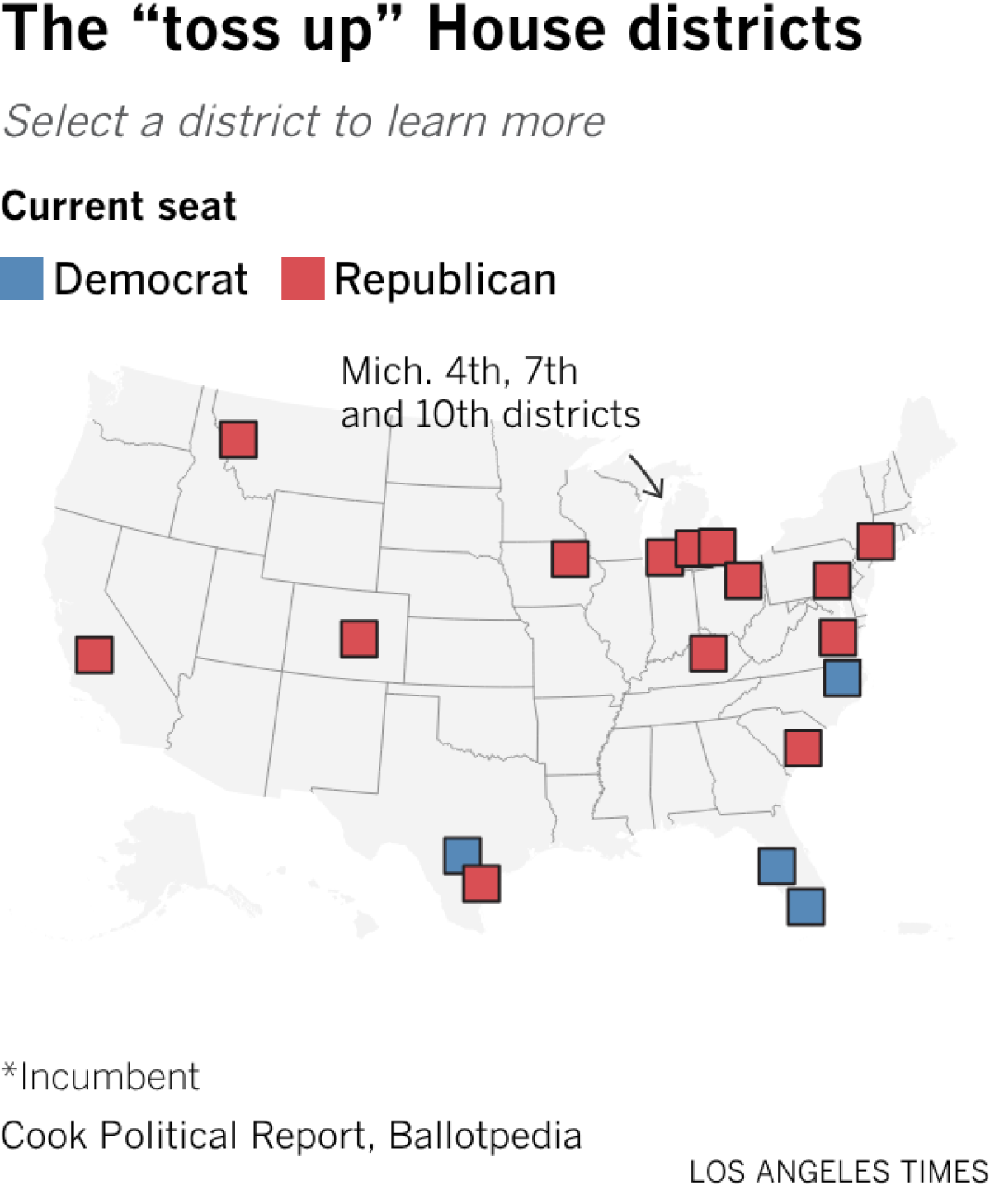
More than four dozen House races are competitive, including 18 that are considered tossups by election forecaster Cook Political Report. The additional 35 races are considered competitive but leaning towards one party. Whether additional, less competitive seats flip unexpectedly will be one indication of how much of a “wave” election this is.

Seven Senate seats are tossups: Alaska, Iowa, Kansas, Maine, Michigan, Ohio and Texas. Three more are potentially competitive: South Carolina, which leans Republican, and Minnesota and New Hampshire, which lean Democratic under Cook’s ratings.

North Carolina and Georgia, originally viewed as competitive seats, are now both seen by forecasters as fairly safe bets for Democrats.

The swing states could largely tip for Republicans or for Democrats, or the majority could come down to just a single race.

Experts say they’re watching a handful of races that could provide early indicators for how the night may go, though predictions are always dicey and outliers are possible. Among the races to keep an eye on:

  • Kentucky’s 6th: This Lexington-area U.S. House district has become an unexpected tossup, and with the nation’s earliest poll-closing time, it could be a bellwether. “If Democrats win that district, then it’s a Democratic tsunami,” said Christopher Warshaw, a Georgetown University public policy professor. “Even if it’s close, that would be pretty telling.”
  • Iowa’s 2nd: Forecasters have shifted this race to a tossup amid a difficult environment for state Republicans. If Republicans lose this seat — which belonged to Rep. Ashley Hinson, the party’s Senate nominee — it could signal a blue wave on the bigger side.
  • New York’s 17th: One of just three districts with a Republican incumbent that went blue in the 2024 presidential election, the outcome of this close race could “tell us a lot,” said Todd Belt, a George Washington University political science professor.
  • Texas’ 15th: This district offers a bellwether for Latino voters who moved right in 2024 but, signs indicate, may be shifting back to the left. The 34th and 35th districts in Texas could also be indicative.
  • Michigan Senate: If the Democrats lose Michigan, their path to Senate control becomes difficult. A win in Michigan is a best-case scenario for Republicans seeking to retain Senate control. Without Michigan, Democrats would have to flip five out of six swing seats in Alaska, Texas, Ohio, Iowa, Kansas and South Carolina.
  • Maine Senate: If Democrat Troy Jackson wins in Maine, that will likely be a good sign for his party’s chances at the Senate majority and their races in Michigan, Ohio and Iowa. Without it, Democrats could still take the majority, but Republicans’ path will become easier.
  • Other states: If Democrats pull off wins in purple or red districts in Florida, Virginia and Pennsylvania, those could also signal a blue-leaning night.
Source link

Israeli elections: What are the possible outcomes? | Explainer News

Israel is heading to the polls on October 27 in an election that could end Prime Minister Benjamin Netanyahu’s long grip on power.

The vote for all 120 seats in the Knesset is the first since the Hamas-led attacks of October 7, 2023, the onset of Israel’s subsequent genocidal war on Gaza and a wider conflict that has seen Israel carry out attacks in several countries across the region.

Recommended Stories

list of 3 itemsend of list

Opinion polls suggest his right-wing bloc is in a close race against a Jewish-led opposition alliance. But defeating Netanyahu at the ballot box does not necessarily mean removing him from power.

Israel’s proportional representation system means parties must negotiate alliances to secure a governing majority in the Knesset. No single party has ever won an outright majority of at least 61 seats.

According to recent polling, the opposition bloc is projected to win 52 seats, compared with 50 for Netanyahu’s religious-nationalist alliance. Palestinian-led parties could, therefore, determine who governs.

Here are eight possible outcomes:

Netanyahu forms another government

Despite slightly trailing in opinion polls, Netanyahu could remain prime minister if his Likud party assembles enough parliamentary support from existing allies or new coalition partners.

His traditional partners include far-right National Security Minister Itamar Ben-Gvir’s Jewish Power party and Finance Minister Bezalel Smotrich’s Religious Zionism party.

Ultra-Orthodox parties Shas and United Torah Judaism – which have previously joined his coalition multiple times but also walked away, most recently in 2025 – could also play an important role.

An opposition-led majority government

In late September, four opposition parties signed a non-aggression pact, agreeing to work together in a bid to unseat Netanyahu.

The rival movements – the Yashar party, the Democrats, the Yisrael Beytenu party and the Together alliance – said they are united in their goal to “preserve and strengthen Israel as a Jewish and democratic state”.

The bloc has not announced who would lead a future governing coalition, but former army chief Gadi Eisenkot, leader of the Yashar party, is seen as its most likely prime ministerial candidate.

Former Prime Minister Naftali Bennett, who heads the Together alliance with Yair Lapid, is another potential candidate.

A coalition involving Ra’am

The Joint List and Ra’am – the two Arab-led parties representing the Palestinian citizens of Israel, who make up about 20 percent of the population – are projected to win about 13 seats.

Ra’am, also known as the United Arab List, made history in 2021 by joining Bennett’s coalition, becoming the first Arab-led party to participate in an Israeli governing coalition.

Mansour Abbas, leader of Ra’am, has signalled a willingness to repeat that arrangement if the opposition-led alliance needs additional seats.

He has said his priorities include combatting the wave of violent crime that has been allowed to engulf Palestinian communities, as well as addressing discriminatory government policies, including on housing.

However, most opposition leaders, including Eisenkot, have ruled out such an alliance.

A minority government

If a coalition falls short of 61 seats, it could seek outside parliamentary support from other parties without including them in government, such as the Palestinian-led parties.

Joint List, which includes the Hadash, Ta’al and Balad factions, has said it could provide a so-called safety net to the anti-Netanyahu coalition by agreeing not to stand against it in a confidence vote, even if the alliance does not join the government. In return, it has said it would demand certain conditions, including a path to Palestinian statehood and fighting organised crime.

However, any such arrangement would leave the governing coalition vulnerable to defections and disputes over major policies.

A national unity government

A national unity government, according to Israel’s parliament, is a “government based on a broad coalition, the members of which also include representatives of rival parliamentary groups”.

This is usually formed at times of national emergencies, such as war, natural disasters or economic crises.

In May 2020, Netanyahu and Benny Gantz formed a unity government following three inconclusive elections. That agreement collapsed within a year.

However, in 2023, following the Hamas-led attacks on Israel, Gantz and members of his party joined Netanyahu’s coalition – seen as an emergency unity government – despite Gantz previously bitterly opposing it.

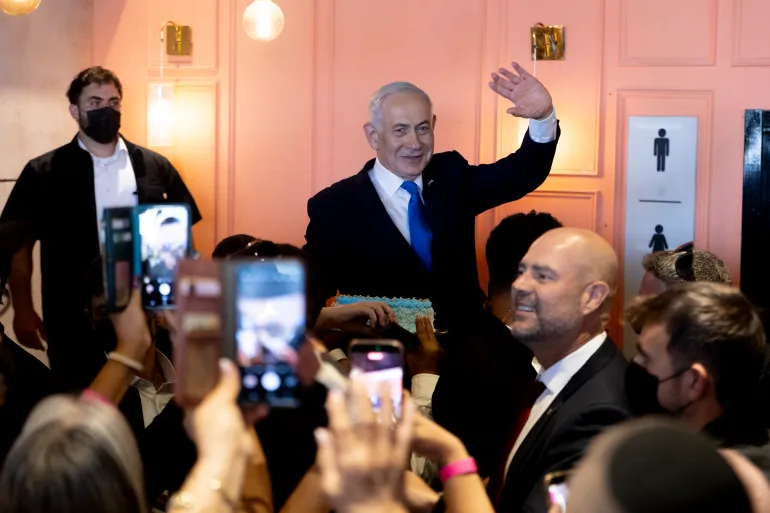
DIMONA, ISRAEL - OCTOBER 21: Israeli Prime Minister and Likud Party leader, Benjamin Netanyahu, greets supporters during an election campaign event ahead of Israel's general elections scheduled for next week on October 21, 2026 in Dimona, Israel. Israel will hold legislative elections on October 27, 2026. (Photo by Amir Levy/Getty Images)
Israeli Prime Minister and Likud Party leader, Benjamin Netanyahu, greets supporters during an election campaign [File: Amir Levy/Getty Images]

A rotating premiership

Two political leaders could agree to alternate as prime minister under a power-sharing arrangement.

Netanyahu and Gantz agreed to such a rotation in 2020, but their coalition collapsed before Gantz could take over.

Bennett and Lapid made the same arrangement for the prime minister’s office to change hands after the former came into power in June 2021. After Bennett’s coalition lost its parliamentary majority in June 2022, Lapid took over as caretaker prime minister in July that year.

A different prime minister from the same political camp

In Israel, the prime minister is voted in by members of the Knesset after an election.

If negotiations stall over forming a government, parties could agree to support another Knesset member from Netanyahu’s political camp or that of an opposition bloc, someone who is more acceptable to future partners.

No agreement – another election

If no leader can assemble sufficient support in the Knesset, Israel could face another period of political turbulence and head for a new election.

The country held five elections between 2019 and 2022 as rival blocs repeatedly struggled to form stable governments.

In such a scenario, Netanyahu would remain caretaker prime minister until a new administration took office.

Source link