On Friday morning, with a power outage at Simi Valley High in effect out of concern that power lines could ignite a wildfire to erupt because of strong Santa Ana winds, Simi Valley football coach Jim Benkert was frantically checking locations available to help keep on schedule a homecoming game against Newbury Park on Friday night.
But with Ventura County facing increased outages, the Simi Valley home game has been moved to Saturday at 3:30 p.m. Another change involves St. Bonaventure hosting Oaks Christian at 1 p.m. on Saturday.
Southern California Edison warned about possible shutoff of electricity because of the wind. Simi Valley students remained in classes on Friday because the school has emergency generators.
Westlake coach Rick Clausen said his team’s game at Ventura High remains on because the school has generators if power is cut off.
The Valencia-Canyon game has been moved to 4 p.m. at Canyon High on Friday due to possible power outages.
Aden, Yemen – In this coastal city long accustomed to sweltering, humid summers, the absence of electricity can reshape an entire day.
When the power cuts out, fans and air conditioners fall silent. Sleep becomes difficult. Students race to finish their homework before darkness arrives. Children spill onto the streets while young men drift towards the sea in search of moving air and cooler waters.
Inside hospitals, where treatment cannot be postponed until the lights come back on, electricity carries a different weight altogether.
Yemen’s power crisis predates the current war. Even before the conflict, only about 55 percent of the population had access to electricity from all sources, which is among the lowest rates in the Middle East and North Africa.
Since 2015, damage to infrastructure, fuel shortages and ageing generation and distribution systems have left supplies even more fragile.
In Aden, power stations continue to face repeated shutdowns, leaving residents without electricity for long periods. Insurance premium increases on tankers carrying fuel to Aden have also reportedly made the crisis worse.
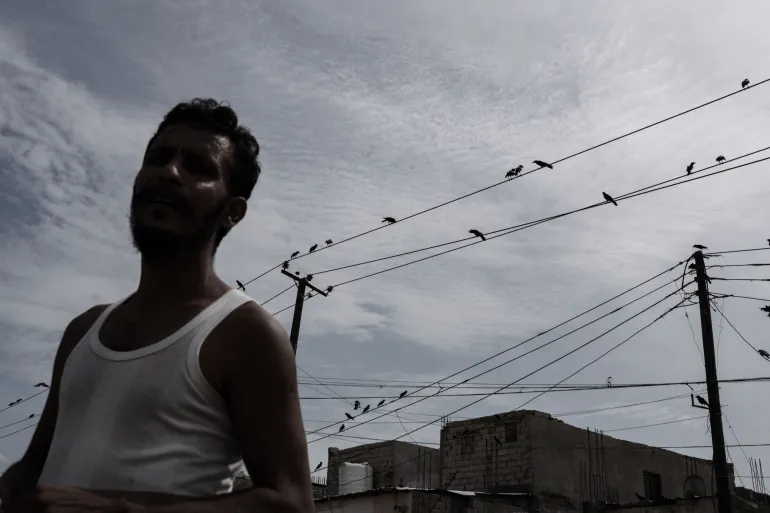
A man walks beneath a web of power lines in a neighbourhood in Aden, where long and frequent power cuts have become part of daily life. [Belal Khaled/Al Jazeera]
An assessment by the International Monetary Fund (IMF) published this year said Aden was receiving just two to six hours of electricity a day as structural weaknesses and fuel shortages caused frequent outages.
As the sun sets over the city, a second part of the day begins. Homes and businesses slip into darkness, punctuated only by small lights powered by batteries and solar systems. Residents often do not know how long the latest blackout will last, or how long the power will stay on once it comes back.
During the summer, when temperatures in Aden climb towards 40 degrees Celsius (104 degrees Fahrenheit), the consequences are hard to escape. Residents in the city interviewed in the middle of the year said their homes had become almost unbearable during the prolonged power cuts that plague the city. The heat does not always disappear when the sun goes down.
After the sun sets in Aden, most of the city falls into darkness with only scattered lights coming from devices powered by batteries or alternative energy systems. [Belal Khaled/Al Jazeera]
“Sometimes the power comes back while we are asleep, so we wake up to use it. Our lives have become tied to when electricity comes and goes,” one resident said. For her family, an outage is measured not just in hours but in problems. Children are unable to sleep, food spoils in warm refrigerators and housework must wait.
When the heat inside becomes too much, Youssef heads for the coast. The sea, he said, is no longer just a place of recreation but a refuge from the unbearable heat of the city.
“When the electricity is off for hours, it is very difficult to stay inside,” he said. “There is no fan and no air conditioning, and the humidity makes the heat worse, so we come to the sea.”
Towards the end of the day, young men and families gather along the waterfront. Some swim. Others simply sit beside the water and wait for the city to cool. But the sea cannot solve Aden’s electricity crisis. Hours later, Youssef returns home and sometimes finds the house exactly as he left it.
“Sometimes we get back and the power is still out, and we start waiting all over again,” he said.
For children like Mohammed, Saeed and Abdullah, blackouts have changed where childhood takes place. When their homes become too hot, they move into the street, running between houses or sitting with other children until late.
A child walks through a neighbourhood in Aden, where a generation has grown up knowing electricity as something that comes and goes rather than being a constant part of daily life. [Belal Khaled/Al Jazeera]
“It gets hot inside the house, so we come down and play in the street,” one of the boys said. “We play football or sit with our friends. Outside is better when the electricity is off.”
For them, a blackout is not an extraordinary event. It is part of the life they have grown up with.
The effects follow them into the classroom. In Aden, the United Nations Development Programme documented more than 7,000 students and teachers struggling in dark, stifling classrooms during power cuts. The installation of solar systems at eight schools and an education office has helped. One teacher reported that some students had fainted due to the heat.
At home, preparing for exams can depend on a rechargeable lamp or a small solar system if they have one.
In hospitals, there is no option but to simply wait out the darkness. Operating theatres, intensive care units, laboratories, medical refrigerators and dialysis machines all depend on continuous power.
The World Health Organization (WHO) says recurring power cuts disrupt lifesaving health services across Yemen, forcing facilities to rely on combinations of grid electricity, generators and solar systems.
In 2025, the WHO supplied about 4.33 million litres (1.14 million gallons) of fuel to 177 health facilities across the country to keep generators and essential equipment running.
An incubator inside a hospital in Aden. At health facilities, power cuts disrupt operating rooms, intensive care units, incubators, laboratories and vital equipment that depend on continuous electricity. [Belal Khaled/Al Jazeera]
Zeina Ahmed, a kidney patient, watches tubes carry her blood to a dialysis machine.
“For people at home, a power cut means heat and darkness. For us here, the first thing we think about is whether we will be able to have our dialysis or not,” she said.
“I come to the hospital knowing that I need this session. If it is delayed, I keep thinking about when I will get it and whether the machines will continue to work.”
After years of unreliable grid supply, solar panels, batteries and generators have become familiar parts of Yemen’s landscape.
They sit on rooftops, providing power to the homes, businesses and schools that can afford them.
More than half of Yemen’s homes now rely on solar power in some form, according to the WHO, while hospitals and other health facilities are increasingly adopting solar systems to keep essential services running.
Families who can afford to buy larger panels and batteries can power more appliances. Others might have just enough electricity for a light, a fan or a phone charger – a fragile shield against the dark and the heat.
The nor’easter causes another round of flooding in low-lying areas in New Jersey and New York City and knocks out power to tens of thousands of homes into New England.
Published On 27 Sep 202627 Sep 2026
A powerful storm is pummelling the shoreline in the northeastern United States for a second day, causing another round of flooding in low-lying areas and knocking out power to tens of thousands of homes.
Tidal surges swamped low-lying neighbourhoods in New Jersey on Sunday, while wind gusts toppled trees on New York’s Long Island, damaging homes and bringing down utility poles.
Recommended Stories
list of 3 itemsend of list
In New York City, streets in the Howard Beach neighbourhood of Queens were inundated.
The slow-moving storm, which killed a New York City housing authority worker when a tree fell on Saturday, was expected to linger through Sunday, with heavy rain, strong winds and dangerous surf all the way to New England.
Extreme amounts of rain – more than 10cm (4 inches) since Friday in some spots in New Jersey – combined with a surging ocean led to flooding amounts not seen for close to a decade in places used to dealing with high water, residents said.
The storm, known as a nor’easter, triggered memories of Hurricane Sandy, which left behind more than $60bn in damage across the eastern US in 2012. While this storm’s impact has been nowhere near that, it could be the first of several along the East Coast this fall because of an El Nino climate pattern disrupting this year’s weather.
Images of waves crashing into sea walls and onto beaches raised concerns about coastal erosion.
More than 100,000 customers were without power across the Northeast and mid-Atlantic at times on Sunday, according to PowerOutage.us. The most widespread outages were in counties along the coast from New Jersey to Connecticut.
Numerous flights were cancelled or delayed up and down the coast. More than 250 flights had been cancelled at Boston Logan International airport by late Sunday morning as wind gusts reached 64km/hour (40 mph), according to the Massachusetts Port Authority.
The worst of the remaining rainfall was expected on Sunday from northern New Jersey into southern New England.
While the storm was gradually weakening, tidal flooding would stay through high-tide cycles Sunday night, said Bob Oravec, a lead forecaster with the National Weather Service in College Park, Maryland.
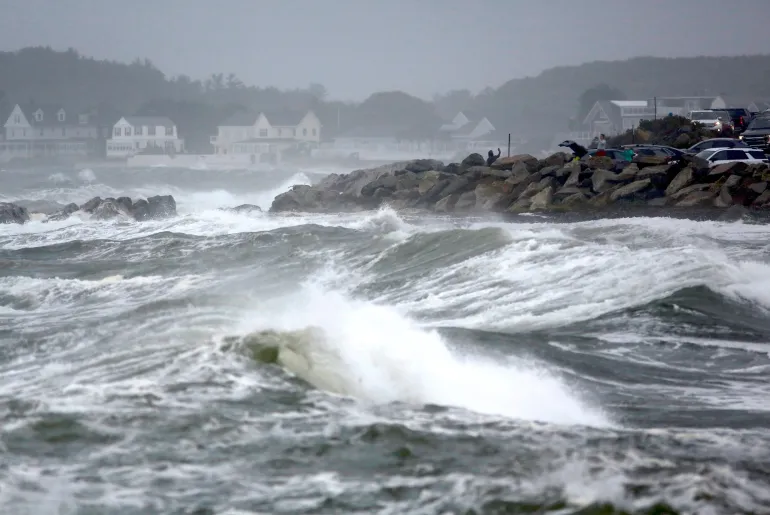
People watch the ocean as a nor’easter storm hits Rye, New Hampshire, US, on September 27, 2026 [Caleb Jones/AP Photo]
Authorities warn residents that extreme conditions could pose risks and urge people to stay away from flooded areas.
Published On 26 Sep 202626 Sep 2026
Residents of the northeastern United States are facing a powerful storm known as a nor’easter that has knocked out power and caused flooding across the region.
The storm has led to the cancellation of more than 400 flights and power outages affecting more than 88,000 homes and businesses as of Saturday afternoon local time. That figure is down from a high of 119,000 earlier in the day.
Recommended Stories
list of 3 itemsend of list
Bob Oravec, lead forecaster with the National Weather Service in College Park, Maryland, said that the storm is likely to persist, with “a lot of high winds, a lot of high tides and heavy rain possibility over the next few days for the northeastern US”.
The governors of New York and New Jersey declared states of emergency in counties expected to see the worst of the storm, including New York City, on Friday.
Large puddles and debris line a walkway in the Dumbo neighbourhood in Brooklyn as a nor’easter moves through the area on September 26, 2026 in New York [Spencer Platt/Getty Images via AFP]
Authorities have also warned residents about the risks of flooding and high tides, cautioning people to stay away from the beach and areas inundated with water.
“Anyone who goes in or near the water this weekend is literally gambling with their life,” New York Governor Kathy Hochul said.
Despite the warnings, people have been seen kayaking down flooded streets in Long Island, New York, while others took advantage of large swells in Hampton, New Hampshire.
“In all the canals, the water is up really high and coming into people’s back yards,” Jay Boyd, a resident of Ocean City, Maryland, told The Associated Press news agency.
Oravec said that nor’easters are not unusual as the region of New England enters the autumn season, but that “this might be a little earlier than average for a big storm”.
A surfer catches a wave as a nor’easter batters the US northeast coast, in Rockaway, New Jersey, on September 26, 2026 [Caitlin Ochs/Reuters]
About 425 flights have been cancelled and 1,338 delayed so far on Saturday, according to data from the flight tracker FlightAware.
Concerts and sporting events have also been cancelled, including musician Ed Sheeran’s scheduled shows in the state of Massachusetts on Friday and Saturday.



![People watch the ocean as a nor'easter storm hits Rye, New Hampshire, US on Sunday, September 27, 2026 [Caleb Jones/AP Photo]](https://i0.wp.com/occasionaldigest.com/wp-content/uploads/2026/09/AP26270677753401-1790545375.jpg?w=640&ssl=1)