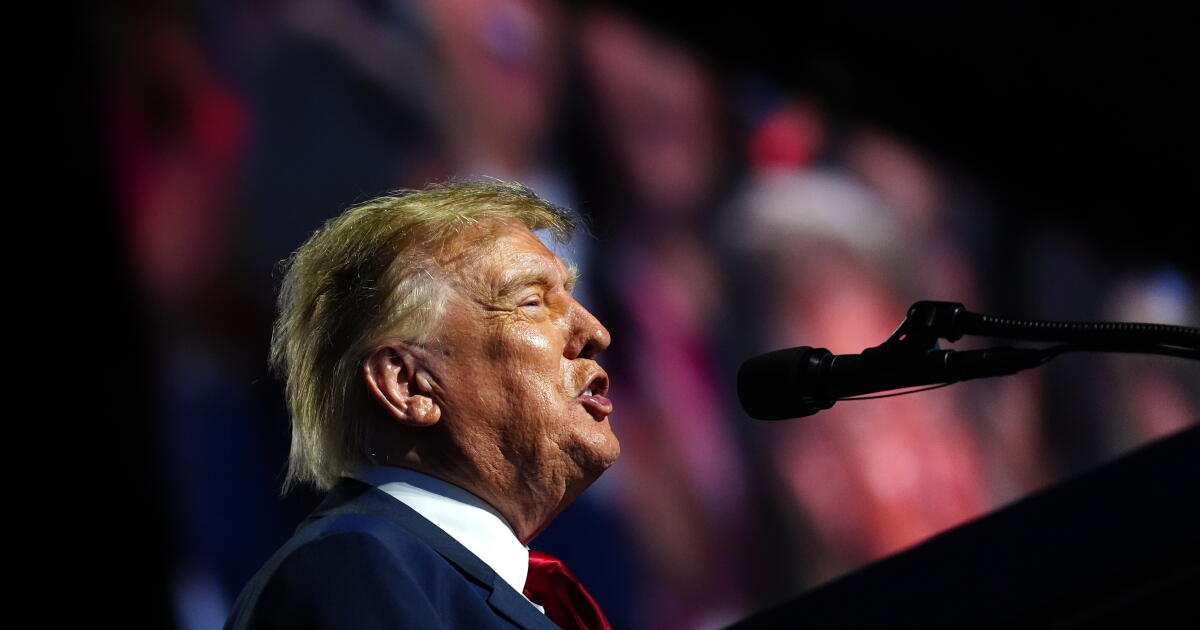
At first glance, it looks like a typical Republican campaign advertisement. As images of President Trump flash across the screen, the 30-second spot says, “America will never be a communist country” and boasts about the “largest tax cuts in history.”
But there’s something different near the end — a bit of text at the bottom that says “paid for by the U.S. government.”
According to AdImpact, which tracks media spending, the advertisement cost $14,000 and it ran during conservative shows on Fox News and Newsmax.
The White House said in a statement the ad is “educational and unapologetically patriotic.”
“These public service announcements are about reminding Americans to love their country and understand what makes it worth defending, at home, at our borders, and abroad,” the White House statement said.
Fox News and Newsmax did not immediately return a request for comment.
The White House did not say what agency paid for the spot, which includes background music with singers crooning “love me” over and over.
The advertisement does not say who voters should support in the midterms, but it meshes with campaign messaging from Trump and other Republicans, particularly during the party’s unusual convention in Dallas earlier this month.
Democratic Rep. Jamie Raskin of Maryland, who is in line to chair the House Judiciary Committee if his party wins the majority in November, said in a social media post that it’s a violation of the Hatch Act for government employees to work on such a video.
“It is blatantly unethical under numerous federal ethics provisions proscribing the use of government resources for political campaigns,” Raskin wrote.
Republicans also criticized the ad.
North Carolina Sen. Thom Tillis, who is not running for reelection, referenced the former right-wing Hungarian prime minister to critique the advertisement.
“It’s inappropriate. It’s not like they need a GoFundMe page to have the dollars to do that sort of ad and they could do it. But using taxpayer dollars, it feels like Viktor Orban,” he said.
Louisiana Republican Sen. John Kennedy said he hadn’t seen the ad but questioned whether it was legal.
“I don’t generally like to see politicians use public money to pay for their own campaign ads,” he said.
Catalini writes for the Associated Press. AP writers Joey Cappelletti and Steven Sloan in Washington contributed to this report.
YOUNGSTOWN, Ohio — In the wood-paneled basement of a union hall, retirees sat in folding chairs last week as they recalled how miles of steel mills and plentiful jobs had slowly disappeared.
“We told our children to get your education, get out, and don’t come back,” said Al Antonelli, who has been a member of Ohio Laborers’ International Union of North America Local 125 for nearly 50 years. “Because there’s no future here, especially blue collar.”
Versions of Youngstown’s story played out across the industrial Midwest, where disappearing jobs and frustration in longtime Democratic strongholds helped fuel Donald Trump’s political rise. When Trump visited as president in 2017, he promised the jobs that had left Ohio were “all coming back.”
“Don’t sell your house,” one of the retirees recalled Trump saying during his Youngstown visit.
Nearly a decade later, the old industrial economy Trump promised to revive has not returned, and Democrats hope the political tide is shifting again. Two years after Democrat Sherrod Brown lost his Senate seat, he’s attempting a comeback by trying to win back some of the same voters who turned on his party. Brown wants to harness dissatisfaction with the economy, the war in Iran and the expansion of artificial intelligence data centers to dislodge Republican Sen. Jon Husted in November.
Brown’s chances of returning to Washington depend largely on whether he can win again in parts of the state that have spent years drifting away from Democrats. His race is also part of a much broader challenge for Democrats, who need to make inroads in Republican-leaning states like Ohio, Iowa, Alaska and Texas if they are to win control of the chamber in November.
Brown outlasted Democrats’ decline in Ohio — until he couldn’t
For years, Brown was able to outrun the Democratic Party’s decline in Ohio. His pro-labor populism resonated with enough swing voters to deliver decades of victories from the statehouse to Congress.
Trump carried Ohio by 8 points in 2016, four years after Barack Obama won it. Yet Brown won his third term in the Senate two years later, in part by continuing to perform well in places like Mahoning County, anchored by Youngstown.
By 2024, even Brown could no longer hold on, losing his reelection campaign to Republican Bernie Moreno by 3.5 percentage points.
Trump carried Mahoning by more than 10,000 votes, a remarkable reversal in a previously loyal Democratic county that Obama had won by nearly 30 percentage points just 12 years earlier. With Trump’s endorsement, Moreno won the county by just 220 votes.
The transformation extends across the Mahoning Valley. Neighboring Trumbull County went from backing Obama by 23 points in 2012 to Trump by nearly 17 points in 2024.
“The Mahoning Valley has struggled with deindustrialization, job loss for years, and the politicians in power have seemed to understand that, but it doesn’t seem like they were doing enough about that,” said Cryshanna Jackson Leftwich, a politics professor at Youngstown State University. “So at some point, 20, 30 years of supporting the candidates, people are gonna say, well, look, this has never worked for us, right?”
Trump and other Republicans offered voters something different, Leftwich said.
“Did they keep their promises? Not at all. Is the county still poor? Absolutely,” she said. “But they at least said they were going to do something different.”
Brown faces a much different environment this year
Democrats’ bid to flip the Senate requires them to net four seats, including by competing deep in Republican territory.
Two months from the end of midterm campaigns, high gas prices stemming from the war in Iran have compounded discontent with the economy.
Trump has also escalated a trade war with neighboring Canada, a fight with particular implications for Ohio. The state exported $17.5 billion in goods to Canada in 2025, or nearly a third of the state’s total exports, according to federal statistics.
Tension from the economic strain is visible in Parma, a working-class Cleveland suburb that split its ticket in 2024, backing both Trump and Brown. At a watch party for the Republican midterm convention in Dallas, supporters who stayed late into the evening cheered Trump but acknowledged that other issues would most likely determine the midterms.
“The real thing that’ll move the needle is going to be economics. Gas prices, grocery prices,” said Parma City Councilor Kevin Kussmaul. “That’s really what’s going to help.”
Parma Republican Party President Doris Peters said similarly that “everyone’s concerned about the high gas prices.”
“It’s all about the economy,” she added. “People remember how much money’s in their wallet and how much is not in their wallet.”
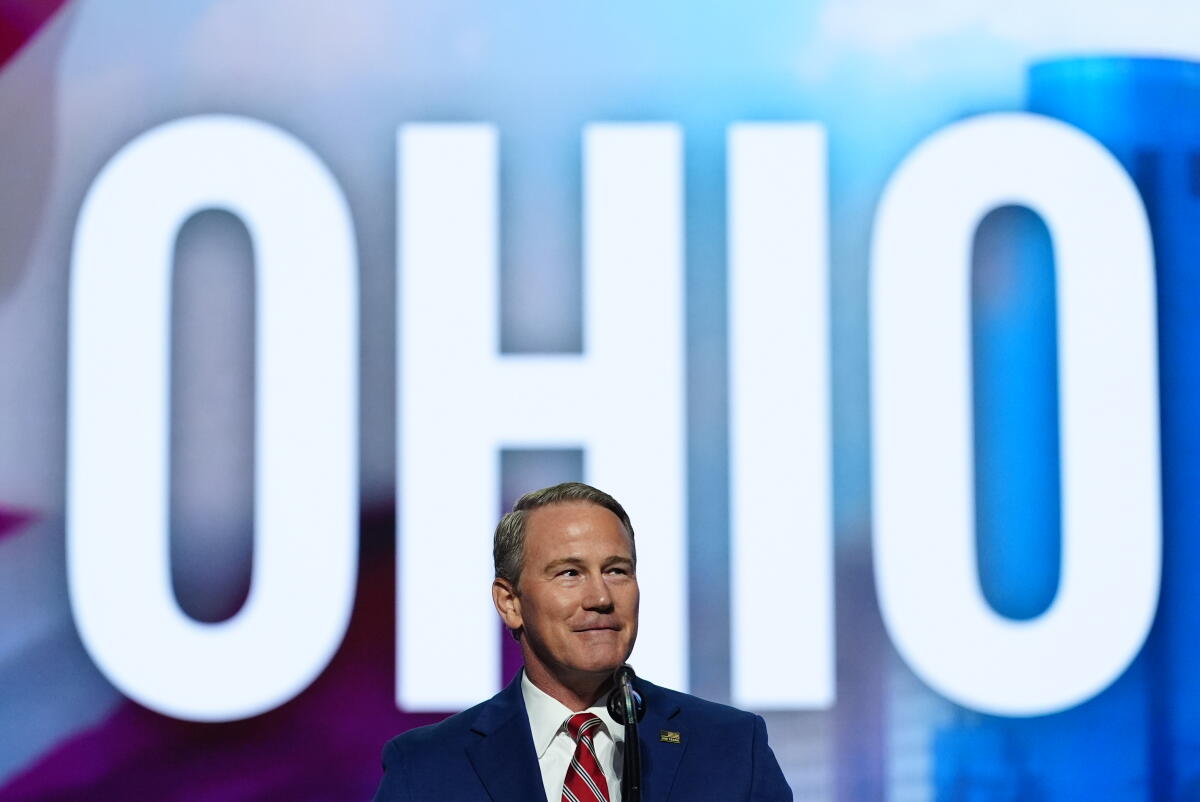
Sen. Jon Husted (R-Ohio) speaks at the Republican convention in Dallas.
(Julia Demaree Nikhinson / Ap Photo/julia Demaree Nikhinson)
The limits of a Democratic rebound in Ohio
Husted presents a different opponent than the one Brown faced two years ago. His restrained demeanor contrasts with Moreno, the brash former car dealer who entered politics as an outsider. Husted spent nearly 25 years in Ohio politics, as a state lawmaker, House speaker, secretary of state and lieutenant governor, before being tapped to fill Vance’s Senate seat.
But Husted may not need to generate much enthusiasm of his own. Except for Brown and candidates for the Ohio Supreme Court, a Democrat hasn’t won a statewide race for state office in Ohio since 2008.
Adam Radogna, 37, who hosted the watch party Wednesday for Parma Republicans at his Italian restaurant, has attended more than 80 Trump rallies and remains an ardent Trump supporter. But Husted is not someone he’s followed closely.
“I don’t know him at all,” Radogna said of Husted. “But I mean, I will vote for him.”
Brown faces enthusiasm problems of his own as he asks voters to return to a 73-year-old former senator whom they rejected just two years ago.
Ellen Zban, 67, a longtime Youngstown resident who said she leans Democratic but has voted for Republicans, said she won’t support Husted because she doesn’t believe he has listened enough to the community.
“I really don’t think he’s done anything for us,” she said. “We never hear from him.”
But Brown isn’t necessarily the candidate she wishes Democrats were offering either.
“He’s my best option,” Zban said. “But I’d like to see younger people running.”
The race is being flooded with money as both sides try to drum up enthusiasm and define the choice for voters. Husted and allied Republican groups have already spent more than $80 million with $86 million more reserved through Election Day, according to AdImpact. Brown and Democratic groups have spent $69 million, with $67 million reserved.
Elon Musk has also waded into the race through his America PAC, which is running online and streaming ads attacking Brown over transgender issues.
“Billionaires are lying to try and bail out their ‘Golden Boy’ because Jon Husted has always put special interests ahead of Ohio,” Brown’s campaign manager, Patrick Eisenhauer, said in a statement.
Brown has attempted to make data centers central to the race, an issue that has seen bipartisan outrage in communities across the country. Brown’s allies have called Husted the face of Ohio’s data center boom, blaming the massive facilities for contributing to rising electricity costs. Husted helped promote Ohio as a destination for data centers while serving as lieutenant governor.
The ads and backlash have generated enough concern among Republicans that an internal party memo described data centers as an “anchor” around Husted in the race.
“Thirty-two years in Washington turned Sherrod Brown into a liar,” Amy Natoce, a spokesperson for Husted, said in a statement. “Jon Husted is fighting to lower costs and help Ohioans keep more of what they earn. Sen. Husted introduced legislation requiring data center companies to pay for the power they use and return excess electricity to the grid.”
The state’s politics could shift again
In Youngstown, the union retirees who watched the Mahoning Valley shift toward Republicans aren’t convinced the movement is permanent.
Rich Troisi, business manager of Laborers’ Local 127, said Republican candidates in recent elections could win support in the area largely by aligning themselves with Trump. This year, he said, that dynamic may not hold.
“I don’t think Donald Trump’s endorsement is going to be what it was,” he said.
Antonelli, the longtime union worker, pointed to independent voters, who he said tend to move with their economic circumstances.
“My dad used to say, it depends on how tight your shoes are. Tight meaning, how’s the money?” he said. “Right now, the shoes are pretty tight, no matter who you are.”
Cappelletti writes for the Associated Press. AP reporter Julie Carr Smyth contributed to this report from Columbus, Ohio.
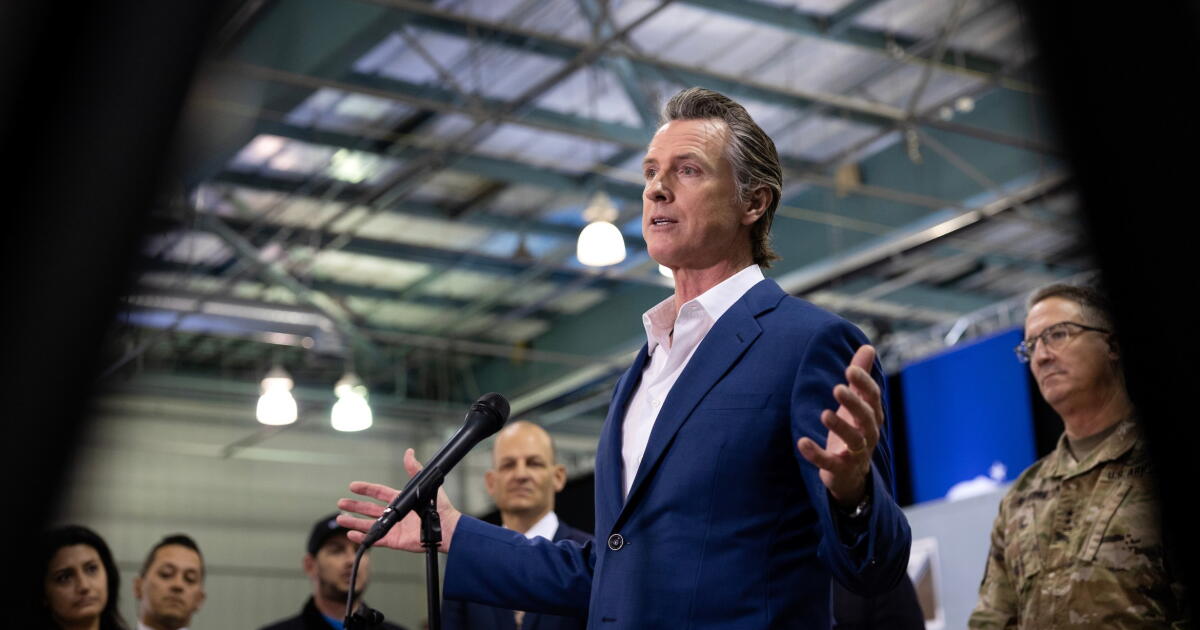
Within a few short months, he will be termed out of office and return to being a regular citizen, if not an average one. Newsom’s presidential ambitions are stronger than ever, and there’s virtually no list of Democratic hopefuls that doesn’t include his name near the top.
But 2028 is a long way away, about a millennium in political time. Newsom has a tough road ahead to not just stay relevant, but also to forge a difficult path between keeping a national profile as a Trump-attacking defender of democracy and not getting pummeled (or worse, ignored) when he loses the safety and power of his elected office.
Our columnists Anita Chabria and Mark Z. Barabak take a look at what the next few months, and the next year, may have in store after the governor becomes simply Mr. Newsom.
Chabria: Newsom is making the most of his last leg in office. Recently, he went on an election jaunt through the South, visiting the Carolinas and Alabama to help campaign and raise money in those states.
It is not his first out-of-state trip to lend a hand in campaigns, but likely one of his last as governor. He wouldn’t be the first elected official to have a gap year (or years) before being elected to the Oval Office — Ronald Reagan had more than five years off between being governor of California and winning the presidency — but it’s definitely a disadvantage.
How much do you think being out of office hurts Newsom?
Barabak: Loyal readers of this column — thanks, we appreciate both of you! — know I’ve long looked askance at our gallivanting governor and his extracurricular, eyes-on-2028 activities. I understand that preening and politicking is way more fun and ego-enhancing than the minutiae of government in Sacramento. At the same time, I’m old-fashioned enough to think a person should do the job taxpayers are paying them to do.
But, as you note, that will be a moot point soon enough.
I’m not certain being out of office will be all that great a hindrance. In fact, I think it offers advantages, the main one being Newsom’s freedom to devote his full time and energies to running for president.
You mention Reagan; I don’t think it’s an accident he made two failed tries for the White House while serving in Sacramento. Pete Wilson also attempted the leap from the state Capitol to Washington, and failed badly.
It’s tough to do both.
As Dan Schnur, a former Wilson strategist, once put it, “There aren’t any direct flights from Sacramento to Manchester” — New Hampshire traditionally being home to the first primary — “and you can’t run the state from a cellphone at O’Hare” airport.
In a recent PBS interview, though, Newsom didn’t disavow some democratic socialist ideas, such as Medicare for all, pointing out that California has long had a powerful progressive faction and many of the ideas considered radical for the right are run of the mill here — and potentially popular across the country.
Newsom seems to be embracing some of those lefty stances, especially ones about affordability and opportunity. While affordability is going to be everyone’s platform, pairing it with big-swing policy like universal health insurance might appeal to voters tired of words without action.
We agree that no fellow Democrat is going to cede the $7-a-pound affordability argument to Newsom. But to offer some differentiation, many will doubtless portray him as being a bit too out there, especially when they start making the electability argument.
And that’s not to mention what awaits him if Newsom were to emerge as the Democratic nominee. (Fun fact: In 1988, it was a Democratic primary opponent, Al Gore, who first criticized Michael Dukakis over Massachusetts’ prison-furlough program. Republicans then seized upon the issue and used it as a bludgeon, to Dukakis’ great detriment, in the fall campaign.)
In a way, it’s interesting we’re even having this discussion about whether Newsom is too far left. There are parts of his record — his chummy ties to Silicon Valley, his light regulatory stance toward data centers, his making nice with the likes of Charlie Kirk and Steve Bannon, that make some Democrats question whether he’s too far right.
Chabria: It’s true that Newsom is more centrist than progressive, and equally true that most of America misses that point.
I think there is a version of the next election, though, where the Democratic Party has its own Tea Party moment, when a populist faction wanting social change carries power.
Everything we know about elections and electability really is up for grabs in this new age of technology and billionaire influence, and the vein of frustration within the rank-and-file of the Democratic Party is only growing stronger because of it. If Republicans do lose out in the midterms — and I am not convinced they will — it changes the calculation on everything, including how far left the average independent voter may swing in the face of an economically crushing oligarchy.
We need to safeguard elections, otherwise candidates don’t matter.
Barabak: We 100% agree on that. Candidates, and the campaigns they wage, matter only if elections are free and fairly conducted and all sides —looking at you, President Trump — acknowledge and abide by the outcome.
But midterm results are notoriously unreliable barometers of the presidential election that follows. To give just a few examples, Republicans walloped Democrats in the 1994 and 2010 midterm elections and yet Presidents Bill Clinton and Barack Obama each won reelection just two years later. In 2022, Democrats fared surprisingly well in the midterm election, and in 2024, well … you know what happened.
Chabria: I don’t think America has a past political moment that can be compared to this one. By nearly every independent measure, the United States is closer to an autocracy than we’ve ever been. We’ve lost the respect and trust of our allies, and a political party that has the support of only about 30% of citizens is reshaping our social and civic life under white nationalist principles.
We are in a high-stakes moment, and the next election won’t be a decision between Democrats and Republicans, but between democracy and something else. The sad truth is that in 2024, more Americans did not vote at all than voted for Trump. About 64% of eligible voters cast a ballot, and Trump received only 49.8% of those votes.
The next Democratic nominee can come with whatever message they want, but if Democrats don’t vote, their candidates don’t win. So for Newsom, or whoever the nominee is, the first victory may be the nomination — but the real test will be turning out the vote.
Barabak: It’s a long way — about a millennium, as you said — from here to November 2028. I agree, though, on the importance of not sitting out this or any election, for that matter. I recollect a button I once saw in a shop on Elm Street, the main drag through, yes, downtown Manchester! It read: “Didn’t vote? Don’t bitch.”