Law firm Eversheds Sutherland, which carried out the independent investigation, said there were “high levels of stress and concern” within NESO’s Electricity National Control Centre over the “current state of the energy industry generally” and the longer-term ability to keep it balanced.
It said this was, according to evidence gathered from staff, due to the fact that traditional methods of electricity generation such as gas were “easier to manage”, compared to renewables, which were “less flexible”, and were making the job of ensuring supply meets demand “more difficult”.
The probe also found there to be a “significant disconnect” between those working in the control room and NESO’s leadership.
Multiple witnesses expressed the view that those in senior leadership and executive positions “do not fully appreciate or understand either the way in which the control room works, or the reality of the pressures faced by those on the frontline who are responsible for ‘keeping the lights on'”, Eversheds’ report said.
The investigation was prompted after Conservative shadow energy secretary Clare Coutinho said in July she had been contacted by a whistle-blower alleging that NESO had been “hiding information about how securely our grid is being run”.
One of the claims was that control room staff were encouraged to conceal or alter records to avoid leaving a paper trail linked to efforts to stabilise the grid during a period of extreme heat in June.
This was done in order for NESO, which is owned by the government, to avoid public scrutiny or reputational damage, according to the allegation.
Eversheds said its investigation did not substantiate any of the allegations from whistle-blowers but did identify “cultural, governance and control issues” that it said were “significant findings in their own right”.
Fintan Slye, chief executive of NESO, said the investigation identified “areas where we could improve how colleagues can raise concerns and how we respond to them”.
“I want all colleagues at NESO to feel heard. We will act on the recommendations, working closely with our trade unions, and be open with colleagues about the progress we make,” he added.
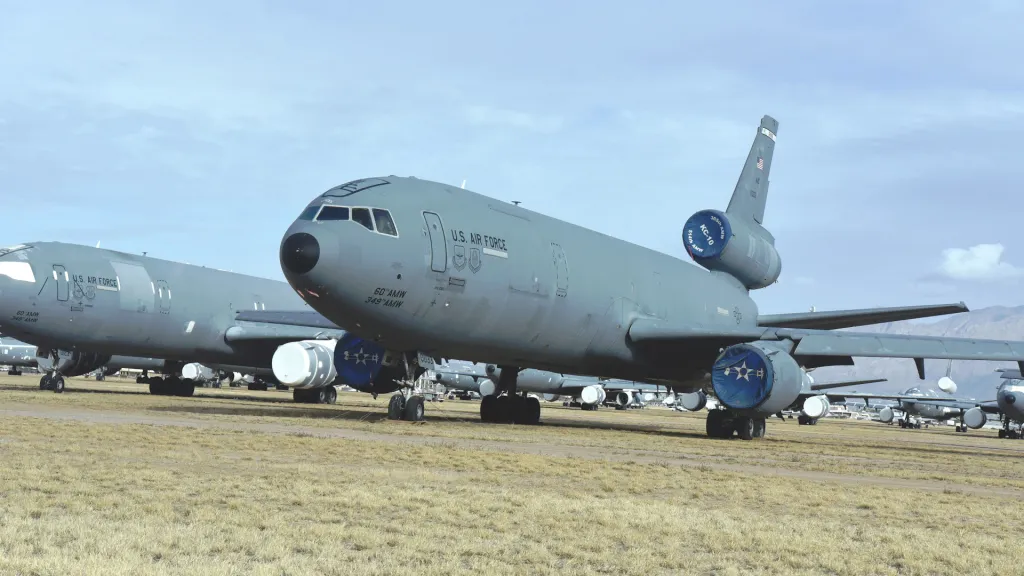
Just over two years after the U.S. Air Force retired the last of its KC-10A Extender aerial refueling tankers, four of those aircraft may be bound for a new career in North Africa for a mysterious end user.
The Air Force Life Cycle Management Center (AFLCMC) put out a contracting notice yesterday “solely for information and planning purposes” with the express intent “to identify potential industry sources that possess the capability, expertise, and facilities to execute the regeneration, one-time flight clearance, depot-level return to service, worldwide ferry delivery, in-country Contractor Logistics Support (CLS), and operational/maintenance training for up to four (4) KC-10 Extender aircraft.”
The KC-10s could be “transferred via Excess Defense Articles (EDA) to a partner nation in North Africa,” the notice adds, without naming the country in question.
Retired KC-10 tankers seen at the boneyard at Davis-Monthan Air Force Base in Arizona in 2025. US Military
The Air Force operated KC-10s between 1981 and 2024. TWZ has reached out to the U.S. Air Force, as well as the U.S. State Department, for more information. The State Department directed us to contact the Pentagon.
The EDA program allows for materiel deemed extraneous to U.S. military needs to be transferred to allies and partners either at a reduced cost or as a grant. The foreign nation in question has to pay for those assets to be delivered, as well as refurbishment, if applicable.
It is important to note here that the Extender, as designed, is capable of refueling receivers using either the boom or the probe-and-drogue method. Tankers equipped for the probe-and-drogue method are, by far, more common internationally. We will come back to this later on.
A KC-10 seen refueling F-16 fighters via the boom. USAFA KC-10 refuels a US Navy F/A-18 Hornet via the probe-and-drogue method. USN
While we don’t know what the North African country might be in line now to receive the quartet of KC-10s, Egypt and Morocco would seem to be the most likely candidates based on their current and planned aircraft inventories. They are also both major U.S. allies.
The Egyptian Air Force currently does not operate any dedicated aerial refueling tankers. The country is in the process of acquiring two new C-130J-30 Hercules aircraft for use as airlifters, as well as tankers, using the probe-and-drogue method. It does already fly C-130s, but none explicitly configured for aerial refueling duties. Egypt also has a very diverse array of fighters that includes U.S.-made F-16 Vipers that can only be refueled in mid-air via boom.
A US Air Force KC-10 refuels an Egyptian F-16 during an exercise in 2023. USAF/Staff Sgt. Emily Farnsworth
A Moroccan F-16 seen linking up with a US Air Force KC-135 tanker during an exercise. USAF
As mentioned, the KC-10 was designed to connect with receivers via probe-and-drogue, as well as boom, and could be used to refuel other tactical jets in Egyptian or Moroccan service. As an aside, fighters belonging to both regularly receive foreign tanker support during exercises, as already seen earlier in this story. Just last month, Chinese YY-20 tankers (also sometimes referred to as Y-20Us) notably did just this in an exercise in Egypt.
Footage released by Egypt’s official authorities from the “Eagles of Civilization 2026” joint air exercise shows Egyptian **MiG-29M/M2s and Rafale fighters receiving aerial refueling from a Chinese Y-20 tanker aircraft. pic.twitter.com/pvxkpsDHxG
Whichever country may be in line to receive the four KC-10s, there is a question about the current state of those aircraft. Earlier in this story, we talked about the Extender’s capabilities as designed.
McDonnell Douglas (since absorbed into Boeing) delivered a total of 60 KC-10s to the U.S. Air Force between 1979 and 1987. The Extender was derived from the three-engine DC-10 airliner, the last of which was produced in 1989. The Air Force lost one of its KC-10s in an accident in 1987.
Of the remaining 59 KC-10s, 10 were put up for auction in a non-flyable state last year. For reasons that remain unclear, a single engine had been removed from under one of the wings of each of those aircraft. These Extenders were also among the first to be retired, and their booms had been stripped to be used as spares for the examples that remained in service until 2024. Private aerial refueling contractor Omega Air looks to have subsequently won those auctions. Omega also operates two ex-Dutch KDC-10 tankers, which are broadly similar to the KC-10, as well as another DC-10 converted into a probe-and-drogue-only tanker. The company has several Boeing 707-based tankers, as well.
One of Omega Air’s KDC-10s refuels US Air Force F-16s. USAF
The condition of the remaining 49 Extenders is unclear. Congress included a provision in the annual defense policy bill, or National Defense Authorization Act (NDAA), for the 2026 Fiscal Year that required the Air Force to preserve remaining retired KC-10s, but only stipulated they be maintained “in the same storage condition” they were in as of September 30, 2025. The bill, which was signed into law in December 2025, also made clear that the Air Force could still “dispose” of the aircraft in accordance with existing property management statutes.
Regenerating military aircraft, especially larger ones, back to service can be costly, complex, and time-consuming, even when they are kept in storage in a highly maintained state. In this particular case, acquiring KC-10s via the EDA program, with a very low up-front purchase price, could still be attractive to the right buyer, especially compared to the cost of acquiring new-production tankers.
Personnel at the boneyard at Davis-Monthan Air Force Base apply a protective coating to a KC-10. USAF
For a country like Egypt or Morocco that has never operated a boom-equipped tanker, second-hand Extenders could be a valuable entry point to future aerial refueling capabilities, as well. In general, organic aerial refueling capability is an important force multiplier for any air arm.
There is a possibility that KC-10s could be regenerated not as tankers, but as cargo aircraft, though this seems less likely to be the case. Cargo carrying was also an important duty for the Extenders while in U.S. Air Force service, and they still could operate in this role even when returned to service as tankers.
Though the aging KC-10s were getting increasingly more difficult to operate and maintain, the Air Force’s decision to retire them was still controversial. The Extender was a highly flexible tanker that could carry more fuel than the KC-46s that supplanted them. Clearly, there are others still interested in operating them.
It should be stressed that the AFLCMC contracting notice does not present the transfer of the four KC-10s as a done deal. At the same time, it has revealed that one of America’s partners in North Africa could breathe new life into four of these retired tankers.
The NFL is urging the Supreme Court to rule on the regulation of prediction markets, arguing in an amicus brief filed Thursday that states — which already regulate legal sports books — are better positioned to oversee sports-related contracts “given the current landscape.”
The NFL is supporting New Jersey’s request for the Supreme Court to rule on the governing authority for prediction markets, which provide an opportunity to trade — or wager — on the result of future events. The Commodity Futures Trading Commission has maintained it has exclusive federal jurisdiction, while states have argued that the array of typically yes-or-no questions is akin to gambling and falls under their purview.
“Absent the clarity that only this Court can provide, (prediction market) operators will continue exploiting the gap between state and federal regulation, endangering consumers and the integrity of sports events across the country,” lawyers for the NFL wrote.
According to the NFL’s brief, on the first Sunday of this season, more than half of the trading volume on prediction markets — $1.8 billion out of $3.3 billion total — was related to the league.
“Any delay from the Court will result in increasing consumer harm and risk to game integrity,” the NFL wrote in its brief.
Kalshi spokeswoman Elisabeth Diana said its top priority is market integrity, and she pointed to its partnerships with the NHL, Major League Baseball and other sports organizations as evidence.
“Contrary to the NFL’s statements, the CFTC is actively policing sports-related markets, which are now listed on nearly every U.S. commodities exchange,” Diana said. “The CFTC’s ongoing rulemaking addresses many of the NFL’s supposed concerns. And those rules sit atop the same comprehensive system of federal enforcement that protects trillions of dollars of transactions in U.S. markets.”
A Polymarket spokesperson said the operator “shares the NFL’s commitment to preserving the integrity of the game,” and it is working on “a harmonized federal framework that delivers a stronger, more consistent form of integrity compared to a patchwork of disconnected state laws built for a bygone era.”
Ohio filed a brief on Wednesday urging the high court to side with New Jersey and preserve the power of all states to regulate prediction markets, as they do casino gambling and sports betting. The filing was backed by 38 states, including Republican and Democratic attorneys general from states including Arkansas, California, Illinois, Missouri, New York, South Carolina and Pennsylvania.
Roughly 20 states are involved in litigation over prediction markets, and a split has formed between appeals courts, making it more likely that the Supreme Court will take up the issue. The 6th and 9th U.S. Circuit Courts of Appeals have ruled in favor of states seeking to regulate prediction markets, while the 3rd U.S. Circuit Court of Appeals agreed with Kalshi in a ruling earlier this year.
“As between the two approaches, the NFL believes the Sixth and Ninth Circuits got it right, given the current landscape,” lawyers for the league wrote in their brief.
The NFL also is questioning the CFTC’s enforcement capabilities. In its filing, the league writes that the commission has 543 employees and their responsibilities include a range of derivatives beyond event contracts.
“Without adequate staff engaged in oversight and enforcement, even the best regulations cannot meaningfully ensure game integrity and consumer protection,” lawyers wrote in the NFL brief.
A message was left by the AP seeking comment from the CFTC.
The NFL has urged the CFTC and prediction markets to adopt a list of prohibited wagers that it feels pose the greatest threats to game integrity, according to the brief, but they have declined thus far. It also has asked the commission to adopt an age limit of 21 for trading on prediction markets, up from the current 18.
Diana said Kalshi has tried to collaborate with the NFL on market integrity, but it has received no response.
Cohen writes for the Associated Press. Associated Press writer Marc Levy contributed to this report.