LA28 still not prepared for Cultural Olympiad, critics say
With less than two years until the 2028 Olympic and Paralympic Games in Los Angeles, serious questions remain about funding and coordination for the Cultural Olympiad, the arts and culture program accompanying the Games.
The Cultural Olympiad is a measure of a host city’s commitment to the creative arts and can have a lasting impact on a region’s artistic legacy. The 2024 Olympics in Paris featured more than 2,500 projects over a period of three years. And while Los Angeles arts organizations and neighboring cities are already commissioning work and developing neighborhood celebrations, critics say a more formal and cohesive plan has failed to materialize.
At a legislative hearing Wednesday at the California Science Center, lawmakers pressed organizers for answers to a basic question: How much money will there be to support the Cultural Olympiad, and when will that money reach the artists and communities expected to bring it to life?
Former Los Angeles County Supervisor Zev Yaroslavsky, director of the Los Angeles Initiative at UCLA’s Luskin School of Public Affairs, criticized the failure to mobilize cultural planning earlier. Los Angeles was awarded the Games in September 2017, giving it nearly 11 years to prepare.
“I’m not trying to point a finger here, but it just didn’t happen,” he said.
The delay had consequences, he warned: major artists book engagements years in advance, limiting what organizers can now arrange.
“So that’s the kind of thing that we lose. But that doesn’t mean that the Cultural Olympiad is a flop.”
Yaroslavsky also described the 1984 Olympic Arts Festival as a catalyst for Los Angeles’ cultural growth. “It allowed us to think much bigger,” he said.
“The urgency to share what our local communities can expect has been pressing, and many local cities and nonprofits could no longer wait for outside direction,” said Sofia Klatzker, Santa Monica’s cultural affairs manager.
She outlined Santa Monica’s proposed cultural framework, “Land and Water Here and Now,” encompassing performances, exhibitions, public art and international cultural exchanges.
The joint hearing of the Senate’s Special Committee on International Sporting Events and the Legislature’s Joint Committee on the Arts brought together about 100 city and county officials, LA28 Cultural Olympiad leaders and arts advocates. Their presentations revealed a patchwork of efforts, with municipalities and organizations moving ahead while seeking clearer coordination and financial commitments.
Sen. Benjamin Allen (D-Santa Monica), who chairs both committees, convened the hearing.
A September report from City Administrative Officer Matthew W. Szabo and Chief Legislative Analyst Sharon M. Tso puts LA28’s Olympic and Paralympic Games budget at $7.263 billion.
At Wednesday’s hearing, Dwayne Jones, LA28’s senior vice president for the Cultural Olympiad and stakeholder events, did not disclose a precise cultural budget or how much funding had been secured. He described a fundraising ambition in the tens of millions of dollars, with conversations underway with philanthropic donors and LA28 partners.

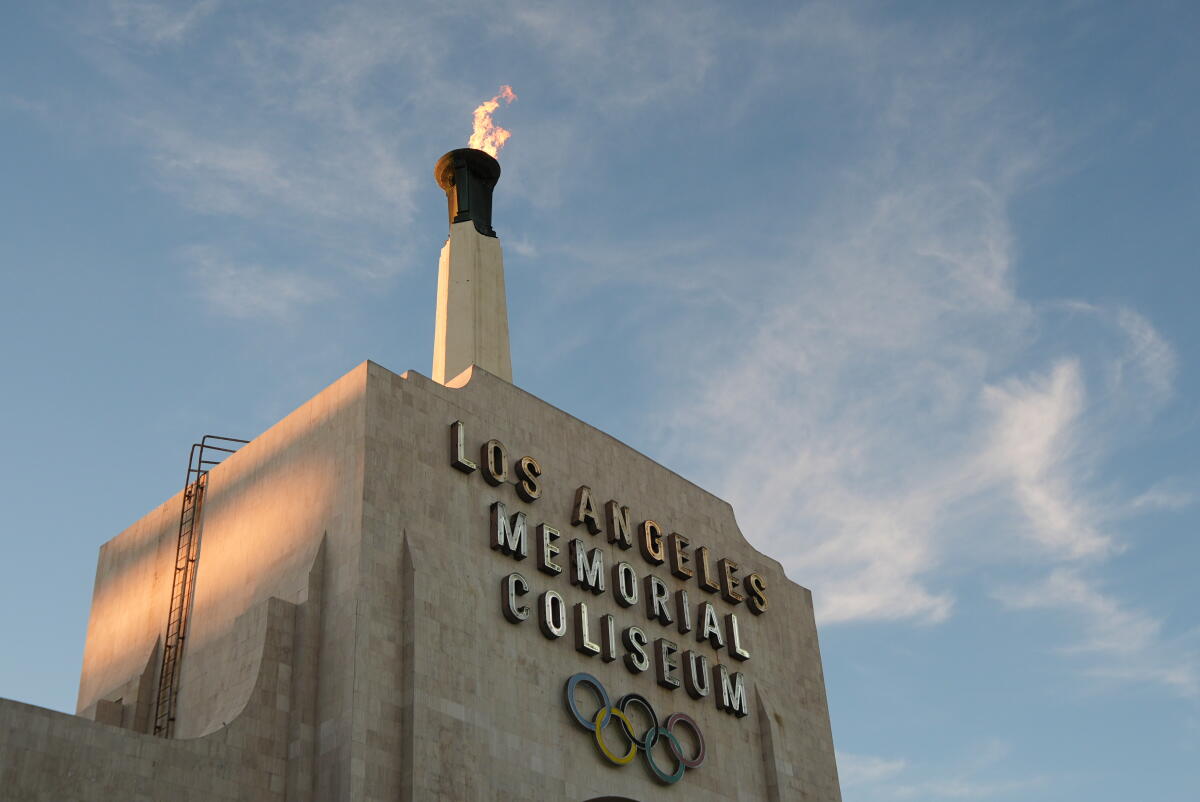
The Olympic cauldron is lit at the Los Angeles Memorial Coliseum ahead of the launch for ticket registration to the 2028 Summer Olympic Games Tuesday, Jan. 13, 2026, in Los Angeles.
(Damian Dovarganes / Associated Press)
Sen. Lola Smallwood-Cuevas (D-Los Angeles) repeatedly questioned how those resources would reach artists and community organizations. After the hearing, she conceded that “there are a lot of unanswered questions.”
LA28 Cultural Olympiad Executive Director Nora Halpern and Jones provided updates on plans first outlined in May, including an official Cultural Olympiad mark recognizing participating programs and a digital calendar and mapping platform. They also said programming spanning fashion, film, food, music, performing and visual art, will be announced in 2027.
Applications for the mark are expected to open in early 2027. The calendar and mapping platform is scheduled to launch in January 2028.
Separately, Halpern said artists had been selected to create 16 official posters — eight Olympic and eight Paralympic — through a process involving nominations from regional curators. The posters will be unveiled in July 2027.
Jones also described free community film screenings paired with local food and musical performances, as well as plans for dance, theater and spoken-word programming. Further announcements will come in 2027, he said.
City and county cultural affairs officials presented complementary efforts. Los Angeles’ Department of Cultural Affairs general manager Daniel Tarica said $15 million from its existing budget has been committed to its core program.
The department reported completing 19 programs and events this year, citing World Cup celebrations that combined sports screenings with art-making and dancing. The department is continuing exchanges between local and international artists and testing neighborhood programming ahead of an official summer 2027 launch. Additional initiatives, including 15 new Olympic and Paralympic murals and disability arts celebrations, depend on further funding.
Los Angeles County’s Department of Arts and Culture is building its 2028 effort around existing grants, youth programs, public art and neighborhood partnerships, Director Kristin Sakoda said. Plans include a Year of Creative Youth, an Olympic arts education curriculum being developed with the Olympic Museum in Switzerland, and outreach through parks, libraries and cultural venues.
Arts administrators from Long Beach and West Hollywood described local initiatives. Long Beach Cultural Affairs Officer Griselda Suarez reported investing $135,000 in 12 groups to pilot cultural projects, while Rebecca Ehemann, arts manager, City of West Hollywood, said the city was completing its first year of implementing a multiyear creative plan.
Arts for LA CEO Gustavo Herrera presented Mosaic LA, a community-led initiative intended to coordinate neighborhood cultural programming and sustain investment beyond 2028. Its proposals include a pooled fund, technical assistance and shared promotion, alongside exploration of a new county-level arts funding mechanism. Cultural districts would anchor the effort.
Its financing remains unresolved. “There are budgets that have been laid out, but no resources that have been allocated to it yet,” Herrera said.
The discussion also touched on the federal government’s role. Congress has appropriated $1 billion through FEMA’s State Homeland Security Grant Program for Olympics-related security, planning and other costs, and $94.3 million for Games-related transportation assistance. Those commitments are separate from the cultural fundraising described at the hearing.
Assemblymember Christopher M. Ward (D-San Diego) called for federal financial support and “a little bit of a better attitude,” saying recent political rhetoric was unhelpful to attracting visitors to California.
Earlier this month, President Trump drew criticism for remarks at a Nebraska rally about Iran potentially striking Los Angeles and San Diego. He subsequently said his comments had been misinterpreted.
The potential benefits of the Games are not automatic, UCLA professor of history Dr. Tawny Paul cautioned. Her research found that large Olympic visitor numbers do not necessarily translate into higher museum attendance, underscoring the importance of local audiences and programming before and beyond the competitions.
For Smallwood-Cuevas, securing additional state support requires a clearer account of the needs.
“At the end of the day, we need a concise, coordinated and clear ask,” she said after the hearing. “That’s rooted in some real facts.”
Horowitz is a special correspondent.