ohio

Ohio voters once rejected Sherrod Brown. Can he get a second chance?

In the wood-paneled basement of a union hall, retirees sat in folding chairs last week as they recalled how miles of steel mills and plentiful jobs had slowly disappeared.

“We told our children to get your education, get out, and don’t come back,” said Al Antonelli, who has been a member of Ohio Laborers’ International Union of North America Local 125 for nearly 50 years. “Because there’s no future here, especially blue collar.”

Versions of Youngstown’s story played out across the industrial Midwest, where disappearing jobs and frustration in longtime Democratic strongholds helped fuel Donald Trump’s political rise. When Trump visited as president in 2017, he promised the jobs that had left Ohio were “all coming back.”

“Don’t sell your house,” one of the retirees recalled Trump saying during his Youngstown visit.

Nearly a decade later, the old industrial economy Trump promised to revive has not returned, and Democrats hope the political tide is shifting again. Two years after Democrat Sherrod Brown lost his Senate seat, he’s attempting a comeback by trying to win back some of the same voters who turned on his party. Brown wants to harness dissatisfaction with the economy, the war in Iran and the expansion of artificial intelligence data centers to dislodge Republican Sen. Jon Husted in November.

Brown’s chances of returning to Washington depend largely on whether he can win again in parts of the state that have spent years drifting away from Democrats. His race is also part of a much broader challenge for Democrats, who need to make inroads in Republican-leaning states like Ohio, Iowa, Alaska and Texas if they are to win control of the chamber in November.

Brown outlasted Democrats’ decline in Ohio — until he couldn’t

For years, Brown was able to outrun the Democratic Party’s decline in Ohio. His pro-labor populism resonated with enough swing voters to deliver decades of victories from the statehouse to Congress.

Trump carried Ohio by 8 points in 2016, four years after Barack Obama won it. Yet Brown won his third term in the Senate two years later, in part by continuing to perform well in places like Mahoning County, anchored by Youngstown.

By 2024, even Brown could no longer hold on, losing his reelection campaign to Republican Bernie Moreno by 3.5 percentage points.

Trump carried Mahoning by more than 10,000 votes, a remarkable reversal in a previously loyal Democratic county that Obama had won by nearly 30 percentage points just 12 years earlier. With Trump’s endorsement, Moreno won the county by just 220 votes.

The transformation extends across the Mahoning Valley. Neighboring Trumbull County went from backing Obama by 23 points in 2012 to Trump by nearly 17 points in 2024.

“The Mahoning Valley has struggled with deindustrialization, job loss for years, and the politicians in power have seemed to understand that, but it doesn’t seem like they were doing enough about that,” said Cryshanna Jackson Leftwich, a politics professor at Youngstown State University. “So at some point, 20, 30 years of supporting the candidates, people are gonna say, well, look, this has never worked for us, right?”

Trump and other Republicans offered voters something different, Leftwich said.

“Did they keep their promises? Not at all. Is the county still poor? Absolutely,” she said. “But they at least said they were going to do something different.”

Brown faces a much different environment this year

Democrats’ bid to flip the Senate requires them to net four seats, including by competing deep in Republican territory.

Two months from the end of midterm campaigns, high gas prices stemming from the war in Iran have compounded discontent with the economy.

Trump has also escalated a trade war with neighboring Canada, a fight with particular implications for Ohio. The state exported $17.5 billion in goods to Canada in 2025, or nearly a third of the state’s total exports, according to federal statistics.

Tension from the economic strain is visible in Parma, a working-class Cleveland suburb that split its ticket in 2024, backing both Trump and Brown. At a watch party for the Republican midterm convention in Dallas, supporters who stayed late into the evening cheered Trump but acknowledged that other issues would most likely determine the midterms.

“The real thing that’ll move the needle is going to be economics. Gas prices, grocery prices,” said Parma City Councilor Kevin Kussmaul. “That’s really what’s going to help.”

Parma Republican Party President Doris Peters said similarly that “everyone’s concerned about the high gas prices.”

“It’s all about the economy,” she added. “People remember how much money’s in their wallet and how much is not in their wallet.”

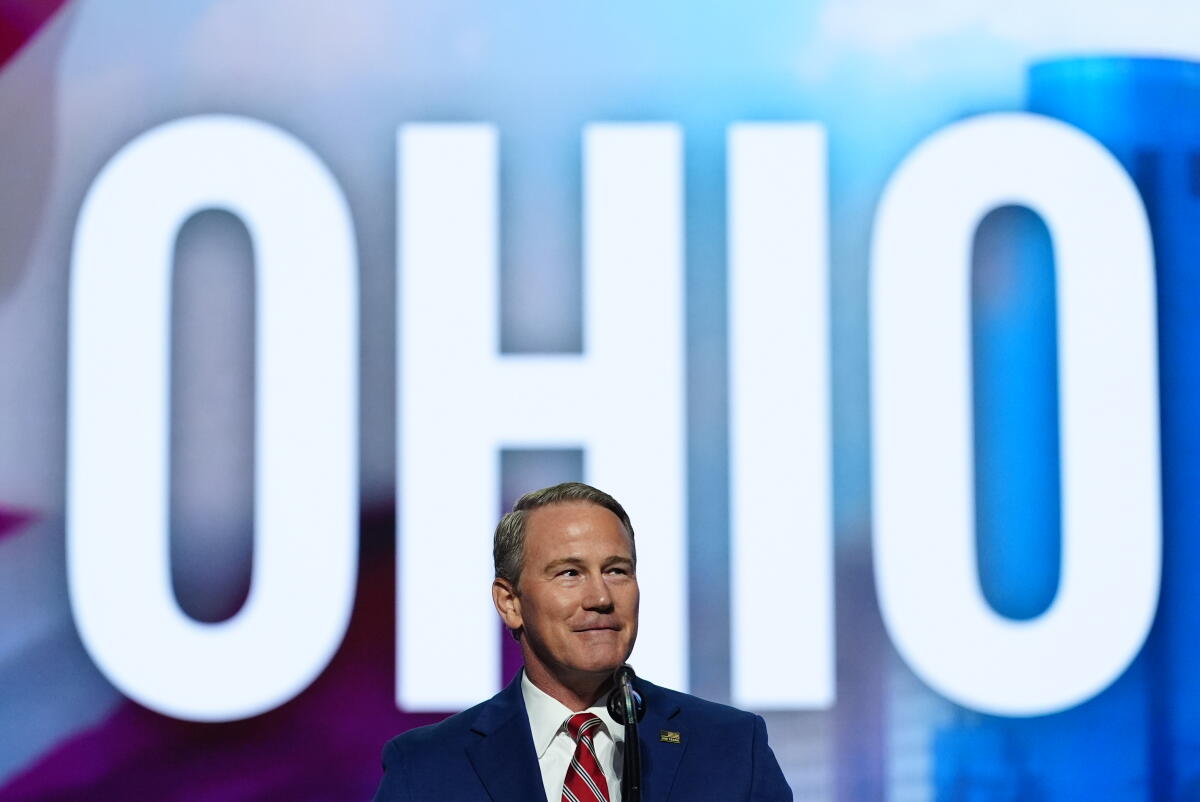
Sen. Jon Husted, R-Ohio, speaks at the Republican convention

Sen. Jon Husted (R-Ohio) speaks at the Republican convention in Dallas.

(Julia Demaree Nikhinson / Ap Photo/julia Demaree Nikhinson)

The limits of a Democratic rebound in Ohio

Husted presents a different opponent than the one Brown faced two years ago. His restrained demeanor contrasts with Moreno, the brash former car dealer who entered politics as an outsider. Husted spent nearly 25 years in Ohio politics, as a state lawmaker, House speaker, secretary of state and lieutenant governor, before being tapped to fill Vance’s Senate seat.

But Husted may not need to generate much enthusiasm of his own. Except for Brown and candidates for the Ohio Supreme Court, a Democrat hasn’t won a statewide race for state office in Ohio since 2008.

Adam Radogna, 37, who hosted the watch party Wednesday for Parma Republicans at his Italian restaurant, has attended more than 80 Trump rallies and remains an ardent Trump supporter. But Husted is not someone he’s followed closely.

“I don’t know him at all,” Radogna said of Husted. “But I mean, I will vote for him.”

Brown faces enthusiasm problems of his own as he asks voters to return to a 73-year-old former senator whom they rejected just two years ago.

Ellen Zban, 67, a longtime Youngstown resident who said she leans Democratic but has voted for Republicans, said she won’t support Husted because she doesn’t believe he has listened enough to the community.

“I really don’t think he’s done anything for us,” she said. “We never hear from him.”

But Brown isn’t necessarily the candidate she wishes Democrats were offering either.

“He’s my best option,” Zban said. “But I’d like to see younger people running.”

The race is being flooded with money as both sides try to drum up enthusiasm and define the choice for voters. Husted and allied Republican groups have already spent more than $80 million with $86 million more reserved through Election Day, according to AdImpact. Brown and Democratic groups have spent $69 million, with $67 million reserved.

Elon Musk has also waded into the race through his America PAC, which is running online and streaming ads attacking Brown over transgender issues.

“Billionaires are lying to try and bail out their ‘Golden Boy’ because Jon Husted has always put special interests ahead of Ohio,” Brown’s campaign manager, Patrick Eisenhauer, said in a statement.

Brown has attempted to make data centers central to the race, an issue that has seen bipartisan outrage in communities across the country. Brown’s allies have called Husted the face of Ohio’s data center boom, blaming the massive facilities for contributing to rising electricity costs. Husted helped promote Ohio as a destination for data centers while serving as lieutenant governor.

The ads and backlash have generated enough concern among Republicans that an internal party memo described data centers as an “anchor” around Husted in the race.

“Thirty-two years in Washington turned Sherrod Brown into a liar,” Amy Natoce, a spokesperson for Husted, said in a statement. “Jon Husted is fighting to lower costs and help Ohioans keep more of what they earn. Sen. Husted introduced legislation requiring data center companies to pay for the power they use and return excess electricity to the grid.”

The state’s politics could shift again

In Youngstown, the union retirees who watched the Mahoning Valley shift toward Republicans aren’t convinced the movement is permanent.

Rich Troisi, business manager of Laborers’ Local 127, said Republican candidates in recent elections could win support in the area largely by aligning themselves with Trump. This year, he said, that dynamic may not hold.

“I don’t think Donald Trump’s endorsement is going to be what it was,” he said.

Antonelli, the longtime union worker, pointed to independent voters, who he said tend to move with their economic circumstances.

“My dad used to say, it depends on how tight your shoes are. Tight meaning, how’s the money?” he said. “Right now, the shoes are pretty tight, no matter who you are.”

Cappelletti writes for the Associated Press. AP reporter Julie Carr Smyth contributed to this report from Columbus, Ohio.
Source link

The GOP was confident about keeping its Senate majority. Now the fight for control is wide open

Republicans appeared to have a firm grip on the Senate heading into the final two years of President Trump’s term. But with less than two months until Election Day, control of the chamber is now up for grabs.

Democrats have found themselves competing in states that once seemed beyond their reach as Trump’s slipping approval ratings and voters’ dissatisfaction with the economy create a difficult political environment for Republicans. But races Democrats once counted on winning have also become more complicated.

It’s a battle that’s expected to exceed $3.4 billion in spending across all races during the midterm campaign. The implications are huge for Trump’s agenda and his ability to fill administration jobs and open court seats for the remainder of his term, as the Senate is empowered to confirm or block presidential nominees.

Republicans say it’s unlikely for everything to break in Democrats’ favor, but they acknowledge they’re facing a difficult landscape. Senate Majority Leader John Thune told South Dakota’s KELOLAND News last week that he does “worry” about losing the chamber.

“I’m a realist,” Thune said. “I don’t ever try and sugarcoat things. I think it’s a competitive environment right now.”

Democrats face a scrambled path to the majority

Democrats need to net four seats to win the majority. The original path had been to hold Michigan, Georgia and New Hampshire while winning back Republican-held seats in Alaska, Maine, North Carolina and Ohio. But things have changed.

“We now have multiple paths for the majority,” Senate Democratic Leader Chuck Schumer said last month. “We found new states — Iowa, Texas — which people a year ago weren’t even paying attention to.”

Some of the states where Democrats were feeling most optimistic at the start of the election cycle, such as Michigan and Maine, have grown murkier.

In Michigan, where there’s an open seat this fall, no GOP candidate has won a Senate race since 1994. But Democrats are struggling to unite behind nominee Abdul El-Sayed. The favorite of progressives narrowly defeated moderate U.S. Rep. Haley Stevens in the August primary, and feelings remain raw from a bruising contest that saw nearly $70 million spent against El-Sayed.

Republicans believe Mike Rogers, who lost the 2024 Senate race by fewer than 20,000 votes, has an improved shot against El-Sayed. The Senate Leadership Fund — Senate Republicans’ spending PAC — added $6 million to its Michigan advertising investment after El-Sayed won, bringing their total spending to $51 million, the third-highest total.

Democrats also saw a prime opportunity to finally defeat five-term Republican Sen. Susan Collins in Maine, where Democratic Vice President Kamala Harris won more votes than Trump in 2024.

Progressive Graham Platner easily won the nomination in June, but he left the race the next month over a sexual assault allegation that he denies. Democratic delegates in late July chose Troy Jackson, a lesser-known former state legislative leader, to replace him.

Jackson has been forced to play catch-up. Collins and aligned super PACs have spent almost $80 million so far, according to the ad-tracking firm AdImpact, while Jackson and Democratic-aligned groups have spent and reserved close to $45 million since he became the nominee.

As one path narrowed for Democrats, others widened

Democrats increasingly see a real possibility in Texas, a state that has been an elusive goal for decades, and other GOP-led states including Iowa, Alaska and Ohio.

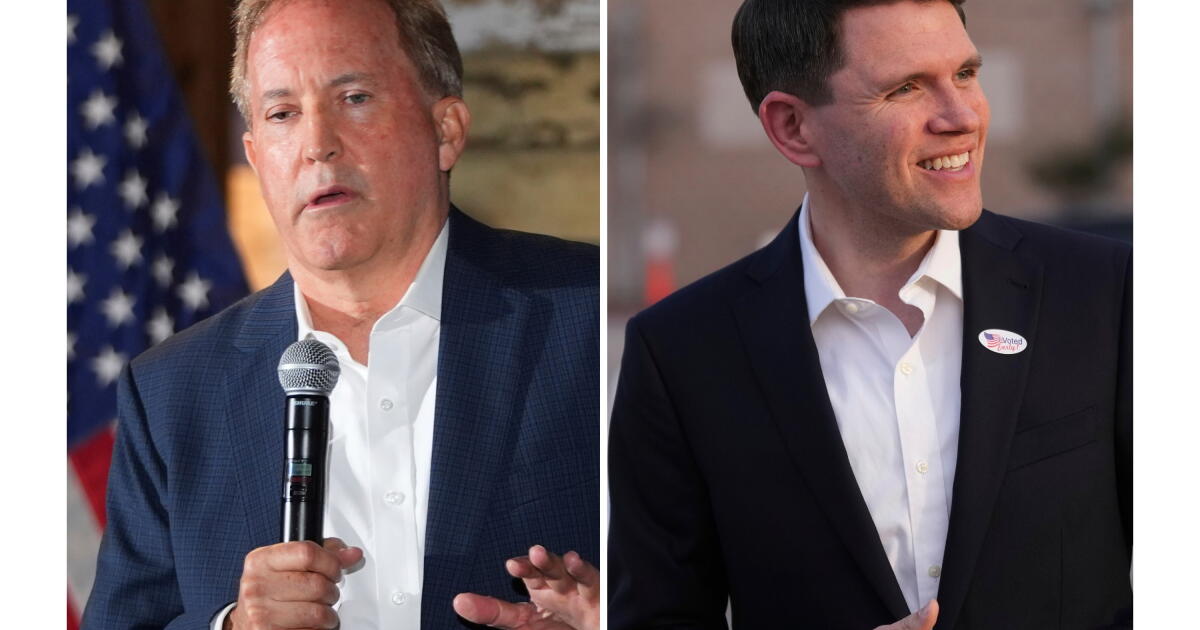
In Texas, Democrat James Talarico faces state Attorney General Ken Paxton, who ousted four-term incumbent Republican Sen. John Cornyn to win the GOP nomination. Senate GOP leadership backed Cornyn, seeing him as the stronger general election candidate.

Paxton has been shadowed for decades by legal and ethical questions, including indictments for securities fraud, though he was not convicted.

Talarico and allied groups have spent nearly $30 million on advertising since the May runoff, compared to less than $3 million by pro-Paxton groups. The political fund associated with Trump last week spent $10 million on TV and digital ads to help Paxton — the first major general election investment by MAGA Inc. for the midterms. Senate GOP leaders had petitioned Trump’s political team to spend some of the more than $400 million it had last month to help Paxton.

Democrats have also upped their spending in Alaska, Iowa, Ohio and North Carolina, all states currently held by Republicans. The GOP, meanwhile, is feeling more optimistic about New Hampshire as well as Michigan, while spending more to defend seats in Iowa and Alaska.

The expanded map has upped the anticipated total spending this cycle. AdImpact in June projected $3.4 billion in advertising spending on Senate races, a significant increase from the $2.8 billion the ad spending firm projected in the fall of 2025.

Why more states are in play than expected

Democrats’ path has widened in part because of Trump’s slumping job approval, notably on handling the economy, which was at 32% according to an AP-NORC poll in July — down from 40% in March 2025, shortly after he took office.

Trump’s trade policies and the war in Iran, with its corresponding inflated fuel costs, have added to the economic uncertainty for voters less than two months before Election Day.

“Things still cost too much. And so we’ve got to work on that issue,” Republican Rep. Jim Jordan of Ohio told The Associated Press. “We understand that and we know that’s real.”

Ohio Sen. Jon Husted heard the concern firsthand at a roundtable last month. Husted is looking to fend off a comeback from former Sen. Sherrod Brown in another key matchup for both parties.

During the discussion on housing, one attendee told Husted that costs were “skyrocketing” in part because of uncertainty around tariffs.

“Uncertainty is the killer to this economy,” said Dean Windham, a real estate developer who previously ran for office as a Republican.

Some Republican Senate candidates have defended Trump’s policies while confronting concerns about their economic impact.

In Michigan, where Trump’s tariffs on Canada have become a central issue, Rogers has backed the president’s approach while leaving room for disagreement.

“President Trump is right to put America First — and tariffs are necessary, but are not a one-size-fits-all solution,” Rogers said in a recent statement.

Republicans believe the math still favors them

Even if Democrats hold every seat they currently control, they would need to flip at least two seats in states Trump carried by double digits in 2024 to win the majority.

Republicans are betting that those underlying advantages will matter more as Election Day approaches — particularly as Trump and the party turn their attention toward mobilizing voters who helped return him to the White House.

Trump told reporters last week that he will “be making a lot of stops” in the last 30 days before the election.

This week, Republicans will hold a midterm convention in Texas, where Trump is set to speak and top Senate candidates including Rogers and Husted are expected to attend.

But Republicans acknowledge they have work to do.

“Politics is local,” Republican Sen. Mike Rounds of South Dakota said. He pointed to Trump’s decision to import beef, which he said made farmers and ranchers “feel just like the administration pulled the rug right off from underneath” them.

“They’re hurt,” Rounds said. “They feel like they’ve been let down.”

Cappelletti, Beaumont and Jalonick write for the Associated Press. Beaumont reported from Des Moines, Iowa.

Source link

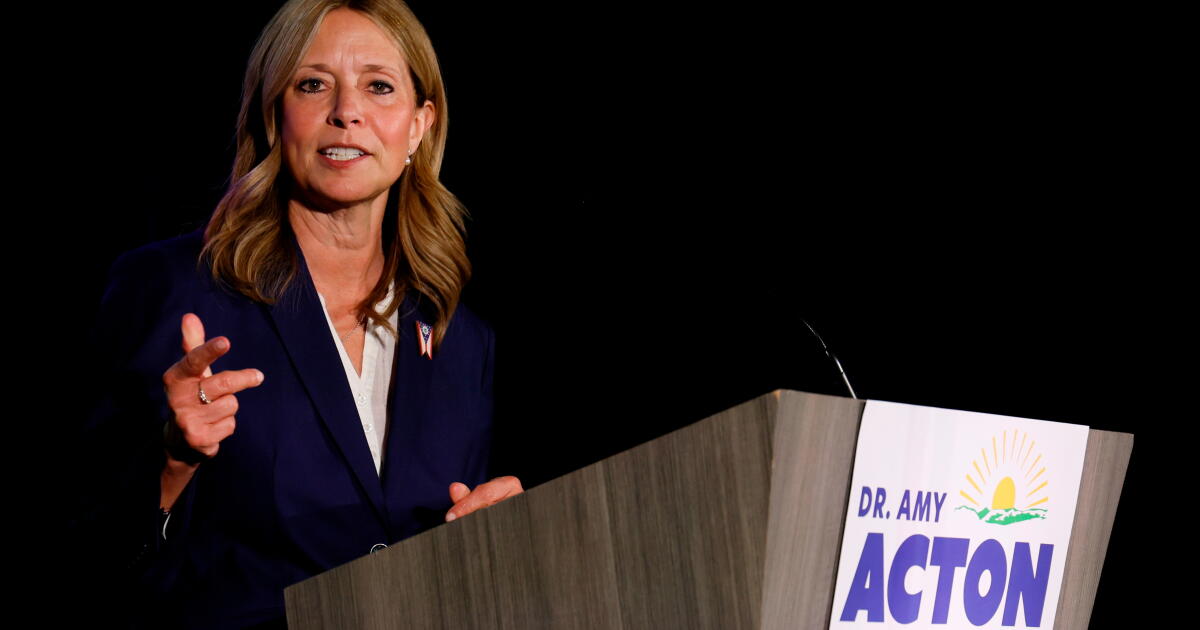
Armed man charges toward Democratic candidate for Ohio governor

An armed assailant charged toward the Democratic candidate for Ohio governor, Amy Acton, on Sunday during a campaign stop at the Canfield Fair, injuring several people before he was stopped by troopers, the Ohio State Highway Patrol said.

The Highway Patrol said in a statement that a man it identified as Patrick Havas, 38, forced his way through a crowd, knocking over members of the audience as he moved toward Acton, the state’s former public health director. He had a taser and two pistols, the statement said.

The Mahoning County Sheriff’s Office said two handguns and a set of brass knuckles were recovered after his arrest, and “no weapons were ever brandished or even removed from their holsters.”

Havas was taken to the county jail and booked on charges of disorderly conduct and two counts of assault, the Highway Patrol statement said, adding that no other details were available pending an investigation. Online court records didn’t yet list the case, and it wasn’t clear as of Sunday night whether Havas has an attorney.

Republican Gov. Mike DeWine said in a statement that the man “tried to forcefully push himself” toward Acton as she was speaking at the fair in Canfield, in northeastern Ohio.

“Violence or the threat of violence at political or public events is always unacceptable,” DeWine added.

The attack is the latest act of political violence to roil the United States. The Ohio gubernatorial contest is one of the most high-profile races this year as the campaigns enter the final six weeks of campaigning before the election in November.

Acton is facing Republican Vivek Ramaswamy, who has parlayed his national name recognition from his 2024 presidential run, tech industry connections and alliance with President Trump into a record fundraising haul that he is tapping for advertising spots. He is using campaign rallies and advertising to criticize Acton.

Ramaswamy’s campaign called Sunday’s attack unacceptable.

“Candidates should be able to meet with voters without having to worry about threats or violence. What happened today is completely unacceptable and has no place in politics, and we hope that no one was hurt,” Ramaswamy’s communications director, Connie Luck, said in a statement Sunday.

Addie Bullock, communications director for Acton’s campaign, said in a statement that the assailant lunged at Acton. She said the candidate “will always stand up to the chaos, hate and vitriol that pits us against one another.”

The incident brought condemnation from Ohio Republican Sen. Jon Husted, who said on X that he and his wife were “disturbed by the attempted attack on Amy Acton today at the Canfield Fair. We are grateful for law enforcement’s quick response. There is no place for this kind of behavior, and it must never be tolerated.”

The country has seen a rise in political violence over the last decade, including assassination attempts against Donald Trump at a rally in 2024 and at the White House Correspondents Assn. dinner in April, and the Jan. 6, 2021, riot by a pro-Trump mob at the U.S. Capitol.

Other examples include a 2017 shooting at a Republican congressional baseball team practice in Alexandria, Va., a 2022 hammer assault on then-Speaker Nancy Pelosi’s husband at the couple’s San Francisco home, and the fatal shootings last year of a Democratic Minnesota state lawmaker and her husband and of conservative commentator Charlie Kirk in Utah.

Federal political committees spent more than $40 million on expenses labeled as security during the 2023-24 campaign cycle, the most recent one for which data are publicly available, according to a report released in April from the Public Service Alliance, a nonpartisan group that focuses on security for public officials.

Before running for governor, Acton had been recruited by DeWine in 2019 to lead the Ohio Department of Health while serving as an associate professor of public health at Ohio State University. As the COVID-19 pandemic ramped up in early 2020, she was thrown into the state and national spotlight — becoming a source of comfort to many viewers of the governor’s daily news conferences.

For her service as health director, Acton earned the John F. Kennedy Library Foundation’s Profile in COVID Courage Award, the Columbus Foundation’s Spirit of Columbus Award and Ohio State’s highest alumni honor, the Alumni Medalist Award.

Her position as the face of the DeWine administration’s aggressive stance against the coronavirus also earned Acton many enemies, among them statehouse Republicans and conservative Ohioans who opposed pandemic public health restrictions.

Fields writes for the Associated Press. AP writer Ryan J. Foley in Iowa City, Iowa, contributed to this report.

Source link

US judge blocks Ohio law requiring proof of citizenship to register to vote | US Midterm Elections 2026 News

The amended law was an attempt by state Republicans to crack down on unproven claims of voting by noncitizens.

A United States federal court has temporarily blocked an Ohio law that required proof of US citizenship from residents who wanted to register to vote while they obtained a driver’s license.

In his ruling on Tuesday, US District Judge Solomon Oliver Jr granted a preliminary injunction against the law, saying it likely violates the US National Voter Registration Act (NVRA) because it requires more information than necessary to determine a resident’s eligibility to vote.

Recommended Stories

list of 3 itemsend of list

“Election officials do not need documentary proof of citizenship to assess a voter registration applicant’s citizenship because signed attestation of citizenship is enough,” Oliver wrote.

The judge also pointed to a clause in the act that says each US state’s driver’s license application “shall serve as an application for voter registration with respect to election for Federal office unless the applicant fails to sign the voter registration application”.

Oliver said that Ohio must offer applicants the opportunity to register once they’ve submitted their driver’s license application, not after it’s been approved by the state’s Bureau of Motor Vehicles (BMV).

“To interpret this section of the NVRA otherwise would allow States to make registering to vote at the BMV more onerous, and could result in fewer voter registrations because the opportunity to apply was not proactively offered to otherwise eligible citizens,” Oliver added.

In 1995, Ohio passed a so-called “motor-voter” law that allowed residents the opportunity to register to vote when they applied for a driver’s license

But that law was amended last year by the state’s Republican-controlled legislature in an attempt to crack down on unproven claims, pushed in part by US President Donald Trump, that noncitizens were voting in the state’s election. US law prohibits noncitizens from voting in federal elections.

The ruling marks a victory for voting rights advocates like Red Wine & Blue, which sued Ohio’s secretary of state, Frank LaRose, over claims that the law disenfranchised eligible voters and violated the NVRA.

One of the group’s lawyers, Ben Stafford, praised the ruling, calling it “a win for Ohio voters.”

“With the registration deadline just weeks away, eligible Ohioans will now have the opportunity to register to vote at the BMV without having to produce unnecessary paperwork that is not required by federal law,” Stafford, an attorney at Elias Law Group, said in a statement.

LaRose said his office disagrees with the decision and will appeal.

Source link

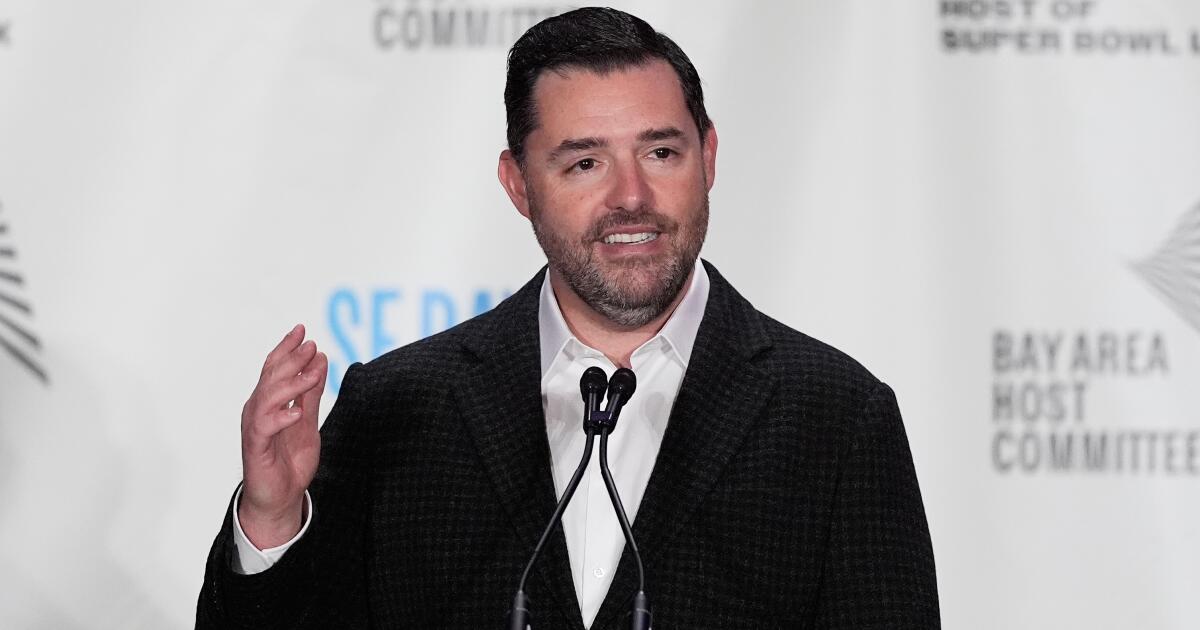
San Francisco 49ers owner arrested in Ohio, pleads no contest to two misdemeanors

John “Jed” York, the owner and CEO of the San Fransciso 49ers, was arrested this weekend in his home state of Ohio and pleaded guilty to a pair of misdemeanor charges, according to local court records.

York, 45, pleaded no contest to charges of disorderly conduct and possessing criminal tools, Columbiana County Municipal Court records show.

He was arrested Sunday and released on $5,000 bail, court records show. He returned to court Monday morning to be arraigned on charges that were initially listed as engaging in prostitution and possessing criminal tools, but the former was changed to disorderly conduct in his plea.

York was sentenced to two days in county jail, with credit for the day he has already served, and ordered to pay a $1,150 fine, the court file shows. The order also noted that $160 that had been confiscated in the arrest would be forfeited to MVHTTF, which appears to stand for the Mahoning Valley Human Trafficking Task Force. The records also said that officials were to return a phone to York, and that York had “completed online course,” but additional details were not immediately available.

A mugshot from York’s arrest was published by local news site WKBN-27, who said he was arrested Sunday by the East Palestine Police Department. That agency told the news outlet that any additional information from the case would come from the Mahoning Valley Human Trafficking Task Force, a regional task force that includes the East Palestine Police Department and the Columbiana County Sheriff’s Office.

York grew up in Youngstown, Ohio, which is just north of East Palestine.

York had already filed a request to have the charges expunged Monday.

The Times attempted to contact the attorney listed in York’s sentencing records, but he did not immediately respond. The 49ers have not yet addressed the arrest.


Source link

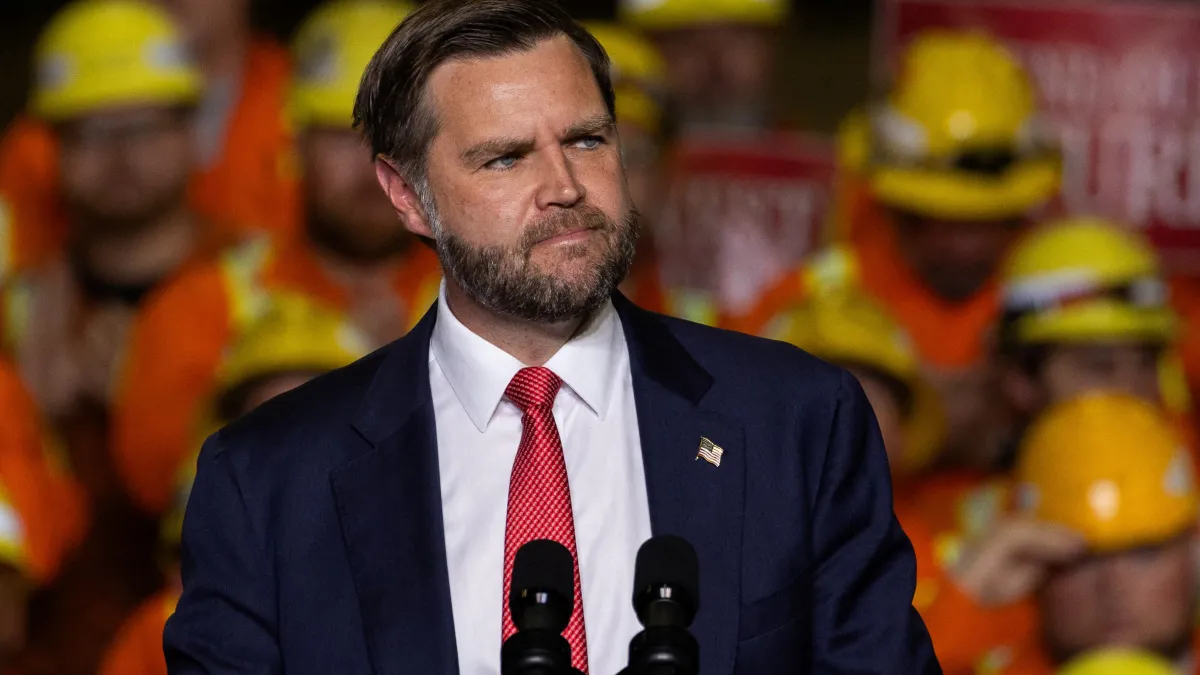
US Vice President JD Vance holds midterm election rally in Ohio hometown | Donald Trump News

For the first time since becoming vice president of the United States, JD Vance has returned to his hometown of Middletown, Ohio, with a goal of rallying Republican voters ahead of November’s pivotal midterm elections.

Vance delivered Friday’s speech at a symbolic location: the steel plant where his late grandfather once worked.

Recommended Stories

list of 3 itemsend of list

He used the appearance to tout a $1bn investment from the steel manufacturer Cleveland-Cliffs that was supported by $500m in government awards.

That funding, he said, illustrated his party’s commitment to the manufacturing sector and reinvigorating the US economy overall.

“I’m not saying it’s going to be easy – or it’s all going to happen overnight – but in just 18 months, we have seen an explosion of rebuilding in the American heartland,” Vance said, crediting the growth to policies under President Donald Trump.

Vance’s speech comes at a critical time for the Republican Party and Trump in particular.

November’s midterm races will decide whether Republicans are able to maintain control over both chambers of Congress. Should their hold on the legislature slip, Democrats could stymie Trump’s policy priorities for the last two years of his presidency — or even impeach him, as Trump himself has suggested.

Polls have shown that the state of the economy remains the top issue ahead of the midterms.

But how voters perceive each party’s ability to address economic strain has shifted. Before the start of Trump’s second term, the Pew Research Center found that voters were more likely to favour Republican policies on the economy.

In July, however, the dynamic had switched: Thirty-seven percent of those surveyed backed the Democratic approach to the economy, compared with 36 percent for Republicans.

Another poll this month from the news agency Reuters and the firm Ipsos likewise found slightly more respondents siding with the Democrats on economic policy than Republicans, upending a longtime trend that stretched back to 2017.

Trump, for his part, has publicly appeared to dismiss cost-of-living issues as a partisan invention, calling questions of affordability a “hoax” and a “con job” engineered by Democrats.

At Friday’s speech, Vance took a different approach, trying to assuage concerns about the administration’s handling of the economy.

“We got a lot of work to do, but we’re making progress on all the things that matter the most,” Vance said, citing efforts to make homeownership more affordable.

The speech is part of an intensifying campaign under Trump to boost the prospects of Republican candidates ahead of the midterms, with the president and other top officials holding rallies for their party’s candidates.

Ohio, part of a historic manufacturing region known as the Rust Belt, has become increasingly conservative since Trump’s first White House victory in 2016.

But amid rising dissatisfaction with Republican leadership, Democrats see a chance to win back the state’s governor’s office, as well as the US Senate seat left vacant when Vance became vice president.

Whoever wins the special election in November will serve the remainder of Vance’s Senate term, which would have ended in January 2029.

The Republican nominee in the race, Senator Jon Husted, joined Vance on stage at the Middletown rally on Friday. Husted was appointed to fill Vance’s Senate seat until a special election could be held.

Vance, for his part, dedicated part of his speech to attacking Husted’s Democratic rival, former Senator Sherrod Brown, who lost his re-election race to Republican Bernie Moreno two years ago.

He accused Brown of being among the politicians “who pretend to be friends of the workers in this facility”, while instead advancing their own priorities.

“It’s hard to understand what these modern Democrats actually stand for,” Vance said, characterising the party as having strayed from its ideals.

He pointed to Brown’s record of siding with the policies of former Democratic President Joe Biden, who defeated Trump in the 2020 presidential race.

“[Brown] was a man who claimed to represent this state but never once raised his voice against Joe Biden’s border crisis or against the inflation that was brought on by Joe Biden underinvesting and trying to destroy American industry,” Vance said.

The vice president also singled out Michigan’s Abdul El-Sayed, repeating a false claim that the Democratic Senate candidate called for “Sharia law” in the US.

“I’d love to go back in time and tell my papaw that there’s a man who claims to stand for working people, who says not only should we have Sharia law, but if you criticise it, you are a white supremacist,” Vance said about El-Sayed.

Trump’s approval rating currently sits at 33 percent, according to Reuters-Ipsos polling from this month.

Source link