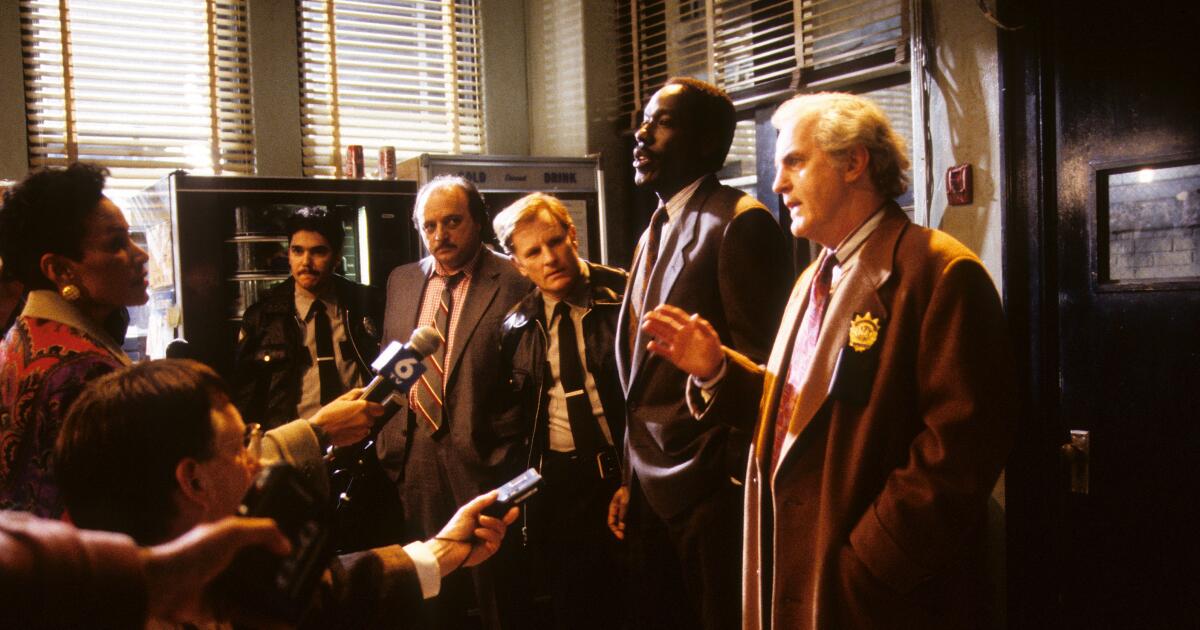
Los Angeles police are investigating the fatal stabbing of actor James Handy, who officials said was killed by his girlfriend’s son Wednesday at a home in Tarzana. The suspect was apprehended after he made a bizarre 911 call.
On Thursday, authorities identified the 81-year-old stabbing victim as the actor, who appeared in the films “Logan,” “Jumanji,” “Top Gun: Maverick” and “Arachnophobia.”
Representatives for the actor confirmed the news to The Times.
On Wednesday morning around 9:30 a.m., West Valley area patrol officers responded to an emergency call in a residential neighborhood of Tarzana. The 911 caller stated, “I am the son of man. I just killed the man of sin.”
When police arrived, they found Handy in the front yard of the Erwin Street home, unconscious and suffering from a stab wound to his chest. According to law enforcement, Handy was taken to a local hospital by paramedics, where he was pronounced dead.
A news release said that Michael Gledhill, the man suspected of stabbing Handy, flagged down officers who were responding to the incident and told them he was the one they were looking for.
Gledhill, 44, lives at the Erwin Street home with his mother, who police said was in a relationship with Handy.
Detectives said they believed this was an isolated incident and there appeared to be no danger to the public at this time.
Gledhill was arrested and transported to Van Nuys Jail, where he was booked on suspicion of murder. His bail was set at $2 million.
Handy has more than 150 acting credits to his name and had acted across television and film since the 1970s. Most recently, he played a bartender alongside Jennifer Connelly in the 2022 sequel “Top Gun: Maverick.” In 2017, he played opposite Hugh Jackman in “Logan” as a doctor who pleads with Wolverine to heal up.
In 2021, he portrayed Father MacGuffin in the comedy “Senior Entourage.” The film’s director, Brian Connors, posted on Facebook last year that Handy was one of the “finest character actors I know.”
Handy also acted in numerous television crime dramas, including “Alias,” “Criminal Minds,” “NCIS: Los Angeles,” “Rizzoli & Isles,” “CSI: NY,” “Cold Case” and more.
The police are asking anyone with additional information about this incident to contact the Robbery-Homicide Division, Valley Section, Dets. Simonyan or Lopez, at (818) 374-9550.
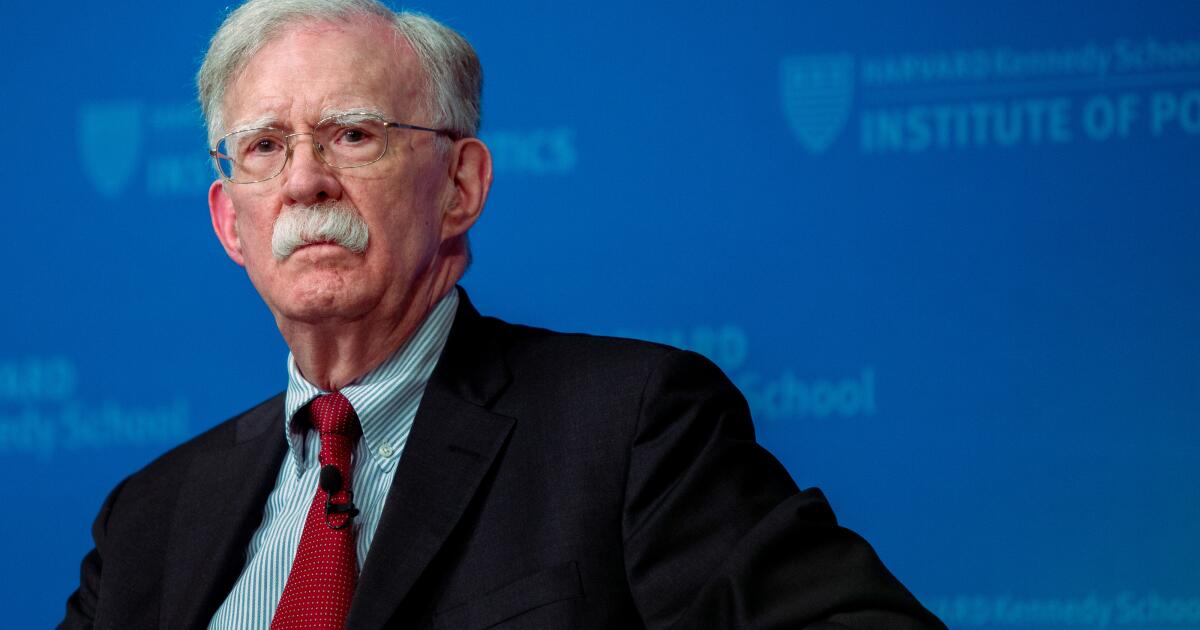
WASHINGTON — Former Trump administration national security advisor John Bolton has agreed to plead guilty to a single count of retaining classified information under a deal with the Justice Department that could allow him to avoid prison time, a person familiar with the matter said Thursday.
The deal would resolve a criminal case filed in October that charged Bolton with 18 counts of either retaining or disseminating classified information, including diary-like notes from his time in government that officials say he shared with his family members as he was preparing a memoir about his time in office.
Under the agreement, Bolton would also face a $2.25-million fine, said the person, who insisted on anonymity to discuss a deal that had not been made public. Any prison sentence would be capped at five years, but the agreement allows for him to avoid time behind bars, though the punishment will ultimately be up to a judge.
The case against Bolton, filed weeks after prosecutors secured indictments against former FBI Director James Comey and New York Atty. Gen. Letitia James, unfolded against the backdrop of concerns that the Justice Department was using its law enforcement powers to pursue perceived adversaries of President Trump. The investigation burst into public view last August when FBI agents served search warrants at his Maryland home and Washington office, but it had been well underway by the time Trump returned to the White House in January 2025.
Bolton is a longtime fixture in Republican foreign policy circles who became known for his hawkish views on U.S. power. He served for more than a year in Trump’s first administration before being fired in 2019 and publishing a critical book that portrayed the Republican president as deeply misinformed, an unflattering portrait of his leadership and decision-making.
Trump’s administration fought unsuccessfully to block the publication of “The Room Where it Happened” on the grounds that the book risked disclosing classified information. The plea deal that Bolton will enter covers the notes he shared with relatives as opposed to information published in the tell-all book.
A rearraignment, which typically signals a plea agreement, is scheduled for June 26 in federal court in Greenbelt, Md.
The Justice Department declined to comment.
The indictment’s 18 counts carried a threat of a substantial prison sentence in the event of conviction.
Court documents alleged that he shared with two family members “diary-like” entries with information classified as high as top secret that he had learned from meetings with other U.S. government officials, from intelligence briefings or talks with foreign leaders. After sending one document, Bolton wrote in a message to his relatives, “None of which we talk about!!!” In response, one of his relatives wrote, “Shhhhh,” prosecutors said.
The indictment said that among the material shared was information about foreign adversaries that in some cases revealed details about sources and methods used by the U.S. government to collect intelligence. One document related to a foreign adversary’s plans for a missile launch, while another detailed U.S. government plans for covert action and included intelligence blaming an adversary for an attack, court papers say.
In a statement released after his indictment, Bolton described the charges as part of an “intensive effort” by Trump to intimidate his opponents, to ensure that he alone determines what is said about his conduct.”
Bolton also served in the Department of Justice during President Reagan’s administration and was a State Department point person on arms control during George W. Bush’s presidency.
Bolton was nominated by Bush to serve as U.S. ambassador to the United Nations, but the strong supporter of the Iraq war was unable to win Senate confirmation. He resigned after serving 17 months through a recess appointment that allowed him to hold the job on a temporary basis without Senate approval.
In 2018, Bolton was appointed to serve as Trump’s third national security advisor. His brief tenure was characterized by disputes with the president over North Korea, Iran and Ukraine.
Those rifts ultimately led to Bolton’s departure, with Trump announcing on social media in September 2019 that he had accepted Bolton’s resignation.
Bolton subsequently criticized Trump’s approach to foreign policy and government in his book, alleging that Trump directly tied providing military aid to Ukraine to that country’s willingness to conduct investigations into Joe Biden, who was soon to be Trump’s Democratic rival in the 2020 presidential election, and members of the Biden family.
Trump responded by slamming Bolton as a “washed-up guy” and a “crazy” warmonger who would have led the country into “World War Six.”
Tucker writes for the Associated Press. AP writer Alanna Durkin Richer contributed to this report.
Los Angeles police are investigating the fatal stabbing of actor James Handy, who officials said was killed by his girlfriend’s son Wednesday at a home in Tarzana. The suspect was apprehended after he made a bizarre 911 call.
On Thursday, authorities identified the 81-year-old stabbing victim as the actor, who appeared in films “Logan,” “Jumanji,” “Top Gun: Maverick” and “Arachnophobia.”
Representatives for the actor confirmed the news to The Times.
On Wednesday morning around 9:30 a.m., West Valley area patrol officers responded to an emergency call in a residential neighborhood of Tarzana. The 911 caller stated, “I am the son of man, I just killed the man of sin.”
When police arrived, they found Handy in the front yard of the Erwin Street home, unconscious and suffering from a stab wound to his chest. According to law enforcement, Handy was taken to a local hospital by paramedics, where he was pronounced dead.
A news release said that Michael Gledhill, the man suspected of stabbing Handy, flagged down officers who were responding to the incident and told them he was the the one they were looking for.
Gledhill, 44, lives at the Erwin Street home with his mother, who police said was in a relationship with Handy.
Detectives said they believed this was an isolated incident and there appeared to be no danger to the public at this time.
Gledhill was arrested and transported to Van Nuys Jail, where he was booked on murder charges. His bail was set at $2 million.
The police are asking anyone with additional information about this incident to contact the Robbery-Homicide Division, Valley Section, Dets. Simonyan or Lopez, at (818) 374-9550.
WASHINGTON — Acting Atty. Gen. Todd Blanche said Tuesday that the Trump administration was scrapping plans to create a $1.8 billion fund meant to compensate allies of the Republican president after widespread political backlash and setbacks in the courts.
“We are not moving forward with the fund, period,” Blanche said in response to questions at a House hearing on the Justice Department budget.
““Not moving forward, ever?” asked Rep. Grace Meng, a New York Democrat.
The blunt declaration marked an extraordinary turnabout for a Trump Justice Department that just two weeks ago had pronounced the fund as essential to make up for what officials insist was weaponized law enforcement during President Biden’s Democratic administration. Since then, though, the idea has faced mounting pressure from Republicans who demanded reassurances that plans for the fund were off the table before they would move forward with legislation funding President Trump’s immigration enforcement agencies.
Blanche said the Justice Department was not abandoning an element of a settlement with the IRS that gave Trump and his family immunity from tax audits.
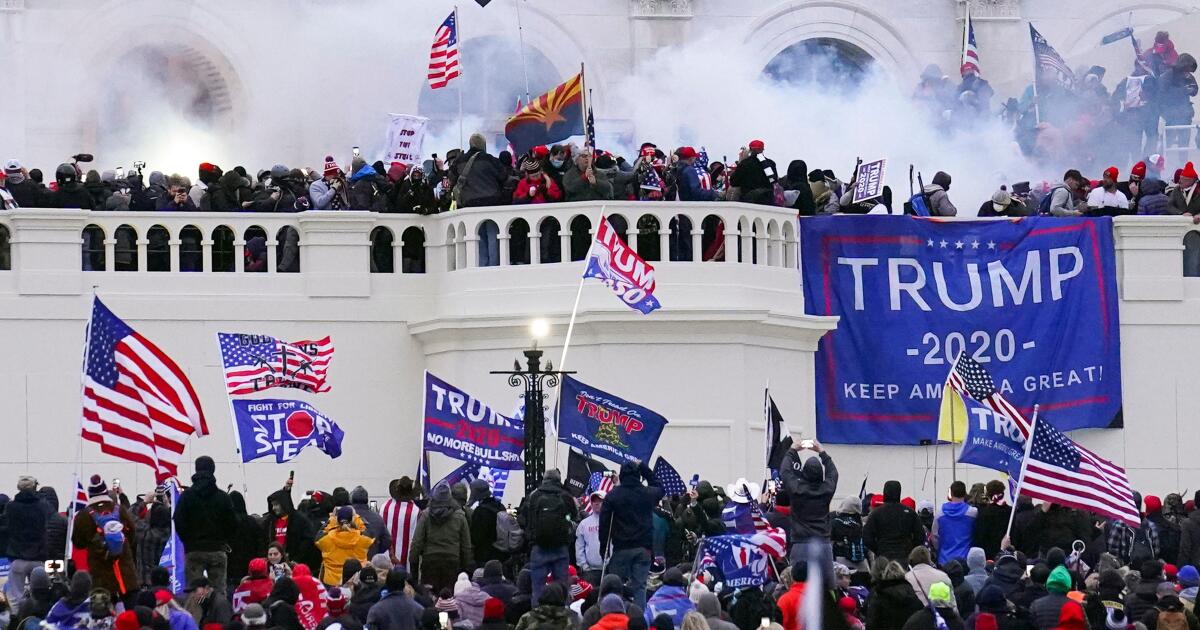
The hearing before a House Appropriations subcommittee was scheduled for discussion of the Justice Department’s budget, but lawmakers quickly focused their questioning on the creation of a fund that has provoked outrage over the mere possibility that violent pro-Trump rioters who stormed the U.S. Capitol on Jan. 6, 2021, could be eligible for payouts.
Signs for the retreat surfaced Monday when a person familiar with the matter said the Republican president was now reconsidering whether to move forward with the fund established to resolve his lawsuit against the Internal Revenue Service over the leak of his tax returns. The Justice Department also said Monday it would comply with a Virginia court temporarily blocking the administration’s “Anti-Weaponization Fund,” effectively agreeing to pause the plan for at least two weeks.
Another judge in Florida raised the prospect of reopening the IRS lawsuit because of “grievous allegations” of improper dealing made against the administration by settlement critics.
The Trump administration has defended the fund as an appropriate measure to make up for what officials insist was a weaponized Justice Department during President Joe Biden’s Democratic administration, a claim the Biden administration strongly denied. Though some Trump supporters, including participants in the Capitol riot, have celebrated the announcement, the reaction among Republicans in Congress has been decidedly more hostile, forcing Blanche to try to assuage a GOP constituency that generally operates in close alignment with the administration.
The furor has especially complicated matters in the Senate, where Republicans defiantly left town 10 days ago without passing legislation to fund Trump’s immigration enforcement agencies. Republicans who returned to Washington on Monday said they won’t have the votes to pass the Homeland Security spending bill until the White House works with them to place parameters on the fund. Many have pushed the administration to impose limits or scrap the idea altogether.
At a Senate budget hearing last month, Blanche refused to rule out the possibility that those who carried out violence on Jan. 6 could be eligible for payouts and has repeatedly said in interviews that anyone who feels persecuted by the criminal justice system is free to apply. Payouts will be decided by a five-member commission appointed by Blanche.
But he has apparently struck a more conciliatory tone in private when confronted by Republican anger.
Blanche encountered a groundswell of opposition last month at a tense private meeting with GOP senators, with more than half raising concerns, including by shouting at the Justice Department’s top official, Republican Sen. Ted Cruz of Texas said in a recent episode of his podcast.
“There were fireworks at an epic level — and I’ve got to say, it’s one of the roughest meetings I’ve seen in my entire time in the Senate,” Cruz said.
Behind closed doors, Blanche was “adamant” that no one who assaulted police at the Capitol would receive compensation, according to Cruz.
“He said not just ‘no,’ but ‘hell no,’” the senator recalled.
Brooke Mayo was just 4 when she started playing soccer. She was about 4½ when she started fantasizing about participating in the World Cup.
“I just fell in love with the game,” she said. “Like any soccer player, you dream about the World Cup, you know?”
That dream came true three years ago, though not quite in the way Mayo had imagined. Although she took part in four matches at the 2023 Women’s World Cup, she did so as an assistant referee, not a player, running up and down the field with a flag in her hand, not a ball at her feet.
Yet Mayo made history just the same, joining Tori Penso and Kathryn Nesbitt as the first American officials to work a World Cup final as a trio. More importantly, they performed so well they have been invited to officiate in the men’s World Cup this summer, where they will make more history as just the second all-female crew to work a game in the men’s tournament.
And while Mayo appreciates the barrier breaking, for the three women it’s just another day at the office.
“For us, it’s just business as usual,” she said. “I think there’s still a lot of places in the world that need to see this and that’s why it’s still important. But our colleagues are used to seeing women around.”
Mark Geiger, a two-time World Cup referee who is now general manager of the Professional Referee Organization (PRO), which manages officials for MLS, agrees. After decades of seeing U.S. and Canadian referees given little respect by FIFA — nor by international soccer in general — Geiger says the biggest takeaway from this summer’s tournament isn’t the gender of the domestic officials selected, but rather the number, 11, making it the largest contingent to work a World Cup.
In addition to Mayo, Penso and Nesbitt, the list includes Ismail Elfath, Armando Villarreal, Kyle Atkins, Corey Parker and Drew Fischer, who took part in the 2022 men’s tournament. Nesbitt, Elfath, Parker and Atkins all worked the final of that World Cup four years ago, Elfath as the fourth official, Nesbitt as the reserve assistant referee and Parker and Atkins as video assistant referees.
With Mayo’s team working the 2023 women’s final — alongside Villarreal, who was in the video booth — seven MLS officials have worked the last two World Cup finals and at least one PRO official has been assigned to 19 of the 32 knockout games in the most recent men’s and women’s tournaments.
No other league or country in the world is even close to that.
“Over the past few years I think we’ve shown that the quality of football and the quality of the officiating in the United States and Canada is at a really high level,” said Geiger, who made history of his own in 2014 when he became the first American center referee to work a Round-of-16 match in the men’s World Cup.
“We are in the normal conversation of knockout-stage games, we’re in the normal conversation for Tori to do the final. It’s not out of the realm of possibility.”
Another thing that makes this World Cup special for the PRO officials is that with the U.S., Mexico and Canada sharing host duties, the tournament will be played at home. The only other time the men’s World Cup was played in the U.S., in 1994, Arturo Angeles, a Mexican-born naturalized citizen, was the only American referee selected and he supervised just one group-play game.
“Any World Cup game anywhere is going to be special on some level,” said Fischer, a 45-year-old Canadian who has been a FIFA referee for 11 years. “It’s definitely a special feeling when you get to play host. It’s a little bit of welcoming the world into your backyard.
“There’s a certain hometown pride. So I’m definitely looking forward to that aspect of it.”
Joe Dickerson, U.S. Soccer’s reigning male referee of the year, received the FIFA international badge he needed to work major competitions just three years ago. Yet he will be a replay official in this World Cup, the first one he was eligible to work.
“This kind of happened so fast in the last couple of years,” said Dickerson, who became a professional referee in 2013, then began targeting the World Cup when it was awarded to the U.S., Mexico and Canada in 2018. “To work the biggest sporting event in the world in front of friends and family is really cool. And being a part of the celebration of culture happening in your own country and, as much as we can, celebrate our own culture, is really cool.”
It also makes things much easier on family and friends. When Mayo officiated her first group-stage game in the 2023 tournament in New Zealand, her wife, Falon Catalano, flew in for the match.
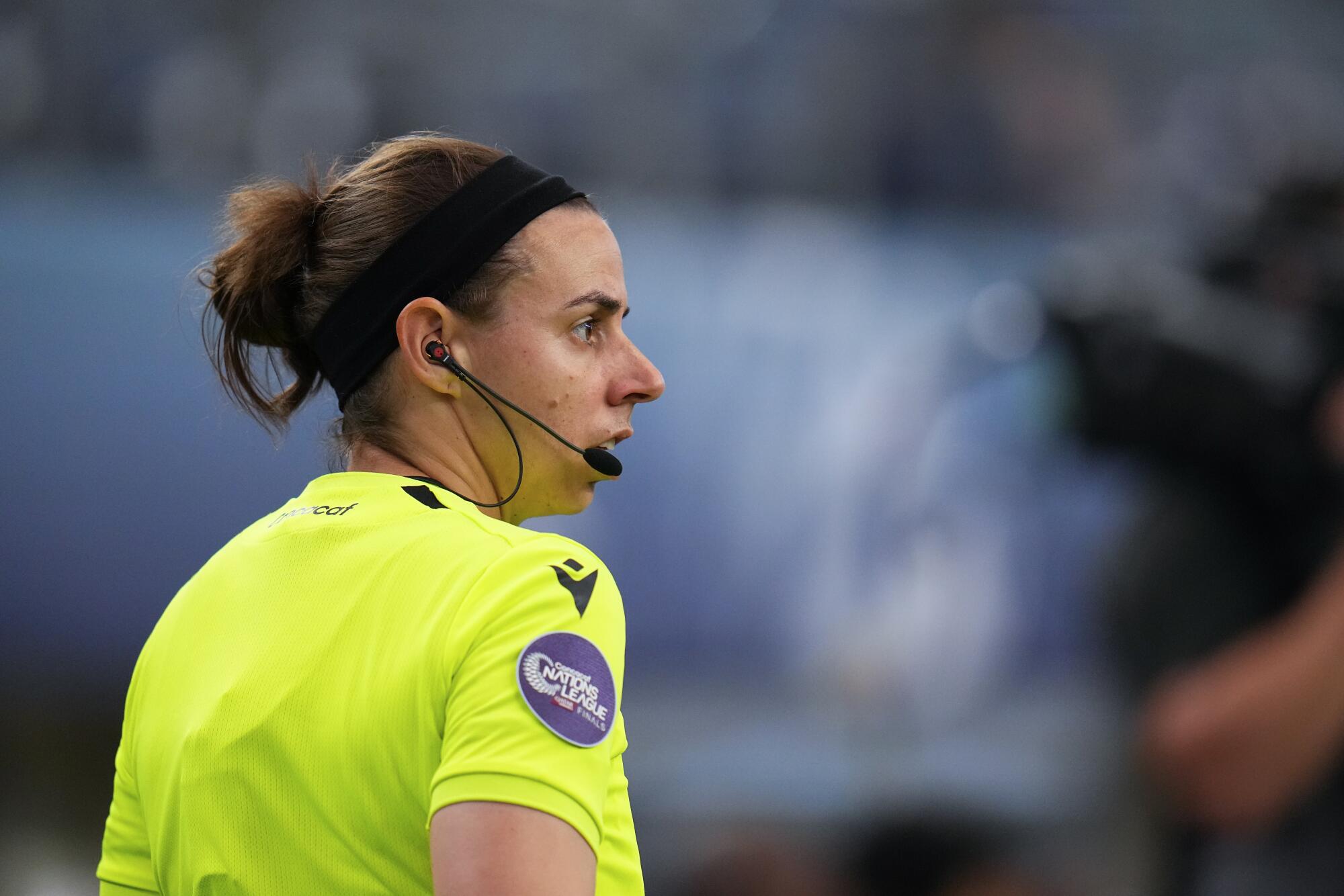
Referee Brooke Mayo looks on during a CONCACAF Nations League third place match between Jamaica and Panama in March 2024.
(Julio Cortez / Associated Press)
“I told her like hey, it’s our first World Cup. So she came to that and then went home,” said Mayo, 37, who wasn’t sure she’d get another game.
When she was assigned the England-Australia semifinal in Sydney, she called Catalano back.
“I said ‘this might be the biggest appointment in my entire career, in Australia in front of 75,000 fans. You’ve got to come to this,’” she pleaded.
So Catalano came then went before Mayo found out she would be doing the final. That led to another call. “I said, ‘well, you’ve gotta come back.’”
An exhausted and broke Catalano said no to the expense and fatigue of another 38-hour round trip, but after a group of MLS officials passed the hat to buy the ticket, Catalano surprised Mayo by making the match after all.
Making it to the semifinals — much less the final — was far from guaranteed since the World Cup is a meritocracy for officials as well as for the players. In fact, it’s harder to make the final as an official: There will be 170 officials from 50 countries taking part in this summer’s tournament as opposed to 1,248 players — or one referee for every 13 players.
“A lot of people underestimate how difficult it is for us to get there,” said Dickerson.
Referees are graded after every game and those who don’t measure up in their first match don’t work another one. Those who excel, however, continue to advance — as Mayo did in 2023.
“Just like teams try to kind of hit their stride in a tournament setting, that was similar with us. We just went in there focused on only one game in front of us,” she Mayo, who got her FIFA badge in 2018. “Our goal was to earn another game after that, do everything we can to clean up our communication. We’re like micro-managing ‘how could we have done this better?’
“You are just operating in sync. You’re spending every minute together. You’re together at breakfast. You’re together at training. You’re together at lunch. You’re traveling together. By the end, if they even sigh on the field, I know what that means.”
Mayo, like most officials, came to the game as a player — one good enough to play four years at Tennessee Tech. As a teenager she was moonlighting as a referee, raising enough money to fund a trip to South Africa to watch the 2010 World Cup as a fan.
“But I didn’t take reffing seriously,” she said. “Once I finished playing, I missed that competitive edge. When I realized I could do it in reffing, I was like, ‘Oh, this scratches that itch that I miss.”
Taking part in a World Cup remained a dream, however, and she got to scratch that itch three years ago. Now she’s working the tournament at home, where her family, who live in Colorado, will be just a few hours away should there be any frantic last-minute flights to catch.
Having already worked one World Cup final, anything short of the final this summer could feel like a failure.
“It’s a lot of skill, but it’s also a lot of luck. You have to be in the right place at the right time,” Mayo said. “There’s not that much that separates people at the top.
“We’re up against amazing referees. We’re going to fight for every game, one game at a time, knock it out of the park and hope for the best.”
The US and Iran have agreed in principle to a deal that would reopen the Strait of Hormuz, in exchange for Tehran’s commitment to dispose of its highly enriched uranium, a US official said, according to a report by The New York Times on Sunday.
The official said that the agreement has not yet been signed and remains subject to final approval by US President Donald Trump and Iran’s Supreme Leader Mojtaba Khamenei, a process that could take several days, noting that the method for disposing of Iran’s highly enriched uranium is still being negotiated.
The proposed deal does not address Iran’s missile stockpile nor include a moratorium on uranium enrichment, the official said, adding that these issues are expected to be handled in future rounds of talks.
According to a Fox News report on Sunday, the official suggested that the US could consider “significant accommodations” on sanctions relief if Iran agrees to make similar concessions regarding its enriched uranium stockpile.
“Our plan is to deal with all of their stockpile of the enriched material,” the official said, adding that Washington sees Tehran making “serious accommodations” not previously seen in earlier negotiations, according to the report.
The official also rejected the idea of any “tolling” mechanism for the Strait of Hormuz, saying such an arrangement would not be acceptable and had not been proposed by either side, the report noted.
According to a separate CBS News report, the official said the administration views the emerging agreement as stronger than the 2015 nuclear deal reached under former US President Barack Obama, which allowed uranium enrichment up to certain levels.
As part of the agreement, the US would lift its blockade on vessels entering and leaving Iranian ports. The official said the US Central Command and Gulf partners would coordinate to ensure safe passage, stressing this should not be viewed as a toll system.
The official also said US Vice President JD Vance, Middle East Envoy Steve Witkoff, and Trump’s son-in-law Jared Kushner have been involved in the talks, adding that Washington is seeking to include all regional allies in the process, the report added.
The US has leveraged threats to extract major concessions from Caracas, with Claver-Carone allegedly playing a key role. (Archive)
A mastermind of Trump’s hardline Latin American policies, Mauricio Claver-Carone no longer serves in the administration. But according to well-placed sources, he’s “picking who can operate” in Venezuela, controlling access to the government, and creating conflicts of interest.
Speaking with reporters on May 21, US Secretary of State Marco Rubio announced that Venezuelan President Delcy Rodriguez was on her way to New Delhi to discuss energy issues, and that he would be in India as well.
“This is an important trip, I’m glad we’re able to do it,” Rubio chirped after explaining the trio of nations would discuss how to increase Venezuelan oil sales to India.
His statement — and his announcement of Rodriguez’s trip before she had — perfectly illustrated Washington’s newfound dynamic with the Venezuelan government. Following over twenty years of hostile relations with Venezuela’s socialist-oriented leadership, the US Secretary of State was apparently so intimately involved with day to day affairs in Caracas that he was claiming responsibility for Rodriguez’s international itinerary.
In fact, according to an insider who enjoys close contacts within both the Venezuelan and US governments, Rubio’s influence over Rodriguez is said to be traced to one “gatekeeper”: former Trump Latin America envoy Mauricio Claver-Carone. “Mauricio [Claver-Carone] is picking who can operate and Delcy [Rodriguez] is taking instructions,” the source told The Grayzone.
A former senior US official with access to leadership in both Caracas and Washington offered the same assessment, remarking to The Grayzone, “Mauricio’s calling the shots on private sector economic positions, and if anyone wants in, they have to go to him.”
Hand-selected by former National Security Advisor John Bolton to serve as his Latin America charge during Trump’s first term, Claver-Carone no longer occupies an official governmental role. Instead, he has leveraged his legacy in the public sector to establish a Miami-based investment firm called the Lara Fund which could become a key player in the MAGA financial feeding frenzy in Caracas.
Described by the New York Times as the “architect of Trump’s tough Latin America policies,” Claver-Carone is a Cuban-American regime change zealot who once engaged in fisticuffs with Cuban diplomats as a young man. During Trump’s first term, he unleashed a financial “flamethrower” on Cuba, issuing scores of new sanctions that unraveled the Obama-era normalization policy and plunged the island back into economic misery.
Claver-Carone has similarly masterminded many of the policies that define Trump’s relationship with Venezuela, from its recognition of the previously unknown Juan Guaido as the country’s “interim president” to the deportation of hundreds of Venezuelan migrants from the US to El Salvador’s maximum security CECOT prison. Many of those migrants had been prompted to journey to the US by the economically crushing sanctions unleashed at Claver-Carone’s direction.
The Grayzone’s sources described the Trump veteran as the architect of the military invasion that saw Maduro spirited away to a federal penitentiary and installed Rodriguez as president following a stand-down by Venezuelan security forces.
“If he was in charge of implementing the kinetic side, maybe [Rodriguez] thinks she has to listen to him on finance,” the Venezuela insider said of Claver-Carone.
A report this January by investigative journalist Aram Roston described Claver-Carone as a “key backer” of Rodriguez following Maduro’s abduction, and cited sources who claimed he exercised decisive influence over Venezuela policy despite having left the administration.
Claver-Carone is now said to be at the heart of the most sensitive and consequential task Venezuela faces: the restructuring of its $170 billion in defaulted sovereign debt. Forced from several previous positions by corruption scandals and rancorous clashes, an operative with no official governmental position appears to be shaping the economic contours of Project Venezuela.
“He’s got a lock on everything”
This May, the US Treasury Department authorized Caracas to hire a financial advisor to assist with the herculean task of restructuring its debt. The Venezuelan government selected Centerview Partners, a top-drawer investment and financial advisory firm based in New York City.
According to the former US senior official, Claver-Carone’s romantic partner and business colleague, Jessica Bedoya, boarded a private jet to Caracas soon after the big announcement, arriving with a top advisor from Centerview. It was her second trip to the Venezuelan capital, they said, after visiting in February to discuss financial matters.
Claver-Carone did not respond to calls to his personal phone from The Grayzone, or to detailed questions sent by text and email.
His partner, Bedoya, is the founder of the Lara Fund investment firm where he serves as managing partner. Her bio notes that she has also worked in the CIA and National Security Council.
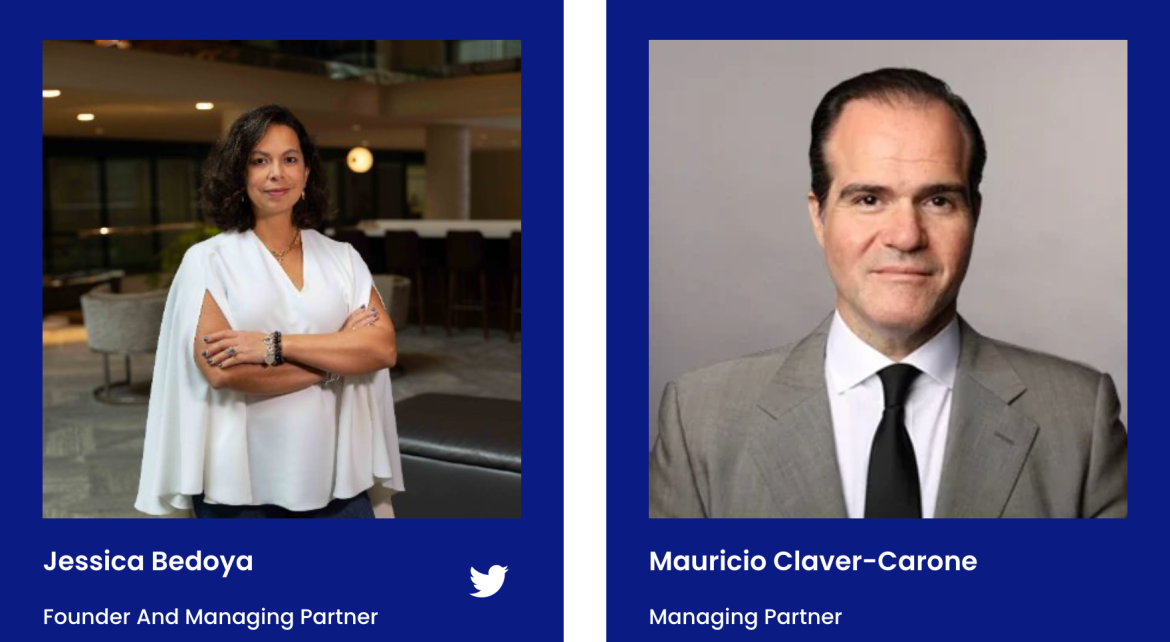
Jessica Bedoya and Mauricio Claver-Carone’s headshots, as featured on Lara Fund’s webpage
Some insiders worry that her reported presence in the Venezuelan capital, together with Claver-Carone’s outsized influence, could represent a conflict of interest, allowing them to steer debt restructuring agreements to their own personal benefit.
“Now he’s got a lock on everything,” the Venezuela insider said of Claver-Carone. “He could say to anyone who wants to work in Venezuela, I’m the guy. I have the keys. If you want to play ball, invest with me.”
The former US official said Claver-Carone was raising capital for his Lara Fund while he served as a special government employee at the State Department. While Bedoya was running the firm, they said Claver-Carone was leveraging his position inside the Trump administration to pitch potential investors.
“Arbitrary and authoritarian actions that showed him to be a real thug”
When Trump appointed Claver-Carone to serve as the first American president of the Inter-American Development Bank (IDB) in 2020, he hired Bedoya as his chief-of-staff. The couple’s secret romance at the bank triggered an embarrassing ethics investigation after a hand-written contract was discovered showing they had agreed to pursue “absolute happiness,” and included a clause with punishments including “candle wax and a naughty box” if either party breached the deal.
An independent probe ordered by the IDB discovered that Claver-Carone had increased his paramour’s salary by 40% – a $133,000 reward in less than a year. Investigators also found that the couple had racked up expenses on an IDB credit card during romantic getaways.
Claver-Carone refused to participate in the investigation while accusing its authors of “fabrications.” In the end, IDB governors voted unanimously in favor of his firing. The US government endorsed their decision.
“President Claver-Carone’s refusal to fully cooperate with the investigation, and his creation of a climate of fear of retaliation among staff and borrowing countries, has forfeited the confidence of the bank’s staff and shareholders and necessitates a change in leadership,” they wrote.
The Argentine governor of IDB, Guillermo Francos, delivered a similarly harsh assessment of Claver-Carone’s tenure. “Claver was a disaster for several reasons,” Francos remarked in 2022. “For having an inappropriate relationship, for having disproportionately increased the salary of this inappropriate relationship, for having lied, and for these arbitrary and authoritarian actions that showed him to be a real thug.”
When Claver-Carone returned to the second Trump administration, it was not long before his proclivity for conflict jeopardized his position.
Throughout 2025, Claver-Carone’s spiteful attitude reportedly complicated Trump administration attempts to prop up a key right-wing ally in South America, Argentine President Javier Milei. Milei’s chief of staff happened to be Guillermo Francos – the former IDB governor whom Claver-Carone held personally responsible for outing his secret relationship with Bedoya. According to the Argentine paper Clarin, Claver-Carone attempted to retaliate by unsuccessfully pressuring Milei to fire Francos. He then attempted to undermine a major IMF loan package to Argentina by demanding the country first sever its credit line from China. This was met with an apparent rebuke from Treasury Secretary Scott Bessent, who visited Buenos Aires to express confidence in the IMF loan just weeks after Argentina’s central bank extended its credit line from Beijing.
The following month, in May 2025, Claver-Carone announced he was leaving the State Department to return to his Lara Fund. His departure gave the appearance that he had been forced out of his job. However, he maintained his clout through his direct line to Rubio.
The former US official told The Grayzone that Claver-Carone is now angling to become a Cuban American version of Jared Kushner, the Trump son-in-law who has leveraged his proximity to the president and role as Middle East negotiator to rake in billions from Israel and several Gulf monarchies despite having no official government title. To do so, he has allegedly inserted himself into the byzantine process of restructuring Venezuela’s debt.
When the Trump administration announced that Venezuela could hire a financial advisor to assist with its sovereign debt, Rodriguez initially planned a public bidding process for the coveted position. But then, according to the ex-US official, Claver-Carone issued support for Centerview, leading to the firm’s selection. (Opposition bloggers have speculated that Centerview was chosen because one of its partners, Matthieu Pigasse, is a self-described “pro-market socialist” who previously worked on deals with Maduro and Venezuela’s state owned PDVSA oil company.)
In recent weeks, according to sources, Claver-Carone has attempted to undermine financial advisors who had been working with the Venezuelan government to restructure its debt since 2014.
They said that when Claver-Carone’s partner, Bedoya, arrived in Caracas this month, allegedly on a private jet with Pigasse, she began pushing to remove the advisory mandate from David Syed, a seasoned French lawyer who had advised Caracas on debt-related issues for over a decade, and is considered incorruptible.
“The effort to push [Syed] out created a lot of tension,” remarked the Venezuela insider. “You can’t understand debt restructuring by parachuting in without his knowledge.”
Syed did not respond to The Grayzone’s request for comment. Hamouda Chekir, another Centerview partner who works on Venezuela’s debt, did not respond to calls and text messages sent to his personal phone.
Scandal-stained firms as vehicles for extracting profit from Venezuela
Just before leaving the State Department in May 2025, Claver-Carone convinced Rubio not to renew a sanctions waiver that allowed Chevron to sell Venezuelan oil in the US market. In doing so, he eliminated a mechanism which was explicitly designed to promote transparency and prevent local officials from skimming cash.
This January, after abducting Maduro, the Trump administration granted confidential licenses to a pair of notoriously corrupt trading houses, Vitol and Trafigura, to export Venezuelan oil. The deal came months after Trump’s re-election campaign received a whopping $6 million donation from a senior trader at Vitol.
Robert Bachmann, an analyst at the Swiss watchdog Public Eye, told the Washington Post at the time, “Trump is taking advantage of firms that know how to circumvent regulation.”
Both companies had been caught engaging in a series of elaborate bribery schemes across Latin America and Africa. In 2020, the Department of Justice (DOJ) forced Vitol to pay a $135 million penalty for bribing officials for licenses in Mexico, Ecuador and Brazil. Trafigura paid a similarly staggering fine in 2024 for a lucrative bribery scheme in Brazil. In the US, Vitol was rung up by the California Attorney General for manipulating spot market prices of oil.
But almost as soon as the Trump administration entered office, it neutered the DOJ corrupt foreign practices division charged with enforcing the judgments against Trafigura and Vitol on the grounds that it was “impeding America’s national security objectives.”
Now, the profits these scandal-stained firms generate through oil sales abroad – including to Israel – are channeled back into a US-run account with little public oversight. A percentage of sales is then delivered back to the Venezuelan government. Where the rest goes is anybody’s guess.
“The Venezuelans are the owners of the oil, and we know nothing. There is no transparency,” said José Guerra, an economist aligned with the Venezuelan opposition, complained to the Washington Post about the Trafigura and Vitol licensing agreements.
Trump, for his part, has essentially admitted Venezuelan oil profits are channeled into a slush fund for his international rampage. “We’ve taken out so much oil in Venezuela, we’ve paid for the cost of the war [with Iran] about 25 times over,” the president boasted during a May 23 campaign rally. While the president’s claim was absurd, as Venezuela is currently exporting only about one million barrels of oil a month – hardly enough to cover a full day of warfare – it revealed his avaricious attitude toward the entire operation.
Among certain Venezuelan opposition activists, Claver-Carone has become a figure of contempt who is partially blamed for Trump’s declaration that their de facto leader, the coup plotter and Nobel Peace Prize winner Maria Corina Machado, “doesn’t have the support within, or the respect within, the country.”
The Trump administration’s embrace of Delcy Rodriguez, and the Venezuelan president’s faithful compliance with Washington’s financial schemes, have prompted some top Democrats to adopt Machado as a partisan cudgel. This January, Chris Murphy, a ranking Democrat on the Senate Foreign Relations Committee, praised the opposition leader as “impressive” following a meeting on Capitol Hill, while taking a nasty swipe at Rodriguez. Machado “reminded us that Trump replaced Maduro with Maduro’s head of torture,” Murphy proclaimed.
We held a bipartisan meeting with Maria Corina Machado, the opposition leader in Venezuela.
Machado is impressive, and is walking a fine line – standing up for her country while trying to placate Trump. She reminded us that Trump replaced Maduro with Maduro’s head of torture. pic.twitter.com/WsamMv5eG7
If the Democrats take Congress after this year’s midterm elections, the Trump administration’s dealings in Venezuela will face intense scrutiny from the House Oversight Committee. Bipartisan pressure will then build for fresh elections to usher in a new government. “Delcy Rodríguez is a terrible person,” the regime change-obsessed Florida Republican Sen. Rick Scott told the Wall Street Journal this month. “We’ve got to have an election soon.”
In the meantime, a flock of MAGA-aligned financial vultures has swooped into Caracas to feast on the petro-state’s post-Maduro carcass. Donald Trump Jr. is said to be hunting for opportunities in the capital for his 1789 Capital fund, while a startup backed by pro-Trump tech oligarchs Peter Thiel and Palmer Luckey, Erebor Bank, just struck a lucrative deal to reconnect Venezuela’s central bank to the global economy. In the midst of this frenzy, a figure with no government title, Claver-Carone, appears to be establishing the new pecking order.
The views expressed in this article are the author’s own and do not necessarily reflect those of the Venezuelanalysis editorial staff.
Mauricio Pochettino knows the joy of making a World Cup roster. But he also knows the misery of being left off one.
In the first case, you want to celebrate; in the second, you want to be left alone.
The U.S. coach said he kept both emotions in mind when informing players they had — or had not — made the roster for next month’s tournament, a roster that was formally announced Tuesday during a sun-splashed, made-for-TV rally in the shadow of the Brooklyn Bridge, about 13 miles from where July’s World Cup final will be played.
“The most important event is to be in any single roster,” said Pochettino, who made Argentina’s team for the 2002 World Cup after being passed over four years earlier.
So when Pochettino decided which 26 men would be on his team this summer, each of them got a WhatsApp message, followed by a video, sent out at 1 p.m. Eastern Time Friday. Defender Tim Ream said he received the message as he walked to his car after training with his club team in Charlotte, N.C.
“It made me stop in my tracks and immediately call my wife to let her know,” he said. “We both had been anxious and excited for the announcement.
“I’m not overly emotional, but it was definitely a relief and there was a little bit of bit of quivering, for sure, with my family when I found out.”
Christian Pulisic was alone in Milan, where he plays in Italy’s Serie A, when his phone lit up.
“I was just relaxing. Then I saw the message pop up and got excited,” he said.
The 29 players from the provisional roster who didn’t make the cut? They each got a simple email. And no explanation.
“I know it is so painful. It was so painful for me,” Pochettino said.
“When I didn’t make the roster, I didn’t want my coach to call me,” he added. “Because we care a lot, we don’t want to say nothing to confuse the player. A player who didn’t make the roster, they don’t want to hear me say, ‘Oh [too bad].’”
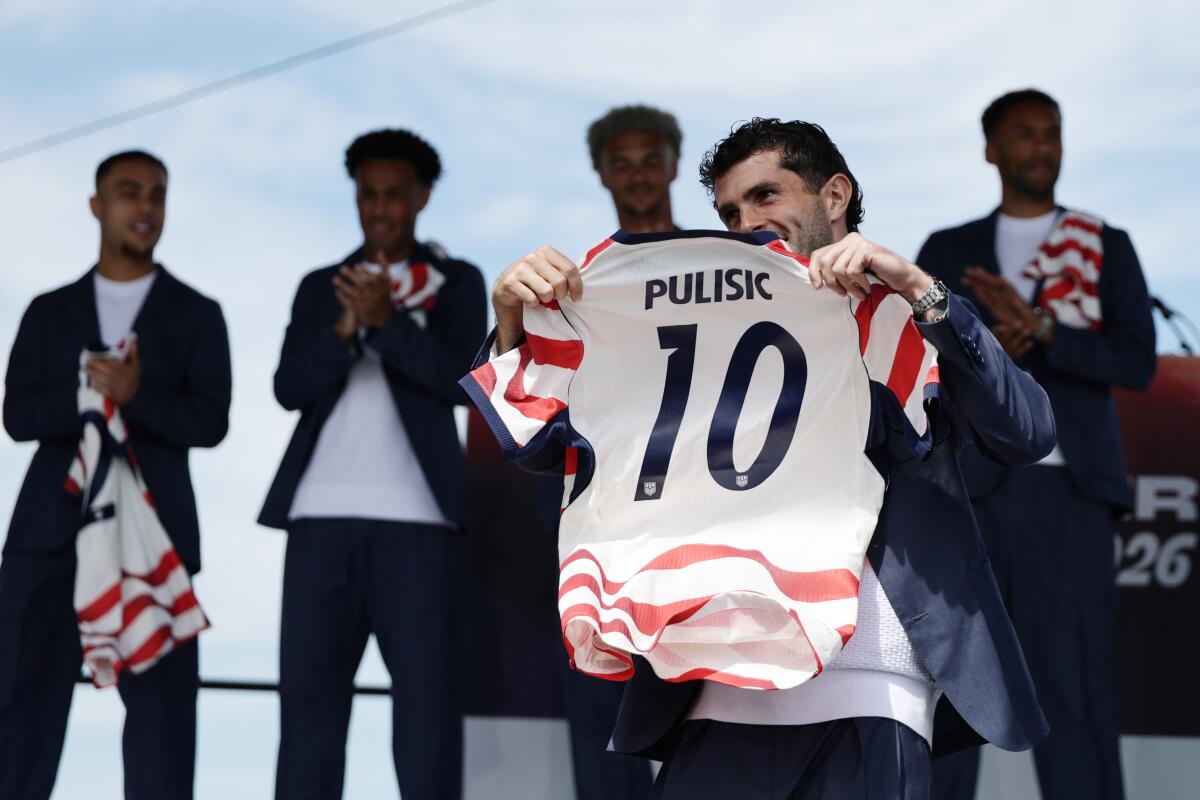
Christian Pulisic holds up his U.S. jersey during a rally Tuesday in New York.
(Adam Hunger / Getty Images)
Ream and Pulisic are two of 13 players who are returning to the World Cup after making the team in Qatar four years ago, part of a list that includes midfielders Tyler Adams, Gio Reyna and Weston McKennie and defenders Sergiño Dest and Antonee Robinson. They will be joined by defenders Miles Robinson and Chris Richards, both of who missed the last World Cup because of injury, and forward Ricardo Pepi, one of the final cuts in 2022.
Richards was chosen despite tearing two ligaments in his left ankle playing for Crystal Palace earlier this month. Pochettino had no new information on the injury Tuesday but said the final World Cup roster doesn’t need to be filed with FIFA until Sunday; after that, teams can replace players up to 24 hours before their opening match in the event of injury or illness.
Reyna’s inclusion was also a minor surprise since he has played just one full 90-minute game for club or country in the last four years. In the last World Cup in Qatar, he was nearly sent home for a perceived lack of effort in training after he learned he wouldn’t be a starter in the tournament.
But Pochettino said picking him was an easy decision.
“I really trust in him,” Pochettino said. “He’s a different player. A different talent. The roster needs to have a player like him.”
There were also notable omissions, among them midfielders Diego Luna and Tanner Tessmann. Luna, who plays in MLS for Real Salt Lake, has been a regular under Pochettino, playing in 17 of the U.S. team’s 18 games in 2025. But he missed time earlier this season with a knee injury and sat out of his club team’s last two games with a muscle problem
Tessmann had been called into six training camps under Pochettino and was seen as a potential starter for the U.S. before being shut down by his French club, Lyon, at the end of the season, leaving his fitness for the World Cup in question.
Pochettino declined to talk about either player — or anyone else left off the team.
“We are not going to talk about the players that are not on the roster,” he said. “That’s disrespectful to the players who are on the roster.”
Raising questions about who should have been included, the coach said, necessarily leads to questions about who should have been left off.
“That was my decision to pick that 26,” he said
Pochettino said he didn’t settle on a roster until the day before players got the WhatsApp videos — or the simple email.
“We wanted the right balance with the right players,” he said.
Among the first-time World Cup selections are midfielder Malik Tillman, the German-born brother of LAFC midfielder Timothy Tillman; Mexican-born attacker Alejandro Zendejas, who plays for Club América in the Liga MX; and Vancouver Whitecaps midfielder Sebastian Berhalter, son of Gregg Berhalter, the U.S. coach in the last World Cup.
Berhalter said he was in Qatar four years ago, cheering on his dad’s team. This year, his dad will be cheering for him.
“If you believe in your dream and put in the work, you never know what might happen,” he said from the stage after being introduced to the crowd at Tuesday’s rally.
The team will open training camp in Atlanta on Wednesday ahead of friendlies with Senegal in Charlotte, N.C., on Sunday and against Germany on June 6 in Chicago. The team will then move to the Orange County Great Park in Irvine for final preparations for its World Cup opener against Paraguay at SoFi Stadium in Inglewood on June 12.
ROSTER
Goalkeepers: Chris Brady (Chicago Fire), Matt Freese (New York City), Matt Turner (New England Revolution)
Defenders: Max Arfsten (Columbus Crew), Sergiño Dest (PSV), Alex Freeman (Villarreal), Mark McKenzie (Toulouse) Tim Ream (Charlotte FC), Chris Richards (Crystal Palace), Antonee Robinson (Fulham), Miles Robinson (FC Cincinnati), Joe Scally (Borussia Mönchengladbach), Auston Trusty (Celtic)
Midfielders: Tyler Adams (AFC Bournemouth), Sebastian Berhalter (Vancouver Whitecaps), Weston McKennie (Juventus), Gio Reyna (Borussia Mönchengladbach), Cristian Roldan (Seattle Sounders), Malik Tillman (Bayer Leverkusen)
Forwards: Brenden Aaronson (Leeds United),Folarin Balogun (AS Monaco), Ricardo Pepi (PSV), Christian Pulisic (AC Milan), Tim Weah (Marseille), Haji Wright (Coventry City), Alejandro Zendejas (Club América)
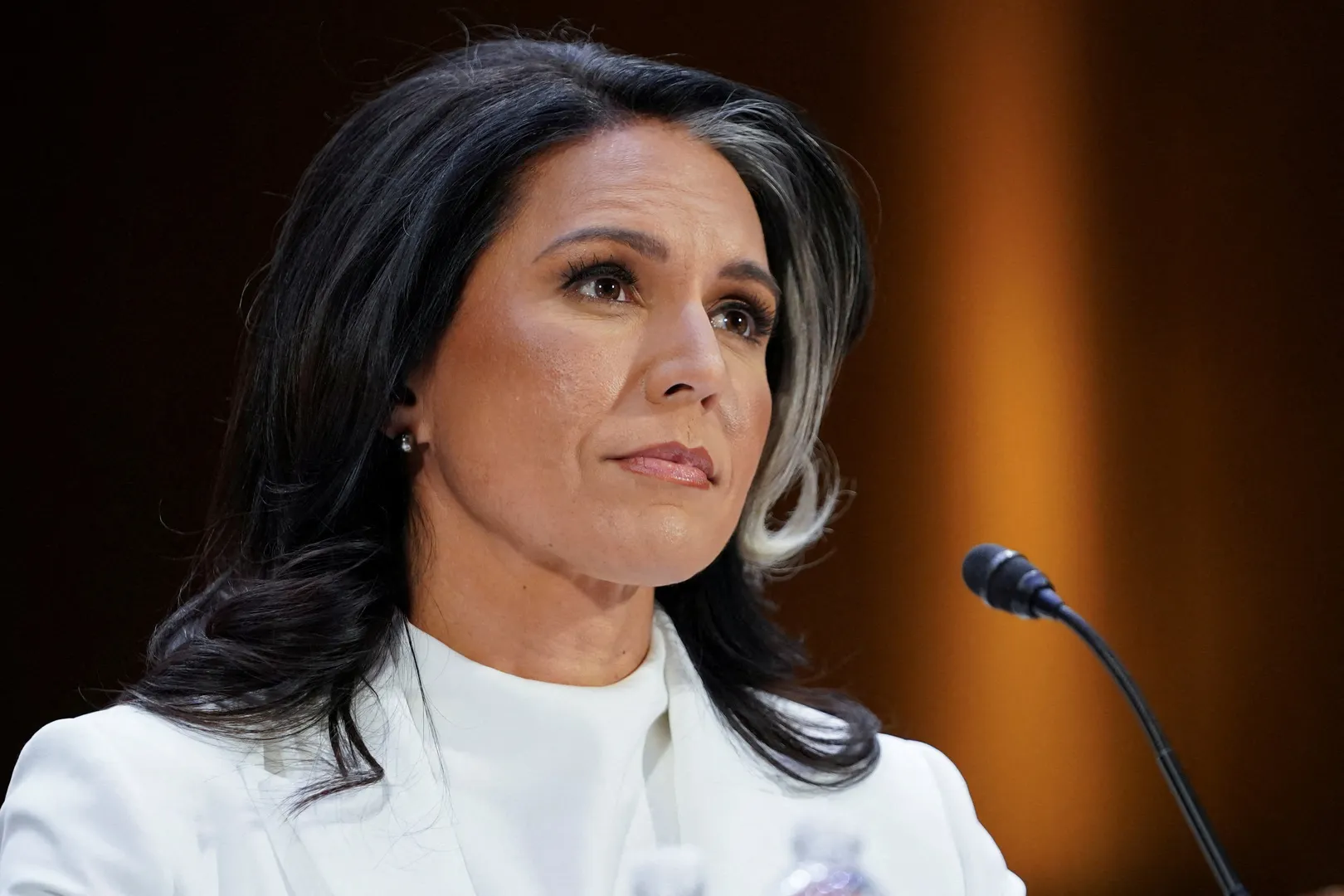
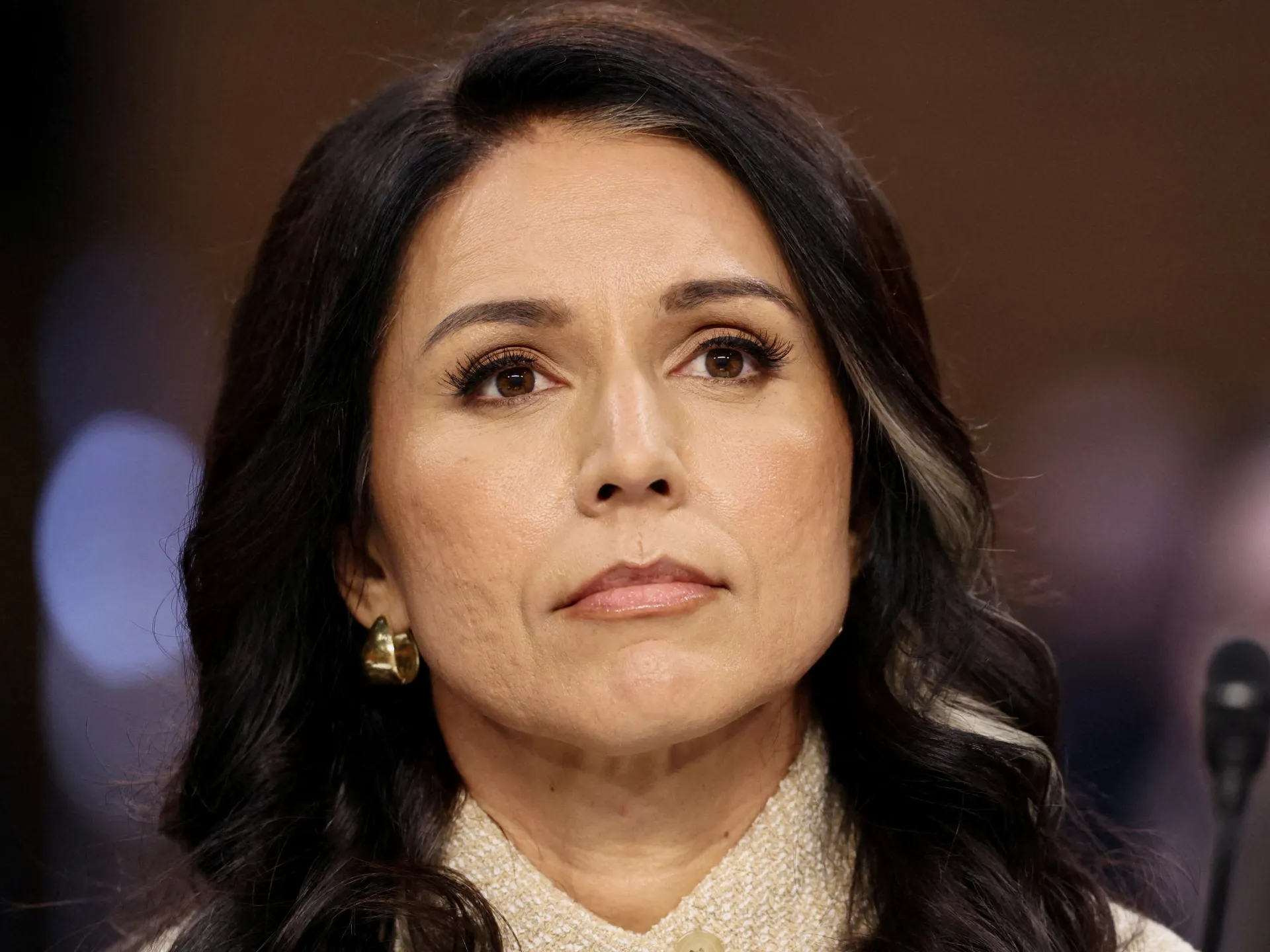
Tulsi Gabbard has resigned as US Director of National Intelligence, citing her husband’s cancer diagnosis. Her departure comes after months of tensions inside President Trump’s administration over foreign policy and intelligence matters, including over the decision to strike Iran.
Tulsi Gabbard is resigning from her job as United States President Donald Trump’s director of national intelligence, according to her resignation letter posted on her X account.
In her resignation letter, Gabbard told Trump she was “deeply grateful for the trust you placed in me and for the opportunity to lead the Office of the Director of National Intelligence for the last year and a half”.
She cited her husband’s recent diagnosis with a rare form of bone cancer as the reason for her resignation.