Dr. Mukesh Kapila, former UN Humanitarian Coordinator for Sudan, warns the current crisis in El Obeid, Sudan could be even worse than what unfolded in El Fasher in 2024-2025. However, he says sustained international attention and Al Jazeera’s continued coverage could help deter the RSF.
Chang Yoon-jeong, deputy spokesperson at South Korea’s Unification Ministry, speaks at a regular briefing in Seoul in this June 26 file photo. File Photo by Yonhap
The unification ministry said Friday it views growing calls to refer to North Korea by its official name as part of a broader effort to build public consensus on the issue.
“The ministry is paying attention to religious leaders’ call for the two Koreas to use each other’s official names,” deputy spokesperson Chang Yoon-jeong said at a regular briefing.
“Since their announcement, we have also noted support from various sectors of society, and we will continue listening to these voices going forward,” she added.
The Korean Council of Religious Leaders said the previous day that genuine peace begins with “acknowledging each other as they are,” urging both South and North Korea to refer to each other using their official names, respectively, the Republic of Korea and the Democratic People’s Republic of Korea.
“Respecting each other’s name is the first step” toward peaceful coexistence, the group said.
Kang Chang-il, vice chair of the Peaceful Unification Advisory Council, a presidential advisory body on unification, echoed the call.
“I would first like to express my deep appreciation for the senior religious leaders who said peace begins with respecting each other’s name,” Kang said Thursday.
South Korea currently uses “North Korea” rather than its official name, “Joson” in Korean, as Seoul does not recognize its ties with North Korea as state-to-state relations under the 1991 inter-Korean Basic Agreement.
The debate has gained momentum in recent months, with senior officials, including Unification Minister Chung Dong-young, raising the need for Seoul to call North Korea by its official name to achieve peaceful coexistence.
Copyright (c) Yonhap News Agency prohibits its content from being redistributed or reprinted without consent, and forbids the content from being learned and used by artificial intelligence systems.
British Prime Minister Keir Starmer formally apologized Thursday to women and their children caught up in a historic forced adoptions scandal in England and Wales over an almost three-decade long period between the 1950s and 1970s. File Photo Betty Laura Zapata/EPA
July 2 (UPI) — Outgoing British Prime Minister Keir Starmer apologized in person Thursday to women and some of their children who were caught up in a historic forced adoptions scandal in England and Wales dating back to the 1950s through the 1970s.
Stamer issued a formal apology on behalf of the British state, calling the taking of an estimated 185,000 babies from unmarried women, railroaded into allowing their children to be put up for adoption, a “stain on our history.”
The shame is not yours. The shame was never yours. The shame is ours,” he said in a statement to the House of Commons after earlier hosting a group of survivors in Downing Street.
“Mothers, many young, vulnerable, and without support were coerced, bullied, or misled into feeling that they had no choice but to have their children taken away from them. What a thing to do,” he said.
Speaking as some of those whose lives were severely impacted watched on from the public gallery, Starmer said that what happened to them and to tens of thousands of mothers, children and families “should never have happened.”
“It is a stain on our history,” he said.
Starmer said the victims had “very powerfully” relayed to him the “gut-wrenching” shame they were made to feel and how it was drummed into them that they were immoral young women whose children would be better off without them.
The experiences stayed with them through their lifetimes, while their children grew up believing they were unwanted, he said.
“We are deeply and profoundly sorry to the mothers who were told they were unfit, who were prevented from caring for the children they desperately wanted to help and to keep, and who have carried this loss for decades,” said Starmer.
Starmer acknowledged that the practice was deliberate and widespread, particularly between 1949 and 1976 when it was, he said, “embedded within systems across local authorities, across voluntary and faith-based institutions, and in health and social care services,” including parts of what is now the National Health Service.
“All institutions that operated with power over people’s lives, yet they did so without compassion, without consent, and without dignity or proper safeguards,” said Starmer.
He said some women, including those placed in Mother and Baby Homes and other institutions, were prevented from seeing their families and partners, denied education and job opportunities and kept in harsh living conditions.
Some of the treatment meted out to the women was tantamount to manipulation and abuse, said Starmer.
Mothers and adoptees campaigned for years for the state to acknowledge wrongdoing but no offer of compensation was forthcoming, although the government has announced a $5.3 million fund to improve access to adoption records and assist family reunions.
Survivor Ann Keen, whose baby son was adopted in 1966 after she was sent to a mother and baby home in Swansea in Wales at the age of 17, told the BBC she had “no say” in the decision.
The former Member of Parliament in the ruling Labour Party, told BBC Radio ahead of Starmer’s statement to lawmakers that she was eagerly anticipating the moment she would finally be “released from my shame.”
WASHINGTON — Former CIA Director John Brennan sued the Trump administration on Wednesday, demanding a court order that would require officials to preserve records from investigations that he says are targeting him for “phantom criminal conduct.”
Brennan said in the lawsuit that the records would be essential for him to mount a defense on vindictive prosecution grounds in the event of an indictment brought by the administration. Such a defense, his lawyers said, would be supported by the more than 100 verbal or written statements that President Trump has made since 2017 lambasting Brennan and by the Republican president’s directives to his Department of Justice to initiate cases “without regard to factual or legal justification.”
“To fully consider those motions, the reviewing judge would need to scrutinize the motivations of the Justice Department officials who directed, oversaw, or undertook those actions to determine whether they violated Director Brennan’s rights, and specifically whether they were motivated by a desire to vindictively prosecute him as an act of retribution,” Brennan’s lawyers wrote in the lawsuit filed in federal court in Washington.
The lawsuit names as defendants Trump and other top law enforcement officials from his administration, including acting Atty. Gen. Todd Blanche, FBI Director Kash Patel and the prosecutors in Florida who have been overseeing investigations related to Brennan and other perceived Trump adversaries.
The lawsuit says Brennan is facing separate investigations in Florida, including one examining whether he made a false statement to Congress related to an assessment by intelligence agencies documenting Russian interference in the 2016 presidential election, in which Trump defeated Democrat Hillary Clinton. The other investigation aims to determine whether former law enforcement and intelligence officials conspired to undermine Trump, including during the course of the Russian interference investigation.
No charges have been brought. The Department of Justice has denied claims of weaponization.
Weekly insights and analysis on the latest developments in military technology, strategy, and foreign policy.
The U.S. military has now confirmed the acceptance of at least six F-35 Joint Strike Fighters for the U.S. Marine Corps without radars. This is due to issues tied to the development of the new AN/APG-85 radar, the first production lot of which is scheduled to be delivered in 2028. The prospect of radarless F-35s had first emerged publicly back in February. The AN/APG-85 is a critical component of the larger Block 4 upgrade package for all variants of the F-35, an effort that has been mired in cost growth and delays.
Marine Corps Lt. Gen. Gregory Masiello, head of the F-35 Joint Program Office (JPO), disclosed the acceptance of the six radarless F-35Bs at a hearing before members of the Senate Armed Services Committee earlier this week. This came as part of a larger back-and-forth between Masiello and Senator Mark Kelly, an Arizona Democrat and a retired naval aviator, about F-35 readiness rates across the U.S. Air Force, Marine Corps, and Navy, which have long been a point of concern.
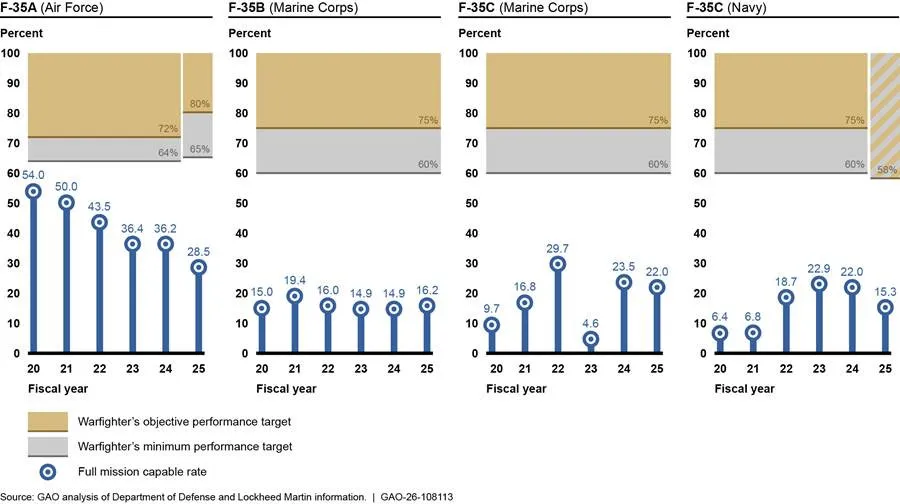
Two weeks ago, the Government Accountability Office (GAO), a Congressional watchdog, released a report stating that the average F-35 full mission capable (FMC) rate across all variants had fallen from 38 to 25 percent between Fiscal Years 2020 and 2025. GAO defines FMC as an aircraft “that can perform all of its missions.” The F-35 JPO has not disputed GAO’s figures directly, but has openly disagreed with the methodology it uses to determine FMC.
The full breakdown of Full Mission Capable (FMC) readiness rates between Fiscal Years 2020 and 2025 for all F-35 variants included the report GAO released two weeks ago. GAO
“So, the GAO FMC rate is, they said, 25 percent. Your office claims it’s 56 percent,” Kelly said, leading up to his question. “We’ll go with your number, 50 percent. So, half of the airplanes are not fully mission capable, and I think it’s the Marine Corps that has been accepting airplanes with no radar in it. Is that correct?”
“We have accepted six aircraft for the Marine Corps that do not have a radar installed. That is correct,” Masiello confirmed.
Kelly then asked if this was due to a lack of available AN/APG-85 radars, which Masiello also confirmed.
US Marine Corps F-35Bs. USMCA US Marine Corps F-35C seen on the deck of the US Navy’s Nimitz class aircraft carrier USS Abraham Lincoln. CENTCOM
“The Block 4 modernization program is necessary to ensure that the Marine Corps and Joint Force can continue to project air superiority against future threats,” a Marine Corps spokesperson told TWZ today when asked for more information. “The Department of War deliberately undertook a highly concurrent development and production program for Block 4 capabilities (Technical Refresh 3 (TR-3), APG-85, etc.) and the largest fighter aircraft production line in the world. DoW officials made this decision with full understanding of the risk of having production aircraft ready ahead of the Block 4 capabilities. The Services’ decision ensured that production aircraft could accept Block 4 capabilities, rather than continuing to build Block 3 F-35s that would require extensive retrofit for Block 4 capabilities, thereby saving multiple years of retrofit hardware installation. ”
The Marine Corps deferred any further questions to the F-35 JPO. TWZ had already reached out to that office for more information, as well.
“F-35 Lightning II aircraft are being built to accommodate the F-35 advanced radar (APG-85) for U.S. Air Force, Navy, and Marine Corps. When delivered, the F-35 with APG-85 will provide unmatched capability against current and future threats. Initial fielding for some F-35 aircraft is planned for Lot 17,” the F-35 JPO previously told TWZ in May when asked for an update on the radar situation. “The Program in coordination with the Services deliberately undertook a highly concurrent development and production program for advanced capabilities. This decision was made with full understanding of the risk of having production aircraft ready ahead of the capabilities.”
A view of Lockheed Martin’s F-35 production line. Lockheed Martin
“The program has plans to accelerate APG-85 production capacity to deliver radars that meet capability, stability, and maintainability requirements needed to meet emerging threats,” the office added at that time. “F-35s with APG-85 radars, actual modernization plans, capabilities, and schedules remain classified to maintain program security.”
The F-35 JPO had provided TWZ with a similar statement when asked about whether radarless F-35s were already being accepted back in February.
In February, the U.S. Air Force also explicitly denied receiving F-35As without radars. There is no confirmation yet that the F-35 JPO has accepted any Joint Strike Fighters for the Air Force or the Navy without radars. Previous reports have said that foreign customers are not expected to be impacted at all, at least in the near-term, since none of them are currently in line to receive AN/APG-85-equipped jets.
Today, the standard radar in use on F-35A, B, and C variants is the AN/APG-81, an active electronically scanned array (AESA) type with air-to-air and air-to-ground modes that traces its roots back to the 1990s. It also has a synthetic aperture radar (SAR) mode, which allows it to produce high-resolution map-like images. These can be used for target acquisition and identification, as well as general reconnaissance purposes.
A Lockheed Martin briefing slide giving a general overview of the capabilities the APG-81 provides the F-35. Lockheed MartinExamples of the existing APG-81’s SAR mapping capability. Lockheed Martin
Details about the new AN/APG-85, which Northrop Grumman is developing, continue to be limited. At the hearing this week, Lt. Gen. Masiello declined to talk about its specific capabilities in an unclassified setting.
The AN/APG-85 is also an AESA design, and is expected to offer an array of new and improved functionality compared to the AN/APG-81. As TWZ has previously noted, it will also just be able to leverage decades of additional general technological advancements since its predecessor was developed. In general, the use of gallium nitride (GaN) has had a major impact on modern radar developments when it comes to physical size, weight, and power requirements.
Another briefing slide offering a general overview of the fusion of sensors and other systems on existing F-35s. Lockheed Martin
As the F-35 JPO noted in its statement in May, the plan had been to start integrating the AN/APG-85 onto F-35s starting with production Lot 17. Deliveries of aircraft from that lot began last year. However, per official budget documents released earlier this year, the first production AN/APG-85s are not expected to be delivered before April 2028. This would actually be a nine-month improvement on the much-delayed delivery timeline for the new radars, the unit cost of which is currently pegged at nearly $9 million.
A compounding factor here is that the hardware used to mount the AN/APG-85 on the F-35 is not backwards compatible with the AN/APG-81. According to a report last year from Breaking Defense, the Joint Strike Fighter’s prime contractor, Lockheed Martin, has reportedly at least raised the possibility of developing a common mounting solution, but also said that this would not be ready before Lot 20 aircraft start being delivered. The first Lot 20 jets are not expected to arrive until sometime between 2027 and 2028.
A row of APG-81 radars. Northrop Grumman
How the Marine Corps, or any other service, might utilize its radarless F-35s in the meantime is unknown. This was among our queries to the Marines today.
“The currently fielded Block 3 (TR-2) F-35 Lightning II is the most capable fighter in the world today, having proven its capabilities in combat,” the Marine Corps spokesperson added in their statement. “Its advanced mission systems enable the F-35 to deter, and if necessary, dominate in any clime and place.”
Senator Kelly also prodded Lt. Gen. Masiello about this, indirectly, at the hearing this week.
“So, I assume that those airplanes can’t count as fully mission capable with no radar?” Kelly asked the JPO head.
“I don’t think I would count them as fully mission capable,” Masiello said in response.
“You say you don’t think. I can’t imagine a scenario where an F-35 with no radar could be an FMC airplane,” Kelly retorted, which Masiello did not push back on.
A US Air Force F-35A heads out on a sortie in support of Operation Epic Fury against Iran in March 2026. USAF
TWZ has previously noted that F-35s without radars would not be completely useless, but their capabilities and survivability would certainly be severely degraded. As we previously wrote:
“As long as one F-35 in a formation has a radar, all of the other aircraft in said group should be able to benefit from the data it provides via their Multifunction Advanced Data Links (MADL). As such, even without a radar installed, a Joint Strike Fighter would not be without F-35-derived radar data if at least one other was flying cooperatively with it within MADL’s transmission reach.“
“It is possible that radar-less jets could be sent into combat, at least in an emergency scenario, though doing so would still require accepting greater risks. It would limit tactical flexibility, as well, since remaining linked together with other radar-equipped jets would be key. Those jets would also have to rely on using their radars more heavily, which can be a vulnerability. The F-35 also has a host of passive sensors that it can rely on for battlespace information, although none are capable of replacing the radar’s functionality. Data from other platforms transmitted via Link 16 is also available to all F-35 pilots.“
“Maybe one of the biggest issues with having no radar is that it is a major part of the jet’s electronic warfare suite. Its ability to transmit narrow, extremely powerful beams of energy adds to the jet’s potent electronic attack capability. So, without the radar, its ability to defend itself and others by leveraging the electromagnetic spectrum is also curbed.“
Remarks from Lt. Gen. Masiello at the hearing this week also raise new concerns about the capabilities that the AN/APG-85 radars will offer even when they do finally start being integrated onto F-35s. This is tied to what it will take to sufficiently cool the radar and other elements of the Block 4 upgrade package. Thermal management is another long-standing issue for all variants of the F-35, which has already had major negative impacts on readiness rates and maintenance demands, as you can read about in more detail here.
An F-35 takes off with its afterburner engaged. Lockheed Martin
“So, right now, you’re cooling, you got about 30 kilowatts [of cooling],” Senator Kelly said as part of another question posed to the head of the F-35 JPO. “Block 4 requires 32 [kilowatts of cooling], is what I have here. But to get to the cooling needed to – for the full capability of the APG-85, needs to be somewhat higher, it seems like 62 kilowatts of cooling?”
“The requirement that we have for the program going forward is 62 to 80 [kilowatts of cooling],” Masiello said in response. “The challenge I see is if the totality of Block 4, when it’s installed, and on the aircraft, it takes the complete power available, which is 32 [kilowatts].”
“There’s no margin, which as you know, is not a smart way to go,” he continued. “So, we have an incremental approach to increase that. And we have an ongoing program to look at a more systemic and affordable upgrade to the power thermal management across the program.”
“For the engine core upgrade that we anticipate and have asked for additional funding on that, we anticipate that being fielded in 2031, and it will come with a marginal increase in the power thermal management,” he explained. “The actual system that’s under review and looking for the forward program will come a few years later into the system, which is when we would have the additional capabilities beyond Block 4, not yet to be determined that will require that.”
Pratt & Whitney F135 engines for the F-35. Pratt & Whitney
At the same time, as Masiello himself acknowledged, the current plan offers no margin when it comes to cooling before the PTMS upgrade is available. In response to further questioning by Senator Kelly, he declined to speak in an unclassified setting about what that might mean for the initial fielding of the AN/APG-85 radar.
As noted, the entire Block 4 upgrade effort continues to be beset by delays and cost growth, despite efforts to reorganize and accelerate certain components thereof. As of September 2025, the schedule for delivery of a truncated portion of the upgrade package was still running five years behind, according to GAO. The original goal had been for F-35s with the full suite of Block 4 improvements to begin arriving this year.
The F-35 program as a whole continues to face growing costs and other challenges associated with operating and maintaining the jets, which are key factors in the low readiness rates of all variants in service today. Spare parts shortages have been a particularly persistent and serious problem, as you can learn more about in this past TWZ feature.
US Air Force F-35As undergoing maintenance. USAF
“That is now what we’re putting forth is the requirement, which is the reason why, in this generational investment of the 2027 budget will help us. So, we will fill up the available parts,” Lt. Gen. Masiello also said at the hearing this week. “It’s not a systemic issue with the system having the ability. It’s the fact that we didn’t put enough parts and pieces on the shelf. And we’ve increased the demand exponentially with the number of aircraft fielded, and we didn’t do the same thing with the spare parts and the system.”
As of last year, the total project cost of the entire program, from initial development in the 1990s through the end of the type’s expected lifecycle in the 2070s, was pegged at $2.1 trillion. The JPO has stressed in the past that this figure includes the acquisition of thousands of jets and that inflation is expected to account for roughly half of the total cost.
When it comes to the continuing saga of the AN/APG-85, F-35s are now being delivered without any radars, and it could be years still before that changes.
June 26 (UPI) — A Federal Emergency Management Agency official who claims he was once teleported to a Waffle House has been ousted from the agency, unnamed sources familiar with the situation told media outlets Friday.
Gregg Phillips, who was appointed to lead the Office of Response and Recovery in December, was asked to vacate his position because of concerns about how he’s publicly perceived, anonymous sources told The New York Times, The Washington Post and CNN.
Phillips, the associate administrator for FEMA’s Office of Response and Recovery, posted on social media in April doubling down on his teleportation claim. He said it really happened and that it is connected to his Christianity.
“God will not be mocked,” Phillips posted on Truth Social. “People can debate me. Question me. Even ridicule what they don’t understand.”
He clarified that it happened while he was heavily medicated during cancer treatment.
“The word ‘teleportation’ was not mine,” Phillips posted on Truth Social. “It was used by someone else in the conversation reaching for language to describe something with no easy name. The more accurate biblical terms are ‘translated’ or ‘transported’ — not new ideas for people of faith.”
The Department of Homeland Security confirmed Thursday that Phillips is leaving the agency, saying he is taking leave for personal reasons. But sources told CNN the departure was not by his choice.
New DHS leadership was tired of his public image and clashes with department leadership, the sources said. David Arnold, a senior official who left FEMA earlier this year, will fill in as an acting leader of the Office of Response and Recovery.
The office has more than 1,000 employees and a budget of nearly $300 million. It’s critical to the mission of responding to disasters.
Phillips was known as a conspiracy theorist, particularly concerning election fraud. He said millions of noncitizens had voted in the 2016 election. Trump also boosted those claims.
Some agency staff were unhappy with his ouster, saying he wanted to help improve the agency.
“He showed interest in preserving the mission of the agency and helping us serve citizens,” one current agency official told The Post.
Another agency official told The Post that Phillips was one of the only political appointees who supported staff and would push back against leadership such as former Homeland Security Secretary Kristi Noem or Karen Evans, who briefly led FEMA.
White House Border Czar Tom Homan speaks during the Faith and Freedom Coalition 2026 Road to Majority Policy Conference at the Washington Hilton on Friday. Photo by Bonnie Cash/UPI | License Photo
Indiana Fever star Caitlin Clark called out officials following her team’s 86-77 win over the Phoenix Mercury on Monday. She was one of five players assessed technical fouls amid a fourth-quarter dustup that also involved former teammate DeWanna Bonner.
Clark was called for a personal foul at the 7:57 mark in the fourth quarter after getting tangled up with Bonner, who was trying to post up near the free-throw line. The two exchanged some words before things escalated as their teammates got involved. Clark appeared flabbergasted when she learned she received a technical foul for clapping while her teammate Myisha Hines-Allen and the Mercury’s Alyssa Thomas were in each other’s faces.
Bonner, Thomas, Hines-Allen and Fever guard Sophie Cunningham were also assessed technical fouls for their actions during the scuffle. Hines-Allen was later ejected from the game after earning another technical foul for pushing Thomas after being called for a foul in the very next play.
This marks Clark’s fifth technical of the season so far. Players who rack up eight technical fouls in a season must serve a one-game suspension.
“It’s ridiculous. I got a tech for clapping,” Clark said after the game. “We should all just go on the calendar now and pick a game that I’m going to be suspended for if I’m going to get technicals for clapping.
“If any technicals should be taken away, it should be that one,” Clark added. “I don’t understand it at all. … I’m going to play with emotion. I’m going to play with passion. And if they’re going to give me a technical foul for clapping, then so be it. That’s their choice.”
Caitlin Clark reacts during Monday’s game between the Indiana Fever and the Phoenix Mercury.
(Michael Hickey / Getty Images)
This was not the first time this season the two-time All-Star has been seen clapping toward other players or officials during a game. None of the previous occasions resulted in Clark receiving a technical foul. The star guard has been receiving more attention this season for her behavior during games outside of her play. The Fever reportedly plan to appeal the technical foul.
Clark led all scorers with 24 points while also dishing out nine assists in the Fever win, while Kelsey Mitchell added 22 points. For the Mercury, Kahleah Copper led with 20 points, while Thomas had 19 points, five rebounds and nine assists.
Bonner, a two-time WNBA champion, had signed a one-year contract with the Fever last season. She played in just nine games before parting ways with the team and eventually rejoining the Mercury, where she started her career. Fever fans could be heard booing Bonner at various times during Monday’s game at Gainbridge Fieldhouse in Indianapolis.
Fever coach Stephanie White said that Clark has to be aware of her technical fouls and that “there are some that we could do without.”
“There are natural things that happen that the energy of the game creates when you do get those,” White said. “But there are some that we can be a little bit more in control of. So, yes, we’ll continue to remind her, and I think she has to have an awareness.”
She also brushed off the incident as something “that … happens” in “a competitive sport.”
“As a group, we have to be able to have our moment and then regroup and play with poise and composure. It can’t continue to go on,” White said.
Dallas Wing guard Paige Bueckers and Golden State Valkyries forward Janelle Salaün are among the other players who have been assessed technical fouls this season for clapping after a play. Neither incidents involved taunting players from the opposing team, and both of those techs have reportedly been rescinded.
Liam Payne’s 9-year-old son has inherited the late singer’s fortune.
Bear Grey Payne, the only child of Payne and British singer and former “X-Factor” judge Cheryl Cole, has been named the sole beneficiary of the former One Direction star’s estate, according to court documents reviewed by People.
Bear now has more than $29 million to his name. According to the filing, a portion of the inheritance can be accessed now, but the majority will be held in a trust for another nine years, until Bear turns 18.
During a 2019 appearance on “The Jonathan Ross Show,” Payne opened up about fatherhood and spending time with Bear after the singer and Cole had called it quits.
“He comes over to my house every so often, and we just hang out and do whatever,” Payne said of his then-2-year-old son. “I think you put pressure on yourself as a dad sometimes. It’s hard to connect with it with a 2-year-old … but they literally will laugh at anything. We put this Batman costume on him in the house, and it was a little bit slidey on the floor, and he kept falling off the sofa. And if I said ‘Whoopsie-daisy!’ and it was like the best thing ever.”
Payne, who was one-fifth of the global boy-band sensation One Direction, died Oct. 16, 2024, after falling from a balcony at the CasaSur Palermo Hotel. Officials determined the 31-year-old singer died from multiple traumas caused by the fall. He had traces of alcohol, several narcotics and a prescription antidepressant in his system when died, according to officials.
The boy-band star turned solo artist had been open about his battle with addiction and mental health and shared updates on his sobriety journey on social media.
After Payne’s death, the National Criminal and Correctional Prosecutor’s Office of Argentina charged five people for alleged involvement in the pop singer’s death, including a representative for Payne and the manager and the head of reception of the Buenos Aires hotel where the British singer fell to his death.
Another hotel employee and a waiter whom Payne met in a restaurant were charged with supplying the singer with narcotics.
Times staff writers Alexandra Del Rosario and Karen Garcia contributed to this report.
The chief of the White House World Cup task force says it’s “pretty amazing” Iran’s football team has been given visas for the tournament. Andrew Giuliani defended the US’s treatment of the team, which has been forced to base itself in Mexico and fly in and out for matches.
Travel industry specialists regularly caution that holidaymakers risk being refused boarding(Image: SolStock via Getty Images)
Millions of Brits planning a summer break are being told to observe a vital passport “3-week rule” following a new alert from His Majesty’s Passport Office.
The government body says that holidaymakers should allow a minimum of three weeks for their passport application to be handled and has cautioned that certain cases may take longer if further checks are needed. The reminder arrives as families gear up to travel abroad during the busy holiday period, when demand for passport renewals typically surges.
In a message to travellers, His Majesty’s Passport Office said: “Sun, sea & stress-free travel. Apply early – UK passports usually arrive within 3 weeks (longer if checks needed).”
Official guidance confirms that standard passport applications lodged in the UK are normally processed within three weeks from when the Passport Office receives the necessary documents. Nevertheless, officials emphasise that not every application can be completed within that window.
Government guidance states: “You’ll usually get your passport within 3 weeks. It may take longer than 3 weeks if we need more information, or we need to interview you. We’ll tell you this within 3 weeks.”
The Passport Office is also cautioning Brits against booking holidays before their new passport has been delivered. Its guidance states: “Do not book travel until you have a valid passport – your new passport will not have the same number as your old one.”
The guidance is especially important for travellers whose passport is set to run out before a planned journey.
Following Britain’s exit from the European Union, numerous European countries now insist that British passports must have been issued in the last 10 years and retain at least three months’ validity on the date of leaving the nation you’re visiting.
Travel industry specialists regularly caution that holidaymakers risk being refused boarding if their passport fails to satisfy their destination’s entry criteria.
Britons requiring a passport with greater urgency might be eligible to utilise the Passport Office’s premium services, such as the Online Premium and One Week Fast Track alternatives, though these come at a higher cost than the conventional application route.
Passport applications can be lodged online or via a paper form obtainable from Post Office branches, although paper submissions incur an extra charge.
Those who have already submitted their application can monitor its progress using the Government’s online passport tracking service.
Content cannot be displayed without consent
Passport processing times.
The standard UK passport application service generally takes up to three weeks for completion. For individuals needing a passport more swiftly, the One Week Fast Track service aims to deliver a passport within seven days.
Travellers who need a passport straight away can opt for the Online Premium service, which provides a same-day appointment and passport collection. The Passport Office confirms that processing times only commence once all required documents have been received, which means any hold-ups in providing paperwork can prolong the total time needed to obtain a new passport. Further information is available here.
Former Japanese Prime Minister Yasuo Fukuda (2-L) speaks during the 2024 Jeju Forum for peace and prosperity at a convention center on the country’s southern Jeju Island, South Korea. Photo by YONHAP / EPA
June 19 (Asia Today) — Former North Korean diplomats have alleged that a North Korean education specialist affiliated with UNESCO and being considered as a speaker at an international forum in South Korea may be connected to Pyongyang’s intelligence apparatus.
Jang Kwang-chol is under consideration to participate by video in a session titled “UNESCO and the Future of Education: Challenges and Prospects” at the 21st Jeju Forum for Peace and Prosperity, according to forum organizers.
The forum, jointly hosted by South Korea’s Foreign Ministry, the Jeju provincial government and other organizations, is scheduled to take place from Wednesday through June 26 at Haevichi Hotel & Resort Jeju and Jeju Stone Park.
The former diplomats’ allegations regarding Jang could not be independently verified. Neither UNESCO nor the North Korean government was quoted as responding to the claims.
Several former North Korean diplomats said Pyongyang selects Foreign Ministry officials for assignments at United Nations agencies to secure international assistance, collect information about foreign governments and South Korea and earn foreign currency.
They alleged that officials selected for such work sometimes receive fabricated or altered professional backgrounds tailored to the agency where they will serve.
Before deployment, the officials may formally transfer their affiliation to an intelligence organization such as North Korea’s Reconnaissance General Bureau, the former diplomats claimed. Such an arrangement, they said, allows the officials to operate with greater independence than ordinary North Korean diplomats.
UNESCO materials identify Jang as an education specialist who earned a doctorate in education from Kim Hyong Jik University of Education and previously worked for North Korea’s Education Ministry.
The former diplomats alleged that at least part of that professional background could serve as a cover for intelligence-gathering duties.
Ko Young-hwan, a former first secretary at the North Korean Embassy in the Republic of Congo, told Asia Today that North Korea has frequently dispatched what it calls international civil servants to U.N. organizations.
“When they were sent abroad in the past, their affiliations were transferred to organizations under the Workers’ Party, such as the United Front Department or the External Information Investigation Department, also known as Office 35,” Ko said.
“After those organizations were consolidated, I understand that their affiliations were transferred to the Reconnaissance General Bureau.”
Ko, who later headed South Korea’s National Institute for Unification Education, said he believed Jang could fall into that category.
North Korea created the Reconnaissance General Bureau in 2009 by combining intelligence and operational units that had previously been divided among the Workers’ Party and the military.
South Korean authorities have described the bureau as North Korea’s principal organization for overseas intelligence collection, cyber operations and clandestine activities.
Former North Korean diplomats also said officials assigned to international organizations operate with fewer restrictions than diplomats posted to embassies.
Ko recalled an official who worked at UNESCO headquarters in Paris while he was serving in the North Korean Foreign Ministry.
“He attended a weekly self-criticism session at the embassy only once a week and did not have to report unless something unusual occurred,” Ko said.
Ryu Hyun-woo, a former acting North Korean ambassador to Kuwait, said such officials can operate independently under special circumstances.
“They are diplomats who act alone in exceptional situations,” Ryu said. “I understand that they receive separate, specialized training before being dispatched.”
The Jeju Forum’s organizers said education innovation is one of this year’s major themes and that Jang is being considered because he is a UNESCO-affiliated official suited to the education session.
The organizers have not publicly suggested that his proposed participation is connected to intelligence activity.
Some observers, however, have interpreted the invitation as a possible attempt to reopen communication with North Korea amid strained inter-Korean relations.
The outreach comes after the Jeju provincial government provided North Korea with about 160 million won ($116,000) worth of agricultural and medical supplies, including hallabong citrus seedlings, chemicals used to combat pine wilt disease and kidney dialysis equipment.
The provincial government’s North Korea assistance program has also drawn scrutiny following reports that Jeju Gov. Oh Young-hun had contact with Ri Ho-nam, a former counselor at the North Korean Embassy in Beijing who has been identified by South Korean sources as an operative involved in inter-Korean affairs.
No evidence was presented in the article showing that Jang had engaged in espionage or other illegal activity in connection with the Jeju Forum.
Mehdi Torabi issued a new visa after previous one expired when team returned to Mexico following the New Zealand game.
Published On 16 Jun 202616 Jun 2026
United States officials have confirmed that Iran’s team will have to leave the country within hours of the full-time whistle at their World Cup group games in Los Angeles and Seattle.
“We were clear this was the process,” Andrew Giuliani, the executive director of the White House FIFA Task Force, told The Associated Press news agency.
Team Melli drew with New Zealand in a politically charged Group G game in Los Angeles on Monday following months of uncertainty over the team’s participation in the World Cup amid the US-Israel war on Iran.
The Iranian delegation left the US hours after the match ended at about 8pm local time (03:00 GMT) and returned to their base camp in Mexico, prompting criticism of the US handling of their visas as the team did not get a day to recover at their hotel.
Iran coach Amir Ghalenoei said after the match that his team had been ordered to leave the US and return to Mexico only a few hours later. Ghalenoei said the team had expected to spend the night in California to maximise the normal recovery process after their opening game.
The US faced further pushback as Iran winger Mehdi Torabi’s entry visa expired after the first game. Team officials confirmed Tuesday afternoon that they had secured him a new, multiple-entry visa allowing him to travel into the US for future matches.
“This issue has been resolved,” the US Department of State said.
“As soon as we became aware of the issue, we worked to ensure that the player can participate in every game.”
Mehdi Torabi, number 16, was issued a new visa after his previous one expired following the first game [Gary Vasquez/Reuters]
Giuliani said during an interview broadcast Monday night on CBS News that some of the Iranian team’s support staff and team officials were denied entry into the US, but all the players and coaches had received visas.
He also outlined the conditions by which the Iranian team would be able to come into the US for their games.
“The team will be allowed to come in, match day minus one, so the day before the match. They’ll be asked to leave the day that the match wraps up, so the evening of the match. And they’ll be able to do that again in Los Angeles. They’ll be able to do it again in Seattle,” Giuliani said.
When asked about why some support staff and team officials had been denied entry, Giuliani wouldn’t go into details but referred to previous comments made by Secretary of State Marco Rubio about denying entry to people with direct ties to Iran’s Islamic Revolutionary Guard Corps (IRGC).
“Secretary Rubio said very clearly: Anybody with direct ties to the IRGC is not coming into the United States of America, and they’re not going to let the World Cup be the reason why they can come in,” Giuliani said. “So I think it’s very clear why.”
Iran captain Mehdi Taremi said the team endured five hours of travel and security checks during what’s normally a very short trip from Tijuana to the Los Angeles area on Sunday.
“I think FIFA have to help us more than this,” Taremi said.
WASHINGTON — While millions of soccer fans cheer or groan over World Cup matches spanning North America, health officials are on high alert for germs.
A heat wave may be the most obvious health threat. But infectious diseases can spread in a crowd, and experts are scrutinizing wastewater, hospital visits, even social media for any signs that an outbreak might be brewing.
Measles, one of the most contagious diseases, is among the top concerns, sparking a warning this week from the Pan American Health Organization, PAHO. With a nearly six-week stretch of packed stadiums, bars and tourist sites in 16 cities, officials are on the lookout for a long list of infections, from the stomach bug norovirus to mosquito-borne dengue fever.
“This is truly a marathon,” said Palak Raval-Nelson, Philadelphia’s health commissioner.
The mass gatherings come at a tense moment for budget-strapped health agencies in the U.S. The Centers for Disease Control and Prevention, hit hard by Trump administration staffing cuts, already was grappling with a growing Ebola outbreak in central Africa and a cruise ship hantavirus outbreak. While CDC officials have advised state and local health departments behind the scenes, it’s expected World Cup disease surveillance dashboard still was “in final development” days before games began, according to the Department of Health and Human Services.
“Our public health professionals are pretty stretched,” said global health specialist Rebecca Katz of Georgetown University, who is leading an unusual new hub to help.
At the Health Security Operations Center, a joint effort between Georgetown and MedStar Health, workers are analyzing data from around the country so they can alert health authorities, even emergency rooms, to any early signs of trouble. The center is issuing daily “situation reports” about disease trends around World Cup host cities and team base camps to several hundred local and federal public health groups, emergency management and hospital officials and others who’ve signed up.
“It’s important that we don’t become alarmist,” said MedStar emergency medicine specialist Dr. Shane Kappler. “We’re trying to be the insurance policy.”
Measles is a top concern for potential World Cup spread
Already more than 2,000 people in the U.S. have come down with measles this year, nearly as many as during all of last year, according to the CDC. Patients can spread measles before the rash appears and they realize they’re sick. Not too long ago, the U.S. seldom saw measles except from international travel by unvaccinated people.
Now with frequent U.S. outbreaks, “actually a lot of our international partners are worried about measles being exported to them after the games,” said Georgetown’s Katz.
Measles is spreading in Canada, too, and has exceeded 11,000 cases in Mexico, according to PAHO. It’s urging soccer fans to be sure they’re vaccinated, with a health campaign saying a single measles patient can spread the virus to up to 18 unprotected people.
Is Ebola a concern at the World Cup?
Brown University’s Dr. Craig Spencer, who survived Ebola while working in the West Africa outbreak over a decade ago, said he’s repeatedly asked about the risk of Ebola during the World Cup — but “for me, Ebola is not the No. 1 or No. 2 or even No. 3 threat.”
“I am concerned about importation of measles, I am much more concerned about the importation of other infectious threats that may not seem as scary to us as Ebola,” Spencer said.
Many health experts agree that the risk of Ebola spreading in the U.S. is very low. That’s partly because of government travel screenings and restrictions on people recently in outbreak-affected areas. Moreover, Ebola spreads by contact with bodily fluids from someone showing symptoms, not through the air like measles or respiratory viruses.
“One fortunate thing about this virus is you’re most contagious when you’re really quite ill. It’s not like COVID, where you could be sitting next to someone who doesn’t even know they’re infected and perhaps contract the virus,” said Jennifer Nuzzo, director of Brown’s Pandemic Center.
How to spot brewing diseases
There’s precedent for germs invading major sporting events. Canadian scientists linked a community measles outbreak to the 2010 Olympics in Vancouver, and clusters of norovirus had to be contained during the Olympics this year in Milan and in 2018 in South Korea.
One way to detect signs of trouble: People with certain viral or bacterial infections shed genetic material that sophisticated testing of wastewater can spot. For example, measles can appear in wastewater days before an emergency room sees its first patients.
A recent surveillance reports from Katz’s center note that wastewater testing recently found diarrhea-causing rotavirus, hepatitis A and norovirus in some parts of the U.S., something to watch as soccer crowds arrive.
In Dallas, officials ramped up wastewater screening including at the international airport, casting a wide net rather than looking for specific illnesses, said Dr. Phil Huang, director of Dallas County Health and Human Services.
His team also is enhancing the usual mosquito testing, checking not just for West Nile virus that regularly spreads in the U.S. but for viruses more common in other countries like dengue and chikungunya.
Public health officials have been preparing for months, said Philadelphia’s Raval-Nelson, including with mock emergency drills and communications with counterparts around the country.
“I don’t want to send a message that there’s one key thing,” she said. “We have the frameworks in place to carry out what we need to.”
Reese had established position in the paint nearly four minutes into the third quarter when she was passed the ball. Harrison reached over and tackled her to the floor. Reese’s teammates immediately jumped in to separate the two players.
The takedown occurred with around 6:05 left in the third quarter, while the Dream were leading 52-42. Officials reviewed the play and Harrison was assessed a Flagrant 2 foul for contact that was deemed “unnecessary and excessive” and ejected from the game.
Harrison, who was drafted in 2015, was the leading scorer for the Tempo with 17 points at the time she was tossed. Reese ended the game with 15 points and 17 rebounds in Atlanta’s 102-77 victory. It marks the ninth double-double of the season for the two-time All Star.
WNBA officials have been cracking down on physical play this season after complaints about the level of physicality last year.
Things appeared to get heated between the two former teammates, who crossed paths during Reese’s rookie season with the Chicago Sky, starting in the first half of Sunday’s game at the Coca-Cola Coliseum in Toronto. The players could be seen exchanging words throughout their match-up and, at one point during the second quarter, Harrison swatted at the ball being held by Reese after play had already been stopped.
After the game, Tempo coach Sandy Brondello said Harrison’s ejection was “unfortunate” because Harrison was “playing so well.” When asked about what she was hoping to see from her team in their next stretch of games, Brondello mentioned consistency and her players “not getting too high [or] too low.”
“I think sometimes the emotions get the best of us and takes away from how we want to play,” Brondella said.
Dream guard Allisha Gray, who led all scorers with 26 points, praised her teammate after the game.
“Angel’s a beast on the boards,” Gray said. “She does everything that we need to help us win and accomplish our goals for the game. So, I think Angel did really well tonight, keeping her composure and really battling on the boards.”
The Dream (9-4) is currently fourth in league standings, while the Tempo (7-7) sit in ninth place.
United States President Donald Trump has said an initial agreement to end the US-Israeli war with Iran is “scheduled to get signed tomorrow”.
But that announcement, made on Trump’s Truth Social account on Saturday, contradicts an earlier statement by Iranian Ministry of Foreign Affairs spokesman Esmaeil Baghaei.
Recommended Stories
list of 3 itemsend of list
In remarks carried by Iran’s IRNA news agency, Baghaei said a memorandum of understanding would not be signed on Sunday and that negotiators are not planning to travel immediately to Geneva, Switzerland, in preparation for such an event.
According to Baghaei, a signing could happen “in the coming days”.
Hours later, Trump wrote, “The Deal is scheduled to get signed tomorrow, and immediately after it is signed, the Hormuz Strait is OPEN TO ALL.” Sunday marks Trump’s 80th birthday.
In recent days, Iran and the US have repeatedly contradicted each other when describing the details of the anticipated agreement, even as both sides have broadly signalled that a deal was closer than ever before.
Still, no terms have been officially released, with US and Iranian officials on Friday stressing that the agreement had not been finalised.
Beyond opening the Strait of Hormuz, Trump said in Saturday’s post that the agreement would be a “A WALL TO NO NUCLEAR WEAPON!” and that “no money would exchange hands”.
Trump also maintained that “at the appropriate time, when all is calm, we will go in and get the Nuclear Dust”, referring to Iran’s stockpile of enriched uranium.
But speaking on Iran’s Press TV on Friday, Iranian Foreign Minister Abbas Araghchi said the initial memorandum of understanding would only be a launch point for negotiations about the future of Iran’s nuclear programme.
He added that the signing would result in an immediate pause in fighting, but that Iran and Oman would continue to administer the Strait of Hormuz.
The issue of lifting foreign sanctions against Iran and unfreezing the country’s assets would be discussed following the signing of the memorandum of understanding, Araghchi said.
From threats to diplomacy
The latest flurry of diplomacy came after the US and Iran traded strikes for two days this week, threatening to end a pause in fighting that has persisted since April 8.
The US and Israel launched the war on Iran on February 28, amid ongoing indirect talks on the future of Iran’s nuclear programme.
The US and Israel had also launched a 12-day war on Iran in 2025, during another round of nuclear talks.
Iranian officials have said that deep distrust towards the US has slowed the progress towards creating a lasting agreement to bring the current war to an end.
Trump, meanwhile, has repeatedly pledged to reach a deal that would surpass the 2015 Joint Comprehensive Plan of Action (JCPOA), struck under his Democratic rival, former President Barack Obama.
That agreement, from which Trump unilaterally withdrew in 2018, saw Tehran agree to limit its nuclear programme and allow for international inspections in exchange for sanctions relief.
For years, Iran has maintained that it is building a nuclear programme for civilian use only and is not seeking a nuclear weapon.
In his post on Truth Social, Trump again pledged that any deal reached would be more stringent than the JCPOA.
“Our relationship with Iran is a much different and better one than previous Administrations have had,” he said.
“Hopefully, this process will all work out quickly, easily, and smoothly,” he added.
“If it doesn’t, we have the ultimate alternative, hopefully never to be used again!” he wrote, without elaborating on what his threat meant.
WASHINGTON — The Trump administration has identified more than 15,000 cases of adults gaining custody of multiple immigrant children who enter the U.S. without a parent, officials said Thursday, signaling a potential push to prosecute prolific child sponsors.
The Justice Department highlighted cases against three Guatemalan nationals that they say underscore the dangers of improper vetting of sponsors in a program that seeks to unite kids with relatives or family friends after they enter the U.S. Officials said they are investigating numerous other so-called super-sponsors — those who gained custody of more than three unrelated children — to determine whether the sponsors took the kids in fraudulently.
“We will not accept half measures when it comes to securing the border, protecting American lives and saving children from exploitation,” Acting Atty. Gen. Todd Blanche told reporters.
Taking custody of multiple unrelated migrant children is not a crime. The sponsors may be caring and well-intentioned, but senior administration officials calling them out suggests that authorities harbor suspicion about them and may subject them to deeper scrutiny.
Under former President Biden, officials tried to release children to eligible adult sponsors within 30 days, reuniting many families quickly. But the approach also yielded errors, with some children being released to adults who forced them to work illegally or to people who provided clearly false identification and addresses.
Under Trump, the administration tightened rules aimed at preventing traffickers from illegally bringing children into the country, and that has also led to a dramatic increase in federal custody times for kids. As of May, children are held in federal custody for an average of 206 days before they’re released, compared with an average of 37 days when Trump took office. At the same time, the number of total children in custody has steadily dropped.
Striking a balance between releasing children to vetted sponsors and shielding them from danger has proved a contentious partisan disagreement.
Democrats “want to claim that Republicans, because we’re enforcing the laws, it’s inhumane, somehow,” Blanche said after criticizing the vetting procedures under the Biden administration. “What’s inhumane about taking care of our kids?”
The cases announced Thursday include charges against a woman who, authorities say, was living in the U.S. illegally, schemed with others to smuggle kids across the border, then used fake identities to gain custody of them in exchange for money. In another case, a woman is accused of falsely claiming that she was siblings with a teen who had entered the U.S. illegally in her application to become the teen’s sponsor.
The Associated Press has sought comment from attorneys representing the accused in those cases.
Critics of the Trump administration have raised concerns over wellness checks carried out by immigration officers at elementary schools, immigration officers showing up and detaining sponsors at reunification meetings with children, and newly required documentation that’s created a “paperwork barrier” and led to a recent lawsuit.
Even sponsors willing to undergo the new vetting procedures have been forced to wait through unnecessary delays.
A Chicago father who is a U.S. citizen and had a valid birth certificate for his child was kept waiting for five months before the government could schedule a fingerprinting appointment. During the wait, his toddler daughter was sexually abused in federal custody, a lawsuit claimed.
Richer and Gonzalez write for the Associated Press. Gonzalez reported from McAllen, Texas.
Supporters of a new Los Angeles County half-cent sales tax rallied Wednesday to celebrate what they framed as a historic win for the region’s cash-strapped healthcare system.
After a rocky election night that showed the tax lagging, supporters claimed victory Tuesday after the latest vote tally pushed Measure ER further over the 50% margin needed to pass. The measure would impose a new half-cent sales tax countywide, with the proceeds going toward local hospitals and clinics hit by federal funding cuts.
Jim Mangia, the chief executive of St. John’s Community Health who helped craft the measure, summed up the campaign as “grueling and expensive.”
“We had to ask an already overtaxed community — in the midst of runaway inflation and [an] affordability crisis — to tax themselves yet again,” he told a crowd of supporters Wednesday.
L.A. County already has a sales tax of 9.75%, and some cities add their own on top. Measure ER passing would raise the countywide sales tax to 10.25%, with some individual cities having a sales tax of more than 11%, according to the California Department of Tax and Fee Administration.
Despite a recent winning streak for sales taxes in L.A. County, some political observers had forecast doom for the measure, which came at a time of skyrocketing gas prices and cost-weary voters.
The largely informal opposition had consisted mainly of local cities that warned another sales tax would disproportionately burden the poorest residents and force shoppers across the county border in hopes of finding lower costs. Some city leaders had also dinged the county for misusing homelessness money generated from a previous sales tax and argued this new pot of dollars would be handled no better.
But supporters were able to eke out a narrow victory, according to the latest election returns, by emphasizing looming hospital closures and the temporary nature of the tax, which is set to sunset in five years.
“It’s a lifesaver to carry us through the storm we’re all in,” said county Supervisor Holly Mitchell, who led the push within the Board of Supervisors to get the measure on the ballot.
County leaders in February voted 4-1 to put the tax on the ballot after federal legislation threatened to pull health insurance from the poorest residents, leaving the already cash-strapped county to foot the bill for their care. Officials say cuts in the One Big Beautiful Bill Act are expected to slash more than $2 billion from the county’s budget for health services over the next three years.
“It’s disgusting what’s going to happen to our residents,” said Supervisor Hilda Solis, who championed the measure alongside Mitchell.
The tax, which begins Oct. 1, comes at a time of budget-tightening for the county amid rising labor costs and a $4-billion sex abuse settlement that is set to be paid out over the next five years.
Officials estimate the tax will bring in about $1 billion per year, which will go to clinics, hospitals and Planned Parenthood services that supporters say are at risk of closure without a new source of cash.
A similar proposed healthcare sales tax in Contra Costa County, meant to generate $150 million a year, was soundly rejected with about 57% of voters opposing the measure, according to votes tallied as of Wednesday.
FORMULA One star Lewis Hamilton has gone Instagram official with Kim Kardashian after sharing his first photo of the reality star following the Monaco Grand Prix.
The snap quickly sent fans into a frenzy, with followers flooding the comments section as the pair confirmed their relationship.
Sign up for the Showbiz newsletter
Thank you!
Lewis Hamilton went Instagram Official with girlfriend Kim KardashianCredit: Instagram/LewisHamiltonKim and Khloe Kardashian arrived in Monaco for the Grand Prix weekendCredit: Splash
Kim Kardashian appeared in Lewis Hamilton’s photo dump from the star-studded Monaco Grand Prix weekend attended by a host of celebrities and sporting icons.
Kim looked glamorous as ever, and many were quick to point out that it was the first time Lewis had shared a photo featuring Kim on his social media.
In the snap, Kim was seen holding Lewis’ racing helmet.
The reality star opted for a daring black sheer top, adding to the glamour of the Monaco Grand Prix weekend.
The stylish photo immediately caught fans’ attention.
One commented: “Great pics Lewis and a fab weekend well done ❤️ And welcome to the family Kim kardashian ❤️”
Another added: “In his boyfriend era”.
A third penned: “YES!!!!!! Kim on the grid!”
A fourth said: “Omgggggg kimmmmmm😍”
A fifth wrote: “Omg Kim !! U guys are so cute”.
Kim made her F1 trackside debutCredit: GettyKim arrived in Monaco to support her boyfriendCredit: Getty
Kim made her F1 trackside debut to support her Ferrari driver boyfriend.
She arrived with her sister Khloe Kardashian as well as a huge entourage.
Kim wore a stunning cream one-shoulder maxi dress, while Khloe opted for a satin plunge midi dress also in cream.
Kim watched the race and Lewis narrowly miss out on winning.
Kimi Antonelli became the youngest winner at 19 years old.
Despite the loss, Lewis appeared in high spirits as he blew Kim a kiss and sprayed her with champagne as he celebrated on the podium.
After being friends for a decade, Kim and Lewis were first spotted getting cosy on New Year’s Eve in AspenCredit: Shutterstock EditorialLewis and Kim went public with their romance at the Super Bowl in FebruaryCredit: X
Kim and Lewis have been friends for over a decade.
They were first spotted getting cosy on New Year’s Eve in Aspen.
They went public with their romance at the Super Bowl in February.
Just last week, they took a huge step in their relationship as he was seen with her four children for the first time.
A source previously said that the couple have an “intense” relationship and Kardashian’s family absolutely “adores” him.
Iran’s national soccer team set off from Turkey for their World Cup training base in Mexico on Saturday, with some members of their entourage reportedly still without U.S. visas, before three group matches in the United States later this month.
The Iranian Football Federation’s secretary-general, Hedayat Mombeini, and its vice president, Mehdi Mohammad Nabi, were among 14 staff and officials without U.S. visas before games in Los Angeles and Seattle, according to Iranian state television.
It was unclear whether the federation’s president, Mehdi Taj, had been issued a visa.
The team’s participation in the World Cup has been complicated by the Iran war. Problems with processing visas had earlier led Iran to move its training base from Tucson, Ariz., to Tijuana, Mexico, which is on the border with California.
The federation accused the U.S. of “vindictive behavior” in refusing visas for “key managerial and administrative members” of the team.
The decision had “effectively denied the Iranian national team the opportunity for a level playing field and a competition free from discrimination,” according to a statement on the federation’s website. It added that the federation would pursue the matter through world soccer authority FIFA.
The Iranian Embassy in Ankara, Turkey, meanwhile, responded to an earlier social media post from U.S. Ambassador Tom Barrack, in which he congratulated his embassy staff for processing the Iran team’s visas.
“You cannot whitewash conduct that violates FIFA regulations and breaches the United States’ host obligations merely by praising yourselves,” the Iranian post read. “This represents the worst possible form of politically biased interference in sport.”
One U.S. official earlier told the Associated Press that all players on the Iranian team were approved for visas, while a second official said visas had been issued for players, coaches, trainers and some support staff. A third official suggested that some applicants affiliated with the team had been rejected for requesting visas “under false pretenses.”
The officials spoke on condition of anonymity because they weren’t authorized to discuss the visas publicly.
The squad has been preparing for the World Cup at a training camp in Antalya. The team said that it has already received visas from the Mexican Embassy in Ankara.
The players, dressed in blue blazers over white T-shirts, left the luxury Mardan Palace hotel in Antalya on Saturday afternoon. They boarded a private jet at the Mediterranean city’s airport and were due to fly directly to Mexico.
Iran plays its first two games in Inglewood against New Zealand on June 15, and Belgium six days later, then heads to Seattle to face Egypt on June 26. Iran and the U.S. could meet in the round of 32 on July 3 in Arlington, Texas, if both teams come second in their groups.
In March, U.S. President Donald Trump had discouraged Iran from participating in the tournament, saying he didn’t think it was “appropriate” and raising concerns over players’ “life and safety.” A day later, Iran’s national team pushed back, saying “no one can exclude” it from playing.
Iran finalized its team on Monday, including 17 home-based players whose clubs haven’t played since February because of the war. Star forward Sardar Azmoun was dropped in March, reportedly because of a social media post that angered Iranian authorities during the war.
Change in water bottle policy
FIFA announced that it will now allow fans to bring their own water bottles to some stadiums during the World Cup, adjusting a policy that had barred spectators from bringing refillable water bottles into the tournament’s 16 stadiums across North America, including some with limited or no shade from the sun.
FIFA in a social media post said fans will be permitted to bring one soft plastic 20-ounce, factory-sealed, disposable water bottle into any match taking place in the United States or Canada.
In a video released by FIFA, Chief Operating Officer Heimo Schirgi said fans will still not be permitted to bring in hard sided, reusable water bottles “due to safety and security reasons.”
Going green
As the tournament opens on Thursday, 13 of the 16 stadiums have earned LEED certification, the world’s most widely used green building rating system, the U.S. Green Building Council said. Ten have been certified since 2024 through the rigorous process to ensure buildings meet strict sustainability standards. The council expects at least two of the three remaining stadiums to achieve certification in the coming weeks.
Together, the LEED-certified stadiums have installed over 11,500 solar panels to generate clean electricity. Because of the changes made, they will save over 100 million gallons of potable water annually and eliminate more than 5 million single use plastics annually, according to information shared by the stadiums. Four venues are reusing, recycling or composting nearly all waste, preventing it from reaching a landfill.
Weekly insights and analysis on the latest developments in military technology, strategy, and foreign policy.
In the latest flare-up of tension during a very shaky ‘ceasefire,’ “Iran has launched multiple drones towards the Strait of Hormuz,” a U.S. official told us. “U.S. forces have taken out at least four of them.”
The statement comes as unconfirmed reports are emerging online of explosions on Iran’s Kharg Island. The official, who spoke to us on condition of anonymity to discuss operational issues, declined comment about those claims.
Big Development
The United States Airforce just launched an intense airstrike on Kharg Island of Iran. Reportedly Air Defence & missile launch site of IRGC has been targeted. pic.twitter.com/qseXJ5g6B7
Kharg Island, which has come under attack before during Epic Fury, is Iran’s main oil export facility. An attack on the oil infrastructure would represent a major escalation.
News of the U.S. takedown of the drones is the latest kinetic incident in the Strait and comes amid sputtering peace talks. As we wrote last week, the U.S. struck Iranian targets and Iran launched missiles and drones at Kuwait and Bahrain in an exchange that severely damaged Kuwait International Airport, killed several people and injured scores more.
You can see video and images of damage from the June 3 attack below.
This is what Iran did in my country, Kuwait: it killed innocent civilians by bombing Kuwait International Airport. Violating all international norms
— حمد عبدالكريم السعيد (@Hamad_Alsaid) June 4, 2026
Other exchanges have occurred around the strait, where U.S. Navy ships says vessels, including their own, were fired upon, which resulted in reprisal attacks on shore targets.
UPDATE: 6:56 PM EDT –
CENTCOM confirmed U.S. forces attacked Iranian facilities and shot down Iranian drones..
“Moments ago, CENTCOM forces shot down four Iranian one-way attack drones that were launched toward the Strait of Hormuz,” the command stated on X. “The attack drones posed an immediate threat to regional maritime traffic. U.S. forces subsequently struck Iranian coastal surveillance radar sites in Goruk and on Qeshm Island to defend against further attacks. American forces remain vigilant and postured to respond to unjustified Iranian aggression in self-defense.”
Moments ago, CENTCOM forces shot down four Iranian one-way attack drones that were launched toward the Strait of Hormuz. The attack drones posed an immediate threat to regional maritime traffic. U.S. forces subsequently struck Iranian coastal surveillance radar sites in Goruk and…
In a post on X, CENTCOM claimed that “U.S. forces intercepted multiple Iranian ballistic missiles and drones launched by Iran toward the Strait of Hormuz and Gulf neighbors, June 5. “
“Iran fired seven ballistic missiles toward Kuwait and Bahrain,” the command stated. “Initial assessments indicate six of the missiles launched by Iran were intercepted and a seventh did not reach its intended target. There are currently no reports of harm to U.S. personnel, and Iranian claims of damaging U.S. 5th fleet headquarters in Bahrain are false. CENTCOM forces remain vigilant and postured to continue responding to unwarranted Iranian aggression in self-defense.
The Iranian attack took place hours after the previously mentioned CENTCOM strikes on Iranian coastal targets.
The CENTCOM post included a video showing those strikes.
ALEXANDRIA, Va. — A former senior CIA official accused of stashing more than $40 million worth of gold bars from the federal government at his Virginia home was ordered to remain jailed until his trial after a hearing Friday where a defense attorney accused prosecutors of smearing the official with “sensational,” irrelevant allegations.
The defendant, David J. Rush, has both the means and motive to flee while the case against him is pending, U.S. Magistrate Judge William Fitzpatrick ruled, citing Rush’s professional experience.
“He’s in a different position than most people to flee and avoid detection by law enforcement,” Fitzpatrick said.
Rush is charged with fraudulently claiming tens of thousands of dollars in compensation for military leave after he was honorably discharged from the U.S. Navy in 2015. He was arrested last month after investigators searched his home and seized more than 300 gold bars, roughly $2 million in U.S. currency and about 35 luxury watches, according to an FBI agent’s affidavit.
Rush’s attorney, Jessica Carmichael, noted that Rush isn’t charged with any crimes related to the discovery of the gold bars, which she referred to as “basically a non-issue” and “nothing more than a sensational tidbit.” She said Rush properly obtained the gold bars and kept them locked in a safe in his basement.
“Mr. Rush never claimed they were his,” she said.
Between last November and March, Rush requested and received a “significant quantity” of foreign currency and tens of millions of dollars in gold bars for “work-related expenses,” according to the FBI affidavit. Justice Department prosecutor Gavin Tisdale said Rush wasn’t supposed to have the gold bars at his home.
“That’s the issue — his skirting of rules and regulations,” he said.
Tisdale briefly summarized the case against Rush in open court after a portion of the hearing was sealed from the public. The evidence against Rush “grows stronger by the day,” Tisdale told the magistrate judge.
“Mr. Rush simply cannot be trusted to abide by this court’s conditions,” he said.
Rush enlisted in the Navy in 1997 and was honorably discharged from the U.S. Navy Reserves as a lieutenant in 2015, according to the affidavit.
Authorities claim Rush lied about his education and military background on job applications, falsely claiming to be a former Navy pilot who graduated with a bachelor’s degree from Clemson University in South Carolina and a master’s degree from Rensselaer Polytechnic Institute in New York.
Investigators determined that he didn’t serve as a Navy pilot and didn’t attend either school.
WASHINGTON — The U.S. military is waiting for clarity from the Pentagon following President Trump’s back-and-forth on troop levels in Europe, upending the lives of military personnel and potentially costing taxpayers millions of dollars, two U.S. defense officials told the Associated Press.
NATO allies were bewildered in May when Trump said he would send 5,000 U.S. troops to Poland just weeks after ordering the same number pulled from Europe, following a spat with Germany’s Chancellor Friedrich Merz over the Iran war. The Trump administration says troop reductions in Europe have long been planned and coordinated with allies.
The Republican president announced on social media two weeks ago that he was sending troops to Poland — the same day the Pentagon had officially ordered the cancellation of a rotation of soldiers heading there, one of the defense officials said.
The unit’s equipment was already on the way. Sending it cost the military $32 million, said U.S. Transportation Command, the military agency largely responsible for moving troops and gear across the globe.
The abrupt changes are forcing the military to “retroactively engineer” a policy in line with the president’s latest pronouncement, the official said. Both officials were briefed on the decisions and, along with others, spoke on the condition of anonymity to discuss sensitive military matters.
The uncertainty is not only rattling European allies worried about the message being sent to Russia, but it also risks hurting morale among American troops — some of whom had their rotations canceled shortly before departure — and comes as the Army budget is already strained.
Changes to troop deployments to Poland add up
The rotational deployment to Poland of 4,000 troops from the Army’s 2nd Armored Brigade Combat Team, 1st Cavalry Division, based in Fort Hood, Texas, was canceled in a memo sent to the military at the beginning of May. European allies found out mid-month.
Some of those troops were told shortly before traveling not to get on a flight to Poland, while those who had been sent ahead — initially around 1,000 troops — are still waiting for confirmation they are being sent back, a U.S. military official said.
The military also is still waiting for details from the Pentagon on how to satisfy Trump’s order to send 5,000 troops to Poland, that official said. The working assumption is that they will come from units already in Europe, rather than an additional deployment from the U.S., the official said.
U.S. Transportation Command had chartered a ship to take the team’s equipment from Texas to Poland and transport a departing unit’s gear back to America. The incoming team’s portion of the cost was $32 million, including chartering the ship and loading and unloading the gear.
Because the ship was chartered to take one unit to Europe and bring another back, it is hard to say if that amount would have been saved had the decision to halt the deployment been made before the new team had already begun moving overseas.
However, the military official said the unscheduled move of personnel and equipment back from Europe is most likely not a cost the Pentagon budgeted for and would be an additional expense.
Total costs of canceling the rotation are hard to quantify because of many factors, said Joe Costa, a former senior Pentagon official who now focuses on challenges faced by the U.S. military as director of the Atlantic Council’s Forward Defense program.
They most likely stem from returning equipment and troops sent ahead of the deployment and would probably be on the low end of the rotation’s overall cost, Costa said. The greater impact is on the readiness of troops who were trained for one mission and may be deployed on another, he said.
U.S. military contracts with private companies to transport troops and equipment contain cancellation clauses that often add extra fees if a deployment is called off, said John Deni, a senior nonresident fellow at the Atlantic Council who has studied such costs.
“The question is what additional costs were incurred by deciding to send them back prematurely, changing the arrangements, changing the plan?” said Deni, a former U.S. military advisor and planner who focused on forces in Europe.
It is not clear if the Pentagon can recoup those costs or those associated with moving the unit to Europe. The Defense Department did not answer questions about the costs of changing the deployment plans, and the White House referred a request for comment to the department.
Pentagon officials have repeatedly said they planned to lower troop levels to have Europe shoulder more of its own defense and that the decision was part of a “comprehensive, multilayered process.”
Last month’s memo also led to the cancellation of a deployment to Germany of a battalion trained in firing long-range rockets and missiles.
Pulling troops stationed in Germany would be more expensive
When Trump first threatened to remove 5,000 troops from Europe, Pentagon officials initially suggested pulling back the 2nd Cavalry Regiment, which is based permanently in Germany, the defense official said.
Instead, officials decided to cancel the rotation of the other unit to Poland. Then Trump threw that plan into confusion as well.
Pulling the troops stationed in Germany could cost in the low billions because there is no dedicated space and infrastructure in the U.S. to accommodate them and their families, Costa said.
“The other option is basically breaking up the unit,” Costa said. “They move the equipment in different places. They move the people to different places. That carries significant readiness costs because now you’re artificially jamming pieces of units into places where they don’t necessarily belong.”
Pulling or pausing deployments also can hurt morale among soldiers and families because they plan for them months and years in advance, Deni said. The uncertainty can be disruptive.
“That’s often the last thing you want to do to military families,” Deni said.
It is still unclear what will happen to U.S. troops stationed in Europe, the two officials said. Options include moving military units assigned to Germany to Poland, but that could take several years and cost more, the military official said.
Troop changes happen during an Army budget shortfall
The moves come as the Army is facing a budget shortfall, which the service’s top uniformed officer, Gen. Christopher LaNeve, recently acknowledged to Congress.
Estimates put the deficit somewhere between $2 billion and $6 billion, according to an Army official who also spoke on condition of anonymity to discuss sensitive defense matters. One impact has been cutting training courses for soldiers nationwide, which ABC News earlier reported.
In a statement, the Army said it has issued guidance to its commands to “make tough and sound resource decisions that optimize and prioritize resources toward their most critical requirements, to include major training and readiness events.”
The Army official also noted that the service has been tasked with missions like the National Guard deployment in Washington, a bolstered presence along the U.S.-Mexico border and its part in the Iran war — all of which have strained its budget.
The Department of Homeland Security expects to reimburse the Army for its role in the border mission.
Army Secretary Dan Driscoll told lawmakers at a May 15 hearing that he was “optimistic” there would progress on those payments “within a week or two.” But to date, the Army has not been reimbursed.
“We want those backfilled payments,” Driscoll said then.
The U.S. military in Europe also is scaling back support for non-combat related training and ruthlessly prioritizing critical functions, the military official said.
Burrows, Finley and Toropin write for the Associated Press. Burrows reported from London.