WASHINGTON — Federal immigration officers opened fire on a Dominican man in New York because he drove his car into officers’ vehicles and they believed their lives were in danger, a senior Immigration and Customs Enforcement official said Friday.
The 28-year-old man, whom New York City police identified as Oscar Belgal, was shot “superficially” in the neck as ICE officers attempted to arrest him, said Marcos Charles, head of ICE’s Enforcement and Removal Operations. Authorities have not released details of Belgal’s condition.
Officers used their vehicles to block the man as he attempted to drive away, but he accelerated toward them, Charles said during a news conference with U.S. Homeland Security Secretary Markwayne Mullin in Washington. The Department of Homeland Security said the news conference was about the “dangerous consequences of sanctuary city policies.”
“Our officers, using their training and believing that their life and the life of the partners and the general public were in danger, used their training and fired weapons,” Charles said.
Belgal had his 5-year-old son in the car with him when the shooting happened, officials said.
Mullin said ICE agents didn’t know the child was in the car, but that Belgal “was aware” and chose to put the boy at risk by trying to evade officers.
ICE previously tried to detain Belgal, Charles says
Belgal was associated with a robbery crew that used mopeds and weapons, and was convicted of grand larceny last year and sentenced to five years of probation, Charles said, adding that he evaded officers in September when ICE tried to arrest him for deportation.
The Legal Aid Society, which was representing Belgal in an ongoing drug case, called Friday for a “full and transparent” investigation of the shooting, the officers involved to be held accountable and an end to “ICE’s escalating presence in New York City.”
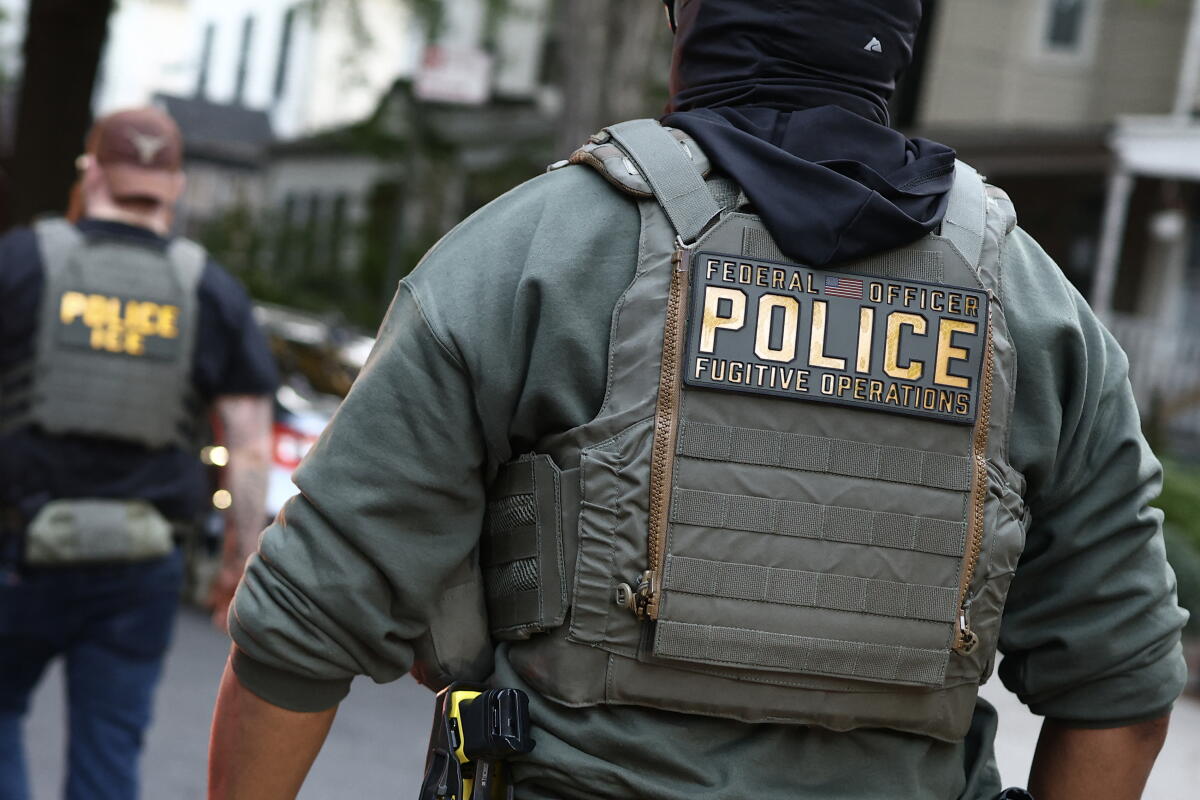
Federal agents walk near the scene where a man was shot by an ICE officer during an operation in the Bronx borough of New York on Oct. 8, according to local media and police.
(Charly Triballeau / AFP via Getty Images)
Belgal has pleaded not guilty to narcotics-sale charges in the drug case. The Legal Aid Society did not comment further.
New York City Mayor Zohran Mamdani and New York Gov. Kathy Hochul, both Democrats, said late Thursday that they had pressed Mullin and Republican President Trump to release Belgal, but to no avail. They also urged the administration to immediately release ICE officers’ body camera footage of the shooting and to halt immigration enforcement operations in the city.
Mullin said Belgal was being held in a “highly secured” detention facility outside New York City but declined to say where.
Attorneys representing Belgal filed an emergency petition Thursday night calling for his release. A hearing is scheduled for Friday afternoon.
He also confirmed ICE officers were wearing body cameras that were activated, but didn’t say when any of that footage would be released. Under agency policy, bodycam video can be released within 72 hours if “determined that it is in the best interests of the agency.”
On Friday, New York City police released footage from its officers as they arrived at the scene following the shooting. The department previously said its officers were not involved in the arrest and not at the scene when the shooting happened.
The video shows a city officer responding to a chaotic scene where Belgal — sitting on the ground with his hands behind his back and head drooping to one side — was surrounded by several officials. The video shows officers lifting Belgal and placing him in a black SUV. Police said he was taken to a hospital.
“Yo put pressure. Put pressure,” an officer can be heard saying as the SUV reverses down the block.
New York City Police Commissioner Jessica Tisch said Belgal was pulling into a parking space when a federal officer in plainclothes approached with his gun drawn, followed by another federal officer who also wasn’t in uniform. Belgal started to pull the car forward, and at least one of the officers fired seven rounds, hitting the man below his left ear.
Protesters and local officials decried the shooting as an example of the dangers of the Trump administration’s immigration crackdown.
New York City Mayor Zohran Mamdani arrives to speak to the media about the ICE shooting in the Bronx borough of New York on Oct. 8. Mamdani said he would ask President Trump to remove federal immigration agents from the city as tensions flared over the latest shooting involving ICE.
(Charly Triballeau / AFP via Getty Images)
Homeland Security Secretary Markwayne Mullin takes questions from reporters during a news conference at U.S. Immigration and Customs Enforcement headquarters on Friday in Washington, DC. Mullin, joined by ICE officials, addressed Thursday’s shooting of a man in New York City by a federal immigration agent as he spoke out against sanctuary city policies.
(Kevin Dietsch / Getty Images)
“There is no justification for what we have seen today,” Mamdani said late Thursday at the scene of the shooting.
Federal officers who surrounded the vehicle wore construction vests and masks, making it difficult to identify them as immigration officers, he said.
Mullin criticizes NYC’s immigration policies
Mullin devoted much of Friday’s news conference to criticizing Mamdani and New York City’s limits on cooperation with ICE. The Democrat, who took office in January, has restricted local cooperation with immigration enforcement operations and repeatedly called for the abolition of ICE.
“Sanctuary politicians, they create an environment for criminal activity to thrive, not for the American citizens to be safe,” Mullin said.
Homeland Security Secretary Markwayne Mullin takes questions from reporters during a news conference at U.S. Immigration and Customs Enforcement headquarters on Friday in Washington, DC. Mullin, joined by ICE officials, addressed Thursday’s shooting of a man in New York City by a federal immigration agent as he spoke out against sanctuary city policies.
(Kevin Dietsch / Getty Images)
ICE has asked local officials in New York to hold onto more than 14,000 people for federal officers to collect and place in immigration detention, he said.
“Silence. Absolute silence is what we have gotten back,” the secretary said. “Why would they release these individuals back onto the streets?”
“We’re enforcing our nation’s laws. We’re not picking and choosing,” Mullin continued. “Why is that controversial? We should all want law and order on our streets.”
ICE has justified other shootings with perceived threats to officers
During Trump’s second term, Homeland Security has often accused suspects of attempting to ram officers with vehicles or otherwise pose a threat and using that as justification for opening fire. But evidence from other shootings involving immigration enforcement officers has sometimes called into question that rationale.
In the Jan. 7 shooting death of Renee Good in Minneapolis, Homeland Security officials initially claimed an ICE officer opened fire in self-defense after Good attempted to run him over with her vehicle. Videos filmed from multiple angles challenged the administration’s narrative.
On July 10, ICE officers fatally shot Lorenzo Salgado Araujo in Houston as the Mexican national was driving his construction crew to a job site. DHS maintained Salgado Araujo rammed an ICE vehicle, but the three men inside his vehicle disputed the narrative.
Last year in a Chicago suburb, immigration officers fatally shot Silverio Villegas González after they say the Mexican national drove at them and dragged one with his car, causing “serious injuries.” But body camera videos from local police showed the agent who shot Villegas González walking around afterward and dismissing his own injuries as “nothing major.”
Santana and Marcelo write for the Associated Press. Marcelo reported from New York. AP reporters Anthony Izaguirre and Jennifer Peltz in New York City and Ryan Foley in Iowa City, Iowa, contributed to this report.
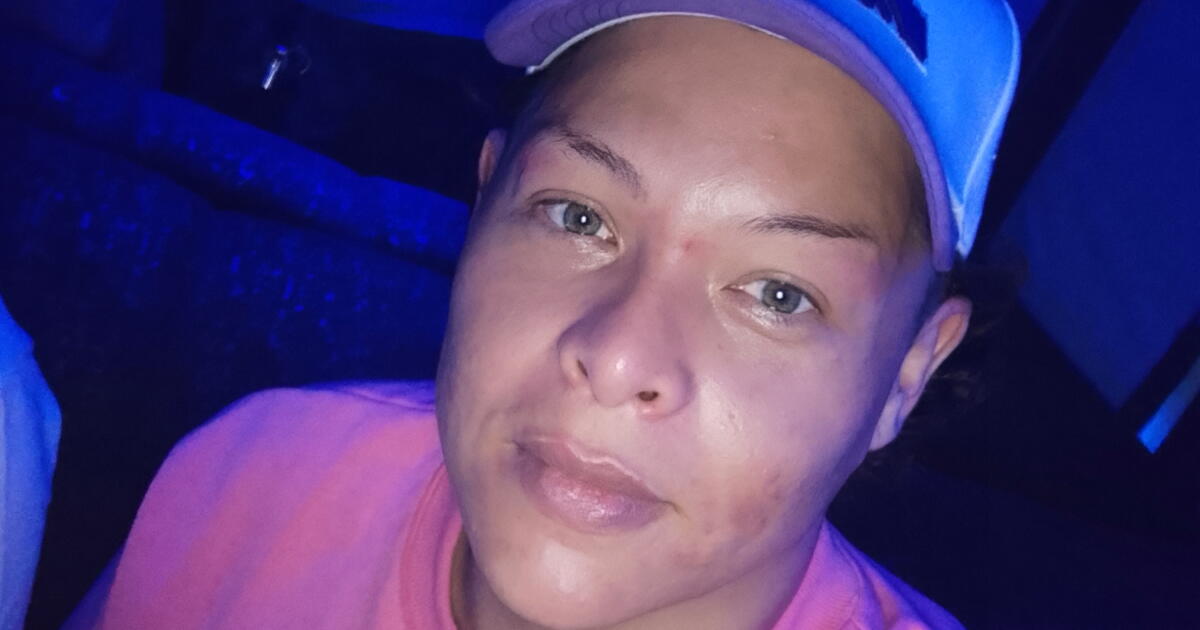
DAKAR, Senegal — In Miami, Daniela Fuentes styled hair for clients and performed in drag at a nightclub called Azúcar. She wore her blond wig in public and dressed as the woman she had known herself to be since adolescence in Cuba.
Now, more than 6,000 miles away in the Central African Republic, she wears men’s clothes, lowers her voice and tries not to draw attention to the breasts she developed after beginning hormone treatment as a teenager. As part of U.S. efforts to deport people to countries other than their own, authorities sent her Aug. 29 to a place where she has no ties and where advocacy groups have reported arbitrary detention, torture, and other rights violations of sexual and gender minorities.
“Everything is difficult here because I have to hide who I am,” said Fuentes, a 32-year-old transgender woman living on a compound she rarely leaves, sharing a room with four Cuban men also deported from the U.S. “I don’t know this place, the people or the language, and I have no idea what will happen to me.”
The Central African Republic — one of the world’s poorest countries, a place with a history of conflict that the U.S. State Department advises American travelers to avoid — is one of at least 12 African nations that signed agreements to accept “third-country” deportations, a policy the U.S. Supreme Court last month allowed to continue, at least temporarily.
In the Central African Republic — where transgender people have little to no legal protections and are marginalized in much of society — Fuentes dons her wig only in the privacy of her bathroom. She described disguising herself as protection, first in U.S. detention and now in a country she first heard of when she was already headed there on a deportation flight.
“My whole life, my whole identity, was taken away from me,” Fuentes said.
Public records say a judge ordered Fuentes to leave the U.S. but offer no other information. Immigration and Customs Enforcement officials did not reply to emailed questions.
Tens of thousands of people have been deported to “third countries”
Fuentes’ compound in the capital, Bangui, is an apartment complex where the government houses male deportees.
Fuentes said she can leave but that officials have advised her and others to avoid it — they have no identification, which could lead to issues with the police. It also means they can’t work, she said, and she’s waiting on travel documents that would allow her to leave the country. The International Organization for Migration, an agency associated with the United Nations, has provided food, and the migrants say they’ve crowdsourced for donations to buy groceries.
The U.S. — via agreements often not made public — has deported about 25,000 people to more than two dozen countries that aren’t their own, the vast majority to Mexico, according to a tally by Third Country Deportation Watch, a partnership of Refugees International and Human Rights First. The U.S. has not released numbers or details.
From January 2025 to August 2026, more than 500 were sent to countries in Africa, according to a Human Rights Watch report published Thursday — including at least 12 people who identify as lesbian, gay, bisexual or transgender and were deported to places that criminalize same-sex relations or public same-sex romantic conduct. Some advocates say the number is likely higher.
“These are not bureaucratic errors or isolated incidents,” said Bridget Crawford, of the group Immigration Equality. “They are the predictable result of policies that purposefully abandon our legal and moral obligation to protect LGBTQ+ immigrants fleeing persecution.”
The U.S. government says the policy is lawful and that receiving governments provide assurances deportees won’t be persecuted or tortured.
Daniela Fuentes says ICE detained her with men before deportation
Fuentes grew up in La Lisa, on Havana’s outskirts, and said she understood from childhood that she was different. She began living as a woman in adolescence and started taking hormones at 18.
She ran a salon from her home, coloring and cutting hair. She said she was harassed because of her gender identity and attacked at least twice, leaving scars on her arm and head. Police also questioned her about operating a private business, she said — though housefront businesses are common in the area.
In 2023, Fuentes sold her home and left amid a deepening economic crisis and a crackdown on dissent — even as Cuba, one of Latin America’s most progressive countries for LGBTQ+ rights, adopted new inclusion laws. Making her way to the U.S., she said, she presented as a man traveling through Central America; she believed it was safer.
After seven months in Mexico, she said, she entered the U.S. through Texas via CBP One, a President Joe Biden-era online appointment system that allowed migrants to live in the country for two years on humanitarian grounds. Then she went to Miami.
There, she began living openly as a woman again. She found work styling hair and performed at Azúcar. Though she lacked permanent legal status, Fuentes said Miami offered something she’d rarely experienced: the freedom to move through daily life as herself.
That ended when officers encountered her outside a motel. Fuentes said they learned she had missed an immigration court hearing in Texas. She said she asked that the case be moved to Florida but received no response.
Fuentes said she was taken into custody and later placed in immigration detention with men. Officials confiscated her wig and gave her a male detainee’s uniform, she said.
Such treatment is in line with a January 2025 executive order directing officials to exclude transgender women from women’s prisons and detention centers.
“When I learned that they were going to put me with men, I almost fainted,” Fuentes said.
Deportees said they boarded a flight without knowing the destination
Fuentes was held at two detention facilities in Florida, then transferred to Texas. When armed officers arrived there, she said, she suspected she was facing deportation, but they didn’t reveal she was being sent to Africa until about five hours into the flight.
Other deportees on the flight told AP they also weren’t told the destination until they were on the plane. Dozens have been sent to the Central African Republic, including an Iranian woman facing persecution in her home country and an Afghan whose brothers worked with the U.S. military.
Fuentes said she does not understand why she was sent to Africa rather than Cuba. She told AP she has no lawyer.
The U.S. does repatriate Cuban citizens, as part of agreements to resume deportation flights in 2023, despite tensions in relations between the countries. Charter flights have arrived in Havana regularly.
Yasmany Moreno, another Cuban deportee in Bangui, said that upon arriving, the group had no visas or documents establishing their legal status in the country. Officials spoke of providing assistance for 90 days, he said, but the deportees didn’t know what would happen afterward or where they would live.
Several told AP their longer-term status remained unclear and that U.S. authorities had taken their identity documents.
A policy officer at the Central African Republic’s Foreign Ministry said the deportees are in “good hands” and are being monitored by the International Organization for Migration. He spoke on condition of anonymity because he was not authorized to discuss the matter publicly.
The U.S. this year committed to $85 million in funding to IOM for Central African Republic operations including “assistance to migrants” and “community stabilization.”
IOM says migrants can seek asylum in the country, request assistance to return home or get help traveling to another place they’re authorized to enter. It referred questions about the deportees’ status and individual cases such as Fuentes’ to Central African Republic officials. A government spokesperson didn’t reply to phone calls and text messages seeking comment.
Human Rights Watch’s report says some people deported to third countries face detention, abuse and the prospect of persecution. Eswatini has held deportees in a maximum-security prison without charges. Equatorial Guinea has held them against their will at a hotel owned by the president’s family.
“Several of these African governments are not only complicit in U.S. abuses but have violated the human rights of these deported people themselves,” Michael Garcia Bochenek, of Human Rights Watch, said in a statement.
Fuentes and other deportees say they can’t work, with most days spent at the compound
Fuentes said the Cuban men in her room know she is a woman and look out for her. She rarely feels safe enough to leave. Once, at a supermarket, workers pointed at her breasts and initially refused to sell her fruit, she said. Other people in Bangui have mocked her and pointed at her.
“My personal appearance is awful,” she said. “I look like a different human being.”
Moreno described restrictions on the group’s movements, saying officers accompanied them to the market and on occasional outings but restricted them from going out at night.
Fuentes and Moreno said they have no passports or other identification and cannot work. Most days, Fuentes remains at the compound, looking at her phone and waiting for travel documents.
She said Cuba has agreed to accept her return — a Cuban embassy document shows she is authorized.
But Fuentes said she hopes to seek asylum elsewhere, possibly Canada.
“The harassment and economic hardship that caused me to flee still remain,” she said.
Banchereau writes for the Associated Press.Jean Fernand Koena in Bangui, Central African Republic; Tim Sullivan in Minneapolis; and Cristiana Mesquita in Havana contributed to this report.
TWO huge British pop stars have revealed their secret romance.
The Sun can reveal that singer Jack Garratt is dating Foxes, whose real name is Louisa Rose Allen.
Brit pop stars Foxes and Jack Garratt have confirmed their relationshipCredit: Instagram/@jackgarrattThe Sun can reveal that the pair are dating and have grown very close in recent monthsCredit: Instagram/@iamfoxes
The pair have grown close over several months and have gone Instagram official with new loved-up snaps.
BRIT Award winner Jack posted a sweet photo with the Clarity hitmaker as they cosied up while on a day date.
Sign up for the Showbiz newsletter
Thank you!
He wrote: “We saw you from across the model village and we dig your vibe.
“Model in the model village, good afternoon, good evening, and goodnight.”
The singer has been sharing heart emojis in Jack’s comment sectionCredit: GettyJack admitted he was ‘busy being happy’ in a recent post about lifeCredit: Getty
Foxes commented: “Best/ most overwhelming day of my life x”
Jack replied: “Official review,” to which Foxes wrote back: “Take snacks and it’s okay if you cry half way through.”
Jack added: “Foxes good advice for being in a relationship.”
Musician Foxes posted a photo five weeks ago of BRIT Award winner Jack, 34, playing the guitar to her, while their legs were intertwined.
The Let It Go Tonight songstress captioned it: “Thank you.”
The pair looked cosy and comfortable in each other’s presence.
Jack also posted around the same time snaps of his summer and told fans he was “busy being happy”.
Pictures included him at the beach, posing in front of the mirror and in bed with his dog.
He wrote: “Sorry I’ve been quiet again, still busy being happy.”
The pair have also been exchanging love hearts in each other’s comment sections for some time now.
Jack is best known for tracks like Surprise Yourself, Worry and Weathered.
He won the Critics’ Choice Award at the BRIT Awards in 2016 and has two top ten albums.
Foxes is best known for her collab with Zedd on track Clarity.
She has also provided the vocals for a number of Rudimental songs and was in Doctor Who once singing Don’t Stop Me Now.
The NFL Referees Assn. says the suspensions handed out by the league to two game officials this week went too far and that it will attempt to get them reduced.
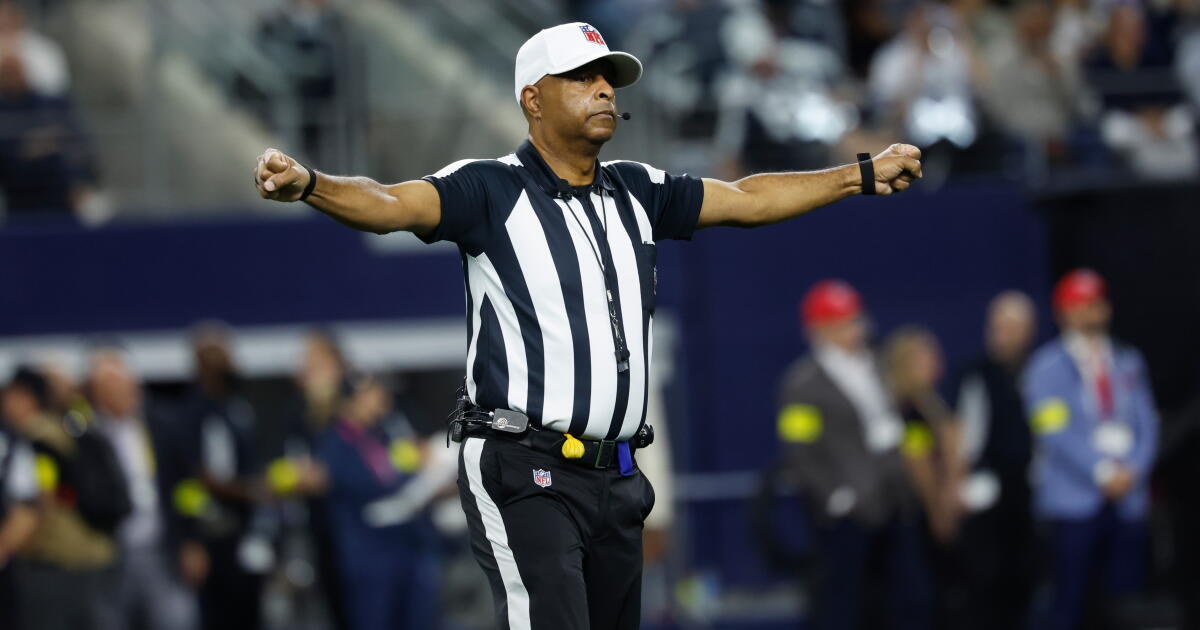
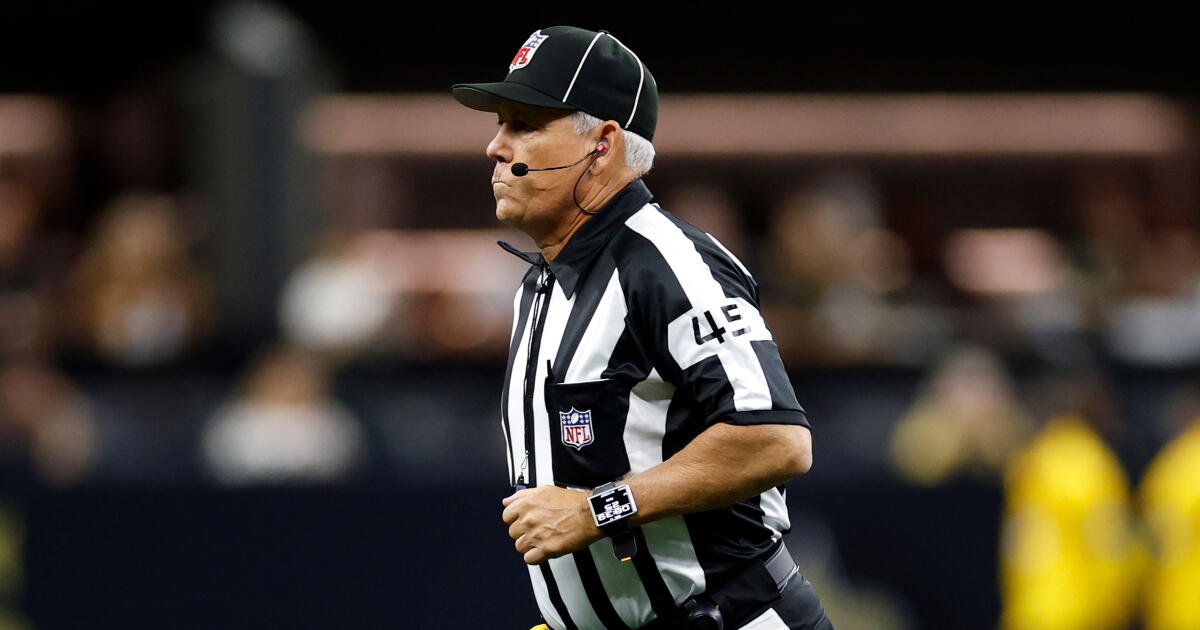
On Monday, the NFL issued a two-game suspension for line judge Jeff Seeman and a one-game suspension for referee Adrian Hill for separate instances of “unprofessional conduct toward a player” during games they were working the previous day.
The NFLRA said in a news release Tuesday that it “believes the suspensions imposed by the NFL on two officials following incidents this past weekend were excessive and inconsistent with past precedent.”
“Given these concerns, the NFLRA will challenge the severity of those suspensions and meet with the NFL Officiating Department to discuss the League’s disciplinary standards,” the NFLRA said. “The association also plans to meet with NFL Players Association leadership to address on-field conduct and the growing levels of confrontation between players and officials.”
Late in the Arizona Cardinals’ 36-24 loss to the New York Giants, Cardinals tight end Trey McBride argued a non-call with Seeman. A video of part of the interaction between McBride and Seeman, posted on X by ESPN’s Adam Schefter, appears to show the line judge shouting profane language at McBride.
“This kind of behavior from an official towards a player is unacceptable,” NFL Players Assn. executive director JC Tretter wrote with a repost of the footage. “Players are consistently held accountable when the roles are reversed. We expect the NFL to hold officials to the same standard.”
Early in the Minnesota Vikings’ 15-10 victory over the Miami Dolphins, Vikings linebacker Eric Wilson appeared to be shoved into Hill, who was knocked to the ground. When Wilson attempted to help Hill to his feet, the official jumped up and appeared to yell at the player and point for him to move away.
“I ended up apologizing to him and explained the situation,” Wilson told reporters after the game. “He was cool about it. He understood what was happening. He just said he was trying to get me — he didn’t want us fighting apparently, me and the Dolphins guy. So he was just trying to break us up.”
NFLRA executive director Scott Green acknowledged that both officials “fell short” in conducting themselves professionally on the field, but he also suggested that players often do the same.
“Officials are routinely subjected to highly charged interactions and, at times, verbal abuse from players and coaches,” Green said in the association’s news release. “While that never excuses misconduct by an official, it shouldn’t be dismissed as simply part of the game. The League expects the highest level of professionalism from its officials, and it should demand the same from everyone on the field.
“We will defend the principle that discipline must be fair, consistent and proportionate,” Green continued. “Holding officials accountable while ignoring or minimizing the conduct directed at them is neither fair nor an effective way to address this issue. We look forward to working with the League and NFLPA toward that shared goal.”
The NFL has issued suspensions for two officials involved in confrontations with players during Sunday’s games, including one who was caught on camera apparently cursing at Arizona Cardinals tight end Trey McBride.
“The NFL confirmed today that line judge Jeff Seeman has been suspended for two games and referee Adrian Hill has been suspended for one game, each for an instance of unprofessional conduct toward a player in Sunday’s Arizona-New York Giants (Seeman) and Miami-Minnesota games (Hill),” the league said Monday in a statement. “The suspensions were issued by NFL Vice President of Officiating Ramon George.”
Late in the Cardinals’ 36-24 loss to the New York Giants, McBride argued a non-call with Seeman. A video of part of the interaction between McBride and Seeman, posted on X by ESPN’s Adam Schefter, appears to show the line judge shouting, “F— you!” at McBride two times.
NFL Players Assn. executive director JC Tretter posted a clip of the interaction that zoomed in on Seeman as he shouted toward McBride.
“This kind of behavior from an official towards a player is unacceptable,” Tretter wrote. “Players are consistently held accountable when the roles are reversed. We expect the NFL to hold officials to the same standard.”
CBS reporter Aditi Kinkhabwala reposted Tretter’s post and commented that she was “standing right there” during the interaction between McBride and Seeman.
McBride “was heated for sure, but I never heard a curse from him,” Kinkhabwala wrote. “The harshest he got was, ‘You’re ruining the game.’”
The other incident took place early in the Minnesota Vikings’ 15-10 victory over the Miami Dolphins. On a play that was whistled dead because of a neutral zone infraction, Vikings linebacker Eric Wilson appeared to be shoved into Hill, who was knocked to the ground. When Wilson attempted to help Hill to his feet, the official jumped up and appeared to yell at the player and point for him to move away.
“That was funny, honestly,” Wilson told reporters. “I ended up apologizing to him and explained the situation. He was cool about it. He understood what was happening. He just said he was trying to get me — he didn’t want us fighting apparently, me and the Dolphins guy. So he was just trying to break us up.”
The NFLPA said it had no further comment on either incident other than Tretter’s X post. The NFL Referees Assn. did not immediately respond on Monday to multiple requests for comment.
WASHINGTON — A Massachusetts man was arrested Thursday in a federal case alleging he cyberstalked conservative podcaster and former Trump administration official Katie Miller, targeting her dozens of times with menacing phone calls and messages, according to court papers.
Authorities say the man contacted Katie Miller at least 40 times over the course of several weeks, sometimes leaving disturbing voicemails and text messages about her and her husband, Stephen Miller, who serves as White House deputy chief of staff. He also sent messages to phone numbers for her parents, according to prosecutors.
John Anthony Proia III, 41, is charged with one count of cyberstalking. An attorney listed for him didn’t immediately respond to an email seeking comment on Thursday.
The court documents do not identify the victim by name, but a person familiar with the matter confirmed that it is Katie Miller. The person spoke on the condition of anonymity to discuss non-public parts of the investigation.
“Those who use technology to harass, intimidate or torment others should understand that attempts to anonymize their criminal conduct will not shield them from prosecution,” Leah Foley, the U.S. Aattorney for Massachusetts, said in an emailed statement. “We will find you, and we will hold you accountable.”
In a social media post Thursday, Katie Miller thanked Justice Department and FBI officials for keeping her and her family safe.
“Good to see a Boston grand jury indict this man,” she wrote.
The investigation contributed to upheaval inside the FBI’s Washington field office, where two top counterterrorism supervisors were recently reassigned by the office’s leader in part because of dissatisfaction over their handling of and approach to the Miller probe, according to multiple people familiar with the matter who spoke on condition of anonymity to discuss non-public personnel changes.
Darren Cox, the assistant director in charge of the Washington office, said in a statement that the reassignments were not ordered by Director Kash Patel and that the moves were a personnel decision “based on our constant evaluation of mission needs. Any suggestion otherwise is false.”
FAO director said he was informed his contract would not be renewed because of allegedly breaching impartiality rules.
Published On 2 Oct 20262 Oct 2026
A senior UN agency director has said that he lost his job because he criticised Israeli policies in Gaza.
Ben Davis, who had been Director of Rural Transformation and Gender Equality at the Food and Agriculture Organization (FAO), told AFP news agency on Wednesday that he was informed in July that his contract would not be renewed because he had allegedly breached impartiality rules.
Recommended Stories
list of 3 itemsend of list
He said that he was accused of organising weekly silent protests at the Rome-based organisation.
“They accused me of organising these moments of silence on the situation of starvation and famine in Gaza,” Davis said.
Davis was also criticised for a report he worked on about food availability in Gaza and humanitarian law, published in May.
“We were told to take it down,” he said. “We weren’t allowed to make any references to humanitarian law.”
‘Game of human rights’
FAO Director-General Qu Dongyu appeared to warn FAO staff on Tuesday that “we don’t allow you to play the game here of human rights”.
He was speaking in public comments made at the start of a filmed session on forestry.
“Of course, human rights is very important, but we have the human rights agency in Geneva,” he added. “If you want to take care, go there.
“That’s why some senior members play the political game here, I fire him … You should follow the FAO constitution … You are against staff regulations … But I’m a very soft person, I didn’t fire that many,” he said.
“I will fire more people if they are against the law,” he added.
Director-General of the Food and Agriculture Organization of the United Nations Qu Dongyu delivers his speech during a World Food Forum meeting [File: Andrew Medichini/AP]
FAO did not respond to an AFP request for comment.
Asked if he thought the director-general’s comments were about him, Davis said “absolutely”.
“He has already scolded me in public in the past for being too political.”
Davis also said he was “concerned” about the director-general’s comments on firing more people.
Hundreds of people attended the moments of silence at their height, while now there are only 30 to 40 people coming on a weekly basis, he said.
Israel’s genocidal war on Gaza has killed over 74,000 people since October 2023, and at least 1,431 Palestinians have been killed in Israeli attacks since the so-called ceasefire between Hamas and Israel was agreed upon in October 2025.
Cuba’s deputy foreign minister slams US sanctions, labelling them ‘equivalent to genocide’.
Published On 27 Sep 202627 Sep 2026
A senior official in Cuba has warned that any prospective United States military action taken against the island nation would constitute a serious international crime, and has rejected claims made by US President Donald Trump that Cuba is a failed state.
On Sunday, Carlos Fernandez de Cossio, the country’s deputy foreign minister, told the US cable television channel C-SPAN’s flagship programme, Washington Journal, that it would be an “atrocious international crime for the US to use military force against Cuba, which is a peaceful neighbouring country”.
His comments come after Trump said during his Tuesday speech at the United Nations General Assembly (UNGA) that “freedom will be coming” to the island. His remarks prompted the Cuban delegation to exit the assembly hall. On Saturday, Trump brought up military action, telling reporters, “I don’t think we’ll need the military. Cuba is failing very badly.”
Fernandez de Cossio said that coercing nations who do not “submit” by disrupting their commercial shipments, attempting to handicap a population through starvation, depriving it of stable healthcare and withholding fuel, as the US has “done for nine months now”, is “equivalent to a genocide”.
The US has maintained a foreign policy of maximum economic pressure against Cuba for more than 60 years. The Trump administration has previously said that it wants a shake-up in Cuba’s government. Earlier this year, the administration enforced an additional oil and fuel blockade against the island, which has crippled the nation’s infrastructure, causing widespread fuel scarcity and rolling power outages. Government officials in Cuba cited systemic difficulties in securing food supplies and other basic necessities for the country of more than 10 million.
Fernandez de Cossio said Havana must ready its citizens for the prospect of US military aggression, adding that while Cuba recognises it might stand alone, it will still exercise its legitimate right to self-defence.
He explained that bilateral diplomatic channels with the US remain open but have yielded minimal results due to the economic stranglehold of ongoing sanctions, adding that Havana remains willing to engage with Washington in a “respectful manner” only if discussions accommodate mutual dignity, benefit both populations, and respect state sovereignty.
Several countries condemned the US’s continued economic sanctions and blockade of Cuba during the UNGA earlier this week.
US State Department Spokesman Tommy Pigott says President Donald Trump ‘holds all of the cards’ in talks with Tehran. Officials from both countries met with mediators on the UNGA sidelines, but so far, there is no deal.
Pope Leo XIV drew huge crowds on the first Papal visit to France in 18 years. The Pope delivered a message of encouragement to thousands of young people during a mass in the Stade de France.
Marvin Reid can’t say how many pedestrians he’s seen get hit while trying to brave the North Hollywood intersection of Magnolia Boulevard and Tujunga Avenue. He gave up keeping count long ago.
One afternoon last spring, he watched a man get run over while walking toward a 7-Eleven on the corner. Fortunately, the man popped to his feet “like nothing ever happened” and hustled into the store, Reid said. A week or two prior, he said, an out-of-control motorist nearly plowed into the statue of Amelia Earhart that sits next to a library bearing the famous aviator’s name.
“This is really a bad spot,” said Reid, who has helped run a Jamaican food pop-up at the busy street corner for the past five years. “It doesn’t matter if it’s an old lady crossing the street with a walker.”
The number of Angelenos who die in traffic crashes now regularly outpaces those killed by homicide. From 2016 to 2023, the annual traffic death toll rose nearly 29% overall, and pedestrian deaths jumped roughly 54%. Fatal crashes fell slightly last year, but deaths still exceeded 300 in each of the last three years.
The city is rolling out 125 speed cameras in school zones, known street-racing corridors and places where speeding has contributed to a high rate of collisions — including Reid’s intersection.
But for him, the cameras aren’t a replacement for police traffic enforcement, which he said seems virtually nonexistent.
Even though LAPD squad cars are posted up outside the library “everyday,” he says, they rarely do anything about the drivers who come careening off the exit ramps from the nearby 170 Freeway.
Similar complaints are being echoed around the city. Historically, Los Angeles — like other places across the U.S. — has relied on police stops to produce road safety. But in recent years, public pressure has compelled city leaders to think more critically about whether enforcement can continue without the historical harms that has come along with it.
LAPD data show the department is far less proactive than it used to be.
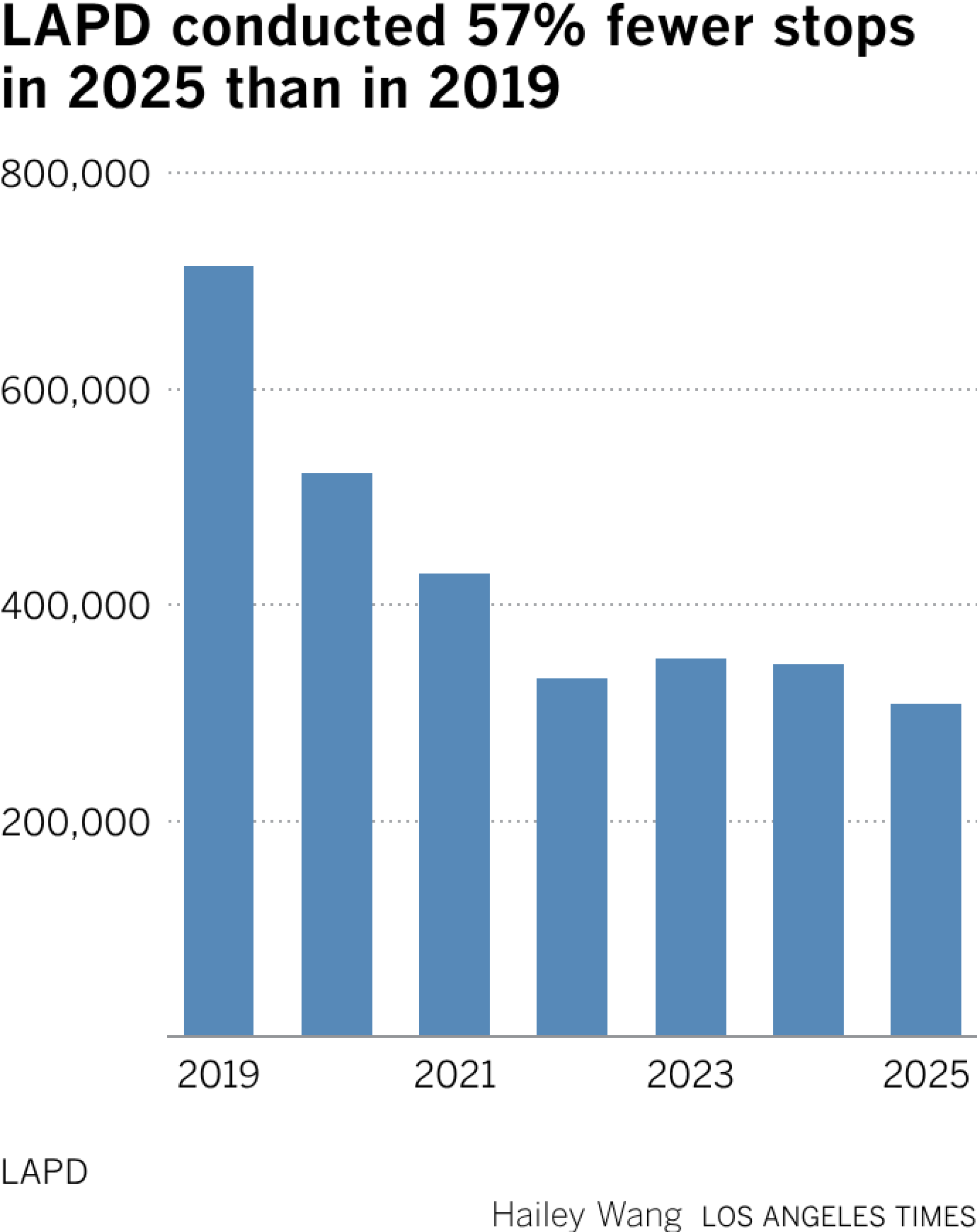
In 2019, LAPD officers made about 713,000 stops across the city; by 2025, that number had decreased to roughly 308,000 — a roughly 57% decline. A Times analysis of police stop data found that the drop-off was especially pronounced in the Central, West Valley, 77th Street and Southeast police divisions.
In some ways, the decline in stops is unsurprising. Other large U.S. cities have seen similar changes in enforcement strategies by police since the pandemic. As the department continues to shrink, LAPD commanders say they have fewer resources to devote to traffic duty. Officials have been under pressure to curb the use of so-called “pretext stops,” in which officers use a minor violation — a broken turn signal, say, or a cracked windshield — as justification to stop someone in order to investigate whether a more serious crime has occurred.
The largest declines were in the Central and 77th Street areas
Change in police stops, 2019 to 2025
LAPD
Hailey Wang LOS ANGELES TIMES
Reform activists and some city leaders argue the stops are fishing expeditions that lead to police abuses — while failing to deliver safer streets.
The practice of pulling over random vehicles, often based on little more than a hunch, has been a cornerstone of the city’s crime-fighting strategy for decades. The tactic is especially prevalent among the department’s elite Metropolitan Division and anti-gang units, several of which have come under investigation in recent years for failing to document the stops and improper searches.
Since 2019, when a Times investigation found significant racial disparities in LAPD crime suppression tactics, officials have slowed — but never abandoned — the practice of flooding neighborhoods with tactical officers to pull people over and search their vehicles.
Four years later, stops for minor violations began dropping again after LAPD overhauled its policies to limit the circumstances under which officers can make pretext stops, joining law enforcement agencies in cities like Philadelphia, Seattle and Berkeley, Calif.
Yet a report published last year found that officers are still disproportionately targeting Black and Latino drivers.
LAPD Chief Jim McDonnell and other department leaders have fought against more restrictions, arguing they risk losing an essential weapon against serious crime.
But in May, the Los Angeles City Council passed a measure urging the Police Commission, the LAPD’s policy-making body, to further limit arbitrary pull-overs for non-moving traffic violations.
While LAPD officials had acknowledged issues in a handful of police divisions, the latest audit found that gang units citywide routinely flouted the department’s rules on pretext stops, including by often failing to obtain proper consent to search the vehicles they stopped. The inspector general’s office also found that gang officers didn’t always turn on their body-worn or dashboard cameras as required during these encounters and at times failed to properly log who they were stopping — resulting in an undercount of “both the number of detentions and the enforcement actions taken,” the report said.
The review, based on a sample of 300 stops as well as interviews with current and former gang officers, also highlighted ongoing confusion about what the department expects its officers to do when pulling someone over.
The findings of the second report — which reviewed pretext stops by officers from other units in January — are expected to be presented at an upcoming commission meeting.
The Los Angeles Police Protective League, the union for rank-and-file officers, and other proponents of pretext stops argue that elected leaders don’t grasp the consequences of doing away with the tactic, which the U.S. Supreme Court has deemed lawful.
Reform advocates have fought to deploy unarmed civilians instead of LAPD officers for traffic enforcement — as the city has already started doing for certain mental health-related calls — but the union has warned that the work is too dangerous. A state bill that would have allowed trained civilian workers to make traffic stops failed to make it through the state assembly.
With the death toll from speeding on the rise, more enforcement is needed, not less, department leaders say. The city, they argue, can’t afford to wait on alternative programs that require study, money and public buy-in that could take years.
Amid the debate over how to proceed, LAPD enforcement hasn’t vanished completely.
Even though the department no longer dispatches officers to the scenes of minor accidents, LAPD statistics show that enforcement the department’s 308-member traffic bureau has gone up. As of July, the number of traffic tickets issued had climbed 44% from the same time last year — increasing to more than 14,600 from around 10,100. Citations for impaired driving have also risen, and the department continues to crack down on street takeovers.
Still, progress toward new, non-police approaches to traffic enforcement has been frustratingly slow in Los Angeles, advocates say.
Advocates have pointed to mounting research in other cities that showed road improvements along high-injury street corridors were more effective than police at changing driver behaviors, ultimately reducing the number of traffic-related deaths and serious injuries more than the threat of being ticketed.
Supporters of so-called “self-enforcing” roads say narrowing lanes can lead to a considerable decline in crashes as drivers reduce their speed and move more cautiously than when the road is less wide. Such changes also reclaim space for protected bike lanes, public transit lines, or safer walkways — after long prioritizing convenience for cars, advocates say.
Car accidents are dangerous for everyone involved, but they have become even more hazardous for pedestrians and cyclists.
Experts cite speeding and cellphone distractions as two of the biggest problems.
Another factor is the proliferation of larger vehicles — a phenomenon known as “autobesity” — which have bigger blind spots and more likely to seriously injure a pedestrian or bicyclist.
Andres Ramirez, executive director for the transportation advocacy nonprofit People for Mobility Justice, said he’s cautiously optimism that the mayor’s promise of a “No Car” 2028 Olympic Games will help fast-track some of the most pressing road safety projects.
“The streets needs to be a lot safer for pedestrians, for bicyclists, different modes,” Ramirez said. “The most obvious way is ensuring that infrastructure projects are prioritized in communities that have long been ignored.”
Within hours of a Feb. 28 missile attack that hit an Iranian school, some Pentagon personnel knew the U.S. was responsible, according to officials involved in an internal investigation of the incident. That probe found what the officials now describe as a cascade of preventable failures.
Two Tomahawk missiles struck the building and its grounds that Saturday, killing more than 150 people, including at least 123 children. The strikes devastated the two-story school, which was built on land that was part of a military compound in the southern Iranian town of Minab. In terms of child casualties, it’s the deadliest American military targeting error of the 21st century.
United Nations investigators said Thursday that there were reasonable grounds to conclude that the strike on Minab and another U.S. attack that took place on the same day amounted to war crimes. The U.S. has yet to publicly accept responsibility for the school strike, and President Trump has previously suggested it was Tehran’s fault. As recently as July 14, he told Fox News, “I don’t think anybody’s going to ever be able to say what happened there.”
But in interviews, officials with direct involvement in the Pentagon’s internal investigation have offered some of the first accounts of the probe. The strike didn’t result from a single catastrophic decision but an accumulation of smaller ones, they said, and their review has identified a series of missed opportunities to prevent the disaster. The officials, like more than two dozen others who provided descriptions of targeting procedures or background information for this story, asked not to be named to discuss sensitive matters.
In the final days of February, the Trump administration demanded an overwhelming aerial assault. More than 1,000 Iranian targets were hit within the first 24 hours alone. That order compressed the time frame for finalizing targets, the officials said, instilling an urgency that — combined with gaps in underlying information about the site, cuts in civilian protection personnel and an overreliance on artificial intelligence technology — set the stage for the deadly error.
Full details from the investigation remain tightly held. Officials who described it said they faced constraints on the amount of information they could share. Previous news reports have indicated that by early March, a preliminary internal review determined the U.S. was likely responsible for the Minab strike.
A report on the full Pentagon investigation, which commenced in March, hasn’t been released — though the officials said it has been all but complete for several months.
Adm. Brad Cooper, who heads U.S. Central Command and ordered the investigation, told members of Congress in May that he’s committed to providing transparency. Yet it’s not clear how much detail will be included, nor how much of the report ultimately will be released to the general public.
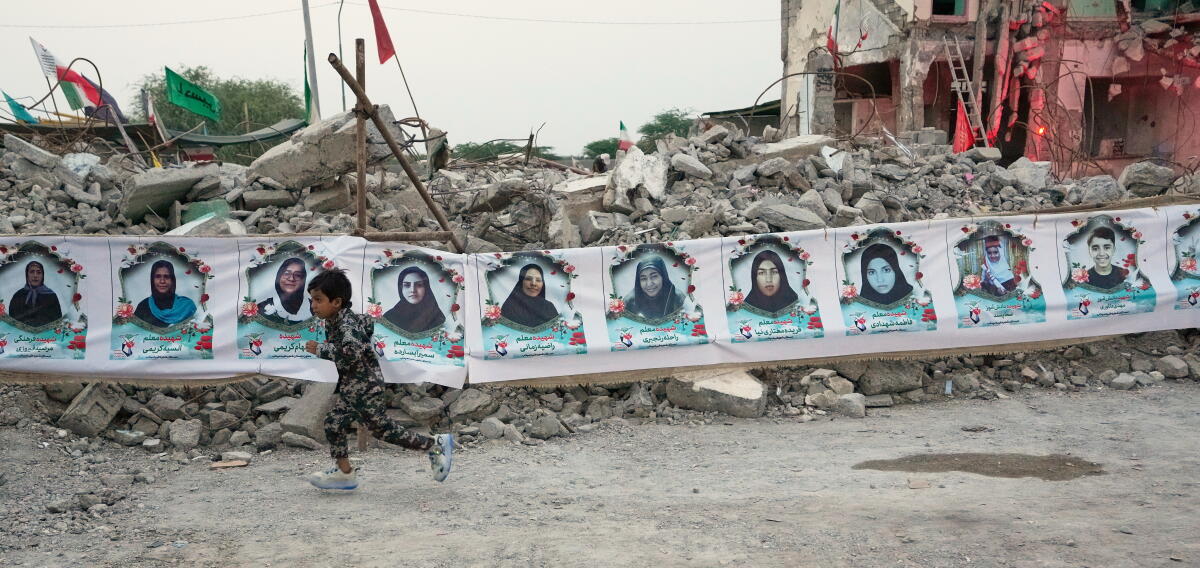
A child runs past a banner strung across the rubble of Shajarah Tayyebeh Elementary School showing portraits of the children and teachers killed there by a U.S. missile strike.
(Vahid Salemi / Associated Press)
A Pentagon spokesperson said the incident remains under investigation and declined to comment further.
In response to questions, including about when the White House was informed that the strike was a mistake, a senior administration official also cited the ongoing probe and added: “The United States does not target civilians.”
Last week, a report from the United Nations’ Independent International Fact-Finding Mission on Iran said that the U.S. had “failed in its obligation to do everything feasible to verify” that the school was a military target and that the failure “went beyond negligence.” The U.S. Department of Defense has declined to comment on the report.
U.S. officials have said that outdated intelligence was a problem. Although the site in Minab had been identified years earlier as a military compound, there was clear evidence that it had been modified and undergone a change of purpose, the officials said. Physical changes reflecting new construction — visible on satellite imagery — dated back almost a decade, they said, and the site operated openly as a school.
Analysis of commercially available satellite images shows construction of walls and entrances that separate the school site from the military base, work that appears to have been completed by 2017. An image from 2018 shows brightly painted walls alongside a soccer pitch, assembly rows and play markings on the ground.
Some U.S. intelligence analysts took notice, the officials said. Bloomberg reported in June that one analyst detected changes to the site as early as 2019, and logged remarks about the modifications in a system that wasn’t connected to the primary military intelligence database, which informs targeting.
Inside Centcom, which conducted the U.S. attack, some personnel relied too much on the artificial intelligence embedded in Maven Smart System, the officials said. Maven, which is made by Palantir Technologies Inc., allows users to view and coordinate complex military operations — from targeting to command and control — using AI-enabled software that fuses more than 150 different data inputs into a coherent set of information to inform commanders’ decisions.
In the past year, the Defense Department has rapidly made Maven a cornerstone of the U.S. military apparatus. Several former senior U.S. military officials now work for Palantir, including some with high-level security clearances in Centcom’s Tampa headquarters. Their role is to keep the software functioning inside secure military environments.
Some Centcom personnel expected Maven to flag stale information or inconsistencies in the underlying intelligence assembled for potential targets, the officials said. It’s not clear why they had such expectations.
A Palantir spokesperson said that the company “is not responsible for the underlying data nor identifying intelligence deficiencies” and that there’s no evidence that its software was at fault in the Minab strike.
Two people familiar with the firm’s Pentagon contracts said the government retains primary responsibility for the quality of the information that’s fed into Maven. But they said it’s not uncommon for personnel who use tools such as Maven to develop operational understandings that differ from contractual terms.
After the Minab strike, Palantir built new capabilities into Maven that “re-review underlying intelligence to identify factors that would disqualify a target and flag inconsistencies and inaccuracies that human review may have missed,” according to a person familiar with the matter. That work has already caught some anomalies, the person said.
The ‘kill chain’
As Feb. 28 approached, Pentagon officials were tasked with identifying strikes they thought would paralyze Iran’s military before Tehran had a chance to respond, the officials said.
High on Centcom’s list: the naval division of the Islamic Revolutionary Guard Corps, the most powerful force across the country’s military, economy and politics. It’s tasked with defending — and at times, disrupting — the Persian Gulf and the Strait of Hormuz. The Minab school site — with its uncorrected classification as a Revolutionary Guard facility — was fed into Maven along with other potential targets. It ultimately emerged as one of the recommended Day 1 targets, people involved in the investigation said.
As all targets do, the Minab site moved through a multi-stage assessment process known by the military as the “kill chain.” Steps in that process have traditionally involved intelligence analysts, imagery specialists, targeteers, lawyers, operational commanders and launch crews, according to U.S. military doctrine and interviews with current and former Defense officials. Today, Maven sits at the heart of those operations — between the initial intelligence inputs and the latter review stages, officials said.
In past conflicts, preparing lists of proposed targets — work that includes assessing how they align with an operation’s objectives — had taken hours for staffers to complete. Ahead of the U.S. attack on Iran, much of that work was condensed into several minutes via Maven, people involved in the Pentagon’s internal review said.
Officials involved in the investigation pointed to gaps that they said were left after Defense Secretary Pete Hegseth dismantled most of the Pentagon’s civilian harm mitigation, or CHM, units — cutting headcount across a number of teams by roughly 90% to fewer than 20 staff members, people with direct knowledge of the matter said. Centcom’s team was reduced from 10 to 1.
No CHM team member reviewed the Minab site before the strike, according to officials involved in the internal investigation. That was a consequence of the cuts in staffing but also a decision not to involve the group in planning and operations, the officials said. While not mandatory, that sort of review had become routine in recent years, they added. It’s unclear whether such checks, which include mapping the civilian environment, assessing noncombatant presence and developing lower-risk strike options, would have been enough to raise questions about the Minab site.
The Biden administration had built up civilian-harm-prevention capabilities within the Pentagon after an August 2021 drone strike in Kabul killed 10 civilians — based on the misidentification of an aid worker as a threat. Hegseth has characterized his subsequent cuts to those efforts as a shift away from “Biden-era, non-lethal programs.”
“America, regardless of what so-called international institutions say, is unleashing the most lethal and precise air power campaign in history,” Hegseth said at a news conference March 2, days after the Minab attack. “All on our terms with maximum authorities. No stupid rules of engagement, no nation-building quagmire, no democracy-building exercise, no politically correct wars.”
Under Hegseth’s leadership, the U.S. military has prioritized speed of delivery. People involved in the Pentagon probe said a rush to finalize targets shortly ahead of Feb. 28 contributed to the tragedy.
“Haste can lead to errors,” said Laurie Blank, who was appointed a special counsel at the Pentagon’s general counsel during the Biden administration from 2022 to 2024. She drew a distinction between planned targets and those that arise in the heat of battle. “A rush to hit pre-planned targets just isn’t the same thing,” she said, “especially when the operations are launched by choice and not in response to an attack where you are responding without time to plan.”
Why Minab?
A little more than 800 miles south of Tehran, the city of Minab sits on the critical Strait of Hormuz, at the crossroads of centuries-old trade routes and the nation’s modern military might. As the U.S. attack on Iran began, it was deemed a high-value target, according to people involved in the investigation.
As the strait’s significance grew in the 1980s, so did the number of military assets devoted to protecting it and projecting power into the Persian Gulf. The Revolutionary Guard’s missile units, naval facilities and logistics compounds operate alongside neighborhoods where fishermen, teachers and civil servants have lived for generations in the city of 76,000.
Shajarah Tayyebeh Elementary School was built almost a decade ago on land originally occupied by a Revolutionary Guard naval unit. The Pentagon had cataloged the site as a military base several years earlier — a determination that wasn’t updated before the February attack. The New York Times reported in June that targeting officials used satellite imagery that hadn’t been updated in seven years and that did not show a school at the site. Investigators have focused on the Defense Intelligence Agency’s failure to reclassify the location, officials involved in the inquiry said.
On Feb. 28, Minab awoke to clear skies. Shopkeepers unlocked their storefronts. Fishing crews unloaded ice chests along the docks. Children in green-plaid uniforms walked through the gates of the 260-student school, before heading into classrooms.
Firsthand descriptions of the events that took place in and around the school that day have been gathered by a group of human rights advocates, lawyers and digital forensics experts who’ve spent months reconstructing the attack. Members of the informal consortium — including some based in the U.S. and Europe — asked not to be named given the sensitivity of their outreach efforts with victims’ families. Their work and an assessment by the U.K.-based watchdog group Airwars — viewed as a highly reliable source by some Pentagon officials — provides the following account:
After the first reports of attacks on Iran emerged that Saturday morning, teachers called parents and asked them to collect their children, saying the school planned to close early. Shortly after 11 a.m., a first missile hit part of the school, triggering an explosion that reverberated across the neighborhood. Panicked shrieks filled the air. Teachers ushered children from the playground back inside to take cover in a prayer room.
Within minutes, a second missile struck, sending metal fragments across the school. Part of the roof collapsed. Only a few children inside the prayer room survived, buried beneath the rubble.
Rescue vehicles rushed to the scene while passersby helped the wounded. Some injured children were pulled from the rubble while dozens more, deceased, were slowly identified. One rescue crew member stumbled upon a child’s hand, detached and laying on the ground. He wept as colleagues continued to hunt through the debris alongside him.
Some parents were left to identify their dead children by fragments of clothing or belongings — a pencil case, bracelet or shoe — as many faces were no longer distinguishable. The father of Arash Gol-Azin didn’t learn the fate of his 7-year-old son until reaching the morgue. Only then did he spot him by identifying his sock.
Payam Akhavan, a Toronto-based lawyer who has practiced before the International Criminal Court and is an expert on civilian protection, said it’s important for investigators to determine what efforts U.S. officials made to try to ensure they were targeting a military installation.
“The Geneva Convention says you must take all feasible measures to determine that this is, in fact, a military objective,” said Akhavan, who spoke before Thursday’s U.N. report was published. “This does not mean that every mistake is a war crime, because mistakes will be made, even if you take all feasible measures.
“But if all feasible measures were not taken,” he added, “then that raises a question of criminal responsibility.”
At least 1,701 civilians were killed in the opening 39 days of the war, according to data compiled by the U.S.-based group Human Rights Activists in Iran. That’s an average of 43 people a day, and the group — viewed by some in the Pentagon as an authoritative source for Iranian casualty figures — said it’s a low estimate.
“We should be asking how so many civilians were killed amid an unprecedented tempo of strikes over just a matter of weeks,” said Skylar Thompson, the group’s deputy director.
More recently, Iranian officials and a United Nations body said the U.S. was responsible for a Sept. 1 strike on Kuhestak — some 20 miles south of Minab — that hit a residential area where a wedding party was underway and killed at least five people with dozens more injured. The U.S. is investigating the incident, Vice President JD Vance said earlier this month.
Target libraries
For decades, American military planners had maintained extensive target libraries in anticipation of potential conflict with Iran, encompassing everything from limited strikes to maritime war and major air campaigns. The list stretched into the thousands and included air bases, missile factories, nuclear facilities and ports, according to current and former U.S. officials familiar with the plans.
Some potential targets had remained on the books for years, accumulating layers of satellite imagery, intelligence reports and legal reviews.
But these catalogs can age quickly, according to people who’ve dealt with them. Buildings appear and disappear. Headquarters switch locations. Where a military barracks once stood, schools, hospitals and mosques may now exist. So the libraries’ contents require close and continual review well before any particular building or site winds up on a target list.
Maintaining the lists is critical but labor-intensive. Officials involved in the internal investigation of the Minab incident described gaps in vetting — or checking whether the underlying information is accurate, reliable and timely — that came well before the school site was selected.
Some of the most sensitive sites, such as Iran’s nuclear facilities — attacked by Israel in its 12-day war with Tehran in June 2025 — faced relentless attention from U.S. intelligence analysts ahead of the 2026 war, according to officials with direct knowledge of the matter. Less prominent locations, such as Minab, went months without receiving another close look, the officials added.
War planners start to think they’ll have time to revisit the less urgent sites, current and former Pentagon officials said.
That assumption evaporated during the final days of February as diplomatic talks between U.S. and Iranian officials in Geneva faltered and then collapsed on Feb. 26.
Work that had unfolded in previous conflicts over weeks or months — matching sites from the library, such as buildings, airfields or bases — was completed in a matter of days, according to officials involved in the inquiry. More than a thousand potential targets had to be reassessed and approved.
By the time the first Tomahawk missile bound for the Minab site left its launcher on a ship operating in the Arabian Sea, roughly three dozen people were involved along the kill chain, the officials said.
Most sat in secure facilities more than 7,000 miles away in Tampa, Fla., studying maps, imagery and databases in preparation for a war that, until 48 hours before the Minab attack, many officials had believed for decades wouldn’t occur.
Typically, part of their work entails refining a list based on satellite imagery and on-the-ground intelligence that’s used to create a pattern-of-life analysis reflecting human movements on the site and changes over time. In Iran, a bitter U.S. adversary for almost half a century, such intelligence was limited, especially in the south of the country, people involved in the probe said.
Additional steps in the kill chain address other types of issues. Lawyers assess whether each proposed target is a lawful military objective. Specialists estimate potential collateral damage. Weapons experts debate not only which missiles to fire but when.
Every stage leaves a record. Analysts sign off on each piece of the chain. They’re told to report any inconsistencies to superiors.
Then a series of questions is asked by the senior commander: Is the target lawful? Is there sufficient intelligence? And have reasonable precautions been taken to minimize civilian harm? In the early hours of Feb. 28, the answer to each question about the Minab site was yes, according to the officials involved in the probe.
The Pentagon’s internal investigators, who examined the satellite imagery, intelligence databases, targeting materials, operational chat logs and computer records that analysts used, concluded that there was high confidence throughout the kill chain that the Minab site was a Revolutionary Guard facility, according to people involved in the probe.
“Insufficient intel wasn’t really viewed as a concern before the war,” said one Pentagon official involved in the internal probe. “We were confident in our intel. Minab proved you should never be too confident.”
Political pawns
Government researchers and auditors have noted deficiencies in the primary intelligence database that’s used to develop strike targets, and the Pentagon is working to replace it with one that will introduce more automation. And Minab isn’t the first time that flawed intelligence has directed U.S. precision weapons toward the wrong target.
The accidental bombing of the Chinese Embassy in the Serbian capital Belgrade in 1999 killed three people and injured 27 others. A mistaken 2015 airstrike on a Doctors Without Borders hospital in Kunduz in Afghanistan killed 42 people. More recently, soon after the Pentagon’s civilian-harm-mitigation teams were disbanded, a strike on the Ras Ina port in Yemen in April 2025 resulted in at least 80 civilian deaths.
In the months since the attack, the children of Shajarah Tayyebeh Elementary have become symbols. Their faces were plastered on the backs of the seats of Iranian planes ferrying diplomats to Islamabad for talks with the U.S. in April. They adorn memorials on the streets of Minab. Some families have complained that their injured children haven’t received the treatment they need. Critics accuse Iranian officials of leveraging the school attack to their political advantage.
In the U.S., the disaster has become a different sort of political touchstone. Democratic lawmakers, who are seeking to take control of the Congress in the November election, are asking how the attack could have happened.
Sen. Jack Reed of Rhode Island, the ranking member on the Senate Armed Services Committee, accused the Pentagon of deliberately withholding the results of the investigation, and his Republican counterpart, Thom Tillis of North Carolina, called for congressional briefings on what went wrong.
That call is echoed by Sen. Richard Blumenthal, who also sits on the committee, which helps set spending caps for the Pentagon’s roughly $1-trillion annual budget.
“The administration should have been forthcoming within hours or days, and here we are months later and nothing has been provided,” Blumenthal said.
A Bay Area Republican Party leader who earlier this year claimed dead people cast votes in Marin County in the Proposition 50 special election has backtracked on that comment.
But don’t expect him to stop digging. In an interview with The Times, John Turnacliff, chairman of the Marin County Republicans, said he still thinks more should to be done to ensure voter rolls are accurate, and indicated that he and his group would continue their probe.
At a Marin County Board of Supervisors meeting last week, Turnacliff apologized for his dead-voter claims. SFGATE was first to report on his apology.
“I’m here today to retract that statement I made a few months ago as far as those voters being on the roll,” he said at the meeting. “I did not find them. I apologize to the Board of Supervisors and to the registrar’s office and to the registrar for any angst and consternation that could have put on you since then.”
When the county supervisors met on Feb. 10, he claimed that Marin Republicans found that 73 dead people voted in the Nov. 4 Proposition 50 special election following a ballot analysis. The proposition, which passed by a wide margin, takes effect in January and redraws California’s congressional districts to favor Democrats.
Turnacliff then called on Natalie Adona, the county’s registrar of voters, to investigate.
“In summary, dead people are voting in Marin County, and we would like to know why,” he said at the meeting.
The county voluntarily reviewed the list of names provided to them by the Marin Republicans, according to reporting by SFGATE; the registrar found that there were up to five deceased people in the list, but there was no record of votes in their names following their deaths.
Following the county’s investigation, Turnacliff checked his work. He bought subscriptions to Ancestry.com and another personal information database. As he looked up the names on his group’s list, he realized that many were in fact alive.
“I jumped the gun,” he told The Times on Wednesday, referring to his “dead people” list. “I just thought, if I was wrong, I should admit it.”
He publicly apologized because he wanted to take the “aggressive high road,” and because he does not want to have an adversarial relationship with the registrar and her office, since he intends to work with them in the future and plans to observe future vote counts, he said.
He’s been praised for his admitting he was wrong, but some people have incorrectly interpreted the apology as an admission that voter fraud doesn’t exist, he said.
Turnacliff, who works in equipment leasing, began digging into Marin County voter rolls after the 2020 election, which he described as “not right,” echoing claims touted by Trump and beliefs held by many Republicans. “It comes from the heart. … There’s no political agenda,” Turnacliff said of his intentions.
He later added, in an email, that his group planned to keep investigating “other irregularities.”
“The next time I speak about election irregularities, I will have bulletproof evidence,” he said in the email.
CAPE TOWN, South Africa — The Trump administration has announced that it will impose travel bans on officials it claims are responsible for discrimination against whites and other minority groups in South Africa.
U.S. Secretary of State Marco Rubio said Tuesday he would revoke U.S. visas or reject visa applications from foreign nationals found to be responsible for, or complicit in, enacting or enforcing laws and policies that allow for uncompensated land seizures, race-based discrimination and the incitement of violence against minority ethnic and racial groups in South Africa.
“The United States will not allow such behavior to go unchecked,” Rubio said in a statement. “These actions directly undermine peace, economic stability, and the rule of law, and they are incompatible with the pillars of America’s foreign policy.”
The South African government has strongly rejected U.S. allegations of discrimination against whites, calling the claims made by the administration since President Trump returned to office last year baseless and a result of misinformation.
It’s the latest U.S. move to sanction South Africa
Rubio did not identify any officials who would be targeted with the travel restrictions, though a lobby group for minority whites in South Africa has previously called for the U.S. to sanction officials of the African National Congress party, the party of South African President Cyril Ramaphosa and the largest in South Africa’s Parliament.
It’s the latest move by the Trump administration to sanction South Africa over its claims that whites, and especially the Afrikaner group, are being discriminated against by their Black-led government. Afrikaners are descended from mainly Dutch and French colonial settlers who first came to South Africa in the 17th century. They were at the heart of South Africa’s previous apartheid system of racial segregation.
There are approximately 4.5 million white people in South Africa’s population of 62 million, which also includes whites with British or other heritage.
The Trump administration casts South Africa as anti-white
The U.S. has cited a contentious South African law that allows for the expropriation of unused private land without compensation in some circumstances, affirmative action policies that advance opportunities for Blacks and others, and a small number of violent crimes against white farmers as evidence of a larger anti-white stance in South Africa.
The Trump administration has also strongly criticized South Africa’s move to accuse U.S. ally Israel of genocide against Palestinians in Gaza, in a highly emotive case at the United Nations’ top court. Israel vehemently denies that allegation.
South Africa asks the U.S. to respect its sovereignty
South African Foreign Minister Ronald Lamola said Wednesday that some of the domestic policies that the U.S. had branded as discriminatory were designed to address the injustices of apartheid and hundreds of years of colonial rule before that, when Black people were stripped of their rights.
“South Africa respects that the United States may hold differing views on certain policy measures and their implementation. … The people of South Africa likewise respect the right of the American people to develop legislation that addresses their own circumstances,” Lamola said in a statement. “We expect that the same respect will be accorded to the people of South Africa, as the principle of sovereignty requires.”
The U.S. says more sanctions will follow
The U.S. has enforced a series of other sanctions against South Africa during Trump’s second term for purported anti-white and anti-American policies. They include barring South African officials from meetings of the Group of 20 economic bloc this year in the U.S., and phasing out aid for South Africa’s HIV treatment program.
The U.S. has also launched a refugee program for Afrikaners and other whites, claiming baselessly that they are victims of a humanitarian emergency in South Africa.
The U.S. says the sanctions are because South Africa has not changed its policies, and warned of more to follow.
“This visa restriction policy is only the first step in a series of escalatory measures that will show America’s firm resolve in this matter,” the official U.S. Ambassador to South Africa account posted on X, referring to Rubio’s visa announcement.
Imray writes for the Associated Press. AP writer Matthew Lee in Washington contributed to this report.
RIYADH: Prince Fahad bin Jalawi bin Abdulaziz, vice president of the Saudi Olympic and Paralympic Committee, received an honorary 6th Dan black belt from World Taekwondo President Chungwon Choue during their meeting at Taif Camel Racing Track.
World Taekwondo gave Prince Fahad the black belt in recognition of his efforts to support taekwondo globally and promote international sports through Saudi Arabia’s hosting of major events.
The honorary belt is awarded exclusively to heads of state and sports officials who support taekwondo’s development.
The presentation took place on the sidelines of the 15th General Assembly of the Islamic Solidarity Sports Association in Taif, which brought together leaders of Olympic committees from 57 Islamic countries, along with heads of international sports federations and organizations.