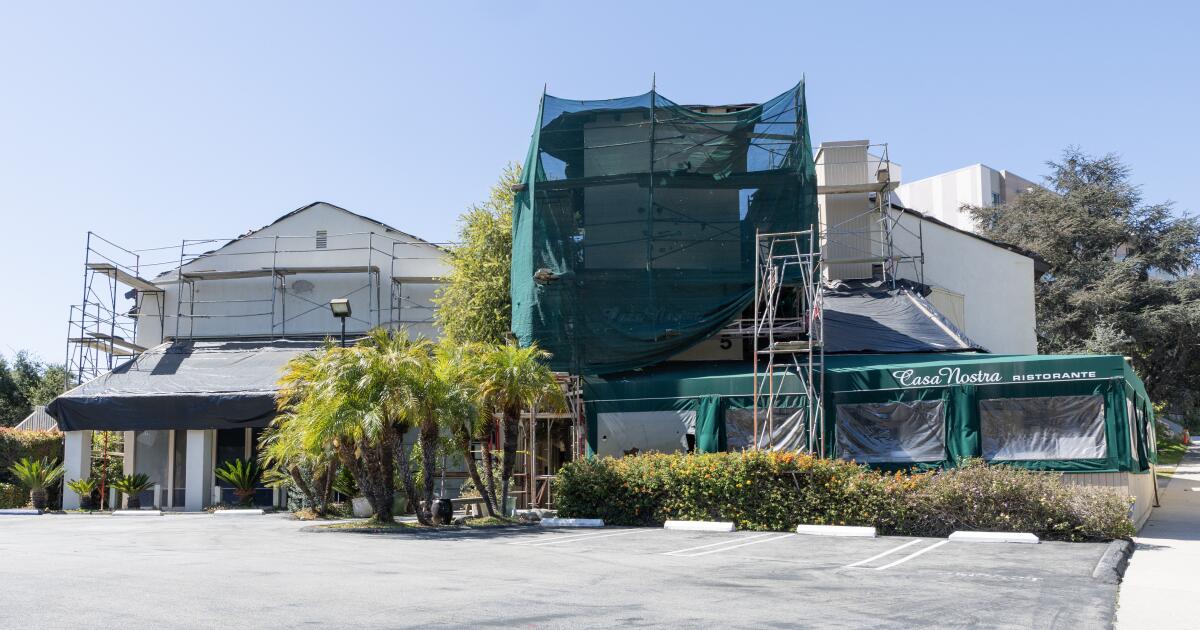
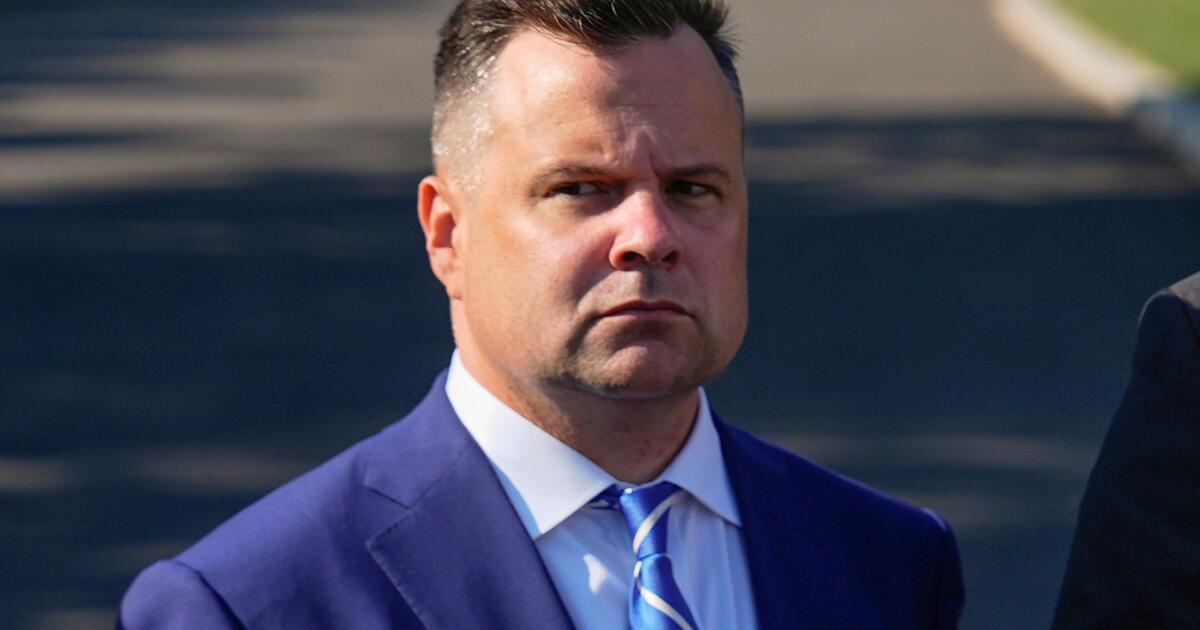
Last January, Spencer Pratt’s house in Pacific Palisades was razed by the raging flames of the Palisades Fire. Now, there has been what he called a “very suspicious fire” in a building in the neighborhood’s tony Highlands where he maintained an office for his crystals company.
Pratt, a former reality TV star who ran a high-profile campaign for Los Angeles mayor that he appeared to concede on Friday, talked to the California Post about the incident, which was first reported by the Palisadian-Post. According to the company’s website, the business sells precious and semi-precious crystal pendants, carvings and chains.
“I want to be careful to not compromise an arson investigation, but this incident is very suspicious,” Pratt told the California Post.
“I will wait for the investigators to make public the details, but this was no accident, and the timing of this … on the heels of all of the contentious election tomfoolery of the last two weeks, it is very suspect, indeed.”
Fire officials have not determined what sparked the blaze, and, in an interview with the Palisadian-Post, the building superintendent said he doesn’t believe the fire is related to Pratt’s campaign for mayor.
A spokesperson for Pratt did not immediately respond to phone calls and a text message seeking comment Saturday afternoon. Pratt suggested in his remarks to the California Post that he believes the fire may have been a politically motivated arson.
“This fire was not an accident, and it would not surprise me in the least if this were a reprisal for my work in opposing Karen Bass and Nithya Raman,” he said.
LAFD Public Service Officer Jamie Stewart told The Times in a phone interview Saturday afternoon that the department received a call at 6:09 p.m. Thursday reporting “a two-story commercial building with light smoke showing.” Stewart added that “arson was notified” and that LAFD arson personnel “did respond and they were on scene” of what he said was a one-alarm fire.
According to the Palisadian-Post, on Thursday, “Multiple firefighting units, including two ladder trucks, were dispatched by LAFD from Fire Stations 23 and 69 in the Palisades and Station 92 in Cheviot Hills to respond to the fire.”
The complex’s superintendent, Oscar Chang, told the local publication that the building was being remediated while waiting for a permit for work on its roof. Eyewitnesses, he told the Palisadian-Post, “saw two guys exiting the building shortly before the fire was reported.”
Chang added that he did not believe the fire was related to Pratt’s political campaign.
“One of the tenants shared a video with me of a homeless person right around the corner,” Chang told the publication, but “no one was living in the building.”
On Saturday morning, Pratt posted on social media about the Thursday fire, which tore through the Highlands Circle commercial complex at 1515 Palisades Drive. The complex was best known as the longtime home of the beloved Italian eatery Casa Nostra Ristorante, which closed a week before the Jan. 7, 2025, Palisades Fire and never reopened.
In the social media posting, he referred to the Los Angeles Times as the El Segundo Times — a derisive moniker referring to the location of its building in the coastal city near LAX Airport — and his repeated allegation that the newspaper “doxxed” him by reporting in April that he was staying in Santa Barbara County, not L.A.
“The El Segundo Times were very eager to dox where my children sleep; they thought that was newsworthy,” he wrote on X, formerly known as Twitter. “Have they reported on the arsonists who set fire to my office in the middle of my election?”
Overhead video footage of the fire posted on the Palisadian-Post’s YouTube channel showed smoke rising from the building as firefighters stood on the roof.
A filing in February with the L.A. City Department of Buildings and Safety proposed work for “change of use from commercial to retail, 2-story” at the property. In September, the department issued a code enforcement violation for “ABANDONED OR VACANT BUILDING LEFT OPEN TO THE PUBLIC.”
First Assistant U.S. Atty. Bill Essayli — President Trump’s loyalist federal prosecutor in Los Angeles — has not been shy in recent days about his intention to ferret out voter fraud in California’s primary election and criminally charge those responsible.
He has announced that his office “has multiple election fraud investigations underway” in coordination with the FBI, urged Californians on social media to submit evidence of “potential election fraud” directly to his office, and said flatly he “will be charging some people” with election fraud — just as soon as California certifies its vote count and his office “can prove some of the allegations.”
Essayli’s public callouts and promises are highly unusual and in direct conflict with Justice Department guidance on ballot fraud investigations at the federal level, which states federal prosecutors should not publicly pursue such claims amid of vote counting.
The Justice Manual — which regulates the actions of federal prosecutors nationwide — says the department “should not engage in overt criminal investigative measures in matters involving alleged ballot fraud until the election in question has been concluded, its results certified, and all recounts and election contests concluded,” in part because doing so “runs the risk of chilling legitimate voting and campaign activities and of interjecting the investigation itself into ongoing campaigns and the adjudication of any ensuing election contest.”
Ciaran McEvoy, a spokesman for Essayli’s office, said neither Essayli nor the office had any comment.
Essayli has repeatedly acknowledged in other interviews that he has no evidence of widespread fraud that could sway the results of races, and he even shot down one prominent online conspiracy that falsely alleged Democratic cheating in the Los Angeles mayoral race.
But he has also pointed to more isolated instances of fraud as potentially indicative of bigger problems. He added that there’s no proof such rampant fraud isn’t occurring, partly because of resistance from California to a federal audit of its voter rolls.
Essayli’s remarks are part of a much wider battle to frame fraud in California as pivotal or not, in which Republicans cite individual instances of alleged fraud as evidence of some grand scheme by Democrats to steal the election from them, and Democrats — along with many elections experts — say there is no evidence that isolated crimes reflect fraud on a scale large enough to impact election outcomes.
His remarks have added fuel to baseless claims from Trump and other influential conservative voices that California’s elections have been poorly compromised by coordinated Democratic “cheating.” They have made Essayli one of the most prominent Trump administration figures in the nationwide debate around election integrity — which election experts expect to intensify ahead of November’s midterms.
A public campaign
Essayli has made his case in recent days on various alternative and right-wing news programs and podcasts, arguing that California’s slow process for counting votes had undermined public trust and needs to be audited.
On One America News Network, Essayli said his office has been “sounding the alarm on California’s election system” because it’s ripe for fraud.
“We believe that it has major vulnerabilities. We believe California does not have sufficient safeguards to make sure only eligible U.S. citizens are voting in elections in California, and that is why we’ve been demanding an audit of the California voter rolls,” he said.
On NewsNation with Chris Cuomo, Essayli said he doesn’t “care what the outcome of the election is,” but wants voters “to have confidence in the systems, and that the laws are being followed.”
“I guarantee you, when we do bring cases, we will have plenty of evidence to prove beyond a reasonable doubt, in a court of law — that is how we work,” he said.
On the podcast of conservative commentator Glenn Beck, Essayli said he was “prohibited from discussing ongoing investigations,” but that “election fraud is not a theory” but “a real thing” — noting his office recently secured a guilty plea from a woman who paid homeless people to register to vote.
He said California is “a fraudster’s paradise,” accused the state Legislature of “going out of their way to make it as easy as possible for people to commit fraud,” and repeated oft-cited complaints about California’s voter ID policies being lax, its universal mail ballot policies sending ballots to the wrong places, its ballot collection policies allowing “harvesting” and its voter rolls being “dirty,” or filled with ineligible voters.
Essayli said all of that makes his job “incredibly difficult,” because “California has removed the paper trail, they’ve removed the chain of custody, they’ve removed any meaningful way for us to basically have a forensic audit of where a ballot came from,” but that he will nonetheless be bringing election fraud charges in the next “one to two months.”
State and local elections officials in California have defended the state’s policies as facilitating voting by as many eligible voters as possible, which they say is more important than a quick count. They’ve said there are robust procedures in place to ensure ballots are cast fairly and counted accurately, and to identify any problems and audit the results.
Elections experts say instances of fraud do exist, both in California and everywhere else in the country, but that robust efforts in past years to investigate and identify widespread fraud that could sway an election — including by Trump and his lawyers but also outside organizations — have always failed.
Essayli’s efforts have drawn sharp criticism from elections experts, leading Democrats and former prosecutors in the office.
Justin Levitt, a Loyola Law School professor who studies elections and was a senior policy adviser on democracy and voting rights in the Biden White House, said what Essayli is doing — throwing out unspecified claims of fraud amid an ongoing election and before he has built a case — is “absolutely nuts” and “not a thing that real prosecutors do.”
Before the current administration, the “mantra” of federal prosecutors, he said, was that “you only hold a press conference about a not-yet-concluded investigation when the public is already aware of a large crime,” such as a mass shooting. “Absent that, you wait for the facts to come in, and you see whether there has been a legal violation, and then and only then do you issue a press release — usually hand in hand with an indictment or a conviction.”
In an election, Levitt said the standard is even higher, and “the ethos of a federal prosecutor should be to never become the story, and to never make the prosecutorial job itself an impact in the election you are investigating.”
In an MS NOW interview, Sen. Adam Schiff (D-Calif.), a former federal prosecutor in the L.A. office, blasted Essayli as wildly searching for fraud to please Trump — despite it and other efforts to please Trump, including on immigration, causing an exodus of experienced career prosecutors from the office.
Schiff said Essayli was “basically making a plea to the public: ‘Please send me evidence. I’m asserting there’s fraud. We don’t have evidence of it, but please send me something. I need to make the boss happy.’”
Another former prosecutor in the office, who requested anonymity to avoid retaliation, said Essayli is pursuing alleged election fraud cases as hard as he is only because “Trump told him to,” and he’s “constantly auditioning for a bigger D.C. job in case he gets kicked out of his current one.”
Essayli is not the U.S. attorney for Los Angeles — only the “first assistant” — because he has been unable to win confirmation from the U.S. Senate and has only remained in charge through a legal loophole.
Investigations in the works
It’s unclear what specific issues or incidents Essayli’s office is investigating.
Essayli has said his investigations so far lean toward individuals rather than networks, and he told the California Post that he would be investigating a report that thousands of people were registered to vote at homeless shelters with far fewer beds.
His office also looked into false claims that an election night ballot update in Los Angeles County include no votes for Spencer Pratt, the Republican candidate. He said his office “reviewed official county records” and determined the claim was false.
“My office will continue monitoring the election counting process and will follow the evidence wherever it leads,” he said.
One person involved in investigating the latter case was Assistant U.S. Atty. Robert Renner, who joined the office in March after previously serving as deputy general counsel for the Center for Individual Rights, a nonprofit Washington, D.C., law firm where he worked on lawsuits focused on conservative free-speech issues, according to his LinkedIn page.
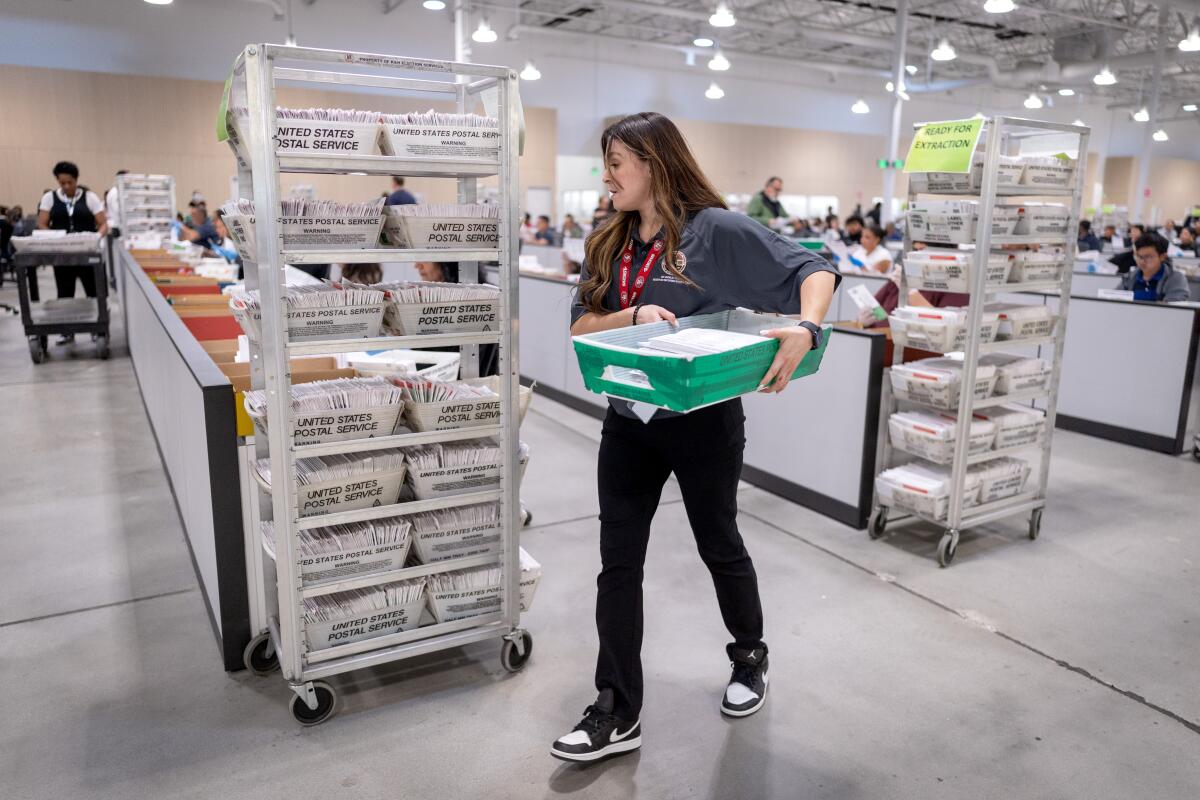
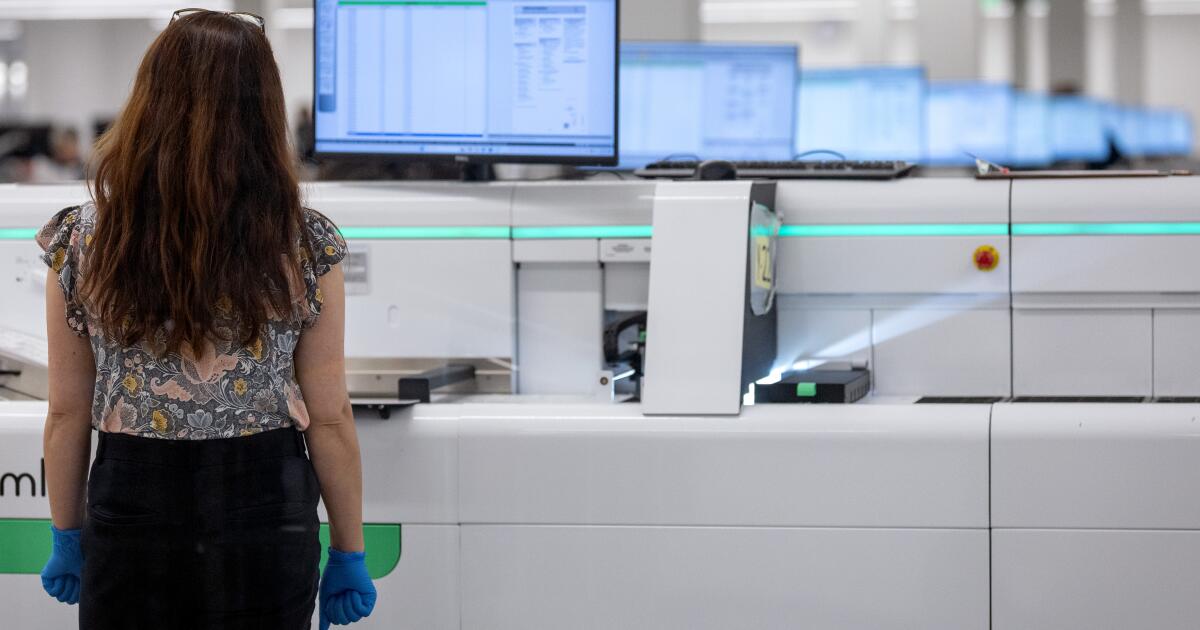
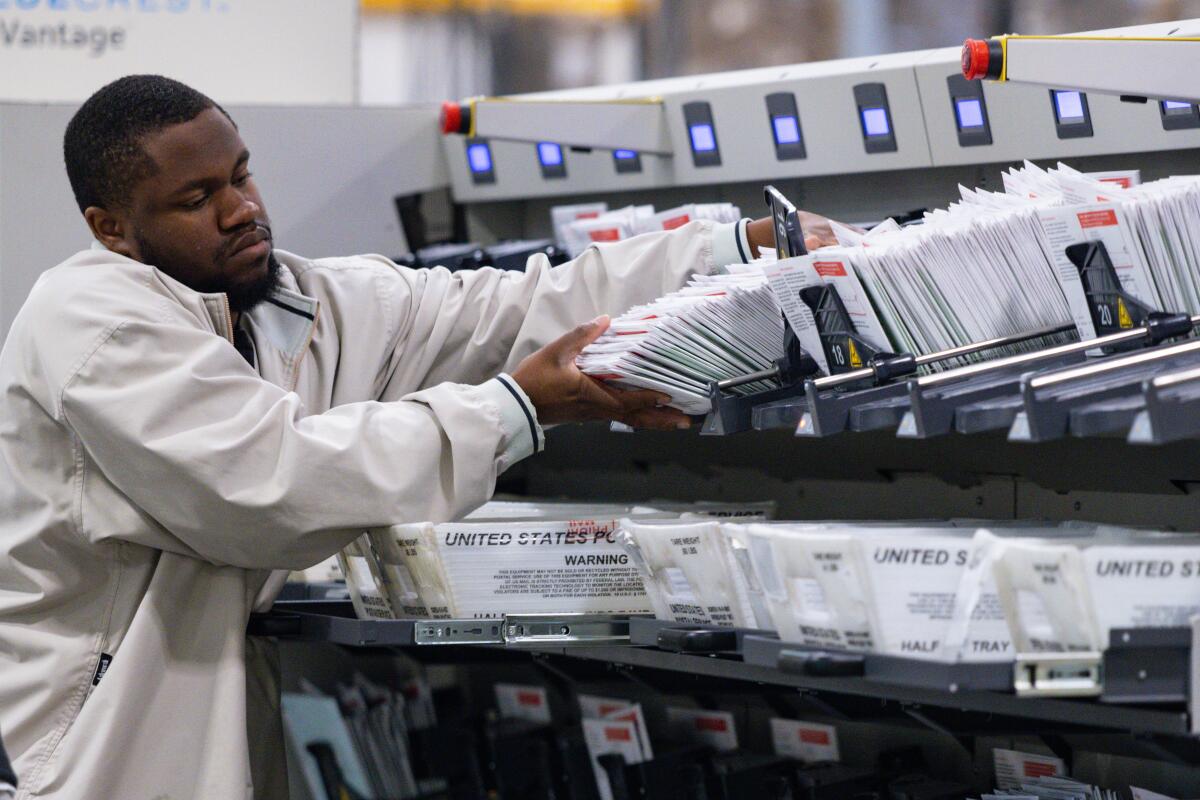
A worker carries ballots at the Los Angeles County Ballot Processing Center.
(Eric Thayer / Los Angeles Times)
Renner, who referred questions to the office spokesperson, visited an L.A. County ballot processing center as part of the investigation, where he questioned election officials about the ballot update, according to a law enforcement source with knowledge of the situation who spoke on the condition of anonymity for fear of retaliation.
Election officials have said their numbers were always correct and that the discrepancy was based on a one-minute lag in vote updates for Pratt by The Associated Press, which also confirmed the lag.
Renner also grilled election officials about whether or not post office officials had backdated postmarks on mail ballots sent after election day so they could still be counted, the source said.
Essayli’s elevation to the top prosecutor position in L.A. was part of a broader push by the Trump administration to fill key Justice Department roles with people loyal to the president and open to his election skepticism. Earlier this year, a Times investigation detailed how disgraced ex-L.A. County prosecutor Eric Neff was named “acting chief” of the Justice Department’s voting section.
Neff led a bungled election integrity case at the L.A. County district attorney’s office that was thrown out after an internal review revealed it hinged on the word of “Stop The Steal” activists who had pushed Trump’s discredited theory that the 2020 presidential election was “rigged.”
It was one of two election integrity cases Neff tried in his entire career before being elevated to the voting chief post by Asst. Atty. Gen. Harmeet Dhillon, another proud Trump loyalist from California.
Michael Sanchez, a spokesperson for Dean Logan, head of the Los Angeles County Registrar-Recorder/County Clerk, said the office has not received any formal document requests or investigation notices from Essayli’s office, only “routine questions about operations.”
What will come of Essayli’s investigations is also unclear. He will have to prove whatever allegations he makes in court — which he has repeatedly appeared to begrudge in recent interviews.
“Instead of putting the burden on the system to reassure the people [that] only legal citizens are voting, one person one vote is the law of the land, and the burden on the system to assure us that there’s integrity and we can believe in it,” he complained to Beck, “they’ve flipped it and now it’s on us to prove every allegation of fraud.”
WASHINGTON — Independents have grown increasingly unhappy with President Trump during his second term, a new AP-NORC polling analysis finds, particularly those without a college degree.
The analysis from researchers at The Associated Press-NORC Center for Public Affairs Research shows that while about half of independents without a college education had a positive view of Trump around the 2024 election, his approval with that group fell to about one-quarter this spring. That shift has erased the large education gap that existed among independents in the months before Trump took office for his second term, with independents now holding similarly negative views of the president regardless of their level of education.
The analysis was conducted by aggregating nearly two dozen AP-NORC polls conducted between July 2024 and April 2026, allowing for a deeper look at how support for Trump changed during several distinct periods, including the last six months of 2024, the first 100 days of Trump’s presidency, the summer of 2025 when the One Big Beautiful Bill passed, last fall’s government shutdown and the beginning of the Iran war.
The compiled polling shows a steady decline among independents throughout Trump’s second term. His standing has also dropped among several small but important groups that moved toward him in the 2024 presidential election, including Black and Hispanic independents.
More Americans than ever consider themselves independents, and they are among the groups that shifted toward Trump in the 2024 presidential election. Any erosion in that support could signal trouble for Trump and Republicans headed into the midterm elections, which are often seen as reflection of how voters feel about their governing party.
Tafari Torres, a senior research associate at NORC who co-authored the analysis, noted that while Democrats’ and Republicans’ views of Trump have held largely steady in his second term, independents’ opinions are still moving.
“Independents are, broadly, the people who are reacting to the events and dropping in their support,” he said.
Dramatic declines during Trump’s first 100 days
Trump’s return to the White House was in part fueled by independent voters who saw him as the stronger candidate on key issues like the economy. The new analysis, which looks at Trump’s favorability and presidential approval ratings, shows that once he took the helm, their views quickly soured.
Independents without a college degree had a much more positive view of Trump than college-educated independents did during and shortly after the 2024 election, but that shifted in the first few months of his term. Positive views of Trump among independents without a college degree fell from 48% in the months before he returned to office to 31% in polling conducted during Trump’s first 100 days back in office. Those warm views declined even further, to about one-quarter, during the government shutdown and the early months of 2026.
Only about 3 in 10 college-educated independents, by contrast, had a positive view of Trump before he returned to office, making their drop to about one-quarter much less dramatic.
“The decline among no-college independents was steeper and it was greater than the slight decline in college independents,” said Sean Collins, a research associate at NORC who co-authored the analysis. “That was surprising, especially given, when you think of Trump’s coalitions, those without college degrees is usually one of the ones that that stands out.”
Hispanic, younger independents grow disenchanted
Americans without a college degree have long been a key part of Trump’s coalition. But Trump also won in 2024 by making gains among groups that tend to support Democrats, including Hispanic adults.
About 4 in 10 independent voters — 42% — voted for Trump in 2024, up from 37% in the 2020 presidential election. Independent voters without a college degree were a little more likely to back Trump over former Vice President Kamala Harris in the last election, according to AP VoteCast, and Hispanic independents were about evenly split between the two.
The picture looks much bleaker for the president now.
Nearly half of Hispanic independents — 46% — saw Trump favorably in the polling conducted around the presidential election. His approval among these adults dropped quickly in his second term, falling as low as 15% during last fall’s government shutdown before landing around one-quarter in the spring.
Younger independents also became less supportive of the president, while independents age 60 and older remained mostly stable. Other AP-NORC polling has pointed to Trump losing ground among younger Republicans over inflation concerns and Hispanic Americans growing increasingly discontented.
“The gains Trump appeared to make during the election, I don’t know if they’re sticking around. He’s experienced some significant shifts among those people,” Torres said. “From our research, they don’t appear to be permanent gains.”
The economy is frustrating many independents
Polling suggests that the economy is at the root of many Americans’ frustrations with Trump, including independents.
About half of independents who supported Trump in 2024 said inflation was the single most important factor for their vote, AP VoteCast found, and most expressed high levels of concern about the cost of food and gas.
More than a year into Trump’s second term, inflation remains high, fueled by gas prices that remain elevated as the Iran war continues. An AP-NORC poll conducted in April found that about 3 in 10 independents were “extremely” or “very” concerned about being able to afford groceries in the last few months, and a similar share were worried about being able to afford gas.
The analysis found that Americans’ views of the U.S. economy tend to align with their view of the president. Those with negative views of the country’s economy tended to have negative views of Trump, and about 8 in 10 independents described the U.S. economy this spring as poor.
The latest AP-NORC polling from May found that only about 3 in 10 independents approve of how Trump is handling the economy, in line with the roughly 3 in 10 who said that at the beginning of his second term. The April poll found only about 1 in 10 independents — 12% — approved of how Trump was handling the cost of living.
This AP-NORC analysis of 4,836 independents was conducted over 21 AP-NORC surveys, blocked into five time periods before and during President Donald Trump’s second term. Independents are classified as panelists who do not select that they identify with or lean toward either the Democratic or Republican Party.
MINNEAPOLIS — The man charged in the political assassinations of the top Democrat in the Minnesota House and her husband, as well as the nonfatal shootings of a state senator and his wife, pleaded guilty in federal court Thursday after prosecutors said they would not seek the death penalty.
Vance Boelter was charged with murdering Minnesota House Speaker Melissa Hortman and her husband, Mark Hortman, and with shooting state Sen. John Hoffman and his wife, Yvette Hoffman. Boelter came to their doors in the early hours of June 14, 2025, disguised as a police officer and driving a fake squad car.
The Hortmans’ golden retriever was so gravely injured that it had to be euthanized.
Boelter, 58, was captured near his home in rural Green Isle the day after the shootings following what prosecutors have called the largest search for a suspect in Minnesota history. He also faces state charges, which have been on hold pending the resolution of his federal case.
The U.S. attorney’s office in Minneapolis notified the court Wednesday that the Justice Department would not seek the death penalty against Boelter in accordance with a proposed plea agreement, and the court set the change-of-plea hearing for Thursday.
Minnesota abolished capital punishment in 1911 and has never had a federal death penalty case. Daniel Borgertpoepping, a spokesperson for the Hennepin County Attorney’s Office, said the federal plea deal would not affect Boelter’s state charges.
While the Trump administration has pushed for greater use of capital punishment, there were questions about whether Boelter’s case would qualify for the death penalty under federal law.
Prosecutors have called the shootings political. When they announced the federal indictment in July, they released a rambling handwritten letter they say Boelter wrote to FBI Director Kash Patel in which he confessed to the attacks. However, the letter didn’t make clear why he targeted the Hortmans or the Hoffmans.
In some messages to media, Boelter referenced a vague and cryptic “investigation” he had been carrying out, sometimes suggesting it was about the COVID-19 vaccine.
John Hoffman said in a lawsuit filed against Boelter in April that his left arm and hand likely would never fully recover, and that he also had permanent injuries to his digestive and urinary systems.
Yvette Hoffman was left with permanent physical weakness, the lawsuit said, while their adult daughter, Hope Hoffman, who was there and called 911 but was not shot, suffered severe psychological trauma.
In a statement, AMC said due to the “robust lineup of upcoming films and strong advance ticket sales in the weeks ahead,” it needed to make some programming adjustments. Some of the major upcoming releases for June include Disney’s “Toy Story 5” and Steven Spielberg’s “Disclosure Day.”
Acts like Bebe Rexha, Paris Hilton, Kim Petras and Marren Morris were lined up to test out the new format next week, as a part of the Girls Night Live concert series.
The chain is partnering with live entertainment company Arena One to bring new technology to theaters. This tech would allow artists on a remote stage to see, hear and respond to the theater audience, in effect turning your local cinema into a stadium, the companies said. Fans who already purchased tickets have received refunds.
The series was initially marketed as a new draw to get customers to the theaters, but given the strong box office numbers so far this year, it’s clear the demand for theaters is already growing
Focus Features’ “Obsession” is now nearing $230 million in global box office revenue, according to Box Office Mojo, and is the studio’s highest-grossing movie at the domestic box office.
Most recently, “Scary Movie” topped the box office last weekend with a $105.5-million worldwide debut, ranking among the top five biggest R-rated comedy openings of all time.
AMC said it would announce new dates and additional artists for the interactive concert series in the coming months.
California’s slow vote counting process — still underway and causing friction after last week’s primary — may be forced to change before November’s midterm elections, as the U.S. Supreme Court prepares to rule on whether mail ballots must be received by election day to count.
Whether those changes will speed things up — and help tamp down baseless claims from President Trump and others that the slow count is evidence of fraud — will depend on a variety of factors, election experts said, including how the high court rules, how state lawmakers and local elections officials respond, and whether they push any additional steps to quicken the count.
“We’re all on the edge of our seats, waiting to see what the Supreme Court does,” said Kim Alexander, president of the California Voter Foundation.
“We’re certainly planning for a bad Supreme Court decision in this case, but we don’t really know all of our options for how to respond until we see the court’s decision,” said Assemblymember Gail Pellerin (D-Santa Cruz), chair of the Assembly Elections Committee and a former top elections official in Santa Cruz County.
Pellerin said she has been working on contingency plans with other state officials — including some from the offices of Gov. Gavin Newsom, Secretary of State Shirley Weber and Atty. Gen. Rob Bonta — and has requested $35 million in state funds to educate voters on any new midterm deadlines, though that funding has not been appropriated.
Federal law has, since 1872, set “election day” as the first Tuesday following a Monday in November, and gives Congress oversight over elections for the president and members of Congress. However, most authority for running elections falls to the states.
California currently provides a grace period for ballots to be counted as long as they are postmarked by and received within seven days of election day. More than a dozen states have similar laws that allow for counting late-arriving ballots, and most states accept such mail ballots from members of the military who are stationed overseas.
In March, the nation’s high court heard arguments about a five-day grace period in Mississippi, with the court’s conservative majority appearing skeptical. Many observers expect from those arguments that the high court will rule, by the end of this month, that ballots — at least for federal races — must be received by election day to count.
That outcome — in the case Watson vs. Republican National Committee — is considered likely but not assured, and some elections experts believe the high court has little legal precedent to support such a conclusion.
“That is a bogus interpretation of the statute,” said Rick Hasen, an election law expert and director of the Safeguarding Democracy Project at UCLA Law. “It violates what the statute says as a matter of text and history, and just how it’s been understood since the Civil War basically.”
Hasen and others also doubt that such a change would have much impact on the speed of California’s vote counting process, given that huge volumes of mail ballots that are placed in ballot drop boxes or arrive at processing facilities on or just before election day would still count — and would still drag the counting process out for days after the election.
In 2024, California counted more than 406,000 late-arriving mail ballots, but they represented only about 2.5% of the statewide total.
“The main bottleneck is really not ballots that arrive after election day. The bottleneck is ballots arriving before or on election day,” Hasen said. “So I don’t think the Watson case — however it comes out — is going to appreciably change California’s timing on when they’ll get enough ballots counted in a close race for it to be able to be called by news organizations.”
Nonetheless, state and local elections officials are preparing for changes — and looking for other ways to speed up the vote count, which, as of Monday, had resulted in more than 7.7 million ballots counted from last week’s primary, but more than 1.7 million left to process.
State plans unclear
If the Supreme Court were to rule that votes cast in federal elections must be received by election day, California would need to respond quickly.
It would need to craft a messaging campaign to inform millions of voters of the new rules, and determine when to tell voters they must mail their ballots by in order for their votes to count, experts said. That calculation may be shaped in part by efforts by the Trump administration to assert federal control over the mail ballot process through the U.S. Postal Service, which California and other states are fighting in court.
California officials may also need to determine whether they will create a “bifurcated counting process” with different rules for primary and general elections and different rules for federal races and state and local races on the same ballots, Alexander said, as a narrow Supreme Court ruling may not apply to them all equally.
“That’s a big policy decision that lawmakers will need to make, and I’m not sure how that would go,” Alexander said, citing a lack of detailed public plans from state and local elections officials.
Brandon Richards, a spokesperson for Newsom, said the governor’s office doesn’t comment on “hypotheticals,” but that Newsom “is planning for all eventualities, including but not limited to attacks on our democracy and disruptions in our elections.”
Bonta’s office said it is “in communication with election officials and actively preparing for the possibility that the U.S. Supreme Court could require changes to California’s election procedures,” but that it could not provide details.
Dean Logan, head of the L.A. County Registrar-Recorder/County Clerk’s office, said he was “not in a position to discuss specific contingency planning details” given the high court has yet to rule, but that his office “is closely monitoring the case and has begun evaluating potential impacts to election administration.”
If changes are required by the court, Logan said his office “is prepared to undertake a comprehensive voter education and outreach effort to ensure voters understand any new requirements, deadlines, or voting options,” which would be “multilingual, multi-channel, and designed to reach voters directly across Los Angeles County, particularly in communities that rely heavily on voting by mail and those that have historically done so.”
Funds needed for faster count
Alexander’s group has backed Pellerin’s request for $35 million for a marketing campaign to encourage voters to send midterm ballots in early, and advocated for another $55 million in state funding to support county efforts to build up their vote processing capabilities.
H.D. Palmer, a spokesperson for the California Department of Finance, said it would be “premature” to comment on those requests, but “discussions have been underway and are continuing.”
Both Alexander and Hasen said California should be investing more in its ballot processing capabilities even if the current process is fair and secure and the claims of fraud are baseless, because those claims have succeeded in diminishing trust.
“On the one hand, this is a manufactured crisis. There is nothing that is intrinsically bad about a slow count for a race,” Hasen said. “On the other hand, we live in an era of profound distrust in institutions and in the integrity of elections, in no small part because of Donald Trump.”
In 2012, slightly over half of all California votes were cast via mail ballots. However, that number has increased dramatically since, thanks in part to an expansion during the COVID-19 pandemic, and nearly 89% of ballots were cast by mail in last year’s special election.
Alexander said that throughout that same period, California lawmakers have passed new laws to expand access to the ballot but have not provided counties with the necessary funding to keep up with the volume — meaning “counties are left holding the bag.”
Alexander said California should fix that by providing consistent state funding for new ballot counting machines, more modern and efficient county processing facilities, and an expansion of a program backed by Pellerin and available in some counties already that allows voters dropping off ballot envelopes in person to essentially convert those ballots into in-person votes on the spot — which Alexander called a “hybrid” option that saves counties a huge amount of processing time.
She said the state spent millions to educate voters on new COVID-related vote-by-mail protocols and deadlines in 2020, and it led to both record turnout and a faster count — proving access and speed are not mutually exclusive.
“We’re being asked to make a false choice,” Alexander said. “It is possible to have accessible, secure, reliable and verified elections, and also an accelerated vote count.”
Times staff writer David G. Savage in Washington contributed to this report.
Since its creation more than a century ago, the Los Angeles Bureau of Street Lighting has been in the lamppost business and little else.
But in recent months, the little-known city agency has found itself pulled into a fierce debate over L.A.’s relationship with Flock Safety, a surveillance technology company that has been criticized for supplying data used to enable the Trump administration’s immigration crackdown.
In L.A., Flock operates dozens of automated license plate readers, which allow authorities to scan for vehicles that have been reported stolen or are registered to known fugitives, tracking their movements throughout the city.
The devices are often mounted on municipal light poles, which makes the Bureau of Street Lighting responsible for their installation.
Reports that Flock has shared license plate data with federal authorities, including U.S. Immigration and Customs Enforcement, have prompted dozens of mostly smaller cities across the country to end their relationship with the company. But in L.A. it still has found willing customers, including the LAPD.
Hundreds of emails obtained by The Times through public records requests reveal how LAPD boosters, homeowner associations and elected officials have engaged in a months-long campaign to pressure the Bureau of Street Lighting to speed up installations of the plate readers.
Flock, headquartered in Atlanta, said that it contracts with roughly 5,000 U.S. law enforcement agencies nationwide, and that its technology complies with a California law that limits what information can be shared with federal authorities. A company spokesperson said that Flock’s technology is “built around transparency, accountability, and local control.”
“Our customers own and control their data, which is deleted after 30 days by default,” the spokesperson, MoMo Zhou, said in a statement to The Times. “Our platform includes safeguards like audit trails to help ensure accountability at every step. Every day, Flock supports communities across the country in addressing crime and locating missing people.”
The Bureau of Street Lighting, with 177 employees and a relatively modest budget of $49.4 million, would seem an unlikely player in the broader debate over police surveillance. It is primarily tasked with repairing and fortifying the city’s more than 210,000 streetlamps — a frequent target of copper wire thieves — and maintaining its network of electrical vehicle charging stations.
The push to put up more plate readers has come amid calls for greater transparency around the Los Angeles Police Department’s dealings with Flock. In March, the Police Commission asked the department to report back on what information the company’s scanners collect and share. In recent months, the commission declined to approve donations of Flock cameras.
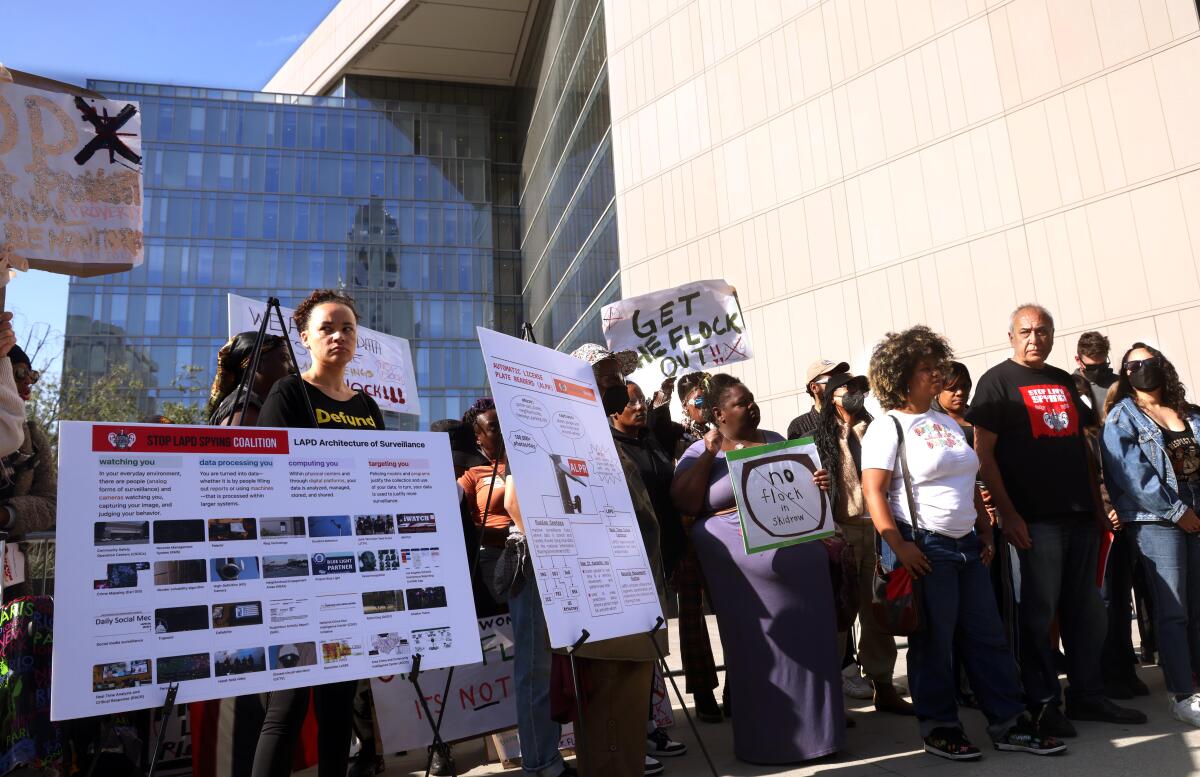
Members of the Stop LAPD Spying Coalition held a news conference to express opposition to Flock Safety, a license plate reader, ahead of a Los Angeles Board of Police Commissioners meeting on March 3, 2026.
(Genaro Molina / Los Angeles Times)
The commission ordered its inspector general to conduct an audit of the LAPD’s use of license plate reader technology, with the findings expected to be released in the summer.
Recently, Councilmember Ysabel Jurado introduced a motion urging the commission to “refrain from entering into any new Memoranda of Understanding, Contracts, or other Agreements, or implement any pilot programs with Flock Safety or its affiliates.” LAPD officials said last month that the city attorney’s office has been working on drawing up a formal contract with Flock.
Behind the scenes, though, the pressure to work with Flock has been ratcheting up from other council offices and community groups.
When a representative from Councilmember Katy Yaroslavsky’s office emailed the streetlighting bureau urging speed, she received a response that said the installation process shouldn’t be rushed because some city light poles can’t support the weight of a Flock reader, which is normally powered by a solar panel.
“The last thing we need is to have a pole fall onto someone or something if there are high winds,” the bureau’s Clinton Tsurui wrote in the June 4, 2025, email.
In another exchange, Tsurui expressed frustration with a colleague who had offered what he thought was an overly optimistic timetable for installing new plate readers.
He wrote: “smh, promising things we can’t do is going to catch up with us one day.”
The Los Angeles Police Foundation, a nonprofit group that has long bankrolled equipment for the LAPD and offered other support, has criticized delays in installing the Flock devices. Last year, the foundation facilitated the donation of dozens of Flock cameras, most of which ended up in affluent neighborhoods on the city’s Westside and in the San Fernando Valley.
Records show that in May 2025, Dana Katz, the foundation’s executive director, reached out to the mayor’s office with a request to waive permit and rental fees associated with installing the new readers. Katz wrote in an email that the extra expense of around $2,000 per device were “cost prohibitive and detrimental to public safety.”
Katz also pointed out that in some places, there are no city-owned poles on which to mount the devices — but offered a possible solution.
“Flock has its own pole that has been accepted by the County of Los Angeles for these situations, and we would like the City to accept the use of them, too,” she wrote to Robert Clark, the city’s then-deputy mayor of public safety.
A few of L.A.’s historic streetlights stand outside the Bureau of Street Lighting’s office near Virgil Avenue and Santa Monica Boulevard.
(Jason Armond / Los Angeles Times)
Katz wrote Clark again on Aug. 6 to ask why officials were estimating a six-to-12-month wait for approval of new Flock readers on public property in the neighborhoods of Cheviot Hills and Brentwood Park, where there were no existing city poles to mount them. She noted that the county’s engineering department had already approved the company’s poles, and asked Clark whether there was a way for the city to “piggyback on these other entities’ approvals in order to speed this up so that these neighborhoods don’t have to wait so long for help in preventing these home invasions?”
In the following weeks, Katz’s emails took on an increasingly urgent tone. In one of her last messages, email records show, she told an aide she expected more help than the mayor’s office was offering.
“With all due respect, the answers you have provided are completely generic and do not provide any guidance and direction as to how we can expedite this process,” she wrote.
She added: “I’ve said it before, and I will say it again — these delays are harmful to public safety.”
A spokesperson for the mayor’s office told The Times that ultimately neither Clark nor the aide intervened on the Los Angeles Police Foundation’s behalf.
Email records show Flock’s courtship of the bureau dates at least to spring 2024, when the company agreed to donate two of its plate readers to help combat copper thefts.
Tsurui emailed LAPD Capt. Celina Robles to say that the company’s executives had requested an in-person meeting with the bureau and the LAPD “to discuss the benefits of this product and how it can benefit the city moving forward.”
On June 24, 2024, a lobbyist from the D.C. firm Modern Fortis emailed Bureau of Street Lighting Executive Director Miguel Sangalang seeking to “explore a public-private partnership” between Flock and the city. Sangalang took another meeting to discuss Flock a few months later with former City Councilmember Joe Buscaino, who after leaving City Hall had gone to work for Ballard Partners, a powerful Florida-based lobbying firm.
In January 2025, after wildfires devastated Pacific Palisades, Altadena and other areas, Flock stepped in again. The company agreed to donate more than 50 plate readers, free of charge for six months, to the wealthy Palisades area, where residents and law enforcement officials were on high alert about potential theft.
A Flock Safety automated license plate reader in Costa Mesa.
(Courtesy of the city of Costa Mesa)
In the days and weeks that followed, city and police officials continued to pepper the bureau about speeding up the approval process.
On Jan. 21, 2025, records show, Cmdr. Randall “Randy” Goddard of the LAPD’s Information Technology Bureau wrote streetlighting officials to say that the Palisades community “could use a big favor from your department.”
LAPD Chief Jim McDonnell “fully supports this and has been working with the City Attorney’s office to finalize the terms,” Goddard wrote.
WASHINGTON — A relentless push by President Trump to reshape Washington‘s cityscape is facing mounting resistance, threatening a slate of transformative monuments intended to cement his legacy in the nation’s capital.
Eager to see his projects completed before leaving office, Trump has responded to growing legal and political obstacles by pushing ahead, attempting to force approvals through faster than opponents can challenge them. But the scramble to fast-track construction has inflated their costs for taxpayers, imperiling his plans and amplifying his political risks as the midterm elections approach.
Urban design has become a preoccupation for Trump since the start of his second term. Cranes dot the skyline of the city, and construction fences block access to many of its most cherished parks and venues less than a month before the nation celebrates 250 years since its founding on July 4.
Cranes from the White House East Wing ballroom construction project rise from behind the U.S. Treasury Department building on Thursday in Washington, D.C.
(Kevin Carter/Getty Images)
Government lawyers are defending the president’s use of the wrecking ball, arguing in court that he has unfettered power to build and destroy. Should he ever choose to tear down the Statue of Liberty, the Justice Department told a judge Friday, no one could stop him.
Yet a recent series of legal setbacks, as well as increasing Republican opposition on Capitol Hill, have cast doubt on the fate of his most lavish designs, including the construction of an imposing ballroom at the White House and the erection of a massive triumphal arch on the sightline of the National Mall.
It’s become a race against time for the president, who could soon confront a Democratic-controlled Congress armed with renewed oversight authority and subpoena power, further gumming the works of elaborate construction projects, which could stymie their completion before he leaves office.
“This is very much on the committee’s radar,” said one Democratic source with the House Oversight Committee, citing “serious concerns surrounding corruption.”
Visitors at the Mall gather in front of the Lincoln Memorial and near the Reflecting Pool, which is under renovation on Friday in Washington, D.C. President Trump dismissed criticism of the recent Lincoln Memorial Reflecting Pool renovations, rejecting claims the project amounted to merely a “paint job.”
(Roberto Schmidt / Getty Images)
Trump as ‘builder-in-chief’
Several of Trump’s more modest initiatives, referred to by the administration as beautification projects, are complete or well underway.
At the White House, a historic rose garden conceived by Jacqueline Kennedy was paved over, and its adjoining colonnade refurbished with black granite and gilded presidential portraits. The Palm Room foyer was decked in marble and chandeliers. New flagpoles fly supersized American flags on the North and South lawns.
The en suite bath of the Lincoln Bedroom in the residence has been gutted and renovated. And the Oval Office now practically drips in gold, while an adjoining study, once used by Franklin Roosevelt to scrutinize war maps and Lyndon Johnson to monitor the space race, was converted into the president’s personal swag shop.
A temporary Ultimate Fighting Championship arena constructed on the White House South Lawn is another example of how Trump is leaving a visual mark on the presidential residence. The structure, which towers over the White House, was paid for by the UFC, which is scheduled to host a series of fights on the premises.
Outside the White House complex, fountains across the city are coming back to life after decades of neglect, from DuPont Circle to Freedom Plaza and Union Station. The idyllic Logan Circle, surrounded by historic mansions, is being revitalized by the National Park Service, as is Lafayette Square, the site of an infamous clash between Trump and protesters shortly after George Floyd’s murder in 2020.
1
2
1.National Park Service Conservator for the National Mall and Memorial Parks Ali Cavicchio puts a clear coat over the recently repainted “I Have a Dream” marker at the Lincoln Memorial on June 05, 2026 in Washington, DC. The marker’s letters are carved into stairs of the Lincoln Memorial where Dr. Martin Luther King Jr. stood and delivered his “I Have A Dream” speech in 1963.(Chip Somodevilla / Getty Images)2.Members of the West Branch Area School District in Morrisdale, Pennsylvania, student marching band perform at the Lincoln Memorial on the National Mall on June 05, 2026 in Washington, DC.(Chip Somodevilla / Getty Images)
In some parks, even the turf is getting a makeover.
“People are all thanking me because Washington is beautiful again,” Trump told reporters last week. “The parks are open, we changed the grass. You know, grass has a life, also. Like people, grass has a life, and that grass hasn’t changed in 70 or 80 years.”
On Friday morning, several people sat by the restored cascading fountain at Meridian Hill Park. They walked their dogs, read books and exercised by the water.
Jean Luc, 33, was one of them. As he took a stroll with his 2-month-old daughter, Juno, he said it had been nice to see the government fix up the park, which he says he tries to enjoy with his daughter daily.
“It’s been nice to see the whole process,” he said. “I love it.”
President Trump displays a chart titled “Our Pool is Bigger than Skyscrapers” while discussing his renovations to the Lincoln Memorial Reflecting Pool on Wednesday in the Oval Office.
(Kevin Dietsch / Getty Images)
The Lincoln Memorial Reflecting Pool has been painted over in “American Flag Blue” by a firm that Trump said had worked on the swimming pool at his golf club in Virginia. Millions will be spent to regild the hulking Art Deco statues that buttress Arlington Memorial Bridge. And Trump has plans to connect the Lincoln Memorial to the Potomac River by building a promenade, one of many projects he has said may be named after himself.
Federal contracting data show that the Virginia firm Terra Site Constructors has been awarded roughly $60 million in contracts from the National Park Service to complete work on the various fountain rehabilitation projects across the city.
Another Virginia firm, Atlantic Industrial Coatings, holds a contract for $14.2 million to paint the reflecting pool.
The funding for both contracts comes from the entrance fees paid by national park visitors.
“How fortunate are we to have the builder in chief?” Interior Secretary Doug Burgum said Thursday in the Oval Office. “Someone who both has the vision and the understanding of how to get projects done that would make our city safe and beautiful.”
Construction continues on the White House East Wing ballroom on May 29, 2026.
(Kevin Carter / Getty Images)
‘The finest ballroom anywhere in the world’
Yet other, more controversial projects, exacting irreversible change to capital institutions, are facing greater opposition.
On Thursday, the Kennedy Center for the Performing Arts directed its staff to begin removing Trump’s name from its facade after a judge ruled that the attempted name change, and his effort to close the venue for two years of dramatic renovations, were illegal.
Angered by the court’s decision, Trump directed the Commerce Department to make arrangements to transfer control of the Kennedy Center to Congress. The move would give lawmakers power over the center’s operations, maintenance and management. It was originally an act of Congress that gave the Kennedy Center its name and mandate.
In other areas of the city, preservationists have successfully delayed the president’s bid to paint over the natural gray granite of the Eisenhower Executive Office Building. And Republican lawmakers have refused to vote to fund the construction of a ballroom at the White House that has already laid waste to the East Wing and, if completed, would dwarf the landmark residence.
Construction crews began tearing down the East Wing in October to make way for the 90,000-square-foot facility. Trump, who built a career as a real estate developer, has frequently touted the project, gushing over the sounds of jackhammers and excavation trucks.
Construction continues on the White House South Lawn on June 1, 2026, for an upcoming UFC match. President Trump is hosting a UFC match on the White House grounds to mark the nation’s 250th birthday.
(Kevin Carter / Getty Images)
“Oh, that’s music to my ears. I love that sound,” Trump told Republican senators at a White House event last fall. “A lot of people don’t like it. When I hear that sound, it reminds me of money.”
The ballroom project was initially expected to cost $200 million, a price that has since doubled. It is being financed by private donors and Trump, who has called it a “gift to the United States.”
“We are building what will be the finest ballroom anywhere in the world,” the president said last month.
More than half of the publicly identified donors of the ballroom projects — 14 of the 27 known corporate contributors — have won new or bigger federal contracts worth more than $50 billion in the six months since construction began, according to a report released by Public Citizen, a watchdog group.
“These giant corporations aren’t funding the Trump ballroom fiasco out of the goodness of their hearts,” said Jon Golinger, a public policy advocate at Public Citizen and author of the report. “They have massive interests before the federal government and they hope to curry favor with, and receive favorable treatment, from the Trump administration.”
White House military aides stand next to the giant mirror that hangs along the Rose Garden Colonnade at the White House on May 21, 2026.
(Chip Somodevilla / Getty Images)
The White House has challenged the report’s assertions, saying critics of how the project is being funded are “only people who suffer from a severe and incurable disease known as Trump Derangement Syndrome.”
“President Trump is making the White House beautiful and giving it the glory it deserves at no cost to taxpayers — something everyone should celebrate,” White House spokesman Davis Ingle said in a statement.
The report came out as the ballroom project has faced persistent hurdles in court and Congress.
The National Trust for Historic Preservation sued to stop construction, arguing the administration had not followed the legally required review process and had not secured congressional approval. In March, a federal judge halted aboveground construction, but an appeals court quickly allowed work to resume through June while the case proceeds.
On Friday, the panel heard the case and expressed skepticism about Trump’s push to build the ballroom without congressional approval.
On Capitol Hill, Senate Republicans dropped a proposal to set aside $1 billion in security funding for the ballroom after several GOP senators said it lacked the votes to pass.
Trump has insisted the funding is not necessary to complete the project, though he said it would help secure the complex. Without it, he told reporters last month, “the White House won’t be a very secure place.”
(Los Angeles Times photo illustration; Photo by Kevin Dietsch / Getty Images)
Arc de Trump
The president is also seeking to build a 250-foot-tall “triumphal arch” near Arlington National Cemetery, across the Potomac River at the foot of Memorial Bridge.
Renderings show the arch would be twice the height of the Lincoln Memorial, crowned by a golden statue of Lady Liberty sporting outstretched wings. An observation deck on its roof would offer sweeping views of the city.
Preservationists have criticized the plan as disrupting a sacred sightline between the memorials to Abraham Lincoln and Robert E. Lee, designed as a statement of unity after the Civil War. Even advocates of adding an arch in Washington have criticized the size of Trump’s proposed structure as overbearing. And a group of Vietnam War veterans has sued to try to stop its construction, arguing the project lacks congressional approval and would “dishonor their military and foreign service” because it would block the view of the cemetery.
Commission of Fine Arts member Pamela Hughes Patenaude, left, hands colleague Matthew Taylor a model of President Trump’s proposed triumphal arch to commemorate the country’s 250th anniversary during the commission’s public meeting at the National Building Museum in Washington on April 16, 2026.
(Andrew Harnik / Getty Images)
Despite public opposition, the National Capital Planning Commission last week advanced the project in its review process.
Trump praised the planning commission’s support, saying that “when completed, it will be, without question, the Greatest Arch of them all!”
The president has yet more plans to leave his mark — in some cases with his name, in others with his face.
Transportation Secretary Sean Duffy has proposed a $22-billion overhaul of Dulles International Airport outside the capital that would include a new terminal brandishing Trump’s name. Limited-edition U.S. passports will feature his portrait. And the Treasury has plans to mint a $250 bill featuring Trump’s mugshot from his 2023 Fulton County arrest, pending congressional approval — an unlikely prospect.
A walkway with the numbers “45” and “47” leading to construction on the new ballroom extension of the White House in Washington, D.C., on May 19. President Trump said a military hospital and research facilities will be built on the site of his planned White House ballroom, offering more details about the scope of the sprawling, controversial project.
(Samuel Corum/Bloomberg via Getty Images)
In a moment that went viral on social media, Sen. Jon Ossoff (D-Ga.), who is generating buzz over a potential run for the Democratic presidential nomination in 2028, offered a theory on what’s driving the president.
“He’s trying to put his face on the money. He’s building a monument to himself,” Ossoff told a crowd of supporters.
“But see, Atlanta, he’s doing these things now because no one will honor him when he’s gone,” he added, “because he’s a failed president and a national disgrace.”
Wilner reported from Los Angeles and Ceballos from Washington. Times staff writer Ben Wieder contributed to this report.
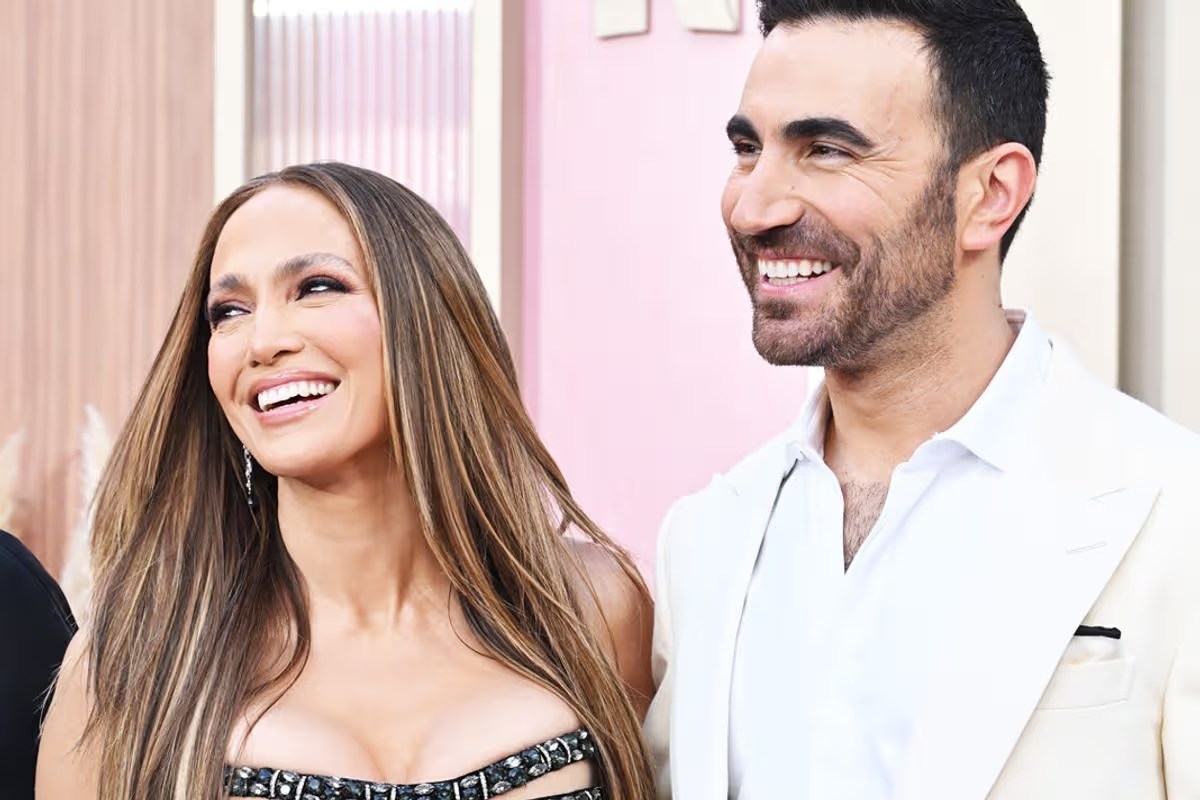
The Netflix rom-com Office Romance stars Jennifer Lopez and Ted Lasso’s Brett Goldstein and audiences have already hailed it as “an absolute blast”
Office Romance cast as Netflix rom-com hits #1(Image: NETFLIX)
Everything you need to know about Netflix’s number one rom-com, Office Romance
Netflix’s latest rom-com Office Romance has already won over viewers with its charming workplace love story starring Jennifer Lopez and Brett Goldstein. It’s currently the number one title on the streamer’s film chart.
Ted Lasso star Goldstein teams up with global icon JLo in this cheeky portrayal of romance between a CEO and her new British solicitor. Lopez plays AirCruz CEO Jackie Cruz, who finds herself in legal trouble with rival airline Falcon Air. When her usual lawyer is indisposed after a food truck burrito incident, enter Daniel Blanchflower (Goldstein) to save the day.
Romantic tension quickly develops between the pair, with a passionate work trip to the Dominican Republic blurring professional boundaries. One IMDB user gushed: “Well, I absolutely loved it. Romantic comedies are a dying breed, but I enjoyed this very much.”
Directed by Ol Parker of Mamma Mia! Here We Go Again fame, the film also features an impressive supporting cast including Betty Gilpin (GLOW), Tony Hale (Toy Story 4), Bradley Whitford (The Handmaid’s Tale) and former Doctor Who star Jodie Whittaker.
Also in the main cast are comedy icon Amy Sedaris as Julie Schatz and Blade Runner’s Edward James Olmos as Captain Jack Cruz, Jackie’s father.
With the Wayans brothers firmly back in the driver’s seat, horror parody “Scary Movie” muscled its way past He-Man for the top spot at the box office this weekend.
The reboot of the 2000s-era franchise — or “rebootiquel,” as the movie calls itself — brought in $55 million in the U.S. and Canada for a worldwide total of $105.5 million, according to studio estimates. The movie, which had a production budget of $30 million, beat studio expectations and marks the return of the Wayans brothers to “Scary Movie.”
The franchise was developed by Marlon Wayans, Shawn Wayans and Keenen Ivory Wayans. But after 2001’s “Scary Movie 2,” the Wayans got in a pay dispute with former Miramax executives Bob and Harvey Weinstein. The Wayans have said the Weinsteins did not tell them that 2003’s “Scary Movie 3” would be made without them. The franchise then continued with fourth and fifth installments.
After former MGM film executive Jonathan Glickman was named chief executive of Miramax in 2024, he reached out to Marlon Wayans to see if he’d be interested in reviving “Scary Movie.”
“Always dreamt of having this moment again,” Wayans said, while thanking Glickman and executive producer Marc Weinstock during a short speech at the movie’s premiere. “I thank you guys for having the vision to go, there’s only one way to do the next ‘Scary Movie,’ and that’s to bring the Wayans family back.”
Miramax led the production and financing of the film, while Paramount Pictures was the distributor.
Amazon MGM Studios’ “Masters of the Universe” came in second at the domestic box office with $29.3 million, in Mattel Studios’ first film in theaters since the 2023 smash hit “Barbie.” Globally, the movie made $54 million.
The action adventure movie had a production budget of about $170 million and aimed to reintroduce the ‘80s-era action hero “He-Man” to a new audience, while also driving the nostalgia of adults who played with the franchise toys or watched the original film and series. The movie is part of Mattel Inc.’s strategy to continue extending its toy brands into the entertainment arena.
Mattel Chief Executive Ynon Kreiz said last week that “Masters of the Universe” didn’t need to match the success of “Barbie” “to have a meaningful economic impact on the company.”
A24’s runaway hit “Backrooms” came in third at the box office this weekend, continuing its strong performance with a haul of $25.9 million. Focus Features’ “Obsession” ($25.6 million) and another YouTube-native property, “The Amazing Digital Circus: The Last Act,” ($12.7 million) rounded out the top five at the box office, according to Comscore data.
WASHINGTON — President Trump has issued a pardon to Stephen Buyer, a Republican former congressman from Indiana who served nearly two years in prison for making illegal stock trades based on inside information after he left office.
Buyer was sentenced to 22 months in prison in 2023 for trades made while working as a consultant and lobbyist. He was ordered to forfeit more than $350,000, representing the amount of the illegal gains, and pay a $10,000 fine. He was released in 2025.
The Supreme Court in May rejected Buyer’s appeal without comment or noted dissent.
In granting “a full, complete, and unconditional pardon,” Trump cited Buyer’s career as a judge advocate general in the Army and in the House that was “distinguished and highly productive.” The pardon was dated Thursday and released by the White House late Friday.
Buyer asserted that the pardon “corrects a politically motivated prosecution” and that it was “horrific to be imprisoned for a crime that I did not commit.”
Trump used his social media platform May 31 to share a pair of letters requesting a presidential pardon for Buyer, a lawyer and Persian Gulf War veteran who left office in 2011. He was a House prosecutor at President Clinton’s 1999 impeachment trial and in 2016 he served on Trump’s transition team focusing on veterans issues.
A letter signed by more than 40 Republican former members of Congress said Buyer was “targeted by the deep state” because of his involvement in Clinton’s trial a generation ago.
A second letter, from five current House Republicans, including Ken Calvert of Corona, said pardoning Buyer would bring justice to his case. The June 2025 letter was also signed by Tom Cole of Oklahoma, Marlin Stutzman of Indiana, Jack Bergman of Michigan and Pete Sessions of Texas.
Buyer, 67, was convicted in connection with insider trading involving the $26.5-billion merger of T-Mobile and Sprint, announced in April 2018, and illegal trades in the management consulting company Navigant when his client Guidehouse was set to acquire it in a deal publicly disclosed weeks later.
The Constitution gives a president broad power to grant pardons for federal crimes. The pardons do not erase a recipient’s criminal record but can be seen as an act of mercy or justice.
Ted Lasso star Brett Goldstein has denied he is dating his Office Romance co-star Jennifer Lopez, but what do we know about his love life?
Office Romance fans want to know if Brett Goldstein is married
The Office Romance leads have quashed speculation following their chemistry-filled promotional appearances.
Brett Goldstein has dismissed talk of a romance with Office Romance co-star Jennifer Lopez, leaving admirers wondering about his actual relationship status.
The Sutton-born Ted Lasso actor plays Daniel, a bumbling solicitor alongside JLo’s formidable airline boss Jackie in Netflix’s latest rom-com destined for success.
When the corporation becomes embroiled in legal action from a fearsome competitor, Daniel and Jackie are thrust into close proximity, though the firm’s strict no-dating policy throws a spanner in the works as their attraction intensifies.
Speculation about an off-screen relationship between the leads gained momentum throughout the film’s publicity campaign, fuelled by their undeniable on-screen rapport, reports the Express.
Yet during an appearance with Savannah Guthrie on The Today Show, the duo cleared up the confusion by confirming they’re not an item.
“There’s never a time when I’m seen with somebody or working with somebody where they don’t try to put me with the person,” Jennifer quipped.
Brett added with a laugh: “If you stand near her, that’s what happens.”
Jennifer’s marital history includes four marriages, with her most recent being a rekindled relationship with Hollywood A-lister Ben Affleck. The couple wed in 2022 before divorcing last year.
Regarding Brett’s romantic situation, inquisitive supporters will find little satisfaction as, similar to his Office Romance alter-ego Daniel, he maintains strict privacy around his personal affairs. Details about his love life remain largely under wraps, though he previously had a relationship with fellow comic Beth Rylance.
During his Emmy acceptance speech for Ted Lasso, he gave her a shout-out, quipping: “I was very, very specifically told I’m not allowed to swear, so this speech is going to be f****** short. Beth, I love you.”
Watch Netflix hits like Beef season 2 for free
This article contains affiliate links, we will receive a commission on any sales we generate from it. Learn more
Sky is giving away a free Netflix subscription with its new Sky Stream TV bundles, including the £15 Essential TV plan. This lets customers watch live and on-demand TV content without a satellite dish or aerial and includes the new season of Beef.
Beth herself responded in a since-deleted tweet: “Today is the day that my boyfriend goes to the Emmy’s as a Best Supporting Actor nominee and I am at home on my second load of laundry. Just to confirm, my boyfriend is Kenan Thompson off of SNL.”
The timeline of Brett and Beth’s romance remains unclear, as does when they parted ways. Currently, Brett is thought to be unattached. He is almost certainly unmarried as he has not been spotted wearing a wedding ring.
He’s recently been contemplating the notion of soulmates, particularly after starring in his 2025 Apple TV sci-fi romance All of You, which delves into the concept.
Speaking to InStyle, he pondered: “Do I believe in soulmates? I change my mind,” adding: “I honestly don’t know. Sometimes yes, sometimes no. I’m not sure there’s one person for everyone. I think there’s 50 people for everyone.”
He elaborated: “I think in your lifetime there are probably 50 people that you should have met. That doesn’t mean you’ll have sex with, but there’s some karmic connection, over millennia. You know what I mean?”
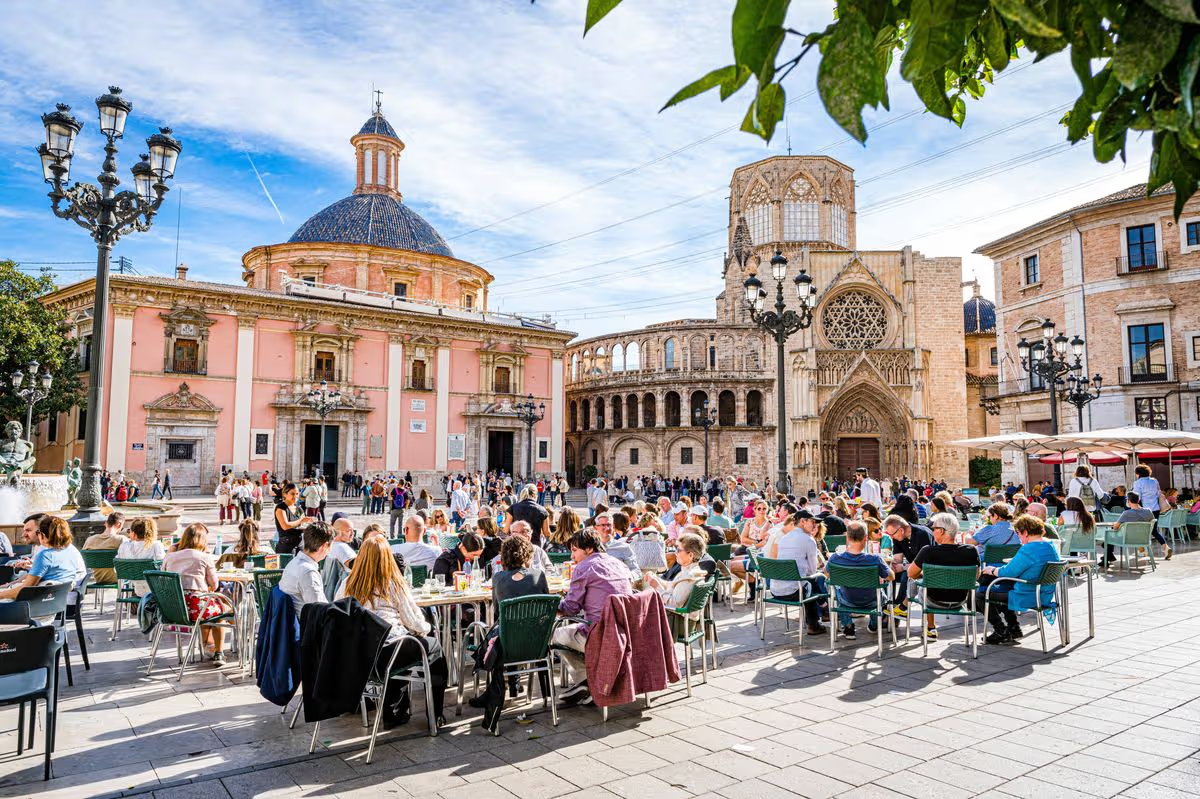
Spain is the most popular destination for UK holidaymakers
09:01, 06 Jun 2026Updated 09:01, 06 Jun 2026
Millions of Brits head to Spain each year(Image: fcafotodigital via Getty Images)
Anyone planning a trip to Spain should act eight weeks before travelling, according to the latest Foreign Office advice.
The Foreign, Commonwealth and Development Office (FCDO) provides advice for travel to more than 220 countries and territories across the globe, covering everything from entry requirements and safety risks to health precautions and regulations. The FCDO recommends that those heading to Spain check the most up-to-date vaccination advice at least eight weeks before they set off, and find out where to get their vaccines and whether any fees apply.
Holidaymakers are directed to the Spain page on the TravelHealthPro website, which states: “Travellers [to Spain] should be up to date with routine vaccination courses and boosters as recommended in the UK. These vaccinations include for example measles-mumps-rubella (MMR) vaccine and diphtheria-tetanus-polio vaccine.”
It’s worth noting, however, that there are no certificate requirements for entry into Spain. Those visiting Spain are also urged to ensure their tetanus jabs are up-to-date.
TravelHealthPro guidance adds: “Travellers should thoroughly clean all wounds and seek medical attention for injuries such as animal bites/scratches, burns or wounds contaminated with soil.” TravelHealthPro also recommends that all holidaymakers make sure they have sufficient travel insurance.
It adds: “If visiting European Union (EU) countries, carry an European Health Insurance Card (EHIC) or a Global Health Insurance Card (GHIC) as this will allow access to state-provided healthcare in some countries at a reduced cost, or sometimes for free.
“The EHIC or GHIC, however, is not an alternative to travel insurance.”
First Assistant U.S. Atty. Bill Essayli on Friday morning said his office “has multiple election fraud investigations underway,” in coordination with the FBI in Los Angeles.
Essayli’s remarks, posted to X, seemed to be in response to President Trump alleging in his own social media post late Wednesday that Democrats in California were “cheating” in the state’s primary election, and that there was an investigation underway in Essayli’s office.
Essayli’s office also confirmed that one of its prosecutors — Assistant U.S. Atty. Robert Renner — was at a Los Angeles County ballot processing center Friday “to observe the vote counting process.”
A spokesperson for Dean Logan, head of the L.A. County registrar-recorder/county clerk’s office, described the visit as in line with other routine observations of the counting process, which is open to public observation by appointment.
Democratic officials firmly rejected Trump’s claims of cheating, which they had warned he would make in advance of the election given his long record of objecting to and claiming fraud in elections he and his party lose.
Trump provided no evidence for his claims, other than to complain about California taking a long time to count ballots and criticizing its mail ballot system, suggesting it was a source of fraud. California officials have acknowledged the process takes longer than they would like, but said that is a result of a careful, accurate count of millions of ballots, many of which were mailed on election day.
“Taking the time to do this work correctly protects voters’ rights and ensures the integrity of our elections,” California Secretary of State Shirley Weber said Thursday. “California has built a strong system that expands access, empowers voters, and ensures more Californians can fully participate in our democracy.”
According to Weber’s office, about 5.6 million ballots had been processed in the state as of Thursday evening, while an estimated 3.6 million additional cast ballots remained.
Steve Hilton, a Republican who was leading in the gubernatorial race, said Friday that he expected to make it to November’s head-to-head race between the top two primary finishers — despite Trump insinuating Democrats were rigging the vote to exclude him. But Hilton also lambasted the state for counting so slowly, and said Gov. Gavin Newsom should deploy state resources to help ensure results are verified by next Thursday.
“This shambles is absolutely shameful for our state,” Hilton said, of the slow results.
Newsom’s office dismissed Hilton’s comments as uninformed. “It’s concerning that a candidate for Governor doesn’t know the Governor has nothing to do with counting ballots,” said Brandon Richards, Newsom’s deputy director for rapid response.
Essayli — a Trump loyalist the administration has kept in charge of one of the country’s largest federal prosecutor’s offices through a legal loophole, and despite his failing to be confirmed by the Senate — said he would not comment “on any specific investigation.” But he added that protecting California’s elections is “a top priority” for his office, and that “California’s election system has serious structural vulnerabilities.”
He said California’s mail ballot system, which a vast majority of voters rely on in the state, and its voter ID requirements — he said there were none, but California does have measures to ensure voters are who they say they are, including signature verification — create “conditions where fraud can go undetected and unpunished, eroding public confidence.”
“We will follow the evidence wherever it leads and prosecute any violations of federal election law to the fullest extent,” Essayli said.
He also noted that his office is working with Assistant Atty. Gen. Harmeet Dhillon, head of the Justice Department’s Civil Rights Division, to “conduct a comprehensive audit of California’s voter rolls.”
The Justice Department sued the state for its voter rolls, in a lawsuit that was thrown out by a federal judge who called the demand “unprecedented and illegal” and accused the federal government of trying to “abridge the right of many Americans to cast their ballots.”
The Justice Department appealed the ruling, and the case is now before the U.S. 9th Circuit Court of Appeals.
“The state has stonewalled every effort to verify that only eligible U.S. citizens are registered to vote,” Essayli wrote. “My office will not look the other way. We will investigate and prosecute. Every legal vote deserves to be counted. Every illegal vote cancels one out.”
Essayli’s office did not provide any additional information about Renner’s presence at the county balloting center, or about its fraud investigations. Essayli also provided no evidence of widespread fraud or acts by Democrats in the state to rig or steal the election, as Trump continued to claim Thursday.
Essayli did, however, point to a case in which a woman recently pleaded guilty to paying homeless people on Skid Row to help get initiatives on the California ballot. “Yes. There is evidence of election fraud in California. Here’s a case we charged just last month. More investigations are underway,” Essayli wrote.
Election experts say there are certainly examples of fraud in voting, but they are isolated and rare, and there is no evidence that fraud is widespread or exists in volumes large enough to sway elections. They note Trump has tried to argue such fraud in the past — including in disputing his 2020 loss to Joe Biden — but has never been able to prove it.
Michael Sanchez, Logan’s spokesperson, said Logan’s office was notified by Essayli’s office late Thursday that an assistant U.S. attorney would be visiting the ballot processing center to observe.
“The individual arrived this morning, was provided an overview of the public observation program, and participated in a walkthrough of the ballot processing operations,” Sanchez said.
Sanchez said election officials “routinely host observers representing a wide range of interests, including members of the public, candidates, political parties, advocacy organizations, and government agencies.”
California Atty. Gen. Rob Bonta’s office has also been involved in monitoring ballot processing in the state, including during last year’s vote on Proposition 50.
On Friday, Bonta acknowledged Renner’s presence at the L.A. County facility, and said his office also had a presence at the facility, was “monitoring the situation closely, and stands ready to protect voters and ensure California’s election laws are followed.”
Other Democrats in the state have also defended the state’s election process and blasted Trump for calling it into question.
“Let’s be honest about what this is: A blatant attempt to cast doubt in our election results, and a phony pretext for Trump to act illegally in the midterms,” Sen. Adam Schiff (D-Calif.) wrote on X. “California has safe and secure elections. And it takes time for every vote to count. It’s called democracy, Donald.”
The November runoff for state schools superintendent will pit two school board presidents — one a union-friendly liberal and the other a Trump-aligned conservative — against each other.
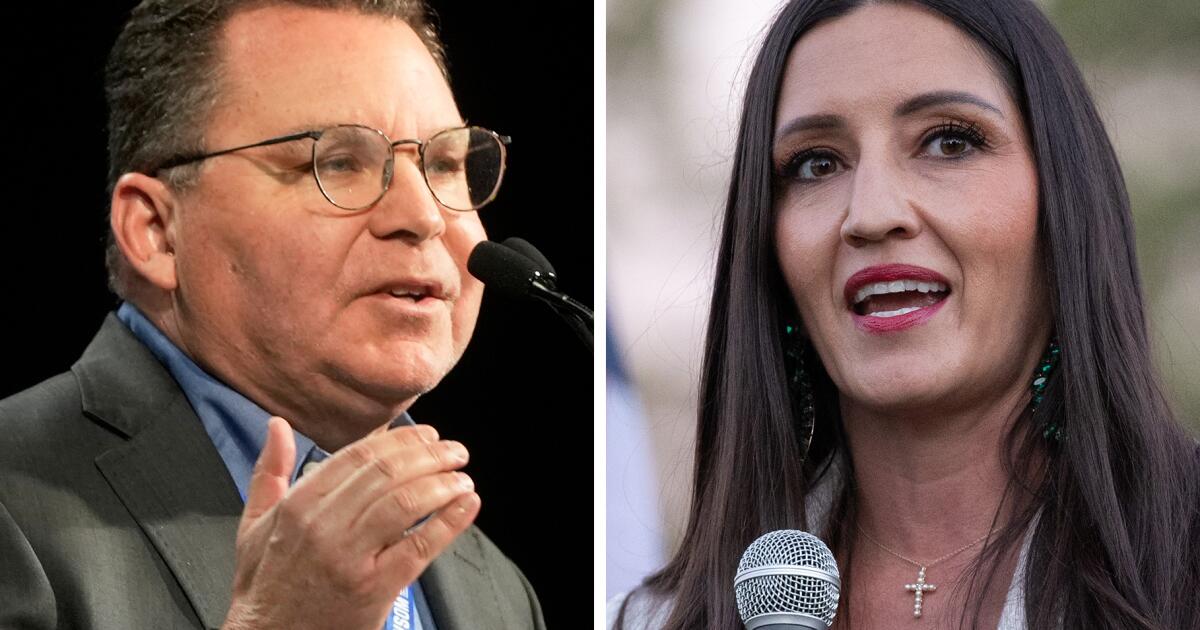
Republican, Sonja Shaw finished in first place in this week’s primary with 24.5% of votes counted through June 4. Democrat Richard Barrera had19.3%.
Shaw’s margin seems comfortable even with more ballots to be counted, with Barrera firmly in the runoff. The third-leading vote-getter, Wendy Castaneda Leal, was about 10 percentage points behind him.
The race creates a clear contrast between candidates and their vision for California’s schools.
While Shaw, 43, has not typically spoken to Trump’s immigration policies in relation to schooling, she is in accord with the Trump administration education agenda, including banning trans-athletes from women’s and girls’ sports and notifying parents when a child expresses gender-identity issues at school.
Under Shaw’s leadership, the school board in Chino Valley Unified, located in San Bernardino County, also approved a policy that permits parents to challenge books in school libraries.
Barrera, 59, is the board president of San Diego Unified, the second-largest school system in the state. He is a former union official who has developed strong bonds with the teachers union during his long board tenure.
That history helped him win the endorsement of the California Teachers Assn., which poured about $5 million into an independent campaign on his behalf.
Barrera acknowledges that this support made the difference in his leap ahead of other strong Democratic candidates.
Shaw has framed her campaign as a populist effort against a failed and self-interested status quo establishment.
“I didn’t get into this race because I was a politician,” Shaw said in a statement. “I got into it because I was a mom who saw too many families being ignored, too many classrooms falling behind, and too many elected officials unwilling to stand up for our kids.”
Barrera said he is ready to focus on the job of helping students learn more effectively.
“We see examples of schools that are delivering,” Barrera said. “The answers are all around us. The challenge for us as a state is to learn from educators in the local community about what is beating the odds and then take those practices to scale.”
Barrera speaks of an “assault” by the Trump administration on immigrant families: “I’m going to stand up to that assault.”
Barrera, who is a senior adviser to outgoing state Superintendent Tony Thurmond, praises the record of his boss.
Shaw, in contrast, once threw Thurmond out of her local school board meeting.
Lance Christensen, a conservative education analyst who ran unsuccessfully for the office four years ago against Thurmond, is ready for a spirited campaign that “is about to go nuclear.”
“Sonja Shaw pulled out an impressive primary win as an unabashed parental rights advocate while successfully running her local school district,” Christensen said.
“Should Shaw weather the political maelstrom that is about to hit her with tens of millions of dollars from the entrenched left,” he added, “she will have a bigger bully pulpit to shame the people in power who have made California’s education system the laughing-stock of the nation.”
Veteran Democratic political consultant Larry Levine predicted that, in November, Democrats will consolidate around Barrera just like Republicans did around Shaw in the primary — likely leading to a different order of finish in November.
“She consolidated the Republican vote and the Democrats spread like butter on warm bread,” Levine said. “It will be a far different story in the general. CTA will step up with the money to make sure their candidate wins.”
One of the trailing Democrats — former state Legislative leader Anthony Rendon —has already endorsed Barrera.
Rendon said that Barrera “is qualified, shares my values, and has spent his career fighting for public education. He is the candidate who will stand up to and defeat the dangerous, extremist ideology of Sonja Shaw.”
The state superintendent has limited authority over school districts, which are locally managed. The officeholder instead manages the California Department of Education. This agency guides local school districts and also provides partial oversight. The state superintendent also typically takes advantage of the bully pulpit on education issues.
The office has an uncertain future because Gov. Gavin Newsom is pushing a proposal to reimagine the office and redistribute some of its duties.
ABOARD AIR FORCE ONE — President Trump said Friday that he wants Bill Pulte, his new acting director of national intelligence, to cut the office, which has already been significantly scaled back during his second term.
Trump noted that the size of the office has been “way too high for way too long” and that “if he cut, I wouldn’t mind.”
“Bill Pulte is very good, he’s very talented,” Trump told reporters on Air Force One as he traveled to Wisconsin. The Republican president said in an earlier interview with the Wall Street Journal that he has asked Pulte to start the process of firing employees.
In the interview with the Journal, the president says he has already conveyed his view to Pulte, the incoming acting director of national intelligence, who has served as head of the Federal Housing Finance Agency but apparently has no national security expertise.
“I’d like to see it smaller. I think there are a lot of people in there that shouldn’t be there,” Trump said, which the Journal said was in reference to intelligence community officials who had served in the Democratic administrations of Presidents Biden and Obama.
Trump told the Journal that he wants Pulte to “start the process” of firing personnel and that the eventual permanent director of national intelligence should continue it. The president has indicated that he would not formally nominate Pulte for the position.
“Frankly, it might be good for him to shake it up before people come,” Trump said. “Because, if he [Pulte] reduced the size, in conjunction with me … and in conjunction with possibly the person coming in … he can do a lot of the hard work and we wouldn’t have to saddle somebody that goes in.”
Pulte was tapped by the president earlier this week in a surprising move that has been met with bipartisan resistance in the Senate, which confirms presidential nominations. The temporary appointment has now snarled the renewal of a critical national security surveillance program on Capitol Hill, with Democrats key to the vote pointing out that they did not trust Pulte — whose office oversees 18 intelligence agencies — to help administer the surveillance program.
Under Pulte’s successor, Tulsi Gabbard, the director of national intelligence’s office had already taken steps to scale back its size. In August, the Trump administration said that the office’s budget would be cut by more than $700 million per year, while slashing the size of its workforce.
At the time, Gabbard said the office had become “bloated and inefficient” while she announced the roughly 40% workforce reduction.
Gabbard resigned last month after revealing her husband’s cancer diagnosis.
Price and Kim write for the Associated Press. Kim reported from Washington.
The last time Angelenos sacked an incumbent city attorney in the primaries, almost 30% of them were unemployed.
That was May 2, 1933, the nadir of the Great Depression, when sprawling encampments blanketed downtown, King Kong ruled movie theaters and violent crime reached a fever pitch not seen again for almost half a century.
Incumbent City Atty. Hydee Feldstein Soto’s near-certain defeat on Tuesday may have little in common with Erwin P. Werner’s primary loss 93 years ago, but themes of Depression-era Los Angeles echo through the contest.
Marissa Roy, a deputy attorney general with the California Department of Justice who leads the race with ballots still being counted, wooed voters with shoe-leather and social media savvy, promising to use the office to fight for wage workers and tenants. But it was the city’s powerful unions and its increasingly democratic socialist bloc that propelled her to the top spot, mirroring the coalition that drove California’s sharp left turn in the early 1930s.
Meanwhile, county prosecutor John McKinney tapped into voter frustration with homeless encampments, a blighted downtown and general distrust of City Hall to pull off a last-minute heist of the second runoff spot. McKinney only started campaigning in earnest five weeks ago, but managed to win votes with a tough-on-crime campaign — even as some categories of city crime have dipped to historic lows.
L.A. Mayor Karen Bass, left, shares a laugh with L.A. City Atty. Hydee Feldstein Soto, right, at Avance Democratic Club’s politics and tacos event on May 16.
(Christina House / Los Angeles Times)
As of Thursday morning, Roy had nearly double the number of votes of Feldstein Soto. McKinney led the incumbent by 13 percentage points for the second runoff slot. The race has not yet been called, but Feldstein Soto issued a statement effectively conceding the race Wednesday morning. She acknowledged that “the voters had spoken” and referenced “her successor’s administration.”
Her campaign did not respond to a request for comment for this story.
The ouster of Feldstein Soto would be nearly unprecedented. Werner’s 1933 loss is the only similar instance since the city adopted its current primary ballot process in 1917, according to the City Clerk’s office. No other incumbent city council member or mayor has ever failed to advance out of the primary when facing two or more opponents.
“This is not something that has happened in the lifetimes of most people who follow city government,” said Mike Bonin, former City Council member and executive director of the Pat Brown Institute for Public Affairs at Cal State L.A.
McKinney’s sudden emergence in the race in May saw him hijack the incumbent’s support from law enforcement. His campaign received $3 million worth of independent expenditures. An official with a group supporting McKinney — who spoke on condition of anonymity because they were not authorized to speak to the media — said an internal poll showed Feldstein Soto falling nearly 10 points outside the runoff a week before election day.
Since Roy had already captured the support of the county Democratic Party and energized left-leaning voters, that put Feldstein Soto in the center, analysts said, which left her vulnerable in a race that most people casting ballots hadn’t closely followed.
“To the extent that people had any information, they knew that one of them basically wanted to be tougher and somebody on the other side wanted to be kinder, that left her with very little room to maneuver,” said Roy Behr, a longtime consultant to veteran politicians in the city.
Roy “micro-targeted” likely progressive voters in social media spots, experts said, presenting as an affable presence in her ever-present purple blazer while sharing her vision of serving as the “people’s lawyer.”
Marissa Roy, a deputy attorney general with the California Department of Justice, appears poised to finish first in the June 2 primary race for L.A. city attorney.
(Gary Coronado / For The Times)
Boosted by a massive influx of cash from rental giant Airbnb, some of McKinney’s ads played up his hard-luck upbringing in one of New Jersey’s most violent cities. His campaign also sent out texts that painted his opponents as “George Gascón”-style Democrats, invoking the former progressive district attorney as a bogeyman for voters anxious about crime.
AI-generated videos depicted McKinney as a stoic, suit-clad crime fighter walking through a dystopian version of L.A.’s Metro system.
“The debate isn’t necessarily two candidates on one stage appealing to one person, it’s for attention and information in the same sphere,” said Spencer Slovic of Mycorrhiza Digital, who ran Roy’s digital advertising. “That battle of information will play out almost in different realms.”
Without a compelling story for her powerful but poorly understood role, Feldstein Soto often struggled to explain her achievements in office.
In a recent interview with The Times, she said she delivered on “public safety, public integrity and public services.” She went on to discuss granular improvements she made to the office, such as limiting access to law enforcement databases by former employees, modernizing internal systems and improving the rapport between the city attorney’s office and LAPD. By her own admission, she doesn’t often publicly celebrate her accomplishments.
“I didn’t hold some big press conference and hop up on a white horse and declare myself Joan of Arc and the savior of all things Los Angeles,” she said. “Which I could have done.”
Tumult during Feldstein Soto’s lone term in office was easier for voters to identify. The cost of litigation exploded. A high-ranking city lawyer accused her of abusing her power, prosecuting political enemies, mistreating employees and engaging in “inappropriate alcohol consumption.” Feldstein Soto claimed she improved her office’s rapport with the LAPD, but the police union’s decision to rescind its endorsement of her and instead back McKinney cost her a key voting bloc.
Feldstein Soto’s messaging was at times muddled and lacked the flair of her challengers, political observers said. Campaign finance records show she paid for 80 email blasts, mailers and other messages that sought to influence voters.
John McKinney, a Los Angeles County prosecutor, appears set to advance to a run-off against Marissa Roy in the race for L.A. city attorney.
(Kayla Bartkowski / Los Angeles Times)
In one video, she stood in front of a static background and talked for three minutes straight about her record while describing her opponents as representing the “extreme left” and “extreme right.” She attacked both for receiving large sums of money from “special interests,” especially McKinney for accepting Airbnb’s largesse. Feldstein Soto sued the rental giant for price gouging in the wake of the 2025 wildfires.
Roy’s campaign sent out 180 communications, records show, the bulk of them ads for Instagram and Facebook, where her team said they saw instantly which stories resonated with likely voters and which were duds.
Slovic said a “clip of Hydee talking about how she wasn’t going to prosecute the Trump administration” seemed to touch a nerve with voters.
“That was by far our best performing ad,” he said, adding, “What Democrats really want in primaries is someone who will fight and have some sort of backbone.”
McKinney had just 23 communications, campaign records show, plus 19 more made by independent groups. He often leaned into the same gritty visuals that defined mayoral candidate Spencer Pratt’s viral AI spots.
In a race for a position most voters don’t understand, McKinney’s and Roy’s ability to play a consistent character may have proved critical, political analysts said.
“The vast majority of voters started off with no strong feelings about the race,” Behr said. “Nobody had any votes locked down other than their friends and neighbors.”
To the surprise of few, President Trump has once again claimed without evidence that Democrats are somehow cheating to win California’s primary elections — writing on social media late Wednesday that federal prosecutors in Los Angeles are investigating the matter.
“The Dumocrats are at it again! They are trying to STEAL THE GOVERNOR OF CALIFORNIA PRIMARY, AND THE MAYOR OF LOS ANGELES, PRIMARY, AWAY FROM TWO GREAT REPUBLICAN CANDIDATES. Here we go with the very late and massive numbers of MAIL IN BALLOTS,” Trump posted to his social media platform Truth Social.
“There’s BIG cheating by the Dumocrats in California. Votes are all tied up. May not be in for weeks. Under investigation by the U.S. Attorney’s Office in Los Angeles,” he wrote in a second post. “Why the vote counting DELAY???”
A spokesperson for the U.S. attorney’s office in Los Angeles — run by Trump loyalist First Assistant U.S. Atty. Bill Essayli — declined to comment Thursday morning on Trump’s claims of an investigation.
California Secretary of State Shirley Weber’s office also did not immediately respond to a request for comment.
Gov. Gavin Newsom’s office responded directly to Trump late Wednesday with its own social media post, writing, “Trump is lying about California again — time to take the phone away from grandpa and put him to sleep.”
On Thursday morning, Newsom’s office wrote that there “is a lot of misinformation floating around about California’s election — including from the President,” and recommended people watch a CNN video about California’s election process. It concluded that delays in vote counting in the state are essentially a result of state leaders deciding that providing voters with “last minute options” for casting ballots is more important than a quick count.
“And yes, for the record: we wish the votes were counted faster, too,” Newsom’s office wrote — a nod to the fact that the issue isn’t new.
In an email, Brandon Richards, Newsom’s deputy director for rapid response, said Trump’s claims are part of “a tinfoil hat level conspiracy theory that has been debunked repeatedly.”
The president’s claims of cheating were predicted before the election by both elections experts and Democratic leaders in California, who dismissed them in advance as more baseless bluster from a president beset by low approval ratings.
A worker puts ballots in a counting machine at the Los Angeles County Ballot Processing Center on Wednesdayin City of Industry.
(Kayla Bartkowski/Los Angeles Times)
Those same experts and Democratic leaders acknowledge that California’s system for counting votes takes a long time and should be quickened, but stress that is not because of anything nefarious. Rather, it is because California allows voters to cast ballots by mail up until election day — and then has to count those ballots, which can number in the millions and are subject to manual signature verification.
Trump has long dismissed such explanations. An election denier since he first entered politics more than a decade ago, Trump has pushed skepticism about elections he and his party lose time and again since — most notably when he claimed, again without evidence, that the 2020 election he lost to Joe Biden was stolen.
Trump even challenged Biden’s victory in court, but his claims were rejected completely because neither he nor his attorneys could produce any evidence substantiating them.
He has combined his tactic of targeting undocumented immigrants for political gain with his skepticism of election integrity by claiming, again without evidence, that such immigrants somehow vote in large numbers, particularly in big blue states such as California, despite experts saying there is no evidence of that.
He has alleged that mail ballots — such as those used by the majority of California voters — are a particularly rich source of voter fraud, despite again having no basis for the claim and it being disputed by experts.
A consistent feature of his election fraud claims is that they arise and target races only when Republicans lose or lose ground.
And, he has tried to use the power of his administration to make sweeping changes to election laws to bar mail ballots and require strict voter ID and proof of citizenship measures, despite the control of elections and their rules being constitutionally given to the states.
Those efforts have prompted a wave of litigation between the Trump administration and California and other blue states, with multiple cases pending in the courts over voter ID, proof of citizenship, mail balloting and the role that the U.S. Postal Service may be allowed to play in processing such ballots.
Trump’s latest remarks came as additional vote counting on Wednesday narrowed the advantage of Republican Steve Hilton over his Democratic challengers in the California governor’s race and closed the gap in the L.A. mayoral race between the MAGA-aligned candidate Spencer Pratt, currently running second, and City Councilmember Nithya Raman, who is running third.
The trend was anticipated. Elections experts warned before vote counting began of the potential for a “red mirage,” wherein earlier voting among Republicans and late voting among Democrats — many of whom were unsure of whom to vote for in the two high-profile races — would create an early illusion of Republican victories despite large volumes of liberal votes from major population centers still to be counted.
It is a trend that has played out repeatedly in past elections, and one that does not come as a surprise to careful elections watchers.
Elections officials in California knew such claims were going to be made, as they’ve been made in the past. Some local elections officials made a point of preparing their staffs for baseless claims of election fraud in advance of this year’s primaries. State officials made repeated efforts to explain the reasons why California elections take time, precisely to undercut claims amid counting that the delays were the result of fraud.
But those claims have come regardless, and not just from Trump.
Above an X post Wednesday suggesting Pratt was losing ground to Raman as more counts came in, Florida Gov. Ron DeSantis wrote, “California keeps dumping votes. Odds are shifting because the vote dumps always seem to go one way. Count until you get the result you want?”
Above another X post Wednesday noting that the California count would take time, Katie Miller, a former Trump administration official and conservative podcaster married to Trump’s top advisor Stephen Miller, wrote, “The Democrats are about to steal the LA mayoral race once again using mail-in voting.”
Both of the posts that DeSantis and Miller were responding to were from Polymarket, a prediction market where people can bet on the outcomes of political races, pop culture events and a slew of other subjects.
Such emerging financial markets, which process billions of dollars in bets, are causing rising concerns about political meddling for profit — including by campaign staffers and other individuals with insider knowledge of polling and other campaign information, or by politicians and their operatives, whose public remarks about politics can swing those markets.
CHICAGO — Former President Obama’s influence in his presidential museum runs deep, from the location on Chicago’s South Side to textured stone adorning its dramatic tower to striped reading chairs that resemble ones in his own home.
The Obama Presidential Center opens to the general public on Juneteenth after a celebratory dedication in Chicago with dignitaries. But tens of thousands of people — friends and family of museum staff, students and journalists — have already been offered a sneak peek of the nearly 20-acre campus as crews finish final art installations and landscaping.
The roughly $850 million project covers the political and personal realms of the nation’s first Black president. Campaign memorabilia and presidential artifacts are displayed in the admission-based museum tower while public spaces of the sprawling campus feature other things important to Obama: a new library, basketball court and picnic area with grills.
“This is a safe space for people to come and, yes, reflect on the historic moments of this presidency and the campaigns, but also to come together as a community to think about what change you can bring to your own neighborhood,” Josh Harris, the Obama Foundation’s vice president of public engagement, said during a recent tour with The Associated Press.
Here’s a closer look at the top attractions of the campus that is expected to draw as many as 1 million visitors annually.
President for a day
Obama’s presidential museum will be the first fully digital museum of its kind. There will be no official papers on display. Instead, visitors will experience high-tech and hands-on exhibits spanning the campaigns, key moments of Obama’s presidency and life at the White House.
One of the largest attractions is a life-sized replica of the Oval Office.
On a recent day, a stream of visitors, including schoolchildren, walked through the circular room, stopping to sit behind the desk and pose for pictures. The top drawer holds a copy of a handwritten letter from his predecessor, President George W. Bush, and Obama’s beloved BlackBerry phone.
“We want to make sure that people from all walks of life have the opportunity sit behind the Resolute Desk,” said Harris. “You think about the possibilities that if a young organizer from the South Side of Chicago can be president, you can be president too.”
Other sections of the museum detail the Affordable Care Act, immigration policies, and smaller moments such as when Obama unexpectedly sang during a 2015 eulogy for those killed in a South Carolina church shooting. A large television screen plays a clip of Obama singing “Amazing Grace.”
Peppered throughout are areas for personal reflection, which museum organizers say is key.
“We’re passing that baton and inviting people to bring change home, however change may be defined, both small or large,” said Louise Bernard, the museum’s director.
Touching iconic ballgowns
When Obama touted the museum’s contents at its groundbreaking in 2021, he predicted one of the top draws.
“We want this center to be more than a static museum or a source of archival research,” Obama joked at the site. “It won’t just be a collection of campaign memorabilia or Michelle’s ballgowns, although I know everybody will come see those.”
Roughly a dozen outfits on mannequins are behind glass, including a black and red dress designed by Narciso Rodriguez that the former first lady wore on Election Night in 2008 in Chicago.
Visitors will also get a chance to touch swatches of the fabrics, including the rose gold chain mail Atelier Versace evening gown she wore at her final state dinner in 2016.
Obama’s personal touches
The museum’s location is near where Barack Obama started his political career, taught law at the University of Chicago and where the family lived. Michelle Obama also grew up on the South Side.
A lifelong basketball lover, Obama requested a glass-paneled, professional grade basketball court to be used for community programs.
The former first lady designed a garden, where lettuce and strawberry plants are sprouting. There are also charcoal grills available for public use — an element that Obama envisioned when he pitched the plan in community meetings nearly a decade ago.
“President Obama always talked about his feelings of being in Chicago and one of his memorable moments was grilling in the park,” Harris said.
The Obamas’ design tastes and love of history are also evident.
The museum campus features dozens of commissioned works of art while different parts of the campus are named after prominent figures. The central “John Lewis Plaza,” named for the late congressman and Civil Rights leader, is designed as a public gathering spot.
Inside a new Chicago Public Library branch, a 70-foot mural depicts literary figures, including Walt Whitman and James Baldwin. At the center, Toni Morrison reads to a boy wearing orange shirt, representing a young Obama.
The presidential reading room features thousands of books chosen by the Obamas, ranging from presidential biographies to best-selling fiction. One of Obama’s favorite parts are two high-backed chairs with blue, yellow and black stripes. They were selected by the former president as top-notch reading chairs similar to ones he has at home.
Pricey admission with free options
Tickets are $30, the highest of any U.S. presidential museum or library. Next on the list is the Richard Nixon Presidential Library and Museum in California, where tickets are $29.
Obama Foundation leaders say the prices are justified for the state-of-the-art facility.
Tickets at the adjacent Griffin Museum of Science and Industry are $25.95. In downstate Illinois, tickets to the Abraham Lincoln Presidential Library and Museum in Springfield cost $15.
Along with free days and discounts for Illinois residents, Obama Foundation officials also argue that most of the campus is free, with only four floors of the museum tower requiring tickets.
Anyone can walk the campus, use the playground, library, sledding hill or grilling area. The tower’s top floor, which feature panoramic views of the nation’s third-largest city, is also free.
“The idea behind this institution, this campus, was to make it accessible to as many people as possible,” Harris said.
The promotion of Conservative MP Alistair Burt to Minister for the Middle East within Britain’s Foreign and Commonwealth Office (FCO) demonstrates that the UK’s friendship with the Saudi-aligned Gulf Cooperation Council (GCC) states will remain toxic.
Between May 2010 and October 2013, Burt was only an Under-Secretary of State at the FCO, with responsibility for “Counter Terrorism, Counter Proliferation, Counter Piracy, North America, Middle East and North Africa, the Maldives and Sri Lanka.” As of earlier this month, he is now a full minister of state, responsible solely for the Middle East; he also holds a second ministerial position at the Department for International Development.
As Under-Secretary, Burt had a long record of protecting the Bahrain-Britain intimate relationship. It was not just, as one activist put it, the usual “meaningless FCO shtick” in which he repeatedly claimed that progress was being made on reforms even when it patently wasn’t. It was a serious of smears, lies and fabrications which went above and beyond the call of duty. There is no reason to believe that his time as a full minister will be any different; in his time out of government office he engaged deeply with GCC lobbyists.
That the lobbyists were interested in him is unsurprising. From 2011 (“the Arab Spring”) until he left the FCO in 2013, despite repeated requests, Burt never admitted that British equipment had been used against pro-democracy demonstrators in Bahrain. He claimed there was no evidence that British-supplied shotguns, teargas and stun grenades had been used in the suppression of protests, despite ample photographic proof. When asked whether AssetCo, a private fire equipment company based in Britain, was involved in the crackdown, he twisted away from the truth; it was.
It was BAE Systems armoured cars, manufactured in Newcastle, which were used by the Saudis when they intervened to save the Al-Khalifa ruling family from wipe-out by deploying troops during the Bahrain protests. Burt claimed meekly that they were only there to “safeguard installations.” The Campaign Against The Arms Trade (CAAT) pointed out that even if this was the case, “the Saudi presence in that country increases the capacity of the Bahraini authorities to suppress protests.”
Burt then smeared a Bahraini human rights organisation for offering criticism of the regime; a group which had, coincidentally, helped to organise the 2011 protests.
In the summer of 2013, a Labour MP asked about rights allegations raised by “the Bahrain Youth Society for Human Rights”. “I have not seen the report,” Burt replied bluntly. The report in question dealt with specific cases of the abuse of prisoners, but he still seemed to know a lot about the specific society. It was almost as if he had been briefed on what to say. He told parliament that the BYSHR was merely “an unregistered non-governmental organisation… and its credibility is untested.” It was a naked attempt to discredit the group.
Mohammed Al-Maskati founded the BYSHR some six years previously. He had applied for it to be registered under Bahrain’s onerous charity regulations, but had been turned down for being too critical of the state. His father-in-law is a prominent political prisoner.
Al-Maskati is now a senior consultant for the highly credible Frontline Defenders organisation. In 2011, Amnesty International adopted his case after the regime sent out a mass text message calling for his death because his society had been a leading organisation in the Pearl Roundabout protests.
Since the mid-2000s, Al-Maskati has been subject to constant judicial and other forms of harassment, including public discrediting. Minister Alistair Burt has looked comfortable about joining in with these attacks.
Burt also displayed studied indifference to anyone facilitating the crackdown and refused to engage with the organisers of the Formula One Grand Prix who were heavily criticised for repeatedly hosting their events in Manama in subsequent years. He also refused to raise with European allies the allegations that they were shipping surveillance technologies to the regime in Bahrain, and completely ignored reports that a British social media monitoring firm, Olton, was also involved, working for the Bahrain ministry of the interior.
What Burt has done since October 2013 until his re-appointment as a senior minister is even more of a concern. He is clearly a man beholden to Saudi-aligned GCC interests. Two months after he stepped down, the Bahrain parliament paid for him to attend the Manama Dialogue, arranged by the PR firm Meade Hall & Associates.
Although he was despatched temporarily to the Department of Health for another ministerial role, when the Saudi Arabian Shura (Consultative) Council arrived on a flying visit to London in 2015, Burt sat down with its members for a cosy meeting.
The new minister’s relationship with the UAE has also remained close. This April, before he was re-appointed to the FCO, Burt took it upon himself to lead a delegation of British MPs to the country, and appeared in the de facto state-controlled media encouraging further economic co-operation. He also became chairman of the All Party Parliamentary Group (APPG) for the UAE.
Burt has also maintained a relationship with Bell Pottinger, the PR firm enlisted to defend the State of Bahrain during the 2011 crackdown. In 2015, he was appointed as a non-executive director of the oil and gas exploration company President Energy, whose own lobbying and public relations are also handled by Bell Pottinger. The PR agency also handles secretariat functions for the APPG on Bahrain, a pressure group for Bahraini state interests; Burt is a member. There is an alternative grouping for those British politicians in favour of democratisation, known as the APPG for Democracy in Bahrain; Burt is not a member.
Even after Alistair Burt left the Foreign and Commonwealth Office, the APPG Bahrain continued to court him, perhaps in the hope that, one day, he might be returned to greater office; so did the UAE and Saudi Arabia, and he has. The minister is clearly the GCC’s man at the FCO; we should be wary about who he really works for.
The views expressed in this article belong to the author and do not necessarily reflect the editorial policy of Middle East Monitor.
Los Angeles County prosecutors are reviewing two sex assault cases against Sean “Diddy” Combs that stem from allegations made by a Florida music producer last year, law enforcement officials and the alleged victim said Wednesday.
Investigators from the Los Angeles Police Department and the Los Angeles County Sheriff’s Department presented the cases to prosecutors in January 2026, according to a statement from the district attorney’s office.
A spokesman for the district attorney’s office declined to say when the alleged incidents occurred or explain why it has taken nearly nine months to make a charging decision.
Combs — who rose to fame as a hip-hop mogul in the 1990s as the face of Bad Boy Records — has gone through a years-long public downfall following myriad allegations of domestic violence and sex abuse. In July, a New York jury convicted him of transporting prostitutes across state lines for drug-fueled bacchanals referred to as “freak offs.”
He was sentenced to four years in federal prison and remains incarcerated at a minimum-security prison in New Jersey.
Combs’ reputation and business began to publicly unravel in 2023 after federal authorities raided his homes, and a leaked video showed him beating his ex-girlfriend, Casandra “Cassie” Ventura, at a Los Angeles hotel.
TMZ first reported on the D.A.’s office’s decision to review the L.A. allegations. A spokesman for Combs declined to comment.
In November, The Times reported that the Sheriff’s Department was investigating Combs on suspicion of a sex assault that happened in East L.A.
Jonathan Hay — a Florida-based music producer who was working with Combs on a project to remix songs written by deceased rap legend Notorious B.I.G., also known as Christopher Wallace — said Wednesday that he is the alleged victim in the cases under review by the district attorney.
Hay told several media outlets in 2025 that he was the “John Doe” from a civil lawsuit filed last July that accused Combs of sex assault in 2020 and 2021. Hay first reported the assaults to police in Largo, Fla., he has said.
According to the suit, Hay, Combs and others were at a Los Angeles warehouse that stored some of Wallace’s possessions in 2020 when Combs “provided drugs to everyone present” and subsequently began masturbating in front of Hay.
Combs “started watching porn on his cell phone, grabbed one of Biggie’s shirts off a rack, and began to masturbate with it in front of the plaintiff,” the suit alleges. In a separate incident in March 2021, Hay alleged Combs forced him to perform oral sex, according to the suit.
“I have an overwhelming feeling of hope as we are knocking on the door of criminal justice,” Hay wrote in an email to The Times on Wednesday. “I am beyond grateful that both the LASD and LAPD investigated this case thoroughly for many months and submitted it to the District Attorney.”
Combs’ civil attorney Jonathan Davis has previously denied Hay’s allegations.
“Let me make it absolutely clear, Mr. Combs categorically denies as false and defamatory all claims that he sexually abused anyone,” Davis said in a statement last year. “He looks forward to vindicating himself in court, where such matters are decided — and not in the media — based on admissible, material evidence, not rank speculation and unsubstantiated allegations.”
Times staff writer Richard Winton contributed to this report.
Here are five takeaways from a gubernatorial contest that was sedentary and sleepy until, suddenly, it wasn’t.
Flashback!
Three months ago, Xavier Becerra seemed so irrelevant he — along with a clutch of other weak-polling candidates — was conspicuously excluded from a scheduled debate at USC. Today, the Democrat has seemingly punched his ticket to November.
The obvious parallel is with another massive underdog, Gray Davis, who also came from far behind to win the last time a gubernatorial primary held this level of uncertainty and suspense. That was back in 1998.
Like Davis, Becerra has a political persona that could be marketed as a sleep aid. No one will ever mistake either of them for, say, Arnold Schwarzenegger. But Becerra’s even-keeled demeanor seemed the perfect prescription following the overnight implosion of Eric Swalwell’s scandal-scarred campaign while presenting a welcome contrast with the endless Sturm und Drang emanating from Washington, D.C.
Despite California’s star-struck reputation (perpetuated mainly by outsiders), the state has elected far more governors like Davis and Becerra than Schwarzenegger and Ronald Reagan. In fact, other than Schwarzenegger, who prevailed in an unprecedented recall campaign, every candidate following Reagan has successfully run for statewide office at least once before being chosen governor.
Becerra was elected attorney general before heading to Washington to join the Biden administration; his candidacy offered worn-out voters a safe harbor amid the Trumpian tempest.
Cha-ching!
There are things money can’t buy which, Tom $teyer — er, Steyer — is just the latest to discover.
The hedge fund billionaire turned Democratic activist sank more than $215 million — a record — into his gubernatorial bid, after spending nearly $350 million in a failed 2020 try for president.
With roughly 60% of the vote counted, he was running an unimpressive third and hoping a lopsided surge of still-to-be-counted ballots will push him into the top two.
Half a billion dollars, which makes for a pretty pricey, “Meh.”
California has a long record of rejecting money-bag candidates for governor and the U.S. Senate — a pattern stretching back more than half a century. Given that hostile history, Steyer would enter the runoff as a distinct underdog, notwithstanding the many added millions he is poised to spend.
“These filthy rich people who don’t have to deal with the kind of financial struggles that people have in connection with their daliy lives just don’t feel relatable,” said Garry South, who ran Davis’ successful 1998 campaign against the free-spending Steyer of his day, former airline executive Al Checchi.
Given the relentlessly negative campaign Steyer has waged, besieged voters could count on many more ugly months of brutality on the airwaves, on computer screens and in their mailboxes.
The only happy ones would be TV station managers and political consultants cashing Steyer’s super-sized checks.
A self-fulfilling prophecy
It was never likely. But the mere prospect of Democrats being shut out of the November runoff was enough to guarantee such a scenario would not happen in this reliably blue state.
With a large pack of Democrats running and just two serious Republican contenders, Democratic partisans feared their fractured vote would let the GOP nab both spots in Tuesday’s top-two primary.
Much of the freak-out was fed by polls supposedly showing Republicans Steve Hilton and Chad Bianco atop the field. But no candidate ever had much more than a paltry 20% support; for all the heavy breathing, the race was always pretty much a multi-candidate tie.
Fearing the worst, however, voters who normally couldn’t tell a “jungle primary” from a jungle gym began thinking a lot like gimlet-eyed political strategists. Democrats, in particular, held onto their ballots much longer than usual, waiting to see which candidate appeared strongest at the end.
“The decision matrix on this was not just the political insiders, but all the normies who heard there might be two Republicans,” said Paul Mitchell, a Sacramento political data expert who developed a popular online tool handicapping various election scenarios. “They’re talking to friends and families. It was kind of crazy.”
In the end, the race among Democrats became less a contest than a self-fulfilling prophecy. Becerra was seen as the candidate with the best chance of advancing to November, so many voters flocked his way — ensuring he would advance to November.
Now he waits to see whether his opponent will be Hilton or Steyer.
Sacramento still a boy’s club
More than 30 states have elected female governors. A few have done so multiple times. But come January, California — which perceives itself as oh-so-cutting edge on oh-so-many things — will install the 41st in the state’s unbroken line of male governors.
“There’s expectations that are put on a woman” that are different from those male candidates face, said Mindy Romero, director of the Center for Inclusive Democracy at USC. Toughness in a man can be seen as abrasive or off-putting in a women. Acting with authority can come across — at least to some observers — as overbearing.
“A woman’s version of a leader still has to be at least somewhat feminine,” Romero said. “That’s what our society expects. So you have to be tough, but do it with a smile.”
But in Sacramento, within the governor’s suite, California’s highest glass ceiling remains firmly intact.
Youth won’t be served
Last fall, over a plate of enchiladas in downtown San José, Mayor Matt Mahan emphatically ruled out a run for governor.
“I have a wonderful marriage,” Mahan said at the time. “I have two wonderful kids. I loved working in the private sector. I’ve got a lot of great friends … I genuinely want to make our city better, and I love the job.”
He should have stuck to those words.
Instead, Mahan and his wealthy Silicon Valley backers talked themselves into a rushed and premature campaign that was never remotely competitive. Investors might have thought they were getting in on the ground floor of the next Amazon. Instead, Mahan’s candidacy was more like Pets.com, a famous e-commerce flop that came to embody the heedless froth of the dot.com bubble.
But it would be equally premature to write Mahan off.
Decades ago, another youthful big-city mayor ran an ill-considered campaign for governor, finishing a distant fourth and failing to muster even double-digit support. That, however, didn’t hurt Pete Wilson’s political career. Four years later, he was elected to the U.S. Senate en route to two terms as California governor.
At 43, Mahan has plenty of highway ahead and a good deal of political potential. His time may yet come.