offering

‘One-of-a-kind’ British lido with 3 heated pools and dragon inflatables is offering free swimming for kids this weekend

A POPULAR lido is set to offer all day sessions this weekend – where kids will be able to swim for free.

The Grade II listed venue also offers a number of adult-friendly swim sessions and an adventure course.

Café building at the outdoor swimming lido in Pontypridd park.
The pool re-opened in 2015 following a multi-million pound renovation Credit: Ceri Breeze
Aerial view of the Lido swimming pool and adjacent playground in Ynysangharad Park, Pontypridd.
The lido offers three pools, an outdoor play areas and an inflatable course on weekends Credit: Ceri Breeze

The National Lido of Wales, in Pontypridd, is hosting all-day sessions from May 2 to 4, ahead of the pool’s official summer season on June 1.

Kids under 16 will be able to enjoy the lido for free all weekend, while adult entry is priced at just £4.

The pool currently offers weekday and weekend sessions from 6.30am until 8.45am for early-morning swimmers.

Family fun sessions are also hosted only on weekends and bank holidays until the start of June.

DIVE IN

‘Ultimate’ UK aquapark with beach bus and climbing towers is reopening this weekend


SPLASH OUT

UK’s biggest freshwater lido to reopen this week as temperatures to hit 26C

For an additional £3, visitors can purchase tickets for the inflatable obstacle course, Aqua Peddlerz and Water Walker, which includes floating zorbs – inflatable plastic balls that allow people to run on the water.

The area also contains an outdoor play section – a dedicated playpark with slides, seesaws, climbing and balancing equipment.

The historic venue, also known as Lido Ponty, has been nestled within Ynysangharad War Memorial Park since 1927.

Following its closure in 1991, the pool spent the intervening 24 years in a state of disrepair until its official re-opening in 2015.

Now it features a renovated main pool, an activity pool and a splash pool, which are all heated to 28 degrees.

The site is also considered the “earliest and best preserved lido” in South Wales.

Source link

SNC Gives Details Of Its Clean-Sheet Freedom Trainer Offering To The U.S. Navy

The U.S. Navy’s Undergraduate Jet Training System (UJTS) competition to replace the T-45 Goshawk is accelerating toward one of the most consequential training decisions in decades. The Navy has now issued its eagerly-anticipated Final Request For Proposals – an inflection point in the long-running effort to field 216 modern jet trainers for the next generation of naval aviators.

Amid this pivotal moment, SNC is leading a powerhouse team that has developed the only clean-sheet design in the running: the Freedom Trainer. Built specifically to address the Navy’s evolving carrierborne training needs, the Freedom Trainer aims to deliver modern capability at significantly reduced lifecycle cost.

An artist rendition of two SNC Freedom Trainers. SNC

SNC is partnering with Northrop Grumman, General Atomics Aeronautical Systems, Inc., and CAE, leveraging advanced production, manufacturing, and synthetic training expertise to create a comprehensive, integrated family of training systems. 

“SNC’s Team Freedom brings the agility of a disruptor and the reliability of our well-established defense partners to bear so that we can deliver what the Navy wants, on the aggressive timeline it set,” says Jon Piatt, executive vice president at SNC.

Why the Navy’s training model is changing

Core requirements for the T-45 replacement have shifted dramatically. Advances in automated carrier landing technologies and increasingly capable simulation environments have altered the Navy’s perspective on how student naval aviators should be trained. The service has already removed carrier qualifications from the T-45 syllabus, one of the most significant training changes in decades, and plans for UJTS could further reshape how training occurs ashore.

A major driver of this debate centers around Field Carrier Landing Practice (FCLP), the land-based surrogate for shipboard carrier landings. Traditionally performed to touchdown, these aggressive, un-flared landings, or “bouncing,” replicate the forces and precision required aboard the carrier. But for UJTS, the Navy has removed the requirement for FCLP-to-touchdown, instead calling only for FCLP-to-wave off.

The Freedom Trainer is designed to be able to fly FCLP-to-touchdown. SNC

This change dramatically broadens the aperture for competitors. Trainers designed for land-based operations can meet wave-off profiles without requiring the structural upgrades typical of Navy aircraft. But this also introduces concerns about the long-term impact on aviator proficiency, and whether foundational carrier skills can be taught effectively without actual touchdown repetition.

The FCLP equation and its implications for the fleet

FCLP has long been considered essential for preparing student naval aviators for the demands of carrier aviation. A Navy spokesperson reaffirmed to TWZ in August 2025 that “Field Carrier Landing Practice landings ashore are still required for graduation,” though did not specify whether touchdown was still necessary. 

Touchdown landings impose tremendous structural loads on an aircraft, particularly landing gear and associated components. Removing this requirement opens the competition to off-the-shelf trainers such as the T-7 Red Hawk, Korean-built TF-50N, and the Italian M-346N. These jets can perform FCLP-to-wave-off but not repeated unflared touchdowns without extensive structural reinforcement.

SNC argues that this shift elevates readiness and cost risk. “FCLP-to-touchdown is a tried and trusted method to train naval aviators,” says Derek Hess, vice president of strategy at SNC. “Not performing carrier qualification or FCLPs-to-touchdown  essentially defers that training to the fleet replacement squadrons with their 4th-, 5th-, and soon, 6th-generation fighters which would be a very expensive use of those precious assets.”

In other words: the Navy can remove the requirement, but the fleet will still pay the bill.

Why a clean-sheet matters

The Navy’s decision not to mandate touchdown capability fundamentally changes the nature of the competition. Legacy trainers can now be offered at lower upfront cost, but at the expense of performance characteristics essential to naval aviation.

SNC is blunt on this point: the Freedom Trainer is the only aircraft in the field that can perform FCLP-to-touchdown without major modification because it is purpose-built to meet Navy training standards. SNC believes this is the defining advantage of a true naval trainer.

Where its competitors adapt land-based jets for a naval training mission, the Freedom Trainer is engineered from inception for the pounding, the control margins, and the durability required for FCLPs-to-touchdown.

A view of the Freedom Trainer’s tandem cockpit arrangement. SNC

Clean-sheet means a whole new approach

The Freedom Trainer offers improvements over the T-45, while delivering dramatically lower lifecycle costs. Hess explains that lifecycle economics are central to SNC’s approach: only about 10 percent of lifecycle cost is tied to research, development, test and evaluation (RDT&E) and 30 percent for procurement, while roughly 60 percent stems from operations and sustainment.

“From a business perspective, you can pay more in the RDT&E phase and still dramatically reduce your lifecycle costs,” Hess says. “We’re employing a more businesslike approach to training that balances training costs holistically across the lifecycle of the aircraft.”

To achieve this, SNC leverages advanced digital engineering to reduce risk and ensure real-world fidelity. “Digital engineering has evolved significantly over the last 10 years,” Hess says, pointing to Northrop Grumman’s work on the B-21 Raider as a benchmark for its modeling environment.

The Freedom Trainer’s mission systems architecture is built using Model Based Systems Engineering (MBSE) and is delivered with full technical and data rights – ensuring the Navy retains long-term control and interoperability.

Designed for the mission: performance and durability

The aircraft’s design reflects a deliberate choice to provide representative fighter performance at dramatically lower cost. The Freedom Trainer’s design reflects a deliberate philosophy: deliver the handling qualities and durability of a fighter‑representative aircraft without imposing fighter‑level sustainment costs. Rather than itemizing features in a list, SNC emphasizes that the jet’s airframe, engines and performance envelope all work together to meet the Navy’s demanding syllabus.

The Freedom Trainer is designed to provide fighter-like performance at lower cost. SNC

At its core, the Freedom Trainer is built around a 16,000‑hour airframe that’s engineered to withstand up to 35,000 carrier‑style landings. This level of durability is essential for repetitive FCLP operations, especially un-flared touchdowns that impose loads far more intense than standard runway operations. By designing the structure from day one to accept these stresses, SNC ensures the aircraft can train pilots to full carrier‑representative standards while avoiding the costly structural fatigue associated with modifying older, land‑based designs.

Power comes from a pair of Williams FJ44‑4M engines, selected not only for reliability but also for their lower operating cost compared to legacy trainer engines. These efficient turbofans help reduce support burdens by an estimated 40 percent relative to the T‑45, while enabling longer sorties on less fuel than the competition.

Performance‑wise, the Freedom Trainer provides the maneuvering capabilities student naval aviators must master before transitioning to fleet aircraft. With a −3 to +8 G envelope and angles of attack (AoA) reaching up to 27 degrees, the aircraft exposes students to the high‑AoA handling characteristics relevant to modern 4th‑ and 5th‑generation fighters. Yet SNC deliberately designed the jet to avoid the transonic regime, which typically demands larger thrust margins and higher fuel consumption to accomplish the same training maneuvers. By staying sub‑transonic, the aircraft maintains fighter‑representative handling qualities while keeping lifecycle costs far below those of high‑performance jets.

“You don’t need a fighter to learn how to fly a fighter,” Hess notes. “You need a trainer engineered for Navy training missions that create graduates who are ready for FRS training and beyond.”

The Freedom Trainer features twin Williams FJ44-4M engines. SNC

LVC: The synthetic backbone of modern training

Live, Virtual, and Constructive (LVC) training is now central to the Navy’s future training enterprise. The service intends to offload many carrier operations scenarios into synthetic environments as part of its modernization journey.

The Freedom Trainer’s LVC environment, developed with CAE, includes synthetic radar, targeting pods, and augmented reality tactical scenarios that replicate beyond visual range (BVR) and within visual range (WVR) engagements. Hess notes that many mission training functions can be downloaded from frontline squadrons, producing far more capable pilots at much lower cost. 

“Ultimately, flying 4th- and 5th-gen fighters with modern flight control systems isn’t hard these days,” Hess says. “The tough part is employing the aircraft. That’s where we excel with our LVC capabilities.”

Turning clean-sheet into reality: timeline and industrial base

The final RFP envisions Engineering and Manufacturing Development (EMD) beginning with up to two contract awards in 2027, delivering four EMD aircraft followed by seven low-rate production jets beginning in 2032. The goal is initial operating capability in 2035.

Hess is confident SNC can meet the timeline. With a restructured Navy acquisition enterprise and strong industrial partners, the Freedom Team argues it is well positioned to deliver a future-focused foundation for Navy training.

“Our primary focus is to deliver a trainer that meets the demanding needs of naval aviation with zero compromise,” Hess says. “We believe the next-generation navy trainer must enable efficient sortie generation, evolve with technology, and strengthen the nation’s industrial base.”

The bottom line: improving training while reducing cost

SNC positions the Freedom Trainer as a solution that protects naval aviation’s most critical training standards while delivering significant lifecycle savings. The company argues that deferring essential skills like FCLP-to-touchdown to the fleet imposes an unnecessary cost and readiness burden.

The Freedom Trainer is designed to lower lifecycle costs for the Navy. SNC

“If aviators aren’t learning these key skills while they’re earning their Wings of Gold,” Hess says, “they will have to learn it in a much more complex, more expensive, and more scarce resource – frontline gray jet fleet fighters.”

A compelling candidate for the future fleet

The Navy’s next trainer will shape every aviator who enters the fleet for generations to come. The Freedom Trainer’s clean-sheet approach positions it as a contender capable of improving Naval training capabilities while reducing cost.

For a decision as consequential as UJTS, SNC’s argument is clear: choose a trainer designed for the Navy’s mission – not adapted to it.

Source link

Madonna’s Coachella outfit is missing and she’s offering a reward

Talk about a crime of fashion.

Madonna revealed Monday on social media that the purple jacket, corset and dress she wore Friday during a surprise performance with Sabrina Carpenter at Coachella are missing.

“Bringing Confessions II back to where it began was such a thrill,” she wrote. “This full circle moment hit different until I discovered that the vintage pieces that I wore went missing. … These aren’t just clothes, they are part of my history.”

The clothes are archival items that she wore in the early aughts during her “Confessions on a Dance Floor” era. Her upcoming “Confessions on a Dance Floor: Part II,” set to be released July 3, is a sequel to the 2005 album. Madonna played Coachella’s Sahara Tent 20 years ago in a similar purple getup.

Madonna appeared midway through Carpenter’s headlining performance at Weekend 2 of Coachella. The 67-year-old singer rose from beneath the stage as Carpenter sang “Juno.” The pair then transitioned into a rendition of her 1990 hit “Vogue.” Madonna also performed an unreleased song — “Bring Your Love” — followed by 2005’s “Get Together” and 1989’s “Like a Prayer.”

“I’m hoping and praying that some kind soul, will find these items and reach out to my team,” she continued, offering a reward to anyone who could recover the items and providing an email for her representatives.

A spokesperson for the Indio Police Department said in a statement Tuesday that “at this time, there is no evidence to suggest the bags were intentionally stolen.”

A representative for the singer filed a missing property report for items including clothing and jewelry Saturday shortly after 7 p.m., according to the statement. The items were last seen on a golf cart at the Empire Polo Grounds Saturday around 1:30 a.m.

“Preliminary investigation indicates the two bags containing the items may have fallen off a golf cart operated by staff who were on their way to load the bags onto a bus,” the statement read. “Upon arriving at the hotel shortly thereafter, the staff realized the bags were missing.”

If you have seen the bags, contact Indio Police at (760) 391-4057 or Crime Stoppers at (760) 341-STOP to share information anonymously.

Source link

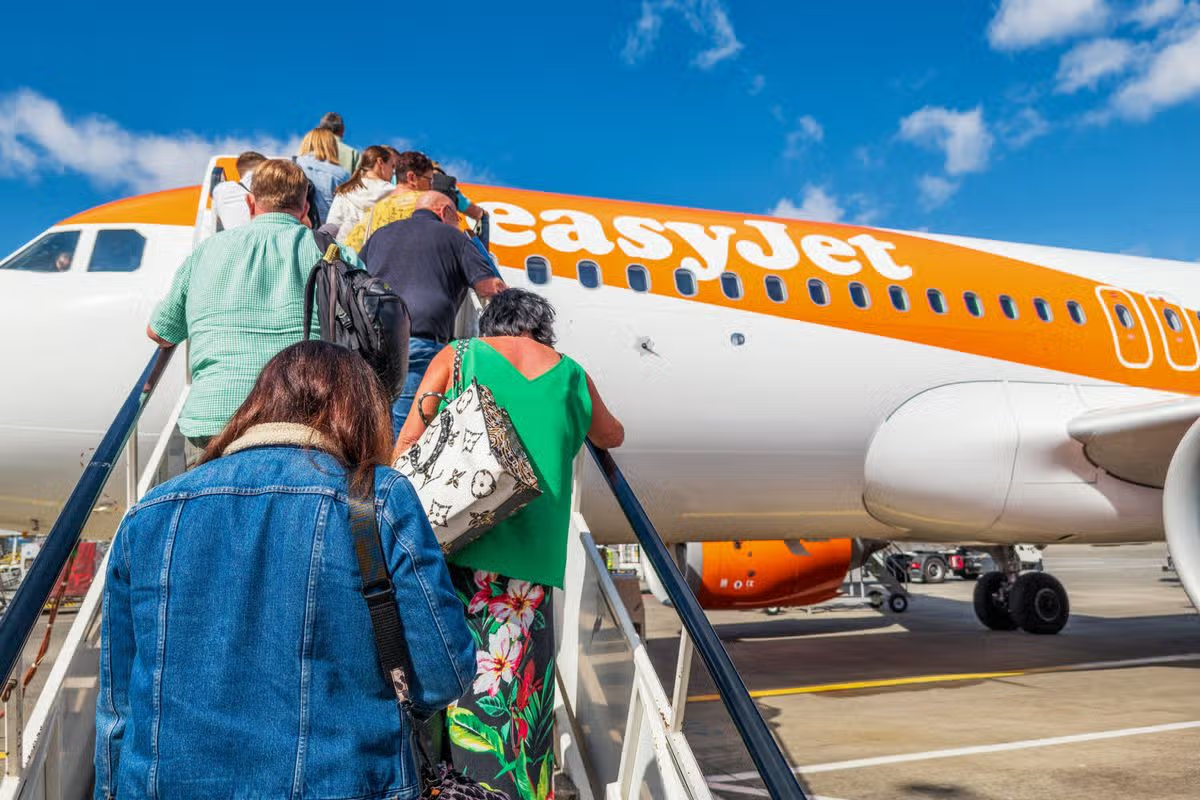
Every airport offering free Jet2 service making 6am flights ‘easier’

Save stress and time if your holiday is due to start in the early hours of the morning

People can start their holiday quicker than others when flying with Jet2 and taking advantage of a little-known service that lets families skip the queues. Planning this ahead of time can make early morning flights feel “a whole lot easier”.

On its website, Jet2 claims the Twilight Check-in service can be used by any passengers booked to fly on a service due to leave the airport before midday. Later flights in the afternoon or evening cannot benefit from this perk.

A spokesperson said: “Your morning flight is about to get a whole lot easier. With our free Twilight Check-in service, you can drop your bags off at your UK departure airport between 4.30pm and 9pm the evening before your morning flight.

“Thanks to Twilight Check-in, when you arrive at departures the next day, your luggage is already sorted. If you live near the airport or are staying at a nearby hotel, it’ll make your morning a little easier.”

Flights leaving before midday are extremely common at UK airports. People tend to opt for these early departures to make the most of their holiday time rather than leaving the UK later.

The following UK airports offer the free Jet2 Twilight Service:

  • Birmingham
  • Bristol
  • East Midlands
  • Edinburgh
  • Glasgow International
  • Leeds Bradford
  • Liverpool
  • London Gatwick
  • London Luton
  • London Stansted
  • Manchester
  • Newcastle

The process of pre-checking luggage the night before can save time and hassle on the morning of the trip. Jet2 claims that people don’t need to book this service specifically in advance, but people do need to check in online “no later than 24 hours before their flight”.

Some UK airports offer discounted or free limited-time parking to customers who use Twilight Check-in. The Jet2 website lists 10 that offer this for customers, but stresses that travellers should check for themselves using the Airport Information page on its website.

People who want to use this service will need to remember to bring their boarding passes and passports along with bags (excluding hand luggage). After completing everything, get some rest and, on the day of the flight, Jet2 claims people can simply “bypass check-in and head to security”.

It only takes one person from your group to check in and drop off bags for up to six people travelling on the same booking reference. For full details of how the free service works, click here.

Source link

The holiday resorts loved in the 90s that are making a comeback in 2026 & offering VERY low prices

IF you’re wondering where the next big holiday trend is coming from, I can save you some time.

It’s not a brand new destination, and it’s not somewhere “undiscovered”.

The 1990s were a peak for all-over tans at any costCredit: Getty Images
But the same resorts are now great for family breaks with school summer holidays dates from £58pp a nightCredit: Getty

It’s the places your parents went in the 90s.

I spend most of my time looking at holiday booking data, and this one trend keeps jumping out.

A whole wave of classic British package holiday resorts are making a serious comeback in 2026.

And the reason is simple: they’re still ridiculously good value.

From Europe to Africa, here are my top 10 cheap holiday spots that are booming again… and the deals you can get right now.

10. Skanes, Tunisia

Skanes is a proper throwback to 90s package holidays – big beachfront hotels, short transfers, and everything centred around the resort.

And now, it’s having one of the biggest comebacks I’ve seen in the data, with bookings to Tunisia up massively again heading into 2026.

I found a really strong all-inclusive deal here – 7 nights at the 4* Hotel Liberty Resort, flying from London Southend (16–23 Aug 2026), from £535pp for a family of four. That’s roughly £76pp per night, and crucially, it’s all-inclusive.

What makes this one work is how family-friendly it is – big pool areas, loads going on for kids, and everything included, so you’re not constantly spending.

And the reason it’s this cheap is simple. Tunisia is still rebuilding demand, so hotels are pricing low to win Brits back. Which means right now, you’re getting proper beachfront value for a fraction of what you’d pay elsewhere.

Our holiday expert found an all-inclusive deal in Skanes, Tunisia from just £76pp per nightCredit: Getty

9. Calpe, Costa Blanca, Spain

Calpe was huge with British tourists in the 80s and early 90s – classic Spanish seaside, big beaches and that iconic rock backdrop.

Now it’s trending again in 2026, as people look for more relaxed, less chaotic alternatives to bigger resorts.

I found a great-value summer deal – 7 nights at the 4* AR Diamante Beach, flying from Bournemouth (3–10 Aug 2026), from £588pp for a family of four. That’s about £84pp per night, on a bed & breakfast basis.

This hotel stands out because it feels a bit more premium than your typical Costa Blanca stay – big modern rooms, great pool area, and close to the beach without being chaotic.

It’s cheaper because it’s not trying to be flashy or all-inclusive heavy. And for families, that works – because you can eat out cheaply and control your spending instead.

The coastal town of Calpe is situated in Costa Blanca, and is famous for the Peñón de Ifach rockCredit: Getty

8. Hurghada, Egypt

Hurghada was unbelievably popular in the 2000s all-inclusive boom, thanks to massive resorts, guaranteed heat and loads included in the price.

And now it’s properly back again, with bookings climbing fast into 2026.

This one’s properly eye-opening – 7 nights at the 4* Royal Lagoons Aqua Park Resort & Spa, flying from Belfast (22–29 Aug 2026), from £668pp for a family of four. That’s around £95pp per night, and it’s all-inclusive.

What makes it great for families is the waterpark setup with slides, multiple pools and enough going on to keep kids busy all week without leaving the hotel.

This is why Egypt is flying with Brits right now, despite its proximity to the Iran conflict. Because once you arrive, everything’s covered.

Flights are longer, which keeps demand slightly lower, but for families, that means ridiculous value for what you get.

You can stay a week at the 4* Royal Lagoons Aqua Park Resort & Spa from £95pp per nightCredit: Alamy

7. Hammamet, Tunisia

Hammamet was one of the classic British beach holidays of the 90s – long sandy beaches, big hotels and loads of all-inclusive resorts.

Just like Skanes, it’s seeing a massive resurgence heading into 2026.

I spotted this while digging through peak summer prices – 7 nights at the 4* Houda Yasmine Hammamet, flying from London Southend (23–30 Aug 2026), from £553pp for a family of four. That’s about £79pp per night, and it’s all-inclusive.

It’s a proper classic family hotel with a massive pool, entertainment, and everything geared around easy, no-stress holidays.

Again, the price comes down to perception catching up with reality.

The hotels are good, the weather’s great – but demand hasn’t fully returned yet. So you’re benefiting from that gap.

Hammamet in Tunisia offers some of the most affordable 4 and 5* stays on the marketCredit: Getty

6. Salou, Costa Dorada, Spain

Salou was massive with British families in the 90s and early 2000s with beaches, family hotels and PortAventura right next door.

And now it’s flying back again in 2026 as families rediscover how easy it is.

I couldn’t ignore this deal – 7 nights at the 4* 4R Playa Park, flying from Birmingham (21–28 Aug 2026), from £408pp for a family of four. That’s just £58pp per night, on a bed & breakfast basis.

This is exactly what Salou does well: simple, well-located hotels with good pools and easy access to everything – and at a really great price too.

And it’s such great value because you’re not paying for extras upfront.

But in Salou, that’s ideal – everything locally is affordable, so you can build your own budget holiday.

Salou in Spain is a great-value resort with lively nightlife and the PortAventura theme parkCredit: Getty

5. Torremolinos, Costa del Sol, Spain

Torremolinos is where the British package holiday basically started back in the 60s and 70s.

And in 2026, it’s trending hard again thanks to how easy and reliable it is.

I found a really solid summer option here – 7 nights at the 4* Hotel Apartamentos Bajondillo, flying from Bournemouth (22–29 Aug 2026), from £518pp for a family of four. That’s about £74pp per night, on a self-catering basis.

What makes this one great is the location, as it sits right on the beachfront, with loads nearby, and perfect if you want flexibility with food and spending.

It’s not the cheapest on the list, but you’re paying for convenience – short transfer, loads to do, and no surprises.

Torremolinos in Malaga is a reliable holiday resort with package holidays from £74pp per nightCredit: Getty

4. Benidorm, Costa Blanca, Spain

Benidorm was the capital of British holidays in the 80s and 90s, and now a whole new generation is discovering it.

Bookings are up again in 2026, especially with younger families and couples.

I found this cracking value deal – 7 nights at the 3* Terralta Apartments, flying from Dublin (23–30 Aug 2026), from £403pp for a family of four. That’s roughly £58pp per night, on a self-catering basis.

It’s ideal for families too, as it’s home to spacious apartments, a big pool, and a quieter location just outside the main strip.

And this one’s cheap simply because Benidorm is built for volume: loads of apartments, loads of competition – which keeps prices low.

Best part is, once you’re there, everything else is cheap too.

Benidorm remains an affordable holiday destination for Brits, with deals from £58pp per nightCredit: Getty

3. Sousse, Tunisia

Sousse has always been one of Tunisia’s most popular beach resorts – big hotels, great beaches and loads of all-inclusive options.

And just like the rest of Tunisia, it’s seeing a huge comeback into 2026.

One of the best-value all-inclusive deals I found – 7 nights at the 4* El Ksar Resort & Thalasso, flying from London Southend (16–23 Aug 2026), from £583pp for a family of four. That’s about £83pp per night, and it’s all-inclusive.

This is exactly what families want – beachfront setting, slides, big pool areas and everything included from day one.

This is where the value really shows.

Because when everything’s included, you’re not constantly spending – which makes it one of the easiest holidays to budget for.

Tunisia’s Sousse is home to a UNESCO World Heritage medina and your pick of beachesCredit: Getty
Some of the most popular beaches in Sousse, Tunisia are Bou Jaafar and Samara BeachCredit: Alamy

2. El Arenal, Majorca, Spain

El Arenal was massive in the charter flight era – big beach, loads of hotels and right next to Palma.

And now Majorca, and El Arenal in particular, is firmly back on the rise again in 2026.

I found a peak summer Majorca deal that really stood out – 7 nights at the 3* BLUESEA Costa Verde, flying from Bournemouth (19–26 Aug 2026), from £580pp for a family of four. That’s about £83pp per night, and it’s all-inclusive.

What makes this one work is simplicity – good pool, food included, and a no-frills base in a super easy destination.

It’s slightly pricier because Majorca never really goes out of demand.

But you’re paying for ease – short flight, reliable weather and a destination that just works.

1. Sharm El Sheikh, Egypt

Sharm El Sheikh was one of the BIGGEST British holiday hotspots of the 2000s.

And now it’s making the biggest comeback of all destinations worldwide heading into 2026.

And this is where the value really hits home – 7 nights at the 4* Xperience Saint George Homestay, flying from London Luton (5–12 Aug 2026), from £650pp for a family of four. That’s around £93pp per night, and it’s all-inclusive, in great hotel, with guaranteed heat.

This hotel is built for proper relaxation with multiple pools, loads of food options and everything set up so you barely need to leave. Just turn up, pay for nothing, and leave rested, relaxed and tanned.

And the reason it’s such good value, even in the summer holidays, is simple.

Flights have only relatively recently come back at scale, so demand is still catching up. But the hotels are still world-class.

Which means right now, you’re getting proper 4* all-inclusive… for less than most self-catering holidays in Europe.

Al Sahaba Mosque is a spectacular landmark to visit in Sharm El SheikhCredit: Getty
You can stay in Sharm’s Xperience St.George Homestay from just £93pp per nightCredit: EasyJet

Source link