NVIDIA

A divided Trump team closes ranks ahead of AI talks with China

Behind the scenes, Treasury Secretary Scott Bessent spent months pushing for action that would signal resolve within the Trump administration against China’s pursuit of the most powerful American computer chips, a flashpoint in their race for superiority in artificial intelligence, multiple sources said.

But Trump’s courtship of Xi Jinping, seeking to alleviate tensions among the world’s greatest powers, and a contingent of advisors skeptical of commercial warfare against Beijing slowed the process down — giving China months of opportunity to gain access to U.S. semiconductors through the back door.

Ultimately, just hours before departing for Asia alongside President Trump, Bessent got his way, bolstering his position ahead of talks with Chinese officials in Shenzhen this week on the risks posed by frontier systems.

A new rule tightening loopholes in U.S. export controls sends a dual message to Beijing ahead of Thursday’s summit, that Washington is serious about curbing Chinese circumvention — and that China hawks within the administration may be gaining the upper hand.

Trump has repeatedly sidestepped confrontation with Xi over the intensifying AI race in their two previous meetings this year, in Beijing and Washington, wary of upsetting a carefully managed détente and reluctant to jeopardize a technology boom increasingly central to the U.S. economy.

But the administration, from the president down, is acutely aware of China’s ambitions to dominate an industry that could reshape the global balance of power. That competitive drive was underscored this month by a scandal involving a Chinese espionage campaign targeting Jensen Huang, co-founder of Nvidia, the world’s leading AI chip maker.

Before resigning from the company in disgrace over the weekend, Huang admitted to having an affair with a suspected Chinese spy — a woman who worked at a Singaporean firm accused by American authorities of helping to divert restricted Nvidia chips to China, in violation of U.S. export controls.

The national security scandal has roiled the markets — and in so doing, commanded Trump’s attention — inflicting a significant devaluation on Nvidia and reverberating well beyond it, wiping nearly $1 trillion from the combined market value of major technology companies in a single trading session on Monday.

Trump, who counts Huang a friend and ally, indicated he would be open to his return as Nvidia’s chief executive. Bessent suggested otherwise, expressing confidence its board could find competent new leadership and urging a full investigation.

Trump is not expected to raise the Nvidia matter directly with Xi. But Bessent plans to do so in his own meetings, one official said.

The Treasury secretary has thus taken on the role of an enforcer, pursuing a tougher line than Trump is willing to take himself in his highly personalized relationship with the Chinese leader.

Bessent is scheduled to meet with Chinese Vice Premier He Lifeng on the sidelines of the summitry in Shenzhen to discuss potential collaboration on AI safety protocols, standards for testing of advanced models, and a direct communications channel for AI emergencies.

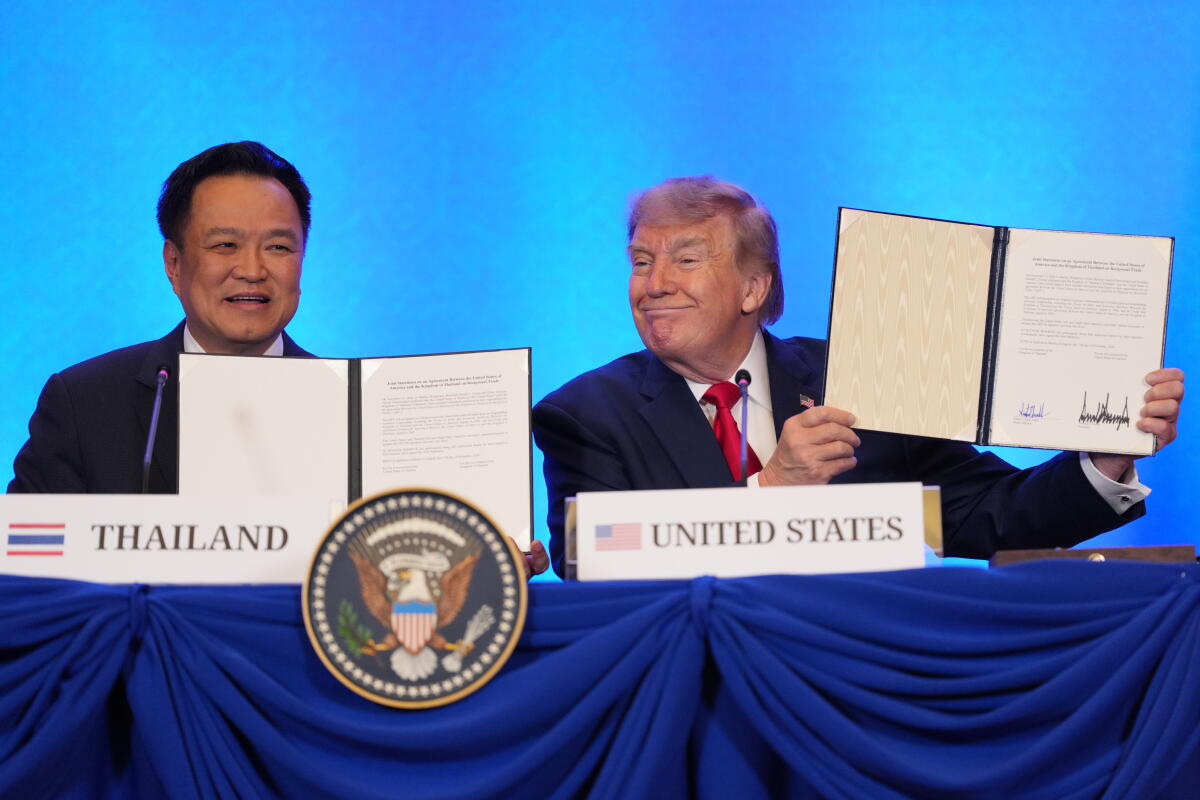
President Trump and Thailand's Prime Minister Anutin Charnvirakul shows documents during a signing ceremony in Manila.

President Trump and Thailand’s Prime Minister Anutin Charnvirakul shows documents during a signing ceremony in Manila.

(Mark Schiefelbein / Associated Press)

The two men have met before to discuss AI, most recently in New York, where they agreed in principle to coordinate. But the talks have yet to produce much in the way of tangible results.

“Bessent is signaling that, while he sees working with Beijing to mitigate AI risks as a priority, it won’t come at the expense of actions that he sees as necessary to protect U.S. national security, like limiting AI chip exports to China,” said Daniel Remler, a senior fellow with the Technology and National Security Program at the Center for a New American Security.

The administration’s latest action marks a policy defeat for Howard Lutnick, secretary of the Commerce Department, who oversees chip policy and had advocated for a less restrictive approach than Bessent, Secretary of State Marco Rubio and Jamieson Greer, the U.S. trade representative.

The feud began spilling into public view ahead of the president’s travel, and in light of the Nvidia scandal, after Bessent said in a television interview that the Commerce Department “has the pen” to act, implying a split within the team.

“Look, there’re two different views,” Trump told reporters on Monday, answering questions on the matter. “One view is you don’t want to insult China. We have a very good relationship with China, and you don’t want to insult them.”

“The other view is just go, you know, down and dirty and do what you have to do,” Trump continued. “You can’t say either is wrong or right. We’ll let you know.”

Beyond the diplomatic niceties, Trump has been explicit and consistent since resuming office that the United States must “win” the race for AI superiority, calling the alternative “not acceptable.”

“Whoever wins AI,” Trump said at the UN General Assembly in September, “whoever wins superintelligence, wins.”

Trump will arrive in China on Wednesday after meeting with world leaders in Manila, including those from the Quad — an alliance of Japan, India, Australia and the United States — which discussed AI at their own summit Tuesday evening.

Describing “superintelligence” — Trump’s preferred term for AI — as “the greatest opportunity for economic growth since the industrial revolution,” Trump announced a Quad effort to accelerate adoption of the technology, including an investment of more than $85 million to enhance AI ecosystems throughout the region.

“We want to be careful with it,” Trump said, “but it’s amazing, the things that have come out, in terms of science and in terms of medical breakthroughs. No one can believe what we’re finding. And we’re finding it fast.”

“We want to be very careful, but we want to cherish it,” he added. “The United States as you know is leading in that capacity, by quite a bit.”

The new U.S. rule requires overseas data centers serving customers in China, Russia, Iran and Cuba to identify their end users before gaining access to chips. It also imposes additional licensing requirements on chip sales to Indonesia, Malaysia, Singapore, Thailand and Brazil, which the Commerce Department identifies as posing a “higher-than-normal risk of diversion” to unauthorized destinations.

U.S. officials say that export controls are not up for negotiation in talks with the Chinese. But Beijing sees them as yet another historic example of Washington trying to contain its rise — a posture that has repeatedly stifled diplomatic progress between the two superpowers.

“While administration officials say export controls aren’t up for negotiation, Chinese officials will certainly bring them up,” Remler said. “These restrictions are the key obstacle to China’s AI progress, which is increasingly important to the Chinese economy and to Xi’s strategic goals.”

Protesters in Manila take part in a demonstration against President Trump visit to the Philippines for the ASEAN summit.

Protesters in Manila take part in a demonstration Tuesday against President Trump visit to the Philippines for the ASEAN summit.

(Ezra Acayan / Getty Images)

China claims it does not seek an all-powerful, generalized “superintelligence,” but rather specialized AI systems embedded across industries to boost productivity and improve quality of life.

In Beijing’s telling, it is the United States — pursuing generalized AI through a private sector largely unchecked by the federal government — that poses an existential threat to the global order.

Sheila Jasanoff, a professor of science and technology studies at the Harvard Kennedy School, said China “has a much clearer vision of what it is seeking to accomplish in the so-called AI arms race, as well as the capacity to benefit from Nvidia’s chips.”

“I doubt that China will be interested in launching a discussion that calls attention to its spying operations, or jeopardizes any supply networks it has built over the years,” Jasanoff added, “by innocent or nefarious means.”

Pressed by The Times, Chinese officials would not say whether they expected progress in the AI talks — before the announcement of the new rule on export controls.

And “what the U.S. president chooses to bring up,” Jasanoff added, “is anyone’s guess.”
Source link

US moves to block China’s remote access to AI chips amid Nvidia scandal | Business and Economy News

Trump administration introduces export license requirement for Malaysia, Thailand, Indonesia, Singapore and Brazil.

United States President Donald Trump’s administration has announced new restrictions on China’s access to advanced chips amid the fallout from the alleged spy scandal involving AI giant Nvidia.

The rule announced by the Bureau of Industry and Security (BIS) on Monday aims to prevent Chinese AI developers from getting around export controls by remotely accessing data centres in third countries, particularly in Southeast Asia.

Recommended Stories

list of 4 itemsend of list

It designates Indonesia, Malaysia, Singapore, Thailand and Brazil as countries with an “unacceptable risk of diversion” and requires anyone seeking to export advanced chips to those destinations to obtain an export licence.

BIS, which sits under the US Department of Commerce, said the change was a “logical extension” of the existing requirement for companies to obtain a licence to export or transfer chips to firms based in China.

“The United States is the global leader in advanced computing and super intelligence technology and is committed to promoting the global adoption of American technology for legitimate commercial purposes while ensuring that sensitive technologies are not exploited in ways that threaten US national security,” BIS said in a statement.

The restrictions come as Nvidia’s export of advanced chips is under scrutiny following claims that former CEO Jensen Huang was romantically involved with a woman recruited by China’s Ministry of State Security for the purposes of espionage.

Huang, who became one of the most prominent faces of the AI boom at the helm of Nvidia, resigned last week amid a company board investigation into the allegations involving the Chinese-born executive of Singapore-based data centre company Megaspeed.

Beijing has denied the spying allegations, made by unnamed US officials in media reports, calling them “entirely groundless, speculative and intended to smear and malign China”.

Alice Huang, the former Megaspeed executive who has been identified as Jensen Huang’s ex-romantic partner, has not publicly commented on the claims.

Late Monday, the US Commerce Department and Department of Justice confirmed for the first time that investigators had opened a criminal investigation into Megaspeed.

The Commerce Department began investigating Megaspeed for potential export control violations in 2024, leading BIS officials to conduct an on-site inspection of Megaspeed and to interview Alice Huang the following year, the statement said.

The Department of Justice subsequently took the “lead role” in the criminal investigation of the company, according to the statement.

“The Department of Justice and the Department of Commerce’s Bureau of Industry and Security working together will bring the full extent of the law against Megaspeed for any criminal conduct that may have occurred,” it said.

US tech stocks fell sharply on Monday as investors weighed the fallout of the scandal on the AI rollout.

The tech-heavy Nasdaq Composite fell 2.49 percent, closing in the red for the third consecutive session.

The broader S&P 500 dropped 1.92 percent.

Shares of Nvidia, which has shed more than 30 percent of its market value over the past month, dropped 4.12 percent.

The remainder of the “Magnificent Seven” all finished in the red, with Alphabet and Amazon seeing the next biggest declines of 4.07 percent and 3.34 percent, respectively.

The sell-off continued in Asia on Tuesday, with key indexes in Japan, South Korea and Hong Kong falling in morning trading.

Japan’s benchmark Nikkei 225 and South Korea’s Kospi were down 1.45 percent and 1.93 percent, respectively, as of 04:30 GMT.

In Hong Kong, the Hang Seng Index was down 0.77 percent.

Source link

Megaspeed, firm at centre of Nvidia scandal, says Alice Huang left in 2025 | Technology News

Chinese tech executive romantically linked to ex-Nvidia CEO Jensen Huang left in August 2025, the Singapore-based firm says.

Megaspeed has confirmed that Alice Huang, the tech executive whose reported relationship with former Nvidia CEO Jensen Huang is at the centre of international spying claims, left the company last year.

The Singapore-based data centre company said in a statement on Sunday that Alice Huang left her executive role on August 30, 2025, and has held no position with the firm since.

Recommended Stories

list of 4 itemsend of list

“Megaspeed does not comment on Ms. Huang’s personal and private matters,” the statement said.

Megaspeed also pushed back on media reports it said contained claims about its operations that “are not supported by verifiable evidence”.

“The company has retained external legal counsel to conduct a thorough internal investigation,” it said.

Megaspeed, a major buyer of graphics processing units (GPUs) made by the California-based Nvidia, used to train and run frontier AI models, is facing scrutiny over its compliance with United States export controls intended to keep high-end chips out of China.

While data centres in Southeast Asian countries such as Singapore, Malaysia and Thailand can import high-end Nvidia chips legally, US authorities have long suspected the region is a hotbed of illicit smuggling on behalf of Chinese AI developers.

Megaspeed CEO and chairman Tan Yong Pong said on Thursday that the company had retained a top US law firm to lead a “comprehensive census” of its GPUs and verify its export control compliance practices.

Unnamed US officials have accused Alice Huang of working with China’s Ministry of State Security in an espionage operation targeting Jensen Huang, who stepped down as Nvidia CEO, president and board member on Thursday amid a board investigation.

Beijing has denied the allegations, describing them as “entirely groundless, speculative and intended to smear and malign China”.

Alice Huang has not publicly commented on the claims.

Singaporean authorities are investigating Megaspeed on suspicion of making false declarations in relation to its purchases of servers. They said last week they had previously confiscated Alice Huang’s passport for eight months as part of their inquiries.

Singapore’s Ministry of Home Affairs said on Thursday that it barred Huang from re-entering the country after determining that she had provided inaccurate information to investigators to downplay her role at Megaspeed.

Police investigations into Megaspeed and six other individuals are ongoing, the ministry said in a statement.

Source link

US Treasury chief calls for outsider to lead embattled tech firm Nvidia | Technology News

United States Treasury Secretary Scott Bessent has called for an outsider to take the helm at Nvidia, the California-based technology giant that has faced scandal over its former chief executive, Jensen Huang.

Speaking on Fox News’s Sunday Morning Futures programme, Bessent said the company should look beyond its own ranks for Huang’s successor.

Recommended Stories

list of 4 itemsend of list

“This makes me think that, as the board conducts a search for a new leader, that they need to go outside the company,” Bessent told Fox News. “Just [with] what was going on inside the company, they need a dramatic shake-up.”

Bessent’s comments come three days after Huang stepped down on Thursday, following revelations of extramarital affairs, including one involving a woman US officials suspect of working for Chinese intelligence.

Nvidia plays a leading role in producing chips and other computing components for artificial intelligence (AI).

As a result, the company has been at the centre of a technology race between the US and China, with the two superpowers competing for dominance in the growing AI sector.

Huang was long a key figure at Nvidia, as one of the company’s cofounders. Since 2025, he has also cultivated a close relationship with the second administration of US President Donald Trump.

In August 2025, for instance, Huang successfully lobbied the Trump administration to loosen restrictions on the sale of H20 microchips to China, in exchange for the US government taking 15 percent of the sales.

But in late October, The New York Times revealed Huang had an extramarital relationship with Alice Huang, a former executive at Megaspeed, one of Nvidia’s clients.

The report cited unnamed US intelligence agents who believed Alice Huang had been recruited by China’s Ministry of State Security to help the country’s firms navigate US chip restrictions.

The Ministry of Foreign Affairs in Beijing has denied the allegations, calling them “entirely groundless, speculative and intended to smear and malign China”.

Alice Huang has not publicly commented on the claims. She reportedly left Megaspeed in 2025.

Tightening chip controls

For his part, Jensen Huang had long maintained that wider access to US technology would help Washington preserve its edge in the global AI race.

Bessent, however, questioned whether Nvidia had turned a blind eye to potentially illicit chip sales to bolster its financial results.

In Sunday’s television appearance, Bessent suggested a 10-day deadline for the company to show its compliance with US export controls.

“I think we need answers in the next 10 days from the board and from the outside counsel,” Bessent said.

“I want to keep coming back to what was the culture at Nvidia, and were they pressing these seemingly illicit sales to goose their revenues and their earnings?”

The controversy has encouraged a bipartisan push in Congress to tighten controls on US chip exports to China.

Lawmakers, including Republican Senator Jim Banks and Democratic Senator Elizabeth Warren, have sought to use the annual end-of-year defence bill to close loopholes that Chinese companies can exploit to obtain advanced US-designed semiconductors.

But Bessent questioned the need for new laws, telling Fox News host Larry Kudlow that Washington’s existing export controls were sufficient but needed better enforcement.

“I don’t think we need the legislation,” he said. “We have all the rules we need; we just need them enforced.”

A new leader for Nvidia?

Since Huang’s departure, rumours have swirled about who might replace him at Nvidia’s helm.

The company’s board has floated Rene Haas, the chief executive of the semiconductor firm Arm Holdings, as a possible successor to Huang, according to the Financial Times.

Haas is no stranger to Nvidia, having spent several years at the company before joining the British chip designer.

Trump, meanwhile, has named former Apple chief executive Tim Cook as a potential candidate.

In a post on Truth Social on Thursday, Trump praised Huang’s work at Nvidia and said Cook was an ideal candidate to replace him.

“A Legend replaces a Legend,” Trump wrote.

But the Financial Times has suggested Huang may seek to return to his top-level post. In a report on Sunday, the publication said unnamed allies of his are rallying Silicon Valley executives to support his return to the company.

“Everyone that matters in tech outside the frontier labs loves Jensen,” one source told the Financial Times.

Currently, chief financial officer Colette Kress is leading Nvidia on an interim basis.

Source link

Lutnick under fire as Bessent blames Commerce Department in Nvidia crisis

Fallout from Jensen Huang’s ouster as Nvidia Corp. chief executive officer is reaching deep into Washington, where Commerce Secretary Howard Lutnick is confronting accusations that his department didn’t do enough to keep the company’s prized artificial intelligence chips out of China’s hands.

As the ultimate overseer of U.S. export control programs, Lutnick is accountable for any policy or enforcement gaps that allowed Nvidia’s AI processors to reach unauthorized Chinese buyers. Internal tension over his role burst into the open on Friday when Treasury Secretary Scott Bessent blamed him for failing to blacklist a Singapore-based company, Megaspeed, over possible violations.

“Treasury, [the U.S. Trade Representative office] and State — they were in favor of putting Megaspeed on the entity list for months, but Commerce has the pen,” Bessent said in an interview with CNBC. “We have all the authorities that we need. They just need to be implemented.”

Lutnick is a controversial figure in President Trump’s orbit. People with ties to the White House, who asked not to be identified describing private conversations, said he’s been marginalized within the administration for a while. At the same time, his exit has been predicted before, and he’s still in the job.

As of Thursday, the Commerce chief retained Trump’s blessing. In a statement, the White House said Trump maintains complete confidence in the secretary and his ability to serve in the position.

Congress is now demanding answers from Lutnick and other Trump administration officials about decisions that may have made it easier for China to obtain Nvidia’s advanced chips as well as the degree to which Silicon Valley leaders like Jensen Huang may have influenced policy.

Pressure on the administration and the tech sector is escalating a week after an election where voters expressed intense frustrations over the impact of the AI boom.

Huang’s abrupt departure was prompted by revelations that he’d had an affair with a woman suspected by U.S. officials of spying for China and that Megaspeed had been under investigation by Commerce for possible export control violations. Megaspeed has denied any wrongdoing, while the former Nvidia chief’s romantic partner, Alice Huang, is now in China.

“I would like for Secretary Lutnick ASAP to come testify before the Senate Banking Committee because we have a lot of bipartisan questions and concerns about what’s happened over the last year,” Sen. Jim Banks (R-Ind.) said in an interview on Fox News.

Late Thursday night, a Commerce Department spokesperson, Kristen Eichamer, said Lutnick had agreed to testify.

Axios reported on Wednesday that Trump had authorized a new crackdown on companies suspected of diverting advanced AI chips to China, but that Lutnick delayed acting on the directive. Rep. Raja Krishnamoorthi (D-Ill.) called the report “deeply, deeply disturbing.”

On at least three separate occasions earlier this year — in May, August and earlier this month — Trump approved taking action against suspected diversions of Nvidia chips to China, Axios reported.

This week’s events, Krishnamoorthi said in an interview Wednesday, deserve “tremendous scrutiny not only by obviously Nvidia’s board, but by the intelligence community and the U.S. government as well.”

Further complicating the dynamic are allegations by Democratic lawmakers that Lutnick’s sons, who hold leadership positions at Cantor Fitzgerald, are profiting off policy decisions that he makes. Lutnick, who previously was chief executive of Cantor, divested his stake as legally required before becoming secretary, and elevated his sons to top jobs at the firm.

The Commerce Department didn’t immediately respond to a request for comment. Cantor Fitzgerald declined to comment.

One element of the Nvidia imbroglio is a little-known but powerful Commerce Department agency that’s known as the Bureau of Industry and Security and falls under Lutnick’s jurisdiction.

The bureau regulates exports of a wide range of products — including advanced AI chips — and it’s set to face renewed scrutiny as lawmakers threaten investigations of the bureau’s leader, Under Secretary of Commerce Jeffrey Kessler.

The Senate Banking Committee is already planning inquiries into Lutnick and Kessler’s decision-making. The two men “must explain why they have not closed export control loopholes and act today to ensure our advanced technology is not fueling China’s military,” Sen. Elizabeth Warren of Massachusetts, the top Democrat on the committee, said in a statement.

In late summer 2025, Nvidia General Counsel Tim Teter called Kessler to ask whether the Bureau of Industry and Security was involved in the Singapore government’s recent detention of Alice Huang. The bureau was not involved in that action, citing people familiar with the matter.

An Nvidia spokesperson has said that Teter was unaware of the affair at the time he called Kessler about Alice Huang’s detention in Singapore. But in the weeks following the call, Bureau of Industry and Security staffers were muzzled in their ability to investigate the company, including a mandate that they route all requests of Nvidia through Kessler, Bloomberg reported.

Bureau of Industry and Security spokespeople earlier denied any wrongdoing.

“It’s really important to understand what the Commerce Department knew about Megaspeed,” said Ben Buchanan, former White House special advisor for AI during the Biden administration, in an interview. “This is an incident where the enforcement is not good. The decision-making has not been good.”

Diaz and Eastland write for Bloomberg.

Source link

How will the US deal with Nvidia scandal? | Technology News

Tech giant CEO resigned and will testify before Congress.

Jensen Huang, tech superstar, and now former chief executive of Nvidia, is due to appear before the United States Congress.

He has admitted to having an affair with a woman accused of having links to Chinese intelligence.

Nvidia says no company data has been compromised and there were no breaches of national security. But the FBI and the Department of Justice have launched investigations.

Could this damage the US chip-manufacturing industry?

And how will the US deal with potential spying at the highest levels of one of the world’s most valuable companies?

Presenter: Per Nyberg

Guests:

Paulo Carvao – Research fellow at Harvard Kennedy School, specialising in AI and technology policy

Aya Ibrahim – Senior fellow for economic and national security at the AI Now Institute

Einar Tangen – Senior fellow at the Centre for International Governance Innovation and a specialist in China-US relations

Source link

Nvidia CEO Jensen Huang steps down, more affair details revealed | Technology

The CEO of one of the world’s most valuable companies, Nvidia, has stepped down after reports of a second extra-marital affair. Jensen Huang’s position had been under threat after initial revelations about an affair with a suspected Chinese spy.

Source link

Trump heads to China amid Nvidia scandal: Will he get tougher on Beijing? | Politics News

United States President Donald Trump travels to the Chinese city of Shenzhen next week for the Asia-Pacific Economic Cooperation (APEC) summit, where he is due to meet Chinese President Xi Jinping.

The trip comes as Jensen Huang, Nvidia’s outgoing chief executive and one of Trump’s closest allies in Silicon Valley, faces mounting scrutiny over his relationship with Alice Huang, a former Megaspeed executive whom US officials suspect of working for Chinese intelligence. China has denied the allegations.

Recommended Stories

list of 4 itemsend of list

On Thursday, Nvidia announced that Huang would step down as chief executive.

Huang accompanied Trump on his May visit to Beijing.

His presence mattered for Nvidia, which has struggled to secure approval to sell its H200 AI chips in China. Now, his place in the next delegation is in doubt.

So could Trump’s closeness to Huang push his administration towards a tougher line on China? Here’s what you need to know:

How did Huang shape the US-China chip thaw?

As founder and CEO of Nvidia, Huang pushed Washington to ease restrictions on the sale of advanced chips to China, arguing that wider use of US technology would help Washington hold onto its lead in AI development.

In December 2025, Trump did approve sales of the H200, Nvidia’s second-most powerful chip, to China, with 25 percent of proceeds to be paid to the US government.

He did so despite opposition from China hawks in both parties.

Huang was a surprise late addition to Trump’s delegation to Beijing in May, in hopes of unlocking stalled H200 sales. Despite Trump’s decision to allow the sales, shipments were low because of slow import approvals from the Chinese government in a bid to support domestic chipmakers.

No breakthrough was announced.

Trump has stood by Huang throughout his recent personal scandal, calling him an “honourable guy”.

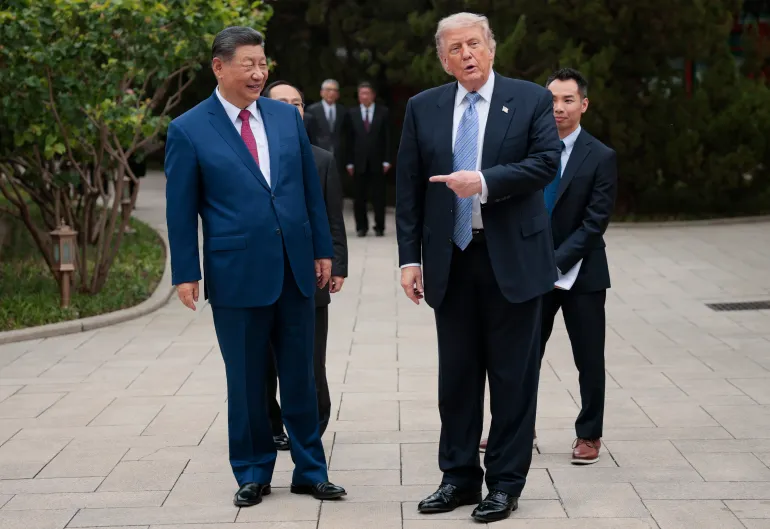
BEIJING, CHINA - MAY 15: U.S. President Donald Trump gestures towards Chinese President Xi Jinping while leaving after a visit to Zhongnanhai Garden on May 15, 2026 in Beijing, China. Trump and other U.S. officials are finishing up a visit intended to address the Iran conflict, trade imbalances, and the Taiwan situation while establishing new bilateral boards for economic and AI oversight. (Photo by Evan Vucci - Pool/Getty Images)
US President Donald Trump, right, and Chinese President Xi Jinping leave Zhongnanhai Garden on May 15, 2026 in Beijing, China [File: Evan Vucci/Pool via Getty Images]

Will the Nvidia scandal prompt Trump to take a tougher stance with China?

Not immediately.

Huang’s removal from Nvidia’s board and the scandal leading up to that are unlikely to significantly affect relations between Washington and Beijing, which Steve Okun, a Singapore-based geopolitical analyst, told Al Jazeera is “a stalemate at best”.

Instead, if the US continues to impose restrictions on AI product sales to China, AI diversion and diffusion – how products are traded around the world both formally and informally – would be much more likely to cause tension between the two nations.

Gabriel Wildau, managing director at the advisory firm Teneo, told Al Jazeera earlier this week that Trump “shows no sign that he intends to disrupt the current US-China rapprochement”.

But he warned that the president “may face new pressure from Congress and hawkish voices inside his administration”.

Carsten Holz, an expert on the Chinese economy at the Hong Kong University of Science and Technology, said Trump “would not seem to have a coherent China policy and therefore his position in the upcoming talks in Shenzhen is hard to predict”.

Huang’s personal affairs “will be of little relevance” to China-US relations, he told Al Jazeera.

Where is the pressure to be tougher with China coming from?

Mostly from Congress, where control of both houses will pass to the Democrats in January.

Lian Jye Su, chief analyst at the technology research group Omdia, said a tough US line on AI and China was not Trump’s alone, calling it “one of the rare political consensuses domestically across the aisle”.

Trump, he said, “will do whatever he can to protect his contribution and legacy on this matter”.

On Wednesday, Democratic Senators Elizabeth Warren and Chris Coons asked Commerce Secretary Howard Lutnick, Secretary of State Marco Rubio and White House chief of staff Stephen Miller to preserve all records on Nvidia’s chip exports to China.

“This incident raises significant concerns about the federal government’s ability to effectively enforce our export controls and protect our national security,” the senators wrote.

The news website Axios reported that Lutnick had held up a planned crackdown on firms suspected of funnelling Nvidia chips to China.

Meanwhile, procurement notices seen by the AFP news agency show that a Chinese university linked to the country’s defence establishment bought Nvidia H200 chips through a third party in September and October.

How has China responded?

Beijing has rejected the spy claims and accused Washington of using them as cover to impose stronger restrictions and semiconductor export controls on China.

“The US side should stop fabricating such ‘spy’ narratives as a pretext for imposing a technological blockade,” Ministry of Foreign Affairs spokesperson Mao Ning said on Thursday.

But Mao also said China is willing to work with the US to implement the consensus reached by the two leaders.

Omdia’s Su said China “has no interest in not engaging with Trump, given substantial interest in Nvidia graphics processing units”.

Chinese chipmakers may also gain from better access to US technology.

Shares in Moore Threads, MetaX and Cambricon, China’s leading makers of graphics processors, jumped nearly 10 percent on Thursday.

What happens after Shenzhen?

Holz, the Chinese economy expert, noted that the use of advanced Nvidia chips in Singapore data centres to serve customers in mainland China was “not new information”.

Still, Okun expects the pressure to build next year.

He said Congress could pass the Remote Access Security Act, aimed at stopping Chinese firms from reaching advanced chips through the cloud.

The Department of Commerce, he added, could put export controls on Megaspeed or require licences for advanced chips sent to countries such as Singapore and Malaysia.

If that happens, it will strain the US-China relationship in 2027, he said, adding “but that’s not going to happen next week”.


Source link

Nvidia CEO Jensen Huang steps down amid spy scandal and market loss | Donald Trump News

DEVELOPING STORY,

Nvidia loses more than $600bn in market value as CEO Jensen Huang steps down amid espionage and affair allegations.

Nvidia CEO Jensen Huang has stepped down from the company following his reported affairs with a suspected Chinese spy and an Nvidia executive.

The $4.2 trillion tech giant has lost more than $600bn in market value this week as Huang’s scandals rocked the company, which supplies most of the chips powering advanced artificial intelligence (AI) technology. The stock slid more than 10 percent in premarket trading on Thursday.

The company appointed Colette Kress, Nvidia’s chief financial officer and executive vice president, as interim CEO on Thursday.

Nvidia’s board met on Wednesday night to discuss ousting Huang, whose relationship with the alleged Chinese spy triggered investigations by the FBI, the United States Congress and the California-based tech giant. Nvidia is also facing a shareholder class-action lawsuit.

The alleged Chinese intelligence asset, Alice Huang, is a former executive at Singapore-based Megaspeed, Nvidia’s primary business partner in Southeast Asia. Founded in 2023, Megaspeed has been investigated over whether it helped Chinese companies access its $4.8bn stock of powerful Nvidia chips.

The affair has raised national security concerns in the US, which restricts chip sales to China over concerns that the Chinese military, intelligence agencies or companies could use the advanced technology.

Huang, 63, is Nvidia’s co-founder, president and CEO. A close ally of United States President Donald Trump, he has pushed to ease US restrictions on chip exports to China. Trump said earlier this week that Huang told him he had “absolutely no idea” that he was in a relationship with an intelligence operative.

Huang owns about 3.6 percent of Nvidia’s stock, making him one of the richest people in the world. He is a powerful figure in the AI industry, which has driven record stock market and wider economic gains.

Nvidia’s board, which hired a law firm to investigate the affair with Alice Huang, met to decide Huang’s fate on Wednesday shortly after the New York Times reported that Huang also had an extramarital relationship with a Nvidia vice president who reports to him.

Nvidia’s stock has tumbled since the scandal erupted, falling to a 14-year low, the Reuters news agency reported.

Source link

What could Chinese intelligence have learned from Nvidia CEO’s affair? | Cybersecurity News

United States lawmakers are pushing for answers from Nvidia CEO Jensen Huang amid growing concerns over whether an affair he had compromised national security.

Huang, 63, has admitted to having extramarital relations during his time leading Nvidia, a major US tech firm. Media reports indicate the woman involved was Alice Huang, a former executive at Singapore-based tech company Megaspeed who is accused of working for Chinese intelligence.

Recommended Stories

list of 3 itemsend of list

As the scandal continues to grip Washington, Republican leaders of three committees in the House of Representatives have asked Huang to appear at a closed-door briefing to testify about the relationship.

House Foreign Affairs Committee Chair Brian Mast said he was prepared to subpoena Huang if he did not respond by the end of Wednesday.

According to The New York Times, US intelligence officials believe Alice Huang was recruited by Chinese intelligence to gather information about the Nvidia CEO and influence him to push for looser restrictions on chip sales to China.

In a statement on Sunday, Jensen Huang apologised to his family and Nvidia employees about the affair.

His company also launched an independent investigation, saying it had no reason to believe that “either national security or NVIDIA secrets were compromised”. Still, by Wednesday, media reports emerged that Nvidia was preparing to part ways with Huang over the controversy.

US President Donald Trump confirmed on Monday that the Federal Bureau of Investigation was looking into the matter, but he has stood by Huang, calling him an “honourable guy”.

But the pressure on Huang intensified on Tuesday when Republican Senator Kevin Cramer called for him to resign.

“The potential for extortion is so tremendous that something as sensitive as Nvidia chips, I just think he’s got to go,” Cramer said in an interview with Politico.

But Huang, who co-founded Nvidia more than 30 years ago, has shown no signs of heeding that call.

Despite the company’s assurances, experts say the affair raises concerns about what information Alice Huang may have been privy to and what role the relationship may have played in the Nvidia CEO’s decisions.

What are the national security concerns surrounding Nvidia?

Nvidia’s advanced chips, which power much of today’s artificial intelligence, have put the company at the centre of the race for tech dominance between China and the US.

Since 2022, Washington has restricted sales of some of the most advanced chips to China over concerns that they could be used by the country’s military or intelligence agencies.

According to US intelligence officials cited by The New York Times, Alice Huang was tasked with getting Jensen Huang to lobby for looser restrictions on chip exports.

The Nvidia CEO had already been pushing for an easing of the rules, arguing that China’s domestic chip industry would get stronger without better access to US products.

But some experts say it is worth looking at how Alice Huang may have influenced decisions Nvidia made specifically about her former employer Megaspeed, which bought more than $4.8bn worth of Nvidia chips over the span of about two years.

Megaspeed has also been investigated over allegations that it helped Chinese companies get access to restricted chips. Megaspeed denies the allegation.

Ryan Fedasiuk, a fellow at the Foundation for American Innovation who studies Chinese technology and intelligence activities, pointed to reports from Bloomberg and The New York Times that Nvidia contacted the US Commerce Department about its investigation into Megaspeed.

He also noted that, in disclosures to the government, Nvidia appeared to vastly undercount the value of the chips it sold to the company.

“The question at hand is whether Nvidia took specific actions with respect to Megaspeed that it might not otherwise have done,” Fedasiuk told Al Jazeera, “possibly as a result of the personal relationship between the two executives.”

What sensitive information could have been a risk?

There are also questions about what sensitive information Alice Huang may have had access to through her relationship with Jensen Huang.

In an analysis published by the Council on Foreign Relations, a think tank, senior fellow Jessica Brandt pointed to information about how Nvidia designs its China-specific chips.

“Information about its conversations with policymakers could be helpful for anticipating where those controls and other policies are headed,” she said. “Understanding where it disagrees with government could expose fault lines to exploit. And that’s before we get into anything touching R&D [research and development].”

Fedasiuk raised similar concerns about what Alice Huang could have learned about Nvidia’s internal operations and plans for future products, as well as its customer base, which includes American and foreign tech companies.

He also pointed to Jensen Huang’s close ties to Trump and other senior White House officials.

“I have to wonder what kind of information about those people and about those relationships may have inadvertently made its way to Ms Huang or to Chinese intelligence,” he said.

So far, however, there is no publicly available evidence that Alice Huang got access to sensitive information from Nvidia or influenced Jensen Huang’s decisions. US intelligence also has not made public any evidence that Alice Huang was working for Chinese intelligence.

China has flatly denied the allegations of espionage.

“The claim of so-called ‘Chinese spies’ is completely groundless and is nothing but a smear campaign against China,” said Foreign Ministry spokesperson Guo Jiakun on Monday.

Source link

Nvidia shares plunge amid reports board to discuss CEO Huang’s future | Technology News

DEVELOPING STORY,

Chip giants stock price falls more than 8 percent amid speculation over co-founder’s position.

Chip giant Nvidia’s stock price has tumbled amid reports that its board of directors is meeting to consider the future of CEO Jensen Huang.

Nvidia shares fell more than 8 percent in after-hours trading on Wednesday as questions swirled over Huang’s position at the top of the $4.2 trillion company.

Recommended Stories

list of 4 itemsend of list

The plunge comes after The New York Times, The Wall Street Journal and the Financial Times reported that Nvidia’s board of directors would discuss Huang’s position amid controversy over his personal life.

Nvidia did not immediately respond to Al Jazeera’s requests for comment.

The reported meeting comes amid reports that Huang engaged in an extramarital relationship with an Nvidia employee, in addition to an affair with a woman accused of working the Chinese intelligence services.

This is a developing story.

Source link

Chinese university buys Nvidia AI H200 chips despite US ban, records show | News

A Chinese defence-linked university bought two H200 chips last month, as scrutiny grows over Nvidia CEO Jensen Huang’s affair with an alleged spy for Beijing.

A Chinese university with ties to the army bought Nvidia’s powerful H200 AI chips last month despite being on a US export blacklist.

Northwestern Polytechnical University, a member of China’s “Seven Sons of National Defense” group of elite defence-focused universities, bought two H200 chips last month for 874,700 yuan ($123,000), according to an October 21 procurement record on its website, the Reuters news agency reports.

Recommended Stories

list of 3 itemsend of list

The chips were bought for its management school from Shaanxi Bosuan Network Technology rather than directly from Nvidia, the record showed.

The Reuters investigation comes as Nvidia and its CEO Jensen Huang face mounting scrutiny in Washington, DC, over his lobbying for looser ⁠⁠restrictions on sales of AI chips to China, following reports alleging he was targeted by a Chinese spying operation.

The H200 is among Nvidia’s most capable chips for training and running advanced AI systems and is subject to US export licence approvals, which are normally denied for blacklisted institutions such as Northwestern Polytechnical.

Northwestern Polytechnical also bought access this year to H200 ‌‌chips and other powerful Nvidia AI processors through five contracts for rented computing capacity from Chinese companies, procurement records show.

Nvidia CEO Huang has argued that continued US sales to China would preserve US technological leadership and keep Chinese customers reliant on its technology.

However, some US lawmakers say access to Nvidia’s most powerful AI chips can speed China’s development of AI systems for weapons design, intelligence analysis and military modernisation.

US blacklist

Based in the northwestern city of Xi’an, Northwestern Polytechnical conducts research related to military aircraft, missiles and satellites.

Washington’s Department of Commerce added the university to its trade blacklist, known as the Entity List, in 2001 over the institute’s alleged involvement in missile-proliferation activities, and its military research. Washington tightened the restrictions in 2019, making licences for exporting controlled US technology to the university subject to a policy of denial in most circumstances.

Northwestern Polytechnical’s purchases show how Chinese institutions with military ties continue to obtain US AI computing power through domestic suppliers, either by buying chips outright or renting access to servers containing them.

A Reuters review of 26 Chinese procurement and corporate records from this year found universities and research institutions buying US-restricted Nvidia chips or renting access to Nvidia-powered computing services ⁠⁠that use such chips through domestic suppliers.

Several had close links to China’s defence industry or military research.

US President Donald Trump’s administration began allowing some H200 exports to China on a case-by-case basis in January. But that policy did not lift the separate restrictions applying to Entity List organisations such as Northwestern Polytechnical.

Both Democrats and Republicans in the US Congress have urged stronger controls on China’s access to advanced AI ⁠⁠chips, such as chip-tracking requirements, and greater congressional oversight of exports.

The Huang affair

This comes at a time of increased pressure on Nvidia’s Huang. Republican US Senator Kevin Cramer from the Senate Banking Committee called on Huang to step down as CEO after his intimate relationship with Alice Huang, accused of working for Chinese intelligence, plunged the company into crisis.

“The potential for extortion is so tremendous that something as sensitive as Nvidia chips, I ⁠⁠just think he’s got to go,” Cramer told Politico late on Tuesday.

Three Republican congressional committee chairmen have requested a briefing with Huang on November 18 over his reported contacts with the alleged Chinese intelligence operative.

Jensen Huang – who cofounded Nvidia, the world’s second-most valuable company after Apple, more than three decades ago – admitted on Sunday to being unfaithful to his wife, but the company said it has no reason to believe US national security or confidential information has been compromised.

Nvidia’s board announced an independent investigation on Sunday into whether the 63-year-old Taiwan-US dual national had been targeted by a foreign intelligence operation after media reports linking him to Alice Huang, a former executive at a Singapore-based data centre company.

Source link

Nvidia spy scandal fuels debate over chip exports to China | Business and Economy News

Nvidia CEO Jensen Huang’s intimate relationship with a woman accused of being a Chinese spy has highlighted divisions in Washington over the export of advanced chips to China.

Huang, the head of one of the most critical firms in the global artificial intelligence race, has long been among Silicon Valley’s most powerful voices arguing against restrictions on high-end chip sales.

Recommended Stories

list of 4 itemsend of list

For years, the tech executive lobbied United States President Donald Trump to loosen export controls, finding allies in sympathetic administration figures such as David Sacks, Trump’s former AI tsar.

Whereas hawkish voices argued that Beijing should not have access to cutting-edge US technology on national security grounds, Huang and like-minded executives argued that China already had the computing power to make strides in AI and that wider uptake of US technology would help maintain its dominance in the field.

Jensen Huang’s lobbying now faces intense scrutiny following claims that former Megaspeed executive Alice Huang — with whom he had an affair — was an intelligence agent recruited by China’s Ministry of State Security.

China’s Ministry of Foreign Affairs has denied the allegations, calling them “entirely groundless, speculative and intended to smear and malign China”.

Alice Huang has not publicly commented on the claims, which The New York Times and the Financial Times first reported, citing unnamed US intelligence officials.

Nvidia’s board of directors on Sunday launched an inquiry into Jensen Huang’s relationship, pledging to examine “all available information” while also expressing confidence in the CEO.

Jensen Huang, who cofounded Nvidia in 1993, has pledged to cooperate fully with the inquiry and expressed his commitment to protecting Nvidia and US national security.

Trump has meanwhile said the FBI too is investigating whether Huang’s affair led to any compromise on US national security.

Already, US lawmakers have invoked the controversy to push for tighter restrictions on China’s access to US chips.

Democratic Senator Elizabeth Warren and Republican Senator Jim Banks on Monday called on the US Congress to take “decisive action” and pass their AI Overwatch Act, which would empower lawmakers to scrutinise and potentially halt exports of advanced chips to China and other adversaries.

“The Commerce Department should complement these efforts with immediate action to close export control loopholes and ensure that advanced AI chips are not going to China’s military,” Warren and Banks said in a joint statement.

Democratic House Representative Bill Foster also cited Jensen Huang’s relationship in a statement on Monday in which he called on his fellow lawmakers to get his Chip Security Act “across the finish line”.

The legislation, cosponsored by Republican House Representative Bill Huizenga, aims to prevent illicit smuggling to countries such as China by implementing measures to track the location of chips sent overseas.

Advocates of tighter restrictions now have a “much stronger political argument” and are likely to make use of it, said Rui Ma, a tech industry consultant and founder of Tech Buzz China.

“Chip exports to China have been deeply divisive in Washington, and Huang has been one of the strongest advocates for keeping that market open,” Ma told Al Jazeera.

“If his influence is diminished by this investigation, regardless of its eventual findings, those pushing for tighter restrictions will be in a much stronger position,” she said.

Trump, who has forged a close relationship with Jensen Huang since returning to the White House, has taken several actions to make it easier for chip makers to do business with China, while also maintaining significant export controls.

In May last year, the US Department of Commerce announced that it would scrap the previous Biden administration’s “AI Diffusion Rule”, which would have imposed caps on chip exports to more than 100 countries, including some US allies.

In December, Trump said he had granted Nvidia approval to sell its second-most powerful chip, the H200, to China under an arrangement that would see 25 percent of sales paid to the US government.

Nvidia, which controls an estimated 80 to 90 percent of the market for graphics processing units (GPUs) used to run frontier AI, welcomed the decision at the time, saying it would “support high-paying jobs and manufacturing in America”.

On the other hand, Trump has resisted calls to allow exports of Nvidia’s top-of-the-line Blackwell chips, which deliver about 2.5 times the performance of the H200.

“I think recent events likely increase attention on export control loopholes, and add momentum to bills already being discussed in Congress, like the Chip Security Act,” Erich Grunewald, a senior researcher at the Institute for AI Policy and Strategy, a Washington, DC-based think tank, told Al Jazeera.

While export controls have spurred contentious debate, their effectiveness has been called into question amid China’s steady advances in AI development.

Authorities and analysts have documented widespread smuggling of restricted chips into China, mainly through Southeast Asia.

Chips with compute power equivalent to 1.6 million Nvidia H100s made their way to China in violation of export restrictions up to the end of 2025, according to an estimate by Epoch AI.

Chinese companies have also been able to bypass US law by remotely accessing compute capacity supplied by Nvidia-powered data centres in countries such as Singapore, Malaysia and Thailand.

Gabriel Wildau, managing director at global business advisory firm Teneo, said claims that Huang had been ensnared in an espionage campaign deserved to be treated with skepticism given the anonymous leaks and motives to discredit him and his company.

“President Trump shows no sign that he intends to disrupt the current US-China rapprochement, but he may face new pressure from Congress and hawkish voices inside his administration to address the remote access issue,” Wildau, who focuses on political risk analysis in China, told Al Jazeera.

Trump and Chinese President Xi Jinping have already met twice this year: The US president visited Beijing in May, and the Chinese leader reciprocated with a state visit to Washington in September. They are scheduled to meet again next week when Trump visits Shenzhen for the Asia Pacific Economic Cooperation (APEC) summit. And they are expected to meet a fourth time in 2026 in December, when Trump hosts the G20 summit in Miami.

“The risk is that Washington acts to close this loophole [in the aftermath of the Huang controversy], and Beijing regards the action as a violation of the bilateral truce,” Wildau said, referring to the trade truce Trump struck with Xi during their summit in South Korea last year.

Chris Clague, an associate fellow at the International Institute for Strategic Studies in London, said the revelations about Jensen Huang would inevitably undermine the “legitimate” argument in favour of allowing tech transfers between the US and China.

“This has made it a little bit easier for his detractors to poke holes in that,” Clague told Al Jazeera. “It’s indicative of the tensions that exist between the US and China, which are never going away, but it shouldn’t derail efforts at finding some sort of compromise.”

Source link

Trump says FBI probing Nvidia CEO’s affair with alleged spy | Technology News

DEVELOPING STORY,

US President Donald Trump has said the FBI is probing Nvidia CEO Jensen Huang’s relationship with a woman accused of working for Chinese intelligence services.

Speaking at the White House on Monday, Trump said law enforcement had began inquires following Jensen’s admission that he engaged in an extramarital relationship with a Chinese executive named Alice Huang.

Recommended Stories

list of 4 itemsend of list

“We’ll look into it. I know the FBI is looking into it in terms of something else,” Trump told reporters in a news conference.

“I think he will be in good shape.”

Trump said Huang told him earlier that he had “absolutely no idea” that the woman was an alleged intelligence agent.

“He said I had no idea that she was a spy, and I really believe him,” Trump said.

Asked when he first become aware of concerns about the relationship, Trump said it was “not too long ago.”

“I have been hearing about it and I have been reading a little bit about it over a period of time,” the US president said.

Nvidia, one of the world’s most valuable companies, on Sunday announced that it had opened a probe into its CEO’s relationship with the woman following media reports that US intelligence officials had determined that she was working for China’s Ministry of State Security.

Nvidia’s board of directors said it had no reason to believe that national security or company secrets were compromised, but that an independent inquiry overseen by outside counsel would examine “all available information”

More to follow…

Source link

Lawmakers briefed on Nvidia affair as security concerns mount

The Trump administration has briefed top lawmakers on a growing national security crisis around the world’s leading chipmaker, Nvidia, after its chief executive, Jensen Huang, admitted over the weekend to an extramarital affair with a suspected Chinese spy.

Senior U.S. intelligence officials briefed the Gang of Eight — congressional leaders from both parties, and the chairs and vice chairs of the House and Senate intelligence committees — on the matter, House Democratic Leader Hakeem Jeffries said on Monday.

Congressional Republicans have called on Huang himself to provide an update, warning the incident raised “significant national security concerns” that could have compromised cutting-edge American technology at a critical moment in the race with China for supremacy in artificial intelligence.

Huang admitted Sunday to having an affair with Alice Huang, who was identified as a Chinese intelligence asset by U.S. authorities, after the New York Times reported that Secretary of State Marco Rubio had raised concerns within the administration about his potential compromise.

President Trump is scheduled to visit China next week.

“I was unfaithful to my wife. My actions hurt her and our children. There is no excuse for what I did. I am deeply sorry,” Jensen Huang said in a statement Sunday.

“Regarding the national security concerns raised in news reports,” he added, “NVIDIA’s Board of Directors has initiated an independent investigation. I support the investigation and will cooperate fully. I love our country and our company, and I am committed to protecting NVIDIA and supporting America’s national security. I am proud and grateful to be an American.”

Debate over export controls for the world’s most advanced semiconductor chips, produced by Nvidia, has raged over the last eight years in Washington, with lawmakers across party lines expressing concern that Chinese access to the chips could strengthen their hand in the development of the most powerful AI models.

Huang has been one of the most vocal opponents of the U.S. export controls, calling them a “mistake” and saying they were hurting American businesses more than they were constricting Chinese government efforts.

The executive was successful in lobbying the Trump administration to ease export restrictions on some of Nvidia’s most advanced chips over the past year.

Jeffries said he would be calling for greater export controls on chips after the incident. The New York congressman is expected to become the next speaker of the House after Democrats swept into power in this month’s midterm elections.

“We’re going to need a full briefing specifically as it relates to the Nvidia issue,” Jeffries said, adding that “real concerns” have arisen from the case that will need to be addressed.

U.S. intelligence unmasked the Chinese intelligence operation after intercepting the communications of Alice Huang, a former journalist with Chinese state media who later became a senior executive at Megaspeed International. The Singaporean data center firm was already under the microscope for allegedly funneling restricted AI chips to Beijing.

Trump was reportedly made aware of the Chinese espionage effort targeting Huang, but chose not to act, according to the New York Times.

Nvidia’s stock dropped more than 4% Monday, after the board said it would open an investigation into its chief executive being the “target of a foreign intelligence effort.”

The company “prioritizes U.S. national and economic security, which is paramount to the interests of NVIDIA and its shareholders,” it said in the statement.

“While the Board has no reason to believe that either national security or NVIDIA secrets were compromised, the Board’s inquiry will examine all available information,” it continued. “The Board has confidence in Jensen and his leadership team and will provide further updates as appropriate.”

Rubio declined to address questions from reporters on the matter Monday.

“It’s an internal corporate matter for them, so I’m just not going to comment on that topic,” the secretary of State and national security advisor said.

But the administration could face increased calls to investigate Jensen Huang, a Trump ally, who traveled with Trump to Beijing in May and attended a state dinner for Chinese President Xi Jinping in September held at the White House.

Republicans have also formally requested Huang appear before the House on Nov. 18 — when Trump will be in China — to brief them on what happened.

Rep. Brian Mast of Florida, chairman of the House Foreign Affairs Committee, Rep. Rick Crawford of Arkansas, head of the House Intelligence Committee, and Rep. John Moolenaar of Michigan, who leads the House Select Committee on the Chinese Communist Party, said the issue of Chinese infiltration and access to cutting-edge U.S. technology “is core to the investigative work of our three committees this Congress.”

“It is vital that Congress determines the extent to which U.S. national security has been placed at risk,” they wrote.

Source link

Nvidia shares tumble over investigation into Huang’s affair with alleged Chinese spy

Hundreds of billions of dollars have been wiped off the value of Nvidia after the US chipmaker announced an independent investigation would be carried out into its chief executive’s affair with an alleged Chinese spy.

The tech firm saw its shares fall by about 6% on Monday after Jensen Huang admitted having an extramarital affair.

Nvidia’s probe came after reports that the US believed the Nvidia boss had been targeted in an espionage campaign by China.

However, China has rejected the claims, with its foreign ministry saying “allegations about Chinese spies were “entirely groundless, speculative and intended to smear and malign China”.

Nvidia said it had no reason to believe the company’s secrets or national security were compromised, but a statement by the firm’s board of directors said it would begin an investigation in “light of recent reporting that founder and chief executive Jensen Huang has been the target of a foreign intelligence effort”.

US intelligence officials believe Alice Huang, also known as Huang Le, was a spy for Beijing, according to a New York Times report, external.

The report said Secretary of State Marco Rubio sent a memo to top officials in Washington last spring warning that the Nvidia boss was in a close relationship with a Chinese spy.

Alice Huang was managing director of Singaporean company Megaspeed, which has had dealings with Nvidia.

Huang admitted he was “unfaithful” to his wife and apologised for hurting her and their children. He added he was “committed to protecting Nvidia and supporting America’s national security” and would cooperate with the investigation.

The Nvidia co-founder has also been requested to appear for a joint closed-door briefing for several Congressional committees next week.

Members of the US House Foreign Affairs Committee last week asked Huang to appear for a closed-door briefing on his interactions with Alice Huang, as well as Nvidia’s security protocols around espionage.

“Recent reports raise significant national security concerns regarding the PRC’s [China’s] access to sensitive US technology and information,” congressmen Brian Mast, John Moolenaar, and Rick Crawford wrote in a letter.

“It is vital that Congress determines the extent to which US national security has been placed at risk.”

After Nvidia’s investigation was announced, other big tech bosses, including Elon Musk, came out in support of Huang to continue leading the firm.

US President Donald Trump said the Nvidia boss was an “honourable guy”.

However, the news sparked a sell-off in Nvidia’s shares, with about $250bn (£190bn) wiped of the company’s market value.

Source link

Nvidia CEO Jensen Huang’s image tarnished by board investigation, affair, analysts say

Nvidia CEO Jensen Huang, leader of one of the world’s hottest chipmakers, is under immense scrutiny after he admitted to an extramarital affair, and the company’s board said it plans to investigate him in light of recent reporting that he was the target of a foreign intelligence effort.

The stunning admission follows a series of reports that Nvidia’s leader was targeted by former Megaspeed International executive Alice Huang, who the U.S. government suspects was recruited by a Chinese spy agency. The CEO previously denied having anything but a “normal” relationship with the woman.

Analysts say this will prompt calls for closer examination of tech companies’ dealings with China.

“This is a black eye moment for Jensen and will spark multiple congressional inquiries at a minimum and will create an overhang on the stock for a myriad of reasons,” said Daniel Ives, partner and senior managing director at merchant bank Yorkville Ives & Co. in an equity research note. “This will also increase major scrutiny regarding selling chips to China, which remains a key battleground issue in DC,” wrote Ives, who has an “outperform” rating on the stock.

Nvidia’s board said in a statement on Sunday that it has confidence in Huang and his leadership team. On Sunday in after-hours trading, Nvidia’s stock was $188.70 a share, up about 1%.

“While the Board has no reason to believe that either national security or NVIDIA secrets were compromised, the Board’s inquiry will examine all available information,” Nvidia’s board said.

In a staff memo, Huang apologized to his family and Nvidia employees.

“I was unfaithful to my wife,” Huang wrote. “My actions hurt her and our children. There is no excuse for what I did. I am deeply sorry.”

Huang wrote that he is committed to protecting Nvidia and supporting America’s national security, adding that he is “proud and grateful to be an American” and supports the investigation.

The transgression blemishes Huang’s leadership, which has been admired by many people in Silicon Valley. Huang, a former microprocessor designer and Denny’s dishwasher, discussed the idea behind Nvidia inside a Denny’s in San Jose with fellow entrepreneurs Chris Malachowsky and Curtis Priem. They co-founded the Santa Clara-based chipmaker in 1993.

Since then, Huang’s profile has risen to the status of Apple co-founder Steve Jobs, with thousands of people gathering to hear his keynotes.

The company’s valuation has risen dramatically in recent years alongside AI’s boom. The company reached a record market capitalization of nearly $5.8 trillion in October. That has slipped below $5 trillion, however, weighed down by concern about the sustainability of AI infrastructure build-out.

“It certainly is going to put a cloud over Jensen and Nvidia for a while,” said Rob Enderle, principal analyst at advisory services firm Enderle Group, adding that Nvidia sells products to the U.S. Department of Defense. “If it turns out that he was intimate with the Chinese spy, Nvidia could face some pullback from the U.S. government.”

The company has no public succession plan, and Huang has no obvious heir apparent. He has repeatedly said he wants to continue in his role for decades and has created an informal organizational structure around him that eschews a conventional hierarchy. Instead, his direct reports are tasked with rapidly implementing his decisions.

Huang has said that this system gives his company the flexibility to react to rapid changes in technology and remain agile. But it has also created a situation where there’s no replacement ready to step in and take over Huang’s relentless schedule.

Concerns that sensitive information might leak through Nvidia’s contacts with China have fueled calls for investigations and greater scrutiny of Huang and the company, ratcheting pressure in what has already been a difficult geopolitical balancing act.

“The big issue is China is all out in everything they can do to try to compromise U.S. security, whether it’s running a honeypot scheme or whether it’s blackmailing or extorting existing employees across U.S. firms,” said Ray Wang, principal analyst at Constellation Research. “The issue here is if the extortion resulted in Nvidia making policies or the CEO making policies that would compromise national security. That’s what’s at stake.”

Legislators, including Sen. Chris Coons (D-Del.), said Congress will look into these relationships.

“The more I learn about the insane relationship between the Trump Administration, Chinese spies, and AI billionaires, the more I’m convinced there is nothing this administration does that isn’t corrupt,” Coons wrote on X on Saturday. “Congress will investigate and get answers.”

The White House did not immediately return a request for comment on Coons’ statement or Nvidia’s board investigation.

While Nvidia is allowed to ship a limited range of products to China under a licensing program granted by the current Trump administration, Beijing has restricted imports of the chips — an impasse that continues to curb the chipmaker’s sales in the world’s second-largest economy.

Megaspeed, based in Singapore, has been accused of breaking U.S. export restrictions and smuggling Nvidia chips to China. Huang had told Bloomberg that his contacts with Megaspeed employees were typical of business relationships he has with many Chinese customers and executives.

Bloomberg contributed to this report.

Source link