A new South Korean action thriller has taken Netflix by storm with fans desperate to see more.
Agent Kim Reactivated is climbing the Netflix chart(Image: NETFLIX)
Netflix fans are eager to find out what happens next following Agent Kim Reactivated’s jaw-dropping premiere.
Netflix has just unveiled a new action thriller starring So Ji-sub in the titular role of Agent Kim, and it is already climbing the UK Top 10 chart.
Based on the webtoon Manager Kim, the series, which is one of many Netflix k-dramas, follows an ordinary, hardworking father who is forced to reveal his secret identity to rescue his missing daughter.
The series premiered on SBS TV on June 26 and the episodes are also streaming on Netflix, however, only two instalments have been released so far. The epic premiere introduced Kim Do-hyeon, a former North-South Korean covert operative who retired to fulfil his late wife’s wishes.
But when his daughter, Min-ji, is kidnapped, Kim jumps back into action and he quickly draws the attention of the National Special Missions Bureau. Here is all you need to know about how many episodes are in the series.
How many episodes in Agent Kim Reactivated?
As the series continues, Kim comes across two other fathers who are also former operatives: Seong Han-su (Choi Dae-hoon) and Park Jin-cheol (Yoon Kyung-ho). Together, they face opposition from various figures, including a construction executive and a North Korean agent.
Fans have already been left hooked after two episodes and they are keen to find out how many there are in total.
The entire series is made up of 10 episodes, with two episodes airing each week, on Fridays and Saturdays. The final two episodes are expected to drop on July 24 and 25.
Viewership figures have been released for the first two episodes, with 1.9million people watching episode one and 3.2million people watching episode two.
The huge jump in viewership is expected to continue as fans eagerly await the next two episodes on July 3 and July 4. The weekly release approach is unusual for Netflix as the streamer tends to drop all episodes at the same time for most shows.
Fans have taken to IMDb reviews to share their thoughts on the series so far, with one saying: “One of the most brutal k-dramas. Emotional as well.
“I have watch a lot of Action-thriller film and series from Korea, most of them were the same. Thrilling, yes, but not emotional in a way that makes my heartbeat escalated. Yet this k-drama gave me that feeling.”
Another said: “I think the first episode was already superbly done, it was so much fun to finally watch it, and I’m already looking forward to the next episodes of the series.”
A third shared: “Agent Kim Reactivated has already pulled me in completely. The story starts on a strong note, setting up an intriguing plot with excellent pacing, suspense, and enough mystery to keep you wanting the next episode immediately.”
Agent Kim Reactivated airs on Netflix with two episodes airing each week, on Fridays and Saturdays.
A New Zealand expat and his Spanish wife, who share travel guides about Spain on YouTube, have named one city as their top destination
The Spanish city is more than 3,000-years-old(Image: F.J. Jimenez via Getty Images)
Perched on a narrow strip of land encircled by the Atlantic Ocean lies Cádiz, one of the oldest continuously inhabited cities in Western Europe, which one expat living in Spain is urging visitors to make time for. The capital of the Province of Cádiz, in the autonomous community of Andalusia, the city is over 3,000-years-old and dotted with remarkable ancient buildings gazing out over the breathtaking blue waters that surround it.
New Zealand expat James and his Spanish wife Yoly, who both reside in Spain, have made it their mission to help others experience Spain on a deeper level through the travel guides they share on their YouTube channel @spainrevealed. They spotlighted the magnificent city of Cádiz as their “number one place to visit” on any trip to Spain, reports the Express.
“You see this city deep in the southwest of Spain on this impossibly small spit of land is the most magical city in Spain according to me,” said James.
Indeed, the expat fell so deeply in love with the region that he has long dreamed of living there for a period. He even goes as far as suggesting it would be a “crime to visit Spain without seeing Cádiz”, a sentiment his wife Yoly wholeheartedly echoes, describing such an omission as “unforgivable”.
James places the city’s rich history at the very top of his list of favourite things about Cádiz, with traces of its remarkable past visible at virtually every corner.
“There’s almost a sense that Cádiz has so much history that it can’t keep up it can’t keep it in check and all of these historic buildings are being beaten by the weather that comes off the Atlantic so it’s a challenge to keep these buildings in a state of good repair,” he said.
“And for better or worse what that does mean is that these historic parts of Cádiz have this gritty authenticity to them.”
Centuries-old buildings and cobbled streets are dotted throughout the city’s various districts, known in Spain as barrios, including El Pópulo, La Viña, and Santa María. El Pópulo is the city’s most ancient quarter, situated at the gateway to the historical centre, nestled between the Town Hall and the Cathedral.
It is widely regarded as the true medieval heart of the city, with roots stretching back to the 13th century.
The promenade is another unmissable attraction, where visitors can stroll along and take in the city’s breathtaking scenery, including the shimmering golden dome of the cathedral.
The Cathedral itself ranks amongst the most iconic landmarks in Cádiz, blending baroque and neoclassical architectural styles. Visitors can even embark on tours to oft-overlooked sections of the cathedral, including its crypts.
Plaza de las Flores is a charming square flanked by an array of cafés serving up local delicacies such as churros and fried fish, while Mercado Central buzzes with stalls brimming with locally-sourced produce.
While the millennia-old heritage forms a significant part of the fabric of Cádiz, the city has also welcomed modernity, as evidenced by the contemporary Parador de Cádiz.
The hotel first opened its doors in 2013 and boasts a stunning outdoor swimming pool with Atlantic views as its backdrop.
Flights from London to Cádiz take around two hours and 45 minutes with the nearest airport to the city is Jerez. From there it takes 45 minutes to drive with flights starting from £67.
For more than four decades his voice was embraced by millions, a calming baritone in a sea of Lakers bedlam.
Yet in the most unfair of twists, on the night his career ended he was silent and alone.
Three months ago, Lawrence Tanter was walking through his bedroom when he suddenly collapsed while losing all strength in his arms and legs.
He fell and couldn’t get up. He lives alone, so he couldn’t cry out for help. He was able to secure his phone, but he says he was too stubborn to call 911.
“I wanted to get up by myself,” he said. “I knew I would eventually get up by myself.”
But this 6-foot-7 bear of a man was too weak to get up by himself. Listening to a Lakers road game on a bedside radio, he remained on the floor and eventually fell asleep until finally summoning his oldest friend the next morning.
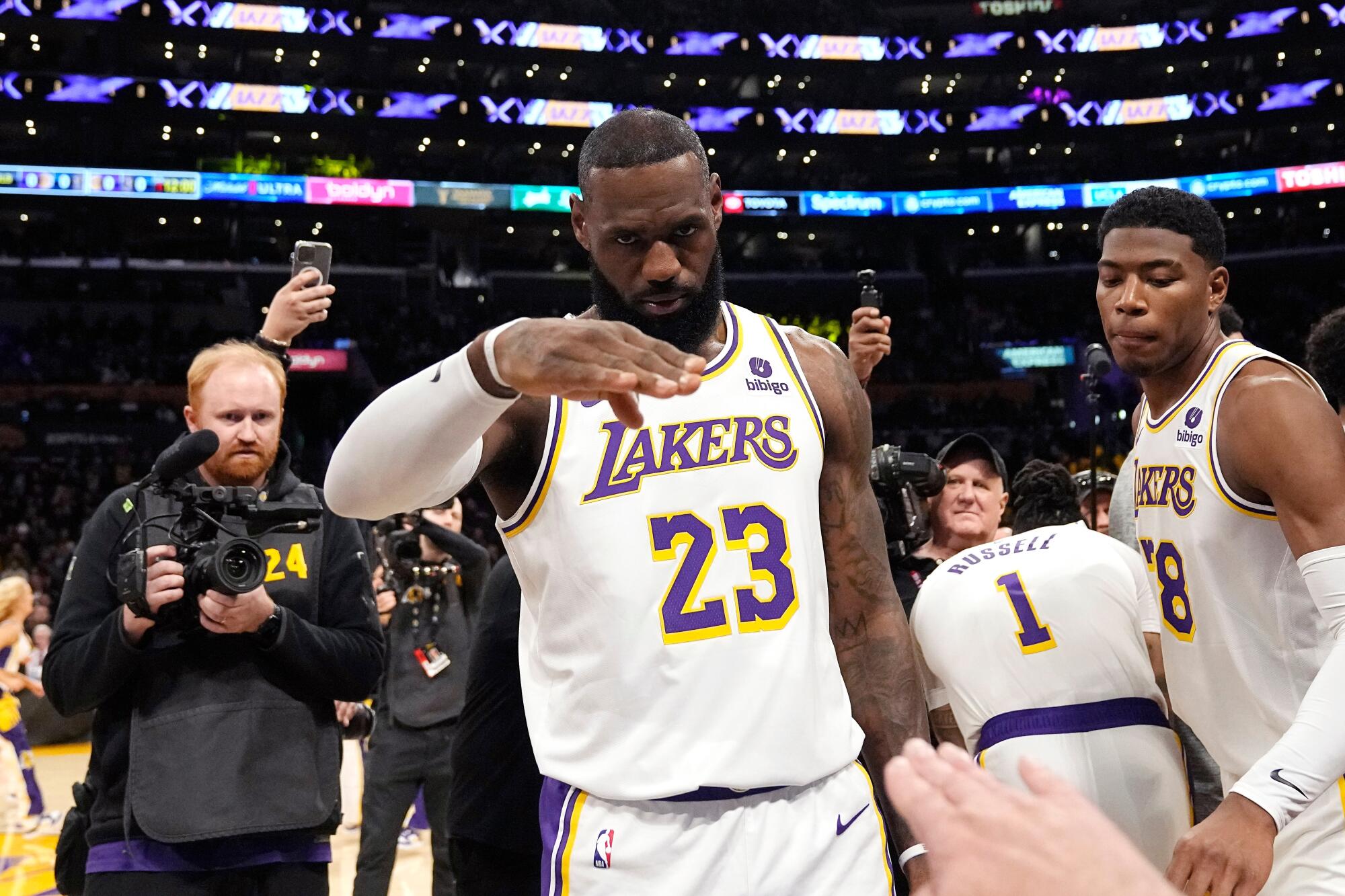
Lakers star LeBron James salutes public address announcer Lawrence Tanter before the start of a game in 2024.
(Mark J. Terrill / Associated Press)
“I got there and I’m like, why didn’t you call sooner?” Joe Williams said. “I told him, ‘I know you’re a warrior but, c’mon man, this is serious.’”
Serious enough to be diagnosed as a stroke. Serious enough to quietly end the most sonorous, soothing stretch in local sports history.
For 43 years as the Lakers’ iconic public address announcer, Tanter has been the coolest sound in the city, the measured, reassuring voice that decorated the team’s two hype-filled homes with gravitas and grace.
When the Lakers announced his retirement last week as he continues to battle effects from the March 17 stroke, the man known to everyone as simply “LT” closed his career with taciturn perfection, summing up a Lakers lifetime in eight words.
“It’s been a great run,” he intoned this week from a hospital bed, his pipes still the strongest part of him. “I’ve been blessed.”
It is Lakers fans who have been blessed, gifted with a voice that, whenever they attended a game, reminded them they were home.
“LT is in every way a part of Laker history,” said former Laker and current broadcaster Mychal Thompson. “He too is a Laker legend.”
Lakers public address announcer Lawrence Tanter gets set up at the scorer’s table before a game in 2011.
(Gary Friedman / Los Angeles Times)
When the retirement news broke with the Lakers announcing they were moving LT into an advisory role — a classy good-bye — fans everywhere broke out their LT best.
“Toooo many steps.” … “James Woooorthy.” … ”LeBronnnn James.”
And, of course, everybody’s favorite…“Llllaker Girlsss.”
“I always imagine, if he could hear God’s voice, it would sound like LT’s,” Thompson said.
This was never more true than on a somber night in late January in 2020. LT put his giant arms around a grieving city with pregame introductions that will never be forgotten.
“At one guard, number 24, 6-6, 20th year out of Lower Merion High School, Kobeee Bryant.”
The player taking the court was Avery Bradley.
“At the other guard, number 24, 6-6, 20th year out of Lower Merion High School, Kobeee Bryant.”
Lakers public address announcer Lawrence Tanter watches play from his spot at the scorer’s table during a game in 2012.
(Mark J. Terrill / Associated Press)
The player taking the court was Danny Green.
And on it went, all five Lakers introduced as Kobe Bryant before their game against the Portland Trail Blazers, the ultimate tribute before the Lakers’ first game since Bryant’s death.
It might have been LT’s finest hour, and every second of it broke his heart.
“The hardest introductions ever,” he remembered.
LT handled it simply by being LT, a comforting bard who could elicit much emotion with a slight change in cadence or key.
“With his timing, his rhythm, he could get excitement going without raising his voice,” said Bob Steiner, the retired Lakers executive who hired LT in 1982. “Lawrence became a star in the same way Chick Hearn was.”
While working for the Lakers, LT also worked for several jazz and rhythm and blues radio stations in town, most notably KJLH, which gave him built-in credibility in the city.
“If you go around town, you will find that he was known almost as much for his radio work as his public address work,” Williams said.
In combining the rhythm of jazz with the tenor of basketball, LT was the coolest cat at the scorer’s table, a distinctive figure in a white goatee and a newsboy cap who raised the roof while never raising his voice.
“I never tried to be a cheerleader,” said LT, 76. “I just tried to be a public address announcer.”
While many of today’s public address announcers are screamers, LT was so subtle that his most repeated call involved not the action, but the in-game entertainment.
“Everywhere we go, somebody recognizes his voice and does an imitation,” Williams said. “But nothing gets repeated like ‘Llllaker Girlsss.’”
Those two words, uttered at the end of every routine by the iconic dance team, contain the essence of LT’s greatness. He knows what you’re watching doesn’t need any embellishment; he’s capturing the scene with the power of subtlety.
“You’re sitting in the stands and when the dancers finish dancing, you say to your friends out loud, ‘Llllaker Girlsss,’ and everybody laughs,” said Pete Arbogast, who was the master of ceremonies when LT was inducted into the Southern California Sports Broadcaster Hall of Fame last year.
LT’s speech that afternoon was dominated by individual thank-yous to his many friends who attended the ceremony, typical LT humility.
“From my nose to my toes, I say thank you,” he concluded.
Lakers public address announcer Lawrence Tanter is given brownies by actress Dyan Cannon before the start of a game in 2011.
(Los Angeles Times)
Today it is the Lakers who are thanking him.
“Since the 1980s, LT has narrated every chapter of Lakers basketball, connecting generations of fans, players, coaches and staff while becoming a trusted and unforgettable part of the Lakers experience,” Lakers governor Jeanie Buss said in a statement. “I am incredibly grateful for everything he has given to this franchise.”
His next stop should be the Naismith Memorial Basketball Hall of Fame, where he deserves to be enshrined as a contributor, becoming the first public address announcer to receive such an honor.
What other PA voice defined a franchise like LT? Who else missed just two games in 43 years? Name another PA announcer who accumulated nine championship rings yet refuses to wear any of them, ever, because it was never about him?
“It’s high time the Hall of Fame inducts him as a valuable and legendary contributor to the game,” Thompson said.
And if he is one day inducted, how would he introduce himself?
“At one forward, number 43, 6-foot-7, from Thornton Township High School, Llllawrence TAN-ter …”
LT laughed at the thought. He never actually would say that. But wouldn’t you like to hear it? Just once?
“Laker games,” Thompson said, “will never sound the same again.”
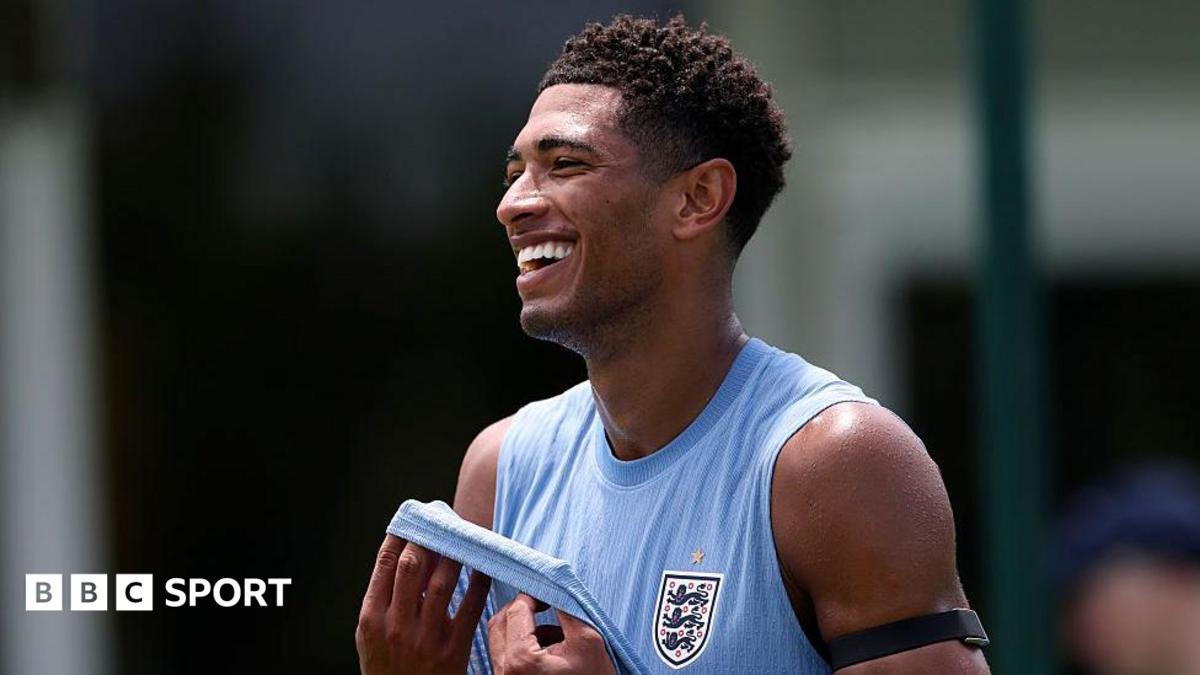
However, it is understood England manager Thomas Tuchel is likely to select Bellingham, 22, for Wednesday’s Group L encounter in Dallas (21:00 BST).
The Real Madrid star is expected to have Arsenal’s Declan Rice and Elliot Anderson of Nottingham Forest alongside him in midfield.
Elsewhere, Ezri Konsa is likely to get the nod at centre-half alongside John Stones – with Marc Guehi in line to start on the bench.
Reece James and Nico O’Reilly are set to start at full-back.
Harry Kane will captain the side and lead the attack. Anthony Gordon is expected to play on the left wing with Noni Madueke in line to play on the right in place of Bukayo Saka, who is working his way back to full fitness from Achilles tendinitis.
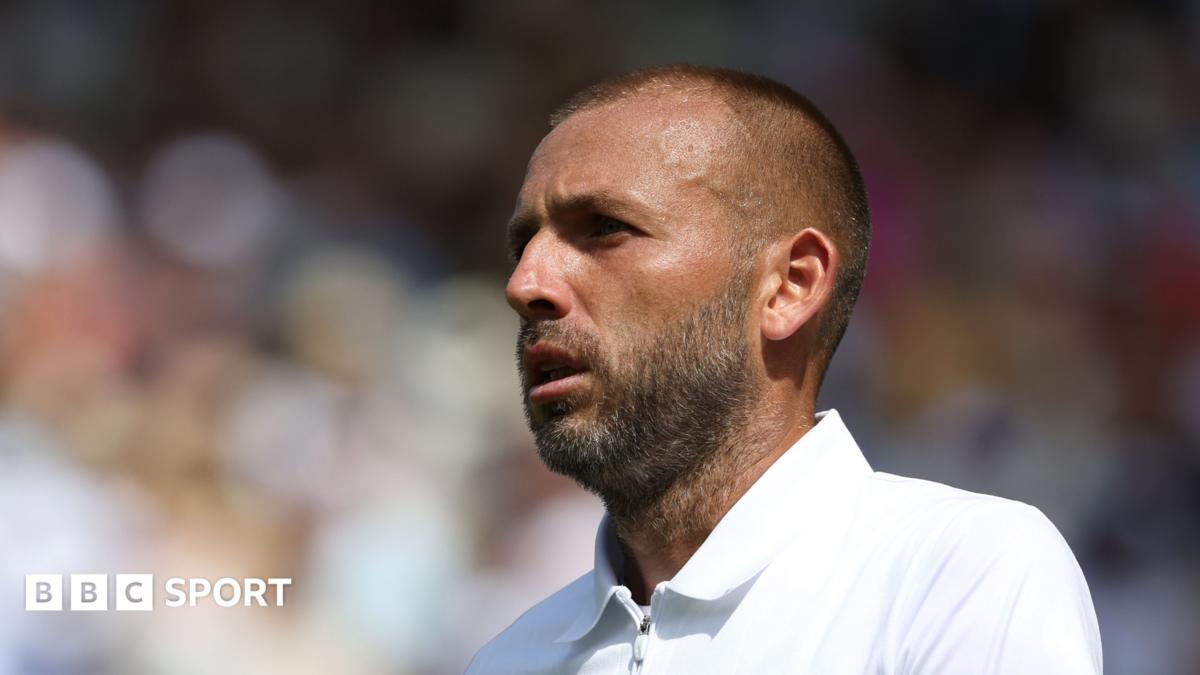
In 2024, Evans sacrificed the 500 ranking points he had won at the Washington Open the previous year to partner fellow Briton Andy Murray for his final tournament at the Paris Olympics.
“Representing Great Britain in both Davis Cup and the Olympics remains the greatest honour of my career and something I will cherish for the rest of my life,” added Evans, who played 28 Davis Cup ties for Great Britain.
Evans, who was suspended for a year after testing positive for cocaine in 2017, thanked his family for their “unwavering support through every high and low”.
“I’m looking forward to finishing on a high… and giving everything I have one last time,” he said.
Wimbledon starts on 29 June, although Evans would have to go through qualifying or receive a wildcard to play in the main draw.
He has failed to advance through qualifying at the past three Grand Slams, while he received a wildcard for last year’s Wimbledon.
The tournament’s wildcard committee will meet on Tuesday to decide which players they would like to invite into the main draw.
Claire Danes’ performance in Netflix’s “The Beast in Me” appears like a lock for an Emmy nomination for lead actress in a limited series or TV movie. In typical fashion, Danes left it on all the floor in portraying a reclusive author who suspects her developer neighbor (Matthew Rhys) of misdeeds.
1995
The Golden Globes rarely get it as right as they did in awarding Danes the drama series best actress award, at 15, for ABC’s “My So-Called Life.”
19
The lifespan of the authentic teen drama that introduced viewers to Danes’ unique emotional translucence, counted in episodes.
1st
Danes also received an Emmy nomination for the series — the first of eight for acting so far.
16
She is the second-youngest Emmy nominee ever for lead actress in a drama series, between Melissa Sue Anderson (15, for “Little House on the Prairie”) and Kristy McNichol (17, for “Family”).
3
Danes won an Emmy for playing the real-life animal science professor in the HBO movie “Temple Grandin,” and two for playing complex CIA officer Carrie Mathison on Showtime’s “Homeland.”
31
Span of years between Danes’ first and 2026 nominations, if she receives one.
47
Danes’ Emmy longevity may not equal the likes of Carol Burnett, nominated in 2024 for “Palm Royale” 62 years after her first, but it’s mighty impressive for someone Danes’ age.
49
There’s even a contender in her category this year whose span between nominations would be longer than Danes’ lifetime: Sally Field, who appears in Netflix’s TV movie “Remarkably Bright Creatures.”
It’s Broadway’s time to shine Sunday when the 79th Tony Awards take New York City.
Broadcast live from Radio City Music Hall, the night promises plenty of onstage drama and hopefully some real-life intrigue. The number of new Broadway productions this year — 30 — shrunk from last year’s 42, but there are still some standout shows and performances to watch out for, from flashy revivals like “Cats: The Jellicle Ball” to Laurie Metcalf’s stunning turns in both “Death of a Salesman” and “Little Bear Ridge Road.”
Grammy Award winner Pink is hosting for the first time, and though the pop star lacks direct Broadway roots, her songs have been featured in the jukebox musicals “Moulin Rouge!” and “& Juliet.”
Here’s everything else you should know about this year’s ceremony, including how to tune in.
How can I watch?
The three-hour awards ceremony will air live on CBS on Sunday at 5 p.m. Paramount+ premium-level subscribers can also stream it on the app, while those with other membership tiers can watch the show on-demand after it airs.
The annual pre-show, “The Tony Awards: Act One,” will stream live on free service Pluto TV at 3:35 p.m. that same day. It is hosted by Tony Award nominee Laura Benanti and actor Tituss Burgess and includes the first round of Tony Award presentations.
Who is performing?
This year’s opening number, a show-stopping Tonys tradition, will feature more than 170 Broadway performers. It’s choreographed by Sarah O’Gleby and written by Benj Pasek, Justin Paul and Mark Sonnenblick.
As always, casts from the productions nominated for best musical — “The Lost Boys,” “Schmigadoon!,” “Titaníque” and “Two Strangers (Carry a Cake Across New York)” — and for best revival of a musical — “Cats: The Jellicle Ball,” “Ragtime” and Richard O’Brien’s “The Rocky Horror Show” — will perform during the ceremony.
Rachel Zegler will pay tribute to “A Chorus Line” and Tony Award winner Leslie Odom Jr. will perform “Without You” from “Rent” to honor the show’s 30th anniversary as well as those in the theater community who have died this year.
The “Chicago” revival will also celebrate its 30th anniversary on Broadway with a performance from stars including Queen Latifah, who was nominated for an Academy Award for her portrayal of Matron Mama Morton in the show’s 2002 film adaptation, and Tony Awards host Pink. The entire original cast of “The Book of Mormon,” including Tony Award nominees Josh Gad, Andrew Rannells and Rory O’Malley and Tony winner Nikki M. James, will also perform in celebration of the show’s 15th anniversary on Broadway.
Who is presenting?
Notable stars of stage, screen and music presenting awards include Grammy Award winner Megan Thee Stallion, who made her Broadway debut this year in “Moulin Rouge!”; Nicole Scherzinger, who won a Tony last year for her performance in the revival of “Sunset Boulevard”; and Academy Award winner Adrien Brody.
You can find the star-studded presenter lineup here.
What is nominated?
“Schmigadoon!” and “The Lost Boys,” both nominated for best musical, lead the pack with 12 nominations each going into Sunday’s awards ceremony. The “Ragtime” revival trails with 11 nominations, and lauded revivals “Death of a Salesman,” “Cats: The Jellicle Ball” and “The Rocky Horror Show” are each nominated for nine awards.