Nithya

What Nithya Raman’s election means for the future of the LAPD

The election of Nithya Raman, a democratic socialist, as the next mayor of Los Angeles promises to have a profound impact on the city’s police force — although perhaps not right away.

Among the most important and widely watched decisions facing the city’s next mayor is about what to do with LAPD Chief Jim McDonnell. Raman repeatedly said prior to her election that she would replace him as chief.

Raman frequently criticized McDonnell throughout her campaign, particularly over how he handled the LAPD’s response to the Trump administration’s immigration enforcement blitz last year.

She has taken issue with the LAPD’s aggressive tactics under McDonnell toward demonstrators, which have included firing tear gas and less-lethal weapons into crowds, officers mounted on horseback swinging batons and accusations of journalists being targeted.

She has questioned whether the LAPD should continue to work closely with the Trump administration on non-immigration matters that require data-sharing, potentially affecting investigations into cargo theft and human trafficking, which involve local collaboration with federal law enforcement.

The events of the last year, she said, have shattered public trust.

In a since-deleted video with a progressive influencer that went viral, Raman said she would work to ensure the LAPD “is actually protecting people, instead of protecting ICE on our streets as we saw happen.”

“I think that starts with a culture shift at the top and new leadership in the department. I don’t believe that Chief McDonnell has met the moment,” she said in the video.

Asked about her plans for the LAPD chief at her inaugural news conference Thursday night, Raman said she had already spoken to McDonnell and believed that public safety was the “most important service” the city can provide. She did not directly say whether his days leading the department are numbered.

“I wanna make sure that whatever happens over this transition that we are prepared to deliver that service at the levels that Angelenos expect,” she told reporters. “And I know Chief McDonnell’s committed to that, I’m committed to that and we’ll continue those discussions.”

During one sit-down with CNN, she was asked to name a police chief whom she admires or respects. “I don’t know … I don’t know,” she stammered in reply.

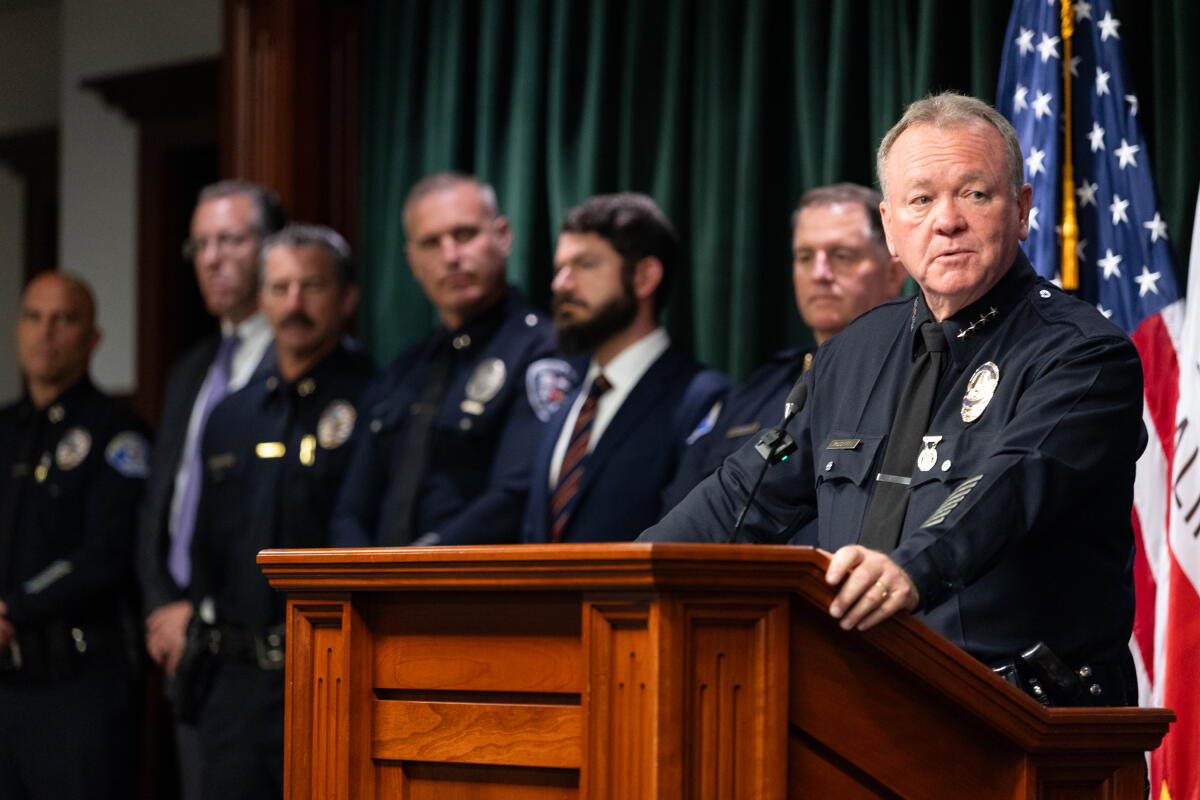
Police Chief Jim McDonnell

Los Angeles Police Chief Jim McDonnell speaks at a news conference in August.

(Arwen Clemans / Los Angeles Times)

In a brief statement, McDonnell said he respected the outcome of the election and congratulated Raman on her victory. He added that while politicians change, the LAPD’s mission public safety “remains constant.”

“As Chief of Police, I remain committed to leading a department that delivers professional, constitutional, and compassionate policing to all Angelenos,” the statement read.

McDonnell has called Raman’s comments disappointing in news interviews, but has otherwise steered clear of directly criticizing Raman in public. The department has released a series of public service announcements featuring the chief on its official Instagram account in recent days to address what officials said was “misinformation” about the LAPD’s operations — saying that the department is barred by Special Order 40 and state and city laws from assisting federal immigration agencies.

If Raman were to replace the chief, when and how it would happen are unclear.

L.A.’s mayor cannot unilaterally fire the police chief. Only the City Council and the Board of Police Commissioners, whose five civilian members are handpicked by the mayor, have that authority. Under the city charter, the council can initiate removal proceedings, but only by a two-thirds vote. It’s unclear whether Raman could muster enough support to make a change right away, since none of the City Council members endorsed her candidacy.

New mayors typically replace current police commissioners with their own appointees — sometimes, leaving one or two in place for continuity — but the process can take weeks since each commissioner has to be confirmed by the council.

A spokesperson for Raman’s mayoral campaign did not respond to a request for an interview about her plans for the LAPD.

Outgoing Mayor Karen Bass has publicly backed the chief she hired two years ago, saying the LAPD could be thrown into disarray if McDonnell is removed before the 2028 Olympic Games.

The question of who might replace McDonnell has been the subject of feverish speculation. One of the most talked about candidates for the top job is Emada Tingirides, an assistant chief who was a finalist in the last chief search, which ended with Bass’ selection of McDonnell. Although questions were previously raised about her perceived lack of leadership experience, Tingirides has been in charge of the department’s Office of Operations, which oversees virtually all patrol personnel, for more than a year.

Other names have been bandied around — including top former LAPD official Bill Scott, the chief of the new Metro police force, and former Los Angeles County Dist. Atty. George Gascón.

But department insiders have dismissed certain reports — namely any mentioning Gascón — as nothing more than rumors. Gascón told The Times that he has not communicated with the Raman campaign, and said he does not want to be chief. Scott did not respond to a message seeking comment.

LAPD insiders have also discussed Art Acevedo, who has served as police chief in Houston and Miami, and Robert Arcos, a former LAPD assistant chief who works for the county Probation Department, as potential candidates for the job. Both also interviewed for the job during the last chief search; Arcos was a finalist.

Arcos said he has had no conversations with Raman’s team. Asked whether he has been approached about working with Raman, Acevedo replied, “No, absolutely not.”

The guessing game about who will lead the department in the near future has been fueled at least in part by Raman’s seeming indecisiveness on the matter. In interviews and debates, she has struggled to offer a clear vision of where she wants to take the LAPD.

Members of Raman’s progressive base expect major changes from Day 1 — and without swift action, she risks angering them, some political experts say.

Black Lives Matter-Los Angeles co-founder Melina Abdullah, who endorsed Raman in the final days of the campaign, said in a text message with The Times that she is counting on the new mayor to follow through on her “commitment to remove Chief McDonnell.”

Beyond that, though, she said Raman needs to increase funding for violence prevention and intervention groups and to “block the mass surveillance of Angelenos” by companies such as Flock Safety and Axon.

Picking a new chief is considered one of the most important decisions any mayor will make, with legacy-defining implications. The conventional wisdom holds that a new mayor means a change of leadership at the LAPD, and potentially new policies.

But that hasn’t always been the case. At least not recently.

Bass oversaw the reappointment of McDonnell’s predecessor, Michel Moore, shortly after her election and stood by him for a year through numerous controversies before Moore’s abrupt resignation in early 2024. Bass’ predecessor, Eric Garcetti, stuck with Charlie Beck, the chief he inherited when he was elected in 2013; Beck was then reappointed to a second five-year term, also under Garcetti. In the early 2000s, then-Mayor James Hahn — with the support of the police union — infamously opposed Police Chief Bernard Parks’ bid for reappointment.

Beyond replacing the chief, a mayor can influence the LAPD’s operations and policies in other ways, including through executive directives. Raman’s election could, for instance, prompt the City Council to take a second look at Special Order 40, a 1979 policy that prohibits officers from stopping people for the sole purpose of determining their immigration status. Critics say the policy — aimed at reassuring the city’s immigrants that they could safely report a crime or serve as a witness without fear of deportation — doesn’t prevent the LAPD from working with federal immigration agencies.

As part of her agenda for her first 100 days, Raman has said she will seek an audit of the LAPD’s efforts to follow L.A.’s sanctuary city law, which requires that city agencies treat information that can be used to trace a person’s citizenship or immigration status as confidential.

Even McDonnell’s critics acknowledge the difficulty of replacing him. Doing so would probably involve a national search, outside consultants and pitched debates about whether to appoint an experienced outsider with top leadership experience — or promote an insider with a firm grasp of where the LAPD has come from historically and an understanding of the political and labor landscape.

McDonnell is popular with the Los Angeles Police Protective League, the union for rank-and-file officers, which remains a powerful force in city politics — although its influence has waned in recent elections, with mayoral candidates who have received the union’s endorsement failing to win in the last two election cycles. The union poured millions of dollars into attack ads against Raman.

As it became clear that Raman would win the race, longtime police union director Jamie McBride was quoted in a news story saying that her mayorship would spell “Armageddon” for the city.

Ruben Lopez, a former LAPD lieutenant, said he has read or heard similarly alarmist comments by plenty of other current and former LAPD officers. But the reality is, he said, he expects Raman and LAPD officials to eventually find common ground — and in the meantime most officers will keep working.

“The true professionals, they’ll keep doing their job just like we saw in New York when [Zohran] Mamdani got elected, said Lopez, who was in charge of SWAT before leaving the department.

Near record-low crime numbers could provide Raman with enough political cover to begin pushing through LAPD reforms while juggling the myriad other issues confronting the city, such as homelessness, housing affordability and crumbling infrastructure.

As mayor, Raman may also be called on to solve the problem of the LAPD’s dwindling ranks.

As of this week, the department had 8,504 sworn personnel — the lowest total since October 1995 — roughly a tenth of whom are not on full duty status, officials say. Even after efforts under Bass to streamline hiring and boost recruitment, some officials are concerned there won’t be enough new officers to replace those projected to leave or retire in the coming years.

Also on her to-do list will be overseeing the negotiations of the next police contract.

The mayor-elect has denounced the raises for rank-and-file officers negotiated by Bass in 2023, which Raman said has deepened the city’s financial problems. Sold as a way to boost recruitment, the pay increases are among the reasons the police union endorsed Bass’ reelection.

Some political experts say Raman enters office unburdened by an indebtedness to the police union. At the same time, she has said she doesn’t want to see the LAPD get any smaller and will need to work with the union to hammer out a new contract, after the current one expires in December.

In a statement released after her election victory, the Police Protective League’s board of directors said it shares a common goal with Raman of shoring up the department’s recruitment of new officers.

“Los Angeles police officers and others are filled with uncertainty and angst at the prospect of major cuts to the LAPD that will reverse the progress made in reducing crime,” the statement said. “Mayor-elect Raman has stated that she does not want staffing levels to decrease from current levels, we share that goal and are committed to ensuring enough officers remain to keep our residents, the Olympics, and our officers safe.”

Negotiations for the next contract are expected to ramp up in January.

Times staff writers David Zahniser and James Queally contributed to this report.


Source link

Inside Nithya Raman’s improbable campaign for L.A. mayor

The first volunteers gathered in the back house of Nithya Raman’s Silver Lake home with little besides a whiteboard counting down the number of days until the June 2 primary election.

Raman had jumped into the Los Angeles mayor’s race the day before, right at the Feb. 7 filing deadline. Her campaign didn’t have an office, a bank account, a campaign treasurer, or even a proper website.

It lacked, put simply, “the most basic things,” said Ian Manheimer, Raman’s campaign manager, who joined the team after a 10 p.m. call from Raman the night before the filing deadline. There would be a meeting the next day in Raman’s backyard accessory dwelling unit to get things rolling.

“For anyone who suspected Nithya had designs on this for a long time, you could just come to the ADU and that would dispel those notions,” Manheimer said.

Those unassuming beginnings in Raman’s backyard, with her parents and her husband’s parents taking turns cooking vegetarian Indian lunches for the small staff, evolved into a disciplined campaign that overcame initial struggles to unseat incumbent Mayor Karen Bass, a veteran politician who had racked up endorsements from most of L.A.’s traditional power brokers.

Nithya Raman at a phone bank event at UCLA.

Nithya Raman speaks at a campaign phone bank event at UCLA on May 31.

(Jonathan Alcorn/For The Times)

Raman did it on a hyper-abbreviated timeline by turning out and expanding her base of younger renters, pitching herself successfully to Latino voters, securing late but key endorsements from groups and officials that gave massive support to her campaign’s ground game and by running on a hopeful message about restoring city services against a deeply unpopular mayor.

From the moment she got into the race, there was an evident, yet narrow lane for the progressive, second-term council member to rise to the city’s highest office, but it was far from clear that she would be able to make it through.

For much of the primary, Raman and her campaign were all alone. She had few endorsements, and almost none from elected officials.

Because of her late entry into the race and some past disagreements, she failed to secure the backing of the Los Angeles chapter of the Democratic Socialists of America for the June 2 primary, even though the left-wing organization endorsed her in both of her council campaigns. Raman got almost no supportive outside spending in the primary, while millions of dollars were spent opposing her.

But Raman had made a name for herself on the City Council as an advocate for tenant rights, and her campaign focused on turning out L.A.’s legions of renters to secure enough of the vote to make the runoff.

She was still a largely unknown entity early on in the race, with 51% of likely voters in a March poll saying they didn’t know enough about Raman to form an opinion of her.

On top of that, Raman was quickly upstaged by Spencer Pratt, the Republican former reality television personality, whose slash-and-burn campaign on social media attacking L.A.’s liberal political establishment dominated news coverage.

While Raman’s camp hadn’t initially worried too much about Pratt, thinking he and entrepreneur Adam Miller would split the more conservative vote in the city, it became clear as the primary went on that Pratt could emerge over Raman as the second candidate in the runoff.

Spencer Pratt, Karen Bass and Nithya Raman debate during the primary.

Spencer Pratt, from left, Karen Bass and Nithya Raman take part in a televised debate at the Skirball Cultural Center May 6 during the primary race.

(Jason Armond/Los Angeles Times)

To dent Pratt’s appeal, the Raman campaign worked to brand him as the MAGA Republican in the nonpartisan race, knowing it would hurt his chances in a deep-blue city like Los Angeles. They chose to try out the line at the only televised mayoral debate.

Raman didn’t miss her chance.

“This is a MAGA Republican’s idea of what Los Angeles looks like,” she said during the NBC4 debate on May 6, referring to Pratt’s sometimes dystopian depiction of L.A. “This is really not the city that I love so much.”

Though Raman’s debate performance was widely panned — and Pratt’s was praised — her team felt she had gotten the point across to Angelenos: With the unpopular Bass almost certain not to win the primary outright, the runoff could either be a contest between two progressive Democrats, or Bass versus a candidate whose views echoed those of President Trump.

That debate was a learning moment for Raman and her campaign.

“She’s up against an extremely seasoned politician and a television star. She’s just a normal person who hasn’t been on stage like that,” Manheimer said.

But defining Pratt as MAGA, the campaign believed, would pull some voters to Raman from lower-performing candidates on the left and in the middle with the hopes of keeping Pratt out of the runoff.

Raman was able to eke out a win against Pratt in the primary, getting 29% of the vote compared to his 26%, with Bass taking first place at 34%.

The sole goal of the primary for Raman’s campaign was, self-evidently, to make it out of the primary.

If her team could move on to the runoff, it would be able to reset — fundraising would restart, it could build a bigger team and it would have a longer runway to increase Raman’s name recognition and build out her base.

While Bass dominated labor and elected official endorsements throughout the race, Raman began to pick up key supporters in the runoff.

In August, the Western States Regional Council of Carpenters endorsed her, sponsoring an independent expenditure group for her called Estamos con Nithya for Mayor 2026.

That was followed by the endorsement from the union Unite Here Local 11, a major player in city politics, which represents hospitality workers at airports and in hotels.

Raman also got major endorsements in the runoff from City Controller Kenneth Mejia and L.A. County Supervisor Lindsey Horvath.

Mejia especially became a pit bull for Raman at events and on social media.

“Kenneth would call every day and say, ‘Let me know what myths I can bust today,’ ” said Tessa Wick, the communications director for Raman’s campaign.

“We didn’t have time to feel particularly lonely in the primary, but once we saw what it felt like to have all these groups and people behind us, each press conference we would do was injecting more force into this movement we were building,” Wick said.

Raman’s bid also got a serious infusion of cash from Aaron Sosnick, a hedge fund manager and bike lane advocate who poured $8 million into two independent expenditure groups to support Raman, making him the single biggest spender in the mayoral campaign.

“He is a cyclist. He just wants to not die riding the streets in L.A.,” said Michael Schneider, who runs Streets for All, a transportation advocacy group that ran one of the independent expenditure groups that Sosnick funded.

Raman also capitalized on a difficult summer for Bass, during which the mayor faced turnover on both her campaign and administration teams, unsheltered homelessness rose citywide (but crucially, went down sharply in Raman’s city council district) and a massive fire burned at a cold-storage food warehouse in Boyle Heights, sending noxious fumes into the heavily Latino, working-class neighborhood.

Mayoral candidate Nithya Raman, right, reviews notes in Spanish with Lauren Perez-Rangel.

Nithya Raman, right, reviews notes in Spanish with Lauren Perez-Rangel before an interview at Univision on Oct. 22.

(Myung J. Chun/Los Angeles Times)

“Many Latinos saw themselves in the Boyle Heights residents,” said Lauren Perez-Rangel, senior director of Latino outreach for the Raman campaign.

Bass had prevailed in more Latino neighborhoods than any other candidate in the primary. The Raman campaign worked to change that in the runoff, Perez-Rangel said, focusing especially on Latino voters. Raman brushed up on her Spanish and used it frequently at events.

The campaign also teamed up with Latino and Spanish-language content creators to spread Raman’s message of affordability, building more housing and solving the homeless crisis. The result: Raman led Bass among Latino likely voters throughout the runoff campaign, according to polls by UC Berkeley IGS and the L.A. Times.

Despite that growing support, Bass and her allies’ negative portrayal of Raman in attack ads had an effect, as Raman’s unfavorable ratings rose month by month. They framed the council member as too far left, allowing homeless encampments in front of schools and failing to show up for thousands of City Council votes.

“It was a race to define Nithya,” said Jeff Millman, an advisor and spokesperson for Raman’s campaign. “Their strategy was to tear down Nithya. Our job was to make sure that people knew Nithya’s strengths and record of success as a council member.”

As the campaign drew to a climax, Raman improved as a candidate and came off as more confident during the two runoff debates. Her team said she spent many hours improving her debate skills.

“There was no secret weapon, just a person really committed to practicing,” said Wick.

Still, she opened herself up to attacks from Bass’ side during the final debate Oct. 13, after she said the city used to be the “gold standard” of noncooperation with immigration authorities under controversial former LAPD Chief Daryl Gates. Bass hammered Raman over the remark, accusing the council member of romanticizing Gates’ tenure.

Despite that and other missteps during the closing days of the campaign, her team said it was Raman’s insistence on running a largely positive campaign about an optimistic vision of L.A.’s future that pushed her over the finish line.

“She was really dogged that it was a campaign that was hopeful, not nasty and cynical. She wanted the campaign to be a love letter to L.A.,” said Wick.

LA mayoral candidate Nithya Raman embraces her husband, Vali Chandrasekaran.

Nithya Raman embraces her husband, TV writer Vali Chandrasekaran, left, on election night at the Greek Theatre plaza.

(Robert Gauthier/Los Angeles Times)

In her election night speech, still trailing Bass by a few percentage points that she would quickly make up, Raman spoke to that vision.

She called it a vision where the people who made L.A. extraordinary could afford to live in the city and where government is responsive and takes responsibility.

“We believed that Angelenos were hungry for that city,” she said. “And it turns out that we were right.”

Source link

Nithya Raman will be mayor for the L.A. Olympics she once opposed

As a Los Angeles City Council candidate six years ago, Nithya Raman gave a firm “No” when asked if she supported the Olympics coming to Los Angeles.

Responding to a questionnaire from the Democratic Socialists of America, Raman added: “There was no vetting of this process, extremely rushed budgeting outreach, and the residents of our city had no say in any of it.”

Once in office, she joined just one other council member in voting against the prime city contract outlining the city’s partnership with the LA28, the private nonprofit hosting the event. And in August she voted against a deal outlining how LA28 would reimburse the city for the extra trash collection, policing and other services that will be expanded during the 2028 Summer Olympics.

My, how time, fortune and politics can change things.

With her election this week as mayor of Los Angeles, Raman won herself a ticket to sit among the dignitaries for the opening ceremony of the Summer Olympics on July 14, 2028. And she will be asked to take center stage at the closing ceremony — handing the Olympic flag to the mayor of Brisbane, Australia, host city for the 2032 Summer Games.

You’re reading the L.A. on the Record newsletter

Sign up to make sense of the often unexplained world of L.A. politics.

In the little more than 600 days before the Games begin, Raman will oversee the city’s preparations.

Those looking for signs of friction might note that the mayor-elect has closely allied herself with City Controller Kenneth Mejia, who has been locked in a battle with LA28 over its failure to publicly report some of the details of its finances.

It’s unclear what position Raman will stake out in that conflict and another one dear to several members of the City Council — getting LA28 to agree to set aside a certain percentage of as much as $4 billion in contracts to businesses based in the city of L.A.

During her run for mayor, Raman did what she has done on many other issues — project a more moderate, conciliatory stance on the Olympics.

“Nithya supports a successful Olympics that showcases the best of Los Angeles and delivers the economic boost Angelenos deserve: more customers for local businesses, opportunities for workers, and lasting improvements in our neighborhoods,” a spokesperson for the mayor-elect said in a recent statement. “She wants residents to share in the excitement and the benefits long after the closing ceremony, but not left to cover the bill unfairly.”

Raman’s rep said she also will “enforce the city’s agreements with Olympic organizers, put strict financial safeguards in place, and make taxpayer obligations public before commitments are made.”

She also pledged that the security around the Olympics will “respect every Angeleno’s dignity and rights, especially immigrants and our most vulnerable neighbors.”

Raman also signaled over the summer that she is ready to be a fan. In an Instagram video, she touted the opening of a new cricket grounds in Pomona, practiced her bowling (like pitching in baseball) and enthused: “The second most popular sport in the world coming back to the Olympics, and coming back, right here in L.A., is really exciting.”

LA28 Chairman Casey Wasserman congratulated the new mayor.

“We look forward to working closely with the mayor-elect, her team, and leaders at every level of government to deliver a safe, secure and fiscally responsible Olympic Games,” Wasserman said in a statement. “With less than two years until the LA28 Opening Ceremony, there is much work to be done. We’re confident that, together, we’ll be ready to welcome the world to Los Angeles and showcase the magic of our city.”

Harris-Dawson is running

It’s still a month away, but the City Council is going to have to cast a pivotal vote: Who should serve as its president under a Raman administration.

City Council President Marqueece Harris-Dawson, in a quick interview Friday, said he will seek the council’s top leadership job for another two years. Harris-Dawson, who supported Mayor Karen Bass in Tuesday’s election, said he was unaware of anyone else angling for the job.

“I intend to be president,” said Harris-Dawson, who faces term limits in 2028.

Meanwhile, council members are still processing the Raman victory and what that will mean for the city. Harris-Dawson said the election revealed a divided city, with newer arrivals to L.A. backing Raman and “people who have been here for generations” lining up behind Bass.

“This race, I think, exacerbated the divisions of the city,” he said. “That showed up a lot more than I was expecting, and the divisions were a lot deeper than I expected.”

Raman’s young progressives

Gen Zers crisscrossed the dance floor, Modelos and seltzers in hand, as the DJ bumped her head to the beat.

But this was no Friday night at Zebulon. This was election night in L.A., and Nithya Raman’s campaign had taken over the plaza outside the Greek Theatre in Griffith Park for the occasion.

“We’ve had a mayor that’s failed young people,” Rutik Shinglot, a 26-year-old working in public affairs, shouted over the noise. “I think L.A. is ready for a change.”

Many of the young progressives at Raman’s election night party at the Greek Theatre had knocked on doors or made phone calls for the now mayor-elect. Unionized UCLA and USC student workers sported bright-pink United Auto Workers shirts. Others wore a red pin brandishing the Democratic Socialists of America’s logo.

Their excitement seems to have made it to the ballot box: Partial returns showed young people ages 18-34 had increased their share of the vote compared with the same early returns in 2022.

The Berkeley IGS/L.A. Times poll sponsored by the L.A. Times days before the election found Raman led Bass 74% to 16% among voters in their thirties.

Raman struck a chord with young people, many said, by hitting hard on the major issues affecting them: affordability, housing and transit.

The council member took her message directly to them. She frequently campaigned at bars and released ads spoofing popular movies and shows.

She garnered the support of niche progressive celebrities young folks trust, including comedians Brennan Lee Mulligan and Rekha Shankar of Dropout (formerly known as CollegeHumor) who emceed Raman’s election night party.

By clinching the endorsements of both DSA-LA and the regional UAW, she unlocked two major pools of young L.A. progressives — eager to build on national momentum — to campaign on her behalf. Rafael Jaime, president of UAW 4811, said the region’s members had contacted 116,000 voters in support of Raman. DSA-LA knocked on more than 110,000 doors with the help of more than 1,600 volunteers.

At DSA-LA, the endorsement created “a mechanism to build up our canvassing infrastructure citywide,” said Keshav Kundassery, 27, a member of both DSA-LA and UAW 4811. “We need to exercise those muscles right now to be ready for the fight that’s waiting for us in 2028.”

State of play

— THE ROAD TO RAMAN: Bass started election night ahead of Raman but the tide quickly changed. By Thursday, the mayor had conceded and Raman was giving her first press briefing at the Original Farmers Market.

— THE NEW AGENDA: What initiatives will Raman pursue once she’s in office? Bike lanes, housing voucher, new apartments, a new police chief and lots of data crunching. “L.A. has been flying blind when it comes to measuring the impacts of the dollars spent. That is going to change,” said former deputy mayor Rick Cole, a Raman advisor.

— WHERE WERE THE VOTES? We’ve got a preliminary map showing how different parts of the city voted in the mayoral election.

— ROY REIGNS: Deputy Atty. Gen. Marissa Roy romped to victory in her race against Deputy Dist. Atty. John McKinney. Council aide Jose Ugarte had a lead that’s been steadily shrinking over community organizer Estuardo Mazariegos in a South L.A. council race. Meanwhile, political aide Barri Worth Girvan was leading business owner Tim Gaspar in the west San Fernando Valley.

— SIGNS OF THE TIMES: On election day, Ugarte’s camp released video that appeared to show Mazariegos supporters stealing an Ugarte lawn sign and replacing it with one for Mazariegos.

— CH-CH-CH-CHANGES: L.A. voters approved all eight of the ballot measures that were on their ballot, hiking taxes to pay for the fire department, sending more city money to public parks and giving the council the power to cut the number of weekly meetings from three down to one.

— SECOND TIME AROUND: In a case of ballot deja vu, Los Angeles County voters reelected Sheriff Robert Luna, rejecting former Sheriff Alex Villanueva by a wide margin once again.

QUICK HITS

  • Where is Inside Safe? The mayor’s signature program to address homelessness went to Venice, a neighborhood represented by Councilmember Traci Park, and to Sylmar, which is represented by Councilmember Monica Rodriguez.
  • On the docket next week: The L.A. County Board of Supervisors will take up a motion Tuesday to lay out steps to fix the county’s restraining order system, in response to reporting by The Times on ways the system fails survivors.

Stay in touch

That’s it for this week! Send your questions, comments and gossip to LAontheRecord@latimes.com. Did a friend forward you this email? Sign up here to get it in your inbox every Saturday morning.

Source link

Nithya Raman wins LA mayoral race, becoming city’s first South Asian mayor | Elections News

DSA-backed Raman will lead America’s second largest city, promising action on homelessness and affordable housing.

Nithya Raman, a progressive Los Angeles City Council member, has defeated incumbent Mayor Karen Bass, putting her on track to become the first South Asian to lead the second-largest city in the United States.

The Associated Press called the race for Raman on Thursday, with Raman holding 52 percent of the vote.

Recommended Stories

list of 3 itemsend of list

Raman, 45, overtook Bass despite the incumbent’s support from prominent Democrats such as California Governor Gavin Newsom, former Vice President Kamala Harris and former House Speaker Nancy Pelosi.

Her campaign was backed by the Democratic Socialists of America (DSA), with her victory coming as part of a surge in visibility and electoral wins for the left-wing political movement.

A record number of candidates backed or affiliated with the DSA won federal offices in Tuesday’s midterm elections. On its website, the DSA has claimed credit for contributing to at least 300 candidacies or ballot referendums during the midterms, and it said it is on track to count 105 of those as victories.

Some of those wins came in congressional races, with figures such as Darializa Avila Chevalier, Claire Valdez, Melat Kiros and Chris Rabb winning their first terms as US representatives.

Raman’s victory in Los Angeles follows another high-profile democratic socialist winning a mayor’s race in New York City last year: Zohran Mamdani.

Raman was born in India and worked as an urban planner before running for office. Once an ally of Bass, she had initially endorsed her re-election campaign but reversed course, entering the mayoral race in February, just hours before the filing deadline.

In her victory speech, Raman promised to restore what she called an ambitious, creative and entrepreneurial Los Angeles.

“For too long our broken and unjust status quo has convinced Angelenos that this is the best that we can do,” she told the crowd.

Raman also pledged to expand affordable housing, improve neglected city services and take a different approach to homelessness by deploying more medical teams to assist people who are unhoused.

In addition, she called for replacing the city’s police chief over concerns about cooperation with federal immigration authorities.

Raman now faces the task of delivering on those promises in a city of more than 3.8 million people.

Los Angeles also faces the challenge of hosting the 2028 Olympic Games, which open in July of that year.

With the result, Bass has become the first Los Angeles mayor in more than two decades to lose a re-election bid.

Her defeat follows a difficult four years in office. Her administration faced mounting criticism over the city’s homelessness crisis and its response to the deadly Palisades Fire, which broke out while she was overseas and devastated communities across the Los Angeles area.

In a statement on Thursday, Bass congratulated Raman and said she was committed to ensuring a smooth transition.

“Four years ago, you elected me as the first Black woman mayor in the history of Los Angeles. You gave me the honor of serving the city that raised me, and every single day since, I have carried that responsibility with me,” Bass wrote.

“Moving this city forward is what Los Angeles needs from all of us.”

Source link

What Nithya Raman’s effort to learn Spanish says about her vision for L.A.

Nithya Raman slowly recited the start of her handwritten message to Angelenos.

Llegué de la India con mi madre a los seis años. Sé lo que cuesta empezar de nuevo.

I came from India with my mother when I was 6. I know what it takes to start over.

The mayoral hopeful was in the green room of Univision’s Westchester studios on Thursday, waiting for an interview with anchor Guad Venegas. He would ask each question in both English and Spanish, and Raman could respond in English.

But she hoped to do better than that.

Since the start of her campaign, Raman has sprinkled Spanglish into her speeches and sometimes offered whole sentences in softly accented, lightly stilted Spanish. It’s part of an effort to win over Latinos, nearly half the city’s population and a crucial swing vote , with less than a week to go before election day.

“Can you say the whole thing for me?” Raman asked Lauren Perez-Rangel, her Latino outreach senior director, who read the full message in effortless Spanish. Raman repeated it word for word, accent for accent, with no flubs or pauses.

“You got it!” Perez-Rangel told her boss.

“I hope,” Raman replied.

It was showtime.

Raman, who serves on the L.A. City Council, grinned when someone said “me vale madre” — I don’t give a damn — on the walk to the studio. She cracked in English, “I doubt that’s true!” when I told an Univision producer in Spanish that no one likes my work.

A cameraman proclaimed “¡Muy bien!” when Raman rattled off an “uno, dos, tres” mic check. Venegas responded in English, “It’s always like that” to Raman’s comment in Spanish that her pronunciation is better than her comprehension.

During the interview, Raman raised her eyebrows when Venegas talked about streets filled with “basura,” the word for “trash” that became an insulting pun on Bass’ name hurled by then-candidate Spencer Pratt during the primary. Raman answered questions in English even when Venegas only asked them in Spanish, fully understanding what he said. And she kept saying “sí” to acknowledge Venegas’ points, as a native speaker would.

She never got a chance to read her Spanish-language statement, but that was OK. I saw enough to know that while she isn’t going to write the next “Don Quixote,” she isn’t limited to ordering at Casa Vega.

Supporters have praised her efforts en español. Critics dismiss them as pandering. I see something more interesting at work.

Raman spoke Tamil and Malayalam in India before moving to the U.S. as a child. If she wins, she would be the first immigrant mayor since Canadian-born Frank Shaw in the 1930s. She’d also be the first mayor whose native tongue wasn’t English since Bernard Cohn, who grew up speaking German in Prussia and served as mayor for two weeks in 1878.

Having a non-native English speaker in charge of a world capital such as L.A. — and one who wants to express herself in the city’s second tongue — wouldn’t just be symbolic. A person who’s earnest about learning a language is forever trying to decipher something new, failing far more often than succeeding in the early going — yet always working to master the task.

Isn’t that what we want from any politician, especially in a city where 56% of residents live in a household that speaks a language other than English?

Los Angeles mayoral candidate and city council member Nithya Raman

Los Angeles mayoral candidate and city councilmember Nithya Raman prepares to speak at a “Latinos Con Raman” rally at La Cita Bar in downtown Los Angeles on Sept. 18.

(Genaro Molina/Los Angeles Times)

Familiarity with Spanish has become a prerequisite for L.A. mayors. Antonio Villaraigosa famously took classes to improve his assimilated Spanish. Eric Garcetti described his fluency as “good community meeting Spanish” and often delivered remarks in Spanish. Bass, who was married to a Chicano and treats her ex-husband’s children as her own, isn’t fluent but has a robust Spanish-language outreach for her campaign, complete with ads, mailers and websites.

For Raman, though, learning Spanish isn’t just a way to reach out to constituents. It’s a reminder of “what it means to grapple with a bureaucracy that wasn’t intended for you.”

We spoke outside Univision’s studios after her interview. I asked to speak about her experience with Spanish as a way to show a private side of her to Angelenos. (I had asked Bass to sit down with me and talk about food. The interview was initially scheduled, then campaign spokesperson Alex Stack said it was canceled so Bass could attend a news conference assailing Raman for saying that former LAPD Police Chief Daryl Gates was a “gold standard” in protecting immigrants. Bass’ campaign didn’t reschedule the interview and didn’t provide comment on her Spanish skills in time for publication.)

In 2022, Raman co-authored a motion that introduced live Spanish translation services at city council committee meetings. She wants the city to research whether it can provide the information that’s being lost as the Trump administration increasingly deletes Spanish-language versions of federal websites.

“You have to show them that you’re trying,” Raman told me. “And even if you go out there, and you speak broken Spanish, and you mess it up, and you don’t conjugate it properly, and you get all the endings wrong — ‘a’ versus ‘o’ — the fact that you show up and you say it, and you try it in Spanish, means something to the people that I’ve been talking to.”

Her Spanish journey began with four years of classes at a suburban Boston high school. She chose Spanish instead of French because she felt it “would be more useful for me in the world.”

Raman forgot most of it while attending Harvard and MIT but started practicing with her brother, a Spanish major at UCLA, when she moved to L.A. 13 years ago. She read bilingual books for beginners and streamed shows such asNetflix’s dark comedy “La Casa de las Flores” (“The House of Flowers”) and podcasts such as “Chill Spanish.”

Those lessons have happened “pretty regularly” since she joined the city council in 2020, Raman said, although she scaled back once the mayoral campaign intensified.

I wondered what languages are spoken in her household. Her husband, whose Tamil-speaking parents are immigrants from India, only speaks English. Her twin 10-year-olds “can kind of follow along” when she speaks to her parents in Tamil, but she is no longer fluent in Malayalam.

“I have friends like who speak a different language, and they’re, like, religious about speaking it to their children,” Raman said. While she would love for her children to learn other languages, “life is too stressful trying to make every moment of your time with your family into almost a chore.”

I asked about the pandering charge. Throwing out Spanish phrases in an effort to appeal to Latinos is a political cliché as weak salsa as eating tacos in East L.A. or cruising in a lowrider.

Raman shook her head.

“To try and communicate to people in the language that they speak doesn’t feel like pandering. It feels like what the city should do,” she said. “Why shouldn’t elected representatives here also speak Spanish, or do their best to communicate to people in their language?

“If there was a lot of Tamil speakers here,” Raman continued, “I would appreciate that for me and for my family and for my grandparents.”

Los Angeles Mayor Karen Bass

Mayor Karen Bass speaks during the “Latinos Con Bass” campaign at Ernest E. Debs Regional Park on Sunday, Sept. 20, 2026 in Los Angeles.

(Kayla Bartkowski/Los Angeles Times)

Then I tested her Spanish.

Had she heard of one of my favorite words: convenenciero? Someone who goes with what will help them and doesn’t stand for anything but themselves. Haters have never outright called Raman a convenenciera, I said, but that’s what they’re insinuating in almost every other sentence.

In fairness, most politicians have a bit of convenenciero in them.

“People say, ‘She doesn’t stand for anything,’ but people also criticize me for being ideological, so which is it?” Raman calmly responded. “I try and learn. And I don’t come and say, ‘I know what you want.’ I say, ‘I’m trying to learn what you want, and I want to make the city work for you. How can I make it work?’”

So you’re not a convenenciera?

“I don’t feel that,” Raman said, repeating the phrase two more times.

I told her I’d ask three questions in Spanish. First: how was she doing?

“Bien. Un poco nervioso.”

“Poca nerviosa,” I corrected. A bit nervous. She thanked me for correcting her and said, “Sí, sí, nerviosa.”

What was she doing to try and relax during this campaign?

“Yo quiero estar con mi familia. Mis hijos …” I want to be with my family. My children …

She thought about the right phrase.

“… son mi vida.” Are my life.

What’s a word she loves in Spanish?

Perez-Rangel suggested chisme — gossip.

“I do like chisme!” Raman said with a laugh. But that wasn’t it.

“I like the word tomar [to take] and how many different meanings it has,” she said in English, then rattled off definitions and tenses in Spanish. Tomar bebidas. Tomar su tiempo.

“Tomar City Hall?” I asked.

She laughed again and said something that needs no translation: “Yes.”

Source link

Nithya Raman has at least one friend in City Hall — City Controller Kenneth Mejia

After the L.A. mayoral debate on NBC4 ended Tuesday, reporters rushed downstairs to a courtyard hoping to speak with the candidates or their surrogates.

Speaking for Mayor Karen Bass were Councilmember Monica Rodriguez and State Assemblymember Rick Chavez Zbur (D-Los Angeles). On the other side, speaking for Councilmember Nithya Raman, the sole spin doctor was Controller Kenneth Mejia.

“What Councilmember Nithya Raman did up there was show a better path, a better vision for what this city could be,” Mejia told reporters outside the NBC4 and Telemundo52 studios in Universal City.

Mejia isn’t just listed as Raman’s top endorser on her campaign website. He’s also her biggest cheerleader, and the only elected official at City Hall publicly supporting her mayoral bid. (Raman’s camp has contended throughout the campaign that endorsements are not necessarily a sign of how the electorate is feeling.)

Of all the elected officials out there, Mejia is an obvious ally for a politician like Raman who has been somewhat ostracized at L.A. City Hall since she announced her candidacy in February. Not a single council member — even her three fellow comrades in the Democratic Socialists of America — has endorsed Raman’s candidacy.

“When you’re in office, once you learn how status quo works and how to game it, you don’t want to change it,” Mejia told The Times, referring to the three DSA council members supporting Bass.

As for Mejia, he doesn’t mind being on the outside.

“It’s been lonely since I’ve been here [at City Hall],” he said.

“People have told me, ‘Kenneth you ruined your political career by endorsing Nithya,’” he said. “I’m honored to be the only one endorsing her … Karen Bass said the political establishment doesn’t like Nithya and I said, ‘So? I won by bucking political establishment.’”

Mejia has turned into an attack dog for Raman over the past few weeks. After endorsing her in July, he has showed up at news conferences with her and posts sometimes multiple times per day on social media supporting her or attacking the mayor.

One reason for his endorsement is that Bass declined to consent to Mejia performing an audit into her signature homelessness program Inside Safe.

Raman, meanwhile, has said she’ll open the books to Mejia.

If Raman wins, she will have a formidable City Hall ally in Mejia, who has not been shy about using social media to attack an assortment of political targets in and outside city government. On Friday, he announced that he had issued subpoenas to LA28, the private Olympic organizing committee, demanding financial records on the planning for the 2028 Games.

You’re reading the L.A. on the Record newsletter

Sign up to make sense of the often unexplained world of L.A. politics.

A vote, but no endorsement

Fourteen members of the Los Angeles City Council have endorsed Bass (yes, that includes Raman, who subsequently decided to challenge the incumbent).

The sole holdout on the council, Traci Park, made her allegiances — soft as they may be — abundantly clear Wednesday at a town hall in Pacific Palisades when she said she would be voting for Bass but not endorsing her.

“I want some change too,” Park said, addressing her constituents about the mayor’s race. “But the alternative does not actually get us where we want to be. I think it actually impedes our progress.”

“I have deep concerns about the leadership and effectiveness of both candidates. I have personally been deeply frustrated and angry with our current mayor. We have tangled on some major policy issues. But always respectfully.”

Park said that as difficult as things may be now, they could get worse if Raman were elected.

The council member, who represents a large swath of L.A.’s Westside, said she is “very, very concerned” about a Raman mayoralty.

Park represents the Palisades, where the Palisades fire burned last year, destroying thousands of homes and killing 12 people.

Park told The Times in an interview that an endorsement of Bass would have represented “an affirmative statement of support earned based on agreement with someone’s records or positions or accomplishments.”

But Bass is someone Park can work with, the council member told The Times.

“I cannot say the same thing about Nithya Raman. That’s the problem. She doesn’t work with others. I think that deep frustration with her unwillingness to collaborate with others is reflected in the fact that no other council members at all are endorsing her,” Park said.

Bass goes to Ramanland

Bass went hard after Raman at this week’s NBC4/Telemundo 52 debate, accusing her of neglecting constituents in her district, which stretches from Silver Lake to the San Fernando Valley. She pushed even harder the following morning, appearing with some of those dissatisfied residents and business owners in Sherman Oaks.

Standing outside the Valley Inn Restaurant and Martini Bar, Bass said she reached out to Raman early on as mayor to warn her that some of her Valley constituents had contacted the mayor’s office to voice unhappiness with Raman. Bass said she told Raman she was going to meet with them.

“She essentially said to me that … she knew that they didn’t like her, that it was a feeling that was mutual, and to have at it if I want,” Bass said. “To me, I thought that was a strange way to respond.”

Raman spokesperson Liz Garcia denounced Bass’ comments as “bizarre and simply not true,” saying her boss has maintained positive relationships with her constituents. In a statement, she pointed to recent polling that showed Raman with an 8-point lead in the Valley.

“Nithya’s results in her district help explain why: She has reduced encampments, tents and RVs by 70% in her district over the past three years, helped businesses succeed, protected tenants, installed traffic safety upgrades and improved quality of life for residents,” Garcia said.

Raman has been pushing back against the mayor’s claims in other ways, noting that two-thirds of voters in the June 2 primary chose someone other than the incumbent.

During this week’s debate, Raman criticized Bass for boasting that she had given Sherman Oaks residents her personal cell number, saying it showed that regular government operations are dysfunctional.

Standing outside the martini bar, Bass acknowledged that her own staffers aren’t always happy about her generosity with her cell number. But things were worse when she was a member of Congress, she said.

“My cellphone was on my business card,” Bass said.

State of play

— BLOW FOR BLOW: The gloves came off in the final debate between Bass and Raman this week, with the two candidates trading verbal jabs over public safety, the Palisades fire and the fate of Police Chief Jim McDonnell. Meanwhile, here’s who three L.A. Times columnists believe won the debate.

— A MOVING TARGET: Raman has shifted her position on police hiring, public safety spending, the so-called mansion tax and other issues, causing some to question what she stands for. Raman has defended her various policy shifts, saying she made them after receiving new information or recognizing changed circumstances.

— CHIEF AMONG THEM: Raman and Bass have diverged over whether to keep Chief McDonnell. Raman said she would replace the chief if she becomes mayor, although she offered mixed messages on the timing. Bass said that McDonnell’s replacement before the 2028 Olympics could throw the LAPD into turmoil.

— GATES-GATE: Bass denounced Raman for saying the “gold standard” for the LAPD’s noncooperation with immigration enforcement took place during the tenure of former police chief Daryl Gates. Bass suggested Raman is not in touch with the city’s Black community, while Raman said the mayor had deliberately twisted her words.

— HOPE FOR HOUSING: Both Bass and Raman have been talking up their work on housing affordability. Bass said her administration has fast-tracked tens of thousands of units of affordable housing, while Raman has boasted of her success in enacting the strongest tenant protections in L.A. in 40 years.

— FIGHTING FRAUD: Los Angeles County voters are concerned about a host of voter fraud issues that could disrupt the Nov. 3 general election, even though they have a high degree of confidence in local elections officials, according to a new poll funded by the nonprofit California Community Foundation.

QUICK HITS

  • Where is Inside Safe? The mayor’s signature program did not have an operation this week.
  • On the docket next week: The final, pre-election campaign finance statements are due in Los Angeles runoff contests on Thursday.

Stay in touch

That’s it for this week! Send your questions, comments and gossip to LAontheRecord@latimes.com. Did a friend forward you this email? Sign up here to get it in your inbox every Saturday morning.

Source link