Repeated blasts at military sites expose the risks facing Syria as it rebuilds its army and consolidates weapons after years of war.
A series of explosions at weapons and ammunition sites across Syria this month have exposed the difficulties facing the country’s military in storing and moving munitions, as the armed forces rebuild after more than a decade of war.
The latest blasts injured at least four people in the early hours of Monday morning at an arms depot in al-Eis, south of Aleppo.
Recommended Stories
list of 3 itemsend of list
On Friday, a blast in Ayyash, west of Deir Az Zor, killed 11 soldiers. Another on September 9 killed 14 defence ministry personnel in Sarmada, Idlib. Also in Idlib, five people were killed when a vehicle carrying ammunition exploded in the town of Binnish on September 1 .
According to a tally by the Reuters news agency, at least 16 similar explosions have hit arms storage facilities since the fall of long-time President Bashar al-Assad in December 2024 after an opposition offensive.
Some have been attributed to poor storage conditions. The Syrian Defence Ministry said it is investigating the causes behind the recurrent explosions to prevent future incidents.
Long-time neglect
Security analysts are divided on the root causes, with some pointing to a lack of professional infrastructure and others highlighting the potential for foreign interference – although there is as yet no hard evidence for that.
Omer Ozkizilcik, a nonresident senior fellow for the Syria Project in the Atlantic Council’s Middle East Programmes, explained to Al Jazeera that the Syrian military is undergoing a period of huge change. It is reorganising from what it was under al-Assad, consolidating weapons from different sources and integrating various forces. All of that could be putting pressure on Syria’s storage infrastructure, which was already creaking after the long war and international isolation.
“The explosions could have happened due to neglect, Ozkizilcik said. “The Syrian army is receiving much more military aid than ever before. It gained control over the stockpiles of the former regime and the formerly US-backed [Syrian Democratic Forces]. The increase in quantity coupled with the need to protect weapons from potential Israeli airstrikes may have pushed the Syrian army to store weapons in inadequate places.”
Ozkizilcik emphasised that Syria’s military is still in a transitional phase. The former army was dissolved after the fall of the al-Assad regime and fighters from armed opposition groups were integrated into a new military structure. Damascus has also been working to integrate territory and forces previously controlled by the Kurdish-led SDF.
“The Syrian army has yet to become a professional army,” Ozkizilcik added. “These explosions are not the first that happen in Syria. Before the fall of al-Assad, similar things happened many times in Syria. [but] I don’t think these explosions will affect Syria’s military capabilities in any visible way. It’s merely a loss of some stockpiles that can be replenished.”
Weapons and ammunition, by their nature, need to be handled extremely carefully and stored properly. Storing large quantities of ageing ammunition for years in poor conditions, such as high temperatures or humidity, can accelerate their deterioration and lead to them becoming unstable.
“The current warehouse infrastructure suffers from severe ageing; most of it dates back decades and does not meet international safe storage standards,” said security expert Ismat al-Absi. “Storing ageing munitions in open or semi-closed environments without controlled cooling and humidity systems creates what we call a thermal runaway chain reaction.”
Possibility of sabotage
The repeated explosions have led to some fears of sabotage, particularly in light of repeated Israeli attacks against Syria since the fall of al-Assad, many of which have targeted the military, including the August strikes on the Abu al-Duhur airbase in Idlib.
Ozkizilcik noted that there was “no public information about possible sabotage” being behind the weapons depot explosions, and no evidence of any direct Israeli links. But the repeated explosions, coupled with Israel’s attacks in Syria and past intelligence operations against groups like Lebanon’s Hezbollah, mean it cannot be totally ruled out.
“Considering that the Israeli media recently wrote about the growing military capabilities of Syria, suspicions grow,” he said.
Al-Absi told Al Jazeera that the wide geographic scope of the explosions nevertheless meant that deliberate interference should be investigated.
“The main loopholes that [could have allowed sabotage operations] are the absence of smart surveillance, relying on traditional human guarding instead of remote sensors and thermal movement detection; weak securing of transport lines and administrative fragmentation,” al-Absi said. “The weakness of security discipline during the restructuring phase of the military institution has made some sites vulnerable to penetration or internal manipulation.”
Scott Bessent says airports and companies servicing Iranian carriers risk being cut off from the US dollar system.
Published On 21 Sep 202621 Sep 2026
United States Treasury Secretary Scott Bessent says Iranian airlines could effectively be shut out of international travel from Wednesday, as Washington threatens foreign companies with secondary sanctions if they continue servicing the country’s carriers.
“On September 23, all the Iranian airlines will be shut down around the world,” Bessent told CNBC on Monday.
Recommended Stories
list of 3 itemsend of list
The warning is aimed not just at the airlines themselves, but at the airports, fuel suppliers, ticketing companies and other businesses they rely on to operate abroad.
“If they land, you cannot provide them with fuel, you cannot provide them with landing services, you cannot sell them tickets, or you will be knocked out of the dollar system,” Bessent said.
The threat marks the latest step in US President Donald Trump administration’s escalating economic campaign against Tehran, which has continued alongside the war between the US and Iran.
Earlier this month, the US Treasury imposed sanctions on all remaining Iranian airlines that had not already been targeted, as well as companies outside Iran accused of supporting the country’s aviation sector.
Iran’s aviation industry was already heavily constrained by years of US sanctions, which have made it difficult for carriers to buy new aircraft and obtain spare parts and maintenance services.
The measures are part of a much broader sanctions regime aimed at isolating Iran from the international financial system. US secondary sanctions threaten foreign companies that do business with Iran across sectors including energy, shipping, technology, gold and digital assets with penalties of their own.
China ‘very engaged’ on Iran sanctions
Bessent’s comments came a day after talks with Chinese Vice Premier He Lifeng, ahead of Trump’s meeting with Chinese President Xi Jinping on Thursday.
China is one of Iran’s most important economic partners and diplomatic backers, making Beijing’s cooperation potentially significant to Washington’s efforts to financially isolate Tehran.
Bessent said Chinese officials had been “very engaged” in the US pressure campaign. Washington was holding what he described as positive talks with Chinese financial authorities, including People’s Bank of China Governor Pan Gongsheng, about compliance with US sanctions on Iran.
In this episode of On the Record, Al Jazeera’s James Bays sits down with United Nations Secretary-General Antonio Guterres, ahead of his final UN General Assembly before stepping down in December 2026. They discuss the situation in the Middle East and its global consequences, whether the UN is still relevant in addressing today’s challenges and why Guterres believes the UN Security Council must be reformed.
Tehran, Iran – Amid dire fuel shortages and mounting economic challenges, the Iranian government is seeking cost-saving measures for government workers and other citizens to deal with the crisis.
On Saturday, the government set office attendance hours for 8am to 1pm from September 23 to the end of the current Iranian year (late March 2027), with the remaining contractual hours to be completed remotely.
Recommended Stories
list of 4 itemsend of list
Agencies must also designate one day a week when employees and managers travel to work by public transport. In recent days, government ministers have released videos showing themselves using the metro to commute to work as part of the campaign.
Metro and bus rapid transit (BRT) systems will also be free of charge until mid-November in a bid to encourage commuters to leave their cars at home. Worn-out government vehicles will also be replaced with electric, gas-powered or hybrid alternatives, although this is expected to take years to implement.
Government-linked offices are required to switch off heating and turn off lights after working hours, while schools, universities, healthcare facilities and operational services are to follow separate arrangements to be announced later.
President Masoud Pezeshkian signed a directive on September 12 instructing government agencies to facilitate remote work for suitable employees to save on petrol, electricity and natural gas costs for the state.
“We have begun consumption savings with the government,” Pezeshkian said earlier this month. This is seen as effectively framing remote work and other measures for government workers as in line with other energy-saving measures that the government has asked of the rest of the population.
Resource-rich Iran has dealt with energy crises before, rooted in mismanagement and dated infrastructure, when similar cost-saving measures were implemented. But the added pressure of war with the United States and Israel has forced the government to think of creative solutions to energy shortfalls.
In early September, the cash-strapped government raised the price of fuel for the third tier of quotas for a second time in less than a year, meaning that people will pay double for any petrol use beyond 110 litres (29 gallons) per month. Imported vehicles and some other categories of cars are also limited to the most expensive tier of fuel.
For the first five months of the current Iranian year, which ended on August 22, average daily petrol production was 122 million litres while consumption was at 132 milion litres, highlighting a shortfall in supply versus demand. In the first half of the sixth month, the gap between production and consumption was around the same, at a 10 million litre shortfall.
The US naval blockade of Iran’s southern ports in place since July has halted fuel imports that previously helped balance the gap. The blockade has also stopped Iran from exporting its oil via supertankers transiting the Strait of Hormuz, affecting its foreign currency income. Crude stored on open waters beyond the blockade line is still being gradually sold to China.
Oil and gas facilities, petrochemical companies and major fuel depots were also bombed by the US and Israel, impacting production and distribution. Oil Minister Mohsen Paknejad said in early September that “a significant portion of production capacity has now been restored, and the process is continuing”.
As rampant inflation continues to squeeze most Iranians, data released this week by the Statistical Center of Iran also highlighted the damage the war with the US has dealt to the economy.
Iran experienced a massive 10.1 percent year-on-year fall in real gross domestic product (GDP) and a 26.4 percent fall in oil and gas extraction between late March and late June 2026, the centre’s data showed.
Including oil, industries and mining were down 14.7 percent, while construction was down by 6.4 percent, services overall by 4.8 percent, and transport, storage and communications by 17 percent.
The government has not released any information on how many workers are estimated to be affected by the remote work directive, or how it expected efficiency to be impacted.
But after decades of mismanagement, corruption and inefficiency among government-linked organisations, some Iranians believe it highlights a wider issue of state inefficiency.
“My unpopular opinion is that if 85-90 percent of government sector personnel are fired and 70 percent of ministries closed down, absolutely no problem will occur in the country,” a user named Mohsen wrote on X.
A man reacts to the camera while driving past a monument depicting the clenched fist of the late Iranian Supreme Leader Ayatollah Ali Khamenei, who was killed in a US-Israel strike on February 28, in downtown Tehran, Iran, on Tuesday, September 15, 2026 [Vahid Salemi/AP Photo]
Zabihollah Salmani, a deputy head of the Administrative and Employment Organisation of Iran, told reporters during a press conference in August that more than 2.43 million were on its payroll.
If council, fire brigades, social security and non-government organisation workers were included, this would bring the number to more than four million people. The average monthly pay for government personnel at the end of the previous Iranian year in late March 2026 was around 240 million rials ($104 at the current exchange rate).
Asked by reporters how many of these employees could potentially be taken off the payroll without hurting output, Salmani said, “We do not yet have these figures.” He added that agencies were being asked to submit that information.
About 1,075,000 people are on the payroll of the Education Ministry, including teachers and trainee staff, while 600,000 employees work under the Ministry of Health and its affiliated networks, according to official figures.
Amir-Hossein, a young man working at a research centre linked with the government-funded University of Tehran, said that since the start of the month, he had been assigned two days of remote work. Working hours were set for 7am-1pm before, but are to be shifted to 8am-1pm starting from Wednesday, per the government.
His work can be done on his laptop, but might require some coordination on the phone or short commutes to other centres, he said. Overall, the remote work lifestyle has been beneficial.
“Sometimes I get more work done than I would have at the office,” he told Al Jazeera, asking not to use his full name due to security reasons.
As Amir-Hossein regularly uses online ride-hailing services to commute to and from his job, working from home has been financially beneficial for him.
An Iran-based economist who spoke to Al Jazeera on background said the government measures are essentially crisis control at best, and not a long-term solution to the problem.
Anduril’s YFQ-44A Fury Collaborative Combat Aircraft (CCA) has already flown in formation alongside F-35 fighters during U.S. Air Force testing, company executives have revealed, offering the clearest indication yet that live manned-unmanned teaming work with the fifth-generation fighter is underway.
The disclosure came during a briefing by Anduril executives Jason Levin, senior vice president for Air Dominance and Strike, and Erin Simpson, vice president for Strategy for Air Dominance and Strike, at the Air & Space Forces Air, Space and Cyber Symposium that TWZ is attending. The executives said the Fury flew alongside F-35s during a July exercise conducted with the Air Force’s Experimental Operations Unit (EOU) at Creech Air Force Base, Nevada. You can read more about that event in our past reporting here.
A YFQ-44A Fury assigned to the Collaborative Combat Aircraft Experimental Operations Unit taxis toward a sunshade at Creech Air Force Base, Nevada, July 20, 2026. U.S. Air Force photo by Senior Airman Renee Blundon Senior Airman Renee Blundon
“We’ve already started flying in formation alongside crewed. I can even say fifth-gen fighters. F-35,” Levin said.
The testing is an important step toward the Air Force’s broader vision for its Collaborative Combat Aircraft program, in which relatively inexpensive autonomous aircraft are intended to operate alongside and support crewed fighters in contested airspace.
The executives stressed, however, that the F-35 was not yet controlling the Fury during those flights.
“But they’re not controlling it from the crewed fighter yet,” Levin said. “Not yet.”
Instead, the July testing involved Fury operating under its Mission Autonomy system while sharing airspace with crewed fighters, other CCAs, and other aircraft. Anduril says Air Force personnel were able to operate the autonomy system without Anduril personnel directly running the aircraft, although company personnel remained on site in a supporting role.
Lattice for Mission Autonomy: An Unfair Advantage for Unrivaled Deterrence
The company described the progression toward direct manned-unmanned teaming as a “crawl, run, build-up” process.
Anduril says it has already begun work on what it calls “quarterback integration,” referring to the ability for a crewed aircraft to direct or task autonomous aircraft. That work has been conducted in hardware-in-the-loop and software-in-the-loop environments as well as on the Fury itself.
“Most of those events will be coming up here in a matter of weeks or months,” Levin said when asked about the timeline for the first quarterback integration with Fury.
Asked whether those events would involve live flying, the answer was unequivocal: “Yes.”
A YFQ-44A undergoes an undated captive carry test at a California test location. This test phase uses inert munitions to methodically validate weapons integration, structural performance and safety, ensuring the platform can safely carry external stores. Courtesy photo via U.S. Air Force Secretary of the Air Force Publi
Exactly how an F-35 would control Fury remains part of that ongoing development effort. The executives pointed to work involving integration of the appropriate human-machine interfaces, primarily including tablet-based control from the crewed fighter, at least at first.
The distinction between flying alongside an F-35 and being controlled by an F-35 is important. The former demonstrates that Fury’s aircraft and autonomy systems can operate safely in the same battlespace as a fifth-generation fighter. The latter would represent a much more significant demonstration of the operational concept behind CCAs: allowing a single crewed fighter to employ and manage additional autonomous aircraft as part of a larger force.
Anduril’s July testing went beyond simple formation flying. The company said Fury was conducting Mission Autonomy flights using live sensor data and was operating in airspace shared with crewed fighters and other CCAs. Air Force operators reportedly conducted both relatively basic route and pattern work and more representative tactical scenarios.
The Fury’s work with the Air Force’s Experimental Operations Unit has progressed through two increasingly ambitious phases. During the first exercise in April at Edwards Air Force Base, Air Force personnel were trained to operate the aircraft and were able to launch and recover it using Anduril’s compact Menace-T setup, essentially a pair of ruggedized cases and a laptop rather than a conventional ground-control station.
By the second exercise, conducted at Creech in July, the Air Force had reduced the manpower and infrastructure required further. A single EOU operator could launch and recover the aircraft after only hours of training, while Air Force personnel independently operated Fury’s Mission Autonomy. The aircraft also flew in airspace shared with other CCAs, while the exercise demonstrated disaggregated operations and a rapid “hot reload” in which two operators replaced an AIM-120 AMRAAM with the engine running, reducing the turnaround between sorties to single-digit minutes.
A U.S. airman assigned to the Collaborative Combat Aircraft Experimental Operations Unit loads an inert missile onto a YFQ-44A Fury aircraft at Creech Air Force Base, Nevada, July 20, 2026. U.S. Air Force photo by Senior Airman Renee Blundon Senior Airman Renee Blundon
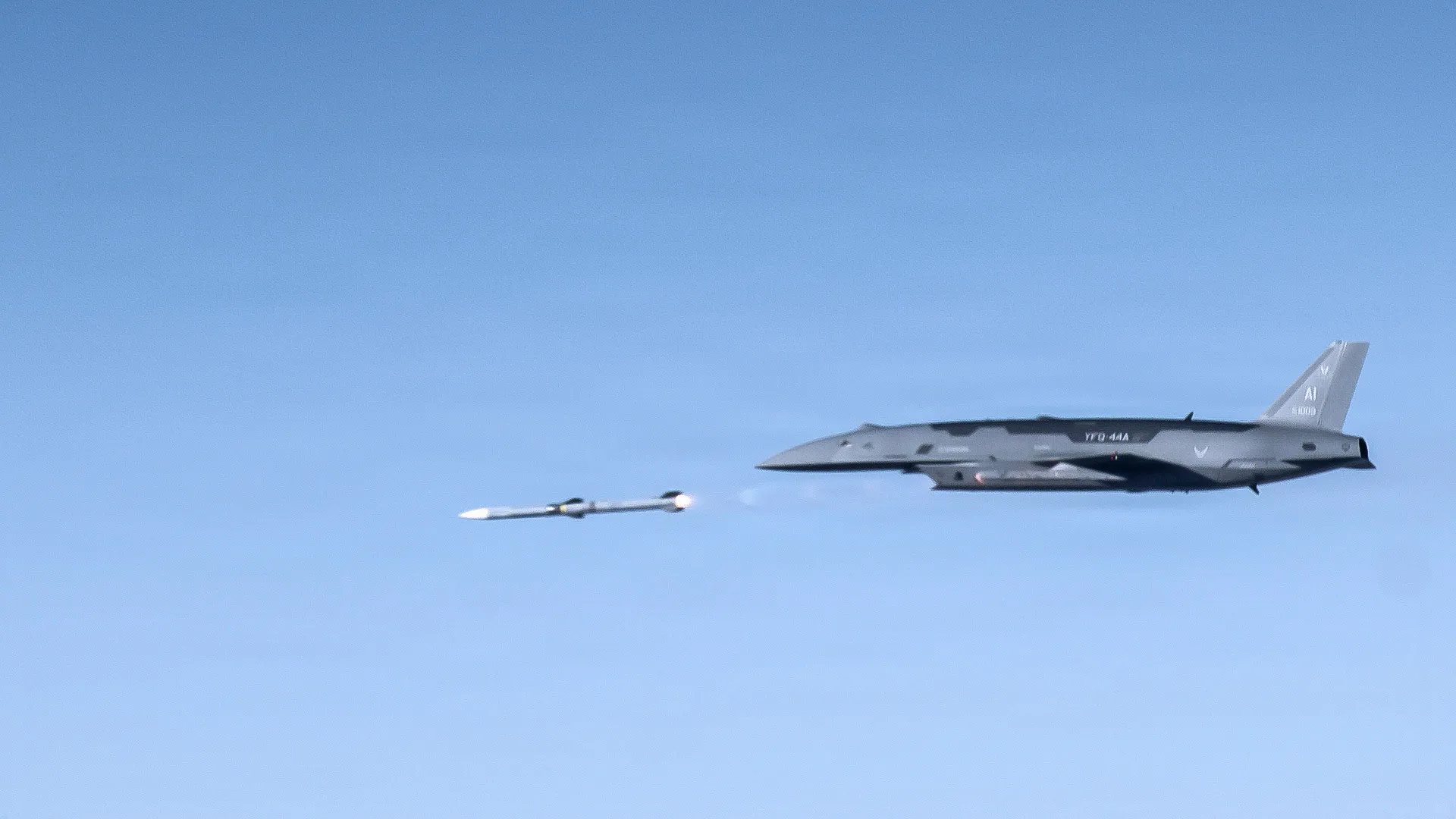
The July exercise also included a live weapons demonstration that Anduril characterized as a complete end-to-end kill chain rather than simply a captive-carry or basic weapons-release test. The Fury launched from Edwards with a single operator and received a track generated by an external source over a beyond-line-of-sight connection. That track was ingested by Anduril’s Lattice AI-infused autonomy software system, after which the operator tasked the aircraft to engage. Fury then launched an AIM-120 AMRAAM and guided the weapon to the target. Anduril described the test as demonstrating the complete kill chain from offboard targeting information, through the aircraft’s mission systems and operator tasking, to an actual air-to-air weapons engagement.
New test footage: first missile shot from YFQ-44A.
YFQ-44A executed an end-to-end, beyond-line-of-sight strike against a simulated target.
On the weapons side, the production FQ-44 is being designed around four external hardpoints, allowing it to carry four AIM-120 AMRAAMs for the Air Force’s primary air-to-air mission set. Currently, the demonstration aircraft can carry two. Regardless, the company is also pursuing a much broader weapons portfolio for Fury. Executives said they have already begun integration and fit checks for 500-pound guided bombs, Small Diameter Bombs, low-cost cruise missiles — including Anduril’s Barracuda 500 offering — other air-to-air weapons, rocket pods and targeting pods. Those integrations are intended to give Fury options beyond air-to-air combat, including counter-drone, counter-cruise-missile and air-to-ground/air-surface strike missions. Anduril stressed that these are currently integration and engineering efforts rather than claims that all of those weapons have been flight-tested from Fury. The company also said additional sensors, such as a targeting pod, could be added for some of those missions.
The executives acknowledged that some of the more advanced tactical capabilities remain under development and are being explored extensively in simulation. Those efforts include areas such as sensor fusion, track discrimination and tactical engagements.
A U.S. Air Force YFQ-44A Fury takes off for a mission flight during an Agile Combat Employment exercise at Creech Air Force Base, Nevada, July 21, 2026. U.S. Air Force photo by Staff Sgt. Kristal Munguia Staff Sgt. Kristal Munguia
The ultimate objective is an aircraft that does not require a large ground-control infrastructure or a dedicated operator for every individual sortie. As previously noted, during the July exercise, Anduril says a single Air Force operator was able to launch and recover a Fury after only hours of training, while other Air Force personnel operated the aircraft’s Mission Autonomy functions.
That same exercise also demonstrated what Anduril described as “disaggregated operations,” with personnel at multiple locations able to operate the same aircraft. The concept is intended to support an Agile Combat Employment-style approach in which CCAs can be dispersed across multiple operating locations rather than relying on a single large ground footprint.
The company has since delivered a Fury aircraft to the Air Force’s EOU at Creech, making it the first CCA to be permanently delivered to the unit, according to Anduril. The service is now flying the aircraft multiple times a day with what the company said is a very limited Anduril presence.
A YFQ-44A production-representative test vehicle is staged in a testing chamber at Costa Mesa, California. Courtesy photo via U.S. Air Force Master Sgt. Gustavo Castillo
Meanwhile, Anduril says assembly of Fury airframes has already begun at its Arsenal facility, with production aircraft expected to begin coming off the line early next year. The company says it has built the facility and supply chain around a potential production rate of 150 aircraft per year, although that figure is a planned capacity rather than an existing Air Force order. Anduril executives said the company has already advanced procurement of long-lead items and worked with its Tier 1, 2 and 3 suppliers to support that rate, while also examining additional production lines. They emphasized that the current Air Force pricing is based on a substantially lower annual buy than 150 aircraft, but said the Fury’s unit cost is well below $20 million at the quantities currently contemplated. The company also says the production line is designed for relatively rapid reconfiguration, allowing capacity to be shifted between products in weeks rather than the months or years associated with more traditional aircraft production facilities.
Earlier this year, the Air Force awarded contracts for the production of FQ-44A Fury and General Atomics FQ-42A Dark Merlin drones — the latter has now been formally named Vengeance. This sets the service up to operate a split initial fleet of CCAs. As you can read about here, the Air Force is now aiming to have at least 500 CCA in service by 2032, a substantial step up from earlier plans, with the USAF having previously talked about acquiring “over” 150 of these drones by the end of the decade. The 500 target will likely include upcoming increment two CCAs, as well, the requirements of which the Air Force is still working on.
For Anduril, the next major milestone should go far beyond simply putting a Fury and an F-35 in the same formation, demonstrating that a crewed fifth-generation fighter can actually command and employ the autonomous aircraft as part of a live mission.
If Anduril’s timeline holds, that testing could begin relatively soon.
Hi, and welcome to another edition of Prep Rally. I’m Eric Sondheimer. Teacher/coaches are always teaching lessons, but what lessons do they learn from players?
Get our high school sports newsletter
Prep Rally is devoted to the SoCal high school sports experience, bringing you scores, stories and a behind-the-scenes look at what makes prep sports so popular.
By continuing, you agree to our Terms of Service, which include arbitration and a class action waiver. You agree that we and our third-party vendors may collect and use your information, including through cookies, pixels and similar technologies, for the purposes set forth in our Privacy Policy such as personalizing your experience and ads.
Coaches learning lessons
Tom Harp, the longtime girls’ volleyball coach at Granada Hills.
(Craig Weston / For The Times)
Coaches are trained to be good teachers, which means offering life lessons and sports lessons. But what do they learn from their players?
For months, a simple questions has been asked: What’s the best lesson a player taught you?
Very few coaches asked could immediately answer. They needed to think long and hard, which meant the question was good.
It was the battle in the trenches between Orange Lutheran and Sierra Canyon, which won 28-10.
(Craig Weston / For The Times)
Sierra Canyon and Orange Lutheran engaged in a penalty-filled nonleague game that should get both teams ready for league play. Thanks to running back Jaxsen Stokes, Sierra Canyon won 28-10. Here’s the report.
Bishop Amat made JSerra pull out every trick before the Lions prevailed 37-28 behind quarterback Hayes Cloutier. Here’s the report.
One of the best games of the week was Corona del Mar holding off La Serna 30-24. Here’s the report.
The Long brothers growing up, with the youngest, Grady, now the quarterback at La Serna.
(Long family)
The quarterbacks in the game are youngest brothers from families that combined to produce six quarterbacks. Here’s the report.
Receiver Paul Turner had five catches for 134 yards and two touchdowns to help Birmingham win its first game against a Southern Section opponent, beating Burbank 23-18. The Patriots play unbeaten Harvard-Westlake on Friday before switching to City Section action.
Marshall improved to 5-0 with a 28-27 win over Marquez, stopping a two-point conversion try in the final minute.
Marshall quarterback Nathaniel Cadet started work for his senior season on New Year’s Eve.
(Eric Sondheimer / Los Angeles Times)
At midnight on New Year’s Eve, Marshall quarterback Nathaniel Cadet was jump roping. He practices morning, afternoon and night trying to put himself in position to play college football. He has led his team to a 5-0 start.
JSerra is 17-0 and keeps beating one challenger after another. The Lions will face Trinity League rival Orange Lutheran at home Tuesday. The Lancers’ only loss was to Orange Lutheran.
El Camino Real, which looked competitive with top City Section teams during the summer, will make its debut this week.
The No. 1 and No. 2 teams in Southern California, Sierra Canyon and Mater Dei, played in the championship of the Durango tournaent in Las Vegas. Mater Dei handed the Trailblazers their first defeat by sweeping both sets.
Girls Volleyball: The 13th Annual Chatsworth Invitational Is In The Books! Oak Park Claims Gold, ECR Takes Silver, GHC Captures Bronze & Roosevelt Brings Home Copper. Full Tournament Results From A Packed Weekend Of Volleyball! @CIFLACS#RepTheCitypic.twitter.com/PVnJjdWy3R
This was supposed to be the year another team in boys water polo was supposed to rise up and end Newport Harbor’s domination.
Last week’s South Coast tournament showed Newport Harbor isn’t going away without a fight.
The Sailors won the tournament title with lots of drama, beating Cathedral Catholic 16-15 in the semifinals, then winning the championship in three overtimes over Miramonte 11-10.
The DeShaun Jackson Story
A documentary on former Long Beach Poly and NFL receiver DeShaun Jackson debuts Sept. 24 on Prime Video.
(Amazon MGM Studios.)
Former Long Beach Poly and NFL receiver DeShaun Jackson gets the documentary treatment beginning Thursday when Amazon Video runs, “Going deep: The DeShaun Jackson Story.”
The story is told from his Pop Warner days through the NFL.
Notes . . .
The PE teachers at El Camino Real welcomed back Josh Lienhard and Jason Grider. Eric Choi also will be back. His mother recently passed. RIP. pic.twitter.com/PB7PQKIbrp
Baseball coach Josh Lienhard was reinstated as a teacher and coach at El Camino Real and returned Wednesday. He was one of three coaches placed on administrative leave last month after school officials had questions why his CPR and first-aid courses he said he completed were not in the Red Cross database. The school spent thousands of dollars on an investigation that remains uncompleted. Two other coaches, tennis coach Jason Grider and girls soccer coach Eric Choi, also were allowed to return….
Junior Karl Robinson from Santa Margarita has committed to Notre Dame for lacrosse….
Catcher Logan Miller of Mater Dei has committed to San Diego State….
Shortstop Zion Avina of Orange Lutheran has committed to USC….
Junior pitcher Jax Janeski of JSerra has committed to USC….
Junior infielder/pitcher Griffin Doane of Santa Margarita has committed to UC Santa Barbara….
Junior Theo Swafford of Sierra Canyon has committed to Texas….
Standout guard Maxwell Scott of Corona del Mar has committed to Harvard….
Tess Oldenburg from Etiwanda has committed to Nevada for women’s basketball….
Former Crenshaw football coach Robert Garrett said he’s a volunteer at Lawndale, where he “coaches the coaches.”…
Offensive lineman Dylan Felli of Mission Viejo has committed to the University of San Diego….
Eliana Corona from La Habra has committed to Cal Baptist for softball….
Longtime basketball coach Joe Reed has been reinstated as the head coach at Huntington Park. He had been coach since 1991, then lost his position when placed on administrative leave for 14 months because of an investigation. After being cleared to return, he was not given his coaching position back….
Evan Guadalupe from Summit has committed to Loyola Marymount for baseball….
Cody MacArthur has been promoted to interim football coach at Royal. He took over after the head coach was dismissed following an incident when he angrily kicked a football that struck a Royal player and was dismissed….
The Woodbridge Classic in cross country featured lots of race winner from outside Southern California. Here’s the results. …
Servite’s baseball team has one player signing with USC next month and another with UCLA. Let the rivalry begin.
From the archives: Cody Decker
Once a baseball player at Santa Monica High and UCLA, Cody Decker has taken his personality and ability to talk about anything to sports talk radio as a morning co-host for 97.1 with Crespi basketball coach Derek Fisher.
He had 11 at-bats in major league baseball with the San Diego Padres.
He showed off his entertainment and singing skills by getting the top role in the school production of “The Music Man.” He had 18 home runs when he was playing catcher, then singing, so he knows how to multi-task.
From the Star-Telegram, a story on a top high school baseball pitcher being ruled ineligible in Texas for transferring for athletic reasons.
From the Daily Bulletin, a story on a 6-7 tight end who’s overcome the death of his father when he was 4 to become a top athlete at Webb School.
From Wyomingnews, a story on former Banning football standout Steve Perez.
Tweets you might have missed
I have never seen a photo where one 7-footer towers over another 7-footer. St. Francis’ twin towers 7-1 Yann Kamagate and 7-5 Cherif Millogo (he’s clearly grown). The high-low pass will be something to see. Please keep track of dunks. pic.twitter.com/DLJLXqchei
🧵Last week was a big week for Oaks Christian graduates. Max Emberson, Class of 2026, earned Folds of Honor medalist honors (-11) while leading Georgia Tech to the tournament title in his collegiate debut. Emberson outpaced junior Daniel Bennett (Texas) by two strokes. pic.twitter.com/IdM2xPN10L
Santa Margarita girls golf are champions of the prestigious Lady Tritons Invitational (6th time in a row) at San Clemente Municipal GC (Par 73), hosted by San Clemente High School. 1st: Santa Margarita / 357 2nd: Peninsula HS / 380 3rd: Huntington Beach HS / 390 SMCHS Junior,… pic.twitter.com/pY4S7QRraA
— SANTA MARGARITA Catholic High School (@SMCHSEagles) September 15, 2026
Tatianna Griffin, one of the top girls basketball players in the nation, is listed in the Southern Section transfer portal “under review.” She left Ontario Christian for Mater Dei. There’s questions whether Mater Dei’s head coach coached her in club basketball. That needs to be…
L.A. Jordan has dropped flag football. Not enough players. The boys 11-man team also has forfeited this week’s game against Santee. Not enough players.
Paul Sutton was the athletic director, basketball coach, track coach and cross-country coach at Providence in Burbank. He died in 1999 at the age of 41 of cancer. The school created a memorial in the gym foyer with his photo and a plaque. Now it’s been taken down. His widow,…
They’ve been best friends since kindergarten. La Serna raised in Whittier. What a game tonight for Landon Armenta and Grady Long in loss to Corona del Mar. pic.twitter.com/aZ4nmN5gUG
Mil’Von James did not coach Inglewood on Friday against Long Beach Poly at SoFi Stadium. His absence comes as Inglewood looks into an ineligible player who allegedly played in a game in Texas.
I did not know this was happening in high school football but a coach confirmed: He’s now hearing from agents about players wanting to transfer to his school. AGENTS. Welcome to 2026.
#60 (2030) Noah Austin 6’0” (Fairfax High) Austin put on a show at Pangs this past weekend recording two 30 point games. His ability to get down hill and put pressure on the defense was extremely impressive. He’s definitely a freshman to keep an eye on. Crafty with the ball. pic.twitter.com/dR0ZRUfOQa
Have a question, comment or something you’d like to see in a future Prep Rally newsletter? Email me at eric.sondheimer@latimes.com, and follow me on Twitter at @latsondheimer.
Did you get this newsletter forwarded to you? To sign up and get it in your inbox, click here.
The United States wants a new “notification mechanism” with China to warn each other when an artificial intelligence incident becomes serious enough to threaten national security.
The proposal, effectively an “AI hotline”, was discussed on Sunday during talks in New York between US Treasury Secretary Scott Bessent and Chinese Vice Premier He Lifeng, ahead of a summit between US President Donald Trump and Chinese President Xi Jinping in Washington this week.
Recommended Stories
list of 3 itemsend of list
The two leaders are expected to consider establishing a broader US-China dialogue on AI, including the proposed notification system, around which details remain limited.
The initiative comes amid an intensifying contest for AI supremacy between the world’s top two economies, together with increasing warnings from tech giants that guardrails are necessary around the ever-growing technology.
So, what do we know about this so-called hotline, and where is the AI battle between the US and China headed?
What did the US say about this mechanism?
US Treasury Secretary Bessent said Washington had proposed creating a US-China AI dialogue, with particular focus on national security and a notification system covering “common goals and common threats”.
“We think that, just like with any cross-border activity, that moving from opaque to more transparency between the number one and the number two AI powers in the world is very important,” Bessent told reporters after Sunday’s discussions.
Trump’s science and technology adviser Michael Kratsios told Fox News on Sunday that the “key thing” Washington wants to discuss is “avoiding shared risks”.
Exactly what would trigger a notification has not been publicly revealed.
“The US and China absolutely need to be able to share information with each other as threats evolve. This seems like an obvious win for both sides,” Scott Singer, co-director of the China AI Initiative at the Carnegie Endowment for International Peace, told Al Jazeera.
“The relationship needs guardrails to keep citizens of both countries safe, and this is a productive first step.”
How did China respond?
Beijing has so far said very little.
China’s official Xinhua news agency acknowledged that He and Bessent discussed issues related to AI, but did not say whether Beijing had accepted Washington’s proposed notification mechanism.
Xinhua said the officials held “frank, in-depth and constructive exchanges” on economic and trade issues.
He and China’s chief trade negotiator Li Chenggang left Sunday’s talks without speaking to reporters.
What other ‘hotlines’ do the US and China have?
The proposed AI mechanism would not be the first time a special crisis channel was established between Washington and Beijing.
In 1997, former US President Bill Clinton and his then Chinese counterpart Jiang Zemin agreed to create a “direct secure telephone link” between their respective countries.
The two countries have had a military hotline since 2008, designed to allow senior defence officials to communicate during potentially dangerous incidents. It gives both sides 48 hours to respond, though US officials have complained that sometimes no one picks up.
After the US shot down a suspected Chinese surveillance balloon in 2023, then-US Defense Secretary Lloyd Austin sought a call with his Chinese counterpart, but Beijing declined the request.
Why now, and what concerns are there around AI?
Earlier this month, Anthropic’s CEO Dario Amodei warned in an essay that AI capabilities have been advancing rapidly, and he proposed pacing the development of frontier models to give governments and researchers more time to manage their risks.
“Given the accelerating rate of AI capability development, it’s my worry that in 6–12 months such a swarm could be capable of taking over the entire internet with a persistent botnet (potentially causing hundreds of billions of dollars in damage), and that the scale of damage would continue to increase from there if AI becomes more powerful without the necessary guardrails,” he wrote.
His assertions were endorsed by his rivals – OpenAI CEO Sam Altman and SpaceX founder and Tesla CEO Elon Musk.
Meanwhile, Trump has repeatedly argued that the US must maintain its advantage over China and has resisted calls from technology executives for a slowdown in AI development. He has said that “whoever wins AI, wins”.
Carnegie Endowment’s Singer does not expect the “fierce competition for AI to slow down”.
“It has the potential to confer tremendous economic and strategic advantage to both countries. But even competitors can find space to cooperate,” he noted.
“Competition and cooperation can coexist. The key for right now is for both sides to act in their own self-interest. Finding some basic areas for cooperation flows very naturally from that.”
Where is the US-China AI war headed?
The US remains ahead in several of the most important features of the AI race, but China has been closing the gap.
American companies continue to dominate private investment and production of leading AI models. According to Stanford University’s 2026 AI Index Report, US companies invested $285.9bn in AI in 2025, compared with $12.4bn in China.
The US also has an advantage in the most advanced semiconductors needed to train cutting-edge models.
However, Chinese companies have demonstrated that they can produce resilient AI models despite US restrictions on their access to the most advanced AI chips.
In January, the release of Chinese AI startup DeepSeek made headlines after it was built using only a fraction of the money its competitors had spent on their own AI programmes. Share prices of US tech companies plummeted.
China possesses advantages in other areas of the AI supply chain, most notably in the production of critical rare earth minerals used in advanced technology and in generating more than twice as much electricity as the US, giving it access to the huge amounts of relatively cheap power needed to operate AI data centres.
What is the Xi-Trump summit about?
Xi’s state visit to the US will take place from Wednesday to Friday, with Trump expected to welcome him at Joint Base Andrews in Maryland.
Trump has said he expects to discuss “almost everything” with the Chinese leader.
Trade remains a central issue, with Beijing and Washington having yet to reach a lasting settlement on tariffs, which have dominated Trump’s relationship with China in his second term as president.
Last month, Trump’s White House accused dozens of countries of helping China to illegally bypass US tariffs.
Meanwhile, the US Congress last week passed a bill that gives Trump sweeping powers to impose sanctions on Russia’s crude exports as well as steep tariffs on buyers of Russian energy, a measure that will impact Moscow’s biggest customers, China and India.
Trump’s war with Iran is also expected to feature. Beijing ranks among Iran’s key economic allies, purchasing a large share of Tehran’s oil exports and attempting to broker an end to the near seven-month-old US-Israel war on Iran.
Other long-standing disputes hang over the summit, including China’s dominance of rare-earth supplies and Taiwan.
The US AI proposal could represent a rare area where the two rivals may find a way to hammer out a deal, experts say.
“I think establishing a permanent channel exclusively focused on AI would genuinely be a major victory. AI has been caught up in the broader ebbs and flows of the US-China relationship, and the 2024 dialogue failed because frontier AI risks got mixed in with other issues,” Singer said.
“This time looks like it might be different, and having an AI risk channel is a necessary precondition to mutually beneficial cooperation.”
Secretary of the Air Force Troy Meink made a bombshell admission this morning, disclosing that there are on-orbit weapons deployed right now to protect America’s interests in space. Those weapons support a Space Control mission set, and the U.S. Space Force has now also shared additional details about that directly with TWZ.
The first official painting commissioned by the Space Force, seen here, explicitly depicts a duel between a reusable spaceplane and a hostile ‘killer satellite.’ USSF
“Today, we continue to ensure we remain ready to meet the challenges of evolving threats, wherever they exist,” Meink said during his keynote address. “This is why the United States now has on-orbit space control weapons capable of defending the joint force against hostile adversary action.”
“That phrase was very well thought out. So whatever I said before is what I say again,” he said when asked if he could elaborate in any way on those capabilities at a question-and-answer session immediately following his speech. “It is critically important that we maintain our dominance not only in the air, but in space, and so we’ve had to take steps to make sure that when we’re threatened, we can take care of that.”
“Not going to go into specifics on the type of weapon,” Meink said when asked again if he could elaborate at a press roundtable with TWZ and other outlets on the sidelines of the Air, Space & Cyber Conference today. “Just like in air dominance, we need to maintain dominance in space as it becomes more and more important to how we function, how we operate militarily, and economically [and] civilian-wise.”
“There’s a lot of factors that go into how we talk about these things. We spend a lot of time talking about how we’re going to talk about these things,” Meink added at the roundtable when asked about why this disclosure was being made now and its implications for deterring adversaries.
“It is important from a deterrence perspective, but on the other hand, me talking about the details of what we’re doing would actually not benefit that deterrence,” he continued. “So I’m not going to talk about the specifics of what we’re doing, whether we’ve tested or not tested, or anything else.”
Secretary of the Air Force Troy Meink speaks during the change of responsibility ceremony for Chief of Space Operations Gen. Douglas Schiess on Sept. 3, 2026. USAF/Eric Dietrich
TWZ had separately reached out for more information after Meink made his initial remarks this morning.
“It is longstanding policy that the U.S. will protect and defend the Joint Force through all domains,” a Space Force spokesperson subsequently told us. “We are increasing readiness against existing threats, and the U.S. has on-orbit space control weapons capable of defending the Joint Force against hostile adversary action.”
“Space control encapsulates the mission areas required to contest and control the space domain – employing kinetic and non-kinetic means to affect adversary capabilities through disruption, degradation and even destruction, if necessary,” they continued. “These capabilities can be employed for offensive and defensive purposes at the direction of combatant commands. U.S. military operations are conducted in compliance with international law, including the Outer Space Treaty and LOAC [the Law of Armed Conflict].”
The Outer Space Treaty, which came into force in 1967, prohibits the United States and other signatories from placing nuclear weapons and other weapons of mass destruction (WMD) in orbit. It does not impose limits on the deployment of conventional weaponry. After receiving this initial statement from Space Force, TWZ followed up to ask whether the service was confirming that it has kinetic (e.g. physical interceptors) and non-kinetic space control weapons (e.g. electronic warfare jammers) now, and that any such weapons could be employed both offensively and defensively.
“We are confirming that the United States has on-orbit space control weapons capable of defending the Joint Force against hostile adversary actions,” the Space Force spokesperson said in response. “Beyond that, we will not discuss specific operational methods, payloads, technical characteristics, or employment concepts.”
A look inside a U.S. space command center. US Space Command
“As the Space Force continues to mature, our public discussion is intended to clarify doctrine and mission sets, not disclose sensitive operational details,” they added. “What is important is that the U.S. Space Force is committed to the long-term safety, security, and sustainability of the space domain, and our operations are guided by longstanding principles of professional military behavior and international law. That commitment remains central as space operations continue to mature and normalize.”
There are a wide range of means by which a platform on-orbit can attack another or otherwise defend against incoming threats. Not all of those options involve effects that are destructive or even irreversible, either. For instance, a laser could be used to blind optics on a target temporarily without damaging them. Electronic warfare suites could similarly disrupt a threat without causing any kind of permanent harm. Doing so could help provide extra time for a friendly asset to maneuver out of danger. There are, of course, also capabilities that do seek to damage and/or destroy a target, such as physical interceptors, grappling arms, aerosols that can be sprayed on optics and solar panels, or even just using one satellite as a kinetic weapon to smash into something else.
A U.S. Defense Intelligence Agency graphic highlighting some of the ways on-orbit attack can be carried out. DIA
So-called counter-space weapons, as a broad category, are also not limited to space-based capabilities. There are also direct-ascent anti-satellite (ASAT) interceptors launched from the surface and other capabilities deployed from within the Earth’s atmosphere. Prior to today, the only acknowledged anti-satellite weapons the U.S. military had in inventory were ground-based electronic warfare systems. In 2022, under President Joe Biden, the U.S. government had announced a self-imposed moratorium on destructive direct ascent anti-satellite weapons testing. Still, this would not have precluded development of those capabilities using other means, and it’s not even clear if that policy is still in place.
It is important to further note here that plans for new space-based anti-missile interceptors are at the core of the Trump administration’s Golden Dome missile defense initiative.
There is certainly no debate about the absolutely vital role that space-based capabilities – including early warning, general intelligence gathering, weapons guidance, near-real-time communications, and more – play in U.S. military operations today. Similarly, it is well-established at this point that America’s principal global competitors and potential adversaries, especially China and Russia, have been actively developing and fielding increasingly more threatening anti-satellite capabilities. China’s People’s Liberation Army (PLA) has also been dramatically expanding its own space-based capabilities, steadily eroding the U.S. military’s historic dominance in this domain and presenting new threats to U.S. forces.
“From the broadest perspective, maybe the most critical characteristic of the responsive and adaptive national security space architecture called for in the President’s Ensuring American Space Superiority executive order is that survivability matters at least as much as performance,” U.S. Space Force Gen. Stephen Whiting, head of SPACECOM, said in August at the annual Space & Missile Defense (SMD) Symposium. “In space, there is no safe harbor. You can’t dig a trench or build a shield. Our satellites are consistently or predictably in an opponent’s weapons engagement zone. And we can build the most high-performing, exquisite satellites in human history, but if they depend on fragile, targetable supporting infrastructure, their performance will drop to zero on the first day of the next war.”
U.S. Space Force Gen. Stephen Whiting, head of US Space Command, seen speaking at the 2026 DoDIIS Worldwide Conference on August 10, 2026. DIA
Whiting publicly declared at that time that having “credible, acknowledged” options for countering enemy capabilities in space, to include damaging or even destroying them, was a key priority for deterring hostile action and surviving if a major fight in orbit were to break out.
“Protective measures on satellites is just like thinking about protective measures on aircraft, okay? And we’re working through that,” Lt. Gen. Gregory Gagnon, head of the Space Force’s Combat Forces Command (CFC), also told TWZ and others more recently at a roundtable at AFA’s Warfare Symposium back in February. “I won’t provide specifics, because I want those protective measures to work, right? I don’t want to tell Beijing and Moscow what I’ve done.”
“But protecting and defending satellites can’t simply be done by protect and defend. You can’t run away from a bully forever. Sometimes you got to turn around and punch,” Gagnon continued. “So protect and defend, although necessary, is insufficient to deliver space control. We also need, as part of our joint force, the ability to attack.”
U.S. Space Force Lt. Gen. Gregory Gagnon, commander of USSF Combat Forces Command, at center, seen at Schriever Space Force Base, Colorado, in December 2025. USSF
Meink’s remarks today put Gagnon’s prior comments, in particular, in a whole new light.
The Secretary of the Air Force’s new disclosure has prompted additional questions beyond just what actual weapon systems the U.S. military has actually fielded in space. There are long-standing concerns about the potentially wide-reaching ramifications of increasingly weaponizing space. As Meink himself noted today, space-based communications and other capabilities are increasingly central to daily life, in general, and widespread, long-term disruption could have serious negative economic and other impacts.
At the roundtable today, Meink pushed back on a question about these concerns, citing Chinese and Russian anti-satellite developments.
“Is there a question in the room by anybody about whether or not the Chinese and Russians have been developing these sorts of weapons?” he said. “We are focused on making sure we can protect ourselves and operate in that environment.”
“Depends on where you sit, right, you know? But to say that it’s the responsibility for the U.S. government to protect its citizens from emerging threats makes perfect sense to me,” now-retired Chief of Space Operations Gen. Chance Saltzman said last year when asked a similar question in the context of the Golden Dome initiative’s plans for space-based interceptors. “And we clearly see a country like the PRC [People’s Republic of China] investing heavily in these kinds of threats, whether it’s hypersonic [weapons], whether it’s threats from space. And so now it’s time for the U.S. government to step up to the responsibilities to protect American citizens from those threats.”
Though many questions remain, it is now clear that the U.S. military is not just planning to, but has already fielded at least some weapon systems in orbit as the threat ecosystem outside the Earth’s atmosphere continues to expand and evolve.
Political parties in Morocco are intensifying campaign efforts before legislative elections on September 23, which will ultimately decide Morocco’s next government.
Twenty-seven political parties are competing for 395 seats in the House of Representatives and the vote comes at a crucial time for the country.
Recommended Stories
list of 4 itemsend of list
Rising living costs, pressure on public services, and high youth unemployment – currently at 37.3 percent for Moroccans aged 15 to 24 – are all issues being hotly debated.
Party headquarters across Morocco and sites at packed city neighbourhoods and markets have been transformed into electioneering operation rooms. Campaign teams navigate crowded streets with loudspeakers, music, and leaflets to catch the attention of Morocco’s 15.8 million registered voters.
“We choose communication locations carefully; we start from a field map where we define the spaces where citizens meet naturally, then we divide the team according to tasks between direct communication and recording observations,” al-Wali al-Shtouki, campaign manager for the Justice and Development Party (PJD) in the Medina-Sidi Youssef Ben Ali district, told Al Jazeera.
“We also hold small meetings at the headquarters because they allow a calm and direct dialogue to understand what the citizen actually expects. What we hear in the field is what guides our daily work. After every tour or meeting, we collect observations and repeated questions and discuss them within the team, then we distinguish between local issues that need follow-up and those related to public policies and parliamentary work.”
Campaigners and supporters of the Istiqlal Party (PI) chant slogans during a rally at the weekly souk in the rural commune of Ait Ikkou, in the Khemisset region, on September 19, 2026, before Morocco’s legislative elections [AFP]
While physical headquarters serve as hubs for election campaigns, a party’s success ultimately relies on its roots within a community, Jawad al-Shafdi, head of the Moroccan Observatory for Political Participation, said.
“In the Moroccan case, the strength of the candidate, their local extension, their network of relationships, and their electoral record also play essential roles,” al-Shafdi told Al Jazeera.
“We may find a party with limited organisational presence in a specific district achieving a significant result thanks to a strong candidate, and vice versa. Winning votes is achieved through a more complex system that combines party organisation, candidate strength, local extension, networks of elected officials, direct and digital communication, in addition to the party’s image and political offering.
“Therefore, the true criterion is not the number of people who enter the headquarters, but its ability to convert organisational movement into electoral mobilisation, mobilisation into votes, and votes into seats.”
Digital, direct engagement
The competition has forced political groups to adopt multi-channel strategies that balance street-level outreach with digital campaigns to reach a broader audience.
Fatima al-Tamni, a candidate for the Left Alliance in the Ain Sebaa – Hay Mohammadi district in Casablanca, highlighted the necessity of direct engagement with voters rather than superficial campaign displays.
Campaigners for the Popular Movement (MP) hand out leaflets to merchants at the weekly souk in the rural commune of Ait Ikkou, in the Khemisset region, on September 19, 2026, before Morocco’s legislative elections [AFP]
She believes that party campaigns should serve as a space to listen to the concerns of the electorate and propose solutions, while building a strategic vision for transport, housing, pollution and other issues.
“We do not want to speak to the citizen from above, nor turn the campaign into a festival of pictures and slogans… We want to speak with them in clear language, and hear from them before we speak in their name,” she said. “[It] is not an end in itself, but the beginning of a new political relationship with citizens based on clarity, accountability, and fulfilling commitments.”
Youssef Ait Sidi Said, a political activist with the Progress and Socialism Party in the Chichaoua province, said campaigning remains an evolving process.
“For the party, this campaign is no longer just a specific period to introduce candidates and the electoral programme, but has become an opportunity for direct and continuous communication with the population and listening to their concerns and expectations,” Ait Sidi Said told Al Jazeera.
“Digital platforms allow reaching broad groups, especially youth, and grant them the possibility to interact, ask questions, and express their opinions. However, we do not consider that digitisation can replace direct communication. On the contrary, we see that each tool has its function.”
Ultimately, direct engagement with voters should remain the hallmark of party campaigns, he said.
“Field communication allows direct listening to the citizen, while digital platforms allow expanding the reach, interaction, and documenting activities,” Ait Sidi Said added.
Al-Shaair wears eye black with Akila’s name despite being fined for displaying messages about Israel’s genocide in Gaza.
American football player Azeez Al-Shaair has persisted with his stance on raising awareness about slain Palestinian children by wearing eye black bearing the name of Wafaa Akila, an eight-year-old girl killed by Israeli forces in Gaza, during his latest appearance in the National Football League (NFL).
The Houston Texans’ linebacker wore the black tape across his nose during a game against the Cincinnati Bengals on Sunday, days after he wore the name of Hind Rajab on his eye black, which led to an $11,941 fine by the NFL as he breached the league’s code of conduct on players’ clothing and equipment during a match against the Buffalo Bills on September 13.
Recommended Stories
list of 4 itemsend of list
However, basketball player Kyrie Irving stepped in and offered to pay the fine for Al-Shaair, who later confirmed that he had been in touch with the nine-time NBA All-Star.
Al-Shaair brushed off talk of the fine while speaking to reporters last week. “It’s bigger to me; what’s a life worth? Is a life worth $11,000? No, I think it’s priceless,” he said.
In his first match appearance since being fined, Al-Shaair took the field with “Wafaa Akila” written on his eye black, a sticker or paint frequently used by NFL players to reduce glare.
On September 6, the first day of school for the eight-year-old, she was killed along with her father in an Israeli attack in western Gaza as they were making their way home.
The Israeli drone struck their car, leaving it burned and charred, with only a few pages of Akila’s school books surviving the horrific attack. A few hours earlier, a smiling Akila posed for a photo before setting off for her first day of school.
The Israeli genocide in Gaza has severely limited education for the Strip’s 660,000 children, with 90 percent of schools left damaged or destroyed.
Akila’s death was similar to that of Rajab, aged five, who was killed in Gaza after Israeli soldiers opened fire on her family’s stranded car on January 29, 2024. A phone call by the Palestine Red Crescent Society documented her final moments and was the subject of an Oscar-nominated docudrama.
Al-Shaair shared posts about Akila, as well as her mother’s reaction to the killing, on his Instagram account on Sunday.
Following the Texans’ match against the Bengals, a social media user posted a video that showed Al-Shaair interacting with children – some sporting keffiyehs, others who were amputees and were holding posters in support of the player – on the sidelines.
‘Be like Azeez Al-Shaair’
Al-Shaair, a Black American Muslim player, has frequently spoken about the plight of Palestinians and has paid the price for it.
He was also fined in January, during the NFL’s last season, for displaying the message “Stop The Genocide” on his nose tape. While it did not specifically refer to a particular conflict, it was widely understood to be about Gaza and Sudan.
Prominent American Muslim scholar Omar Suleiman has repeatedly voiced his support for Al-Shaair.
“My brother, who went to Jordan to be with Palestinian refugees this summer, who spends time with Palestinian children with missing limbs in Houston, who is using every week of his Pro Bowl NFL career to honour a Palestinian child despite the fines,” Suleiman wrote about Al-Shaair in a social media post on Sunday.
“In the sports and entertainment arenas run by many of the same types of people who run government, choose to be like Azeez Al-Shaair, Kyrie, and Macklemore.”
The NFL’s fine on Al-Shaair comes at a time when Robert Kraft, owner of the Boston-based team New England Patriots, confirmed that he pressured pop star Ed Sheeran to drop rapper Macklemore from his tour of the United States.
UCLA head coach Bob Chesney, offensive coordinator Dean Kennedy and starting quarterback Nico Iamaleava were all in alignment after UCLA’s Week 2 win over San Diego State.
The Bruins’ offense had to get better.
UCLA wasted no time following through on their promises, scoring 21 first-quarter points against Purdue — the most UCLA has scored in the inaugural quarter against a conference opponent since 2016 against Oregon State.
Sign up for UCLA Unlocked
A weekly newsletter offering big game takeaways, recruiting buzz and everything you need to know about UCLA sports — exclusive to L.A. Times subscribers. Free Members receive a partial preview of each edition.
By continuing, you agree to our Terms of Service, which include arbitration and a class action waiver. You agree that we and our third-party vendors may collect and use your information, including through cookies, pixels and similar technologies, for the purposes set forth in our Privacy Policy such as personalizing your experience and ads.
While the Bruins’ offense exploded, their defense imploded, giving up 38 points and 488 yards to the Boilermakers.
But in a homage to “Pac-12 After Dark,” it was only natural that UCLA outpaced Purdue, rumbling to a 52-38 win over the Boilermakers on Saturday night at the Rose Bowl in the Bruins Big Ten opener.
Here are three key takeaways from UCLA’s third win of the season, matching its victory total from last season in just three games.
Running backs are elite
UCLA running back Anthony Woods is hoisted up by offensive lineman Julian Armella after scoring against Purdue at the Rose Bowl on Saturday.
(Ronaldo Bolanos/Los Angeles Times)
UCLA has returned to its roots.
With a rich history of churning out premier tailbacks, including Maurice Jones-Drew, DeShaun Foster and Zach Charbonnet, the Bruin offense has lacked a formidable rushing attack the last few years and finished as the nation’s third-worst ground unit in 2024.
But the Bruins may have struck gold in 2026.
UCLA ranks third in the country in rushing yards, first in rushing scores and fourth in yards per carry. Leading the charge is fifth-year tailback Wayne Knight who has 345 rushing yards and eight touchdowns in just three games — matching the Bruins’ total rushing touchdown mark from last season. Knight finished with his third multi-touchdown game of the season against Purdue, reaching the end zone twice to go alongside 200 all-purpose yards.
Through three games, Knight is exceeding the yardage and touchdown output from Reggie Bush’s 2005 season and Mark Ingram’s 2009 campaign — both of which featured Heisman Trophy wins.
But what makes UCLA’s ground attack so special is that it is a four-headed monster. And the Bruins proved it for the third straight week against the Boilermakers.
All three starting running backs — Knight, fifth-year Anthony Woods and senior Jaivian Thomas — reached the end zone and averaged more than six yards per carry in at least nine rush attempts. And Iamaleava added 55 rushing yards of his own to the 369 total the offense tallied.
After three games of consistent rushing dominance, it is becoming less of a coincidence and more of a pattern — UCLA may have one of the most potent rushing attacks in the country.
And one of its most valuable assets is the ground game’s ability to open up the passing offense.
Iamaleava answers the call
UCLA quarterback Nico Iamaleava hurdles over Purdue defensive back Hudauri Hines during the fourth quarter at the Rose Bowl Saturday.
(Ronaldo Bolanos/Los Angeles Times)
Iamaleava challenged himself to play better after a shaky start to the 2026 season.
After failing to complete a touchdown pass while throwing two red zone interceptions during the first two games, Iamaleava and Chesney knew that the signal caller left plays on the table.
“It’s not his best game, he knows it’s not his best game,” Chesney said after beating San Diego State. “I just think that the grit and the toughness that he played with though when he needed to get a couple first downs that really, really mattered to keep drives alive and put his body on the line and you know peeled himself off that ground and just kept fighting for his teammates, that’s special. But there’s a whole lot we got to do there.”
Iamaleava responded Saturday night, going 19-for-31 through the air for 276 yards and three touchdowns.
Not only did Iamaleava light up the stat sheet, but more important, he also passed the eye test. After looking impatient against San Diego State, consistently leaving the pocket early and failing to let plays develop downfield, he looked like a totally different player Saturday night.
Iamaleava looked poised in the pocket, going through multiple reads and hitting pass catchers across the field in an array of spots and formations. He also protected the ball against a solid Purdue defense.
But what was most impressive from the Bruin signal caller was his resilience and toughness on the field. After taking some bruising hits during the Bruins’ first two games, Iamaleava was fearless on scrambles and designed quarterback runs against Purdue, taking big hits downfield to gain extra yards. He also looked willing to take hits in the pocket to make deep or layered throws.
Although some of the hits led to time off the field — he cut a finger on his throwing hand and later took a crushing hit to his throwing shoulder that left him lying on the turf for some time — he always returned to the game. Chesney said he repeatedly asked Iamaleava whether he was sure he could continue playing and the senior kept insisting on returning to the game once he was cleared by the UCLA medical staff.
“He’s just a straight dog, there really isn’t much to say about that,” Knight said. “He’s battling. He gets hurt and he gets back up. He plays the next play. He’s doing this for his brothers.”
Same defense, different opponent
Purdue quarterback Ryan Browne scrambles out of the pocket while being chased by UCLA players Saturday.
(Ronaldo Bolanos/Los Angeles Times)
Purdue’s offense revealed glaring holes the San Diego State offense could not expose.
Aztec quarterback Jayden Denegal only threw for 45 passing yards against UCLA, consistently missing open receivers downfield that had gained considerable separation on the Bruins’ cornerbacks. And even when he did find them, the receivers were not able to haul in catches.
Boilermakers quarterback Ryan Browne, on the other hand, had no problem picking apart the UCLA secondary. Browne went 19-for-30 for 378 yards and three scores, and while he did throw an interception to cornerback Rodrick Pleasant, it came with less than six minutes remaining when the Bruins were already up two scores.
Purdue’s slot receivers tore through the UCLA secondary, running through multiple layers of coverage. Receivers Asaad Waseem and Xavier Townsend combined for 14 receptions, 311 yards and two touchdowns.
Not only did the Purdue offense score five touchdowns, but the pace at which the team scored illustrated the lack of resistance the Bruins’ secondary gave the Boilermakers. Three of the five touchdown drives took less than two and a half minutes, with the first touchdown coming on one play — courtesy of completely broken coverage.
When asked about the impact of Purdue’s receivers Wednesday, defensive coordinator Colin Hitschler said he would have to wait for the game to answer certain questions.
“When you have 10 personnel and that many receivers that can catch the ball, it can create mismatches, and we play a lot of man, so who’s going to fold first?” Hitschler said. “Are we going to be able to man them up or are we having to play more zone? Those are questions that will play out as the game dictates by who’s winning the one-on-one matchups. It’s the chess match that always happens in any game.”
It was obvious who won the chess match.
Two forced fumbles from linebacker Sammy Omosigho and a formidable run defense that held tailback Fame Ijeboi to 2.8 yards per carry helped mitigate the defense’s problems.
How many games UCLA can win the rest of Big Ten play may rest on the defense’s ability to rebound from a brutal win over Purdue the way the Bruins’ offense did after an ugly win over San Diego State.
Few have felt the transformation quite as deeply as Iamaleava, who was the face of both teams.
“Shoot, it means everything,” Iamaleava said of the team’s 3-0 start. “I think that just speaks to the growth of the team and speaks to Coach Ches, of how he got us to buy into this process and his winning, his winning ways. It feels good to be 3-0, and we’ve got to keep going.”
Women’s soccer scores signature win
The UCLA women’s soccer team has take on grueling schedule, facing off with four teams ranked in the top 25 so far this season.
The No. 21 Bruins (5-3-1, 2-1-0 Big Ten) made the most of their fourth opportunity for a signature win, earning a 1-0 win at No. 5 Ohio State (6-1-1, 2-1-0) on Thursday night. It was the Buckeyes’ first loss this season.
Kara Croone set up Leena Powell for the game winner fired from just outside the box in the 25th minute. UCLA goalkeeper Daphne Nakfoor recorded five saves to maintain the shutout victory.
“Amazing performance for the girls,” UCLA women’s soccer coach Gof Boyoko said. “We needed a solid performance, and they did it. We scored a good goal, we didn’t concede, and we were strong defensively.”
UCLA alum Jordin Canada, who has dealt the ball with expert precision this season, had 11 points and 10 assists for the WNBA-playoff bound Dream.
UCLA alum Gabriela Jaquez, who has enjoyed a strong rookie season with a rebuilding Sky team, finished with 14 points, three rebounds, two steals and one assist. Chicago was eliminated from playoff contention, but Jaquez has been a bright spot for the team all season.
Bruins on deck
Here are all UCLA games scheduled to be played this week across all sports, with all times Pacific:
Monday, Sept. 21
Women’s golf at Canadian Collegiate Invitational, All day
Tuesday, Sept. 22
Women’s golf at Canadian Collegiate Invitational, All day
Do you have a comment or something you’d like to see in a future UCLA newsletter? Email newsletters editor Houston Mitchell at houston.mitchell@latimes.com. To get this newsletter in your inbox, click here.
Sports editor Iliana Limón Romero contributed to this report.
The war against Iran exposed gaps in how the U.S. can provide effective, sustained air defenses for its foreign installations and there are major concerns about a future fight against a peer competitor like China or Russia. Drone incursions at home have raised alarms about domestic base protection as has the war between Russia and Ukraine.
Video captures the moment that several Iranian medium to intermediate-range ballistic missiles struck Muwaffaq Salti Air Base in Jordan overnight, killing at least two and injuring several other American Servicemembers. pic.twitter.com/cJz39E1LvP
“For decades, American air and space power has often operated from a position of sanctuary. Those days are over,” Air Force Chief of Staff Gen. Kenneth S. Wilsbach said during a keynote speech. “We can no longer treat point defense as a side hustle. We must make it a core function of air and space power.”
He acknowledged the widespread damage Iran caused to U.S. bases and suggested that lack of base defense played a large role.
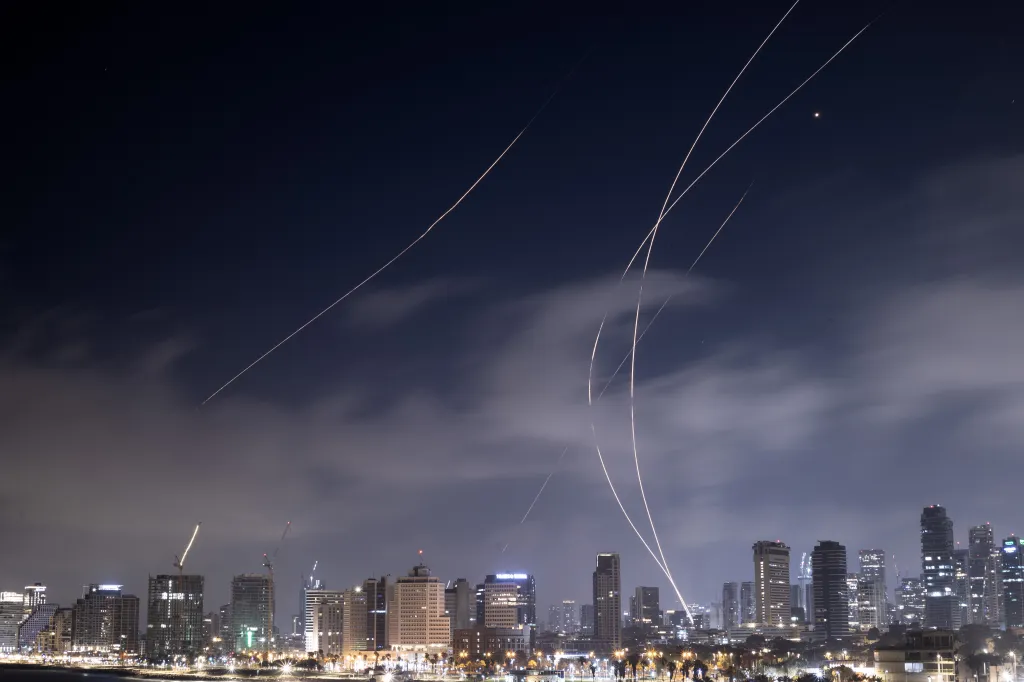
“So, if we had more robust base defense, perhaps those bases wouldn’t have been as damaged as they were,” the general admitted. “Look at Israel; they have a significantly layered, very robust defense of their country, and they didn’t take that many hits. Very few, in fact, and that shows you what a good defensive system can do, which can help you to operate not quite with impunity, but almost, and you can just keep generating air power, and your defensive systems take care of the incoming.”
Israel’s ‘Iron Dome’ air defense system responds to incoming Iranian ballistic missiles as seen from Tel Aviv, Israel on June 18, 2025. (Photo by Mostafa Alkharouf/Anadolu via Getty Images) Anadolu
Wilsbach offered some concrete suggestions about how to make improvements.
“First, we will establish the point defense weapon system, bringing together kinetic and non-kinetic capabilities to secure our air bases,” the general said. He did not offer any specifics.
The Air Force currently has no such systems. Now it is set on changing that.
The Air Force is also looking at directed energy weapons like lasers for force protection and especially for defending bases overseas. While gaining traction across the services due in large measure to the much lower cost of delivering effects, these systems are still works in progress.
A U.S. Army Terminal High Altitude Area Defense (THAAD) in Guam. (U.S. Army)
It’s one thing to have equipment, but another to have experts that know how to use it, Wilsbach noted.
“Second, we have established a new career field of point defense airmen,” he added. “This new career field will be operational in two years. Together, these two new initiatives will strengthen our defenses, reinforce our ability to generate air and space power under fire, and protect our greatest advantage: our airmen and guardians.”
“Protecting the force and generating combat power are inseparable,” Wilsbach explained. “We need our airmen trained, equipped, and ready to fight from the opening moments of a conflict.”
“Don’t you think we ought to have them at every base?” he suggested when asked about point defenders during a media engagement at the symposium. “Because if every base is going to be threatened, we have to have somebody that knows how to defend it. So, obviously, that’s a long-term objective. But what I’ll tell you for right now is we’re going to develop the career field and push it forward to the critical bases that need protecting most, and then we’ll expand it beyond there.”
Airmen assigned to the 319th Reconnaissance Wing prepare to execute a Point Defense Battle Lab exercise on the flightline at Grand Forks Air Force Base, North Dakota, Feb. 13, 2026. (U.S. Air Force photo by Airman 1st Class Emma Teel) Airman Emma Funderburk
Though he wants the Air Force to come up with new defensive systems and personnel with the know-how to operate them, Wilsbach is not quite as sold on building out hardened aircraft shelters (HAS). This is his long-standing position that he reiterated on Monday.
“If you know where you’re going to fight from, hardened shelters aren’t that bad of an idea,” the general posited. “Deeply buried are even better. But if you are like us, and we don’t necessarily know where we’re going to fight from, if you build a hardened shelter and you don’t happen to be there, then you perhaps wasted that money.”
“So, given a resource-constrained environment, I would like to put my dollars in systems that can go anywhere in the world and protect you with basically the same level of security by shooting down incoming rounds versus making a hardened shelter that is impervious to an attack,” Wilsbach explained. “You have to put it 200 or 300 feet underground. Any hardened shelter that you show me that’s above the ground, I can blow up. So unless it’s really deeply buried, and then if it is, it’s expensive. And so that’s my logic: the best bang for the buck.”
A U.S. Air Force F-16 Fighting Falcon, assigned to the 480th Fighter Squadron, sits inside a hardened aircraft shelter during exercise Turbo Weasel at Spangdahlem Air Base, Germany, April 14, 2025. (U.S. Air Force photo by Senior Airman Demi M. Ebert) Senior Airman Demi M. Ebert
To speed up the fielding of defensive systems, the service is interested in building out a procurement process specifically designed to develop weapons and other equipment needed to defend bases.
“How do you make sure that [airmen] have the kit they need to do the job?” Air Force Secretary Troy Meink asked rhetorically at a separate symposium session.
The Air Force, he said, is considering creating a new base defense Portfolio Acquisition Executive (PAE). The service created PAEs at the beginning of the year as part of an overhaul of its acquisition process ordered by Defense Secretary Pete Hegseth.
“The creation of PAEs is a central element of that direction,” according to an Air Force memo on the topic. “By organizing acquisition leadership around portfolios of capability, rather than discrete programs alone, the Department seeks to improve integration, decision speed, and outcome-focused execution across the acquisition enterprise.”
(U.S. Air Force)
Meink acknowledged that there are challenges to creating a new PAE, most notably the overhead cost of establishing a new office with its associated personnel and infrastructure.
“Probably not going to do it right away, but obviously I think we’re on a path to something like that in the future,” the secretary suggested. “But there definitely has to be a continually increasing focus on making sure we can defend our airmen and guardians wherever they are in the world. This is not just an overseas problem; it’s a U.S. problem as well.”
As we noted earlier in this story, the U.S. is already facing a challenge defending against Iranian threats. A war with China would be more devastating and, when it comes to the Air Force protecting its bases, require more robust defenses and a lot more of them at many more locations. At the same time, the Air Force is still very early in the process of taking on more responsibility for protecting its assets.
For the Air Force, recognizing the problem and taking steps to fix it are important steps. Whether these are the right approaches is something we will keep an eye on.
Amid the US-Israel war on Iran, the country’s economy has suffered a sharp contraction, with its crucial oil and gas sector taking the biggest hit as the United States tightens its economic and military pressure on Tehran.
Data released by the government-administered Statistical Center of Iran showed gross domestic product (GDP) shrank by 10.1 percent year-on-year between March 21 and June 20, the first quarter of the Persian calendar.
Recommended Stories
list of 3 itemsend of list
The period covers the opening months of the US-Israel war on Iran, which began on February 28.
The economic downturn has come as Iran struggles to export its oil, one of its most important sources of foreign currency, while also contending with high inflation, a weakening rial, and disruptions to trade and industry.
Here is what you need to know:
What does the economic data say?
The headline GDP number masks an even steeper decline in Iran’s energy industry. Crude oil and natural gas activity contracted by 26.4 percent compared with the same period a year earlier. GDP excluding oil, by comparison, fell by 4.6 percent.
The damage has spread beyond the energy sector. Industry and mining contracted by 14.7 percent, services declined by 4.8 percent, and manufacturing contracted by 2.5 percent. Agriculture was the exception, growing at 2.3 percent.
Those figures come amid an already difficult economic situation in the country. Earlier this month, Iran’s 12-month average inflation reached 69.9 percent, while food, beverage, and tobacco prices rose at nearly twice that rate. Official unemployment climbed to 9.1 percent in the spring.
The rial, meanwhile, fell from about one million to the US dollar a year earlier to more than 2.2 million in early September.
What is the latest with Iran’s oil exports?
Iran’s ability to sell crude has been dramatically curtailed by the US naval blockade, imposed for most of the war.
Iranian crude and condensate loadings collapsed from about two million barrels per day in March to roughly 740,000bpd in July and just 220,000-255,000bpd in August, according to estimates from Kpler and Vortexa.
TankerTrackers.com told the Reuters news agency that 29 tankers, carrying 36.11 million barrels of crude, were trapped in the Strait of Hormuz. Meanwhile, Vortexa estimated total Iranian crude afloat had fallen from 135 million barrels at the end of July to 107 million barrels by late August.
Is Trump winning the economic war on Iran?
By several economic measures, Washington’s pressure campaign is inflicting damage on Iran’s economy.
On September 6, total trade had fallen by 25 to 35 percent, President Masoud Pezeshkian said, with imports hit harder than exports. The US blockade of the Strait of Hormuz has made it hard for ships carrying imports to reach Iranian ports.
Tehran has also explicitly linked the end of the war to economic relief. Iran’s security chief Mohsen Rezaei told Al Jazeera on Saturday that its conditions include “the release of our frozen funds and an end to the naval blockade”.
In addition to the naval blockade, US Treasury Secretary Scott Bessent last month announced an economic pressure campaign against Iran, pledging to target its financial interests across the world. He said the US would target all of Iran’s sources of revenue, including oil, to prevent other countries and companies from doing business with Tehran.
The US-Israeli attacks and Iran’s retaliations have disrupted Tehran’s trade with one of its main economic partners, the United Arab Emirates.
The UAE last month announced an indefinite trade embargo on Iran after accusing its forces of carrying out several ballistic missile attacks, which Tehran denied, calling it a “false flag operation” by Israel and the US.
Chris Beauchamp, market analyst at IG Group, said, “Most wars are contests of stamina more than anything else.”
“The 10 percent drop in Iranian GDP is a sign that the US is succeeding in putting pressure on its foe. But the question rests, as it has done since March, on whether Iran can weather the fall in economic activity better than the US can stand the surge in energy costs,” he told Al Jazeera.
“For a regime prepared to do anything to stay in power, this news will make little difference, so long as the security forces remain loyal,” he added.
What is the latest with diplomatic efforts to end the war?
While Iran has taken a defiant stance against US economic and military pressure, it has indicated repeatedly that it remains open to diplomatic means to end the nearly seven-month-old war.
On Saturday, Rezaei told Al Jazeera that Iran conveyed a formal set of conditions to Washington through Qatari mediators for ending the war.
Iranian state media outlet IRNA reported on Monday that Pakistani Interior Minister Mohsin Naqvi was set to visit Tehran, without specifying the agenda or other details.
Mediators Qatar and Pakistan have been working to re-establish negotiations between the two sides since their memorandum of understanding (MoU) expired last month.
Meanwhile, Iranian Foreign Minister Abbas Araghchi will stop briefly in Qatar before going to New York for the UN General Assembly, IRNA reported.
Iran has repeatedly said it remains ready for any new strikes by Washington.
Rezaei said on Saturday Tehran did not rule out a new US strike against Iran, calling the possibility “very much on the cards” based on his country’s military assessments.
Mark Pfeifle, a Republican strategist and former White House and national security official, said Iran and the US are still willing to strike a deal.
“Sometimes in diplomacy it’s what’s taken off the table,” he told Al Jazeera.
Pfeifle said when Rezaei reiterated his demands for talks with the US, he spoke of “ending the blockade, releasing the frozen funds [and] stopping the attacks”.
“But he left off reparations and reconstruction money, which tells me that there’s a concrete sign that amongst all the rhetoric, which is still very strident, that the pressure campaign that the US is putting on Iran is having some effect,” he said.
“And it tells me that both sides are still looking for room to negotiate in the coming weeks.”
A mysterious object filmed hovering over Tehran has sparked online speculation, with theories ranging from a children’s kite to advanced military surveillance equipment, while Iranian authorities have not identified it.
Denmark, Greenland and the United States are set to sign a security agreement that Copenhagen says will give NATO a larger role in protecting the Arctic, potentially shifting responsibility beyond the United States and Denmark alone.
The agreement is expected to be signed at the United Nations General Assembly in New York on Tuesday. Its full contents have not been made public, although US President Donald Trump has described it as giving Washington “permanent control” over Greenland’s security.
Denmark and Greenland have not endorsed Trump’s description. Both have said the agreement will benefit Greenland while respecting the island’s sovereignty.
The deal follows months of pressure from Trump, who has repeatedly argued that the United States should control Greenland and at times declined to rule out military or economic measures to acquire the semi autonomous Danish territory.
Stay ahead of the geopolitical week.
MD Briefing delivers expert analysis across five global fronts — the Indo-Pacific, energy, geoeconomics, European security, and the Middle East — every Monday morning. Free.
His demands triggered a diplomatic crisis within NATO and pushed Copenhagen and Nuuk into negotiations with Washington to address US security concerns while maintaining Greenland’s status within the Kingdom of Denmark.
A broader NATO role
Danish Foreign Minister Lars Lokke Rasmussen said the agreement would change the way Arctic security is handled.
“It will be in a form where responsibility for security in the Arctic is not only Danish or American,” Rasmussen told Danish broadcaster TV2 on Sunday. He added that NATO would play a major role in protecting the region.
A NATO spokesperson said the alliance welcomed the agreement, describing it as a step that could advance security, stability and cooperation in the Arctic.
Rasmussen travelled to New York for the signing but has declined to disclose the agreement’s details.
He said Denmark had been open from the beginning to addressing what he described as legitimate US security interests.
The negotiations therefore appear to have focused on finding a framework that can accommodate Washington’s strategic concerns without formally transferring Greenland’s sovereignty to the United States.
Trump’s claim raises questions
Trump has offered a different description of what the agreement means.
In a post on Truth Social on Friday, he said the deal gives the United States “permanent control over security, and all other needs” in Greenland. He also said no US adversary would be able to establish a base or military presence on the island without Washington’s written approval.
Copenhagen has not publicly responded to that characterization.
The difference between Washington’s description and Denmark and Greenland’s public statements leaves important questions about the agreement unresolved.
Among the most significant is whether it changes the 1951 US Denmark defence agreement, which provides the legal basis for the American military presence in Greenland.
The document’s provisions on US access, military infrastructure and the role of NATO have not been made public.
Greenland at the centre
The agreement comes as Denmark acknowledges that it underinvested in Greenland’s defence for decades.
Copenhagen has since pledged to increase its military presence on the island and strengthen Arctic surveillance, including through greater NATO involvement.
Greenland’s government has sought to reassure residents that the negotiations do not compromise the island’s sovereignty.
Erik Jensen, an opposition lawmaker in Greenland, said on Facebook that he had read the draft agreement and felt reassured by its contents. He also praised Greenland’s foreign minister for handling the negotiations.
For Greenland, the issue is particularly sensitive because the island has extensive autonomy within the Kingdom of Denmark and has long maintained a political debate over eventual independence.
What the agreement could mean for the Arctic
The deal could mark a significant change in the security architecture of the Arctic.
Greenland occupies a strategically important position between North America and Europe, making it valuable to the United States and NATO as competition over the Arctic increases.
A larger NATO role could provide a multilateral framework for responding to concerns about military activity and strategic infrastructure in the region. At the same time, the agreement’s precise legal and operational arrangements will determine how far that shift actually goes.
Until the text is released, it remains unclear whether the agreement represents a substantial restructuring of Greenland’s defence arrangements or primarily a political framework for closer cooperation.
What is clear is that the negotiations have moved Arctic security from a dispute centred on US ambitions for Greenland toward a broader discussion about NATO’s collective role in one of the world’s increasingly contested strategic regions.
South Korean officers injured in DMZ explosion, possibly caused by a landmine, according to local media reports.
By Reuters and The Associated Press
Published On 21 Sep 202621 Sep 2026
Three South Korean military officers have been wounded in an explosion in the western sector of the Demilitarized Zone (DMZ) that separates North and South Korea, Seoul’s Joint Chiefs of Staff (JCS) said.
The cause of Monday’s explosion was not immediately clear, the Ministry of Defence said.
Recommended Stories
list of 3 itemsend of list
Two of the officers were evacuated from the site by helicopter, while the third was transported by land before being airlifted, according to the ministry. The officers are being treated at a military hospital near the capital Seoul, it said.
Mine explosions and other blasts are a recurring hazard in and around the DMZ, where legacy devices and suspected stray mines have periodically wounded military personnel on both sides.
The DMZ, which is 248km (154 miles) long and 4km (2.5 miles) wide, is one of the world’s most heavily armed borders. An estimated 2 million mines are peppered inside and near the border, which is also guarded by barbed wire fences, tank traps and combat troops on both sides. The zone is a legacy of the Korean War from 1950 to 1953, which ended with an armistice but not a peace treaty.
There have been growing concerns in South Korea about increased activity by North Korean soldiers near the military demarcation line as the North strengthens its border defences during prolonged tensions.
New imagery shared with TWZ by Anduril shows its YFQ-44A Fury Collaborative Combat Aircraft (CCA) configured with air-to-ground weapons, underscoring the fact that the CCA could take on an air-to-ground role in the future in addition to its current air-to-air focus. Yesterday, Anduril executives revealed that the company had begun integration and fit checks for a range of air-to-ground weapons, although they confirmed to us that those weapons had not yet been flight-tested aboard Fury.
The YFQ-44A is one of two aircraft selected by the Air Force for its CCA Increment 1 program, alongside General Atomics’ YFQ-42A Vengeance. The service’s stated priority for the initial aircraft is air dominance, and Anduril says the production FQ-44 will have four external hardpoints capable of carrying four AIM-120 AMRAAM air-to-air missiles. The YFQ-44A, which currently has two underwing pylons for two AMRAAMs, has already conducted a live AIM-120 firing as part of testing with the Air Force’s Experimental Operations Unit.
A YFQ-44A fires an AIM-120 weapon in secluded airspace over the Mojave Desert. U.S. Air Force photo by Jennifer Healy Tech. Sgt. Jennifer Healy
The new imagery, however, points toward a substantially broader weapons envelope, with the aircraft shown carrying different air-to-ground stores on its two external stations. The weapons are shown fitted to the aircraft during a ground-based fit check, an important step in the integration process before captive-carry and, ultimately, live-release testing, if Anduril and the USAF choose to go down that route.
During a recent roundtable with reporters yesterday at the Air & Space Forces Air, Space and Cyber Symposium that TWZ is attending, Anduril’s Jason Levin, senior vice president for Air Dominance and Strike, and Erin Simpson, vice president for Strategy for Air Dominance and Strike, said the company had already begun integration and fit checks of 500-pound Joint Direct Attack Munitions (JDAM), 250-pound Small Diameter Bombs (SDB), and low-cost cruise missiles. Pods for 2.75-inch guided or unguided rockets are also seen fitted to the aircraft. In each case, the stores are mounted on a twin adaptor rack.
Furthermore, Anduril’s plans extend to testing the Fury with other air-to-air weapons and targeting pods.
Importantly, the diversity of weapons will give Fury a range of potential missions beyond high-end air-to-air combat, including counter-UAS, counter-cruise-missile, and air-to-ground or air-to-surface strike missions.
“We’ve begun integration and fit checks of a lot of other munitions,” an Anduril executive said. “We’ve done 500-pound guided bombs. We’ve done Small Diameter Bombs.”
Introducing: Barracuda-M Family of Cruise Missiles
It should be noted that giving the YFQ-44— or YFQ-42A — the ability to deliver a JDAM or SDB against a predetermined fixed target is not particularly complex. This type of austere air-to-ground capability should be relatively straightforward to add, providing a useful secondary strike function without requiring the aircraft to take on the far more demanding requirements associated with dynamic targeting or more sophisticated air-to-ground missions. This could also allow for these increment one CCAs to be used independently as air-to-ground ‘weapons trucks’ if their air-to-air assistance isn’t needed.
When the production FQ-44 arrives, it will have four hardpoints, compared with the two currently fitted to the YFQ-44A. Anduril says loading all four stations with AIM-120s for the Air Force’s air-dominance mission would reduce the range of the aircraft but would not require a larger engine or otherwise push the aircraft outside its basic takeoff, landing, climb, and flight-envelope requirements.
Anduril
While the Air Force’s initial CCA requirement is heavily focused on air dominance, the same aircraft could potentially be configured for different missions by changing its external stores and sensors. Anduril is already positioning Fury as something more than a single-purpose “missile truck.”
That flexibility could become increasingly important as the Air Force considers how CCAs will be employed alongside crewed fighters. During a July Experimental Operations Unit (EOU) exercise at Creech Air Force Base, Fury flew in the same airspace as crewed fighters and other CCAs while Air Force personnel operated its Mission Autonomy system. Anduril says the aircraft has also flown in formation alongside F-35s, although the fighters were not yet controlling Fury.
The company is now working toward what it calls “quarterback integration,” in which a crewed aircraft will direct autonomous aircraft as part of a larger combat formation. Anduril says that work has already progressed through hardware- and software-in-the-loop environments and onto the aircraft itself, with live testing expected in the near term.
Another view of the twin rack loaded with two GBU-39/B Small Diameter Bombs (SDB) under the wing of the YFQ-44A. Anduril
A Fury operating under the direction of an F-35 could potentially carry air-to-air missiles for counter-air missions, while other aircraft in the formation could be configured for strike or other effects. Alternatively, the same autonomous aircraft could be reconfigured for a different mission before being dispersed to another operating location. Having four pylons would also give the production Fury greater scope to undertake “swing-role” missions, flexing between prosecuting air and surface targets as required.
The July EOU exercise also demonstrated a rapid “hot reload” capability, with two Air Force personnel replacing an AIM-120 on a running Fury and reducing the turnaround between sorties to single-digit minutes. The demonstration was intended to show how CCAs could be rearmed and returned to the fight without the large maintenance and ground-support footprint associated with traditional combat aircraft. This will be vital as the Air Force integrates CCAs into its Agile Combat Employment concept, in which the drones can be dispersed across multiple operating locations rather than relying on a single large ground footprint.
Carrying inert AMRAAMs, a YFQ-44A flies together with an F-35A from an Air Force test unit. via Anduril
Also speaking yesterday at the Air & Space Forces’ Air, Space and Cyber Symposium was Air Force Chief of Staff Kenneth Wilsbach, who confirmed that the service hasn’t necessarily made any decisions on Increment 2 of the CCA program yet, but it could include air-to-ground capabilities.
“We’re going through some thought processes about what Increment 2 should be able to do. Increment 1 is air-to-air, so do we want air-to-ground? Maybe, maybe not. Do we want it to have more sensors? Do we want it to be a lot cheaper? Do we want it to be more attritable or expendable, or do we want it to be more exquisite? Do we want shorter range or longer range? Do we want something that can be dropped from another platform, or does it take off and land by itself?”
“These are all considerations,” Wilsbach continued. “It’s still a bit early to make any definitive decisions on that, especially before we really get our hands on the current Increment 1 aircraft and learn from them.”
It’s also important to note that export customers for Fury may demand an air-to-ground capability set, especially if they will only be buying a limited number of CCA types. Having this option ready to go is relevant to prospects beyond the U.S., which are certainly growing.
Fury’s air-to-ground weapons work is part of a broader effort to make the aircraft a flexible combat system rather than simply an uncrewed air-defense adjunct for crewed fighters. The Air Force’s immediate priority may be air dominance, but the weapons integration underway suggests that the same four hardpoints could eventually support a much wider range of missions. This weapons flexibility could ultimately be central to the broader CCA concept, especially as the Air Force works out what it wants Increment 2 to deliver.
High pressure is building across the UK and this means the weather will become more settled with brighter conditions.
After a chilly start on Monday morning, with sunshine and light winds across much of England and Wales, temperatures will climb into the low 20s.
Even with more cloud in Scotland and Northern Ireland, it will turn warmer with highs also reaching 18 to 22C.
It will also start to feel more humid again.
That more humid air combined with light winds across England and Wales into Tuesday means it will start off rather misty and foggy with areas of low cloud for some.
Once the sun has broken through though, it will feel warmer still.
Temperatures could peak at around 24 or 25C in south-east England, but reach the low 20s Celsius in many other parts of England, Wales, Northern Ireland and Eastern Scotland.
The highest temperature though will be determined by how much the cloud breaks allowing the strong September sunshine through.
2026 has already been a record-breaking year for the number of days above 25C, with last week exceeding the record of 89 days set in 1959.
Fuming Real Madrid manager waves printouts of what he believes were clear red-card tackles by Atletico Madrid players following his team’s loss.
Published On 21 Sep 202621 Sep 2026
Jose Mourinho needed only a sheet of paper to deliver his verdict on La Liga’s Madrid derby, waving images of two first-half tackles as he accused the officials of losing control in Real Madrid’s 2-1 defeat by Atletico Madrid.
Real were furious that Atletico defender Cristian Romero was not sent off for a stamp on Jude Bellingham and also complained about a challenge by Lee Kang-in on Federico Valverde, before the visitors were themselves reduced to 10 men five minutes after half-time in the heated capital derby on Sunday.
Valverde finished the match but was later diagnosed with “severe trauma to his left ankle”, the club said in a statement. The midfielder will undergo further tests, it added.
“We could skip the press conference because the story of the match is right here,” Mourinho said, holding up the images in what was the start of a near five-minute rant.
“Those were two clear red cards. The difficulties we’ve faced since the sending-off: 11 against 10. Well, we can imagine what 50 minutes of 11 against nine would have been like if justice had been done.”
Jude Bellingham reacts after being fouled [Ana Beltran/Reuters]
Real defender Dean Huijsen was dismissed for bringing down Giuliano Simeone inside the area as the last defender, allowing Alejandro Grimaldo to score with a low spot kick. Jonathan David doubled Atletico’s lead six minutes later, with Antonio Ruediger heading in a free kick late to reduce the deficit.
Mourinho said he could only “hug” his players after what he described as a first half “full of class and great character”, but he aimed sharp criticism at referee Miguel Angel Ortiz Arias and those who appointed him.
“They’ve put a referee, aged 41, with no international experience – it’s certainly not because he’s a great referee,” Mourinho said.
“Then the poor chap has come here and hasn’t been able to cope with the pressure – and it really is intense pressure. I call it ’80s-style pressure’ here in this stadium, which you hardly ever see these days.”
Asked about being six points behind Barcelona, Mourinho offered a pointed reply.
“If they just leave us in peace and let us compete on a level playing field with everyone else, we’ve still got a long way to go,” he said.
“I don’t want to go so far as to say this was set up … I want to believe that they simply made a mistake.”
Referee Miguel Angel Ortiz Arias speaks to Mourinho during the match [Oscar Del Pozo/AFP]
Asked about Mourinho’s comments, Atletico manager Diego Simeone urged restraint.
“Whoever is speaking – be it me, Mourinho, Hansi Flick or Manuel Pellegrini, anyone – we have to be careful what we say,” Simeone said. “When you step outside the bounds of respect, whoever you are, it’s not on. You can’t cross that line.”
Simeone preferred to focus on Atletico’s performance.
“Today we saw a great match; we defended very well against a team that plays very well,” he said.
“We controlled the match when it was 11 against 11. We continued to control it when it became 10 against 11. But this isn’t just another step towards continuing to grow and improve.”
Atletico climbed above Real to second in the standings on 16 points, five behind leaders Barcelona and one ahead of Real and Real Betis.
Atletico Madrid coach Diego Simeone was all smiles at full time [Juan Barbosa/Reuters]
Italian Prime Minister Giorgia Meloni is planning to ban the burqa and niqab in schools and cap the number of foreign students per class. The move comes as Meloni seeks to boost her popularity ahead of Italy’s election next year.
Tehran threatens retaliation as Trump weighs military action while Qatar pushes to revive talks.
Published On 21 Sep 202621 Sep 2026
Iran’s central military command says it has received information that the United States is preparing to resume strikes on the country.
The warning, issued on Sunday by the Khatam al-Anbiya Central Headquarters, which oversees Iran’s armed forces, raises the prospect of a new round of fighting after months of reduced direct attacks.
Recommended Stories
list of 2 itemsend of list
Tehran said any renewed US assault would bring retaliation against American bases and interests in the Middle East and warned regional countries against helping Washington.
The military command said states that allowed their territory or facilities to support US attacks would be “considered complicit” and could face an Iranian response.
US President Donald Trump told Fox News on Sunday that he was in a “deciding mode” over Iran and said his options included further military action, economic pressure or a deal.
He also said he would be open to meeting Iranian President Masoud Pezeshkian on the sidelines of the United Nations General Assembly in New York this week.
Iran’s Foreign Minister Abbas Araghchi left Tehran on Sunday evening for the UN General Assembly in New York, state media announced, adding that he is making a brief stopover in Qatar.
Parliament Speaker Mohammad Bagher Ghalibaf told lawmakers on Sunday that Tehran should use military force to push back its opponents before turning to diplomacy to secure any gains.
Tehran has told Qatari and Pakistani mediators that conditions for renewed talks include an end to the war and US attacks, the release of frozen Iranian funds and the lifting of the US naval blockade on Iranian ports.
Ghalibaf said the Strait of Hormuz would remain closed until Washington met what Iran says are its commitments under an earlier agreement.
Al Jazeera correspondent Tohid Asadi, reporting from Tehran, said Iranian officials were sending a deliberate two-track message, signalling that they remained open to diplomacy while preparing for renewed fighting.
Qatar, a Gulf state mediating between the two sides, says its officials are travelling between capitals and exchanging proposals aimed at restarting negotiations.
Qatari Foreign Ministry spokesperson Majed al-Ansari said Doha had heard assurances from US officials that Washington wanted an agreement.
The confrontation is already disrupting the Strait of Hormuz, a narrow waterway linking the Gulf to the Arabian Sea and a key route for global energy shipments.
Shipping data showed 12 commodity vessels crossed the strait over the weekend, down from 35 the previous weekend. The war began in late February after joint US-Israeli strikes on Iran.
A 60-day memorandum reached in June reduced full-scale fighting but expired last month, with attacks around Hormuz increasing since then.
Mark Pfeifle, a Republican strategist and former White House national security official, told Al Jazeera that both countries were “locked in this frozen conflict” and trying to increase pressure before possible diplomacy around the UN gathering.
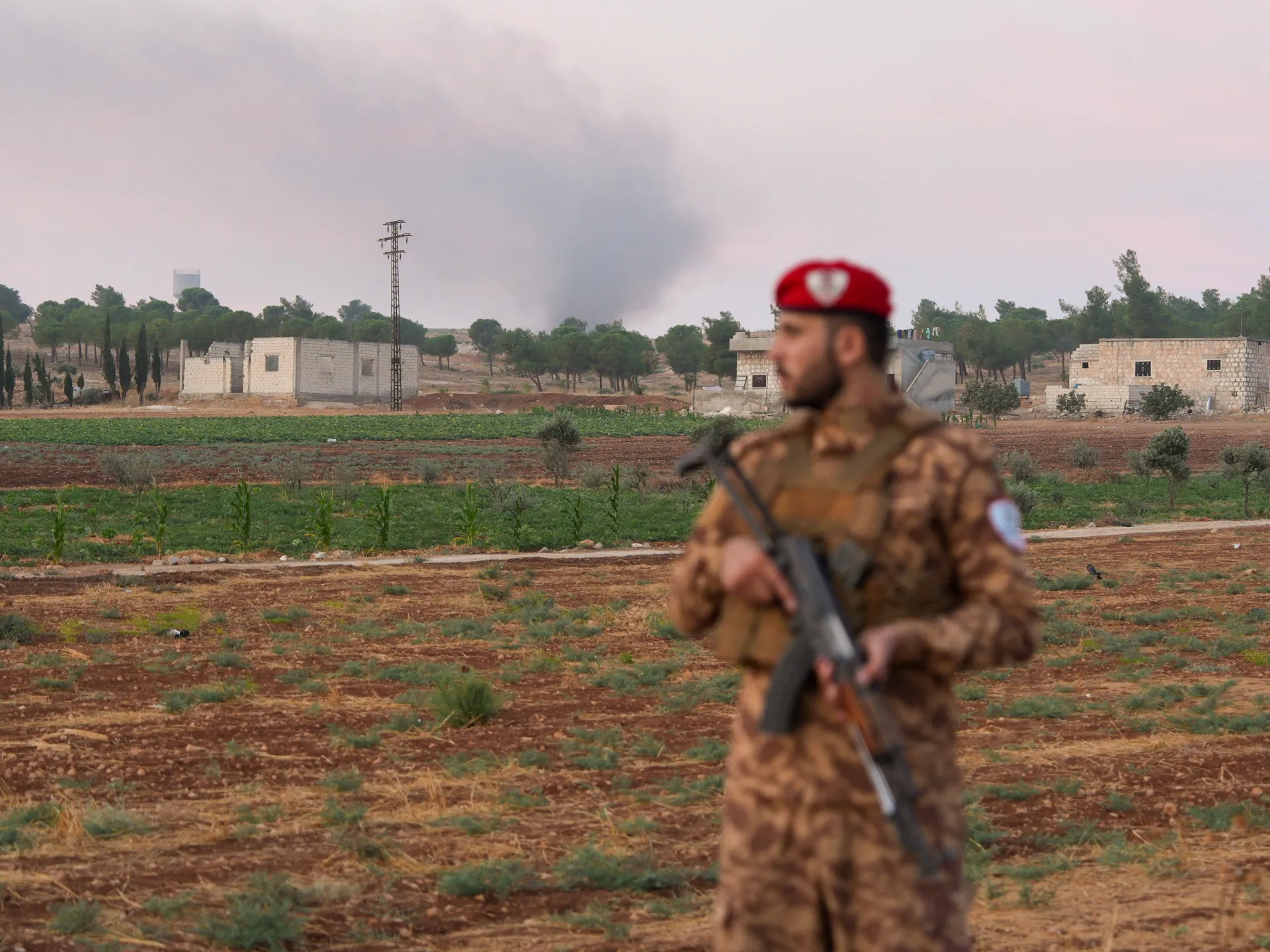


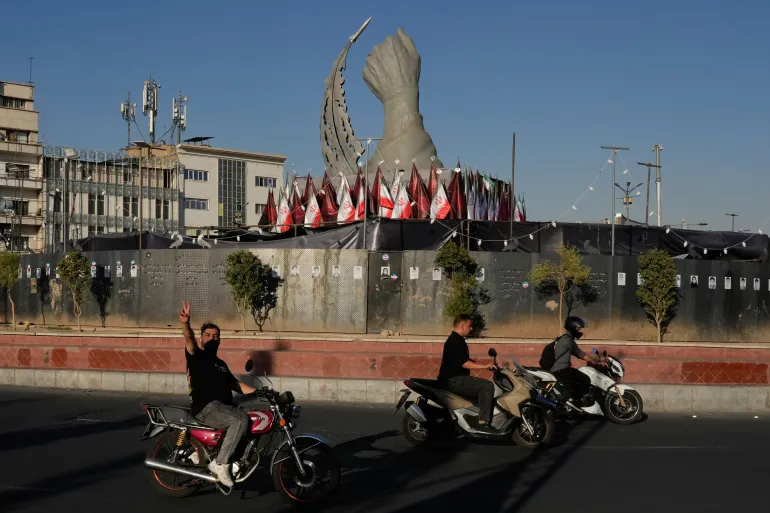

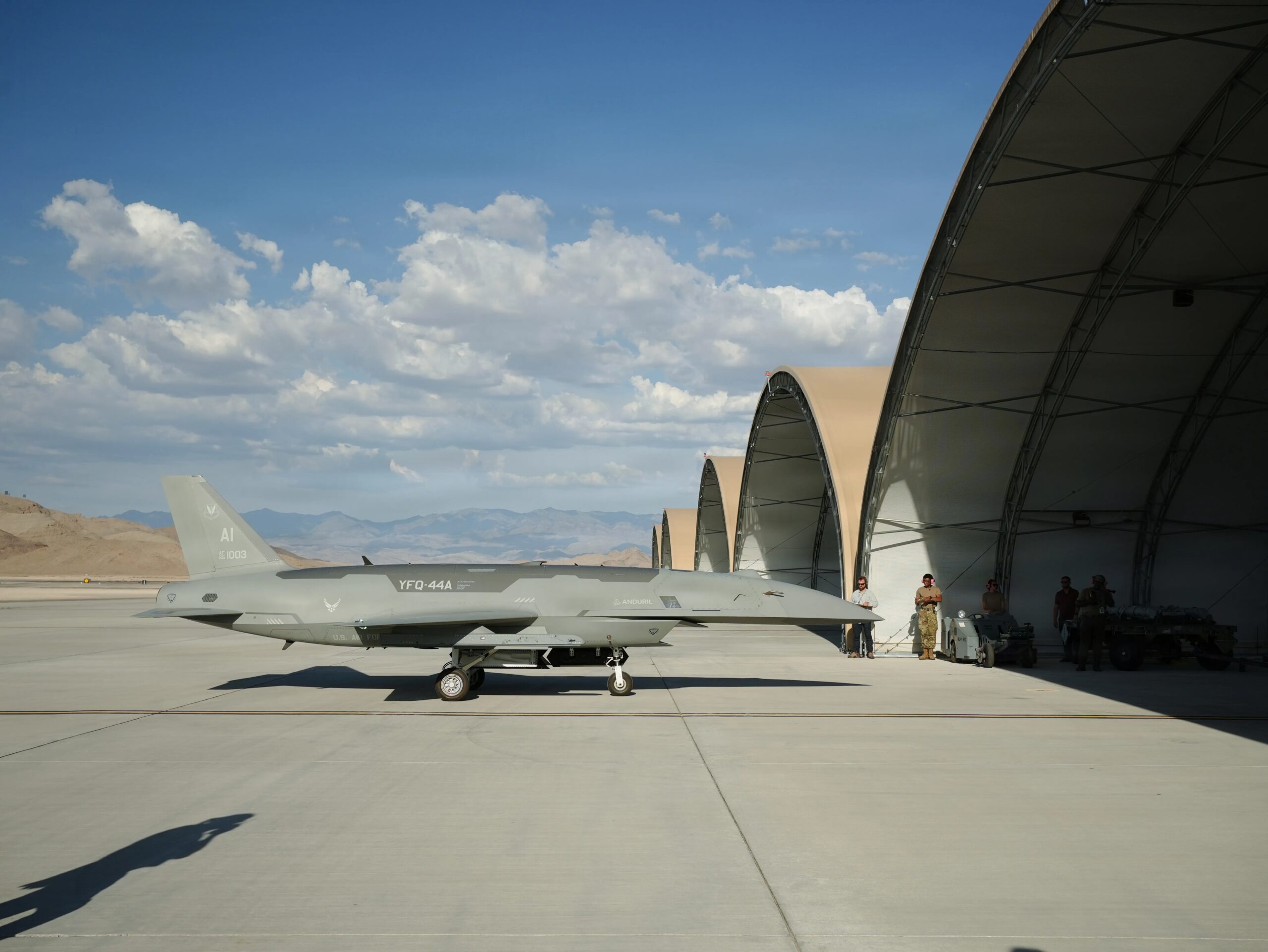





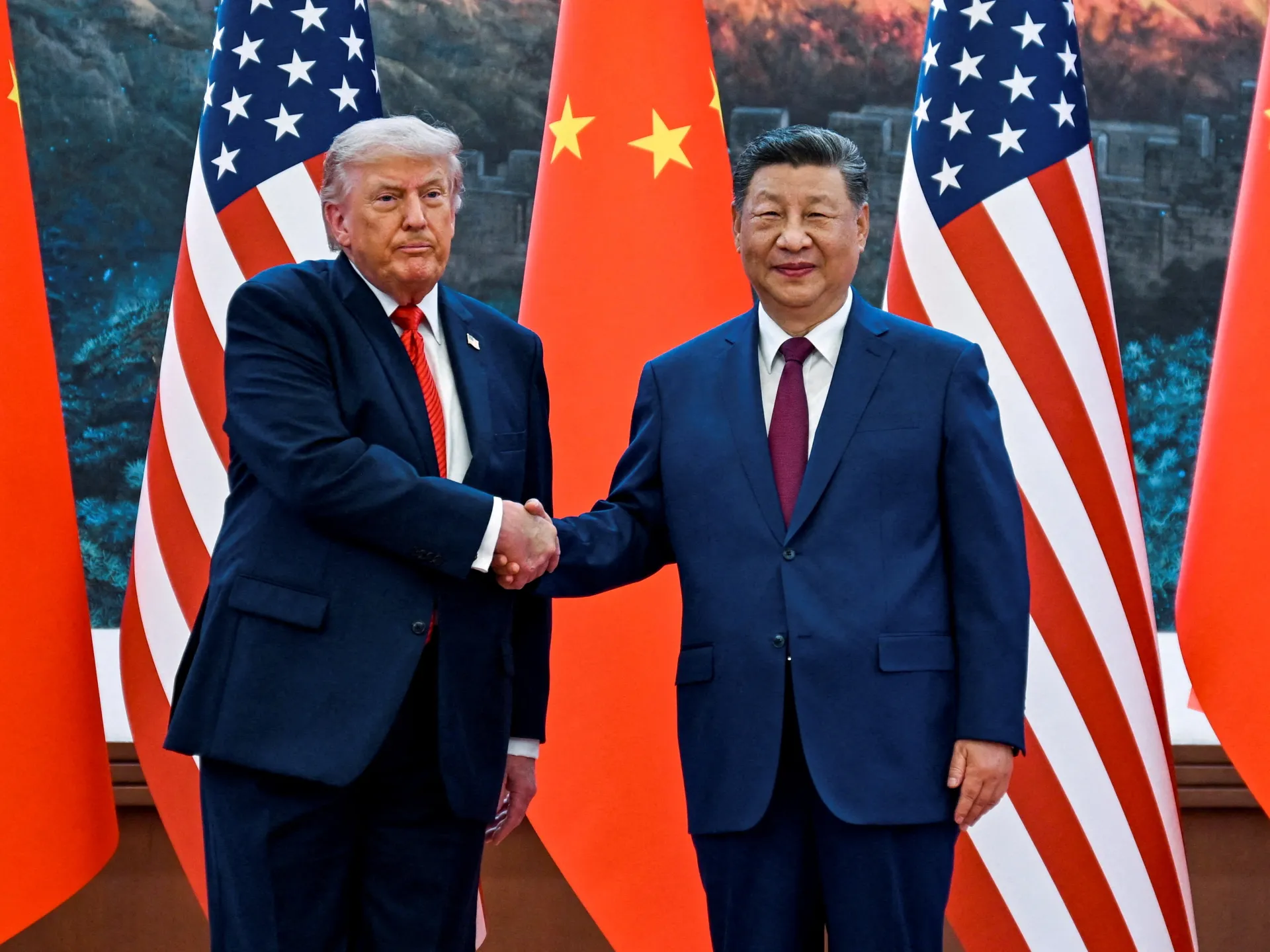



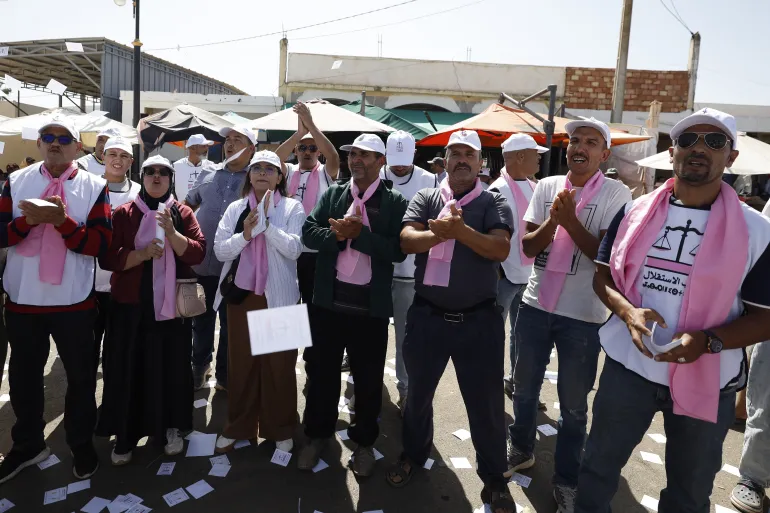
![Campaigners and supporters of the Istiqlal Party (PI) chant slogans during a rally at the weekly souk in the rural commune of Ait Ikkou, in the Khemisset region, on September 19, 2026, before Morocco’s legislative elections [AFP]](https://i0.wp.com/occasionaldigest.com/wp-content/uploads/2026/09/afp_6ab11af2690d-1789991666.jpg?w=640&ssl=1)
![Campaigners for the Popular Movement (MP) hand out leaflets to merchants at the weekly souk in the rural commune of Ait Ikkou, in the Khemisset region, on September 19, 2026, before Morocco’s legislative elections [AFP]](https://i0.wp.com/occasionaldigest.com/wp-content/uploads/2026/09/afp_6ab11b21c12e-1789991713.jpg?w=640&ssl=1)