news

South Korean judge indicted under anti-graft law, prosecutors say

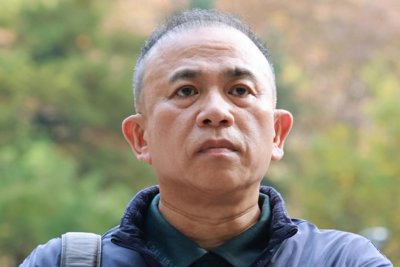
Self-proclaimed power broker Myung Tae-kyun speaks to the press upon arriving at the Seoul Central District Court in South Korea, 07 November 2025. He is attending a hearing as a witness in an election-meddling case involving Kim Keon Hee, the wife of former President Yoon Suk Yeol. File. Photo by YONHAP / EPA

Feb. 7 (Asia Today) — A presiding judge at the Changwon District Court has been summarily indicted on suspicion of violating South Korea’s anti-graft law, prosecutors said Friday, days after he issued acquittals in a high-profile political funding case.

Legal sources said the Seoul Central District Prosecutors Office filed a summary indictment against Judge Kim In-taek on Wednesday for alleged violations of the Improper Solicitation and Graft Act.

Kim is accused of receiving luxury clothing worth several million won (several thousand dollars) last year from a duty-free shop employee identified only as a team leader surnamed A at HDC Shilla Duty Free. Prosecutors are also examining allegations that the employee covered expenses for an overseas trip taken with Kim.

Under the anti-graft law, public officials including judges who receive valuables exceeding 1 million won (about $681) in a single instance can face up to three years in prison or a fine of up to 30 million won (about $20,438).

On Thursday, Kim acquitted political broker Myung Tae-gyun and former People Power Party lawmaker Kim Young-sun of charges related to alleged political funding violations, ruling that money exchanged between them did not constitute political funds, according to the report. In the same case, the court convicted Myung of inducing the concealment of evidence and sentenced him to six months in prison, suspended for one year.

Kim is scheduled to transfer to the Suwon District Court on Feb. 23 under the judiciary’s regular personnel rotation.

— Reported by Asia Today; translated by UPI

© Asia Today. Unauthorized reproduction or redistribution prohibited.

Original Korean report: https://www.asiatoday.co.kr/kn/view.php?key=20260207010002588

Source link

How has Israel’s genocidal war on Gaza shaped the Middle East? | Gaza

Al Jazeera Forum discusses the regional impact of Israel’s genocidal war against the Palestinian people in Gaza.

Four months into the Gaza “ceasefire”, Palestinians in the devastated territory are coming to terms with the post-war situation.

At this year’s edition of the Al Jazeera Forum in Doha, delegates are focusing on the power shifts created by Israel’s genocide.

A new committee of technocrats is expected to be in charge of Gaza’s governance.

The committee is to be overseen by the newly formed Board of Peace, headed by US President Donald Trump.

What are its chances of success?

Presenter: Sami Zeidan

Guests:
Mustafa Barghouti – general secretary of the Palestinian National Initiative

Abdullah Al Shayji – professor of international relations and political science at Kuwait University

Ziad Majed – professor of Middle Eastern studies at The American University of Paris

Source link

Thailand’s conservative royalist party wins elections

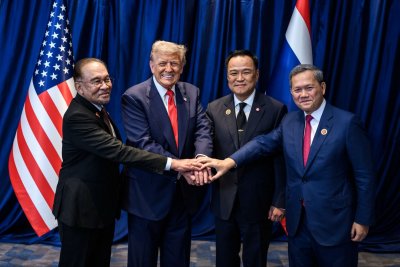
With Malaysia’s Prime Minister Anwar Ibrahim by his side, U.S. President Donald Trump oversees the signing of a ceasefire agreement between Thailand’s Prime Minister Anutin Charnvirakul and Cambodia’s Prime Minister Hun Manet on the sidelines of the 47th Association of Southeast Asian Nations summit in October. Photo Courtesy of The White House | License Photo

Feb. 8 (UPI) — Thailand’s conservative-royalist party won the election Sunday.

The Bhumjaithai party secured 194 House of Representatives spots after 89 percent of the votes had been tallied, The New York Times reported.

“We will accept the decision of the people in giving us the confidence, the trust to the Bhumjaithai party,” said Anutin Charnvirakul, who helms the party, per the outlet.

Charnvirakul had vowed to construct a border wall following a battle with Cambodia over the boundary between countries.

Bhumjaithai has committed to uphold the monarchy status quo.

The more progressive People’s Party earned some 116 seats, while the Pheu Thai party gained 86 spots.

“People’s priorities have shifted from reform to the need for stability,” ISEAS-Yusof Ishak Institute fellow Tita Sanglee told The New York Times.

Source link