The United States stock market has hit an all-time high as excitement around artificial intelligence continues to fuel a buying frenzy on Wall Street.
The S&P 500, the benchmark stock index, closed 0.58 percent higher on Tuesday, topping the previous peak reached in mid-August.
Recommended Stories
list of 4 itemsend of list
The Nasdaq Composite, which is more heavily weighted towards tech stocks, also hit a record high, finishing up 0.45 percent.
Tech stocks were among the top performers, with each of the “Magnificent Seven” apart from Meta closing higher.
Amazon led the pack with a 1.95 percent gain, followed by Microsoft and Tesla, which rose 0.78 percent and 0.51 percent, respectively.
Apple and Alphabet both rose 0.22 percent, while Nvidia gained 0.14 percent.
Meta, which has risen more than 20 percent since the launch last month of its new AI assistant, Muse, fell 0.41 percent.
Other big movers in tech included Marvell Technology, which rose 5.81 percent, and Cisco, which gained 4.54 percent.
Technology, AI
Keith Lerner, chief investment officer and chief market strategist at Truist Advisory Services in Atlanta, Georgia, said the market rally should be seen as a “technology and AI surge”.
“Every bull market has a dominant theme, and technology and AI remain this market’s dominant theme,” Lerner told Al Jazeera.
“Technology and communication services were the only two S&P 500 sectors to rise last month, while the other nine declined.”
Wall Street has shrugged off a host of challenges facing the US economy amid hyperscalers’ multibillion-dollar investments in AI.
Despite the energy crunch caused by the US-Israeli war on Iran and a sell-off of US government bonds partly driven by ballooning government debt, the market is well on track to record its fourth consecutive year of double-digit returns.
The S&P 500 has risen 14 percent so far in 2026, while the Nasdaq Composite is up 18.78 percent.
Lerner at Truist Advisory said the market rally had the potential to continue through the end of 2026 given historical trends and expectations for strong corporate earnings.
“We do not expect a straight line higher for markets,” Lerner said.
“Still, the fourth quarter of midterm-election years has produced an average gain of 7 percent and has been positive 84 percent of the time since 1950.”
Lerner said that rising interest rates posed the biggest risk to the upward trend.
“Still, on balance, the weight of the evidence suggests this bull market still has more upside potential,” he said.
Asian stock markets fell on Wednesday, with key indexes in Japan, South Korea and Hong Kong slumping in morning trading.
The Nikkei 225 in Tokyo, Kospi in Seoul and Hang Seng Index in Hong Kong were down 0.79 percent, 1.36 percent and 0.71 percent, respectively, as of 02:30 GMT.
Oil prices, which have been elevated since the start of the war on Iran, rose on Wednesday as traders weighed the fallout of fighting between forces aligned with Yemen’s internationally recognised government and the Iran-aligned Houthis.
Brent crude futures for December delivery stood at $101.45 a barrel as of 02:30 GMT, up 0.87 percent.
Two years ago, Jaguar Land Rover (JLR) relaunched Jaguar into a blizzard of controversy. Its bizarre teaser ad was described as “woke” and its “Barbie pink” concept car was ridiculed.
Now, the first of its new models has appeared in public for the first time. The all-electric Type 01, unveiled in New York, represents a radical new direction for the classic brand.
The car itself is an imposing four-door “Grand Tourer”, with a long bonnet that deliberately harks back to Jaguar’s emblematic 1960s E-Type.
But it marks a gamble for JLR, which has invested billions reinventing Jaguar and is facing mixed reactions over the new car’s design and the brand’s all-electric strategy.
The new model’s electric motors are potent, producing about 1000 horsepower and allowing it to accelerate from 0-62mph in 3.2 seconds. JLR says it has a range, at “sustained highway speed”, of up to 320 miles.
The company describes it as the “most technically advanced, powerful and aerodynamic Jaguar ever engineered”.
However, it comes at a hefty price tag, with a minimum cost of £130,000 ($172,426). In the US, the Type 01 has a starting price of $130,500.
Under normal circumstances, the launch of a car like this might generate few headlines. But in this case the attention has been much greater, and for good reason.
Three years after the October 7 attacks, the politics of Israeli society has shifted further right, sidelining voices calling for a political settlement with Palestinians. But as Al Jazeera’s Nour Odeh explains, the shift began years before October 7.
Members of the Republican Party have joined Democrats in questioning remarks made by United States President Donald Trump about the California cities of Los Angeles and San Diego.
Much of the backlash came on Tuesday, a day after Trump told a midterm rally in Nebraska that Americans should be willing to make sacrifices to gain victory in the US-Israeli war against Iran.
Recommended Stories
list of 3 itemsend of list
Those sacrifices, he implied, could include the destruction of American cities, in case of an Iranian attack.
“It’s a small price to pay for keeping the world safe, keeping our country safe,” Trump said, seemingly in reference to the knock-on effects of the war, including rising fuel and fertiliser prices.
“They can take out a city. Let them take out Los Angeles. Let them take out San Diego. This is a very small price to pay, and it’s going to be over with very soon.”
Trump has downplayed the impact of the war – now in its eighth month – despite polling that shows the conflict is widely unpopular in the US. He has also repeatedly promised the war would end soon, though no lasting ceasefire has been reached so far.
The fallout from his Nebraska remarks was swift. Gavin Newsom, an outspoken critic of Trump and the Democratic governor of California, said the president was “deranged”.
“This is not only madness. This is dangerous,” Newsom said in a video on the social media platform X, in which he called for Congress to rein in Trump’s behaviour.
Newsom, a possible contender in the 2028 presidential race, has clashed repeatedly with Trump.
Last year, the two faced off over Trump’s decision to deploy federal troops to California, as part of an effort to support a crackdown on undocumented immigration in the Los Angeles area.
In December, a federal judge ruled that the deployment had been illegal and ordered its end. Newsom, who opposed the deployment, cited that conflict in his remarks about Trump’s Nebraska rally.
“The president of the United States – the same one who sent in the National Guard into Los Angeles, sent 700 active duty Marines to the second largest city in the United States of America – just invited Iran to take out Los Angeles and San Diego,” Newsom said.
He added that Trump’s remarks should convince those who “didn’t think the November election mattered” to vote in the upcoming midterms.
Some from Trump’s own party have also expressed shock at his remarks.
Jim Desmond, a Republican running in a competitive race for the House of Representatives near San Diego, was among those who distanced themselves from Trump’s statement.
“I vehemently disagree with President Trump’s comments. America must stand up to Iran and defend our interests, but the first responsibility of our Commander in Chief is to protect the American people and our homeland,” Desmond wrote on X.
“No American city is expendable, and no American family should ever be treated as collateral damage.”
US Representative Kevin Kiley, an independent who caucuses with Republicans and is running for re-election in northern California, also called Trump’s comments “unhelpful”.
But the White House has dismissed criticism of the remarks, calling it part of a “media freakout” that “is not rooted in reality”.
“He was clearly stating U.S. cities would have been threatened if a nuclear Iran hadn’t been stopped,” White House Director of Communications Steven Cheung wrote on social media.
“America is safer because of the President. Iran has no nuclear, no navy, no air force, and no money.”
California has the largest population and economy of any state in the US. Because of its population, it also has the most seats in the House of Representatives, at 52.
All 435 seats in the House of Representatives are up for grabs in November’s midterms, along with a third of the Senate. Also on the ballot are key state and local races.
With Republicans’ control of Congress on the line, the results of the midterms are expected to weigh heavily on the final two years of Trump’s second term.
Editorial decisions at ABC News are being influenced by the Federal Communications Commission’s early license review of its TV stations, the network’s legal team told a U.S. District Court judge Tuesday.
The Disney-owned network is seeking a restraining order to stop the FCC’s action, which its attorneys said was unprecedented and an attempt by the Trump White House to chill free speech.
Disney attorney Beth Wilkinson said the FCC’s action is having an impact on ABC News coverage in the weeks leading up to the midterm elections, as the network tries to avoid further action from the agency that regulates over-the-air broadcast TV licenses.
“We are making different editorial decisions,” Wilkinson said during the court hearing in Washington. “We are watching everything that we do because every time we do something — even not broadcasting this presidential speech — brings out the anger in the administration and the retaliation from the agency.”
Wilkinson was referring to President Trump’s frustration over ABC’s decision not to air his July 16 speech about voter fraud. The network chose to run it on its news streaming platform. FCC Chairman Brendan Carr criticized the move and said it would be considered in the license renewal process.
Wilkinson cited Carr’s complaint as an example of how the review is being driven by Trump’s unhappiness over the network’s coverage across its news programs, its late-night show “Jimmy Kimmel Live” and its topical daytime chat show “The View.” The FCC’s action, she said, is the administration “retaliating with their government power against ABC’s right to protected speech.”
Assistant U.S. Atty. Dimitar P. Georgiev argued for the FCC that ABC is trying to avoid the commission’s regulatory process by taking the case to the U.S. District Court. Georgiev said the license renewal was initiated because of a dispute over documents in the commission’s investigation into alleged discriminatory hiring practices at Disney.
Judge Loren L. AliKhan did not issue a ruling. She asked the FCC to provide further documentation on its claim. Disney will have until Oct. 14 to respond.
Trump has frequently threatened to have TV station licenses pulled when he believes he is treated unfairly on news and talk programs. He has also successfully extracted multimillion-dollar settlements from CBS and ABC after suing the networks over news content he said had treated him unfairly.
ABC is the first network to take the FCC to court over the threats.
Wilkinson noted that Carr said during a visit to Trump’s Mar-a-Lago Club in Palm Beach, Fla., that “broadcasters that are running hoaxes and news distortions, also known as fake news, have a chance now to correct course before their license renewals come up.”
The licenses for eight ABC-owned TV stations, including KABC in Los Angeles, were originally scheduled for renewal between 2028 and 2031.
Carr has said ABC’s daily talk show “The View” should not be exempt from the FCC’s equal time rule that requires broadcasters to bring on opposing candidates to provide balanced coverage. Wilkinson noted that the program — which was given the exemption in 2002 — has avoided using clips of politicians during its popular “Hot Topics” segment at the top of the program.
Carr also said earlier this year that stations could be subject to discipline if they “don’t operate in the public interest” after criticisms from the White House about coverage of the Iran war.
Carr called for the ABC license review in April, days after Kimmel delivered gags about the White House Correspondents’ Assn. dinner attended by Trump for the first time as president and described First Lady Melania Trump as having a “glow like an expectant widow.”
The satirical remarks drew criticism after a man later breached security at the Washington Hilton event while armed with a shotgun, handgun and several knives. The dinner was cut short and rescheduled.
At least 10 civilians were killed in West Kordofan and 5,500 displaced in Blue Nile as clashes widened on Tuesday.
Published On 7 Oct 20267 Oct 2026
Sudan’s military chief, Abdel Fattah al-Burhan, has promised to seize “every inch” of territory under the control of the paramilitary Rapid Support Forces (RSF), rejecting negotiations to end three and a half years of war.
Al-Burhan made the comments on Tuesday while addressing a gathering in Village 5, located in the northern Sudanese locality of Merowe, according to the Sudan News Agency.
Recommended Stories
list of 2 itemsend of list
He said the “military option” would continue until the RSF was removed from Sudan.
The Sudanese army and the RSF have been fighting since April 2023 after leaders of the groups fell out over plans to integrate the paramilitary force into Sudan’s army. The conflict has killed tens of thousands of people and displaced around 13 million, according to UN and international estimates.
Al-Burhan’s pledge to continue fighting came as 10 civilians were killed and several others were wounded in an attack by the RSF in Sudan’s West Kordofan state, according to a local charity group.
Women gather for a meal in al-Rahmaniyah camp for displaced people, near the city of el-Obeid in Sudan’s North Kordofan state, on July 7, 2026 [File: AFP]
In a statement, the Dar Hamar Emergency Committee accused the RSF of multiple violations against civilians in Abu Ajal village in the southeastern countryside of En Nahud.
The RSF has been massing in West Kordofan as Sudan’s army advances towards the cities of En Nahud and Al Khuway after gains in neighbouring North Kordofan.
In Sudan’s Blue Nile state, more than 5,500 people were displaced from villages over three days amid deteriorating security, the International Organization for Migration (IOM) said on Tuesday.
Meanwhile, an envoy of US President Donald Trump said Sudanese parties must take the lead in talks to end the war.
In a post on X on Monday, Massad Boulos, the US senior adviser for Arab and African affairs, said peace could be achieved “through an inclusive Sudanese-owned and Sudanese-led national dialogue, transition toward a civilian-led government”.
The US State Department said last month that neither the Sudanese Armed Forces, the RSF, nor their respective leaders “represent legitimate, constitutional governance for Sudan”.
The hum of the kidney dialysis machine that Onasis Munoz is connected to suddenly stops. The fluorescent lights overhead flicker out, and his room at a clinic in Valencia, Venezuela, is plunged into darkness.
It is not the first time a power cut has interrupted one of the three weekly sessions Munoz needs to do the work his failing kidneys can no longer do, filtering waste and excess fluid from his blood.
For years, electricity would go out every couple of days across parts of Venezuela’s Carabobo state.
But in recent months, Munoz said, the outages have grown to be daily, lasting around seven hours. The clinic’s emergency batteries have since been depleted, and its backup generator no longer works.
He explained that the frequent power failures have disrupted his treatment. His health has slumped as a result.
“I arrive home, exhausted, as if I had run a marathon,” the 34-year-old said.
But often there is no electricity there either, and recent weeks have been sweltering. “I can’t switch on the air conditioning. I cannot rest because of the heat and the mosquitoes. There’s no relief,” Munoz said.
Onasis Munoz of Valencia, Venezuela, has seen his dialysis treatment interrupted by power outages [Courtesy of Onasis Munoz]
Across Venezuela, the prolonged outages are riling locals, as the electricity supply to homes, businesses and essential services becomes unstable.
Some of the cuts are deliberate, as the government of interim President Delcy Rodriguez rations electricity.
The resulting frustration has spilled onto the streets, where demonstrators hold “cacerolazos” – a traditional form of protest that involves banging pots and pans.
Some have gone as far as blocking roadways and setting tyres on fire. The electricity crisis has also raised concerns about how the government is managing the country’s vast oil supply, a key source of income for the country.
“We are desperate. We cannot understand how a country so rich in resources can be practically left in the dark,” said Patricia Cueva, a lawyer from Maracaibo, the capital of oil-rich Zulia state.
“We cannot rest. We cannot work. Our children cry.”
Saudi Arabia’s Jazan and Najran airports were attacked as Saudi-led gov’t forces launched air strikes on Houthi sites in Yemen and claimed control of the Bab al-Mandeb strait. Houthi officials say the Iran-backed group maintains ‘firm control’ over recently captured territory.
Letter from progressive US representatives brings attention to Israeli abuse and detention of Palestinian medical workers.
Published On 6 Oct 20266 Oct 2026
A group of six progressive Congress members in the United States have released a statement condemning Israel’s abuse of Palestinian healthcare workers, including the Gaza doctor Hussam Abu Safia, who has been held in Israeli detention since 2024.
The Tuesday statement draws attention to Israeli attacks on Palestinian medical workers, who have been targeted and detained during the country’s genocidal war on Gaza.
Recommended Stories
list of 3 itemsend of list
It was signed by Representatives Rashida Tlaib, Ilhan Omar, Jesus “Chuy” Garcia, Summer Lee, Pramila Jayapal and Delia Ramirez.
“Over the last three years, the Israeli government has systematically destroyed the health system in Palestine, murdering at least 1,700 Palestinian doctors, nurses, paramedics, and other healthcare workers and destroying dozens of hospitals,” the statement reads.
“It has arrested and arbitrarily detained hundreds of Palestinian healthcare workers, including at least 16 physicians who continue to be held in inhumane conditions.”
Among those detained is Abu Safia, who lawyers say was subjected to abuses such as torture, sleep deprivation and beatings during his detention.
Israeli soldiers arrested Abu Safia in December 2024, after he and other medical workers reportedly refused to evacuate from Kamal Adwan Hospital, where they worked.
No charges have been filed against Abu Safia, and he has not had a trial.
Israeli attacks on health infrastructure in Gaza, including the destruction of nearly all of the strip’s hospitals and medical centres, are one component of what rights groups have depicted as an effort to deprive Palestinians of essential services such as food, water and medical treatment.
Tuesday’s statement argues that such efforts are part of an “intentional policy designed to further occupation, apartheid, and genocide against the Palestinian people”.
That assessment is shared by a growing number of rights organisations, scholars and United Nations officials, who have denounced Israeli actions in the Palestinian strip.
Israeli officials have stated that they target hospitals and medical facilities as part of an effort to attack the Palestinian armed groups that allegedly use such facilities to carry out and coordinate operations.
Such claims have often failed to withstand scrutiny. Israel admitted that its soldiers killed a group of 15 emergency workers in southern Gaza in March 2025, after initially stating that the ambulance convoy had approached soldiers “suspiciously” and claiming, without evidence, that several of those killed were linked to Hamas.
A report by the group Forensic Architecture and Earshot found that Israeli soldiers fired more than 900 bullets as they opened fire on a clearly marked ambulance convoy and killed some of the medics “execution-style” before burying their bodies and their vehicles.
Space used to be an exclusive club dominated by a few key players. But at the 2026 International Astronautical Congress in Turkiye, emerging nations are pushing for more inclusivity.
Spain’s Constitutional Court ruled an amnesty law for Catalan separatists applied to the politician.
Published On 6 Oct 20266 Oct 2026
Self-exiled Catalan separatist leader Carles Puigdemont could be set to return to Spain after the country’s Constitutional Court ruled that an amnesty law for Catalan separatists applies to embezzlement charges against Puigdemont.
A Supreme Court judge then lifted a warrant for Puigdemont’s arrest on Tuesday, clearing the way for his return without fear of arrest.
Recommended Stories
list of 3 itemsend of list
Puigdemont, then president of Catalonia, fled to Belgium in 2017 after holding an independence referendum for his self-governing region to break away from Spain. Madrid said the vote was illegal.
Catalonia unilaterally declared independence from Spain that year after the referendum, with 90 percent of voters backing independence.
He has since avoided several extradition attempts by Spain to face trial over the vote, while many of his confidants and supporters spent time in prison.
Members of Puigdemont’s political party Junts welcomed his potential return.
“It’s a great victory for President Puigdemont and the two other exiled [leaders in Belgium]”, Jordi Turull, secretary-general of Junts, told reporters.
“They held firm, they resisted, they prevailed in Europe, and today they have prevailed against the Spanish state.”
Junts’ role in Spain’s snap election
Puigdemont appears set to return to Spain just as the country is preparing for a snap election in November, although an official from his Junts party said he is unlikely to take part.
Prime Minister Pedro Sanchez was only able to remain in power in 2023 when Puigdemont’s Junts party, along with another Catalan party, backed his new government in exchange for the amnesties.
A year ago, Junts withdrew its support for the minority central government, and the party was decisive in Spain’s progressive government losing two key votes in parliament this week when it tried to push through emergency housing measures amid street protests.
Sanchez responded by calling a November snap election, hoping anger over housing will mobilise his voters.
The prime minister told reporters on Tuesday he did not regret launching the amnesty and welcomed the court ruling.
“I believe the important message is that of coexistence among Catalans,” he said.
Although separatism has lost ground and Junts is trailing in opinion polls, Puigdemont’s return could prompt renewed political drama.
Spain’s conservative People’s Party is leading in opinion polls ahead of the election and may need to seek the support of Junts and other centre-right parties to govern.
Maduro and Flores were kidnapped by US forces on January 3, 2026. (AFP)
Caracas, October 6, 2026 (venezuelanalysis.com) – The US Justice Department has urged New York District Judge Alvin Hellerstein to reject Venezuelan President Nicolás Maduro and First Lady Cilia Flores’ sovereign immunity claims amid their ongoing legal case.
In a court filing submitted on October 2, prosecutors told the court that Maduro and Flores’ motions to dismiss their indictments “should be denied.”
The Venezuelan president and first lady, who is also a legislator, were kidnapped in Caracas by US forces on January 3. They were charged with drug trafficking conspiracy and weapons possession, with Maduro additionally facing a “narco-terrorism” accusation.
The pair’s defense teams filed motions to dismiss the case in September, arguing that their respective positions in the Venezuelan government should make them immune to criminal prosecution in a third country.
In response, the Justice Department stated that the recognition of a foreign head of state is the exclusive competency of the executive branch, and that Washington has not recognized Maduro since 2019. Historically, US courts have deferred to the White House and State Department on foreign policy matters.
However, in the ongoing case, Justice Department officials sought to bolster their argument by stating that the Venezuelan government, led by Acting President Delcy Rodríguez, has declined to invoke immunity for Maduro and Flores.
“If Venezuela wished to assert its view that the defendants were entitled to immunity in this, it could have,“ the submitted document read. “The defendants’ attempt to claim the contrary is an admission that such silence is devastating to their claims.”
The prosecutors pointed to an ongoing civil lawsuit in Florida against Maduro, Rodríguez, and other defendants, where the Venezuelan government, through its US embassy, requested that the Trump administration communicate to the respective court that the acting president should “enjoy absolute immunity from judicial proceedings in foreign domestic courts.”
The State Department sent a letter in June calling on the Florida district court to “promptly dismiss the proceedings.” The White House likewise communicated to the court that all claims against Rodríguez should be “dismissed without prejudice.”
In August 2025, three US nationals who were imprisoned in Venezuela sued Maduro, Rodríguez, and several other current and former state officials. The plaintiffs claimed to have suffered “torture” and to have been used in “hostage diplomacy.” The judge issued a default ruling after Maduro and other defendants failed to show and awarded $314 million in damages to the plaintiffs.
“Venezuela did not request immunity in this case, despite every opportunity to do so. Indeed, there is no doubt that the current Venezuelan government knows how to request immunity,” the Justice Department’s recent filing continued.
Prosecutors went on to claim that the Trump administration’s foreign policy views, coupled with the Venezuelan government not explicitly invoking immunity, should outweigh the defense’s assertion that the United Nations recognized Maduro’s presidency.
Hellerstein is scheduled to hear oral arguments on the pre-trial motions to dismiss on November 17 before issuing a ruling. If the trial goes forward, it will begin on June 1, 2027.
Caracas has not commented on the latest developments in Maduro and Flores’ legal case. In recent months, Venezuelan officials have occasionally expressed hope that the two will eventually return to the country but without demanding their immediate release.
Rodríguez made no mention of Maduro and Flores’ kidnapping and prosecution during her recent trip to New York for the 81st session of the UN General Assembly. In a July interview, she claimed that Maduro has the right to “demonstrate the truth” before the US Justice system but did not call for his liberation.
The Venezuelan government is covering the pair’s legal defense costs after the US Treasury Department lifted restrictions blocking it.
In his UN speech on September 22, Trump celebrated the military operation that led to the abduction of Maduro, whom he called an “outlaw dictator.” Trump and Rodríguez met on the sidelines of the UN General Assembly, with the Venezuelan leader thanking the US president for supporting “Venezuela’s reinsertion into multilateral spaces.”
Kosovo faces the risk of turmoil as protests against the convictions of former Kosovo Liberation Army (KLA) leaders coincide with a midnight deadline to elect a president.
Demonstrators have called for changes to the law governing the Hague-based Kosovo Specialist Chambers, including measures affecting prison terms and where convicted people serve their sentences. The protests follow the September 16 convictions of former KLA leaders, including former President Hashim Thaci.
Recommended Stories
list of 4 itemsend of list
The protesters’ demands have become entangled with negotiations over the presidency, raising the prospect of new elections if lawmakers fail to reach an agreement. November 15 has emerged as a likely date for a new vote.
“New elections do not, in themselves, promise anything particularly positive,” political analyst Artan Muhaxhiri told Al Jazeera. “The chances of a radical political change are slim.”
He said that if a president is not elected by midnight, a new vote will take place in a tense political climate.
Anger over the verdicts will become a central campaign issue, he said, “overshadowing fundamental questions of socioeconomic development, and deepening the country’s downward spiral of systemic instability”.
How did Kosovo get here?
In 2015, the Specialist Chambers were established under Kosovo law following international investigations into alleged war crimes committed by KLA members during and after the 1998-99 conflict. Although formally part of Kosovo’s judicial system, the court sits in The Hague. It remains contentious in Kosovo because the KLA is widely revered for having fought against Serbian rule.
In September, protests erupted after the court sentenced Thaci to 25 years in prison.
Later, the opposition Democratic Party of Kosovo (PDK) – formerly led by Thaci – proposed amendments aimed at curbing the tribunal. The plan included capping prison sentences at 15 years, allowing convicts to serve their sentences in Kosovo, enabling appeals before Kosovo’s Supreme Court, granting presidential pardons and narrowing the court’s temporal jurisdiction.
On October 2, 2026, Prime Minister Albi Kurti’s government concluded that there were no legal obstacles to the PDK initiative and forwarded its assessment to the parliament, the Assembly of Kosovo. Days later, Kosovo’s parliament approved the initiative at first reading with 91 votes in favour, although it has not been finally adopted.
Meanwhile, Kosovo has been mired in a political impasse after the expiration of President Vjosa Osmani’s term in April, as the National Assembly has been unable to select a new president.
Now, internal power struggles within the PDK following the September sentencing have left the party fragmented, rendering the largest opposition party incapable of negotiating a cross-party presidential compromise, according to Nexhmedin Spahiu, a Pristina-based professor of political science.
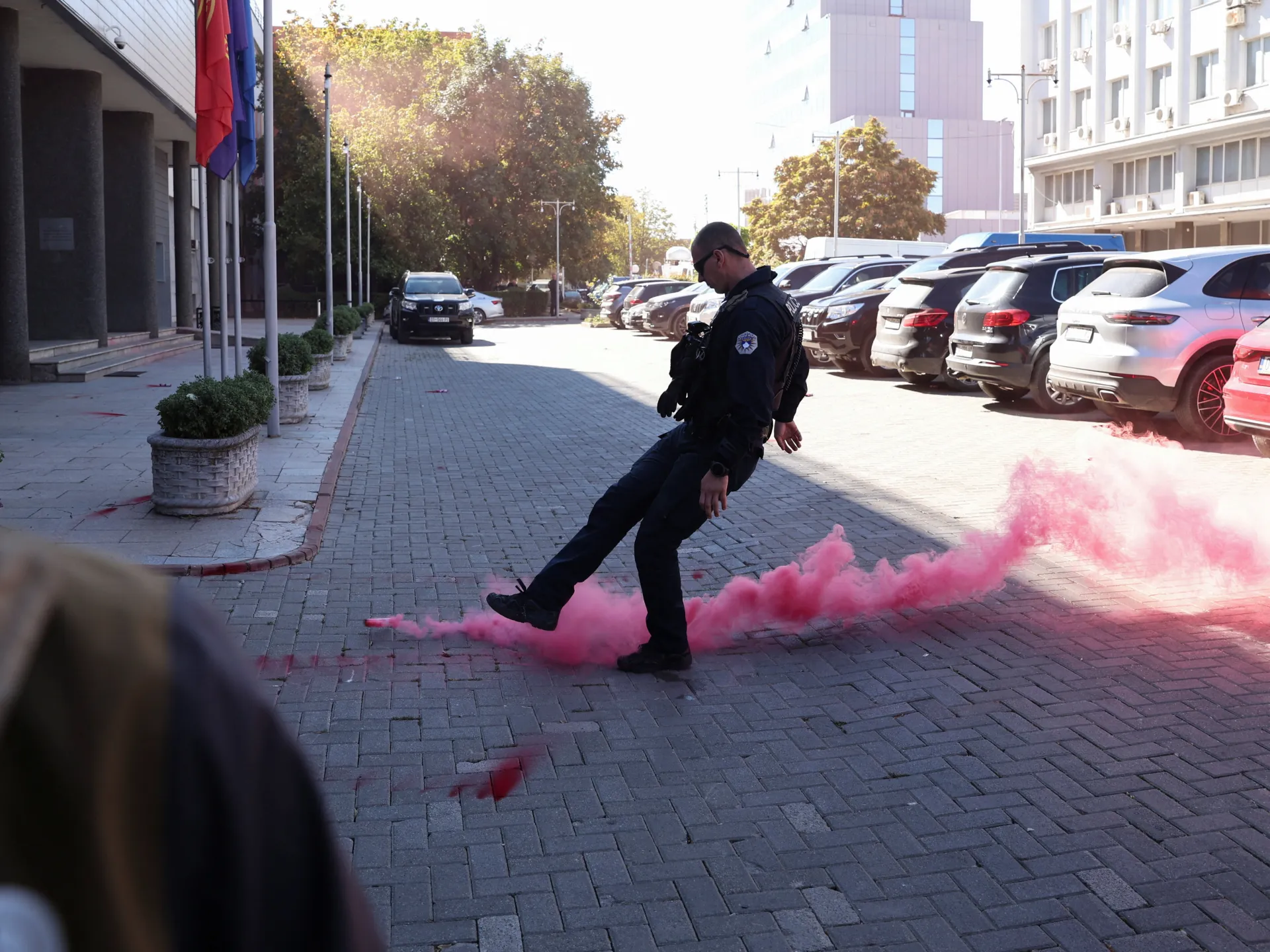
On Monday, as lawmakers failed to secure a quorum to elect a president, police deployed tear gas and water cannon outside the Assembly, following confrontations involving fireworks and bottles. The use of force prompted criticism from observers.
Tensions rise
Pristina-based journalist Gezim Baxhaku believes special police units overstepped their legal authority.
“There was an overuse of force,” Baxhaku told Al Jazeera. He said that while protesters threw firecrackers, police “exceeded their legal powers and acted entirely contrary to the situation on the ground”.
Among the hundreds of protesters were KLA veterans.
Pristina had witnessed nearly three weeks of largely peaceful gatherings before Monday’s escalation.
“Citizens were routinely bringing food, water, and coffee to the officers on duty,” Baxhaku said. “There was absolutely no reason for this to happen. For the first time since the late 2000s, police acted in such an uncalled-for manner – reacting upon orders to escalate a situation.”
Spahiu, the political science professor, said the protests should not be understood as a sign that people in Kosovo broadly reject the verdicts.
“A large majority of citizens in Kosovo are satisfied with the decision of the Specialist Chambers in The Hague,” said Spahiu.
He told Al Jazeera that the court’s rejection of Serbian claims of systematic crimes against humanity by the KLA “validated the liberation struggle”.
“Furthermore, people are relieved that individuals are finally being held accountable for crimes committed against political rivals within the Albanian community itself,” he said.
The political deadlock and Kurti’s ‘transactional’ approach
The Assembly remains deadlocked over the election of a head of state, as the PDK and other opposition parties boycott the voting session, denying the legislature its constitutionally required 80-MP quorum.
Muhaxhiri blamed Kurti for the crisis, criticising his decision to link the presidential vote to the Hague court amendments.
“Tensions escalated further when Kurti presented a plan based on a transactional approach to two fundamentally distinct issues: linking the draft law amending the Law on the Specialist Chambers to the election of the new president,” said Muhaxhiri.
“In effect, this amounted to a quid pro quo. By doing so, he appeared to be placing the historical, national, and identity-related significance of the liberation war on the same political bargaining table as the immediate objective of electing a president who would serve his political interests.”
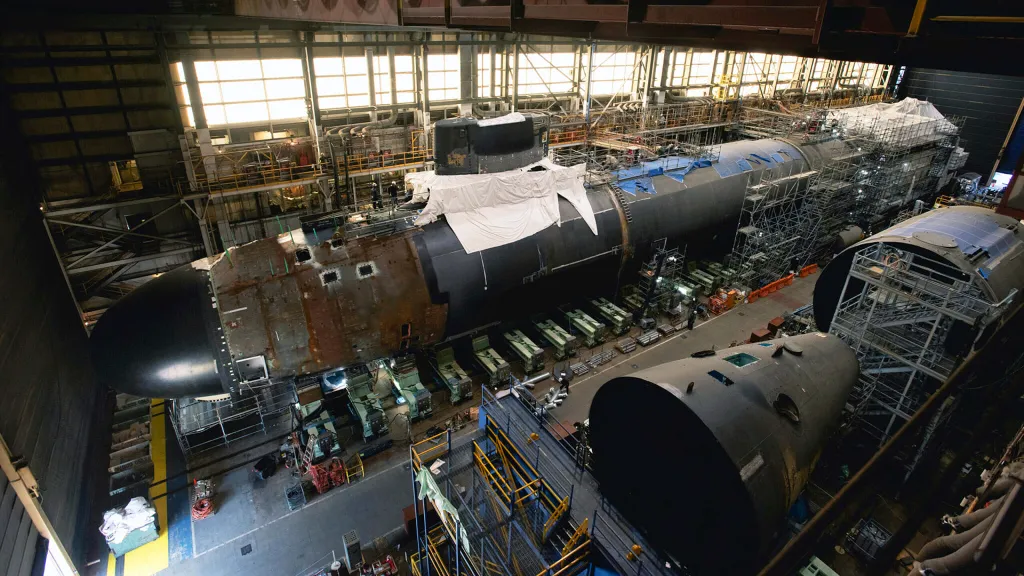
As part of its overall effort to boost America’s flagging shipbuilding capacity, the Trump administration on Tuesday announced that Anduril is building a new two-million-square-foot facility in Baltimore designed to help speed up the production of Virginia class nuclear-powered attack submarines. The plant, dubbed Arsenal-2, will eventually produce components like torpedo tubes and spherical air flasks, which will then be sent to the two shipyards that build nuclear submarines, General Dynamics Electric Boat and Huntington Ingalls Industries’ Newport News Shipbuilding. Anduril’s plan to build complex submarine components is a huge leap for a company with a shipbuilding portfolio consisting of a limited number of smaller craft.
The submarine component plant announcement was made as the Navy is struggling to keep up with its goal of producing two of these boats per year amid a wider issue of construction and delivery delays across the service. However, it will be years before the first Anduril-produced components are placed on a submarine, with no specific timelines for that effort yet established, an industry official told us. We will discuss that in greater detail later in this story.
A Virginia class submarine under construction. (HII) HII
“Today’s $6.6 billion investment represents the president’s commitment to restoring American maritime dominance by constructing new vessels in communities like Baltimore and across the country,” White House spokesperson Anna Kelly told a group of reporters, including from TWZ, at a Tuesday morning press conference.
Those funds include a $3.7 billion investment from Anduril to build and staff the new facility and a contract worth up to $2.9 billion awarded to Anduril by the Navy to produce the components.
“The Virginia class submarine program is one of the most critical warfighting capabilities that our nation has that guarantees deterrence every single day,” Anduril President and Chief Strategy Officer Chris Brose stated. “It is also a program that has been challenged in terms of the ability to meet the Navy’s requirements. So we’re, as a nation, not necessarily where we need to be, and that’s not because of our shipyard workers.”
The Navy currently has 26 Virginia class boats, with two more expected to be commissioned next spring, a senior administration official told reporters on Tuesday. Another 31 vessels are still needed to meet the Navy’s overall plan to have 59 Virginia class boats.
The USS Idaho (SSN 799) pulls into Submarine Base New London in Groton, Conn. for the first time on Monday, Dec. 15, 2025. When commissioned, it became the 26th Virginia class attack submarine and fifth U.S. Navy ship to be named for the Gem State. (U.S. Navy Photo by John Narewski) John Narewski
However, while the Navy has been buying them at a rate of two per year from Fiscal Year 2011 through Fiscal Year 2024, “the actual Virginia class production rate has never reached 2.0 boats per year, and since 2022 has been limited by shipyard and supplier firm workforce and supply chain challenges to about 1.1 to 1.2 boats per year, resulting in a growing backlog of boats procured but not yet built,” according to a Congressional Research Service (CRS) report published in January. “Key drivers of the drop in production include workforce challenges, first-time quality, material and supplier delays, and lead ship issues associated with the Virginia Payload Module [VPM] variant. The Navy is working closely with the shipbuilders to drive improvement throughout the Virginia enterprise.”
A briefing slide with details about the Virginia Payload Module (VPM) that will be added to the Block V Virginia class submarines. USN
Adding to the strain on production and delivery, Australia is set to get one new-build Virginia class boat and two from the U.S. Navy’s fleet under the 2021 trilateral AUKUS nuclear submarine acquisition deal with the United States and the United Kingdom.
In May, Chief of Naval Operations Adm. Daryl Caudle told Congress that the service would meet its two-boat-a-year delivery rate by 2032.
During Tuesday’s press conference, officials laid out claims that the new Anduril plant will address several of the issues that have slowed down the construction and delivery of these submarines.
“If you look at this in terms of capacity, the potential based on the area and what Anduril plans to do is to add about 9 million hours of labor a year at this facility,” stated a senior administration official, who, like others on Tuesday spoke on condition of anonymity. “That would be the equivalent of about a 15% increase, and so that would be directly translatable to Virginia class submarine production. So having those torpedo tubes earlier would let us move production of current Virginia submarines under construction faster.”
Adm. Frank Caldwell, Jr., director of the Naval Nuclear Propulsion Program, examines a torpedo tube aboard the Virginia class fast attack submarine USS Illinois (SSN 786) during Ice Exercise (ICEX) 2022. (U.S. Navy photo by Mass Communication Specialist 1st Class Alfred Coffield/Released) Petty Officer 1st Class Alfred Coffield
In addition, Anduril plans to draw on a huge potential workforce to staff the plant.
“If you basically draw like a one-hour radius around the Baltimore County area, there are millions and millions of people who could potentially contribute and work at this shipyard, and that is a huge selling point for us,” an industry official suggested.
The greater Baltimore area. (Google Earth)
Beyond producing components like torpedo tubes, Anduril aspires to eventually build “full ship sections, bows, sterns, etc.” at Arsenal-2, the industry official added.
Anduril said Arsenal-2 will be “purpose-built” for the “high-volume, high-precision production of undersea naval capabilities.”
“The shipyard’s layout is optimized for production,” the company stated in a media release. “Reduced distances between fabrication, assembly, testing, and integration areas eliminate the staging bottlenecks that slow conventional yards.”
“A functional 1,200-foot graving dock and multimodal road and rail access support large-scale component movement,” Anduril added. “High-bay assembly halls, adjacent fabrication areas, and reconfigurable production lines allow the yard to shift rapidly as Navy requirements evolve.”
ArsenalOS, Anduril’s industrial software platform, “will provide the digital backbone for the yard and its production systems,” the company further pointed out. “It will connect fabrication workflows, outfitting sequences, material movement, inspection protocols, and documentation requirements in a single system, giving workers and managers real-time visibility into the state of production. Digital work instructions, embedded quality controls, modern sensing, and automation will support the expertise of welders, pipefitters, electricians, shipfitters, inspectors, and other skilled trades.”
ArsenalOS™: The Digital Backbone of Modern Defense Manufacturing
Anduril claims the project “will create 3,100 direct jobs and support more than 11,000 indirect jobs. The site will drive $2 billion in annual economic output, including an estimated $312 million in wages each year.”
Before Arsenal-2 is up and running, Anduril said it plans to “manufacture critical Virginia class submarine components at a new 160,000-square-foot facility in Orange County, California, purpose-built to support key submarine construction processes and SUBSAFE-qualified production qualification [efforts].”
The Orange County facility will give Anduril “a two-year operational head start to develop and validate manufacturing methods, production workflows, and quality systems before Arsenal-2 comes online,” the company noted. “It will support prototyping and production of Virginia-class test assets and critical maritime components, including torpedo tubes, while allowing Anduril to recruit and train the early workforce on the systems and standards that will ultimately scale at Arsenal-2. Once Arsenal-2 comes online, the Orange County facility will continue supporting broader maritime manufacturing efforts across Anduril’s industrial network.”
Newly built Virginia-class submarine #Massachusetts launches for the first time #shorts
As we noted earlier in this piece, it will be years before anything produced by Anduril winds up on a sub. In addition to recruiting and training a workforce to build the components and ensuring the production system can meet goals, the parts then have to be tested to ensure they are safe enough to place on boats.
The industry official told TWZ that there is no schedule yet for when that will happen.
“We are starting this work now,” the industry official said. “We’re going to be working quickly. There’s a lot we’re going to have to do to prove the ability to produce the initial components – the torpedo tubes. We’re going to have to work with our partners in industry and partners in government on the certification. So it’s really not possible to put a time stamp on it as much as I’d like to.”
“I think our goal, and I know this is shared by the administration, is to go as fast as possible while keeping the bar of safety as high as it needs to be, and try to get these systems certified so that they go into the production of boats… and solve the critical limiting factor currently in our supply chain, and help our industry partners produce more submarines.”
Arsenal-2 follows the development of Anduril’s Arsenal-1 plant in Ohio, first announced two years ago. That five-million-square-foot facility, once fully up and running, will be able to “produce tens of thousands of autonomous weapons systems addressing the urgent needs of the United States and our allies,” the company said at the time.
Anduril’s Arsenal-1 plant in Ohio. (Anduril)
Arsenal-1, however, remains a work in progress, with more construction work yet to be done. Still, Anduril’s first product from that plant, the U.S. Air Force’s Collaborative Combat Aircraft (CCA) known as the YFQ-44A Fury, rolled off the assembly line there in July. That milestone met the company’s initial production schedule announced in January 2025, according to JobsOhio, the state’s business development arm.
A U.S. Air Force YFQ-44A Fury aircraft, assigned to the Collaborative Combat Aircraft Experimental Operation Unit, takes off for a mission flight during an Agile Combat Employment exercise at Creech Air Force Base, Nevada, July 21, 2026. (U.S. Air Force photo by Staff Sgt. Kristal Munguia) Staff Sgt. Kristal Munguia
Anduril, which also produces systems like the Ghost Shark extra-large autonomous undersea vehicle (in partnership with Australia), the Roadrunner reusable missile-like air vehicle, the Iris family of passive infrared sensors, and a wide range of other items, is playing a growing role in the Trump administration’s weapons development efforts.
Last month, Defense Secretary Pete Hegseth announced that Anduril co-founder Palmer Luckey, who made a name for himself and his fortune in the virtual reality space with Meta, will help lead a new program dubbed Project Meridian. The goal, according to a Pentagon memo, is to “map the trajectory of future warfare, identify critical capability gaps, and propose actionable solutions in furtherance of the identified goals in the 2026 National Security Science and Technology Strategy.”
The Pentagon’s Chief Technology Officer, Emil Michael, has been directed to set up this project. SpaceX founder Elon Musk and Newt Gingrich are other key members.
A screen capture from last month’s livestream of Secretary Hegseth’s speech announcing new plans for autonomous warfare capabilities. From left to right, Palmer Luckey, Newt Gingrich, and Elon Musk. U.S. Military capture
“The inclusion of Musk and Luckey does raise ethical questions, as they both lead companies with major U.S. government contracts already, and which could be in line to see more opportunities based on Project Meridian’s findings. What guardrails might be put in place to prevent conflicts of interest is unclear.”
Regardless of any such concerns, today’s shipyard announcement is a clear indication that the Trump administration and the Pentagon see Anduril as a major player across its weapons manufacturing industrial base. It’s also a reminder of just how challenging it is to actually expand America’s ability to build fighting vessels.
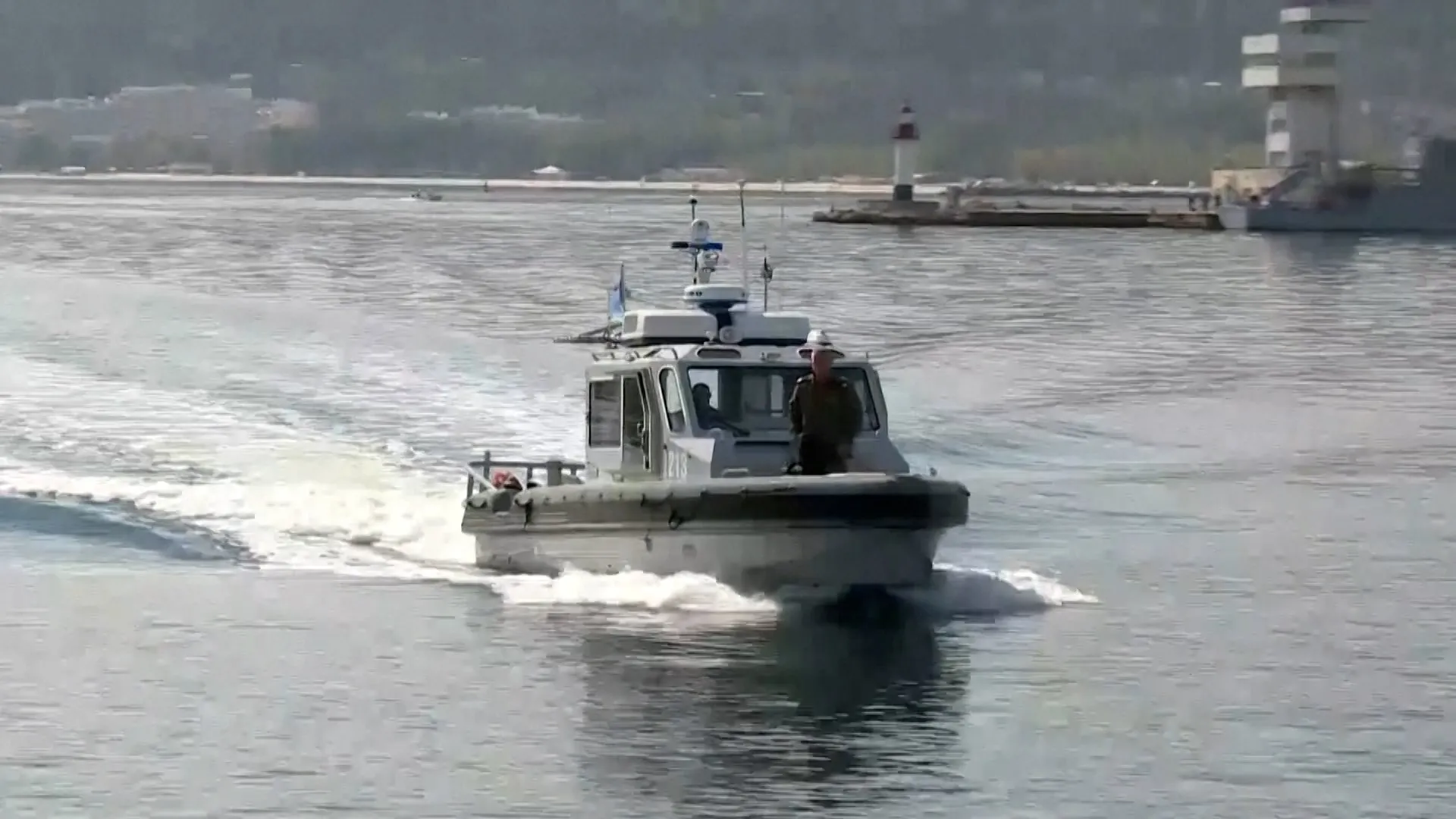
A Togo-flagged merchant ship sank off Bulgaria after a drone attack, with its crew missing. A second ship was also hit and its crew was rescued. Bulgaria’s prime minister called the attacks a ‘flagrant violation’ of international and maritime law.
Novac Djokovic won 102nd match of his career, while ATP 500 tournament victory was Carlos Alcaraz’s third of the year.
Published On 6 Oct 20266 Oct 2026
Novak Djokovic won the China Open after his opponent Alex de Minaur retired from the final with injury, while Spaniard Carlos Alcaraz retained his Japan Open crown to continue his resurgence after a lengthy wrist injury layoff.
The 39-year-old Serbian won the first set in the tie-break 7-6 (7-3) and was down a game in the second set when the Australian ended the match with retirement on Tuesday.
Recommended Stories
list of 4 itemsend of list
Djokovic extended an astonishing unbeaten streak in Beijing and winning the 102nd title of his career.
De Minaur left the court for a medical timeout after losing the first-set tie break but played on with his left thigh heavily bandaged. However, he had to stop after winning the first game of the second set, leaving him trailing 7-6(3) 0-1.
“I don’t feel great … I want to say sorry to all the amazing fans,” de Minaur said at the trophy presentation.
“I didn’t want to finish like this … hopefully see you next year,” added the 27-year-old fifth seed.
The win in China was Novak Djokovic’s 102nd of his career [Tingshu Wang/Reuters]
Alcaraz retains Japan Open crown
Alcaraz made another slow start before cruising past unseeded Czech Jiri Lehecka 7-6(4) 6-4 in the Japan Open final on Tuesday.
The ATP 500 tournament victory is Alcaraz’s third of the year after the Australian Open and Qatar Open, before the 23-year-old was sidelined by an injury for nearly five months and returned at the US Open in late August.
“I’m really happy to be able to lift a trophy again,” Alcaraz said. “It’s been a while and obviously it’s extra special after my injury and my comeback, in the second tournament that I’m playing.
“It was a really tough week and I didn’t play my best tennis and my best level but I did find good solutions and that’s what matters in the end.”
Alcaraz became the first man to go back-to-back in Tokyo since American Pete Sampras won the men’s title in both 1993 and 1994.
The world number three started shakily, dropping serve in the first game, but soon recovered and dialled up the intensity to break world number 19 Lehecka’s serve with a scorching backhand to level at 3-3.
More uncharacteristic errors from Alcaraz gave Lehecka hope in the tiebreak, but the Spaniard unleashed a sublime drop-shot en route to clinching the opening set to lay the platform for his 27th title overall.
Alcaraz says he ‘trusted’ himself
The seven-time Grand Slam champion took control midway through the second set, breaking to claim a 4-3 lead before sealing victory by forcing an error on match point and then celebrating wildly with his team courtside.
Alcaraz said his triumph helped erase the doubts that he faced during his injury break.
“A lot of negative thoughts come to your mind,” Alcaraz added: “If you’re going to come back healthy, if you’re going to come back the same as you were before, if I will be able to hit the ball normally without pain. I trusted myself and it worked out.”
Alcaraz will return to action at the Shanghai Masters where he will take on Argentina’s Juan Manuel Cerundolo or a qualifier first. The main draw of the ATP 1000 event begins on Wednesday.
After Israeli soldiers stormed Birzeit University near Ramallah to demolish a stone memorial dedicated to dead students, Rania Washaha, 47, felt the pain of bereavement again.
Her brother, Fadi, 34, was shot in the head by an Israeli soldier near the northern entrance to el-Bireh in the central West Bank in May 2021.
Recommended Stories
list of 4 itemsend of list
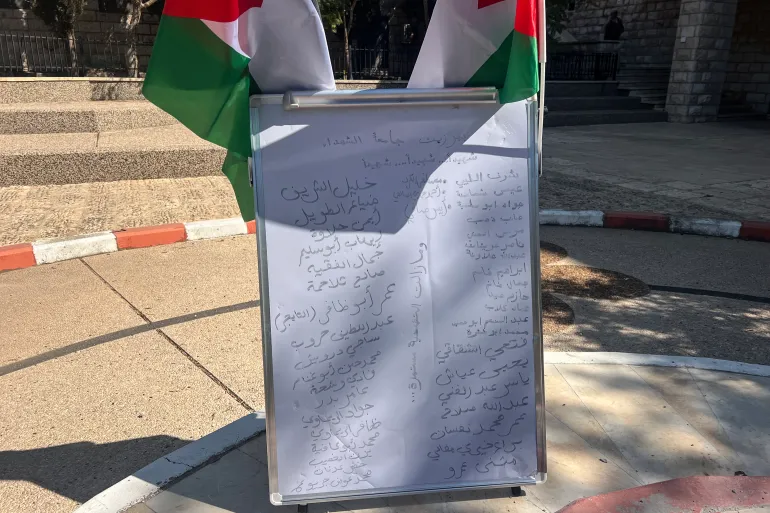
His name was among the 38 students from the university killed by Israel and listed on the stone pillar known as the Martyrs’ Monument.
Israeli soldiers raided the university campus at dawn on Monday, accompanied by 10 military vehicles. A bulldozer demolished the pillar, and soldiers took away the marble stone. In its place, the Israelis left a planter containing a fig sapling, bearing the inscription: “Water it twice.”
Targeting the University
This raid marks the fifth Israeli incursion into the campus since the beginning of 2026 and the 28th since 2002.
Birzeit University’s administration condemned the recent raid, describing the destruction of the Martyrs’ Monument as a violation of international law and an attack on education and national memory.
“Bulldozers won’t erase the memory of the martyrs, military vehicles won’t extinguish the light of knowledge, and these assaults won’t break the university’s resolve to pursue its academic and national mission,” a statement by the university pledged.
Birzeit University students again wrote the names of martyrs that were inscribed on the memorial [Mohamad Turkman/Al Jazeera]
It came 10 days after another incursion by Israeli forces during the daytime, a day before the start of the new fall semester.
Nardeen al-Memi, the university’s public relations and media officer, told Al Jazeera in the brief minutes of their incursion, Israeli soldiers approached the monument for the first time and photographed it.
The Martyrs’ Monument was erected between 1994 and 1996, bearing the names of students and alumni at Birzeit killed by Israeli forces. The list starts with Sharaf al-Tayyibi, who was shot dead by Israeli forces on the campus in 1984. The names of other students and alumni were added during the years that followed.
“The last name inscribed on the monument was that of student Omar al-Naasan, whom soldiers killed in al-Mughayyir east of Ramallah on September 2 while he was confronting settler incursions,” said Nardeen. “Days after his death, his father came and personally wrote his son’s name on the monument.”
University students organised a protest at the site of the destroyed memorial on Tuesday afternoon, most viewing it as an Israeli attempt to intimidate them.
Sami Adel, a Birzeit student who wanted to use a pseudonym due to his fear of being detained, told Al Jazeera the memorial holds a place in the heart of everyone who has attended the university since the 1990s.
In recent years, Israel has tried to suppress any student activity dedicated to commemorating the martyrs, he said.
“Soldiers detained me for several hours three weeks ago and threatened that if I participated in any political student activity on campus, I would face a long and harsh detention,” he added.
Erasing memory
The removal of the memorial is part of a broader Israeli policy targeting memorials dedicated to Palestinians killed by Israel in the occupied West Bank.
The Israeli far-right has made the issue part of its campaign to erase markers of Palestinian identity.
Zvi Sukkot, a member of the Knesset from the Religious Zionism Party, destroyed one such memorial in the village of Madama, south of Nablus, with a sledgehammer in August. The Israeli military later said that it routinely removes “symbols of incitement”.
The location of the demolished memorial in Birzeit University [Mohamad Turkman/Al Jazeera]
Israeli Finance Minister Bezalel Smotrich submitted a list of approximately 40 Palestinian memorials, proposing their destruction, to Prime Minister Benjamin Netanyahu.
There has been a wider targeting of civic and cultural symbols across the West Bank, particularly in Jenin, by Israeli authorities.
“Jenin Horse”, a monument constructed from the wreckage left behind by an Israeli incursion into the city, was removed. A memorial dedicated to Al Jazeera journalist Shireen Abu Akleh in Jenin was also targeted in 2023.
A cemetery containing the bodies of Iraqi soldiers killed during the 1948 war, also located in Jenin, has been raided by Israelis from illegal settlements.
Other landmarks embedded in the city’s collective memory, including the “Watermelon Roundabout”, have also been targeted.
Crushing resistance
Israel’s targeting of Palestine’s collective memory has coincided with a wider campaign of suppression in the occupied West Bank.
Palestinian universities have been a particular target in this pressure campaign, with campuses raided, students detained, and strict restrictions on activities and events within university grounds.
Israeli authorities are likely focusing on Palestinian universities because they hold a special significance for Palestinian resistance. They historically served as spaces for anti-occupation activism and have been an integral part of the Palestinian political landscape for decades.
Rania Washaha looks at her brother’s photo in her office inside Birzeit University [Mohamad Turkman/Al Jazeera]
Political analyst Mohammed al-Qeeq, who served as president of the Birzeit University Student Council between 2006 and 2007, told Al Jazeera that Israel has targeted writers, influencers, and activists, along with students, to deter any resistance to the occupation.
Universities have historically served as a “fundamental pillar” of Palestinian resilience and identity.
“Israel had also sought to weaken Palestinian political and social cohesion inside universities by deepening divisions between factions and creating chaos”, he said.
Remembering Fadi
For Rania, the memorial served to cement the names of the martyred students in the minds of the next generation of Berzeit students, including her brother’s.
“I cannot deny that I felt a pang of anguish when the memorial was demolished,” she told Al Jazeera. “I realised the goal wasn’t simply to uproot a physical object; I felt the suppressed violence Israel inflicts upon us.”
The memorial, constructed in 1996, stood on the campus when Fadi studied at Birzeit University. He had been arrested multiple times, spending a total of eight years in detention, and Israel denied Fadi the chance to wear a graduation gown.
“He didn’t even complete two years of study due to repeated arrests and injuries from soldiers’ gunfire,” Rania said. “Yet, he loved Birzeit University dearly and would stand by the memorial, contemplating the names of the student martyrs, never knowing that his own name would one day be added to theirs.”
This year, Rania’s son enrolled at Birzeit University as a first-year student. Shortly before classes started last September, an Israeli officer phoned him, threatening him if he participated in any student activities on campus. “Remember what we did to your uncle,” they warned him.
Tens of thousands have taken to the streets across France as unions and teachers joined high school students who, for days, have been demanding better learning conditions in protests punctuated by violent confrontations.
The French Ministry of the Interior said 86,000 people had already joined demonstrations across the country early on Tuesday, while the General Confederation of Labour (CGT) union put the figure at 260,000.
Students have blocked the entrances to hundreds of high schools since late September, complaining of missing teachers, overloaded timetables, dilapidated classrooms and buildings unable to cope with rising temperatures.
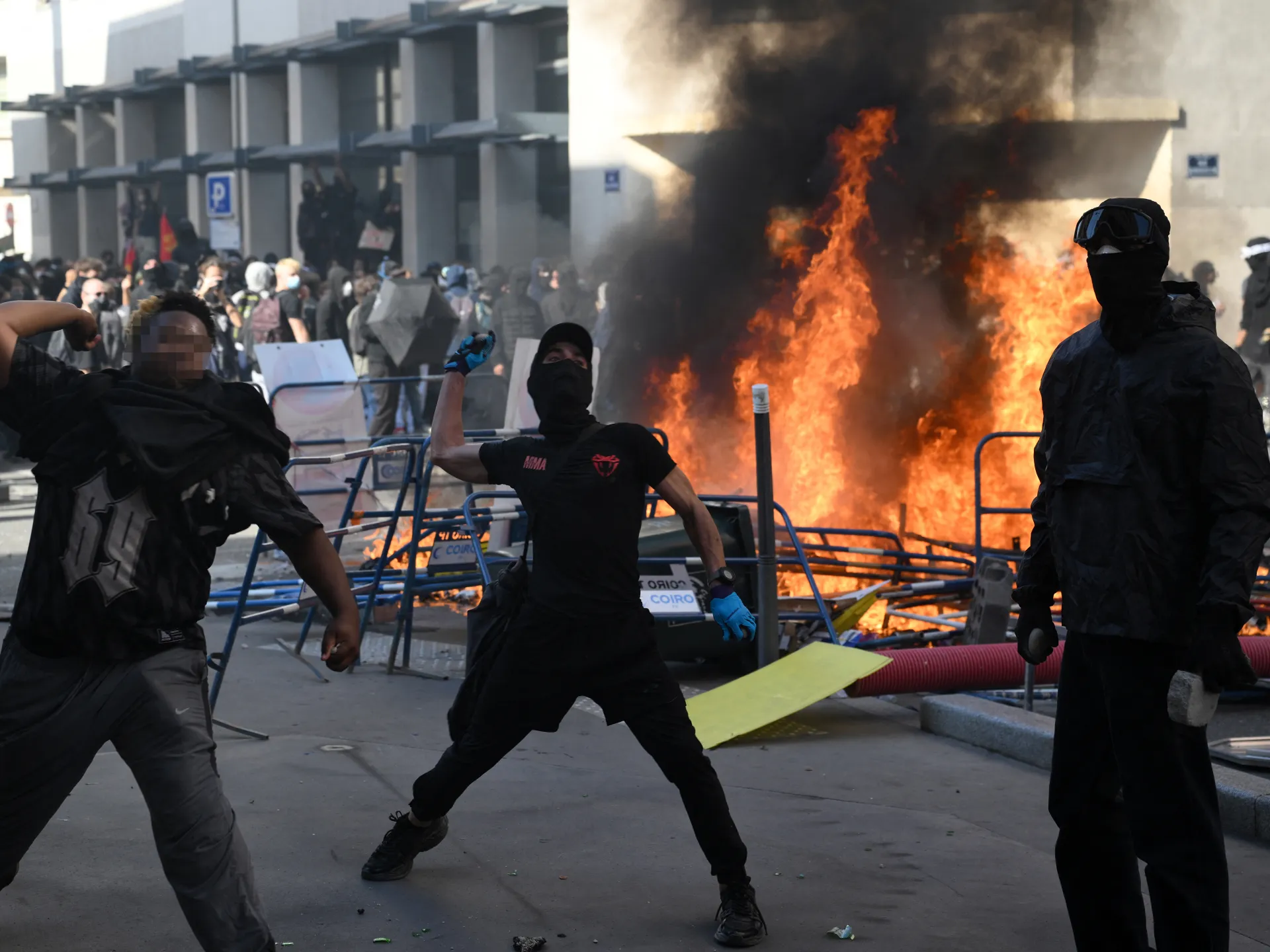
While many protests have been peaceful, some demonstrators have started fires, destroyed bus shelters or clashed with riot police.
Police have responded with batons, tear gas and riot-control rounds.
Injuries, investigations
The government says 215 students and 715 police officers have been injured since the start of the movement.
Unions, rights groups and students have accused the authorities of using disproportionate force.
A 15-year-old lost a hand to a stun grenade fired by riot officers in the northern town of Lens on Monday.
Police have launched 10 internal investigations into allegations of brutality since the protests began, Interior Minister Laurent Nunez said late on Monday.
Since the start of the movement, 24 schools have been burned or ransacked, according to the Ministry of Education.
More than 5,000 people, 87 percent of them minors, have been arrested.
Prime Minister Sebastien Lecornu’s office said 85 members of teaching staff have also been injured.
The government is also pushing legislation to make those responsible for damaging public property pay for repairs themselves, instead of using public funds.
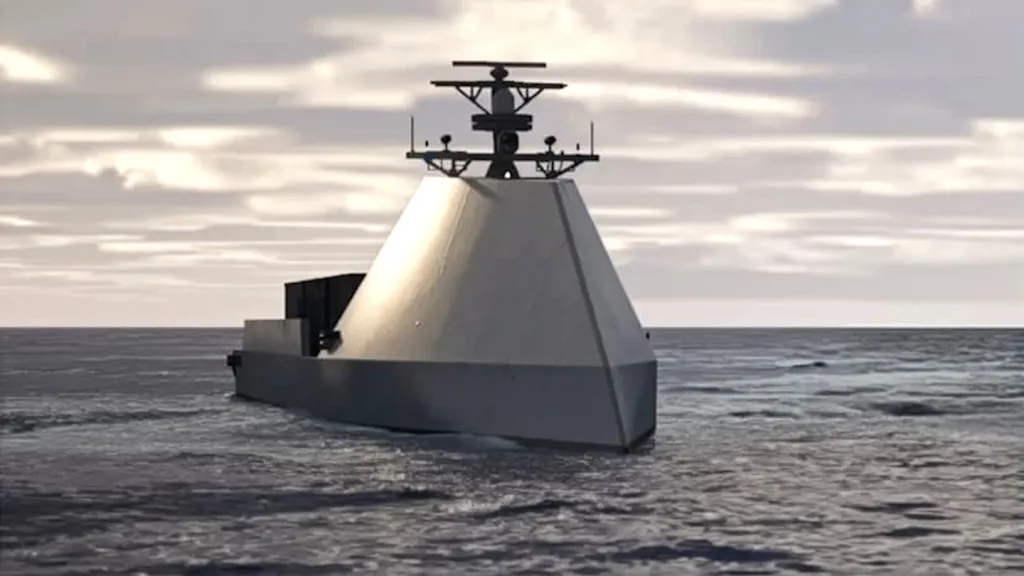
The Navy has announced plans to buy 30 new drone boats, 10 from each of three companies, under its Medium Unmanned Surface Vessel (MUSV) program. The deals are an important step forward for the Navy’s latest attempt to field larger USVs after years of setbacks and shakeups, but it remains to be seen when these new capabilities might actually become operational.
Galliano Marine Services, Huntington Ingalls Industries (HII), and Saronic Technologies each received so-called Other Transaction Authority (OTA) agreements in relation to the MUSV program today. OTA is a contracting mechanism designed to support rapid prototyping and other research and development work without having to use more traditional and often lengthy processes.
The awards “mark a significant step forward in translating the strategic vision into a tangible fleet capability,” Chris Miller, the Navy’s Acting Direct Reporting Portfolio Manager for Robotic and Autonomous Systems (DRPM RAS), told TWZ and others at a media roundtable earlier today. “Each agreement is for the procurement of 10 MUSV at an average procurement cost of $40 million per vessel.”
A rendering of HII’s Romulus design. HII
Saronic and HII submitted their Marauder and Romulus designs, respectively, to the MUSV Phase I competition. Galliano Marine Services, which does business as Edison Chouest, does not appear to have announced its entrant publicly. At a unit cost of $40 million, the total price tag for 30 MUSVs, regardless of type, would be $1.2 billion.
“Production will begin immediately at shipyards in Loreauville, Houma, and Franklin, Louisiana, with deliveries starting as early as the fourth quarter of [Fiscal Year] 2027,” Miller added.
Saronic’s Corsair, seen here, is an example of a speedboat-sized USV already in operational Navy service. Saronic
Threshold MUSV program requirements the service put out in March included a range of at least “2500 nm [nautical miles] at 25 knots while carrying a 25 MT [metric ton] load on the payload deck in NATO STANAG 4194 Sea State 4.” Sea State 4 is characterized by wind speeds of 17 to 21 knots and wave heights between four and eight feet, per that NATO standard. The MUSVs also had to be able to carry forty-foot equivalent units (FEU) containerized payloads and refuel at sea at a rate of “2,000 gallons per minute of fuel through deck connections.” Various other operational and sustainment requirements were laid out at that time, as you can read more about here.
The OTAs announced today were awarded “following successful at sea testing” under Phase I of the MUSV program, according to a press release the Navy put out today. A total of seven companies competed in this initial phase, with the others being Birdon, Leidos, PacMar Technologies, and Sea Machines. That work was conducted under an earlier round of OTAs.
“The testing evaluated, among other things, the vessel’s ability to see and understand the surrounding maritime environment, how well the vessels navigated autonomously according to the international regulations for preventing collisions at sea, and the vessel’s ability to conduct a long-duration mission,” the Navy’s Miller said at the roundtable earlier today. “The demonstrations had to prove that the designs were mature enough to meet the Navy’s operational standards and our requirements.”
In terms of the long-duration mission requirements, “the test was that they had to be able to execute [over] roughly 26 hours and over 360 nautical miles with only a single input during that time from a C2 [command and control] station allowed,” Milleter further explained. “So, it basically demonstrated that the vessel could run for an excess of 24 hours at an extended range with very minimal input from the actual operator from a C2 station. This provided basically our input and our ability to assess how truly autonomous the functionality was of the platforms.”
Overall, the OTA awards “were based on the optimal mix of autonomy, performance, design, production schedule, and cost,” he added.
The MUSV Phase II contracting notice outlines additional parameters, including that submitted designs cannot be more than 295 feet (90 meters) long or displace more than 5,000 metric tons. The USVs also have to be able to accommodate “at least 2x Twenty-foot Equivalent Unit (TEU) [containerized payloads] weighing 24,000 kg each and consuming 25 kW each” and be “capable of executing multi-day unmanned operations of at least 10 days.” The drone boats need to be “operable in NATO STANAG 4194 Sea State 4 and survivable in Sea State 6,” as well. The full lists of threshold requirements and desired attributes are reproduced below.
USN
In addition, “to be considered for this Call for Solutions, the proposed MUSV must be ready for operational demonstration at the time of solution submission,” according to the Phase II contracting notice. “An MUSV requiring substantial modifications for the production platform compared to the as-demonstrated platform will not be considered.”
“The Phase II solicitation allows entrants to compete and existing vendors to submit updated product blocks and modular payload configurations,” Miller, the Acting DRPM RAS, said today. “Testing evaluations will begin as early as November 16th, and proposals will be assessed on a continually rolling basis over the next five years.”
Miller also drew attention to the elimination of the speed and at-sea refueling targets previously outlined in Phase I.
“What we learned from Phase I is that as you increase the speed requirements and some of these other things, it does present certain challenges for industry,” according to Miller. “So I’m trying to actually find the sweet spot in the market where there is healthy competition, and there’s opportunities, and we can have more things that potentially are dual use, both military and civilian.”
A rendering of Saronic’s Marauder with containerized payloads. Saronic
So far, the Navy has only offered limited insights into exactly what specific mission sets it wants the MUSVs to perform, even initially.
The “MUSV Phase I requirements were closely tailored to fulfill operational requirements for a specific mission set focused on demonstrated ability to carry containerized payloads while meeting specific vessel performance requirements for speed and range,” Miller said during today’s roundtable. “However, there is an ever-increasing demand signal that we must be ready to meet. To ensure scalability across the broader mission sets and to support our joint force, we issued a formal call for solutions for MUSV Phase II integration and testing.”
He also stressed that the modularity of the designs being acquired now would allow for the continued evolution of their capabilities as time goes on.
With the focus on containerized payloads, “honestly, inside you could have a sensor, you could have repair equipment for ships,” Rebecca Gassler, who was the Navy’s Portfolio Acquisition Executive for Robotic and Autonomous Systems (PAE RAS) until August, also told TWZ and other outlets back in March. “You could have any number of payloads inside those, and you basically are able to just swap them on.”
In announcing the new OTAs today, as well as discussing the Phase II MUSV plans, the Navy also highlighted continued opportunities for the other companies that had been involved in Phase I.
“Leidos, PAC MAR, and Sea Machines were determined to complete the project provided for in their prototype other transaction agreement and will receive a $15 million award as part of the previously established terms of the prototype OTs,” the Navy’s MUSV announcement today adds. “Alongside the OT awardees, will be accepted onto the Drones.mil hosted Maritime Marketplace, where they are now eligible to receive follow-on production agreements from authorized acquisition authorities across the DOW [Department of War].”
A rendering of Steamracer, a larger USV design Sea Machines has pitched to the US Navy in the past. Sea Machines
Birdon did not complete the required testing. Based on the terms of the Phase I OTAs, Galliano, HII, and Saronic will also receive $15 million awards and be included in the marketplace. The aforementioned Phase II CFS is intended “to expand its acquisition pipeline through a Maritime Marketplace to broaden offerings and satisfy future MUSV mission sets,” as well, per the Navy.
The Navy stressed the importance of this open-ended “marketplace” model as a way to accelerate the acquisition process when it first outlined the MUSV program to the public back in March, as you can read more about here. Just last week, the service also established a new Robotic and Autonomous Systems Warfighting Development Center (RASWDC) to serve as a focal point for “the development, operational integration, and employment of robotic and autonomous systems (RAS) across the maritime domain,” to include the MUSV effort.
The Drones.mil marketplace also extends to all branches of the U.S. military and beyond just USVs. Miller today did highlight the potential for possible cooperation with other services on drone boat efforts through this framework. He also said the Navy might be willing to consider additional acquisition strategies, including leasing uncrewed platforms, in the future.
Larger USVs have long been seen as key to bolstering the U.S. Navy’s overall operational capacity above the waves, and doing so in a cost-effective and rapidly producible manner. They are also viewed as central to enabling new, more distributed concepts of operations designed to help expand operational coverage and reduce the vulnerability of crewed ships, especially in any future high-end fight in the Pacific with China.
A pair of optionally-crewed vessels the Navy has been experimenting with for years now seen sailing together with a Japanese Mogami class frigate. USN
“Unmanned technology is redefining operations and providing our combatant commanders with unprecedented scale, persistence, and risk tolerance,” the Navy’s Miller said at the roundtable.
At the same time, as mentioned, the Navy has attempted to acquire operational fleets of larger drone boats in the past without success. Today, the service’s capabilities in this regard remain limited to a pocket force of still largely experimental optionally-crewed designs.
Since the Navy first unveiled it in March, MUSV has already faced certain hurdles. This includes a major leadership shakeup in August that saw PAE RAS Rebecca Gassler, the first person to ever hold that post, removed from her post after just eight months for reasons that are still not immediately clear.
In July, it also emerged that Blue Water Autonomy and Saildrone had filed suit against the Navy over being left out of Phase I of the MUSV competition. The companies alleged that the service did not follow its own selection criteria. That lawsuit is still ongoing. Blue Water Autonomy, among others, had also previously made investments in response to requirements the Navy had laid out for a previous effort called the Modular Surface Attack Craft (MASC) last year. The MUSV program has now fully supplanted MASC.
In speaking at the roundtable today, Miller acknowledged potential budget limitations and other hurdles that could still impact MUSV going forward. “I’m trying to be prepared depending on where that demand goes,” he said.
As said at the start, today’s MUSV announcement is an important new step forward for the Navy’s efforts to acquire fleets of larger USVs, but the service still has to transition these efforts into operational realities.
Protests have continued across France for a third week as tens of thousands of school pupils and trade unionists have taken to the streets across many cities.
Students initially began boycotting classes in deprived areas of Paris on September 21 over teacher shortages and poor conditions, but protests have quickly morphed into a nationwide movement, with some of the largest demonstrations taking place on Tuesday.
Recommended Stories
list of 4 itemsend of list
School blockades have turned violent, with protesters accused of hurling items at police and officers allegedly responding forcefully using batons, tear gas and rubber bullets. In one case, a teenager lost his hand in a grenade explosion.
The mass demonstrations, which also coincided with a public sector strike over government budget plans last week, have presented another challenge for President Emmanuel Macron’s cash-strapped government ahead of next year’s elections, amid an ongoing fiscal crisis as government debt has rocketed in recent years.
Here’s what we know:
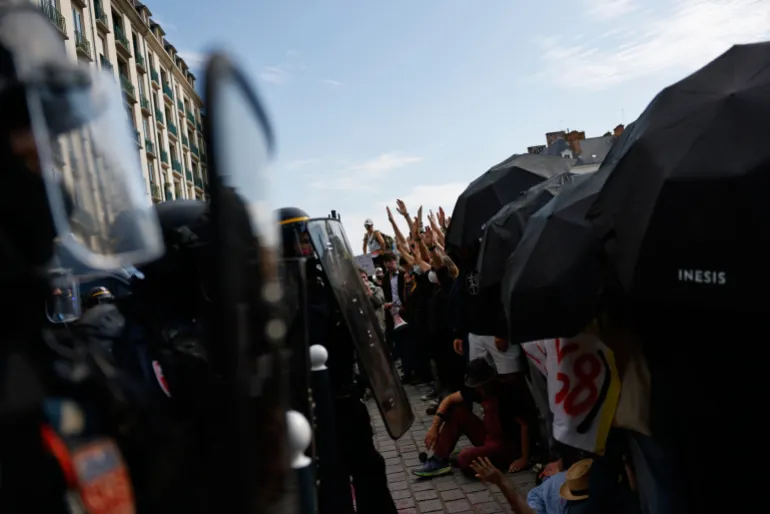
Riot police face students during a protest against under-resourced schools in Rennes, western France, on October 6, 2026 [Jeremias Gonzalez/AP]
What do protesters want?
Students have been protesting over what they say are poor conditions in France’s high schools – or lycees – especially in poorer areas. Protests have been held in Strasbourg, Bordeaux, Nantes, Marseille, Lyon and other towns and cities.
Students say absent teachers are not replaced, dilapidated school buildings are sometimes rodent-infested, there are inadequate tables and chairs, large class sizes and long classroom hours.
The intense heatwave which hit France in the summer exacerbated existing problems in neglected school buildings, which also suffer from a lack of air conditioning, school pupils say.
The protests have coincided with ongoing nationwide public sector strikes over a proposed 2027 cost-cutting budget that aims to achieve 54 billion euros ($61.3bn) in savings as Macron’s government races to bring a large public deficit under control.
Public sector staff and unions object in particular to a government plan to freeze salaries to save about two billion euros ($2.27bn).
Parents are also increasingly present at protests amid widespread anger about the police response to demonstrating minors.
But the protests are happening amid wider discontent over soaring fuel and commodity prices and reduced public spending under Macron.
Government officials have meanwhile accused political opposition groups and unionists of taking advantage of the student movement. Prime Minister Sebastien Lecornu accused political opponents last week of encouraging escalation.
What has happened so far?
At least 6,100 people had been arrested by early Tuesday, many of them under the age of 18, as police tactics come under intense scrutiny.
Serious injuries have also been reported.
A 15-year-old lost a hand in the northern city of Lens on Monday after he reportedly came into contact with a police stun grenade, which then exploded. Public prosecutors say investigations are ongoing into whether the youth actively picked up the grenade or if it landed on him.
Overall, at least 190 high school students have been injured, Education Minister Edouard Geffray said on Monday. On Sunday, he said 78 teaching staff had been injured, and 24 schools had been burned or ransacked.
Some 715 police officers have been injured, according to Interior Minister Laurent Nunez on Tuesday.
Officials said as many as 589 schools have been disrupted this week, down from 735 on Friday last week.
Rights groups, including Amnesty International, have criticised the use of force against minors amid media reports of students being hit with batons and rubber bullets, as well as sprayed with tear gas.
What happened on Tuesday?
Protesters again blockaded schools on Tuesday as thousands demonstrated over their demands.
Placard-waving crowds were reported in southern Marseille, eastern Strasbourg and other major cities.
In Paris’s 20th district, protesters outside the shut Helene Boucher lycee tipped over rubbish bins and bicycles and created a makeshift barricade, The Associated Press news agency reported. Parents, meanwhile, positioned themselves between the demonstrators and police to protect their children.
“They are our children. Teachers, parents, federations, we all share the same goal: the protection of children’s rights, and it is a legitimate right to demonstrate and to make demands,” said Emilia Sichili Suriam, one member of a parents’ association.
Interior Minister Nunez rejected criticism of the police on Tuesday, saying the response has been proportionate in “almost all cases”. He claimed that the protests were transforming into “riots”.
What does this mean for the French government?
These are only the latest in a series of high-profile protests that have marked Macron’s presidency and undermined his government’s reform efforts ahead of elections in April and May.
Macron will not run in next year’s elections, but his image and that of his government have no doubt been tainted by photos of police chasing students in the streets, France expert Jacob Ross, from the German Council on Foreign Relations (DGAP), told Al Jazeera.
“He is not taken seriously any more because many think of him as already out of government,” Ross said of Macron. “But this is still very significant for his government because it has become clear that they don’t have the capacity to calm things down. There’s clearly little fiscal room to manoeuvre.”
Macron’s terms have long been beset by political and financial instability. Successive prime ministers have faced difficulties in pushing through policies in the highly polarised National Assembly where Macron’s centrist Renaissance party and allied blocs lack a majority.
Critics have taken aim at Macron’s deeply unpopular austerity measures, which have seen drastically reduced government spending taking a toll on pensions and healthcare. Officials, however, have defended these policies amid rising debt following COVID-19-era spending.
On Sunday, Lecornu said the government had kickstarted initiatives to address the protesters’ demands and that a report was expected by the end of the month. He, however, added that Paris would not “yield an inch” to violence.
Meanwhile, frontrunner and opposition leader Marine Le Pen of the far-right National Rally party submitted a shadow budget on Tuesday promising 140 billion euros ($157.6bn) in cost savings by 2032 if elected next year.
U.S. Customs and Border Protection (CBP) has retired the last of its P-3 Airborne Early Warning (AEW) aircraft. The AEW version is instantly recognizable from the saucer-like radar dome on top, as seen on other AEW types like the E-2 Hawkeye and the E-3 Sentry. CBP was the only operator of this variant of the P-3 Orion and is said to have been the only law enforcement agency to fly any kind of dedicated AEW plane. The retirement of these aircraft comes at a time when American AEW assets, in general, are under heavy strain by demands globally.
CBP officially retired its final P-3 AEW on September 30, 2026, after a final flight from National Air Security Operations Center Jacksonville (NASOC Jacksonville), in Jacksonville, Florida. CBP has also flown Long Range Tracker (LRT) variants of the P-3, configured for more traditional maritime surveillance missions. The current plans for the LRT aircraft, and whether their sunset may also be on the horizon, are not immediately clear, and TWZ has reached out for more information. Orions of all types have been steadily disappearing from service with the U.S. military and elsewhere across the U.S. government as the aging aircraft become more difficult to operate and maintain.
End of the Road: AMO’s Iconic P-3 Dome Takes Its Final Flight!
On September 30, 2026, the distinct silhouette of a four-engine turboprop carrying its massive rotating radar dome touched down for the final time at the National Air Security Operations Center in Jacksonville.
“Our Jacksonville-based P-3 AEW fleet has served as a cornerstone of America’s outer-layer border security,” according to a brief announcement from CBP about the retirement on social media. “Its crews flew far beyond our borders, providing wide-area surveillance across the Caribbean, Gulf of America [Gulf of Mexico], and the transit zones of Central and South America, helping detect and track threats before they could reach the United States.”
By all indications, including official CBP sources, the P-3 AEW fleet consisted of eight aircraft at its peak. There is a confusingly worded 2014 CBP press release that mentions an “11th and final Lockheed Martin P-3 Airborne Early Warning (AEW) aircraft overhaul,” but that figure looks to also include three of the six LRT versions. The same release says that CBP only had 14 P-3s of all types at that time.
What was then known as the U.S. Customs Service (USCS) first began operating the P-3 AEW version in the late 1980s. The aircraft were converted from second-hand maritime patrol variants of the Orion. The first example had started life as a P-3B for the Royal Australian Air Force (RAAF). Ex-U.S. Navy P-3s were also converted.
A picture of a P-3 AEW in USCS service circa the late 1980s. CBP
The initial three P-3 AEWs were equipped with the AN/APS-138 radar. The same radar was used on early E-2C Hawkeye airborne early warning and control aircraft operated by the U.S. Navy, as well as several other armed forces internationally.
“The Customs Service had previously borrowed U.S. Navy E-2Cs to meet its antinarcotics surveillance requirements, but required an aircraft with longer range and on-station time,” according to a 2006 report from Forecast International. “In June 1989, the U.S. General Accounting Office issued a report on the drug interdiction P-3B AEW aircraft. The findings indicated that the radar performance was as specified, but the P-3B (when compared to the E-2C) was less costly to operate per square mile of area covered because of the higher cruising speed and longer endurance. The P-3B had at least twice the in-flight endurance of the E-2C.”
Starting in the 1990s, USCS began the process of acquiring additional P-3 AEWs with newer AN/APS-145 radars, as also used on later model E-2Cs. The original AEW Orions were eventually refitted with APS-145s, as well. It’s worth noting here that the U.S. Coast Guard separately moved to acquire an AEW version of the C-130H, designated the EC-130V, in the 1990s, which used the AN/APS-125 radar, also used on older E-2s. Budget cuts led to the end of that program. The EC-130V that had been built was redesignated as an NC-130H and subsequently used for test purposes.
A US Navy E-2C Hawkeye. USNThe NC-130H test aircraft with its radar dome still on top. US Military
The P-3 AEWs were also equipped with a sensor turret containing electro-optical and infrared (EO/IR) video cameras, allowing the aircraft to more closely investigate targets spotted on radar. CBP regularly conducted P-3 operations that paired AEWs with LRT variants to provide an even broader array of sensor capabilities on missions. The LRTs have EO/IR sensor turrets, as well as AN/APG-66 and SeaVue radars. The pulse-doppler AN/APG-66 is primarily designed for spotting and tracking aerial targets, and was originally used on early variants of the F-16 fighter. SeaVue is a multi-function type with surface search and synthetic aperture radar (SAR) imagery modes. Images produced via SAR are highly detailed maps of the surface below, and can be captured day or night, and regardless of any cloud cover, smoke, or dust.
Beyond radars and other sensors, the P-3 AEWs also had a robust communications suite consisting of VHF and UHF radios, as well as satellite communications links by the end of their career. CBP’s entire P-3 fleet, including the AEWs and LRTs, has received various updates over the years, including new ‘glass cockpits’ starting in the early 2000s.
CBP Air and Marine Operations: Extended Border Operations
Though primarily employed in support of counter-narcotics interdiction operations, the airborne radar and command and control capabilities were also applied to other missions, including disaster relief and humanitarian assistance efforts at home and abroad. As an example, CBP’s P-3 AEWs helped with air traffic coordination, as well as provided other support, during relief efforts in Texas in the wake of Hurricane Harvey in 2017.
At the same time, CBP’s entire P-3 fleet, including both the AEW and LRT versions, has only been getting increasingly older and difficult to sustain. The P-3B variant first entered U.S. Navy service in the 1960s. CBP did put its P-3s through a Service Life Extension Program overhaul in the 2010s, which included “new wings and tail for each aircraft and completely strips down the aircraft to its bare metal for an inspection,” according to a 2014 press release.
A P-3 AEW seen during a test flight as part of the SLEP overhaul. The aircraft notably lacks its radar dome. CBP
A key question now is how CBP will fill any gaps left by the retirement of the final AEW version. The agency does continue to operate a mix of other crewed fixed-wing aircraft with mixtures of radars and other sensors, as well as MQ-9 drones, but none of these platforms are equipped with a sensor like the AN/APS-145. CBP also has a network of tethered aerostats with radars at fixed sites around the Caribbean. As an aside, General Atomics, together with Saab, is now working on an AEW configuration for the MQ-9B drone, but there are no known U.S. orders for that capability at the time of writing. That platform will not offer the same level of flexibility and look-down capability as modern crewed AEW aircraft, either. Look-down AEW capability is only growing in importance today amid expanding and evolving drone threats, including to the U.S. homeland.
Another look at one of CBP’s now-retired P-3 AEWs. CBP
The Air Force, in particular, is also aiming to eventually push most, if not all, air moving-target indicator (AMTI) tasks currently performed by aircraft like the E-3 and E-7 into space. The service is heavily investing to accelerate the fielding of those capabilities, which could eventually offer revolutionary constant, persistent coverage globally. The first of those satellites are still not expected to reach an early operational state until 2028. It is possible that CBP could get access to a tailored data feed from this system when it does become operational. It still does not obviate the need to have crewed or uncrewed aircraft capable of more closely investigating tracks of interest using EO/IR cameras and other sensors.
Whatever the future might now hold, CBP’s unique time as the operator of the P-3 AEW aircraft has come to an end.








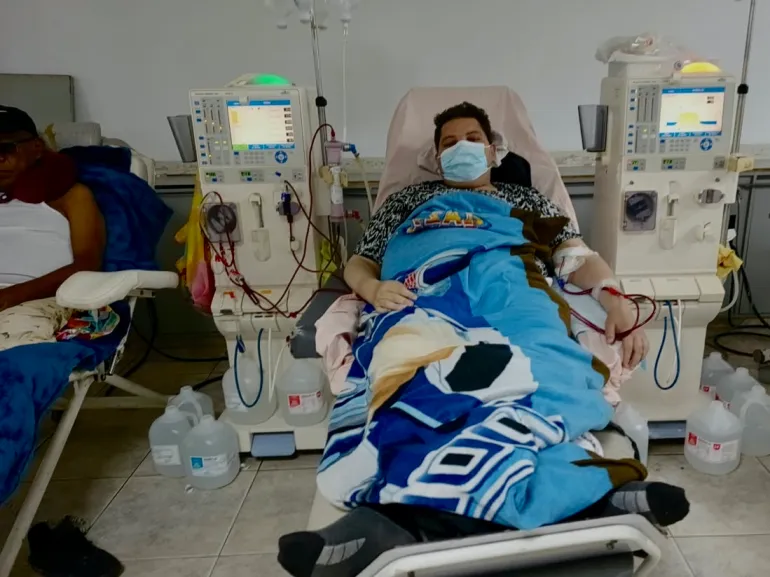
![Onasis Munoz of Valencia, Venezuela, has seen his dialysis treatment interrupted by power outages [Courtesy of Onasis Munoz]](https://i0.wp.com/www.aljazeera.com/wp-content/uploads/2026/10/2615546f-db48-4e1d-9291-455ccb057b32-1791255429.jpg?w=640&ssl=1)