The Arctic has long been known as “high North, low tension”, as its frozen waters and permafrost landscape offered no incentives to the states. However, due to global warming, it is changing. The rate of warming in the Arctic region is four times faster than the globe, resulting in massive ice loss. This anthropogenic anomaly has made the Arctic a region of geopolitical significance.
The Strategic Importance
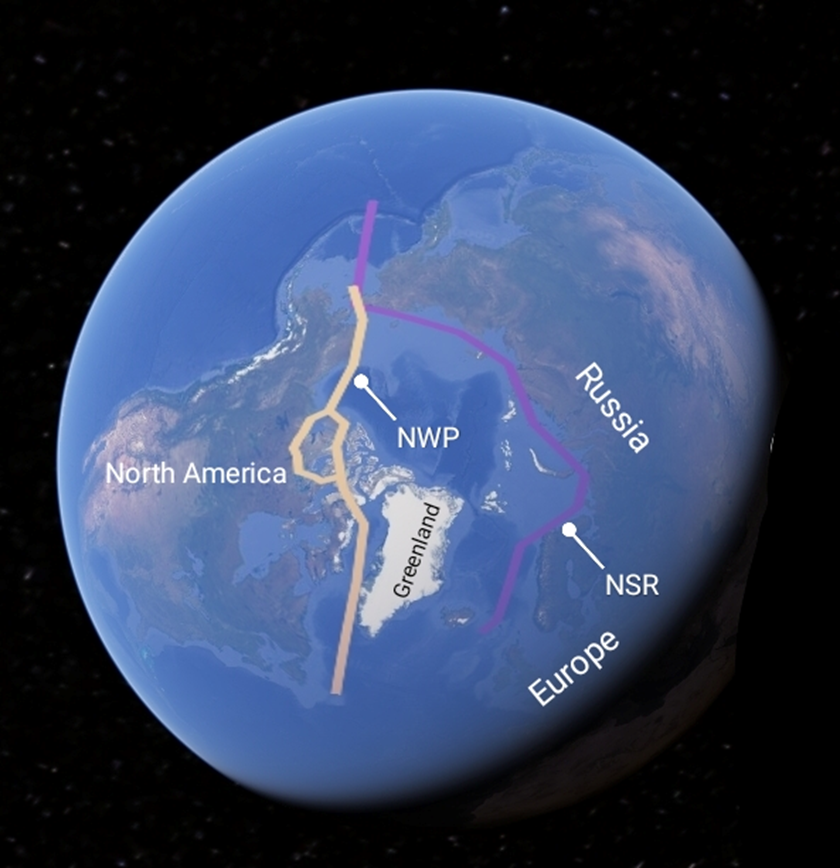
The strategic importance of any region primarily depends on two factors: The first is Geographical position; which not only emboldens its importance as a trade passage but also defines its fruitfulness as a strategic location in both peace and war. The second; its Resources which offer economic benefits to the states, which can be translated into military might. The Arctic, indeed, has manifested both qualities. Its seas are becoming navigable as the ice recedes. The Northern Sea Route (NSR) and the Northwest passage (NWP) provide the countries in the high latitudes lucrative trade opportunities. Similarly, the geo-economic weight of the Arctic is augmented by its huge reserves of petroleum and minerals. It holds almost 13% (90 billion barrels) of the world’s undiscovered oil and 30% of its undiscovered gas resources. Moreover, the Arctic has a large amount of mineral resources. For example, Greenland; which comprises almost 15% of the Arctic region and its second largest contiguous landmass, is estimated to possess large deposits of Rare Earths, Copper, Zinc, Iron ore, Gold, Nickel and Uranium. Therefore, the big powers have set eye on the Arctic, including the US; Russia and China, with ambitions to dominate which may be termed as The Arctic Great Game.
Strategic location of the Arctic
“Whoever holds Alaska will hold the world”, General Billy Mitchell was not wrong when he uttered this phrase in 1935. Indeed, during the Cold War, the possession of Alaska for the US, its only in the Arctic, proved fruitful. American early warning satellites and missile defenses were installed in Alaska to detect Soviet infiltration. The Cold War is over now, but the competition over the Arctic has reinvigorated. The US, under Trump administration, is ambitious to dominate
the Western Hemisphere. The Arctic, especially Greenland, can be defined as the head of the Western Hemisphere. The geographical position of the Greenland is indeed enviable. East of it runs the widest gap between the Arctic and the Atlantic Ocean. Therefore, America holds the Island in esteem for its strategic location. The 2026 National Defense Strategy emphasizes the US military and commercial access to the Arctic, especially Greenland. It already operates the Pituffik Space Base (formerly Thule Air Base) in Greenland, in addition to its Alaskan military bases in the Arctic.
Russia, an important stakeholder in the region, enjoys one of the longest coastlines and largest territories in the Arctic. Russian activities in the Arctic are not novice. In the late 18th century, Russian emperor Peter the Great launched the ‘Great Northern Expedition’ which aimed to search for a northern sea route that could connect the Pacific and Europe. The quest for a such a sea route seems promising now as the Arctic waters become traversable. In 2020, Russia unveiled its Arctic policy till 2035. Among others, it emphasized the development of the Northern Sea Route (NSR) as ‘a national transport communication of the Russian Federation that is competitive on the world market’. However, after Russian invasion of Ukraine, Kremlin adopted a staunch outlook. In Feb 2023, Putin decreed to amend the country’s Arctic policy. The amended document mentioned the prioritization of the national interests of the Russian Federation in the Arctic. For this purpose, Russia has endeavored to transform NSR into a global trade and energy route. Russia currently operates the largest Icebreaker fleet and thanks to this technology, the transit of trade vessels is expected to increase through the NSR.
Routes through the Arctic Ocean. Source: Author’s creation
However, any unilateral Russian action in the Arctic Ocean would not land off the attention of the other Arctic states. While Russia is ambitious to hew the Arctic Ocean as a “Russian Lake”, the other Arctic countries too deem the Arctic as their ‘number one priority’. The Nordic countries consider the Arctic as a security concern, they also see Russia as a threat in the region while emphasizing sustainable development in the region. Therefore, the strategic competition in the Arctic will, inevitably, shape the European security dynamics.
The strategic importance of GIUK (Greenland-Iceland-UK) Gap, a body of open water between the three countries, is still relevant. During the Cold War, it provided the Soviet vessels an outlet into the North Atlantic Ocean which conferred optimal range to strike NATO targets. However, in late 2019, Russian submarines surged through the gap into the North Atlantic in what was a large-scale military exercise to which NATO forces counteracted with air missions to gather reconnaissance. Therefore, the Arctic is of strategic significance. It acts as a vanguard for the defenses of the Americas and Europe.
The most interesting case offered in the Arctic security is that of China, which lacks any geographical connection to the region. For Beijing, the Arctic begets new opportunities. China has already declared itself a “Near-Arctic State” in its Arctic Policy 2018 and seeks to participate in the development of the Arctic shipping routes. China’s growing interest in the Arctic shipping routes can be interpreted as its efforts to diversify its trade routes. Compare the two routes which link China to the Western European markets: First is from the Chinese ports through the East and South China Sea, into the Indian Ocean, then crossing the Suez and reaching Mediterranean, squeezing through Gibraltar strait and reaching destinations. China’s apparition, utilizing this route, is evident in what has been translated as the “Malacca dilemma”. The second runs northerly from the Chinese ports and then cruising along the Arctic reaches Northern and Western Europe. The first is long, time-consuming and precarious in case of conflict given complex maritime features of the region. The second not only cost saving but also relatively more secure and safe. Therefore, the prospects for China to make the Arctic a “Polar Silk Road” are rewarding.
Probability of expansion of power in the Arctic of US, Russia and China
Political
Military
Economic
United States
high
medium
high
Russia
high
high
high
China
medium
low
high
Future Power Politics in the Arctic. Source: Author’s creation
The Race to Secure the Arctic Resources
President Trump, during his first term, had tried to buy Greenland. However, his efforts were reinvigorated after his re-election in late 2024. During his second term, he has repeatedly threatened to occupy Greenland by using military force, the island defined by him as a matter of national security. The strategic importance of the Greenland is evident. Trump’s interest in the Greenland can be defined by two reasons. First to oust China and Russia from the region who have been increasing their influence in the region, as he perceives. Secondly, Trump wants to secure the resources of the Greenland for the US. Greenland, as said earlier, is rich in rare-earth minerals, which have their application in military industries, medical equipment, oil refining and green energy. Currently, China is the largest exporter of the rare earths. US deems ramping up its rare earth’s resources crucial for countering the Chinese monopoly over them. Last year, a global supply chains crisis loomed following China’s restrictions on the exports of the critical minerals. Moreover, to meet the threat imposed by climate change, the real progenitor of the shift in Arctic security, the transition to renewable and smart energy sources demands sufficient mineral resources including the rare earths. These are used in wind turbines and electric vehicles.
Russia extracts a huge amount of its energy and mineral resources from the Arctic. It produces rare earths, nickel and cobalt from its Arctic territory. Russian Arctic also holds almost 37.5 trillion cubic metres of natural gas, 75% of Russia’s gas reserves. As the permafrost thaws and the sea ice melts in the Arctic, Russia will expand its efforts to secure the resources in the region. Therefore, the Kremlin keenly observes changing environmental and political dynamics in the Arctic.
Lastly, the ‘Near-Arctic State’ has also augmented its footholds in the Arctic. China has invested in economic sectors in the Arctic. It is yet to be unveiled whether China’s ambitions in the Arctic are solely for peaceful economic purposes or rather they embody a strategic objective. So far, China has remained innocuous, focusing on economic ties with the Arctic states which benefit all.
Conclusion
The Arctic is going to witness a tense geostrategic competition. Climate Change has transformed this previously unnoticed region into a new stage of strategic competition. Arctic routes and resources invite regional as well as extra-regional powers to vie for dominance in the high north. Therefore, states have shifted their focus to the Arctic. The political and strategic facts imply that in the future the master of the Arctic will decide the matters of the world.
Weekly insights and analysis on the latest developments in military technology, strategy, and foreign policy.
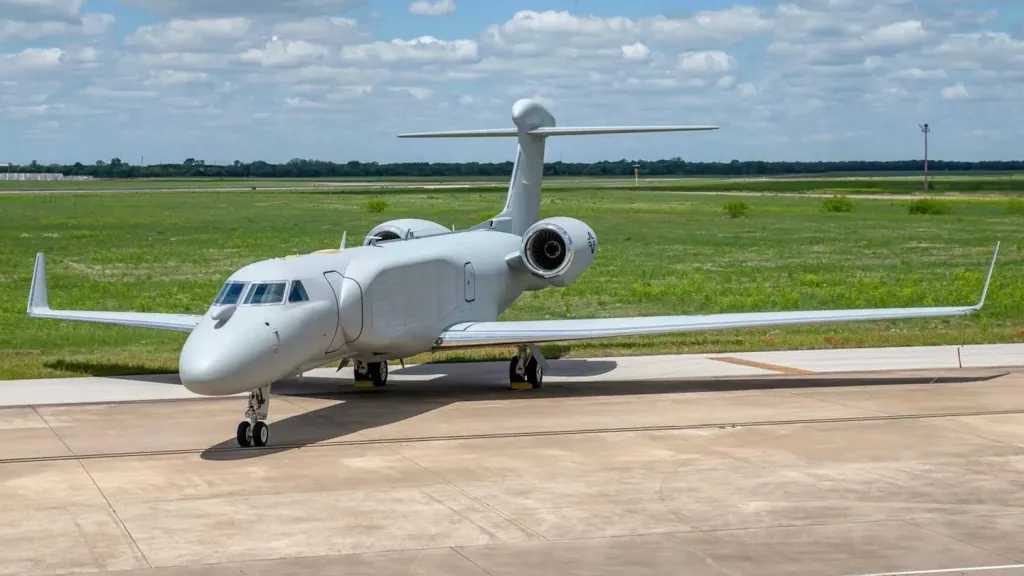
With the U.S. Air Force now in the process of transitioning from the aging EC-130H Compass Call to the brand-new, bizjet-based EA-37B Compass Call, TWZ caught up with top executives from the two co-primes on the electronic attack aircraft program. In the process, we learnt more about its capabilities, related platforms, and other prospects for the future. We spoke with Jason Lambert, president of the intelligence, surveillance, and reconnaissance sector (ISR) at L3Harris Technologies, and Dave Harrold, who leads the Countermeasure & Electromagnetic Attack (CEMA) Solutions business area at BAE Systems.
EA-37B Compass Call (USAF) U.S. Air Force
TWZ: Can you give us a better understanding of what the EA-37B Compass Call does conceptually? There are clearly a lot of different parts to its mission, so I am just interested to hear that in your words.
Dave Harrold: This aircraft is the Department of War’s only long-range, electromagnetic spectrum aircraft. Interestingly enough, it used to be called the EC-37B until it was formally changed to the EA-37B, signifying that it is a dedicated electronic attack platform.
When I say electronic attack, what we’re talking about is really degrading, denying, and disrupting adversary communications. It’s about causing havoc in their command-and-control system, so that adversary leaders are unable to make clear decisions. So that’s about integrated air defense systems [IADS] and disruptions there. It’s about [disrupting] different communication nodes. This really is a dedicated counter-C5ISRT [command, control, communications, computers, cyber, intelligence, surveillance, reconnaissance, and targeting] platform. We’ve been doing this mission set for over 40 years with the EC-130H workhorse starring in every conflict since it was put in the inventory, particularly in the Global War on Terror.
We saw the need to be able to do that at a higher altitude, longer range, higher speed, if we were going to turn this capability toward other regions. And so the challenge was really around: how do you take all of that stuff on an EC-130H and package it down to an EA-37B? That has been a challenge of innovation and technology, for us to reimagine: how do you take that size and weight and reduce it, but not reduce the power? Because we need that power to be able to execute the kinds of techniques that we’re doing on the system. So really, it’s about controlling the electromagnetic spectrum, making sure we can enable our side and disable the other side.
Electromagnetic warfare, evolved
Jason Lambert: The EA-37B does that really on a theater level. There are other capability sets that the Department of War has in their inventory that are more of a point solution, whereas this is really a theater-level, strategic solution, dominating the electromagnetic spectrum and being able to defeat what’s happening on our adversary’s side, while our forces continue to operate in full, with what they need to do for their communications, with what they need to do with their command and control systems. Other systems out in the world are broad jammers. This is not that; this enables our assets to be able to continue to do their job in a non-degraded manner.
Dave Harrold: Yeah, this is really important. One of the strengths of the EA-37B is the simultaneity. What that means is we’ve got the power and the capability. We’re not in a one-versus-world anymore, or using a point solution: here’s a threat, here’s a technique. The threat environment is getting more and more sophisticated and challenging, and so it’s really about how many different techniques can you run at one time to neutralize or disrupt or deny how many different threats that are out there? That’s what’s important about the power and what distinguishes this platform from point solutions.
The 43rd Electronic Combat Squadron (ECS) took its final flight in the EC-130H Compass Call aircraft on February 15, 2024, at Davis-Monthan Air Force Base, Arizona. The 43rd ECS is the first squadron under the 55th Electronic Combat Group to move itself away from the EC-130H Compass Call aircraft to the new EA-37B Compass Call. U.S. Air Force photo by Airman 1st Class William Finn Charles Haymond
Jason Lambert: And it is all software-defined, which is a very important thing. The threats are evolving, and we’ve got the capability, and our Department of War has the capability, for some of our other platforms, our ISR platforms, specifically, to go out and collect on what those potential threats might look like and how those threats evolve over time. That information is able to be configured within the mission system that BAE Systems produces to be able to go and defeat those threats. It’s not like a one-off solution that’s going to be made obsolete. It’s a solution today that’s built for tomorrow and beyond, because it can continue to evolve based on the threats.
TWZ: Can you kind of indulge us in terms of what could it do? What’s a tangible thing this could actually go and do? Could it go and shut down a big part of an integrated air defense system [IADS] for example?
Jason Lambert: I’m gonna go back to one of the things I’ve already said: sophisticated comms networks. Our enemy adversaries have more and more sophisticated comms networks. We have to affect those comms networks in order to affect their overall capability. And, you know, you mentioned IADS, that is an original mission of the Compass Call platform, to disrupt the IADS.
Dave Harrold: Exactly, this is designed to break the kill chain. If there’s no command and control system to process the information for the kill chain, it won’t work. And you can do that significant range. That’s what it does.
U.S. airmen assigned to the 43rd Electronic Combat Squadron pose for a group photo before boarding the EA-37B Compass Call aircraft for its first official mission training sortie flight at Davis-Monthan Air Force Base, Arizona, May 2, 2025. U.S. Air Force photo by Airman Samantha Melecio Airman Samantha Melecio
TWZ: Can you explain a bit more about what you have to do to port these systems and capabilities from the EC-130H into the EA-37B?
Jason Lambert: L3Harris is the integrator. We purchase the aircraft either directly from Gulfstream or from the VIP market. Then we work with Gulfstream to do the conversion of the aircraft. We essentially time it back to what the plane was when it initially left the production line. Then we go and do the outer mold line shape; Gulfstream provides that to us at our facility in Waco, Texas. Then we do the integration of the BAE Systems mission system that Dave and his team provide.
Dave Harrold: We’re the prime mission equipment provider, so that’s our co-prime split, and we build all of that up in Nashua, New Hampshire. We build that equipment, we test it, we lay it out. We have an integration lab up there, where we actually lay it out as if it were in the aircraft, and then we ship that off to Jason’s team, who then lay it out to make sure it all fits again before they put it on the actual aircraft. It’s a very choreographed way to make sure that we’re hand in hand about building the equipment, that the cabling is all appropriate, and all that kind of stuff, so that Jason’s team can integrate it on the aircraft.
An unpainted EC-37B Compass Call arrives at Davis-Monthan Air Force Base, Arizona, August 17, 2022. U.S. Air Force photo by Airman 1st Class Vaughn Weber Senior Airman Vaughn Weber
Jason Lambert: The EC-130H is still in service today, but it is obviously a very different airplane in terms of the capability set. We think about it, we think about the SWAP — size, weight, and power are three constraints or criteria that we look at. Obviously, they are very different on a business jet platform, but we’ve successfully done that integration on the new system. Now we can, of course, put that all on an aircraft that’s got a much larger range, time on station, and altitude to be able to perform this mission.
The EC-130 Crew
TWZ: Returning to the EC-130H comparison. Can you compare the performance of the two platforms? How does that affect survivability?
Jason Lambert: From a speed perspective, the EA-37B flies at Mach 0.82… versus 300 miles an hour for the EC-130H. For altitude, the EC-130H flies at 20,000 feet. The EA-37B is going to be north of 40,000 feet. So we have double the altitude. And when we think about time on station, it’s not comparable. I mean, from a range perspective, we have more than double. We have around 2,300 nautical miles on the EC-130H and 4,400 nautical miles on the EA-37B. Couple that with additional content that can be put on from defensive perspective, and it’s far more survivable, no question about it. In terms of how it operates, the altitude it operates, the standoff range it can operate at, it’s a different plane
TWZ: Does greater altitude improve your ability to do this missions with greater standoff?
Dave Harrold: It actually does. Just the geometry of being at that higher altitude, you can get a far greater view to the horizon, and and not just on the ground, but communication at large. So think what might be above you as well as below you.
Returning to survivability, I think the other thing to remember is that the mission here is to degrade, disrupt, and deny the adversary’s ability to communicate. And so by doing that, we’re contributing to the survivability of the whole campaign, and by itself, also the platform itself, right? If I’m out there disabling different comms networks that are integral to threats actually being successful, the platform is making itself much more survivable through its actual core mission.
Turkish Air Force airmen receive a tour of a U.S. Air Force EA-37B Compass Call aircraft, assigned to the 55th Electronic Combat Group, Davis-Monthan Air Force Base, Arizona, at Ramstein Air Base, Germany, January 26, 2026. U.S. Air Force photo by Senior Airman Edgar Grimaldo Senior Airman Edgar Grimaldo
TWZ: Could it go and operate as an escort jammer? I mean, could it go and follow a package to a certain point to protect it?
Jason Lambert: I mean, I guess. I guess we use the word jammer. But it’s not just a simple jammer. It’s a very different mission set, a very discrete set of techniques. But it is absolutely essential to the overall strike package to make sure that that the goals of that package are achieved.
TWZ: Can we just talk a little more about some of the improvements in the EA-37B version of Compass Call? I guess one of the big improvements is the ability to rapidly insert new capabilities in the form of upgrades. Is there anything you can say about that?
Dave Harrold: I think as we move forward, the original baseline was really about just cross-decking the capability from the EC-130H. Now we’re moving into a much more software-defined radio architecture, an open systems architecture. The whole point there is that we go from SABER [BAE Systems’ Small Adaptive Bank of Electronic Resources], which is sort of what I would call Baseline 3.5, interim, the bridge, to get to Baseline 4, which is the fully open software-defined radio architecture. The whole point there is that it used to take months or longer to find a threat, get a new technique, and figure out how to put it on the hardware. Hardware now is all about adaptability and speed, and, more importantly, it’s not just about BAE Systems’ techniques that this open architecture allows for. Anybody who has the right technique can come and plug into our system. We’ve got a development kit that people can get access to, and they can write new skills that we can rapidly insert into the open architecture. As the threat environment gets more sophisticated, we have to get more sophisticated with how rapidly we can come forward with something to counter those threats.
A U.S. Air Force EA-37B Compass Call assigned to the 55th Electronic Combat Group lands at Kadena Air Base, Japan, September 27, 2025. U.S. Air Force photo by Senior Airman Melany Bermudez Senior Airman Melany Bermudez
TWZ: Just in terms of the CONOPS, does this airplane follow a scripted battle plan? Or can it do real-time adjustments, performing more dynamically?
Dave Harrold: It’s a sophisticated system that is adaptable and flexible to the combatant commanders’ needs, so it can be tasked in that way, to be used optimally, for whatever the commander needs. I also think the exploitation that the system needs to do is flexible enough to be able to change depending on if we are pre-war or at war.
TWZ: How do the mission players actually see the data? Is it processed on board, or can it be worked offboard as well?
Jason Lambert: We’ve got a crew of up to nine people on the aircraft. Of course, the pilot and co-pilot are responsible for the flying, but there are an additional seven members in the back that operate and employ the electronic attack mission system and equipment that’s permanently integrated into the mission and cargo compartment. That crew can include a mission crew commander, which would be an electronic warfare officer, and a weapon system officer. There are experienced cryptologists, linguists, analyst operators, and airborne maintenance technicians. So it’s an entire team that’s up there. The aircraft can process that work onboard, or it can send signals and content to other aircraft in the network.
BAE Systems Compass Call Jammer
TWZ: Can a ground operating team manipulate the Compass Call system? Or does it have to be done airborne?
Jason Lambert: I’m a little cautious on how to answer that question, just in terms of the nature of the classification. I’ll just say it is set up to operate in theater and on a network and so also autonomously. As we continue to evolve our solution set, not just for Compass Call, but what we’re doing on our other ISR platforms, AI is becoming a big part of that in terms of operator workload and being able to do more of the mission set with fewer individuals on the plane. That is evolving as the threat goes up.
TWZ: I think that’s an obvious thing, isn’t it, to want to have fewer operators on board?
Jason Lambert: It helps with weight. If you take out a member of the personnel and a mission crew station, now you can do the same on either a smaller platform, or you can bring more gear onto the same aircraft. There’s always that tradeoff.
An EC-130H Compass call aircraft, at left, alongside the initial EA-37B/EC-37B. L3Harris
TWZ: Can we go back very briefly to the point about reducing the personnel on board. How will you harness AI to do that?
Jason Lambert: It’s really through AI decision content provided to the operator. So think about it in terms of an AEW&C [airborne early waring and control] equation, and a little bit different in terms of what would happen in Compass Call. But in the AEW&C equation, your operators are looking at the number of assets to track. Think of aircraft, airborne assets. They could be ballistic threats, anything that’s been launched and in the sky. There’s a certain number per operator and that number is typically classified. But if you think about it in terms of the things that the human in the system can actually manage at any one point in time, the AI will help that human be able to do a lot more of that by giving the information, compacting the information, and the decision tools to enable them to do more. That’s really what AI does. It’s not a supplement. It’ss an enhancement for the operators.
TWZ: In terms of expandability, the nose and the tail are currently empty. Are you looking at putting anything in there? Is there a need for that? Could you add additional cooling, for example, in the future?
Jason Lambert: We have expansion options for additional content. So we’re continuing to look at that in terms of what you mentioned on the nose. In terms of cooling, there’s both air cooling and liquid cooling on the platform, and so we typically operate in both environments. More broadly, though, about expandability, we talk a lot with our customer about what a roadmap to additional capabilities might look like. Whether that’s new techniques because of emerging threats, prime mission equipment itself, or other capabilities that might take advantage of real estate on the platform. So we’re executing an existing program and at the same time talking about what incremental upgrades might look like in the future.
A U.S. Air Force EA-37B Compass Call aircraft sits on the flightline at Davis-Monthan Air Force Base, Arizona, May 2, 2025. U.S. Air Force photo by Airman Samantha Melecio Airman Samantha Melecio
TWZ: Could you expand the mission set by adding new sensors?
Jason Lambert: It’s actually not so much the hardware, it’s the software, right? And it’s all software defined. The expandability in the mission packages is really designed to evolve based on what the threat package looks like. And so the threat identification is more and more about the adversary, then we can involve the system through the software integration on the platform. It’s already like it’s designed to be self-expanded. Again, that’s why this simultaneity thing is really important, it’s because as new mission sets come on board, I don’t have to sacrifice one mission for another mission and I can simultaneously execute.
TWZ: The first export customer for the EA-37B is Italy, with two jets on order. Can you talk about those aircraft?
Jason Lambert: They will be the same. Italy may use a different nomenclature when the aircraft are delivered, but they will be EA-37B aircraft. We both co-prime this program for the U.S. Air Force. We also do that for Foreign Military Sales [FMS]. Italy is our first international customer, and there is some additional interest beyond that.
A rendering of an EA-37B Compass Call in Italian Air Force markings. L3Harris
TWZ: So you are going to build additional sets of the Compass Call kit to go in that?
Jason Lambert: We are. That particular contract, and the way we execute these programs on an international basis, is we do a hybrid contract. We do a direct commercial sale, typically on the airplanes, and then the mission system and integration are done on an FMS case through the U.S. Air Force. Of course, this has to go through U.S. government approvals with the State Department in terms of policy release and whatnot, for the technology, which has been approved for Italy. There are additional customers that are also interested on the international front.
TWZ: Presumably the benefit there is that the Italians already have G550s and the associated infrastructure?
Jason Lambert: We have an ISR program known as JAMMS [Joint Airborne Multi-Mission Multi-Sensor System]. When you think about a country that wants to go take on an electronic attack capability, the precursor to that is, typically, an ISR capability. They’ve got an aircraft known as JAMMS. We have a legacy program called SPYDR that we’ve done with the Italians. Understanding the signals that you want to go and eventually exploit and get dominance over in terms of the electromagnetic spectrum, having that understanding of them first through the ISR path is typically the starting point. In recent news you might have seen we have also successfully delivered MC-55A Peregrine to the Australians. That’s their foray into this space as well. And they’ve got interest in potentially looking at the EA-37B Compass Call downrange. But to start right now, it’s the ISR capability that’s been delivered.
The first MC-55A arrived at RAAF Base Edinburgh, South Australia, earlier this year. @airman941
TWZ: And so do other export customers for the EA-37B get a U.S.-standard Compass Call, or is it going to be a slightly different standard? How will they work alongside the U.S. Air Force jets?
Jason Lambert: It’s all subject to releaseability in the U.S. Air Force. But they will be getting the same capability. It’s helpful for the United States, because you want to have your partners involved in this. In an unclassified realm, right now, the need from the U.S. Air Force is over 20 planes. We’re currently under contract, in terms of the mission system, for 10. There are congressional plus-ups that have been looked at for FY 26. The budget’s been increased, and it looks like there’s going to be another two aircraft placed on order for this fiscal year. We’re excited about that. As industry, we’re always looking at how we can expand capacity to go address that need. But you think about a need of 20-plus aircraft in an unclassified space with 10 under contract, soon to be 12. Partners are a big part of how we can go address that global challenge, for the global threat. Italy is the foray into doing that in the EUCOM theater, and what could be done in the eastern realm of NATO. Now, potentially, we’re working with partners from PACOM.
Dave Harrold: The RC-135 Rivet Joint is another aircraft in the U.S. Air Force asset base. That is our intelligence, surveillance, and reconnaissance asset employed by the United States and United Kingdom. Again, that works hand in hand and collaboratively with the EA-37B feet. They will combine, and they can also provide information to each other.
A U.S. Air Force RC-135 Rivet Joint. U.S. Air Force photo by Staff Sgt. William Rio Rosado (U.S. Air Force photo by Staff Sgt. William Rio Rosado)
TWZ: In terms of the airframes, the G550 program has come to an end. Where will you source new aircraft from?
Jason Lambert: The G550 is currently out of production. Right now, on any given day, there are roughly a dozen aircraft that are available for sale. Think of it as high-net-worth individuals or corporations that want to trade up or trade in their business jet fleet. So we would go procure those aircraft as they were looking to go buy another asset from Gulfstream or another partner, and we would take those aircraft and work with Gulfstream to do that modification work and get ready to go host the BAE Systems mission kit. That’s how we grow the current G550 base with the used assets on the market.
Additionally, the U.S. Air Force has got 16 C-37 or G550 aircraft that they operate. There are discussions right now on a recap program. Not all those aircraft are a perfect fit for the mission system. They have to be above a certain serial number in terms of how they were produced. Five of the 16 are potential candidates that could be converted to Compass Call. That’s incremental, of course, on top of dozen or so the VIP market. But there are planes available for us to do the expansion. When Dave and I look out and we get the question from Air Force about how do we grow and expand, industry is ready to go do that. We know the need is for greater numbers and we have plans to be able to go execute that.
The C-37 variant of the Gulfstream 5 series in U.S. Air Force colors. U.S. Air Force
TWZ: So the extra two EA-37Bs for the Air Force will be existing airframes that you will harvest from somewhere else?
Jason Lambert: We will purchase those from the market. We’ve already identified owners and tail numbers. We’re ready to go.
We want to thank Jason Lambert and Dave Harrold for taking the time to answer our questions about the EA-37B and share their passion for the aircraft with our readers.
The Ecuadorian government has declared that it will significantly raise tariffs on imports from Colombia, increasing the rate from 30 percent to 50 percent starting March 1.
The decision, announced on Thursday, represents a major escalation in the intensifying trade and security dispute between the two neighbouring Andean countries.
Recommended Stories
list of 3 itemsend of list
Ecuador’s right-wing president, Daniel Noboa, has been pressuring his left-wing counterpart in Colombia, Gustavo Petro, to crack down on border security.
Since the start of the COVID-19 pandemic in 2020, Ecuador has seen a surge in violence linked to the expansion of organised crime in the country.
Noboa, echoing President Donald Trump in the United States, has blamed Petro for not acting aggressively enough to combat narcotics trafficking. Colombia has, for many years, been the world’s largest source of cocaine.
And like Trump, Noboa has increasingly relied on tariffs against Colombia to force adherence to Ecuador’s national security strategy.
His government has accused Petro’s of failing to cooperate with border security measures. The two countries both sit on the Pacific coast, and they share a land border that stretches roughly 586 kilometres, or 364 miles.
Questions about electricity
Thursday’s announcement follows an initial 30 percent tariff imposed by Quito in early February.
Ecuadorian officials have also justified the protectionist measures by citing a growing trade deficit.
According to the Observatory of Economic Complexity, a data analysis firm, nearly 4 percent of Colombian exports go to Ecuador, worth roughly $2.13bn. Ecuador imports significant quantities of medicines and pesticides from Colombia.
Fewer exports go from Ecuador to Colombia, though. Roughly 2.3 percent of Ecuador’s exports abroad go across the shared border, amounting to a value of $863m.
Ecuador’s trade deficit with Colombia sits at roughly $1.03bn through 2025, according to government data, excluding oil.
But in spite of the anticipated tariff hike, it is unclear whether Ecuador will apply the new tariffs to Colombian electricity — a critical resource for the country.
In a retaliatory move following the initial tariffs, Colombia suspended all energy sales to its neighbour.
That suspension risks fuelling tensions in Ecuador against Noboa’s government. Recent droughts have created disruptions to Ecuador’s hydroelectric dams, which provide nearly 70 percent of the country’s power.
Those disruptions have caused widespread power outages in recent years, which in turn have prompted antigovernment protests. In the past, Noboa has responded by buying electricity from Colombia.
Pipeline standoff
The transportation of fossil fuels has also become a flashpoint between Ecuador and Colombia in the aftermath of February’s tariffs.
Noboa’s government has hiked fees for Colombian crude delivered through the Trans-Ecuadorian System Oil Pipeline (SOTE) by 900 percent.
That raises the cost to approximately $30 per barrel. Colombia has responded by halting all oil shipments through the line.
Despite high-level diplomatic efforts, tensions between the neighbouring countries remain at an impasse.
Officials representing foreign policy and security held a meeting this month in Ecuador, but the gathering concluded without a breakthrough.
In announcing the latest tariff hike, Ecuador’s Ministry of Production and Foreign Trade levelled criticism at Colombia for failing to implement “concrete and effective” measures to curb drug trafficking along the border.
Once considered a bastion of stability, Ecuador has seen a spike in homicide and other violent crimes.
According to the Geneva-based Organized Crime Observatory, the Andean nation recorded a homicide rate of approximately one murder every hour last year.
One killed and 29 others wounded in latest Israeli attack in violation of ceasefire.
Published On 26 Feb 202626 Feb 2026
Share
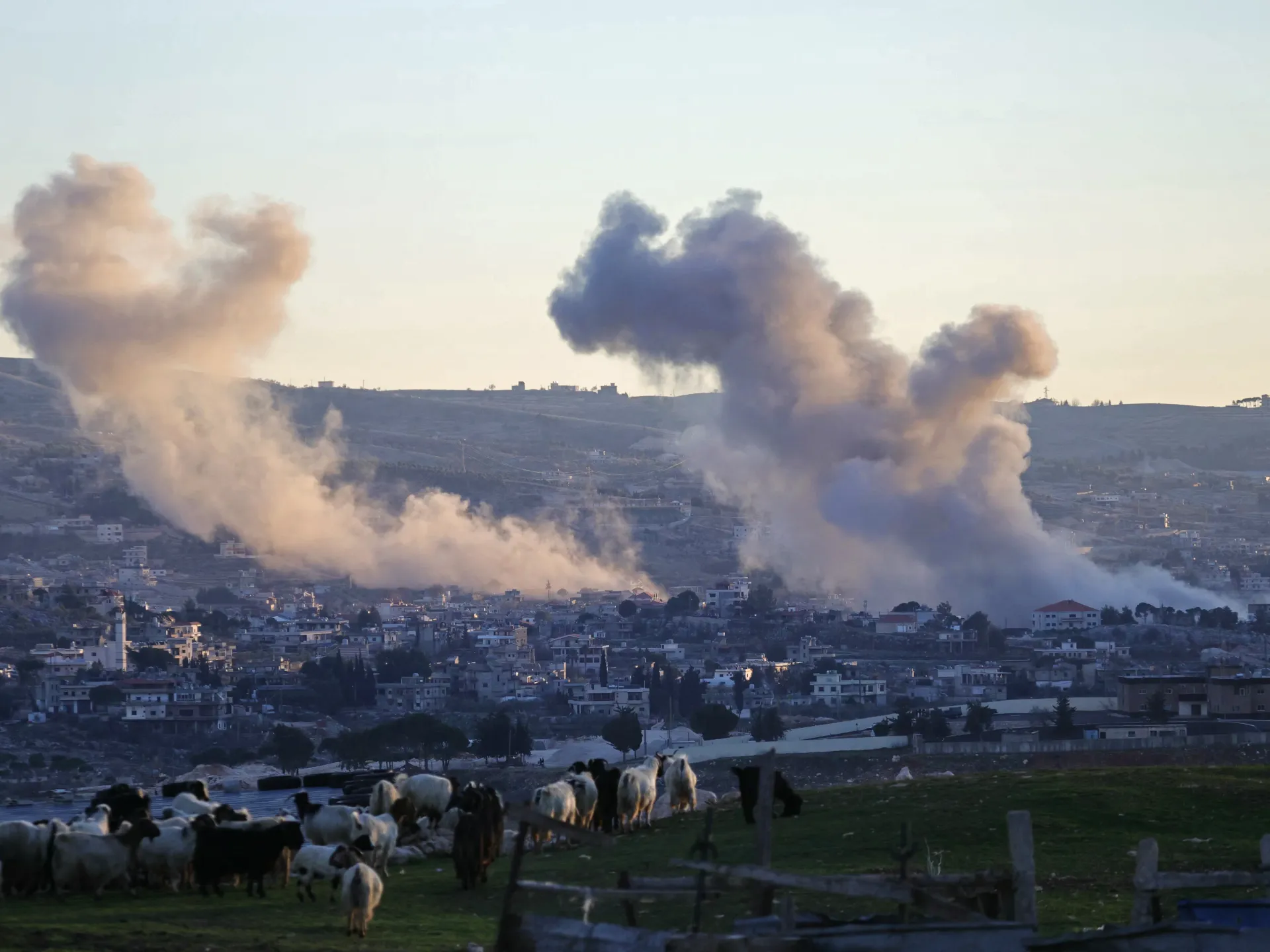
Israeli strikes on Lebanon’s Bekaa Valley have killed one person and wounded 29 others, the latest in a series of ceasefire violations.
Lebanon’s Ministry of Health announced that a “16-year-old Syrian boy was killed”, the National News Agency (NNA) reported on Thursday. He was named as Hussein Mohsen al-Khalaf and was killed in a strike on Kfar Dan near Baalbek, the L’Orient news outlet reported.
Recommended Stories
list of 3 itemsend of list
At least 13 air strikes were recorded, four in Shmestar, five in Boudai, two in Harbata and two in the Hermel and Nabi Chit mountains, according to NNA. Several shops were damaged in the Baalbek Souk in Tallet al-Ajami.
The Israeli military said it targeted eight camps belonging to Hezbollah’s special operations unit, the Radwan Force. It said weapons and missiles were stored there and training was conducted “as part of preparations for emergency situations, and to plan and execute terrorist plots”. It said this activity was a “violation of the understandings between Israel and Lebanon”.
Ceasefire violations
Israel’s military has continued to carry out attacks in Lebanon, despite a November 2024 ceasefire with the Lebanese armed group Hezbollah that sought to bring an end to more than a year of fighting. More than 300 people have been killed since then, including 127 civilians, according to the United Nations.
Last week, at least 12 people were killed in Israeli strikes on the Bekaa Valley and the Ein el-Hilweh Palestinian refugee camp near the city of Sidon. Israel said it was targeting Hezbollah and Hamas command centres.
Lebanon filed a complaint with the UN in January, detailing a total of 2,036 Israeli violations between October and December 2025 alone. It called on the UN Security Council to compel Israel to end these actions and to fully withdraw from its borders.
Israel continues to occupy parts of Lebanon, blocking the reconstruction of border villages and preventing people from returning to their homes.
Lebanon’s government has said it has almost completed its ceasefire commitment to disarm Hezbollah south of the Litani River. It said it will need four months to complete the second phase.
However, Hezbollah has rejected this, saying it believes the disarmament in the ceasefire agreement only applies to areas south of the river.
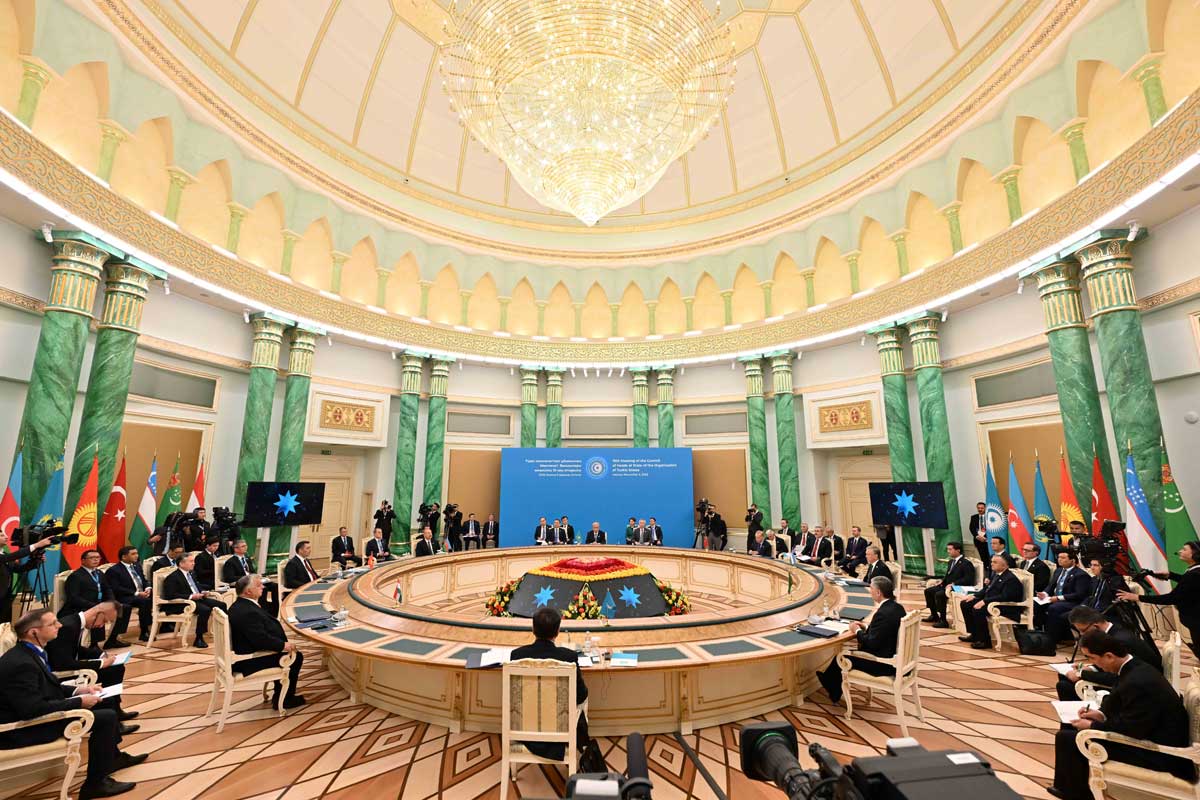
The 10th summit of the Organization of Turkic States (OTS) was held on November 3 in Astana, the capital of Kazakhstan. The main theme of this year’s summit was ‘Turk Time’. The organization, which has set goals such as the long-term Vision of the Turkic World 2040 and the short-term Strategic Roadmap of the OTS 2022-2026, has added a new vision with ‘Turk Time’. So, is the Turk Age possible in the 21st century? Could Turks become an effective political center in the new era? Is Turk Time just a slogan? Or is it based on reality?
Turmoil in the Current Global System gave birth to the Organization of Turkic States
The 2008 economic crisis, the COVID-19 pandemic, and the weakening of United States (US) hegemony that emerged with its military withdrawal from Afghanistan and Iraq left great chaos and a vacuum in international order.[1] Especially with the COVID-19 pandemic and the US debt ceiling crisis, the US hegemony tool, dollar hegemony, has suffered a major shake-up and has become controversial.[2] This vacuum and chaotic environment triggered an effort to build a new alternative order for countries that were uncomfortable with the existing international order, and to gain a position in the new order to be established. As the rise of Asian economies continued in the global economy, organizations such as the Shanghai Cooperation Organization and BRICS accelerated the construction of an alternative multipolar order. The world was divided into two camps: defenders of the old unipolar world order and proponents of the new multipolar world order. The weakening of US hegemony and global chaos paved the way for the OTS. The transformation of the organization in 2021 coincided with the US troop withdrawal from Afghanistan and Azerbaijan’s victory in the Second Nagorno-Karabakh War.
Turkey, in particular, plays a decisive role in the OTS. In recent years, Turkey has experienced sharp ruptures in its relations with the US, EU, and NATO. The weakening of Turkey’s relations with the West is a reflection of the decline of US hegemony in the global order. At the same time, Turkey’s increasing cooperation and friendship with Russia and China played a positive role in the establishment of the OTS. The organization should be seen as an attempt to become part of a multipolar world order. For example, Turkish President Recep Tayyip Erdogan’s statement that the world is bigger than five is an expression of the need to build a just multipolar world order. As the Turkic states increase cooperation, trade, and prosperity among themselves, they serve regional peace and the establishment of a just order. With the OTS, Turkey aims to increase prosperity in the region, improve infrastructure, maintain a common culture, and increase its defense and counter-terrorism cooperation capabilities. Turkey’s objectives in the OTS in Central Asia are an effort to take part in a multipolar world that will strengthen peace and prosperity. President Recep Tayyip Erdogan aims to continue the Turk Time with Turkey and for the Turkic world to become the world’s rising power.[3] Turkey wants to be a subject, not an object, in the multipolar order. In sum, Turkey is trying to play a stronger role in the new international system to be established by establishing good relations with the advocates of the multipolar world order.
Organization Strengthens by Institutionalizing
After the transformation of the Cooperation Council of Turkic Speaking States into the OTS with the Istanbul summit in 2021, the organization entered the process of building a stronger institutional infrastructure. Analyzing the outcomes of the Astana Summit, efforts to complete the institutionalization of the organization stand out. This year, the organization continued to increase institutionalization in areas such as the Civil Protection Mechanism, the Turkic Judicial Training Network, the Union of Notaries of the Turkic World, the Turkic Investment Fund, and the Organization of Trade Unions of Turkic States. The final declaration expresses satisfaction with the activities carried out within the framework of the organization in one year.[4] For example, the Alliance of Turkic News Agencies (ATNA) was established after the summit between Turkey’s news agency Anadolu Agency (AA), Azerbaijan State News Agency (AZERTAC), Kyrgyz National News Agency (Kabar), Uzbekistan National News Agency (UzA), and Kazakhstan’s news agency Qazcontent. After the establishment of ATNA, Binali Yıldırım, Chairman of the OTS Council of Elders, said: “We aim to bring the truth to the people in the fastest way and to prevent colonialist countries from covering the events. Serdar Karagöz, who was elected president of ATNA, emphasized the importance of combating disinformation.[5] In short, in the field of media, OTS has placed establishment of a media network that will challenge the media of the unipolar world and represent the oppressed at its center. During the next few years, it is possible to predict that the organization will institutionalize in various fields.
The organization Aims to Strengthen Trade
There are two important cooperation areas between the member states of the OTS. The first is the development of cooperation in the energy field. Turkic states are rich in valuable minerals such as energy, natural gas, oil, and uranium. Therefore, the member states of the organization tend to deepen their cooperation in the field of energy. The second meeting of the OTS Working Group on Energy Cooperation of the Ministers Responsible for Energy of the OTS was held on September 28, 2022, in Almaty, Kazakhstan. The parties adopted the OTS Energy Cooperation Program and the related action plan for 2023-2027, which includes the exchange of information and ideas on legislation and national programs in the energy sector, renewable and alternative energy sources, fossil fuel energy, nuclear energy, energy efficiency, dissemination of new technologies, capacity-building programs, and enhancing cooperation in the international arena. Turkish Foreign Minister Hakan Fidan emphasized the importance of making efforts to make the Middle Corridor even more attractive for investment and to transport trans-Caspian resources, particularly Turkmen gas, to Turkey and Europe. Strategic energy infrastructure projects such as the Organization, Baku-Tbilisi-Ceyhan, Baku-Tbilisi-Erzurum, Southern Gas Corridor, Trans Anatolian Natural Gas Pipeline Project (TANAP), and Trans Adriatic Pipeline Project (TAP) contribute to the prosperity of Turkic states and European and global energy security. [6]
The second is to take steps to strengthen trade along the Silk Road belt. The member states of the OTS had a trade volume of $ 700 billion. However, only $ 18 billions of this trade volume is carried out among the member states themselves. This situation is the main driving factor in the establishment of the organization. Because Turkey and the member states are determined to develop trade among themselves. The member states of the organization focus on removing or facilitating trade barriers among themselves. Eliminating trade barriers and providing infrastructure investments on roads. In this respect, there is no other way but to work in harmony with the Belt and Road Initiative of the OTS. The implementation of the Action Plan for the Implementation of the 2023-2027 OTS Transport Connectivity Program adopted at the Astana summit is expected to significantly increase the transit potential of the Middle Corridor and make Caspian transits smoother.
The establishment of the Turkish Investment Fund was on the agenda at the Istanbul Summit. During the two-year period of the organization, sub-commissions carried out infrastructure work to establish the Turkish Investment Fund. On March 16, 2023, the Agreement on the Establishment of the Turkish Investment Fund was signed at the Extraordinary Summit of the OTS held in Ankara. Before the Astana summit, Turkey voted the proposal for the establishment of the Turkish Investment Fund as a law in its parliament: “The capital participation commitment of the Republic of Turkey to the Turkish Investment Fund and the payments to be made within the framework of this commitment cannot exceed the equivalent of USD 100,000,000.[7] The President is authorized to increase the amount up to five times. Thus, the OTS has gained an institutional structure to finance its investments among itself. All of these developments are efforts to increase the economic trade volume of the organization and strengthen economic cooperation.
Russia, Iran, and China should be part of the OTS
The fate of Turkic states depends on the revival of the Silk Road and the Belt and Road Initiative. Historically, trade flowing from China to Europe via the Silk Road played an important role in enriching Turks and building powerful states. Today, China, the world’s second-largest economy, has regained its historical position. The revival of the historical Silk Road plays an important role in the revival of the Turkic world. There must be an air of unity in Eurasia in order for the OTS to succeed. In this respect, the accession of Iran, Russia, and China, which have Turkic-speaking peoples, to the OTS will add significant strength to the organization. There is already such an expectation in the OTS. Chairman of the Council of Elders of the OTS Binali Yıldırım stated that China and Russia are natural members of the OTS.[8]
The sanctions against Russia in the aftermath of Russia’s operation in Ukraine have highlighted the strategic importance of the Middle Corridor.[9] Moreover, although 96 percent of the trade from China to Europe is by sea, the US continues to blockade the South China Sea. Currently, the Middle Corridor is the safest port for trade flow. The most important goal of the OTS is to make the Middle Corridor more active. “We should also pay special attention to the development of transport networks between our countries. With this understanding, we continue our efforts to activate the Caspian Trans-Caspian East-West Middle Corridor. We should strengthen our cooperation in removing obstacles to transportation and trade, enriching transportation networks, facilitating border crossings, and visa procedures”.[10]
Conclusion
The world is on the brink of a global rupture, and OTS is an organization that emerged on the brink of this global rupture. Shortly after the Republic of Turkey celebrated its 100th anniversary on October 29, the OTS organized a summit with the theme of ‘Turk Time’, which reflects the expectation of Turks to become a global actor for the 200th year. To achieve this goal, the Organization of Turkic States must unite in Eurasia. In this respect, it is vital for the OTS to strengthen its cooperation with China, Iran, and Russia. These states are the leading powers of Asia and home to Turkic-speaking peoples. Economically, the Middle Corridor is vital for the OTS. Trade between China and Europe passes through Central Asia via railroads, which indicates the revival of the historic Silk Road. Controlling the Silk Road, the OTS can regain its historical role, gain a geopolitical advantage, and become an important figure in world politics. Turks have always had their own special goals, called the ‘Red Apple’. The Ottoman Sultan Mehmet the Conqueror set the conquest of Istanbul and the establishment of a new Roman Empire as the Red Apple. In the 16-18th centuries, the Ottoman Sultans identified the conquest of Vienna and Rome as the Red Apple. In the 20th century, Turkist ideologues had the Red Apple of establishing a Turan State. In the 21st century, it is clear that the Turks’ Red Apple is the greatest ideal to be a center in the multipolar world order under the slogan of ‘Turk Time’.
The views contained in this article are the author’s alone and do not represent the views of Shanghai University.
[1] Francis Fukuyama, Francis Fukuyama on the end of American hegemony, 8 November 2021, https://www.economist.com/the-world-ahead/2021/11/08/francis-fukuyama-on-the-end-of-american-hegemony
[2] CFR, The Future of Dollar Hegemony, 22 August 2023, https://www.cfr.org/blog/future-dollar-hegemony
[3] Türkiye Yüzyılı’nda ‘Türk Devri’ başlıyor, 3 November 2023, https://www.trthaber.com/haber/gundem/turkiye-yuzyilinda-turk-devri-basliyor-809286.html
[4] Organization of Turkic States, “Declaration of the Tenth Summit of the Organization of the Turkic States”, 3 November 2023, https://www.turkicstates.org/assets/pdf/haberler/astana-declaration-3113-215.pdf
[5] AA, “Türk Haber Ajansları Birliğinin ilk genel kurulu yapıldı”, 6 November 2023, https://www.aa.com.tr/tr/kurumsal-haberler/turk-haber-ajanslari-birliginin-ilk-genel-kurulu-yapildi/3045736#
[6] Türkiye İletişim Başkanlığı, 21. Yüzyılın Parlayan Yıldızı: Türk Devletleri Teşkilatı, İstanbul, Cumhurbaşkanlığı İletişim Başkanlığı Yayınları: 2023
[7] Resmî Gazete, Türk Yatırım Fonu Kuruluş Anlaşmasının Onaylanmasının Uygun Bulunduğuna Dair Kanun, 11November 2023, https://www.resmigazete.gov.tr/eskiler/2023/11/20231111-1.htm
[8]Sputnik, Aksakallılar Konseyi Başkanı Yıldırım: Rusya ve Çin Türk Devletleri Teşkilatı’nın doğal üyesidir, https://tr.sputniknews.com/20211126/aksakallilar-konseyi-baskani-yildirim-rusya-ve-cin-turk-devletleri-teskilatinin-dogal-uyesidir-1051186836.html
[10] Türkiye Cumhuriyeti Cumhurbaşkanlığı, “Türk dünyasının barışı, refahı ve güvenliği yönünde adımlar atmayı sürdüreceğiz”, 3 November 2023, https://www.tccb.gov.tr/haberler/410/150055/-turk-dunyasinin-barisi-refahi-ve-guvenligi-yonunde-adimlar-atmayi-surdurecegiz-
Tehran, Iran – Another round of indirect talks between Iranian and United States officials ended with a mediator claiming “significant progress” but still no clear evidence that either side was willing to concede enough on their positions to avoid war.
After the conclusion of the talks in Geneva on Thursday, Iranian Foreign Minister Abbas Araghchi said further technical talks would be held next week in Vienna and progress had been “good”.
Recommended Stories
list of 3 itemsend of list
“These were the most serious and longest talks,” Araghchi said.
Omani Foreign Minister Badr bin Hamad Al Busaidi, who mediated the talks, said Iranian and US diplomats would consult with their governments before the Vienna talks.
Few details have emerged about the discussions, but Araghchi was reported to have met US envoy Steve Witkoff – if only briefly, according to Iran’s Tasnim news agency.
The Iranian team, led by Araghchi, handed over on Wednesday night Tehran’s written proposals to Al Busaidi, who also mediated previous rounds of talks in Geneva and Muscat.
The Omani diplomat then met with the US delegation on Thursday, led by Witkoff and US President Donald Trump’s son-in-law Jared Kushner. Al Busaidi mediated between the two teams throughout the day, and the US delegation also held separate talks over Ukraine.
Also taking part in the talks was Rafael Grossi, the director general of the International Atomic Energy Agency (IAEA), which will have to undertake nuclear monitoring and verification duties in Iran in case of any agreement.
The UN watchdog will hold several days of board meetings starting on March 6, which is around the 10- to 15-day deadline floated by Trump last week for Iran to reach a deal.
Western media outlets have suggested the board could once again consider a move to censure Iran depending on the results of the Geneva talks. Iran has accused Grossi of taking politicised action and criticised the IAEA after Israel attacked Iran in June, one day after the agency passed a resolution saying Tehran was not complying with its commitment to nuclear safeguards.
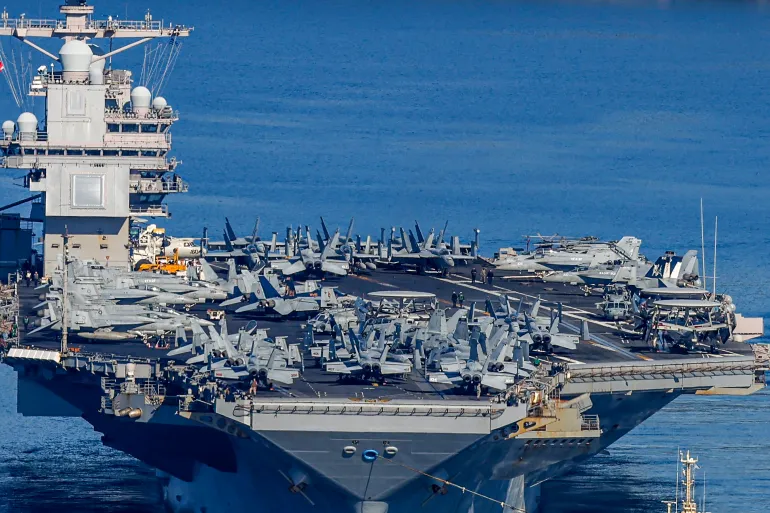
The US Navy aircraft carrier USS Gerald R Ford departs Souda Bay on the island of Crete on February 26, 2026, for the coast of Israel, leading a second US carrier strike group to take up positions against Iran [Costas Metaxakis/AFP]
Fundamental differences
The two sides have been at odds over key issues, including uranium enrichment and missiles.
Washington has repeatedly emphasised, in lockstep with Israel, that it will not accept any nuclear enrichment taking place on Iranian soil, even at civilian-use levels agreed during the 2015 nuclear deal that Iran agreed with world powers. Trump unilaterally abandoned that deal in 2018.
In the days leading up to the Geneva talks, US officials increasingly focused on Iran’s ballistic missile programme, saying the missiles threaten US military bases across the Middle East as well as Israel. Iran has refused to entertain any talks on its conventional weapons. Iranian officials, including President Masoud Pezeshkian, have repeatedly said they will never develop nuclear weapons.
Speaking to local officials during a provincial visit, Pezeshkian also shot back at Trump’s assertion during a lengthy State of the Union speech that Iran was “the world’s number one sponsor of terror”.
Pezeshkian said numerous Iranian officials and nuclear scientists have been assassinated over the decades, particularly in the immediate aftermath of the country’s 1979 Islamic revolution.
“If the realities are seen fairly, it will become clear that Iran is not only not a supporter of terrorism, but one of the main victims of terror in the region and across the world,” he said.
The Iranian government’s IRNA news agency said Tehran’s proposal was expected to gauge US “seriousness” in the talks because it contained “win-win” offers.
Iranian officials have not publicly discussed all the details of their proposals, but they are believed to include diluting part of the country’s 60-percent enriched uranium and keeping the uranium inside the country. Iranian authorities envisage that could be paired with economic opportunities for the US related to Iranian oil and gas and the purchase of airplanes.
People shop at Tajrish bazar in Tehran on February 21, 2026 [Majid Saeedi/Getty Images]
Supreme Leader Ali Khamenei has maintained his tough rhetoric against the US as well, casting doubt on the chances of any agreement. He also said Trump would be unable to overthrow Iran’s government after the US president said regime change would be “the best thing that could happen” in Iran.
Araghchi said during an interview on Wednesday that even if Khamenei is killed, the theocratic establishment in Iran would carry on because it has legal procedures in place to appoint a successor. Pezeshkian added on Thursday: “They can eliminate me, eliminate anyone. If they hit us, a hundred more like us will come up to run the country.”
Double-digit inflation as Iran braces for war
Iranian and US officials have been hailing supposed “progress” in the indirect talks this month, but many Iranians continue to prepare for war.
In Tehran and across the country, people are buying bottled water, biscuits, canned foods and other essentials in case of a war.
“A few days ago, I bought a power bank to keep the electronics charged. Now I’m looking for a short-wave radio so we can hear the news if the state shuts down the internet and electricity infrastructure is bombed,” said a 28-year-old resident of the capital who asked not to be named.
As bombs fell during the 12-day war with Israel in June, Iranian authorities cut off almost all internet access for several days, followed in January by an unprecedented 20-day total blackout imposed on about 92 million people as thousands of people were killed during nationwide protests.
The Iranian government, which blames “terrorists” armed and funded by the US and Israel for the protests, has rejected Trump’s claim that 32,000 Iranians were killed during the demonstrations. It said more than 3,000 people were killed, and rejects documentation by the United Nations and international human rights organisations that its security forces were behind the killings.
As the threat of war intensifies, not all Iranians are capable of stocking up on food and other necessities due to rising inflation that has gripped the country for more than a decade as a result of a mix of chronic local mismanagement and US and UN sanctions.
According to separate reports by the Statistical Centre of Iran and the Central Bank of Iran released on Thursday, inflation has now shot beyond 60 percent.
The Statistical Centre put annual inflation in the Iranian month of Bahman, which ended on February 19, at 68.1 percent, while the Central Bank said it was 62.2 percent.
Food inflation was by far the strongest driver at a whopping 105 percent. That included a 207-percent inflation rate for cooking oil, 117 percent for red meat, 108 percent for eggs and dairy products, 113 percent for fruit and 142 percent for bread and corn.
Iran’s national currency, the rial, stood at about 1.66 million rials to the US dollar on Thursday, near an all-time low.
Venezuelanalysis editor Ricardo Vaz joined Ileana Chan on the Global Majority for Peace podcast to take stock of Venezuela’s political reality following the January 3 US attacks and kidnapping of President Nicolás Maduro.
The discussion focuses on the long history of imperialist attacks against the Bolivarian Revolution and the US’ efforts to take control of the Venezuelan oil industry.
Narendra Modi’s visit to Israel has drawn criticism at home amid tensions over Israel’s genocidal war on Gaza.
Published On 26 Feb 202626 Feb 2026
Share
Prime Minister Narendra Modi says India and Israel will collaborate more closely on defence technology while pursuing a free trade agreement, as he wrapped up a controversial two-day visit.
Modi and his Israeli counterpart Benjamin Netanyahu said at a joint news conference in Jerusalem on Thursday that they would also foster collaboration on technologies, such as artificial intelligence and cybersecurity, as their countries concluded more than a dozen bilateral agreements.
Recommended Stories
list of 3 itemsend of list
“The future belongs to those who innovate and Israel and India are bent on innovation,” said Netanyahu. “We’re proud ancient civilisations, very proud of our past. But absolutely determined to seize the future, and we can do it better together.”
A joint statement highlighted cooperation in the field of “horizon scanning”, describing it as a mechanism that “helps identify emerging global trends in areas like technology, economy and society, by leveraging data”.
Israel also agreed to allow 50,000 more Indian nationals into the country, where tens of thousands of South Asians have filled construction and caregiving jobs since new restrictions were placed on Palestinian workers at the start of its war on Gaza.
Strategic embrace
Modi’s visit, his second since he took office in 2014, has drawn criticism at home, signalling an ongoing expansion of India’s strategic embrace of Israel amid ongoing tensions over Israel’s genocidal war against Palestinians in Gaza, which has killed more than 72,000 people.
Confirming their growing ties, the leaders’ joint statement referenced the Hamas-led attack on Israel on October 7, 2023, and an April 2025 attack on tourists and civilians in Pahalgam, in Indian-controlled Kashmir.
“Terrorism cannot be accepted in any form or expression,” said Modi, who has historically supported the establishment of a Palestinian state yet has sometimes abstained from criticism of Israel in international forums, including the United Nations.
Earlier this month, India was among the countries that condemned Israeli measures to effectively deepen its control over the occupied West Bank.
Both countries also lauded United States President Donald Trump’s plan to advance the “ceasefire” in the Gaza Strip.
The United Kingdom’s government is investing in spyware developed and tested on Palestinians in Gaza and the occupied West Bank despite its public criticism of Israeli action there.
In addition to the Corsight facial recognition technology used to track, trace and detain thousands of Palestinian civilians passing through checkpoints in Gaza and the West Bank, the UK government has disregarded its own public concerns over Israel’s war on Gaza and de facto annexation of the West Bank and has purchased spyware from at least two other Israeli-linked manufacturers: Cellebrite and BriefCam.
Recommended Stories
list of 4 itemsend of list
Cellebrite
Cellebrite is an Israeli company closely linked to that country’s military. It has developed software that can bypass passwords and security protocols on smartphones and computers and access data from them.
That software has been used extensively by the Israeli military on Palestinians across Gaza and the West Bank, including to harvest data from the phones of thousands of detained Palestinians, many of whom have been subjected to systematic torture, a report by the American Friends Service Committee said.
Cellebrite is also reported to have received support from the United States Department of Defense to work on technology designed to map underground tunnels in the Gaza Strip.
Despite its stated public concerns over Israeli action in Gaza and the West Bank, records show the UK has entered into several agreements to take advantage of the technology used by Israel in Palestinian territory.
According to public records, a number of UK police forces have purchased access to Cellebrite software, including the City of London Police, which renewed its one-year contract with the Israeli company for more than 95,000 pounds ($128,600) in June. Leicestershire Police also renewed its contract with the Israeli spyware company in March for 328,688 pounds ($445,300). The British Transport Police, the UK’s Serious Fraud Office, Kent and Essex police, and Northumbria Police have also entered into contracts with Cellebrite.
Inquiries from Al Jazeera to the UK Home Office, Home Secretary Shabana Mahmood and the UK Police’s commercial agent, Blue Light Services, have all gone unanswered.
However, while declining to comment on “specific customer relationships or contracts”, Victor Cooper, Cellebrite’s senior director of corporate communication, rejected the characterisation of the company’s activities as “hacking”, instead saying, “Cellebrite’s solutions are forensic tools used in legally sanctioned investigations and require physical possession of the device. They do not enable remote access.”
Rights groups have raised concerns over Cellebrite exporting its technology to hardline states worldwide, including Myanmar, Serbia and Belarus, where it has been used to extract information from the phones of opposition figures, journalists and activists.
BriefCam
The Israeli-founded company BriefCam, which was acquired by Canon in 2018 and then by the Danish company Milestone Systems last year, has been providing the UK’s Cumbria Police with surveillance software since at least 2022.
A further disclosure by Police Scotland in June confirms that Scotland’s police service is also considering using the service.
BriefCam was founded in 2007 by Shmuel Peleg, Gideon Ben-Zvi and Yaron Caspi based on technology developed at Israel’s Hebrew University.
The company provides video synopsis programmes to law enforcement agencies, governments and companies. Police forces and private firms can use BriefCam’s Protect & Insights platform to sift through and condense hours of CCTV and home-surveillance footage, making it easily searchable.
The system includes facial-recognition and licence-plate search tools and allows police to build “watch lists” of specific faces or vehicle plates.
The technology has been used in East Jerusalem, Palestinian territory illegally occupied by Israel.
According to undated files accessed by the research centre Who Profits, a tender document published by the Israeli Ministry of Housing and Construction inviting companies to bid for maintenance contracts for 98 security systems within East Jerusalem specified that the successful bidder must be able to maintain BriefCam’s software. Israeli public records also show that in 2021, Israeli police committed to a contract valued at $1m for BriefCam’s video analysis systems.
A May 2023 report by the rights group Amnesty International documented how surveillance technology, such as that provided by BriefCam, was instrumental in maintaining Israel’s subjugation of Palestinians.
According to the report, the use of surveillance software is critical in maintaining the “continued domination and oppression of Palestinians … [w]ith a record of discriminatory and inhuman acts that maintain a system of apartheid”.
While not mentioning BriefCam by name, the report continued: “The Israeli authorities are able to use facial recognition software – in particular at checkpoints – to consolidate existing practices of discriminatory policing, segregation, and curbing freedom of movement, violating Palestinians’ basic rights.”
According to the company, the software can also filter footage by a wide range of characteristics, including gender, age group, clothing, movement patterns and time spent in a given location.
And that, despite the technology’s links to the oppression of Palestinians, is what makes it attractive to UK police forces.
Cumbria Police has said it does not currently use the facial recognition capabilities of BriefCam’s technology.
A spokesperson for Cumbria Police also clarified that the force has been using BriefCam for “several years” and, before introducing the technology, it had “consulted Cumbria’s independent Ethics and Integrity Panel and Strategic Independent Advisory Group”.
A request for a copy of those findings went unanswered.
Police officers are deployed in occupied East Jerusalem, where, records show, technology supplied to the UK has been used extensively [File: Atef Safadi/EPA]
Corsight
As previously reported by Al Jazeera, the Israeli company Corsight, through a subcontract with UK company Digital Barriers, has also been selected by the UK Home Office to play a key role in its expansion of facial recognition vans.
In March 2024, long before the UK government chose to include Corsight within its rollout of facial recognition technology, The New York Times revealed that misgivings over Corsight’s facial-recognition technology in Gaza had led to various members of the Israeli military voicing objections to its use by Unit 8200, Israel’s cyberintelligence branch.
The expansion of systems such as those marketed by Corsight, Cellebrite and BriefCam is part of a global trade in Israeli spyware, developed and refined through prolonged surveillance of Palestinians, that is now being exported worldwide.
Rights groups warned that techniques pioneered in Israel are being used by governments to target activists, journalists and political opponents as concerns deepen over the spread of unregulated cyberwarfare tools.
“The government and police should not be awarding contracts to Israeli spyware firms under any circumstances,” Palestine Solidarity Campaign Deputy Director Ryvka Barnard told Al Jazeera. “These companies develop and test their products through Israel’s regime of military occupation and apartheid against Palestinians. It is unacceptable for public money to be given to these companies, allowing them to profit from and develop new products used to surveil and harm Palestinians.”
The continuous clashes between the M23 rebels and the security forces of the Democratic Republic of Congo (DRC) have caused massive displacements and unrest in various communities. Thousands have sought refuge in Ngungu, located in the Bahunde area of the Masisi Territory in North Kivu.
Displaced families arriving in central Ngungu are facing increasingly difficult situations and strained reception from local residents. Humanitarian workers in the area told HumAngle that the continued influx of displaced people is putting overwhelming pressure on host households in Ngungu.
“Receiving families share the little they have with arriving families, but the situation is becoming untenable,” a humanitarian worker who asked for anonymity for security reasons said. “In several quarters of Ngungu, modest households are currently obliged to welcome three extra families, and promiscuity, lack of food, and insufficient potable water are complicating the daily lives of the displaced persons, who are composed mostly of women and children.”
Local sources said affected communities have received no government intervention, as individuals survive through communal solidarity in an already fragile economic situation.
Community leaders said they have reached out to humanitarian organisations for urgent assistance. Their immediate priorities include distributing food and essential supplies, ensuring access to clean drinking water, and providing healthcare for vulnerable individuals.
“Despite their own personal difficulties, the inhabitants of Ngungu continue to show proof of solidarity towards the displaced persons. The people are organising communal initiatives to share food and temporary shelter,” a local community leader revealed.
Local civic actors stress that while solidarity is commendable, it cannot sustain itself in the long term without structured external assistance. Given the profound needs and increasing vulnerability of displaced persons, the residents of Ngungu are hopeful for a swift response from humanitarian partners to prevent a worsening of the humanitarian crisis in North Kivu.
The ongoing conflict between M23 rebels and DRC security forces has led to significant displacement, with thousands seeking refuge in Ngungu, Masisi Territory, North Kivu. The influx has strained local resources, as residents, despite their limited means, share what they have with displaced families, primarily women and children, leading to overcrowding and scarce access to essentials such as food and potable water.
No government support has reached these communities, necessitating reliance on communal solidarity. Community leaders have requested urgent intervention from humanitarian organizations to address pressing needs like food, clean water, and healthcare. Although the local population is organizing efforts to provide support, leaders emphasize that external assistance is critical to sustain these efforts and prevent further deterioration of the humanitarian situation.
The 2026 Annual Sessions of the National People’s Congress and the Chinese People’s Political Consultative Conference (CPPCC), known as the “Lianghui,” are a pivotal event. They will witness the official launch and final adoption of China’s 15th Five-Year Plan (2026-2030). This plan serves as a roadmap not only for China but also for countries of the Global South, focusing on the shift from quantitative growth to “new qualitative productive forces” based on innovation and technology. It is worth noting that formulating medium- and long-term plans to guide China’s economic and social development is a crucial method of governance employed by the Communist Party of China.
The “Two Sessions” meetings (National People’s Congress and the Chinese People’s Political Consultative Conference) in China in 2026 represent a strategic focal point for the Global South, outlining the 15th Five-Year Plan, supporting high-quality development through new productive forces, and strengthening trade partnerships, particularly in the areas of energy, transportation, and the digital economy. Its importance to the Global South lies in China’s leadership of economic integration. China aims to promote openness and cooperation, providing an opportunity for the Global South to benefit from the growth of the world’s second-largest economy. Here, (The Global South’s benefit from China’s innovative development models): During the Two Sessions in March 2026, China will present a model of governance and technological innovation that developing countries and countries of the Global South can utilize to achieve sustainable development and digital transformation. Additionally, China’s 15th Five-Year Plan and the Two Sessions in March 2026 will strengthen the foundations for trade between China and the Global South in particular: These meetings will pave the way for China to enhance trade with countries of the Global South in Asia, Africa, and the Middle East, supporting infrastructure and economic growth in the Global South under China’s leadership. Most importantly, the Two Sessions in March 2026 and China’s 15th Five-Year Plan will support the Asia-Pacific region and the Belt and Road Initiative. China’s Vision 2026 focuses on “building a community with a shared future,” promoting investment projects and economic exchanges with developing countries. Therefore, the upcoming two-day meeting in China in March 2026 is crucial in guiding the Chinese economy towards domestic consumption and innovation, opening new markets and opportunities for developing countries in the Global South.
This tenth five-year plan represents China’s economic and social roadmap for the second half of the current decade, emphasizing “high-quality development” and technological innovation that will benefit developing countries in the Global South. Thus, during the 2026 meetings, China will work to “promote the joint construction of the Belt and Road Initiative with high quality.” This “Chinese-style modernization” will contribute to creating more development opportunities for countries around the world, especially those in the Global South, in accordance with President Xi Jinping’s principles of a shared future for mankind, win-win cooperation, and mutual benefit for all, particularly developing countries. The developing world. It aims to achieve the goal of General Secretary of the Communist Party of China Xi Jinping of doubling the size of China’s national economy by 2030. To this end, the State Council of China held a plenary meeting on February 6, 2026, to review the draft government work report and the draft 15th Five-Year Plan before submitting them to parliament during the joint sessions of the two councils in March 2026. The annual session of the National People’s Congress (NPC) to discuss the draft 15th Five-Year Plan is scheduled to begin on March 5, 2026, while the session of the Chinese People’s Political Consultative Conference (CPPCC) will commence on March 4, 2026.
The meetings of the National People’s Congress (NPC) in March 2026 are of exceptional importance, as they mark the official launch of the 15th Five-Year Plan (2026-2030). These meetings, known as the “Two Sessions,” will chart China’s economic and political course for the second half of the current decade, with a focus on transitioning to “new productive forces.” The strategic significance of the Two Sessions in China in 2026 stems from adopting the Decade Roadmap: The 15th Five-Year Plan serves as a crucial link in achieving China’s goal of socialist modernization by 2035. Furthermore, the meetings will address how China will respond to global challenges: These meetings come at a time when China is facing a slowdown in global growth, geopolitical tensions, and internal structural pressures. With a discussion of the (mechanisms and plans for transforming China’s economic model): The upcoming meetings of the Two Sessions in March 2026 aim to shift the Chinese economy from reliance on traditional manufacturing to an innovation- and technology-driven economy. Emphasis will also be placed on further modernizing the state’s governance system and capacity, raising the level of social civilization, enhancing cultural confidence, continuously improving the quality of life for the Chinese people, achieving new progress in providing sufficient and high-quality employment, making significant new strides in building a “beautiful China,” establishing a green lifestyle and production model, strengthening national security, and effectively promoting the construction of a “safe China” at a higher level.
The Chinese political leadership is currently laying the groundwork for the Two Sessions in March 2026, which will determine the contours of the country’s social and economic development over the next five years. Chinese President Xi Jinping held meetings with senior officials to discuss the key priorities of the new Five-Year Plan (2026-2030), while Chinese state media launched a nationwide campaign to gather public feedback. During a symposium held in April 2025 to discuss the 15th Five-Year Plan, President Xi Jinping, in his capacity as General Secretary of the Communist Party of China, emphasized that “in planning economic and social development for this period, it is essential to proactively assess the impact of changes in the international landscape on China and adapt to them by adjusting and improving the country’s economic structure.” President Xi highlighted several key areas, including ensuring economic stability by stabilizing employment, supporting businesses, and continuing China’s broad-based economic opening-up. During his speech at the April 2025 symposium to discuss China’s 15th Five-Year Plan, Xi Jinping strongly emphasized scientific and technological development. He specifically called for new, high-quality productive forces to play a more prominent role in the country’s economic revitalization. He also called for strengthening the transformation and upgrading of traditional industries, developing emerging industries, and accelerating the construction of a modern industrial system.
In a speech published in the Communist Party’s magazine “Qiushi” in July 2025, President Xi Jinping stated that “the world is undergoing changes unseen in a century, making the technological revolution and competition among major powers increasingly intertwined.” He urged the Chinese nation to consolidate its strategic advantage in the global technology race.
Herein lies the most important strategic dimension of the 15th Five-Year Plan and its impact on the Global South, through leading the technological transformation. The plan aims to achieve “self-reliance” in advanced technology fields such as artificial intelligence, quantum computing, and semiconductors. For countries in the Global South, this represents an opportunity to break the Western monopoly on technology and gain access to advanced Chinese technological alternatives. Furthermore, China offers a “high-quality development model” during the 15th Five-Year Plan period, transitioning from labor-intensive industries to smart and green manufacturing. This approach provides the Global South with an inspiring model for integrating environmental sustainability with economic growth, particularly in the areas of solar energy and electric vehicles. Finally, the plan promotes “dual-cycle development” by focusing on reducing dependence on foreign markets and boosting domestic consumption. This transformation could lead to a reshaping of global supply chains, opening new horizons for countries in the Global South to export their products to the massive Chinese market, which is expected to reach $20 trillion by 2026. Furthermore, the timing of the launch and discussion of China’s 15th Five-Year Plan presents an opportunity to enhance regional and multilateral cooperation, coinciding with China’s hosting of the APEC summit.
In 2026, the 15th Five-Year Plan will focus on (strengthening economic integration with Asia-Pacific and Global South countries), emphasizing the digital economy, transportation, and energy. Beyond its strategic security and resource implications for the Global South, the 15th Five-Year Plan includes new strategies for marine resource exploitation and deep-sea innovation, a vital area for many coastal developing countries seeking to develop their “blue economy,” drawing on China’s experience in this field.
The 15th Five-Year Plan, covering the period from 2026 to 2030, is expected to focus on enhancing economic resilience and strengthening China’s technological and innovative capabilities. It will be adopted during a plenary session of the Central Committee of the Communist Party of China. Chinese Five-Year Plans are the country’s most important policy blueprints, outlining strategic goals for economic and social development over a five-year period. These plans began with the founding of the People’s Republic of China in 1949. They define national priorities, particularly in the areas of economic growth, industrial development, education, and social development, and serve as binding guidelines for all local, regional, and national governments. China, a leading force and supporter of the Global South, draws upon its experience.
As for the main topics of discussion during the 15th Five-Year Plan, which will take place during the 2026 Two Sessions in China, legislative and political deliberations will focus on several key pillars, most importantly: how China can achieve technological independence and self-reliance. This will be accomplished by discussing mechanisms and plans for achieving “Chinese self-reliance” in critical technologies, such as advanced semiconductors, artificial intelligence, and biotechnology. This will be achieved by studying and discussing ways to strengthen scientific and technological capabilities to achieve self-sufficiency in vital industries through advanced manufacturing and artificial intelligence, transforming the manufacturing sector towards smart technologies to enhance innovation. Emphasis will be placed on China’s firm commitment to the “Made in China policy,” aiming to propel China to the forefront of a range of high-tech industries, including aerospace, electric vehicles, robotics, and communications. The discussions will also explore ways to achieve common prosperity and well-being for the Chinese people by improving living standards and ensuring a more equitable distribution of the fruits of modernization.
The 2026 meetings of the Joint Conference will also focus on structural reforms, implementing over 300 reform measures to enhance the efficiency of the Chinese national economy within a complex international environment. This year’s meetings in China will also address the “green transition,” continuing to support clean technologies such as solar power and electric vehicles, and promoting renewable energy (solar and wind) to achieve peak carbon emissions by 2030. Furthermore, they will discuss boosting domestic demand by exploring ways to encourage household consumption as a primary driver of growth, rather than relying excessively on foreign investment. The meetings will also address strengthening national security, exploring ways to bolster industrial supply chains, and ensuring water and food security for Chinese society, including the modernization of 700,000 kilometers of pipeline infrastructure. Finally, they will discuss achieving maritime development by utilizing marine resources and innovating in deep-sea technology as part of balanced regional growth.
From the preceding analysis, we understand that the two sessions of the Global Summit in China in March 2026 represent a strategic pivotal point for reshaping globalization and the developments of the Global South under China’s leadership. This will lead to a more inclusive and multipolar world, moving away from traditional economic dependence, thus strengthening China’s position as a leader and key driver of development in the Global South in the coming decade.
Recent comments by United States and Israeli officials supporting the concept of a “Greater Israel” have raised alarm bells across the region and shed light on a vision once only rarely publicly spoken about.
An interview aired last week by the American right-wing podcaster Tucker Carlson with US ambassador to Israel Mike Huckabee started the current furore. Carlson, an influential figure who has been vocally critical of Israel over the past year, repeatedly asked Huckabee whether he supported Israel controlling all the land between the Nile River in Egypt and the Euphrates River in Iraq.
Recommended Stories
list of 3 itemsend of list
Huckabee, a Christian Zionist, would not disavow the belief that the Bible promised that land to Israel – even though it now encompasses all or part of Egypt, Iraq, Jordan, Lebanon, Saudi Arabia and Syria.
“It would be fine if they took it all,” Huckabee said, leading to anger from those countries and others in the region, many of which are close US allies.
Then, speaking on Monday, Israeli opposition leader Yair Lapid said that he would support “anything that will allow the Jews a large, broad, strong land and a safe haven for us”.
“Zionism is based on the Bible. Our mandate over the land of Israel is biblical, [and] the biblical borders of the land of Israel are clear … Therefore, the borders are the borders of the Bible,” the apparently secular Israeli politician said.
So what is Greater Israel exactly? And is it really an ultimate goal for some Israeli politicians?
Defining Greater Israel
The most expansionist claim for a Greater Israel is based on a biblical verse (Genesis 15:18-21), which narrates God making a covenant with Abraham that promises his descendants the land between the Nile and the Euphrates.
That would include the Jewish people, with the tribes of Israel believed to be descended through Abraham’s son, Isaac. But it would also include the children of another of Abraham’s sons, Ishmael (Ismail), regarded as the forefather of the Arabs.
Other definitions based on different biblical verses are narrower in their territorial scope and specify that the land of Israel would be promised to the tribes of Israel descended from Isaac.
How has Israel worked to achieve expansion?
The current state of Israel emerged from the British Mandate for Palestine in 1948. The mandate, created by the League of Nations in the wake of World War I and the occupation of Palestine by the British, geographically limited Israel upon its creation.
The 1948 war that followed the end of the mandate led to Israel taking control of all of Mandatory Palestine, with the exception of the West Bank and the Gaza Strip.
But Israel soon expanded by force – in 1967 it defeated Arab forces and took control of the West Bank and Gaza, as well as Egypt’s Sinai Peninsula, and Syria’s occupied Golan Heights. Israel continues to occupy all of those regions, with the exception of the Sinai, which it returned to Egypt in 1982.
Since then, Israel has ignored international law and continued occupying Palestinian and Syrian land, and has shown little respect for its neighbours’ sovereignty, occupying more land in Syria, as well as in Lebanon.
How popular is the idea of Greater Israel?
This needs to be broken down into two separate concepts – the expansion of Israel into the territory that immediately borders it, and the most extreme definition of Greater Israel: between the Nile and the Euphrates.
In terms of expansion into its immediate surroundings, Israeli Jews by and large support the annexation of East Jerusalem, which is occupied Palestinian territory, and the Golan Heights.
The Israeli government continues to move towards the de facto annexation of the occupied West Bank. Israeli politicians vary in how open they are in their support for the formal annexation of the West Bank, but most mainstream Israeli politicians are supportive of the illegal Israeli settlements in the territory.
An expansion of Israeli settlements into Gaza is not as popular, but is supported by far-right Israeli parties.
A Greater Israel, including parts of Jordan, or the most irredentist definition between the Euphrates and the Nile, is more controversial. Pre-1948, many Zionists sought not just Palestine but also Jordan for their future state – one of the most important Zionist armed groups at the time, the Irgun, even included the map of both Palestine and Jordan in its emblem.
But after the foundation of Israel this took a back seat, and open calls for a vastly expanded Israel were largely restricted to the fringes. But those fringes – far-right figures like Bezalel Smotrich and Itamar Ben-Gvir – are now in government, reflecting a wider radicalisation within Israeli society itself.
That means the Israeli ‘mainstream’, politicians such as Prime Minister Benjamin Netanyahu and centrists like Lapid, are either more open in their support for some form of Greater Israel beyond the West Bank, or less willing to publicly oppose it.
How threatened do regional countries feel?
Regional states have said that the annexation of the West Bank would be a red line, but have been unable to reverse Israel’s occupation.
Hints at a wider expansion have led to an angry reaction from Arab countries. This goes further back than Huckabee’s recent comments. For example, Jordan condemned Smotrich – Israel’s finance minister – when he gave a speech in 2023 at a podium that displayed a map that showed Jordan as part of Israel.
And Huckabee’s support for Greater Israel was roundly condemned by more than a dozen states, including Saudi Arabia, Egypt and Turkiye.
For Arab and Muslim states, the anger at the comments partially emanates from the sense of a lack of respect towards the sovereignty of regional states by a US official. But it also highlights fears that the balance of power in the region is weighted towards an Israel that is increasingly willing to attack across the Middle East, and has little interest in peace.
Even if the takeover of the land between the Nile and the Euphrates is not feasible, a region where Israel is the primary hegemon will likely lead to more attacks, more wars, and, if Israel determines it necessary, more occupation of land.
A Palestinian mother from Gaza says she recognised her missing son, Mohammed Sharab, when he was shown shackled, blindfolded and listed as ‘for sale’ in a post shared by Israeli soldiers.
Borge Brende has resigned from his roles as the president and CEO of the World Economic Forum (WEF), following revelations of his links with the late financier and convicted sex offender Jeffrey Epstein.
Brende, a former Norwegian foreign minister who became president of the WEF in 2017, announced his departure on Thursday, joining the ranks of prominent figures to have left their jobs or faced criminal investigations after their contacts with Epstein were revealed in files released by the US Department of Justice last month.
Recommended Stories
list of 4 itemsend of list
“After careful consideration, I have decided to step down as President and CEO of the World Economic Forum. My time here, spanning 8-1/2 years, has been profoundly rewarding,” Brende said in a statement, which made no mention of Epstein.
“I am grateful for the incredible collaboration with my colleagues, partners, and constituents, and I believe now is the right moment for the Forum to continue its important work without distractions.”
Brende’s departure came several weeks after the WEF, organiser of the annual Davos summit, launched an independent investigation into his relationship with Epstein, following revelations in the files that the Norwegian had three business dinners with the financier and had also communicated with him via email and text message.
Epstein was convicted of procuring a minor for prostitution in 2008, spending about a year in prison before his release.
His contacts with a network of wealthy and influential figures continued in the wake of his conviction until an investigation into the wealthy financier was reopened in 2019. Epstein died by suicide in prison that year while facing charges of sex trafficking underage girls.
Dinners, emails
Brende said in a statement earlier this month that during a visit to New York in 2018, he received an invitation from former Norwegian politician Terje Rod-Larsen to join him for dinner with several other leaders, plus “someone who was presented to me as an American investor, Jeffrey Epstein”.
“The following year, I attended two similar dinners with Epstein, alongside other diplomats and business leaders. These dinners, and a few emails and SMS messages, were the extent of my interactions with him,” he said.
“I was completely unaware of Epstein’s past and criminal activities.”
He said that had he known about Epstein’s background, he would have declined any contact with the convicted sex offender, adding that he regretted not having conducted a more thorough investigation into his past.
Investigation concluded
In a separate statement, Andre Hoffmann and Larry Fink, co-chairs of the WEF, said the independent review conducted by outside counsel into Brende’s ties with Epstein had concluded.
The findings stated there were no additional concerns beyond what had been previously disclosed, it added.
The co-chairs said the WEF’s Alois Zwinggi will serve as interim president and CEO, and that the forum’s board of trustees would oversee the leadership transition, including a plan to identify a permanent replacement.
Arrests and resignations
Epstein had ties to a long list of business and political leaders, whose links to the disgraced figure have now come under close scrutiny, resulting in arrests and resignations.
In Norway, Thorbjorn Jagland, former prime minister and former secretary-general of the Council of Europe, has been charged with “aggravated corruption” amid an investigation into his connections to Epstein, while Rod-Larsen and his wife Mona Juul, both diplomats, have also been charged.
Crown Princess Mette-Marit, the wife of Crown Prince Haakon, heir to Norway’s throne, has also come under heavy scrutiny following the revelation of her close friendship with Epstein, issuing a public apology for her long association with him.
In the UK, prominent figures including Andrew Mountbatten-Windsor – formerly Prince Andrew – and Peter Mandelson, the former diplomat, minister, and adviser to multiple Labour Party prime ministers, have been arrested over alleged crimes linked to their relationships with Epstein.
In France, financial crimes prosecutors have opened an investigation into former Culture Minister Jack Lang, while in Slovakia, Miroslav Lajcak, former president of the UN General Assembly, resigned as security adviser to the country’s prime minister amid growing criticism over his correspondence with Epstein, uncovered in the files.
Aiden Markram smacked 82 not out off 46 balls as South Africa beat West Indies by nine wickets to maintain their unbeaten record at the 2026 T20 World Cup.
South Africa’s captain struck seven fours and four sixes as South Africa chased 177 with 23 balls to spare to move two points clear at the top of Group 1 in the Super 8s and put one foot in the semi-finals.
The 31-year-old, who brought up his half-century off 27 balls, shared a 95-run opening stand with Quinton de Kock (47 off 24) before the wicketkeeper was removed by Roston Chase in the eighth over. Ryan Rickelton chipped in with a quickfire 45 not out off 28 at number three.
Markram sealed South Africa’s fifth win of the tournament in Ahmedabad with his 11th boundary.
The victory puts the Proteas on the verge of the semi-finals without making them mathematically sure. They will go through if India beat Zimbabwe in Thursday’s other game. West Indies play India in their final match of the group knowing a defeat will likely eliminate them.
South Africa, finalists in 2024, should have been chasing a significantly lower total after taking four wickets in the powerplay and later reducing West Indies to 83-7.
However, the two-time champions fought back through Romario Shepherd and Jason Holder, who put on 89 (57) for the eighth wicket to drag West Indies beyond 170.
After smacking spinner Keshav Maharaj’s opening over for 17, West Indies, who piled on 254-6 against Zimbabwe in their Super 8 opener on Monday, lost four wickets in 11 balls to slump from 29-0 to 43-4 inside four overs, with Kagiso Rabada and Lungi Ngidi collecting two wickets apiece.
Sherfane Rutherford, who couldn’t capitalise on being dropped on three, Rovman Powell, and Matthew Forde joined the procession back to the dressing room before Shepherd and Holder came together in the 11th over.
After rebuilding steadily, the pair burst into life from the 15-over mark, Shepherd accelerating from 21 (17) to finish unbeaten on 52 (37) and Holder reaching 49 (31) before being run-out off the penultimate ball of the innings.
They added 58 runs off the final five overs, including Holder taking the 18th, bowled by Marco Jansen, for 23.
From Eduard Cauich: Gerardo Tavárez has been counting down the days for months.
The 25-year-old Los Angeles resident planned the perfect summer for his family.
He will get married on June 6, five days before the start of the World Cup. His honeymoon will be in Mexico, where he will watch the Mexican national team’s debut at Azteca Stadium in Mexico City and a second match between Mexico and South Korea in Guadalajara, alongside his father, brother, future wife and young son.
The plan seemed set in stone. Until this week.
After the Mexican army killed Nemesio Oseguera Cervantes, the leader of the Jalisco New Generation Cartel known as “El Mencho,” violence erupted in the state of Jalisco on Sunday, including roadblocks and vehicle fires. Images of smoke rising over Guadalajara quickly circulated on social media, sowing doubts among some planning to travel to Mexico for the World Cup.
According to Mexican authorities, more than 60 people, including 25 soldiers, died during the operation to capture the criminal leader.
“I’m more than worried. I’m nervous. I’m scared,” said Tavárez, born in Los Angeles to parents from Jalisco and a diehard fan of the Mexican national team.
From Jack Vita: Roki Sasaki took the mound Wednesday, looking to build off the success he enjoyed late last season, as he enters his second year with the Dodgers.
It did not go smoothly, with Sasaki struggling to find the strike zone and getting hit hard by the Arizona Diamondbacks when he did. The 24-year-old right-hander gave up three runs on three hits and two walks. He did record three strikeouts, with his fastball topping out at 98.6 miles per hour, but only 17 of his 36 pitches landed for strikes.
“There were some positive things, but also things I need to work on,” Sasaki said via an interpreter after he was lifted from the Dodgers’ 10-7 win.
Sasaki gave up a hard-hit single to leadoff hitter Geraldo Perdomo, and Tim Tawa walked. With one out, Nolan Arenado hit a line-drive double to left that scored Perdomo. Ildemaro Vargas followed with another double, scoring Tawa and Arenado for a 3-0 lead.
Kara Dunn had 24 points and Jazzy Davidson had 22, but Penn State rallied to defeat the USC women, 85-82 on Wednesday night.
The Trojans led 62-58, early in the fourth quarter and 70-68 with 5:35 to play before Kiyomi McMiller and Moriah Murray made key shots to give Penn State the lead.
Dunn made a season-high six three-pointers and had six rebounds and three assists. Davidson had her 25th consecutive double-figure scoring performance and sixth straight 20-point game. Kennedy Smith had 19 points along with six rebounds, four assists, two steals and a block.
With the loss, USC drops to 17-11 overall and 9-8 in Big Ten play. Wednesday was Penn State’s second win all-time and first win against USC since Jan. 6, 1980.
Vegas scores five goals in third period to defeat Kings
Pavel Dorofeyev had two goals and the Vegas Golden Knights spoiled Artemi Panarin’s Kings debut by scoring five third-period goals to rally for a 6-4 win Wednesday night.
Colton Sissons, Brandon Saad and Reilly Smith scored three goals in a span of 4:14 midway through the third and the short-handed Golden Knights overcame the absence of five players who participated in the gold medal game at the Milan Cortina Olympics on Sunday. Ivan Barbashev added a late empty-netter, and Adin Hill made 15 saves.
Quinton Byfield had two goals, Adrian Kempe and Brandt Clarke scored, while Panarin had two assists in his team debut, but the Kings dropped their fourth straight game.
Joel Quenneville became the second coach in NHL history to win 1,000 games with the Ducks’ 6-5 comeback victory over the Edmonton Oilers on Wednesday night.
Quenneville joined Scotty Bowman in an exclusive hockey club with a milestone win in the Ducks’ first game back from the Olympic break.
Cutter Gauthier scored the tiebreaking goal with 1:14 to play for the Ducks, who erased a pair of two-goal deficits. Leo Carlsson had a goal and two assists in his first appearance since Jan. 10 for the Ducks, who have won six straight home games and 10 of 12 overall to leapfrog the Oilers into second place in the Pacific Division.
1935 — Babe Ruth is released by the New York Yankees and signed by the Boston Braves.
1938 — Glenn Cunningham sets a world indoor records in 1,500-meter race at the AAU nationals at New York’s Madison Square Garden. Cunningham finishes in 3:48.4.
1947 — Brothers Doug and Max Bentley lead the Chicago Blackhawks to a 9-7 win over the New York Rangers at Madison Square Garden. Doug Bentley scores four goals and sets up two more goals. Max Bentley scores three goals and assists on another goal.
1960 — Dave Jenkins of the United States wins the figure skating gold medal at the Winter Olympics in Squaw Valley, Calif.
1967 — Mario Andretti, better known for his accomplishments in open-wheel and USAC competition, wins the Daytona 500 pulling away from 1965 champion Fred Lorenzen in the closing laps. It’s Andretti’s his first and only NASCAR Grand National event. He is the only person born outside the United States to win the Daytona 500.
1968 — Thirty-two African nations agree to boycott the Olympics because of the presence of South Africa.
1981 — The Boston Bruins beat the Minnesota North Stars 5-1 in a game marred by fights. The teams set an NHL record with 84 penalties worth 392 minutes, and 12 players are ejected.
1987 — Michael Jordan scores 58 points, the most by a Chicago player in a regular-season game, to lead the Bulls over the New Jersey Nets 128-113. Jordan scores almost half his points from the free-throw line, hitting 26 of 27.
1989 — The Dallas Cowboys fire coach Tom Landry after a 29-year career.
1989 — Pittsburgh’s Mario Lemieux becomes the third NHL player to have 100 assists in a season, joining Bobby Orr and Wayne Gretzky. Lemieux gets three assists and a goal in the Penguins’ 8-6 loss to the Hartford Whalers.
1994 — In Lillehammer, Norway, Vreni Schneider of Switzerland wins the slalom for the fifth medal of her career, the most of any woman in Alpine Olympic history.
2006 — Sweden beats Finland 3-2 to win the Olympic men’s hockey gold. Germany leaves Turin with the most overall medals with 29, 11 of them gold, while the Americans win 25 medals overall, including nine gold.
2007 — Roger Federer reaches a new milestone breaking Jimmy Connors’ 30-year-old mark with his 161st week at the top of the ATP rankings. Connors set his record from July 1974 to August 1977. The ATP rankings began on Aug. 23, 1973. Federer took the No. 1 spot on Feb. 2, 2004.
2012 — Pete Weber wins a record fifth U.S. Open bowling championship, throwing a strike on his final ball to beat Mike Fagan 215-214. Weber surpasses his father, Dick Weber, who won the tournament’s predecessor four times, as did Don Carter.
2012 — In Bansko, Bulgaria, Lindsey Vonn captures her fourth World Cup super-G race of the year and becomes the career leader in the discipline. By winning her 18th super G the American overtakes Austria’s Renate Goetschl for the record.
2017 — 59th Daytona 500: Kurt Busch wins after Kyle Larson runs out of gas on last lap; Jeffrey Earnhardt makes NASCAR history, 1st ever 4th generation driver to compete in Daytona 500.
2018 — The U.S. Open changes to a two-hole aggregate playoff, the last of the four majors to do away with an 18-hole playoff.
2018 — The top-ranked UConn women’s team completes an undefeated regular season for the 10th time in program history with an 82-53 win over No. 20 South Florida. The Huskies (29-0, 16-0 American) are 98-0 in games against American Athletic Conference opponents. They are 86-0 in the regular season and have won all four conference tournaments.
Compiled by the Associated Press
Until next time…
That concludes today’s newsletter. If you have any feedback, ideas for improvement or things you’d like to see, email me at houston.mitchell@latimes.com. To get this newsletter in your inbox, click here.
Weekly insights and analysis on the latest developments in military technology, strategy, and foreign policy.
Newly teamed-up Northrop Grumman and Embraer are hoping that a boom refueling system-equipped version of the latter’s KC-390 Millennium twin jet engine tanker-transport will catch the eye of the U.S. Air Force. The two companies say the KC-390’s size and other attributes make it ideally suited to kinds of ‘agile’ distributed operations the Air Force sees as essential for success in future conflict, especially one in the Pacific against China. This is exactly the case TWZ laid out in detail when the concept for a version of this aircraft fitted with a boom first emerged four years ago.
TWZ‘s Jamie Hunter spoke with representatives from Northrop Grumman and Embraer about current plans for the boom-equipped KC-390 on the show floor at the Air & Space Forces Association’s (AFA) annual Warfare Symposium. The two firms first announced their new partnership on this aircraft last week. Embraer had originally unveiled this version of the KC-390 together with L3Harris, but the latter was no longer involved in the project, at least at a high level, by October 2024.
A KC-390 seen at Northrop Grumman’s facility in Melbourne, Florida, last week for an event. Northrop Grumman
“We are excited to announce the partnership to get started on the development of this capability, because we believe it’s a significant advantage to our U.S. Air Force, as well as our international allies,” Craig Woolston, Vice President and General Manager of Research and Advanced Design within Northrop Grumman’s Aeronautics Systems sector, said at the Warfare Symposium. “Partnering our advanced manufacturing and experience in the past in this domain with a proven design, modern capability, we think is a differentiator in this mobility space.”
“With the KC-390, the boom is adding a capability to the refueling capability that is already there with the probe-and-drogue system,” Frederico Lemos, Chief Commercial Officer for Defense and Security International Business at Embraer, also said. “So, adding that capability, and the target is to maintain the multi-mission capability, to bring the KC-390 even more … Agile Combat Employment type of capability, [and be] able to perform all of these missions in a distributed, dispersed operation type of employment.”
Lemos also said his company is committed to investing in a U.S. production facility for the KC-390, but said those plans, including the choice of location, are still to be finalized. Melbourne, Florida, has been raised as one possibility. Embraer and Northrop Grumman both have facilities already, and they held an event there last week to unveil their partnership.
Agile Combat Employment (ACE) is the term the U.S. Air Force currently uses to describe a set of concepts for distributed and disaggregated operations. ACE is focused heavily on short notice and otherwise irregular deployments, often to remote, austere, or otherwise non-traditional locales. We will come back to this later on.
Visualizing ACE
Development of the Millennium dates back to the early 2000s, originally just as a medium-sized jet-powered transport aircraft called the C-390 capable of operating from short and improvised runways. The ability to refuel receivers via the probe-and-drogue method was subsequently added to the design, resulting in its current “KC” designation. The aircraft can itself be refueled using this method via a probe that extends out from the front end of the fuselage above the cockpit. The KC-390 is loosely comparable in size and other respects to the turboprop-powered C-130 Hercules.
Further KC-390 versions configured for maritime patrol, electronic warfare, and intelligence, surveillance, and reconnaissance (ISR) missions are also now in development. Millennium variants are in service today in Brazil, Portugal, and Hungary, with a number of other countries set to begin operating the aircraft in the coming years.
Embraer | C-390 Millennium: Innovation, Performance and Reliability
The U.S. Air Force’s preferred aerial refueling method is the boom, and it is used by the vast majority of its aircraft. L3Harris had previously talked about several options for integrating a boom onto the KC-390, including ones involving remote operation, broadly akin to what is found on the KC-46, or more direct operator control, as is the case on the KC-135. On KC-390s currently configured for probe-and-drogue refueling, an operator manages those systems from a station in the cockpit.
“We’re starting that development. We’re exploring the trade space of what is the best solution,” Northrop Grumman’s Woolston said when asked for more details about the boom integration plan. “I’ll say those decisions haven’t been made. Like I said, it’s a trade space to explore.”
Woolston did highlight a particular focus on “autonomous boom” capabilities to help “rapidly integrate with whatever aircraft or system we’re refueling,” but didn’t elaborate further. This may refer to more automated boom capabilities, which Boeing and Airbus have also developed, which can help speed up the refueling process, increase safety margins, and reduce operator strain. The future development and fielding of new aerial refueling-capable air combat drones will also benefit from, if not require, these kinds of capabilities.
Boeing KC-46A Tanker Refuels Military Aircraft Using 3D
Airbus achieves world’s first fully automatic refuelling contacts
“You know the [KC-]390 is a full fly-by-wire airplane, low-workload for the crew,” Embraer’s Lemos noted. “We already have a third position in the cockpit that is there, has access to all the information that comes in and out of the airplane. Helps today with their refueling missions, monitoring the cameras … , good situational awareness of what’s happening.”
Overall, the boom integration depends “on what multi-mission capabilities we want to retain on the KC-390,” according to Woolston.
“We already have additional tanks on the [KC-]390. They are roll-on, roll-out. They are the same size as a pallet, standard 463 pallet,” Lemos added. “So you can combine additional tanks with cargo and with passengers. That’s a big advantage in terms of flexibility, in terms of employment. And you can use the fuel of [sic] those tanks to fly further or to offload the fuel for a receiver. So the moment you connect those tanks to the airplane, it’s an integral fuel system, you can use that fuel the best way you see fit.”
Lemos also stressed that retaining the KC-390’s existing capabilities in the boom-equipped version means the aircraft will still be able to operate from short and/or unimproved runways.
All of this underscores how a version of the KC-390 with a boom could fit into an ACE scenario just like TWZ previously explored in-depth. As we wrote back in 2022:
“Overall, a KC-390 would provide a significantly smaller footprint than that of a traditional boom-equipped tanker, allowing it to work out of tighter airfields. L3Harris says that the boom-equipped KC-390 itself will still be capable of receiving fuel in flight. However, the model at the Air & Space Force Association Conference shows that it will have a boom receptacle above the cockpit instead the standard type’s refueling probe. Paired with its own refueling boom and the ability to carry out ground refueling operations for other aircraft, the KC-390 will be able to provide ACE deployments with a critical fuel lifeline, not just in the air, but also on the ground, and do so at significantly extended ranges.”
“With its own aerial refueling capability, an Air Force KC-390 could fly out to refuel from a larger tanker, such as a KC-46, and then return that fuel to austere airfields to be used by combat aircraft. Currently, only the service’s special operations-configured M/HC-130s can do that and they do not have a boom of their own so they cannot also provide fuel to Air Force receptacle-equipped aircraft, which accounts for nearly all of the force’s fleet. Basically, the KC-390 could allow for true ‘hub and spoke’ tanker operations, including from austere areas, during a major conflict. This could be especially attractive for refueling tactical aircraft, like fighters and eventually drones, from forward locales. Once again, currently, the Air Force doesn’t have a solution for this problem, which could make the KC-390 very attractive.”
“There are also the multi-role capabilities this aircraft provides, being able to move cargo and personnel to far-flung locations at jet speeds. Once again, this would support a hub-and-spoke concept of operations across a vast theater like the Pacific.”
…
“As noted earlier, the ACE concept will become especially prevalent as the United States continues to keep a pulse on China and any corresponding developments in the Pacific. Considering the sheer size of the region, maintaining the flexibility to disperse aircraft and other assets in less condensed groups will not only ensure widespread U.S. presence, but also prevent adversaries like China from targeting and taking out large amounts of aircraft and other capabilities by attacking just a handful of installations. It also greatly complicates the enemy’s own defensive strategy.”
Another rendering of a boom-equipped KC-390. Embraer
As an additional point, in the scenarios described above, KC-390s could refuel fighters right after takeoff from austere airstrips. Those tactical jets could, in turn, launch with lower gross weights to help get safely airborne from shorter runways. Part of the initial fuel load could also be traded for more munitions while retaining sufficiently low weight. Topping off after takeoff, as well as being able to refuel closer to a forward operating location on the way back from a mission, would give those fighters greater overall operational reach.
The KC-390’s capabilities could be further expanded by the use of podded and/or roll-on/roll-off communications, electronic warfare, and other capabilities. The U.S. Air Force’s Air Mobility Command (AMC) is already heavily investing in new networking and self-protection systems that can be added to tankers and airlifters, as necessary.
Beyond supporting the ACE construct, KC-390s could just help provide the Air Force with valuable added tanker capacity in general, including to help meet day-to-day training and other non-combat requirements. AMC has previously raised the possibility of acquiring a business jet-based tanker, which could also act as a similar gap-filler. U.S. military officials have been sounding the alarm for years now about the strain on existing tanker fleets and raising concerns about their capacity to meet even existing demands, let alone what would be required for a major sustained conflict.
A KC-135, at right, prepares to link up with a KC-46, at left, during a test. USAF
For some time now, the Air Force has been working to refine requirements for what it is currently calling the Next-Generation Air Refueling System (NGAS). The NGAS plan could include new stealth tankers, as well as other types of aircraft and new capabilities for existing types. The service has said in the past that it hopes to see elements of NGAS begin to enter operational service by 2040, if not much sooner.
One concept for a stealth tanker that Lockheed Martin’s famed Skunk Works advanced projects division has presented in recent years. Lockheed Martin Skunk Works
“I cannot have a 90-year-old tanker refueling a B-21 [Raider stealth bomber],” Lt. Gen. Rebecca Sonkiss, head of AMC, separately told TWZ and other outlets at a roundtable yesterday on the sidelines of the AFA Warfare Symposium. “If you do math, as we reach end of programs for things, that’s reality, right? I cannot have that. I must recap[italize] the tanker force.”
“There is also an element of that, that is the NGAS portion of it, which is a more specific problem set within the theater to be able to ensure that we deliver lethality, effectively and survivably,” she continued, noting that the Air Force is also looking to acquire additional KC-46s.
“They’ve put some money in to maintain that NGAS AOA [analysis of alternatives], and they’re working through [it] right now,” Sonkiss added. “I don’t think they’ve solidified the final pathway to NGAS, and I really don’t want to comment on the half work on that space.”
An analysis of alternatives is a process that the U.S. military uses to assess available options and further refine requirements for further weapon systems and other capabilities.
Another Skunk Works stealth tanker concept. Lockheed Martin Skunk Works
“Of course, we’re open to a family [of] systems,” Lt. Gen. Sonkiss also said. “It has to fit in with the greater Air Force scheme maneuver of what do those platforms need? And then we make the NGAS platform get after that portion.”
“How far do they need to get into the threat ring?” she added, noting that there could be various avenues to providing more protection for aircraft operating in more contested environments. “And that’s what that NGAS piece is going to work through.”
It should be made clear here that there is no expectation that a boom-equipped KC-390 would be a single ‘silver bullet’ solution to the NGAS question. Aviation Week reported last week that Northrop Grumman is presenting it as just one part of a three-tiered proposal for NGAS that also includes a larger blended wing body design and a smaller tanker drone. Northrop Grumman has so far declined to confirm or deny that it is making this multi-part pitch. The company is already partnered with JetZero on a project to build a blended wing body demonstrator for the Air Force that could be configured as a tanker and/or a cargo aircraft, which you can read more about here.
A rendering of JetZero’s blended wing body design configured as an aerial refueling tanker. JetZero
“The reaction we’ve gotten here at AFA has been very positive,” Northrop Grumman’s Woolston told us when asked about current Air Force interest in the boom-equipped KC-390, specifically.
“We are now starting to have that dialog,” he also said when asked about whether there had been any formal meetings with representatives from AMC or other Air Force officials.
“I haven’t really looked at that,” Secretary of the Air Force Troy Meink had told TWZ and other outlets in response to a direct question about whether the KC-390 might have a future in his service’s tanker plans at another roundtable yesterday at the AFA Warfare Symposium.
A boom-equipped KC-390 could also be of interest to non-U.S. air arms that operate aircraft with the ability to refuel via this method. Aircraft built, at least in part, in the United States by an American firm could also open doors to acquiring them through a U.S. government foreign assistance mechanism.
Overall, it remains to be seen how the new partnership between Northrop Grumman and Embraer proceeds now, as well as how the Air Force’s vision for NGAS evolves. Still, as TWZ explored in detail four years ago, a new ‘agile tanker’ like boom-equipped KC-390 would seem to slot right into the operational scenarios the Air Force is now planning around, especially when it comes to a future conflict in the Pacific.
Japan is one of those spots on the map of the planet Earth where infrastructure and digital innovation are closely connected.
The country considers technology as an instrument of national competitiveness. For the last few years, this approach has extended, bringing revolution to Japan digital infrastructure, and exceeding expectations not only of citizens but also of international travellers.
5G Expansion and Digital Urban Infrastructure
5G Japan tourism connectivity has accelerated, reflecting broader structural changes in the Japan telecom market. The nationwide 5G coverage of the major carriers has rapidly expanded.
Not so long time ago 5G in Japan was closely connected with industrial policy goals, special highlights among which are automation, smart manufacturing, and AI deployment. As for the sphere of tourism, the impact is no less significant.
Concerning major urban centers such as Tokyo, Osaka, and Fukuoka, high-speed connectivity for them became a significant part of the smart traffic systems, services for real-time navigation tracking and a platform for digital payment. As a result, foreign visitors get into an environment where stable data access is guaranteed.
Japan’s digital infrastructure is reliable, fast, and efficient. These qualities maintain the broad economic model of the country. However, this situation brings high expectations from visitors who are upset with limited data packages because they create a big contrast to the high-tech urban ecosystem.
Smart Tourism and Data Consumption Trends
Digital tourism Japan can be smooth and easy with AI-driven translation services, booking services, and transportation networks.
As a result, in your Japan data usage, you can easily carry out your daily tasks such as streaming, making video conferences, and having cloud-based document access. Even if you’re a short-term visitor, you will need a lot of data and a stable connection for simultaneous operation of your devices.
Such providers as Mobal have become part of the broader ecosystem within this environment. It guarantees international mobility for the maximum comfort of users. Japan supports the strategy of revitalizing inbound tourism, which is linked to regional economic development, especially when talking about areas outside Tokyo. High-speed connectivity is vitally needed.
Remote Work, International Mobility and Data Demands
The latest trend towards Japan is not only the attraction of tourists, but also the creation of comfortable conditions for those who choose remote work Asia opportunities. A lot of people nowadays are choosing hybrid or fully remote jobs, so they can do their daily work and travel at the same time. As a result, these people need good connections not only for their travel needs, but also for joining conferences, working with large files and secure company systems. Public Wi-Fi is not enough, and the need for fast, reliable, and high-speed internet only increases.
In this context, as demand grows, many international visitors search for Japan eSIM unlimited data solutions that match their usage patterns. One example is available at Mobal Japan eSIM unlimited data, which provides an unlimited eSIM designed specifically for short-term stays, typically ranging from 3 to about 31 days, with unrestricted data usage suited to tourists and business travelers.
eSIM technology supports Japan’s tendency for digital transformation. eSIMs are the easiest way for travelers to stay connected, which can be arranged beforehand.
Policy, Regulation and Mobile Accessibility for Foreign Visitors
Japan’s telecom system is a perfect balance of competition and strict oversight. The market is tightly controlled by the rules around SIM registration, protection of consumers, and network licensing. As a result, foreign visitors may face a problem while getting a local SIM card.
At the same time, it’s clear that easy mobile access is needed for the positive experience of Japan for both business and travel spheres. Mobal provides a stable connection within the regulated system. All the services are perfectly adapted to correspond to legal requirements and the needs of travellers. The focus is not on promotion but on smooth service and security compliance.
Japan expands 5G networks, developing smart city technologies. As a result, regulations are constantly changing, covering such aspects as cybersecurity and digital identity. Such updates are needed for easily foreign visitors access and reliable mobile networks.
The Future of Digital Access in Japan
To sum up all of the said above, the focus of Japan’s digital strategy is on the deep use of AI technology and faster network standards. Any city needs data and smart systems. Mobile internet became a need because it provides people with an opportunity to access transport, arrange shopping, and carry out their daily tasks.
Most of the international visitors Japan data usage visitors have expectations, quite similar to the expectations of local residents. Fast data is a must. The demand for Japan eSIM unlimited data plans is constantly growing, and it’s not about trends, but about the fact that travel and digital infrastructure have become closely connected. Companies which provide data for travelers work between regulation, technology, and global travel. Their role can’t be underestimated because connectivity is needed for the support of tourism, business, and the workforce. For Japan as a country, known for technological leadership in smart cities Japan, the accessibility of reliable digital systems for all categories of visitors is highly important to support its reputation.
Talking about the latest trends, the line between physical and digital infrastructure will slowly disappear due to the expansion of 5G networks. The main challenge at the current stage of development is to make sure that networks match changing travel patterns. As a result, seamless mobile access for short-term visitors is not a temporary trend, but the best reflection of long-term changes in the digital economy of Japan.
Arrest in town near the Ethiopian border follows Kenyan intelligence report revealing more than 1,000 citizens were trafficked for war.
Published On 26 Feb 202626 Feb 2026
Share
Police in Kenya have arrested a man accused of being a member of a human trafficking scheme that lured Kenyans to Russia with false promises of work, only for them to end up fighting on the front lines of Ukrainian battlefields.
In a statement released late on Wednesday, Kenyan officials said Festus Arasa Omwamba was being detained in Moyale, a town in the country’s north bordering Ethiopia.
Recommended Stories
list of 3 itemsend of list
The 33-year-old “is believed to be a key player in a more extensive human trafficking syndicate that exploits vulnerable individuals by promising them legitimate employment opportunities in European countries”, read a statement from the Directorate of Criminal Investigations on X. “However, upon arrival, these unsuspecting victims find themselves trapped in illegal and perilous jobs, stripping them of their dignity and safety.”
The suspect was in police custody, undergoing preparation for his “impending” court appearance, it added.
Quoting police spokesperson Michael Muchiri, NTV Kenya reported that Omwamba was arrested after arriving from Russia. He was detained for allegedly recruiting Kenyans into the Russian military, Muchiri said.
The arrest comes after Kenya’s National Intelligence Service (NIS) last week unveiled a report which said more than 1,000 Kenyans have been recruited “to fight in the Russia-Ukraine war”, with 89 currently on the front line, 39 hospitalised, and 28 missing in action.
A day after the NIS released its report, dozens of families protested in Nairobi, demanding the government take action against the network of officials and syndicates tricking locals into joining the war. Many are still awaiting news about their loved ones’ whereabouts and when they might return.
Meanwhile, other families are grieving the deaths of their sons and brothers.
The Russian embassy in Nairobi denies the allegations, calling them in a statement last week “misleading propaganda”. It added that it never issued visas to Kenyan citizens who sought to travel to Russia with the aim to fight in Ukraine. However, the embassy added that Moscow does not preclude citizens of foreign countries from voluntarily enlisting in its armed forces.
Kenya’s Foreign Minister Musalia Mudavadi said he would travel to Russia in March to engage directly with the authorities and secure a safe return of Kenyans believed to be stranded there.
Fraudulent ‘schemes’ to lure foreign fighters
Reports of African men being fraudulently recruited and wilfully duped for work abroad to end up on the front lines in Ukraine have also surfaced from South Africa, Zimbabwe and elsewhere in Africa.
Ukraine on Wednesday accused Russia of using deception to recruit more than 1,700 Africans to join its war effort as the conflict drags into a fifth year.
Ukrainian Foreign Minister Andrii Sybiha made the allegation during a news conference in Kyiv with his visiting Ghanaian counterpart, Samuel Okudzeto Ablakwa. He accused Moscow of using fraudulent “schemes” to lure the foreign fighters.
A day earlier, South Africa’s presidency announced it had secured the return home of 11 of its nationals who were “lured” into fighting for Russia in Ukraine. The presidency had already repatriated four others.
Following his side’s 2-1 win against Portsmouth, Parkinson revealed that strikers Kieffer Moore and Sam Smith – who netted the opener against Pompey – were among those who had been struggling with illness.
But the Wrexham manager says he has no new concerns ahead of the contest with Nathan Jones’ Addicks.
“Yeah, one or two others as well (had been ill), but they’re all back in this morning. We were all off yesterday and back in today,” said Parkinson.
“It’s about getting the ones who didn’t play the right level of training, the ones who did play a second day of recovery and picking the team tomorrow to go and put a performance down at Charlton.”
January signing Zak Vyner was unavailable for the first three matches after joining Wrexham from Bristol City due to a toe injury.
The 28-year-old featured as a substitute in each of the league wins against Ipswich Town and Portsmouth in the past week and is now in a position to be used when called upon.
“Zak’s fine,” said Parkinson.
“It’s been good in a way that we’ve been doing well. It’s given the time to get his toe completely right. He’s training again today.”
Names marked with an asterisk have been changed to protect identities.
London, United Kingdom – “People here are tired, scared and feel forgotten,” says Nabila*, a Muslim mother of two in Basildon, a town in the English county of Essex.
Recommended Stories
list of 4 itemsend of list
Sitting in her living room with a mug of tea, a Qur’an visible on the bookshelf and Japanese prints hanging to its right, she recalls a string of incidents in recent months: Glass thrown from a residential building at Muslim children, a racist attack on the local mosque where red crosses were daubed across its walls alongside the words “Christ is King” and “This is England”, and reports of drivers accelerating as Muslim women cross the road with their children.
Nabila has been documenting incidents of racism in Essex, her home county [Courtesy of Nabila]
According to the 2021 census, Basildon is 93 percent white, and Muslims make up less than 2 percent of the population. Campaigners have warned that in areas where ethnic minority communities are smaller and more geographically isolated, they face heightened risks, as visibility increases vulnerability.
A single mother working full time, Nabila has been documenting incidents of racism, supporting victims and organising meetings with local authorities.
She said she no longer feels safe in the place she calls home.
After being racially abused while walking through her favourite park, she stopped going there altogether. Women, she said, are increasingly changing their daily routines, constantly watching over their shoulders. Racism now permeates every aspect of their lives, she added.
At a women’s listening circle organised by Nabila in collaboration with the local authority at the Wat Tyler Centre, another Muslim woman, Zarka*, spoke about her experiences as a young mother in Basildon who wears the hijab.
After being told to “take that rag off your head” during the school run by a passer-by, she stopped taking her children to school for two weeks. Beyond verbal abuse, she described the cumulative effect of everyday hostility, from cars failing to stop at zebra crossings and hostile looks from passersby.
‘I can’t do this any more, Mum.’
Hundreds of miles north, similar experiences are unfolding in Scottish classrooms.
Etka Marwaha’s daughter Anisa was seven when she first experienced racist taunting at her primary school in Glasgow.
Marwaha said Anisa became quiet and withdrawn. She was isolated on the playground and subjected to racial slurs. Months later, she broke down in tears in front of her mother, explaining the abuse she had suffered.
On multiple occasions, Marwaha contacted the school, urging them to take action, even offering her own support on understanding racism. But, she said, they failed in their duty of care, and the extent of the problem was kept hidden.
It went on for two years before Etka felt compelled to take her daughter out of the school.
“The plan was never to move her into a different school,” she told Al Jazeera. “But she was refusing to go to school; she would come home very, very upset. She was isolated.
“She was in tears, saying, “I can’t do this any more, Mum.’ So she made the decision, at that young age, that ‘I want to get out of here.’”
The girl’s new school is not in the catchment area, nor is there a direct bus to it, causing further inconvenience. But it has a zero-tolerance approach to racism, and Anisa is happier.
At her new school, Anisa can speak about her experiences of racism and how it made her feel.
The ordeal brought back painful memories for Marwaha’s own experiences at school.
“The racist bullying, for me, started at secondary school. You’d think times have changed, that people have been educated, but I think things have changed for the worse when a seven-year-old can openly make a racist comment and that’s accepted by society, and parents don’t address it.”
Sam*, a doctor in northwest Scotland with dual heritage children, said he has been surprised by the level of racism in local schools.
“There has been a clear normalising of racist jokes and name-calling. Every one of our kids has been affected,” he said. “Perhaps the biggest surprise is how few other students stand up against racism. When I was growing up, if someone was racist, they would be the person being socially excluded. Now, silence. It has forced us to look at moving out of the UK.”
‘Racism is out of control’
In the latest incident of alleged and potentially dangerous racism, a man walked into Manchester Central Mosque on Tuesday, reportedly with an axe and weapons. The man was arrested. There had been 2,000 worshippers in the mosque at the time, for the evening tarawih prayers during Ramadan.
Official figures underline the scale of the problem.
In October 2025, the UK Home Office revealed that the number of hate crimes recorded by police in England and Wales had risen for the first time in three years, including increases in racially and religiously motivated offences.
Religious hate crimes against Muslims rose by 19 percent, with a spike following the Southport murders and subsequent riots in mid-2025, the Home Office said.
The rise comes as hard-right politicians and activists, such as Reform leader Nigel Farage and the Islamophobic activist Tommy Robinson, rail against immigration. According to recent YouGov polling, if a general election were held tomorrow, Reform would lead with 24 percent.
Shabna Begum, head of Runnymede Trust, a race equality think tank, said, “Mainstream political and media actors have played in normalising and enabling racist narratives that have scapegoated migrants, people seeking asylum, Muslims and people of colour generally.”
In a report released last year, How Racism Affects Health, Runnymede highlighted the hypervigilance that people of colour have to operate with in order to guard their safety, and which causes long-term physiological damage, affecting life expectancy and mental health outcomes.
“For those that live in more disparate communities where they show up as minorities in a more visible way, that sense of threat is acute,” said Begum.
School suspensions for racist incidents have more than doubled in recent years, according to UK Department for Education data.
“Children as young as four are being sent home for racist behaviour,” Begum said. “This shows a society where racism is out of control, and that our school systems are failing to deal with the problem.
“They are making calculated decisions about where they will go, what travel routes they will take; withdrawing from regular social and community activities because they can no longer trust that those spaces will be safe for them.”