Weekly insights and analysis on the latest developments in military technology, strategy, and foreign policy.
The latest addition to the legendary X-plane family is Bell Textron’s demonstrator for the Speed and Runway Independent Technologies (SPRINT) program. The chosen X-76 designation (for the year 1776) is intended to reflect the 250th anniversary of the United States.
“Bell is honored to receive the X-76 designation and continue the spirit of American innovation, honoring the founding of the United States in 1776,” said Jason Hurst, Bell SVP, Engineering, in a company media release. “This is an important milestone as the Bell and DARPA team advances to a historic first in aviation history and fulfills our mission of developing next-generation vertical-lift aircraft.”
A DARPA artist’s concept for the X-76. The latest DARPA renderings likely incorporate a degree of artist’s license but make an interesting comparison with Bell renderings. DARPA
SPRINT, which we have discussed in the past, is a Defense Advanced Research Projects Agency (DARPA) effort that is being run in conjunction with the U.S. Special Operations Command. Last year, DARPA selected Bell in favor of Boeing subsidiary Aurora Flight Sciences to move to the next phase of SPRINT — an experimental flying demonstrator. It should also be noted that SPRINT is paired with the High-Speed Vertical Takeoff and Landing (HSVTOL) program, something that Bell has discussed with TWZ in depth in the past.
The core goal of SPRINT is to demonstrate a concept for a vertical takeoff and landing (VTOL) aircraft that can cruise at speeds between 400 and 450 knots. In the words of DARPA, the aim is to “[eliminate] one of the battlefield’s most difficult choices — between the high speed of an aircraft that needs a runway and the go-anywhere flexibility of a slower helicopter.”
Bell’s X-76 design centers on wingtip proprotors with blades that fold away after the transition from hover to level flight, as you can read more about here. The company calls this the Stop/Fold rotor system.
At its most basic, the Stop/Fold concept is intended to offer vertical takeoff and landing capability, as well as the ability to hover, but with a tilting rotor system that can be stowed in a lower-drag configuration to allow for higher-speed level flight. A separate traditional jet propulsion system provides forward thrust in the latter mode.
A wind tunnel model of one of Bell’s fold-away rotor design concepts. Bell
DARPA announced today that the X-76 had successfully completed its critical design review (CDR) and has now entered production. CDR followed Bell’s selection in May 2025, after which SPRINT entered Phase 2 of the program.
Once built, the X-76 demonstrator is planned to mature technologies necessary for the following capabilities:
Achieve cruise at speeds exceeding 400 knots
Hover in austere environments
Operate in and out of unprepared surfaces
“For too long, the runway has been both an enabler and a tether, granting speed but creating a critical vulnerability,” said Cmdr. Ian Higgins, U.S. Navy, program manager for DARPA SPRINT. “With SPRINT, we’re not just building an X-plane; we’re building options. We’re working to deliver the option of surprise, the option of rapid reinforcement, and the option of life-saving speed, anywhere on the globe, without needing any runway.”
Eventually, Phase 2 will be followed by a flight-test program, known as Phase 3, which is planned for early 2028.
In its announcement today, DARPA also released a rendering showing the X-76, apparently uncrewed. It was presented together with a rendering showing a potential production aircraft (seen below) based on the X-76/SPRINT, this time optionally crewed.
A DARPA artist’s concept for a future operational aircraft based on the X-76. This operational platform is described as optionally piloted. DARPA
These renderings are broadly similar to those (crewed and uncrewed) that Bell released in 2024 and which we discussed at the time.
Crewed and uncrewed design concepts utilizing fold-away proprotor technology that Bell unveiled in 2024 as part of its work on DARPA’s SPRINT program. Bell
While it’s not immediately clear how the crewed and uncrewed aircraft in the latest renderings differ in size, it’s worth noting that Bell previously showed two different sizes of crewed Stop/Fold rotor concepts, plus one uncrewed.
An earlier (2021) Bell rendering showing three related design concepts with fold-away rotor blades. Bell
Beyond the aspiration to demonstrate cruising speeds in excess of 400 knots, DARPA’s press release does not include any other details about expected flight performance or other capabilities. Previously, Bell has said the technology is scalable, so it could apply to designs with gross weights ranging from 4,000 to 100,000 pounds. In contrast, Air Force Special Operations Command’s (AFSOC) CV-22B version of the Osprey tiltrotor has a maximum gross weight of 60,500 pounds and a top speed of 280 knots.
A CV-22B Osprey receives fuel off the coast of Greenland from an MC-130H Combat Talon II. U.S. Air Force/Senior Airman Laura Yahemiak
Other missions could include combat search and rescue (CSAR), intelligence, surveillance, and reconnaissance (ISR), air-to-air combat, and air-to-surface strike.
Of these, CSAR is currently of particular relevance, with growing questions about how this highly demanding mission will be conducted going forward, especially when it comes to high-end conflicts against adversaries with more capable air defense networks. An X-76-derived platform could be a suitable basis for a future CSAR aircraft.
More generally, the U.S. military is looking at ways to advance its runway-independent capabilities. Runway-independent aircraft, as well as platforms with more limited runway requirements, both crewed and/or uncrewed, are increasingly seen as critical to being able to take on China in a future high-end conflict in the Indo-Pacific region. In Europe and the Middle East, too, where traditional runways can also be targeted by a growing range of threats, the kinds of technologies that the X-76 will explore could also be highly relevant.
A computer-generated image of a Bell future tiltrotor carrying out a personnel recovery mission over the sea. This was schemed under the HSVTOL project, which is closely related to SPRINT. Bell
Regardless of theater or mission, VTOL is a central part of the X-76 and SPRINT. The ability to operate from a greater number of locations, including austere ones close to the battle, would help reduce vulnerability and increase overall flexibility, as well.
As well as freedom from conventional runways and infrastructure, the high speed of the X-76 would bring considerable benefits in terms of being able to rapidly deploy over longer distances, improved response time, and enhanced survivability, which is always a major factor for conventional rotorcraft.
While Bell is confident in the potential of its Stop/Fold rotor system, and DARPA has identified it as a concept worth exploring with a demonstrator aircraft, it is not the only option on the table when it comes to meeting growing demands for new VTOL-capable special operations airlift and other runway-independent capabilities.
Beyond the technical hurdles that lie ahead of the X-76 in particular, and new-generation VTOL concepts in general, it should also be recalled that, despite decades of interest and multiple research efforts, the U.S. military has, as far as we know, so far only fielded one tiltrotor platform. While multiple efforts to develop a truly high-speed VTOL platform in this class have so far failed to yield an operational aircraft, the X-76 should, at the very least, demonstrate whether the Stop/Fold rotor system could be one answer to this requirement.
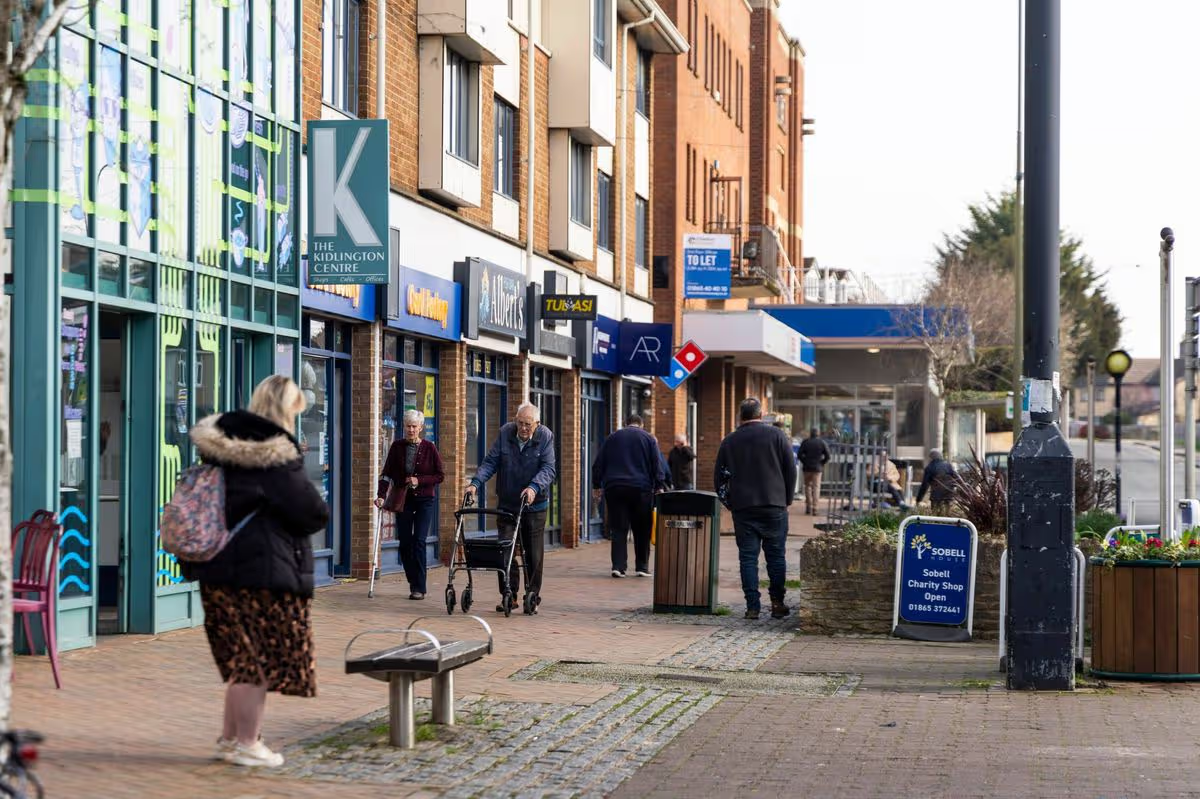
Kidlington in Oxfordshire was declared a town last month after almost 40 years, and boasts scenic walks, cosy pubs and is the perfect base for visiting Blenheim Palace and Harry Potter locations
The UK has a new town(Image: Tom Wren/SWNS)
Britain has officially gained a new town, boasting welcoming pubs, a delightful tearoom, picturesque riverside strolls and a vibrant community spirit.
Located to the north of Oxford, Kidlington features a busy high street and an expanding population. However, until recently, it held the distinction of being one of Britain’s largest villages.
The Oxfordshire settlement is home to nearly 14,000 people and exceeds the size of several of England’s more established towns. Kidlington previously sought to upgrade its designation from village to town status back in 1988, though the bid was unsuccessful at that time, with locals continuing to embrace their preferred classification.
Yet after nearly four decades, Kidlington was officially granted town status last month, after Parish Council members backed the move unanimously. The council highlighted that it possesses the “population, services, and infrastructure of a town”, with the reclassification bringing certain advantages.
Under the government’s revised National Planning Policy Framework and National Policing Guarantee introduced last year, towns benefit from enhanced safeguards, especially concerning planning and policing matters. The settlement has ambitions to construct additional housing and increase its population beyond 30,000, reports the Express.
Yet, some locals remain unconvinced about its elevated status as a town, with one resident telling the Metro: “I would prefer it to be a village – it just got more of a community feel to it. A town to me seems something that it’s not. I don’t know what it represents, being a town.”
They continued: “I can’t see by being a town it’s going to improve.” Meanwhile, others feel disappointed about losing its claim as one of Europe’s largest villages.
However, politics aside, Kidlington boasts a stunning location, close to the beautiful Cotswolds, nestled between the River Cherwell and the Oxford Canal. The town offers numerous picturesque walks, and sits conveniently less than half an hour’s drive from Oxford city centre.
It serves as a perfect base for Oxford commuters, with the neighbouring Parkway railway station providing access to the city in less than 10 minutes. For those exploring the town itself, there’s the 13th-century church featuring an impressive 220-foot spire, and the high street, brimming with shops and welcoming pubs, including The King’s Arms and The Boat Inn, positioned along the river.
Making the most of its setting, visitors can find the Thrupp Canoe and Kayak Hire Centre for leisurely river trips, followed by a visit to the delightful Annie’s Tea Rooms. There’s also the Thrupp Community Forest providing woodland walks, and close by sits Willowbrook Farm for days of adventure.
The town is also in close proximity to the market town of Bicester, renowned for its popular outlet village, offering discounted brands. Meanwhile, less than 10 minutes away lies Blenheim Palace, the distinguished birthplace of Sir Winston Churchill and home to acres of tranquil grounds to explore.
Nearby is also the iconic Harry Potter tree, featured in the franchise films, which is definitely worth a visit after a wander around Kidlington.
For the trendiest tenants in Hollywood office buildings, it’s the latest fad that goes way beyond designer furniture and art: mini studios
To capitalize on the never-ending flow of stars and influencers who come through Los Angeles, a growing number of companies are building bright little corners for content creators to try products and shoot short videos. Athletic apparel maker Puma, Kim Kardashian’s Skims and cheeky cosmetics retailer e.l.f. have spaces specifically designed to give people a place to experience and broadcast about their brands.
Hollywood, which hasn’t historically been home to apparel companies, is now attracting the offices of fashion retailers, says CIM Group, one of the neighborhood’s largest commercial property landlords.
“When we’re touring a space, one of the first items they bring up is, ‘Where can I build a studio?’” said Blake Eckert, who leases CIM offices in L.A.
Their studio offices also serve as marketing centers, with showrooms and meeting spaces where brands can host proprietary events not open to the public.
“For companies where brand visibility is really important, there is a trend of creating spaces that don’t just function as offices,” said real estate broker Nicole Mahalka of CBRE, who puts together entertainment property leases and sales.
Puma’s global entertainment marketing team is based in its new Hollywood offices, which works with such musical celebrity partners as Rihanna, ASAP Rocky, Dua Lipa, Skepta and Rosé, said Allyssa Rapp, head of Puma Studio L.A.
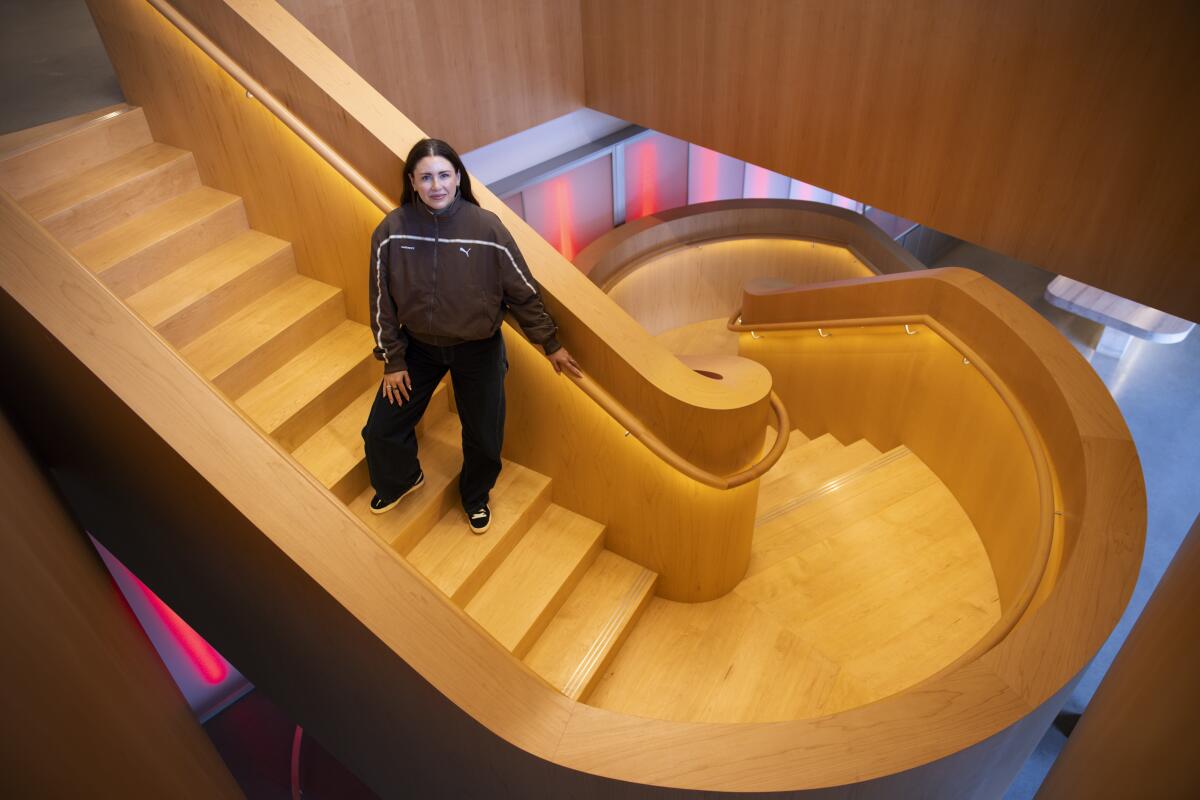
Allyssa Rapp, director of entertainment marketing at Puma, is shown in the Puma Studio L.A. The company keeps a closet full of Puma products on hand to give VIP guests. Visits to the studio sanctum are by invitation only, though.
(Kayla Bartkowski / Los Angeles Times)
Hollywood is a central location, she said, for meeting with celebrities, stylists and outside designers, most of whom are based in Los Angeles.
The office is a “creation hub,” she said, where influencers can record Puma’s design prototyping lab supported by libraries of materials and equipment used to create Puma apparel. The company, founded in 1948, is known for its emblematic sneakers such as the Speedcat and its lunging feline logo, and makes athletic wear, accessories and equipment.
Puma’s entertainment marketing team also occupies the office and sometimes uses it for exclusive events.
“We use the space as a showroom, as a social space that transforms from a traditional workplace into more of an experiential space,” Rapp said.
Nontraditional uses include content creation, sit-down dinners, product launches, album listening parties and workshops.
“Inviting people into our space and being able to give them high-touch brand experiences is something tangible and important for them,” she said. “The cultural layer is really important for us.”
The company keeps a closet full of Puma products on hand to give VIP guests. Visits to the studio sanctum are by invitation only, though. There’s no retail portal to the exclusive Hollywood offices.
Puma shoes are on display in the Puma Studio L.A.
(Kayla Bartkowski / Los Angeles Times)
Puma is also positioning its L.A studio as a connection point for major upcoming sporting events coming to Los Angeles, including the World Cup this summer, the 2027 Super Bowl and 2028 Olympics.
In-office studios don’t need to be big to be impactful, Mahalka said. “These are smaller stages, closer to green screen than a massive soundstage.”
Social media is the key driver of content created by most businesses, which may set up small booth-like stages where influencers can hawk hot products while offering discounts to people watching them perform.
Bigger, elevated stages can accommodate multiple performers for extended discussions in front of small audiences, with towering screens behind them to set the mood or illustrate products.
Among the tricked-out offices, she said, is Skims. The company, which is valued at $5 billion, is based in a glass-and-steel office building near the fabled intersection of Hollywood Boulevard and Vine Street.
The fashion retailer declined to comment on the studio uses in its headquarters, but according to architecture firm Odaa, it has open and private offices, meeting rooms, collaboration zones, photo studios, sample libraries, prototype showrooms, an executive lounge and a commissary for 400 people.
Pieces of a shoe sit on a workbench in the Puma Studio L.A.
(Kayla Bartkowski / Los Angeles Times)
The brands building studios typically want to find the darkest spot on the premises to put their content creation or podcast spaces, Eckert said, where they can limit outside light and sound. That’s commonly near the center of the office floor, far from windows and close to permanent shear walls that limit sound intrusion.
They also need space for green rooms and restrooms dedicated to the talent.
Spotify recently built a fancy podcast studio in a CIM office building on trendy Sycamore Avenue that is open by invitation-only to video creators in Spotify’s partner program.
“Ambitious shows need spaces that support big ideas,” Bill Simmons, head of talk strategy at Spotify, said in a statement. “These studios give teams room to experiment and keep pushing what’s possible.”
LONDON has a new cheap hotel chain – and it’s already a huge success in Europe.
BOB W joined the scene back in 2019 , followed by its first hotel in the UK capital in 2024.
Sign up for the Travel newsletter
Thank you!
I tried out Bob W, the new hotel-apartment style accommodation in the UKBob W Hyde Park is inside The Henry HotelThe room was spacious enough for two
It’s a take on pared back hotels, close to an Airbnb but without the hidden fees, as well as much loved extras like gyms, luggage lockers and breakfast options.
I stayed at the newest hotel, Bob W Hyde Park, which only opened earlier this year, and paid £59 for a room for two people.
This was with the five per cent discount you can get when signing up to the free Inner Circle membership of the hotel.
It’s a short walk from Queensway tube station, as well as close to Paddington train station.
Everything is done online, via the website or app, where you’re sent codes to get access to the building and room.
As it is a blend of Airbnb and B&B, but without all the much hated bits of each, this means you can forget the steep cleaning fees – you just pay the room cost.
Before I arrived, I received a phone call: “We’re so sorry but we’ve had to downgrade your room from a spacious to a compact. We will refund the difference but we’re really sorry.”
Slightly frustrating but, as a solo traveller, no biggie (apart from the fact they were the same price, so no refund for me).
However, everything else? Smooth as anything.
Arriving at 3:30pm, I easily entered the building – it is in the Henry Hotel but with Bob W posters to reassure you you’re in the right place.
There’s no lobby for guests, although there was a man behind the desk for the hotel guests themselves.
I personally love a lobby reception, as I’m often down there when my key doesn’t work, I have questions about the area or just need someone on hand.
But if you are someone who hates the awkward interactions then its the hotel for you.
Another nice touch within the lobby filled with sofas and chairs was a cupboard with free extras, such as toilet roll, ear plugs and spare tea and and coffee pods, as well as leaflets and London hotel guides.
The room was perfect too – clean, spacious, and modern.
A coffee pod machine and kettle were joined by complimentary towels, as well as a hairdryer, ironing board and safe, along with a huge TV.
Despite being the ‘compact’ room, it had a desk for working too.
The bathroom looked recently renovated with a big walk in shower and complimentary toiletries.
The bathroom looked brand newHairdryers, ironing boards and irons are all includedYou can get as much tea and coffee as you want
Some of the hotels have added extras too, like kitchenettes and washing areas, which make them ideal for longer stays.
One downside was that it comes with “complimentary gym access,” but this was just a pass to one that was 45 minutes away at another Bob W hotel, so I didn’t end up going.
Breakfast is extra – I paid £13 – and it includes food and drink at a choice of cafes as well, although only up to this price (any bill over £13, the difference needs to be covered).
If you are on a budget you can easily skip this and just buy some snacks at a nearby bakery or corner shop, but if you want a proper breakfast, it definitely wasn’t overpriced.
I also loved getting to know the cafe owner, as it was a proper local caf so ended up chatting for ages.
So what’s the verdict?
I was seriously impressed with the whole process. Emails were sent promptly, check in was easy, the rooms were clean and the location can’t be beaten.
One of the biggest problems with Airbnbs is the lack of luggage storage, especially if need somewhere to leave it before a flight or train, so I’m glad this wasn’t a problem here.
Even with the smaller niggles, a room for £30 each in central London? I’m not sure I’ve seen a price like that in years – at least for a place as chic as this.
Other cheap dates still available:
March 3-4 at Bob W Earls Court – £61 a night (£30.50 each)
March 16-17 at Bob W London Olympia – £79 a night (£39.50 each)
March 25-26 at Bob W London Kensington – £77 a night (£38.50 each)
April 12-13 at Bob W London Holland Park – £76 a night (£38 each)