The best cinnamon bun I’ve ever eaten and more reasons why we travel
I’m Laurie Ochoa, general manager of L.A. Times Food, with a packed summer vacation edition of Tasting Notes.
On a roll

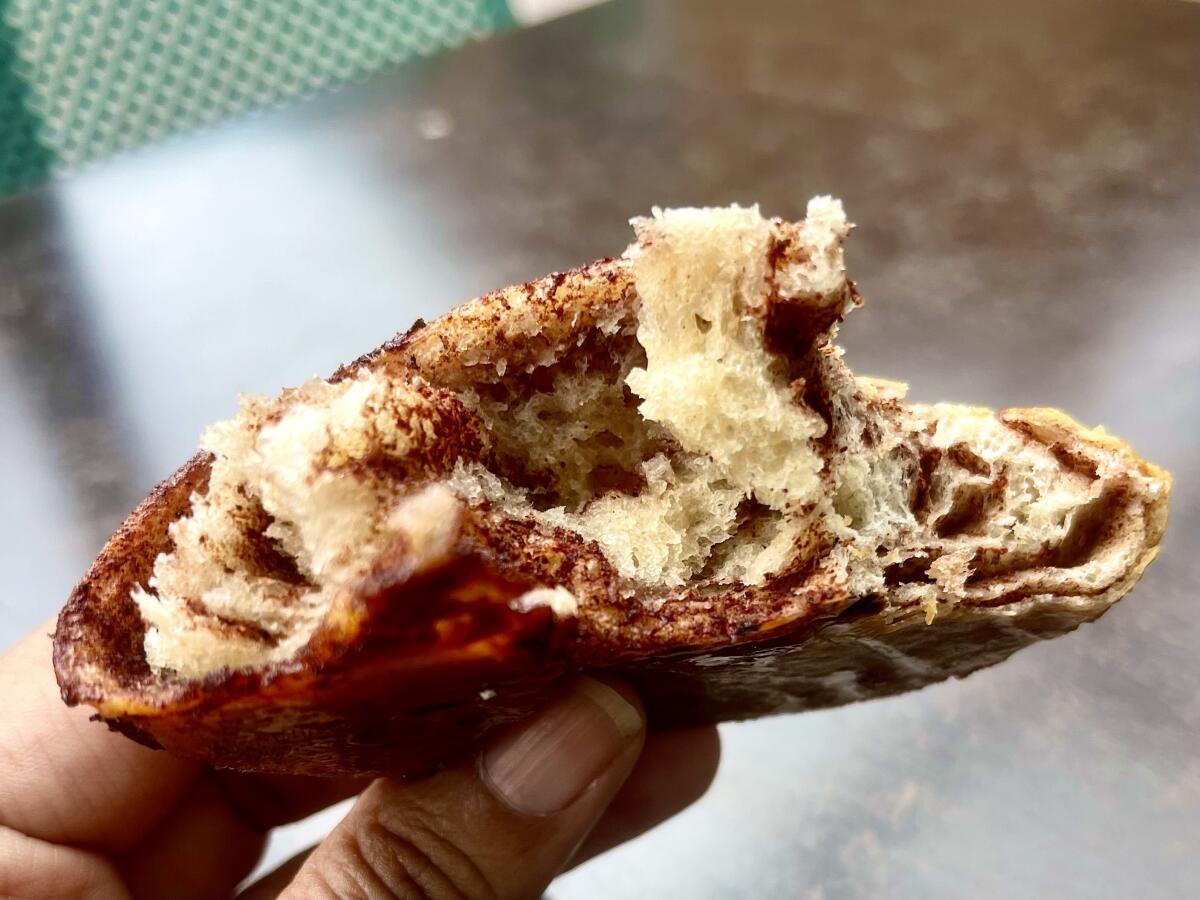
The sourdough-enhanced interior of the cinnamon bun at Daegens in Oslo, Norway.
(Laurie Ochoa / Los Angeles Times)
Norway is not only the land of the Viking Row, one of the most captivating national fandom displays to emerge during this year’s World Cup — and certain to be seen when Erling Haaland and the Martin Ødegaard-led team battle five-time champs Brazil. Norway is also home to one of the world’s greatest cinnamon rolls.
Until I went to Oslo recently, the best cinnamon roll I’d ever eaten was in Chicago — at the venerable Swedish-American diner Ann Sather, where a milky sugar glaze used to be drizzled onto the still-warm, pillowy pastry right at the table. (These days the rolls are glazed in the kitchen after they’re baked.)
Los Angeles, of course, also has show-stopping cinnamon rolls. This spring, Food senior editor Danielle Dorsey, with help from Stephanie Breijo, Jenn Harris and Angela Osorio, put together a guide to 11 of L.A.’s most intriguing cinnamon rolls, including the hip-hop-inspired over-the-top creations at All About the Cinnamon, the sweet-savory buns with honey and sesame seeds at Modu and the tallboy “cinnamon goo”-filled rolls topped with caramel-toffee sauce from SweetBoy. Harris also recommends the especially decadent cinnamon roll served during brunch at Baltaire in Brentwood, where the cake-size roll is wheeled out on a cart and “slathered with frosting at the table.”
In Oslo, however, I discovered a cinnamon bun that stripped away the excess and let the essence of the spiced dough reveal itself.
Daegens, a tiny cafe and bakery hidden away in Oslo’s pretty Lilleborg neighborhood, is run by Anta Stinnerbom, a young entrepreneur who spent several months sharpening his coffee knowledge and barista skills at the acclaimed roastery Tim Wendelboe and is now deep into his explorations of sourdough baking. It’s the sourdough, in fact, that gives the Daegens cinnamon bun its character.

Baker and barista Anta Stinnerbom at his Daegens cafe in Oslo.
(Laurie Ochoa / Los Angeles Times)
Even more than Stinnerbom’s cardamom bun — which some praise as the best in Oslo — the more elemental cinnamon notes, enhanced with lemon zest and juice, allow the sourdough’s multifaceted dimensions to come through. Not just tang, but the taste of time.

When you can’t decide between Anta Stinnerbom’s cardamom bun, front, or cinnamon bun at Daegens in Oslo … get both.
(Laurie Ochoa / Los Angeles Times)

Daegens’ BMO (bolle med ost), which the Oslo bakery makes with a good seeded sourdough roll topped with fresh butter and cheese.
(Laurie Ochoa / Los Angeles Times)
The discovery of a great sourdough cinnamon bun is just one of the reasons I love to travel.
Lately, I’ve been absorbed in the world of Norwegian writer Karl Ove Knausgaard, both for his most recent novel, “The School of Night,” which features a grand-scale narcissist captured in a Faustian downfall, and for “So Much Longing in So Little Space,” which documents the author’s search for the meaning of art through his encounters with the work of Edvard Munch. At Oslo’s boldly vertical, 13-story Munch museum and Bergen’s more contemplative Munch collection at the Kode museum’s Rasmus Meyer galleries, I was able to see for myself the wild stylistic leaps taken by the artist before and after “The Scream,” including the paintings he did for the women’s cafeteria at Oslo’s Freia chocolate factory.
But it was only after the first of many good meals in Oslo that I started to get a feel for the city. As I wrote in the introduction to our new collection of summer vacation dining guides, traveling with an eater’s mindset gives us a deeper understanding of places we’ve read about in cookbooks and novels or seen in movies and paintings. Wandering markets, eating at food stalls, sitting among locals and fellow travelers at the restaurants that embody a city or its surrounding countryside … these are the ways we absorb the rhythm of a place. Its flavors and ways of living are revealed to us over dinner or even a simple morning coffee accompanied by a beautifully baked cinnamon bun.
If you go …

(Giacomo Bagnara / For The Times)
For those of us lucky enough to write about food for a living, each vacation is a chance to add one more spot on our individualized maps of the world’s great places to eat. And this year, we’re sharing our personal maps and notes on places we’ve loved during our wanderings with readers.
Restaurant critic Bill Addison explored Melbourne, whose “modern dining moment,” he says, “derives from the immigrant communities that have rooted in the city since its founding,” making it “innately familiar to Angelenos, and also something wholly distinct to experience.” Then he shared 25 Melbourne restaurants, coffee shops and bars that showed the ambition of its dining scene.

(Photo illustration by Los Angeles Times)
Addison, restaurant critic Jenn Harris, deputy food editor Betty Hallock and I shared a personal list of 33 Paris restaurants and bars we love. Reporter Stephanie Breijo and senior food editor Danielle Dorsey wrote about their 15 favorite London pubs, food halls and bake shops. Addison and Hallock detail 17 splendid Tokyo dining suggestions. I detail 9 reasons Michelin-ignored Lima is one of the world’s greatest restaurant cities and came back from Hong Kong with 10 great eating experiences. And food editor Daniel Hernandez filed three reports from Mexico: an updated guide to 17 new and old favorites in Mexico City, a to-do list for exploring often-overlooked Colima, Mexico’s smallest state, and a fascinating look at how palm wine from Colima is at the heart of “a flourishing culinary movement rooted in its 250 years of trade with the Philippines.”
Given that these suggestions are not meant to be definitive — they are our personal favorites — we know that there are many other worthy places to explore. We’d love to hear from you if you have your own personal picks. We’ve built a form for entering your favorites from around the world and will publish the results in the coming weeks.
And if you’re staying closer to home, check Danielle Dorsey and Stephanie Breijo’s guide to the 23 best new L.A. bars, Dorsey’s choices for the best new L.A. rooftops for drinking and eating and the entire food team’s picks for 50 essential L.A. dining experiences.
We’ve also introduced a new way to save your favorite recommendations and build your own custom guides. Times senior product manager Jeff Poirier explains the new feature, which includes maps and is as simple to use as hitting the “save” button on any individual entry.
Introducing …

Los Angeles Times cooking editor Cody Reiss
(Stephanie Breijo / Los Angeles Times )
We are thrilled to introduce our new cooking editor Cody Reiss, who learned most of what he knows about cooking professionally at Alice Waters’ Chez Panisse Cafe in Berkeley and did time behind the counter at Murray’s Cheese in New York. He also had a part in Eva Victor‘s “Sorry, Baby” and played himself in the very funny “narrative cooking short” “Breakfast for Liz.” Read more about Cody in his hello to readers, which describes the teaching approach he’s aiming for in the food videos he’ll be doing. And check out the videos he released this week on why you should throw away your salt shaker and how to cut a tomato. Finally, with Cody taking over our Cooking Newsletter — which is moving from Sundays to Fridays so that you can have more time to plan your weekend cooking — now is an excellent time to sign up for the free weekly dispatch if you’re not already a subscriber. This week, he provides two crucial lessons on salt and why you might be using it wrong.
Chilaquiles heaven

Chilaquiles, molletes and salsas at Taquearte in Pico Rivera.
(Jason Armond / Los Angeles Times)
Restaurant critic Jenn Harris’ latest review is about Pico Rivera’s Taquearte, which happens to be one of my favorite places to get chilaquiles and a loaded Mexico City-style taco campechano, which made our 101 Best L.A. Tacos list. I first heard about Taquearte from my mom and her friend Pablo. (She went to high school in Pico Rivera and lives in nearby Whittier.) Harris bookmarked the place when Eater’s Bill Esparza wrote about the chilaquiles as L.A.’s best. Harris wholeheartedly agrees and loved how “the chips … were noticeably thin, delicate but sturdy enough to retain their crunch. They hovered in a magical state of limbo between wet and dry, crisp and wilted.”
More restaurants recommendations: 7 L.A. spots for bandeja paisa, Colombia’s classic lunch platter by Angela Osorio, 9 great places to try Midwest-style tavern pizza in L.A. by Kelly Dobkin and the best places to eat and drink in July, according to our Food writers.
The loss of two trailblazers

Chef Joshua Gil, pictured January 17, 2024.
(Tharini Shanmugarajah)
Joshua Gil, who “helped recontextualize and reimagine Mexican food in L.A.,” as reporter Stephanie Breijo wrote, died last week after a four-year fight with cancer.
Gil, who is credited with helping the late Joe Miller‘s now-closed Joe’s Restaurant in Venice gain a Michelin star, and went on to co-found the much-missed Tacos Punta Cabras and Hamburguesas Punta Cabras, as well as the pop-up Supper Liberation Front, established the Alta California restaurants Mírame in Beverly Hills, which closed in 2023, and the still-running Mírate in Los Feliz, which Gil left after a legal dispute. He also established the rooftop raw bar Mother of Pearl, which is closed at the moment, and the teppanyaki restaurant Maison Kasai, both at the downtown L.A. dining collection Level 8.
In an extensive story about Gil opening the now-closed Three Flames in the midst of cancer treatment and his drive to continue mentoring chefs, such as Macheen‘s Jonathan Perez, he told Breijo, “I’m a very stubborn a—. I like telling people, ‘I’m Mexican. I don’t know how to give up.’”

Chef Katsuya Uechi in 2016 at the 10th anniversary celebration of the Brentwood location of Katsuya.
(Michael Kovac / Getty Images for Katsuya)
Late last week, we also got word that Katsuya Uechi, the sushi master whose name has become synonymous with the global Katsuya brand, has died at the age of 67.
“The Okinawa-born chef altered the DNA of the L.A. sushi scene with his innovative, genre-bending creations,” writes Melody Xu of the chef who first came to prominence for many L.A. diners at Sushi Katsu-ya in Studio City, which he opened in 1997. “Spicy tuna crispy rice, which he debuted in the early 2000s, has since become a modern staple in sushi restaurants across the U.S.”
Also …

Amid the puestas of Olvera Street in downtown Los Angeles.
(Etienne Laurent/For The Times)
- Many were hoping that the World Cup would provide an incentive for downtown Los Angeles’ city leaders and other stakeholders to invest in the area’s infrastructure. But it’s sobering to read reporter Angela Osorio’s look at the sad state of downtown’s once-bustling Olvera Street — with even taquito mecca Cielito Lindo facing a precarious financial situation that has left it shuttered … we hope only temporarily.
- Melody Xu talked with the owners of some of L.A.’s prominent Venezuelan restaurants about how they are connecting people and fundraising for survivors of the twin earthquakes. At publication time, the parents of Full Arepas’ Kelly Montano, writes Xu, “who were on vacation in La Guaira when the quakes happened, [were] among the more than 40,600 people still unaccounted for.”
- “For the first time in its history,” writes Stephanie Breijo, the Michelin Guide awarded a Mexican restaurant three stars.” That honor went to Val Cantú‘s Californios in San Francisco. Breijo has all of the news from the announcement of Michelin’s California guide, including the new two-star designation for Los Angeles’ Kato.
- More from Breijo: As the Boyle Heights fire burned, restaurants depended on which way the wind blew.
- The legal fight over who can sell a white nectarine variety, reports Claire Rush, led central California farmer Cesar Mora to give away more than 100,000 pounds of the fruit.
- And Hailey Branson-Potts has the story of the beer queen of Mendocino County, Lost Coast Brewery’s Barbara Groom, one of the country’s first female microbrew owners, who turns 80 this year.