WASHINGTON — After Defense Secretary Pete Hegseth cut nine Navy officers, including all the women, from a promotion list, several female officers say they see the unusual intervention as a sign that their careers now have a ceiling and worry for the future generation of female military leaders.
The Navy had selected 31 sailors to promote from the rank of captain to one-star admiral, but Hegseth recently intervened to strike nine people from the list, including three women and two Black men, according to a Defense official who spoke on condition of anonymity to discuss information not permitted to be released publicly.
As a result, the Navy is not promoting a single woman to the one-star admiral rank this year even though women make up about one-quarter of all Navy officers and nearly one-third of the sea service’s midgrade ranks, according to military data from 2024.
The Associated Press spoke with eight female Navy officers of varying ranks and time in service after Hegseth’s cuts, which were reported earlier by the New York Times, became public. They spoke on condition of anonymity out of fear of retribution from their superiors.
The more junior officers said they saw the development as a sign that their careers would become politicized if they rose too far in the ranks, and some said they felt they now had a limit on how far they could be promoted. Some said it made them feel less valued within the military and wondered whether that wasn’t part of the intent.
The Pentagon has not offered any rationale on why the women, or any of the other six people, were removed from the promotion list.
Sean Parnell, the Pentagon’s top spokesman, said on social media last week that “military promotions are given to those who have earned them” and that the Pentagon “will never consider the color of a service member’s skin or their gender as a factor in promotions.” The Pentagon did not immediately respond to a request seeking further comment.
The Navy’s process for choosing which officers to promote to the one-star rank has been relatively constant and transparent over the years. The service convenes a group of officers, called a promotion board, that examines the records of eligible officers and chooses those deemed to be the most qualified.
The board that selected the initial slate of 31 officers for promotion was directed by then-Navy Secretary John Phelan, an appointee of President Trump, to “recommend for promotion the best qualified officers within their respective competitive category.”
The order from Phelan, who abruptly departed his post in April, said the board should consider an officer’s performance, competence and character, among other traits, as part of those qualifications.
It also said that given China’s prominence in the Trump administration’s National Defense Strategy, “special consideration shall be given to officers who have excelled in their knowledge of the political military affairs and U.S. strategic interests in the Indo-Pacific region, and operational contingency planning for Indo-Pacific war plans.”
Hegseth has long argued, without offering evidence, that women in the military benefit from preferential treatment and are not suited for combat roles.
“For too long, we’ve promoted too many uniformed leaders for the wrong reasons based on their race, based on gender quotas, based on historic so-called firsts,” Hegseth told hundreds of military leaders in September.
The approach, he asserted, made the Pentagon “less capable and less lethal.”
‘A break from tradition’
Phelan’s order said the Navy cannot discriminate based on criteria such as race and sex, and it specifically noted that “this guidance shall not be interpreted as requiring or permitting preferential treatment of any officer or group of officers on the grounds of race, religion, color, sex.”
The full list of 31 people to be promoted was approved by Phelan, other Navy leaders and the chairman of the Joint Chiefs of Staff, Gen. Dan Caine, before it reached Hegseth, who chose to make the changes, the Defense official said.
While Hegseth is within his rights to intervene in the list, “it’s just not the norm” and is “a break from tradition,” said Katherine Kuzminski, a researcher specializing in military recruiting and retention at the Center for New American Security think tank. She said that promotions historically have been seen as “the services’ business.”
Kuzminski noted that “this is a decision that’s not being made by the Navy — it’s being made by the secretary of Defense,” and she said Hegseth’s growing interference in operational aspects of the military services such as promotions is creating “tension” about what “normal” will look like going forward.
Some of the more senior Navy officers who spoke with the AP expressed concerns about the message it sends to the next generation of young sailors.
In addition to pulling the recent promotions of three women to admiral, Hegseth shortly after he took office fired Adm. Lisa Franchetti, the service’s top officer and the first woman to hold the job. He never explained his rationale.
Since then, he also has fired two other female three-star admirals without explanation.
Some of the officers who spoke to the AP said that while they were encouraging female sailors to stick with the Navy, they acknowledged that message is coming at a difficult time.
Kuzminski said the rhetoric and actions surrounding women in the military “affects individual service member decision-making and it also affects family unit decision-making,” including whether people make a career of the military.
Kuzminski said that following the months-long hold on military promotions by Sen. Tommy Tuberville (R-Ala.) during the Biden administration, surveys showed that partisan politics spilling into the day-to-day lives of troops affected their decision-making.
One officer said this impact was not confined to women.
In conversations with other sailors in her unit, she said that male sailors were hesitant to deal with what appears to be a growing politicization of simply following the orders of previous administrations.
Weekly insights and analysis on the latest developments in military technology, strategy, and foreign policy.
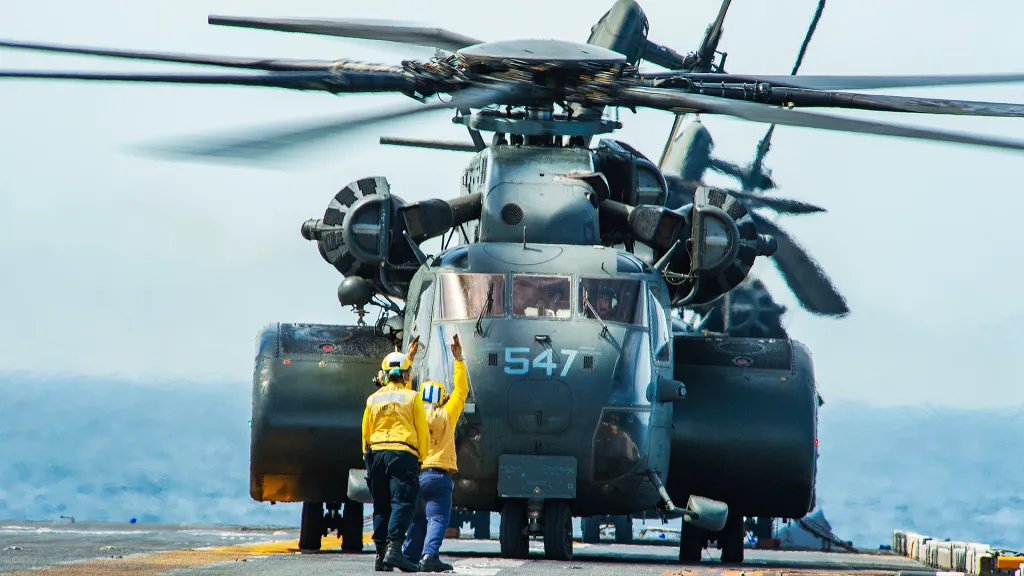
For decades, the massive MH-53E Sea Dragon helicopter has served as the Navy’s primary airborne mine countermeasure platform, dragging massive mine hunting sleds through waters all around the globe. However, the Sea Dragon’s days are now numbered, with the last 11 aircraft scheduled to sunset sometime next year. With the MH-53E’s demise on the horizon, we reached out to one of its former pilots, Steve Jones — a man who came to know this monster intimately during the Global War On Terror. He had plenty of stories to tell and provided us with a new understanding of the often misunderstood counter-mine mission.
The MH-53E’s mission is also, of course, extremely topical right now thanks to ongoing tensions with Iran. Secretary of State Marco Rubio recently told senators that the Islamic Republic mined “large segments” of the Strait of Hormuz, endangering shipping in the region.
As it currently stands, the mighty Sea Dragons, which are considered one of the military’s most dangerous to fly due to numerous fatal mishaps, are being phased out in favor of the smaller MH-60S Seahawk paired with a suite of new aerial mine countermeasures systems, as well as other new technologies, like uncrewed underwater and surface vessels. The Navy’s overall mine hunting force is going through a transition that is controversial, to say the least, with many questioning if the Pentagon is investing enough resources in this critical missions set.
Petty Officer 1st Class Rawad Madanat
With all these issues in play, in an exclusive, wide-ranging, two-hour interview, Steve Jones offered in-depth insights about the Navy’s airborne counter-mine mission, the Sea Dragon’s capabilities and dangers, current mine sweeping operations, as well as everything from what it was like to narrowly avoid getting entangled with a surfacing sub to his experiences ferrying celebrities like Robin Williams and Tom Jones around a war zone.
So, with the stage being set, let’s get into this incredible exchange.
Some of the questions and answers have been lightly edited for clarity.
Then-Navy Lt. Steve Jones in an MH-53E Sea Dragon. (Courtesy Steve Jones)
A: During the time that I selected, you could choose SH-60 Seahawks, you could choose CH-46E Sea Knights and the MH-53 Echo. You could choose SH-3 Sea Kings, but they were kind of winding down the H-3s, which is the same as the presidential helicopter Marine One that they fly now, but they were flying out of Norfolk and Puerto Rico, primarily for VIP transport.
So, I looked at the 53 for a lot of reasons. One, I liked the instructors that came from that community in the advanced helicopter training. And two, I just thought the helicopter just really looked awesome, and it was big, and so that’s why I chose it, and I just thought it would be a good personality fit, work fit for me, and it ended up being that way.
An MH-53E Sea Dragon, assigned to the “Blackhawks” of Helicopter Mines Countermeasures Squadron 15 (HM-15), takes off from the flight deck of the amphibious assault ship USS Wasp (LHD 1) during flight operations on the ship’s flight deck, April 5, 2025. (U.S. Navy photo by Mass Communication Specialist Seaman Soren V.P. Quinata) Petty Officer 3rd Class Soren Quinata
Q: What are the main differences between the Navy’s MH-53E and the Marines’ CH-53E Super Stallion?
A: It’s primarily the same aircraft. Except our aircraft has larger fuel sponsons, so we could carry more gas. The reason for that is ideally we’d want to be able to fly an hour to where the mission objective was, be able to stay on station for about an hour, and be able to fly back. That requires at least three and a half, four hours of gas and extra fuel in those side sponsors. And that allowed us to do that. So instead of a small sponson with two tanks, we had one big sponson with four fuel tanks that were inside each of the sponsons on either side of the aircraft.
Q: So how much gas would that larger sponson hold?
A: About 22,000 pounds of gas.
U.S. Navy Aviation Boatswain’s Mates (Fueling) prepare to refuel an MH-53E Sea Dragon helicopter, attached to Helicopter Mine Countermeasures Squadron (HM) 15, on the flight deck of the Nimitz-class aircraft carrier USS Abraham Lincoln (CVN 72). (Official U.S. Navy photo) Courtesy Asset
Q: Talk about the training and some of the biggest challenges of flying that huge aircraft.
A: Typical Navy training is two years of flight school, and then after flight school, we went to our Replacement Air Group, which we call the RAG, that was in Norfolk, Virginia. You spend about a year, or up to 10 months, in Norfolk, Virginia, learning primarily how to fly the helicopter, how to land the helicopter, and we do that in the combination with the Airborne Mine Countermeasure Squadron. We used aircraft from Helicopter Mine Countermeasures Squadron (HM) 14 to learn how to fly the different mission sets and learn aircraft familiarization. And then from there you either get assigned to HM-14, which was in Norfolk, Virginia, or HM-15, which was in Corpus Christi, Texas. HM-15 has now moved to Norfolk, Virginia. [Editor’s note: HM-14 sunsetted in 2022.]
Sailors assigned to the “Vanguard” of Helicopter Mine Countermeasures Squadron 14 (HM-14) posed for a photo in front of an MH-53 “Sea Dragon” helicopter prior to the squadron’s last flights Dec. 8, 2022. (U.S. Navy photo by Mass Communication Specialist 2nd Class Malachi Lakey) Mass Communication Specialist 2nd Class Malachi Lakey
The training takes about 10 months. Mine was a little bit longer because when I actually joined that community, the aircraft were down because of a crash off the coast of Corpus Christi, Texas. There was a problem called ‘thermal runaway,’ where the bearings in the main rotor head would fail, and they would seize together and get hot, and we lost a few sailors from HM-15. And until they figured out why and how to prevent it, it took about a year for those aircraft to come back up, so I was in Norfolk for maybe about a year and a half, almost two years, before I got to Corpus because of that bearing issue.
Q: What was it like when you finally got out there and learned how to fly while pulling a mine countermeasure sled?
A: There’s different types of equipment that you use and it takes a special kind of person to be able to maintain the situational awareness – both flying the aircraft and what’s happening in the back – because there’s dangers in the back. You have a very confined area, lots of equipment, and under lots of tension, and so the very first couple of times, the instructor is kind of handling everything, and you’re just kind of riding along.
An MH-53 Sea Dragon helicopter from the “Vanguards” of Helicopter Mine Countermeasures Squadron Fourteen pulling a Mark 105 Magnetic Influence Minesweeping System (SLED). (Photo by BOB HOULIHAN / NAVY VISUAL NEWS / AFP) BOB HOULIHAN
Then eventually you start to do more tasks, physical tasks, in terms of flying and maintaining a stable platform for the men and women that are working in the back, and then over time those skills translate into a larger situational awareness, where you’re now a mission commander – where you’re flying the aircraft, but also, conducting the mission in the back is your primary responsibility. The positions are second pilot or co-pilot, and then you become a Helicopter Aircraft Commander (HAC), which is like the captain, and then you become an Airborne Mine Countermeasures Mission Commander (AMCM MC), meaning you’re flying the aircraft, you’re the commander of the aircraft, but you’re also commanding the mission.
Lt. Cmdr. Jeff Spencer and Lt. Cmdr. Nik Bochette, assigned to the Vanguards of Helicopter Mine Countermeasures Squadron (HM) 14, perform a pre-flight check on an MH-53 helicopter. (U.S. Navy photo by Mass Communication Specialist Seaman Jessica L. Dowell/Released) Petty Officer 2nd Class Casey Hopkins
Q: Did you become a mission commander?
A: I did. So I was fully qualified in the MH-53 Echo in my squadron, so I was a mission commander. I worked the maintenance side, so I was the maintenance check pilot and functional check pilot. It takes a lot of maintenance, and then post maintenance, and you have to do post maintenance flights to be able to make sure the aircraft is safe for anyone else to fly. So I spend most of my time in those areas in that squadron.
A U.S. Navy Sailor with Helicopter Mine Countermeasures Squadron 14 guides an MH-53 helicopter from a vehicle carrier ship at Marine Corps Air Station Iwakuni, Japan, Sept. 14, 2022, after completion of aircraft maintenance. (U.S. Marine Corps photo by Cpl. Darien Wright) Cpl. Darien Wright
Q: What are the MH-53’s unique quirks and advantages?
A: One of the advantages was pure brute strength. You had three GE engines, so you could handle lots of torque, and the way that we hunted and swept for mines was pulling sleds in the water, which causes thousands and thousands of pounds of stress, so it’s really like a forceful instrument in the water. The operation requires the coordination of not only meteorologists and Operations Specialists, which are like intel specialists in mine warfare, but then you have the maintainer, you had two pilots and a crew chief, plus it could be up to four people in the back, depending on the type of gear you’re stowing in the back, so it really takes coordination from the front.
An explosive ordnance disposal technician, assigned to Explosive Ordnance Disposal Mobile Unit 5 Platoon 502, operates a communications system aboard an MH-53 helicopter belonging to Helicopter Mine Countermeasures Squadron (HM) 14. (U.S. Navy Combat Camera photo by Mass Communication Specialist 2nd Class Alfred A. Coffield) Petty Officer 1st Class Alfred Coffield
The disadvantage is that it’s a very expensive aircraft to operate. Every hour of flight, required 24 hours of maintenance, and if a squadron had 10 helicopters, which we did at one point in time, you’re looking at the largest deployable squadrons in the Navy, like 600-plus people to operate these aircraft.
With everybody working together, we advertise that we could be anywhere in the world in 72 hours, where there’s a mine threat. We could break down the helicopters, put them in a C-5 and then reassemble them anywhere in the world in 72 hours. After 9/11, for Operation Iraqi Freedom, we did deploy by C-5. We took half the helicopters to Sicily and the other half went to Bahrain and took 11 C-5s in order to move a squadron that size into those two locations, so big footprints, lots of money, lots of parts.
An MH-53E Sea Dragon assigned to the “Blackhawks” of Helicopter Mine Counter Measures Squadron 15 is offloaded from a U.S. Air Force C-5 Galaxy, March 14, 2003, at the U.S. naval base at Sigonella, Sicily. (Photo by Damon J. Moritz/U.S. Navy/Getty Images) U.S. Navy
Q: How fast could the Sea Dragons fly?
A: The 53 is a fast helicopter. One of the fastest out there. We were limited to 150 knots for airframe preservation. Under towing conditions, we typically flew between 18 and 25 knots, depending on the device in the water. Each vehicle had different performance parameters to properly deploy the device. Under rapidly changing conditions we always had to maintain proper speed and altitude control.
Q: The Sea Dragon has experienced a notoriously high rate of mishaps. Did that ever concern you? What do you think contributed to this record?
A: It did. If you’ve ever seen one or been on one, been close to one, or heard one, you’ve got 100-foot long machine with millions of moving parts, right?
Our maintenance crews were very good, I always felt safe flying. I think you have to if you choose to fly that particular weapon system, but there were a lot of accidents. And I knew folks that were killed in MH-53 accidents who I went to flight school with, and buddies.
Maintaining MH-53E’s
It’s a very complicated machine that did a very important mission, and accidents do happen, both mechanically, but also because of pilot error. In combination, you end up losing a lot of airframes. Besides the United States, there is only one other nation that flew that airframe, and that was the Japanese for their mine sweeping operation. It’s a very complicated, expensive machine, and that’s why not very many people flew it.
An MH-53E helicopter belonging to the Japanese Maritime Self-Defense Forces takes off during Marine Corps Air Station (MCAS) Iwakuni Friendship Day, May 5, 2004, at MCAS in Iwakuni, Japan. (Photo by Koichi Kamoshida/Getty Images) Koichi Kamoshida
Q: Did the danger concern you?
A: You know, you’re in your 20s, right? So you feel a little bit invincible. I’ll tell you a story. When I switched from 53s and started flying C-130s, after the Haitian earthquake, I flew into Guantanamo Bay, and my old squadron was there on the same ramp as we were. So I walked over to see who I still knew there, and they had a 53 turning on the deck there, and I was just going, ‘wow, I couldn’t believe I used to do that,’ and not thinking about how many things have to go right in order to have a good day. And I just kind of said to myself, ‘it’s really a young person’s game,’ because you gotta kind of hit the ‘I believe’ button on a lot of things, because there’s just a lot of opportunity for negativity to come in. Weather, environment, and then the mechanics of things.
MH-53 pilot Lt. Steve Jones in Bahrain, circa 2002. (Courtesy Steve Jones) Picasa 2.7
Q: What were the biggest factors contributing to the Sea Dragon mishaps?
A: With any aircraft system, the largest factor that contributes to any accident is the human factor. Yes, engines will fail, components will fail, but a lot of times it was human error that caused the ultimate catastrophe because when an emergency happens, you have three criteria in order to gauge when you should land.
The two critical ones are ‘land immediately,’ meaning if you do not ditch in the water or put the aircraft down, it is going to come apart in flight. The other critical criteria is ‘land as soon as possible,’ meaning as soon as you have a safe place to land, then you land as soon as possible. Then you have another condition where you can continue to fly, but flying is not recommended. And so that decision factor between land immediately and land as soon as possible, it’s a bit of a gray area, right? You have a set of skills you can fly, but you can never time when the aircraft is going to come apart.
Navy ‘Sea Dragon’ Helicopter Unsafe For Flight | NBC Nightly News
For example, in the Corpus Christi crash, they knew that they had a problem. I’m not second-guessing the pilot, but it was in that gray area between land immediately and land as soon as possible.
The aircraft commander chose to try to bring the aircraft closer to the beach, so you could survive a ditch, because putting a helicopter in the water – nothing is guaranteed, right? Then you have no control. However, bring it closer to the beach means you’re flying that much longer. So land immediately, there could have been more survivors.
Not to ‘Monday morning quarterback’ anything. I probably would have made the same call. And then with the new equipment that was put on the aircraft, there are lights now placed in a monitoring system that kind of took the gray area out of those decisions when it came to thermal runaway with the main rotor head. So now the decision is clear. Land immediately if certain indications happen, and land as soon as possible if certain indications happen. Prior to 2000, we didn’t have that.
Q: The Sea Dragon community has been well-documented for being neglected by the Navy. What was your experience when you were flying it? Why do you think that was?
A: It’s a unique mission set. It kind of came online during the Vietnam War and Haiphong Harbor, and clearing those mines, and then again in Desert Storm, when the USS Tripoli was hit by a mine.
Mining sea straits is a very cheap way to stop a huge navy, such as the one that we have in the United States. However, the Navy, in my opinion, didn’t necessarily see the value in that mission. There are very limited resources. There’s only so much money to go around, and large strike groups and ships just took priority. We were always probably a little bit underfunded, in my opinion, for a mission that’s important, which you can see today with the Strait of Hormuz. But it was definitely a huge problem that many people did not talk about during the first two Gulf Wars.
An Iranian mine-laying boat. (Iranian state media) (Iran State Media)
Q: Why was it a huge problem?
A: Well, when you try to move a carrier strike group into a small area like the Persian Gulf, by putting mines in the water, you create doubt in a captain’s head. The captain is responsible for thousands and thousands of lives, and the battle group commander is responsible for thousands and thousands of more lives, plus the strategic reason of why they’re there. If a mine is discovered, then everything has to pause. You can’t land Marines on the beach, you can’t move the strike group closer to the shore. The ability for you to project power ashore, all that kind of comes to an end.
Q: How does the MH-53E go about this unique mission set? Can you walk us through what a mission would look like from start to finish?
A: Depending on the intel, you’ll have a threat and the threat could be you suspect that there’s mines in the water, or that you know that there’s mines in the water. So, typically it’s ‘you suspect,’ right? And we used the AN/AQS-14, or “Q-14.” There’s about three different versions of the Q-14. It’s a side-looking sonar, which you drag in the water – we call it the fish. We would fly the fish at certain depths based on the terrain and what was in the water. That was called mine hunting.
MH-53 crew members and the AN/AQS-14 side-looking sonar. (Courtesy Steve Jones)
So initially you would always kind of begin with a hunting mission, where we could, or the OS operator, or the console operator would mark what they view as a mine-like contact. You’re really kind of looking at the sonar and distinguishing between man-made objects and natural objects. If you believe it’s a man-made object, and then you would mark a tape. You could also, real time, send that image back to the ship, but that capability came a little bit later.
We also had devices that allow you to sweep. A mine can be triggered by different mechanisms. Sometimes they’re triggered by contact.
Some mines are acoustically triggered, meaning you can set that mine to blow up for a certain type of ship acoustics. For instance, a destroyer has a different set of acoustics from an amphibious ship, from an aircraft carrier. If you want to let 1,000 destroyers pass you or a submarine and then wait for the aircraft carrier, you can tune it to that way. So we had devices that could mimic the sound signatures of different ships, and you could tow that in the water, you could tow it really fast. One of the reasons why we were successful is that we could do large areas of the ocean relatively quickly.
An MH-53E Sea Dragon from Helicopter Mine Countermeasure Squadron (HM) 15, aboard the multipurpose amphibious assault ship USS Wasp (LHD 1), performs Mine Countermeasure training using the MK-105 sled. (U.S. Navy photo/Lt. Cmdr. John L. Kline) U.S. Naval Forces Central Comman
The last piece for sweeping is the magnetic variation. Each ship is a metal hull, and as a ship is moving through the water, it has a magnetic signature, and then we have gear, which you could tune to mimic certain types of ships in the water, in order to have them explode behind the gear that we’re towing in the water.
So you hunt, that means you’re searching, and then you sweep, and then that means you’re clearing. Sometimes you can clear using other technology, such as sometimes the Avenger class ships would go in and sweep, and not us. Sometimes you would use dolphins to work with EOD teams in order to sweep mines. It just depends upon the threat, on what the second tool is used after you hunt.
Navy Dolphins Practice In Key West How To Find Mines In The Ocean
The most time that I spent was in the hunting phase of the mission set. In Bahrain, every week, a couple days a week, we would hunt. We would do the Strait of Hormuz. We would do the approaches into Saudi Arabia for the tankers. We would do the approaches into the Suez Canal, just to be sure that there are still no mines in that area.
That is for what we call change detection, meaning you map the ocean floor, and then over time, because of consistency, you’ll be able to tell if something changed. If something changed, then you went in to investigate further. It’s constant because the ocean floor is constantly moving, and then somebody could easily place a very cheap object that could be devastating.
An MH-53 Sea Dragon, Helicopter Mine Countermeasures Squadron 14 attached to USS Anchorage (LPD 23), controls an Mk-105 magnetic mine sweeping sled. (U.S. Navy Photo by Ensign Lindsay Lewis/Released) Ensi Lindsay Lewis
Q: Walk me through how a mission would take place.
A: The intel can be good sometimes, sometimes the intel is lacking. The weather has to be at a certain sea state in order for it to be successful, and you can’t do it at night, right? You have to do it during a daytime in littoral situation, so you’re pretty close to shore and you are susceptible to threats that are on the beach. That is the mission set and if you don’t know where the mines are, that’s why you begin with hunting. The Q-14 is a relatively quick device to deploy. You can pull it in the water relatively fast. Then you can real-time send images back, or you can collect tapes to study for that change detection.
When you’re going out for a mission, you’ll have your standard aircraft brief, where the crews get together and talk about the state of the aircraft, the conditions, the environmental conditions of today. And then you’ll get into the mission brief on where the ship is, or where the shore is, and where actually the square, or the box, or the rectangle is, where we’re going to conduct a mission. We talk about the distances from that point that we’re going to deploy the gear, because it takes time to be able to do that, and then we’ll enter what we suspect is a minefield or an area of interest from which we want to be able to tow in.
Minesweeper Exercise
Then we fly what we call tracks. It’s almost like rows on a field, like cornrows, and we go up, down, up, down, and you have to stay within track by feet, okay? If you, if you stray as little as 20 feet off track, then you have to redo that track, because you want to have a continuous picture of the ground. And so it may take two or three sorties to cover an entire minefield.
And then times where the device may have strayed off track. It takes time, but we can do it quicker than a ship doing it on its own, like the Avenger class ship, and so between the aircraft brief and the mission brief, and executing, it’s like a six, seven hour day in the heat or in the cold, depending on where you are.
This is the Navy’s Largest Helicopter | MH-53 Sea Dragon
There’s no air condition on that helicopter. So everybody’s working in those conditions based on the information that we bring back. Then the tactics folks that are supplied to us by COMINEWARCOM (Commander, Mine Warfare Command), which was our bosses, those intel folks will say what needs to happen next, meaning there’s nothing that needs to happen now, or we need to investigate this further. And then they pick the next tool for us to be able to deploy, or they go with the EOD and dive teams to go take a closer look.
Lt. Sean Johnson, left, and Cmdr. Derek Brady, commanding officer of Helicopter Mine Countermeasures Squadron (HM) 14, right, pilots a MH-53E Sea Dragon out to amphibious dock landing ship USS Pearl Harbor. (U.S. Navy photo Lt. Cmdr. Jeremy Braun/Released) Seaman Molly Evans
Q: How fast are you flying, and how high are you flying? How deep do the sleds go?
A: The helicopters are anywhere between 25 and 75 feet over the water, depending on the gear, because the speed in which we pull through the water is extremely important. You could go as fast as 25 knots in some cases, which is about the top speed, or you’d have to go as slow as 12 knots.
Mine Countermeasures Unit Drops a Slocum Glider from a MH-53E Sea Dragon
Q: How deep do the sleds go?
A: The depth of some of the gear is classified, or at least it was at my time. I’m not sure now, but you could go relatively deep. It’s under lots and lots and lots of tension, and the reason why you had to go very deep is that some gear has to be able to get to the sea floor at certain distances, because there’s also the subsurface fleet that is operating down there, and mines will affect them as well.
Q: What’s the tension like when you’re dragging a sled?
A: You’re looking at around 15,000 to 20,000 pounds of tension. The aircraft will kind of buckle. You look at the side of a 53, it has a crease from the tension that goes on it.
If there is a swell in the sea state, sometimes the Doppler radar – which would kind of track how fast you’re going forward, backwards, or sideways – it’ll go from forward to negative, meaning we’re actually getting pulled backwards by the sea state. And the engines would automatically just start – the torque would come in as the blade did a bigger bite out of the air. And the aircraft will kind of turn, because of the torque. It’ll kind of turn and whine, and you’re just flying an out of balance flight, nose down.
A US MH-53E military helicopter drags a MK 106 Combination escorted by two military Zodiak boats during an operation off the USS Ponce to clear mines from Khor Abdullah at the entrance to Umm Qasr port in the western Gulf, 29 March 2003. (Photo by RABIH MOGHRABI/AFP via Getty Images) RABIH MOGHRABI
Q: Did you ever have the sled get tangled up behind you?
A: Yes. It can get caught on things in the water, and the tension will spike. If the tension spikes too high, or the gear gets fouled in something, you always have the option to guillotine or cut the gear.
Q: Did the aircraft have other devices that helped in the mine hunting mission?
A: Yes. In addition to the Q-14, we had the Mk 104 acoustic device, mine chain cutting devices and the Mk 105, a huge gas generator, which produces electrical charges in the water for those magnetic-seeking mines that change the magnetic variation.
HM-15 Sailors Recover Mk 104
There’s at least six devices that I know of that are used for hunting mines, including something as simple as what we call a MOP, which is stands for Magnetic Orange Pipe, which is what they used in Vietnam.
Essentially you have this pipe, it looks like a telephone pole, which is about the size of a telephone pole or larger, and it’s orange. It has a positive charge on one end and negative on the other end. It’s just a magnetic pipe that we would tow in the water. It’s probably the easiest thing that you can tow, and the simplest, but it’s looking for those magnetic variations. The problem with the magnetic orange pipe is you can’t change it, so it’s set for a certain amount of tactics. You can see how that could become obsolete in today’s environment.
A US MH-53E military helicopter using a cable drags an MK 106 sled sent out from the USS Ponce as mine clearance takes place in Khor Abdullah at the entrance to Umm Qasr port in the western Gulf March 29, 2003. (Photo by RABIH MOGHRABI / AFP) RABIH MOGHRABI
Q: How does the Sea Dragon integrate with other mine hunting capabilities, like the Avenger class ships or other assets?
A: We worked as a team, but obviously we’re a tool in that larger mine warfare strategy. We were the speed aspect of that, meaning we could have left holes, but if you’re trying to move at the speed of war, then sometimes we were the tool that was required. And if you have 72 hours to be somewhere, speed is required. We could do that to be sure that the fleet can continue to do what it needs to do, but if you’ve got time, then you could sail a ship or move one of those slower small boats into that environment, that makes sense.
Q: Did you ever work together with Avenger class ships?
A: Maybe in the same AOR, but other than an exercise where you would see an Avenger class ship working the tow area, and then we will be working our tow area. It was under controlled condition. When I was doing change detection, and during work conditions, we were operating concentrated on our mission set, they’re probably concentrating on their mission set, and between the two pictures, they came together in the operation center to have a very clear picture.
A stock picture of the US Navy’s Avenger class mine-hunter USS Pioneer. USN
Q: When was the Sea Dragon actually used for this mission operationally? How did it perform?
A: It was used throughout Iraqi Freedom, from Shock and Awe to the pull-out to the drawdown. If not every day, every week there was change detection in mine operations, because it’s always a threat. It’s a very cheap weapon that non-state actors can get off the black market. One mistake or one mishap causes devastating consequences for the individuals on that ship, but also the mission, so it’s a constant threat, and still is a threat.
During my time, actively hunting for mines to be sure that those straits and those approaches remain clear, dominated my entire career in the community. From the time I started and then I towed to my last days in the squadron, which was in 2005.
A U.S. Navy sailor directs an MH-53E Sea Dragon helicopter launching March 28, 2003 at the port of Umm Qasr, Iraq. The helicopter was part of a mine clearing unit that cleared the way for the British Navy ship, Sir Galahad, that delivered the first wave of humanitarian aid in support of the U.S.-led Operation Iraqi Freedom. (Photo by Bob Houlihan/U.S. Navy/Getty Images) U.S. Navy
Q: How did the Sea Dragon perform?
A: I would say, since there was not a mishap, it performed as designed. It doesn’t mean that the mines were not there. During Iraqi Freedom, mines were put in the water, but we didn’t have the mishaps like we had before that I can recall. So I would say it was a success.
In this U.S. Navy handout mines are seen which were found on four Iraqi vessels that were intercepted in the Khor Abd Allah waterway by U.S.-led coalition forces March 26, 2003 in the Arabian Gulf. (Photo by Joseph Krypel/U.S. Navy/Getty Images) U.S. Navy
Q: Any close calls during any of your sled-towing flights?
A: I got disoriented one time with vertigo. Like I mentioned earlier, you’re on an out-of-balanced flight, so your ears are doing one thing, your eyes are doing another thing, and sometimes there’s low fog over the water early in the morning. Under tow there was a time where I got vertigo and put the aircraft in an undesired state, but there’s two pilots. I recognized it and told the aircraft commander ‘I’ve got vertigo.’ He took the control and saved it. Being that close to the ground, getting vertigo could have devastating effects, right? We just ended up releasing the gear that day.
Q: How do the big rearview mirrors help with towing?
A: Mirrors are super important for situational awareness when lowering the equipment into the water and for ensuring the tow cable is staying on track. The co-pilot is crucial while under tow because they are responsible for making sure the aircraft remains clear of obstacles and threats. The pilot flying will be head-down monitoring performance of the helicopter and the gear deployed. The pilot flying will maintain navigation in the minefield and overall safety. When flying, looking out of the windows was a brief luxury.
Q: Tell me about the time you encountered a surfacing sub while dragging your sled.
A: It was sometime in 2003 or 2004. We were flying over the Strait of Hormuz, towing a side-looking sonar to do bottom mapping. I’ve got a very loud helicopter in the air and a sonar that’s pinging on the bottom, so it probably was not a surprise where we were to the submarine, but their location was a surprise to us.
It’s a bright sunny day. The water looked beautiful, and we’re just doing a random tow. And all of a sudden, this big black submarine surfaced right in front of us. Just popped out of the water, and right in line with our track.
I think I was maybe 50 feet over the water and the gear is behind me. Now I have to turn like a semi truck, having to turn myself and the gear all at the same time to maneuver around the submarine. I said something like ‘holy shit’ and I remember I banked to the right because I think it was the easiest thing to do. There’s more space.
We ended up able to clear the sub, but it had a startling effect. So either they were in the wrong spot or we were in the wrong spot, I couldn’t tell you. But no one came and knocked on the door, saying that I did something wrong. So I’m gonna leave it as if they were in the wrong spot.
During his time flying Sea Dragons, Steve Jones saw a submarine – like the guided-missile submarine USS Georgia pictured here transiting the Strait of Hormuz – surface right in front of him as he was towing a mine sweeping sled. (U.S. Navy photo by Mass Communication Specialist 2nd Class Indra Beaufort/Release) Petty Officer 1st Class Indra Beaufort
Q: What was it like aerial refueling such a monstrous helicopter and did you use it operationally often?
A: Very intimidating at first. However, it is all about training. Yes, you are very close to the other airplane, but that is not your focus. Your focus is on check points. Align your check points and the aircraft will plug. Once you connect and position the aircraft above the wing and propeller wash, the ride is smooth. When I switched over the flying C-130s, it would have been nice to go full circle, but never got the chance to give fuel.
We almost did aerial refueling during a possible mission scenario, but the plan was scaled back and we ended ship hopping. I only used the boom in training. I’m sure it happened, but didn’t know anyone who did it. They were there for a reason, and we trained for it.
Pilot’s view of an MH-53E during aerial refueling.(Steve Jones)
Q: What’s the operational situation regarding Iran at the time you were flying?
A: Annoying. They have a lot of islands that are in the Persian Gulf that are their territory, and sometimes during operations, when you’re either delivering cargo or going to field a tow, it puts you in close proximity with those islands. At the same time, if it’s necessary, you could have your own boat team in the water as well. It was post-Cole [a reference to the October 12, 2000 attack on the USS Cole just a few years earlier by explosive-laden suicide boats at the port of Aden in Yemen. The blast ripped a 40-foot-wide hole near the destroyer’s waterline, killing 17 U.S. sailors and injuring nearly 40 other crew members.]
A Suicide Boat Attack Leaves the USS Cole Reeling from the Damage | Combat Ships | Smithsonian
So you have fishing boats in the water, and you don’t know who’s on that boat that is getting close to your ship. But when you got close to Iranian territory, they will speak up on the radio, and tell you to turn around, that you’re approaching their territory,. Even though you know exactly where you are, and you know exactly where this island is, they’re still going tell you are in violation of their airspace.
Then it’s always a constant threat, right? So, if I were to have to ditch a helicopter or airplane in the water, they’ve got boats in the water. You wouldn’t want to get captured by them, where they could say you are in violation of their sovereign territory by mistake, and then it becomes an issue.
We were flying helicopters without GPS, so you’re using visual navigation maps and whatnot. I’m sure there’s a GPS on those birds now, but at the time, I had a handheld GPS from Academy Sport, where I marked the islands myself, so I knew exactly where I was, or at least the best that I could manage with the equipment, to be sure that was in the right position.
Q: Did they ever directly threaten you while you were on those missions?
A: No. They talked about violating their airspace, but they never intercepted or anything like that. I think that would be a huge mistake. It would not be a good day for them.
Q: Tell us about other locales where Sea Dragons operated.
A: We had detachments in South Korea for the North Korean threat from underwater mines. We did exercises in the Pacific. We did exercises with Japan because there’s a threat of mine in those straits, like the Strait of Malacca.
There’s obviously a threat in the Pacific theater. But because of the situation with Operations Enduring Freedom and Iraqi Freedom, I spent most of my time in the Middle East.
An Mh-53E Sea Dragon from Helicopter Mine Countermeasures Squadron 14 deploys the Mk-105 sled from the USS Anchorage (LPD 23) well deck, part of air mine countermeasure operations during Rim of the Pacific (RIMPAC) exercise 2014. (U.S. Navy Photo by Ensign Lindsay Lewis/Released) Ensine Lindsay Lewis
Q: Were there any difference between operating in the Persian Gulf area and the Pacific, or Europe?
A: A lot of the effectiveness of what we do is dependent upon water. The salinity of the water, the sea state, the amount of garbage and trash that’s in the water. So those environmental threats change the tactics. That’s why you need to practice out there.
In terms of the purpose of the mission, that does not change, but how you go about it does change. If you’re closer to a near-peer actor, it’s going to require better intelligence, different types of equipment in order to counteract the threat. I would say the Iraqi Navy was not near-peer in terms of mine tactics, but the Chinese could probably be very different in terms of mine tactics. They would be a more sophisticated enemy in this case, which would heighten everything.
Chinese mine-laying AJX002 unmanned underwater vehicles seen during the military parade marking the 80th anniversary of victory over Japan and the end of World War II, in Beijing’s Tiananmen Square on September 3, 2025. (Photo by Greg Baker / AFP) GREG BAKER
Q: Did the Iraqi Navy or the Iraqis present a threat to your aircraft? Did they harass you, fire at you?
A: No, not during my time. I think maybe possibly during the first Gulf War. The threat was that there, it was always a threat when you’re operating close. So yes, something could have happened. They’ve got boats, they’ve got men in the water.
Q: What are your thoughts about the current MCM missions taking place now in the Middle East? Just how hard is it to clear an area of mines like the Strait of Hormuz?
A: I would say that it is difficult. All mine clearing operations are difficult because you’re talking about the needle in the haystack. Like literally, and you know they’re deploying something that can be hoisted by one person and thrown overboard into the water or by a machine, and you can deploy a lot of mines in a very short time in a concentrated, tactical way, or randomly. It really doesn’t matter, it’s still a threat.
I would say it is difficult because people talk about how narrow and small the Strait of Hormuz is, but you have to remember the earth is large, and there is just a sheer volume of water, and square miles or square kilometers on which something can happen.
It is a very daunting task, and so having more MH-53E helicopters probably wasn’t the solution for the future.
From reading, and then from hearing from my peers that are still in, the tactics are different, but also the equipment that they use to detect this threat is also different. It is faster. It is unmanned. You can deploy more assets quicker because you’re not relying upon one machine or two machines at one time being deployed.
What kind of sea mines is Iran using in Strait of Hormuz?
Q: What equipment are they using now? What are the differences?
A: I retired in 2017 and it has changed dramatically. For one, it is more integrated into the fleet, so you’ll have multi-mission capabilities, meaning an MH-60Ss can be used for different sets of missions, from delivering cargo, to deploying different sensor arrays. You have AI for detection assistance. You have side-looking sonar, which instead of being towed are now on underwater unmanned vehicles. So I think more of what you’re looking at now is a mission package of sensors that can be deployed.
When you have sensor sets, it’s integrated into the larger Navy strategic picture better. I think that that was lacking in the past in a way, because you have to cover such a large volume of area, you need more sensors and eyes to be able to do that, and I think that’s the strategy today.
A Sailor assigned to Explosive Ordnance Disposal Mobile Unit 5, describes the capabilities of the MK 18 Mod 2 Kingfish unmanned underwater vehicle and a remotely operated vehicle (ROV) to Japan Maritime Self-Defense Force Rear Adm. Yatsutaka Ebata, commander, Escort Flotilla 2, and Rear Adm. Tom Shultz, commander, Task Force (CTF) 76. (U.S. Navy photo by Mass Communication Specialist 1st Class W. Chase Stephens) Petty Officer 1st Class Chase Stephens
Q: Do you talk to any of the current pilots/crews of the last squadron flying them? What do they say about the current status of the fleet? Are they involved in the mine clearing operation in the Strait?
A: So I talked with folks, there’s still some folks that are still active duty. Some of them have transitioned out of the 53 pilot-wise and have transitioned into the MH-60S community and so they are deploying those tactics and new systems.
I would say it is probably still a neglected community in their opinion. Everybody’s fighting for resources, but I think when you’re talking about the current situation with Iran in the straight, there’s always a time where mine countermeasures become a very hot topic, because people do forget about it.
Q: Are the MH-53Es still performing airborne counter-mine missions?
A: I’m not sure.
Q: What other missions does the MH-53 community perform? Can you talk about your experience with those and what they entail?
A: When you have that much capability, you move a lot of things. And so we did a lot of moving cargo. I could move an F-14 Tomcat engine with the afterburner completely attached. I could move it at 150 knots from shore to ship internally, so I didn’t have to sling it underneath the aircraft in a pod. I can have the engine assembled together and be able to move it. So we moved things that the C-2 Greyhound couldn’t.
The primary mission was mines, the secondary cargo and people. We would do people movement, if a better ride wasn’t available to move an admiral or someone for an important meeting, then we would do so. Obviously, you know, it’s a very dirty ride.
Aviation Warfare Systems Operator 2nd Class Gavin Chatham prepares to push cargo out of an MH-53 Sea Dragon helicopter from Helicopter Mine Countermeasures Squadron 14 (HM-14). (U.S. Navy Photo by Mass Communication Specialist 2nd Class Michael Chen/Released) Petty Officer 2nd Class Adam Craft
Q: What admirals did you move?
A: I can’t remember the admirals, because they kind of all blend together, but we did move fun people. We did Tiger Woods for all the USO engagements. Blink 182. We did Tom Jones, Robin Williams, a number of NASCAR folks and other celebrities. We did a lot of that.
Q: What was Robin Williams like?
A: Funny. He was on from the time that we picked him up in Bahrain, and then giving him the brief. He liked talking with sailors and making jokes. Tom Jones was memorable because he’s got the hair right, and he didn’t want to wear a cranial or helmet on his head to mess up his hair before he did the show, and so that became a thing. But you know, the hair won out. The hair was not going to get covered by the helmet.
Robin Williams with MH-53E crew members, from left to right, LCDR Chuck Miller, Lt. Ray Jimenez and Lt. Kyle Leslie. (Steve Jones photo)
Q: What will the Navy miss when that last squadron is finally retired next year and there are no more Sea Dragons flying? Can the MH-60S handle the job?
A: With the Greyhounds going away, I think even with the CMV-22, which is a very capable aircraft, a very fast aircraft, but in terms of lift capacity internally, there’s something to that. If it’s outsized or weirdly shaped or is on wheels, the MH-53E is your catch-all aircraft. The Navy will miss that and the large numbers of people that we can move.
During the start Operation Iraqi Freedom, when I was in Sigonella we spent four days offloading the Marine Corps battalion landing team from the Iwo Jima on to Souda Bay for them to be flown into the northern part of Iraq. With those two helicopters and in one helicopter with Helicopter Detachment 4, we moved hundreds and hundreds of Marines from a ship to the shore for them to be staged in order to be moved into Iraq in a matter of days. I don’t think that same amount of capability in terms of volume of moving at that speed can be done with what’s available today. So I think they’re going to miss the kind of the ad hoc nature of having a big aircraft to move odd things. It’s good to be a generalist sometimes.
Sailors assigned to operations department aboard the aircraft carrier, USS Gerald R. Ford (CVN 78) transfer passengers to an MH-53E Sea Dragon, attached to the “Blackhawks” of Helicopter Mine Countermeasures Squadron (HM) 15. (U.S. Navy photo by Mass Communication Specialist 2nd Class Maxwell Orlosky) Petty Officer 2nd Class Maxwell Orlosky
Q: What about the mine countermeasures mission? Is there anything that the Navy will miss from the capabilities of the 53 from that standpoint?
A: I can’t speak on it with the new equipment, because I’ve never operated it, but I think what the Navy won’t miss is the price tag, and maybe the lack of full mission capability. We operated a lot of times in that partial mission capability, because of the complexity of the equipment and the machine, and then you have to get the equipment and the machine to work together, the machine being the helicopter. I don’t think the Navy will miss that part of it.
Q: Can the MH-60 do the job?
A: They can do the job, but they don’t conduct it the same way we did. They can’t pull big sleds like we did for underwater sonars because of power and tension. And you can’t send as many crew members in the back in order to make that mission successful. But the 60 is a very capable platform in order to conduct the mission the way they do it now.
Naval Aircrewman 1st Class Patrick Miller, assigned to the Dragon Whales of Helicopter Sea Combat Squadron (HSC) 28, operates the common console, used for both Airborne Laser Mine Detection System (ALMDS) (pictured) and the Airborne Mine Neutralization System (AMNS), aboard a MH-60S Sea Hawk helicopter. (U.S. Navy photo by Chief Mass Communication Specialist Shannon E. Renfroe (Released) Chief Petty Officer Shannon Renfroe
Q: What’s the difference between what they do and what you did?
A: They’re deploying sensor arrays and underwater vehicles from the thing, so they have standoff distance. They’re capable of not putting the helicopter in the same proximity to danger. They can’t put a Mk 105 in the water, but they don’t need to, because they have other types of technology to do it.
An MH-60S Sea Hawk helicopter, from the “Screamin’ Indians” of Helicopter Sea Combat Squadron (HSC) 6, lifts off the flight deck of the aircraft carrier USS Nimitz (CVN 68). (U.S. Navy photo by Mass Communication Seaman Bryant Lang) An MH-60S from Helicopter Sea Combat Squadron 6 lifts off the flight deck of the aircraft carrier USS Nimitz. U.S. Navy photo by Mass Communication Seaman Bryant Lang
Q: What was your most fear-inducing flight in the Sea Dragon?
A: For me, I was on the sea wall in Corpus Christi, Texas, about to do a towing training mission off the coast of Texas. In the 53 you have three engines, and then you have an auxiliary power unit – another gas turbine that’s above the cockpit.
The purpose of the auxiliary power unit is to run the hydraulics and various components and accessories when the engines and the rotor head aren’t turning. The idea is, once you get the engines going and the main rotor is turning, there is a shaft that goes from the main gear box into that auxiliary power unit, where all your generators and hydraulic systems are run. So we had the engines running, we were on the sea wall – we had a hanger, and then we had an apron, and right there was the Corpus Christi Bay.
(DoW courtesy photo)
I was taxiing out to take off from the helipad, and you’re over the water as soon as you take off from the sea wall. Well, that shaft sheared while I was taxiing up. I have to push the cyclic (the stick) forward in order to tip the rotor head forward to pull me along the ground. If you lose hydraulics in a 53 there is no amount of strength that you or the other copilot has to help to change the path of that helicopter.
When the shaft broke, it meant whatever condition that rotor head was in, it was not going to move, and that rotor head was in position for me to be able to take off, but I did not have enough power in order for me to lift off. Even if I lifted off, I probably would have just careened into the water.
So we were going in a situation where I heard it pop, and then all of a sudden the controls froze, and I told the co-pilot, Ty Jurica, that I was so concentrated at that point because I could not control the aircraft. I said ‘I don’t have control, I cannot move the controls.’ But Ty’s quick thinking noted that he could get the hydraulic power unit started again, which it takes time to spool up, but he was able to hit the start on the APU, and we managed to spool up to get hydraulics back, and as soon as the pressure came on at 3000 psi, I was able to move the controls again.
We stopped the aircraft where we were, and we shut it down at that particular time, but in a few seconds, maybe, we probably just would have taxiied off over the sea wall, and into a very bad situation.
(U.S. Navy Photo by Mass Communication Specialist 3rd Class Samuel Bacon/Released)
Q: What was your best memory of a mission you flew, or a moment during one of your missions in your time in the Sea Dragons? Put us in your shoes of what that was like.
A: Oh man, my best day there? There were a lot of good days. A lot of times, we would fly in formation – two ships going out to whether it was an aircraft carrier or whatever – and we would take off before sunrise. When you’re flying in formation low over the water, and the sun is coming up over the Persian Gulf, those are those are great days. Because everything is working. You have two planes actually going to conduct the mission and not training. I don’t care who you are, it’s always a lot of fun.
You’re going relatively fast. I mean, we’re not Hornets or whatever, but we were low and fast at that time for us, and we thought we were pretty cool.
You couldn’t touch us on those days.
(U.S. Air National Guard photo by Master Sgt. Matt Hecht/Released)
Author’s note: we added three additional sets of questions and answers to this story. We asked Jones about how fast the Sea Dragons could fly, how helpful the big rearview mirrors were when pulling a sled and what it was like conducting aerial refueling in the giant helicopter.
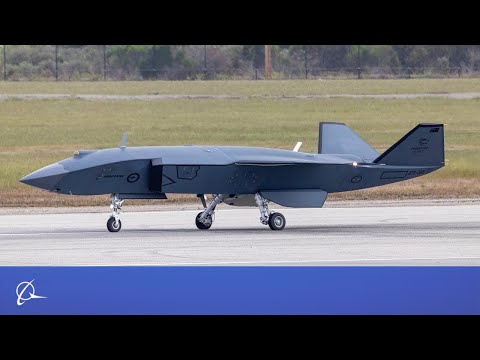
The MQ-28 has now flown at least three times within the Point Mugu Sea Range off the coast of southern California, according to a Boeing press release. The expansive range is routinely used for a wide array of research and development and test and evaluation activities, as well as training. Naval Air Station Point Mugu, part of Naval Base Ventura County, sits right on the coast, surrounded by farmland, with direct access to the range and minimal risk to bystanders. Its location makes it well suited for uncrewed aircraft operations, and it already has a major role in this regard in relation to the MQ-4C Triton and managing target drones.
MQ-28 first international flights
“This testing shows the MQ-28’s ability to operate seamlessly from allied facilities, which helps Boeing demonstrate the aircraft’s maturity and potential export opportunities to international customers outside Australia,” per the press release from Boeing. “Tests at Point Mugu validate autonomous systems while following required airspace, range safety and regulatory approvals.”
Boeing also described this as “MQ-28’s first international operation in allied airspace,” but it is unclear when the first sortie from Point Mugu occurred.
In December, the Pentagon released a video of Secretary Pete Hegseth visiting Naval Air Station Point Mugu with an MQ-28 clearly visible in the background. However, the drone seen in that footage also had an early-style paint scheme with high-visibility orange trim. Pictures and video that Boeing released along with its announcement of the Point Mugu Sea Range flight testing show a Ghost Bat with a two-tone gray livery. It also has an infrared search and track (IRST) sensor system in the nose, something not seen on the example in the Hegseth video. The MQ-28 is a highly modular design, with the nose section designed to be readily swappable.
A comparison of the MQ-28 seen in the video of Secretary Hegseth at Point Mugu, at top, and the Ghost Bat in the video Boeing released as part of its announcement about the flight testing. US Military/US Navy
Boeing itself released a picture of an MQ-28, again with the early paint scheme and no IRST, at MidAmerica Airport outside of St. Louis, Missouri, back in 2023. In that instance, the Ghost Bat was displayed alongside the demonstrator the company had been using to support the development of the MQ-25 Stingray tanker drone for the Navy.
The picture Boeing released of an MQ-28, at left, and the MQ-25 demonstrator, at right, at MidAmerica Airport in 2023. Boeing
How many Ghost Bats are currently in the United States is unknown. TWZ has reached out to Boeing for more information.
The MQ-28 has been flying in Australia since 2021, two years after the design was first shown publicly. Boeing’s subsidiary in Australia had already been working on the design before then under the Royal Australian Air Force’s (RAAF) Airpower Teaming System (ATS) program. To date, RAAF has received eight Ghost Bats in a pre-production Block 1 configuration.
Boeing and the RAAF have already conducted at least one live-fire AIM-120 launch from a Block 1 Ghost Bat, with the missile having been carried aloft on an external pylon under the drone’s fuselage.
Uncrewed MQ-28 Ghost Bat showcases its combat capability
MQ-28, Wedgetail, Super Hornet: Drone Intercept Behind-the-Scenes
Boeing has also been open about its interest in pursuing sales of the MQ-28 outside of Australia. The company has publicly named Japan as a potential customer and has said it is exploring potential opportunities with other unnamed countries in the Indo-Pacific region. In March, Boeing Australia announced a partnership with Rheinmetall in Germany to pitch the Ghost Bat to that country’s armed forces. A carrier-capable version of the design with a tail hook has been pitched to the United Kingdom in the past, as well.
This latter point brings us to what is largely absent in Boeing’s announcement about MQ-28 flight testing from Point Mugu: the U.S. Navy.
In September 2025, the Navy confirmed that it had awarded Boeing, as well as Anduril, General Atomics, and Northrop Grumman, contracts to develop “conceptual” carrier-based CCA drone designs. At that time, the service also announced that Lockheed Martin was under contract for work on an accompanying common control architecture.
In April 2025, Navy Capt. Ron Flanders, public affairs officer at the Office of the Assistant Secretary of the Navy for Research, Development & Acquisition (RDA), had also told TWZ directly that “the U.S. has expressed strong interest in leveraging the MQ-28’s AI-driven autonomy and modular design for future air combat operations.”
As mentioned, Boeing is also developing the MQ-25, a production representative version of which just flew for the first time in April. Beyond the important aerial refueling and other capabilities the Stingray is set to bring to the Navy’s carrier air wings, the service routinely describes it as a “pathfinder” to future uncrewed aviation capabilities.
Flight testing now from Point Mugu is certainly an important development for the MQ-28 program as a whole, and one Boeing hopes could open the door to new opportunities for the Ghost Bat. Whether or not that includes deeper U.S. Navy involvement remains to be seen.