NATO’s Turkiye summit live: Trump, leaders to meet in Ankara | NATO News
Live updatesLive updates,
Defence spending and support for Ukraine’s military needs are expected to top the agenda of summit in Turkish capital.
Published On 7 Jul 2026
Defence spending and support for Ukraine’s military needs are expected to top the agenda of summit in Turkish capital.


Published On 7 Jul 20267 Jul 2026
Share
WASHINGTON — The leaders of Europe are bracing for another turbulent summit with President Trump this week as NATO members gather for their annual meeting in the Turkish capital.
European diplomats view Trump’s decision to attend as a positive sign of his continued commitment to the alliance. But the president’s grievances with several European governments over their refusal to join the U.S. war with Iran have cast a pall over a summit already strained by Trump’s wavering support for the continent.
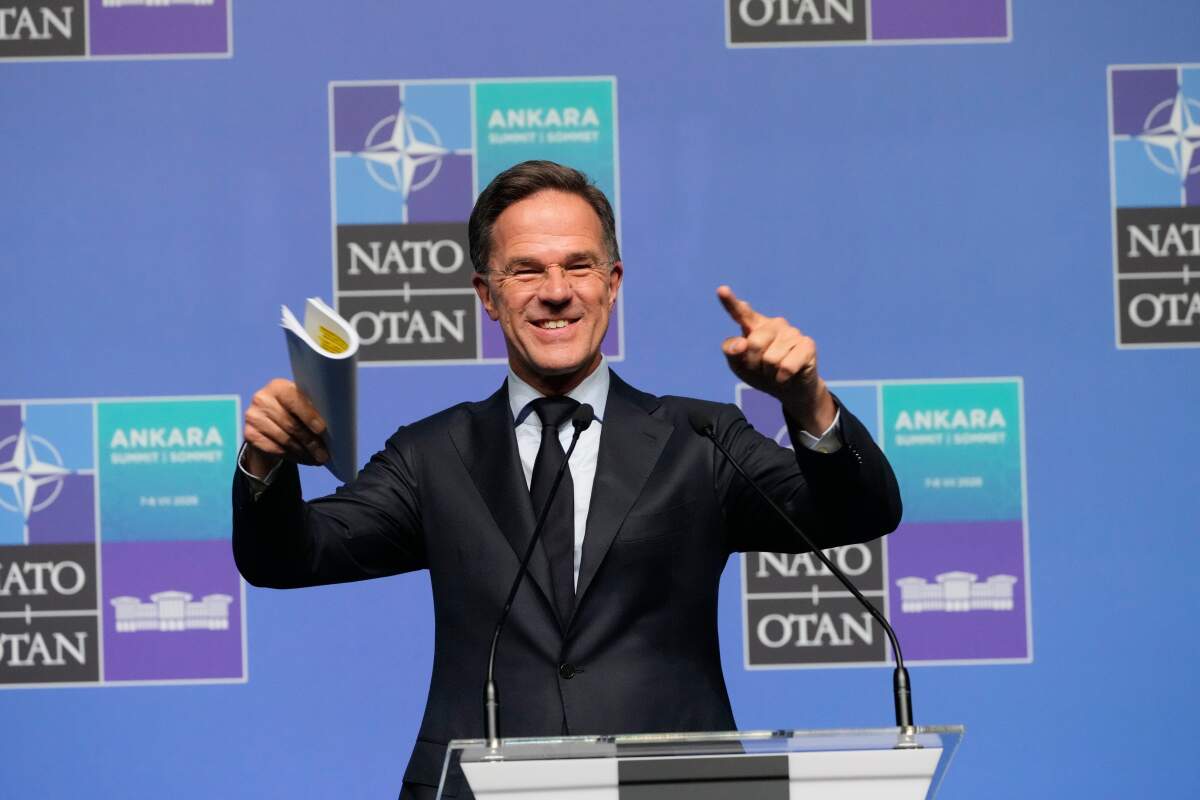
The secretary-general of the transatlantic alliance, Mark Rutte, told reporters on Monday that Trump had aired his resentments in a recent phone call. But Rutte countered with a mix of flattery and countervailing facts that has thus far kept Trump engaged.
While Trump has accused European leaders of denying U.S. forces access to allied bases for takeoffs and refueling during the war, Rutte noted that about 5,000 sorties supporting Operation Epic Fury launched from European airfields. And last Friday, France and Britain committed to a joint military mission with Oman to support freedom of navigation in the Strait of Hormuz — “an extremely important development,” Rutte said.
At last year’s summit, held in The Hague, all NATO member states — with the exception of Spain — agreed to spend 5% of their GDP on defense by 2035, marking a significant increase in historic spending goals for modern Europe. The pledge is divided into two categories, with 3.5% of spending allocated to core military requirements, and the rest committed to a broad set of security-related investments.
Trump’s tough love on the alliance “is, I think, bringing NATO closer together,” the secretary general told reporters.
“You could argue that he is the first president of the U.S. since Eisenhower who was able to come to this situation where the Europeans and the Canadians will spend the same as the Americans” on security, Rutte said. “This equalization was a wish for 50, 60 years, and now it’s happening — I think in large part due to his leadership.”

NATO Secretary-General Mark Rutte speaks to reporters Monday ahead of the NATO summit in Ankara, Turkey.
(Hussein Malla / Associated Press)
In a video message posted on social media Monday, Trump’s ambassador to NATO, Matthew Whitaker, said the summit this week would serve as a “report card” to determine whether countries were beginning to fulfill their commitments from last year.
He offered a note of optimism and suggested the president’s goal is to enhance, rather than undermine, the alliance.
“The United States will be here, but we also need our allies to be here. We cannot do it alone, and the American taxpayer should no longer bear the burden,” Whitaker said.
A White House schedule for Trump’s trip lists bilateral meetings with Rutte and the leaders of Turkey, Syria and Ukraine, in between alliance-wide meals and conferences.
Ukraine will remain at the top of the agenda, Trump told reporters Monday, expressing hope that the war could soon come to an end after four brutal years of fighting.
Russia’s invasion of Ukraine has caused the greatest loss of life in Europe since World War II, resulting in more than 1 million casualties, including an estimated 600,000 dead. Since Russian President Vladimir Putin launched his full-scale invasion in 2022, following his covert invasions of Ukraine’s Crimean peninsula and eastern regions in 2014, Russian forces have captured roughly 12% of Ukraine’s territory.
The war has settled into a deadly stalemate since a 2023 Ukrainian counteroffensive failed to break Russian defensive lines. While Russian forces have occasionally advanced, they have only managed to hold marginal gains along the front, at tremendous cost.
In recent weeks, however, expanded Ukrainian drone and missile capabilities have shifted the dynamic, striking military production sites deep inside Russia and targets near Moscow, bringing the war more directly into the Russian public consciousness and raising questions in the Russian capital whether the war effort is sustainable.
Ukraine’s boldness has impressed the Trump administration, Alexander Stubb, the president of Finland, told the Financial Times this week.
“I think he does feel pressure,” Trump said of Putin, addressing reporters in the Oval Office before departing for Turkey on Monday.
The president referred to an ongoing U.S. effort to end the war, a goal that has remained elusive for Trump since returning to office.
“I think we’re getting much closer than people realize,” he said. “President Putin wants it to end, I will tell you that. Very strongly. Had a good call. And President Zelensky actually wants it to end now.”
“We’re going to be going to NATO, and we’re going to be talking about it,” Trump added. “And I think we’re going to get it ended. It’s been terrible.”

A Russian missile and drone attack on Ukraine’s capital has killed at least 10 people and injured 46 on the eve of a NATO summit. Al Jazeera’s Audrey MacAlpine reports from a residential building that was hit.
Published On 6 Jul 20266 Jul 2026
Share
Ukrainian President Volodymyr Zelenskyy had warned of a likely attack ahead of meeting with US President Donald Trump.
Published On 6 Jul 20266 Jul 2026
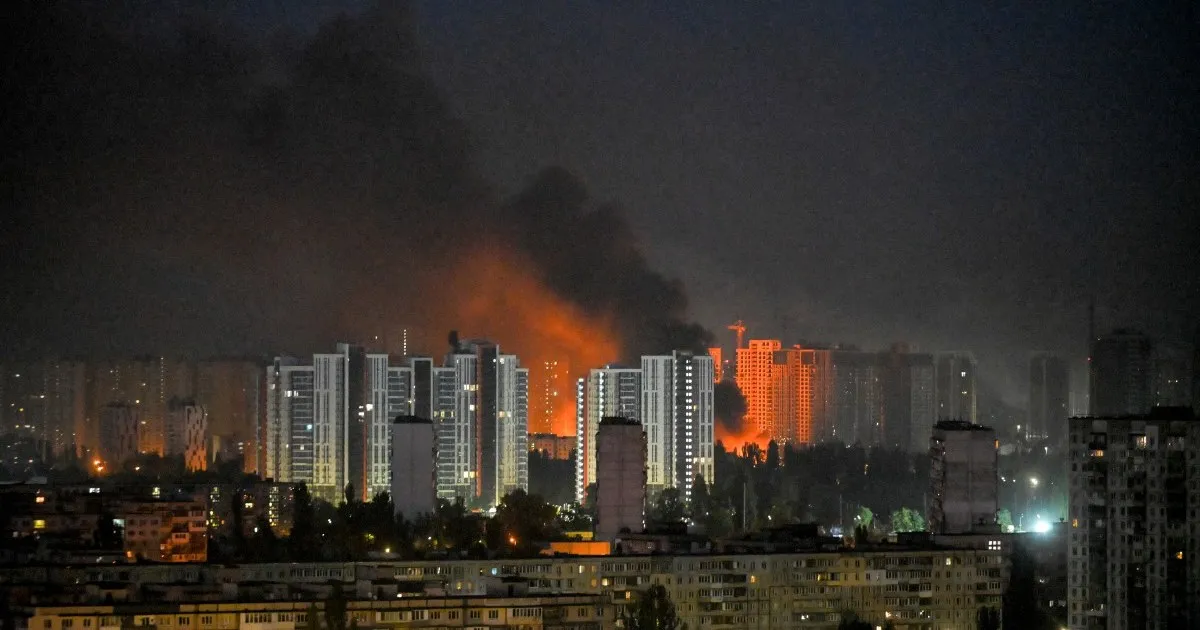
A Russian missile and drone attack on Ukraine’s Kyiv has killed at least 10 people and damaged more than a dozen residential buildings in the second large-scale assault on the Ukrainian capital in less than a week.
The attack early on Monday morning injured at least 46 people in Kyiv, according to Tymur Tkachenko, head of the city’s military administration.
list of 4 itemsend of list
Another person was killed and 10 others were injured in districts surrounding Kyiv, according to authorities.
Ukraine’s military said Russia fired 68 missiles and 351 drones overnight.
The Kyiv Independent reported that the first explosions were heard at about 1:40am local time, followed by more strikes at 2:10am and 3:15am.
Thousands of residents fled to underground shelters, it reported, as air raid sirens sounded across Ukraine.
At least 15 buildings were damaged in Kyiv in the strikes, including four in the capital’s historic Podilskyi district, Tkachenko said.
Rescue work is under way across the capital and the death toll could rise, he said.
“Unfortunately, this is not the final information,” Tkachenko told reporters as the death toll jumped to nine from seven in Kyiv.
In his nightly address on Sunday, Ukrainian President Volodymyr Zelenskyy warned that another Russian assault might be coming before the NATO summit in Turkiye this week.
He is due to meet United States President Donald Trump on the sidelines of the summit, which begins on Tuesday.
“Intelligence once again indicates that the Russians are preparing a new massive strike,” Zelenskyy said, according to the Kyiv Independent.
“This is typical of Putin: right after America’s Independence Day and before the NATO summit in Ankara.”
Late last week, Russia hit the Ukrainian capital with dozens of missiles and hundreds of drones, killing 31 people.
The strikes were the deadliest to hit Kyiv this year.
Both Russia and Ukraine have recently expanded their use of long-range weapons, including missiles, marking a new front in the four-year war.
Ukraine has focused its attacks on Russian energy facilities to weaken its war efforts.
Mikhail Razvozhayev, the governor of Russian-controlled Sevastopol, a Black Sea port in Crimea, said on Monday a Ukrainian strike near the city had knocked out electricity supplies.
“Following an enemy attack on energy infrastructure near Sevastopol, our city was temporarily left without electricity,” Razvozhayev wrote on Telegram.
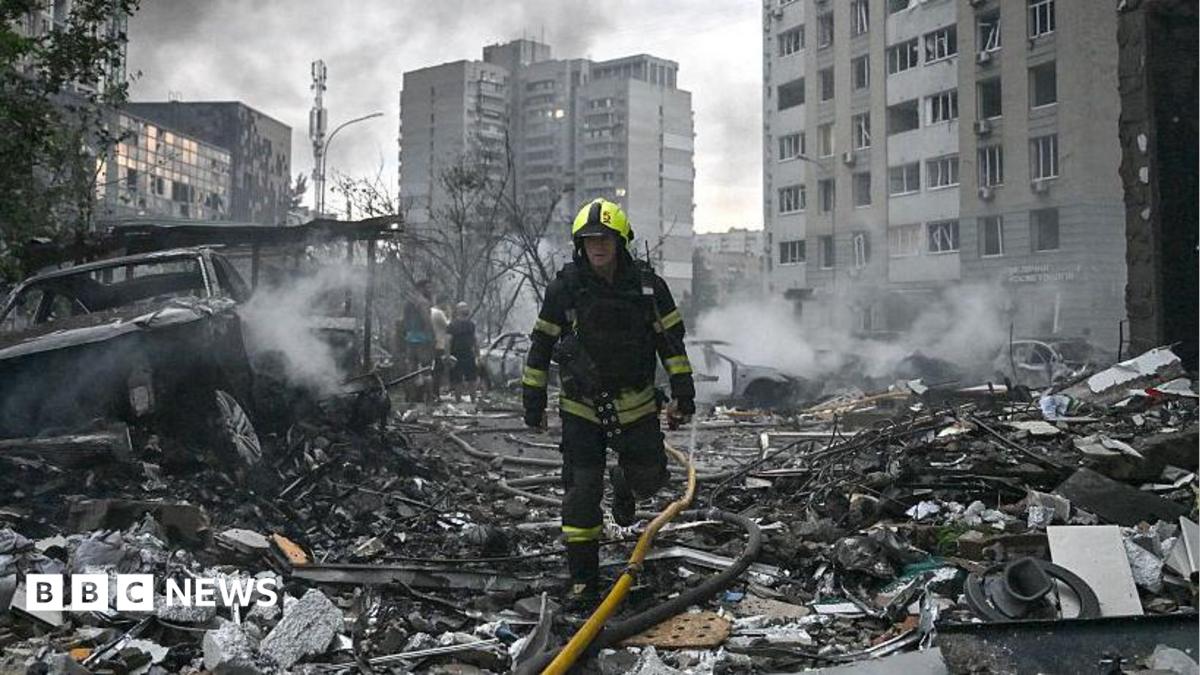
Rescuers in Kyiv are racing to find people trapped under the rubble of partly demolished apartment blocks, after at least nine were killed in Russia’s second round of strikes on the Ukrainian capital in a week.
Kyiv’s top military administrator Timur Tkachenko said 46 people were injured, with at least five children injured.
The strikes come on the eve of the Nato summit in Turkey, where Ukrainian President Volodymyr Zelensky is expected to hold talks with US President Donald Trump.
Hours before the latest strikes, Zelensky warned that Moscow was preparing a second “massive strike” on Kyiv following its attacks on Thursday that killed 30 people.
Russian ballistic missiles hit several buildings across the city, Mayor Vitaly Klitschko said, adding that fires had broken out in some apartment complexes.
Warehouses and a garage workshop were also damaged, according to the mayor.
Photos emerging from Kyiv show smouldering wreckage and charred cars littered throughout the city. Footage also shows crews continuing to comb through wreckage on Monday morning to find survivors.
Zelensky said on Sunday, hours ahead of the strikes, that intelligence indicated that Kyiv would come under a second wave of Russian attacks in a week.
After a barrage of drone and missile strikes through Thursday night, tens of thousands of residents evacuated to metro stations around the city as alarms blared in the early hours of Friday morning.
Ukraine accused Moscow of deliberately attacking civilian areas in the attack, which left at least 30 people dead. Russia said it had targeted military and energy bases in retaliation for recent Ukrainian strikes on power stations and energy facilities in Russian territory.
Such attacks continued overnight with power being cut off temporarily in the city of Sevastopol in Russian-occupied Crimea.
Ahead of the Nato meeting, Zelensky urged allies to not delay on supplies of long-range missiles to be used against Russia.
He wrote on X: “Any delay with missiles for our air defense… means the loss of lives, and it encourages Russia to continue the war.”
Zelensky has also appealed to the US to grant Ukraine licences to manufacture Patriot defence missiles.
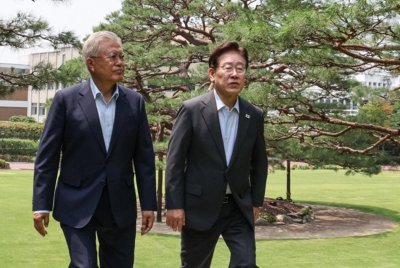

South Korean President Lee Jae Myung (R) and former South Korean President Moon Jae-in head to a luncheon meeting at Sangchunjae, a guesthouse at Cheong Wa Dae, in Seoul, South Korea, 01 July 2026. Photo by YONHAP / EPA
July 3 (Asia Today) — South Korean President Lee Jae Myung will travel to Türkiye and Mongolia next week to promote defense industry cooperation, strengthen the country’s ability to respond to future warfare and expand economic ties with the resource-rich Central Asian nation.
Lee will attend the NATO summit in Ankara on Tuesday and Wednesday at the invitation of NATO Secretary General Mark Rutte, national security adviser Wi Sung-lac said during a presidential office briefing Friday.
He will then make a state visit to Mongolia from Thursday through Saturday.
The South Korean government said Lee’s participation in the NATO summit would provide an opportunity to promote the country’s defense products among members of the world’s largest military alliance.
Seoul also hopes to improve cooperation with NATO in emerging military technologies including drones, artificial intelligence and space systems.
Lee is scheduled to arrive in Ankara on Tuesday afternoon and hold talks with Rutte on strengthening cooperation between South Korea and NATO.
He will participate in a small-group meeting with Rutte and representatives of NATO’s four Indo-Pacific partners: South Korea, Japan, Australia and New Zealand.
Lee will also attend the NATO Summit Defense Industry Forum, which brings together government officials and defense executives to discuss industrial production, investment and technological innovation.
He is scheduled to deliver a keynote address during a session titled “Shared Values, Stronger Industrial Base” and participate in a panel discussion.
Lee will attend an official welcoming dinner hosted by Turkish President Recep Tayyip Erdogan and his wife Tuesday evening.
The South Korean president plans to hold bilateral meetings Wednesday with leaders of countries that have significant potential for defense and other economic cooperation. The presidential office said the schedules for those meetings were still being coordinated.
Wi said the visit would establish a foundation for South Korean defense companies to expand into NATO markets and participate in more resilient international supply chains.
South Korea is not a NATO member, meaning its weapons and communications systems must meet alliance standards to be integrated smoothly with equipment operated by NATO countries.
“We need to advance partnerships that strengthen interoperability in line with NATO standards so South Korean defense products can be exported smoothly to NATO allies,” Wi said.
South Korea has increased defense exports to European countries in recent years, particularly Poland, which has purchased K2 tanks, K9 self-propelled howitzers, FA-50 light combat aircraft and Chunmoo multiple-launch rocket systems.
The government has set a goal of making South Korea one of the world’s four largest defense exporters.
Wi said Lee would use the defense industry forum to emphasize South Korean manufacturers’ technological capabilities and ability to deliver weapons quickly.
“We will directly communicate the excellence and rapid procurement capabilities of South Korea’s defense industry to NATO allies and partners,” Wi said.
The government also hopes South Korean armed forces and private companies can participate more actively in NATO innovation networks involving drones, space technology and other emerging defense systems.
Wi said such participation could give South Korean organizations opportunities to acquire critical technologies, conduct joint research and strengthen their ability to respond to future conflicts.
Mongolia state visit
Lee will travel to Ulaanbaatar on Thursday after completing his NATO schedule.
He will meet Mongolian President Ukhnaa Khurelsukh for a summit followed by an exchange of agreements and memorandums of understanding and a joint news conference.
The two governments plan to issue a declaration titled “A Golden Era of South Korea-Mongolia Relations,” outlining a long-term vision for their strategic partnership.
Lee will deliver a keynote address Thursday evening at a South Korea-Mongolia business forum attended by government officials and business leaders from both countries.
The forum will focus on expanding cooperation in resources, supply chains, infrastructure and other industries.
Mongolia has significant deposits of coal, copper, rare earth elements and other minerals important to advanced manufacturing and clean-energy technologies.
South Korea, which depends heavily on imported energy and industrial resources, has sought to diversify its supply chains by expanding cooperation with Mongolia and other mineral-producing countries.
On Friday, Lee will visit a memorial honoring Lee Tae-jun, a Korean physician and independence activist who supported Mongolia’s medical development and Korea’s independence movement while living in the country in the early 20th century.
The president will then attend a luncheon with members of the Korean community in Mongolia.
Lee is also scheduled to meet Sandag Byambatsogt, speaker of Mongolia’s State Great Khural, and Prime Minister Nyam-Osor Uchral.
Khurelsukh will host a state dinner for Lee on Friday evening.
On Saturday, Lee and Khurelsukh will attend the opening ceremony of the Naadam Festival, Mongolia’s largest national celebration. Lee will attend as a guest of honor.
Naadam features traditional Mongolian wrestling, horse racing and archery and is one of the country’s most important cultural events.
Wi said the visit was expected to strengthen the strategic partnership between South Korea and Mongolia, expand practical economic cooperation and establish a closer partnership in efforts to promote peace on the Korean Peninsula.
Mongolia established diplomatic relations with North Korea in 1948, becoming the second country after the Soviet Union to recognize Pyongyang. It has maintained relations with both South and North Korea.
The presidential office said Mongolia’s traditional ties with North Korea could make it a useful diplomatic partner in efforts to reduce regional tensions and restart dialogue with Pyongyang.
“The two leaders will discuss peace and stability on the Korean Peninsula as well as practical ways to ease regional tensions and build trust,” Wi said.
“They will also explore feasible paths toward resuming dialogue with North Korea,” he said.
— Reported by Asia Today; translated by UPI
© Asia Today. Unauthorized reproduction or redistribution prohibited.
Original Korean report: https://www.asiatoday.co.kr/kn/view.php?key=20260703010001267
Back and forth over defence spending comes as NATO leaders set to meet in Ankara next week.

Published On 3 Jul 20263 Jul 2026
German Chancellor Friedrich Merz has defended his country’s NATO defence spending, shortly after US President Donald Trump re-upped his criticism of alliance members.
The statement on Friday came as NATO leaders were set to meet next week in Ankara. Trump has decried defence spending by members of the bloc throughout his political career, calling the balance of spending “ridiculous” and “one-sided” in his latest Truth Social posts on the issue earlier this week.
list of 3 itemsend of list
In one post, Trump said Germany’s spending was “MUCH LOWER” between 2014 and 2025 than the US or other NATO allies, which he again called “Ridiculous!”
When asked about the comment, Merz said Germany would double its defence budget within four years.
“This is the greatest effort we have ever made to strengthen our defence capabilities. In this respect, we have no reason to shy away from anyone,” Merz said.
“We will state this, with all due modesty, and we are doing so as the European Union’s largest member state, bearing a responsibility within Europe,” he said.
US and European ties have been strained throughout Trump’s first term from 2017 to 2021 and his current term, which began in January 2025.
However, while largely dismissive of the president during his first four years in office, several European leaders have sought a more amenable approach to the president this time around.
At the behest of the US, NATO leaders agreed to spend 3.5 percent of their countries’ GDP on core defence items, such as weapons and troops, by 2035, an increase of the previous goal set by the bloc of 2 percent of its GDP.
However, relations have since frayed over several issues, including Trump’s pledges to take control of the autonomous Danish territory of Greenland. Denmark is a member of NATO.
The US-Israeli war in Iran has also proven to be a major wedge, with Trump launching the conflict without consulting European allies who have dealt with the fallout of the closure of the Strait of Hormuz.
Trump had repeatedly condemned European allies for not joining the war effort.
Merz, meanwhile, roiled the president by saying in April the US had been “humiliated” by Iran. Trump, in turn, said the US would withdraw 5,000 troops currently stationed in Germany.
Speaking on Friday, Merz said Germany was ahead of schedule to reach its NATO commitments.
“We will reach the 3.5 percent benchmark set in The Hague as early as 2029,” he told reporters, “well ahead of the agreed deadline”.
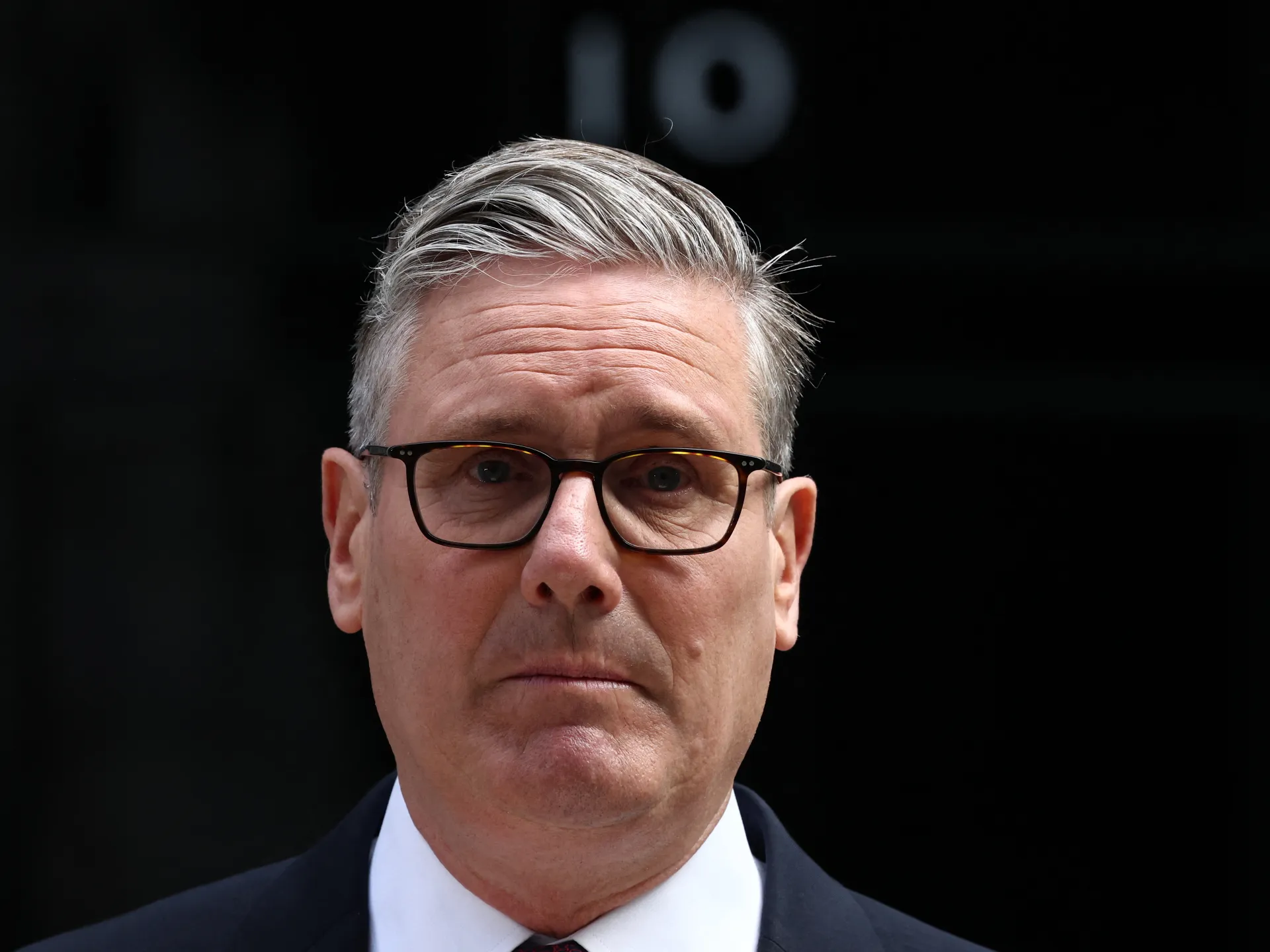
Plan includes more than 5 billion pounds for drones and autonomous systems over four years, Ministry of Defence says.
Published On 30 Jun 202630 Jun 2026
Outgoing Prime Minister Keir Starmer has announced that Britain will spend almost 300 billion pounds ($397bn) over the next four years to modernise its armed forces amid rising threats.
Starmer, expected to leave office next month after losing the support of Labour MPs, announced on Tuesday that the overall defence budget would increase by 15 billion pounds ($20bn) over the next four years to almost 300 billion pounds as he launched his long-awaited defence investment plan.
list of 3 itemsend of list
“Last year I made the decision in the national interest to reprioritise aid spending towards defence and achieved the biggest uplift in defence spending since the end of the Cold War,” Starmer said.
“That was the right choice because the world has changed. National security is economic security.
“Today we uplift defence spending further – an additional 15 billion pounds worth of funding – by … reprioritising spending across government.”
The plan includes more than 5 billion pounds ($6.6bn) for drones and autonomous systems over the next four years, the Ministry of Defence said in a news release.
The announcement followed months of wrangling within Starmer’s Labour government over the resources required to modernise the United Kingdom’s armed forces in the face of rising threats, including from Russia.
Two defence ministers quit this month in a row over the spending proposals, including Defence Secretary John Healey, who said the plans risked making Britain “less safe”.
Starmer’s pledge came as United States President Donald Trump has repeatedly urged NATO allies to spend more on defence and become less reliant on Washington for security.
Starmer will take the plan, which foresees spending nearly 80 billion pounds ($105.7bn) a year by 2029, to Ankara for a NATO summit on July 7-8. He wants to signal Britain is on track to spend 3.5 percent of its gross domestic product on defence by 2035.
With likely successor Andy Burnham due to take power as early as July 20, Starmer acknowledged new governments could “build” on his blueprint.
Critics said the plan, delayed for more than nine months, was too little, too late.
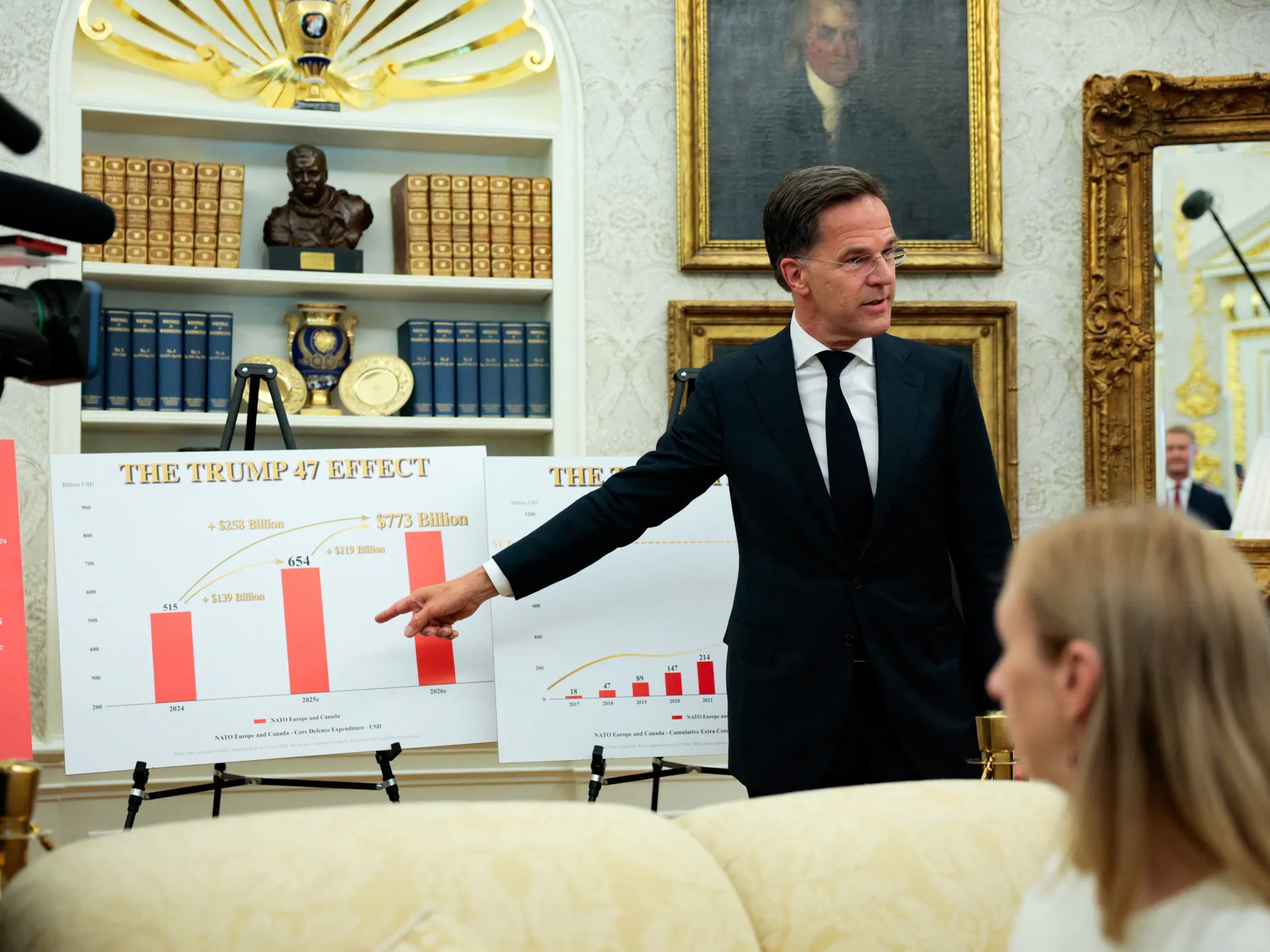
NATO chief Mark Rutte visited the White House to ease tensions with US President Trump ahead of next month’s NATO summit. Trump has said NATO isn’t doing enough, ordering a review of US forces in Europe after saying allies did not support the US war on Iran.
Published On 25 Jun 202625 Jun 2026
Share

The TWZ Newsletter
Weekly insights and analysis on the latest developments in military technology, strategy, and foreign policy.
One of Russia’s biggest advantages in the war against Ukraine is its ability to launch tactical airstrikes from bases largely out of reach of kinetic responses. While we have frequently reported about Ukrainian attacks on these bases, they aren’t sustained enough to stop Russia from generating devastating sorties.
Now Ukraine and NATO are looking to the private sector for ways of changing that equation through what is being called the Airfield Denial Challenge. It offers a 250,000 Euro award to companies or individuals who come up with workable ideas to prevent Russia from being able to use its air bases.
🚀The NATO-Ukraine Joint Analysis, Training and Education Centre (JATEC) and NATO Allied Command Transformation (ACT) have announced the Persistent Airfield Denial Innovation Challenge to find a solution to block enemy airfields. (1/5) ⬇️ pic.twitter.com/8uKWWEI5pQ
— NATO in Ukraine (@NATOinUkraine) June 22, 2026
“The Armed Forces of Ukraine (AFU) operational experience has firmly established that the ability of the adversary to project air power from secure rear-area airfields remains one of the most consequential asymmetries in the current conflict,” according to NATO’s Headquarters Supreme Allied Commander Transformation (SACT). “Enemy tactical aviation, operating from bases beyond the reach of conventional Ukrainian strike assets, continues to conduct strikes using guided aerial bombs, cruise missiles, and stand-off munitions against friendly forces, critical infrastructure, and civilian population centers.”
Objective control footage shows the aftermath of a FAB-250/500 airstrike carried out by a Russian Aerospace Forces (VKS) Su-34M fighter-bomber on a warehouse in Kharkiv used to store UAVs and their components. pic.twitter.com/vnynslqFiO
— Tsar Ivan 🌐 (@RusHonorBG) June 20, 2026
The goal of this program is lofty.
“Each sortie originates from an airfield. Every airfield is a node of vulnerability: if it can be persistently denied, the adversary’s air campaign is fundamentally disrupted at source,” SACT suggested.
You can see video from one of the Ukrainian attacks on Russian tactical aviation bases below.
Russia’s Morozovsk Airbase is currently under Ukrainian drone attack, with several explosions seen in the vicinity of the airfield.
Morozovsk is home to a number of Russian Air Force Su-34 fighterbombers. pic.twitter.com/CnEP4U8tjv
— OSINTtechnical (@Osinttechnical) April 4, 2024
Ukraine’s ongoing efforts to halt these attacks are insufficient, SACT posited.
“Current workarounds: manned strike aviation, ground-based long-range fires (MLRS, ballistic missiles), and conventional single-unit loitering munitions have demonstrated limited effectiveness against defended airfield targets,” SACT argued. “They lack the mass-effect, persistence, and EW (Electronic Warfare)-resilience required to simultaneously suppress airfield infrastructure across multiple aim points in a contested environment.”

The “battlefield logic is clear,” the NATO subcommand added. “Point-defense and reactive interception of individual weapons must be complemented by persistent denial at the source.”
“We must find technologies that will help to permanently limit the enemy’s use of aviation infrastructure: aircraft, runways, fuel and ammunition storage facilities, and ground support infrastructure,” the Ukrainian Defense Ministry (MoD) explained. “Ukrainian miltech companies, startups, and engineering teams are invited to participate.”
SACT said the challenge is technically agnostic and that it is looking for ideas that include, but not are not limited to, the following:
• Uncrewed aerial systems of any configuration or range class
• Autonomous or semi-autonomous munitions and loitering systems
• Swarming and mass-effect approaches
• Alternative delivery mechanisms beyond conventional aerial platforms
• Hybrid solutions combining multiple technologies
Regardless of what type of solution is presented, it “must be capable of operating in GPS-denied and EW-contested environments, across all weather conditions and seasons, and must demonstrate a credible path to rapid fielding.”
In addition, SACT is looking for systems that can conduct sustained strikes deep into contested airspace, operate without “continuous human control,” be fully autonomous and deliver “sufficient mass and precision to suppress multiple aim points across an airfield simultaneously.”
SACT also wants systems that require minimal training, and have AI-assisted target acquisition that “reduces reliance on expert judgment.”
The solicitation comes with the understanding that whatever solutions are presented won’t be proven, but should be at least in the mid-to-upper tier of the military technology readiness level (TRL) scale. It includes systems ranging from those having “high fidelity” laboratory integration of components to those with prototypes “near, or at, planned operational systems.”

Meanwhile, any solution that will take more than a year to be fielded won’t be considered.
The deadline for submissions is July 20. Ten finalists will be selected on August 11 and will be invited to a “pitch day” on Sept. 3, tentatively in Poland, to showcase their designs.
Whether this ambitious program will actually lead to the fielding of any systems that can persistently deny Russia the ability to launch aircraft is very much in question.
As we have frequently reported, Ukraine has one of the world’s most innovative defense technology infrastructures that has created drones, missiles and other weapons designed, tested and fielded under intense wartime conditions. However, it has still been unable to achieve the goals being sought by this challenge.
One of the big issues Kyiv faces is the limited amount of funds to pursue some of these advances and what the Atlantic Council has described as “Ukraine’s inability to mass produce sophisticated weapons or sustain stable military supply chains.”
Getting an idea into the hands of NATO, which has developed a half-billion dollar fund to develop weapons for Ukraine, could ultimately help turn an idea into a workable weapon to keep Russian tactical aviation at bay. Even if that happens, though, the time it would take to develop these weapons at a scale large enough to make a real difference would be a formidable endeavor.
Contact the author: howard@twz.com
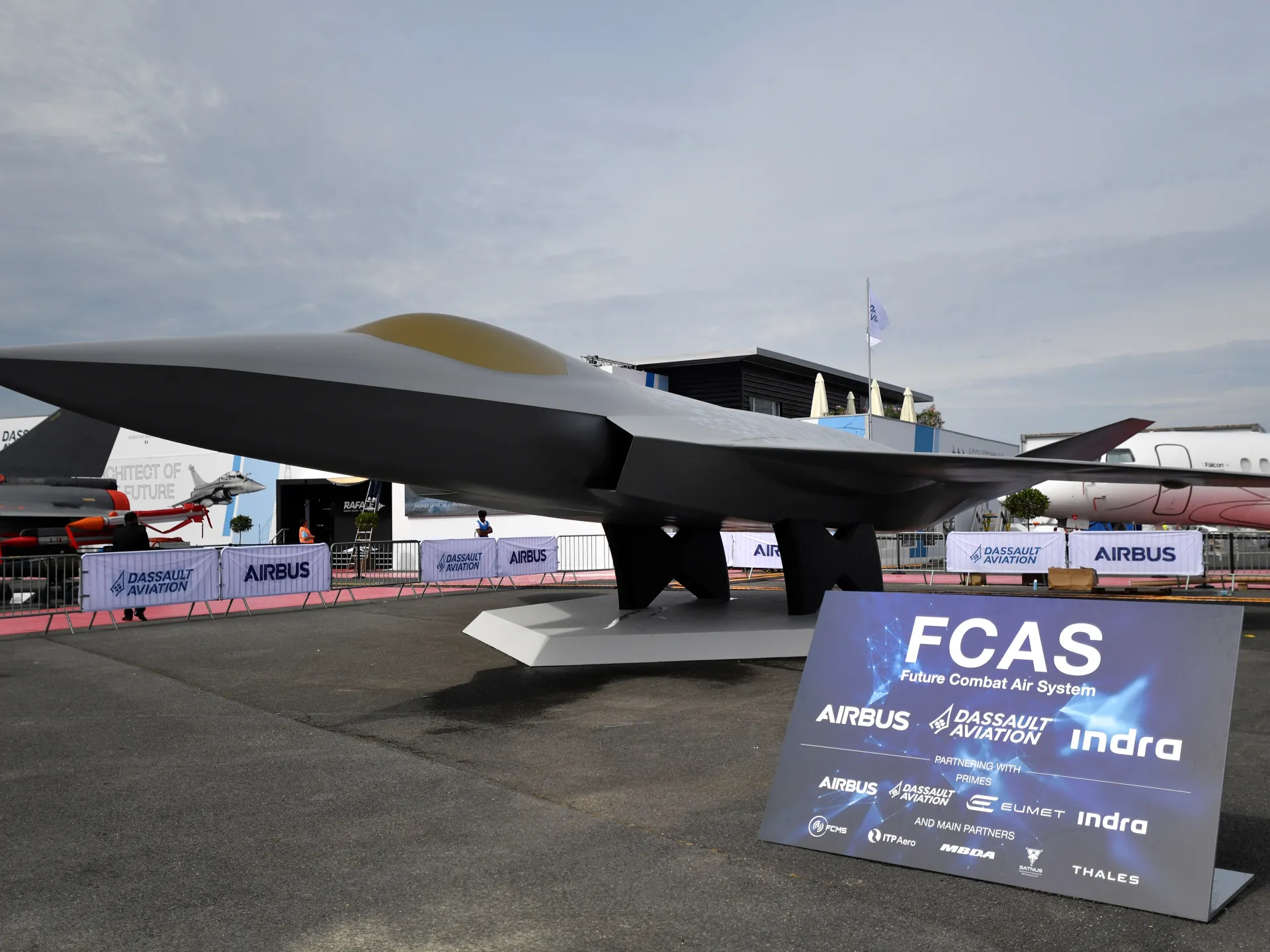
France and Germany have announced this week that they are ditching a landmark project to jointly develop a sixth-generation fighter jet.
French President Emmanuel Macron confirmed on Monday that the project is being terminated, in what is being seen as a major blow to efforts to boost defence cooperation between European Union states, a key issue amid uncertainty cast by United States President Donald Trump over the readiness of the US to help defend its NATO allies.
list of 4 itemsend of list
Trump’s disdain for Europe’s reliance on the US has been building for years.
Since 2019, the US president has been flirting with the idea of obtaining Greenland.
His remarks about his desire for the island, a self-governing territory which is part of the Kingdom of Denmark, built to a crescendo at the start of this year, with European leaders signalling their displeasure with the idea and Trump even threatening additional trade tariffs on those countries standing in his way.
Both Denmark and Greenland have repeatedly stated that the island is not for sale.
At one point, before Trump backed down after agreeing to a “framework of a future deal” on Greenland during a January meeting with NATO’s Mark Rutte in Davos, it seemed as if the US might even try to take the island by force – a notion that would have been inconceivable before the era of Donald Trump.
The threat of military action set off alarm bells in European capitals.
In addition to all this, Trump has withdrawn much of the US’s support for Ukraine and has consistently berated his European NATO partners for not spending enough on their own defence for years, outright urging them to reduce their reliance on the US for military protection.
More recently, Europe’s refusal to join the US-Israeli war on Iran, which began with strikes on Tehran on February 28, has further irked the US president and deepened concerns that a widening transatlantic rift could weaken the continent’s security and embolden Russia.
Until this week, a counterweight to these burgeoning concerns was in hand – the Future Combat Air System (FCAS) project, a landmark pact to jointly develop a next-generation fighter jet involving France, Germany and Spain.
But disagreements over whether France’s Dassault Aviation, or Airbus, which also represents Germany and Spain, should take the lead on the project have ultimately led to its collapse.
Analysts, however, say all hope is not lost: despite the dissolution of the bellwether venture, Europeans can indeed become strategically autonomous, they say – but the road there runs through shared military integration, rather than shared political aspiration.
The FCAS hoopla does “highlight the limitation of Europe’s defence industrial landscape, where national needs sometimes clash with the broader goal of defence integration”, Giuseppe Spatafora, a policy analyst at the European Union Institute for Security Studies, told Al Jazeera.
“But we also shouldn’t overestimate its impact.”
According to Jamie Shea, a retired NATO official and associate fellow with the International Security Programme at Chatham House, FCAS’s dissolution is certainly a setback – but does not spell the collapse of European defence integration in its entirety.
“It was the type of high-tech, innovative and future-oriented programme that Europeans need to be able to achieve successfully if they are to become strategically autonomous and break their dependence on the US for major weapons systems,” Shea told Al Jazeera.
It had been hoped that FCAS would move the needle forward, particularly in the areas of artificial intelligence (AI), space, data fusion, and the manned and autonomous systems interface space, he said.
Others would have additionally joined the project as it gained momentum, as Spain did, he added, potentially creating a domino effect in next-generation defence technologies across the continent.
But, crucially, Spatafora said, the project dates back to 2017 – a different era, before Russia’s full-scale war on Ukraine and before Trump’s return to the White House.
“Nowadays, the project might be designed differently to reflect the scenario,” he said.
“But it doesn’t affect the broader trend in Europe towards reducing dependencies on US military systems and strengthening its own defence capabilities.”
France and Germany will continue with some components of FCAS, such as its “combat cloud” feature, which will increase Europe’s cyber command-and-control capabilities, said Spatafora.
Airbus and a number of other German companies are also seeking to continue the programme in other areas, particularly software architecture and drone technology, Shea said.
“So there may be benefits for European defence and its defence technology base even if a manned fighter aircraft is not built,” said Shea.
Furthermore, there are “scores” of other joint defence projects being launched in Europe at the moment, even if they are not quite as ambitious as FCAS, he added.
Guntram Wolff, a senior fellow at the European think tank Bruegel, similarly urged against alarmism.
“I would not interpret this decision overly negatively,” Wolff told Al Jazeera.
“FCAS was a very complicated project and its military relevance may well be overstated at a moment of increasing importance of cheap autonomous systems. In part, the decision also reflects a reassessment of whether the high cost was really warranted.”
Europe, meanwhile, has other strengths it can build on, the analysts said.
The continent is strong in shipbuilding, submarines, short-range missiles and air defence – with systems like the German IRIS-T and the French-Italian SAMP/T – and has demonstrated it can build capable fighter jets, such as the Eurofighter Typhoon, Tornado and Gripen programmes have shown, Shea said.
Europe’s main problem is underinvestment and the difficulty it has in scaling up to the level of mass production that modern warfare demands, said Shea.
This issue was brought into sharp focus this week when the UK’s secretary of state for defence dramatically resigned from government over defence funding.
He simply cannot keep the country safe on what he has been given to spend, he said. In his resignation letter to the prime minister, he wrote: “You have been unable and the Treasury has been unwilling to commit the resources that the nation needs to defend the country at this time of rising threats,” he wrote.
Ultimately, European nations are going to have to come together if they have any hope of matching US military might in the future, analysts say.
“It is the challenge of integrating all systems and all domains into a single battlefield management space where the US is in advance of the Europeans,” Shea said.
“Drones, which Russia and Ukraine are producing in the millions, are a case in point. Even the US suffers from weapons shortages as we have seen in the Iran war,” the former NATO official added.
Spatafora echoed the idea that the Russia-Ukraine war has lessons to offer the rest of Europe.
“The lesson of the war in Ukraine is that, in order to deter and defend itself properly, Europe needs cheap, mass-produced capabilities,” he said.
FCAS was about a very expensive capability, “so it was not really the key need for Europe’s deterrence today”, the analyst said.
The more pressing question that FCAS raises is how European nations will coordinate large projects which single countries cannot produce on their own and which could clash with the interests of numerous national industries. This is the conundrum which will likely shape the design of future EU instruments to support cooperative defence projects, said Spatafora.
Another challenge facing the continent is that major platforms like aircraft, ships or land warfare vehicles can take decades to develop, and contracts signed today will yield equipment that will not be on the battlefield before 2040, Shea said.
Europe will need to upgrade its current capabilities – recent upgrades to the Eurofighter jet and the Leopard tank are examples he cited – and look for gap-fillers elsewhere.
Spatafora argues that the FCAS collapse should not push European countries back towards reliance on American systems – or at least not more than they already have.
“The Trump administration’s approach and the depletion of stock after the Iran war have significantly reduced the reliability of US supplies,” he said.
The reliability of US guarantees, he added, depends on other assets – long-range missiles, forward-deployed troops, command-and-control infrastructure – “rather than on a next-generation fighter jet”, the analyst added.
The FCAS failure is certainly good news for Russia, Shea said, “and also for the US, which will hope to sell Europe even more F-35s and maintain Europe’s traditional dependency on US military equipment”.
A rebound from the collapsed project, therefore, he argued, is necessary. But that is already in the works, analysts say, as Europe is already turning away from US dependability.
They point to the high likelihood of renewed interest in the UK-Italy-Japan Global Combat Air Programme (GCAP) for a sixth-generation stealth fighter jet, in European Space Agency military space capabilities, and in EU defence financing mechanisms like the Security Action for Europe (SAFE).
Joint ventures with Ukraine, which, under fire from Russia for four years, has mastered mass production of drone technology and AI, should also help keep Europe up to speed in key areas, Shea added.
“The US has proven to be unreliable, or simply unable to remain committed to Europe, and the defence budgets are growing,” Spatfora said.
Washington will continue to remain relevant for certain capabilities – nuclear deterrence above all – but over time, European countries will seek to develop more and more on their own.
The ultimate lesson of FCAS, however, Shea argued, is that defence integration “has to be driven by military requirements rather than political ambition”.
Cooperation between France and Germany has always been difficult, he said – they have large defence companies “that do not want to play second fiddle to the other”, he said.
A more promising model, he said, is the joint UK-Norway agreement to produce a new destroyer-class warship, with BAE Systems as the main contractor and smaller Norwegian companies participating.
“Both countries operate in the North Atlantic and the Baltic Sea and share exactly the same concept of what the ship should be,” explained Shea.
“So it is this model of bottom-up, natural cooperation rather than top-down political cooperation that Europe needs to pursue.”
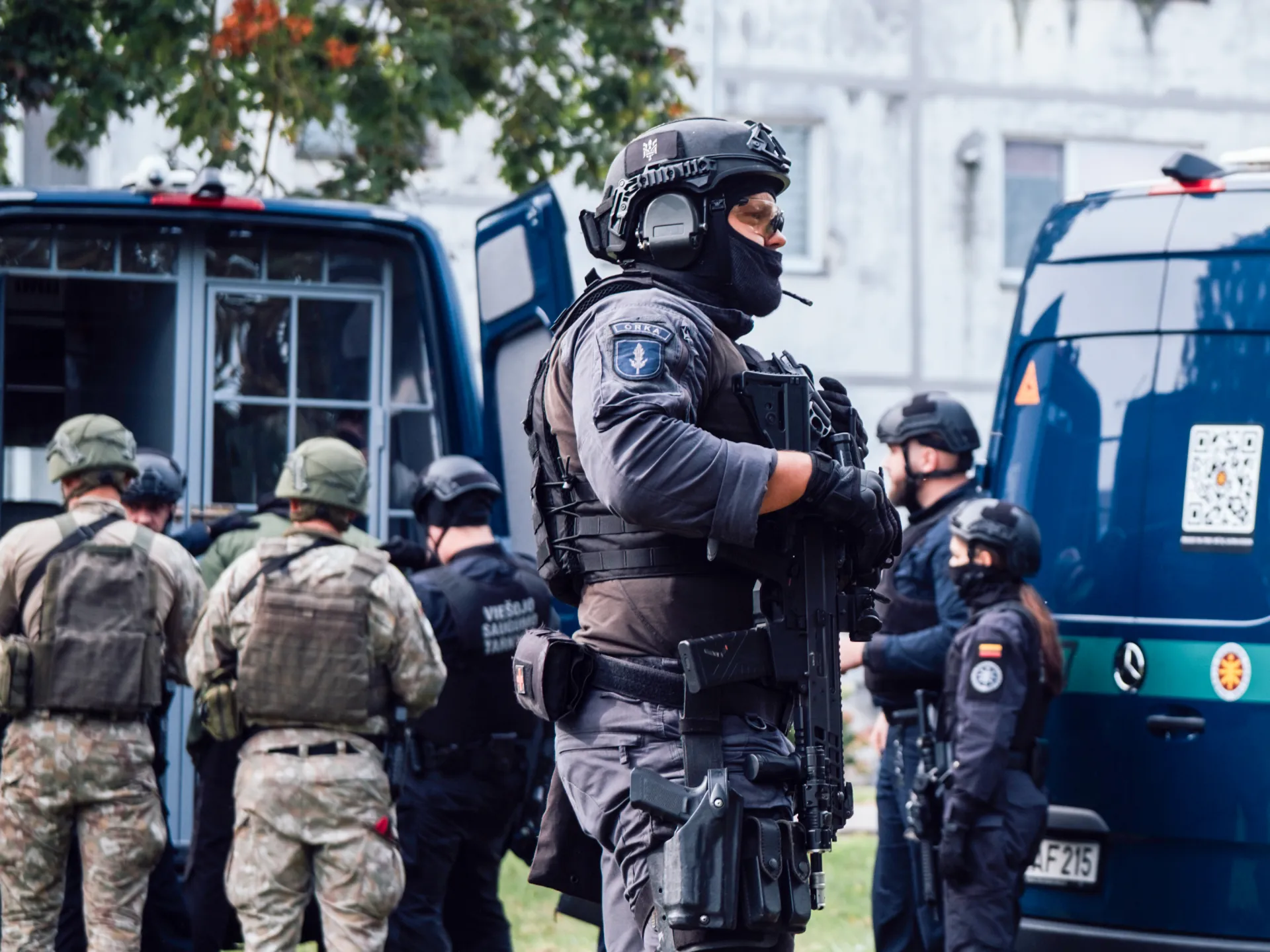
Estonia, the smallest of the Baltic states, has experienced some dramatic incidents.
In September, Tallinn said Russian MiG-31 fighter jets entered its airspace for 12 minutes. NATO scrambled Italian F-35s stationed in Estonia as part of the Baltic Air Policing mission. Russia denied violating Estonian airspace.
In March, a stray Ukrainian military drone crashed into Estonia’s Auvere power station.
In April and May, Estonian authorities said drones entered their airspace, grounding flights and prompting warnings issued to citizens.
Estonia’s intelligence services have said that the country does not believe Russia is preparing an imminent military attack on NATO, but that Moscow may be rebuilding its forces for the long term while engaging in hybrid attacks through drones, cyber operations, and sabotage.
Tallinn claims one such hybrid method is the so-called “Narva People’s Republic”, a pro-Russian separatist narrative that casts Estonia’s Russian-speaking border region as a distinct political entity, echoing the Donetsk and Luhansk “people’s republics” used by Moscow as a pretext for intervention in Ukraine.
Estonian authorities say it is part of a disinformation campaign rather than a credible separatist movement.
Its military has, at times, been bellicose in its statements.
In May, Estonia’s Lieutenant General Andrus Merilo argued that Russia is rebuilding its military much faster than many Europeans realise and that Estonia must be ready for a renewed military threat within the next few years, marking 2027 as a critical benchmark for readiness.
In September 2024, in an interview with the Estonian public broadcaster ERR, Estonian General Vahur Karus stated that if Moscow showed signs of preparing for an attack, Estonia could strike the Russians first.
“Our capability to neutralise the enemy on its own territory is crucial,” he said.
However, the government’s rhetoric has been more measured.
In April, Ukrainian President Volodomyr Zelenskyy suggested in an interview that a new wave of Russian mobilisation may be used to launch an attack on the Baltic states.
But Estonian politicians, including the foreign minister, warned that the remarks echoed Moscow’s objective of stoking fears and made cooperation difficult.
“We do not see Russia concentrating its forces or preparing in any way militarily to attack NATO or the Baltic states; rather, it is the opposite. Russia is not in a very strong position on the Ukrainian front, and economically as well,” Estonian Foreign Minister Margus Tsahkna told ERR.
“No one is in the streets panicking,” Tony Lawrence, a research fellow at the International Centre for Defence and Security in Tallinn, told Al Jazeera.
The air incursions have “put people on edge”, but there is a sense that Russian forces are too preoccupied in Ukraine, he said.
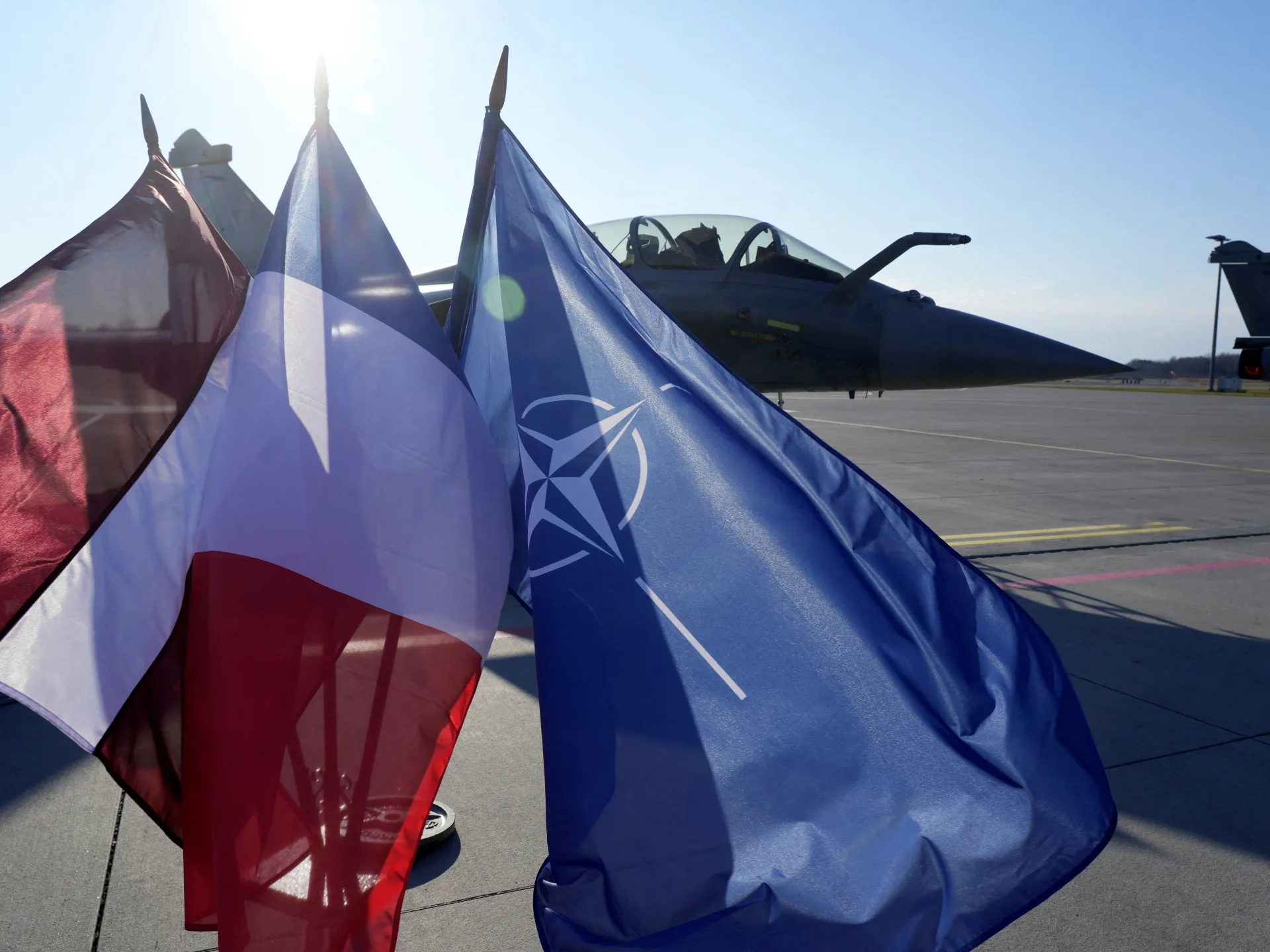
The drone entered Latvian airspace due to ‘Russian electronic warfare’, the military says.
Published On 8 Jun 20268 Jun 2026
NATO fighters have scrambled to shoot down a drone that entered Latvian airspace from Russia.
The Latvian military said on Monday that French aircraft had destroyed “a foreign unmanned aerial vehicle that had entered Latvian airspace as a result of Russian electronic warfare”, without saying where the drone originated.
list of 4 itemsend of list
The incident adds a growing list of incursions from the Russia-Ukraine war into neighbouring countries that are part of the NATO alliance, sparking fears of escalating spillover effects as Moscow’s siege on Ukraine continues apace.
“Thank you to our French allies for shooting down the drone that penetrated Latvian airspace!” Riga’s Foreign Minister Baiba Braze wrote on social media.
Latvian Prime Minister Andris Kulbergs heralded the “swift decision-making and professional action”.
Defence Minister Raivis Melnis told reporters the drone was shot down just after 9am local time (07:00 GMT) near the village of Berzgale, located about 30km (18 miles) from the Russian border. No one was hurt, and no property was damaged, Melnis said.
The French military said in a statement that the jets took off from Siauliai airbase in northern Lithuania and destroyed the drone “over an uninhabited area”.
It added that the incident demonstrated France’s “commitment to contributing to the security of Europe’s eastern flank”.
Authorities had previously warned residents in some parts of eastern Latvia to shelter in place because of the threat.
Countries in the region have reported repeated drone incursions from air and sea in recent months, spawning concerns over the widening impact of Russia’s war on Ukraine.
The issue has raised the political pressure in Latvia, leading to the resignation of Prime Minister Evika Silina last month.
The increased frequency of the reports comes as Ukraine has increased its attacks on Russia, with Moscow deflecting drones using electronic jamming. The statement from the Latvian military regarding “Russian electronic warfare” appears to suggest the drone shot down likely came from Ukraine.
Fragments of a Ukrainian drone were also found in a field in Moldova on Monday after it entered from Ukraine, an incident that officials also blamed on Moscow.
Last week, a maritime drone exploded in Romania’s Constanta port. Kyiv later confirmed it involved a Ukrainian drone that was knocked off course by Russian electronic interference.
However, it was a Russian drone that hit an apartment building in eastern Romania in late May, injuring two people and prompting Bucharest to call for NATO to speed up the transfer of anti-drone capabilities.
European Commission President Ursula von der Leyen warned after that crash that Russia’s war on Ukraine is “increasingly becoming a direct threat to countries on our Eastern border” and said solidarity with them was “absolute”.
The French military jet that shot down Monday’s drone is part of the NATO Baltic Air Policing mission, which has patrolled the skies of Latvia, Lithuania and Estonia since they became part of NATO in 2004.
The TWZ Newsletter
Weekly insights and analysis on the latest developments in military technology, strategy, and foreign policy.
In what appears to be the first incident of its kind, a Russian kamikaze drone strayed into Romanian airspace before striking a residential building, injuring civilians. While Russian drones flying into NATO airspace, whether accidental or deliberate, have become a feature of the war in Ukraine, this marks a notable milestone, although the nature of the repercussions remains unclear.
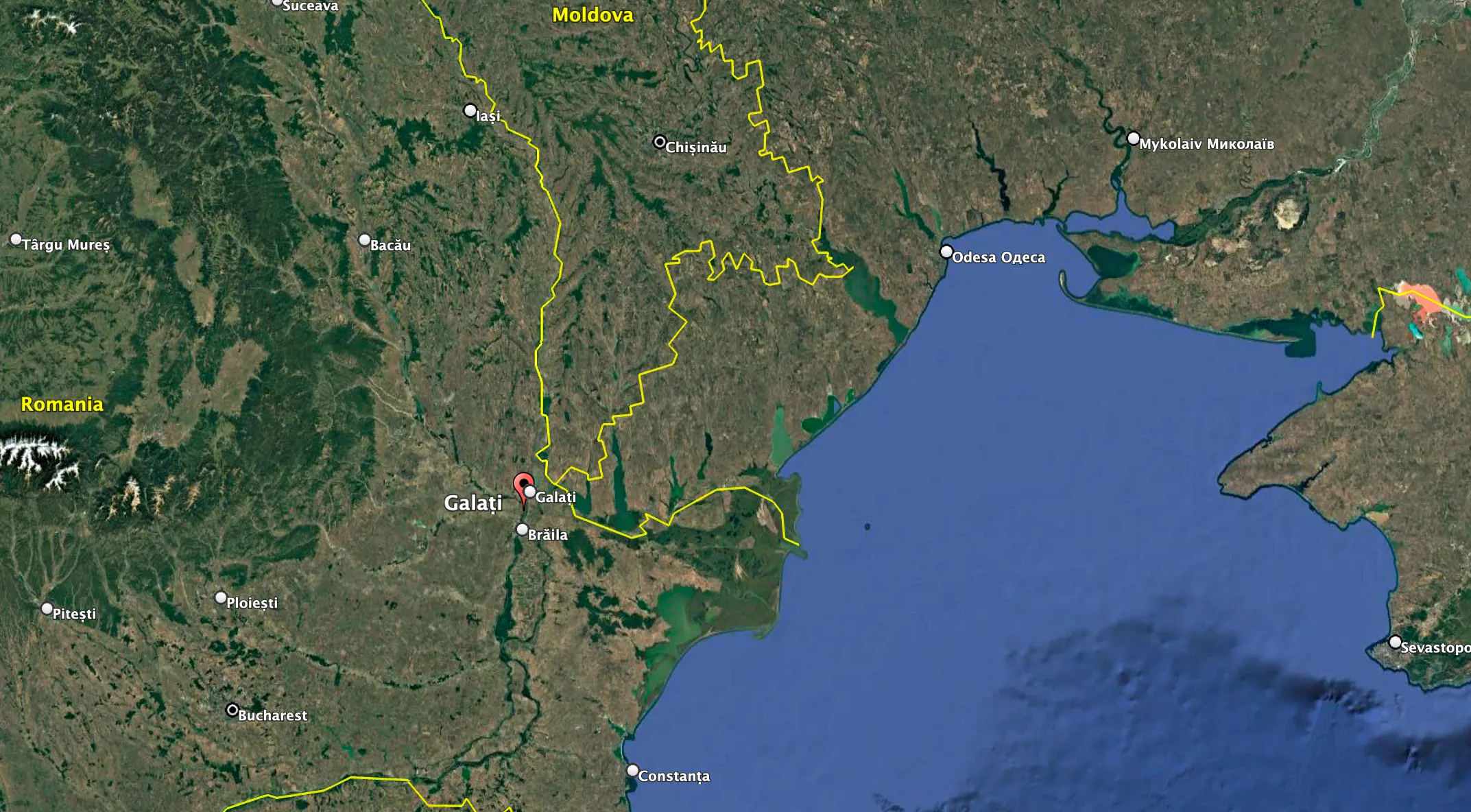
The Russian drone was part of a barrage involved in an overnight attack on Ukraine. It strayed into Romanian airspace before crashing into the roof of a residential building in Galați on the River Danube, in eastern Romania. The Romanian Ministry of Defense assesses that the drone was intended to attack one of several Ukrainian targets in the vicinity of the river border with Romania.
A russian drone carrying explosives, involved in the bombing of infrastructure in Ukraine crashed in Galați, Romania, causing a fire on the roof of a residential apartment building.
Two persons sustained minor injuries and several residents required medical attention, the… pic.twitter.com/P8jzYFrEEp
— Toiu Oana (@oana_toiu) May 29, 2026
A senior NATO official confirmed to TWZ that it had detected and tracked the Russian drone, but it entered Romanian airspace only minutes before striking the apartment building. “To put this in context, you are talking about something that is travelling nearly 200km/h [124 miles per hour] over a populated area less than 15km [nine miles] from the border. Nonetheless, we are assessing what more can be done now to optimize Romania and NATO’s network of sensors and shooters to safely neutralize such threats,” the official added.
JUST IN: Images from inside the apartment hit by a Russian drone in Galați, Romania are now emerging. The images shows extensive damage, with the reinforced concrete ceiling completely perforated by the impact and explosion. A mother and her 14-year-old son were injured. pic.twitter.com/BRq9txK3QS
— GeoInsider (@InsiderGeo) May 29, 2026
According to Ukrainian President Volodymyr Zelensky, the Shahed-type drone was involved in Russian strikes on the Odesa region, which borders Romania, targeting civilian container ships. Since the summer of 2023, Russia has embarked on a campaign to attack Ukrainian ports and other facilities on the Danube, with extensive use of drones. Overnight Russian strikes in the wider Black Sea region saw three foreign-flagged merchant vessels attacked, according to Kyiv, one of them being the Turkish-owned Ant, a dry cargo ship that was heading to Turkey from Odesa.
It is indeed necessary to step up pressure on Russia so that this war is not dragged out or expanded. Last night, the Russians carried out a deliberate strike on our southern region – Odesa region, which borders Romania. This was yet another cynical attack on civilian… https://t.co/lOcfhrwQAf
— Volodymyr Zelenskyy / Володимир Зеленський (@ZelenskyyUa) May 29, 2026

The impact sparked a fire, injured two people, and forced the evacuation of several other residents.
The Romanian Ministry of Defense said the drone had been tracked by radar in Romanian airspace.

In response, two Romanian Air Force F-16 fighters and an armed IAR-330 SOCAT helicopter were scrambled.
There have been some mixed messages as to why the drone was not shot down.
The Romanian Ministry of Defense says that the pilots involved had authorization to engage targets throughout the alert.
President of Romania Nicușor Dan said that the decision not to engage the target was taken “because the conditions did not exist to destroy it without the heightened risk of endangering civilian safety.”
Other reports suggest the interceptors were simply too late on the scene, and others that the chain of command to approve the engagement took too long, although this is clearly at odds with the Romanian Ministry of Defense’s account.
Regardless, Romania summoned Russia’s ambassador today, calling out the “irresponsible escalation” by Moscow.
“We will officially communicate the consequences that this lack of responsibility on the part of the Russian Federation will have for the diplomatic relations between our countries, as well as the next steps at the European level regarding sanctions packages,” the Romanian Foreign Minister Oana Țoiu wrote on X.
L-am convocat pe Ambasadorul Federației Ruse la sediul Ministerului Afacerilor Externe.
Siguranța României este prioritatea noastră absolută.
Avem confirmarea MAPN că drona care s-a prăbușit pe o clădire rezidențială din Galați este de proveniență rusească.
Decizia a fost…
— Toiu Oana (@oana_toiu) May 29, 2026
Meanwhile, Romania’s president, Nicușor Dan, said he had instructed the foreign ministry to prepare a package of measures regarding Romania’s relationship with Moscow, “proportionate to this very serious situation.”
Am avut o convorbire cu Secretarul General @NATO, @SecGenNATO , în urma celui mai grav incident de securitate produs pe teritoriul României de la începutul războiului de agresiune al Rusiei împotriva Ucrainei.
Am condamnat ferm această încălcare inacceptabilă a suveranității…— Nicușor Dan (@NicusorDanRO) May 29, 2026
Condemnation has also come from other NATO allies.
“I want to condemn this irresponsible act by Russia,” France’s foreign minister, Jean-Noël Barrot, said, adding that the drone had struck “a country of the European Union and a NATO country.”
A NATO spokesperson condemned “Russia’s recklessness” and said the alliance would strengthen its defences against all threats, including drones.
Meanwhile, UN Secretary General António Guterres has called for greater diplomacy, immediate de-escalation and “a full and unconditional ceasefire,” warning of “unknown and unintended consequences” from the escalation and intensification of Russian drone and missile attacks against Ukraine.
Russia’s war of aggression has crossed yet another line.
A Russian drone incursion struck a densely populated area in Romania, injuring civilians.
On EU territory.
We stand in full solidarity with Romania and its people.
As we continue strengthening our security and…
— Ursula von der Leyen (@vonderleyen) May 29, 2026
Romania has also called for the beefing up of its counter-drone capabilities to help prevent similar incidents in the future.
The Romanian Foreign Ministry today said it had asked NATO to accelerate the transfer of anti-drone capabilities in response to the drone strike.
PM @Bolojan: @GuvernulRo strongly condemns Russia’s violation of our airspace. We count on NATO Allies’ support and timely delivery of anti-drone capabilities. We are also focusing on rapid implementation of SAFE.
— Guvernul României (@GuvernulRo) May 29, 2026
Romania already hosts several layers of NATO and NATO-linked air defense infrastructure, but most of these are designed to engage ballistic missiles and conventional aircraft, not large numbers of low, slow Shahed-type drones.
Air defense capabilities in Romania include the Aegis Ashore system at Deveselu, the most important NATO missile-defense installation in the region. It is a U.S.-operated land version of the naval Aegis ballistic missile defense system armed with SM-3 interceptors, integrated into NATO’s missile shield.

Romania also operates Patriot PAC-3 systems, which are effective against aircraft, cruise missiles, and some ballistic missiles, but are an expensive option for routine drone interception.

In addition, the country hosts rotational NATO fighter policing detachments, which provide additional air defense over the Black Sea and provide air policing patrols. Currently, a detachment of U.K. Royal Air Force Typhoons is in Romania as part of Operation Biloxi.
UK heatwave? ☀️
Still not as hot as a Typhoon afterburner on Op BILOXI.🔥✈️
🛫Typhoons from @RoyalAirForce continue to launch on BILOXI, sharpening combat edge alongside allies in support of @NATO enhanced Air Policing mission.
Speed. Power. Precision. 💪 #PhoonFriday pic.twitter.com/mCigKNUTfD
— Defence Operations 🇬🇧 (@DefenceOps) May 29, 2026
It should be pointed out that this is not the first incident in which a Russian drone flying from the Ukrainian side of the border has violated Romanian airspace. Drone wreckage was found in Romania, close to the border with Ukraine, in September and October of 2023, although there was no evidence that the NATO country was deliberately targeted. In December of the same year, NATO fighters deployed in Romania were scrambled to respond to a drone violation, with one of the drones exploding in Romanian territory, although it was not shot down. Since then, there have been multiple other Russian drone incursions, but no reported injuries as a result.
However, the overnight strike in Romania further underscores the potentially lethal risk of the war in Ukraine spilling over from Ukraine and into NATO territory.
It also coincides with Russian threats to step up its sustained assault on Ukraine. Moscow has continued using long-range missiles and drones to target Ukrainian cities and critical energy infrastructure, while Kyiv prepares for further waves of intense attacks.
Earlier this week, Zelensky said he was urging the United States to supply more Patriot systems to help defend against Russian ballistic missile strikes, amid an ongoing shortage of critical air defense systems. Speaking today, the Ukrainian leader said that Ukrainian intelligence has information indicating Russia is preparing a new large-scale attack on Ukraine.
As we have discussed in the past, Russian kamikaze drones heading toward population centers in NATO countries represent an entirely new level of threat to the alliance and one that NATO is currently not well-equipped to deal with.

Considering the intensity of Russian aerial bombardment of Ukraine, and the proximity of NATO borders, it was really only a matter of time until an incident like this occurred.
Already, Romania expanded its no-fly zone along a section of the border with Ukraine to up to 20 miles inside Romania and to a height of 4,000 feet. This was intended as a deterrent against Russian drones from deliberately entering Romanian airspace to reach enemy targets.
TWZ reached out to NATO for details of potential posture changes, and a senior official from the alliance confirmed that a NATO E-3A Sentry Airborne Warning and Control System (AWACS) aircraft was launched today to increase air-domain awareness.

The same NATO official told us that one way to avoid similar incidents in the future would be to bring the MEROPS counter-drone system to Romania under NATO command and control.
“Another way is for Romania and other allies to continue the acquisition of more capabilities as part of the Eastern Flank Deterrence Initiative, which integrates sensing, decision-making and precision effects into a resilient, defense-in-depth concept,” the official added.
As you can read about here, MEROPS counter-drone systems, initially used in Ukraine, have also been deployed to protect U.S. troops from Iranian Shahed-136 munitions. The MEROPS is a small, relatively inexpensive drone built specifically to intercept long-range one-way attack drones.

A new system to identify and take down Russian drones is deployed to NATO’s eastern flank
Now that a Romanian residential building has been hit and people injured, this may push the needle further and lead to the more comprehensive deployment of counter-drone capabilities in this country and elsewhere on NATO’s eastern flank.
Contact the author: thomas@thewarzone.com
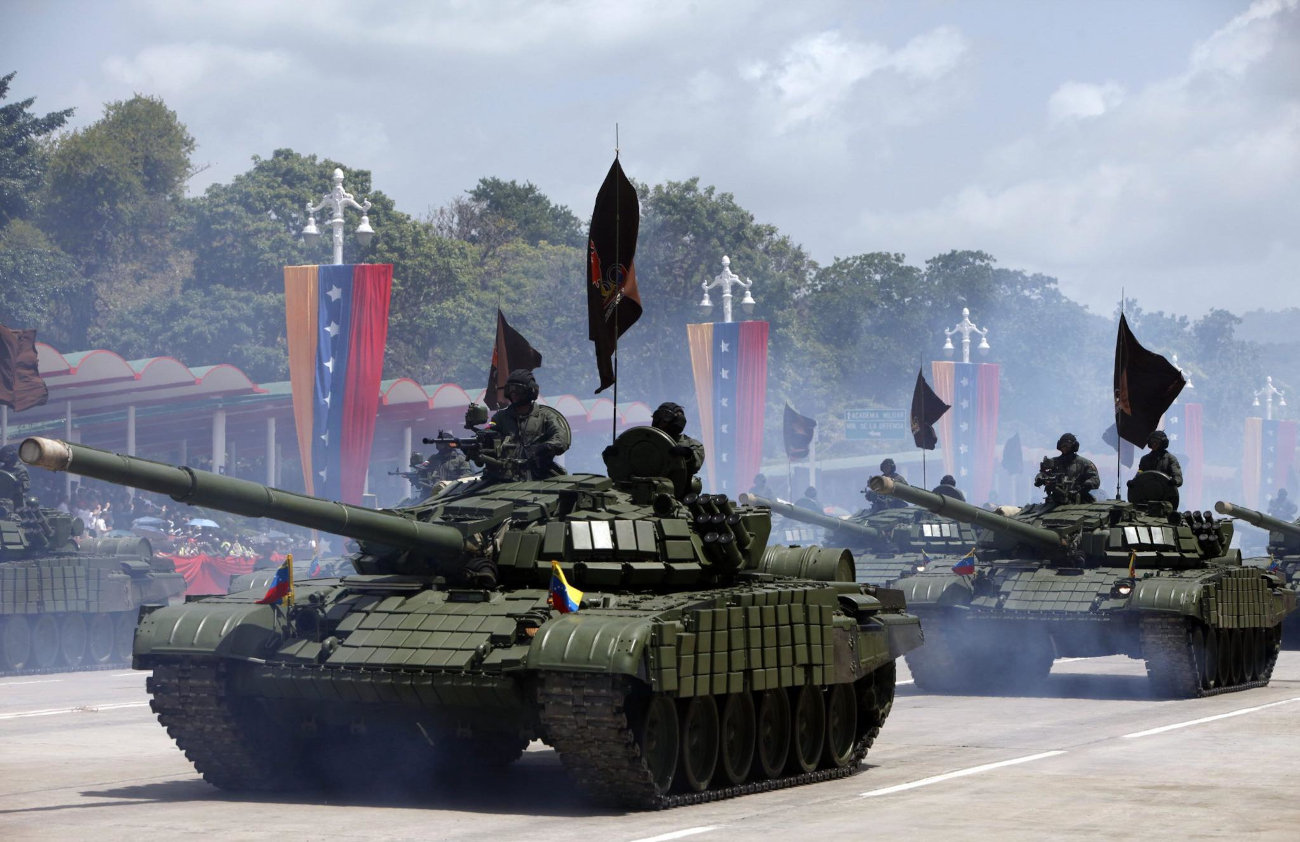
Russian-made T-72B1V tanks in a Venezuelan military parade in 2011. (Archive)
Caracas, May 29, 2026 (venezuelanalysis.com) – The Russian government has urged Venezuelan authorities to “reject approaches” from the US and allies to transfer military equipment to Ukraine.
Russian Security Council Secretary Sergei Shoigu raised the concerns during a meeting with Venezuelan Major General José Ornelas Ferreira, secretary general of the Caribbean nation’s National Defense Council, on Wednesday in Moscow.
The Venezuelan official was a guest at the First International Security Forum, held from May 26-29 at the Russian capital with the presence of 140 top officials from over 120 countries worldwide.
“We are aware of the activity of Western emissaries who are attempting to involve Latin American countries in various arms supply schemes for the benefit of the Kyiv regime,” Shoigu said in a bilateral meeting with Ornelas. “We expect you to reject such approaches and inform us of any such Western attempts.”
Moscow and Caracas have maintained a longstanding military alliance through which Russia has provided Venezuela with a broad supply of weapons, equipment, and technical assistance for decades, forming the backbone of the Venezuelan arsenal. The cooperation dates back to the 2000s as Hugo Chávez sought to reverse the US dependence of the armed forces.
Though neither US nor Venezuelan officials have commented on weapons transfer proposals, Shoigu’s warning follows publicized efforts by Washington and allies to bolster the beleaguered Ukrainian forces in the war against Russia. Kiev’s backers procure Soviet-era equipment that could be easily integrated into the battlefield.
Apart from securing supplies from Eastern European NATO members, Washington has also turned to Latin America, offering to exchange Russian and Soviet-made hardware for newer US equipment. Brazilian and Colombian leaders rejected the proposal.
In February 2024, Ecuador canceled plans to send or exchange Soviet/Russian-origin weaponry with the US, which intended to reroute them Ukraine. Ecuadorian President Daniel Noboa backtracked following Russian threats to suspend banana imports from the Andean country.
According to military analysts, Venezuela’s battlefield equipment — including T-72B1V tanks, BMP-3 infantry vehicles, Mi-17 helicopters, and 152 mm artillery systems — would be valuable on the Ukrainian battlefield and help address chronic ammunition shortages.
The recent Moscow security summit also saw Shoigu condemn the US’ “brutal armed invasion” of Venezuela on January 3 that led to the kidnapping of President Nicolás Maduro and First Lady Cilia Flores.
“We strongly condemn Washington’s actions on January 3, during which the legitimate head of state, Nicolás Maduro, and his wife were captured, and dozens of Venezuelan and Cuban citizens were killed,” the former Russian defense minister stated.
Shoigu criticized the Trump administration for “violating all fundamental norms of international law” and breaking “the principles governing coexistence among nations and respect for state sovereignty.”
The Russian official went on to reaffirm the Vladimir Putin government’s “unwavering support” for Caracas and the desire to “strengthen cooperation” in order to avoid future acts of aggression.
Shoigu likewise commented on the Venezuelan government, led by Acting President Delcy Rodríguez, pursuing a “new modality of relations” with the US and expressed hope that it would protect the Caribbean country’s “sovereignty and national interests.”
Following the January 3 attacks, the Trump White House has exacted major concessions from the acting Rodríguez administration, including seizing control of Venezuelan oil revenues, auditing its Central Bank, pushing pro-business legislative reforms, and securing the handover of former government envoy Alex Saab to face money laundering charges in Florida.
The growing US influence in Venezuela saw the Southern Command hold “rapid response” military exercises on May 23, with Osprey MV-22B aircraft flying over Caracas and landing near the US embassy compound.
US officials have acknowledged a growing “collaboration” with Caracas. During a press conference on Wednesday, Secretary of War Pete Hegseth highlighted Washington’s self-declared anti-narcotics operations in the Western hemisphere and the joint work with local governments.
“Just think about the fact that our Southern Command commander landed by helicopter at the US Embassy in Caracas peacefully,” Hegseth said alongside Trump. “He was welcomed by the Venezuelans because we are now partnering with them, hopefully even in our counter-cartel missions.”
The Trump official referred to Venezuela as “fundamental to securing our energy future and defending the homeland.”
Edited by Ricardo Vaz in Caracas.
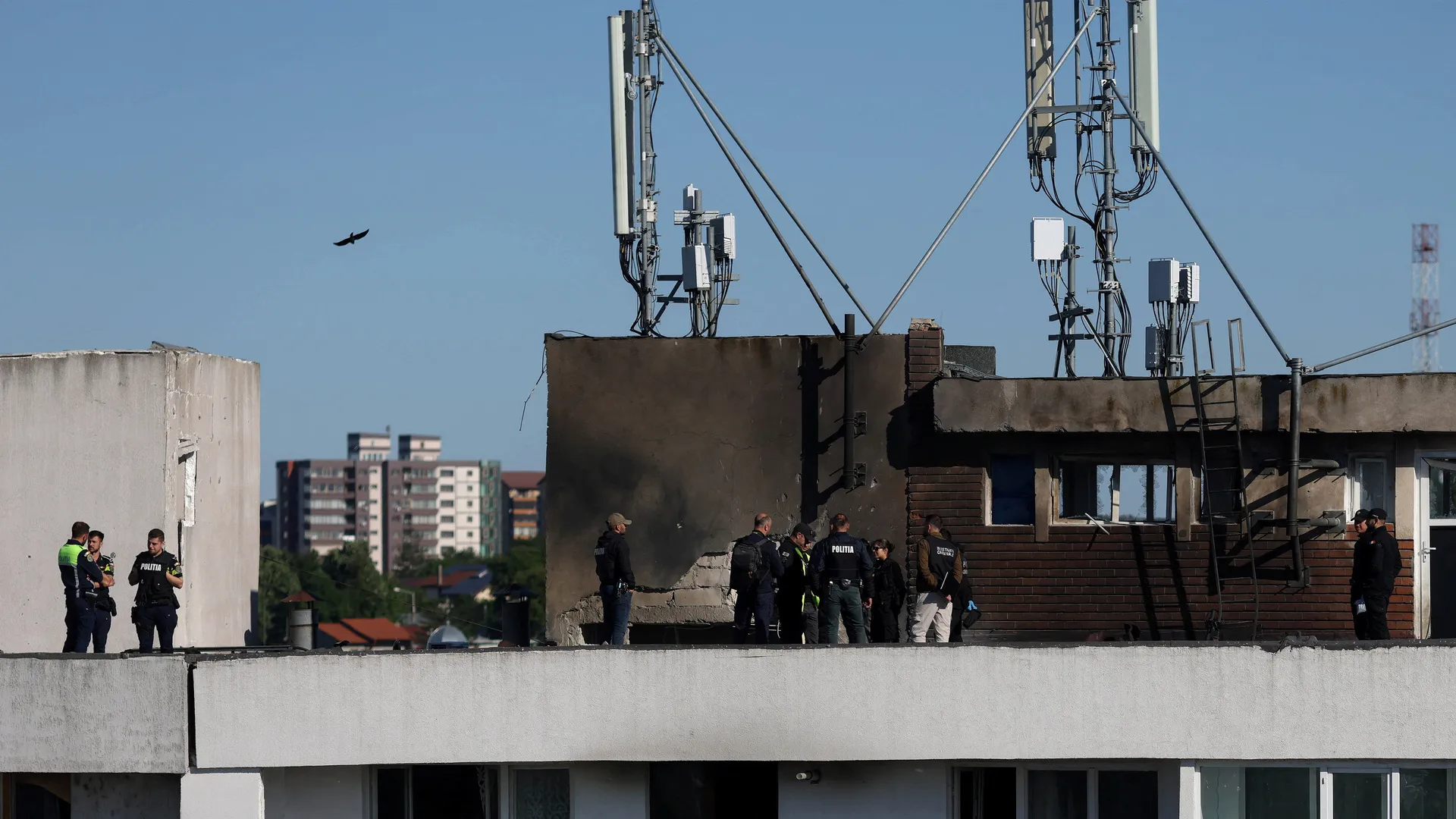
Romanian President Nicusor Dan says that the Russian consul in the southeastern city of Constanta will be expelled and the consulate shut down after a drone intended for Ukraine crashed into an apartment complex in the border town of Galati.
Published On 29 May 202629 May 2026
Share


May 29 (UPI) — A Russian drone carrying explosives struck the roof of an apartment building in NATO ally Romania overnight, risking a dangerous escalation in Moscow’s four-year-old war in Ukraine.
The drone had entered Romanian airspace during a Russian attack on neighboring Ukraine and struck the building in the eastern city of Galati, located near the Romania-Ukraine border, Romania’s Defense Ministry said in a statement Friday.
Two people were “slightly injured,” according to Romania’s Ministry of Foreign Affairs. The two victims were transported to the Galati County Emergency Clinical Hospital, officials said.
The drone sparked a fire on the 10th floor of the building, according to the Department for Emergency Situations, which said online that 70 people were evacuated from the building.
Video of the scene shared by Galati County emergency services officials shows firefighters responding and debris littering the residential street.
“This represents a serious and irresponsible escalation by the Russian Federation,” Romanian Foreign Minister Oana Toiu said online.
According to the Defense Ministry, radars had detected drones flying near Romanian airspace, prompting two F-16 fighter jets and an IAR-330 SOCAT helicopter to deploy at 1:19 a.m., with authorization to engage targets.
The aircraft followed the drone in Romanian airspace, but the decision was made to not engage over heightened risk to the safety of the civilian population, Romanian President Nicusor Dan said in a statement.
Dan said he convened a meeting of the Supreme Council of National Defense for 11 a.m. Friday to discuss what he called “the most serious incident to have affected national territory” since Russia invaded Ukraine on Feb. 24, 2022, igniting the war.
“The unprecedented nature of the event requires a firm, coordinated and commensurate response — at the national, allied and international levels,” he said.
He said he holds the Kremlin wholly responsible.
“What happened today in Galati is the direct consequence of Russia’s war of aggression unleashed against Ukraine, of the irresponsible and indiscriminate manner in which Moscow operates these weapons systems in the immediate vicinity of NATO borders, as well as of its systematic disregard for international law,” he said.
“There is no ambiguity regarding the perpetrator and the cause of this aggression.”
All NATO and European Union allies have been informed of the incident, and the U.N. Security Council has been informed, he said, adding that Romania has formally requested that allies deploy additional anti-drone capabilities to NATO’s eastern flank.
Romania also summoned the Russian ambassador to officially communicate “the effects that this lack of responsibility on the part of the Russian Federation will have on the diplomatic relations between our countries and the next steps at the European level regarding packages of sanctions,” Toiu said.
Numerous heads of state and ministers of foreign affairs condemned the attack, including European Commission President Ursula von der Leyen and NATO Secretary General Mark Rutte, who said he spoke with Dan and assured him that the alliance “stands ready to defend every inch of allied territory.”
“Russia’s reckless behavior is a danger to us all,” he said in a statement. “They continue to target civilians and civilian infrastructure across Ukraine. And last night showed yet again that the implications of their illegal war of aggression don’t stop at the border.”
Russian drones have repeatedly entered NATO airspace amid Russia’s war in Ukraine, but Friday’s incident appeared to be the most severe involving Romania.

Romania and its NATO allies have reacted angrily after a Russian drone crashed into an apartment building in eastern Romania, injuring two people.
The foreign ministry in Bucharest on Friday labelled the crash of the drone, part of an overnight attack aimed at Ukraine, a serious violation of international law and called on NATO to accelerate the transfer of anti-drone capabilities. The incident is just the latest incursion along the alliance’s eastern flank, raising concern that the risk of an open confrontation between Russia and NATO states is rising.
Romania said the overnight drone was tracked by radar in its airspace before crashing onto the roof of a residential building in the city of Galati.
Two F-16 fighter jets and a helicopter were scrambled, as authorities issued emergency alerts to residents. Two people suffered minor injuries and several residents were evacuated after a fire was triggered by the crash.
The incident is just the latest of several, as the war in Ukraine has spilled over into neighbouring NATO countries, raising fears of potential escalation.
Estonia, Lithuania and Latvia, as well as Finland have all reported repeated incursions into their airspace in recent months. Drone incursions sparked a government collapse in Latvia earlier this month.
Shortly after the crash, Bucharest called for NATO to speed up the transfer of anti-drone capabilities. Outgoing Prime Minister Ilie Bolojan also said that Romania would, within hours, sign a contract which will give it anti-drone defences under the EU’S SAFE programme.
On Friday morning, Romania summoned the Russia ambassador.
“We will officially communicate the consequences that this lack of responsibility on the part of the Russian Federation will have for the diplomatic relations between our countries, as well as the next steps at the European level regarding sanctions packages,” Foreign Minister Oana Toiu wrote on social media.
President Nicusor Dan stated that Romania will not accept that the war of aggression waged by Russia against Ukraine be transferred to its citizens, and added that he had asked the foreign ministry to present without delay a series of measures regarding the country’s relationship with Russia, “proportionate to this very serious situation”.
NATO allies and others joined the chorus of anger.
French Minister for European Affairs Benjamin Haddad said the incident highlighted the threat Russia poses to European security, noting that French troops are stationed in Romania.
“Regardless of whether it was on purpose or the result of ineptitude, Russia is still dangerous and we must defend ourselves against it,” Polish Foreign Minister Radoslaw Sikorski told the Reuters news agency.
European Commission President Ursula von der Leyen said the incident showed that “Russia’s war of aggression has crossed yet another line”.
A NATO spokesperson also condemned “Russia’s recklessness” on social media.
Ukraine’s Foreign Minister Andrii Sybiha, whose country is pressing the United States to help boost its air defences, pledged “Ukraine stands firmly by Romania” as he branded Russia a threat to the Black Sea region and the wider European continent.
“We are ready to work closely together to strengthen protection from such threats,” he wrote on social media, adding that the bid to strengthen Ukraine’s air defence is a “strategic task” to protect not only Ukraine but also to reduce risks for neighbouring countries.
United Nations Secretary-General Antonio Guterres warned that the escalating attacks risk spiralling “out of control”, with “unknown and unintended consequences”.
He said more civilians had been killed in the first four months of this year than during the same period in the previous three years, and called for diplomacy, immediate de-escalation and “a full and unconditional ceasefire”.
Concern that the war is threatening to spillover is building as Russia escalates hostilities in a bid to ward off rising political and economic pressure at home.
Ukrainian forces reported that they shot down 217 drones overnight on Friday. Russia attacked with 232 drones and one ballistic missile. Hits were recorded in 14 areas, the air force said.
Moscow has said it plans “systematic strikes” on Kyiv and has issued a barrage of threats at Ukraine’s European allies, listing facilities in Europe that it said are involved in manufacturing drones and components for Ukraine.
Moscow’s Foreign Intelligence Service recently warned the Baltic nations that their NATO membership won’t protect them from retaliation should they allow Ukraine to launch attacks from their territory, with analysts warning that the risk of an open confrontation between Russia and NATO states is rising.
That heightens concern regarding NATO’s Article 5 collective defence clause, which President Donald Trump has hinted the United States may not honour in some cases.
However, the alliance’s Secretary General Mark Rutte insisted on Friday that NATO will defend all of its territory.
“Russia’s reckless behaviour is a danger to us all,” he wrote on social media. “Last night showed yet again that the implications of their illegal war of aggression don’t stop at the border.”
“We will continue to strengthen our deterrence and defence at home and continue our support for Ukraine as they defend against Russia’s aggression,” he added.
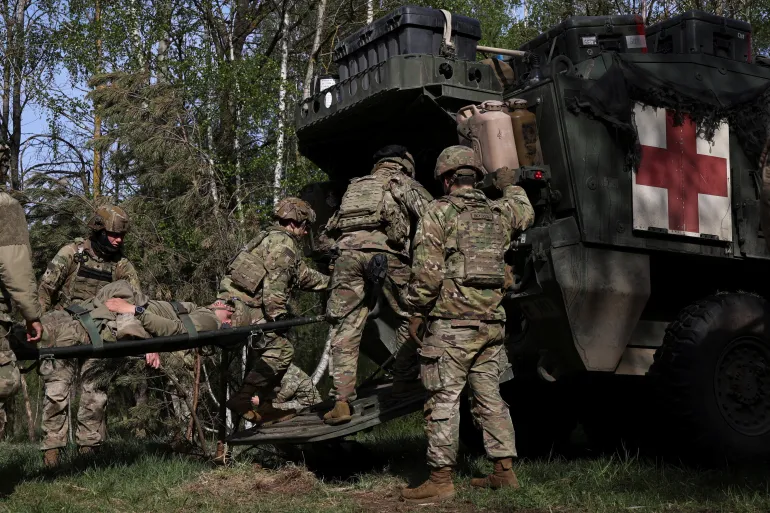
US President Donald Trump has announced that the United States will send an additional 5,000 troops to Poland, a surprise move that has deepened uncertainty about Washington’s military posture in Europe.
In a post on his Truth Social platform on Thursday, Trump linked the decision directly to his relationship with Poland’s right-wing President Karol Nawrocki.
list of 4 itemsend of list
“Based on the successful Election of the now President of Poland, Karol Nawrocki, who I was proud to Endorse, and our relationship with him, I am pleased to announce that the United States will be sending an additional 5,000 Troops to Poland,” Trump wrote.
But the move comes just days after the Pentagon cancelled the deployment of about 4,000 troops to Poland as part of a wider reduction of US forces in Europe.
The abrupt reversal has fuelled questions about what exactly Trump has ordered – and whether the deployment is driven by military strategy with Europe, or by the US president’s increasingly transactional approach to alliances.

While Trump described the move as a new deployment, reports from US media suggest the announcement may actually amount to a reversal of an earlier Pentagon decision.
Last week, the Pentagon abruptly halted the deployment of the 2nd Armored Brigade Combat Team of the 1st Cavalry Division – a Texas-based unit of more than 4,000 troops that had been preparing to rotate into Poland and Eastern Europe.
According to The Wall Street Journal, Trump later questioned Defense Secretary Pete Hegseth about why the deployment had been cancelled, telling him the US should not “treat Poland poorly” given its close ties to Washington.
Several reports said some parts of the brigade – known as the “Black Jack Brigade” – had already begun moving equipment and personnel when the deployment was stopped.
The Pentagon has not confirmed whether Trump’s newly announced 5,000 troops are the same soldiers whose deployment was cancelled earlier this month, or whether they will be redeployed from elsewhere in Europe, such as from Germany.
The White House and Pentagon have so far released few other details about this latest deployment.
Poland currently hosts about 10,000 US troops, largely on a rotational basis, according to the Polish government. Since Russia’s full-scale invasion of Ukraine, the country has become one of Washington’s most important military partners on NATO’s eastern edge and a key hub for Western military aid to Kyiv.
In 2020, Poland and the US signed the Enhanced Defense Cooperation Agreement, expanding military cooperation and helping to formalise a longer-term American military presence in the country.
Nawrocki welcomed Trump’s announcement, calling the Polish-American alliance “a vital pillar of security for every Polish home and for all of Europe”.
“Good alliances are those based on cooperation, mutual respect, and a commitment to our shared security,” he wrote on social media.
Polish Foreign Minister Radek Sikorski also welcomed the news, saying the deployment would ensure that “the presence of American troops in Poland will be maintained more or less at previous levels”.
German Foreign Minister Johann Wadephul also welcomed the move.
“It serves not only for Poland’s security, but for the security of the whole alliance and so also for us,” he told reporters. “So, this is absolutely in our interest.”
The announcement appears to mark a sharp reversal from recent signals that the Trump administration was preparing to reduce the US military’s footprint in Europe.
Earlier this month, Washington announced plans to withdraw 5,000 troops from Germany after a public row between Trump and German Chancellor Friedrich Merz over the US-Israeli war on Iran. Trump later suggested the cuts could go even further.
At the same time, Trump has repeatedly accused European NATO allies of failing to spend enough on defence and of not doing enough to support US policy in the Middle East.
Analysts say the decision over Poland also reflects Trump’s increasingly transactional approach to alliances – punishing governments he sees as hostile or unhelpful while rewarding leaders and countries more closely aligned with his brand of right-wing politics.
Germany and Spain have both faced criticism from Trump administration officials in recent weeks over their positions on Iran and defence spending, while Poland’s nationalist government has cultivated close ties with Trump and the wider MAGA movement.
Before meeting NATO counterparts in Sweden, Secretary of State Marco Rubio said: “Like any alliance, it has to be good for everyone who’s involved. There has to be a clear understanding of what the expectations are.”
“The president’s views, frankly disappointment, at some of our NATO allies and their response to our operations in the Middle East – they’re well documented – that will have to be addressed,” Rubio added. “That won’t be solved or addressed today.”
Poland, by contrast, has emerged as one of NATO’s highest defence spenders, allocating about 4.5 percent of its gross domestic product (GDP) to defence. It has also remained one of Ukraine’s strongest backers and has consistently pushed for a larger US military presence on its territory.
The deployment, therefore, appears both strategic and political – reinforcing NATO’s eastern flank while rewarding one of Trump’s closest allies in Europe at a time when he is openly questioning relationships with other partners on the continent.
But the confusion surrounding the announcement has also highlighted a broader uncertainty hanging over Washington’s Europe policy, with allies still trying to determine whether the administration is reducing its commitment to NATO overall, or simply reshaping it around governments Trump sees as more loyal.
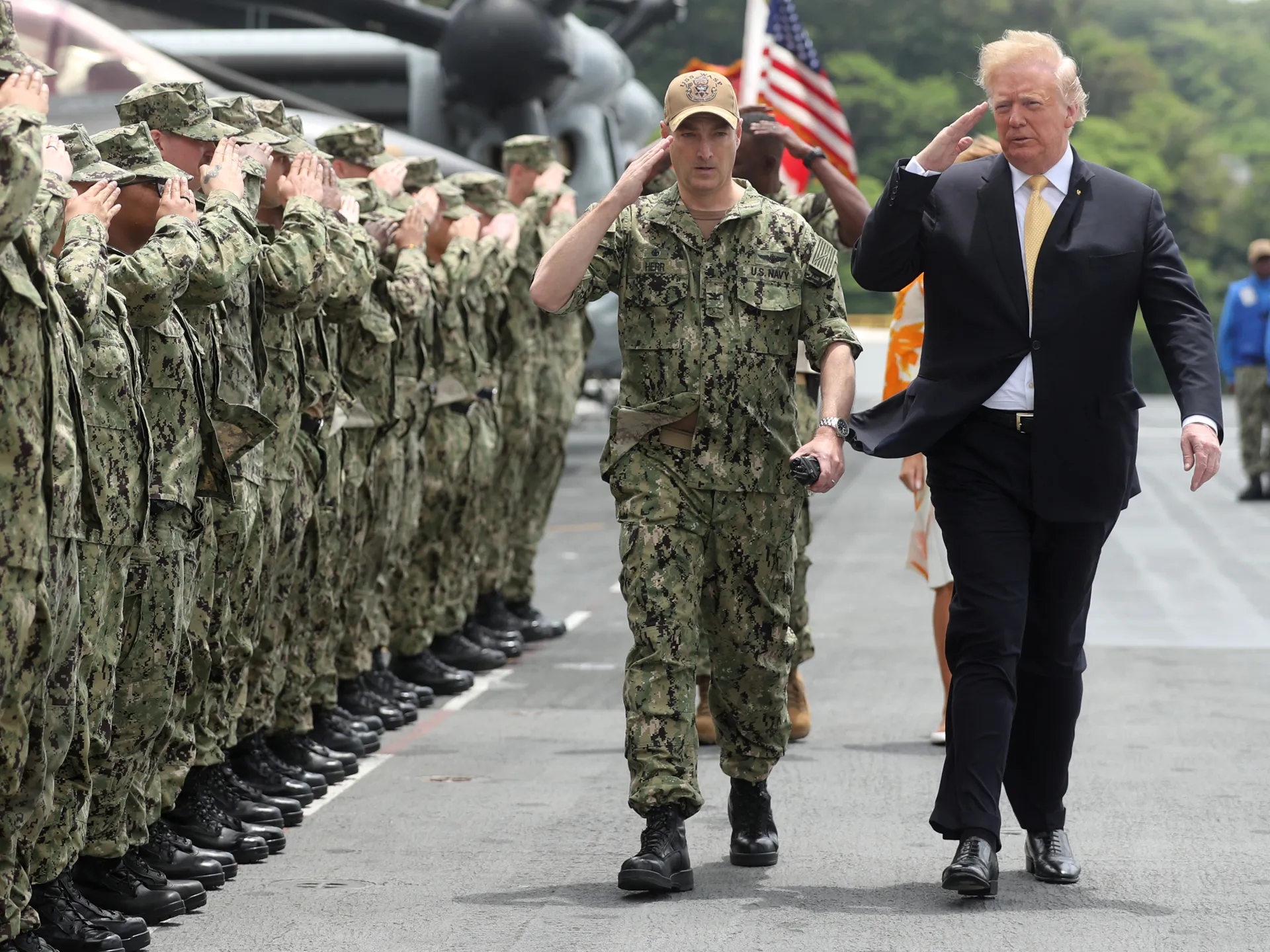
United States President Donald Trump has announced plans to deploy an additional 5,000 troops to Poland.
Trump announced the surprise deployment on social media late on Thursday, citing his friendship with right-wing Polish President Karol Nawrocki.
list of 3 itemsend of list
The move came days after a planned deployment to Poland was apparently scrapped and will deepen uncertainty surrounding the Trump administration’s approach to NATO allies and its long-term commitment to maintaining a military presence in Europe. It leaves European partners increasingly unclear about which areas they should prioritise as they formulate defence strategies.
“Based on the successful Election of the now President of Poland, Karol Nawrocki, who I was proud to Endorse, and our relationship with him, I am pleased to announce that the United States will be sending an additional 5,000 Troops to Poland,” Trump wrote.
Nawrocki welcomed the announcement on social media.
“Good alliances are those based on cooperation, mutual respect, and a commitment to our shared security,” he wrote on Thursday evening.
Polish Foreign Minister Radek Sikorski also welcomed the news on Friday, saying it ensures that “the presence of American troops in Poland will be maintained more or less at previous levels”.
The announced deployment is a sudden about-face from US declarations of plans to reduce military support to Europe under Trump’s “America First” doctrine.
The US president has for years been lambasting European NATO partners for failing to spend enough on defence. His opprobrium has risen in recent weeks as European states have criticised the US-Israeli war on Iran and refused to join the conflict.
The Pentagon abruptly announced a week ago that it was scrapping the planned deployment of 4,000 troops to Poland.
Earlier this month, Trump announced he was withdrawing 5,000 troops from Germany following a spat with Chancellor Friedrich Merz, who said Washington had been “humiliated” by Iranian negotiators.
The US president later said that he would be “cutting a lot further than 5,000”.
Polish officials have noted that Warsaw pays significant sums towards the cost of US troop deployments. The suggestion of a pullback has caused concern over security in Poland and elsewhere in Europe, as Russia’s war on neighbouring Ukraine continues, with the Trump administration largely ceasing efforts to mediate a ceasefire.
European states report that they are getting to grips with the need to replace US defence capabilities, albeit slowly. However, sources suggest that the erratic policies emerging from the White House are creating confusion over which elements should be prioritised.
“It is confusing indeed, and not always easy to navigate,” Swedish Foreign Minister Maria Malmer Stenergard told reporters ahead of hosting a meeting of NATO foreign ministers on Friday, which will be attended by US Secretary of State Marco Rubio.
US defence officials are also confused, according to the AP news agency.
“We just spent the better part of two weeks reacting to the first announcement. We don’t know what this means either,” said one official.
The US president has lashed out at fellow NATO members in recent months for failing to support the US-Israeli war on Iran, suggesting Washington could withdraw from the military alliance as a result.
State Department spokesperson Tommy Pigott said Rubio would discuss the need for NATO allies to increase defence spending and shoulder greater responsibility at Friday’s meeting of NATO foreign ministers.
NATO Secretary-General Mark Rutte, who has worked hard in recent months to attempt to soothe the US president’s displeasure with his alliance peers, welcomed Trump’s deployment to Poland and cautioned that Europe must become less reliant on the US.
Rubio said before meeting his NATO counterparts in Sweden: “Like any alliance, it has to be good for everyone who’s involved. There has to be a clear understanding of what the expectations are.”
He also suggested, however, that the meeting is likely to prove less than comfortable.
“The president’s views, frankly disappointment, at some of our NATO allies and their response to our operations in the Middle East – they’re well documented – that will have to be addressed,” he insisted, before adding “that won’t be solved or addressed today”.
While Rubio meets with NATO counterparts, senior Pentagon officials will brief partners at the alliance’s headquarters in Brussels about Washington’s commitment to European defence.
On Tuesday, the Pentagon announced it plans to reduce the number of combat brigades based in Europe from four to three.
Many of Washington’s allies in Europe remain frustrated with Trump’s handling of the war with Iran, which has damaged their economies and prompted some European leaders to question the reliability of the US.
European NATO countries also remain concerned about Trump’s threats to annex Greenland, which is an autonomous territory of the Kingdom of Denmark, a NATO ally.
It remains unclear whether the deployment to Poland announced on Thursday includes the same soldiers as those the Pentagon said would no longer be deployed to the Central European country, or if they will include redeployments from Germany.