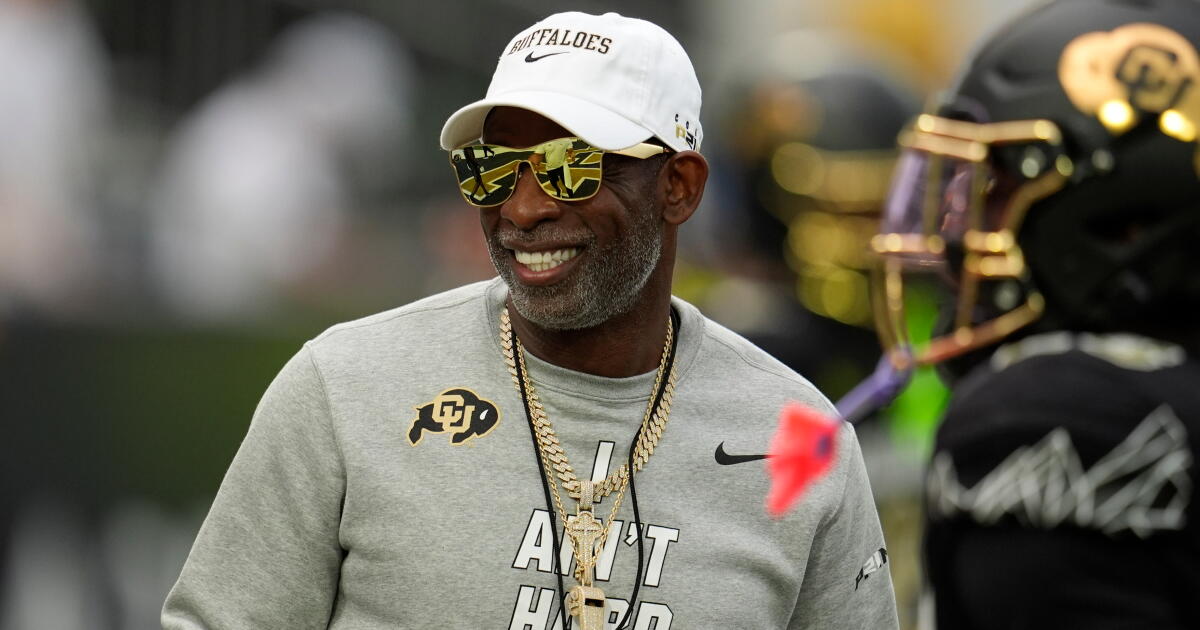
The Colorado Buffaloes coach told reporters on Tuesday that he actually would not be willing pay them or any of their colleagues to refrain from covering him, despite what a close associate of his said during a livestream days earlier.
“Oh, no, no, no. I think you misinterpreted that,” Sanders said. “That was a joke. That’s what we were saying, like, some people live on your name.”
YouTube host and documentary maker Christopher Neely brought up the topic on Saturday during a livestream on “Thee Pregame Network.” A longtime videographer for Sanders, Neely mentioned that some members of the media seem to thrive off of negative coverage of Sanders, nicknamed Coach Prime.
“For the most part, the people that attack him wouldn’t be making the money they were making if he wasn’t here to attack,” Neely said, “which is why he told some of them, ‘Hey man, let’s just do this. I’ll give you $50,000 to not mention my name for a year.’ And ain’t nobody took the deal yet.”
Neely added: “You love talking about this man so much, and you make so much talking about this man that you turn the deal down. That’s what we’re dealing with.”
On Tuesday afternoon, Neely addressed the matter on “TMR Live,” the daily livestream he co-hosts with BiggDogg Chico. Neely clarified that Sanders made the so-called offer while joking around on the show in May and hadn’t actually floated the idea to actual media members.
“This was clearly a tongue-in-cheek, joking example to prove a point that there’s so many people who are negative toward us and they’re making so much money being negative toward us that even if I offered them what they were making or more, they still wouldn’t stop,” said Neely, who played the clip of a smiling Sanders making the comment in the spring.
“All I did this weekend on like October 26 was say, ‘Hey, by the way, ain’t nobody still reached out to Coach Prime and say, ‘Hey, give me that 50, I’ll stop talking about you.’ And then what do they do? [They said] ‘Neely says Coach Prime’s feelings are hurt and he wants to pay people to not talk about him.’”
Neely added: “He was clearly playing. Do you think this man with all he’s worth and been through and been talked about since he first caught a ball that he would literally pay somebody in Colorado to stop talking about him? He’s got better ways to blow $50,000.”
Although amused by the notion, Sanders made it clear that reporters aren’t going to get a dime from him.
“I would never offer a man money not to say — I don’t give a darn what you say about me,” Sanders said. “That was really a joke about someone who is prospering off of your name and your brand but they don’t like you.”
A two-time Super Bowl champion, one-time NFL defensive player of the year and a 2011 inductee into the Pro Football Hall of Fame, Sanders became Colorado’s head coach in 2023. Since then, the Buffaloes have gone 18-26, including a 9-4 effort from a 2024 roster that including his son Shedeur Sanders, who is now with the Cleveland Browns, and Heisman Trophy winner Travis Hunter, now with the Jacksonville Jaguars.
The team is 2-5 and 0-4 in the Big 12 Conference this year. It hosts conference foe Kansas State (4-3, 1-3) on Saturday.
Elizabeth Holmes is the convicted fraudster at the center of Nathan Fielder and Lance Oppenheim’s hit documentary “You Can See Everything,” but for many viewers, it’s her longtime partner, Billy Evans, who has emerged as the film’s marquee villain.
Evans, 34, comes from a wealthy San Diego hotel family and stood by Holmes as her blood-testing startup Theranos collapsed and she was convicted in 2022 of defrauding investors. The couple has two children, 5-year-old son William and 3-year-old daughter Invicta. With Holmes serving an 11-year federal prison sentence in Texas, Evans is raising their children while pursuing a new biotech venture of his own.
In the film — warning: spoilers ahead — Evans comes across as controlling and increasingly volatile, taking over from Holmes as she whisks eggs, interrupting an interview to demand that the cameras be turned off and at one point casually brushing his teeth while standing stark naked in the shower, with Fielder awkwardly looking on. He speaks of Holmes dedicating her life to building “monuments of love” to him, and in one heated confrontation threatens to ruin the lives of people he believes have wronged her. “I’ve got vengeance in my heart,” he declares.
So who is Evans, how did he end up with one of Silicon Valley’s most infamous figures and what is he up to now?
What do we know about Evans’ upbringing?
Evans grew up in a wealthy, prominent San Diego family. His grandparents, William and Anne Evans, founded Evans Hotels in 1953, opening what became the Bahia Resort Hotel on Mission Bay. The family business later expanded to include the Catamaran Resort Hotel and Spa and the Lodge at Torrey Pines in La Jolla.
Evans attended Francis Parker School, an exclusive private school in San Diego, before graduating from MIT with a degree in economics in 2015. Despite his family’s wealth, Evans is neither an employee nor a shareholder of Evans Hotels, according to a statement the company issued Oct. 1.
His family reportedly had reservations about his relationship with Holmes at first. But his father, also named William, became a supporter — and even went undercover of sorts at her 2021 fraud trial. According to NPR, the elder Evans showed up for jury selection under the name “Hanson,” introducing himself to reporters as a concerned citizen who fixed up old cars for a living. His expensive loafers and a Starbucks cup bearing a different name eventually raised suspicions.
How did Evans meet Holmes?
The two met Oct. 7, 2017, at a Fleet Week party hosted by a venture capitalist in San Francisco, according to Evans. Theranos was already engulfed in scandal, though Holmes had yet to be criminally charged.
In the documentary, Evans recalls that he initially didn’t recognize Holmes because she was wearing a floppy hat, dark sunglasses and a Band-Aid on her face from a scratch by her husky. He says he fell in love with her almost immediately. When Fielder points out that he could barely see her face, Evans replies, “I guess that wasn’t what mattered to me.”
Nathan Fielder observes Elizabeth Holmes with her family in “You Can See Everything.”
(A24)
Holmes says the attraction was mutual. The two became friends and started dating about six months later, just weeks before she was indicted on federal fraud charges.
Fielder asks Evans whether he worried early on that Holmes might be conning him. “100%,” Evans replies, before asking what she would have had to gain from him. “Well, isn’t your family rich?” Fielder asks.
Pressed about the family’s money, Evans grows visibly uncomfortable and cuts the conversation short, saying he needs to get to a cousin’s event.
How is Evans managing life with Holmes in prison?
Since Holmes entered federal prison in May 2023, Evans has been raising their two children in Austin, Texas, bringing them to visit her at the federal prison camp in Bryan. Holmes is expected to transfer to a halfway house outside Austin in August.
In an appearance last week on the tech podcast “All-In,” Evans described the difficulty of the experience. “It’s hard because I’m building a business and I’m trying to free my wife from federal prison and I’m raising two kids,” he said.
Though Evans routinely refers to Holmes as his wife, Holmes said in a 2025 interview from prison with People that they had not legally married: “Maybe we’ll get married someday, but our bond is more than a piece of paper.” The two got engaged in 2018, reportedly at a Taylor Swift concert.
Is Evans trying to revive Theranos?
After graduating from MIT, Evans reportedly attempted to launch a medical concierge service before working at companies including LinkedIn and Luminar Technologies, which developed lidar systems for autonomous vehicles.
In 2022, he founded Haemanthus, a biotech startup developing technology to analyze biological samples using lasers. The company hopes to make diagnostic testing cheaper and more accessible — a mission that may sound awfully familiar to anyone who followed the rise and fall of Theranos.
Haemanthus has reportedly raised millions of dollars but has yet to release a commercial product. Eric Potma, a UC Irvine chemistry professor who consults for the company, told Wired this week that its technology is worth exploring despite significant technical challenges. “The engineers at Haemanthus are legit,” he said.
Holmes’ name does not appear in Haemanthus’ incorporation documents, according to Wired. But in the documentary, the couple is shown discussing plans for a new diagnostic venture, with Evans speaking openly about his desire to revive her original ambitions.
“The idea is to put the band back together and do it all again,” Evans tells Fielder.
How has Evans responded to ‘You Can See Everything’?
Evans and Holmes agreed to participate in the documentary in hopes of changing the public perception of her. Early in the film, Evans explains that they wanted to give the filmmakers extraordinary access to their daily lives, embracing what he calls “radical transparency.”
But Evans’ commitment to transparency had its limits. In the film, he repeatedly tries to shut down uncomfortable conversations and, in a meeting reenacted for the cameras, demands a share of the documentary’s profits — an arrangement Fielder fears could compromise the project’s integrity. Evans ultimately agreed to forgo payment.
“We felt Billy was trying to exert a lot of control over the process, and it sort of caused our communication to break down a little bit,” Fielder said during a Q&A after the screening. “The challenging thing is he’s sort of a conduit to her.”
Speaking on the “All-In” podcast before seeing the finished movie, Evans acknowledged that participating might turn out to be a mistake. “I haven’t seen it yet,” he said. “I might think this is like the dumbest thing I’ve ever done.”
Evans attended a private screening of the documentary on Oct. 16, followed by an off-the-record conversation with Bryan Johnson, the tech entrepreneur known for his elaborate efforts to reverse aging.
In a post on X the following day, Johnson called the film “a masterpiece” and described Evans as “magnanimous in conversation.” Though Johnson said he gave Evans every opportunity to defend himself and “strike back because Fielder roughed him up,” Evans declined.
Evans replied publicly, thanking Johnson for treating their conversation with care. “When the world is against you and the pain is so real,” Evans wrote, “it means so much to have people like you show such kindness.”
Their face is gone, LeBron James getting kicked to a Philly curb.
Their voice is gone, longtime public address announcer Lawrence Tanterdying last month at age 76 after more than four decades of dulcet downtown tones.
Meet the 2026-27 Lakers, a team that will look different, sound different, feel different, play different and behave different from their recent predecessors in every way but one.
They’re still not winning a championship.
They’re still not getting to the conference finals.
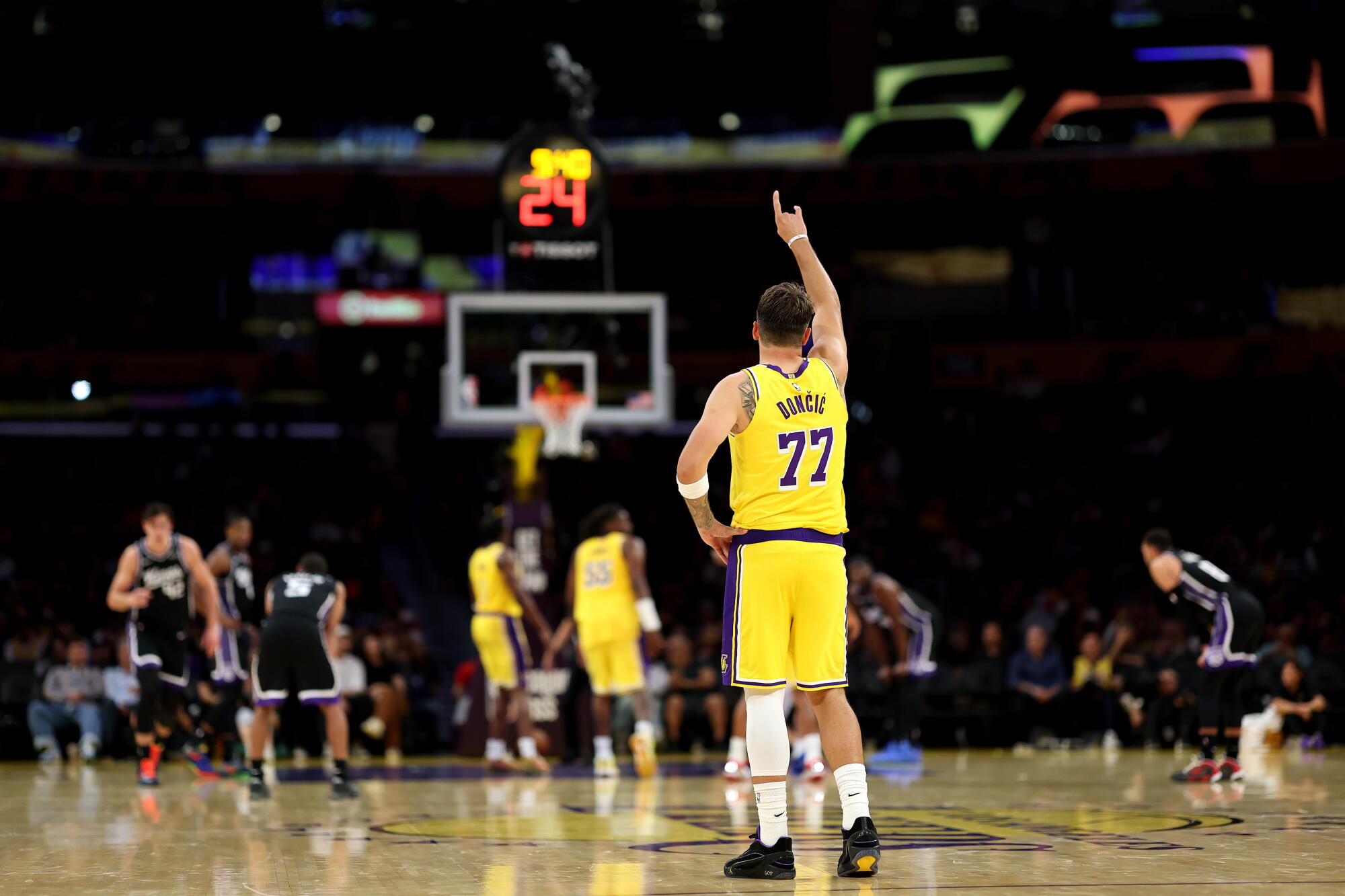
Lakers guard Luka Doncic enters this season as the face of the franchise after LeBron James’ departure.
(Luke Hales / Getty Images)
They’re still destined to a sixth seed and a first-round knockout in the impossible West, a mediocre finish that is sure to convince new ownership to make massive changes — look out Rob Pelinka and JJ Redick! — and start all over again next season.
So call this a gap year.
They’ve graduated from LeBron, but they’re still not quite sure what they want to do with the rest of their life.
They’re planning on majoring in Luka Doncic, minoring in Austin Reaves and specializing in Walker Kessler, but there are flaws in all three, and the rest of the proposed curriculum is an unknown collection of ideas that have yet to be put together in a cogent package.
For now, the league’s biggest roster overhaul includes names that are just names, the likes of Quentin Grimes, Collin Sexton, Matisse Thybulle, Ziaire Williams, Sandro Mamukelashvili and Kevon Looney. Who knows where they will fit? Who knows what they can do?
Then there’s the name Bronny James, whose future here took a nosedive when his pops moved to Philadelphia and he had a lousy training camp. Who knows how long Bronny will stick around, but at least the Lakers are out of the LeBron family drama business, which is good, because this team will create enough drama on its own.
First, there’s Doncic, and the risk in building around him, considering he’s missed an average of 20 games a season the last three years. He’s appeared in a total of five playoff games since leading the Dallas Mavericks to the Finals three years ago. He’s 27, but sometimes he trudges around the court like he’s 50.
Lakers guard Bronny James dribbles during a preseason game against the Kings at Crypto.com Arena on Oct. 8.
(Luke Hales / Getty Images)
Now that this is Doncic’s team, will he act like it?
Every centerpiece player in Laker history — from Mikan to West to Kareem to Magic to Kobe to Shaq to Pau to LeBron — has carried their group to a championship. They’ve not been considered a true Laker until they have done so. In the case of LeBron, one was not even enough.
Is Doncic prepared to shoulder this burden? He says yes. He says he’s done this before, although he’s never won an NBA title, so, um …
“It feels great,” he told reporters at media day last month. “Obviously, it’s a new challenge. I was in this position in my career a lot of times, so it’s not new to me. But I feel great. I feel excited, and like I said, I’m ready to go. It’s been a long time since I played basketball, so I’m ready.”
He got off to a good start this summer when he flew the team to his native Slovenia to spend a few days bonding. He is already acting like a captain. Now he needs to play every day like one.
“I see myself in this role, nothing new, but it’s very important,” Doncic said. “Everybody on the whole team, you know, look up to me, I have to look up to them. And it’s just, there should be many leaders, you know. You should be able to hold each other accountable.”
Lakers guard Austin Reaves dribbles past the Kings’ Nique Clifford during a preseason game at Crypto.com Arena on Oct. 8.
(Luke Hales / Getty Images)
Many leaders? Probably only two, Doncic and his newly minted $180-million running mate Reaves.
The Lakers were 30-11 when the two gunners were on the court last season, and no NBA duo averaged more points, but, again, this year is different.
Last year they both had LeBron as a safety net. This year, it’s all on them.
Just like Doncic, Reaves said he is ready to help guide his new teammates on this arduous journey.
“The expectation here of being a Laker is higher than it is anywhere in the world,” Reaves said. “The media presence, you know, every day something is going to come out about us, and just being able to know how to navigate that and help others navigate that is the main thing. One second we’re going to be the best team in the world. And the next you lose two in a row, you’re the worst team, you can’t figure it out. So, helping these guys understand that none of that really matters, it’s all about what goes on within these walls, is the main thing.”
Actually, for Reaves, the main thing is the postseason, where he has mightily struggled, even taking into account the slight guard usually enters each spring with all sorts of bumps and bruises. He’s been a lousy playoff shooter. He’s been a clumsy playoff playmaker.
But one of the greatest undrafted free agents in recent league history appreciates and embraces every chance to change the narrative, and he’ll have no greater chance than this season.
“You’re going to have failures within this long season,” he said. “But every single night you’re going to have an opportunity when you take the floor, especially for this organization, for this fan base to show the world what you’re capable of. So, you’re going to have every single opportunity to do good with the opportunities that you’re given.”
No Laker, it seems, will have a greater nightly opportunity to write his legacy than Kessler, who was acquired this summer from the Utah Jazz for the princely sum of two first-round picks and two first-round pick swaps.
He is being projected as a perfect lob and pick-and-roll partner for Doncic and a long-awaited rim protector, but let’s be real.
He played in five games last year and never started a full season in his four years in Utah and even for a perpetually tanking team, that’s not a big resume. What sort of NBA center he will be is anybody’s guess.
The Lakers are guessing huge, and at least he sounds like he’s ready for it.
Laker Walker Kessler fouls the Warriors’ Yaxel Lendeborg during a preseason game on Oct. 13 in Las Vegas, Nev.
(Ethan Miller / Getty Images)
“And as far as the belief that they’ve shown in me, I mean, it makes me excited for this year,” he said. “It makes me feel like I can run through the wall for this organization, this team, my teammates, so yeah, I’m just so excited.”
Good thing about that wall, because with this unsettled bunch, there will be plenty of them.
But, hey, at least one looming question has been answered. During media day, new power forward Mamukelashvili gracefully explained how to pronounce his last name.
“So, a lot of people think it’s hard, but I don’t think so,” he said. “It is Mamu-kela-shvili. So if you take like, I feel like, two letters at a time, and “shvili” at the end, it’s not that hard.”
If only the rest of this season would go so smooth.
The “Rookie” actor appeared in a short video posted Sunday to the show’s Instagram Stories with her temporary partner, Alan Bersten — who is filling in for suspended pro Val Chmerkovskiy — to promote their upcoming routine.
“Hi, everybody,” Dewan said while standing beside Bersten during rehearsals. “It’s ‘Dedication Night’ and we are dancing a Viennese waltz to ‘Unchained Melody’ by the Righteous Brothers, the greatest, most romantic song ever.”
The “Step Up” star shared on social media that she is dedicating this dance to her mother.
“My mom has always been my biggest cheerleader,” Dewan wrote in her Sunday Instagram post. “The one who believed in me before I even knew what was possible for myself. Who encouraged me to dream big, to keep going, and most importantly, to never lose sight of who I am along the way.”
She added: “There’s something so beautiful and full circle about getting to honor the woman who first encouraged my love of dance, through the very thing she helped me fall in love with.”
The short teaser was shared shortly after it was announced that Chmerkovskiy would be suspended for a week for posting a message on TikTok that seemed to reference Will Smith‘s infamous 2022 Oscars slap. That incident involved Smith rushing the stage and slapping host Chris Rock with an open hand after the Oscars host made jokes about Jada Pinkett Smith.
“Keep my wife’s name out your … mouth!” Smith shouted at Rock afterward.
Chmerkovskiy’s since-deleted TikTok post appeared to be in response to judge Carrie Ann Inaba‘s harsh critique of the performance by pro Jenna Johnson, his wife, and partner Harry Shum Jr. during Tuesday’s “Super Bowl Night” episode of the show.
“You almost saw Fresh Prince enter the ballroom last night,” Chmerkovskiy reportedly wrote.
“DWTS” producers BBC Studios responded with a widely reported statement that the “well-being of everyone who works on Dancing with the Stars is non-negotiable. Val’s social media post was inappropriate and does not reflect the values or standards expected of anyone connected with the show. As a result, he will not participate in next week’s show.”
Chmerkovskiy has since apologized for his remark, saying in a statement provided to Deadline that he had merely reacted on “instinct” to “defend [his] wife.”
“In a moment where my instinct was to defend my wife, I made a poor decision to reference a meme to ‘keep my wife’s name’ out of the conversation, without stopping to think through what else that reference could imply, which was genuinely never my intention,” the statement read. “Carrie Ann certainly didn’t deserve to get caught in the middle of my bad judgment, and I hate that she was.”
The dancer also reportedly posted an apology to his Instagram Stories on Thursday.
“I want to apologize from the bottom of my heart for my recent post,” he wrote. “I have reached out to Carrie Ann to apologize directly and personally, and I also want to apologize publicly as I understand my words affect so many outside of our internal DWTS family.”
Bersten, who is filling in this week as Dewan’s partner, was previously paired with celebrity chef Giada De Laurentiis before they were eliminated earlier in the season.
COLUMBIA, S.C. — U.S. Rep. Nancy Mace’s former fiance and two of his business associates were charged with sex crimes and voyeurism on Wednesday over an episode the South Carolina congresswoman described in detail during a speech last year on the House floor about how crimes against women are not investigated thoroughly.
John Douglas Osborne committed sex acts on a 23-year-old incapacitated and intoxicated woman while Mace’s ex-fiance Patrick Bryant and Eric Bernard Bowman watched, according to sworn statements by agents from the State Law Enforcement Division, which brought the charges.
The men talked about who would assault the woman beforehand, took photos and recorded the assault, which was also seen on a security system feed at the home in Sullivan’s Island, an affluent suburb of Charleston, state agents said. The woman had fallen into a pool and was passed out on a couch covering herself with a pillow, agents said.
Another woman who happened to be watching the feed saw the assault and took pictures and wrote about it in a journal, police said. Mace and Bryant were not yet engaged at the time of the October 2018 assault.
Osborne, 46, is charged with first-degree assault and battery and two counts of third-degree criminal sexual conduct. Bryant, 53, and Bowman, 46, are each charged with voyeurism.
Along with the voyeurism charge, Bowman was also charged with obstruction of justice after agents said he did a factory reset on a cellphone he knew investigators were seeking in a search warrant, and with publishing the name of a victim of criminal sexual conduct after posting the victim’s name and a video of her on X.
Bryant didn’t return a message seeking comment on Wednesday, and attorneys who have been listed as representing Bowman and Osborne in other cases did not immediately return messages.
Mace, a Republican, described the assault at length in a nearly hourlong speech in February 2025 that named the men and described other photos and videos found when she looked at Bryant’s cellphone when they were still together.
Mace said she “accidentally uncovered some of the most heinous crimes against women imaginable. We’re talking about rape, non-consensual photos, non-consensual videos of women and underage girls, and the premeditated, calculated exploitation of women and girls in my district.”
At the time, Bryant completely denied the allegations. “I take this matter seriously and will cooperate fully with any necessary legal processes to clear my name,” he told the Associated Press.
The State Law Enforcement Division didn’t say if their investigation into any of the men is continuing.
After the arrests, Mace released a statement detailing the 25 bills she says will protect victims of sexual assault, harassment or discrimination, including in retaliatory defamation and libel lawsuits that may result from allegations they bring to light.
The Republican, who is leaving the House this term after losing her bid to be South Carolina governor, introduced a proposal this week to require that anyone who brings such a case and loses must pay attorney fees for the defendant.
“Protecting women and holding predators accountable isn’t a slogan. It’s been one of my top priorities in Congress. For too long, survivors have faced broken systems while predators exploited loopholes and walked free,” Mace said in her statement.
Kinnard and Collins write for the Associated Press.
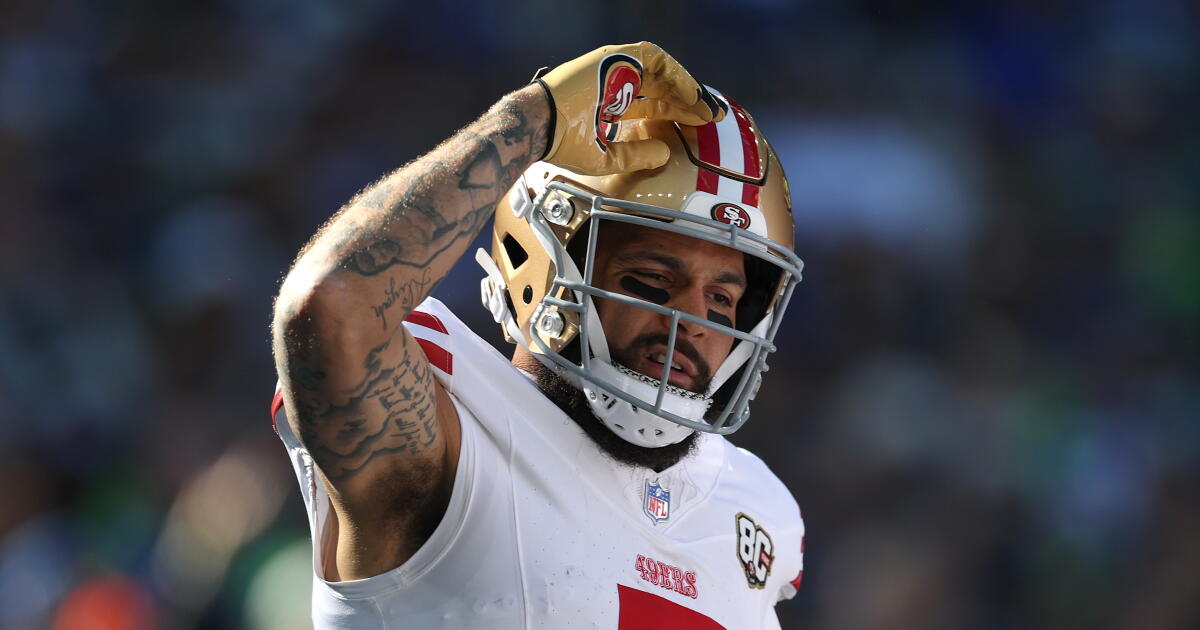
San Francisco 49ers receiver Mike Evans may have earned a spot in the trash-talking hall of fame on Sunday without even trying.
Or so he says.
Late in the second quarter of the 49ers’ 32-29 victory in Seattle, Fox Sports cameras showed Evans and Seahawks cornerback Trevon Diggs jawing after a play. In one of the season’s most meme-able moments so far, Evans put his hands on Diggs’ shoulder pads and turned the two-time Pro Bowl selection around to look at his name, as if to say, “Who are you?”
Diggs, a seven-year veteran who led the league with 11 interceptions in 2021 as a member of the Dallas Cowboys, appeared to be offended and shoved Evans in the facemask.
Retired cornerback and renowned trash-talker Richard Sherman, who played for both the Seahawks and 49ers during his 11-year career, gave Evans some high praise on X.
“Mike Evans Checking to see the name on the back of the Jersey is an all-time Gif and trash talk moment that I wish I would have thought of,” Sherman wrote.
Evans’ move was very similar to one from a 2019 viral clip in which Toronto Maple Leafs star Auston Matthews checked the back of then-career minor leaguer Scott Sabourin of the Ottawa Senators during a preseason game. (Sabourin would go on to play in 74 NHL games for four teams over seven seasons.)
But Evans, a five-time Pro Bowler in his first season with San Francisco after 12 years with the Tampa Bay Buccaneers, told reporters after the game that he was just trying to figure out his vocal opponent‘s identity.
“I was blocking him until the whistle, and then he said something, like I’m doing extra, something like that,” said Evans, who finished with seven catches for 113 yards and one touchdown. “I didn’t know that was him at first, because I played against him a few times and we always been cool, you know? He was a good player. I honestly didn’t know it was him, because in the helmet, it’s hard to tell sometimes.
“And we were just talking trash, and I think I like pushed him and then I was like, ‘Who are you?’ And I looked to make sure. ‘Oh, it’s f— Diggs.’”
Hmmmm, Diggs was a good player? Maybe Evans is a trash-talking master after all.
The 49th Kennedy Center Honors gala will go on despite the recent closure of the Kennedy Center, with the event moving to the Capital One Arena in Washington, D.C., on Dec. 7. The honorees and a broadcaster for the program will be disclosed at a later date.
The annual event will take place amid an ongoing legal battle as President Trump attempts to add his name to the building.
Hours after a federal judge blocked the president’s attempt to restore his name, the Kennedy Center’s board voted on Sept. 15 to shutter the venue for renovations. Trump, however, threatened on social media to block the $250-million renovation, which he initially proposed, if his name weren’t added to the facade.
In mid-September, a picture of the president aboard Air Force One reviewing plans that were titled “Kennedy Center Demo[lished]” prompted panic as architectural, preservation and civic organizations asked the court for a “neutral officer to protect the building and institution.”
A federal judge ordered Kennedy Center leaders to provide 30 days’ notice before any changes, including demolition.
Last year’s Kennedy Center Honors gala, which recognizes artists who have contributed to American culture, was hosted by Trump and televised on CBS and Paramount. The ceremony, honoring Sylvester Stallone, Kiss, Gloria Gaynor, Michael Crawford and George Strait, earned the lowest ratings in its history. It was not announced whether Trump would return as master of ceremonies for this year’s event.
David Ellison said the merged Paramount and Warner Bros. Discovery will be called Skydance — the moniker he picked nearly two decades ago when the tech scion began building his Hollywood empire.
Ellison, currently the chairman and chief executive of Paramount, is aiming to finalize the acquisition of Warner Bros. Discovery by Tuesday. Then the combined company will assume the name and logo of his once small studio.
“We chose this name for a few important reasons,” Ellison wrote Friday in an X post. “As we bring Paramount and Warner Bros. together, we wanted to preserve what has made each of these studios iconic. Both have distinct identities, extraordinary legacies and brands that have resonated with audiences … We never wanted a new corporate identity to diminish, alter or overshadow either one.”
By calling the company “Skydance,” Ellison said the merged entity would have “an identity of its own while allowing Paramount and Warner Bros. — and all our extraordinary brands — to remain in the spotlight.”
In Hollywood, there had been much speculation over what jumbled mash-up of the corporate titles would be used, with WarnerMount and Paramount-Warner Bros. often mentioned as possibilities.
Both companies boast century-old studios, beloved media brands and a recent past that has included several fraught mergers. When AT&T sold WarnerMedia to David Zaslav’s Discovery in 2022, he selected Warner Bros. Discovery as the corporate name.
The merger is quickly reaching the finish line after U.S. District Judge Araceli Martínez-Olguín on Wednesday signed a settlement agreement, effectively ending an antitrust lawsuit brought in July by California Atty. Gen. Rob Bonta and 11 other state attorneys general who initially fought the formation of a new Hollywood colossus. Paramount now has won approvals by nearly 70 regulators for the industry-reshaping deal.
For more than a decade, Paramount has been the smallest of the major media companies, owning CBS, Comedy Central, BET, Nickelodeon and the Melrose Avenue studio. With the $111-billion merger with Warner, Skydance will gain more valuable assets including HBO, CNN, TBS, Food Network and Warner Bros. film and television studios, along with their massive libraries that include the Harry Potter, “Lord of the Rings,” and DC Comics franchises.
Earlier this week, Ellison announced he was bringing Ynon Kreiz, who has served as the CEO of toymaker Mattel for eight years, to run the new entity’s day-to-day operations. Kreiz, 61, brings years of operational experience that Paramount’s top executives had lacked.
Paramount released details of Kreiz’s contract on Thursday in a regulatory filing, saying he would receive an $5 million annual salary and an annual target bonus of $4.9 million. He will also qualify for a signing bonus of $31.5 million to come over to the new company, paid through restricted stock units.
In addition, HBO Chairman Casey Bloys is widely expected to become head of the merged company’s streaming programming. Paramount’s streaming chief Cindy Holland exited the company earlier this week to make way for Bloys.
During a Thursday appearance at the Bloomberg News Screentime media conference in Hollywood, Bloys declined to discuss his presumed new role. But he suggested that that Ellison’s company might bundle HBO Max and Paramount+ services, allowing the two services to remain for now, rather than try to fold them into one gigantic offering.
Skydance will carry than $80-billion in debt, much of it acquired to retire the holdings of Warner Bros. Discovery investors at $31.17 a share. The company also has promised investors that it would find $6 billion in cost-cuts within three years.
During a separate appearance at the Bloomberg conference, RedBird Capital Partners founder Gerry Cardinale, a Paramount investor and board member, said finding $6 billion in cuts would be relatively easy, and would not be focused solely on layoffs. It would include combining the technology stacks for the various streaming platforms.
But Cardinale acknowledged layoffs would be part of the cost-cuts, a prospect that frightened many in Hollywood after endless waves of job cuts at the two companies.
Warner’s outgoing chief executive Zaslav will leave with a golden parachute valued at about $887 million, which includes cash, stock and options valued at more than $550 million, according to regulatory filings.
In addition, Warner board members separately agreed to pay Zaslav’s tax bills, which could approach $330 million.
The new parents shared their happy life update in a joint Instagram post Monday featuring the public social media debut of their new bundle of joy.
“We took Labor Day literally this year,” Palvin wrote in the caption accompanying a photo of she and Sprouse holding their baby girl between them. The snapshot captured the family of three from the back as they watch a Dodgers game on TV while wearing matching jerseys.
The model debuted her baby bump in May at the Cannes Film Festival, where the couple posed together while walking a red carpet. They also announced that they were expecting on social media. Sprouse later shared in a July episode of his “Wildmen” podcast that they would be having a baby girl and that he was “excited to be a girl dad.”
On Tuesday, the actor once again took to his podcast to share some new tidbits about his daughter and life as a new parent.
“She’s very lovely, her name is Sylvie,” Sprouse said of his daughter. “Sylvie Sprouse. And she’s a very well-behaved baby.”
The former Disney Channel star also shared some details about Sylvie’s birth including some of the different options at Cedars-Sinai Medical Center.
“There’s moments when I look at Sylvie and I’m like, ‘This is the coolest thing ever,’” Sprouse said of being a new dad. “She’s looking at me and her eyes are opening … she’s looking at me and she smiles or something and it’s the cutest thing. My heart like jumps out of its chest.”
The “Suite Life of Zack & Cody” star and Victoria’s Secret model first met in 2017 and have been in a relationship since 2018. They were married in 2023.