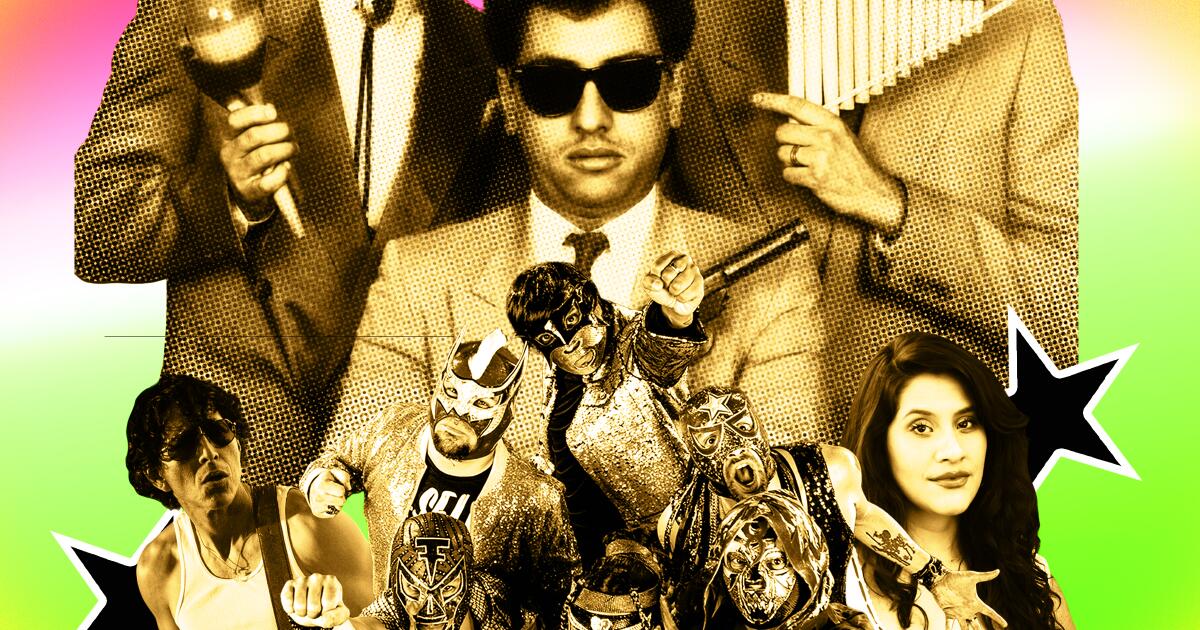
As 2026 reaches its halfway point, the editors of De Los are eager to talk about Latin artists to watch — and share their hottest music takes. Over the years, award-winning music journalist Suzy Exposito and Director of Latino Initiatives Fidel Martinez have documented the rise of genres like reggaeton and música Mexicana in mainstream culture.
In her work for Vogue, The Times and Rolling Stone, Exposito has interviewed influential artists like Shakira, Cardi B and Bad Bunny (the last of which made history as the first Rolling Stone cover story written by a Latina journalist).
Martinez has an impressive roster of his own, having interviewed many stars in the Mexican and Chicano music scenes, from Fuerza Regida to Natalia Lafourcade.
Reflecting on a landmark year for Latin music
On this week’s episode of “The De Los Podcast,” they weigh in on the explosive impact of 2025 on the genre: between Bad Bunny‘s Super Bowl halftime show and Karol G‘s Coachella headlining performance, last year was nothing short of a groundbreaking for Latin music.
“Being there, you could feel barriers coming down,” Martinez, who reported live from the Super Bowl in February, said. “It wasn’t Bad Bunny trying to validate us in front of others. It was him saying, ‘This is who we are, and we are proud of who we are.’”
According to the RIAA, 2025 was the first year that Latin music sales in the U.S. reached $1 billion, in its 10th consecutive year of growth. In 2016, American Latin music sales were at just below $150 million.
“It highlights how quickly and with what speed the genre has been taking off,” Martinez said.
However, as Exposito notes, at times, it came at the cost of originality.
A Latin music trend that De Los is leaving behind this year
“Our generation is too married to the past,” Exposito said. “How can we evolve musically if we keep trying to re-create our grandparents’ music?”
Nostalgia, De Los editors note, has driven the wide-ranging popularity of last year’s most successful Latin projects. As Exposito says, the artists “mine the past in their own ways.”
In Bad Bunny’s “DtMF” and Karol G’s “Tropicoqueta,” classic genres like salsa, plena and cumbia took center stage. “DtMF” samples El Gran Combo de Puerto Rico while in Fuerza Regida samples Mexican classics like Vicente Fernández.
While comforting and educational for younger generations, Martinez argues that artists relying on nostalgia could turn that effort into becoming more experimental with their sound.
Some artists, however, are resisting the nostalgia trend, making De Los’ best albums list of 2026 … so far.
De Los’ 2026 Latin albums you need to hear
Suzy’s picks:
Alvaro Díaz, “Omakase”
“He’s experimental … and taking bold swings, with producers like Tainy,” Exposito said.
“Omakase,” which the Puerto Rican star released in May, blends Latin trap elements with electronic, R&B and in one track, cumbia, for a diverse, thoughtful album that Diaz equates in his De Los story to the Japanese dish omakase, or a platter decided by the chef.
RaiNao, “Marcría”
With a worldplay title that blends the words “malcriada” (badly raised woman) and “cria por el mar” (born in the sea), RaiNao’s project promises earthly, intimate lyricism with experimental musicianship.
“The way she melds jazz with reggaeton and folkloric elements, I really enjoy,” Exposito said. “I really appreciate people (like RaiNao) who can remix but also introduce seemingly disparate elements, like saxophone and Caribbean music.”
Other picks include Ibeyi’s “Offering” and Diles Que No Me Maten’s “Escrito en Agua.”
Fidel’s picks:
Julieta Venegas, “Norteña”
Venegas, who De Los interviewed last month, wrote a memoir alongside this album, which delves into her Tijuana heritage with Mexican collaborators like Bronco, is what Martinez calls “a chef’s kiss.”
“She’s such a fascinating character because she started as an indie rocker,” Martinez said. “This album is a love letter to Tijuana. It’s just the perfect fusion of tradition and pop.”
Hermanos Espinoza, “Linaje”
Two brothers from the Rio Grande Valley, Hermanos Espinoza performed at De Los’ SXSW showcase and blew the audience away with their live energy and accordion work.
“Their project talks about lineage. This album certainly has a point of view,” Martinez said. “With this album, they said, música Mexicana can be like rock and roll.”
Also on the list are Tito Doble P’s “Acomodo” and Trio Asesino’s self-titled.
To hear more about 2026’s emerging artists and De Los’ music hot takes, check out “The De Los Podcast.”
A coalition of advocacy groups for artists, songwriters and managers is warning musicians about the growing risks of artificial intelligence music.
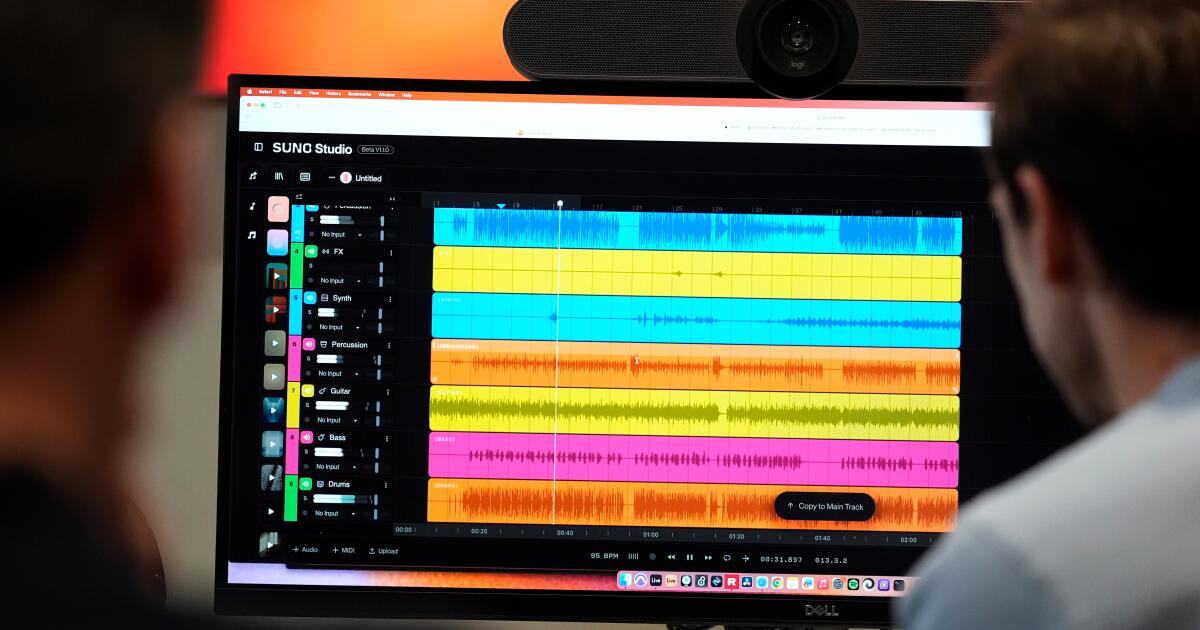
Recently, many major record labels have inked deals with AI music startups such as Suno, Udio and Klay. But the coalition, which includes organizations such as the Music Artists Coalition and the Songwriters of North America, argues in a new letter that “artists and songwriters whose works, voices, performances, likenesses and creative identities make those deals valuable are not being meaningfully consulted.”
The letter, released Monday, stated that many artists and songwriters in existing recording and publishing agreements are currently receiving letters from their labels and publishers claiming that they “will be opted in to AI-related uses by default, with little actual choice offered.” Even new artists are receiving agreements that include “AI rights clauses as a standard condition of signing.”
“We support innovation and recognise that AI can create new opportunities for music,” the coalition wrote in the letter. “However artists are not simply catalogue assets, and innovation cannot be used to override artists’ rights.”
The National Independent Talent Organization, a live entertainment advocacy group that signed the letter, said many of its members are coming to the organization with label contracts that include “non-negotiable AI usage clauses.”
“We can’t allow for contract language signed decades before this technology existed to be the standard bearer. These rights belong to the creators and they get the final say on usage,” said Nathaniel Marro, NITO’s executive director, in a statement to The Times.
“Music companies are leading the fight to protect artists’ and songwriters’ rights in the age of AI,” said a spokesperson for IFPI, the recording industry’s global trade body.
“While our members have taken different approaches, they share the same fundamental objectives: combating the unauthorized use of music and establishing licensing models that return revenue to artists and songwriters,” the IFPI spokesperson added.
The coalition is asking the industry to move forward on AI deals only under four conditions: that musicians directly consent to any agreement; that artists receive fair compensation; that there be transparency between the companies and the talent; and that companies make a public commitment to end contracts built on default AI opt-ins and forced AI clauses.
“Artists need a real seat in these conversations, clear terms on revenue share, and the ability to say no without losing their deal,” said Ron Gubitz, the Music Artists Coalition’s executive director, in a statement.
A little over two weeks ago, the American Federation of Musicians sued Universal Music Group and Warner Music Group. The complaint claims the major labels “received significant compensation” from the AI companies for past copyright violations and licensed “substantial” portions of their music catalogs to them, but haven’t shared that with the musicians.
Despite the confrontational tone of the letter, some signatories struck a more conciliatory note. Overall, the industry seems to be receptive to these AI changes, said Willie “Prophet” Stiggers of the Black Music Action Coalition, another signatory advocacy group. At this point in AI’s development, he added, everyone in the industry — from artists and labels to AI start-ups and policymakers — has a responsibility to establish effective guardrails.
“The companies building these technologies understand that trust is essential to long-term success, and trust begins with respecting creators’ rights,” Stiggers said in a statement to The Times. “There’s still important work ahead, but we’re encouraged that the conversation has shifted from whether protections are needed to how we build them together.”
“The structures being created now will shape the music ecosystem for years to come,” the coalition’s letter said. “The future of music must be built with artists, songwriters and their representatives, not imposed on them.”
Times staff writer Wendy Lee contributed to this report.
Walk into the Grammy Museum in downtown L.A., and you’ll see Clive Davis’ legacy everywhere.
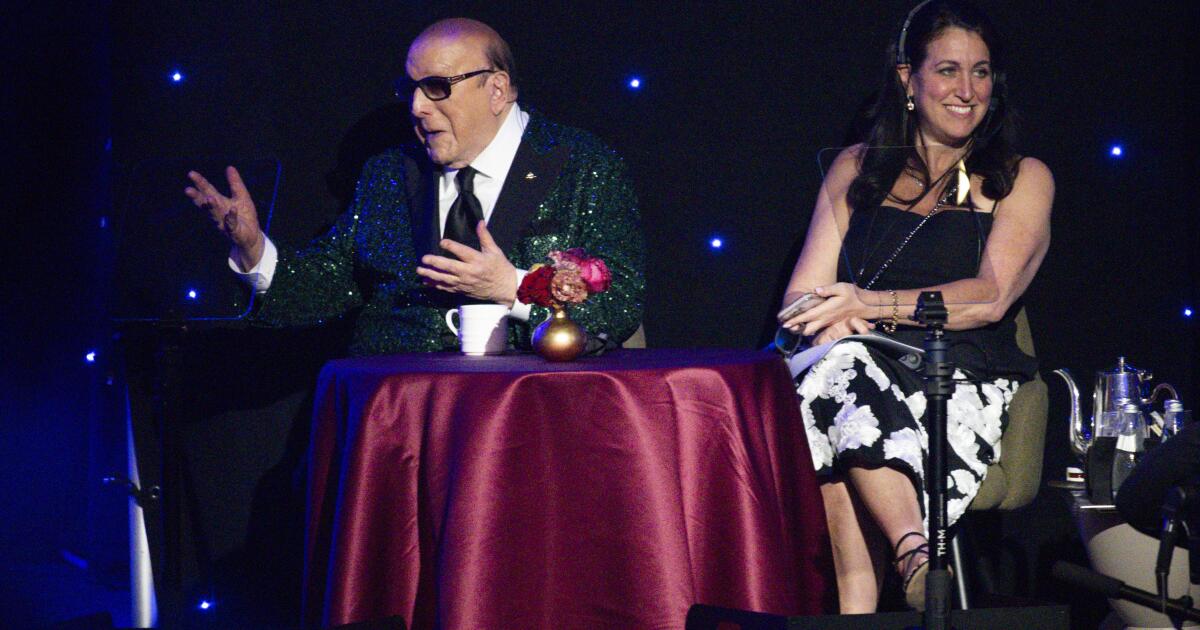
The museum’s intimate performance space is named for the late record executive, and his visage greets guests at the front door. (Davis was the first million-dollar donor to the nascent Recording Academy archive and exhibition space.) His sprawling roster of acts — Bruce Springsteen, Miles Davis, Whitney Houston,Alicia Keys, Earth, Wind & Fire — defined an entire art form and business model as preserved in the Grammy Museum. Davis’ pre-Grammy gala was the most coveted invitation in music every awards season.
Davis’ death at 94 is “devastating,” said Michael Sticka, chief executive and president of the Grammy Museum. “Clive was always a north star of music and talent and artistry. We’re all lucky to have his legacy to look up to.”
Davis’ death marks the end of perhaps the most important and enduring career in the record industry. Sticka spoke to The Times about Davis’ remarkable longevity, creative vision and how a career like his will likely never be possible again.
Clive was a giant of the record business. How did his career shape the modern record industry?
His career was iconic. He really had a unique ability to not just bring an artist to their fullest potential artistically, but commercially. From attending Monterey Pop and first seeing Janis Joplin to Whitney Houston and Alicia Keys, I don’t think anybody had that ear in them the way that he did.
With Clive, what you got was not just hearing commercial viability, but an understanding of what was going on in the zeitgeist. That’s what propelled his career and legacy beyond most record executives.
His name’s on the building at Grammy Museum’s theater. What did he mean to the institution — not just for fundraising but as a living connection to music history?
He didn’t just donate to the museum. He donated his time, his historical knowledge of music, his firsthand perspective. He always kept tabs on what was happening in music. I always say the Clive Davis Theater is the toughest ticket in town for its intimacy and the level of programming we do. But he did an annual program at the museum where people could come hear stories directly from him. Once he decided he was in, he was all in.
His gala was the place to be every Grammy season too.
I don’t think anybody could gather a roomful of luminaries like that from entertainment, tech and politics in the way that Clive did. We were lucky to be a part of that. Even with the stature he had, he was still a physical presence there, he was approachable. He was always looked at as this living legend, but his legacy was continuously being built.
That’s true over the arc of his career, which saw him lead Columbia, Arista, J Records and more. He had a lot of resurrections as well as successes.
He had this ability to resurrect. Look at Santana and “Supernatural,” he was a producer on that album that was inducted into the Grammy Hall of Fame just last year. So many of us would just give up, but he just had this resolve to continue, and thank God he did.
The record industry is so different now than when he began his career. Artists find audiences on social media rather than being discovered by label executives. Is a career like his — a famous executive driven by their own taste and individual savvy — even possible today?
That’s true, artists break on social media before they’re even on record executives’ radars now. I don’t know if we’ll see that kind of career arc again. Clive had a rare combination of gravitas and being recognized so publicly. The man and his legacy are not going to be replicated.
Beyond the name on the theater, how do you hope the Grammy Museum will honor him with its programming in time to come?
I don’t know yet. We weren’t really prepared for this. We’re gonna have to sit down and think how to pay tribute to such a legacy. I think that the impact the Clive Davis Theater has, bringing in 120 artists a year — I couldn’t think of a more apropos name on the door.
Barry Manilow has told the story behind his first big hit so many times that I had no intention of bringing up the half-century-old “Mandy” when I sat down with the singer on a recent afternoon at his home in Palm Springs. Among the questions I did ask was how he ended up recording the song that opens his new album, and the answer — as it’s so often been throughout Manilow’s career, beginning with that 1975 chart-topper — was Clive Davis.
“It was all Clive,” Manilow said of “Once Before I Go,” the Peter Allen/Dean Pitchford number that leads off his just-released “What a Time” LP. Davis, the star-making record executive with the so-called golden ears, had been urging him to record the song for years, Manilow told me, which inevitably brought him back to the well-rehearsed tale of “Mandy” — to Davis’ decision that Manilow’s debut for his Arista label lacked a breakout smash and to his suggestion that the singer cut a version of a modest hit called “Brandy” by Scott English.
“So I went in the studio and did it trying to sound like that guy,” Manilow recalled, stomping his foot to approximate a lumbering rock beat. “Clive came in and said, ‘That’s terrible.’ I said, ‘I know it’s terrible.’ But in order to learn the song, I’d slowed it down and changed the key — I found the love song hiding in ‘Brandy,’” Manilow continued. (He also changed the title to avoid any confusion with Looking Glass’ “Brandy,” which had recently reached No. 1.) Manilow played the tune in his more romantic style for the exec. “I’ll never forget it — Clive said, ‘Just do that.’ And that was the record.” He laughed.
“He’s a kind of a genius.”
Davis, who died Monday at age 94, didn’t sing or play an instrument. “I knew nothing about music,” he once said, looking back at his entry into the record business. Yet his instincts made him one of the surest spotters and nurturers of talent in pop history, with a long — and varied — line of success stories that included Manilow, Janis Joplin, Neil Diamond, Lou Reed, Patti Smith, Whitney Houston, Aretha Franklin, Dionne Warwick, Alicia Keys, Jennifer Hudson and Maroon 5, among many others. He even helped the Grateful Dead score a Top 10 single with “Touch of Grey” in 1987.
Davis, who got his start in Columbia Records’ legal department, could identify original voices and seemed to intuit which songs were likely to become hits. Sometimes the hits came from the voices themselves, as in the case of Bruce Springsteen, whom Davis cajoled into writing “Blinded by the Light” for his Columbia debut; sometimes the exec match-made performers and composers, as in the case of “Mandy” or “Freeway of Love,” a zippy Narada Michael Walden jam that launched Franklin’s comeback in the mid-1980s.
A natty dresser with a cosmopolitan air, Davis founded Arista in 1974 after he was fired from Columbia (where he’d ascended to the presidency) amid an embezzlement scandal of which he was later cleared. In 2000, he was ousted from Arista in a corporate shakeup — just months after the label won eight Grammy Awards with Carlos Santana’s 15-times-platinum “Supernatural” LP — then launched a new label, J Records, which scored an immediate blockbuster with Keys’ “Songs in A Minor.”
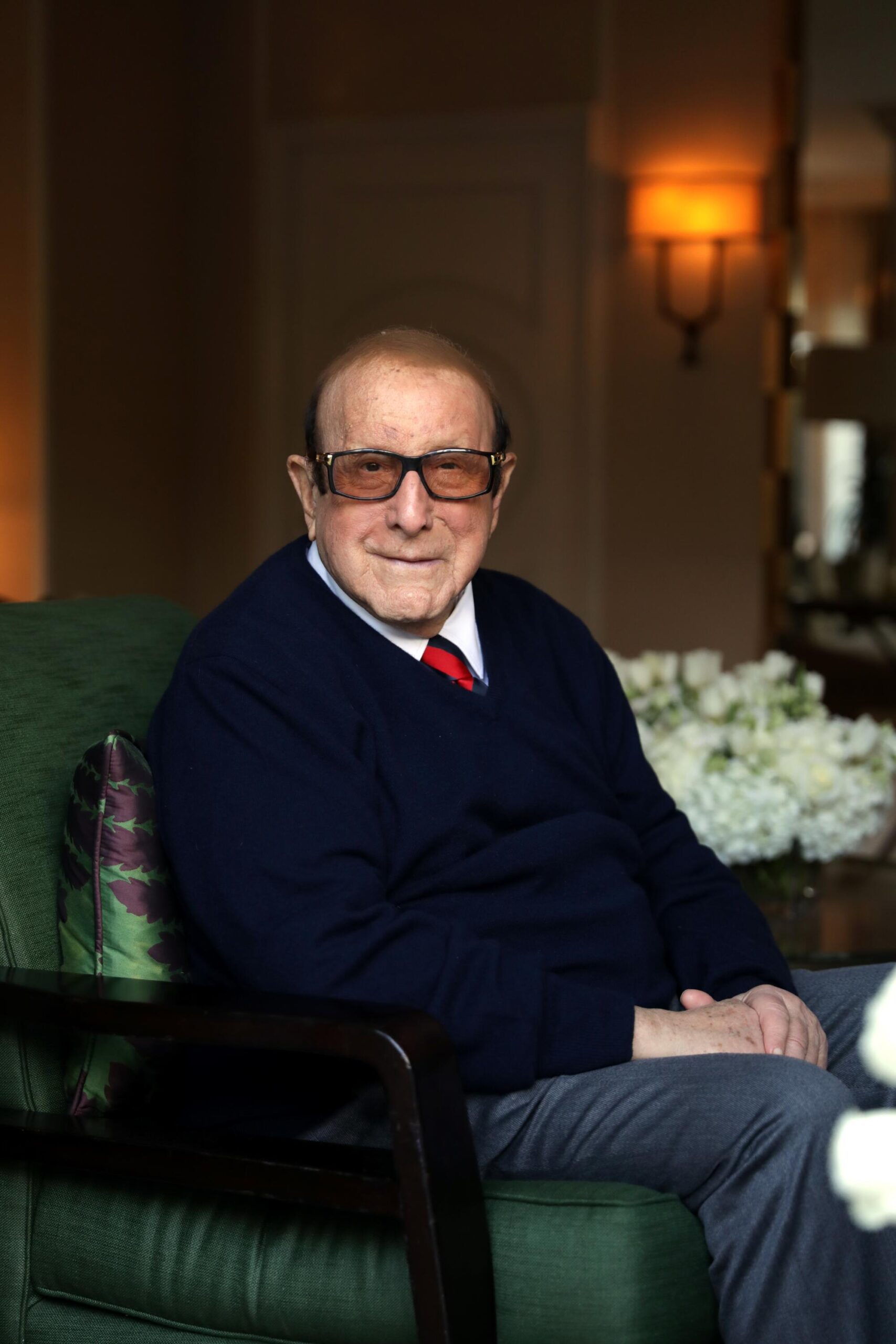
Clive Davis at the Beverly Hills Hotel in 2020.
(Christina House / Los Angeles Times)
Wherever he worked, Davis’ goal was shepherding hits that spanned formats and generations; he delighted in projects like “Smooth,” the inescapable Santana single pairing the rock guitarist and Rob Thomas of Matchbox Twenty, and a series of Great American Songbook albums by the once-scruffy Rod Stewart. He might also have been the music industry’s biggest believer in ballads, at least among suits: Between 1985 and 1992, Houston alone released almost a dozen of music’s all-timers, including “Saving All My Love for You,” “Didn’t We Almost Have It All” and — perhaps the greatest pop ballad ever recorded — her take on Dolly Parton’s “I Will Always Love You.” (It wasn’t a huge hit, but listen to Houston and Jermaine Jackson’s pedal-steel-drenched “Nobody Loves Me Like You Do,” from Houston’s debut, for an early instance of that crossover ambition.)
One of relatively few nonperformers inducted into the Rock & Roll Hall of Fame, Davis brought his flair for variety to the party he threw at the Beverly Hilton every year on the night before the Grammys — a famously hot ticket that drew A-list celebs from the worlds of music and Hollywood as well as business and politics. You could always count on the exec to have persuaded some number of the year’s splashiest new acts to perform; this year’s bash, in January, had Sombr, Olivia Dean and the women of “KPop Demon Hunters.” But my favorite part of the show was always seeing which veteran Davis had tapped to mix it up with the youngsters — Diamond or Manilow, for instance, or Johnny Mathis, who absolutely killed in 2015.
Davis horrified many in 2012 when he opted to proceed with his party just hours after Houston was found dead in a hotel room at the Beverly Hilton. In the years after the singer’s death, Davis drew criticism for taking too much credit for Houston’s artistic achievements; to some, he became a symbol of the music industry’s efforts to tone down Houston’s Blackness in order to reach white audiences. Five years ago, I asked Warwick, who was Houston’s cousin, whether she’d taken on any kind of consulting role on “I Wanna Dance With Somebody,” the 2022 Whitney biopic that Davis produced.
Bobby Brown, from left, Whitney Houston and Clive Davis in New York in 1998.
(Stuart Ramson / AP)
“Not one thing,” she told me. “I want them to let Whitney rest in peace. Leave her alone. Ten years [since she died] — it’s time to let her sleep.” (In a statement Monday, Warwick called Davis her “dear friend” and said she “can think of no other record man that seemed to have that magical ability to know a hit when he heard a song.”)
I spoke with Davis many times over the years and was always struck by his enthusiasm about music and about his recall of events from decades ago. In 2017, I interviewed the exec alongside Mathis and Kenneth “Babyface” Edmonds about a record the three made together that had Mathis singing newish pop songs like Adele’s “Hello” and Pharrell Williams’ “Happy” — a concept Manilow told me in March he and Davis had been talking about replicating. After my story ran, Davis emailed me and said he’d enjoyed the piece, which had a couple of lines about Davis’ tendency to go overboard hyping his projects.
“Yes, a few of your bites required a personal Band-Aid,” he wrote, “but I did appreciate your perspective of the Mathis album’s quality.”
He knew the music was good; Clive Davis always knew when the music was good.
When the gates opened at St. John’s Episcopal Church in San Bernardino on Good Friday, the music coming from inside wasn’t that of angel-faced choristers or pipe organs; it was the collective scream of electric guitars.
As the sky darkened over the white stucco church framed in palm trees and the dry peaks of the San Bernardino Mountains, fringed teenagers made their way inside, shaking their limbs and chattering in excitement. Fluorescent lights shone overhead in a room that, by day, hosted Bible studies and food pantries — that night, it would be the site of Spinkick Dance Hall, a regular underground music series where noses are bound to bleed and limbs to flail along to ear-splitting riffs.
It’s just one of many shows taking place from Pomona to Palm Desert, heralding a Latino-led youth revival where the freewheeling movement of mosh pits meets the raw power of punk rock: Inland Empire hardcore.
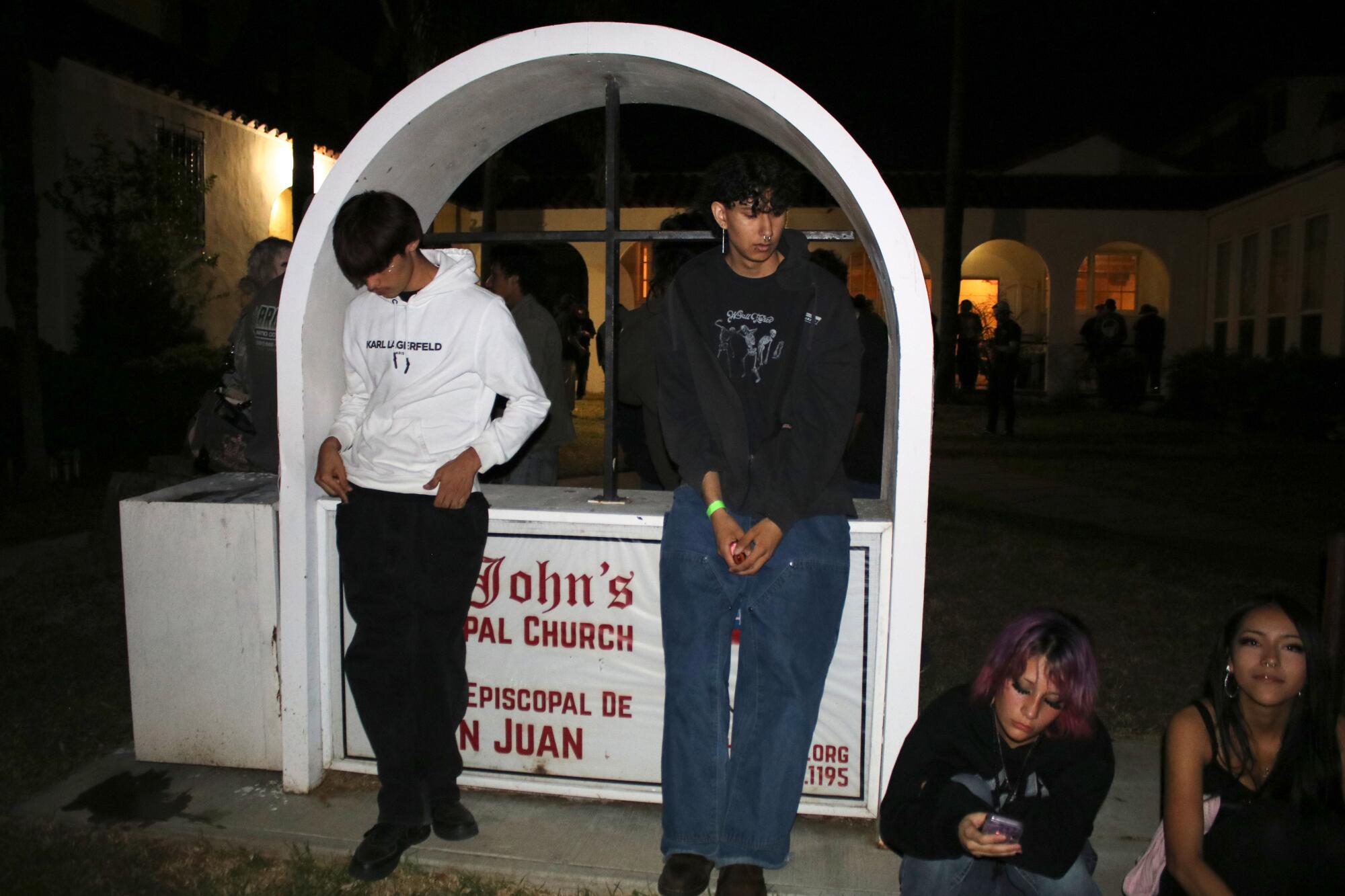
Teenagers congregate in front of St. John’s Episcopal Church in San Bernardino before the start of the night’s hardcore shows on April 3, 2026.
(Katerina Portela / Los Angeles Times)
As the fast-paced and anti-establishment genre known as punk went mainstream in the ’80s, a harder and more unhinged variant emerged in the States; bands like Bad Brains, Minor Threat and Black Flag pushed the limits of vocalization and instrumentation into dissonant new sounds that would make up the subgenre known as hardcore punk.
“As a teenager pre-social media, the music scene was the release for teen angst,” said music photojournalist Zach Cordner. “It was a convergence of nationwide bands that would come to play at [the now shuttered Riverside venue] Showcase Theater, and through word of mouth people got inspired to make cassettes and zines.”
Cordner and his friend Ken Crawford grew up in Riverside in the ’80s and ’90s, photographing the initial wave of hardcore punk taking shape in the Inland Empire. They turned these photographs into a sprawling exhibition held at the Riverside Art Museum earlier this year, “60 Miles East.”
“The scene looks a lot different today than it did in the ’90s,” Crawford said. “It’s browner, it’s queer, and that’s a good thing, to see how it’s become way more diverse.”
Inside the church, the frontman of all-Latino hardcore band Barrio Slam emitted rough growls as the crowd broke into a bustling mosh pit. Teenagers did pinwheel kicks, wrapped Mexican flags over their shoulders and filled the air with chants of “F— ICE.”
Lead vocalist Victor Campos’ family moved from Guadalajara, Mexico, to Pomona, where he says he discovered hardcore through friends. Then, at age 14, Campos attended his first rock show.
“That was the first time that I saw hardcore and metal and the heavier side of music for what it was, and the violence and culture of the shows just sucked me in and I’ve been in it ever since,” Campos said. “It felt like freedom.”
Angela, 19, was in the mosh pit during Load Tha Nine’s performance when she was accidentally struck in the nose by another concertgoer on April 3, 2026, in St. John’s Episcopal Church in San Bernardino. Hardcore shows are characterized by intense music and rough dancing where bloody accidents are not an uncommon sight.
(Katerina Portela / Los Angeles Times)
Jose Ruelas and his Barrio Slam bandmates headbang as they perform on April 3, 2026, in St. John’s Episcopal Church in San Bernardino.
(Katerina Portela / Los Angeles Times)
Campos credits local Latino-led bands like Xibalba and Harsh Reality as inspirations to dive into making music and embrace his identity in the genre.
“In the I.E., it’s really the norm. We’re singing in Spanish, we’re proud. But when we tour, we see it’s not like that everywhere,” Campos said. “Some people still consider punk ‘not for us.’ My own family members will say, ‘You’re listening to white people music.’”
The show at St. John’s is just the tip of the Inland Empire’s DIY venue iceberg. Living rooms, restaurant dining rooms, tattoo shops and record stores have transformed into hardcore venues across the region as established locales closed down.
San Bernardino four-piece “beatdown” group Big Ass Truck is one band that found success beyond the I.E. scene. They signed to Nuclear Blast Records, and at the time of our interview, they had just returned from a tour of Europe.
“With the I.E. especially, we lose a venue like every week. If we have a venue, it’s not staying around for long. I’ve personally seen like three or four venues [in the last few years] just call it,” said Big Ass Truck vocalist Abel Abarca. “So we do get scrappy, and I think that’s what sets the I.E. apart from places like L.A. and O.C.”
San Bernardino hardcore band Big Ass Truck performs a surprise concert at Creator Fest on May 2, 2026, at Creator Tattoo in Pomona.
(Katerina Portela / Los Angeles Times)
Izzy Leyva, 17, describes being met with an immediate “sense of welcoming” at her first DIY hardcore show.
“It’s nice finding people my age to talk about life with. You can start conversations so easily,” Leyva said. “Especially after moshing with someone in the crowd. If you’re struggling to make friends in school, you’ll be able to find someone here.”
She enters the mosh pit fearlessly, dodging flailing arms to two-step — a synchronized dance move that requires punching and running in place — unleashing her energy in the punk sanctum.
“I never feel like an outsider here,” Leyva added.
1
2
3
4
5
1.Mauricio Rivera performs with his band Barrio Slam on April 3, 2026, in St. John’s Episcopal Church in San Bernardino. (Katerina Portela / Los Angeles Times)2.Toni Feliz shows her “IE” tattoo, a nod to her hometown, at Creator Fest on May 2, 2026, at Creator Tattoo in Pomona. (Katerina Portela / Los Angeles Times)3.Izzy Levya, 17, two-steps during Marked for Death’s performance on April 3, 2026, in St. John’s Episcopal Church in San Bernardino. (Katerina Portela / Los Angeles Times)4.Fans dance and “two-step” during Barrio Slam’s performance on April 3, 2026, in St. John’s Episcopal Church in San Bernardino.(Katerina Portela / Los Angeles Times)5.Andres Rodriguez, 18, moshes during Marked for Death’s performance on April 3, 2026, in St. John’s Episcopal Church in San Bernardino. (Katerina Portela / Los Angeles Times)
As 25-year-old Guatemalan American vocalist Jorge Cruz entered the show, he embraced his friends and bandmates. Cruz, who fronts the voracious hardcore band KnuckleSandwich, says he sees TikTok as a major platform for hardcore fans to find one another.
“I saw shows online and was hooked … I used to be so nervous to be in the mosh pit, I’d throw up outside. But when I got in there for the first time, I feel like it changed me into someone who was more comfortable in myself,” Cruz said. “It was like a baptism.”
His music, ranging from songs like “Melting ICE” and corrido-hardcore fusion “El Corrido del Maton,” is inspired by his immigrant household upbringing and interest in Chicano studies.
“Especially with this growing anti-intellectualism going on, and conservatives in our government, writing about Chicano identity and the issues in America feels important,” Cruz said. “There’s no one out there to speak up for us than us.”
A day after attending the show, Garrett Boyer and Kenny Sylvia, longtime friends with nearly matching tattoo sleeves and baseball caps, stood talking in Creator Tattoo Parlor in Pomona.
The pair helps to run Division One, a local booking company that books anywhere from Corona storefront DBZ Books N’ Records to their very own tattoo parlor.
A few weeks prior, Boyer got a call from his sister: His niece was diagnosed with an aggressive childhood cancer called neuroblastoma that had spread through her body, causing his sister to tackle insurance and medical costs. Boyer said he reached out to the hardcore community for help and was “overwhelmed” by the response.
“The community really, really, really came together. A lot of people reached out and really quickly we threw this benefit show that raised thousands of dollars,” Boyer said. “That’s the core of what hardcore music should be and is. It’s community.”
A few months before that, they had united with local bands to throw a benefit show, raising money for immigrant coalition groups after increased ICE raids.
“We thought, ‘How could we not help?’ I’m second generation from El Paso. So many of my neighbors and even my partner’s family were directly affected,” Boyer said. “So many shows are not just about music but they can [impact] people’s lives.”
Brett Rock, bassist of San Bernardino hardcore band Big Ass Truck, performs during Creator Fest on May 2, 2026, at Creator Tattoo in Pomona.
(Katerina Portela / Los Angeles Times)
In Creator’s graffitied back lot area on May 2, bands Load Tha Nine, ’92 and Auditory Anguish opened up a DIY festival called Creator Fest, where 22-year-old Cynthia Garcia came out to “let off steam.”
Garcia, who fronts local band Exutoire, said discovering the local alternative scene “changed everything.”
“In high school, it was very much like nothing was happening. We’re all bored. We’re all depressed. We’re writing, and finally, we get to put the writing to use,” Garcia said. “We meet people that are like-minded and trying to get out of that boredom, and then [the music scene] just exploded.”
At Garcia’s shows, she says she constantly meets concertgoers from L.A., or even from San Diego, who drive hours into the I.E. to be part of its blossoming scene.
At Creator Fest, Abarca commanded the stage, building up the energy of the crowd until hair whipped in frenzies. Abarca says he sees I.E. hardcore continuing to evolve, fusing new genres and making the Inland Empire a place to watch as alternative music booms in the “scrappy” venues of San Bernardino, Corona, Pomona and Riverside.
“Latinos in the Inland Empire have always been hardcore,” Abarca said. “People just know it now because we make them hear us.”
Adele arriving at Aaron Taylor-Johnson’s birthday bash in West LondonCredit: GoffAdele impressing fans during Weekends With Adele in 2022Credit: Getty
Now The Sun can reveal she secretly flew into London earlier this month from her LA bolthole and has been writing and recording at Church Studios in North London over the past week.
In even more exciting news for fans, other famous musicians have been spotted there while she has been inside.
It all leads to hopes the 38-year-old may have collaborations on her next record, having never done so on the core work of her four albums.
American singer-songwriter Justin Vernon, better known as frontman of indie folk band Bon Iver, was photographed outside the studios last Wednesday.
It is not known whether he is working with Adele, although in 2016 she tweeted: “Bon Iver’s music is one of the true loves of my life. Every. Single. Time.”
Gen Z heartbreak singer Gracie Abrams also appeared to be shooting a music video outside at the same time.
Church Studios are also where she made parts of her 2015 album 25.
Adele with sports agent partner Rich PaulCredit: GettyAdele with Lola Young at the O2 Academy BrixtonCredit: Instagram/lolayounggg
A source said: “Adele is spending at least a fortnight in London writing and recording music.
“She was in and out of sessions last week and will be back in there this week, but she is keeping a low profile while she is here.
“She feels safe at Church Studios and it’s where Paul is based, so it made sense to travel over for the sessions, rather than work somewhere else in LA.”
The studios were previously owned by Eurhythmics great Dave Stewart, and it was where the British band recorded their 1983 album Sweet Dreams (Are Made Of This).
Industry insiders believe the move is an attempt to develop a more English-sounding album, after her most recent one, 30, was made in the States.
A second music source said: “Adele has been living in LA for a decade now and although she loves it, her roots in London are very important to her.
“People close to her have been encouraging her to reconnect with where she grew up for her new music, because they believe it will help inspire something different.
“Her last album was well received but it was very Hollywood.
“People loved Adele originally because she was down to earth and relatable, so she’s trying to bring that back by drawing on inspirations in her home town.
“Coldplay, Paul McCartney, Oasis, Mick Jagger, Florence + The Machine, Culture Club, The Streets, Tom Jones, and her close friend Jack Penate have all worked at Church Studios before, so she’s in good company.”
Adele was born in Tottenham, North London, and later moved to Brixton and West Norwood in South London.
On her third album 25, released in 2015 just before she relocated to the US, she had lyrics about the capital and a song called River Lea, about the waterway running through Tottenham.
But 2021’s 30 was written about her divorce from charity entrepreneur Simon Konecki, which happened in LA, and made no mention of the UK.
After releasing the record, she performed two sell-out shows in Hyde Park, followed by her two-year Weekends With Adele residency in Las Vegas and a ten-night residency at a purpose-built stadium in Munich.
Now it is clear the mum-of-one is trying to soak up some British culture while she is here.
Adele was photographed in London nine days ago arriving at the 36th birthday party of actor Aaron Taylor-Johnson.
Gracie Abrams shooting a video at Church StudiosCredit: ErotemeIdol Bon Iver’s Justin Vernon snapped outside the studios last WednesdayCredit: Eroteme
Fans have also claimed Adele was in the audience at a production of Romeo & Juliet in London’s West End on Friday night.
In July 2024, Adele revealed she planned to take a break after her run of Sin City shows.
She said: “I don’t have any plans for new music at all.
“I want a big break after all this and I think I want to do other creative things just for a little while.”
But in February, she flew to Rome for her acting debut in Tom Ford’s upcoming historical drama Cry To Heaven, based on Anne Rice’s 1982 novel of the same name.
She spent several weeks there and will appear opposite Hollywood heavyweights including Colin Firth, Julianne Moore, Nicholas Hoult and Thandiwe Newton.
Two months later, The Sun revealed she was being courted to record a single for the soundtrack.
Adele’s Oscar joy in 2013 with Paul EpworthCredit: GettySince releasing her debut album 19 in 2008, Adele has become one of the 21st century’s best-selling artistsCredit: Handout
But although work has brought her back to the UK, it looks unlikely that a move is on the cards.
The following year Adele talked about how she would find it tough to move back to the UK.
The singer, who now only occasionally returns to London, explained: “I get really bad seasonal depression, so the weather is good for me here.
“It is strange sometimes, because I’m very British. Because it’s a bit harder for me to go out nowadays, what I love the most about LA is everyone goes to each other’s houses. I like that.
“And I actually have made a lot of really great core friends. I didn’t think I’d ever have a real friend group here. I don’t want a bunch of celebrities being my friends — well, only celebrities.
“And my friends are actually from LA, Before I moved here, I’d never met one person who was from LA.
“They’re not famous and they’re great. And having a kid at school, I’ve got great mum friends. I do like it.”
Adele’s 21 was her second hit albumCredit: Handout30 is the fourth studio album by Adele
The same year, she had an emotional exchange with British actor and presenter James Corden on his final Carpool Karaoke segment on The Late Late Show, before he moved back to the UK.
James said: “It’s been a brilliant adventure but I’m just so certain it’s time for us as a family, with people getting older, people that we miss, to go home.”
A teary Adele responded: “I know. I’m just not ready to come back yet, otherwise I would come back with you.”
Adele has won 16 GrammysCredit: GettyAdele with ex hubby Simon KoneckiCredit: Getty Images
She also said she likes being left alone in LA, adding: “For anyone that has never been to LA, you assume it would be the opposite. But there are so many famous people here that they don’t waste their time,” she said.
“I really miss London, but I miss the London from before all of this happened in my life.”
Since releasing her debut album 19 in 2008, Adele has become one of the 21st century’s best-selling artists, and won 16 Grammys.
Her second album 21 racked up sales of 57million, while 30 sold 261,000 copies in its first week to become the fastest-selling album in four years.
Now the pressure is on for Adele to continue her streak of success.
Having named her first four albums after the ages she was when she wrote them — 19, 21, 25 and 30 — it remains to be seen whether her next record will be called 38, her age now.
When 25 came out, Adele said: “I think this will be my last age one.
“I’m sure I’m wrong with this but I feel there’s been a massive change in me in the last couple of years.”
She later decided to name her fourth album after the age she was when she got divorced, and reflected on the future of her titles in an interview at the time.
Adele said: “I am just like everyone else in the world. I can change my mind. And I haven’t got to stay true to something that I’ve said — you know, I think the age thing is a bloody good idea. And so I want to keep going with (the titles). Or I might not.”
Our music insider added: “Adele feels the pressure with her music and won’t rush anything out if it’s not up to scratch with her back catalogue.
“She has been writing for a while now but she is taking her time with it.
“She knows there are always grand expectations and she is determined to only return when the music is the best it can be.”
In early June, hundreds of fans dressed to the nines were in attendance at a rock star’s sold-out show at New York’s Beacon Theatre. There was lace everywhere and leather too. Chains dangled from belt loops and wrists. Some attendees arrived with dyed crimson hair, others with orange or pink.
Sheer black outfits that looked pulled from the pages of a gothic romance novel were draped on bodies. If “The Rocky Horror Picture Show” had collided with a modern concert, it might have looked something like this.
Then a man took the stage. Was it Lestat de Lioncourt, the immortal vampire-cum-rock star, or was it actor Sam Reid?
Moments earlier, attendees had watched the first episode of AMC’s “The Vampire Lestat,” the rebranded third season of “Interview With the Vampire” that premiered earlier this month. This season adapts Anne Rice’s novel of the same name, which is told from the perspective of Lestat, played by Reid, and transforms him into a touring musician.
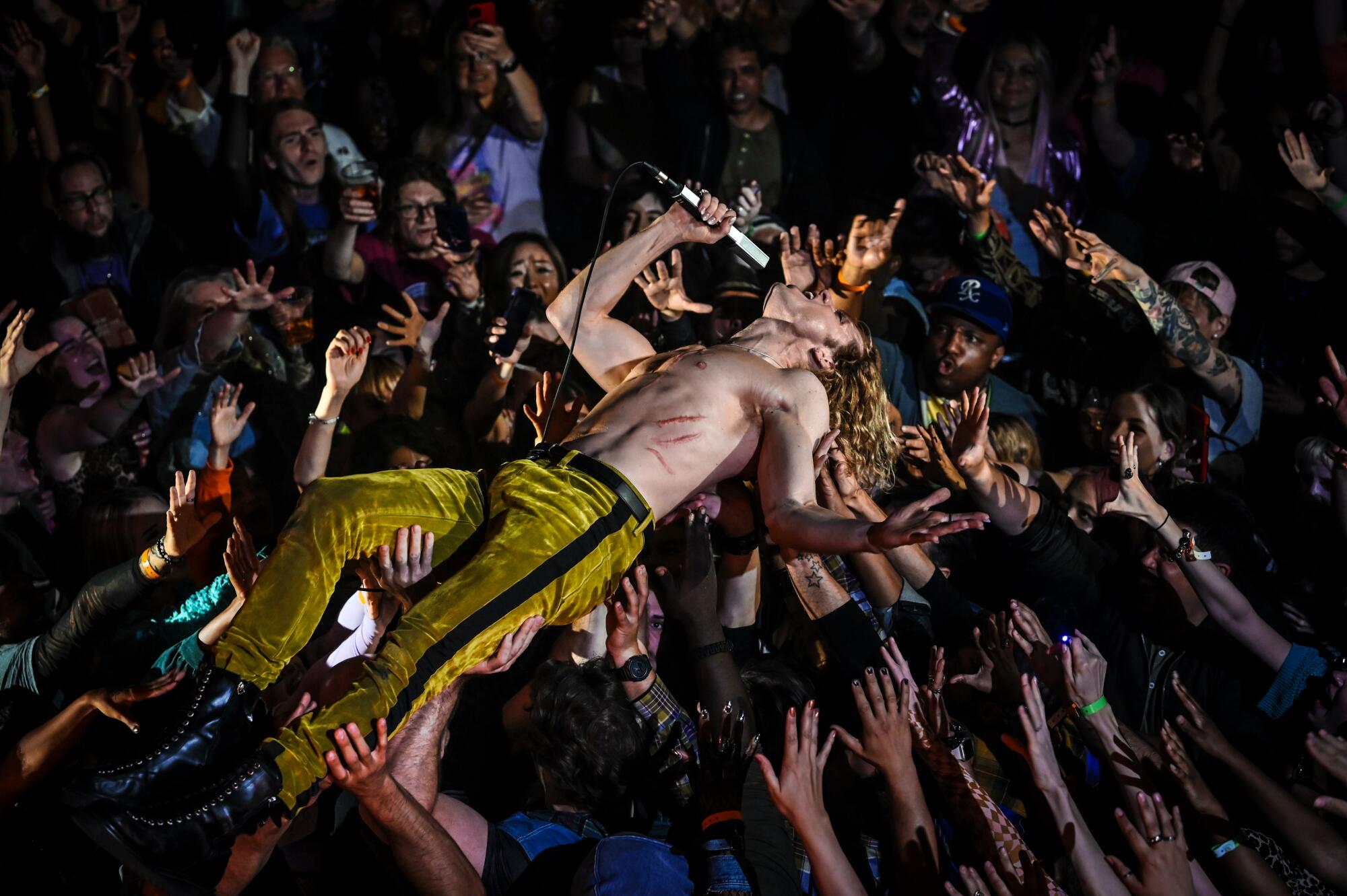
Now Reid, dressed in black with his chest partially exposed beneath an open jacket revealing a scar, stepped on stage and into the role of Lestat in front of the audience. As he moved across the stage, phones shot into the air. Fans screamed. People sang along to a slew of songs, and for a moment, the line between actor and character seemed to disappear.
At first glance, the assignment to turn Lestat into a rock star seemed straightforward. The vampire at the center of Rice’s beloved novels has flirted with music before. In 2002’s “Queen of the Damned,” he emerged as a leather-clad nu-metal frontman capable of commanding massive crowds. But bringing Lestat into the present introduced a different challenge. Rock music no longer occupies the same place in popular culture. Fame is fragmented. Audiences are skeptical of celebrity. Social media can build a star overnight and tear them down just as quickly.
Yet “The Vampire Lestat” asks viewers to believe something as audacious as a centuries-old vampire still being able to captivate people, launch a music career and inspire a movement. Reid thinks part of what drives the character is something surprisingly modern.
“Nobody cares that I exist, nobody cares that I’m not relevant,” Reid said of Lestat’s mindset entering the season. “It’s really fun to see him struggle with that and see him try to find his place in the world and not immediately get world domination.”
Making that fantasy feel believable required far more than putting Lestat in leather and handing him a microphone. To pull it off, the show’s creative team had to build a rock star from the ground up, crafting a visual identity, creating music that could stand on its own outside the series, and transforming Reid into a performer capable of owning a crowd rather than simply acting in front of one.
Sam Reid’s Lestat de Lioncourt crowd-surfs in “The Vampire Lestat.”
(Sophie Giraud / AMC)
“Dropping Lestat down into 2025 and making the decision for him to play rock ‘n’ roll was a really great dramatic switch because while there are many great rock bands that are alive and kicking right now, their hold of the cultural landscape is quite small,” showrunner Rolin Jones said. “You couldn’t think of a worse way to get your message out than going to be a rock star right now.”
That challenge became the foundation of the season.
Step 1: Making the music
A polished aesthetic, marketing and, in Lestat’s case, book buzz can only take a musician so far. It’s the music that had to make diehard fans believe he’s an artistic genius, or at least a star in the making.
That challenge landed with composer Daniel Hart long before a single script was finished. In an unusual twist, many of the songs that would eventually appear throughout the season were written before the writers’ room fully mapped out the story.
“There were so many unknowns when we started,” Hart said. To find a way in, Hart and Jones started with their familiar reference point: David Bowie.
“We settled, I think sort of obviously, on David Bowie as the launch pad for our Lestat,” Hart said. “The way that Bowie was so mercurial, and he was a chameleon. He reinvented himself throughout his career.”
Hart also looked to artists as varied as Kurt Cobain and Chappell Roan, while drawing inspiration from classical music, blues and the old-world sound Lestat would have absorbed over his long life. One early writers’ room exercise even involved breaking down the influences embedded within “Long Face,” the Bowie-coded first single released from Lestat’s fictional album.
“‘Long Face’ feels like a Bowie rip-off to Daniel Molloy [played by Eric Bogosian], and so then Lestat breaks the song down for him and goes into all the other influences that are in there,” Hart said. “ ‘Long Face,’ you could say, was in some way influenced by Bach, and then [he] talked about Willie Dixon, and how the blues had influenced Lestat when he was around the … 1920s and ‘30s.”
“He’s been alive for 250 years,” Hart continued. “He’s seen and heard a lot of music.”
The creative team never set out to replicate the hard-rock sound that defined “Queen of the Damned.” If anything, Jones felt trying to outdo that soundtrack would have been a losing battle.
In “The Vampire Lestat,” Sam Reid sings every song himself, including “Long Face,” “Butterscotch Bitch,” “Your Biggest Fan,” “All Fall Down” and “Black Licorice.”
(Sophie Giraud / AMC)
“I mean, that soundtrack is deservedly very famous,” Jones said. “And I think if we decided to out-Korn Korn, we were going to be in trouble.”
Instead, their Lestat was a musician still searching for his voice. Jones says the season begins in a more performative glam-rock space before gradually evolving into something more personal.
“We thought ‘70s Bowie is where we would start, and that we would musically make a journey with him as we went deeper and deeper,” he said. “He would put his band on one tour, what a normal band would do, over four albums. The music just keeps changing. And as he gets more and more vulnerable, the songs begin to change. They get more raw. They get more exposure, and the music style evolves.”
Reid sang every song himself, including “Long Face,” “Butterscotch Bitch,” “Your Biggest Fan,” “All Fall Down” and “Black Licorice.”
“The more bombastic, the more over-the-top songs — he doesn’t seem to like them by the end of this season,” Hart said. “The more introspective songs that come later on are more in his new wheelhouse.”
That journey also shaped how Reid approached the material. While audiences will ultimately see the songs unfold within the context of the show, Reid encountered many of them before he fully understood where Lestat’s story was heading.
“I think in the beginning, he’s coming from an artificial kind of construct,” Reid says. “As the show goes on, the music becomes more personal, and he becomes less interested in actually finding love through his audience and more about finding who he is as an individual and as an artist.”
When Jones first began adapting “The Vampire Lestat,” he briefly considered making the character the sort of arena-filling superstar audiences might expect, like a Beyoncé or Taylor Swift. But the more the writers discussed it, the less interesting that version felt.
“If we were gonna start chipping away at all the armor that Lestat had, one of the great repetitive ways of a tour is you just can’t seem to break a ceiling,” Jones said. “He’s a niche star. And I think that is part of the gas that fuels this little journey.”
Hart also had the impression that Lestat would be a massive star.
“But it became more apparent that [he might] not exactly have the kind of success that he wanted and desperately felt like he needed — that was a more interesting story to tell,” he said.
Step 2: Getting the rock star look
While the audience has to believe Lestat is a rock star, they also have to believe he’s someone with the look — and worth staring at.
Lex Wood, the show’s costume designer, said that the challenge began long before cameras rolled on Season 3. Jones first floated the idea of rock star Lestat while the team filmed Season 2 in Prague in 2023, giving Wood time to begin imagining what a nearly 300-year-old vampire might wear while reinventing himself as a singer. During a production trip to Paris, she started sourcing pieces and collecting references that would eventually make their way into this season years later.
“The main aim of building costumes for Lestat was to maintain an element of the unachievable,” says show costumer designer Lex Wood. “To emphasize that Lestat is untouchable.”
(Sophie Giraud / AMC)
Being fashionable wasn’t the only goal.
“The main aim of building costumes for Lestat was to maintain an element of the unachievable,” Wood said. “To emphasize that Lestat is untouchable. Hence, building specific costume build shapes and patterns that we adapted throughout the season.”
That idea guided nearly every aspect of the wardrobe. While the first two seasons often presented Lestat through structured tailoring and muted palettes, Season 3 arrives in a much louder world.
“A big thing really was that we wanted to push more color into the season in general,” Wood said.
Wood said the choice reflected where Lestat finds himself emotionally. No longer confined to drawing rooms and period silhouettes, he’s navigating celebrity, performance and self-reinvention. Leather remains. Black remains. But so do bursts of color, softer fabrics and strange patterns.
“We wanted to break Lestat free of the suiting,” Wood said. “Though we wanted to remain true to his roots in the 18th century, we also wanted Lestat’s pieces to feel slightly otherworldly at times.”
That meant weaving in elements of garments from the 18th century and making them feel contemporary. This could look like a very specific cut of a sleeve of a shirt that nods to that time.
Wood also studied the backstage photography of Mick Rock, pulling references of Bowie, Iggy Pop and Freddie Mercury. She blended that with punk-inspired designs from Vivienne Westwood and Jean Paul Gaultier. Goth icon Siouxsie Sioux also became an influence, particularly in the use of layering, texture and attitude.
Wood said the scattered references reflect a character actively trying to figure out who he wants to be.
“He’s investigating social media himself,” she said. “As he’s discovering his presence as a rock star. He’s investigating what it means to be a rock star.”
“He’s finding his persona,” she continued. “And trying on different personas.”
That idea extends all the way down to accessories, with Lestat’s jewelry blending old and new — a custom necklace created by a U.K. silversmith recalls one worn by Mercury during Queen’s early years, while rings featuring sculpted teeth serve as subtle reminders of his vampiric nature.
“We purposefully wanted some of his wardrobe to not be recognizable to any particular brand — at other times, we wanted to celebrate high-end fashion, to explore his playfulness and unpredictable character through his clothing,” Wood said.
Even the shoes became part of the transformation. One of Wood’s earliest conversations with Reid centered on abandoning the heeled footwear that helped define earlier versions of the character. This Lestat needed something heavier for a performer who could pace a stage.
“He wanted something that felt more grounded,” Wood said. “Something he could bounce around more in.”
Wood said the redesigned footwear altered Reid’s posture and movement, helping create a version of Lestat that she noted feels more volatile and more comfortable captivating a crowd than charming one.
Step 3: Becoming the rock star
For all the work that went into the costumes, music and scripts, none of it mattered unless the watchers believed the actor tying it all together.
Reid had already spent two seasons playing Lestat through other characters’ memories and perspectives. This time around required him to carry the character’s story through his own reflections. More importantly, he had to answer a deceptively difficult question: Why would anyone follow Lestat in the first place?
“It’s not fame that he’s after,” says Reid of his character in “The Vampire Lestat.” “Fame is totally temporary for a creature that lives forever.”
(Sophie Giraud / AMC)
The surface answer might be fame. The character launches a music career, records songs and steps into the spotlight. But Reid doesn’t think that’s what drives him.
“It’s not fame that he’s after,” Reid said. “Fame is totally temporary for a creature that lives forever.”
Reid sees Lestat as someone searching for validation.
“Not for the vampire that he is, but for the human being that he was,” he said. “He’s been pretty heavily rejected. From Louis through the book, and then his mother knows exactly how to string him along, when to give him love and when to take it away. So he’s really looking for validation and going into an audience space is where he first experienced that.”
While developing the season, Reid says he became increasingly interested in the gap between the public version of Lestat and the person underneath it.
“His whole life has been performance,” Reid said. “His whole life has been a lot of adversity, and the way that he kind of climbs out of that is to build a construct that he can perform and operate in. It makes a lot of sense for him to do this rock star persona. Through this season you start to see him realize that the music and the art can allow him to access himself as opposed to it just being a performance.”
“He’s trying to discover his sound as a musician,” Reid continued. “But he’s also trying to discover who he is.”
Throughout the season, viewers see a musician struggling to connect.
“Why can’t I sell out 5,000 seats?” Jones says, describing the character’s mindset. “I used to be able to walk into a room and everyone would love me.”
For Jones, that’s ultimately what makes Lestat feel like a contemporary artist. Sure, he may be an immortal vampire, but he’s navigating the same questions that confront plenty of artists: How much of yourself to reveal? How much should one perform? Can admiration ever substitute for genuine connection?
By the time the season reaches its conclusion, Lestat is still larger than life. But he’s also a more complicated performer forced to reckon with the distance between being seen and understood. Jones said none of this would be possible without Reid in the role.
“I think his performance in Season 3 is one of the 10 greatest American TV performances of all time,” Jones says. “I’d put him right next to Carroll O’Connor, Walter White [played by Bryan Cranston] and James Gandolfini.”
“And I’d look at all of them and say, ‘You guys didn’t sing.’ ”
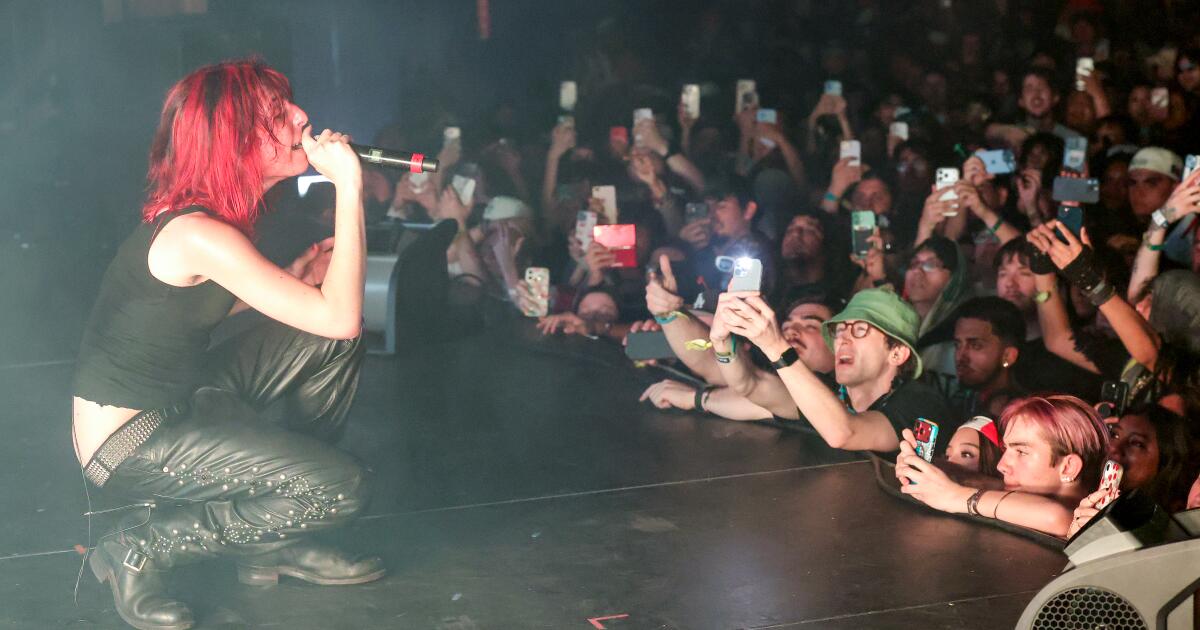
As the noise-rap-electro act Jane Remover shrieked and pleaded through a 90-minute marathon set at the Fonda on Thursday night, one very young couple dressed right out of a conservative‘s nightmare — gender-ambiguous, purple hair, facial piercings — tapped me on the shoulder. They politely asked if I could mind their newly bought vinyl for a bit as they thrashed in the heaving crowd. Of course, this unc obliged them.
Anyone who laments that L.A. crowds don’t dance should go to one of the last sets of Jane Remover’s three-night stand at the Fonda this weekend. It had the most genuinely raucous pit I’ve seen in 2026, made all the more feral for how sweet and earnest it was. After a hotly tipped Coachella set, this Live Exhibit tour affirmed that the subculture Jane Remover built may or may not have wider pop potential, but it’s getting big enough to count for stardom in the fractured music world of today.
Jane Remover is a trans polymath producer and singer-songwriter with influences across rave, shoegaze, trap and beyond. They’ve built up a ferocious elaboration on the hyperpop of predecessors like Sophie, who similarly packed so many good ideas into songs they became talismanic to fans, a tonic to reinvent yourself (new Charli XCX opener Underscores is another fellow traveler).
The music itself sounds like reverse-engineering the moment in the 2000s when metalcore kids discovered EDM. Only now it’s Discord-disaffected youth ramping up hardstyle techno, autotuned girlypop ballads and rage-rap to an explosive fusion point. “Census Designated,” Jane’s brash and dramatic 2023 coming-out LP, tipped them as a force beyond the underground. But they soon eclipsed it with 2025’s “Revengeseekerz,” a deliriously overheated mix of romantic yearning, internet score-settling and virtuosic production prowess.
Backed by just a DJ (Dazedgxd, who opened the set) and a retina-scorching light rig up front, Jane acknowledged on Thursday that the stakes were getting much higher. They joked that they’d played the El Rey like three times before this tour, and to judge by the wild-eyed passions out in the audience, the Fonda will probably be the smallest venue they’ll play for some time. “It gets so cold this high up,” Jane sang on “Turn Up or Die.” “Can’t go to hell but I can drop you off.”
The sentiments driving the music are ultramodern: self-aware, vicious and desperately vulnerable. The hilariously zesty “Angels in Camo” (home to the all-time banger of a line: “Jesus never had it with a freak b—”) wrapped up with a bloodletting plea that “I can’t let you b— win.” Jane wields that word like the flaming sword on the “Revengeseekerz” album cover, with all the casual lustiness of Future but also the wrath of a reclaimed slur.
On “Professional Vengeance,” they grappled with the weird lures of celebrity and intimacy, where no one really knows anyone but desire still courses; “Experimental Skin” found them craving and fighting off God and nihilism and technology and addiction all at once.
The tension in these tracks are the binding agent for Jane’s fan base — the music is full of contradictions and incompatibilities smashing together that just feel like being young right now. Other than a quick affirmation that fans of all identities and backgrounds will always be welcome at their shows, they let the contorting, violent music speak for itself about the way queer fans are feeling about life under siege in the United States.
If the set was a bit too long for the limited setup onstage, it was because Jane simply had that much music to let out — that caliber of emotion to unburden, that much want to acknowledge. It seemed like the set was closing with “In the Dark,” an aching ballad from their Venturing side project, plainly declaring “I still dream of us” through a fog of effects. But instead they ramped it back up for one last cathartic blast to close, sending their faithful out onto Hollywood Boulevard, sweaty and filthy and fundamentally known.
GRAMMY-NOMINATED producer Tay Keith has been found dead in Nashville.
Brytavious Chambers, 29, better known as Tay Keith, was found dead in his apartment earlier today.
Sign up for the Showbiz newsletter
Thank you!
Tay Keith has been found dead in his apartment in NashvilleCredit: GettyInvestigators say there was no suspicion of foul playCredit: Getty
Police said his body was discovered while officers were performing a welfare check at his home.
Investigators say there was no evidence of foul play, but the exact cause of death has yet to be determined.
In a post on social media, Metro Nashville PD wrote: “No foul play is suspected in the death of Brytavious Chambers, 29, also known as the Grammy nominated record producer Tay Keith.
“He was found dead in his Martin St apt this afternoon by officers performing a welfare check.
The producer’s cause of death remains unknownCredit: GettyKeith currently holds the record for the most No.1s on the R&B / Hip-Hop chartCredit: WireImage
“His death is unclassified pending autopsy results.”
Throughout his career Keith worked with a wide range of music artists, including Beyoncé, Travis Scott and Drake.
The Memphis hitmaker enjoyed huge success on the Billboard Hot 100, earning 11 top 10 hits and four No.1 records.
He was also the mastermind behind Travis Scott’s “Sicko Mode” and Drake’s “First Person Shooter”.
Keith currently holds the record for the most No.1s on the Hot R&B / Hip-Hop songs chart this decade – with six.
His work even earned him a coveted Grammy nomination in 2019.
In the aftermath of his death, tributes for the producer have poured in.
Artist and childhood friend Blocboy JB shared photos of the pair as teenagers with the caption: “Damn Cuz You Just Hurt Me Bad.”
Keith was one of the mastermind’s behind Travis Scott’s ‘Sicko Mode’The song – featuring Drake – has been streamed over 2.5bn times on Spotify
He also posted a video of their call history, writing: “We talked everyday yeen tell me you was leaving.”
Fellow Memphis producer Hitkidd also expressed his disbelief, posting a picture of the pair on Instagram.
The caption said: “I ain’t even got the words, we been doing this since 2010.”
Born on September 20, 1996, Keith stated making music when he 14.
He later received a bachelor’s degree from Middle Tennessee State University.
Signed to a publishing deal with Warner Chappell Music, he was also a member of BMI.
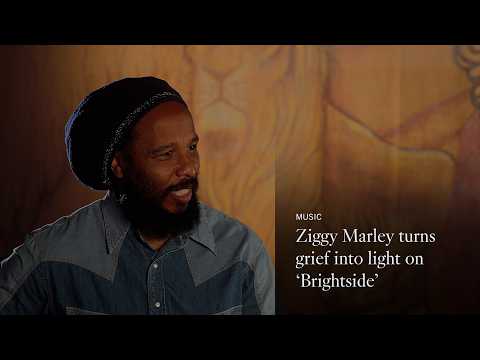
It’s Friday afternoon in North Hollywood and Ziggy Marley is perched on a stool inside his newly built Rebel Lion Studio, tucked in one of the neighborhood’s creative enclaves.
The nine-time Grammy winner is surrounded by a collection of lion figurines, guitars, traditional hand drums and a piano. Along the walls hang two replicas of backdrops his legendary father, Bob Marley, used on tour in the 1970s. The murals, depicting Rastafari icons and Haile Selassie I and Marcus Garvey, were featured in the 2024 biopic “Bob Marley: One Love.”
“These are what we used as the backdrop for the concert scenes. Them spiritual to me,” Marley says in patois as the smell of palo santo dances around the rehearsal space.
Music has been both an inheritance and lifelong pursuit for Marley. From sitting in studio sessions with his father as a child to building a five-decade career of his own, he has remained a curious student of the craft, one willing to challenge convention in search of a deeper meaning. That spirit is evident on “Brightside,” his ninth solo album, which was released on vinyl on April 18 (Record Store Day) and May 1 on streaming.
Rather than recording the eight-track project in 440 Hz, the standard tuning frequency for most modern music, he opted for 432 Hz, a tuning some musicians and theorists believe creates a warmer, more meditative listening experience. He also slowed down his songwriting process, giving each lyric room to carry its message of hope through turbulent times. The album, which may be his most personal yet, also features “Many Mourn for Bob,” the first song he has written directly about his late father.
“I think it shows the next stage that I probably am in,” says Marley, adding that he felt connected to his father on a spiritual level. “We took another step in the relationship, to another place that it’s never been before.”
Ziggy Marley is bringing his “Brightside” tour to the Hollywood Bowl on June 21 alongside reggae star Burning Spear.
(Dania Maxwell / For The Times)
He adds, “When I was doing the song, it kind of came to me like this song could’ve been my father’s song. It could’ve been a song that he wrote.”
The reflective nature of “Brightside” arrives at another pivotal time in Marley’s career. This year marks the 20th anniversary of “Love Is My Religion,” the Grammy-winning album that launched his solo career and crystallized a personal philosophy he still carries today. He is also set to release his sixth children’s book, “True to Myself,” in September.
As we wrap up our conversation, Marley has only a few minutes before Rebel Lion Studio shifts back into work mode. Within minutes, bandmates, background singers and production crew members begin funneling into the space, hauling in stacks of equipment as promotion and preparations continue the “Brightside” tour, which stops at the Hollywood Bowl on June 21.
This interview has been lightly edited for length and clarity.
You recorded your latest album, “Brightside,” here at Rebel Lion Studio, which you designed and built from the ground up. Can you take me back to the beginning of that process and why you wanted to do it?
I grew up around my father and my mother as growing musicians trying to succeed and there was one thing I kept hearing over and over throughout my life: independence. Their whole mission was to be independent. I saw them work and I saw my father build a studio. I saw him have a space where he can do more music and control his own time. That was a dream of mine for a long time, ever since I started doing music because usually we use other people’s studios. I couldn’t have this in my house. It’s too much. It’s a dream come true.
We’re surrounded by two beautiful murals. Is there a particular item that is personal to you?
The murals are replicas of my father’s backdrops that they used. The original artwork is by Neville Garrick, but he helped us re-create them for the Bob Marley movie. These are the murals we used as the backdrop for the concert scenes. They are spiritual to me cause that’s Haile Selassie and Marcus Garvey, two very important beings for us. Inspirational.
On “Brightside,” Ziggy Marley dedicated a song to his father, Bob Marley, for the first time in his career.
(Dania Maxwell / For The Times)
“Brightside” is your ninth solo album. What mindset were you in emotionally and spiritually when you started working on it?
I never thought about making an album, I was just writing songs. You just tap into things in your subconscious that are waiting to become music, I feel like. Then when the time comes for writing songs, the time comes. It’s like a season. Like you have blueberry or orange season. So there’s a season for me when I write songs. Then you say, “All right, let’s make an album then.” But you don’t think about an album before. It’s just an expression or a feeling just to make music, not for any reason but to make it. It happened over a period of years. Ideas and experiences that eventually come out. But closer to the time I [made] the album, I remember writing some of the later songs like “Why Let the World.” It was a song that I wrote because I was feeling down and everything that was happening in the world and the country. Just so much negativity and I just felt like I needed to take a break from it. To recharge yourself. We cannot fight every day. We need to take a break and then get back to it. I needed to teach myself to take some time. It was more of a mental thing than an emotional thing. Stuff I deal with my father, personal life and stuff with my spirituality and my faith. So there’s a lot of me in this record.
“Many Mourn for Bob” is the first song you’ve explicitly written about your father. Your brother, Stephen, is also on the vocals. What surprised you emotionally once that song was finished?
I’m not sure I thought about it like that. The experience of expressing that emotion, it’s a spiritual experience. I think it shows the next stage that I probably am in and even my relationship with my father on that spiritual level. It’s a different place. We took another step in the relationship, to another place that it’s never been before. When I was doing the song, it kind of came to me like this song could’ve been my father’s song. It could’ve been a song that he wrote. That’s how I felt about it. This is partly his song. It’s me and him making this song. This song is his song too.
How has your relationship with grief changed over the years?
It’s more of a comrade, understanding, empathy and having the maturity and the experience to understand what he went through as a man, as a human being. I think that’s what it is, really. A better understanding of what he went through, not the glory. The pain, the mental and emotional state. You’re more than just an idol. You’re more than just a legend. You’re more than just a father. To go deeper than that, so that’s the next level.
Yeah, the skit you used of him saying “I’m just a man from the ghetto” on the song really summarizes that.
That’s the real him. That’s him right there. Even in the tone of his voice, you can hear the real Robert coming out.
Another standout song from the album is “Racism Is a Killa.” One thing that you do well is having a heavy topic, but finding a way to still make it feel hopeful and joyful. Why was it important for you to approach the track this way rather than from a place of anger, heaviness or sounding preachy?
I think it started out preachy and angry, but over time, it kind of evolved and I kind of evolved too ‘cause my own evolution is represented in the music. And you know something, doing that song helped me evolve because I had to think about it differently without the anger. The song made me do that. Like how else can I approach this? It’s inspiration that causes these things. It’s not an intellectual thing. I didn’t do that intellectually. Like over time, something just started coming out of me. I never really thought about it before, but I can see it now.
In the video, which features your daughter, Zuri, you referred to the condition as “Racismosis” in the video and sang about how it can be cured.
It’s kind of like a sickness, a disease. It’s a virus. We can minimize the virus and stop the disease. It’s true. Racism is a killa. This virus can kill ya. Literally kill ya. Spirtually kill ya. Emotionally kill ya. Mentally kill ya. It kill ya in different ways. It kills the victim and it kills the person perpetrating it. It’s killing everyone, but we can cure it though. It starts with the children. I have a friend of mine who said, “Yo, my little son loves this song. He doesn’t want to stop. He says ‘Put on “Racism is a Killa.”’ So that’s where the antidote is starting. The minds of the children. The music with a conscious message gives them the right consciousness that they grow up with. That is how we take our time and lower the spread of the virus.
You recently released an alternate version for “Racism Is a Killa” with Big Boi. How did that collaboration come together and what excited you about working with him?
I’ve loved Big Boi and Outkast from a long time ago. He’s a legend and a strong voice. There’s different layers to it and I feel like Big Boi took it to that other layer. So yeah, we just love Big Boi and I’m going to jump on something he does. [Laughs]
I’d be remiss if I didn’t ask your approach for your album and how you swapped the typical 440 Hz for 432 Hz. Do you remember the first time you heard the music played back that way?
It’s a long journey because for most of my life in music, I’ve tried to be a student. I’ve tried to keep an open mind and learn more and more. With this album, there’s an inspirational side of music and that’s where I lean into most of the time, but as I grew up, I started to understand there’s also a science too. It’s also mathematics. The universe, it’s all mathematics and science, and I shouldn’t shun the science of music just because I think the inspiration is all it should be. I think a part of that was learning that for myself and opening up and saying, “Yo, let me put some science into this.” Frequency. What does frequency do to people? Frequency affects people. Frequency is a weapon. It’s a tool. I’m sure the army has some kind of frequency thing. So frequency is powerful. I wanted to try something different anyway. I want to be different. I want my frequency to be different from the majority of frequencies that’s being played out there, because it’s fun for me to be different.
When I was working on the demos, I was like “Let me try this 432 Hz thing” and I like how it feels for me personally, how I sing on the frequencies. It resonates differently and makes me feel different. We did it and it felt good, and we did it live, and from my point of view, I felt a different energy with the audience too. So all of those experiments led me to the final conclusion to say, “Yeah, let me do the record in 432.” It’s really nice vibes, which the world needs a different frequency. We can use it.
This year marks the 20th anniversary of “Love Is My Religion,” your first solo Grammy-winning album. When you think back to that era of your life, who was Ziggy back then?
A lot was changing because I moved to L.A. during that time.
You got married around that time too, right?
Yeah. I don’t really fight change. I just try to navigate them and figure them out cause sometimes change is hard. There was a lot of change living here, moving around, trying to find a place, music, but then it’s like we are continuously updating ourselves. I’m continually updating. You know how you update your OS. I’m updating my OS. My operating system is being updated throughout my experience in life. There’s always something else out there for me to evolve to. So during that period of my life, “Love Is My Religion” came to me when someone asked me, “What religion are you?” And I just said “Love is my religion.” I never thought about it before, never contemplated it, never even thought of those words together before in my life, and they just came out to me that day. So the album represents a time in my life when I realized there’s a spiritual awakening that I had. “Love Is My Religion” is a spiritual awakening. That’s my thing. That’s who I am. That’s why it’s a milestone.
“If you think you’re going to change this world with music and you’re trying to send a message out there, you have to speak to children,” Ziggy Marley says.
(Dania Maxwell / For The Times)
You’re kicking off the “Brightside” tour this month, which includes a stop at the Hollywood Bowl. What are you most excited about when it comes to bringing this album to people for the first time live?
I’m excited about playing the music. I think it’s about the music. These new songs, they vibrate very highly for me and I’m excited about experiencing and expressing that. And also kind of not doing it for the audience. I don’t want to do it for the audience. I want the audience to experience what I’m experiencing, what I’m expressing. I want them to feel me. I don’t want them to be like “Hey look at me.” [Laughs] There’s still connectivity going on, but I want them to feel the songs the real way. That’s what I’m excited about for people to feel it the way that I feel it.
You even posted the lyrics and told fans to get to practicing, so they can really understand the message.
Yeah. Just reading them for me, I really like the writing I did on this. I also took some time with this too. I was saying to someone that I developed a deeper relationship with the lyrics and the words than I did before. My relationship with the words here are very mature. I feel good about it. That’s why I want people to know the words because words are very important. Words are very important. If you know the words you get a deeper understanding of what I’m talking about and what I’m feeling.
After nearly 50 years of making music, Ziggy Marley built his own studio in North Hollywood called Rebel Lion Studio. He plans to turn it into a multipurpose creative space.
(Dania Maxwell / For The Times)
Look on the bright side is a phrase that people say often, but what do those words mean to you right now?
Sometimes we can get in a place [where] we can’t see the other side of things because we’re so caught up in that one place. Like the cliché, there’s two sides to a story, ya know? The universe is always yin and yang, but there’s always another side of things. But I feel like the way we are being programmed in a way through media and everything, it’s like there’s only one side. Everything is like this, there’s nothing else going on over there that we need to see, we only need to see this. This is all that’s going on in the world. There’s nothing good, there’s nothing nice, there’s no good people, there’s no love. So it’s a realization too. A realization that there’s the other side. Never get to that place where we think it’s just that side alone because we get so much of it. It’s a reminder, I think, for us like “Come on guys.” The thing about it too, sometimes you can feel like — even for me — some people say, “Hey look on the bright side,” some people find that like “Why are you happy? Why you so chirpy?” [Laughs]
That’s true.
I’m proud that I’m on the bright side. I’m living on the bright side, I don’t care. You don’t like me because I’m living on the bright side? You want me to be like you, you want me just live on the dark side with you, right? So it’s like a proudness of being positive and having that outlook in life, and not feeling like you have to [fall to] peer pressure. More positivity in life, not just the negativity. I’m confident in that too. So it’s kind of like that too, you know, like being proud, lifting up that side of me. Yeah, I’m happy to be living on the bright side.
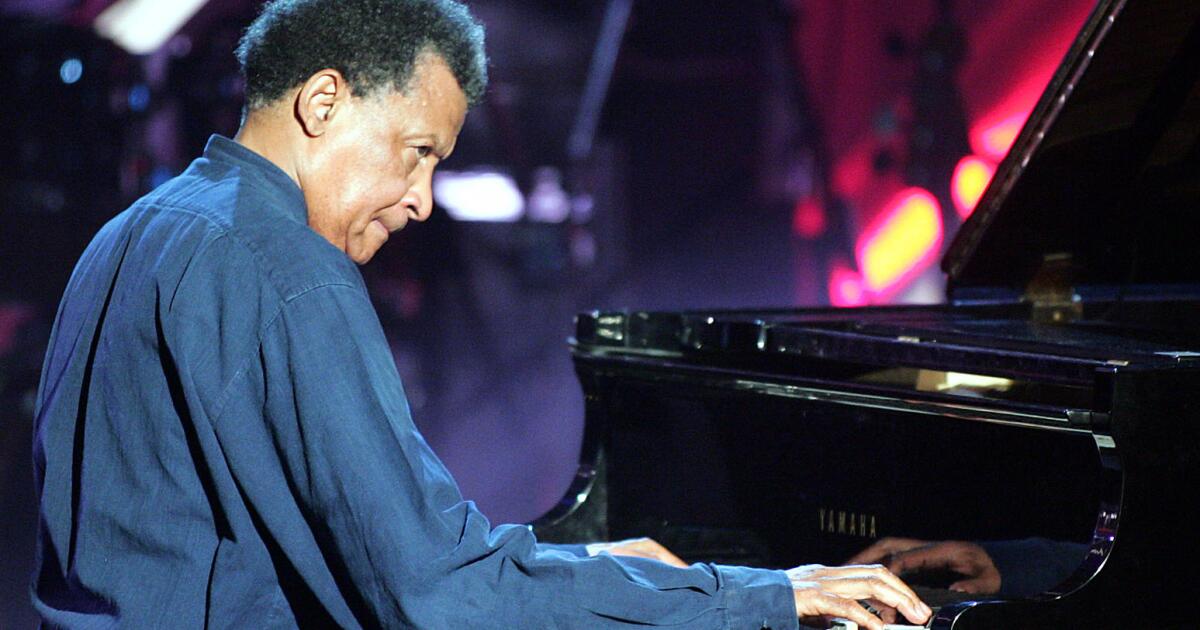
JOHANNESBURG — Globally celebrated South African jazz icon Abdullah Ibrahim has died at age 91, his family announced in a statement Monday.
Ibrahim, formerly known as Dollar Brand, passed away peacefully in Germany following a short illness, surrounded by loved ones, the statement issued on behalf of his family said.
As one of South Africa’s most respected jazz figures, he famously played at Nelson Mandela’s 1994 presidential inauguration. Mandela referred to Ibrahim as “our Mozart.”
His final public concert in South Africa took place at the Cape Town International Jazz Festival in March, when he once again captivated audiences with the musical skill that defined his career.
Paying tribute to her partner, Dr. Marina Umari said he “passed away peacefully with South Africa and its people in his heart.”
“His love for his country never wavered, no matter where in the world he found himself,” she said.
His family said that even though his life is over, his influence and voice would continue to resonate around the world.
South African President Cyril Ramaphosa paid tribute to the musician, praising his contribution to the anti-apartheid struggle and acknowledging his lasting impact through music.
“Today our nation mourns the passing of an international icon and global citizen whose profound creations honored the South Africa that shaped his political commitment and musical brilliance,” said Ramaphosa.
Born Adolph Johannes Brand in Cape Town on Oct. 9, 1934, Ibrahim rose to international prominence as a pianist, composer and bandleader. With a career spanning more than seven decades, he forged a unique blend of jazz and South African musical traditions, making him a cultural ambassador whose music struck a chord with listeners worldwide.
Ibrahim’s mother Rachel Brand was mixed-race and under the apartheid system he was classified as “colored,” which afforded him certain social privileges that were denied Black South Africans. He was raised by grandparents and was told Rachel was his sister, only learning the truth in adulthood. Influenced by his grandmother and mother playing piano at the AME Church in Kensington, a Cape Town suburb, Irbrahim began piano lessons at age 7 and made his professional debut at 15.
In 1959 and 1960, he played with saxophonists Kippie Moeketsi and Mackay Davashe, trumpeter Hugh Masekela, trombonist Jonas Gwangwa, bassist Johnny Gertze and drummer Makaya Ntshoko in the Jazz Epistles. The group recorded the first full-length jazz LP by Black South African musicians, “Jazz Epistle — Verse 1.” The South African government began targeting jazz groups as part of increasing state repression, and following the Sharpeville massacre in March 1960, the Jazz Epistles broke up.
During this time, Ibrahim met jazz singer Sathima Bea Benjamin and the pair moved to Europe. The following year, in Zurich, Switzerland, Benjamin convinced Duke Ellington to come see Ibrahim perform with the Dollar Brand Trio. Impressed, Ellington helped arrange a recording session with Reprise Records, later released as “Duke Ellington presents The Dollar Brand Trio.”
In 1965, Ibrahim and Benjamin married and moved to New York. He played at the Newport Jazz Festival and toured throughout the U.S. In addition to playing with, and, on occasion, leading the Duke Ellington Orchestra, Ibrahim interacted with such musicians as Don Cherry, Ornette Coleman, John Coltrane and Pharoah Sanders, and was influenced by the Black Power movement, incorporating African elements into his jazz. His compositions also reflected the influence of Ellington and Thelonious Monk.
The musician returned briefly to Cape Town in 1968 and converted to Islam, changing his name from Dollar Brand to Abdullah Ibrahim. As an expatriate, he toured the world for decades, appearing at major venues and working with classical orchestras in Europe. His composition “Mannenberg” became noteworthy as an anthem of South Africa’s anti-apartheid movement.
In 2009, Ibrahim received an honorary doctorate in music from Wits University and the Order of Ikhamanga, a prestigious civilian award, from former President Jacob Zuma in the same year.
Ibrahim was named a Jazz Master by the National Endowment for the Arts in 2019.
Alan Winde, the mayor of the Western Cape, where Ibrahim’s hometown is located, honored the performer and commended him for capturing South Africa’s cultural richness and history in his music.
“South Africa has lost a legend,” Winde said. “Abdullah Ibrahim represented everything that makes South Africa and the Western Cape so remarkable. His music told the story of our unique cultural diversity and past.”
Ibrahim is survived by Umari; his son, Tsakwe, a musician; and his daughter, Tsidi, a rapper who goes by Jean Grae.
According to his family, Ibrahim will be laid to rest in the German state of Bavaria, where he lived.
IF you’re looking for a new London hang-out spot, Olympia has it all from pretty bars to top-tier entertainment.
After a £1.3billion upgrade, the impressive project is opening its rooftop ‘Canopy’ today and its music venue later this week.
Sign up for the Travel newsletter
Thank you!
Olympia in West Kensington has been transformed after a £1.3 billion upgradeCredit: OlympiaNew rooftop bars and restaurants are opening this week like Bar ArribaCredit: Olympia
The enormous revamped building in West Kensington is opening its rooftop bars and restaurants that can only be found at Olympia today.
For anyone who fancies Mexican, check out Bar Arriba which serves up fresh cocktails and small bites from tacos to tostadas.
Lillie’s Wine Bar & Restaurant is the spot for the best of British food from Gressingham duck to Devon crab salad and you can even try a rhubarb and custard cocktail.
The outside area looks like an English country garden too with sculptures and beds of daffodils.
At Wolves of Tokyo dig into Japanese dishes from sushi to grilled skewers, gyozas and tartare.
Arbour is the food hall which has more of a casual vibe and inside are four different spots; Café Modo, Fry Baby, The Rambler and Whammy Burger.
All of these spots are up on the rooftop so they’re perfect for a sunny weekend.
But if the weather doesn’t play ball, there is a retractable roof to protect punters from the rain.
Another dining venue at Olympia called Pillar Hall opened in March, 2026.
It’s found in the Grade-II listed part of Olympia that was built in 1886 and is home to Idalia an all-day restaurant and Pepperbird, a speakeasy-style bar.
Lillie’s Bar and Restaurant is in the style of an English country gardenCredit: Incipio
It’s been described as a ‘world-class venue’ which will host music, comedy and entertainment.
It will start with performances by Self Esteem and McFly before the likes of Van Morrison and Khalid take to the stage later in the year.
This will be followed by the 1,575-seat British Airways Theatre in 2027 which will be London’s largest new theatre in 50 years.
Japanese restaurant Wolves of Tokyo has beautiful views from outsideCredit: Olympia
The Hyatt Regency hotel which will have 204 rooms will open to guests from July 6.
The other on-site hotel, CitizenM London Olympia will have 146 rooms and is expected to open this summer, although no official date has been announced.
Olympia London first opened in 1886 and has held performances by Jimi Hendrix and Pink Floyd and was used as an exhibition space by the likes of Vivienne Westwood.
There was a time in the beginning of Sublime’s recent revival when Jakob Nowell, the son of the band’s late singer Bradley Nowell, saw himself simply as a good son trying to help his adoptive uncles — drummer Bud Gaugh and bassist Eric Wilson — restart his dad’s iconic Long Beach trio. The goal wasn’t to take the place of his frontman father who died of an overdose in 1996. “I’ll never look at it as my band. Sublime is my dad’s band, and I’m helping out, that’s all,” he told The Times in 2024. Luckily, he was wrong.
The journey of finding his own voice through his father’s sly, shambolic poetry and reggae rock anthems, along with his determination on the road with Gaugh and Wilson through a barrage of festivals and tour dates helped him eventually step into his own as a songwriter and Gen Z rock star. It’s all been done with the mission to preserving his dad’s legacy and having fun while doing it. Now it feels as natural as the trio sitting together on the waterfront in LBC’s shoreline marina within earshot of the bellowing horn of the Queen Mary earlier this year as they were finishing the recording of “Until the Sun Explodes,” the first album under the Sublime moniker in 30 years.
Just like the band’s original recipe of shoving punk, dub reggae, hip-hop and ska into a blender, the new songs dutifully stick to the formula along with Jakob’s soulful caterwauls that sound scarily similar to his dad. But what emerges from the 21-song tracklist is the evolution of a trademark sound that gives a nod to the past while standing strong on its own, just like Jakob, despite coming to the interview on crutches while healing from a performance-related knee injury. The band members chatted with The Times about recapturing the effortless essence of their immortal beach-ready sound and looking forward to a second chance to chase an endless summer.
This interview was edited for length and clarity
It’s kind of a rare thing for all three of you guys to be in one place at the same time. What was it like working in the studio together to finish the new album?
Bud Gaugh: Magical. Things are just coming together. We showed up, Jake had an idea for another song, and he sent us a little demo and said “Hey, this is what I’ve been thinking about.” And then we get down to the studio [in San Pedro], and he’s like, “Oh yeah, so I had another idea,” and kind of changed it. We jumped in there [and by the end of our sessions, we had written] brand new songs to the list of songs that we already had.
The band’s revival has been a long time in the making. I remember when you guys had your first show together, a surprise gig a couple years ago as part of a benefit show for the Bad Brains frontman H.R. Do you feel you’ve come a long way since then?
Eric Wilson: I never thought the chemistry would be like it was with Bradley.
Jakob Nowell: Especially now that we’ve been playing together this long, the chemistry is very much there. We’re just comfortable and having fun. Jamming together is the best. We get in there to do a take for a song, and I’m always like “Let’s just do like three more!” It’s just that much fun, and that’s how it feels playing live too.
When did the idea for creating a new album come about?
Gaugh: It was pretty much just while we were playing shows, At first, the idea was that we were getting together to do this benefit for H.R. [at Teragram Ballroom in December 2023]. We went from “How’s this going to work?” and then [after the show] it was like, “Wow, this is something special. We should definitely go out and play some more shows, and get this music out there and get the opportunity to bring the music to the people in the purest form that we possibly could.” As we’re doing that, it’s like we’re seeing the reaction in the fans, and we were feeling it emotionally. We realized this is going to be bigger than we ever thought. That’s when we really decided where it was going to go.
Jakob Nowell, right, once thought Sublime was only his late father’s band; now, fronting the Long Beach trio, he’s leading a new chapter that still honors Bradley Nowell’s legacy.
(Allen J. Schaben / Los Angeles Times)
Were any of the songs on the new album mined from previously unreleased material or did you start fresh?
Nowell: There was that song we did with Stick Figure [“Feel Like That”], so I think that kind of inspired us. [We realized] “Oh s—, there really is some meat on the bone.” And then I had found some old recordings of stuff that were just like jams without even like vocals or whatever. Then it became just this thing during sound check or maybe in the middle of sets, we’d just start jamming these random progressions and stuff, and it kind of just evolved from there naturally.
The new songs that I’ve heard fit right in the vein of what people love about Sublime. What was it like putting some of those new songs in the setlist as you were building them?
Nowell: It was like magic. We were joking yesterday that sometimes we’ll play a new song for the first time just randomly and I’d see people try mouthing the lyrics and stuff and I’ll say “you’ve never even heard this before! I know you haven’t. We don’t even really know what the hell we’re saying.”
Gaugh: You frontin’! [Laughs]
Nowell: But [the new material] sounded like it was supposed to be there, so it was kind of a rad little test in a lot of ways. We almost don’t even have to think about it. That’s always going to be the guiding goal of any band trying to make fun music that’s relatable.
Wilson: What if you’re Slayer? That’s not true if you’re Slayer.
Jakob, it seems like you’ve gotten a lot more comfortable in the frontman role since joining the band. What’s it like just taking the lead, not just for the sake of your dad, but for the fans?
Nowell: Oh, dude, it’s the best. I don’t even have to think about it. We really feel like this is — we’re a band, you know?
Gaugh: It’s [Jakob’s] band too. Now it’s our band. It’s us.
Nowell: It feels like that whenever we’re hanging out, just doing stuff, or at the studio or at these shows. So, this upcoming year feels like a really rad adventure. We got all these different eras [of fans] — people who were in their 50s when [Sublime’s] first stuff dropped, who are still alive, and then their kids and their grandkids and great grandkids. Everybody finds a piece of the discography they can relate to. That’s what is most exciting. It’s not just one or two songs, people sing along to everything.
I was at Warped Tour in Long Beach last year when you guys played and —
Nowell: That was my favorite set!
To me that felt like it encapsulated what you were talking about with the multigenerational groups of fans that have enjoyed you guys and associate you with Long Beach.
Gaugh: It was like a homecoming for me. I remembered playing the Chili Cook off, you know, right over there in the same area [as Warped Tour], and it was just bringing me back 30 years. It’s so meaningful to be in our backyard playing our music again, right there. This is where it all started. It’s come full circle.
Nowell: It was like playing at a local bar in a cool way. I had this huge group of people up front, they were just talking and shouting and saying stuff, like f–ing with us and joking around. I was like “Damn this is great!”
How about you, Eric? How’d you feel playing Warped?
Wilson: [Mumbles] It was f–ing awesome.
Now that you’ve played all these festival shows, from Coachella to No Values, you’ve got your own festival going on. Can you talk a little bit about Sublime Fest and your Sublime Reef Madness Cruise and how you came up with it?
Nowell: We could put on a bunch of the bands we love, and some of our boys, like Vandals, and make it our own vibe.
Gaugh: You walk around Coachella and there’s so many different elements there. Wouldn’t it be neat if we could make like all this like a Long Beach element, a Sublime element. Looking at this thing, it’s like “Oh wow. So we can actually get some of our friends and set up like a tattoo booth, and have our idea of art and everything out there, and mix it all together — food, art, music — bringing all these different elements, and friends of ours that play music. We get to decide who’s going to share the stage with us, so it’s really neat. It’s like planning a high school party or something like that.
Nowell: The biggest backyard party ever seen.
You guys always had your own sound going on, what’s it like to see that the fans still want it?
Wilson: It took a lotta years to catch on, but it did.
Nowell: Yeah, the kids really want that, like ‘90s, Y2K kind of vibe. That was the last era of like cool authenticity and stuff. You can see it when young people make stuff to look retro … when things get so high fidelity, we’re almost losing a little element, so I think these festivals kind of seek to bring some of that back in a way that everybody can get into.
With “Until the Sun Explodes,” Sublime’s first album in three decades, Jakob Nowell, Bud Gaugh and Eric Wilson rediscover their studio chemistry, jamming new songs that feel instantly familiar onstage.
(Allen J. Schaben / Los Angeles Times)
You guys also have the timeless iconography of the Sublime sun logo. The title of the album is “Until the Sun Explodes.” Does that title have any particular meaning to you?
Nowell: It’s almost just another way of saying “forever,” like “Oh baby I’m gonna love you till the sun blows up.” That’s gonna happen in billions of years, if at all. The fact that [Sublime’s] lasted this long and has this many fans is evidence to me that we wanna be here forever. I think that’s what everybody wants for themselves.
Jake, you’ve taken steps to advance your own aspirations and music with your label, Sunburnt Records, how does that fit into where Sublime is right now?
I was inspired by the whole Skunk Records thing [Sublime’s first label], Evan Zinger with [his lifestyle brand] SRH, and just all the local brands I grew up with when I was a kid. So just trying to do a cool, chill local thing that has that vibe of putting on small shows and kind of getting to use this new notoriety to be like, man, I have so many friends in these small bands like Strange Case and Eight Ball, and other bands up and down Southern California. Let’s put on shows and sneak them on a Sunburnt Stage at [Sublime Fest] and if people really like that Sublime sound here’s a bunch of kids who are carrying the torch like Slightly Stoopid did when they started out. Mike Watt always said “start your own band!” So the more we can inspire people to do that and be some small part of that, it’s a dream come true.
Do you feel like this version of Sublime is something Brad would be proud of?
Gaugh: We all kind of brought our own element to the music orignally. So we just kind of followed that recipe. Jake’s his own person, he’s got his own influences, and we just kind of stick with that idea. Jake brings in his feelings, and Eric brings in his and we sat there and recorded this song, and then as we were recording it, we’re coming up with ideas. It’s like, “Oh wait, we should do this here, slow that down there, stop here,” it’s all a conglomeration of ideas, everyone does their part, brings in their own spices and we mix it in a pot like gumbo.
Now in its 40th iteration, Grand Performances will celebrate this milestone with dazzling performances all summer long at the California Plaza in downtown L.A.
The free concert series kicks off with a performance by the Latin hip-hop funk band Ozomatli on June 13. Tropicalia group Healing Gems and the Afro-Latin fusion band Jungle Fire will also make special appearances, all while DJ Liza Richardson keeps the groove going.
“For 40 years, Grand Performances has been a gathering place where Los Angeles comes alive through music, culture, and shared experience,” said Rafael González, president and CEO of Grand Performances, in a press release. “This year, we honor that legacy by continuing to open our stage, free and for everyone, so that every Angeleno can find themselves in the experience and feel part of something larger.”
On June 27, the Chicano troupe Culture Clash will return to the Grand Performances stage with comedic sketches colored by political and social satire. The trio — which includes Richard Montoya, Ric Salinas and Herbert Sigüenza — formed in 1984 in the San Francisco Mission District. Through its avant-garde live skits, the group has weighed in on topics like race, immigration and politics, including the 2016 election race between Hillary Clinton and Donald Trump.
Also joining the comedy show are retro cumbia-quebradita musician É Arenas (bassist of Chicano Batman) and the cumbia-fusion, luchador-masked cumbia group La Nueva Ola de Cumbia, as well as DJ Dali. (Editor’s note: De Los is co-presenting the Grand Performances on June 27.)
This summer will also pay tribute to a host of musical legends.
There will be an intergenerational dance party on July 18 with DJ Spinna on the booth, in honor of 76-year-old R&B-pop artist Stevie Wonder — who performed a memorable summer concert in 2013 alongside Ozomatli and La Santa Cecilia.
On Aug. 1, a 12-piece jazz ensemble will gather in tribute to the late Roy Ayers, the pioneering jazz-funk vibraphonist and godfather of neo soul.
Chicano trailblazer Ritchie Valens, best known for classic rock tracks “La Bamba,” “Donna” — will also get his due on Aug. 22, with a stacked program that features live music, narration and archival visuals honoring the late Pacoima legend. There will be performances by Nick Waterhouse, Shannon Shaw (of Shannon & the Clams), Joey Quiñones (Thee Sinseers), Bryan Ponce (The Altons), Denise Carlos & Hector Flores (Las Cafeteras), Angie Monroy (The McCharmlys), Irene Diaz and Jose Varela (Cutty Flam).
The season will wrap up on Aug. 29 with Mexico City cumbia punks Son Rompe Pera, joined by the all-femme percussion ensemble Bloco Obini and violinist Quetzal Guerrero, also known as QVLN (Q-Violin).
Grand Performances has hosted free outdoor performances annually since 1987. The organization’s focus is on giving a platform to both global and local performers, including previous headliners iLe, Adrian Quesada and Ana Tijoux. The full 2026 lineup can be found here.
Serving breakfast and lunch, you can get all the classic of a Full English or avocado on toast, as well as burgers and fish and chips.
They also serve alcohol including cocktails and grazing boards.
Live music evenings will also return this summer, including Jazz Cafe nights and 5 Nights of Sumer with “sunset dining, European sharing platters and cocktails by the sea” along with music.
Otherwise the cafe is only open in the day, from 9am to 5pm, (or 3pm in the week).
Guests can book in for sunset music sessions in the evening tooCredit: Instagram/southseacafeThe outdoor terrace has direct views of the seaCredit: Solent
The cafe’s general manager Elisa Standley told local media: “I think this place has completely reformed the beachfront – it’s taken a modern twist of what we used to do, and it’s expanded what we do in a better way.
Other features of the festival include chill out zones and a number of VIP areas.
Little other details have been revealed about the festival yet.
Visitors can even camp right near the runwayCredit: Wikipedia
Visitors can book camping passes for £103, which allow for a pitch with up to 10 people (so £10.30 per person) or a camper van.
And with each camping pass, one weekend festival pass is included (so other guests camping at the pitch will need to purchase their own festival ticket).
A regular weekend pass costs from £37 per person or you can get four for £112.50.
If you fancy heading to the festival for just one day, you can do so for £22 and kids go free.
And the festival will have a cheap shuttle bus from Thanet Parkway Station if travelling to the festival via train.
Manston Airport closed back in 2014 and was used as a former RAF base and a regional hub, flying Brits abroad from the 1960s.
However, there are current talks to see if the airport could reopen, with the return of flights scheduled for 2029 – however this will be for cargo aircraft only.
Initially, the airport planned to reopen in 2025, but this has been pushed back.
The 2026 World Cup will launch with a series of historic opening ceremonies across North America, marking the first time the tournament has been launched simultaneously in three host countries.
The United States, Mexico and Canada will officially launch the biggest World Cup in history.
Recommended Stories
list of 4 itemsend of list
While the US hosted the tournament in 1994 and Mexico in 1970 and 1986, Canada will host the competition for the first time. Together, the three countries will open the tournament.
This World Cup will feature a record 104 matches spread across 16 host cities. The global event will run from the opening match in Mexico on Thursday, June 11, to the final on Sunday, July 19, in New York.
Here is what we know:
What are the 2026 FIFA World Cup opening ceremonies?
The three interconnected ceremonies staged across Mexico, Canada and the US are built around a shared theme designed to unite the three host nations while showcasing each country’s culture, identity and creative talent.
Each event will begin 90 minutes before the host nation’s opening match.
The ceremonies are being produced by Marco Balich, the creative director behind several Olympic opening ceremonies, including the 2026 Winter Games edition and major international sporting events. While each show will have its own distinct character, all three will be linked by a shared theme centred on football’s ability to unite people across borders.
Each host country will bring its own visual style to the ceremonies. Canada will be represented through a cultural mosaic, Mexico through papel picado, and the US through what Balich called “a super shiny, glowing cup”.
“The FIFA World Cup is a moment the world shares, and that begins with how we open it,” said FIFA President Gianni Infantino.
“Starting with Mexico City and continuing the next days with Toronto and Los Angeles, these ceremonies will bring together music, culture and football in a way that reflects both the individuality of each nation and the unity that defines this tournament. It is a powerful way to begin a truly global celebration.”
According to The Athletic, the ceremony in Mexico City is expected to run for about 16 minutes and 30 seconds, while the shows in Toronto and Los Angeles are scheduled to last approximately 13 minutes each.
Once the performances conclude, the pitch will be handed over to the teams for their pre-match warm-ups. Matchday protocol ceremonies, including the player walkouts and official introductions, will then begin 25 minutes before kickoff and are expected to last about 13 minutes.
Who is playing in the opening games?
Mexico will face South Africa in the first match of the tournament, which will take place following the opening ceremony in Mexico City.
Canada will play against Bosnia and Herzegovina in Toronto, marking a historic milestone as it will be the Canadian Men’s National Team’s first World Cup match played on home soil.
The US will take on Paraguay in their opening match following the celebration in Los Angeles.
When and where are the World Cup opening ceremonies?
Mexico City (June 11)
Mexico will launch the tournament at Mexico City Stadium (formerly known as the Estadio Azteca) 90 minutes before its opening match against South Africa, in a repeat of the 2010 opener.
The ceremony is expected to celebrate Mexican culture through Indigenous performers, contemporary folkloric acts and the traditional art of papel picado.
Artists featured on the Official FIFA World Cup Album are expected to perform, including Alejandro Fernandez, Belinda, Danny Ocean, J Balvin, Lila Downs, Los Angeles Azules, and Mana. The show will also include South African singer-songwriter Tyla.
Shakira is also expected to perform her Dai Dai – an Italian phrase meaning “let’s go” or “come on” – along with Burna Boy. Shakira is also set to co-headline the inaugural FIFA World Cup Final Halftime Show on July 19, alongside Madonna and K-pop band BTS.
Authorities have declared June 11 a public holiday in Mexico City, with schools closed and employers encouraged to allow remote work. Access to the stadium area will be restricted to ticket holders, accredited media and authorised personnel.
Opening day schedule in Mexico 9:00 (15:00 GMT): Stadium gates open 11:00 (17:00 GMT): Opening ceremony begins 12:10 (18:10 GMT): Team warm-ups 13:00 (19:00 GMT): Mexico vs South Africa kickoff
Toronto (June 12)
Canada’s ceremony will take place at Toronto Stadium before the country’s World Cup match against Bosnia and Herzegovina. The opening ceremony in Toronto will kick off at 1:30pm local time (17:30 GMT).
The ceremony will begin with a unique countdown designed to take viewers on a “journey across Canada”, highlighting moments that reflect the nation “from coast to coast to coast”.
Centred on the theme of a cultural mosaic, the event will highlight Canada’s diversity through music and performance, with artists including Alanis Morissette, Alessia Cara, Elyanna, Jessie Reyez, Michael Buble, Nora Fatehi, Sanjoy, Vegedream and William Prince.
The match immediately following the ceremony against Bosnia and Herzegovina is deeply significant, as it will be the first FIFA World Cup match to be played by the Canadian Men’s National Team on home soil.
FIFA President Gianni Infantino noted that the Toronto ceremony will be a “powerful reflection of Canada’s identity” and a “moment of pride, unity and anticipation” as the country steps onto football’s biggest stage.
Opening day schedule in Canada
13:30 (17:30 GMT): Opening ceremony begins. 15:00 (19:00 GMT): Canada vs Bosnia and Herzegovina kicks off.
After the ceremony concludes, the teams will complete their warm-ups before the official pre-match proceedings and kickoff at 3pm local time (19:00 GMT).
Los Angeles (June 12)
The US will host its opening celebration at the Los Angeles Stadium before facing Paraguay.
The ceremony will feature large-scale visuals, immersive storytelling and performances from global artists including Katy Perry, Future, Anitta, LISA, Rema and Tyla.
FIFA President Gianni Infantino highlighted that this specific artist lineup was chosen to reflect the cultural diversity and vibrant diasporas of the US, showcasing the nation’s considerable influence on global pop culture, music, and entertainment.
Opening day schedule in US
16:30 (23:30 GMT): Opening ceremony begins 18:00 (01:00 GMT June 13): The US vs Paraguay kicks off.
How can you watch the World Cup opening ceremony?
Fans in the US can watch the opening ceremonies through FIFA’s official broadcast partners. English-language coverage will be available on FOX and FS1, while Spanish-language coverage will air on Telemundo and Universo.
For free streaming, Tubi will simulcast the opening ceremonies and the opening matches, including Mexico vs South Africa on June 11 and the United States vs Paraguay on June 12.
All 104 World Cup matches will also be available through the FOX One app (subscription required), while Spanish-language viewers can stream every match on Peacock and the Telemundo app.
International broadcasters include:
Canada: CTV, TSN and RDS
Mexico: Televisa and TV Azteca
United Kingdom: BBC and ITV
How many fans are expected to attend and watch?
FIFA has not released an official number for the opening ceremonies. However, the three events are expected to fill their host venues in Mexico City, Toronto and Los Angeles, with a combined live attendance of roughly 200,000 spectators.
The ceremonies will also be broadcast worldwide as part of the opening match coverage, likely attracting a global television audience in the tens or hundreds of millions.
Are the hosting nations facing any challenges before the ceremony?
Yes. In Mexico City, ongoing protests by teachers’ unions and other groups have raised concerns about possible disruptions before the opening match between Mexico and South Africa.
Protesters have threatened to block major roads leading to Mexico City Stadium and other key locations. Authorities have responded with a large security operation and say the opening ceremony is not at risk, although organisers remain on alert as the tournament approaches.
In Los Angeles, officials have focused on security planning, crowd management and preparations for large-scale events across the city. Local authorities have also said they do not expect immigration enforcement operations at World Cup venues.
In Toronto, organisers are preparing for an influx of visitors, with transport agencies adding services and coordinating plans to reduce congestion. Across all three host nations, security and logistics remain key priorities as the tournament gets under way.
People walk near the fallen statue of a football player, placed along Avenida Reforma for the 2026 FIFA World Cup, that was vandalised by teachers from Mexico’s National Coordination of Education Workers (CNTE), following a protest demanding better wages and pensions, under the slogan “If there’s no solution, the ball won’t roll,” in Mexico City [Henry Romero/Reuters]
The FIFA World Cup begins on June 11. You can follow the action on Al Jazeera’s dedicated World Cup 2026 page with all the latest news, match build-up and live text commentary, and keep up to date with group standings, real-time match results and schedules.
Musicians have been left out of settlements between major record labels and AI companies, a new lawsuit alleges.
The American Federation of Musicians of the United States and Canada (AFM), which has 70,000 members, said Universal Music Group and Warner Music Group “received significant compensation” from the AI companies for past copyright violations and licensed “substantial” portions of their music catalogs to them, but haven’t shared that with the musicians.
UMG and WMG sued AI companies Udio and Suno in 2024, accusing them of copyright infringement. Both companies settled with Udio last year. In November, WMG announced a partnership with Suno, but Universal Music Group’s lawsuit against Suno is pending.
“While the Defendants protected their own interests and created a significant source of new revenue with the retrospective settlements and prospective licenses, they have refused to compensate the musicians whose work — created with their own instruments and through their talent, creativity, and hard work — is fed into AI machines for profit,” AFM said in its lawsuit, filed in U.S. District Court in New York on Friday.
AFM said it believes the AI settlements fall under the “new use” provision of its collective bargaining agreements, which requires music companies to notify the union of new licenses for purposes not covered by the contract and to compensate musicians, whose work was used to train AI models.
UMG and WMG said in statements that they are in negotiations on a collective bargaining agreement with AFM.
“Warner Music Group is growing the value of music by establishing guardrails and architecting a healthy AI ecosystem on behalf of artists everywhere,” the company said in a statement.
Universal Music Group said it will continue to work to resolve issues during the negotiations.
“Universal Music Group has been at the forefront of protecting the rights and advancing the interests of artists and songwriters in the age of AI — striking responsible AI licensing agreements to ensure they are compensated, leading the charge for legislation to further protect them and taking legal action against bad actors,” the company said in a statement. “We expect to continue our strong working relationship with the AFM built on mutual respect for the talented musicians in our industry.”
AI has become more popular among consumers, dramatically changing the landscape in the entertainment industry. Many startups have popped up allowing users to type text prompts into AI systems to generate original songs, video clips and stories.
Some creatives say the AI tools help them brainstorm or illustrate bold ideas on a budget. But critics have raised concerns about whether AI systems are trained on copyrighted works without permission or payment to artists. Others are worried AI could eliminate their livelihoods.
Udio said it would create a new platform that would train on licensed and authorized music with artists having the ability to opt-in. Suno agreed to change its platform, launching new licensed models, and place download restrictions.
Bradford Auerbach, a partner at law firm OGC, said he expects to see more of these types of lawsuits filed by unions.
“You’ve got the unions always protecting the status quo, so you’ve got this invariable conflict of new technology coming in, and moving the cheese for a lot of people that were accustomed to having their business set up the way it was,” Auerbach said.
Madonna has landed a host of A-listers to feature in cameos on her new music filmCredit: YouTubeKate Moss in the 13-minute Confessions IICredit: YouTube
The film features six songs from her upcoming album.
During the one unreleased track, Danceteria, the singer slinks through a bathroom where Chelsea football aces Cole Palmer and Joao Pedro are at the urinal, while Richard E. Grant, Gwendoline Christie, Shygirl, Kate and Benedict rave in the toilet disco.
Sabrina Carpenter, who teamed up with Madge on the record’s lead single, the recently released Bring Your Love, also has a starring role.
The superstar’s daughter, Lourdes Leon, is in there too.
Other new tracks in the film are I Feel So Free, Good For The Soul, One Step Away and Read My Lips.
I first told in March how the superstar had enlisted her showbiz pals to be part of a four-day shoot at a West London studio for the video — and now she has proved it was worth the wait.
Her Confessions II collection is set to be released on July 3 — 21 years after her original Confessions On A Dancefloor album came out.
Madonna and Benedict Cumberbatch rave in the toilet discoCredit: YouTubeSabrina Carpenter, who teamed up with Madge on the record’s lead single, the recently released Bring Your Love, also has a starring roleCredit: YouTubeFootballers Cole Palmer and Joao Pedro are in the videoCredit: YouTubeCole and Joao at the urinalsCredit: YouTube
I revealed at the weekend that she is now eyeing up plans for potential concerts to celebrate the record’s release — but you are unlikely to see her follow in other stars’ footsteps with a Las Vegas residency.
Name-checking a state-of-the-art 20,000-capacity arena in Paradise,
Nevada, she said, during a Q&A: “Sphere seems cool, but I don’t want to wake up and look at Vegas every day.”
And she’s ready for fans to ditch their phones at any future gigs. She added: “Put your phones down, go out, and connect with people.
Gwendoline Christie taking a peak in the toiletsCredit: YouTubeJulia Garner, who was cast as Madonna in a yet-to-be-filmed biopic, appears in a scene where Madge flies over the crowdCredit: YouTubeRichard E. Grant makes an appearanceCredit: YouTubeThe superstar’s daughter, Lourdes Leon, is in there tooCredit: YouTube
ABBA have hatched a scheme to take Mamma Mia! The Party to Manchester after it proved a hit in Stockholm and London.
Plans for a new entertainment venue next to the city’s Etihad Stadium have been recommended for approval by council planners.
The three-storey venue, set to be built beside Man City’s new North Stand and close to the Co-op Live, would offer a theatrical dining experience for up to 600 guests.
City have teamed up with entertainment giant Pophouse – founded by Abba’s Bjorn Ulvaeus – for the project, with bosses saying the city’s rich music heritage made it the perfect home for the production.
Pophouse chief executive Jessica Koravos said: “Manchester is known for its innovation in music and entertainment and we cannot think of anywhere better to bring one of the world’s most popular and ground breaking theatrical productions.”
TRAITOR STEPHEN’S MUSICAL
Stephen Libby has penned a musical that he hopes to bring to the West End in the not-too-distant futureCredit: Getty
TRAITORS winner Stephen Libby fancies himself as the next Andrew Lloyd Webber.
I can reveal the Scottish fashionista has penned a musical that he hopes to bring to the West End in the not-too-distant future.
A source said: “Stephen has the musical all written and ready to go.
“He has always dreamed of his work making it to the West End.
“With The Traitors opening so many doors – both financially and in terms of connections – he feels like the time could be now.
“He’s been having various meetings and things are looking promising.”
Stephen and fellow Traitors winner Rachel Duffy split the hit BBC show’s £95,750 prize money earlier this year.
Since then he has been a regular on the showbiz circuit in London and even landed an ad hoc hosting job on ITV’s This Morning.
The Irish singer released Dinner Party on Friday and it is currently in the lead to top the charts, after Sir Paul McCartney claimed pole position last week with The Boys Of Dungeon Lane.
ACE THEO TACKLES TOXICITY
Theo Walcott is getting into the World Cup spirit despite hanging up his footie bootsCredit: PA
FORMER England ace Theo Walcott is getting into the World Cup spirit despite hanging up his footie boots.
The Arsenal legend has teamed up with EE to front its new Yes Boys campaign.
The initiative aims to shine a light on the negative online influences shaping boys’ attitudes both on and off the pitch.
It comes as new data reveals 42 per cent of boys aged 11 to 16 encounter outdated phrases like “men shouldn’t show emotion” and “boys need to toughen up” every week.
Progress has been made over the years, but clearly there is still a long way to go.
DOLLS ASH: MY DANCE TRAUMA
Ashley Roberts has admitted she was so burned out when the group split in 2010 that even seeing people dance would make her cryCredit: Instagram
PUSSYCAT DOLLS star Ashley Roberts has admitted she was so burned out when the group split in 2010 that even seeing people dance would make her cry.
The girls were known for their intense, choreographed routines but Ashley couldn’t bear to bust any moves after the break-up because of the trauma wrapped up in the group’s original run.
She said: “It was absolutely heartbreaking. I couldn’t even actually watch dancing because I would just be bursting into tears.
“When it first became my job, I was like, ‘Well, this is epic’.
“But then it got wrapped up in this bubble of a major pop group that was a global success.
“I got a bit on the other side and I was like, ‘Well, who am I actually outside of this, right?’
“I just felt very lost, very disconnected to the one thing that actually made me feel like it was like the essence of life to me.
“I just didn’t really recognise myself.
“And it was a really, really tough time.”
Thankfully Ashley has since healed herself, as well as her relationship with performing, and has reunited with Nicole Scherzinger and Kimberly Wyatt for a tour here this autumn.
On how she feels to be back, she told Fearne Cotton on her Happy Place podcast: “Everybody’s like, ‘No, you’re in shape – you got this’.
“I’m like, ‘No, this is a whole other beast’.
“It’s like running a marathon in heels.
“We’re like, ‘Screw it’. You never know when we’re going to be able to do this again.
“We’ve got to just do it – we’ve got to say yes and just go for it.”
SAM SMITH mixed business with glamour by pairing a shirt and tie with an eye-catching gold corset.
The Stay With Me singer’s snap has been released for the first time as part of a book called The Elegance Of Time, celebrating the 60th edition of Switzerland’s Montreux Jazz Festival.
Sam played at the event – held annually near Lake Geneva – in 2023, and this photo, along with 150 other intimate portraits of artists including Raye, Lionel Richie, Benson Boone and Pulp, will be included in the book, which is out tomorrow.
BBC bosses splashed out on therapy for UK Eurovision act Look Mum No Computer after he came last in the contest and was ridiculed online.
The performer, whose real name is Sam Battle, said the fallout from his quirky entry Eins, Zwei, Drei is ongoing, so he is still seeing a counsellor.
Sam told The Euro Trip podcast: “There was some sort of therapy stuff. The BBC got me a therapist, which is amazing.
“I’ve never really had one before. They were very accommodating. In fact, I’ve still got the therapist because obviously the fallout is another thing. They don’t just leave you.”
Now Sam reckons the only way forward for the UK at Eurovision is to send a hard rock band.
He said: “We went for ‘very good sensible pop songs’ and then for something ‘a little bit left field’. Still didn’t quite work.
Ben Gibbard remembers late 2023 as a time of competing realities.
Onstage, the frontman of Death Cab for Cutie and the Postal Service was thriving as his two bands toured together to mark the 20th anniversaries of Death Cab’s “Transatlanticism” and the Postal Service’s “Give Up.”
Behind the scenes, Gibbard’s personal life was in shambles.
“I was getting off phone calls — very difficult phone calls — 20 minutes before going on in an arena,” he says. The singer and his wife, photographer Rachel Demy, were in the middle of an agonizing breakup that would eventually lead to divorce. Yet audiences in the thousands were turning up nightly to see Gibbard reanimate the peak-millennial classics that made him one of indie rock’s defining stars.
“I’d just tell myself, You’re a professional — you’re gonna go out there and do it, and no one’s gonna know,” he recalls. “It was all waiting for me when I got offstage, of course. But for two hours I was able to disconnect and be a performer, which was incredibly …” Gibbard, 49, trails off into a laugh.
“I don’t know if it was healthy,” he says. “But it was helpful.”
Two and a half years later, that split-screen experience — “this idea of how we compartmentalize our pain or our grief or our trauma,” as Gibbard puts it now — forms a through line of Death Cab’s ruminative new album, “I Built You a Tower.” Due Friday from Anti Records, where the group landed after leaving its longtime home of Atlantic amid a corporate shake-up, the LP sets thoughts of broken fences and never-ending storms against tuneful arrangements that can churn, shimmer or chime.
“I pledge myself to your misery / I kneel at its throne,” Gibbard sings in his still-boyish tenor over the sleek new wave groove of “Trap Door,” “Respecting your proclivity / To languish on your own.” In the fuzzed-out “Envy the Birds,” the frontman recounts an argument between two lovers “spraying bullets of grievances”; the driving “Riptides” is narrated by a guy “too tired to end the war.”
“This record is definitely the result of a divorce,” Gibbard says plainly during a recent visit to Los Angeles from his home in Seattle. “But I didn’t want to make a score-settling record or an angry record. This wasn’t an opportunity to defame someone or make this about how I’d been wronged. People drift apart — relationships don’t work. And I think how that’s affected me at almost 50 is a very different mindset than I found myself in when I was 33 or whatever the last time it happened.”
Gibbard means his first divorce, in 2012, from the actor and singer Zooey Deschanel — a split that inspired Death Cab’s 2015 album “Kintsugi,” on which one song asks, “Was I in your way when the cameras turned to face you?” and another chides an unnamed celebrity: “You’ll never have to hear the word ‘no’ if you keep all your friends on the payroll.”
“There’s some gnarly stuff on that record,” says Gibbard, who’d moved to L.A. to be with Deschanel then promptly left as soon as their marriage collapsed. “It’s not exactly a kind album.”
Bassist Nick Harmer, who formed Death Cab with Gibbard in the late ’90s after the two met as students at Western Washington University, agrees that “I Built You a Tower” represents a shift in perspective. “There’s so much more self-examination — and so much more self-indictment,” he says. (Death Cab’s other members are drummer Jason McGerr, guitarist Dave Depper and keyboardist Zac Rae.)
Which isn’t to say that Gibbard entirely resists placing blame. In “Trap Door” he sings about “a trap door in your heart and a button on your desk well-worn from being pressed.”
The frontman says that in recent years he’d “tried to get away from using the word ‘heart’ because that had been a touchstone for so many of our early records.” Yet this line seemed worth holding onto when it came to him.
“I Googled it to see: Did I already write this?” he says, laughing. “Or is there a very popular song called ‘There’s a Trap Door in Your Heart,’ and now I’m just rewriting it? We’ve made a lot of songs at this point — you gotta check your work.”
Indeed, “I Built You a Tower” is Death Cab’s 11th studio LP. After the band’s previous album, 2022’s “Asphalt Meadows,” fulfilled its deal with Atlantic, Death Cab reupped with the major label for one more record, Gibbard says, based on its strong relationship with the company’s then-CEO, Julie Greenwald.
“Julie was our shepherd and our protector the whole time we were there,” the singer says of Death Cab’s nearly two-decade run at Atlantic, which began with 2005’s Grammy-nominated “Plans.” Yet just days after they reached an agreement for “Tower,” Greenwald was fired and replaced by a new leader, Elliot Grainge, about whom the band felt less than optimistic.
Ben Gibbard
(Cielito Mercado Vivas / For The Times)
“We weren’t given the impression that Elliot had spent a lot of time with ‘Transatlanticism’ in college,” Gibbard says of the 32-year-old exec, who made his name signing rappers like Ice Spice and Trippie Redd. With Greenwald’s help, Gibbard says, Death Cab negotiated an exit from Atlantic with ownership of the new album.
Did Grainge try to persuade the band to stay?
“Never heard a word,” Gibbard says.
In an email, Grainge (whose father is Universal Music Group Chairman and Chief Executive Lucian Grange) said that Death Cab’s music “has meant a great deal” to him.
“Working together may not have been in the cards for us; however, that does not lessen my enthusiasm for the band,” he wrote. “They have delivered an impressive body of work over their decades-long career, and I am looking forward to their new music.”
Death Cab’s Harmer says he and his bandmates “talked for half a beat” about putting out “Tower” on their own before thinking better of the idea.
“We’re not businesspeople,” Gibbard says. “Music is the only thing we know how to do.”
At a friend’s wedding in 2024, the frontman had been seated next to the musician Allison Crutchfield, who was then heading up Anti’s A&R department; early this year, Death Cab announced that it had signed to the indie label, whose other acts include Fleet Foxes and Madi Diaz.
This summer, the band will tour behind “I Built You a Tower,” including two shows in August at L.A.’s Greek Theatre. After the “Transatlanticism”/”Give Up” anniversary outing — not to mention a subsequent tour on which the group looked back at “Plans” — Gibbard is “very ready to play some new material,” he says.
Doing the hits was fun. “But at a certain point,” he adds, “it’s really about moving ahead.”
Los Angeles’ music industry, in recent years, has generally supported progressive causes. But as the primaries for the city’s mayoral race and California‘s governorship wrapped up Tuesday, some music executives and performers have supported and donated large amounts to Spencer Pratt, the right-leaning activist and reality TV star running for mayor.
According to data from the Los Angeles City Ethics Commission, Pratt’s supporters include two members of the record industry’s most powerful family who donated the maximum amount allowed by law.
Pratt is a registered Republican whose heated rhetoric about homeless “zombies” and AI-created advertisements have rankled progressives and delighted conservatives. He has received support from President Trump, who told reporters that “I’d like to see him do well. He’s a character. I don’t know him, I assume he probably supports me… I heard he’s a big MAGA person.”
In response, Pratt told TMZ that “Everybody wants me to succeed because L.A. is the most important city in the country. The only support I need is from moms that wanna feel safe in Los Angeles. I’m laser-focused on that.”
Universal Music Group is home to some of music’s most outspoken progressives, including Olivia Rodrigo and Billie Eilish, whose brother and collaborator Finneas O’Connell donated $250 to the progressive mayoral candidate Nithya Raman on May 6.
Earlier this year, UMG’s chairman and chief executive Lucian Grainge presented Rodrigo with the company’s Universal Music Group x REVERB Amplifier Award, which advocates for “social and environmental nonprofit campaigns through the cultural power of music,” according to a release.
On May 9, Grainge (listed as a resident of Pacific Palisades, where Pratt lost his home in the 2025 fires) maxed out with an $1,800 donation to Pratt’s campaign, as previously reported in The Times. A representative for UMG did not immediately return a request for comment on Grainge’s donation.
He’s not the only Pratt donor in the family.
Grainge’s son Elliot ascended through the record industry with his 10k Projects label, and now heads UMG’s competitor Atlantic Records. Vocal progressives like Cardi B, the Marías and Charli XCX are some of the label’s most high-profile acts.
On May 8, Elliot Grainge also gave $1,800 to Pratt‘s campaign. A representative for Atlantic did not immediately return a request for comment.
Last month, the record producer and composing titan David Foster and his wife, singer Katharine McPhee, performed at a fundraiser for Pratt where they crooned a version of Tina Turner’s hit “The Best” to the mayoral hopeful. “Spencer, you’re simply the best. Better than all the rest. Better than Karen Bass and Nithya Raman,” McPhee sang.
At Warner Music, Gabz Landman, the senior vice president for A&R at Warner Chappell, its powerful music publishing wing, who has worked with Dua Lipa, Laufey and Amy Allen, gave $105.24 to Pratt on Feb. 4. Through a Warner Music representative, Landman said the donation was for merchandise given to a friend, and was not intended as support for Pratt’s campaign.
The superstar EDM producer and DJ Kaskade has left supportive messages on Pratt’s social media, commenting on one of the candidate’s posts that “At this point, who is buying in to Bass’s fairytale narrative?! I am still shocked she hasn’t resigned!” The DJ and producer Diplo also left a supportive comment — a prayer-hands emoji and “please” — on one of Pratt’s social media posts. Records do not show any personal donations to Pratt’s campaign from either artist.
Public records do not show any donations to Pratt’s campaign from live-industry executives atop firms like Live Nation, AEG or Goldenvoice.
Peabo Bryson, a Grammy-winning R&B singer known for his duets from Disney classics “Aladdin” and “Beauty and the Beast,” has died. He was 75.
His family confirmed to The Times that he died Tuesday in Marietta, Ga. The cause was complications from a stroke he suffered over the weekend.
“We are tremendously moved by the outpouring of love, prayers and support from fans, friends, and colleagues around the world,” the family shared. “While our hearts are broken, we find comfort in knowing how deeply Peabo was loved and how many lives were touched by his voice and his generous spirit. His legacy and music will live on for generations to come.”
Bryson was a fixture on the R&B scene for decades, scoring with such hits as “Tonight I Celebrate My Love” and “If Ever You’re in My Arms Again.”
Peabo Bryson, pictured performing in Washington, D.C., in 2016, won Grammy Awards in back-to-back years in 1993 and 1994.
(Teresa Kroeger / Getty Images)
In a career peak in 1992, the singer was featured on recordings that topped four separate charts: “A Whole New World,” a duet with Regina Belle from the Disney animated movie “Aladdin,” topped the Pop and Adult Contemporary charts; “The King and I” album, featuring Bryson, was No. 1 on the Classical Crossover charts, and Kenny G’s “Breathless” album, featuring Bryson on “By the Time the Night Is Over,” topped the Contemporary Jazz charts.
He nabbed two Grammy Awards back to back in 1993 and 1994 for his performance of “Beauty and the Beast” with Céline Dion, and his performance of “A Whole New World” with Regina Belle.
“I don’t think there’s anything I can’t do,” Bryson told The Times. “I see myself as a true Renaissance man. I don’t like one-dimensional concepts of myself.”
Robert Peapo Bryson was born on April 13, 1951, in Greenville, S.C. He grew up attending concerts his mother would bring the family to, and by the time he was in high school, he knew he wanted a career in music.
In 1978, he told David Nathan, an editor for Blues & Soul magazine, that his mother wasn’t thrilled about the prospect of him chasing his dreams in the rhythm-and-blues biz and worried he’d get into trouble.
“As far back as I can remember, I’ve always been into music,” Bryson said. “It’s all I ever wanted to really deal with. … I had to make that decision, when I was around 14, as to what I was going to get into, career-wise. Well, I’d thought about being a doctor or something like that, but I really felt that music was my thing.”
He cut his teeth as a backing vocalist in various groups, but none of his bandmates could properly pronounce “Peapo,” his French West Indian name, so he changed up the spelling to make it simpler. The stage name Peabo was born. In the late 1960s, he linked up with “My Elusive Dreams” hitmaker Moses Dillard. “I started out just singing, although I progressed into percussion, guitar and, much later, playing piano — that was basically when I started getting into songwriting,” he told Nathan.
In 1967, he signed his first record deal, with Bang Records, and in 1976, he made his solo debut with the single “Underground Music” and his eponymous album, “Peabo.” The next year, he hit it big time and signed with Capitol Records, where he put out back-to-back gold-selling albums: “Reaching for the Sky” in 1977 and “Crosswinds” in 1978.
Peabo Bryson performs at the Centennial Olympic Park’s Fourth of July Celebration in Atlanta.
(Robb D. Cohen / Invision / Associated Press)
By the ’90s, Bryson was at a career high, collected Grammy nominations and became the definitive voice of Disney duets. But the music scene was changing, and Bryson wasn’t keen on the new direction. He told The Times in 1994 that MTV had stopped considering talent as the criteria to be played on the music channel and that he thought mainstream music had taken a hostile and negative turn.
“I guess I [tick] people off because I don’t go away,” he said with a chuckle. “I’m like a tenacious forest fire — you snuff me out over here, and I’m still burning down the back 40 just when you think it’s over. I have a great faith in God, and because of my great faith in God, I have faith in the self.”
Fortunately for legions of fans of the soulful balladeer, Bryson was right and he wasn’t going anywhere for another couple of decades. The Grammy winner continued to grace stages with his flashy blazers and smooth baritone, and recently performed a concert with Jeffrey Osborne at Trilith Live in Fayetteville, Ga.
The event in early May was a standalone performance, apart from the crooner’s Golden Touch tour, which he announced last year, amid his celebration of 50 years in the music industry.
In recent years, Bryson said he had been hitting the gym and prioritizing his health after a scare seven years ago when the artist suffered a heart attack at his Georgia home. He told the Soul Train Cruise 2020 that he flat-lined for nearly 30 minutes, “long enough to make friends on the other side.”
“It turns out that dying is not that hard,” Bryson said. “Didn’t hurt that much. It’s the living afterwards that’s the really difficult part. I mean, why are you still here? You have to ask yourself those hard questions: Are you a good father? Are you a good husband? Are you a good friend? Are you a good brother? Are you a good human being?”
Bryson said he was able to answer yes.
“Then you have to ask yourself the question that makes the answer null and void — can you be better?”
Bryson is survived by his wife, Tanya Boniface Bryson; son Robert Bryson (who goes by Kit); daughter Linda Bryson; and three grandchildren.
Memorial arrangements will be announced at a later date.