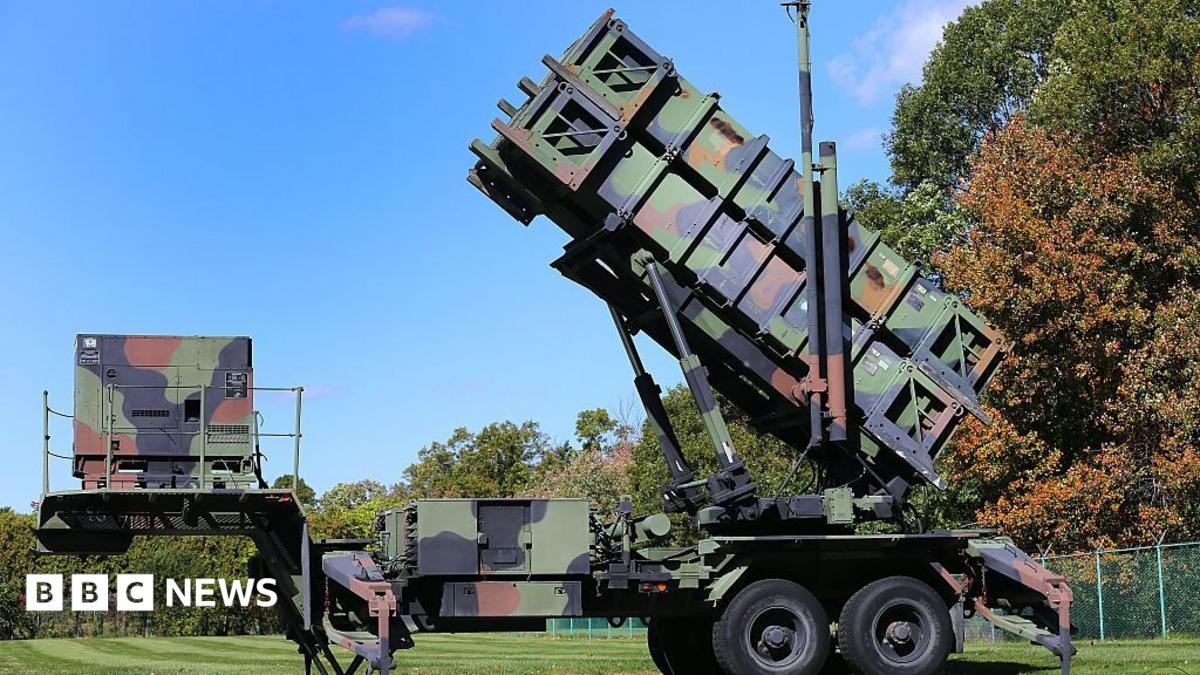
The US defence department’s inspector general says the war with Iran has led to “shortfalls” in munitions and a bottleneck in resupply, contradicting President Donald Trump who has repeatly denied the US is facing shortages.
Trump has claimed US munitions supplies are “virtually unlimited” and said reporting otherwise is “fake news”.
But the independent watchdog said the US spent more than $22 billion on munitions from February through June, leading to “strategic inventory shortfalls”.
The BBC has contacted the White House for comment about the discrepancy.
The new report provides a first-of-its-kind, independent glimpse into US weapons stockpiles, data that is typically classified.
Over the course of the war, US forces have expended vast quantities of both long-range ground attack systems and the air and missile defences used to intercept incoming Iranian attacks.
A late July estimate from the Center for Strategic and International Studies, or CSIS, found that stocks of some interceptors – such as the Patriot missile and Terminal High Altitude Area Defense, or THAAD – were significantly depleted, in some cases by more than half.
The inspector general’s report did not disclose exactly how many of the weapons remain.
It did, however, note the inventory shortfalls and reveal “industrial base bottlenecks” for munitions resupply.
The report added that the defence department is now working to “streamline procurement processes and production lead times” to address the shortages and “respond rapidly to a contingency”.
In a 4 August X post, for example, Defence Secretary Pete Hegseth described news reporting on the shortages as “not true”.
And in a lengthy Truth Social post on 3 September, Trump claimed that the US had “virtually unlimited” amounts of ammunition and is “stockpiling and preparing for any contingency that could happen”.
The watchdog’s report also notes that equipment losses have totaled $3.7bn, with other $7.4bn in other expenditures. Overall, the US spent $33.4bn (£24.7bn) on the war from 28 Feb to 30 Jun.
A separate estimate released on Tuesday by the Congressional Budget Office put the total cost of the war at higher at $38bn, which includes replaced expended munitions and equipment lost in battle, increased flying hours and greater fuel costs.
Among the losses have been four F-15e fighter jets, a highly advanced F-35 Joint Strike Fighter and 30 MQ-9 drones destroyed in “various circumstances”.
When US and Israeli strikes began, Trump repeatedly said that the conflict would be over within weeks.
More recently, he said the conflict might not end until “right after” the November midterm elections in the US.
Polls show that the war is unpopular among Americans.
One Reuters/Ipsos poll released in early September found that only 23% of Americans – and only half of Republicans – believe the US to be in a stronger position with Iran compared with before hostilities broke out.
WASHINGTON: President Donald Trump’s administration is planning to sell to Israel a munitions package worth $2.8 billion, which will include tens of thousands of highly destructive 2,000-pound bombs, according to a US official familiar with the sale.
The planned sale, which has been informally communicated to relevant congressional committees who weigh in on large arms sales, includes 20,000 MK 84s and 20,000 BLU-117s, the official, speaking on the condition of anonymity, said.
News of the package was first reported by the Washington Post.
The State Department and the Israeli embassy did not immediately respond to a request for comment.
US public support for Israel has fallen since the Gaza war began in 2023, particularly among Democrats. A June Quinnipiac University poll found 48 percent of voters and 66 percent of Democrats believe the United States is too supportive of Israel, up from 16 percent and 20 percent when the question was first asked in 2017.
The 2,000-pound bombs have been regularly used by Israel in Gaza as well as in Lebanon, drawing scrutiny from rights experts. More than 73,000 Palestinians have been killed in Israel’s military campaign, according to Gaza health authorities. A UN inquiry determined that Israel had committed genocide in Gaza, a charge Isarel rejects.
Israel calls its actions self-defense, after Hamas-led militants killed 1,200 people and took more than 250 hostages in an October 2023 attack.
The US and Israel attacked Iran on February 28. Iran responded with its own strikes on Israel and Gulf states that host US bases. US-Israeli strikes on Iran and Israeli attacks in Lebanon have killed thousands and displaced millions.
As spades went into the ground to signal the start of construction of the new Building 47 at Lockheed Martin’s Munitions Production Center in Troy, Alabama, it marked a significant development in accelerating production of the company’s Terminal High Altitude Area Defense interceptor, better known as THAAD. The expansion of factory space in Troy is a key element of the company’s $8-9-billion commitment to expand its munitions production footprint across the United States.
The Department of War’s Acquisition Transformation Strategy is part of a long-term plan that signals clear demand for critical munitions and it enables industry to confidently invest in facilities and workforce development, along with supply chain expansion and advanced manufacturing capabilities. In addition to enlarging the facility in Troy, Lockheed Martin is also growing its plant in Camden, Arkansas, which is another site that’s vital for building more munitions at a faster pace.
The THAAD production line in Troy, Alabama. Lockheed Martin
“My job is to interface and collaborate with the Department of War in achieving the call to action to produce these critical munitions, not only at speed but also at scale, multiplying the current production rates by two, three, or even four times the current rates,” Dan Nimblett, Lockheed Martin’s vice president for Munitions Acceleration Integration told TWZ on the ground in Troy during the groundbreaking event.
“Fundamentally what’s occurred changes how acquisition works [with] long term demand agreements. These long term procurement agreements enable Lockheed Martin and our supply base to make the necessary investments with confidence of the future demand. This allows us to make the investments not only in our people and our facilities, but in the technology necessary to build [these munitions] at a scale and a speed that’s relevant to the threat today,” explained Nimblett.
Lockheed Martin was the first company in the U.S. defense industry to announce a framework agreement with the DoW for munitions acceleration of high-demand missiles – initially tripling production capacity of the PAC-3 Missile Segment Enhancement (MSE) interceptor, followed by a second agreement to quadruple the production capacity of advanced THAAD interceptors. These two defensive missiles are cornerstones of a layered air and missile defense system, and both have been integrated together via Joint All-Domain Operations, including with the U.S. Army’s Integrated Air and Missile Defense Battle Command System (IBCS).
In response to the DoW’s call to action, the company has already invested more than $2 billion in its production facilities and in the related tooling, its key suppliers, and its workforce in order to accelerate production rates.
PAC-3 MSE in production in Camden, Arkansas. Lockheed Martin
Lockheed Martin plans to effectively double the factory footprint in Troy and dramatically increase the workforce. “We’re going to increase that [workforce] by drawing in college students, high school students, veterans, everybody’s welcome,” explains Jason Reynolds, vice president and general manager for integrated air and missile defense. “When they come to Lockheed Martin, they receive training, they get opportunity, and because these programs are on a ramp and in production in such high demand, this is where you come to start your career and you [can] work here for a long time.”
Lockheed Martin currently employs around 1,100 workers at its Camden site, but this is also growing. The Camden training center is seen as being critical in providing the swift increase in skilled operators needed to support this acceleration. “We work closely with the state of Arkansas as well on looking at what else we can do in the community and the infrastructure in that community to support people moving, hopefully into Camden as we ramp up,” says Reynolds.
“People here [in Troy] really know their work matters. It’s meaningful for both the community as well as for our national defense. So, we’re really proud of our employees and we’re on a growth trajectory. We’re hiring and we want as many qualified people to come join our team as possible.”
The Camden site is also accelerating its work on the long-range Precision Strike Missile (PrSM), which is also set to quadruple production over the next few years. Reynolds added that building missiles faster using automation and advanced manufacturing technologies, plus increasing the production line capacity, are some of the vital means for success.
Lockheed Martin is developing the new PAC-3 Adapted Capability Effector (ACE) to help build ammunition reserves faster. Lockheed Martin
“PAC-3 MSE and THAAD are the most capable air defense interceptors on the planet. They’re in extreme demand [and] we’re doing everything possible,” says Reynolds. “With PAC-3, we have been doubling that production over the last four years and now, like I said, we’re going to triple it. We’re working very carefully with our suppliers, with the U.S. government and with our partners and allies all around the world to get all the parts in and get them into factories like you see behind us today to assemble them and get them out to the warfighter as quickly as possible.”
Another way Lockheed Martin is accelerating the delivery of advanced air defense capabilities is the through the introduction this summer of the PAC-3 Adapted Capability Effector, or PAC-3 ACE. This new missile leverages the PAC-3 fire-control system and provides for full integration with the Patriot weapon suite.
The main differentiator of PAC-3 ACE is that it would be produced at less than half the unit cost of MSE and first flight could occur within 18 months. A core part of the rapid fielding strategy is an international, joint-development model. Lockheed Martin is partnering with both American and European industry, sharing production lines, supply chains and expertise.
Lockheed Martin says PAC-3 ACE provides a “cost-effective, multi-threat solution.” The interceptor is engineered to engage a broad spectrum of air-breathing threats, cruise missiles, and both short and medium-range ballistic missiles. By offering a low-cost “kill” per-engagement, it is designed to address the current climate that demands deeper ammunition reserves without compromising on performance.
Inside A Growing Lockheed Martin Site That Is Key To Its Munitions Production Ramp
The keys to munitions acceleration
This year, Lockheed Martin has made significant progress in a series of production acceleration projects for munitions programs under its Missiles and Fire Control division. “I was supposed to retire last year. I’m here because this is the most exciting time in the 30 years I’ve been in this industry,” says Dan Nimblett. “These long-term agreements provide us the certainty to enable us to make these investments.”
“What recent conflicts have demonstrated is that Lockheed Martin and the American defense industrial base never lost the technological edge. The technology and the capability has always been there – we have the best systems in the world. We’ve proven that through real world performance.”
Nimblett explained that Lockheed Martin’s supply chain is following suit, and that they are all now investing in similar ways to ensure they meet the demand signals. “We’re evaluating how we produce and increase additive manufacturing and robotics. We’re also looking at how we develop, which I think is a fundamental part of getting capability into the warfighters’ hands at a speed and scale that’s relevant to the threat.”
A PrSM test firing during the missile’s development. Lockheed Martin
Having received Milestone C approval from the U.S. Army in July 2025, PrSM manufacturing has relied on a high level of automation. PrSM was engineered from the start for automated, robot-driven production – automating tasks once done by hand – and that early-stage streamlining is paying dividends as Lockheed Martin seeks to accelerate output.
“We have a lot of robotics built into our munitions production,” explains Gaylia Campbell, vice president, Tactical Missiles. “A lot of times we use robotics to help increase the safety of the assembly, like an explosive charge that has to be integrated into a munition, and we have a robotic arm that places that and tests the placement. We also robotically paint and coat [PrSM]. So, we have a lot of robotics already in Camden and that’s really going to help us with this ramp-up in production – the fact that so much of it is [already] automated.”
Campbell emphasizes that PrSM entered production with a mindset of acceleration. “We got PrSM through preliminary and critical design reviews, and into first flight in times roughly half of what it would normally have taken us. We’ve been amazingly successful on all these flights. Those early [test] flights went off one after the other during the COVID-19 pandemic, at a time when there were a lot of challenges for all of us in our daily lives, and yet we were able to continue to fly and prove the operational performance.”
Lockheed Martin is reshaping the munitions supply chain with an unprecedented slate of manufacturing initiatives that pull together new facilities, strategic partnerships, and workforce development. The company is also expanding a number of its other production facilities, such as a $60-million investment in its complex in Archbald, Pennsylvania, that will add 700 jobs in support of high‑priority programs including PrSM, THAAD, PAC‑3, and Apache sensors. In Orlando, Florida, three legacy paint bays have been merged into a high‑performance shop that can retool a work cell in hours rather than weeks, while Ocala’s new Progressive Work Smart Assembly Line has cut seeker and mission control unit build times by roughly 50 percent.
Production capacity for THAAD is expanding in Troy, Alabama. Lockheed Martin
A partnership with General Motors will bring high‑rate commercial manufacturing expertise into Lockheed Martin’s production processes, and the new Rapid Fielding Center in Grand Prairie, Texas, is tasked to reduce traditional manufacturing development timelines. What once took years of design, testing and tooling is aimed to be prototyped, fabricated and validated in a matter of months.
Echoing endorsement of the DoW’s initiative, Campbell underscores that knowing what the demand signal will be is a critical differentiator when it comes to production ramp-up. “We can plan for some of those really critical rare earth minerals that we need, the batteries for example in our munitions, we need certain rare earth minerals for that. We need to know the total demand signal and that means we can negotiate with the suppliers and guarantee that we have access. That can really help us accelerate.”
To support the wider munitions efforts Lockheed Martin is also investing in solid rocket motor development and production, as well as lower-tier parts that go into solid rocket motors. “We’re working with different suppliers to develop new sources of supply for solid rocket motors,” says Campbell. “We’re investigating heavily right now in designing and prototyping several motors that we plan to test and take to production, and that really will develop a whole new supply chain and will really be critical for all munitions production.”
Having a five-year contract instead of annual contracts allows the manufacturer to have far more buying power to secure sub-components for a far better price point. “I can go and invest. Invest in more capacity, invest in my supplier’s capacity,” explains Campbell.
“Production is all about velocity. Keeping the line moving and not having to stop because we don’t have a part. Being able to order bigger quantities of things up front is really huge when it comes to acceleration.”