The deadpan comedian sailed through to the Season 2 finale, outlasting the show’s returning champion, Bob Mortimer. He went toe-to-toe with David Mitchell in the final episode, with neither comedian breaking as they fed each other buffet food.
It resulted in an unprecedented tie-breaker in which the person who made the most people laugh over the course of the series was awarded the crown, meaning David scooped the win while Sam was awarded the runner-up title.
Sam is set to return to TV screens again in just a few days with his brand new comedy series, but what is it about, when is it released, and who is in it? Here’s everything you need to know.
What is Make That Movie about?
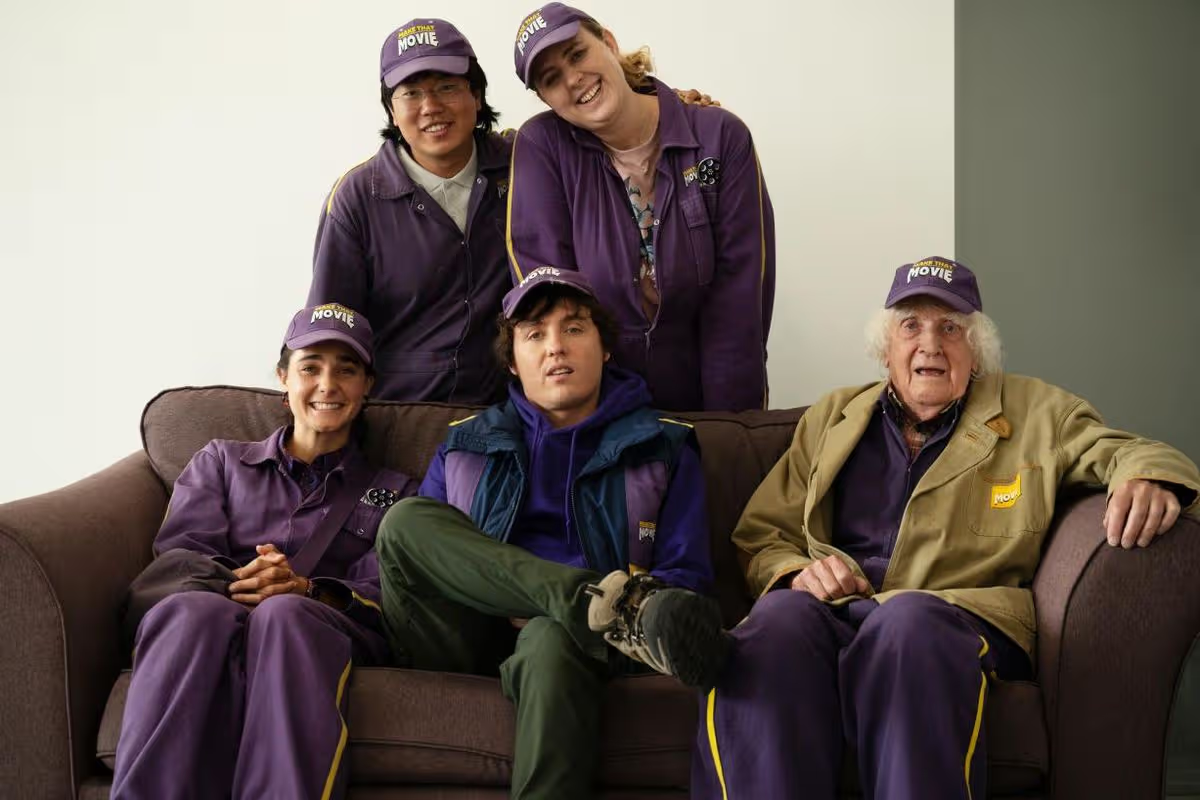
The six-part Channel 4 comedy series follows a director called Sam (played by Sam Campbell) who attempts to make feature films based on the weird and wonderful ideas of everyday people. He goes on a trip around the country seeking out people to share their ideas with him, before attempting to make their movies in just three days.
While Sam appears to play himself, the series is a scripted comedy show and not real life. Alongside Sam in the cast are Michell and Webb Are Not Helping star Lara Ricote as runner Jess, and Am I Being Unreasonable’s Helen Bauer, who plays sound engineer Pat.
Meanwhile Aaron Chen (Fisk) plays intimacy coordinator Sebastian and This Country’s David Hargreaves takes on the role of cinematographer Winnie.
The series is directed and co-written by Joe Pelling who may already be known to some as the director of nightmarish comedy-horror puppet show, Don’t Hug Me I’m Scared.
Make That Movie’s release date and time
The very first 30-minute episode will air on Channel 4 on Thursday, May 28 at 10pm. The second episode will be broadcast immediately after at 10.30pm.
Announcing its release date, Sam posted: “This show is on channel 4. 28th of May ~ so pretty soon in fact. We hope it wets so many people’s whistles. Hopefully not a dry whistle left in the whole world. Hopefully. Please watch.”
A flurry of excited fans were quick to comment, with one penning: “I don’t understand any of this but that’s okay, I trust Sam,” in reference to Sam’s surreal comedy style.
“Nathan Fielder has been real quite since this dropped,” joked another. “Can’t wait for this dynamite series!” a third fan remarked.
Make That Movie begins on Channel 4 on May 28 at 10pm.
Hello! I’m Mark Olsen. Welcome to another edition of your regular field guide to a world of Only Good Movies.
There are, it goes without saying, a lot of movies out there. And so even for someone like myself, whose job is just to stay on top of them, sometime a title slips by. I had not taken much notice of “Is God Is” before it opened last week without playing any festivals in advance, but the reviews and conversation around it grabbed my interest. Once I realized that Tessa Thompson and Janicza Bravo were involved as producers, I made sure to carve out time to see the movie this week. And am I ever glad I did.
The debut as writer-director for Aleshea Harris (adapting her own play), “Is God Is” is among the most exciting movies released so far this year. Kara Young and Mallori Johnson are absolutely electric as twin sisters who set out to find the estranged, abusive father who abandoned them after leaving them and their mother horribly scarred in a fire. There is a volatile unpredictability to the storytelling that gives it a fresh energy. I saw it at a more-or-less empty matinee, but I’m glad I did. Catch this in theaters while you can.
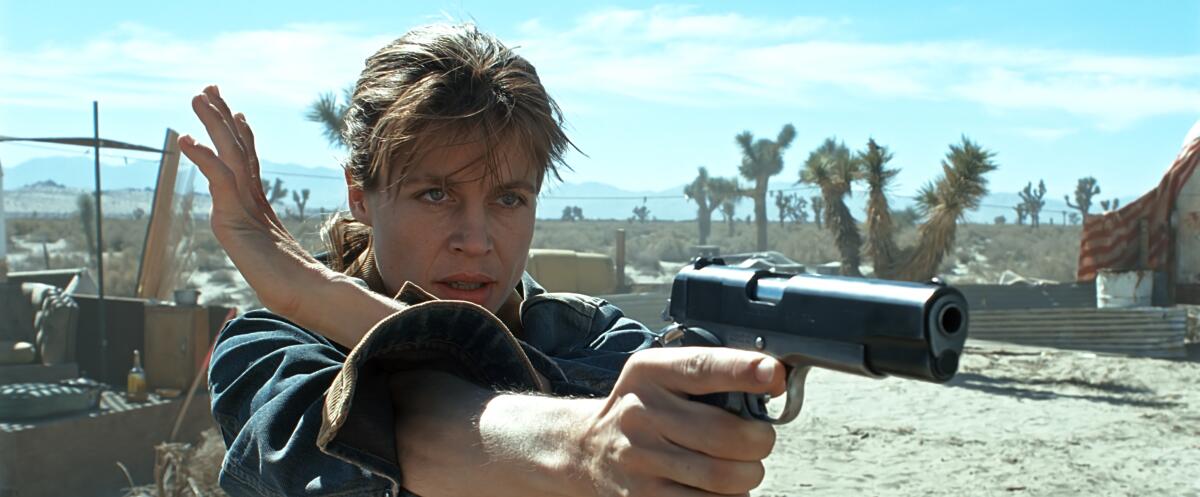
35 years of ‘T2’
Linda Hamilton in the movie “Terminator 2: Judgment Day.”
(Rialto Pictures)
As far as I’m concerned, James Cameron’s 1991 “Terminator 2: Judgment Day” is the quintessential summer movie. You can pay close attention or not, the special effects and action are amazing, the villains are sentient machines (shades of our AI-addled present) and it has a song by freaking Guns N’ Roses.
The main cast of Arnold Schwarzenegger, Linda Hamilton, Robert Patrick, Edward Furlong and Joe Morton are all perfectly tuned into the movie they are making, full of chaos, mayhem and just the right amount of thoughtfulness. (Morton and Hamilton in particular give the film an unexpected soulfulness.)
To celebrate the film’s 35th anniversary, the American Cinematheque is screening the film in 70mm, 35mm, 3D and DCP at different venues on different days. (Check carefully, as there have already been some schedule changes.) The Academy Museum will show the film on Wednesday in 4K with visual effects supervisor Dennis Muren and special effects creator Shane Mahan present. The film is also playing the Vista in 70mm June 6 and 7.
In his original 1991 review, Kenneth Turan wrote, “Most of all, what makes ‘Terminator 2’ come alive in a major way is Cameron’s intuitive understanding of the mechanics and psychology of action films. Unlike many of the wanna-bes who find themselves in charge of pictures these days, this is one director who really knows how to direct. … Cameron flamboyantly underlines, for those who may have forgotten, why the pure adrenaline rush of motion is something motion pictures can’t live for very long without.”
Lena Dunham before ‘Girls’
David Call and Lena Dunham in the movie “Tiny Furniture.”
(Joe Anderson / IFC Films)
Lena Dunham recently published her second memoir, “Famesick,” a portrait of her rise to cultural prominence and media ubiquity and subsequent retreat from it, which makes this a perfect moment to revisit a key component of her initial ascent, the micro-budget 2010 feature “Tiny Furniture.” Made when Dunham was in her early 20s, the film is a deadly accurate portrait of post-collegiate ennui, shot partly in her parents’ NYC apartment, and remains fresh and startlingly insightful.
The Eastwood Performing Arts Center will be screening the film Friday and Saturday. The film is showing along with the “Welcome to Bushwick a.k.a The Crackcident” episode of Dunham’s series “Girls.”
I profiled Dunham at the time, having first encountered her at SXSW the year before when she was there with her film “Creative Nonfiction.”
“That movie is so personal,” Dunham said of “Tiny Furniture” during an interview from the New York production office of the pilot for what would become “Girls.” “It’s like I wrote it, I directed it, I star in it — if you don’t like the movie you don’t like me.”
With the lacerating self-awareness that made her a star, she added, “And I also understand there is something essentially unappealing about ‘girl makes movies about being a loser and then gets un-loserly things to happen to her.’ It’s a little absurd.”
More onscreen Bob Dylan
Rupert Everett, Fiona Flanagan and Bob Dylan in a production still for 1987’s “Hearts of Fire.”
(Skinner / Mirrorpix / Getty Images)
It was just a few weeks ago that we wrote about a program of Bob Dylan live concert footage. In honor of his 85th birthday, the American Cinematheque will be putting on another program of two oddball rarities from his long career.
Rarely screened in theaters, the 2021 film “Shadow Kingdom,” directed by Alma Har’el, was originally released to a pay-per-view streaming site. Though it purports to be a performance at the Bon Bon Club in Marseille, France, the film was actually shot on a soundstage in Santa Monica. The musicians on screen are not playing live and are not even the same musicians who played on the prerecorded tracks.
The whole thing is very confusing in a very Bob Dylan way, but also kind of incredible. With its Dust Bowl “Twin Peaks,” last-nightclub-on-Earth vibes and spare, haunting arrangements of many Dylan classics that he rarely plays at his own concerts anymore, it is a truly one-of-a-kind document.
The same could be said of the 1987 film “Hearts of Fire,” directed by Richard Marquand (who also helmed “Return of the Jedi!”) and screening in 35mm. In a rare acting turn, Dylan plays a reclusive musician who takes a young singer (Fiona) under his wing, only to have her fall for a pop star played by Rupert Everett. Let’s charitably call Dylan’s performance singular as he delivers every line as if he isn’t sure why he is in the movie. It’s still fascinating.
Kurosawa’s late masterpiece
Mieko Harada in Akira Kurosawa’s 1985 epic “Ran.”
(Rialto Pictures)
One of the highlights of the Academy Museum’s ongoing series on Japanese filmmaker Akira Kurosawa will be this weekend’s 35mm showing of 1985’s “Ran,” a retelling of Shakespeare’s “King Lear” shifted to 16th century Japan. Playing in 35mm in the big David Geffen Theater, it’s a chance to see a truly epic-scaled film under ideal conditions.
Reviewing the movie on its initial release, Kevin Thomas wrote, “‘Ran’ is a heroic saga of human destiny, a war movie with some of the greatest battle scenes in the history of the cinema, a costume drama of the utmost magnificence — and a crackling good samurai movie chock full of swordplay and palace intrigue.”
David Fincher’s secret soft heart
Gary Oldman and Amanda Seyfried in the movie “Mank.”
(Netflix)
The last couple months have been a real feast for Fincher-heads out there, with high-profile screenings of “Seven,” “Fight Club” and “Zodiac.” Now, David Fincher’s 2020 film “Mank” will be playing this weekend at the Vista. Because it came out during the pandemic (and was launched by Netflix), the film has only ever played a limited number of theaters, let alone in 35mm, which should do wonders for its black-and-white photography.
From a screenplay by Fincher’s father Jack, the film stars Gary Oldman as writer Herman J. Mankiewicz, working on the script for “Citizen Kane” with Orson Welles. Amanda Seyfried gives a vibrant performance as actor Marion Davies, who attempts to save Mankiewicz from his own worst instincts when it comes to her own paramour, mogul William Randolph Hearst.
In his review Justin Chang called the movie “very much a story about class divides and clashing egos, outsiders and insiders, striving and ambition, creation and authorship, and the thrill and loneliness of being the smartest guy in the room. … The off-kilter rhythms feel both immersive and agitated, as if Fincher were trying to both hypnotize you and jolt you awake with his lustrous Old Hollywood homage.”
New this week
Director Boots Riley, photographed in Los Angeles in May.
(Ian Spanier / For The Times)
Amy Nicholson and Joshua Rothkopf finished out their time at this year’s Cannes Film Festival. (The awards will be announced over the weekend.) Amy took a look at what many have felt to be a weak program this year, while Josh spoke to Korean filmmaker Na Hong-jin, whose sci-fi action film “Hope” has a cast that includes Michael Fassbender and Alicia Vikander as space aliens.
I spoke to Boots Riley, a musician and political activist turned filmmaker whose new movie is “I Love Boosters.” Riley maintains a deep sense of political commitment in his work, one which he does not feel he has to betray by also making things that are entertaining and enjoyable.
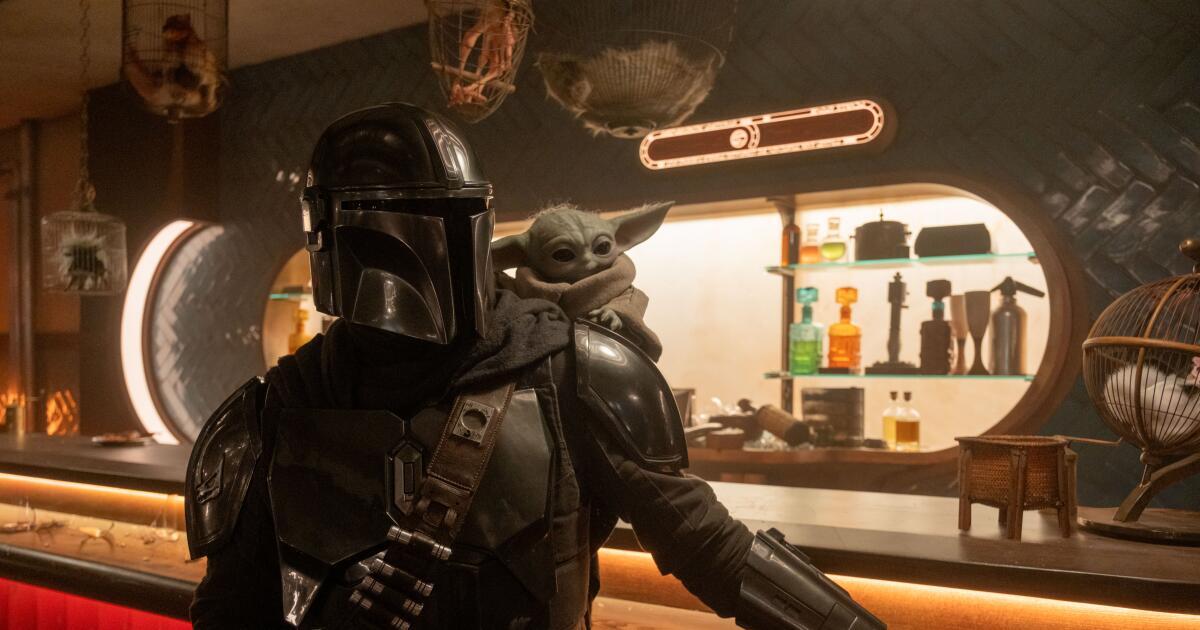
The first new “Star Wars” movie in theaters since 2019, Jon Favreau’s “The Mandalorian and Grogu” is now playing. As Robert Abele put it in his review, “The brand is back together for ‘The Mandalorian and Grogu,’ which is a movie, a hoped-for franchise revival, a fourth season of sorts and an affable throwback. But it’s never quite riveting enough as canon or fodder to supplant anyone’s memories of [insert favorite “Star Wars” film here].”
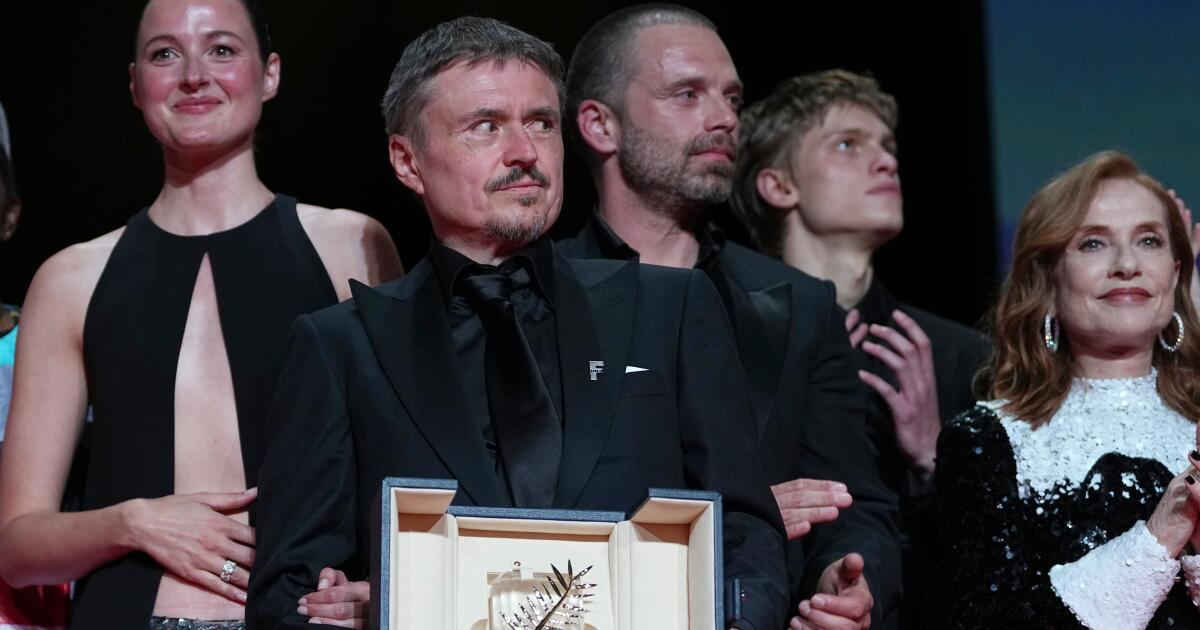
In a squeaker race for Cannes’ top prize, Romanian director Cristian Mungiu prevailed on Saturday, taking the Palme d’Or for his tense community drama “Fjord.”
The movie, a widely admired conversation-starter at the festival, stars Sebastian Stan and Renate Reinsve as religious parents who come into conflict with the child protection services of their tiny Norwegian town where they have relocated with their family.
Mungiu, a previous winner of the Palme for his controversial 2007 abortion drama “4 Months, 3 Weeks and 2 Days,” now joins an exclusive group of 10 filmmakers who have won the Palme twice — an achievement shared by Francis Ford Coppola (1974’s “The Conversation” and 1979’s “Apocalypse Now”) and Ruben Östlund (2017’s “The Square” and 2022’s “Triangle of Sadness”), among others. No one has ever won a third Palme d’Or.
Neon will release “Fjord” in the fall, with an extensive awards campaign to follow.
This year’s nine-member main competition jury, led by Korean director Park Chan-wook and studded with notables including “The Substance” star Demi Moore, Stellan Skarsgård and “Hamnet” director Chloé Zhao, seemed intent on spreading the wealth among as many winners as possible. There were three ties at Saturday’s awards ceremony.
The award for actress was shared by Virginie Efira and Tao Okamoto, co-stars of Ryusuke Hamaguchi’s “All of a Sudden,” a movie pegged by many to potentially go all the way. Similarly, the prize for actor was bestowed on both Emmanuel Macchia and Valentin Campagne, co-stars of Lukas Dhont’s World War I romantic drama “Coward.”
The prize for directing went to three people — and two movies — with a joint win for Javier Calvo and Javier Ambrossi (better known as Los Javis) for their century-spanning queer historical drama “The Black Ball,” as well as to director Paweł Pawlikowski for his exquisite post-World War II psychodrama “Fatherland.” (Pawlikowski half-joked at the podium, “This was a disastrous piece of mise-en-scène” after the awkward award presentation had him waiting in the wings.)
Claiming this year’s Grand Prize (essentially second place) was “Minotaur,” the rapturously received comeback film of Andrey Zvyagintsev, a Russian director who had been sidelined with a near-fatal bout of long COVID that put him in a coma. His new movie, about a wealthy Moscow family, is both an erotic thriller and an indictment of amoral oligarchy detached from the war with Ukraine.
The festival’s third-place Jury Prize went to the borderland German drama “The Dreamed Adventure,” directed by Valeska Grisebach.
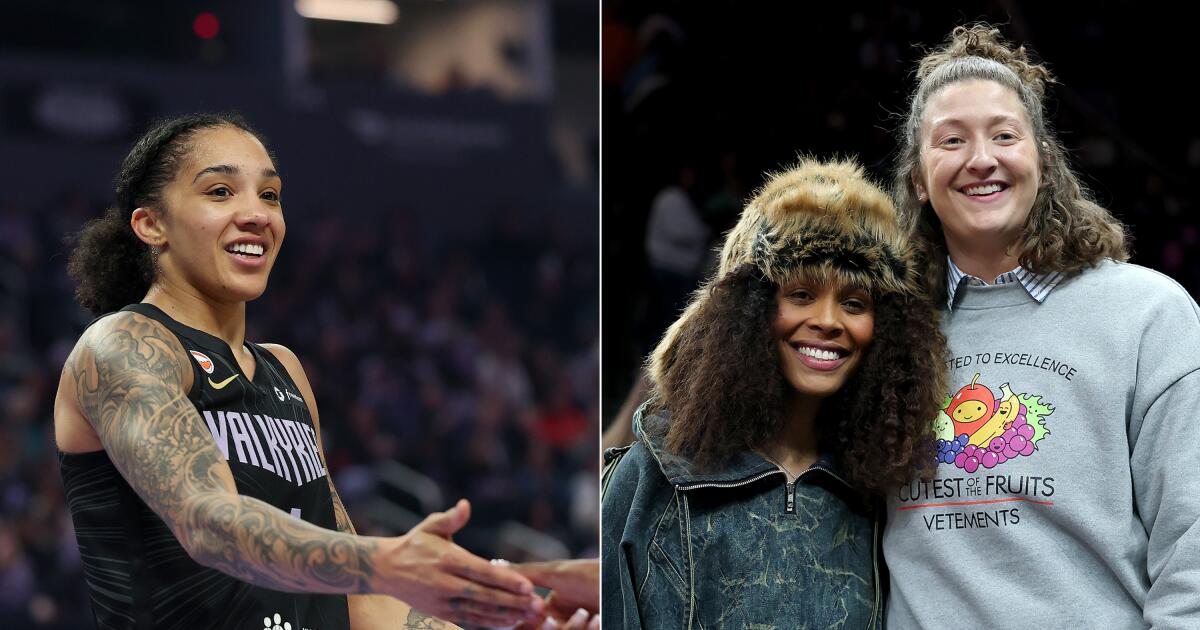
Media company Run-A-Muck has announced that it is developing “Courtside,” a sports romantic comedy set in the world of professional basketball. WNBA All-Star Gabby Williams, two-time WNBA champion Sydney Colson and 2022 WNBA champion Theresa Plaisance are among those set to appear in the movie, according to Deadline.
“If you like ‘Love & Basketball’ and ‘Bend It Like Beckham’ and ‘Bring It On’ but you found yourself wondering, ‘Could this maybe be a little bit gayer?’ We have great news for you,” Colson said in a Thursday Instagram post. “The answer is yeah, you could always make it gayer.”
Colson, a Texas A&M standout who was drafted to the WNBA in 2011, is also one of the executive producers on “Courtside.”
Written by “Abbott Elementary” writer-producer Brittani Nichols and directed by Carly Usdin, the movie will follow an injury-plagued women’s basketball superstar with championship ambitions who is thrown for a loop when she falls for a teammate.
“Making a movie like this is super exciting to me because I grew up playing basketball,” Colson added. “I would have loved as a young person to see my story depicted … on screen so to see a team of people who want to ensure that others can see characters and storylines that feel personal and familiar to them. I’m so excited about it.”
Colsen and Plaisance, who won a championship together as teammates on the Las Vegas Aces in 2022, share a podcast and also starred in the unscripted buddy comedy “The Syd + TP Show” together. Williams, who plays for France in international competition, currently plays on the Golden State Valkyries.
“It feels like I’ve been waiting my whole life for this kind of excitement to surround women’s basketball, and I’m excited to blend my love of sports, lesbian tension, and comedy into one project,” Nichols told Deadline. According to the outlet, Run-A-Muck co-founder and “The L Word” star Jennifer Beals is also slated to appear in the project.
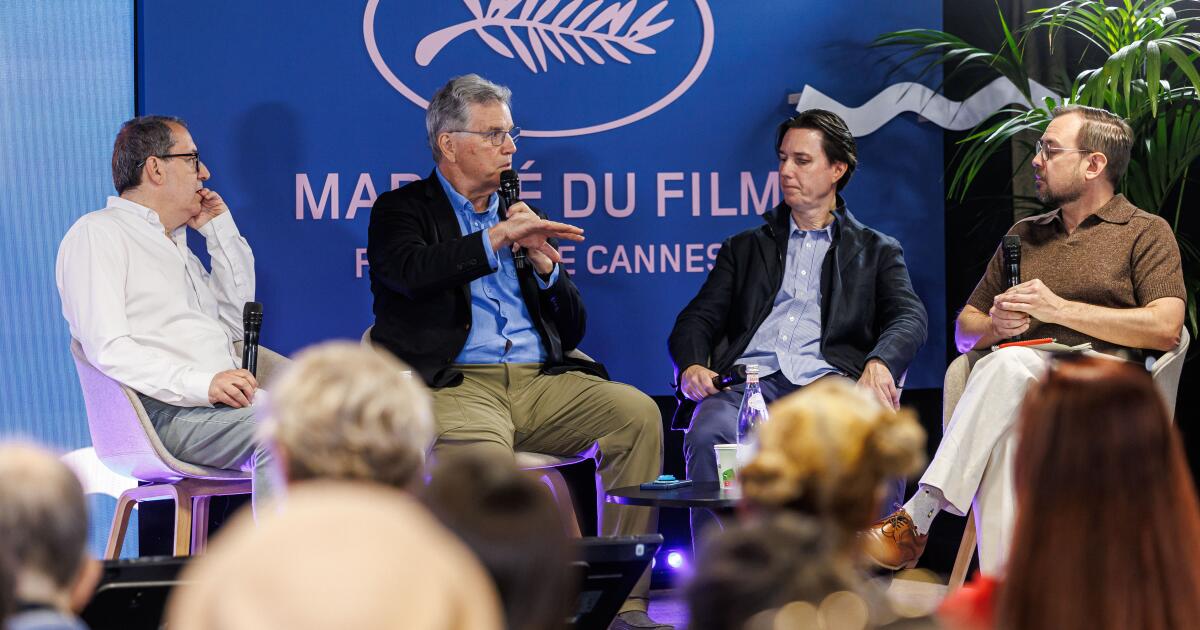
At this year’s festival to unveil our inaugural Cannes issue, I had to opportunity to sit down with Sony Pictures Classics co-founders and co-presidents Michael Barker and Tom Bernard and EVP of Acquisitions, Production and Business Affairs Dylan Leiner on the Main Stage at the Marché du Film to discuss the company’s festival strategy, bidding wars, artificial intelligence and more. Watch the full conversation and read edited excerpts below.
How much does the festival reception of a movie, the reviews coming out of a festival, the buzz around it, shape decisions that you’re making? Or is it just confirming what your gut already knows?
Leiner: I want to tell one story that speaks to that, which was at the first Berlin Film Festival we attended after COVID. I remember, in the same day, I ran into three international distributors who all asked if we had seen “The Teacher’s Lounge.” And I didn’t even know what the film was. It wasn’t on our radar, it wasn’t in competition. So we quickly saw “Teacher’s Lounge” and we acquired the film [which went on to be nominated for the 2024 international feature Oscar]. And that was one of the great values of an in-person festival, the ability very quickly to communicate with distributors, with tastemakers, with critics from around the world and get that kind of information. Gut, personal taste… It plays into it a lot, but then we need reassurance. And being at a festival and being in this fishbowl environment is really helpful for that.
For a lot of people, myself included, the mystique of a festival is often around the bidding war narratives: Who’s going to pick up what and what are they going to pay? I’m curious for your take on the first big acquisition of this year’s Cannes, A24 buying “Club Kid” for a reported $17 million.
Bernard: Throughout the years, there were companies [that would] maybe overpay, or they were going to bid to get this movie no matter what, because they were the headline in all the newspapers covering this festival. So in terms of a company that’s branding — which, A24 is one of the best in branding — I think that that had to do with a little bit of the cash that went up. … There’s a branding aspect in a lot of festivals for a movie that’s a hot movie that the press has decided to seize on.
Barker: Here’s a key to how we have survived. It’s different from the way you talk about it. When we acquire a movie, whether anyone else has offers, we try to block it out. And we have trained ourselves to not let that noise bother us. What is it worth to us? What do we think it’s going to do? Dylan runs these incredible models of what it’ll do on the low end, what it will do on the high end. And then you decide where you want to be.
Bernard: Or we think we can make it work.
Barker: But at no point do we sit around and worry about who else has a higher offer for the movie. Because I have to say, in very few instances, on the movies we buy, are we the higher offer. We just do the best we can, and if we lose it, we lose it.
Bernard: [French film producer] Serge Silberman, a sage of the past, he always said, “You never lose money on a movie you didn’t buy.”
That brings up a question that I had about “Nuremberg,” which was a real success.What you’re saying is,it performed in alignment with your expectations. Were there any lessons that you took away from that in terms of future projects that might come along?
Leiner: Yes, it performed in accordance with our expectations. What’s interesting about that film, we acquired it here last year. Nobody else was really interested in the movie. … So our challenge basically was to figure out how to convince the filmmaking team that, because it was a very expensive film, that we were the right company to acquire the film on the terms that we could afford and that we could make it work. And it was a very intense series of phone conversations, in-person meetings.
Bernard: We felt like we were auditioning to get married to somebody. We were never going to be able to pay to make their money back. It was a $40-million movie, and they were really sort of out there without anybody really looking at it. And we said, “Listen, sell it to us. We think it’s going to be a great success. We’ll make your movie way more valuable over the test of time.”
Barker: There are two types of movies that are being made and distributed. One are the big tentpole studio movies. It’s about winning the weekend theatrically. These are the theatrical-driven movies. And it’s all about making that huge budget back very quickly. But the other kind of film, which is why we are in business, is the evergreen. Every one of our films, we open it with the best marketing push we can. Yes, we try to get the highest box office. But what we know will happen, even if the box office ends up being less, we believe in these films as long-term players. And these films have really long tails. You look at movies like “Run Lola Run” or “Call Me By Your Name” or even “Living” … They have generated revenues to the filmmakers and to us that’s way beyond what the box office would have portended when it opened.
I would be curious, what areas of the filmmaking process or the film distribution process do you think AI is appropriate for use, that you’ve experimented with it, that you’re excited about its prospects? And where are your red lines, if you have any?
Barker: One of the people on our staff — we really love our young staff. One of them was writing a screenplay with AI, and told me they got certain rules on AI. And I’m listening to all these rules. You can’t have your main character die in a first scene. You can’t have your romantic female lead be totally unlikable, people aren’t going to go. I’m listening to this, and I said, “Have you ever seen ‘Sunset Boulevard?’” And she goes, “No, what is that?” I said, “Go watch that movie.” She came back and she was like, “Holy cow.” I said, “Billy Wilder sat down and made that up based on what he observed.” AI is not going to be able to do that.
The race is dominated by just-under-the-wire releases, with three of the seven projected nominees dropping this month (the end of the eligibility window is May 31).
Matt Roush says, “Star-powered late arrivals ‘Remarkably Bright Creatures’ (with Sally Field, Lewis Pullman and the voice of Alfred Molina — as an octopus!) and ‘Miss You, Love You’ (with Allison Janney and Andrew Rannells) suddenly make this category a bit more interesting than usual.”
Trey Mangum says of the runaway No. 1 pick, “Dropping just in time is Netflix’s ‘Remarkably Bright Creatures,’ anchored by Sally Field and an absolute shoo-in.”
While several panelists continue to plead ignorance as to what, exactly, makes a movie debuting on television a TV movie or not a TV movie, some find titles to champion.
“This category continually confounds me, but I have to admit I still love a good, weird, chaotic stoner comedy despite having aged out of that demo,” says a somewhat responsible-sounding Tracy Brown, definitely not typing her comment at a Taco Bell. “All that is to say, I was charmed by ‘Pizza Movie,’ my dark horse pick.”
“Expect to see ‘Deep Cover,’ ‘Miss You, Love You,’ ‘Remarkably Bright Creatures,’ ‘Straw’ and ‘Swiped’ in the running. And what qualifies as a TV movie in 2026, when TV and film mediums are beyond fluid? No idea. I’m just here to blurb.”
“Vince Vaughn’s lightweight culinary comedy, ‘Nonnas,’ managed to earn a nomination for Netflix in 2025. Does that mean voters will be twice as likely to put Hulu’s ‘Mike & Nick & Nick & Alice’ — in which the actor plays two versions of the titular Nick — on their ballot?”
Los Angeles Times
Tracy Brown
1. “Remarkably Bright Creatures” 2. “Miss You, Love You” 3. “Deep Cover” 4. “Jack Ryan Ghost War” 5. “Pizza Movie”
“This category continually confounds me, but I have to admit I still love a good, weird, chaotic stoner comedy despite having aged out of that demo. All that is to say, I was charmed by ‘Pizza Movie,’ my dark horse pick. ‘Remarkably Bright Creatures’ is the likely front–runner but I wouldn’t count ‘Deep Cover’ out.”
Blavity
Trey Mangum
1. “Heads of State” 2. “Deep Cover” 3. “Remarkably Bright Creatures” 4. “Swiped” 5. “People We Meet on Vacation”
“Dropping just in time is Netflix’s ‘Remarkably Bright Creatures,’ anchored by Sally Field and an absolute shoo-in. Then there’s last year’s ‘Deep Cover,’ which is buoyed by the likes of Orlando Bloom and Bryce Dallas Howard.”
TV Insider
Matt Roush
1. “Remarkably Bright Creatures” 2. “Miss You, Love You” 3. “Jack Ryan Ghost War” 4. “Deep Cover” 5. “The Best You Can”
“Star-powered late arrivals ‘Remarkably Bright Creatures’ (with Sally Field, Lewis Pullman and the voice of Alfred Molina — as an octopus!) and ‘Miss You, Love You’ (with Allison Janney and Andrew Rannells) suddenly make this category a bit more interesting than usual. A ‘Jack Ryan’ movie gets in by name recognition.”
Los Angeles Times
Glenn Whipp
1. “Remarkably Bright Creatures” 2. “Swiped” 3. “Deep Cover” 4. “Miss You, Love You” 5. “People We Meet on Vacation”
“Six years after ‘My Octopus Teacher,’ we find there’s still much to learn from eight-limbed marine mollusks in ‘Remarkably Bright Creatures.’ Shameless, yes, but also sweet.”
The two-time Emmy winner is developing a film about the animated icon and will star as the doe-eyed flapper, The Times confirmed on Wednesday. The “Abbott Elementary” star and creator’s production company Fifth Chance Productions will team with cartoonist Max Fleischer’s grandson Mark Fleischer and their Fleischer Studios for the film. Variety first reported the news.
Brunson, in a news release shared with The Times, praised Betty Boop as one of the nation’s “most beloved cartoon characters” and said she realized “there was a much deeper story to tell” after she and Fifth Chance head of creative affairs Erin Wehrenberg met with the younger Fleischer. According to the release, the movie will chronicle the cartoon character’s origin and evolution through Max Fleischer’s perspective and will examine the “relationship between the artist and his creation as he navigates the creative and commercial pressures of building one of the world’s first animated icons, particularly as that icon begins to take on a life of its own.”
Betty Boop, designed by late cartoonist Myron (Grim) Natwick, first appeared in Max and Dave Fleischer‘s 1930 cartoon “Dizzy Dishes” as part of Fleischer Studio’s “Talkartoons” series. The Fleischer brothers asked Natwick to draft up a woman character for the popular song by Helen Kane, “Boop-Boop-A-Doop.” Natwick initially designed Betty as a dog’s head on the curvaceous figure of a woman and modeled her flapper hairdo on Kane’s own coif. As Betty Boop became more popular, Natwick revised his design to swap the character’s floppy dog’s ears for bangle earrings and shrinking her nose. Her curvaceous figure, flapper ‘do and large eyes remained.
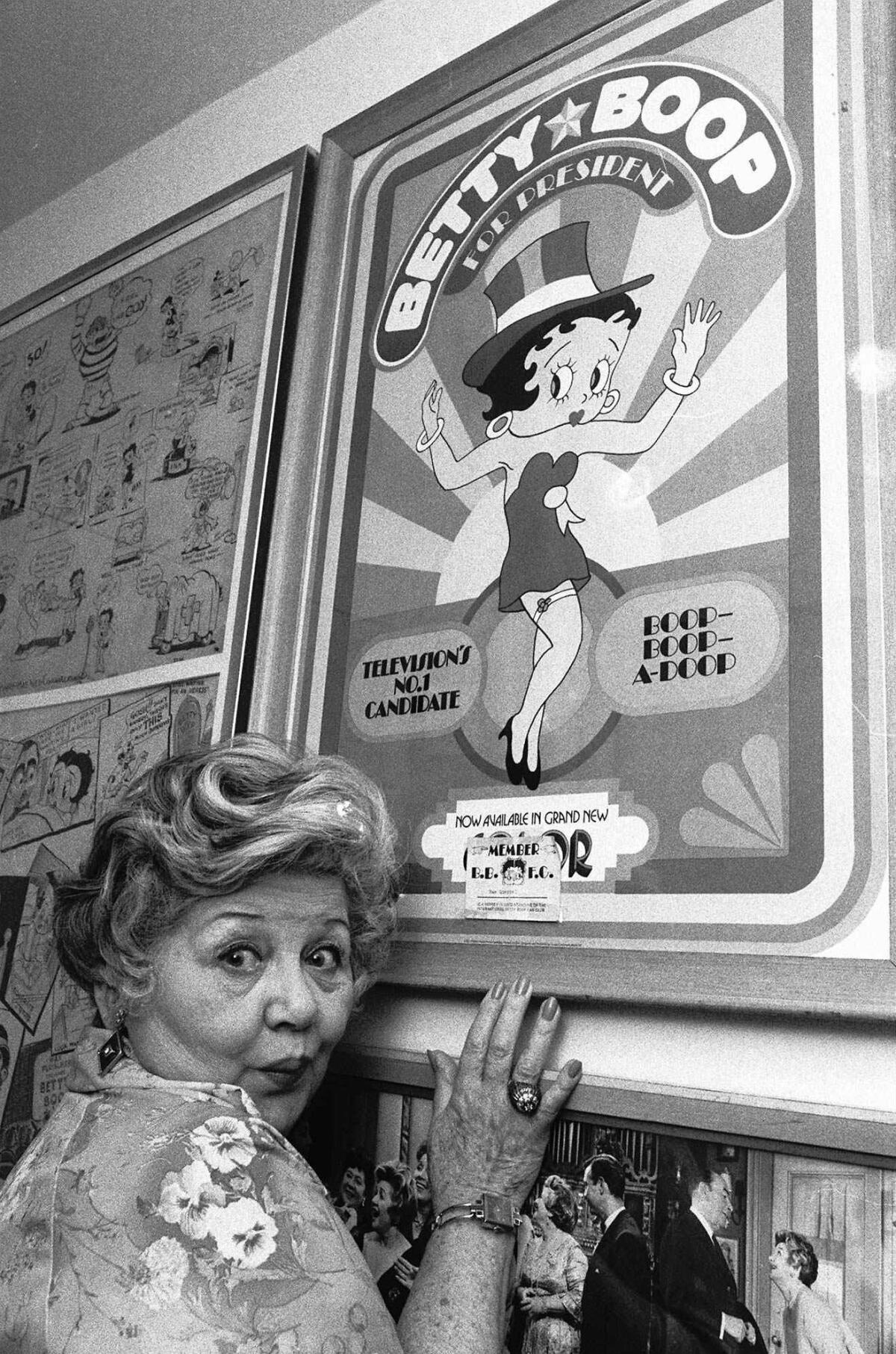
Mae Questel, who provided the loopy, child-like voice of cartoon characters Betty Boop and Olive Oyl, poses in 1978 with a poster of Betty Boop.
(Associated Press)
Kane unsuccessfully sued Fleischer Studios and Paramount in 1932, alleging Betty Boop ripped off her voice, likeness and scat-singing. The performing community challenged that notion, tracing the scat-singing and gesticulations to earlier artists including Black jazz performer Baby Esther Jones and cabaret entertainer Florence Mills. The judge who oversaw the legal battle ruled against Kane.
Betty Boop was primarily featured in theatrical cartoons from 1930 to 1939 — voiced by Mae Questel — but her sex symbol status and general fabulousness made her an intergenerational icon. Earlier this year, the preliminary design of Betty Boop featured in “Dizzy Dishes” entered public domain.
“Quinta so embodies Betty’s love of life, intelligence, humor, sassiness and compassion that the relationship between her as Betty and Max burst into life at its mere mention,” Mark Fleischer said in a news release.
Brunson, though best known for the ABC comedy “Abbott Elementary,” first gained popularity in the 2010s for her viral social media comedy clips and her work on Buzzfeed. She appeared on TV series “A Black Lady Sketch Show” and “iZombie” before “Abbott Elementary,” about a group of educators at an underfunded Philadelphia elementary school, became a breakout hit in 2021.
“Abbott Elementary” has collected four Emmy Awards and was renewed in March for its sixth season at ABC.
Nearly 50 years on from “Star Wars” and the launch of a media empire (large or small “e”? You decide), the fandom has become its own galaxy of warring planets. But based on the success of the streaming series “The Mandalorian,” set around the title bounty hunter, we can all agree that his charge Grogu — green, wrinkled, big-eyed Baby You-Know-Who — is still adorable. Of the many “Star Wars” offshoots, this seems to be the sturdiest.
The brand is back together for “The Mandalorian and Grogu,” which is a movie, a hoped-for franchise revival, a fourth season of sorts and an affable throwback. But it’s never quite riveting enough as canon or fodder to supplant anyone’s memories of [insert favorite “Star Wars” film here].
The expectations game was never going to help series creator Jon Favreau’s big-screen version, written with Dave Filoni and Noah Kloor. Granted, this upscaled, agreeably rangy treatment of an adventure storyline that wouldn’t have been out of place on the show could have attempted more. Especially when it puts sci-fi icon Sigourney Weaver in an X-wing pilot uniform as a veteran of the Rebellion, but barely gives her anything to do besides secure Mando a job and keep tabs on his progress. (Gang, try harder. It’s Sigourney Weaver.)
Aimed squarely at kids of all sizes, “Star Wars” has become a glorified tour of a billionaire’s expanding playworld and “The Mandalorian and Grogu” wants the track well-oiled, not bumpy. The simple pleasures here of good vs evil, IMAX hugeness and composer Ludwig Göransson’s space-opera-hits-the-club score, go down easy enough to not be aggravating. It’s a lot.
But it’s not this reviewer’s position to tell you what “a lot” is — loose lips spoil scripts. When the moment comes at an appropriately dangerous time for our heroes, we sense the kind of thing that only movies can do well when they’re myths writ large: slow things down, shift momentum away from the tyranny of exposition and let emotion, humor, wonder and character co-exist. “The Mandalorian and Grogu” takes the series’ thematic underpinnings — what parenting looks like between a masked human loner and an otherworldly toddler — and deepens them.
The movie takes place in wonderfully detailed environments that evoke the earlier, beloved films. You’re not being pandered to, however; the payoff is a lovely echo. Elsewhere, the action set pieces are serviceably handled by Favreau. (One of them plays like, of all things, an homage to “The French Connection.”)
Otherwise, this is another hunt-and-retrieve narrative for the bounty hunter voiced by Pedro Pascal, physically embodied in armor by Brendan Wayne and, in combat, by fight choreographer Lateef Crowder. Still independent but New Republic-curious, Mando is tasked by Weaver’s Col. Ward to find a wayward scion of the slimy gangster Hutt clan, Rotta (voiced by Jeremy Allen White), whose return will unlock some important information. Of course, things don’t go as planned, which for a while is interesting — are the Hutts like the Corleones, perhaps? — until it’s not, because then the dialogue would need to rise above the level of a middle-school play.
That being said, one of the movie’s strong points, absent its story deficiencies, is that, across its many wordless scenes, it’s at heart a solidly rousing, delightfully icky creature feature, in the vein of a supercharged Ray Harryhausen-meets-Guillermo del Toro joint. “It’s a hard world for little things,” Lillian Gish famously says in “The Night of the Hunter,” a movie nobody will ever confuse with “The Mandalorian and Grogu.” But we all know summer fare like this is only ever as enjoyable as the monsters conjured up for conquering.
CANNES, France — The movies of Na Hong-jin aren’t hard to love — they’re as obsession-worthy as the stylish rigor with which they are made. His 2008 debut, “The Chaser,” found new febrility in the post-Fincher serial killer thriller. “The Wailing” somehow added ghosts, demon-possessed children and inky black crows to the mix with a near-crazed sense of showmanship.
That was 10 years ago. Na, 51, now sits on the other side of a project that has consumed him for years, a sci-fi action film called “Hope” that arrives with expensive CGI, a pair of A-list stars (Michael Fassbender and Oscar-winner Alicia Vikander) and James Cameron-sized franchise ambitions. It will undoubtedly make Na’s gallows-humor-inflected brand more global, even if it lifts him out of the cult niche that’s nourished him to date.
Cannes is an unlikely place to launch “Hope.” That could be seen as a sign that the festival’s increasing accommodation of blockbuster bigness doesn’t need Hollywood. Na sits in the corner of a Côte d’Azur waterfront lounge on a glorious midday, the sky an almost abstract blue. He tugs at his goatee distractedly. His world premiere is tonight.
Neon, the distributor currently enjoying a six-year Palme d’Or winning streak, will release “Hope” in America sometime after its summer bow in Na’s native South Korea. The following conversation has been edited for length and clarity. It also contains significant spoilers.
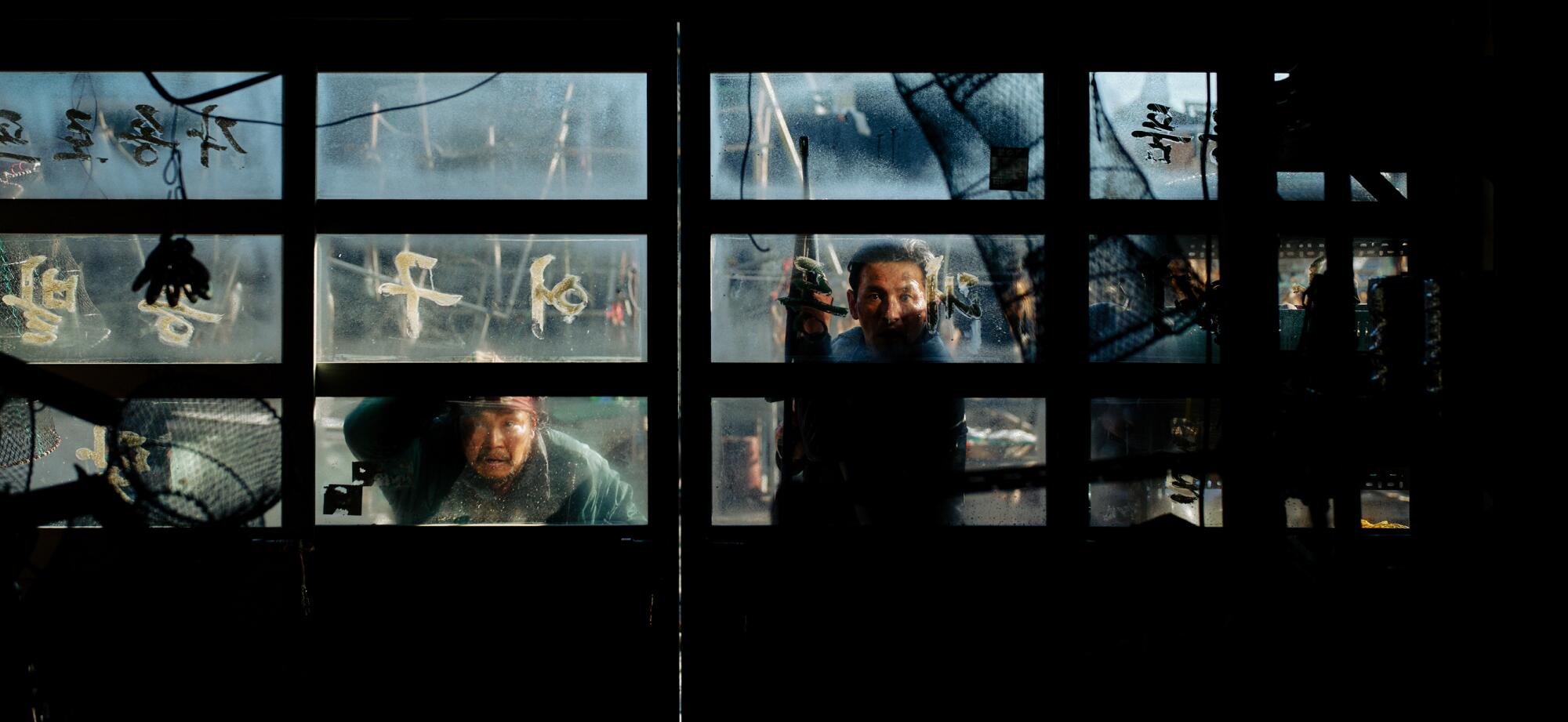
A scene from the movie “Hope,” directed by Na Hong-jin.
(Neon)
When did you realize that you had a big sci-fi alien monster movie in you?
The idea came to me in 2017 in Seoul. The premise started off with somebody watching news in a diner or a small restaurant. It was that image that I had in my head. So I started developing that initial image in more detail. By 2018, I was able to write my first draft.
“Hope” brings to mind several genre classics, from “Jaws” and John Carpenter movies like “The Thing,” to something more homegrown such as Bong Joon Ho’s “The Host.” Were those inspiring to you?
I must have looked all the genre films that I could find, including the ones you mention, before I went into filming. And, as I hope you noticed, I was looking more at films from before 2000 and I tried to reflect that look.
It seems like you’re using Cannes as a moment to pivot or reinvent yourself. Is that intentional?
I didn’t intend for this to be a turning point in terms of style or direction going forward. I never thought of it that way. What I really dwelled on was thinking about how to tell this story in a way that was approachable and entertaining for people.
Why did you set the story in the demilitarized zone?
If you look at it from a universal perspective, what happens in this very shabby, humble, small, insignificant space potentially creates an impact that can go on infinitely. I think none of the characters in the film do anything with any malice. I guess the underlying story I want to tell is that there is no reason for evil intention behind anything, but innocent acts can build up to something tragic.
Michael Fassbender and Alicia Vikander are wonderful surprises in the movie as some rather dignified aliens. What led you to them?
When I was casting the alien roles, I had a bigger story in mind. I don’t know whether there’ll be a sequel after this one, but if so, that sequel is going to be centered around them. So picking the right actors was very important for me. We asked them to learn this invented alien language, which they prepared and came onto set knowing.
How important to you is comedy and releasing tension with laughs?
Very. I try to really think it through and if it comes out the way I intended, that gives me such a thrill. I tried to incorporate it in many places.
A lot of the movie feels like a virtuoso chase sequence, people barreling down the road, guns blazing. But it took me a minute to realize that the more interesting question is: Who’s doing the chasing? Is “Hope” meant to make us examine our own violence?
Yes, very much so. And two of the major chase scenes were designed so that what starts off as righteous somehow tilts toward being unjust. I wanted the action to bring up that transition in perspective.
You’ve premiered at Cannes before but, in a way, it feels like the wrong festival for a movie like this. You’re laughing because I think you agree with me.
It goes without saying. I’m incredibly nervous. And I feel so grateful that you’re treating me so nicely and gently.
A scene from the movie “Hope,” directed by Na Hong-jin.
(Neon)
Why did it take you 10 years to make this film?
There was a pandemic in the middle of that. But except for the pandemic where everything stopped, I was working my ass off before and after. It still took this long. I’m a little concerned myself, like: How did this happen?
With “Hope,” are you saying goodbye to the filmmaker you once were?
Not at all. Throughout the entire process of making this film, I was bloodthirsty. I was thirsting for blood. I have another script written already.
And maybe now it’ll go faster because there won’t be a pandemic. Are you hoping that this movie is going to have an impact on the Korean film industry?
It’s not my place to say that. I’m not sure. I want things to be freer.
Would it be a mistake to read this film as an allegory for what’s happening now in the world? Is it a plea for understanding?
I don’t regard it as a plea for understanding. Rather, let’s hope people will be able to relate to it and be empathetic about the story and realize for themselves, understand for themselves. Maybe there’s something more to it, but you take away what you will from that.
Your dark humor flares on occasion. Did you make it a point to try to preserve that?
Well, you can’t just do something like this without having that. It’s not fun.
This doesn’t feel like an “Avatar”-style film. There’s an openness to it, a sense of exploration. Do you believe in heroes?
I do believe in heroes, but, as I tell in the story, anyone can be a hero.
OFF the coast of Northumberland is a remote, tidal island that you’ll have to time right to visit – as it is cut off from the mainland twice a day.
Called Lindisfarne, or by its other name, Holy Island, it might be familiar to fans of horror movies.
Sign up for the Travel newsletter
Thank you!
The tidal island of Lindisfarne is cut off from the mainland twice a dayCredit: GettyThe island was used a backdrop for the movie 28 Years LaterCredit: Shutterstock Editorial
Follow The Sun’s award-winning travel team on Instagram and Tiktok for top holiday tips and inspiration @thesuntravel.
The island off the coast of Northumberland was used to film post-apocalyptic film, 28 Years Later, which came out just last year.
The 2025 movie was about a group of survivors of the rage virus living on a small island starring actors like Jodie Comer, Aaron Taylor-Johnson and Ralph Fiennes.
Filming spots included the tidal causeway and Lindisfarne Castle which attracts thousands of visitors every year.
The National Trust took over the property in 1944 and it has been open to the public ever since.
Inside the castle, visitors can explore the different rooms, including a dining room, a kitchen, and bedrooms, as well as the upper battery, which has panoramic sea views.
The island has been the backdrop for ITV’s Vera tooCredit: Alamy
In addition to exploring the interior of the castle, there are plenty of other things to see.
Entry to the castle is £14.30 for adults and £7.20 for children (between 5-17).
The island is also referred to as Holy Island, and it got its nickname after becoming the centre of Anglo-Saxon Christianity in the 7th century.
It was home to saints and it’s considered a very religious place.
But for those who want to move away from its history, there’s plenty to do on the island, like visit its coffee roastery, Pilgrims Coffee.
The business first set up in a yurt, but now even has a cosy cafe on the island too serving up caffeine hits and homemade cakes.
St Aidan’s Winery is where locals can try locally made Lindisfarne MeadCredit: Alamy
Another spot to visit is St Aidan’s Winery, where Lindisfarne Mead is made, and visitors to the island can pop in for tastings and browse the shop that sells its wine and beer.
The island has around 160 permanent residents, but it does have places for visitors to stay from hotels to holiday lets.
For seal spotting, head to the harbour or the sand flats around Lindisfarne National Nature Reserve where there are thousands of grey seals especially between February and October.
To get to Lindisfarne, you have to cross the causeway from the mainland which is only accessible at low tide from the town of Beal.
While the tides can be predicted, holidaymakers will need to check the crossings on the day on the Northumberland County Council website.
It’s not merely trendy psychologizing to salute the qualities of a sturdy tree: a humbling reminder of time’s immensity, but also a living embodiment of shelter, change and growth. Leave it, then, to a massive gingko on the grounds of a medieval German town’s college to cosmically center the three-pronged, multi-generational character study “Silent Friend” from Hungarian filmmaker Ildikó Enyedi.
Enyedi, from her mesmeric, calling-card period lark “My Twentieth Century” to the eccentric love story “On Body and Soul,” has always been preoccupied with that realm in which the everyday meets the all-seeing and possibility is awakened. So it shouldn’t surprise anyone that she’d give a starring role to a 200-year-old tree, which just may inspire the needed answers. And why not? Our living, “breathing,” sky-reaching neighbors have considerable communication skills with each other.
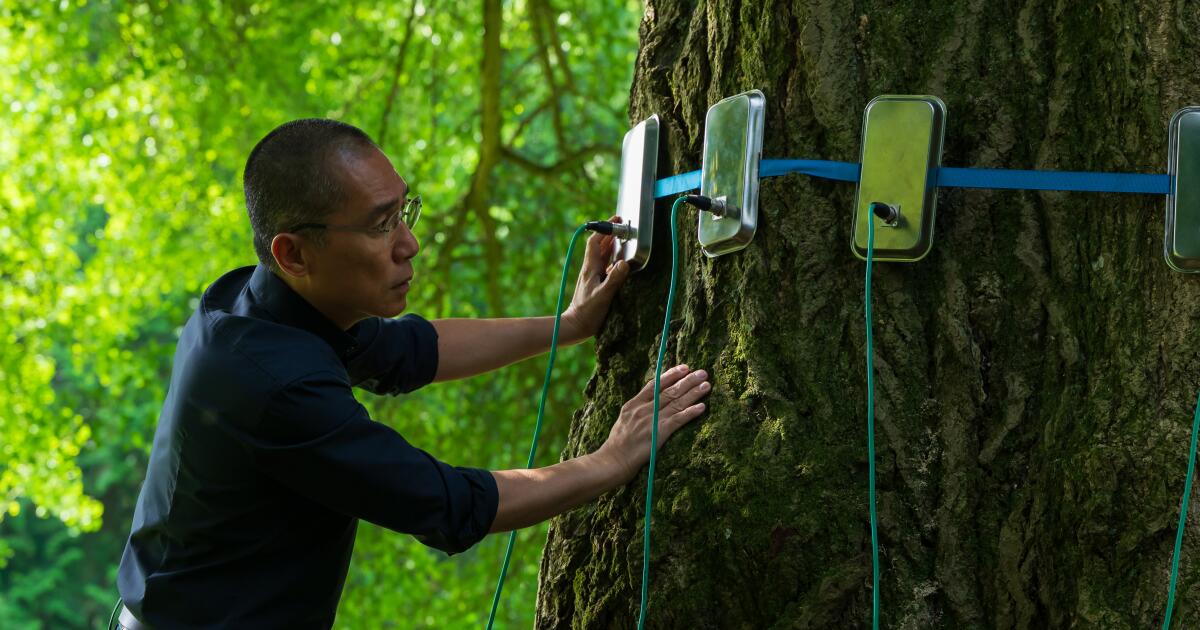
Our entryway is a modern day neuroscientist played by Tony Leung Chiu-wai (and called Tony), who arrives at the University of Marburg as a visiting professor ready to further his groundbreaking research into the mysteries of infant brain development. The gig becomes a lonely endeavor, however, when the pandemic hits and he’s confined to a depopulated campus, sent unwillingly into a kind of monkhood.
It’s as if the nearby natural world, photographed by Gergely Pálos and edited by Károly Szalai, was just waiting for such a solitary moment to draw Tony’s undivided attention into the prospect of green intelligence.
In tandem, Enyedi transports us to 1908 to meet aspiring botanist Grete (Luna Wedler), the university’s first female student, subjected to cruelly patronizing treatment by smug male elders, yet driven to see plants anew when introduced to the light-capturing rigor of photography. The movie’s third woven-in protagonist is a wide-eyed, resourceful farm boy, Hannes (Enzo Brumm), in 1972. While his fellow students spark to the winds of political change and sexual freedom, he becomes fixated on what a lone geranium, imaginatively monitored on its windowsill, might have to convey if given the chance.
The fluid, idiosyncratic charm of “Silent Friend” — which never feels like two and a half hours — is in Enyedi’s heartfelt belief that curiosity is simply a garden that grows progress. It doesn’t hurt, of course, that this veteran dreamweaver’s key cast are entrancing, inviting specimens themselves, led by an inner glow of compassion in Leung that feels like its own natural energy source. When his character contacts Léa Seydoux’s French plant expert, it becomes almost too much rapturously intelligent star wattage for one quietly poetic movie, even if these god-tier actors are just zooming and talking shop.
Hardly anything is overdone here and, in one essential way, Enyedi is also making the case for movies themselves as phenomena to protect and treasure: ecosystems of light, texture, wonder and nourishment. Visually, the film toggles between intimate 35mm black-and-white, grainy 16mm color and multi-purpose digital cameras that visually represent distinct eras. Needless to say, that gingko tree is sublime and majestic in all of them.
‘Silent Friend’
In German and English, with subtitles
Not rated
Running time: 2 hours, 27 minutes
Playing: Opens Friday, May 15 at Laemmle Royal and AMC Burbank Town Center 8
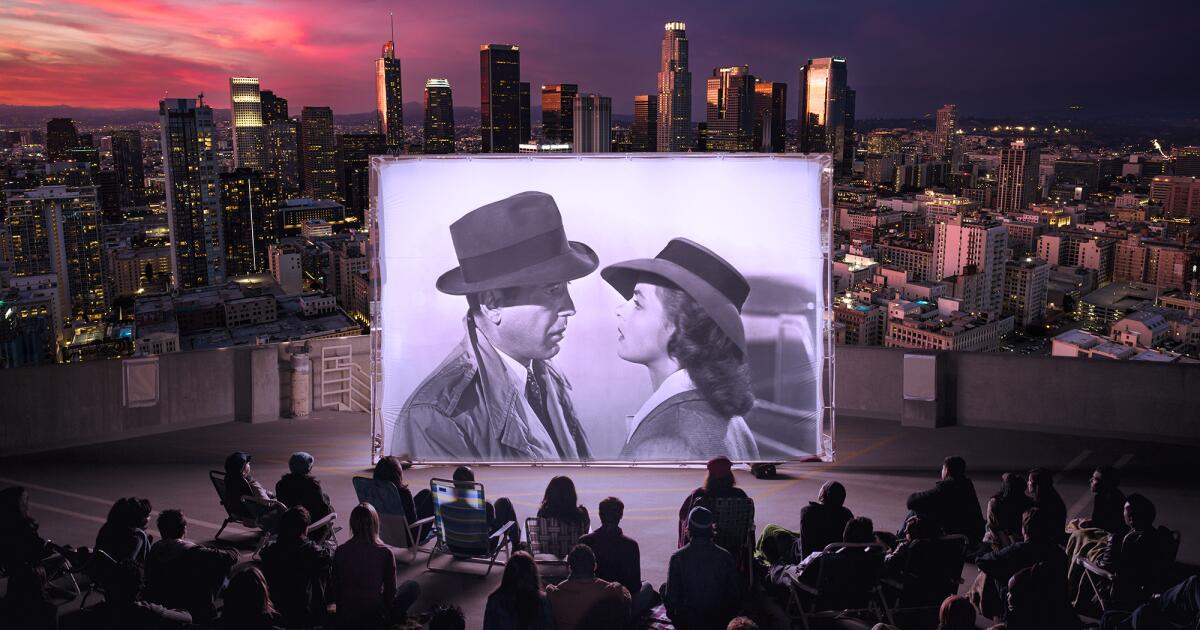
Tucked inside the downtown skyline, four floors and 50 feet above Olive Street, the Rooftop Cinema Club is hosting daily summer showings of cult classics, blockbusters and an occasional art-house piece. Each ticket holder is provided a pair of wireless headphones, and sunglasses are recommended for earlier showtimes.
Cost: $21 to $27 for patio chairs. $32 to $36 for cushioned loveseat. Parking rates below the building range from $10 to $12.
Next film: “Saved!” on May 14, 8:15 p.m.
Other films: “Twilight,” “Josie and the Pussycats,” “Past Lives,” “10 Things I Hate About You.”
Food options: Outside food and drinks are not allowed. Concession stands carry popcorn, nachos, pretzels and other snacks. Full bar with cocktails, beer and wine.
Dog-friendly? Pets not allowed.
Things to note: Bring-your-own-blanket policy for cold nights. Age requirements vary; most showings are 16+, but select films are 18+ and 21+. If weather conditions become too extreme, showings may be canceled.
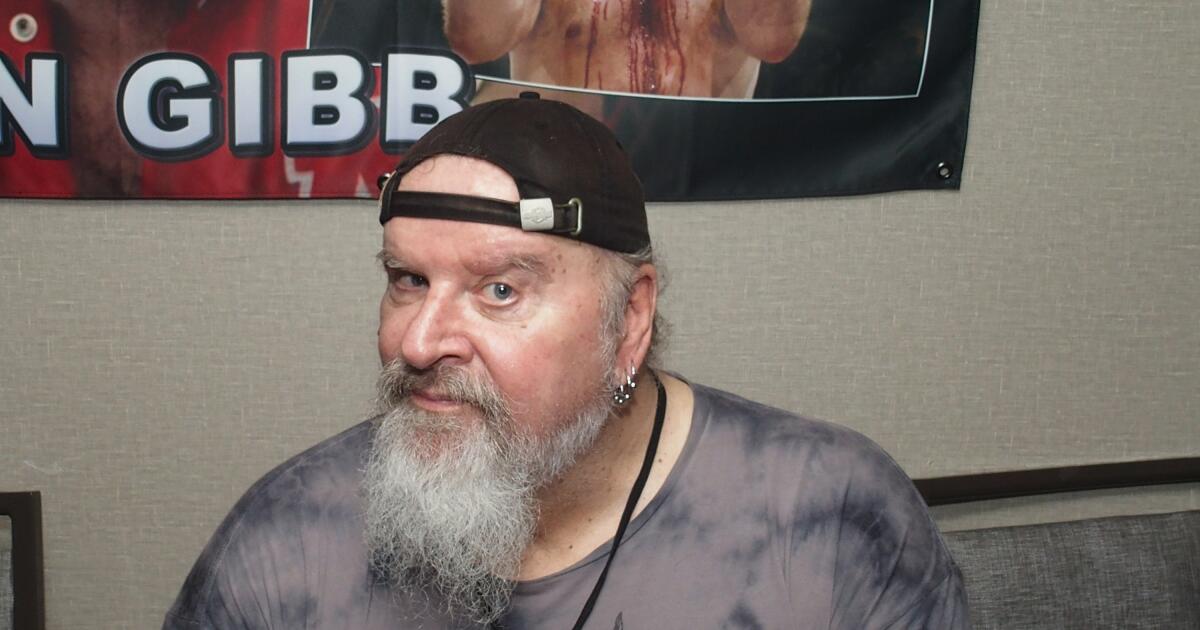
Donald Gibb, the actor who played the hulking fraternity bro Ogre in “Revenge of the Nerds” and Ray “Tiny” Jackson in “Bloodsport,” has died. He was 71.
Gibb’s son Travis confirmed his father’s death to TMZ on Tuesday evening after he died earlier that day at home in Texas surrounded by family. Gibb, a former professional wrestler under the name “Don Gibb,” succumbed to “health complications,” according to his son.
A statement from the family, provided to People, described Gibb as a father, grandfather, great-grandfather, brother, uncle, friend and actor.
“Known for his larger-than-life presence on screen and his kindness off screen, he brought joy, laughter, and unforgettable memories to countless people throughout his life and career,” the statement said.
“Above all else, Donald treasured his faith and the people he loved,” it continued. “His strength, generosity, and spirit will never be forgotten by those who had the privilege of knowing him personally and by the many fans whose lives he touched over the years.”
“Bloodsport” star Jean-Claude Van Damme remembered Gibb in an Instagram story, posting a photo from 1986 and writing “Rest in peace, my brother.” He also reposted a reel showing himself and Gibb in the 1988 movie.
“Whether he was the lovable brute Ogre in Revenge of the Nerds or the fearless Ray Jackson in Bloodsport, Donald brought a heart as big as his frame to every role,” the caption on the reposted reel said. “Watching him alongside Jean-Claude Van Damme was the ultimate display of brotherhood on screen. In the clip, JCVD asks, ‘What took you so long?’ It’s a bitter-sweet reminder that while he’s gone too soon, his legacy in the martial arts and 80s cinema world is timeless. ‘Anytime, anyplace, anywhere.’”
A representative for Gibb didn’t respond immediately Wednesday to The Times’ request for comment.
Gibb had about 100 credits, including the sequels “Bloodsport” and the movie and TV sequels to “Nerds.”
Born Aug. 4, 1954, Gibb started his career in the early 1980s with uncredited roles in “Any Which Way You Can,” “Stripes” and “Conan the Barbarian.” His TV credits included episodes of “Cheers,” “MacGyver” and “The Young and the Restless.”
He acted into 2011, then tagged on one last credit, for the 2026 movie release “Hands.” According to IMDb, that filmed sometime in 2023 or 2024.
Two-thousand, four-hundred and forty-eight miles. That was the span of Route 66 when highway officials stitched it together to link Chicago, Los Angeles and countless cities and towns in between. But as an enduring American symbol, this highway reaches much further than that, inspiring books, songs, movies and countless road trips.
It turns 100 this year, so with summer coming, we drove it all.
Across eight states, we scouted out vintage motels, new businesses, neon signs, friendly Muffler Men, road food, vivid characters and 20th century ruins. We also kept our eyes open for hints of the road’s evolution, from the Dust Bowl years, segregation and the postwar boom to the freeway-era slump and the reemergence of Route 66 as a long, winding and living historic landmark.
Now we’re taking you along for the ride. If you’ve ever daydreamed about covering some part of the famous roadway, hop on in and let’s get our kicks, shall we?
The most recent death on Mt. Wilson claimed the life of a man identified as New Zealand-born, L.A.-based composer Mark Smythe. Following the tragedy, his colleagues and family poured out their hearts as they remembered a man they called smart, funny and a true supporter of his peers.
Smythe died Saturday at 53 after suffering a cardiac emergency on a hiking trail, according to the coroner’s online database. His cause of death was atherosclerotic cardiovascular disease, in which plaque builds up in arterial walls and can lead to a heart attack.
The Sierra Madre Police Department said Saturday that a man — at that point unidentified — died after having a medical emergency on the trail and that no foul play was suspected. First responders arrived at the site around 10 a.m. and administered aid but were unable to save his life.
Smythe had been head of the department of Composing for Visual Media at Los Angeles Music College since last summer, according to his website. Among other honors, he was nominated for a 2023 Society of Composers and Lyricists Award for his work scoring the movie “The Reef: Stalked.”
Kate Ward-Smythe, the composer’s sister, acknowledged his death late Sunday on Facebook.
“It is a comfort to know that he was doing one of the things he loved, hiking in the hills, and we are grateful to his wonderful friends (and emergency service responders) who tried so hard to resuscitate him,” she wrote.
“Mark was a strong larger than life connector in LA, as a professor, composer, musician, and loyal friend. He was also fiercely talented, and an absolute cheerleader for music performance and recording across multiple genres.. he was only just getting started and had so much more to give .. We are heartbroken and trying to process this tragedy, as are all Mark’s friends and family.”
Bear McCreary, known for scoring TV series including “Outlander,” “The Walking Dead,” “Black Sails” and “Snowpiercer” and movies including “Happy Death Day,” “Godzilla: King of the Monsters” and Blumhouse’s “Fantasy Island,” called news of Smythe’s death “awful and surreal,” saying they had just been chatting at a mutual friend’s party a few weeks ago.
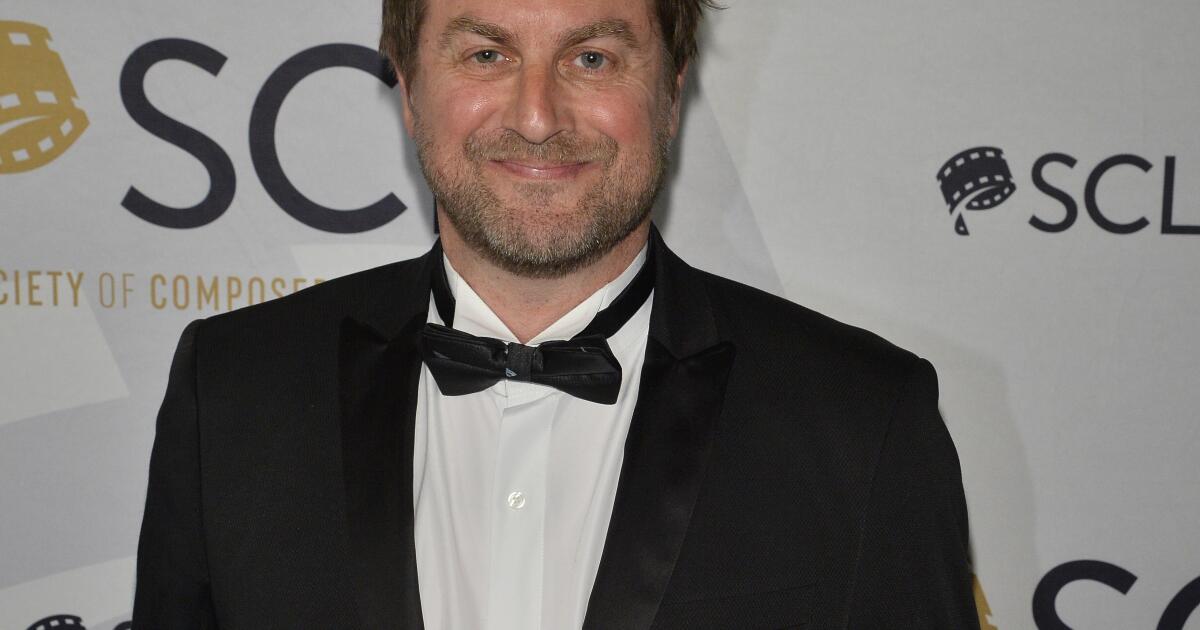
“Mark’s enthusiasm and humor were off the charts,” McCreary wrote Sunday on Instagram. “He brought a shark with a bowtie to the red carpet of an SCL awards ceremony when he was nominated for his work on a shark movie – hilarious! When he found out I was writing a metal album, he curated his favorite German folk metal bands for me (turning me on to his favorite band, Finsterforst).”
Having said he always thought he would get to know Smythe better one day, McCreary called his death “a stark reminder to spend time with the people you care about while you can.”
John Massari, who has more than 150 music credits stretching back to “Little House on the Prairie” and contributed music to TV series including “Dancing With the Stars,” “Pawn Stars” and “It’s Always Sunny in Philadelphia,” said in comments that “Mark was a bright light and a refreshing spirit in our community. He is greatly missed.”
“I’m so deeply sad to lose my friend. Mark, I miss you and love you. Thank you for your love, passion, humor, and joy and for always making me feel loved and valued,” singer Baraka May, whose voice can be heard in “Avatar: Fire and Ash,” “Wicked: For Good” and “Beavis and Butt-Head,” wrote Monday on Instagram.
“He was funny and snarky and whip-smart, yet when we collaborated, he just melted into the music and gushed like a fan with child-like wonder. What a tremendous heart and mind!” the vocalist wrote. “I had the honor of collaborating with him on three of his beautiful pieces as a conductor, and I loved his boyish, genuine joy and excitement even in our rehearsals. He wrote and voiced his music beautifully, which often felt haunting, romantic, deep, and sensitive, and his bass playing was so beautiful and thoughtful. He was such a vivid, enthusiastic music lover, and I was very much looking forward to making more music with him.”
The Los Angeles Film Conducting Intensive also mourned the loss, saying online that “Mark was a brilliant talent and a genuine friend to all, a true pillar in our scoring community.
“During the pandemic, Mark generously joined our 2020 New Music Project to support new repertoire for our music community during a time of great uncertainty and when most traditional pieces could not be performed.”
The Hollywood Music in Media Awards remembered Smythe winning a career-propelling prize at the organization’s 2013 ceremony, soon after he arrived in L.A. from New Zealand.
“He quickly built a distinguished body of work for film, shorts, and television, earned multiple HMMA nominations, served as COO of the Society of Composers & Lyricists, and returned to present at the 2018 HMMA Gala,” the organization wrote. “Mark’s talent and generosity enriched our community — he will be greatly missed.”
Smythe’s death was the second this month on Mt. Wilson. On May 3, a man identified as John McIntyre, 66, was declared dead on the same trail after falling down a ravine at Mt. Wilson Road and the Little Santa Anita fire break in Sierra Madre. His cause of death was blunt force injuries.
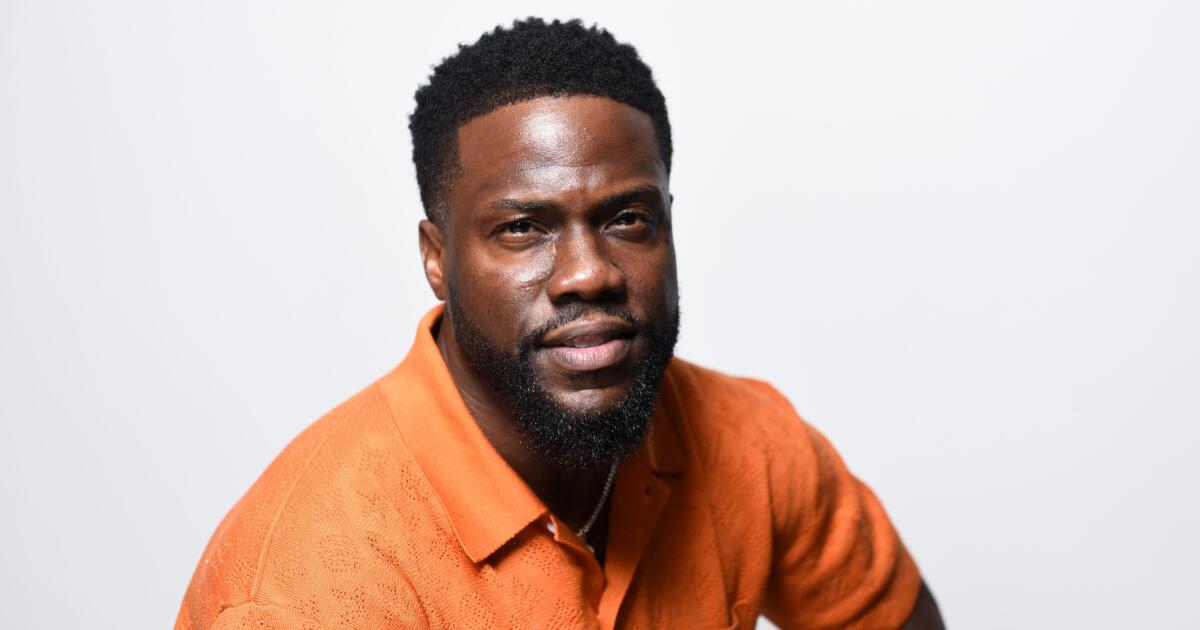
When Kevin Hart announced in January that he’d licensed his name to Authentic Brands Group, the popular comedian was silent on a key detail: the future of his namesake media company.
Hart sold some ownership and oversight of his brand in exchange for an undisclosed sum of money and a stake in Authentic, a New York-based firm that manages the likenesses of Marilyn Monroe, Muhammad Ali, Shaquille O’Neal and David Beckham.
Hart used the partnership with Authentic to reset his relationship with the people around him and his company, according to six current and former employees. Hart’s employees say they worry that this deal marks the beginning of the end of Hartbeat, the comedian’s namesake media company that produces films, owns a network of short-form video channels and handles marketing for brands.
Though the announcement made no mention of Hartbeat, the agreement gave Hart money to buy out his private equity partner in the company over time and regain control of the use of his name, image and likeness. Hart’s endorsement deals, which had been a pillar of Hartbeat business, will now be handled by Authentic.
Once valued at about $650 million, Hartbeat has shriveled over the past few years. The company enacted its latest round of job cuts in December, firing the heads of its scripted TV division, as well as employees working across marketing, social media and brand partnerships, said the people. Earlier this year it let go the leaders of its podcast division and later sued them for breach of contract.
Hart has withdrawn from the company, leaving day-to-day management in the hands of a small group of executives. Staff meetings have been canceled. The development of new film and TV projects has slowed. A slate of new podcasts was pitched but never produced.
Hartbeat’s struggles reflected the challenging environment for many Hollywood production companies as media giants merge and cut spending. The company is also a cautionary tale in this age of the celebrity media mogul. Financial firms have plowed money into media companies led by high-profile figures, believing they could use their notoriety to build valuable businesses. Yet even seemingly successful ones have had a hard time.
Hartbeat, like many of its peers, has suffered from mismanagement and grappled with the tension between the needs of the star and his company. Hart, one of the hardest-working people in Hollywood, tired of subsidizing a company that relied so much on him
Hart declined to comment for this story, which is based on conversations with several current and former employees. On Sunday night, Hart, who hosted the widely viewed roast of NFL great Tom Brady two years ago, was the subject of his own roast on Netflix.
Building a Billion-Dollar Business
One of the most successful stand-up comedians and actors of his generation, Hart, 46, has always been entrepreneurial. In 2017, he started Laugh Out Loud, an online video comedy business that later grew to include branded entertainment. He also operated his own production company, Hartbeat Productions, that made programs for streaming services like Peacock, Quibi and Netflix Inc.
With Hollywood in the midst of a production boom, Hart watched his fellow celebrities get rich from their media enterprises. Reese Witherspoon sold her media company, Hello Sunshine, in a deal that valued it at as much as $900 million. Hart’s friend LeBron James raised money for his company, SpringHill, at a valuation of $725 million. Hart believed he could be next.
In late 2022, Hart merged his business interests under the Hartbeat banner and raised money by selling a 15% stake to the private equity firm Abry Partners. The deal valued the company at about $650 million.
The new business was predicated on three pillars: film and TV, short-form video and advertising. Hartbeat had a deal to produce movies for Netflix, a slate of podcasts for SiriusXM Holdings Inc. and original audio series for Audible. Hartbeat also developed relationships with advertisers such as Lyft Inc., Procter & Gamble Co. and DraftKings Inc.
While Hart would star in Hartbeat projects, the goal of the company was to develop projects and new business that didn’t involve its namesake founder. The company could leverage Hart to sell projects and secure broad programming partnerships. Hart would ask that Hartbeat be involved in producing his movies and any advertising campaign for which he was a spokesperson. His fees as a producer and brand ambassador would help pay the bills. The hope was he’d convince other celebrities to use Hartbeat as well. Thai Randolph, who had been running Laugh Out Loud, was named chief executive officer.
Hartbeat opened offices in New York and Atlanta and took over a 40,000-square-foot West Hollywood office once occupied by Oprah Winfrey. Hart redesigned the space and installed a world-class art collection.
The upper-level lobby featured a work by Ghanaian artist Serge Attukwei Clottey, while the conference room had a sculpture by Zimbabwean artist Moffat Takadiwa made of computer keyboard keys. A portrait of Kobe Bryant by Julian Pace hung outside a podcast studio.
Hart’s own office featured a dressing room, a series of paintings by South African artist Feni Chulumanco, multiple TVs and a desk from a prominent French designer. “He really has almost a full-service apartment in his suite,” Kai Williamson, who worked with Hart on the project, told Architectural Digest. Hart was interviewed for a story and also filmed an episode of the design magazine’s “Open Door” video series.
While Hartbeat expanded, Hollywood entered a recession. Economic uncertainty, rising interest rates and growing skepticism about the profitability of streaming caused major media companies to fire staff and pull back on buying new projects. Hartbeat was a little more insulated than most because talent like Hart could usually still get a project made. Still, producing projects without Hart in a starring role became more difficult.
Randolph left the company in late 2023 and was replaced by Jay Levine, who had spent much of his career at Warner Bros. Discovery Inc. Levine brought in a couple of other senior leaders with experience at major media companies.
A contingent of executives pushed Hart to scale back some ambitions, the people said. The company couldn’t afford to be working in so many different businesses at the same time, especially as areas like free, advertising-supported online video, and podcasts got more competitive. Hart was one of the most prolific and productive creative people in the world, starring in and producing movies, TV shows, comedy, short-form videos and advertisements. The point of the company was to relieve the stress on him, not add to it.
While Hartbeat closed its New York office, Hart was reluctant to scale back his vision or replace some long-time lieutenants. Levine negotiated his exit at the end of 2024 and was followed out the door by the company’s chief financial officer and chief content officer. Days before Thanksgiving, Hartbeat laid off about 20 people, nearly one quarter of its work force.
A year of chaos and conflict
In January 2025, Hart announced he would be the new CEO of Hartbeat and pledged to outline the firm’s strategy in the coming weeks. Instead, Hart went weeks and sometimes months without visiting the office, the people said, and empowered Jeff Clanagan and CFO Eric Stoneburner to run the company day to day. (Hart was on set to shoot at least a couple movies last year, in addition to his other work.)
A former concert promoter and movie producer, Clanagan had helped make Hart a major star. He had partnered with Hart to bring his stand-up specials to the big screen, producing shows such as 2013’s Kevin Hart: Let Me Explain, which grossed $32 million at the box office. Clanagan produced some of these specials under the banner of his own company, Codeblack Films, which helps promote, market and distribute video from Black creators.
Clanagan continued to operate Codeblack while serving in a senior capacity at Hartbeat, said the people. He pushed employees at Hartbeat to post its videos to the Codeblack channels as well, saying they could use the additional reach to raise awareness. The videos generated advertising sales for Codeblack.
Clanagan had employees at Hartbeat oversee Codeblack’s social media pages and asked to get those channels loaded into Hartbeat’s content management system. That gave Codeblack’s YouTube channels advantages over others because of Hart’s prominence and his company’s designation with YouTube. Employees raised concerns with human resources and the company’s lawyer.
Clanagan also became increasingly interested in video generated by artificial intelligence. He started a new app called Blktopia, a streaming service for Black viewers programmed with content from online creators and often made by AI. He urged employees to work on it, the people said. Clanagan initially responded to a request for comment and then retracted the text message.
Meanwhile, many of Hartbeat’s main businesses languished. Sales from the company’s YouTube channels fell and investment in new film and TV projects slowed. Hartbeat, once profitable, started to bleed cash. Hartbeat had hired Eric Eddings and Lesley Gwam to produce audio shows that didn’t involve Hart. While the pair developed a slate of projects, they never got approval to make them.
In mid-December, Hartbeat fired about a dozen employees, including some of those who were supposed to develop the podcasts. Eddings and Gwam then decided to start their own company and began trying to raise money. When Clanagan found out, Hartbeat fired them and sued for alleged theft of trade secrets and breach of contract.
A court approved a temporary restraining order but then rejected a preliminary injunction, saying Hartbeat had not demonstrated Eddings and Gwam had used proprietary information or trade secrets. The court said the request was “vague, ambiguous, and overly broad.” The case is ongoing.
Hartbeat also fired the heads of its TV division, Tiffany Brown and Mike Stein, who were in the middle of producing a TV show based on the film Barbershop for Amazon.com Inc. and a second season of the animated series Lil Kev.
The company made no official announcement explaining the cuts. The following week, senior leadership arranged a Zoom meeting. Hart remained off camera until it was his time to speak. He talked for a few minutes about changes at the company and took no questions. Hart changed his phone number in the weeks following the layoffs. (Some of his advisors had suggested he do this years earlier so that he wasn’t so available.)
A few weeks later, Hart announced the deal with Authentic Brands Group. Hart used some of the proceeds to buy out Abry Partners, freeing him to steer his brand deals to Authentic and outside of Hartbeat. A few of his employees and his publicist joined him at Authentic.
“This is a turning point for Hartbeat,” the company wrote in a subsequent email to employees, explaining that the deal would free Hart up to focus on what he does best, while allowing Hartbeat to stand on its own and grow beyond him.
“I know the past few months have been tough,” Hart wrote, adding that for too long the company had been too dependent on him. The email was said to be from “Kevin AKA Boss Man.” It was sent by Hart’s assistant.
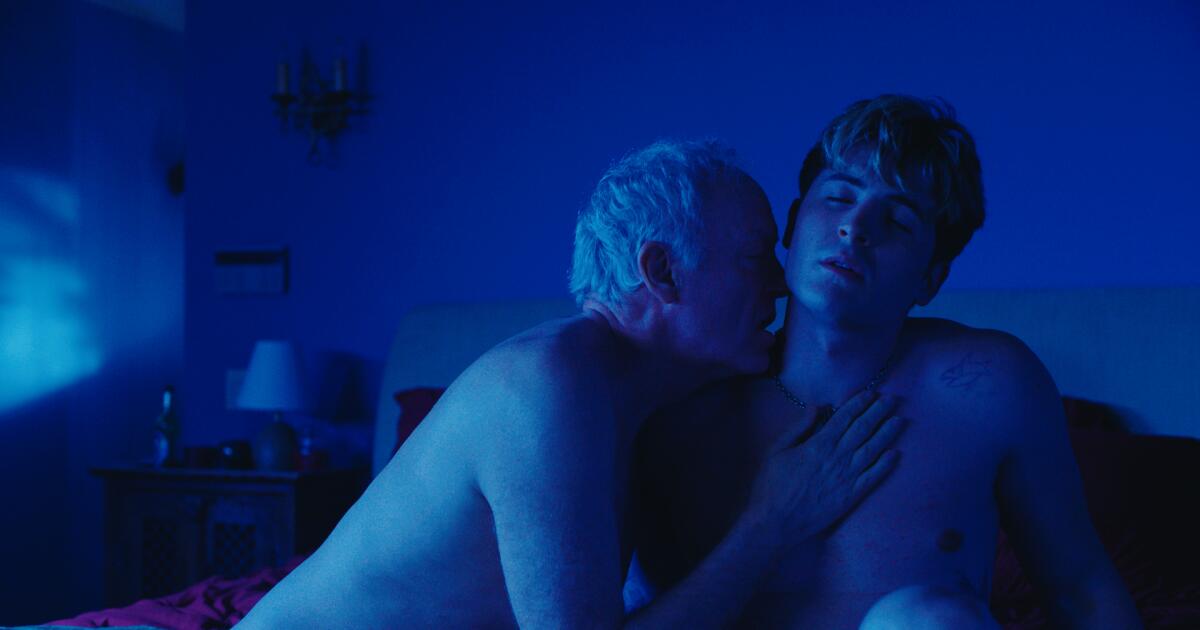
To describe a movie as including a ski mask, a camcorder and $50,000 in cash would certainly lead one to imagine a specific type of story. Add two men and sex work and the brain might roll around more pointed scenarios.
But none of that can prepare you for what micro-indie “Blue Film” has in store. The nexus of perversion, pain and sexual purpose driving writer-director Elliot Tuttle’s dark, discursive chamber drama is of a stripe rarely attempted in even the most self-consciously daring movies. Should you need a self-imposed break afterward from intimate two-handers, even Tuttle might understand, then wink in the general direction of his Pasolini posters. (I’m guessing at this provocateur’s wall art.)
Is it clear yet that “Blue Film,” set primarily in a house in Los Angeles over the course of a revelatory night, isn’t for everybody? Some of that “everybody,” incidentally, includes the festivals and distributors who rejected the queer filmmaker’s debut feature, despite having critical buzz, Tony-winning actor Reed Birney as one of its stars and indie guru Mark Duplass as a mentoring producer.
But certain subjects (spoilers ahead) are bound to trigger a different kind of scrutiny. Initially, our attention is on macho-posturing tattooed camboy Aaron (“Boots” star Kieron Moore), graphically boasting to his followers online of the big payday he’ll receive that evening from a submissive client. What he later encounters, however, at the door of a Craftsman on a quiet street is a masked, polite, older host (Birney) with a camera and, once it’s turned on, a lot of personal questions, the kind that begin to crack the facade of a young man used to being in control of his transactional life.
Then his client’s face is revealed and Aaron recognizes it’s his middle school teacher Hank, a convicted pedophile who once coveted him. Hank, who completed prison time for the attempted assault of a different boy, has made a cross-country trip to seek out the adult version of someone who could have been his first victim. He is still processing what he is, wondering if desire, even love, is available to him anymore.
The question is, will you care? Even viewed through Aaron’s cautious, clear-eyed empathy, it’s a steep ask. But you should. Tuttle’s fearless inquisition won’t insult your intelligence, ask your mercy or hogtie your feelings. Honestly, it’s refreshing to be repulsed and intrigued by a movie willing to plumb these psychological depths when Hollywood won’t. In its commitment to unvarnished talk — even if that leads to a clunky staginess — “Blue Film” has thoughts about identity, choice, sin and salvation. There’s a sincere engagement with humanity’s more difficult realities.
Needless to say, this type of graphically articulated exchange wouldn’t work if the performances didn’t land. Thankfully, Moore’s affecting portrayal of jumbled masculinity mixed with situational curiosity is well-calibrated, while Birney, a pro with a challenge, eases us into Hank’s weary self-possession (if not always the nauseating facts of it) before coloring outside the lines with a believably interesting philosophy about reckoning.
But “Blue Film” is tough, make no mistake. Awkward and searching, it exists in a filmic space that you could argue was opened up by last year’s courageous documentary “Predators.” And sometimes that gaze is just discomfiting, full stop. Tuttle wants that. He has room to improve but he’s someone to watch, plumbing the hard-to-fathom.
Hello! I’m Mark Olsen. Welcome to another edition of your regular field guide to a world of Only Good Movies.
This newsletter is about going to the movies, of course, but it’s about writing and reading about movies, too. And so it was exciting news this week that Film Comment, the venerable but shuttered publication that helped foster cinephilia in America, would return as a quarterly online publication.
A complete archive is now available online, going all the way back to the earliest issues in 1962. Looking for landmark writings by Manny Farber, Paul Schrader, Richard Corliss, Amy Taubin, Jonathan Rosenbaum, Kent Jones or countless others? It’s all there and well worth digging into. I began my career as an intern at Film Comment, publishing some of my own earliest pieces, and still consider it a North Star for writing about movies. Its return is most welcome.
Agnès Varda’s bruising brilliance
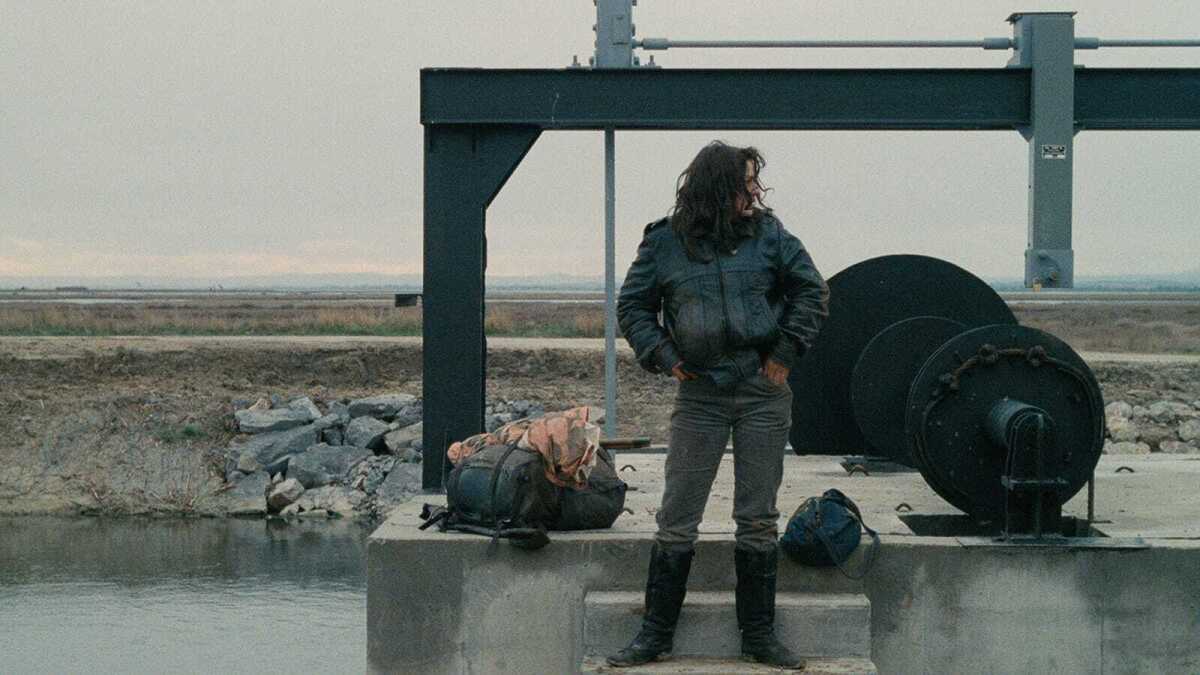
Sandrine Bonnaire in the 1985 movie “Vagabond.”
(Criterion Collection)
Though she became better known for her free-spirited, pixie-ish persona later in life, French filmmaker Agnès Varda was also capable of the bruising emotions of 1985’s “Vagabond,” arguably her greatest fiction feature and winner of the Golden Lion at Venice and the César for best actress for star Sandrine Bonnaire. Opening with the lead character found dead in a ditch, the film flashes backward to piece together her life from the memories of others, creating a fragmented portrait of an enigmatic young woman’s life.
Mezzanine will screen the film on Saturday at 2220 Arts + Archives, followed by a conversation between art critic Megan O’Grady and former Times staffer Carolina Miranda. Writing about the film in 1986, Sheila Benson said, “Just how Agnes Varda has kept ‘Vagabond’ from being a monumental downer is interesting, but she has. It is haunting. It is melancholy … but ultimately, beyond its central tragedy, it is an exhilarating film, the sort you leave burning to talk about with friends.”
A cartoon comes to life
Robin Williams and Shelley Duvall in the 1980 movie “Popeye.”
(Paramount Pictures / Getty Images)
It is one of the most deranged credit blocks imaginable: an adaptation of “Popeye” directed by Robert Altman, produced by Robert Evans, with a screenplay by Jules Feiffer, music by Harry Nilsson and starring Robin Williams and Shelley Duvall. When it was first released in December 1980, it was seen as too weird for kids and too naive for adults, but it has since been reconsidered as a unique snapshot of intersecting talents — a strange, wonderful, one-of-a-kind movie.
Vidiots will screen the film on Saturday afternoon with actors Paul Dooley and Donovan Scott, who played J. Wellington Wimpy and Castor Oyl. In our original 1980 review that is more positive than one might expect, Charles Champlin wrote, “Its difficulties arise not from a lack of ambition and innovation but from excesses of them.”
Neil Young + Devo = gloriously weird
Neil Young in the 1982 movie “Human Highway.”
(Shakey Pictures)
Neil Young’s place as a singer-songwriter and musician is unassailable — he’s an irascible, restless troubadour. But his sidebar work as a filmmaker, typically under the name Bernard Shakey, has had more sporadic and unpredictable output.
Young’s 1982 film “Human Highway” is probably the pinnacle of his work as a director, starring Young himself in an offbeat story of a small community in the shadow of a nuclear power plant. Dennis Hopper, Dean Stockwell, Devo and even former Times music critic Robert Hilburn all appear. Now Instant Image Hall will be screening the film on Saturday and Sunday along with a selection of Devo music videos in celebration of an exhibition at the MutMuz gallery.
After Young premiered a new cut of “Human Highway” a decade or so ago, I somehow found myself sitting across from him at a diner on a rainy midnight in downtown Toronto. (This job does have its moments.)
“My films are not super commercial, but they mean something to me,” Young said.
An Oscar-winning debut
Shirley MacLaine, Debra Winger and Jack Nicholson in the 1983 movie “Terms of Endearment.”
(Paramount Pictures)
Part tearjerker, part family drama and part comedy, 1983’s “Terms of Endearment” trademarks a certain bittersweet tone that is still just pure magic. The story of a mother (Shirley MacLaine) and daughter (Debra Winger) across many years of ups and downs in their relationship, the film was the feature debut for James L. Brooks as writer-director and won five Oscars, including three for Brooks. The Academy Museum will play the film in a new 35mm print on Sunday afternoon.
When the movie came out on 4K disc in 2023, I spoke to Brooks about it. He talked about how even though it does have moments of great emotional weight, it was intended to play with a lighter tone overall.
“The whole thing was to make it as a comedy,” Brooks said. “The whole thing was to clock laughs. You had to, in order to do it right. And of course, once the audience leaves and it has its afterlife, it’s a drama because people are watching it alone. But I swear to you, in the theaters it was a comedy.”
A ’90s noir ripe for rediscovery
Jason Patric, left, Bruce Dern and Rachel Ward in the 1990 movie “After Dark, My Sweet.”
(Kino Lorber)
Set in the Coachella Valley with the woozy feel of a day drunk and a sense of uneasy menace, 1990’s “After Dark, My Sweet” is an adaptation of the novel by pulp icon Jim Thompson, directed by James Foley.
Jason Patric, then only 23, stars as Kevin Collins, known as Collie, a former boxer who escapes from a mental institution and is now just drifting. He falls in with Fay (Rachel Ward), an enigmatic, lonely alcoholic widow, who in turn introduces Collie to a shady man known as Uncle Bud (a delightfully sleazy Bruce Dern). Soon Collie is ensnared in a plot to kidnap a sickly rich boy that immediately goes off the rails.
On Tuesday at Vidiots, there will be a screening of Patric’s personal 35mm print of the film — a gift he received some 20 years ago and has never watched before. (It is said to be in pristine shape.) Along with a video introduction from actor and filmmaker Alex Winter, there will be a Q&A afterward with Patric moderated by critic and scholar Travis Woods, who contributed a commentary track to a recent Australian Blu-ray release of the film.
Patric organized the screening as a tribute to director Foley, who died in May 2025 at age 71. “After Dark” landed in between Foley making “Who’s That Girl” with Madonna and the David Mamet adaptation “Glengarry Glen Ross.” Among his other credits are “At Close Range,” “Fear” and the last two “Fifty Shades” movies.
“He was a good friend of mine at the time,” says Patric on a recent phone call from Santa Monica. “I know this was his favorite movie and it was closest to him. It’s the only movie that he had actually written that he directed. And I thought the best way to do that is just to show the movie.”
Patric, who says Collie is his favorite character in a career that also includes “The Lost Boys,” “Rush” and “Your Friends & Neighbors,” was first given the script and in turn gave it to Foley; developed it further together, trying to retain the language of Thompson’s novel. (The screenplay is credited to Foley and Robert Redlin.)
“It’s really a subjective piece of filmmaking,” says Patric. “So as Collie’s figuring things out, the audience is figuring things out.”
In her original review of the film, Sheila Benson wrote that “Collie is one of those roles actors lust after, the damaged dreamer, maybe dumb, maybe dangerous, and Patric demolishes the conventions of the role with breathtaking skill.”
“After Dark, My Sweet” landed just ahead of the Tarantino-inspired crime movie boom of the mid-’90s, alongside such noir-influenced precursors as Dennis Hopper’s “The Hot Spot,” John Dahl’s “Kill Me Again” and Stephen Frears’ Thompson adaptation “The Grifters.”
“This is just such an exciting film to want to reintroduce to audiences,” said Woods in a call. “And to get the opportunity to see this film on the big screen, which most people haven’t had that opportunity for 36 years, it’s just one of those really cool, really only in Los Angeles cinematic moments.”
New this week
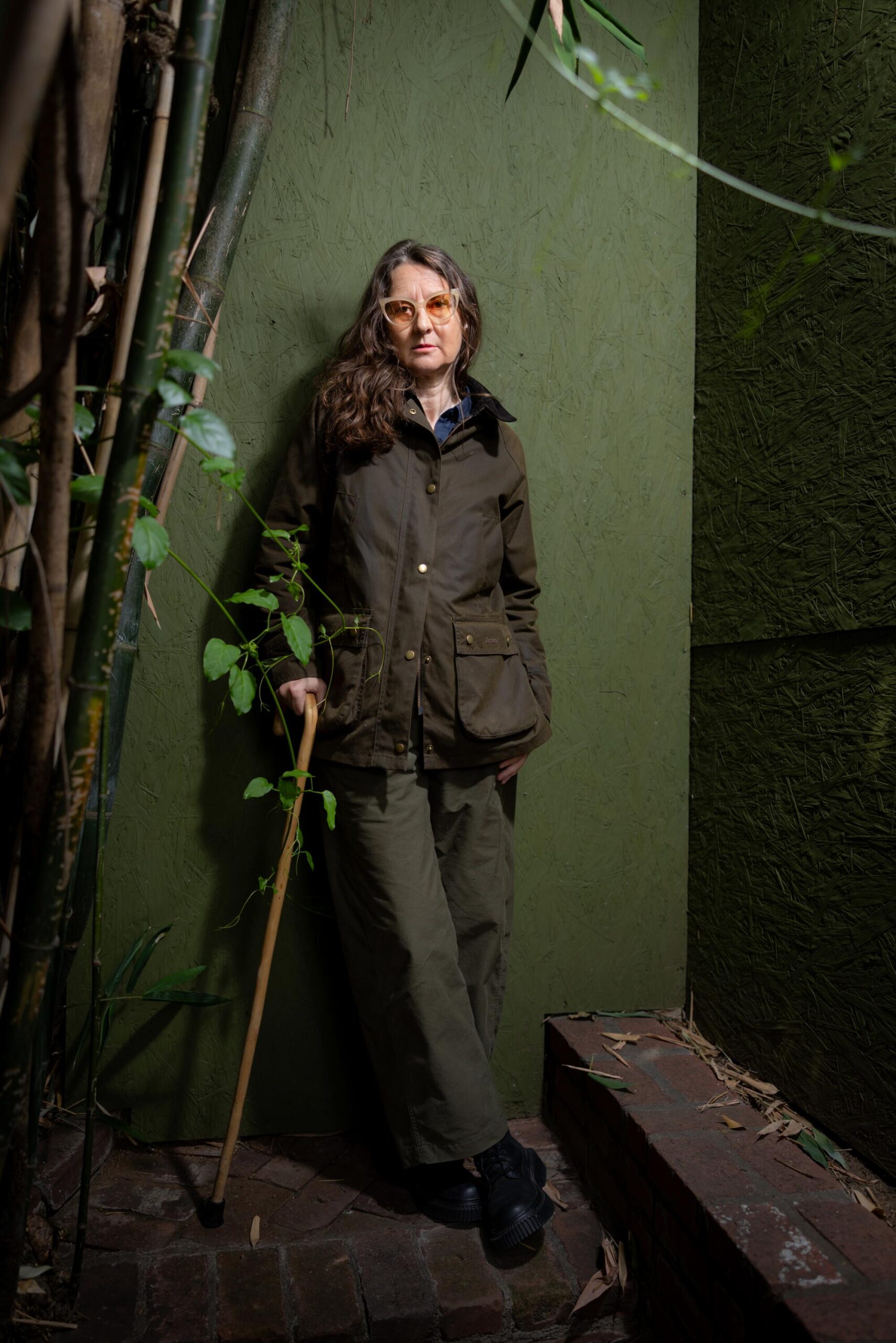
Argentinian director Lucrecia Martel, photographed at the Sunset Marquis in April.
Argentinian director Lucrecia Martel is among the world’s most accomplished filmmakers and the true crime tale “Our Land (Nuestra Tierra)” is her first documentary. Carlos Aguilar spoke to Martel about it.
“Mad Bills to Pay” expands to multiple Laemmle venues after a weekend run in the Vidiots microcinema. Carlos Aguilar spoke to director Joel Alfonso Vargas about portraying the Dominican American community in the Bronx.
On one of her previous visits to Los Angeles, Argentine filmmaker Lucrecia Martel found herself having a smoke on Hollywood Boulevard.
There, while she stepped over the famous concrete-embedded stars, an unhoused man struck up a conversation with her.
“He kept explaining to me that he was poorly dressed because he was currently living on the street after someone robbed him, but he had written a screenplay,” Martel, 59, recalls in Spanish over coffee on a morning in April at a West Hollywood hotel.
“He told me they had stolen a watch from him — not a Rolex but a known brand,” she continues. “The whole time he was trying to convince me he was a millionaire who just so happened to be on the street because of random circumstances.”
One of Latin America’s most indispensable storytellers, Martel is fascinated by how prevalent that dream still is in L.A. — that movies can change your life overnight.
“That particular fantasy is par for the course in this city,” she says, though she’s not above it. It’s the reason she’s back to promote her first documentary, “Our Land,” out Friday.
Unhurried when it comes to her output, Martel has only made four fiction features, among them 2001’s “La Cienaga” and 2008’s “The Headless Woman” (returning to theaters this month in a new 4K restoration). Her biting and formally audacious narratives examine class, politics and — a speciality — the interiority of women through enigmatic portraits of psychologically complex individuals.
“Our Land,” a piercing indictment of the enduring wounds of colonialism, chronicles the murder of Indigenous Argentine activist Javier Chocobar in 2009 and the prolonged trial of the perpetrators in 2018.
Chocobar was shot during a confrontation with armed men over land in the Tucumán province of Argentina where the Chuschagasta Indigenous community has lived for many generations. Martel explores the killing not as an isolated event in her country’s recent past but as part of a long history of dispossession.
“Racism is a foundational element,” she says of her homeland. “The only consistent thing in Argentina, from the country’s birth to the present day, is the rejection of Indigenous people.”
In Argentina, Martel explains, public education has indoctrinated the population into believing Indigenous people no longer exist. Yet many Argentines proudly claim a connection to the Europeans, Italians in particular, who arrived in the country in the late 1800s and early 1900s.
“When giving speeches, our presidents always say, ‘We are a country of immigrants,’ or ‘We came from the boats,’” says Martel. “They use metaphors like these because deep down Argentines feel much more indebted to European immigration than to our Indigenous population. But more than half of the people in Argentina have Indigenous ancestors.”
In 2020, Chocobar’s three convicted murderers appealed their guilty verdicts and were set free. “Our Land” premiered at the Venice Film Festival in September 2025, which brought renewed attention to the case. A month later, the sentence was upheld and two of the men returned to prison (one died in the interim).
Martel believes that outcome was a response to her film. “Communities wage the fight but cinema helps,” she says.
“I believe that we must use cinema for its enormous power to alter perception and not soothe the rich,” Martel says. “It’s not about delivering a message but rather about showing how an idea functions.”
(Jason Armond / Los Angeles Times)
For over 14 years, Martel worked on “Our Land” on and off. This time included periods when she focused on 2017’s “Zama,” her masterful period piece following a Spanish official in 18th century Argentina “who doesn’t want to be American,” she says, referring to the continent. In her mind, both “Zama” and “Our Land” come from the same impulse to dissect colonialism.
As part of her research process, Martel and her team created a detailed archive of documents related to the case that the Chuschagasta community now has at its disposal. Over the years, Delfín Cata, one of the Indigenous men present during the attack, would call Martel. He never asked about how her film was going, but the director sensed he was tacitly checking in on her progress, hoping that she was not losing faith.
“That was a confirmation that, beyond my own interest, there were people who needed this film,” she says. “I felt the immense satisfaction of knowing I was doing something that would be concretely useful.”
For Martel, the question of whether she was the right person to make this film (one she got in Venice) seems unfair. “It’s wrong to prevent a human being from speaking about their own history because they are not a woman, because they are not Black, or because they are not Indigenous,” she says. “It’s better to make mistakes trying to understand something than not to try at all. The chances of making a mistake are enormous in a film, no matter how good your intentions are.”
A key piece of evidence in the Chocobar case, prominent in the film, is a video that one of the attackers filmed, presumably expecting the Indigenous community to react violently, to justify firing his gun at them. The Chuschagasta men that faced them weren’t armed. As used by their aggressors, the camera functioned as a weapon.
Hollywood feels incompatible with Martel’s sophisticated, confrontational movies rooted in her country’s troubles. By Martel’s own admission, it doesn’t feel like a fit for her.
“I would have to force myself to create something outside my own country, outside my own language,” she says. “And that doesn’t really appeal to me.”
Still, Marvel Studios famously asked to meet with her when seeking a director for 2021’s “Black Widow.” Martel says she was among many directors they contacted, but she was curious to take the meeting even if she knew nothing would come of it.
“They wanted to do it over Zoom and I happened to be here in Los Angeles,” she remembers. “I told them I could come in, because I wanted to see what the whole process was like.”
Martel describes the month she spent in L.A. — an eye injury prevented her from flying home sooner — as a “lot of fun in the end,” even if no blockbuster emerged from it. More recently, another Hollywood offer did tempt her, but she ultimately passed.
“It was a good book suggested to me by an actress of undoubted talent,” Martel shares, careful to avoid names. “I considered it, but you very quickly have to picture yourself spending three years or at least a year and a half living in the United States making a movie. I have a thousand things in Argentina to worry about.”
Still, Hollywood, and its significance to moviemaking, has a singular, unnerving allure on her. Two of Martel’s favorite movies set in L.A. are David Lynch’s nightmarish “Mulholland Drive” and Robert Aldrich’s psychodrama “What Ever Happened to Baby Jane?”
“There is something ruthless and utterly devoid of sanity at the heart of this film industry, and I’ve never felt that darkness as clear as in ‘Mulholland Drive,’” she says. “How can an industry that handles so many millions [of dollars] and such impeccably dressed famous people be so full of lunatics? That film captures that perfectly.”
And occasionally, she thinks, a big production breaks the mold, such as Todd Phillips’ “Joker,” which won the Golden Lion at the Venice Film Festival in 2019 when Martel served as jury president — a controversial choice.
“It certainly had an impact on me,” says Martel. “I didn’t vote for it, though. I had another favorite, a Chinese film that stood no chance of winning.”
Phillips, she thinks, created a premonition for what was to come. “For me, the real killer clowns are Trump, Milei or Orbán,” Martel says, referring to polarizing leaders. “They expose themselves to ridicule and spout all sorts of nonsense. Those are clowns. And I think that movie captured that.”
Not one to mince words, Martel elaborates on the relation of Joaquin Phoenix’s social outcast turned supervillain and President Trump.
“The origin of the Joker is social resentment,” she says. “Trump holds no resentment toward society because the system gave him everything. But he has exploited the people who do harbor resentment. That is where you see the kind of clown he is, one who knows how to use people.”
Artificial intelligence, far-right ideologies, voracious capitalism — all of it makes Martel alarmed, seeing it as pushing us collectively to the brink of collapse. But there is hope, she thinks.
“What we have invented is very dangerous but we can dismantle it,” she says. “That is the only thing I’m betting on, that, at some point, a consensus will emerge and we’ll go, ‘Let’s not do this.’”
“I believe that we must use cinema for its enormous power to alter perception and not soothe the rich,” she says. “It’s not about delivering a message but rather about showing how an idea functions.”
She points to one of her subjects in “Our Land,” an Indigenous man who told her he loves the 1959 Charlton Heston epic “Ben-Hur,” a passion she does not share but understands.
“That’s a blow for all of us who make auteur cinema,” Martel says with a laugh. “That feeling that ‘Ben-Hur’ evoked gave him the strength to continue fighting for his community’s territory.”
The night before our interview, Martel rode around L.A. on a scooter holding onto a friend. These days she uses a cane to help her with mobility. “The city has great light,” she says, still open to being surprised by it.