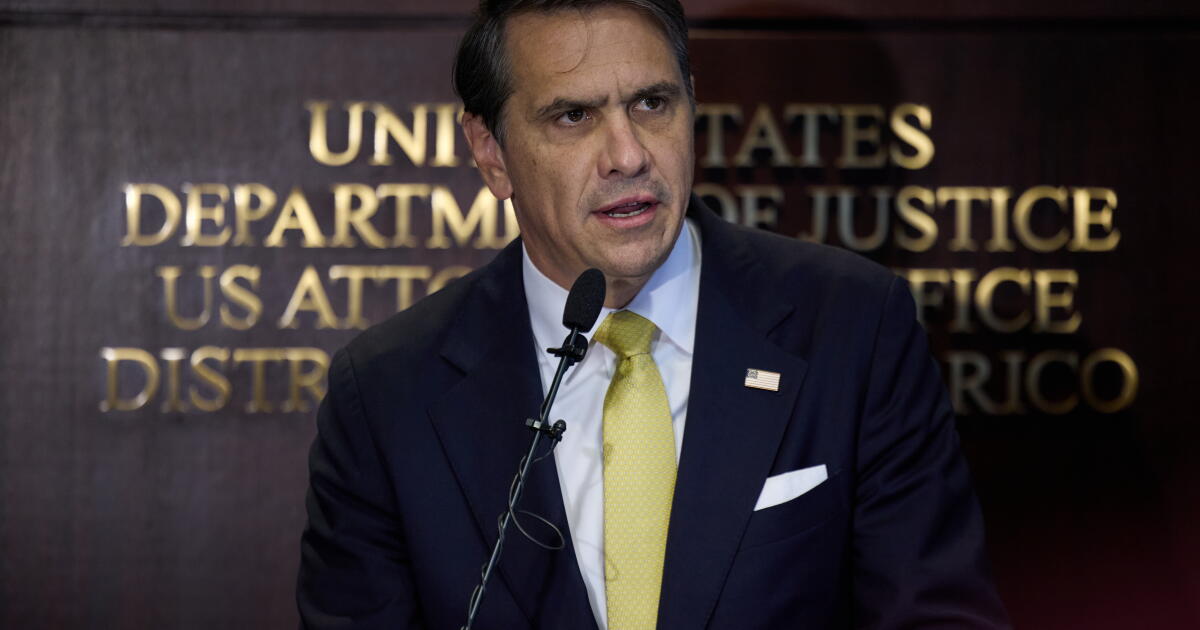
Atty. Gen. Todd Blanche defends his record as political pressure mounts
SAN JUAN, Puerto Rico — Atty. Gen. Todd Blanche’s fidelity to President Trump nearly cost him his confirmation. Now comes Blanche’s real test.
Trump’s former personal attorney has stepped into the commanding role facing a challenge that other leaders of the Republican president’s Department of Justice could not overcome: threading the needle between Trump’s boundary-busting demands and a prosecutor’s duty to uphold the rule of law. At the same time, Blanche must try to stabilize a workforce shaken by an exodus of experienced lawyers and an erosion of trust in the judicial branch.
In a wide-ranging interview with the Associated Press during a trip to Puerto Rico this week, Blanche promised to lead the department with integrity, dismissing concerns from critics who say his actions so far — including an indictment against longtime Trump foe and former FBI Director James Comey — call into question whether Blanche is still functioning as Trump’s personal lawyer.
A slew of ongoing politically charged investigations under Blanche’s watch could force him to choose between his long-standing loyalty to the president and the foundational principles of the Cabinet agency he leads. At stake is the fate of a department already reeling under a president who has made clear his desire for retribution over the criminal scrutiny he faced.
“My integrity, my commitment to the rule of law is the same today that it was the day I graduated,” Blanche told the AP when asked where he would draw the line on requests from the White House. “I would never do anything unethical or improper or violate my oath, no matter the circumstances.”
Critics disagree.
As acting attorney general, Blanche came under fire from lawmakers, including many Republicans, for signing off on a $1.8 billion fund meant to compensate Trump’s allies who believed they were politically prosecuted. He also greenlit a deal that granted Trump, the Trump Organization, and two of his sons immunity from tax audits. Those moves, unusual steps aimed at granting the president and his allies far-reaching benefits, put Blanche’s confirmation at risk, prompting key senators to express concern.
Blanche, like Trump’s other attorneys general, walks a tightrope
In the AP interview, Blanche addressed criticism of the department under his leadership, his priorities as attorney general and losses the administration has had in high-profile cases. He also depicted the Justice Department as an institution whose independence had eroded long ago — a characterization at odds with decades of fierce autonomy that challenged the highest echelons of power in Washington and beyond.
Blanche, a former federal prosecutor in New York, is walking the same tightrope as Trump’s three other Senate-confirmed attorneys general. They found their pledges to uphold the rule of law and the department’s ethical norms at odds with the president’s demands to bend the institution to his will.
During Trump’s first term, one attorney general infuriated Trump over his withdrawal from an investigation into Trump’s winning White House campaign and was forced out. Another submitted his resignation weeks after breaking with Trump over Trump’s false claims of election fraud. Blanche’s immediate predecessor, Pam Bondi, was ousted in April after failing to deliver successful prosecutions against the president’s political enemies.
Blanche’s narrow confirmation this month over opposition from two Republican senators underscored growing concerns about the dismantling of the Justice Department’s long-standing tradition of independence from the White House, which is meant to protect the impartiality of politically sensitive investigations and prosecutions.
Concerns that the Justice Department is being weaponized
Blanche bristles at the suggestion that the Justice Department should be independent of the president and he has made clear his view that the executive has both the power and the right to shape and control the law enforcement agency.
He has staunchly defended the integrity of cases the administration has brought against the president’s perceived political opponents, often pointing to his own experience representing Trump in criminal cases brought by Democratic President Joe Biden’s Justice Department. Blanche and the president have characterized those cases as politically motivated.
“I think attorneys general and others have said, ‘Oh, we’re independent.’ I don’t think that’s actually true,” Blanche told the AP.
Blanche claimed the Justice Department was not truly independent when he was a federal prosecutor or during the Biden administration. But that characterization ignores the fact that under Biden, the Justice Department investigated Biden himself over his handling of classified documents and secured felony charges in two separate cases against his son Hunter before Biden pardoned him.
The two criminal cases filed by special counsel Jack Smith against Trump were based on allegations, supported by long-running investigations, that Trump had classified documents at his Mar-a-Lago estate in Florida and obstructed government efforts to get them back, and conspired to overturn the 2020 election.
Growing distrust of the Justice Department among judges
Blanche has sought to highlight the administration’s focus on tackling illegal immigration, violent crime and drug-trafficking cartels, spotlighting cases such as the takedown of a Puerto Rican gang that he announced during his visit to the U.S. island territory.
But Blanche’s policy priorities are often overshadowed by a growing number of investigations that have drawn criticism that the department is being used as a weapon in the president’s campaign of retribution.
Blanche’s supporters have argued that the close relationship he developed with Trump while serving as his criminal defense lawyer can make him more effective at pushing back on or explaining the legal constraints of the president’s demands. Others wonder whether he will fare any better than Bondi up against the same skeptical court system, and factual and legal hurdles, that impeded efforts to deliver the sought-after results.
Blanche is also confronting growing distrust of the Justice Department among judges, who in multiple cases have accused government lawyers of withholding information or misleading courts. Courts in some cases have quashed subpoenas or ordered the review of grand jury transcripts, and the criminal cases against Comey and New York Attorney General Letitia James were dismissed after a judge found the prosecutor who brought them was illegally appointed.
But Blanche played down concerns that the erosion of judicial trust could impede his efforts to advance his agenda.
“The isolated incidents that make the news are not reflective of the way the bench feels in my view, or the way prosecutors are doing their job around the country,” Blanche said.
Richer writes for the Associated Press. AP writer Eric Tucker in Washington contributed to this report.