mother

Brother of NFL’s Calais Campbell charged with murdering their mother

A brother of veteran NFL star Calais Campbell has been charged with the murder of their mother in her Atlanta home on Tuesday.

Ciarre Campbell, one of the Baltimore Ravens defensive end’s seven siblings, faces two counts of murder as well as aggravated assault, and possession of a knife during the commission of a felony in connection with the death of his 71-year-old mother Nateal Campbell, according to the affidavits for his arrest issued by the magistrate court of Fulton County, Ga.

“We are devastated to share that the Campbell Family has lost its matriarch, Mrs. Nateal Campbell,” the family said in a statement. “While the details of her passing are still being investigated, we take comfort in knowing she is reunited with our father, her beloved Chuck, and in the arms of our Lord and Savior, Jesus Christ. We ask for privacy at this time so that we may honor her and share in our overwhelming grief privately and as a family.”

According to the Atlanta Police Department, officers responded Tuesday at around 12:36 p.m. to a welfare check at Nateal Campbell’s address. They found a male, later identified as Ciarre Campbell, 41, who “appeared to have barricaded himself inside the home.”

Nateal Campbell was found unresponsive inside the home and was pronounced dead at the scene by EMS services. Ciarre Campbell was detained by the officers and transported to the Fulton County Jail, where he was held without bond. He waived his initial court hearing Wednesday.

A booking photo of Ciarre Campbell provided by the Fulton County Sheriff's Office on Wednesday.

A booking photo of Ciarre Campbell provided by the Fulton County Sheriff’s Office on Wednesday.

(Fulton County Sheriff’s Office Via Associated Press)

WSB-TV in Atlanta reports that Ciarre Campbell is being represented by defense attorney Jay Abt, who told the station that his client is innocent.

“We look forward to his day in court,” Abt said. “I’m honored to defend him and, most importantly, the Campbell family.”

In a 911 call released by police, a man said he was calling for authorities to check on his mother at her house. He said he was there with his sister and brother-in-law but they couldn’t get inside. According to the caller, his brother — whom the caller says is “mentally ill” — had been staying at the house and was seen driving their mother’s car, “which is very unusual [because] he doesn’t drive at all.”

The caller said his brother was inside the house and told them their mother had left, even though video footage from a neighbor showed that wasn’t the case.

The affidavit for arrest stated that Ciarre Campbell created “incisions upon the victim’s neck causing her to be nearly decapitated.”

Atlanta police say they have received at least 10 calls for service at that address since September, including one in April reporting arson. According to a police report from that incident, Kimba Blaylock had called 911 because her brother, identified in the report as Ciarrie Campbell, had started a fire to rid the house of demons.”

Firefighters found no one inside the house.

Another police report from May 26 states that police were dispatched to the address on a dispute call. The responding officer wrote that a neighbor told him that her neighbor’s son, identified in the report as Ciarri Campbell, “was acting crazy and putting stuff in her trash and yelling at her.” She told the officer that the neighbor’s son had just been released from a hospital “for mental issues” a couple of days earlier.

The neighbor also said that Nateal Campbell had told her that her son “was a good kid.”

Calais Campbell is a five-time Pro Bowl selection who has played 18 seasons in the NFL for the Arizona Cardinals, Jacksonville Jaguars, Miami Dolphins, Atlanta Falcons and Ravens. He was named the Walter Payton NFL Man of the Year in 2019.

“We are incredibly saddened to learn about the passing of Calais Campbell’s mother,” the Ravens said Wednesday in a statement. “We extend our deepest condolences and full support to Calais and his family during this difficult time.”

The Associated Press contributed to this report.

Source link

Some paid the ultimate price to enact voting rights. Their survivors see America turning backward

Holiday gatherings and major life events have come with an empty seat. Certain dates on the calendar meant time at a cemetery, standing before granite stones.

They are a relatively small group of people, scattered across different states, but they share a common bond that stretches decades: Each had a family member die violently in the struggle for voting and civil rights, victims on a long and difficult path marked by blood that ended when the country seemed to mature into the nation of its creed.

But 61 years later, and as the country approaches its 250th anniversary this weekend, those sacrifices are in question. In a series of decisions over the last dozen years, including one in April, the Supreme Court has essentially dismantled the law that their family members died to see enacted, the Voting Rights Act of 1965.

“My mother’s blood is on that bill. We were always proud of that, and now it’s gone,” said Anthony Liuzzo, whose mother, Viola Liuzzo, died on an Alabama highway between Selma and Montgomery while driving marchers in 1965.

Critics of the law contend that times have changed, an argument Chief Justice John G. Roberts Jr. made in a 2013 decision that was the first major step in rolling back the law.

Survivors of lost loved ones disagree, pointing to the speed with which Republican-led state legislatures eliminated majority-Black congressional districts after the court’s April ruling, which severely weakened a section of the law that had protected voting rights for minority communities. They feel anger and sadness that a milestone political victory decades ago has been reversed, but they are committed to keep fighting.

A church bombing and a chunk of concrete

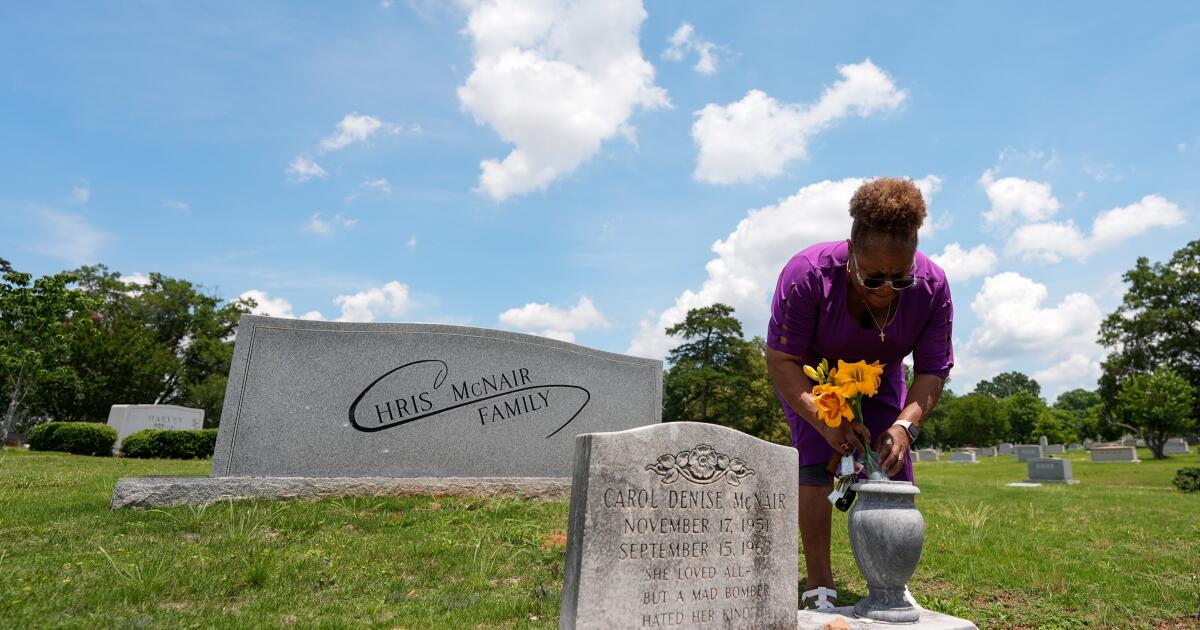
Lisa McNair was born Sept. 19, 1964. Her older sister, Denise, died in the Sept 15, 1963, bombing of the 16th Street Baptist Church in Birmingham, Ala. The church had been a central organizing point for civil rights protest.

The explosion killed Denise McNair, 11, and 14-year-olds Addie Mae Collins, Carole Robertson and Cynthia Morris Wesley. Nearly two dozen others were injured. Three Ku Klux Klansmen were convicted years later.

One of Lisa McNair’s early memories of her sister was of the box that their grandmother kept from the funeral home. It included Denise McNair’s shoes, a purse and a rock-sized piece of concrete that had been embedded in her skull.

The crime brought the civil rights struggle onto the national stage and outraged President Kennedy.

The times were tumultuous, McNair said, but it seemed the nation was heading in the right direction. Most of her life, “I’ve seen advances” on television, in commercials, with interracial marriages, civil rights and voting rights, “a plethora of rights that we got over the greater part of my lifetime.” But that has changed, she said.

McNair, 61, said she is “physically sick” about the Supreme Court decision and subsequent actions by lower courts and legislatures.

“I am constantly working to pray my way through it, so I can get up and go to work in the morning and do what I need to do. But I just want to ask every white person I see, ‘What more do you want?;” she said. “‘Why do you hate us so?’”

They left for Freedom Summer and never came home

Michael Schwerner, known as Mickey, came from a family in which human rights activism and challenging social norms were expected. He was in Mississippi in 1964 as part of Freedom Summer when he, Andrew Goodman and James Chaney vanished one day in June while investigating a bombing at a Black church.

Their bodies were found weeks later, buried in an earthen dam in a rural area of Neshoba County. Schwerner, 24, and Goodman, 20, were white; Chaney, 21, was Black.

Stephen Schwerner, who died earlier this year and was a social activist in his own right, told the Associated Press in a 2023 interview that as soon as the family heard his younger brother and the other men were missing, they knew they were dead.

“Our family was very out front in the media that the only reason there was international attention was two of the young men were white,” said Stephen’s daughter, Cassie Schwerner. “Had all three of those young men been Black, they would have ended up absent from our history and our narrative.”

The executive director of Morningside Center for Teaching Social Responsibility, Cassie Schwerner, said her family has followed voting rights through their ups and downs. That includes the 2013 Supreme Court decision that allowed states and counties with a history of discriminatory voting rules to make changes without prior approval from the Department of Justice.

The court’s April decision, she said, brought rage “and a good deal of sadness — not for me and my family, but for this country.” There is, she said, work to be done on multiple fronts.

Rights paid for in blood turned out to be fragile

Tamara Orange said among her many thoughts when she heard of the Supreme Court decision in this year’s Voting Rights Act case, there was relief — “relief that my dad is not here to see that; that Jimmie Lee Jackson is not here to see it; that Viola Liuzzo is not here to see it,” she said. “I’m relieved for them because to me, it’s as though the sacrifices that were made were done in vain.”

Her father, James Orange, was working with the Southern Christian Leadership Conference to organize voting rights protests in Marion and Perry County, Ala., in 1965. When juveniles joined the effort, he was arrested for contributing to the delinquency of minors. Concern arose that Orange was going to be taken out of the jail and lynched.

A protest to intervene ended with Jackson, a 26-year-old Black church deacon, being shot in the stomach by a state trooper while Jackson tried to shield his mother and grandfather.

His death was the catalyst for what became the Selma-to-Montgomery march and “Bloody Sunday.”

Orange stayed in the movement all his life and died in 2008, Tamara Orange said. But even after the Voting Rights Act passed, “he would say, ‘Be careful or we’re going to lose it.’”

‘We got bad news for you’

Anthony Liuzzo had just turned 10 when his mother, 39, left their middle-class neighborhood in Michigan and headed for Selma. She had cried as she watched scenes from “Bloody Sunday” on television.

Viola Liuzzo participated in a portion of the second march and then helped drive other civil rights protesters around the Black Belt region of the state. On March 25, 1965, she was driving one protester between Selma and Montgomery when a vehicle pulled alongside and fired into the car.

The phone call came around midnight. Anthony Liuzzo remembers the caller asking his dad, “Is your wife Viola? We got bad news for you. She’s been shot.” When his father asked whether she was all right, the caller said, “No, she’s dead,” and then hung up.

An informant for the FBI quickly identified members of the Ku Klux Klan as her killers. The three men charged would escape conviction on state charges but be convicted in federal court.

Anthony Liuzzo and his siblings lived with the lost birthdays and other missed milestones. His comfort was that the voting rights she had died for had become a reality. But the April ruling by the Supreme Court and the subsequent rush by Republican-led legislatures in several Southern states to eliminate congressional districts represented by Black lawmakers left him angry and distraught.

Even so, he said he is still proud his mother had the courage to go to Selma “when others sat in their pretty little houses.”

One morning, the Klan returned

The inscription at the bottom of Vernon Dahmer Sr.’s tombstone reads simply: “If you don’t vote, you don’t count.”

It is a message that embodies his life’s work and the story behind his death.

Even after President Johnson signed the Voting Rights Act, not every state was eager to implement the new law. In Mississippi, it came with a poll tax. The amount was $2, but in a world where a farmworker’s wages might only be $5 a day, that was substantial, said Dahmer’s son, Dennis Dahmer Sr.

The elder Dahmer, 57 at the time of his death, was a successful businessman who owned a store, sawmill and farm near Hattiesburg. He also was a civil rights leader and NAACP president in Ford County. He offered to pay the $2 for Black residents who wanted to register to vote.

He had already been under scrutiny by the local Ku Klux Klan. There was harassment and there were threatening phone calls. The windows were shot out of his store, but no one challenged him directly because his sons were always present and armed.

That seemed to tail off after Johnson signed the law.

“The Klan quit calling,” Dennis Dahmer said. “They quit shooting out the windows, so my family thought that all of this was behind us.”

That changed in the early hours of Jan. 10, 1966, when two carloads of Klansmen showed up. They firebombed the house and adjacent grocery store and began shooting at the house. The elder Dahmer shot back, using his ample arsenal to fight off the attack.

His wife and the three children who were home survived, but he suffered severe injuries from inhaling the smoke and fumes from the flames. He died later that day.

Dennis Dahmer was 12 as he stood next to his dad’s hospital bed. He wondered why some people wanted his father dead just for trying to help Black people vote.

A former Imperial Wizard of the Ku Klux Klan, Sam Bowers, was convicted in 1998 for the attack and sentenced to life in prison.

Like the families of other survivors, Dennis Dahmer’s family has witnessed the methodical dismantling of the Voting Rights Act.

“Finally, they basically turned it into a relic,” he said.

His plan now is activism, to speak out and promote the need for a massive voter turnout. He also wants to remind people of the price that certain families paid for everyone to have the right to vote and be represented by someone of their choosing.

“We’re living in a time when America has a lot of the same characteristics of the 1960s that I grew up in,” he said. “People say, ‘Are we going back?’ Hell, we’re already there.”

Fields writes for the Associated Press.

Source link

Between English and mother tongue: Kenya’s education language dilemma | News

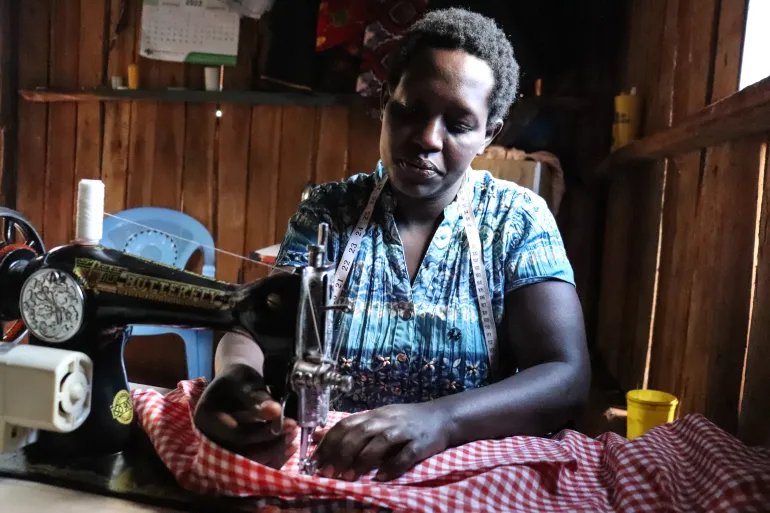
Kericho, Kenya – When Lona Chepkemoi walked into a technical college classroom in 2023, she found something she had rarely experienced during her years in school: She could understand what the teacher was saying.

After leaving primary school in 2008, Chepkemoi had failed her final exam, and her family could not afford to send her to secondary school. For years, the dream of becoming a fashion designer seemed out of reach.

Then a scholarship from her local member of parliament gave her a second chance.

But what surprised the now 33-year-old mother of five was not returning to education. It was hearing lessons delivered partly in Kalenjin, her mother tongue, she said.

“When I got to college, I felt at home because the language of instruction was my mother tongue [Kalenjin], and was mixed with a bit of Swahili and English, unlike in school when teachers only taught in English and exams were strictly only in English. Language here was accommodating, and it made me feel happy because I understood the concept quite well,” she told Al Jazeera.

For Chepkemoi, the difference went beyond comfort, it was comprehension.

Her experience reflects a wider global reality. According to UNESCO’s Global Education Monitoring (GEM) reports, about 40 percent of learners worldwide are not taught in a language they understand well, rising to about 90 percent in some low- and middle-income countries.

A second chance through familiar language

In Kenya, education policy provides for mother-tongue instruction in the early years of primary school, typically up to grade 3, before English becomes the main language of instruction from grade 4, with Kiswahili also widely used. In practice, however, classrooms often shift between languages depending on region, teacher capacity and student background.

Kenya Inclusive Education
After years away from school, Lona Chepkemoi discovered that learning in her mother tongue made education feel possible again [Dominic Kirui/Al Jazeera]

Across much of Africa, the language of schooling still reflects colonial legacy systems, where English, French or Portuguese dominate classrooms even when children grow up speaking entirely different languages at home.

UNESCO’s Global Education Monitoring work shows multilingual classrooms are now the norm in many countries. The organisation has consistently argued that children learn best in a language they understand, describing mother-tongue-based multilingual education as key to improving literacy and learning outcomes.

When English meets the classroom reality

Chepkemoi was not alone in finding confidence through familiar language. Her husband, Philemon Tonui, enrolled at the same institution to study building and construction.

Although Tonui completed secondary school, he was unable to sit his final examinations because his family could not afford the fees, leaving him without a certificate.

For Tonui, the use of Kalenjin alongside English and Kiswahili made a significant difference.

“Nothing could beat that. I felt like if every level of education were instructed in their mother tongue, many people would excel in their education,” he told Al Jazeera.

Kenya Inclusive Education
Tonu checks the nails on an iron sheet he just installed [Dominic Kirui/Al Jazeera]

Ismael Kiplang’at, a 28-year-old mason, also studied at the same institution. He recalls instructors making a deliberate effort to teach in languages students could understand.

“Our college was in a town with many communities in it, and even though the instructors did not understand all languages, at least they repeated their words in almost three languages just to make sure everyone was on board and understood the content. And those who came from other tribes always expressed satisfaction, saying that they really felt involved and not left out,” he said.

Now working as a mason three years after graduating, he credits that approach with helping him succeed.

“If education meant those tired English classes that we were taken through earlier in school, I would not have achieved my passion in masonry and earned a living,” he told Al Jazeera.

Between understanding and opportunity

Yet Kenya’s education system, like many across Africa, continues to face a structural tension: Early learning is most effective in familiar languages, but English remains essential for higher education, formal employment and global mobility.

Kiplang’at says he now practises English daily because he hopes to study further and work abroad.

For Shadrack Tonui, national chairperson of the Kenya Association of Technical Training Institutions, the challenge is not choosing between languages, but balancing them in multilingual classrooms.

“Generally, the mode of training is in English as the language of instruction and learning within the institutions. But of course, with the need to understand the flexibility of learning, there can be emphasis and use of a language that the learner will be able to understand at lower levels,” he told Al Jazeera.

Kenya Inclusive Education
Kiplang’at uses mortar to build a wall [Dominic Kirui/Al Jazeera]

He adds that institutions bring together students from diverse linguistic backgrounds, making it impractical to rely on one local language, while also stressing the need for English proficiency in the labour market.

The challenge is not unique to Kenya. UNESCO’s Global Education Monitoring work shows multilingual classrooms are now the norm in many countries, and education systems often struggle with teacher preparation, learning materials in local languages, and competing expectations from parents and employers over the role of English.

‘Why must we learn in another language?’

As for Chepkemoi, she is less concerned with policy than with practice. Most of her clients speak Kalenjin, while Kiswahili allows her to communicate with a wider customer base.

“Even though we were lucky to have teachers who would bring a point home while in college, we also had classmates from other communities who did not speak Kalenjin, and the teachers would explain it to them in Kiswahili,” she said.

For Kiplang’at, however, the debate ultimately comes down to one question: understanding.

“I ask myself sometimes why someone in Europe, Asia, or America learns in a language they grew up speaking, while we are expected to compete in theirs,” he said.

Source link

”The Little Sister’ review: Queer drama bolstered by complex performances

In “The Little Sister,” a teenager tries to hide in plain sight. Although everyone comments on her beauty, 17-year-old Fatima prefers to tie her hair back in a ponytail, her bright eyes buried underneath a black ball cap, her body concealed in unflattering tracksuits. As played by first-timer Nadia Melliti, who won the actress award at last year’s Cannes Film Festival, Fatima is encased in a kind of armor, an outward manifestation of her hesitancy to share her sexual orientation with a world she knows will judge her. This graceful film chronicles the process by which Fatima gradually sheds that reserve.

Adapted from Fatima Daas’ 2020 novel “The Last One,” a work of autofiction detailing the French author’s own coming out, “The Little Sister” takes place over five seasons, observing Fatima as she completes grade school and begins attending university. An adept athlete with a tomboyish demeanor, Fatima disappears inside a friend group consisting of immature teen boys who treat her like one of the guys, including her in their raunchy sex talk. Fatima has a boyfriend, Adel (Ahmed Kheloufi), but the relationship feels vestigial, with him constantly complaining that she should dress more feminine. Just as upsetting to Adel: When he tells Fatima that he loves her, she doesn’t respond in kind.

This is the third feature from French actor and director Hafsia Herzi, who herself made an acting splash in 2007’s “The Secret of the Grain.” For “The Little Sister,” Herzi takes a cue from Daas’ book, mapping Fatima’s inner journey as a modest series of tentative steps forward and anxious steps back. Fatima has reason to be skittish. The youngest of three daughters in a loving French-Algerian Muslim family, she conceals any hint of her sexuality from her mother, father and sisters, anticipating their disapproval. Many queer coming-of-age movies position the character’s awakening as an act of defiance. For Fatima, a practicing Muslim who adores her parents, the stakes feel even higher. Melliti’s performance is one of silent suffering, illustrating Fatima’s deference to her family.

But as much as she smothers her desires, others can sense them. An altercation between her friends and a gay male classmate gets heated once the classmate accuses her of being closeted, which she vehemently (and violently) denies. Soon after, Fatima secretly joins a dating app, hoping to understand her queerness. Her first date, in which she uses a fake name, focuses on learning terminology such as scissoring, and she approaches each new encounter like a fact-finding mission. Melliti keeps the shy teenager’s reactions neutral, Fatima’s stoicism a strategy to prevent exposing her inexperience.

That’s when she meets Ji-Na (Park Ji-min, the free spirit of “Return to Seoul”), a physician’s assistant who practically glows in her presence, overwhelming Fatima’s cautious nature. Ji-Na and Fatima’s love story — its blossoming, its unraveling, its possible resuscitation — forms the heart of “The Little Sister,” which also received the Queer Palm at Cannes. Melliti and Park exude a frisky, lusty chemistry, but it’s a film as much about self-love, as Fatima seeks to become comfortable in her own skin. Ji-Na is open and confident while Fatima remains closed off, her shame about her sexuality deeply culturally ingrained. When our main character starts lowering her defenses, however, that’s when she’s hit by a jolt that sends her spiraling.

Herzi’s slender, unassuming drama contains few emotional crescendos or grand insights, although this is the rare French film to center on a Muslim lesbian as its protagonist. “The Little Sister” grows even more intriguing once the love affair runs aground, forcing Fatima to flounder in her heartache. Her odyssey will lead to threesomes and lonely nights, but also difficult questions regarding how her faith and family may leave her perpetually adrift.

“The Little Sister” leaves much unspoken, which is fitting for a protagonist who rarely expresses herself in clear terms. Even during a touching scene near the finale, as Fatima sits at the dinner table weeping, upset over the end of a relationship, she and her mother (Amina Ben Mohamed) engage in a nimble dance: Fatima doesn’t feel safe explaining precisely why she’s crying, while her supportive mom chooses her words carefully, perhaps knowing more about her daughter than she dares say aloud. But despite the character’s rocky path to sexual awakening, Herzi navigates toward a hopeful conclusion that doesn’t peddle phony uplift. Fatima still faces a community that won’t embrace her true self. But maybe, at last, she’s willing to be seen.

‘The Little Sister’

In French, with subtitles

Not rated

Running time: 1 hour, 48 minutes

Playing: Opens Friday, June 12 at Laemmle Glendale

Source link

In Sundance breakout film ‘TheyDream,’ a Puerto Rican family heals old wounds

At this year’s Sundance Film Festival, filmmaker William D. Caballero won the NEXT Special Jury Award for Creative Expression for his intensely personal, multimedia feature debut, “TheyDream.” During his acceptance speech, he made a powerful statement.

“In case ICE were ever to harm me or kill me, this film will serve as the truth of who I am, and who my family is, before Fox News or this administration ever makes us out to be the villain[s],” he recalls paraphrasing during a recent interview.

Blending live action footage with different animation techniques — as well as the 3-D-printed miniatures that have been a fixture of Caballero’s work for more than a decade — “TheyDream” honors the filmmaker’s Puerto Rican loved ones, particularly his mother, Milly.

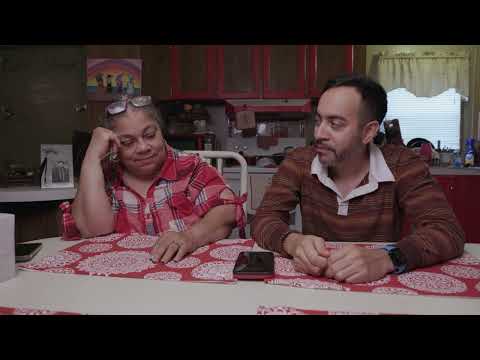
She collaborated with him in the making of this one-of-a-kind portrait of loss, resilience and shared healing. Their heartfelt exchanges throughout this process are also shared on-screen.

“Seeing her light up and become transformed throughout was just invigorating, because it allowed us to talk about heavy things and bond throughout the process of creating a story that’s personal [for us] both,” Caballero says. “It’s like, ‘Let’s guide each other and instead of me taking your stories and making magic with them, let’s make this magic together.’”

The brilliantly unconventional piece of autobiographical storytelling will screen as the closing night film of the Los Angeles Latino International Film Festival (LALIFF) on Sunday. Recently, John Leguizamo and Ben DeJesus joined the film as executive producers.

Starting with his 2013 short film “How You Doin,’ Boy? Voicemails From Gran’pa,” Caballero has used miniatures to immortalize his loved ones. That bite-sized introduction to his Boricua grandfather’s humorous wisdom evolved into the HBO Latino show, “Gran’pa Knows Best.”

“When I started working on ‘Gran’pa Knows Best,’ I knew that 3-D printing was this new technique,” he says. “But I’d never seen anyone that looked or sounded like my grandfather in it. I realized that it could be a really creative method to preserve his voice and his story. “

Then came the 2017 short “Victor & Isolina” about his grandparents’ relationship, and more recently in 2022, he debuted “Chilly and Milly,” which focused on his parents. Some of the sets from these shorts, tiny replicas of places familiar to Caballero, and a few of the miniature characters were reused in “TheyDream.”

“Being able to create these things in miniature is almost like getting back in touch with the idea of play,” Caballero explains. “As a child, you invent lots of stories all the time. But now as an artist, I’m able to tell stories that touch upon reality and painful memories, but also hopes and dreams in a way that hearkens back to the innocence of childhood.”

Man holds his folded hands in front of his mouth while he sits.

Filmmaker William D. Caballero will screen “TheyDream” on Sunday at the Los Angeles Latino International Film Festival (LALIFF).

(William D. Caballero)

“TheyDream” is a culmination of the eclectic and nimble artistic practice that Caballero has developed since he studied digital art at the Pratt Institute in Brooklyn.

“I’d always just been attracted to new ways of expressing myself and expressing stories. And I say this both in a way that brings me pride, but also brings me a bit of a headache, because I don’t think I’ll ever be a conventional filmmaker,” he says, laughing.

Still, working outside the margins of traditional moviemaking requires great adaptability.

When Caballero received funding for “TheyDream” in 2021, the money wasn’t enough to conceive it as he had originally envisioned it: entirely told with 3-D-printed figures in physical sets. The lack of resources forced him to rethink his approach, and he opted for hiring two Puerto Rican animators, Julisse Tinoco and Frank Martinez, each of whom animate in distinct styles, to help him create some of the sequences needed.

“This all goes back to the resourcefulness that I learned when I was young,” Caballero says. “When you’re born Latino and low-income in this society, you can’t let yourself be written off or you’re already defeated before you even begin.”

Caballero grew up in housing projects in New York City, and later in a trailer in his grandmother’s backyard in Fayetteville, N.C. Both of his parents were disabled.

Filmmaker William D. Caballero poses as his father for a reference shot in the making of his 2026 film "TheyDream."

Filmmaker William D. Caballero poses as his father for a reference shot in the making of his 2026 film “TheyDream.”

For Caballero, he says the arts have provided an escape that he “needed in order to survive and not feel weighed down by American consumerism, by poverty and by feeling trapped.” Whenever grief has perturbed him, Caballero has processed it through creativity.

With “TheyDream,” he wished to extend that vehicle for self-reflection to his mother. The film addresses complicated familial bonds and his mother’s experience caring for others.

“Throughout the years, we’ve lost several of my family members that we were both close to, but my mother especially,” he says. “She feels their absence much stronger than I do. I live in Los Angeles, my mother still lives in North Carolina. Knowing that she was alone in the mobile home, it just made me feel like, ‘That can’t be good for her.’”

His mother, he says, deals with self-esteem issues because her identity has for so long been reduced to being a caretaker for elderly relatives, who, inevitably, pass away — leaving her feeling like a failure. In reality, it was thanks to her devotion that they added years of life.

Caballero’s mother was at the Sundance premiere of “TheyDream,” where she witnessed how others saw her through the film she helped her son craft.

“I wanted her to feel like, ‘Mom, look at all these people that are clapping for you. They’re clapping for you because you are a hero. You deserve to hold yourself high and be strong and know that there’s something incredible in your story that’s indicative of the stories of many low-income Americans, regardless of race,’” Caballero says, visibly moved.

A prolific and highly regarded artist (he is a 2018 Guggenheim Fellow), Caballero has several other projects in the works that he’s trying to shop around. One of them is an episodic series titled “Second Fiddle,” about a 15-year-old Latino boy who gets accepted to a prestigious summer youth orchestra camp — and whose overbearing mother decides she’s going to stay in the camp with him.

Caballero's mother, Milly, got the animated treatment in "TheyDream."

Caballero’s mother, Milly, got the animated treatment in “TheyDream.”

“I never saw a Latino playing violin on TV or the big screen. I didn’t see any quirky, nerdy, artsy Latino kids like I was,” he says. “And I felt in my core that [it] was just wrong and something that I could change.”

Another project, “Raúl Playing Game,” is “an adult version of Pixar’s ‘Inside Out,’ ” that takes place in the mind of a closeted bisexual man. Caballero himself is bisexual. In 2022, “Raúl Playing Game” was selected for the LALIFF Inclusion Fellowship, which provided support for a short film version that serves as proof of concept for a potential TV show.

“I always wanted to make sure that I was telling authentic stories even if not necessarily always positive stories,” he says. “I’m very happy that I never lost track of that. Because I do believe that we need to tell our own stories, in our own unique voices, before someone else does it for us.”

Source link