The Corona Centennial High football team has an interesting blend of players spelling their similar first names differently, leaving coach Matt Logan to be the referee as to which parents got the spelling correct.
There’s Jaden Jefferson, Jaden Walk-Green, Jaden Bynum, Jayden Steeber, Jayden Rodriguez and Jaiden Sapp on varsity.
Asked for a comment on what the correct spelling should be, Logan replied, “Which one?”
With six player possibilities, he better be specific as to which Jaden, Jayden or Jaiden he’s trying to alert when shouting the name.
Luckily, Logan isn’t the freshman or JV coach because there’s also Jayden Morales, Jayden Bullard and Jaidon Wilkerson. That’s nine players who qualify to join a club or create a T-shirt: Which first name is spelled correctly?
This is a daily look at the positive happenings in high school sports. To submit any news, please email eric.sondheimer@latimes.com.
Maysa Abu Daoud and her daughter Mary al-Najjar among five Palestinians killed in Gaza City attack.
Published On 4 Oct 20264 Oct 2026
The Latin patriarch of Jerusalem, Cardinal Pierbattista Pizzaballa, has expressed his “deep sorrow and grief” over the “tragic” killing of two Christian women in an Israeli air attack on Gaza City.
Maysa Abu Daoud and her daughter Mary al-Najjar were among five Palestinians killed in the attack that hit the ground floor of a building in the Remal neighbourhood on Saturday, in the latest Israeli violation of a United States-brokered “ceasefire” agreement with the Palestinian group Hamas.
In a statement, the patriarch extended his “heartfelt condolences” to the loved ones of the two women and to the Christian community in Gaza.
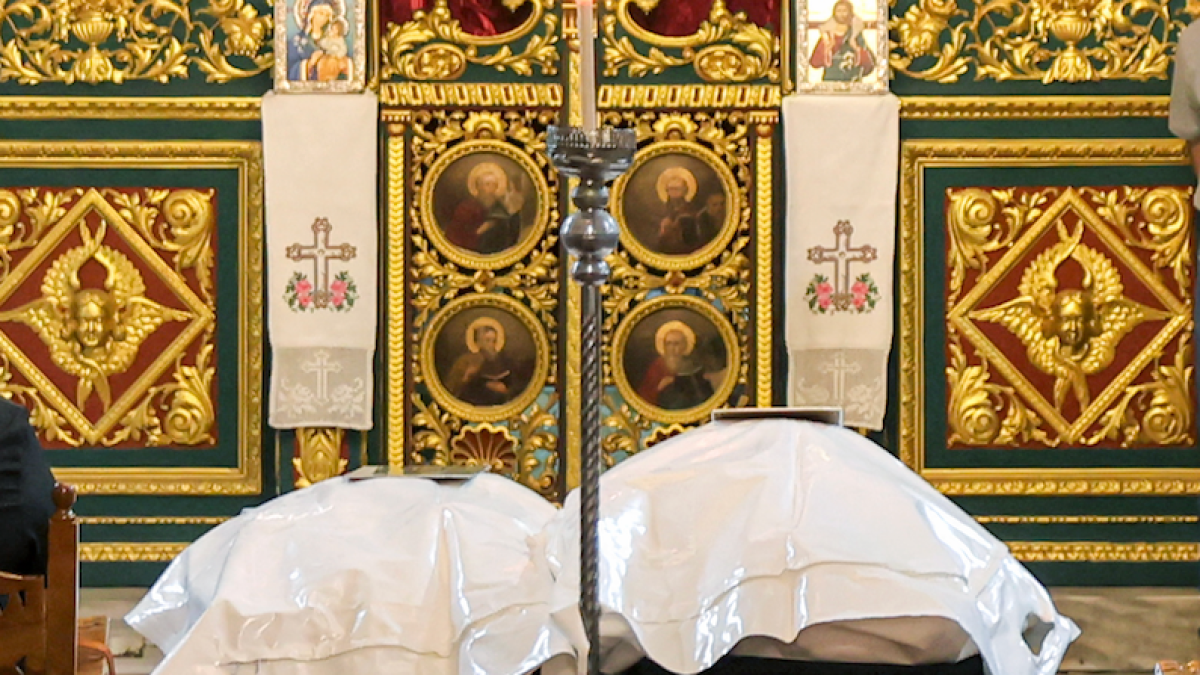
Their funeral took place on Saturday at Saint Porphyrius Church in Gaza City’s Old City.
The two women were Palestinian Christians from Gaza City who devoted their time to helping parishioners and displaced people sheltering at the Holy Family Church, according to Palestine’s Higher Presidential Committee for Church Affairs.
The committee’s chairman, Ramzi Khoury, described their deaths as a “painful loss” for their families, the church and its parishioners.
People inspect the damage after an Israeli attack on a residential apartment in the Remal neighbourhood of Gaza City [Omar al-Qattaa/AFP]
Mary’s son, 14-year-old Fouad al-Najjar, told the Anadolu news agency the strike hit the building at about 1:30am (22:30 GMT).
“My grandmother and my mother died. May God have mercy on them,” he said.
Al-Najjar appealed for an end to Israel’s genocidal war on Gaza, saying Palestinians were losing their loved ones every day.
“We are exhausted by this war and have endured so much,” he said. “For almost three years, we have been living through the same destruction, the same grief and the same war.”
Palestinian Lutheran pastor Munther Isaac, who serves in Ramallah and directs the Bethlehem Institute for Peace and Justice, wrote on X: “The genocide continues in Gaza.”
Civil Defence members carry the bodies of Maysaa Abu Daoud and her daughter Mary al-Najjar during their funeral at the Greek Orthodox Church of Saint Porphyrius in Gaza City [Omar al-Qattaa/AFP]
The Gaza Strip is home to fewer than 1,000 Christians. The community was already small before the war, and many of its members have been killed since then in attacks on their homes and churches throughout the war that began in October 2023.
On October 19, 2023, an attack on the Saint Porphyrius Church compound killed at least 18 people. Two months later, the Latin Patriarchate of Jerusalem said an Israeli sniper shot dead a woman and her daughter inside the Holy Family parish compound in Gaza.
An Israeli strike on the Holy Family Catholic Church compound on July 17, 2025 also killed three people and wounded others, including parish priest Father Gabriel Romanelli.
According to the Ministry of Health in Gaza, Israeli attacks have killed at least 74,228 people, including at least 1,445 since the start of the “ceasefire” in October 2025.
Funeral prayers were held at Gaza City’s Saint Porphyrius Greek Orthodox Church for a Palestinian mother and daughter who were among five killed in an overnight Israeli airstrike on an apartment.
Country western star Wynonna Judd is confirming that she and her sister, Emmy Award-nominated actor Ashley Judd, do not have a relationship.
She spoke with People ahead of the release of her 10th solo studio album, “The Hard Truth,” which drops Friday, and revealed that the rift between the sisters is still there after years of on and off disharmony.
Wynonna told the outlet that Ashley hadn’t heard the album, as the sisters are not “connected.”
“We’re taking a break, which all families can relate to,” she said. “She’s doing her thing, and I’m doing mine.”
In April 2022, Wynonna and Ashley’s mother, Naomi Judd, died by suicide at 76 after a lifelong battle with depression. Naomi and Wynonna made up the Grammy-winning duo the Judds.
At the time, the sisters released a statement together, writing, “Today we sisters experienced a tragedy. We lost our beautiful mother to the disease of mental illness. … We are shattered. We are navigating profound grief and know that as we loved her, she was loved by her public. We are in unknown territory.”
The following month, the two appeared at the annual Medallion Ceremony, where the Judds were inducted into the Country Music Hall of Fame, and the sisters spoke on behalf of their mother.
“While this is so much about the Judds as a duo, I want to take a moment to recognize my sister, a GOAT,” Ashley said at the ceremony. “Do you know what that means? I don’t think she knows I’m calling her the greatest of all time. She lives on a farm. She’s being a little literal.”
Ashley told the crowd that growing up as the younger sister of Wynonna, she got to “bask in this voice that was around the house, and I’ve always been so proud of the music and so proud of you. … So I know that we’re talking a lot about Mom tonight, as we should be. Our beautiful mother, and I want you to know that you also are being inducted to the Hall of Fame tonight. And newspapers don’t get much right these days, but when the Los Angeles Times said you were Elvis-like, they got it right. And I love you, and I’m proud of you. And Mom is proud of you, and she always was.”
By October 2022, rumors were flying that the sisters were fighting over their mother’s will, a claim that Wynonna shot down while speaking with People.
“Someone told me while I was at Ashley’s house, ‘Hey, did you know that they’re saying this about you?’ I went, ‘Huh? I’m fighting with Ashley?’” Wynonna said. “Fighting over what? I have such a great life. Ashley has a great life. Why would we be fighting over the will?”
This wasn’t the first time a feud was reported between the two. Back in January 2015, Wynonna gave a teary-eyed account of the disconnect during an appearance on AXS TV’s “The Big Interview With Dan Rather.”
“The only thing I have in common with my sister is a father missing and a mother that’s both of ours. She and I are very different. We don’t communicate, nor do we spend time together, and that’s a long history of being apart,” Wynonna told Rather.
Wynonna said that she and Ashley were dysfunctional, didn’t agree on anything and developed separate lives, but she cared for her younger sister growing up.
“I raised Ashley, so I think there’s a lot of work we still have to do about where do we find the ‘sister’ in all of this,” she said. “She called me sister mommy, and I really had a hard time with that, because I was like, I don’t want to be your mommy. I want to be your sister.”
The body of a newborn baby has been found along a shoreline in north Wales.
North Wales Police have appealed for the mother who maybe “extremely vulnerable” to come forward.
A member of the public found the remains on the Menai Strait shoreline near Siliwen Road on Sunday shortly before 17:00 BST.
During a press conference, Director of Midwifery and Women’s Services for Betsi Cadwaladr health board Fiona Giraud has appealed directly to the mother to come forward.
“I want you to know that our immediate concern is for your health, safety and wellbeing. We recognise that you may be feeling frightened, overwhelmed or unsure about what to do next,” she said.
Giraud said they “have real concerns for the health of the mother”.
“We recognise that she is likely to be extremely vulnerable. She may be fearful of seeking the support she needs through fear of identifying herself.
Speaking directly to the mother, she added: “You may feel you have nowhere to turn, or that you cannot speak to anyone about what has happened. Please do not feel that you have to face this alone.
“We don’t yet know all the circumstances surrounding your baby’s death but what is important right now is that we find you, make sure you are safe, and ensure you receive any medical attention and support you may need.
“I am asking you personally, to please get in touch with us. You can speak to a healthcare professional, approach a police officer or attend a police station.
“If you are watching or listening to this appeal, please know that we want to hear from you. Please take the first step and contact us. There are people to help you.”
This breaking news story is being updated and more details will be published shortly. Please refresh the page for the fullest version.
It’s never been a more terrifying time to be an undocumented immigrant in America. Despite countless protests and pushback, ICE agents continue to patrol the streets. In July, Colombian immigrant Johan Sebastián Durán Guerrero was shot and killed by an ICE officer in Biddeford, Maine, during a routine traffic stop.
But what about the white-passing undocumented immigrants that seem to slip through the system? The ones who blend in so seamlessly (despite the thick accents of some)? We forget they are also legally not supposed to be here. Specifically, those from Eastern Europe, Russia and the former Soviet Union. And what about those young, desperate women who suggestively posed for the camera as the Soviet Union collapsed all around them, hoping to be chosen by an American man?
Book Review
Ungrateful Immigrant Daughter: A Memoir From the Child of a Mail-Order Bride
By Katya Suvorova Alcove Press: 352 pages, $30
If you buy books linked on our site, The Times may earn a commission from Bookshop.org, whose fees support independent bookstores.
Katya Suvorova’s searing debut memoir, “Ungrateful Immigrant Daughter: A Memoir from the Child of a Mail-Order Bride,” out Sept. 29, is a heart-wrenching tale of immigration that pulls back the velvety red curtain to reveal one story behind the over-sexualized stereotypical post-Soviet mail-order bride narrative so ingrained in post-Cold War U.S. culture.
My own family legally immigrated to the U.S. from Soviet Belarus in the early 1990s. I grew up with the Western media narrative that Eastern European women were submissive sex symbols, desperate for financial security. Some boys in school even assumed I was “easy” because I was Eastern European.
Mostly told from a child’s point-of-view, Suvorova’s “Ungrateful” traces their journey in the ’90s from Russia to the U.S. and life thereafter, as white-passing undocumented immigrants who illegally crossed the border from Mexico — with the help of a man who replied to her mother’s mail-order-bride ad in a catalog. A catalog Suvorova would find years (and many rich American stepfathers) later while cleaning out the garage, and realize her mother had lied to her. She was not, in fact, a model, posing for a Coca-Cola ad, but a young woman with a small child desperate to leave Russia behind for the West. When Suvorova confronts her mother after finding the catalog, her mother replies: “Everyone was doing it.”
Mail-order brides shaped early colonial America. Men were often the first to settle small Western frontier towns and would in turn grow lonely for companionship. Newspaper ads for brides were normalized and proliferated in 19th century America. According to historian Elliott West, “Some mining camps in Idaho in 1870 had nine men for every woman.” The truth is that love didn’t enter the picture when it came to marriage until about the 19th century with the Victorians; before then, marriage was more like a business contract, with dowries and cows alike.
Letter brides remained ubiquitous in 20th century America and were not stigmatized until the 1970s and 1980s when it became more apparent that mail-order immigrant brides from developing Southeast Asian and Eastern European countries were being abused and exploited. It wasn’t until 2005 that the U.S. passed the International Marriage Broker Regulation Act (IMBRA), which requires background checks and other precautions meant to protect foreign brides from domestic abuse, violence and exploitation. You don’t have to dig deep to see this narrative proliferated in our culture. Jeffrey Epstein mostly recruited Eastern European women into his international sex-trafficking ring.
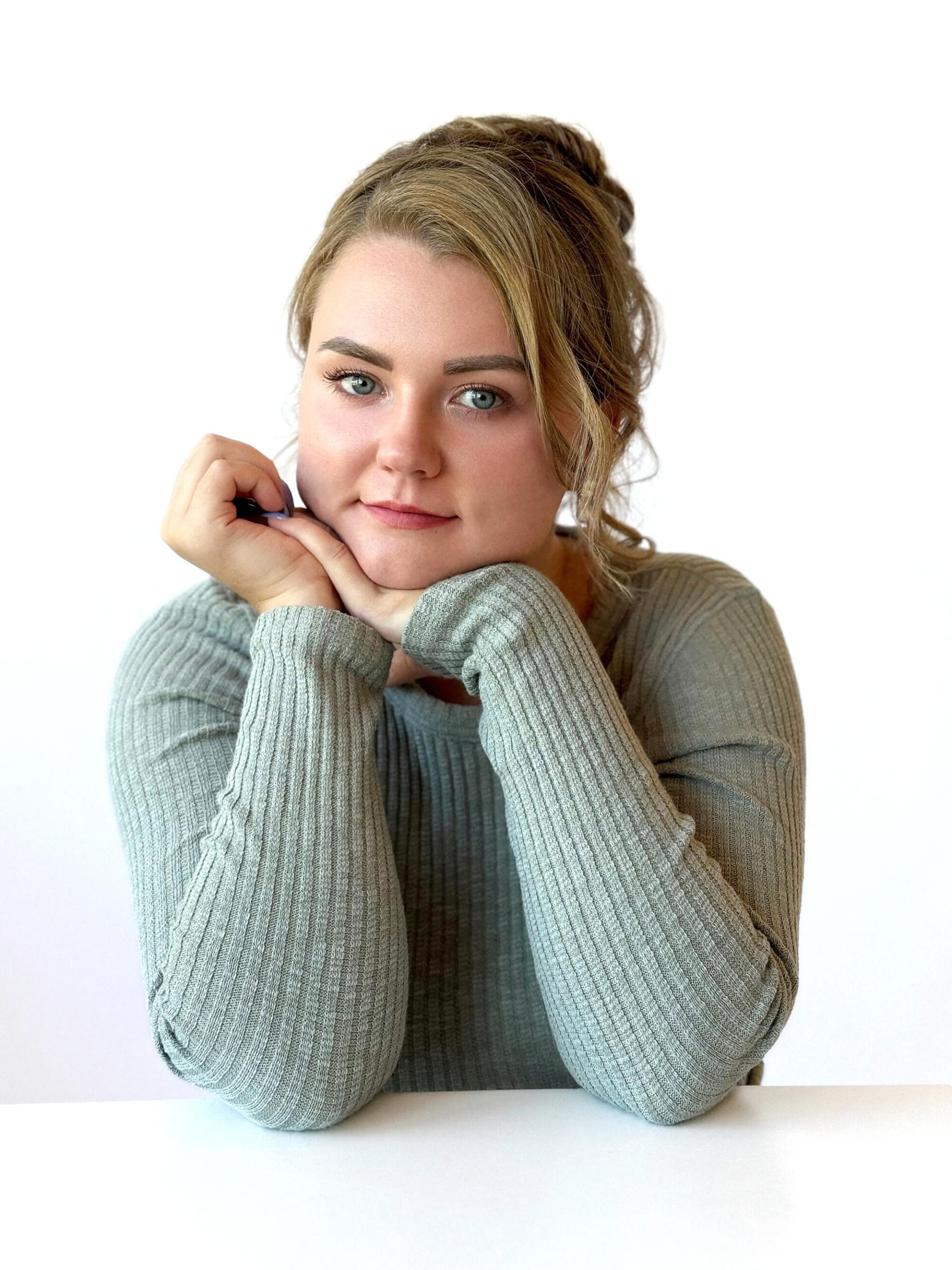
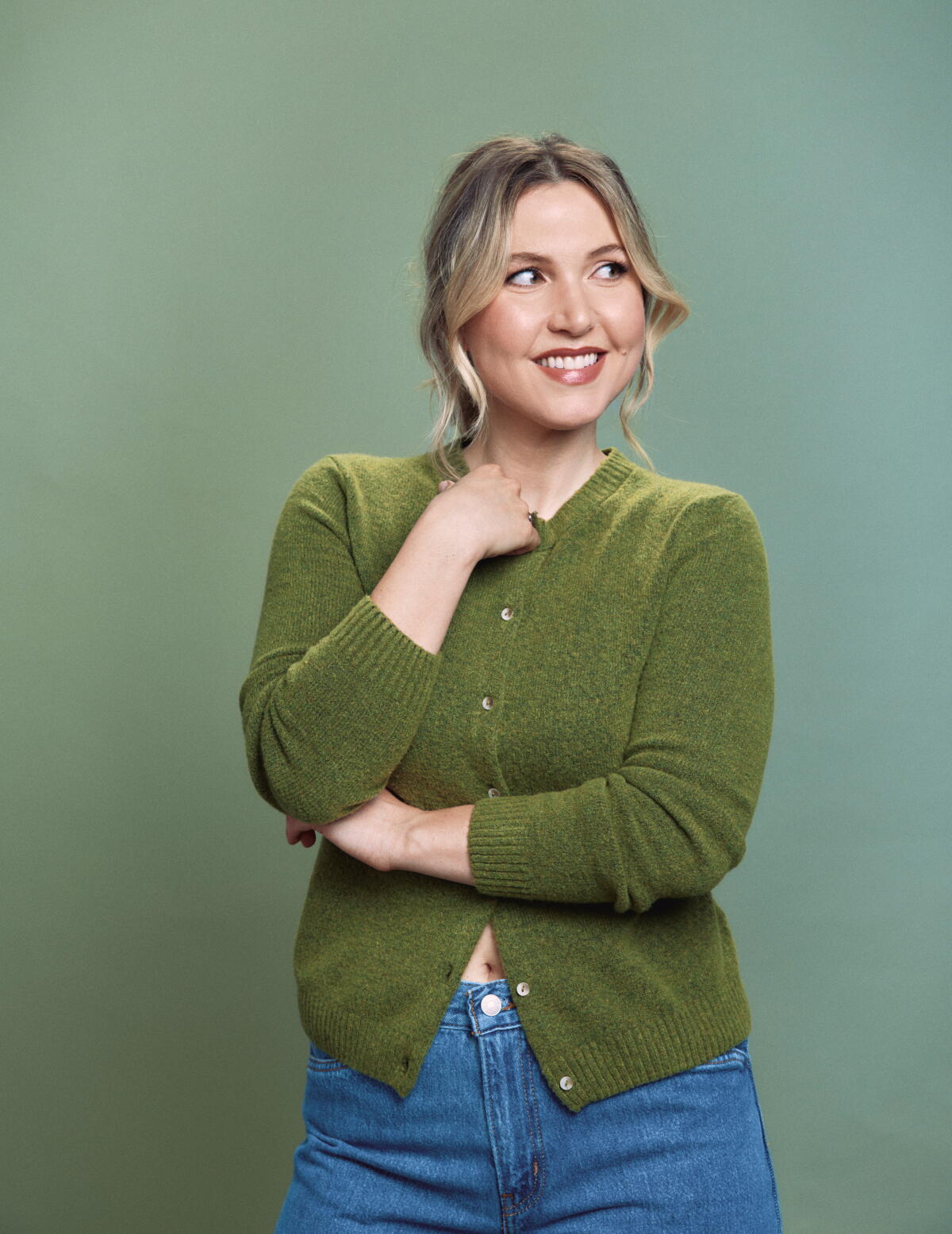
Author Katya Suvorova
(Alcove Press)
Suvorova and her mother were not spared such indignities. Abuse, both psychological and physical, permeates the pages of “Ungrateful.” From one of her earliest childhood memories of watching her mother being abused while stuck in a closet to later tales of her mother’s forced alcohol abuse and estrangement from her own mother (Suvorova’s beloved Babushka), expertly executed by her stepfather Adam — the abuse ran rampant. Suvorova herself is a victim, neglected by her mother and forced to act as a child bride to please one of the husbands. Eventually, Suvorova realizes that it wasn’t just her mother that was sold in a catalog to an American suitor, but her young daughter (Suvorova) as well. It’s no surprise that Suvorova is estranged from her mother, a topic she covers often on her social media.
Of course, there is also the “gold digger” stigma. Suvorova writes about girls in school accusing her mother of being a gold digger, intentionally choosing rich boyfriends that would eventually become rich husbands while they lived in poverty and couch surfed. Suvorova’s mother would use creative tactics to find these men: hang out in five-star hotels or fancy athletic clubs. She would have them buy her computers, clothes and expensive jewelry she could sell later. She always ordered the priciest thing on the menu and bought gift cards when the men gave her money for groceries in case the relationship did not work out. She passed down these survival tactics to Suvorova like gospel. But, ultimately, it wasn’t money that her mother was after, it was green cards for them both, the permanence and safety of American citizenship: the American Dream.
In 2012, I dressed up as a mail-order bride for Halloween. I was 22, about the age Suvorova’s mother was when they immigrated to the U.S. I wore a tight sleeveless red American Apparel dress. Shiny fake patent leather pumps. A white veil from Claire’s at the mall. I covered myself in bits of cardboard, packing tape and foam peanuts and overdid my makeup with several coats of mascara and thick black eyeliner. I thought this costume was funny, clever, appropriating and reclaiming the narrative that haunted me all my life. I thought because of where I was born, I was allowed to do this. A notoriously blunt girl who I sensed didn’t like me approached while I was waiting for the bathroom. “What are you, a slut?” she said, scanning me like a barcode.
Suvorova’s memoir effectively shows the risks immigrants were willing to take to escape the collapse of the Soviet Union and the corruption (ruled by the KGB) that followed. Without explicitly diving in, her writing sheds light on today’s Russian corruption and Putin’s endless war with Ukraine, which is ultimately a war against the West. In fact, Suvorova and many antiwar Russian immigrants today are terrified to return to their motherland due to fear of imprisonment and retaliation, as one Los Angeles woman in 2024 learned the hard way upon landing in Russia, receiving a 12-year prison sentence for donating $51 to a Ukrainian charity.
In the building I grew up in and my parents managed, a young Russian “model” and her mother lived with a much older Persian man. Without much inquiry, I simply assumed she was a mail-order bride running from a traumatic past in the motherland, ordered from a catalog to make him dinner and vacuum his carpet. Closer to my age than not, she became my friend. Gifted me jewelry. Babysat me while my parents drank tea with her mother. I later found out she cheated on the Persian man, laid out her wedding dress on the soiled carpet while he was at work, and moved herself and her mother to Las Vegas, where she started a successful business and bought a house.
Suvorova’s story is not just about the childhood trauma inflicted by her mail-order-bride mother, but it’s a redemption story about reuniting with her beloved maternal Babushka and biological father. It’s a story of self-discovery. Not unlike the bestselling memoir “Educated” by Tara Westover, who overcomes an abusive childhood in a rural survivalist Mormon family. Like Westover, Suvorova finds shelter in books, school and an education.
Like all contemporary creative nonfiction writers and memoirists who are not celebrities, Suvorova must have been told somewhere down the line that in order to sell her memoir she must gain a following on social media, and she’s done just that. With about 95,000 followers on Instagram, Suvorova uses the platform to reveal earnest roundups, tips, tragic tales of estrangement and survival, and summaries of deleted chapters of “Ungrateful” as blocks of text over grainy film photos of her as a child. Suvorova’s very active social media presence sheds light on the current state of memoir and nonfiction publishing: You must have a platform to be read.
In a bizarre meta twist of events, Suvorova must sell herself and her story on social media, like her mother sold herself (and in turn her daughter) to those American husbands. In a stroke of marketing genius, some early copies of “Ungrateful” come with book-branded condoms.
And despite revealing in the memoir that she eventually did become an American citizen, Suvorova has since moved to Europe. When I asked Suvorova over Instagram direct message why she and her husband left the U.S. for Europe, she replied: “We left because I didn’t feel safe publishing my book about growing up as an undocumented kid under the current Trump administration. I have to take medicine that, if I were detained and could not take it, would lead to organ failure. We knew ICE was detaining U.S. citizens as well and decided not to risk it. In order to still publish the book and not be detained, we left the U.S.”
How many of us have been cruel immigrant daughters (or sons)? Ungrateful. Spoiled. Unaware or unwilling to acknowledge how much our parents have sacrificed to get us here. In the case of Suvorova’s memoir — although, she does acknowledge her white privilege — she certainly has a lot to be ungrateful for.
Ruzova is a Soviet-born writer based in Los Angeles. Her essay “The Sauna” was a notable in Best American Essays 2025.
Kyle MacLachlan is living up to his reputation as the Internet’s Dad.
It’s an especially warm day in August, and the bespectacled actor, best known for his many projects with the late auteur David Lynch, is approaching with a coffee (black, naturally) in one hand and a massive cookie in the other. The snack, it turns out, is meant for us to share.
On the Shelf
Fictional Selves: A Memoir
By Kyle Maclachlan Crown: 320 pages, $34
If you buy books linked on our site, The Times may earn a commission from Bookshop.org, whose fees support independent bookstores.
“Whatever it is, it’s very healthy,” he says when I ask what sort of confection he chose. “It’s cranberry, oatmeal and gluten-free. Who knows if there’s any sugar in there?”
At 67, MacLachlan isn’t necessarily a health nut. But he is highly amenable and willing to roll with my vegan cafe selection, which is conveniently located near our photo shoot location. “I come from Eastern Washington state — it’s a desert,” he says assuringly when I offer to move us to an indoor seat with air conditioning. Later, as we prepare to leave for the shoot, he clocks my car, a rare station wagon, and dubs it “spec-TAC-u-lar.”
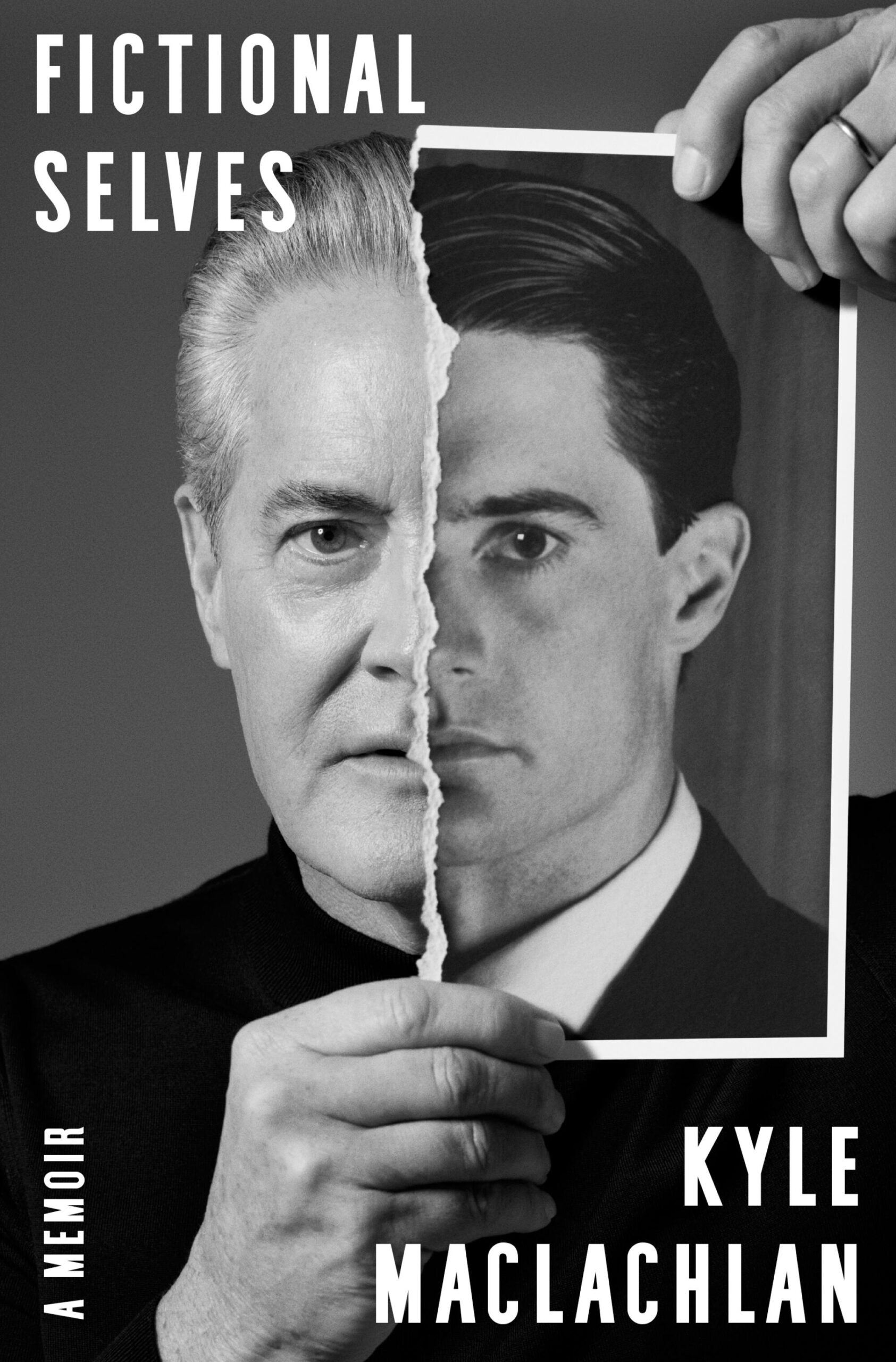
That’s MacLachlan for you — all it takes is one word (he also drops an “Aces!” during our meeting) or enthusiastic gesture (very likely a swooping thumbs up) to channel the type of eccentric and upbeat characters he’s spent the last 40 years playing. Now, with the release of his thoughtful new memoir, “Fictional Selves,” MacLachlan gives us a much closer look at the man behind the chin-jutting grin, and, in doing so, introduces us to his doppelganger, “Other Kyle,” an image-conscious shadow figure constantly trailing behind, questioning his choices.
“There’s definitely another entity, an observer, the ego, the harder self,” MacLachlan says of how he would describe Other Kyle, whom ghostwriter Jon Sternfeld first identified after noticing the way MacLachlan tended to fall into conversation with himself while recounting his life. “[He’s] the kind of person that I’m not comfortable leading within the world. But he’s definitely in there commenting on the things that I do.”
Other Kyle first began to taunt MacLachlan after he saw himself on a gargantuan billboard for “Dune” in Times Square. (In his early 20s, MacLachlan was famously plucked from obscurity to lead David Lynch’s 1984 adaptation of Frank Herbert’s sci-fi epic.)
Well before his alter ego materialized, and well before Hollywood found him, MacLachlan was prone to anxiety and fears of never fitting in. Born in Yakima, Wash., MacLachlan grew up the oldest of three boys; his parents were solidly middle-class, with his father working as a lawyer, and then stockbroker. His mother was a homemaker known in the community for her civic involvement, particularly in local arts programs. In fact, it was MacLachlan’s mother who first encouraged him to try a “Teen Theater” program, drawing him in with the promise that there might also be girls in attendance.
But it took a minute for MacLachlan to genuinely embrace his calling. As a young adult, his father pushed him to study business, while his mother urged him to try PR or communications. His studies at the University of Washington weren’t going well, so he dropped out and worked at a manufacturing plant back in Yakima. It wasn’t until a girlfriend recommended a summer theater program in North Carolina that MacLachlan leaned back into his first real passion, eventually returned to school with a newfound focus, and was accepted into the University of Washington’s professional acting program.
Kyle MacLachlan at the glass and mirror shop LA Mirror Man on La Cienega Boulevard.
(Christopher Patey / For The Times)
Fast-forward 40 years, it’s impossible to imagine that MacLachlan would have anything else for Other Kyle to latch onto. For one, his acting resume is the stuff of thespian fantasy. Sure, “Dune” infamously flopped hard upon arrival, and all planned sequels were immediately canceled. But it wasn’t long before MacLachlan had teamed back up with his mentor, with whom he had developed an almost telepathic bond on “Dune,” to lead Lynch’s much more kindly received 1986 neo-noir arthouse entry, “Blue Velvet.” A few years later, the overwhelming success of the TV mystery series “Twin Peaks” propelled the actor to the upper stratosphere of celebrity.
“When we were working together creating Jeffrey in ‘Blue Velvet’ or [Coop in] ‘Twin Peaks,’ we would sit and talk or not talk, we melded together in some weird way, we were like one person,” MacLachlan says of his bond with Lynch, who died in early 2025 of cardiac arrest due to chronic obstructive pulmonary disease. “It was this very symbiotic kind of thing in front of the camera,” MacLachlan continues. “It was like this weird circular energy. … He’s the only director I share that with.”
And yet, breaking out of what MacLachlan refers to as “The Black Suit,” worn by his unceasingly chipper “Twin Peaks” character, Special Agent Dale Cooper, proved challenging. By the time “Twin Peaks” left the air in 1991, MacLachlan had grown ambivalent about the job that changed his life, partially because he felt Lynch didn’t fight hard enough to keep artistic control of the show’s second season, which saw the network upping its creative involvement and Lynch distancing himself until the final few episodes.
MacLachlan longed to diversify his output — to show that he was capable of being a mainstream Hollywood leading man, one who could interface with a variety of directors. In the book, he writes about jobs he comes so close to booking — roles in Robert Redford’s “A River Runs Through It” and Francis Ford Coppola’s “Dracula” — but losing out at the last minute.
Kyle MacLachlan explores his alter ego “Other Kyle” in his new memoir.
(Christopher Patey / For The Times)
He took these rejections hard at the time. Many decades later, however, he can see how he was the one holding himself back. “I felt like people were only seeing the black suit,” MacLachlan says. “Now, the truth is, they would probably have been more than happy to see me as somebody else, but I was not able to deliver. … I think there was a lot of insecurity,” he continues. “I was like, ‘Maybe it’s not the suit. Maybe it’s me.’”
As the 1990s played out, MacLachlan fought an on-again, off-again existential crisis regarding the type of actor he was really meant to be. His friend and former “Doors” co-star Val Kilmer urged him to accept a lead role in a BBC adaptation of Kafka’s “The Trial,” which didn’t move the cultural needle in the States, but did put him in the same room as enormously pedigreed actors like Anthony Hopkins and Alfred Molina. He snagged a role in a Paul Verhoeven film about topless dancers — a career risk he hoped would pay off but ultimately felt like “walking into a buzz saw,” as he writes in the book.
Despite the cult reappraisal of “Showgirls,” and the lasting popularity of “Sex and the City,” Other Kyle had a few things to say about both of these roles, but the Kyle sitting across from me has a much more measured approach, particularly to “Showgirls.”
“I think it’s fun that it’s still around,” MacLachlan says. “I’ll still argue with anyone that [says] it’s a good movie. It’s not a good movie, but it’s definitely an appreciated movie, and that is kind of where I leave it.”
In the early 2000s, his wife, Full Picture founder and chief executive Desiree Gruber, pushed him to accept a role in HBO’s “Sex and the City,” playing an Upper East Side doctor with erectile issues.
Portraying Trey MacDougal was a mixed bag for MacLachlan. On one hand, he was thrilled to be part of such a cultural juggernaut, and he delighted in the emphasis the show placed on female friendship and sexual agency.
“I want to keep being challenged,” says Kyle MacLachlan, looking ahead to the next chapter of his 40-year career.
(Christopher Patey / For The Times)
At the same time, he had mixed feelings about playing an old-money mama’s boy with a Freudian Madonna-whore complex. Not to mention the sheer ridiculousness of the things the writers would have him do: One scene had him bent over a bathroom sink, masturbating to a pornographic magazine. A passage of “Fictional Selves” also recalls the cringe-inducing moment when Trey gives his wife, Charlotte (Kristin Davis), a cardboard cutout of a baby in an effort to make light of their struggle to conceive.
In the book, MacLachlan recalls being utterly dumbfounded at having been asked to do something so oblivious at best and cruel at worst. Eventually, however, he writes that he realized the writers just needed a way to foist him off the show. (His and Davis’ characters get divorced soon after the cardboard baby incident.)
“Every time I got a script, I’d be like, ‘Oh boy, OK, what’s going to happen here?’” MacLachlan says. “And then it would be, like, whatever they’ve come up with, ‘how can I shape it? What is it that [Trey’s] wrestling with? What are the issues here? Then, you know, realizing that in some cases it was just going to be a sight gag. Like, the Juggs magazine is going to be a sight gag. And as I said in the book, in my mind, I would sort of float away. I would be like, ‘That’s not really me. I don’t know who that is down there doing that.’”
As MacLachlan moved into middle age, he gradually grew more comfortable with the clean-cut oddball characters he’d so often be asked to play: a refined but possibly murderous dentist on “Desperate Housewives,” an idiosyncratic boat obsessive on “How I Met Your Mother,” an over-the-top civic leader on “Portlandia,” and, once again, Special Agent Dale Cooper (plus his doppelgängers) on “Twin Peaks: The Return.”
The 2017 “Twin Peaks” reboot would be the last big project MacLachlan would work on with Lynch, but MacLachlan would frequently visit the director in their shared Hollywood Hills neighborhood. “It’s many things,” MacLachlan says when I ask what he misses most about his friend and mentor. “The voice on the phone — ‘HEY, KALE! Come on up for coffee!’” he continues in a pitch-perfect Lynch imitation. (“Kale” became Lynch’s nickname for MacLachlan, referencing “Dune” producer Dino De Laurentiis’ Italian pronunciation.)
“Towards the end, I would go to visit him, and I would sometimes take my phone and record things. I still have these stories loaded in my iPhone — about ‘Dune,’ or a story about a moment in ‘Blue Velvet,’ or a story about when he met John Huston, or when he got a kiss from Elizabeth Taylor. … I have these little gems, and I savor those.”
Lately, Other Kyle has been replaced by Online Kyle, a goofy, lighthearted version of MacLachlan who primarily lives on TikTok and Instagram — thus the wholesome, Gen Z title of “Internet’s Dad.” And when he’s not playing a father to Ella Purnell on Prime Video’s hit “Fallout,” or interviewing a younger generation of entertainers on his podcast, “What Are We Even Doing,” MacLachlan is also someone’s real dad. One of the most endearing moments in our afternoon happens when his teenage son, Callum, calls looking for something around the house. “Oh, it’s in the fridge in the gym. In a foil. And there’s chicken in the fridge. Love you too,” MacLachlan tells his son.
There’s certainly no doubt that this Kyle doesn’t get in his head — or in his own way — the way earlier versions did. He’s still eager to test his limits as an actor, but he’s comfortable with the thought that there is no plan. “I want to keep working with interesting people,” he says with his trademark buoyancy. “I want to keep doing fun things. I want to keep being challenged. … I don’t really know where I’m going, but something will excite me, and I’d be like, ‘OK, what the hell?’ And I jump in.”
Brodsky is an L.A. culture and music writer. Her biography of Stevie Nicks “Lessons & Lace” is out now.
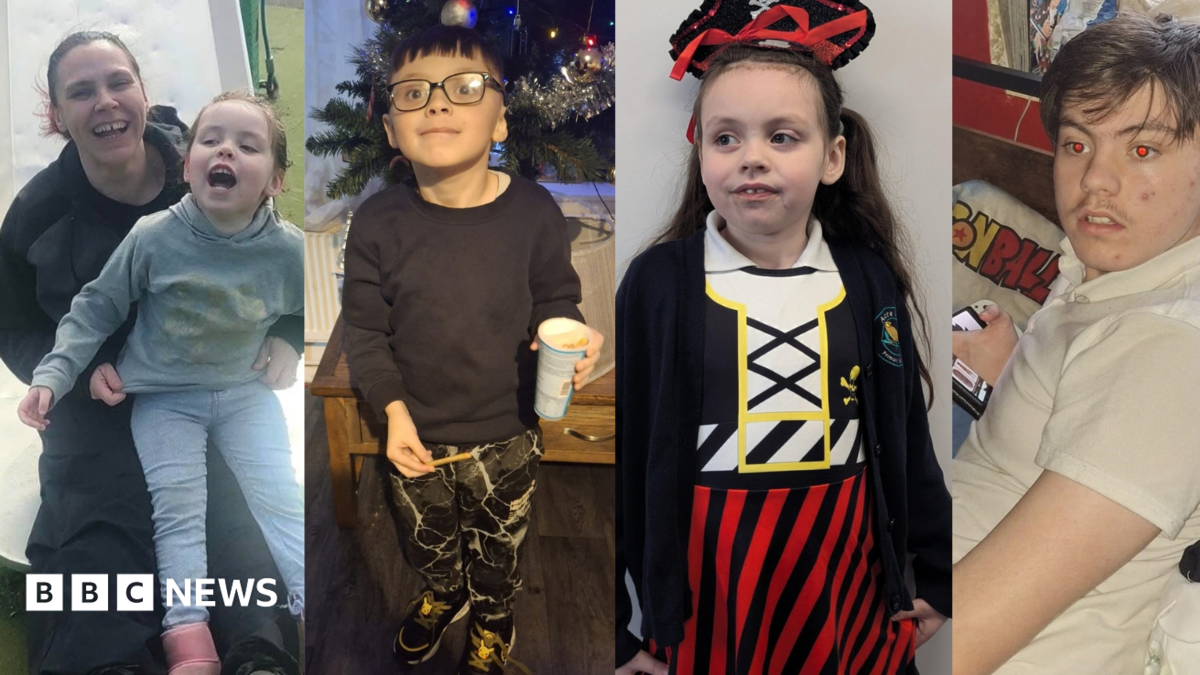
The family of a mother and three children who died in a house fire have said they are experiencing an “unimaginable” loss.
Elisha Brabin, 36, and her children, Leo, 16, Ellis, 8, and Prudence, 7, died after a blaze “spread rapidly” inside a house on Stone Square in Bootle in the early hours of Tuesday.
Paying tribute, their relatives said they had been left “heartbroken” and the loss would be “felt forever”.
The statement added that “Elisha was a devoted and loving mother” and “our beautiful babies, Leo, Ellis and Prudence, were loved beyond measure”.
The family said: “Our whole family is devastated by the loss of Elisha, Leo, Ellis and Prudence.
“Elisha was our beloved daughter, wife, mother, sister, aunty, niece and cousin.
“She was a devoted and loving mother who lived for her children. They were her whole world, and she meant everything to us.”
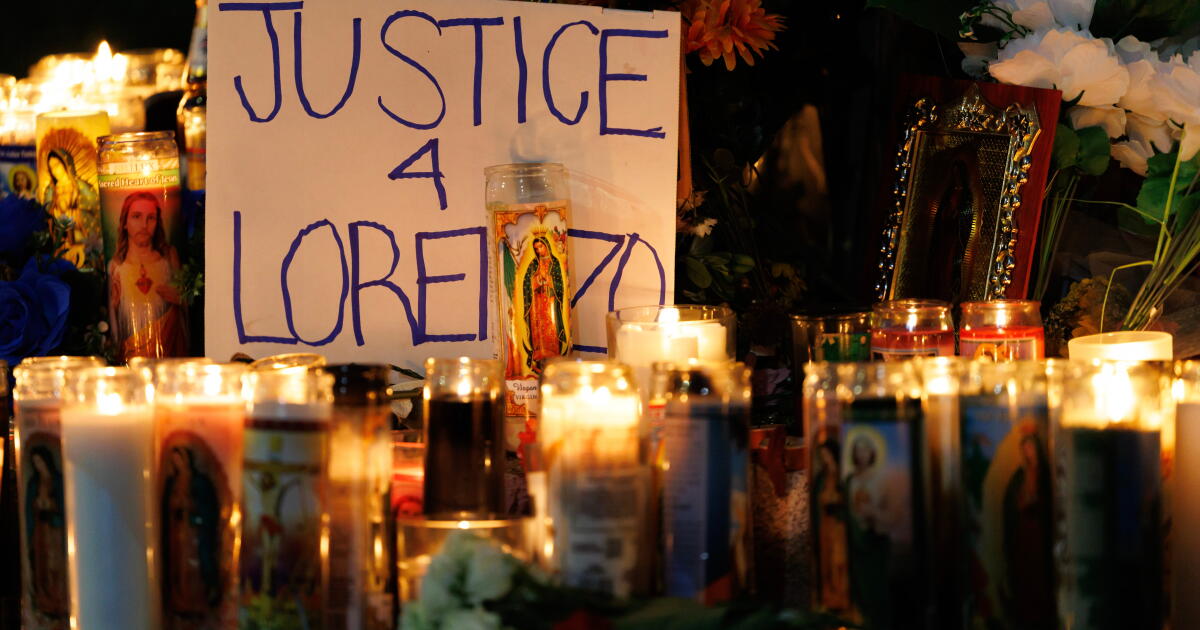
WASHINGTON — Lorenzo Salgado Araujo’s wife used to spend her evenings cooking a big meal for her husband and waiting for him to return home from his job as a home builder. Now, his son told members of Congress, Salgado Araujo’s wife spends those evenings visiting her husband’s grave at the cemetery.
In a packed Senate hearing room, a rapt audience of dozens listened to the sons of Salgado Araujo, the mothers of Ruben Ray Martinez and Renee Good, as well as the woman who video-recorded the death of Alex Pretti and the lawyer for the family of Johan Sebastián Durán Guerrero.
Salgado Araujo, Martinez, Good, Pretti and Durán Guerrero were shot and killed by federal agents since the start of the Trump administration’s crackdown on immigrants. Some were U.S. citizens; others were immigrants.
“We still have so many questions,” said Lorenzo Salgado, one of Salgado Araujo’s sons. “What are the names of the ICE agents who killed our dad? Why do they get to be protected behind anonymity, while my brother and I stand before cameras, showing our faces, proudly saying our first and last name?”
The forum on Tuesday was led by Rep. Robert Garcia (D-Long Beach) and Sen. Richard Blumenthal (D-Conn.). It was the fifth such event that the two lawmakers have hosted since December, forums aimed at shedding light on what the lawmakers call the “lawless and abusive tactics” by immigration agents.
The forums are not official hearings because they have been organized without Republican support. Nothing has changed since the first forum, the lawmakers said, accusing the Department of Homeland Security of failing to fully investigate the deaths and prevent further ones.
Blumenthal noted that two days prior in Austin, Texas, another man was shot by ICE agents. Wilber Rafael Garces Perez, a Venezuelan who was making a DoorDash delivery when ICE agents sideswiped his car, was seriously injured and placed in ICE custody with a bullet still lodged in his back.
Garcia said that, as of this month, Democrats on the House Oversight Committee have verified more than 1,000 instances of abuse by immigration agents under this administration.
“Every community in America should be asking itself: How long will it be until ICE is in our city?” Blumenthal said. “How long will it be until we have a grieving family, until another loss of life?”
Rachel Reyes sobbed as she recounted the moments leading up to the death of her son, Martinez. She said his death came nearly a year before Good’s and Pretti’s “yet far fewer people know his name” because the family was denied access to investigative reports and video evidence showing he had been shot by an immigration officer.
“It’s deeply distressing to know that Ruben’s final moments were consumed by confusion, fear, pain and disregard for his life,” she said. “Though the circumstances surrounding his death and these other victims are distinctly different, the pattern is the same: lives cut short by the same agency, agents without body cameras, no warnings, no attempt to de-escalate, excessive force followed by deflection, and a lack of accountability after the fact.”
Donna Ganger, the mother of Good, said her daughter should still be alive. Ganger described herself as a Republican and a Christian. While Jesus teaches forgiveness, she said, she deserves accountability too.
“I voted for President Trump under the impression that these agents were here to protect the citizens of the United States,” she said.
“This is madness,” Ganger added.
Stella Carlson said that when she saw Pretti, she decided to become “his backup.” Instead, she watched him die and then watched the agents who shot him flee. Two masked agents returned “and began to manipulate his dead body, ripping open his clothes as if to provide aid, but instead moving him around like a rag doll.”
Later, Carlson said, she witnessed top government officials lie about Pretti, calling him a domestic terrorist who wanted to “massacre law enforcement.”
“I am just a regular person, but I care deeply about my community, my state and my country,” she said. “I believe there is power in ordinary people speaking the truth.”
Good and Pretti were killed within weeks of each other in January during a period of increased immigration enforcement in Minneapolis.
Sean Murphy, who represents the family of Durán Guerrero, said he and Durán Guerrero’s widow recently attended a meeting with representatives of the Maine attorney general’s office to retrieve some of his property that isn’t considered evidence.
One item that wasn’t returned was his 3-year-old daughter’s car seat, which had been pierced by a bullet.
Sen. Alex Padilla (D-Calif.) asked each speaker what they think justice would look like.
Reyes said an independent investigation. Brent Ganger said that true justice isn’t possible because his sister can’t come back, but that accountability is possible if federal agents are held to the same accountability standards as local law enforcement.
To Carlson, justice would mean getting ICE off the streets and letting detainees return home. Murphy called for prosecution for the agent who killed Durán Guerrero.
For Lorenzo Salgado, justice would take another form: getting to see his mom heal and finally getting a full eight hours of sleep.
The forum came as congressional Democrats are seeking to edge out Republicans in the Nov. 3 election, and at times the Democrats seized it as a way to criticize the other party.
Rep. Jasmine Crockett (D-Texas) asked members of the audience to stand up if they’ve been affected detrimentally by ICE. Ronaldo Salgado looked around the room as about a dozen people stood.
“The reality is that there are so many more stories. There are so many more names that you will never hear,” she said. Later, referring to Republicans, she added, “It’s time to vote them out.”
Rep. Suhas Subramanyam (D-Va.) noted that Reyes voted for Trump and asked her to say anything she would want him to hear now. Reyes said that, like many Latinos, she deeply regrets her vote.
“I haven’t heard anything from any Republican whatsoever,” she said. “I’m very disappointed, and he lied.”
Good’s brother Brent Ganger said his family has waited long enough for accountability for the damage caused by ICE. As a moderate, he said, he hoped that all members of Congress — even those not in attendance — were listening.
“We will not be quiet, and we will not go away,” he said.
There’s an alternate universe where Taylor Tomlinson is a young adult fantasy author holed up in a cabin miles from civilization.
“ I don’t know if you have some sort of backup career or backup life that you go to in your head when you’re overwhelmed or fed up with your career or whatever process you’re in,” she asks in the lobby of the Four Seasons Hotel Denver ahead of a two-show night. “That was in the back of my head, [I was] like, ‘Well, I could just move to the woods and write books.’”
In this world, she’s a 32-year-old comedian with four Netflix stand-up specials and a two-season stint as the host of late-night game show “After Midnight.”
Her manager told her that people would probably be more interested in her memoir before a series centering on magic and dragons, so she started writing her own story two years ago.
A self-diagnosed workaholic, Tomlinson spent 10 years constantly moving. From a combination of mold exposure and severe burnout from filming “After Midnight” on weekdays and performing in different cities on weekends, she fell ill for months and was forced to take a break.
In that time, she wrote “Actually, Nevermind.” Coming out Tuesday, the autobiographical essay collection delves into the aspects of life that she changed her mind about since her mother died when she was 8 years old.
“Actually, Nevermind” opens with an eclectic mix of three quotes from “Anne of Green Gables” by Lucy Maud Montgomery, celebrated writer Joan Didion, and the 2001 Anne Hathaway-led comedy film “The Princess Diaries.” Tomlinson wanted a combination of funny and serious excerpts capturing grief, but also a quote about evolving as a person.
In the classic coming of age novel “Anne of Green Gables,” a young Anne Shirley states, “I’m not a bit changed — not really. I’m only just pruned down and branched out. The real me — back here — is just the same.”
That’s the essence of Tomlinson’s realizations in her book — she’s growing into herself but that girl who started performing stand-up shows on the church circuit at 16 is still in there.
Tomlinson has a bit from her first Netflix special “Quarter-Life Crisis” about your 20s being a period to “fish trash out of the lake before it freezes over.” She asks how I’m enjoying my 20s, to which I bluntly reply, “It’s a nightmare.”
“ My 20s were a nightmare, too, and I was waiting to be 30, and I was like, ‘When I turn 30, I’m going to be solidified and great.’ And then I turned 30, and it was like the last two years I have probably changed just as much, if not more, than I did in my 20s,” she says. “It’s been much rockier than I anticipated.”
In speaking with her friends, she realized they also felt a disconnect between the lives they envisioned for themselves and their realities. Tomlinson channeled that uncertainty into a jumping-off point for her book.
She reflected on when she began questioning the trajectory of her life and traced it back to her mother’s death.
“ I didn’t know if I was even going to write about my mom at all when I first got the book [deal] because I was like, ‘Well, I talked about it in ‘Look At You,’ and I’ve talked about it in interviews,’ but that’s the thing about losing a parent or any big traumatic grief event is you’re always getting hit by waves of it, and then you’re always untangling it,” she says.
In creating “Actually, Nevermind,” Tomlinson pored through her mother’s diary, deciding to include a few excerpts in the finished book. For most of Tomlinson’s life, she regarded her mother as a flawless, devout Christian whom she desperately yearned to impress.
Drawing on her mother’s diary, estrangement from her father and complex sibling bonds, Tomlinson confronts impossible standards, relinquishes parentified guilt and reframes what family means after loss.
(Sela Shiloni)
Her mother married young, so she tried to hit that milestone, too.
“I didn’t manage it and self-sabotaged a lot,” she says. “Now, I’m grateful that I didn’t get married young, but at the time it was all I wanted because I wanted to fit in and I wanted to be someone she would’ve liked, someone she had things in common with.”
Through reading her mother’s diary entries, Tomlinson began to heal from the impossible standards she set for herself to follow in her mother’s footsteps.
“ She was sort of this perfect, infallible character in my brain for so much of my childhood, so it was helpful to read about her being like, ‘I’m nervous about getting married. We got pregnant on accident,’” Tomlinson says. “There’s stuff I didn’t include about arguments she had with my dad in college. It was just very human, and it was very encouraging to go, ‘Oh, it wasn’t like this perfect frictionless decision for her.’ It’s not like she just nailed it and did everything perfectly.”
One of Tomlinson’s largest shifts in perspective was no longer feeling parental responsibility toward her three younger siblings.
“ I went from their sister to a weird half parent figure when I was still a kid,” she says. “And I made all these missteps because I was also a kid. And then young adulthood was confusing because I had been waiting for everyone to get old enough to be friends with me.”
Now, Tomlinson’s siblings all take care of each other in their own ways. She refers to them as her “soul mates” and feels guilty wishing for a romantic partner when she already has three lifelong best friends.
While Tomlinson remains close with some of her mother’s relatives, she has been estranged from her father for five years. She writes about the sadness of not speaking to someone you feel so alike, but she doesn’t go into extreme detail about cutting ties.
“ There’s some things you just want to keep for yourself, you know?” she says. “You don’t want every painful private detail about who you are and what’s happened to you available to Google because it just makes you feel like you’re a raw nerve walking around, and you can’t get it back once you’ve shared it.”
“And you want something to say on a fifth date,” she jokes.
After processing the heartache of losing another parent in a different way, Tomlinson allowed herself to miss the good memories with her father and assuage any longing for revenge.
In her essay “I’m Gay Now,” Tomlinson explores her bisexuality and the transition from chasing male validation to feeling comfortable in herself. She came out at around 28 years old. Part of what took her until then was feeling the need to prove that she deserved to identify as queer.
In essays on sexuality, faith and ambition, she trades the pursuit of perfection for hard-won self-acceptance, exposing a more vulnerable offstage self still learning to do her best.
(Sela Shiloni)
“ I think that’s just a theme throughout my entire life,” she says. “I felt like I needed to earn the label of comedian. I felt like I needed to earn the label of queer. I needed to earn love.”
Her brother helped her understand that she didn’t have to achieve the title — she’s always been gay.
With all of her adulthood realizations, Tomlinson also reflects on what she wishes she could tell her younger self. Talking to a 16-year-old Taylor, she writes, “The most valuable thing about us cannot be all the things we haven’t done.”
“ So much of my childhood was like, ‘Don’t drink, don’t do drugs, don’t have sex. Don’t step out of line,’” she says. “I wanted to experience things more than I wanted to be this pure version of myself that was performing for the Lord.”
“Actually, Nevermind” is a reflection of Tomlinson when she puts down the microphone, and she is nervous for readers to see that side of her.
“ I feel pretty good about me on stage. Me in the room, I feel really insecure about,” she says. “I’ve gotten to a place where I feel pretty confident about taking up like 45 minutes to an hour and a half of your time. Eight hours, I think, is what the audiobook is. I’m like, ‘Eight hours is a lot more than that.’ So it’s been a real test of confidence.”
After years of chasing perfection, Tomlinson says she finds comfort in knowing that she may never be the world’s greatest anything.
“ In my 20s, I think I was always trying to be the best,” she says. “And now I’m like, ‘I’m going to do my best.’”
In Philippe Caland’s semi-autobiographical 2003 film “Hollywood Buddha,” his mother, Huguette Caland, plays herself. Wearing her signature white smock, inscribed with a flurry of painted swirls, circles, letters and cross-stitches, the Lebanese artist makes precise gray-blue lines on a canvas spread across her dining room table as her son laments a fickle movie industry.
Filmed in her Venice home, the scene, her three children agree, was true to life. Caland worked constantly: on stretched canvas, on fabric folded in her lap, on a children’s menu, on the wall of her kitchen, or the sleeve of her smock. Whatever was at hand.
“Of course it could be frustrating,” said her daughter Brigitte, an elegant, soft-spoken scholar of Semitic languages who has managed Caland’s estate since her death in 2019.
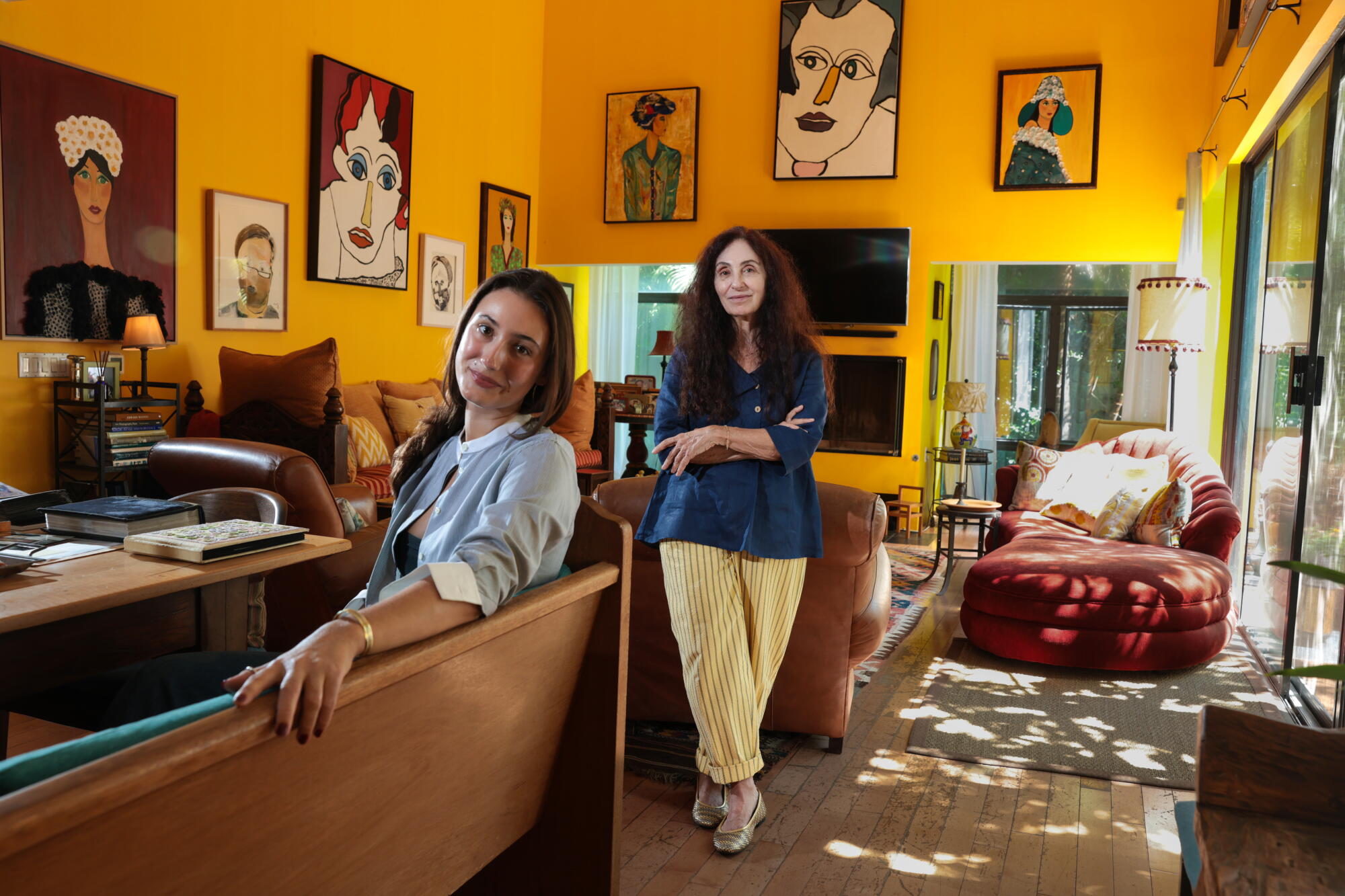
Brigitte Caland, right, and Charley Caland — the daughter and granddaughter of the Lebanese-born painter, sculptor and fashion designer Huguette Caland — stand in Caland’s former L.A. home and studio.
(Robert Gauthier / Los Angeles Times)
Sitting in that very home, which Caland had built in 1997, Brigitte recalled the many times her mother invited her over only to continue working as they talked. “I’d go to leave, and she’d put the canvas away, beg me to come back, and as soon as I did, she’d start painting again.” Still, from early on, Brigitte understood the compulsion as evidence of her mother’s resolve. “She had this incredible drive to create.”
“Huguette Caland: A Life in a Few Lines,” opening Sunday at the Hammer Museum, traces that relentless drive across nearly 150 paintings, drawings, sculptures, garments and tapestries. Organized by the Museo Nacional Centro de Arte Reina Sofía in Madrid in collaboration with the Deichtorhallen Hamburg, the show comes to Los Angeles as the largest Caland survey in the country to date. Spanning five decades and installed chronologically, it features work from the 26 years she spent immersed in Venice’s creative community even as her practice was largely ignored.
It was Caland’s generous hospitality and boisterous wit that made her custom château a gathering place for a vibrant Westside art circle. Ed Moses, who lived around the corner, visited several times a week; Larry Bell, Frank Gehry, Robert Wilhite and others joined her for long meals and even longer parties. Her work surrounded them, and her studio, the grandest space in the house, stood open just beyond the living room. Yet her guests remained uninterested. “No one,” Brigitte said, “would walk the 10 steps.”
Huguette Caland in Stone Doorway, France, 1970.
(Huguette Caland Estate)
Curator Hannah Feldman sees that tension as central to Caland’s California years. “Instead of supporting and bolstering her as a creative in their midst, she became their salon host,” she said. The lack of recognition, Feldman argues, reverberates through Caland’s heavily impastoed portraits of Moses and her enigmatic late abstractions such as the rectilinear paintings in the “Silent Letter Series.”
“To draw a line is a way to contain one’s emotion, one’s anger, one’s anguish,” wrote Caland of her challenging relations with fellow artists in “Sketchbook 2” (1990-91). “My lines tell the story of my life, of people encountered along the path, people I loved, and found and even lost.”
Caland is perhaps best known for her cheeky, erotic paintings of fulsome body parts and for a biography too often reduced to cliché: the libertine daughter of Lebanon’s first post-independence president who left her husband and children in Beirut to pursue an art career in a less repressed Paris.
Huguette Caland, “Self-Portrait in Smock,” 1992
(Huguette Caland Estate)
Feldman hopes the exhibition, which spans fine-line drawings of entangled lovers and radiant topographical tapestries, will complicate that familiar account. “There’s joy, and there’s sex,” she said, “but there’s also pathos, vulnerability. The search for autonomy is not an easy one; it comes with conflict, strife.”
Caland’s freedom was no doubt hard-won. She first picked up a brush as a married mother of three in her thirties, and only after her father’s death. In her first painting, alternately titled “Soleil rouge” and “Cancer” (Red Sun/Cancer) (1964), hazy concentric circles gather in a crimson orb at the center of the monochromatic plane. Simultaneously a tumor and a light source, the refulgent motif holds grief and release.
Soon after, Caland enrolled in art classes at the American University of Beirut, relinquished much of her constricting couture wardrobe, and adopted a uniform of loose, flowing kaftans, which she would later turn into works of art in their own right. Archival photographs show a glamorous Caland arriving at an event in a floor-length garment bearing painted breasts, a belly button and a triangle of curly pubic hair.
Huguette Caland, “Bribes de corps,” 1973
(Huguette Caland Estate)
Caland moved to France in 1970, leaving her children (then 15, 13 and 12) in Beirut with their father, a French-Lebanese lawyer named Paul Caland. In paintings from that decade, Caland’s imagery of bodies swell, split, meld and dissolve. In “Enleve ton doigt” (Remove Your Finger) (1971), lipstick-red lips receive a pale finger reaching out from a crush of fantastical profiles; two years later, in “Self-Portrait” (Bribes de corps), Caland dispersed a sensual body across a pale pink field interrupted at the lower edge by a slight, shadowed cleft — either buxom cleavage or buttocks.
The distance from her children produced another kind of line: text. Philippe recalled receiving illustrated letters almost every week, filled with drawings, doodles and notes of affection. Most of these were later destroyed when the family house was bombed during the Lebanese Civil War of 1975. “I always knew my mother loved me,” Philippe said. “The family was not torn apart. She took a break, and in the end made a home for us in Paris, where we all landed when the war was raging.”
After the death of her lover, Romanian sculptor George Apostu, whose rough-hewn wood sculptures still populate the house’s patio, Caland’s children encouraged yet another departure. Her eldest son, Pierre, a businessman and former Olympic swimmer, paid for a stay at a friend’s Venice bed-and-breakfast, all but forcing his grieving mother out of Paris and to sunny L.A. Her initial reluctance gave way to affection. The light, arid climate and mountains sloping into the sea reminded her of Lebanon. “She liked that California land sounded like Caland,” Brigitte said.
Huguette Caland works at her home and studio in Venice, date unknown.
(Huguette Caland Estate)
After making Venice her primary residence, Caland collaborated with architect Neil Kaufman on the design for her enclosed château. Its towering, mostly unbroken face and narrow swimming pool suggested a rampart and a moat, but behind the concrete exterior, Caland eliminated every door save the guest bathroom. Long vertical windows opened onto a courtyard shaded by a sprawling olive tree. Art crowded the steep stairwell; it accumulated on scattered plywood and Formica tables and unraveled across the kitchen in an intricate mural composed of tessellated marks that recall Byzantine mosaics and tatreez, a form of traditional Palestinian embroidery.
“There was no distinction for her,” Brigitte said, between the home and the studio, art and life. Caland once described her “very, very mixed media” as including “every single exchange, a look, a smile, a brief encounter.”
That original interior survives in “Hollywood Buddha” and archival photographs. Philippe now lives in the house with his family, and although the concrete exterior remains intact, the rooms and the courtyard have been remodeled around their own aesthetics and routines. Along with the technicolor mural, Caland’s singular sensibility persists in scattered drawings, a bouquet of her preferred 30-inch paintbrushes and a pair of stiff-backed pews. Her presence, too, is felt in the people who now inhabit the space, like her granddaughter Charley, 25, whose easy warmth recalls qualities long ascribed to the matriarch.
The former Venice home and studio of the Lebanese-born painter, sculptor and fashion designer Huguette Caland. The home is still occupied by Caland’s family and no longer looks how it did when she was alive, but her spirit lives on in small details.
(Robert Gauthier / Los Angeles Times)
When the Hammer selected Caland for “Made in L.A. 2016,” the honor brought some measure of the local attention that had long eluded her. “If you had to pick one critical turning point for her career,” Pierre said, “it was the inclusion of her work in that show.” For the family, the coming survey fulfills one of her long-held ambitions.
“She told me, ‘Live your life day by day and plan it on a thousand years,’” Philippe said. Only later did he understand that the advice described her own life. “Today, her work is here,” he added. “She continues with it.”
Huguette Caland, “Le grand bleu,” 2012.
(Huguette Caland Estate)
The final painting in the exhibition, an oceanic large-format canvas titled “Le Grand Bleu” (The Great Blue) (2012), once hung high above the central hearth in the Venice house. Surrounded by undulating circles, spots and stripes, red-roofed Lebanese abodes and white-masted schooners traverse an unsettled horizon line. From the dining table below, where a young Charley often helped her grandmother fill blank planes with delicate dots, Caland could look up and see how far her line had taken her.
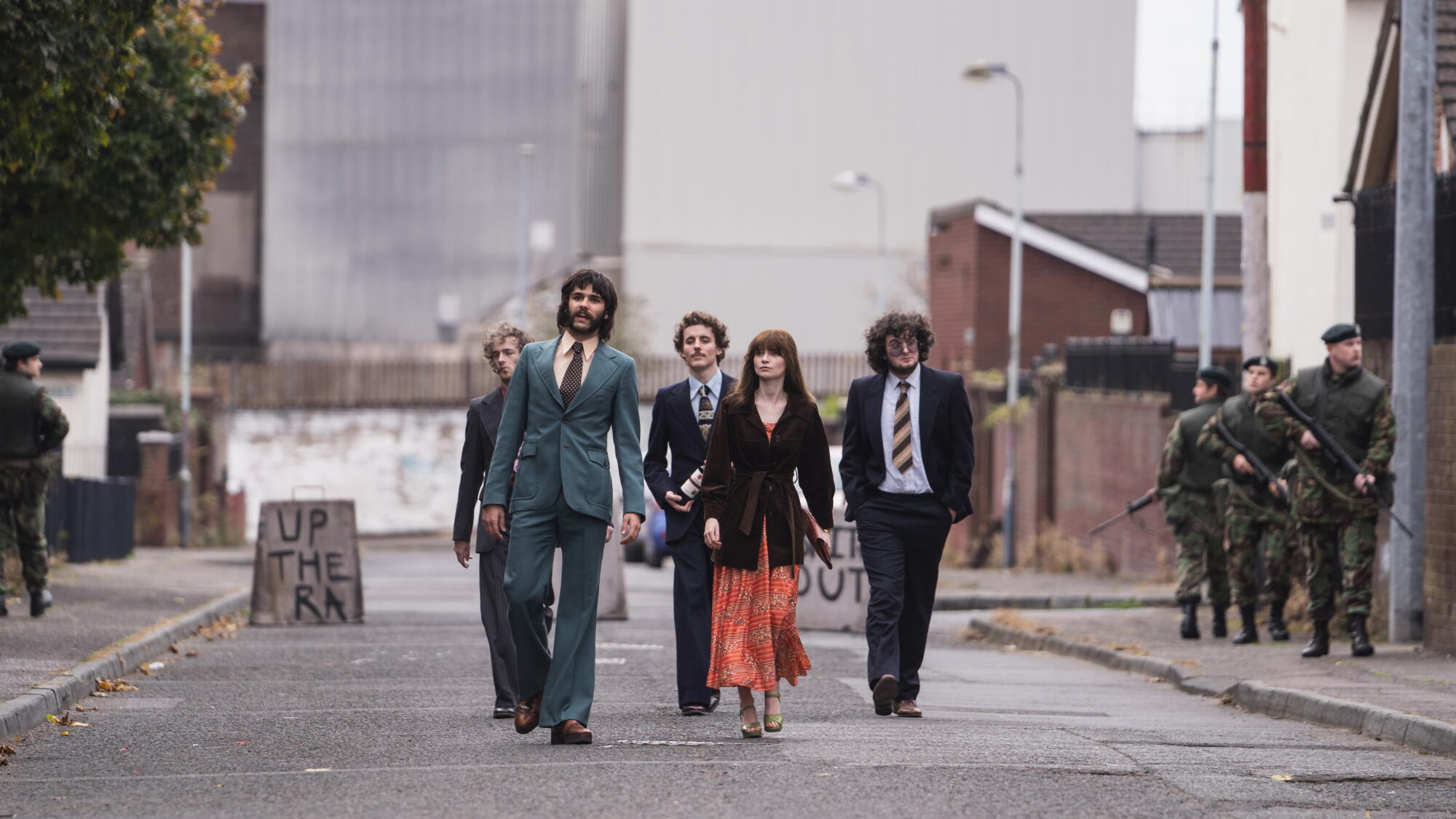
Premiering Sunday on PBS, “Trespasses,” a four-part adaptation of Louise Kennedy’s 2022 debut novel, is a story of love in a time of choler. Set outside of Belfast in 1975 during the Troubles, it follows a clandestine affair between Cushla Lavery (Lola Petticrew, the serial killer in “Furious”), a 24-year-old Catholic elementary school teacher, and Michael Agnew (Tom Cullen), an older, married Protestant barrister known for defending stone-throwing Catholic youth with an eye to keeping them out of the IRA.
Emptying the thesaurus, press materials stress the hot stuff — “scandalous,” “risqué,” “racy,” “torrid,” “titillating” and “steamy” — and while there is more than a modicum of modest sex scenes, the actual tone of the limited series, as adapted by Ailbhe Keogan and directed by Dawn Shadforth, is quite measured; it runs on talk. That’s not to say, given the setting and the setup, which betokens tragedy as surely as Romeo meeting Juliet, it doesn’t throb with tension, let’s say, three-quarters of the time.
Along with teaching, Cushla works for her brother Eamonn (Martin McCann) at the family bar. The clientele includes Catholics and Protestants, united in their love of whiskey, lately including Michael — whose opposition to extremism grants him the honor of being disliked by both sides — seemingly there expressly, even too expressly, to gaze upon Cushla while he pretends to do crosswords. And she gazes back. Moving through discussions of Malcolm McDowell’s typecasting and group lessons in Irish, led by Cushla, they will go beyond gazing.
She’s a ray of light; he’s magnetically mature. You may or may not buy the mutual attraction the series insists upon, or for that matter, trust the lovers’ motivations. (I think we’re meant at least not to wholly trust Michael, as the older party, with a reputation as a womanizer — I didn’t, anyway.) But you will also be invited to change your mind. Because the camera never leaves Cushla’s side, anything there is to learn we learn along with her, which pays some dramatic dividends and means we’ll be forced to revise earlier judgments, usually for the better.
It’s a dangerous liaison. Michael, who is given to speechifying (and actual speechmaking), declares, “We cannot let the old bigots and the boys with guns tell us how to live … Otherwise nothing will ever change. Hate wins” and, in a favorite refrain, “We must find the bravery to choose freedom over fear.” Cushla, however notes that she comes “from a long line of Catholics that have survived by keeping their heads down and their mouths shut. Having a big opinion like yours, it’s a luxury I don’t have.”
Gerry Harkin (Oisin Thompson), left, Cushla’s colleague and confidant.
(Peter Marley / Channel 4)
Many shots are framed as if Cushla and Michael are being watched, whether or not they are, though sometimes they are, including by each other. (“They like to let me know they know where I am,” Michael says, when Cushla mentions seeing a patrol car outside his flat.) We’re shown the oppressive presence of loyalist troops, and some anti-Catholic vandalism, and a neighbor reflexively checking his car for a bomb, but the greater violence comes through as background noise on the radio or TV news, or reported by Cushla’s young students.
Fortunately, if no less terribly, there is more to the story, and many of the most compelling scenes have little or nothing to do with Michael. (Every scene is a Cushla scene.) She’s wonderful with her class, and her colleague and confidant Gerry Harkin (Oisin Thompson), who will jump onstage at a school assembly to interrupt a strident, bigoted superior, leading the students in a peace song — “Take away the hate and the violence / Bring love into our hearts.” Viewers will consider his bowl haircut a romantic nonstarter, but there are levels to be revealed.
Cushla may not have the luxury of big opinions, but as an obviously good person, whatever one thinks of adultery, she’s unafraid to go against the grain in support of her student Davy McGeown (Daithi Ó Haragain), whose mother (Emily Taaffe) is Protestant and whose Catholic father, in the child’s words, has been “beat up for loving my mummy.” She’s also supportive of Davy’s bright older brother Tommy (Conlaoch Gough-Cunningham), teetering on the edge after the attack on his father.
Above all, there is Cushla’s mother, Gina, played by Gillian Anderson, in a downward spiral since the death of her husband, some two years earlier. Introduced in a state of drunken collapse, Anderson — fearful, bitter, despairing, protective — is quite magnificent limning different levels of intoxication. But she’s even more impressive in her sober scenes, participating in the world beyond her couch, bringing food to the McGeowns and, finally, acting as a mother to Gina.
Michael’s declarations not even aside, Keoghan has a gift for writing dialogue that feels native to the speaker and doesn’t land heavily on a point, and apart from the lovemaking interludes and a gauzy montage of a romantic trip to Dublin, Shadforth’s naturalistic direction enhances the drama by not underscoring it. She has an especially convincing way with party scenes — a school disco, a wedding, an art opening, a birthday party (at which Michael performs a soulful, foreshadowing version of the Carter Family’s “The Last Move For Me”) — where so many productions fall down.
Come for the promised steaminess. Stay for the rest of it.
For the first time since California and Congress passed a pair of laws bolstering U.S.-based claims to Nazi-looted artwork around the world, two lawsuits have been filed in California demanding prominent museums relinquish pieces seized during World War II.
In one case, filed in federal court in Los Angeles on Monday, the daughters of Auschwitz survivor Dina Gottliebova Babbitt sued the Auschwitz-Birkenau Memorial and Museum in Poland for the return of watercolors Babbitt was forced to paint of fellow prisoners for the Nazi physician and war criminal Josef Mengele.
In the other, filed in Los Angeles Superior Court on Monday, the Jewish Federation of Greater Los Angeles and Daniel Gryczman, the federation’s board chair, sued the Norton Simon Museum in Pasadena for the return of the diptych “Adam and Eve,” a pair of 16th century masterpieces by Lucas Cranach the Elder.
The lawsuits revive legal battles waged unsuccessfully for the watercolors and the diptych for years, on the premise that their claims are newly viable under the new laws — one passed by California lawmakers in 2024 and the other signed into law by President Trump earlier this year.
Both laws were inspired in part by another legal battle over looted art between a California family and a prominent museum, which is still ongoing.
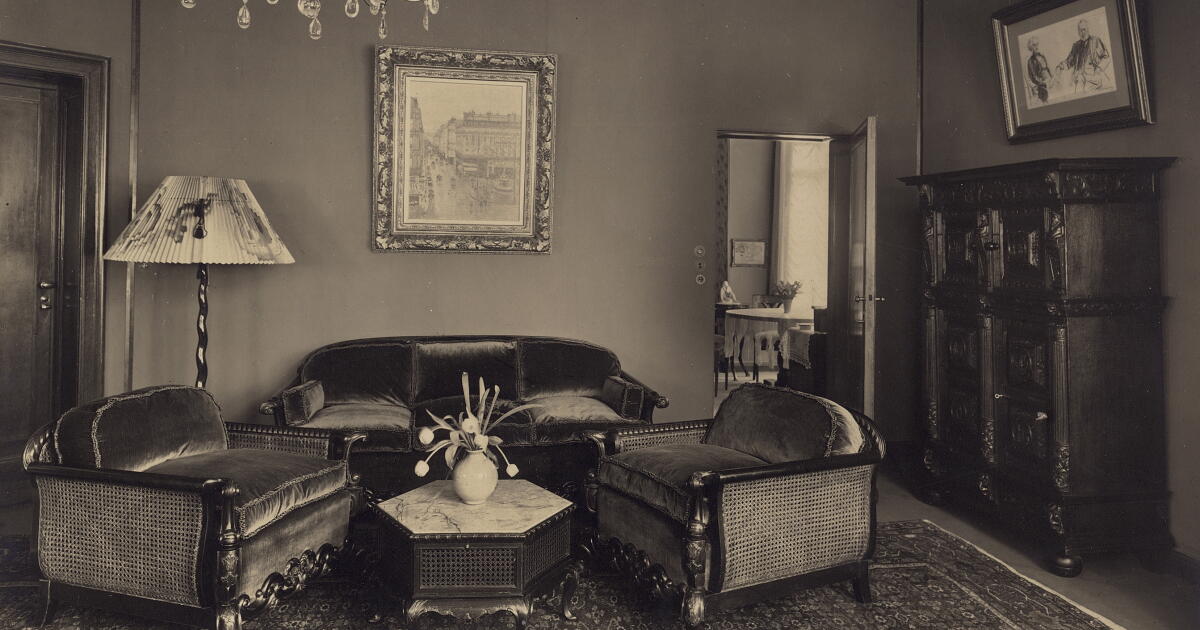
Lilly Cassirer Neubauer escaped Germany at the dawn of World War II by relinquishing to a Nazi art broker the exquisite impressionist masterpiece “Rue Saint-Honoré in the Afternoon. Effect of Rain,” by Camille Pissarro. The painting is now worth millions. Her grandson Claude Cassirer, who moved to California, and great-grandson David Cassirer have been fighting for the painting’s return from the Thyssen-Bornemisza Collection in Madrid for the last two decades.
Amid that battle, California lawmakers rewrote state law to make clear that in situations where it and another jurisdiction’s law on looted artwork are in conflict, California law applies and requires the return of the art to its original owners regardless of the passage of time. In an unusual moment of bipartisanship, Congress followed up by passing its own measure — the Holocaust Expropriated Art Recovery Act of 2025 — to further bolster such family claims.
The two new lawsuits — neither of which provide a valuation for the artwork in question — were filed just ahead of a deadline under the California law for claims to artwork with long-known locations.
David Cassirer said his father would be “extremely proud” to know a California law passed in part in response to his family’s fight has also given other families another chance “to vindicate their ancestors’ artistic legacies.”
Auschwitz watercolors
Michele Babbitt Kane, of Ben Lomond, Calif., and Karin Wendy Babbitt, of Las Vegas, say in their lawsuit that Mengele demanded their mother produce the seven watercolors in question — each depicting a Roma prisoner later murdered — to support his “pseudo-scientific” and racist work studying the Roma people. Known as the “Angel of Death,” Mengele conducted gruesome medical experiments on Auschwitz prisoners.
They said their mother obliged “with deep sympathy for her subjects,” on the condition Mengele “spare her and her mother from the gas chambers.”
After liberation, the lawsuit says, their mother moved to California and worked for nearly 20 years as an animation assistant for Hollywood studios such as MGM and Warner Bros., where she contributed to familiar cartoon characters such as Wile E. Coyote, Tweety, Daffy Duck and Speedy Gonzales.
They say theirs is exactly the sort of case California’s new law was enacted to allow — involving “a California family seeking the return of watercolors created by their Jewish mother under Nazi coercion at Auschwitz and withheld by a Polish state museum for decades despite the Museum’s own repeated acknowledgments of the family’s rights.”
Paweł Sawicki, a spokesperson for the Auschwitz Memorial, said in a statement to The Times that the Babbitt paintings “must remain in the Memorial as part of the documentation of the crimes of Mengele,” and that many in the Roma community agree.
“We fully understand the emotional approach of Dina Gottliebova’s family to the works she made on the orders of Josef Mengele in circumstances that certainly affected her life, but in carrying out our statutory responsibility, we express the deep conviction that the watercolors should remain at the Memorial,” Sawicki said. “The portraits of Roma victims are the few remaining fragments of the documentation made by Mengele as part of his criminal experiments. Therefore, they should be treated as unique documents related to the history of Auschwitz.”
‘Adam and Eve’ diptych
According to the Jewish Federation’s lawsuit, the “Adam and Eve” paintings were part of a vast collection seized from prominent Dutch Jewish art dealer Jacques Goudstikker by Hermann Göring, Hitler’s second-in-command. The collection was later recovered by Allied forces and given to the Dutch government, with the diptych being sold to the Norton Simon in 1971.
The lawsuit says Marei von Saher, Goudstikker’s surviving heir, has long sought the return of the Goudstikker collection, and years ago was successful in forcing the Dutch government to return 200 pieces still in its possession. She first demanded the “Adam and Eve” paintings from the Norton Simon in 2000, without success.
The new lawsuit says Von Saher on Monday signed her claimed rights to the paintings over to Gryczman and the Jewish Federation, which said in a statement that they will use a majority of any proceeds from the return of the paintings to “care for Los Angeles-area Holocaust survivors living in poverty.”
Von Saher’s daughter, Charlène von Saher, said in an interview that her family gave the painting rights to the Jewish Federation because of that shared mission. She said she wishes California and Congress had acted sooner but hopes a win now will help other Jewish families reclaim what is rightfully theirs in the future.
“My grandfather lost his life fleeing the Nazi invasion, and many of his family members were sent to Auschwitz and did not survive,” she said. “Victory would be justice, and a piece of the puzzle to restoring my grandfather’s legacy and his collection.”
The Norton Simon Art Foundation said in a statement to The Times that it was reviewing the new lawsuit, but that various courts, including the U.S. Supreme Court, have over decades of litigation confirmed that the foundation “has proper title” to the diptych paintings, and the foundation “will continue to make these important artworks accessible to the public.”
The Pissarro
The Thyssen-Bornemisza Collection and the Kingdom of Spain, which owns it, have fought the Cassirer family’s claims to the Pissarro painting since Claude Cassirer, now deceased, first sued for its return in 2005. Spain has argued the painting was legally obtained by the collection prior to its 1993 sale to the country by Baron Hans Heinrich von Thyssen-Bornemisza, a prolific art collector whose wealthy industrialist family helped finance Adolf Hitler’s rise.
The matter has repeatedly wound its way through the U.S. courts, including to the Supreme Court, which remanded the case to the lower courts for additional review in light of California’s new law. A hearing is set for next month.
The museum has contended California’s new law is unconstitutional, which California is contesting. David Cassirer has argued the law clearly requires the museum to return the painting — and has pledged to support other looting victims with any proceeds.
He said both California and Congress “acted decisively to guarantee that stolen art victims, and victims of political persecution in particular, can have a fair shot to recover family legacies the Nazis ruthlessly tried to destroy,” and that “the momentum at all levels of government in favor of restitution is very encouraging.”
Mother Monster has reportedly welcomed her first baby.
Pop singer Lady Gaga and her fiancé, tech investor Michael Polansky, were recently photographed with a newborn child during an outing in Northern California, according to Page Six.
The “Bad Romance” singer and 16-time Grammy winner was seen wearing a large ring and holding the child, supported by a baby wrap, tightly to her chest, according to photos published by the outlet.
A representative for the singer, whose real name is Stefani Germanotta, did not immediately respond to a request for comment Friday.
She confirmed her engagement to Polansky at the 2024 Summer Olympics in Paris, where she was said to have introduced him to then-French Prime Minister Gabriel Attal.
The pair was first spotted together kissing at a Las Vegas party in 2019.
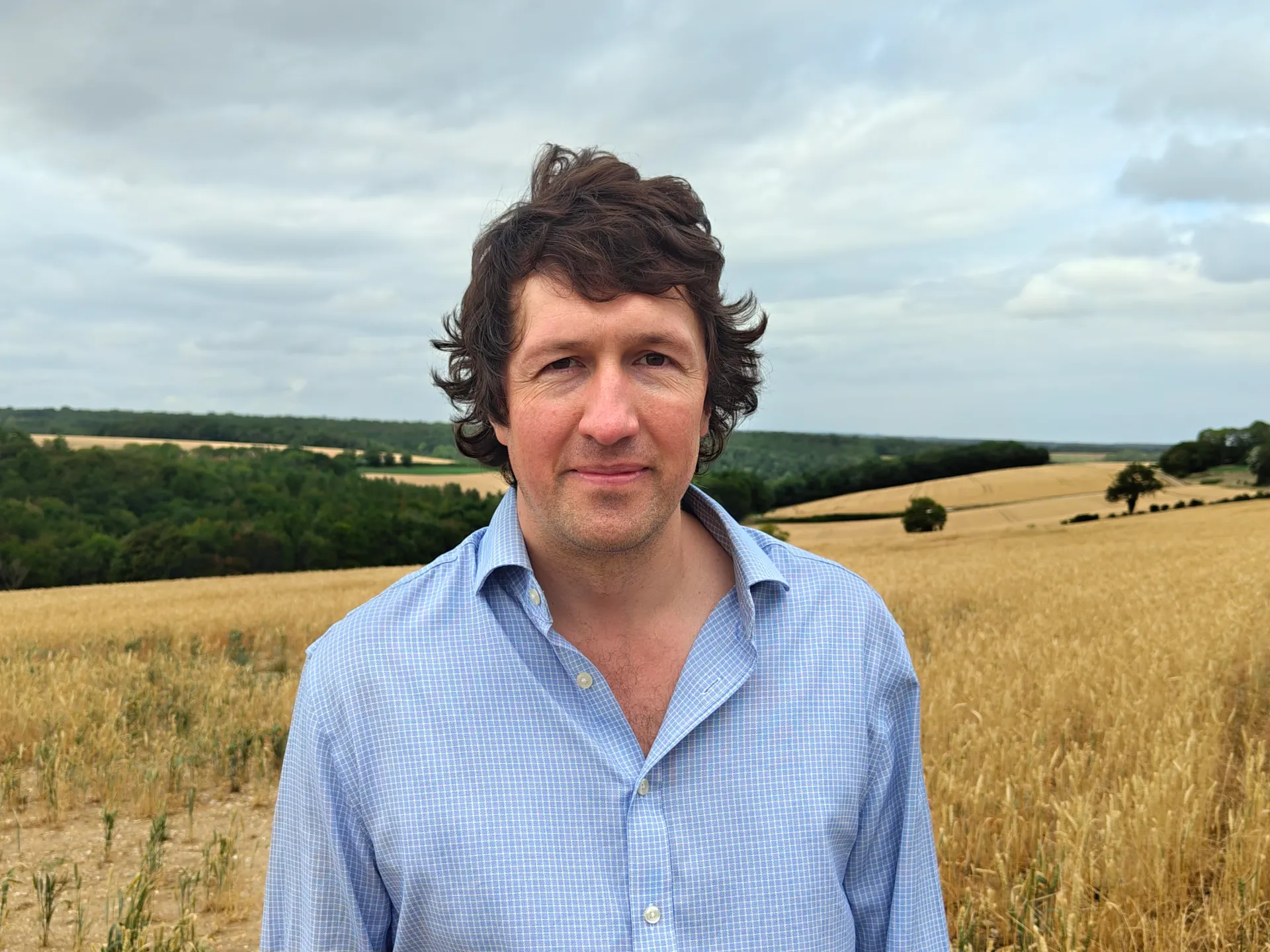
London, United Kingdom – In a wheat field near High Wycombe in the rolling English countryside, Alex Nelms watched the harvest on his farm die in a matter of days.
His crop had looked strong until the first heatwave came in May, when temperatures surpassed 35 degrees Celsius (95 degrees Fahrenheit) just as his milling wheat entered its grain-fill phase, the critical weeks when the plant fattens its kernels.
Recommended Stories
list of 4 itemsend of list
“It just killed everything stone dead,” he told Al Jazeera. “Everything was finished really early, and when we were sort of full of optimism and hope, it was scuppered almost overnight.”
Nelms farms just over 2,000 acres (809 hectares) of arable land in south Buckinghamshire, on a business his grandparents founded in 1955. His uncle, who has worked the farm for more than 40 years, has just suffered the worst harvest of his career.
Last month, the Department for Environment, Food and Rural Affairs (Defra) said almost three-quarters of England, 71.3 percent, remained in drought. Rainfall in August reached just 34 percent of what would normally be expected by that point in the month, Defra said, and reservoir levels were 18.2 percentage points below where they should be for the time of year.
“We’re totally reliant on Mother Nature,” Nelms said, and nature did not deliver this year.
After a historically dry spring and a run of summer heatwaves, the farm is down roughly 1,000 tonnes on its average harvest, a shortfall of some $270,000 in revenue.
The farm, tucked in the Chiltern Hills, a steep, long ridge of white limestone rock, has no irrigation and never will.
“That has serious knock-on effects on our cash flow,” he said. A third consecutive difficult year would mean hard conversations with his bank and landlord, and farming to minimise risk rather than maximise output, “consequently, probably producing less food”.
‘Financial crisis point’
The National Farmers’ Union (NFU) says farmers are at a “financial crisis point” after the worst drought in 50 years, with historically low harvests, stunted grass growth, rising fuel and fertiliser costs, and a severe outbreak of bluetongue disease in livestock.
The union puts the gross production value loss of wheat at approximately $499m and the cost of replacing a shortfall in forage at roughly $45m.
NFU president Tom Bradshaw has said farmers now lack “breathing space” and are “increasingly exposed to geopolitical shocks, as well as repeated weather extremes, animal disease and global wars”.
He believes action is needed now to ensure the future of British farming “and enable the next generation to keep producing the nation’s food”.
To manage the risk, Nelms is diversifying, planting oilseed rape again on about 350 acres (142 hectares) for the first time in 20 years. He says that the crop’s usual insecticide protection, neonicotinoid seed treatments, is now banned, leaving it exposed to cabbage stem flea beetle and to game birds that can “absolutely nibble, eat, and destroy a crop”.
Growing it also means breaking a continuous wheat rotation that has kept a soil-borne disease called “Take-all”.
Tax allowances would make investing in grain storage and diversified income worthwhile, he said, as well as government-backed bridging loans, modelled on COVID-era support, to survive a bad year without permanent damage.
It is the kind of relief the NFU is pressing the government to provide nationally.
The union wants an interest-free “Keep Britain Growing” loan tied to drought losses, help covering the cost of disposing of livestock lost to bluetongue, faster planning permission for on-farm reservoirs, and clearer rules letting farmers access water as soon as levels allow, echoing Nelms’s case for storage on his farm.
“Drought conditions will continue to worsen until we receive sustained rainfall across the country and we still all have a role to play in conserving precious water supplies,” according to Philip Duffy, the Environment Agency’s chief executive, in a statement shared by Defra.
The Environment Agency has applied for a drought order to restrict abstraction from the River Severn, and 10 water companies, serving 30 million customers, now have restrictions in place.
“A few days or even weeks of wetter weather cannot reverse the impacts of several months of exceptionally dry conditions,” added Duffy.
Defra noted that the first meaningful rains since June have fallen but they have been patchy, so reservoirs and groundwater are still declining even as a handful of rivers see brief upticks in flow.
Despite the losses, Nelms is hopeful about farmers pulling together – sharing labour, machinery and market routes. He points to the Central Chiltern Farmer Cluster, where growers meet to talk through their problems and find solutions together.
“We’re working together, not competing with each other,” he said.
For a farm like Nelms’s, with no irrigation and no water in reserve, that patchiness is the problem. Soil parched from months without rain needs to absorb sustained rainfall before groundwater can even begin to recharge, let alone refill the reservoirs a future harvest might depend on.
“Our climate has changed,” Water Minister Emma Hardy, who chairs the National Drought Group, said late last month, “and we will continue to take all action necessary.”
A Happy Mondays star revealed their elderly mother is in hospital – stepping backCredit: Instagram/rowettaSinger Rowetta has performed with the group across two stintsCredit: Getty – Contributor
Rowetta – ful name Rowetta Idah was part of the group from 1990 to 1993 and again from 2012 to 2024.
Taking to Instagram, she shared a photo of her mother lying in a hospital bed, sipping a drink.
Sign up for the Showbiz newsletter
Thank you!
Rowetta captioned her post: “Apologies to friends & family but my mum has had another fall.
“She has 3 broken ribs and her left lung needs to heal, so I won’t be on here much and studio & Ibiza are on hold.
Rowetta performing with Happy Monday’s lead vocalist Shaun RyderCredit: GettyIn 2004, she competed in the first-ever series of The X FactorCredit: News Group Newspapers Ltd
“She’s in a great place so hopefully back soon.”
One person commented: “Thinking of ye both. I hope she gets better soon.”
Another wrote: “Wishing her a speedy recovery and sending you lots of love, strength and courage.
“Please do get in touch if I can help with anything.”
A third said: “Hope she feels better soon.”
Aside from her work with the Happy Mondays, Rowetta is the vocalist on 1989 track Reach Out.
It has since been sampled by other artists including The Black Eyed Peas and Steve Angello.
Meanwhile, Rowetta competed on The X Factor‘s inaugural 2004 series, placing fourth and being the highest placed female contestant.