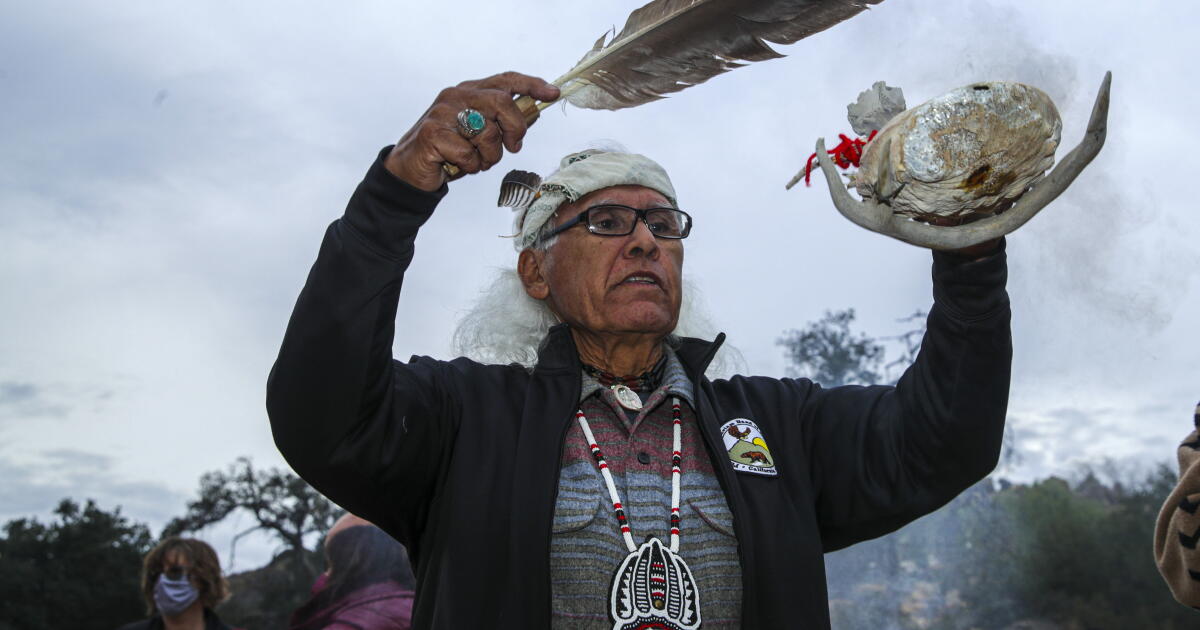
Prop 45 would bar dozens of tribes from consulting on development projects
Buried in the language of Proposition 45, the initiative that would overhaul California’s powerful law on environmental review, are provisions that would mean government agencies have to consult only with certain tribes in the state, and not others when they develop major projects.
Tribes that are federally recognized would be consulted; those without recognition would not.
This effort mirrors similar ones supported by tribes that have federal recognition to limit the say of tribes without it in recent years. Non-recognized tribes see it as another move by economically powerful tribes to protect their own interests and avoid having to negotiate with other local tribes over territorial disputes and how to best protect important sites.
“Our concern is that wealthy casino interests and political influence are being allowed to outweigh ancestral connections,” Andrew Salas, chairperson of the Gabrieleño Band of Mission Indians — Kizh Nation, said in a statement to The Times.
Proposition 45 on the Nov. 3 California ballot would create a streamlined environmental review process for projects deemed “essential” — including most housing, transportation, water, health, wildfire mitigation, education, internet access and clean energy projects. The streamlining would mean stricter deadlines for review and court challenges, would bar local governments from requesting repeated analyses and allow developers to propose a single alternative with less environmental impact rather than several.
One of the largest contributors to the Yes on Prop 45 committee is a federally recognized tribe, the Yuhaaviatam of San Manuel Nation, which contributed $750,000.
“Federal recognition is the legal and constitutional foundation of tribal sovereignty and establishes a government-to-government framework for consultation,” Amelia Matier, spokesperson for Yes on Prop 45, said, noting tribes without recognition still can still meaningfully participate alongside members of the public.
The Yuhaaviatam of San Manuel Nation reaffirmed its support for the measure in a statement to The Times but did not respond to specific questions.
Critics, meanwhile, say moves such as this would give federally recognized tribes the power to consult on development projects hundreds of miles outside their homelands, overriding local tribes.
“Proposition 45 is part of a much longer struggle over whose voices California chooses to hear,” Salas said. “For decades, non-federally recognized ancestral tribes in Southern California have fought to protect our homelands while facing pressure to accept a ‘lesser role’ than federally recognized tribes.”
“Our rivers, habitats, and the animals that depend on them lose their protection when the people who know these places are removed from the table,” he said.
None of the Gabrieleno and Tataviam tribes within the greater L.A. area have federal recognition.
Last year, three tribes with federal recognition championed a bill that would have significantly limited how tribes without it could participate in the consultation process for all projects — not just the ones deemed “essential” ones under Proposition 45. A few months later, the small state agency that maintains the official list of tribal contacts unveiled a proposal that some non-recognized tribes argued would effectively exclude them. Multiple federally recognized tribes supported the effort.
The environmental review process under the California Environmental Quality Act, better known as CEQA, is one of the primary ways that tribes have a say over how the state and local governments develop land within their ancestral territories. It allows tribes to comment on how a proposed housing or infrastructure project might harm graves, ceremonial grounds or ancient villages. A separate law lets tribes comment on general plans that outline where developers can propose housing, and commercial and industrial facilities.
Tribal consultation differs from general public comment. It allows Indigenous leaders to discuss the location and details of sensitive information — such as burial sites — confidentially, before draft environmental reviews are published.
The Kizh Nation has used the CEQA process to consult on hundreds of land development projects a year around the Los Angeles Basin. In one instance, the process generated extra protections for one of the oldest living plants in the world, a more-than 13,000 year-old oak tree in the Inland Empire, that Indigenous people have taken care of for millennia. It also resulted in the Kizh Nation winning one of the largest land returns in Southern California history for a tribe without federal recognition — while still creating a development of nearly 1,700 homes and industrial and business parks.
There are over 100 tribes in the state with federal recognition, a status that brings protections, funds and services from the federal government, including funding for Indigenous elementary and secondary schools, access to healthcare and the potential for a reservation. Yet dozens more remain unrecognized.
Federal agents negotiated treaties in the 1850s with more than 130 Indigenous communities in the new state of California, setting aside roughly 7% of the state for reservations. But Congress refused to ratify the very treaties it had ordered and failed to notify tribes of its decision.
The federal recognition process today is long and grueling. Only 18 tribes have successfully achieved recognition through it since it was created in 1978. Only one was in California — Death Valley’s Timbisha Shoshone Tribe.
Tribes along the coast who were coerced into building the missions, including the Gabrielino, have had an especially hard time gaining recognition. They endured three waves of settlers: the Spanish, Mexican, and American. With these came death, forced displacement and cultural suppression. When the federal government sent agents to create reservations for California’s mission-affected tribes in the 1890s following reports of dire circumstance, the agents inexplicably overlooked the Gabrieleno.
At least one-third of tribal cultural resources protected under CEQA are in the homelands of tribes without federal recognition, Jonathan Cordero, executive director of the Assn. of Ramaytush Ohlone, estimates.
If Proposition 45 passes, “that means that hundreds of sacred sites and thousands of invaluable and irreplaceable tribal cultural resources would be destroyed in subsequent years,” he said in a statement.