MIAMI — The Trump administration has extended protections shielding about 11,000 Lebanese from deportation, allowing them to stay and work in the United States for another six months.
The decision, announced Thursday by the Department of Homeland Security, marked a rare reprieve for people protected by temporary measures that have been harshly criticized by Republicans. The extension comes amid ongoing fighting in southern Lebanon between Israeli troops and Hezbollah fighters.
The decision was automatic, meaning that the administration missed the deadline by which it was supposed to decide on whether to extend the measure called Temporary Protected Status for Lebanese people living in the U.S. who are covered by the program. By statute, the status automatically extends for six months if the department misses the deadline.
It was an unusual outcome for an administration that has canceled the protections that had covered people from 13 countries, including Venezuela, Haiti, Nicaragua and Syria from deportation.
TPS was created by Congress in 1990 to prevent deportations to countries suffering from natural disasters or civil strife, giving people authorization to work in increments of up to 18 months. More than 1 million immigrants from 17 countries were protected by TPS at the beginning of the Trump administration, after the Biden administration greatly expanded its use.
The program has been at the center of a controversy.
Republicans and critics of TPS argue that the program and its protections deviate from their original temporary intent, taking on a quasi-permanent character when extended. Its defenders assert that it is a fundamental humanitarian program that prevents vulnerable individuals from being forced to return to dangerous conditions.
The DHS notice said that former DHS Secretary Kristi Noem and current Secretary Markwayne Mullin, who has led the department for the last two months, “were unable to make an informed determination on Lebanon’s TPS designation.”
The extension allows existing beneficiaries to keep their protections through Nov. 27, “if they still meet the eligibility requirements for TPS,” according to the notice. The work permits that were already issued for Lebanese TPS holders will be valid until the same day.
This is the second time the Trump administration has automatically extended a TPS designation. The first happened nearly a year ago with South Sudan, but the protections were terminated in November 2025, after the six-month extension period.
There are dozens of lawsuits challenging the termination of TPS at federal courts in different states. The Supreme Court is set to make a decision on TPS that protected Haitians and Syrians during the summer, and the result is expected to have an impact on all the other cases.
Advocates welcomed the extension.
“Extending Temporary Protected Status means Lebanese nationals in the United States will not be forced back into dangerous conditions but allowed to stay and continue supporting their families and contributing to their local communities,” said Kelly Razzouk, vice president of policy and advocacy at the International Rescue Committee.
José Palma, national coordinator of the National TPS Alliance — an advocacy group that has fought in federal courts against the cancellation of TPS for several countries—welcomed the extension of protections for the Lebanese.
“But we need to find a permanent solution for all TPS beneficiaries,” he warned.
Salomon writes for the Associated Press. AP writer Rebecca Santana contributed to this report.
A GRAND new multi-million hotel is opening in Cornwall right by the beach and it will transport you straight to Italy.
Officially opening on June 15, The Nici in Newquay is “inspired by the sun-soaked glamour of the Amalfi Coast” and has the “indulgence of a Mediterranean escape”.
Sign up for the Travel newsletter
Thank you!
The Nici Newquay will open on June 15Credit: NiciThe hotel has an Amalfi feel, with indoor and outdoor poolsCredit: Nici
The clifftop heated pool is the star of the show, with amazing views over the ocean as well as a poolside bar.
But the hotel will also have a spa described as a “coastal cocoon” with a heated indoor pool, hot tub, an aromatherapy sauna, a steam room and a hydrotherapy suite.
A cinema room and kids club will also be on-site to both adults and kids occupied.
In the restaurant – aptly named Amalfi’s – guests will be able to enjoy Italian-inspired such as handmade pizzas and salads.
A second restaurant is planned for 2027, called Tucker Rocks – a more casual dining spot meant to resemble a “clifftop Italian cafe” with live music and even a gelato counter.
And a unique feature at the hotel is the rare Victorian bathing lift that has been restored, so guests can get to Great Western Beach directly from the clifftop hotel.
Inside the hotel there will be 82 refurbished bedrooms and suites, some of which will have sea views.
Otherwise they will all be kitted out with the extras from Nespresso machines, Bluetooth speakers and fancy toiletries in the bathroom.
For those who like to keep fit, the hotel has a fully-equipped gym and fitness studios and juice bar for post-workout refreshments.
Guests can sign up to The Nici Club and get unlimited access to the spa, as well as exclusive events, too.
Inside there is also a spa with an aromatherapy sauna and steam roomCredit: NiciThe hotel also has a restaurant and cafe as wellCredit: Nici
Rooms at The Nici Newquay cost from £155 per night.
The destination used to be called Hotel Victoria before The Nici took it over and spent £20 million on transforming it.
The hotel is just a five-minute walk from Newquay train station, as well as a five minute walk from Great Western Beach.
If you want to head to one of the most popular beaches in the area – Fistral Beach – then it is just a six minute walk away.
There’s plenty to do in the surrounding area as well, with the hotel just steps away from Great Western Beach – a golden cove which is great for both surfing and rock pooling.
And if you fancy a cheap £1.99 pint, right by the hotel is The Towan Blystra, a Wetherspoons pub.
There’s direct access from the hotel to Great Western Beach tooCredit: Alamy
The Nici Newquay isn’t the only one to open in June, as The Nici New Forest will also open on June 15.
Sitting at the edge of the New Forest in the historic town of Lymington, the hotel is “inspired by the laidback sophistication of the Hamptons”.
Around the hotel, guests can explore woodland trails as well as heading down to the beach.
Another Nici hotel will also be opening in the New Forest on June 15Credit: Nici
She said: “Its chic-as interiors are super-Instagrammable – rooms are fresh white with bold, palm-print textiles and brass lighting, while ice-cream pastels, glitterballs and eye-catching artwork adorn the communal areas.
“As well as the beautiful pool, there’s a dinky cinema showing four films each day and a petite playroom with table football, giant Jenga and board games.
“Some rooms come with hot tubs, while others have freestanding baths – bag one with a sea view and you’ll wake up thinking you’re in the South of France!”
WASHINGTON — Former Atty. Gen. Pam Bondi is scheduled to meet with the House Oversight Committee on Friday to discuss the Justice Department’s investigations into deceased sex trafficker Jeffrey Epstein and its release of files related to that investigation.
But the circumstances surrounding her meeting with the committee raise questions about how much the committee will actually learn about either.
For one, the former attorney general will not be under oath in a sworn deposition but will provide a transcribed interview, which is voluntary. Bondi’s interview with the committee will happen behind closed doors with members of the committee and staff and will not be filmed. The committee says it plans to release a transcript soon after the hearing.
And Bondi will be represented at her interview by Assistant Atty. Gen. Harmeet Dhillon, which legal experts say raises the prospects that the Department of Justice could direct Bondi to not answer some questions posed by the committee.
Former Atty. Gen. William Barr, former President Clinton and former Secretary of State Hillary Clinton all gave sworn depositions.
Rep. James Comer (R-Ky.), the chair of the committee, rejected the Clintons’ offer to provide a transcribed interview, rather than sit for a deposition, out of concern that someone giving a transcribed interview could “refuse to answer whatever questions he wanted for whatever reasons he wanted.”
Comer’s spokesperson said Bondi was allowed to sit for a transcribed interview, rather than a deposition, because the former attorney general was “cooperative.”
“Unlike the Clintons who defied subpoenas for seven months, former Attorney General Pam Bondi voluntarily and quickly cooperated with the Committee to identify a mutually agreeable date,” spokesperson Austin Hacker said in a statement.
Bondi had, in fact, refused to comply with the committee’s subpoena while she was still in office, and the ranking Democrat on the committee, Rep. Robert Garcia (D-Long Beach), filed a resolution on April 29 to hold Bondi in contempt for not complying with the committee’s subpoena a month earlier. Bondi’s agreement to provide a transcribed interview was announced the same day.
The committee subpoenaed Bondi in March to learn more about the department’s long-running investigations into Epstein — the financier accused of abusing more than 1,000 women and girls and directing some of them to have sex with his high-powered friends — and the department’s release of files in response to the 2025 Epstein Files Transparency Act, which mandated disclosure of the investigative records.
Asked whether Dhillon’s participation indicated that the department planned to invoke privilege and bar Bondi from sharing some information, the department said in a statement that Dhillon and other agency officials would attend Bondi’s interview “solely to ensure accurate representation of Department processes, facilitate any necessary clarifications, and support a complete factual record for the Committee.”
The department added that it “routinely provides staff” to assist with “congressional engagement involving past Department staff actions.”
But a former DOJ ethics official, speaking on the condition of anonymity for fear of retribution, said that Dhillon’s participation in the proceedings was anything but routine.
Typically, this type of work would be handled by a less senior attorney at the department who had more direct involvement with the subject matter at hand, the former official said. Dhillon oversees the department’s civil rights division, while the investigations into Epstein were criminal matters.
“I don’t see where Harmeet Dhillon has the experience or the normal level of authority that this would be delegated to,” the official said. “Everything about this seems unusual.”
Bondi would also need to have submitted a formal request for representation from the department.
“It doesn’t just happen willy-nilly,” the former ethics official said.
The department didn’t say how Bondi came to be represented by the agency’s attorneys. Bondi, who said this week she is being treated for thyroid cancer, didn’t respond to a request for comment.
The presence of Dhillon — a San Francisco attorney and Republican party insider who has been talked about as a potential pick for attorney general — could also present a conflict of interest, experts said.
“It’s unclear if she is representing the interests of Bondi, the department, or herself,” said Dave Rapallo, a former staff director of the House Oversight Committee.
He said that Dhillon would not have been able to represent Bondi if her testimony was provided in a deposition because the committee’s rules prevent agency lawyers from attending depositions.
Bondi was fired by President Trump on April 2. She was dogged by questions about her handling of the Epstein investigation throughout her time in office.
Trump campaigned on the promise of releasing information about the government’s investigation into Epstein in 2024 and in February 2025, Bondi told Fox News that she had on her desk a list of clients of Epstein — who died in federal custody in 2019.
But months later, as questions swirled about Trump’s relationship with Epstein, the Justice Department announced that it was closing its investigation into Epstein and said that, in fact, no such client list existed.
Soon after, Rep. Ro Khanna (D-Fremont) and Rep. Thomas Massie (R-Ky.) introduced the bipartisan Epstein Files Transparency Act, requiring the Justice Department to release all of the records from its investigation into Epstein. Trump initially opposed the legislation but ultimately signed it into law.
The department has released millions of pages of records in response to the law. While Acting Atty. Gen. Todd Blanche said in January that there are millions of additional pages of records that are not yet public, the department has indicated that it doesn’t plan to release these additional files.
The Dodgers’ recent string of injuries continued Wednesday when left fielder Teoscar Hernández pulled up limping after trying to beat out a grounder to shortstop.
Once he was thrown out in the second inning of the Dodgers’ 4-1 win against the Rockies, Hernández took his time walking across the field back to the dugout.
The Dodgers announced that he sustained a left hamstring strain. Utility player Hyeseong Kim replaced Hernández in left field.
This series, as results went, was a success for the Dodgers. They swept the Rockies, outscoring Colorado 24-10 over the course of three games. But the injury losses dealt a blow.
Earlier this month, the Dodgers’ rotation bore the brunt of the injury bug. But recently, it has spread to the position players. Over the last week, three Dodgers position players have left games with injuries.
Last Friday in Milwaukee, third baseman Max Muncy was hit in the wrist by a pitch and sidelined for three games.
Utility player Kiké Hernández made his season debut Monday, after starting the season on the injured list while recovering from offseason surgery on his left elbow, and helped fill in for Muncy’s temporary absence. But Hernández logged just four at-bats before landing on the IL again, lifted from Tuesday’s game with a strained left oblique.
Even after tweaking his oblique in batting practice Monday, Kiké Hernández went four for four with two doubles and a home run as he played through the injury.
Teoscar Hernández’s hamstring strain came in the midst of a hot offensive stretch. Entering Wednesday, he had a 1.072 OPS in his last 13 games.
Manager Dave Roberts also pulled Shohei Ohtani from the Dodgers’ blowout win Tuesday, after he was hit on the right hand by a changeup. But that had more to do with the score, an opportunity to get Dalton Rushing more at-bats, and getting Ohtani ready for his start on the mound Wednesday.
For the second week in a row, Ohtani was in the batting order while also pitching. And for the second pitching start in a row, he gave himself run support with a leadoff home run.
This jumped off his bat at an exit velocity of 111.3 mph, according to Statcast, landing on the netting beyond the center field wall.
Shohei Ohtani runs the bases after leading off Wednesday’s game with a home run.
(Gina Ferazzi / Los Angeles Times)
His pitching performance was less straightforward. He held the Rockies hitless through six innings. But he still gave up a run, thanks to a total of five free passes (four walks and a hit batter).
Two of them set up the Rockies’ scoring opportunity. With runners on first and third in the fourth inning, the Rockies’ Willi Castro hit a grounder to the right side of the infield, pulling first baseman Freddie Freeman away from the base.
But second baseman Alex Freeeland, recalled Wednesday as the corresponding move as Kiké Hernández went on the IL, ranged to his left and dove to first base with the ball, beating Castro to the bag for the second out of the inning. Ohtani acknowledged Freeland with a point.
A run scored, but Freeland’s hustle set up Ohtani to get out of the inning without further damage.
The Dodgers held the Rockies hitless until the eighth inning, when Tyler Freeman hit a ground-ball single through the right side of the field off reliever Tanner Scott, in the midst of a scoreless inning.
Meanwhile, the Dodgers scored almost all their runs on homers, with Freddie Freeman and Andy Pages adding their own solo blasts after Ohtani, and Alex Call contributing an RBI single.
THREE of Greece’s most popular islands are getting new cheap flights next month – so you can live out your Mamma Mia dreams.
So here are some of our top tips for each island, according to the Sun Travel team.
Sign up for the Travel newsletter
Thank you!
Wizz Air is jetting off to Mykonos this summerCredit: AlamyFrom June 7, the airline will take Brits to the island with three flights a weekCredit: Alamy
Follow The Sun’s award-winning travel team on Instagram and Tiktok for top holiday tips and inspiration @thesuntravel.
The first destination that Wizz Air is flying to this summer is Mykonos which is known for its beautiful whitewashed buildings and windmills.
Flights there might be cheap, but Mykonos is one of the most expensive islands in the Cyclades – but Travel Reporter Alice Penwill, has some top tips have recently visited the island said:
She said: “Chora Town is beautiful and has lots of boutique shops selling elegant dresses, designer handbags and it is fun to window shop – or splash out if you wish.
“There are 16 windmills on Mykonos and seven are on the hill in Chora which at sunset makes for an incredible photo.
“If you’re lucky, you might spot several of the island’s pelicans walking about too.
“They’re a mascot of the island, starting with the original, Petros who roamed the island for 30 years.”
Flights to Mykonos are direct from London Luton and will operate three times a week from June 7 – fares start from £38.
Rhodes gets over 300 days of sunshine every yearCredit: AlamyOne-way flights to Rhodes start from £31Credit: Alamy
Brits can also hop onto a flight to Chania in Crete, which is the largest island in Greece.
It’s got everything from beaches, to mountain backdrops, quaint villages and plenty of history.
Its Venetian harbour is where you’ll find waterfront cafes and restaurants with shops being just a few streets behind within maze-like alleyways.
Deputy Travel Editor Kara Godfrey told us what she loved about Crete, saying: “As an anti-fly-and-flopper, you know a hotel is good when even I’m tempted to just stay there the whole time.
“Over on the west side of Crete, I spent a blissful few days at the family-friendly Royal Senses Resort & Spa.
“The sprawling resort had me sold instantly with the massively long heated swimmingpool, as well as the adult-only spa section with day beds and hot tubs.
If you really do want to explore, this side of the island has some beautiful little spots, such as Margarites – a small village known for its ceramics – or Rethimno, a coastal city perfect for market shopping and cocktails.”
The Venetian harbour is lined with pretty tavernasCredit: Alamy
Meanwhile Assistant Travel Editor, Sophie Swietochowski suggested heading to Gioma Meze for classic mezze dishes bfeore catching a boat to the Spinalonga, a UNESCO World Heritage site.
Flights to Chania are direct from London Luton operating twice a week from June 8 – fares start from £44.99.
And the third route is to Rhodes, which is the largest of the Dodecanese islands and is well-known for being sunny.
In fact it gets over 300 days of sunshine every year so it’s perfect for a summer break.
The island’s UNESCO listed Old Town is one of the best preserved medieval cities in Europe.
And another popular spot is the village of Lindos which has incredible hilltop views looking out to sea.
The island has plenty of beaches too from shallow family-friendly bays to secret coves and ones with plenty of sand for sun-bathing.
Flights to Rhodes are direct from London Luton operating twice a week from June 7 – fares start from £31.
After their work permits expired, an immigration attorney near San Diego was fired and a nurse in the East Bay area was placed on unpaid leave.
Both depend on work permits and legal protection afforded under Deferred Action for Childhood Arrivals, a program created by President Obama in 2012 for immigrants who were brought to the U.S. as children. But recent processing delays at U.S. Citizenship and Immigration Services are leaving many DACA recipients vulnerable to arrest and deportation as their two-year work permits expire.
“It’s definitely an attack on the program,” said the lawyer, Maria Fernanda Madrigal. “My first thought was, ‘Oh, they’re so clever. They weren’t able to end the program through the courts, so this is what they’re doing.’”
The agency did not explain what’s causing the processing delays. Spokesperson Zach Kahler wrote in a statement that “under the leadership of President Trump, USCIS is safeguarding the American people by more thoroughly screening and vetting all aliens.”
DACA does not confer any form of legal status in this country, he said.
During his first term in office, Trump tried unsuccessfully to rescind DACA.
This time around, his administration has simply weakened its benefits.
And last month, a precedent-setting decision from the Board of Immigration Appeals, which will apply to immigration judges across the country, said having DACA is not enough to protect someone from deportation.
A Department of Homeland Security spokesperson said ICE arrested 650 DACA recipients between Jan. 20, 2025, and April 30, nearly 90% of whom had been charged with or convicted of a crime. The spokesperson did not say how many have been deported.
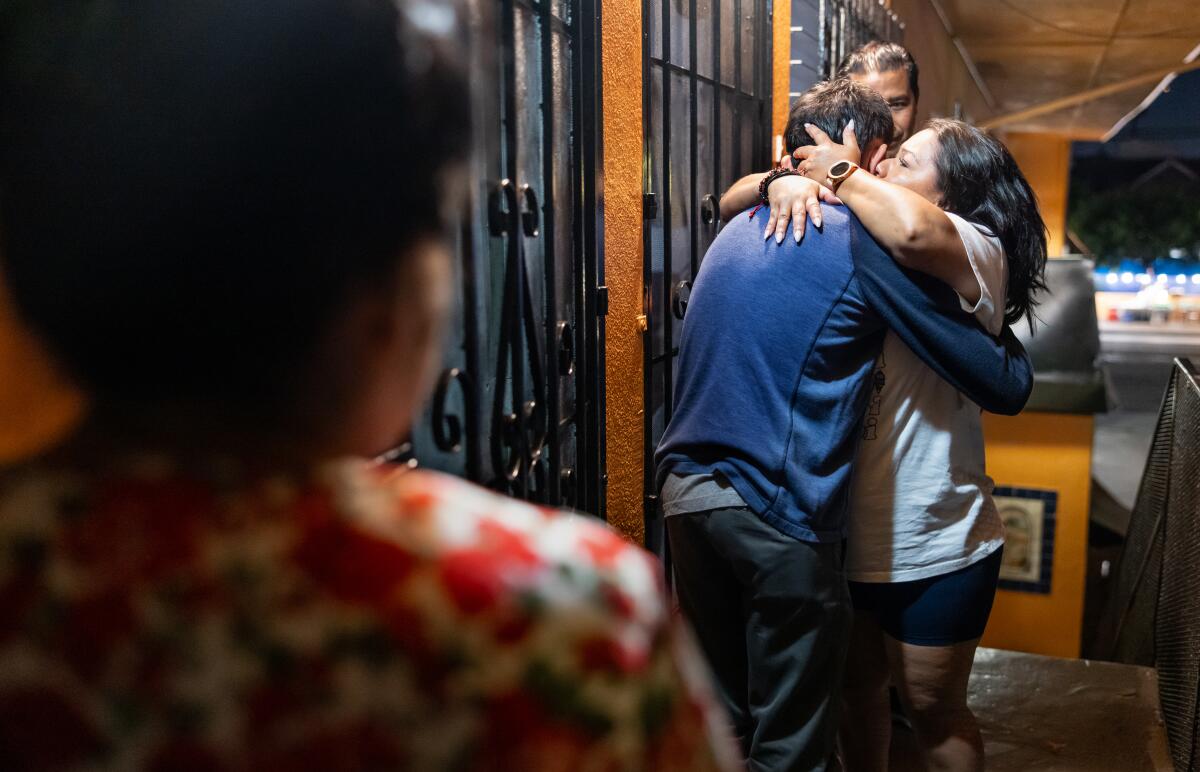
DACA recipient Javier Diaz, center, is welcomed by his neighbors including Martha Avelar, right, in South Los Angeles after returning home from a detention center in Texas in July 2025.
(Christina House / Los Angeles Times)
But in a February letter to U.S. senators, then-Homeland Security Secretary Kristi Noem said the agency had deported 86 DACA recipients between Jan. 1 and Nov. 19, 2025. Federal judges have ordered the agency to return some, including Maria de Jesus Estrada Juarez, a Sacramento mother who was deported a day after her green card interview.
Lawmakers are expressing alarm that DACA’s promise of protection is being undermined.
Last month, Democrats on the Senate Judiciary Committee held a forum on the Trump administration’s “all-out assault on DACA.” The forum featured Santa Ana Police Chief Robert Rodriguez, who testified that he had been forced to fire a police officer because their work permit renewal was not processed on time.
Last week, members of the House from California’s Central Valley, including Rep. David Valadao (R-Hanford), sent a letter to Homeland Security and Citizenship and Immigration Services leaders, urging them to expedite DACA processing.
“Our offices have seen a substantial increase in constituent cases involving pending renewals, with many remaining unresolved for more than six months,” the letter continued. “These extended processing times are creating avoidable hardships for our communities and our economy.”
California has more than a quarter of the nation’s approximately 500,000 DACA recipients, according to Citizenship and Immigration Services figures. On average, they are 31 years old.
To qualify for DACA, applicants had to pass background checks and meet certain educational or work requirements.
During a news conference ahead of the DACA forum last month, Sen. Dick Durbin (D-Ill.) reflected on the day in June 2012 when DACA applications first opened. He said parents of young immigrants asked him if it was safe for their children to sign up for the program, which required admitting their lack of legal status and home address.
“Are you sure that the government won’t use that information against us at some time?” he remembered them saying. “I said, ‘Follow the law exactly as it is written and announced in the executive order, and we’ll stand by you. Just believe in us to do that.’”
Sen. Dick Durbin (D-Ill.), foreground, speaks during a Homeland Security oversight hearing before the Senate Judiciary Committee in March.
(J. Scott Applewhite / Associated Press)
“Well, I didn’t anticipate the current president and what he is now doing,” Durbin continued.
Sarah Krieger, a former Citizenship and Immigration Services official who is now senior policy counsel at the National Immigration Law Center, said processing delays were caused, in part, by the agency temporarily pausing an automated system for processing DACA and other applications.
Krieger said that “streamlined case processing” was turned off about a month after Trump took office last year, in order to audit whether each process had sufficient security checks. The automated system was turned back on a couple of months later but was modified to include more manual security checks. Krieger left the agency last July.
Turning off the automated system was “a purposeful choice that doesn’t increase national security,” she said. “All it does is slow things down.”
Citizenship and Immigration Services recommends that applicants submit their paperwork and pay the $555 fee between 120 and 150 days before their benefits expire.
Among those who did so are two nurses who work for Kaiser Permanente in the Bay Area. Both requested anonymity out of concern over their immigration status.
One of the nurses, who came to the U.S. from the Philippines as a toddler, said she applied for renewal on Dec. 1. Her work authorization expired April 15.
Kaiser placed her on a 30-day unpaid leave of absence, after which she would be fired. Eventually, her work permit was renewed, but only after Sen. Alex Padilla (D-Calif.) and two other members of Congress lobbied the federal government on her behalf.
Sen. Alex Padilla (D-Calif.) speaks during a news conference on the DACA program on May 12 outside the U.S. Capitol.
(Graeme Sloan / Getty Images)
Padilla said his office has fielded requests from hundreds of DACA recipients this year.
Another Kaiser nurse, who also submitted her renewal paperwork in December, is still waiting. She has been on unpaid leave for nearly a month.
The nurse, who is from South America, said one Citizenship and Immigration Services officer told her it could take up to 10 months for her renewal to be processed.
The nurse is pregnant and she and her husband just bought a house. Losing her job would mean losing her healthcare and maternity leave benefits.
“I’ve spent years caring for others in my community, paying taxes, contributing to a healthcare system,” she said. “I worked through COVID and it’s heartbreaking to feel like you’re so easily discarded.”
Another DACA recipient, Elsa Sanchez, 35, of Georgia has maintained DACA status since 2012 and says she always follows the recommendation to submit the renewal application at least 120 days before the expiration date.
For the last three renewals, she said, she was approved within a week or two. This time, her work permit and DACA expired on April 1, more than four months after she submitted her application.
Elsa Sanchez, whose work permit expired because of DACA renewal delays, at her home in Atlanta.
(Emilie Megnien / Associated Press)
The healthcare IT company where Sanchez works as a senior customer success manager allowed her to take a 60-day unpaid leave of absence but said it would have to terminate her employment afterward.
Sanchez’s unpaid leave was set to run out on June 1. On May 20, she got notice that her DACA renewal had finally been approved. But by then Sanchez, a single mom, had had to pull funds out of the college savings account for her 19-year-old daughter, who is attending a local university. She put the money toward her nearly $2,000 rent and food.
“I feel so relieved and grateful,” she said in an Instagram video announcing the news. “I know that a lot of us are still being affected by these delays. I wish that I could share my approval with all of you and that we would all be celebrating today.”
Others have also turned to social media to share their experiences and swap resources. Madrigal, the fired attorney, pivoted to making daily videos. On Tuesday, she shared “day 35 of unemployment.”
“Some days look like big emotions and uncertainty,” she wrote. “Other days look like walks, toddler activities, cooking dinner and ending the night with tostadas. Trying to find joy and normalcy in the middle of it all.”