monday

Lakers sign Ziaire Williams to one-year, $3-million contract

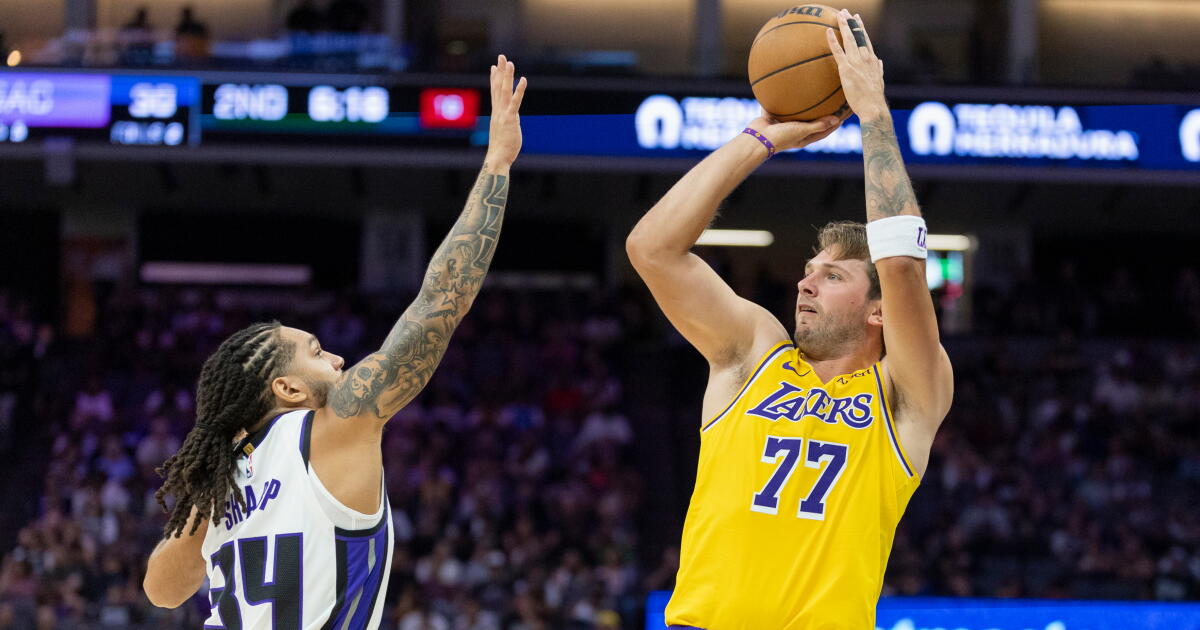
The Lakers signed free-agent forward Ziaire Williams to a one-year, $3-million deal on Monday, people not authorized to speak on the matter publicly confirmed to The Times.

Williams, 24, was available after the Brooklyn Nets declined his team option of $6.25 million, making him an unrestricted free agent.

The 6-foot-9 Williams gives the Lakers an athletic wing player. He averaged a career-high 10.2 points last season in 56 games, 13 as a starter.

He shot 42.5% from the field and 34.3% from three-point range.

NBA scouts who requested anonymity to speak candidly on the matter said Williams is athletic but hasn’t figure out his game yet. He’s seen as an inconsistent three-point shooter.

Williams, who attended Sierra Canyon High with Bronny James and Stanford, gives the Lakers a maximum 15 roster players.

Source link

Life after LeBron: Austin Reaves embracing new-look Lakers roster

From the time Austin Reaves joined the Lakers in 2021 as an undrafted prospect, his basketball life centered around playing with a savant in LeBron James.

That no longer will be the case.

Reaves re-signed with the Lakers on a four-year, $185-million deal, but James decided to move on as he prepares to play an unprecedented 24th season.

Reaves was stunned when he heard about James’ decision while playing golf in Lake Tahoe. Nearly two weeks later, Reaves says he still is trying to process the development.

“I kind of was thinking about it last night when I got here,” Reaves said Monday in his first news conference since re-signing. “Starting the season without him being on the team is going to be different for me. He’s kind of all I’ve ever known. Just him being around, joking around, acting like he’s 15. But that’s his decision and like I said in Tahoe, anytime I’ve talked about it, I got nothing but love and respect for him and yeah, let’s play some golf soon.”

The contract Reaves signed was the richest in NBA history for an undrafted player. At 28 and entering his sixth season, Reaves wanted to stay in L.A.

“I wanted to be a Laker the whole time. We had that period from when the season ended until the first [of July] to get something done and we figured it out before then,” he said. “My heart was in L.A. the whole time.”

Reaves will become one of the de facto leaders of the Lakers along with Luka Doncic. The two once again will be one of the most dynamic backcourts in the NBA.

“Obviously my relationship with the guys that were on the team last year,” Reaves said of why he wanted to stay. “And then Luka. I mean, he’s one of my best friends on this planet. Talk to him almost every single day. He sends me videos of his golf swing and asks me what he can do to get better and I tell him I’m not a coach.”

The Lakers have overhauled the roster: All the players who started alongside Reaves in the playoffs last spring are gone. With the signing of former Brooklyn Nets forward Ziaire Williams on Monday, the Lakers have nine new players, all of them arriving either via trades, free agency or the draft.

“They’re good,” Reaves said of the moves. “Obviously, I’ve been with the guys that are leaving for a couple years and with Bron for five years and I hate to see guys like that go. But the pieces that are coming in, I’m very excited about and I’m happy to get started today and see where it goes.”

Walker Kessler dunks during a game between the Utah Jazz and Cleveland Cavaliers on March 23.

Walker Kessler dunks during a game between the Utah Jazz and Cleveland Cavaliers on March 23.

(Rob Gray / Associated Press)

One of those new players is Walker Kessler, a 7-foot-2 center the Lakers felt fit best around Doncic and Reaves because he’s a lob threat, rim-protector and good defender and is developing his three-point shooting.

The Lakers got him from the Utah Jazz in a trade and then signed him to a four-year, $130-million contract. The Lakers sent out two unprotected first-round picks (2031, 2033) and two first-round pick swaps (2028, 2030).

Kessler, who played only five games last season after having surgery to repair a torn labrum in his left shoulder, is aware the Lakers paid a big price to get him.

“It definitely makes you feel a certain way when you know an organization believes in you,” Kessler said Monday in his introduction. “And I think what they’ve invested, they’re showing that belief in a monetary value, not just with money, but like you said, assets. And for me, I’m somebody that if I know that they have that belief in me, I’m gonna run through a brick wall for them. That’s just how I’ve been wired my whole life and it definitely makes it a lot easier to go out there and compete for a team.”

Power forward Sandro Mamukelashvili could become a fan favorite, in part because of the tattoo he has on his lower left leg — a No. 24 in honor of Kobe Bryant.

Mamukelashvili, who signed a four-year, $52-million deal, averaged 11.2 points last season with the Toronto Raptors and shot 52.3% from the field, including 38.9% from three-point range.

“I got a Mamba Mentality tattoo. I just love his mindset,” Mamukelashvili said. “Growing up, I used to always say, “Mah-moo Mentality!’ So, I know it’s a little far from each other. But we are getting closer.”

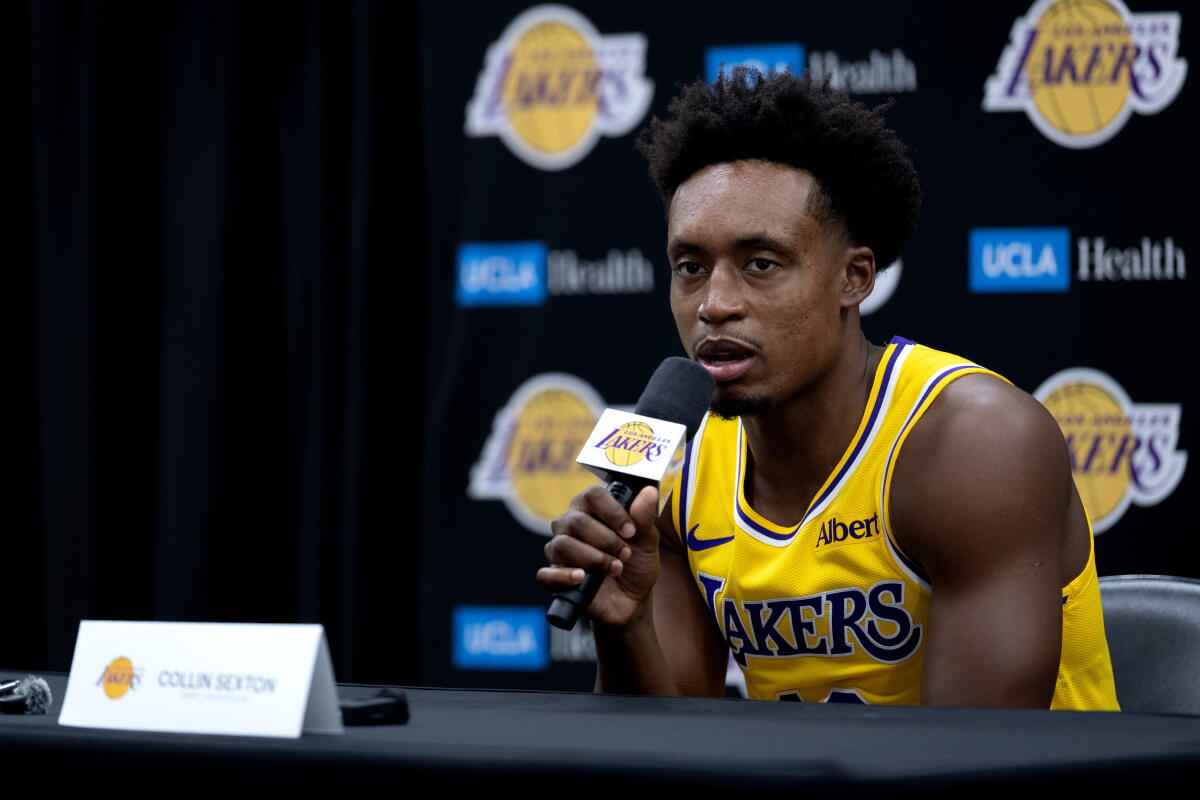
When guard Collin Sexton, another new Laker, was drafted by the Cleveland Cavaliers in 2018, James left and signed with the Lakers. When Sexton signed a two-year, $19-million deal with the Lakers this month, James left again.

Sexton could only laugh about missing out on playing with James.

“He’s just leaving every time I arrive,” Sexton said, laughing. “That’s what it is. No, but one of the other coaches made the same joke yesterday. It’s cool, I know. I’ve always wanted to team up with him for sure, but it’s definitely cool knowing him and just having normal conversations and stuff, so that’s cool.”

Sexton averaged 15.4 points and shot 48.5% last season with Chicago and Charlotte. He’s ready for whatever role coach JJ Redick and the Lakers want for him.

“They believe in me,” he said. “And I just feel like at the end of the day, whenever a coach believes in you and like he said, he’s going to be hard on me and yelling and screaming at me. So, I like that. I think that’s what gets the best from me.”

Source link

Nneka Ogwumike’s double-double lifts Sparks to victory over Sky

In an alternate universe, the Sparks’ win over Chicago on Friday could have been a barometer to indicate whether general manager Raegan Pebley’s gamble to trade Rickea Jackson to the Sky paid off.

Jackson didn’t get a chance for revenge after tearing an anterior cruciate ligament in May, making the Sparks’ 102-87 win at Crypto.com Arena not a true litmus test. Veteran guard Ariel Atkins, who was shipped out of Chicago in the Jackson deal, had her best game with the Sparks, finishing with a season-high 17 points.

The Sparks showcased their potential en route to their second straight win, even with All-Star Kelsey Plum (lower left leg) and Cameron Brink (left ankle) out. Nneka Ogwumike, the Sparks’ other All-Star, posted 25 points and 12 rebounds, Dearica Hamby and Rae Burrell both scored 17, and Erica Wheeler had 15 points and eight assists.

“The ball’s got to move,” Sparks coach Lynne Roberts said. “It can’t be a lot of one on one. And that’s what happens when you have 32 assists, the ball’s moving. So it’s just the continued emphasis of ball movement, player movement, getting those high-quality shots, and we’ve got players that are going to make them for percentage.”

Still a game under .500, the Sparks (10-11) have a long way to go to be considered serious postseason contenders. Chicago also has struggled mightily outside of a win against Phoenix this week and has been engulfed in drama around veteran guard Skylar Diggins, who sat out because of a knee injury.

The Sparks easily could have spiraled following Monday’s disaster in Seattle. Instead, their season has life.

“After the game on Monday, I think there was just kind of like an ‘enough’ mentality, and we all felt it,” Roberts said. “We all kind of just said, ‘enough.’ That doesn’t mean that we’re going to go undefeated the rest of the way, but we play like that. We give ourselves a chance in every game.”

For the second straight game, all five starters scored in double digits. Hamby had a late backhanded layup over 6-foot-7 Kamilla Cardoso to help close out the win.

Brought in to be Plum’s partner in the backcourt, Atkins has had an inconsistent offensive season, with career-low scoring and shooting numbers. Against her former squad, she showed why the Sparks wanted her, and why they need her to produce with Plum out of the lineup for the foreseeable future.

“It feels good to see shots go in,” Atkins said. “My biggest thing is that it feels good when we all feel good too. When they lead to wins, it makes it even better.”

After the Sparks opened up a 16-8 lead, Chicago (7-15) stormed back to keep it tight throughout the second quarter. The Sparks led 73-70 after three quarters before pulling away late.

Ogwumike made three three-pointers in the fourth to carry the Sparks across the finish line.

“Just to have that poise, like we haven’t shown that in a very long time,” Wheeler said. “So for us to display that tonight, like that should be the standard, and it felt good to have that poise.”

The Sparks scored 25 points off 15 Sky turnovers. They shot 51% from the field.

Ball movement has been emphasized all season, “so it’s good that we’re starting to figure it out,” Roberts said. “When you look at the assists, it wasn’t like one person had 16 or something, right? So it’s balanced. The ball’s moving. There’s [the thought of] ‘we need to get the win,’ not ‘I need to get the bucket.’ And I think that’s the mentality of great teams.”

Veteran forward Emma Cannon played 12 minutes and scored nine points as a key post presence late when Cardoso was in foul trouble.

Ogwumike moved into fifth on the Sparks’ all-time assists list with her third helper in the first quarter, passing Mwadi Mabika.

The Sparks are half a game outside the final playoff spot, not bad given how poor some of their performances have been. They head to Atlanta (13-9) to face a slumping Dream squad on Monday as they try to win three consecutive games for the third time this season.

“It took us a bit with KP out to figure out kind of how we can still flow,” Roberts said. “I think we’ve figured it out.”

Source link

Ex-Charger Marcellus Wiley says wife lied in filings that led to TRO

Former Chargers defensive end and Los Angeles sports radio personality Marcellus Wiley has denied explosive allegations from his wife — including that he raped her and physically abused her and their children — that led to a judge granting her a temporary restraining order against him.

Annemarie Wiley, a nurse anesthetist and former cast member of “The Real Housewives of Beverly Hills,” made the accusations in a declaration submitted Monday to the Superior Court of Los Angeles County with her request for a restraining order against her husband of 12 years. She filed for divorce the same day.

The former Pro Bowl player responded Tuesday on X to what he called “baseless claims.”

“I owe it to my children to truthfully document what they and I have endured,” he wrote. “To do that, I must address the lies Annemarie has told about me by telling the truth about her and our marriage.”

According to the temporary restraining order, Marcellus Wiley must have no contact with his wife and their three children, ages 6-10, and must not come within 100 yards of them. Annemarie Wiley now has sole custody of the children and her husband was given no visitation time. The order remains in effect until a hearing scheduled for July 24.

On Saturday, Marcellus Wiley was arrested in Florida after his wife told police he poked her in the face with his finger and threatened to kill her. According to the arrest affidavit, Annemarie Wiley told a deputy that her husband “had an unreported history of violence toward her and she was planning to divorce him when they returned home to California.”

Marcellus Wiley was released the next day on $1,000 bond and faces a possible charge of misdemeanor domestic battery. An arraignment hearing has been scheduled for Aug. 4. He denied all the allegations against him Monday on X.

In her court filing, Annemarie Wiley provided details of an alleged incident that led to her husband’s arrest. She wrote that on Saturday he “warned me to watch how bad he was going to make things for me, which I understood to be a threat that his abuse would become more severe. During this same incident, Marcellus pushed our ten-year-old son, Marcellus, Jr. I called the police.”

Annemarie Wiley also documents numerous alleged incidents that she says demonstrates “a continuing and escalating pattern of physical violence, sexual abuse, verbal and emotional abuse, financial control, and intimidation, much of which our children have witnessed.”

She mentions four instances in which her husband allegedly raped her — once in 2012 and three times in January — as well as alleged physical abuse that includes striking her in the face or head, breaking her right thumb and throwing heavy objects at her.

In his most recent X post, Marcellus Wiley states that he has “videos, photographs, text messages, emails, and other evidence that directly contradicts those baseless claims and provides a factual record of our family and the events leading to this unfortunate divorce.”

“To be frank, many friends, family members, and fans have opined that after she was kicked off The Real Housewives of Beverly Hills, she lost her mind!” wrote Marcellus Wiley, a Compton native who also played for the Buffalo Bills, Dallas Cowboys and Jacksonville Jaguars during his 10-year NFL career. “Unfortunately, I must agree.

“I never wanted my family’s issues and struggles to become public for any reason, including divorce leverage. But I unfortunately knew this day was inevitable. I was willing to endure anything —even hell itself — if it meant being with my children every single day. I am their hero, and now I am fighting to make sure the positive and real image they know of me is the one that endures.

“I am prepared to address these allegations and related matters through the legal process and with evidence. My focus remains on my children, my integrity, and the truth.”

Multiple women have accused Wiley in civil lawsuits of sexually assaulting them in the past. Wiley has denied all the allegations against him in court documents and publicly.

Source link

Graham Platner’s ruined campaign in Maine adds pressures for Democrats

The campaign of U.S. Senate nominee Graham Platner was buckling in Maine on Tuesday after he was accused of rape, injecting uncertainty into a contest that is central to determining which party wins Senate control in November’s midterms.

The situation set off swift debate about how state Democrats would choose Platner’s replacement if he were to withdraw, and which Maine figures might be best positioned to play off the progressive messaging he used to win over voters.

With Maine viewed by Democrats as a key seat to win in their long-shot bid for a Senate majority, the decision would be high stakes, analysts said. In the meantime, with uncertainty clouding the race, the shake-up could put additional pressure on the party to win Senate races in states seen as more difficult to flip.

Platner has denied the rape allegation, which came in a Politico report Monday from a woman who said Platner forced her to have sex with him when he was intoxicated. Platner said Monday that he would “reflect” on his candidacy but has not withdrawn.

“The calculation that almost everyone on the Democratic side is making is that with Platner in it, it is an unwinnable race,” said John Cluverius, director of survey research for the Center for Public Opinion at UMass Lowell, “and without Platner in it, they have a much better chance.”

An oyster farmer and Marine veteran, Platner had entered the race to challenge Republican Sen. Susan Collins as an outsider and was seen as riding an anti-establishment wave of support.

His candidacy highlighted the split within his party between progressives and establishment Democrats and represented a matchup between an older incumbent and a younger outsider candidate.

By Tuesday afternoon, Platner’s financial backing was disintegrating and prominent Democrats had withdrawn their support — including Sen. Bernie Sanders (I-Vt.), a key endorser of Platner’s, who said Tuesday afternoon that he had told Platner to withdraw.

A spokesperson for Platner’s campaign did not immediately respond to a request for comment Tuesday.

Rep. Ro Khanna (D-Fremont), who had been one of Platner’s most visible backers, quickly withdrew his endorsement Monday.

“I’ve been very clear that sexual assault or violence against women is a red line. These allegations are very serious and credible,” Khanna, who has been a prominent supporter of victims of the late sex offender Jeffrey Epstein, wrote on X.

The California congressman had been among progressives, including Sanders and Sen. Elizabeth Warren (D-Mass.), who previously stood by Platner. Khanna had rallied for Platner at a pre-primary event in June after a set of allegations about the candidate’s “unsettling” conduct from his exes reported by the New York Times and the revelation that he had sent sexually explicit messages to women outside his marriage.

Platner’s collapse comes after the fall of former California Rep. Eric Swalwell, whose ascendant campaign for governor was ended in April after he was accused of sexual assault.

As in Swalwell’s case, Platner’s support has unraveled quickly, leaving him with little path forward.

The Democrats’ formal Senate campaign arm and the Senate Majority PAC, which is aligned with Senate Minority Leader Chuck Schumer, both pulled investment from the race, their leaders said in statements. Swing Left, an organization working to flip seats for Democrats, removed Maine from its target Senate races for now.

“We continue to believe this seat is winnable if Platner is not on the ballot,” said Senate Majority PAC spokesperson Lauren French.

Under state law, Platner has until Monday to withdraw in order for the Maine Democratic Party to be able to nominate a replacement. The committee would have until July 27 to do so.

For Collins, facing a new candidate could make for a harder race than going up against Platner, analysts said.

The fifth-term senator has survived reelection repeatedly, including in 2020, when the state went blue in the presidential election, but drawn ire from some moderate and left-leaning voters who want her to push back more forcefully against President Trump.

Without Maine, Democrats would have to pick up an additional race in a state that went for Trump in 2024 in order to flip the four seats required to win a majority.

To get to four, the party needs to win some mix of Maine, North Carolina, Ohio, Texas and Iowa and must also retain its seats in Michigan, Georgia and New Hampshire.

That scenario could be within reach for Democrats but they face a steep climb, a New York Times/Siena poll released last week found.

“This does put enormous pressure on Democrats across the country with every viable race,” said David Niven, who teaches American politics at the University of Cincinnati. “The margin of error was already slim, and it’s approaching none.”

In Texas, a heated and expensive race has shaped up between Democrat James Talarico, a state representative who is facing Republican Ken Paxton, the state attorney general.

“I would suspect that Democrats are going to be relatively all-in on Texas simply because they can no longer rely on Maine in the way they thought they were going to be able to,” said Mark Jones, a political science professor at Rice University.

The Politico report came after a string of other controversies for Platner, who had successfully batted them away ahead of the state’s June primary.

His quick rise in the campaign excited Democrats looking for younger, non-establishment leaders. His primary opponent, Maine Gov. Janet Mills, suspended her campaign in late April, clearing his path.

But questions about the rushed vetting of Platner soon arose.

He faced scrutiny over a tattoo on his chest that was widely recognized as a Nazi symbol, which he then said he had covered up, and a tranche of deleted Reddit posts that he said were “stupid” comments from a time when he had post-traumatic stress disorder.

Ahead of the primary, the report of his extramarital texts and the allegations by exes about volatile behavior revived questions about his candidacy; Platner described them as politically motivated and privately assured Democratic leaders that nothing else was coming.

The situation “reinforce[s] the need for more careful vetting [of] first-time outsider candidates,” said Dan Schnur, who teaches political communications at USC, UC Berkeley and Pepperdine.

“Every political professional knows that the most important type of candidate research is not opposition research — it’s research on your own candidate,” Schnur said.

Progressive leaders on Monday sought to validate the success of Platner’s campaign in energizing Maine voters while disavowing Platner. They urged Democratic leaders to stick with a candidate who shares Platner’s working-class image if he withdraws — something Platner may hope to influence, the New York Times reported.

“To the Democratic establishment: this is not your opening,” Joseph Geevarghese, executive director of the progressive organization Our Revolution, said in a statement. “Whoever leads this movement forward must be someone who has actually lived the fight Graham Platner ran on.”

Some Democrats were already looking to the party’s gubernatorial primary candidates as possible replacements, including Maine Secretary of State Shenna Bellows, former state Sen. Troy Jackson and former state health official Nirav D. Shah.

The July deadlines would leave enough time before November for Democrats to persuade voters of a new candidate, said Mark Brewer, a political science professor at the University of Maine, but how the party chose to select a replacement would probably be as important as whom it chose.

“Having a 100-person executive committee select it on their own would probably not sit well with Platner’s supporters,” Brewer said. “A caucus they could pull off; if they want to be as open and inclusive as possible, that’s probably their best option.”

McDaniel reported from Washington and Kwok from Los Angeles.

Source link

Lauren Bennett death: ‘Party Rock Anthem’ and G.R.L. singer was 37

Lauren Bennett, the British singer who told millennials to “put yo’ hands up” in LMFAO’s megahit “Party Rock Anthem,” and a member of pop group G.R.L., has died. She was 37.

G.R.L. members Emmalyn Estrada, Natasha Slayton and Paula van Oppen announced Bennett’s death on Monday via social media.

“It is with great sadness that we share the passing of our beloved Lauren,” G.R.L.’s statement read.

“Our hearts are broken, and we cannot begin to express how much she meant to us. We will forever cherish the love, laughter, and countless memories she gave us. Her beautiful spirit touched so many lives, and she will be deeply missed and forever loved. Rest peacefully, sweet Lauren. You will always be in our hearts.”

Bennett’s cause of death has not been revealed.

The British singer first splashed onto the music scene when she appeared on the U.K. “X Factor” in 2006. She was eliminated before the live show round of the series, but the following year she was recruited to join Paradiso Girls, a group launched by Pussycat Dolls founder Robin Antin. In 2009, they dropped “Patron Tequila,” featuring Lil Jon and Eve. The group disbanded in 2010 and their debut album was never released.

In 2011, Bennett joined forces with electronic dance duo LMFAO on “Party Rock Anthem.” The track spent six weeks topping Billboard’s Hot 100 chart and became wildly popular globally. Billboard ranked the megahit second on their official “Top Hot 100 Songs of the Decade” list for the 2010s, behind Mark Ronson and Bruno Mars’ “Uptown Funk.”

In 2012, she and Antin teamed up again, forming pop group G.R.L. (Girls Rock Life) with founding members including Bennett, Estrada, Slayton, van Oppen and Simone Battle. The group debuted on the “Smurfs 2” soundtrack with “Vacation” in July 2013 and, in early 2014, they were featured on Pitbull’s “Wild Wild Love.” In the summer of 2014, they dropped “Ugly Heart,” the lead single of their self-titled EP, but in September, founding member Battle died by suicide. G.R.L. split up the following year. By 2016, the group reformed as a trio with Bennett, Slayton and new member Jazzy Mejia.

Bennett welcomed her daughter, Harlow, with partner and “Footloose” star Kenny Wormald in 2019. Wormald often shared photos of Bennett on his Instagram with loving captions.

Longtime friend and music producer Josh Stevens, who co-wrote and engineered LMFAO’s sophomore album “Sorry for Party Rocking,” posted a tribute to Bennett on Monday, writing, “My friend [Lauren Bennett] we will deeply miss you. I was lucky enough to witness you change the world! We traveled the globe party rocking from night clubs to stadiums, a wild and crazy time. A true legend!

“Later on in life our children had the same birthday, I remember us texting each other while you were in labor and my wife was in labor on the same day, same time, both in the hospital. We were laughing and it somewhat seemed calming to know to each was going thru this at the same time.

“We will very much miss you.”

Source link

Trump’s World Cup meddling was a culprit in brutal U.S. exit

Is everybody happy now? You good, Mr. President?

Put our boys in a blender, President Trump did, with those phone calls to FIFA President Gianni Infantino. Messed with their mojo by politicking to get American striker Folarin Balogun’s red card rescinded.

We’ll have to check VAR, but it might be the first time Trump succeeded at having a decision overturned.

Probably because this time what he sought to overturn — discipline stemming from Balogun’s accidental contact in the United States’ victory over Bosnia and Herzegovina — actually was unjust. Balogun should not have received a red card.

The problem is, having our President butt in here was a joke. Unfunny and out of bounds, offsides, an own goal — all of the things.

It put the U.S. team at the center of a geopolitical maelstrom, which is exactly what they did not need in the hours before the biggest match of their lives and the biggest match in the history of the U.S. men’s soccer program.

Some 40 or 50 million viewers were expected to tune in; how many of them watched for the first time? And what sort of impression did Monday’s 4-1 blunder-filled meltdown against Belgium make? That we stink at soccer — still?

If you were one of them, please, believe your soccer-fan friends when they tell you the Americans played much better in previous matches.

But so much for a magical run. On their home turf, the Americans pulled up lame before the finish line (aka, for the U.S. team’s purposes, its first quarterfinals since 2002).

To their credit, after the debacle, members of the U.S. team didn’t complain about anything being rigged. They didn’t use the distraction as an excuse. And they didn’t point fingers at anyone — anyone at all.

U.S. striker Folarin Balogun (20) walks to the locker room at halftime against Belgium in the World Cup.

U.S. striker Folarin Balogun (20) walks to the locker room at halftime against Belgium in the World Cup on Monday at Lumen Field in Seattle.

(Allen J. Schaben / Los Angeles Times)

“We’re playing on home soil,” defender Chris Richards said. “So the only pressure we put on ourselves is to perform for our country, and ultimately didn’t feel the way we wanted to today. But I don’t think the antics of the last 24 hours had anything to do with it.”

No, they said the “debate,” or “outside noise” or “political manipulation” — as Tim Ream, Alex Freeman and coach Mauricio Pochettino described what others are calling “Balogate” — were not to blame for the gut-punch that answered the question: Why not us?

Because the U.S. is not yet good enough to beat the world’s great teams. Especially not when their pregame preparation includes having to try to block out an international uproar.

To have any hope against the Belgians in the round of 16 — a matchup between FIFA’s Nos. 9- and 17-ranked sides — the Americans needed to be going full-tilt, to be focused and ferocious and probably also a little bit lucky.

Instead, they looked shook, rattled. And they got rolled.

They were the worst version of themselves at the worst time, which was so weird from a team that had been on its front foot from the first whistle against Paraguay.

Not Monday. Against Belgium, they were on their heels from the outset. Heavy touches, slow afoot, playing like they had the weight of the World Cup on their shoulders.

And all that White House maddening meddling — for what?

Balogun started and played most of the match, but it could just as well have been reserve striker Ricardo Pepi. Or you or me, Balogun was that ineffective.

His play of the day came postmatch, when he approached Belgian coach Rudi Garcia and the two had a respectful exchange. A real diplomat, that Brooklyn-born, Britain-raised American by birthright.

This loss was a real team effort, of course. Christian Pulisic came off in the 59th minute after twisting his right ankle — leaving this World Cup without a goal in the four matches he appeared.

Matt Freese, the Harvard-educated starting goalkeeper, had a brain cramp of epic proportions when he stepped outside of the box and failed to corral a ball. Belgium’s Charles De Ketelaere kicked it loose and set up Hans Vanaken, whose shot traveled behind Ream for an easy score that made it 3-1 in the 57th minute.

There was a lot of poor decision-making with this match, on and off the pitch.

In the end, Trump’s appeal to Infantino did more harm than good. But what if some good could come from it?

Hey, FIFA, what about giving teams a process to appeal cards, like our American athletes in the NBA, NFL and MLB have?

Offering a suggestion box wouldn’t be opening Pandora’s box, not if it were a transparent and regular part of the game that would, hopefully, offer increasingly fair outcomes in a tournament where every match is so monumental — as our President recognized, much too enthusiastically.

U.S. coach Mauricio Pochettino waves to the crown after a 4-1 loss to Belgium at the World Cup on Monday.

U.S. coach Mauricio Pochettino waves to the crown after a 4-1 loss to Belgium at the World Cup on Monday.

(Allen J. Schaben / Los Angeles Times)

Source link

FIFA’s reversal of red card after Trump phone call prompts international uproar

President Trump did not like what he saw. So, once again, he picked up the phone.

Trump said Monday that he called FIFA President Gianni Infantino after he disagreed with the World Cup referee who gave a red card to U.S. men’s soccer team star Folarin Balogun. The discipline, which Trump called “very unfair” and a “stain” on the World Cup, would have barred Balogun from playing in Monday’s elimination game against Belgium.

“I asked for a review because I didn’t think it was a foul,” Trump told reporters during an event in the Oval Office. “I am good at this stuff. I didn’t think it was a foul. I thought it was two great athletes that crashed into each other and got entangled.”

Trump said he initially didn’t know “what the hell a red card was” or what it meant. “When I found out, I said, ‘You gotta be kidding!’” he said.

Trump’s involvement in soccer’s disciplinary process created an international uproar.

UEFA, European soccer’s governing body, said FIFA “crossed a red line” with the reversal. Belgium’s football association appealed the ruling, which FIFA denied during a hearing Monday. Belgian coach Rudi Garcia mocked the decision as an April Fools’ joke.

“This decision clearly raises many questions,” Belgian Foreign Minister Maxime Prévot said in a statement Monday, according to the New York Times.

“If a phone call really is what explains this incomprehensible decision, it would amount to undermining the most basic rules of soccer and sports,” added Prévot, a former soccer referee.

Trump’s close relationship with Infantino also has drawn new scrutiny.

In December, Infantino presented Trump with the inaugural FIFA Peace Prize, an award the governing body created after Trump was passed over for the Nobel Peace Prize. That decision is now the subject of an ethics complaint, backed by members of the European Parliament, who argue it compromised FIFA’s political neutrality.

Trump said he did not ask Infantino to reverse the call. But that was the outcome reached by FIFA’s disciplinary committee, which, in 64 years, has reversed a red-card penalty only once during a World Cup tournament.

The episode serves as a reminder of a pattern of behavior the president has exhibited when he doesn’t get his way, regardless of the rules of the game. For Trump, a deal-maker who has described the world as “a casino,” often pushes the boundaries of long-standing norms.

After FIFA reversed course, Trump called the decision “brilliant” and said Belgium can now “be really proud” if they were to beat the U.S. team on Monday night.

“The other way, if they beat us, we’ll say, or I’ll say it was rigged, just like the election was rigged in 2020, but I won’t get into that,” Trump said.

Steven Levitsky, a Harvard political scientist and co-author of “How Democracies Die,” said Trump’s action are “perfectly consistent with how Trump has behaved on the world stage.”

“He has no interest in or no respect for any kind of international rules or norms,” he said.

Levitsky said the events illustrate the Trump administration’s worldview, one that, he argues, revolves around the ethos that “if we’re strong enough, we can leverage our way to whatever the hell we want.”

As examples, he pointed to the administration’s military strikes on boats in the Caribbean and efforts to acquire Greenland, both of which have led to diplomatic tensions.

Trump also has a history of using phone calls to pressure officials to reach an outcome he wants.

In a 2019 call, he asked Ukrainian President Volodymyr Zelensky to investigate his political rival, a moment that became the catalyst of his first impeachment. And after losing the 2020 election, he pressed Georgia Secretary of State Brad Raffensperger to “find 11,780 votes,” the margin he needed to flip the state, a move that ultimately led to a criminal indictment.

FIFA President Gianni Infantino presents President Trump with the FIFA Peace Prize in December.

FIFA President Gianni Infantino presents President Trump with the FIFA Peace Prize in December.

(Evan Vucci / Associated Press)

Trump defended his call with Infantino to reporters and appeared to downplay how much it may have contributed to the red card penalty being reversed.

“I can’t tell [Infantino] what to do, and I don’t believe he made the decision,” Trump said. “I think it was a committee that made the decision, and they made the right decision, because No. 1, it wasn’t a foul, and you want to see a game with your best players.”

Sen. Ted Cruz (R-Texas), who was in the Oval Office when Trump acknowledged the call with Infantino, made reference to the Peace Prize as he thanked Trump for “getting rid of the ridiculous red card” ahead of the knockout game.

“There was a reason the FIFA trophy sat here for as long as it did,” Cruz told Trump.

Infantino, for his part, issued a statement Monday insisting that the decision came from FIFA’s independent disciplinary committee and that he told Trump the case would be decided by the body. Bill White, the U.S. ambassador to Belgium, also defended Trump, saying he “would never interfere with the inner workings of FIFA.”

Norman Eisen, co-founder of Democracy Defenders Action, said Trump’s decision to get involved in soccer’s disciplinary process is a “classic example of achieving a right outcome through wrong means.” He added that he believes the Trump administration and FIFA showed to be “two of the most corrupt entities around.”

“Like many Americans who are following the World Cup and rooting our team on, I thought it was a bad call,” Eisen said. “But I would never have chosen to bring that about in this fashion.”

Levitsky argued that given the popularity of the World Cup, which hundreds of millions of people around the world are tuning into to watch, Trump is opening himself up for more scrutiny on the global scale.

“People across the world who don’t give a damn about politics are following the World Cup, and they’re seeing the United States behave this way, taking what it can take at the expense of others unfairly,” he said. “Of course it is going to hurt the U.S. image abroad.”

Source link

Platner says he will ‘reflect’ on Maine Senate campaign after woman accuses him of sexual assault

A woman who previously dated Maine Senate candidate Graham Platner said he drunkenly forced her to have sex after she told him to stop, according to a Politico report released Monday.

Platner denied the allegation and said he would be considering next steps for his campaign.

“Regardless of the inaccuracy of the reporting but mindful of the political reality it will inflict, we’re taking the time to reflect on the best path forward,” he said in a video released on social media.

Jenny Racicot, who lives in Maine, told Politico that Platner entered her home in 2021 while drunk and assaulted her. Racicot said she had been in an on-and-off relationship with Platner, but she cut off contact with him after that night and told him the incident wasn’t consensual. A voicemail left at a number listed for Racicot seeking comment did not receive an immediate response.

An email and phone message from the Associated Press seeking comment were sent to Platner’s campaign on Monday.

“Any accusation of non-consensual behavior is categorically false,” Platner said in his video.

As of Monday, Platner had canceled a handful of campaign town halls planned in Maine.

Several lawmakers and groups that have supported Platner, including Sen. Bernie Sanders and the organization he founded, Our Revolution, as well as Rep. Ro Khanna, did not immediately respond to requests for comment.

Khanna has supported Platner through several scandals but said last month on CBS’ “Face the Nation” that “if there was evidence of violence, I would not support him. If there was evidence of sexual assault, I’d have zero support for him.”

Platner secured the nomination to become Maine’s Democratic Senate candidate last month, but state law does include a provision for Democrats to replace him ahead of the general election.

According to the statute, party officials may select a new nominee if a candidate who won the primary withdraws by 5 p.m. July 13. The replacement candidate must be named by July 27.

The Associated Press generally does not name victims of sexual assault, but in this case Racicot spoke in an interview with Politico.

Kruesi writes for the Associated Press.

Source link

Trump heads to NATO as tensions simmer with Europe

The leaders of Europe are bracing for another turbulent summit with President Trump this week as NATO members gather for their annual meeting in the Turkish capital.

European diplomats view Trump’s decision to attend as a positive sign of his continued commitment to the alliance. But the president’s grievances with several European governments over their refusal to join the U.S. war with Iran have cast a pall over a summit already strained by Trump’s wavering support for the continent.

The secretary-general of the transatlantic alliance, Mark Rutte, told reporters on Monday that Trump had aired his resentments in a recent phone call. But Rutte countered with a mix of flattery and countervailing facts that has thus far kept Trump engaged.

While Trump has accused European leaders of denying U.S. forces access to allied bases for takeoffs and refueling during the war, Rutte noted that about 5,000 sorties supporting Operation Epic Fury launched from European airfields. And last Friday, France and Britain committed to a joint military mission with Oman to support freedom of navigation in the Strait of Hormuz — “an extremely important development,” Rutte said.

At last year’s summit, held in The Hague, all NATO member states — with the exception of Spain — agreed to spend 5% of their GDP on defense by 2035, marking a significant increase in historic spending goals for modern Europe. The pledge is divided into two categories, with 3.5% of spending allocated to core military requirements, and the rest committed to a broad set of security-related investments.

Trump’s tough love on the alliance “is, I think, bringing NATO closer together,” the secretary general told reporters.

“You could argue that he is the first president of the U.S. since Eisenhower who was able to come to this situation where the Europeans and the Canadians will spend the same as the Americans” on security, Rutte said. “This equalization was a wish for 50, 60 years, and now it’s happening — I think in large part due to his leadership.”

NATO Secretary-General Mark Rutte speaks to reporters.

NATO Secretary-General Mark Rutte speaks to reporters Monday ahead of the NATO summit in Ankara, Turkey.

(Hussein Malla / Associated Press)

In a video message posted on social media Monday, Trump’s ambassador to NATO, Matthew Whitaker, said the summit this week would serve as a “report card” to determine whether countries were beginning to fulfill their commitments from last year.

He offered a note of optimism and suggested the president’s goal is to enhance, rather than undermine, the alliance.

“The United States will be here, but we also need our allies to be here. We cannot do it alone, and the American taxpayer should no longer bear the burden,” Whitaker said.

A White House schedule for Trump’s trip lists bilateral meetings with Rutte and the leaders of Turkey, Syria and Ukraine, in between alliance-wide meals and conferences.

Ukraine will remain at the top of the agenda, Trump told reporters Monday, expressing hope that the war could soon come to an end after four brutal years of fighting.

Russia’s invasion of Ukraine has caused the greatest loss of life in Europe since World War II, resulting in more than 1 million casualties, including an estimated 600,000 dead. Since Russian President Vladimir Putin launched his full-scale invasion in 2022, following his covert invasions of Ukraine’s Crimean peninsula and eastern regions in 2014, Russian forces have captured roughly 12% of Ukraine’s territory.

The war has settled into a deadly stalemate since a 2023 Ukrainian counteroffensive failed to break Russian defensive lines. While Russian forces have occasionally advanced, they have only managed to hold marginal gains along the front, at tremendous cost.

In recent weeks, however, expanded Ukrainian drone and missile capabilities have shifted the dynamic, striking military production sites deep inside Russia and targets near Moscow, bringing the war more directly into the Russian public consciousness and raising questions in the Russian capital whether the war effort is sustainable.

Ukraine’s boldness has impressed the Trump administration, Alexander Stubb, the president of Finland, told the Financial Times this week.

“I think he does feel pressure,” Trump said of Putin, addressing reporters in the Oval Office before departing for Turkey on Monday.

The president referred to an ongoing U.S. effort to end the war, a goal that has remained elusive for Trump since returning to office.

“I think we’re getting much closer than people realize,” he said. “President Putin wants it to end, I will tell you that. Very strongly. Had a good call. And President Zelensky actually wants it to end now.”

“We’re going to be going to NATO, and we’re going to be talking about it,” Trump added. “And I think we’re going to get it ended. It’s been terrible.”

Source link

’47 Ronin’ director gets prison sentence for defrauding Netflix

Carl Erik Rinsch, the director of the 2013 Keanu Reeves action film “47 Ronin,” will serve more than two years in federal prison for defrauding Netflix of $11 million.

U.S. District Judge Jed S. Rakoff on Monday sentenced 48-year-old Rinsch to 30 months in prison, the U.S. Attorney’s Office, Southern District of New York, announced. Federal prosecutors convicted Rinsch in December of wire fraud, money laundering and other counts. A legal representative for Rinsch did not immediately respond to a request for comment on Tuesday.

Federal prosecutors indicted Rinsch in March 2025, alleging the $11 million went into Rinsch’s personal accounts. The filmmaker “quickly transferred” the money from the Rinsch Co. account, where it had been deposited March 6, 2020, by Netflix, through additional accounts until about $10.5 million wound up weeks later in a personal brokerage account. He lost more than half of that money in less than two months via risky investments in the stock market, the indictment said.

Though Rinsch told the streamer that his sci-fi show “White Horse” was progressing nicely, the filmmaker allegedly moved the remaining money into cryptocurrency and profited from crypto speculation over the next couple of years. The streamer had invested around $44 million in the show. Rinsch was accused of spending around $10 million on five Rolls-Royces, a Ferrari, watches, clothing, luxury bedding and linens, credit card bills, attorneys to sue Netflix for more money, and lawyers to work on his divorce.

He was arrested in West Hollywood and released the same day after agreeing to post a $100,000 bond to guarantee his appearance in a New York federal court.

Rinsch never finished the Netflix show.

During his sentencing, Rinsch and his legal team told the court his behavior was a result of mental health struggles and medication problems and they are working to address those issues with a new care provider, the Associated Press reported.

“I failed to recognize the danger of the state I was in,” Rinsch said, though his mental issues were not described in court, and his attorneys declined to provide further detail.

Ahead of the sentencing, Reeves — the star of Rinsch’s most notable project to date — penned a letter in May requesting “leniency and mercy as well as justice” in the filmmaker’s sentencing.

In addition to prison time, Rinsch must serve three years of supervised release, forfeit the $11 million and pay $700 in mandatory special assessments, according to Monday’s announcement. U.S. Attorney Jay Clayton said in the announcement: “Today’s sentence sends a deterrent message: fraud will not be tolerated.”

The Associated Press and former Times assistant editor Christie D’Zurilla contributed to this report.

Source link

Trump’s fixation on voting has had mixed results. He still has ways to affect November’s elections

President Trump has tried many ways to tighten his grip on U.S. elections, from signing executive orders to pushing restrictive legislation in Congress. Monday’s Supreme Court ruling siding with states that accept late-arriving mail ballots was the latest example showing the limits of his reach.

It followed back-to-back rulings last week that barred his two sweeping executive orders seeking to change national election rules, more court rulings preventing his Department of Justice from obtaining detailed state voter data and his stalled attempts to get the Senate to pass the SAVE Act. That measure would eliminate nearly all absentee voting, require citizenship documents to register to vote and impose photo identification requirements nationwide right before the midterm elections.

“It’s been a mixed bag for Republicans,” said University of Notre Dame law professor Derek Muller. But the president, he added, “has come up mostly empty-handed.”

Trump’s efforts have not been entirely fruitless. Republican-run states have satisfied his demands to redraw congressional district lines, efforts buoyed by the Supreme Court striking down a key section of the Voting Rights Act, and he has been directing his Department of Justice to investigate voting and election operations, which Democrats see as a possible prelude to their involvement in November.

All the activity around how the nation votes and runs its elections is a reflection of the Republican president’s long fixation on his false claim that his 2020 election defeat was rigged. He has been so frustrated by the inability of the Senate to pass the SAVE Act that he has refused to sign a bipartisan housing bill.

He weighed in again Monday after the Supreme Court’s decision in the mail ballot deadline case, saying on his social media account that he is trying to “save America from crooked elections.” Voting rights groups and Democrats see him abusing power and attempting to suppress legal voters to gain an advantage in the midterms, when control of Congress is at stake.

Regardless, Muller said Trump faces legal and political realities: The Constitution gives the states and Congress authority over elections while providing no such role for the president.

“That’s how federalism works,” Muller said.

Here’s a look at Trump’s efforts to reshape election rules and what options he might have left for the November midterms.

Focus on noncitizens and voter data has met roadblocks

The president has repeatedly said U.S. elections are riddled with fraud in part because of noncitizen voting. Research shows the problem to be rare, accounting for a minuscule percentage of fraud cases. Convictions are measured in the hundreds over periods in which tens of millions of ballots are cast.

Trump’s view resulted in a multiagency push to nationalize voter data and use federal resources to help states remove voters from the rolls. The Department of Justice has sought detailed voter files from multiple states, data that would include dates of birth and partial Social Security numbers. Democratic and some Republican secretaries of state balked, and federal lawsuits followed. The administration has lost every case so far.

Homeland Security citizenship check rejected in court

Trump’s Department of Homeland Security, with help from the DOGE effort led by Elon Musk, revamped a government tool called SAVE (Systematic Alien Verification for Entitlements). The program has been a key pillar of his efforts to cull potentially ineligible voters from state rolls.

Last week, a federal judge blocked its use as a mass citizenship check.

The administration, according to its own news releases, had allowed local election administrators to search users by the thousands, using a wider range of metrics rather than DHS-issued identification numbers. At least 67 million registrations, primarily in Republican-controlled states, were analyzed. Tens of thousands were flagged as potential noncitizens or people who have died, but some voters were wrongly identified as ineligible.

U.S. District Court Judge Sparkle L. Sooknanan ruled that Trump’s changes aggregated Americans’ sensitive personal data in a way that could result in voters being wrongly purged from the rolls.

“All in all, the federal government has knowingly trampled on the privacy rights of American citizens in a manner that threatens the sacred right to vote,” Sooknanan said in her order.

Executive orders used in place of legislation

As presidents before him, Trump signed executive orders when Congress would not enact his policy preferences.

Trump’s first order reflected his emphasis on noncitizens. Like the SAVE Act pending on Capitol Hill, it sought to require would-be voters to document their citizenship to be able to register to vote.

U.S. District Court Judge Denise Casper put a temporary block on the order last year as she considered the case and last week made her decision permanent. The Constitution, Casper wrote, “does not grant the President any specific powers over elections.”

Trump issued a second order in March, as the SAVE Act’s rough path in Congress became obvious. He called for a national voter list using data from U.S. Citizenship and Immigration Services and the Social Security Administration. Further, the order would have empowered the U.S. Postal Service to determine who gets an absentee ballot and threatened local elections officials with prosecution.

Absentee voting is a staple of U.S. elections, but Trump describes the practice, incorrectly, as allowing fraud — even as he has used it himself. A 2025 report by the Brookings Institution found that mail voting fraud occurred in only 0.000043% of total mail ballots cast.

Democratic secretaries of state sued, and U.S. District Court Judge Indira Talwani made the same legal assessment as Casper. The provisions, she wrote last week, “unconstitutionally violate the separation of powers.”

The White House has indicated it will appeal.

Even Trump says the SAVE Act has long odds

Trump on Monday called the Senate logjam “crazy” and one of the holdouts, Republican Alaska Sen. Lisa Murkowski, “Trump-deranged.”

It’s the latest legislative tussle that prompted Trump to demand Republicans scrap the filibuster, which requires most major legislation to get support from 60 of the 100 senators. But that likely wouldn’t matter in this case, with four of the Senate’s 53 Republicans declaring their opposition to the bill itself: Murkowski, Susan Collins of Maine, Mitch McConnell of Kentucky and Thom Tillis of North Carolina.

The president acknowledged Monday that the SAVE Act is “probably not going to happen.”

Trump still has options for the November elections

Both major parties have national operations to monitor elections, including legal teams ready to file challenges.

Despite the Republican National Committee losing the mail ballot case, Chairman Joe Gruters on Monday alluded to those efforts: “We are not going to be deterred by this decision, and the RNC will keep fighting to have elections end on Election Day,” he said.

Meanwhile, Trump has been developing a possible roadmap for more aggressive actions.

His U.S. attorney in Los Angeles said in June that he had opened multiple election fraud investigations, and he sent a prosecutor to the county’s vote-tabulation center after California’s June primary. Six months earlier, FBI agents executed a warrant and seized ballots and other records from the 2020 election in Georgia’s Fulton County, which includes Atlanta.

Muller, the law professor, said local elections officials “already are having conversations about chain of custody disputes” for ballots as they are cast, collected, counted and stored.

He and UCLA law professor Rick Hasen noted that judicial warrants are required for the kinds of actions that happened in Fulton County. Muller predicted “the bar would be even higher” for any warrant the administration requests during a live election.

Hasen added that he’s working to educate judges around the country on the importance of chain of custody for ballots.

“Republicans believe him when he says the election is rigged. And then when Republicans try to change voting rules to tighten things up, that causes Democrats to also think that the election system is being rigged,” Hasen said. “So, if what he’s trying to achieve is undermine voters’ confidence in the election process, he seems to have succeeded spectacularly.”

Barrow writes for the Associated Press. AP writer Ali Swenson in New York contributed to this report.

Source link

‘Feeling back like myself.’ JuJu Watkins returns to practice at USC

She’d been out for over a year, her long, arduous recovery from a season-ending knee injury kept almost completely under wraps. But as JuJu Watkins took her place in front of a microphone for the first time since returning to practice this summer, the USC superstar could barely contain her gratitude.

Asked Monday what the best part about being back has been so far, a big smile crept across Watkins’ face.

“Honestly everything,” Watkins said. “Like I don’t even know, the smallest stuff just gets me excited.”

Watkins’ return is a momentous mile marker for a team that has serious national title aspirations this season. Her status remains uncertain, and reporters in attendance Monday were told not to inquire further about Watkins’ specific recovery timeline. But Watkins did say that she’s already been able to scrimmage during USC’s summer practice and that she’s “feeling back like myself.”

“It’s just been a long time coming,” Watkins said. “I’ve just been working out and grinding every day so that I could be in position, so to see all of that hard work pay off right now, it’s really fulfilling.”

Watkins was a two-time consensus All-American and the Associated Press Player of the Year in 2025, when her knee buckled that March during a breakaway in the second round of the NCAA tournament. The injury, a torn ACL, wouldn’t just derail a possible title run for USC that season, but also upend the Trojans’ trajectory for the next one.

Facing one of the toughest schedules in the nation, USC missed Watkins dearly. The Trojans finished their frustrating campaign 18-14 before losing in the Round of 32.

As she sat out, Watkins said she struggled to keep still. Patience didn’t necessarily come naturally. She found herself leaning on others, she said, like Dallas Wings point guard Paige Bueckers, who went through her own ACL recovery.

“She was constantly checking up on me, sending me texts, encouraging me,” Watkins said of Bueckers. ‘I really appreciated that.”

Coaches suggested she pour that energy into her teammates. So she took solace in doing the little things, like arranging the locker room chairs during pre-game.

“Just to watch her take something that was so difficult and pour herself into everything that went into last year was something I’ll never forget,” coach Lindsay Gottlieb said. “I really do take a lot of inspiration from it.”

The silver lining, coming out of a season without their superstar, was the emergence of freshman Jazzy Davidson, who came to USC to play alongside Watkins. Instead, she ended up winning National Freshman of the Year and becoming a rising star in her own right,

This month, Watkins and Davidson were finally able to take the floor together, just as Gottlieb had once envisioned. She’d waited quite a while for that pairing, she reminded Monday. But Davidson, she thinks, will be all the better for having survived her freshman season without Watkins.

“You just come back with a different level of confidence,” Gottlieb said. “I hope she brings with her every experience she had because who had more experience than Jazzy in terms of a freshman year where she handled so much?”

Now, with Watkins back and Davidson set to take another step forward, there won’t be so much pressure on the Trojans’ newest top recruit.

Saniyah Hall marks the third straight No. 1 overall prospect to sign with Gottlieb and USC, but she steps into a decidedly different scenario than the other two did. In addition to Watkins and Davidson, the Trojans also brought in two other top freshmen in Sitaya Fagan and Sara Okeke, as well as two priority portal adds in Ryann Bennett and Pania Davis.

“With the talent that’s on the team,” Hall said, “I think it could be something that’s very special.”

That starts with Watkins, who, in spite of a year away, apparently hasn’t skipped a beat in her return.

“I feel like she’s back like she never left,” guard Kennedy Smith said.

Source link

Supreme Court allows late-arriving mail ballots, leaving California’s system unaffected

The Supreme Court on Monday upheld state laws that allow for counting mail ballots that are postmarked by election day but arrive later.

The 5-4 decision rejects a Republican challenge to laws in California and 13 other mostly Democratic states which permit the counting of these late-arriving ballots.

Justice Amy Coney Barrett and Chief Justice John G. Roberts Jr. joined with the three liberals to form the majority.

The decision is a mild surprise and should bolster Democrats in the fall election.

While California’s seven-day grace period for mail ballots has contributed to slow tabulations, it has not been shown to trigger fraud or unreliable vote counts.

Election law experts blame slow tallies on the surge in voting by mail combined with the need to carefully match signatures on these ballots.

The court said federal law since 1845 has set election day nationwide as the Tuesday after the first Monday in November and voters were required to cast their ballots that day.

Citing that fact, the Republican National Committee and the Trump administration joined a challenge to a Mississippi law adopted during the COVID-19 pandemic that allowed counting ballots that were up to five days late.

Trump’s lawyers said federal law preempted or overrode the state law.

“From the dawn of America, election day has meant the day the ballot box closes — and when election officials must be in receipt of all ballots,” wrote Solicitor Gen. D. John Sauer.

Democrats said the Constitution says the “time, place and manner of holding elections” for Congress “shall be prescribed in each state” by its legislature. However, Congress was given the power to override those state rules and set its own regulations for federal elections.

Barrett said the federal election day requires only that the voter must decide by then.

“The election-day statutes require the electorate’s choice to be made on election day. That occurs so long as election day is the deadline for individuals to vote — as it is in Mississippi,” she wrote. “But the election-day statutes do not set a deadline for ballot receipt, so they do not prevent Mississippi from counting ballots postmarked before election day yet received afterward.”

While Congress could have prohibited the counting of late-arriving ballots, it had not done so. That may be because states wanted to count ballots from members of the military stationed overseas even if they arrived late.

Last year, however, the 5th Circuit Court of Appeals in New Orleans struck down Mississippi’s law that allowed for counting ballots that were cast by election day but arrived up to five days later.

The opinion by three judges, all Trump appointees, concluded that the election day set by Congress “is the day by which ballots must be both cast by voters and received by state officials.”

In its appeal, Mississippi stuck with a states’ rights view and argued that the federal election-day statutes mean that ballots must be cast — not received — by election day.

“This is a victory for voters and for an election system that meets the needs of the people it serves,” said Common Cause President Virginia Kase Solomón. “Eligible Americans shouldn’t lose their voice because of mail delays outside their control.”

Source link

Speaker Johnson to send housing affordability bill to Trump for signature Monday

1 of 2 | Speaker of the House Mike Johnson speaks during the Faith and Freedom Coalition 2026 Road to Majority Policy Conference at the Washington Hilton in Washington, D.C., on Friday. He said Sunday he plans to send a housing affordability to President Donald Trump on Monday for a signature. Photo by Bonnie Cash/UPI | License Photo

June 28 (UPI) — Speaker of the House Mike Johnson said Sunday he plans to send housing affordability legislation to President Donald Trump for a signature Monday despite his refusal to sign the package last week.

In an appearance on Fox News’ Sunday Morning Futures, Johnson said he believes Trump will sign the legislation.

“I’m going to send the bill over to him Monday, and it will become law,” Johnson said.

“I certainly want him to take the biggest, boldest marker that he has and do that big Trump signature proudly on that legislation because we’re delivering for the people, and that’s what he wants to do.”

Both chambers of Congress overwhelmingly voted in favor of the 21st Century ROAD to Housing Act last week. The legislation seeks to lower housing costs, expand homeownership access, and limit corporate and institutional ownership for rental purposes.

The bill includes 60 pieces of legislation that would also seek to ease bureaucracy to hasten housing development, modernize federal housing programs and banking regulations, and incentivize local governments to prioritize housing.

The non-profit National Low Income Housing Coalition said the United States is facing a shortage of 7.2 million affordable units for low-income renters, resulting in a housing crisis in every state.

The House voted 358-32 and the Senate voted 85-5 in favor of the bill.

Trump was originally scheduled to sign the legislation Wednesday, but he canceled those plans, saying he won’t sign housing legislation until lawmakers approve the SAVE America voting bill.

There haven’t been enough votes to pass the legislation, which would require people to prove their citizenship before they can register to vote. Opponents to the law say it would disenfranchise millions of legitimate voters.

In an appearance Sunday on NewsNation‘s The Hill Sunday, Rep. Suhas Subramanyam, D-Va., said he wouldn’t be surprised if Trump doesn’t sign the housing legislation.

“I don’t know with this president, because he’s said that he doesn’t care about rising costs,” Subramanyam said.

“He said … if he doesn’t have a housing problem and his friends don’t have [a] problem with housing, then it doesn’t matter to him. So I actually wouldn’t be surprised if he doesn’t sign it.”

White House Border Czar Tom Homan speaks during the Faith and Freedom Coalition 2026 Road to Majority Policy Conference at the Washington Hilton on Friday. Photo by Bonnie Cash/UPI | License Photo

Source link

Caitlin Clark blasts officials for ‘ridiculous’ tech, her fifth

Indiana Fever star Caitlin Clark called out officials following her team’s 86-77 win over the Phoenix Mercury on Monday. She was one of five players assessed technical fouls amid a fourth-quarter dustup that also involved former teammate DeWanna Bonner.

Clark was called for a personal foul at the 7:57 mark in the fourth quarter after getting tangled up with Bonner, who was trying to post up near the free-throw line. The two exchanged some words before things escalated as their teammates got involved. Clark appeared flabbergasted when she learned she received a technical foul for clapping while her teammate Myisha Hines-Allen and the Mercury’s Alyssa Thomas were in each other’s faces.

Bonner, Thomas, Hines-Allen and Fever guard Sophie Cunningham were also assessed technical fouls for their actions during the scuffle. Hines-Allen was later ejected from the game after earning another technical foul for pushing Thomas after being called for a foul in the very next play.

This marks Clark’s fifth technical of the season so far. Players who rack up eight technical fouls in a season must serve a one-game suspension.

“It’s ridiculous. I got a tech for clapping,” Clark said after the game. “We should all just go on the calendar now and pick a game that I’m going to be suspended for if I’m going to get technicals for clapping.

“If any technicals should be taken away, it should be that one,” Clark added. “I don’t understand it at all. … I’m going to play with emotion. I’m going to play with passion. And if they’re going to give me a technical foul for clapping, then so be it. That’s their choice.”

Caitlin Clark on the court with her arms held out.

Caitlin Clark reacts during Monday’s game between the Indiana Fever and the Phoenix Mercury.

(Michael Hickey / Getty Images)

This was not the first time this season the two-time All-Star has been seen clapping toward other players or officials during a game. None of the previous occasions resulted in Clark receiving a technical foul. The star guard has been receiving more attention this season for her behavior during games outside of her play. The Fever reportedly plan to appeal the technical foul.

Clark led all scorers with 24 points while also dishing out nine assists in the Fever win, while Kelsey Mitchell added 22 points. For the Mercury, Kahleah Copper led with 20 points, while Thomas had 19 points, five rebounds and nine assists.

Bonner, a two-time WNBA champion, had signed a one-year contract with the Fever last season. She played in just nine games before parting ways with the team and eventually rejoining the Mercury, where she started her career. Fever fans could be heard booing Bonner at various times during Monday’s game at Gainbridge Fieldhouse in Indianapolis.

Fever coach Stephanie White said that Clark has to be aware of her technical fouls and that “there are some that we could do without.”

“There are natural things that happen that the energy of the game creates when you do get those,” White said. “But there are some that we can be a little bit more in control of. So, yes, we’ll continue to remind her, and I think she has to have an awareness.”

She also brushed off the incident as something “that … happens” in “a competitive sport.”

“As a group, we have to be able to have our moment and then regroup and play with poise and composure. It can’t continue to go on,” White said.

Dallas Wing guard Paige Bueckers and Golden State Valkyries forward Janelle Salaün are among the other players who have been assessed technical fouls this season for clapping after a play. Neither incidents involved taunting players from the opposing team, and both of those techs have reportedly been rescinded.

Source link

Dodgers game to start 30 minutes late; give updates on Kyle Tucker and Dalton Rushing

Dodgers manager Dave Roberts is planning for right fielder Kyle Tucker to be out for the rest of the series against the Minnesota Twins, after he left Monday’s game with low back spasms.

Roberts hopes to write Tucker into the lineup Friday, when the Dodgers open a three-game series in San Diego, after three days off, plus most of the game Monday.

“Hopefully he [can take] advantage of this, obviously to get right, but also kind of a mental reset,” Roberts said. “Hopefully the four days will suffice.”

Tucker, who said he felt a little better Tuesday but still sore, especially when rotating, is “pretty confident” that he’ll be able to avoid the injured list. And if he can take swings on Wednesday, he’ll probably be on track for that Friday return.

“But if he doesn’t, then we’ll have probably a tougher decision on Friday,” Roberts said.

Tucker, who has a .707 on-base-plus-slugging-percentage this season, has had a slow offensive start to his Dodgers’ tenure. He wasn’t ready to make any declarations about the potential benefits of time off to reset.

“Maybe,” he said. “We’ll see after I get back. We’ll see how that goes.”

The news on catcher Dalton Rushing, who exited Monday’s game to rule out a concussion, was more straightforward.

Rushing hadn’t yet gone through the second round of concussion testing needed to clear him to play when Roberts addressed the media Tuesday afternoon. But Rushing had told Roberts he was ready to play.

“That doesn’t carry too much weight until I hear from the medical staff,” Roberts said. “But it is good to know that he said he’s good to go. My hope is that he’ll be available off the bench in some capacity.”

As a downpour hammered the tarped field early Tuesday evening, it was unclear when exactly the Dodgers would be playing. But despite plenty of rain in the forecast Tuesday evening, the teams and Major League Baseball identified a window for the game.

The Twins announced an estimated 5:05 p.m. PDT first pitch, representing a 25-minute rain delay.

Source link

Georgia Democrats blast requirement to recount votes by hand in bill that would keep ballot QR codes

Legislation to keep Georgia’s embattled vote-counting method in place for this year’s midterm elections faced strong opposition from state Democrats on Monday after Republicans in the Georgia Senate approved an amendment that would require a hand recount of ballots.

Georgia’s governor, Republican Brian Kemp, had called lawmakers into a special session in part to address a July 1 deadline that was set to ban the QR codes used for the official vote count. Legislators passed a law two years ago that set that deadline, but then failed to find a replacement for tabulating votes.

Some voting rights activists had warned that any changes so close to the midterm elections could create confusion at polling sites. Georgia is a political swing state where voters will decide high-profile races for U.S. Senate and governor in the fall.

State lawmakers last week appeared to have reached a deal on a bill to push the July 1 deadline back to 2028. But Republicans in the Senate approved an amendment over the weekend that would require a full hand recount of the two races at the top of ballot. In November, that would be the governor’s contest and a U.S. Senate election.

The amended bill passed the Senate on a party line vote, but the House did not immediately schedule it for a vote on Monday.

Georgia Democrats say a hand recount in November would create chaos that could sow doubt about the results. Research has shown that hand-counting is more prone to error, costlier and likely to delay results. It has gained traction, however, with Republican lawmakers in some states amid President Trump’s repeated false claims about a stolen 2020 election.

“What we are experiencing is a Republican Senate who’s acting extraordinarily irresponsibly with Georgia’s elections and people’s votes,” state Rep. Saira Draper, a Democrat, said Monday.

Republican state Sen. Max Burns defended the Senate bill, saying hand counts and machine counts can “coexist and confirm each other’s ultimate results.”

“This amendment to a good bill is to strengthen it so that the voters have confidence in election security,” he said.

Georgia’s current election system uses a QR code printed on ballots to tally the votes. It has drawn the ire of Trump, who claimed without evidence that voting machines in Georgia deleted or switched votes in the 2020 election. He narrowly lost the state to Democrat Joe Biden that year.

Georgia voting machines have been the subject of conspiracy theories, which manufacturer Dominion Voting Systems fought vigorously in court. But election integrity advocates also have raised concerns about the machines, arguing that they are vulnerable to hacking and that voters cannot be sure their selections are accurately reflected because people can’t read QR codes.

The Georgia Senate bill would extend the July 1 deadline to Jan. 1, 2028. It also would create a committee to recommend requirements for a new voting system. The committee would have until Jan. 31, 2027, to report its findings. State lawmakers would be responsible for funding, buying and implementing the new system for the 2028 election cycle.

The special session also was supposed to redraw Georgia’s congressional and legislative districts for the 2028 election, but state lawmakers postponed those plans.

Thanawala writes for the Associated Press.

Source link

Dodgers’ Kyle Tucker (back spasms), Dalton Rushing exit game

Dodgers right fielder Kyle Tucker exited the game against the Minnesota Twins on Monday in the top of the second inning because of lower back spams, the team announced.

He drew a walk in the second inning, advanced to second on Tommy Edman’s single and was replaced by pinch-runner Alex Call soon after.

Tucker jogged off the field into the dugout, his hand on his right side as he talked to hitting coach Aaron Bates.

Tucker, in his first season with the Dodgers after signing a four-year deal worth $240 million this winter, entered Monday with a .705 on-base-plus-slugging percentage, on pace for his worst offensive year by that measure since his 2018 rookie season with the Houston Astros.

Tucker recently went nine games with a .303 batting average. But then he went hitless in the Dodgers’ two losses to the Baltimore Orioles last weekend.

“If we can get him back to being who he is, then we’ll bet on the results,” manager Dave Roberts said before the game, noting Tucker’s reputation for controlling the strike zone. “It’s not something that we might see tonight. But I think going here forward, that’s something that I think we’re going to see.”

Rushing exits too

Catcher Dalton Rushing was replaced behind the plate by Chuckie Robinson in the bottom of the third inning so the team could check Rushing for a possible concussion.

The Dodgers did not point to a cause for the concern, but Rushing did take a foul tip off his mask on Will Klein’s first pitch of the game.

The Dodgers already were down one catcher. Starter Will Smith has been sidelined for more than two weeks because of a neck injury. He did not travel with the team to Minnesota.

Source link

Patrols and nanobubbles continue at the Reflecting Pool as Trump looks for a renovation do-over

National Guard service members and U.S. Park Police were patrolling the deck around the Lincoln Memorial Reflecting Pool on Monday, as Donald Trump’s administration faces a self-imposed deadline to fix a botched renovation and cleaning efforts ahead of the nation’s 250th anniversary celebration.

The patrols come two days after Trump said authorities had made “multiple arrests” of people he insisted were responsible for damage to the peeling coating after an algae bloom occurred. The liner was installed as part of his $14-million-plus project.

The president has confirmed the problems likely require draining the pool again for liner repairs, and he promised a quick fix. But the timeline was not clear Monday, and the administration did not immediately respond to questions about a new round of work. Contractors and federal workers in recent days have been using chemicals and ozone nanobubbles to combat the algae.

Trump pitched the original improvements as intended to clean, beautify and reinforce an iconic site that he said had become dilapidated and dirty because of previous presidents’ neglect. Algae has plagued the pool for a century, and Trump insisted that a newly installed “American flag blue” coating, which he selected himself, would turn the pool into a gleaming expanse along the National Mall.

Yet within weeks of Trump declaring the rehabilitation completed in time for Independence Day, the water was plagued by a vivid green algae bloom that clouded the pool’s coating. An approximately 4-foot-square piece of the liner was observed Friday partially floating in the pool. The Associated Press observed additional pieces in the water Monday.

Via social media, the president has blamed the problems on “SICK, DERANGED PEOPLE!” He asserted Monday on Truth Social that intentional damages include a “300 foot long gash” and that “chemicals have been illegally placed in the water.” A day earlier, Trump posted, “Work will begin immediately on fixing the seriously vandalized Reflecting Pool.”

He has not substantiated those claims, and even if anyone has deliberately peeled the lining, that would not explain the algae bloom that appeared more intensely than what typically occurred before the renovation.

Images showing that Trump’s project apparently backfired boomeranged across social media last week, drawing crowds of onlookers eager to see the effects themselves. An unknown number ended up being detained by federal authorities.

One man arrested was David Hearn, 67, of Bethesda, Md. A former Olympic canoe racer, Hearn told the Associated Press that he reached into the pool because he wanted to examine the peeling new coating. He said he briefly touched a chunk that was still attached to the side of the pool, then let go shortly after a park worker told him to. Hearn said he was then detained by National Guard troops and Park Police for five hours before being released Friday night.

“I’m a curious citizen,” Hearn said in a telephone interview. “I reached down to see what it felt like. It was very rubbery.”

The Park Police did not immediately respond Monday to AP’s questions about how many arrests were made and whether any charges had been filed. Washington’s Metropolitan Police Department said Monday that the agency is not involved.

It was not immediately apparent what criminal or civil violation someone might commit reaching into the pool. Trump, in one of his Truth Social posts on the matter, threatened prison time for his unnamed assailants, referencing laws against defacing federal monuments.

Ellgren and Barrow write for the Associated Press. Barrow reported from Atlanta. Katie Vogel contributed reporting from Washington.

Source link

Olivia Miles carves up shorthanded Sparks, leads Lynx to a win

The Sparks’ defensive struggles continued on Wednesday during a 99-83 loss to the first-place Minnesota Lynx at Crypto.com Arena.

The Sparks (7-7) had trouble containing Lynx rookie Olivia Miles, who set a WNBA rookie record with 24 first-half points and finished with a career-high 31. Miles helped the Lynx (11-3) make a strong push for a spot in the Commissioner’s Cup championship, but the Las Vegas Aces snatched the final spot against the New York Liberty with a victory over Phoenix on Wednesday night.

Sparks guard Kelsey Plum, the WNBA’s leading scorer, missed the game with a lower leg injury. The team also played without forward Cameron Brink, who sprained her ankle on Monday.

Rae Burrell led the Sparks in scoring with 19 points, while Jihyun Park added 13 off the bench. Dearica Hamby was limited to 12 points and nine rebounds, while Nneka Ogwumike added 10 points and eight boards.

“I thought [Jihyun] was a bright spot. She is really smart out there and knows what she is doing,” Sparks coach Lynne Roberts said. “That’s what you need to do when you get those moments — you take advantage of it, and that’s what she did.”

With Plum and Brink out, Roberts said pregame that it would take a team effort to beat Minnesota, but it was a tough climb for four quarters.

The Sparks were nearly perfect in the first quarter before committing their first turnover with under five minutes to play. The turnover swung the momentum in Minnesota’s favor.

The Lynx erased the Sparks’ 7-3 lead — fueled by quick starts from Burrell and Hamby. Burrell scored 10 points by being aggressive in all areas and Hamby scored 10 of her 12 points in the first half.

Miles took a few minutes to get her feet wet. Once her shots started to fall, the Sparks struggled to contain her.

“She is good,” Roberts said about Miles’ performance. “She is talented. Like I said pregame, she is super skilled, and we were trying to mix things up. We didn’t execute exactly how we’d hoped to all the time, but you just have to tip your cap to her. She is a great player with a lot of skill.”

Lynx took their first lead with a jumper from Natasha Howard with 5:04 left in the first quarter. The lead changed frequently early, but the Lynx opened the second quarter with a 27-21 advantage.

The Sparks’ scoring trouble flared up in the second quarter just as Miles got hot. The Sparks were outscored 29-18 during the quarter and entered halftime down 52-37.

After trailing by as many as 20 points in the third quarter, the Sparks cut the margin to 10. Erica Wheeler sank two free throws to cut the deficit to 61-51 with 4:32 remaining in the third quarter.

The Sparks held Miles to five points during the third quarter, but the Lynx got 20 points from Nia Coffey and 15 points from Howard.

Fouls and turnovers crushed the Sparks’ rally. After Minnesota built a big lead, both teams cleared their benches late in the fourth quarter.

The Sparks haven’t beaten the Lynx at home since Aug. 21, 2018. L.A. is riding a two-game losing streak and will face Eastern Conference leader New York Liberty on Sunday at Crypto.com Arena. The game will feature a celebration of the WNBA’s 30th anniversary.

“We are going through adversity right now,” Roberts said. “We just got to get healthy.”

Source link

He lost his father to Iran’s regime. At World Cup, he cheered for Team Melli

Unprecedented sports feats and historical firsts are usually joyous affairs. Something to celebrate, fun trivia to tuck away for later.

On Monday in Inglewood, the history was much more fraught, and not at all trivial.

Iran’s national soccer team played on American soil — this time on SoFi Stadium’s natural turf — for the first time in 26 years. And for the first time, a country hosted a World Cup participant with which it is mired in an on-again, off-again war.

There was, in the days and hours leading up to the match, protest and pushback from portions of the large, local Iranian diaspora who didn’t think it was possible to support the country’s football team without supporting the oppressive regime.

But inside SoFi Stadium, thousands of L.A.’s Iranian supporters gave the team its full-throated support. So did many new Mexican fans who’ve adopted Team Melli, which has been staying and training in Tijuana between matches as it was barred from the United States except for game days.

Most of the near-sellout crowd of 70,108 were there cheering Iran, helping propel this team under so much pressure to an entertaining 2-2 tie with New Zealand.

And there, among the thousands of enthusiastic Iran supporters swept up in the match, was my son’s favorite soccer coach, Narbé Mansourian, with his son, 13-year-old Daniel.

Narbé’s brother got his hands on a pair of nosebleed tickets and immediately handed them over to his soccer-loving relatives.

And Narbé — a fifth- and sixth-grade social studies teacher in Hollywood — had no qualms about backing these Iranian men. There were no second thoughts about separating the players from the politics in the country with the complicated geopolitical — and personal — history.

Now, know this: Mansourian is no fan of Iran’s Islamic regime. He was 7 in 1983 when his father, a political dissident, was executed in Evin Prison, nine months after he’d been apprehended.

Narbé remembers visiting his dad, Vazgen, at the notorious prison. He remembers the long drive to get there, the long wait to see him and the game he and his mom used to play: “Today you are 4 years old.”

Narbé Mansourian, right, and his son Daniel before Monday's World Cup match between Iran and New Zealand at SoFi Stadium.

Narbé Mansourian, right, and his son Daniel before Monday’s World Cup match between Iran and New Zealand at SoFi Stadium.

(Mirjam Swanson / Los Angeles Times)

What started as a way to avoid paying bus fares for 6-year-old Narbé became the way to fool guards at prison, where only the small children were allowed to physically touch their imprisoned loved ones.

He remembers being allowed behind the glass, where he’d wait for his dad to emerge, blind-folded.

When his dad was killed at 37, Narbé said his mother didn’t immediately find out. And when she did, she initially told Narbé that he’d been sick. There was no funeral and when they went to visit his father’s grave, they found a dirt field. There were no markers, Narbé recalls.

He has kept Vazgen’s Coke-bottle glasses, his watch and the still-intact little LEGO house they built together before his dad was taken to prison.

Narbé has held onto so many difficult memories, including the nighttime terrors associated with bombings during the Iran-Iraq war. But there are also happier recollections. Like the stories he would make up about good guys going against the greedy. And, yes, memories of going to soccer games with his dad.

So, “absolutely, I’m going to root for the Iranian national team,” Narbé said before Monday’s match, saying that, to him, equating the Iranian national team with the country’s regime is like rooting against the Knicks because you don’t like President Donald Trump, a native New Yorker.

“It’s not like a cartoon good guy, bad guy,” Narbé said. “There’s so much gray. Because they live there. My heart goes out to them. It can’t be easy, to kind of teeter-totter like that.”

A pre-revolutionary Iranian flag is displayed before the World Cup group stage match between Iran and New Zealand at SoFi.

A pre-revolutionary Iranian flag is displayed before the World Cup group stage match between Iran and New Zealand at SoFi Stadium.

(Allen J. Schaben / Los Angeles Times)

I should’ve expected this outstanding youth soccer coach would be most concerned with the players on the pitch.

Some fans got into SoFi on Monday with the Iranian Lion and Sun flag, a historic Iranian national and opposition flag that was banned from the stadium because FIFA desires to steer free of politics (unless it’s steering straight into them). It was a strange sight in Los Angeles, seeing stadium workers asking attendees to discard flags in an effort to censor the expression of people here.

Some of those fans turned their backs during the national anthem, which many in the stands jeered at its start. But then, once the game took hold, so did the support.

“There were many Iranians here,” Iran coach Amir Ghalenoei said through an interpreter. “They believe in different political affiliations, different beliefs, but they all wholeheartedly encouraged us, and I think that’s a victory for all of us.”

Source link