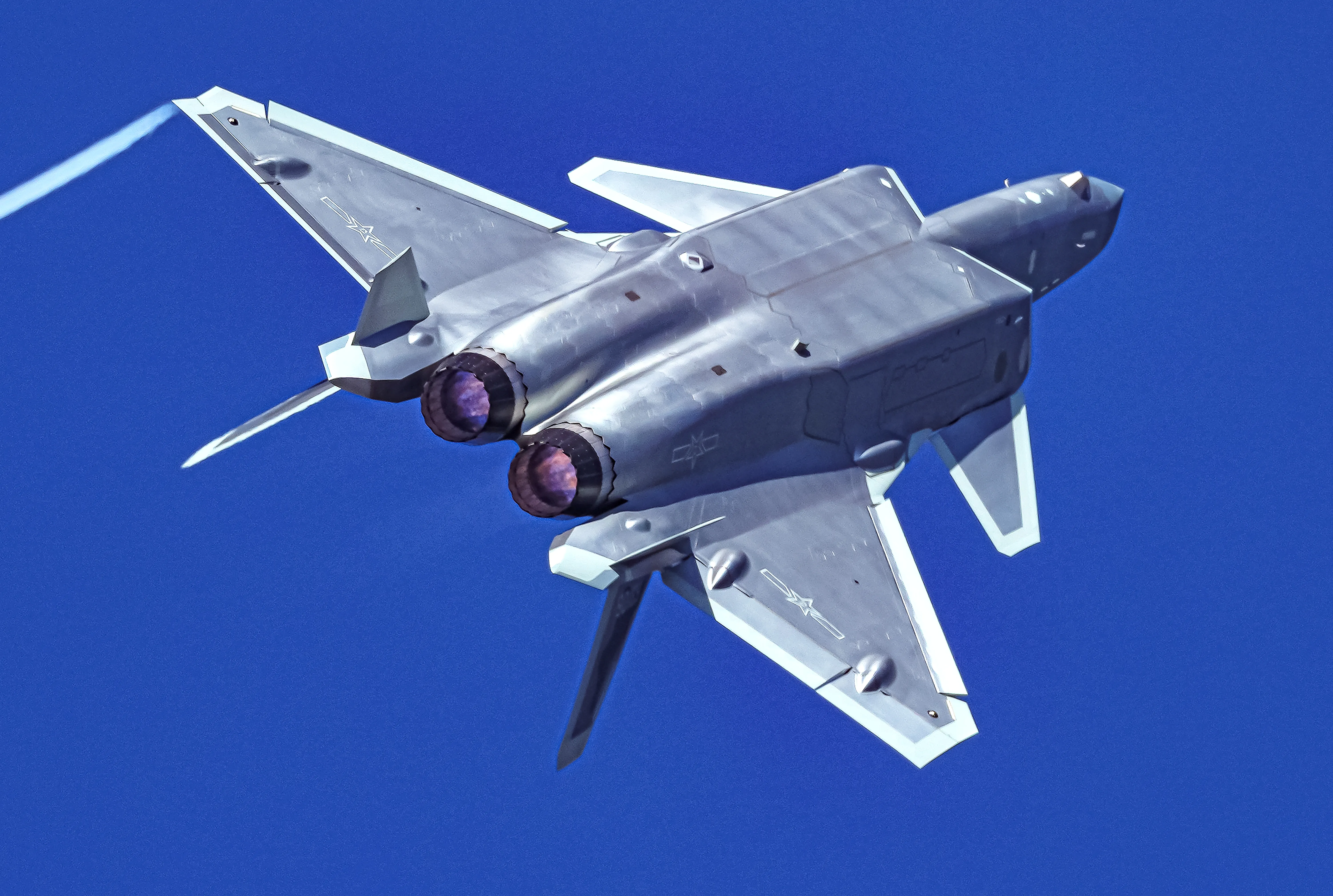
Mighty

How Many J-20 Mighty Dragon Fighters Does China Actually Have?

China’s mysterious next-generation combat aircraft have dominated headlines since a pair of sixth-generation designs broke cover in late 2024. But while those aircraft understandably command attention, the single most important fighter in the People’s Liberation Army Air Force (PLAAF) is arguably the Chengdu J-20 Mighty Dragon. Not only does the J-20 offer a level of capability previously missing from the PLAAF, but it is being introduced in remarkably large numbers. This underscores China’s ability to mass produce even the most advanced weapons in its arsenal. The quantities of J-20s that are now rolling off the production line also highlight the pace of the PLAAF’s transformation and raise the question of exactly how many Mighty Dragons have already been fielded.

The appearance of new Chinese combat aircraft designs, including the J-35 medium-weight stealth fighter in both naval and land-based versions, means that the J-20 is no longer under such a high level of public scrutiny. This contrasts with the situation back in 2021, when TWZ provided a review of the program on what was then the 10th anniversary of its first flight.

CHANGCHUN, CHINA - SEPTEMBER 23: J-20 fighter jet performs in the sky during the 2025 aviation open-day activities of the Chinese People's Liberation Army (PLA) Air Force and the Changchun Air Show on September 23, 2025 in Changchun, Jilin Province of China. The events concluded in Changchun on September 23. (Photo by Zhou Guoqiang/VCG via Getty Images)
A J-20 fighter performs during the Changchun Air Show on September 23, 2025 in Changchun, Jilin province of China. Photo by Zhou Guoqiang/VCG via Getty Images

At that time, we stated that the J-20 was, “without doubt, the main focus of global attention when it comes to China’s military aircraft developments. Within the People’s Republic of China, too, the jet known as the Mighty Dragon has become a totem for the country’s fast-emerging high-technology defense sector and its associated aviation industries.”

It is worth recalling that when the J-20 first appeared on the runway at Chengdu’s sprawling manufacturing plant in late 2010, the black-painted aircraft was deemed by some Western observers to be a technology demonstrator at best, not something that would end up being the country’s first stealth fighter built at scale. It is one thing to fly an impressive, hand-built experimental aircraft. It’s very much another to produce an advanced fighter reliably in large quantities, especially one that incorporates stealth technologies that are notoriously challenging to manufacture. However, after some design tweaks, the J-20’s service entry followed in late 2016, and the jet became only the third true stealthy fighter to become operational anywhere in the world.

Picture of an early J-20 prototype.

Since then, the J-20 has continued to be improved, and new variants have emerged. Perhaps the most significant development concerning the jet has been the introduction of a domestically produced powerplant to the series-built aircraft, superseding the use of previous Russian-supplied engines. A two-seat version of the aircraft has also appeared, representing a notable novelty for a fifth-generation fighter. More advanced weapons — and more of them — and enhanced avionics have also been steadily introduced.

Most important, however, has been the increased production rate of the Chengdu jet, leading to its proliferation across the units of the PLAAF.

A still from an official PLA video showing a J-20 with its novel side weapons bays open, showing two short-range PL-10 air-to-air missiles. via Chinese internet

At the end of 2019, nearly a decade after the J-20 first appeared, Western sources estimated the number of J-20s built to be around 50, a figure that likely also included pre-production machines. At the same time, unconfirmed Chinese reports suggested a production capacity of 48 aircraft annually, but there was no publicly available evidence that that figure had been attained.

By late 2022, Western defense outlets were reporting that the PLAAF had received at least 200 J-20s, a figure based primarily on a study of construction numbers seen on the jets and equating to four production batches. At the same time, more than 240 examples of the J-16 multirole fighter aircraft, a Chinese development of the two-seat Flanker family, were said to be in service, equivalent to 11 batches. Also in production, the number of J-10Cs in service was somewhat lower, but the fleet was also bolstered by older J-10A/B versions.

A YY-20 aerial tanker simultaneously refuels J-16 and J-20 fighters. via Chinese internet

In its assessment of the PLAAF modernization drive, in early 2023, the International Institute for Strategic Studies (IISS), a British think tank, was somewhat more circumspect, counting a frontline fleet of at least 150 J-20s. However, the IISS noted, the fleet was projected to outnumber the U.S. Air Force’s F-22 Raptors by the end of the same year, aided by an annual production rate that “had likely doubled” within the previous three years.

Three U.S. Air Force F-22 Raptor aircraft assigned to the 90th Fighter Squadron, Joint Base Elmendorf-Richardson, Alaska, fly alongside a U.S. Air Force KC-135 Stratotanker aircraft assigned to the 100th Air Refueling Wing at Royal Air Force Mildenhall, England, over Poland, Aug. 10, 2022. The NATO Air Shielding mission provides a near seamless shield from the Baltic to Black Seas, ensuring NATO Allies are better able to safeguard and protect Alliance territory, populations and forces from air and missile threat.
Three U.S. Air Force F-22 Raptors assigned to the 90th Fighter Squadron, Joint Base Elmendorf-Richardson, Alaska. U.S. Air Force U.S. Air Force photo by Staff Sgt. Kevin Long

As for the F-22, the U.S. Air Force currently has 185, but only 143 of the jets are combat-coded, with the rest being assigned to training and test and evaluation activities. Meanwhile, a significant portion of the overall fleet is typically down for maintenance at any given time.

A detailed analysis of the operationalized nature of the J-20 program was provided by Janes in mid-2024. This concluded that, in a period of over 11 months from July 2023, the PLAAF had inducted more than 70 J-20s, for a total of approximately 195 of the aircraft. Using satellite imagery, it was determined that, as of May 2024, the PLAAF operated 12 air brigades with J-20s, of which three brigades were fully equipped with the type. Significantly, it also confirmed that all five of the Theater Commands — joint military commands organized on a geographical basis — had inducted the J-20.

A two-seat J-20S (top), a J-20A (bottom left), and a J-20 (bottom right). via Chinese internet

Moving forward to 2025, it appeared that the J-20 production total had rapidly reached the 300 mark.

In the fall of that year, Andreas Rupprecht, a longtime Chinese military observer and contributor to this website, identified a J-20 with a serial number that indicated it was the 300th airframe, from the 10th production batch.

Meanwhile, the Royal United Services Institute (RUSI), a U.K.-based think tank, assessed that, by late 2025, production rates for the J-20 had likely reached around 120 aircraft per year, and that around 300 of the aircraft were in service across at least 13 PLAAF regiments. “The total produced is likely to be higher,” RUSI explained in a report on the subject, “since a significant number of newly produced fighters will still be awaiting delivery to units.”

Based on the trend, RUSI suggested in its report earlier this year that, by 2030, around 1,000 J-20s of all versions (plus around 900 J-16s) will be in service with the PLAAF. “There is also a noticeable trend towards heavy fighters in general, with J-16s and J-20s being used to re-equip units that previously were operating not only J-11 and Su-27/30 Flanker heavy fighters, but also some J-7 light and J-8 medium fighters,” the report added.

Rupprecht told TWZ that he is confident that, as of mid-2026, around 500 J-20s had likely been delivered. This theory is reinforced by the presence of the jets with 14 frontline PLAAF units, and with another three Flight Test and Training Bases (FTTB), which operate mixed fleets. Of the 14 frontline units, four appear to have introduced the enhanced J-20A version, replacing the initial-production J-20s.

Interestingly, among American officials, there has been some downplaying of the J-20’s capabilities vis-à-vis the U.S. military.

“It’s not anything to lose a lot of sleep over,” Pacific Air Forces (PACAF) head Gen. Kenneth Wilsbach said in 2022. “Certainly, we’re watching them closely and seeing how they field and how they operate them.” Wilsbach qualified his comments by saying that the U.S. Air Force has “had a limited opportunity to assess it [the J-20], but it seems okay.”

On the other hand, other U.S. Air Force leaders have highlighted concern over the rapidly growing PLAAF, an expansion in which the J-20 is playing a major role.

“We are the smallest and oldest that we have ever been,” Air Force Brig. Gen. Doug Wickert, head of the 412th Test Wing at Edwards Air Force Base in California, said of his service during a briefing early last year. “The PLA is the largest and most modern that it has even [sic; ever] been. That is risk. That is uncertainty.”

Brig. Gen. Doug Wickert, 412th Test Wing commander, points to an image of the B-21 Raider. U.S. Air Force

Wickert added that he predicted that, by 2027, China would have numerical superiority of approximately 12 to one in modern fighter aircraft (including five to three in fifth-generation aircraft) in relation to U.S. assets stationed west of the international dateline.

At the same time, we don’t know how many J-20s Beijing intends to buy. As well as its continued development, much will depend on plans for the land-based J-35, which could potentially offer a cheaper alternative for some mission sets. Beyond that, there are at least two sixth-generation crewed combat aircraft designs and various collaborative combat aircraft (CCAs) and uncrewed combat air vehicles (UCAVs) that will need to be factored into the future force structure.

Undoubtedly, the J-20 has faced challenges, too, but it has matured from a prototype that some were quick to dismiss into the backbone of China’s premier air arm. Its continued evolution in terms of engines, avionics, weapons, and variants is important, but the most important development may simply be the rate at which China is able to build it.

In the same way that technologies and tactics developed alongside the J-20 will find their way into China’s next generation of combat aircraft, these will also be able to leverage the advances in production output. China has proven to be remarkably capable of punching out large numbers of advanced fighters, so these new aircraft could hit flightlines in greater quantities faster than some may expect, once they are developmentally mature enough to enter production. Moreover, Chengdu’s serial-manufacturing abilities underscore the wider degree to which China can churn out its most advanced weapons, of all kinds, which is historically a hugely challenging endeavor.

China's growing weapons programs puts pressure on intelligence community.
A head-on view of the new-generation Chinese combat aircraft known as the J-36. via Chinese internet Chinese internet via X

In military terms, quantity has a quality all on its own, and if current production estimates are even broadly accurate, the J-20 program has entered a phase where manufacturing capacity is just as strategically significant as the fighter’s stealth and performance.

Contact the author: thomas@thewarzone.com

Thomas Newdick is a staff writer at TWZ, where he covers military aviation, defense technology, weapons systems, and international security. Based in Berlin, Germany, he reports on conflicts, military modernization efforts, and emerging aerospace technologies around the world, with a particular interest in airpower and its role in contemporary warfare. His reporting is informed by deep expertise in modern and historical airpower, particularly in Europe, with a focus on military aviation, air campaigns, and aerospace developments across the continent and beyond.


Source link

Inside ‘Mighty Real,’ Barry Walters’ history of LGBTQ+ music

For more than 40 years, Barry Walters has been closely watching the dance floors of New York and San Francisco, chronicling the ways in which LGBTQ+ culture has influenced mainstream culture. As a writer for the Village Voice, the Advocate and Spin, among others, Walters became one of music journalism’s most eloquent and crucial voices, championing artists like the Pet Shop Boys and Madonna during their formative years.

Walters’ new book, “Mighty Real, draws on his deep firsthand knowledge, offering a comprehensive history of LGBTQ+ music from 1969 to 2000. I recently spoke with Walters about Babs, Madge and Bowie.

You’re reading Book Club

An exclusive look at what we’re reading, book club events and our latest author interviews.

✍️ Author Chat

In the book, you make a distinction between pre-Stonewall LGBTQ music and post-Stonewall LGBTQ music.

Gay culture before Stonewall really had to be hidden, or at least secretive. I think of Barbra Streisand as a quintessential pre-Stonewall figure. Judy Garland, as well. These women are tough, and even though they sing songs written by men, it’s not in a submissive way. They are singing like they are the champions, even when they are suffering through what men do to women through the torch songs they perform.

What can you say about the encoded nature of certain songs that spoke to gay culture in a way that flew under the radar of hetero listeners in the pre-Stonewall era?

The music that spoke to gay culture, by necessity, had to be encoded. “Secret Love” by Doris Day is a good example. It’s about struggling to have something that’s otherwise forbidden. Sinead O’Connor covered that song. There was a song I loved as a young child called “Have I The Right?” by the Honeycombs, which was written by two British gay men at a time when homosexuality was illegal in England. You know, have I the right to be with whomever I want to be with?

What, in your view, was the big bang of post-Stonewall LGBTQ music?

David Bowie to a large degree. Right around the time that “Hunky Dory” was being released in 1971, he told the Evening Standard newspaper that he was gay, flat out just said it. And it was such a strange thing to say that many people doubted his sincerity.

Barry Walters wrote a new book about the history of LGBTQ music.

Barry Walters, a writer for the Village Voice, the Advocate and Spin, among others, wrote a new book about the history of LGBTQ+ music.

(Kelly Lawrence for Walters)

I remember seeing Bowie wearing that dress on the cover of “The Man Who Sold The World,” thinking that was the most transgressive act any rock star had ever committed.

And then he performed “Starman” on Top of the Pops in 1972 and he put his arm around his guitarist Mick Ronson, who also looked gorgeous. They were displaying a familiarity men aren’t supposed to have.

I thought I knew everything about pop music, but you have uncovered so many fascinating stories. Tell me about Olivia Records.

Olivia Records was an independent record label in the Bay Area owned and controlled by lesbians for female artists. This is years before punk or indie rock, when so many small labels cropped up. They pioneered so much. They would recruit fans in different cities to man the merchandise and to help get their records in stores. The idea of a merch table was something new at the time. They also created the forerunner of Burning Man. They would go find a farm somewhere and create an impromptu village, with food, sanitation and the rest.

You have given the most space in your book to Madonna, whom you have written about extensively over the years. Why is Madonna such a huge figure in the history of LGBTQ music?

Her art is so queer. I feel like she is one of us. She’s very much like Grace Jones, in that her sensibility is so aligned with gay culture. I related to Madonna on multiple levels. In the early ‘80s, I would see her around town, dancing at the same New York clubs I was frequenting, like Danceteria. She was steeped in gay culture, and then she brought all of this into the mainstream, and that was profound. I also feel like she was misunderstood in many ways. When straight men called her a slut, things like that. That is so far from the truth. She is such a complex artist. If you are making that claim, you don’t know anything about her.

(This Q&A was edited for length and clarity.)

📰 The Week(s) in Books

Illustration of a man swimming away from a book-shaped shark

(Javier Pérez / For The Times)

Pulitzer prize winner Elizabeth Strout has a new novel called “The Things We Never Say,” and Julia M. Klein approves. “[Strout] reprises her familiar themes: the mysteries of human personality, the perils of solitude, the occasional possibility of grace … in deceptively simple, occasionally mannered prose that draws readers in and immerses them in her fictional worlds,” Klein writes.

They’re on a boat! Paula L. Woods climbed aboard a 130-foot yacht in Marina del Rey to soak in the vibes of the Yacht Girls Book Club. “I wanted conversations with like-minded women that were intellectual but fun,” club founder Aloni Ford told Woods. “And talking about books seemed to be the ideal way to achieve that.”

“PEN15” co-creator Anna Konkle has written a memoir called “The Sane One,” and Rachel Brodsky talked to her about it. “In some ways, ‘PEN15’ was a reaction to loving memoirs,” she tells Brodsky. “Raw memory has always been very exciting to me.”

Finally, our Times critics take the measure of this summer’s hottest beach reads.

📖 Bookstore Faves

Kinokuniya bookstores sell Japanese manga, stationery and literature.

Kinokuniya bookstores sell Japanese manga, stationery and literature.

(Courtesy of Kinokuniya)

When Kinokuniya opened its first L.A. shop in 1977, it was primarily to provide Japanese expats with imported books and magazines to read in their native tongue. Forty years later, the store has become a locus of Japanese printed matter for Angelenos eager to scoop up Japanese literature and manga in Japanese and English, as well an expansive selection of imported stationery products that, in L.A., can only be found in Kinokuniya’s three stores. I spoke with Sakura Yamaguchi, who manages two of Kinokuniya’s stores downtown (the third is in Mar Vista) about its many-splendored pleasures.

How did the store travel from Japan to Los Angeles?

Books Kinokuniya was founded by Moichi Tanabe in 1927. Located in the Shinjuku district of Tokyo in a two-story wooden building, the first Kinokuniya started with five employees, including Mr. Tanabe himself. In 1969, Kinokuniya opened its first overseas bookstore in San Francisco. The first Los Angeles store opened in 1977.

Who are your customers?

We first started as a store for Japanese customers, so we imported Japanese books and magazines and sold them, mainly. But in the past 10 years, Japanese manga/anime, stationery and literature has been quite popular in the U.S. Therefore our customers are a mix of Japanese-speaking customers and non-Japanese speakers who are interested in Japanese culture.

What percentage of your clientele buys Japaneselanguage products?

Forty percent Japanese-language products versus 60% English books.

What specific titles are selling for you right now?

“Witch Hat Atelier Grimoire Edition, Volume 1,” “JoJo’s Bizarre Adventure: Purple Smoke Distortion” and the “Strange Houses” series.

Are you seeing more young people turning to printed matter? It seems like there is an analog revival at the moment.

We have been trying to make exclusive editions that come with freebies to make the printed manga more attractive, but without that our English manga sales have been increasing and our main target for the manga is young people. There are many titles that are published exclusively in e-book format, but we frequently hear from customers asking when they will be released in print form. Also, recently there has been a growing number of cases where titles that were originally available only in digital format have later been published as physical books.

Kinokuniya at the Bloc in Los Angeles is located at 700 W 7th St.

(Please note: The Times may earn a commission through links to Bookshop.org, whose fees support independent bookstores.)

Source link