Mexico

California Reverts to Its Scapegoating Ways : Immigration: Throughout its history, when economic times got tough, blame was passed on to migrant groups. Mexico is the latest target.

Kevin Starr, professor of planning and development and faculty master of Embassy Residential College at USC, is the author of “The Dream Endures: California Through the Great Depression,” to be published by Oxford University Press.

The California dream, according to the latest Times’ poll: National Guardsmen patrol the border with Mexico, bayonets at the ready. Every resident, citizen and non-citizen alike, carries a tamper-proof identi ty card (You can’t leave home without it). Countless times a day, the card is shown to bureaucrat or police officer to prove citizenship. The 14th Amendment, guaranteeing citizenship to the U.S.-born, is abrogated. Truant officers, lists in hand, enter classrooms and pull undocumented children from behind their desks, trundling them into vans for shipment to relocation centers. At hospitals nearby, emergency-room doctorsturn away the sick or injured who do not possess the identity card.

Every now and then, the people of California surrender themselves to a recurrent paranoid delusion that is virtually a badge of Californian identity. Now is such a time. And the combination of a paranoid-delusional populace and demagogic politicians has engendered among Californians a mean-spiritedness, a detachment from reality–and worse, a fear of freedom itself.

It happened in Los Angeles on Oct. 24, 1871, when a mob, which included some of the city’s best citizens, tortured and hanged 17 Chinese men from downtown lampposts, among them a teen-age boy, then looted the Chinese quarter.

It happened in the 1930s, in the midst of the mother of all Depressions, to Dust Bowl migrants. In February, 1936, the city of Los Angeles declared both the federal and state constitutions null and void, dispatched 126 police officers to seal off all California’s land borders from entry by migrants–all American citizens–who could not prove their net worth.

It happened most sweepingly in 1942, when American citizens of Japanese descent were shipped off to what were euphemistically called relocation centers.

It happened in June, 1943, when thousands of young servicemen wandered the streets of Los Angeles, beating up young Mexican males, stripping them of their zoot suits, blaming them, implicitly and explicitly, for the fact that they, the Anglos, had to go off to war while the Mexican youths were able to stay home and jitterbug.

As Yogi Berra would say, “It’s deja vu all over again.” Just as Californians once believed that the Chinese, the Japanese, the Dust Bowlers, or Mexican youths in zoot suits were the cause of their ills, they now believe, with the full force of mass psychosis, that illegal immigrants–read: illegal Mexicans–constitute the gravest threat to our way of life, in a close third to the economy and crime, to which illegal immigration is intimately linked.

Think of it! Mexican illegals responsible for bloated bureaucracy. Mexican illegals responsible for special-interest-dominated politicians. Mexican illegals responsible for a soaring divorce rate, the breakdown of the family, AIDS, venereal disease, declining standards in culture and education, anti-female violence in rap music, drugs, child abuse, spousal batterings, the loss of religion and personal morality, deferred maintenance of the infrastructure, teen-aged pregnancies, the Inquisition of political correctness, slovenliness in personal dress–or whatever other symptom one might choose to signify the decline of California as a culture.

To say all this is not to deny that California faces a terrible array of problems, including illegal immigrants. As Delmore Schwartz once pointed out, even paranoids have enemies. Illegal immigrants are a drain on the public sector. The underground economy–with its exploitative wages, lack of benefits, forged and perjured documents–corrupts employer and employee alike.

Furthermore, in an economy partly dependent upon illegal immigration, citizenship is devalued. What previous generations struggled for across a lifetime–the chance to live and work in America–is stolen by means of false papers. The ghetto existence of illegal immigrants reinforces an unfortunate tendency in the legal immigrant community not to learn English, not to assimilate, on some level, the language, legal and institutional structures, heritage and historical identities of the United States of America.

As bad as these problems are, however, they are not the whole picture. The state’s current malaise cannot be blamed on the young busboy, far from home, washing dishes late into the night in an upscale restaurant on the Westside. Indeed, in the vast majority of instances, Mexican illegals are doing the work that others–even those on welfare–will not do, yet needs to be done.

How did we lose faith in the premise of America and California, which is freedom and an open society, personal liberty, courage, fairness and, whenever possible, generosity to others who also wish something better for themselves? Why are we talking about bayonets on the border when, every day, there are tens of thousands of legal crossings between Mexico and California crucial to the survival of our economy? Why are we scapegoating obliquely, perhaps, yet with loathsome effectiveness, the fact of Mexican immigration to America, an immigration that was absolutely necessary for the creation of modern California?

Mexican labor built the interurban electrics that made possible modern Los Angeles and its hinterlands. Mexican labor played the major role in the creation of the agricultural economy that still remains the leading component of California’s domestic product.

Californians had it easy in that long arc of prosperity extending from World War II through the ‘80s? When it was taken away–when California began to suffer like the Rust Belt or rural New England or Appalachia–they turned around and blamed the weakest, especially an underclass approaching non-personhood.

Paranoia is intrinsically self-destructive. Paranoids not only blame others; they do damage to themselves. And so it is not surprising that the current paranoid-delusional mind-set, not content with soldiers on the border and identity cards, with kids yanked from classrooms and the sick denied treatment, now seeks to sink the North American Free Trade Agreement. True, the treaty requires some amending, but to kill the entire idea of economic cooperation with Mexico on the ground that Mexico will hijack our economy is to betray in an instant how far our self-esteem has sunk, how far we have devolved into paranoia. We want it both ways: to see the Mexicans as, on the one hand, illegals enervating our social system; and, on the other, to see them back on their own turf, capable of stealing our industrial base.

What a horrible hypocrisy for California to simultaneously exploit and berate those who come only for a better life.

Source link

Thanks to the World Cup, I’m finally learning the words to the Mexican national anthem

I rose from my living room couch before Mexico’s World Cup match against Czechia when the Telemundo announcer stated it was time for the Mexican national anthem.

The public address system at Azteca Stadium in Mexico City played a short string intro. My back straightened. I pressed my right hand against my chest horizontally in the traditional gesture that accompanies the tune. And then I recited the opening lyrics to a song I’ve heard all my life but that I only began committing to memory this month:

Mexicanos al grito de guerra/El acero aprestad y bridón/Y retiemble en sus centros la tierra/Al sonoro rugir del cañon

Those florid 19th century words — “Mexicans, at the cry of war/Ready the steel and the bridle/and may the Earth tremble to its core/at the cannon’s resounding roar” — make “The Star-Spangled Banner” seem as anti-war as “Give Peace a Chance.” My kumbaya heart nevertheless jumped as the anthem continued.

Goosebumps blossomed on my skin as Mexico’s head coach Javier Aguirre, he of a stern face and gray haircut worthy of a drill sergeant, beamed while singing. My eyes watered as the camera panned over his arm-in-arm players as they shouted the line, “Think, o beloved homeland! That heaven/gave you a soldier in each son.”

Millions of Mexican Americans like myself have stumbled through the himno nacional during this World Cup, whereas in previous years, we might have just hummed some bars or stayed silent. It’s a boisterous way to connect with one half of our hyphenated lives and get in the right mindset to root for El Tri, but otherwise something we don’t really have to know all the way through given we’re in the U.S.

Yet seeing stadiums and bars packed with Latinos wearing the jerseys of their ancestral homes and warbling their national anthems during this World Cup has been a jolt of inspiration I wasn’t expecting. Those few minutes before each match have become a reminder of what we’re up against at this moment in the Western Hemisphere, as President Trump thirsts to smash Latin America into submission while persecuting too many of us stateside.

In downtown Santa Ana earlier this week, Alicia Rojas quietly recited Colombia’s national anthem word for word before a game against the Democratic Republic of the Congo, even though she was just one of a handful of Colombian fans at Chapter One: The Modern Bistro.

“It reconnects me to my roots, my family and the memories of home,” said Rojas, who was born in Bogotá and moved to the U.S. at age 12. The artist has helped to organize against federal immigration raids in Orange County and volunteers for local political races. “Those few minutes remind me that beyond our differences, we share a history, a culture and a love for the land that made us who we are.”

Latinos are a famously divided bunch, to the point that we don’t even like a catch-all label for “us.” A 2024 Pew Research Center survey found that 52% of Latinos prefer to refer to themselves by their family’s country of origin, while only 30% identify as Hispanic or Latino and just 17% use plain ol’ American.

One thing that can unite us all — and all lovers of liberty, for that matter — is those Latin American national anthems. Many were written in the aftermath of wars for independence. Most are bright, rousing listens, even if you don’t understand Spanish, because their chords reflect the Romantic classical music popular at the time of their composition in the 19th century. All call for their countrymen to fight against tyranny.

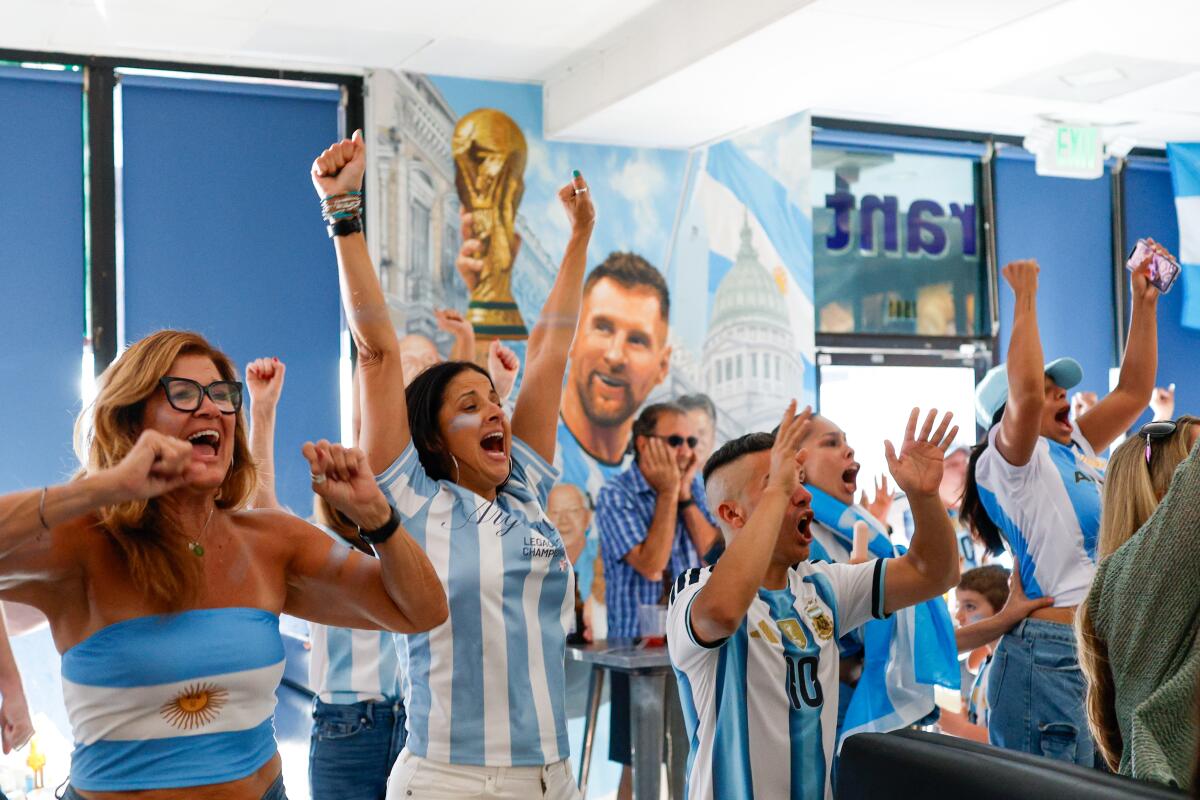
Fans cheer after Lionel Messi scores a goal

Fans cheer after Lionel Messi scores a goal against Algeria during a World Cup watch party at Mercado Buenos Aires on Tuesday, June 16 in Van Nuys.

(Ronaldo Bolaños/Los Angeles Times)

Cue up this soundtrack for your summer:

Paraguay’s national anthem starts by stating that the people of the Americas were “oppressed for three centuries” until they rebelled. Ecuador’s recalls how its founding fathers “cried out a holy voice to the heavens/that noble voice of a unbreakable pledge/to defeat that [Spanish] monster of blood.” Colombia’s similarly doesn’t shy away from how violent its fight for independence was, but takes solace that “in furrows of pain/good now germinates.”

On and on, these songs stir the soul. Argentina: “Hear the sound of broken chains/See noble equality enthroned.” Uruguay: “Tyrants: Tremble!/We shall cry out ‘Liberty’ in battle!” — a boast backed by flutes and violins that make it sound like a Rossini overture. I especially like how Panama’s national anthem concludes by urging “shovel and pick/to work without delay” — a reminder that the job of creating a better society is never done.

Conservatives have, unsurprisingly, long railed at the very idea of singing the national anthems of other countries on American soil. But that just reinforces Samuel Johnson’s adage that patriotism is the last refuge of a scoundrel.

There’s nothing wrong with taking inspiration from the clarion calls of other countries. “O Canada” is as soaring as “God Save the King,” while revolutionaries across the world have chanted “La Marseillaise” for centuries. And yes: I sing “The Star-Spangled Banner” with all my heart as well — and I definitely know the words to it.

But the message of the U.S. national anthem isn’t enough for Latinos right now. Hailing survival against an invading force is important, but it’s a mindset too many of us have resigned ourselves to under Trump.

The theme of Latin America’s national anthems is the demand that we stand against despotism and push for a better world through sacrifice and valor. They should be a wake-up call, especially for Latinos, to lead the electoral charge against Trump this November. We helped put him in the Oval Office in 2024, and we have the power to take Congress away from his GOP vassals.

Alas, all those paeans to freedom have played out better in song than in real life. Latin America is swinging rightward again, electing presidents who promise to channel the strongmen of yore and rule the region through might, not right.

On the same night that Rojas was cheering on Colombia, she was bemoaning that her homeland had elected Abelardo de la Espriella, a millionaire criminal defense lawyer and political novice who earned Trump’s endorsement for his “tremendous accomplishments in life” — which include claiming that female voters would pick him because of the supposed size of his genitals.

We must channel the hopes and dreams of Simón Bolívar, Emiliano, Zapata, José Martí and other heroes of the Americas who fought for freedom for their countrymen, sought to cast off the long reach of colonialism and imperialism and urged pan-American alliances over forever wars.

Nothing like the World Cup’s unofficial pre-game soundtrack to reinforce this eternal, universal message.

Mexico dominated Czechia 3-0 and finished first in its group. When El Tri plays again on Tuesday in the first round of the knockout stage, I will stand at a packed Chapter One with other fans and so many more across the U.S. and sing again Mexico’s national anthem.

I will hope to have it all memorized by then instead of reading off my smartphone — the thing is hard! The Spanish is archaic, the intonations are complicated, and the words tumble over themselves like a hard charge toward the goal posts.

But I will do it — a little victory in the long battle for freedom that never ends.

Source link

Mexico defeats Czechia to complete a perfect group stage

World Cup: Mexico defeat Czechia

From Eduard Cauich: Mexico’s national team overcame a lackluster first half to rout Czechia thanks to a dream second half that allowed it to finish the group stage undefeated on a night that will be remembered as one of the greatest in Mexican World Cup history.

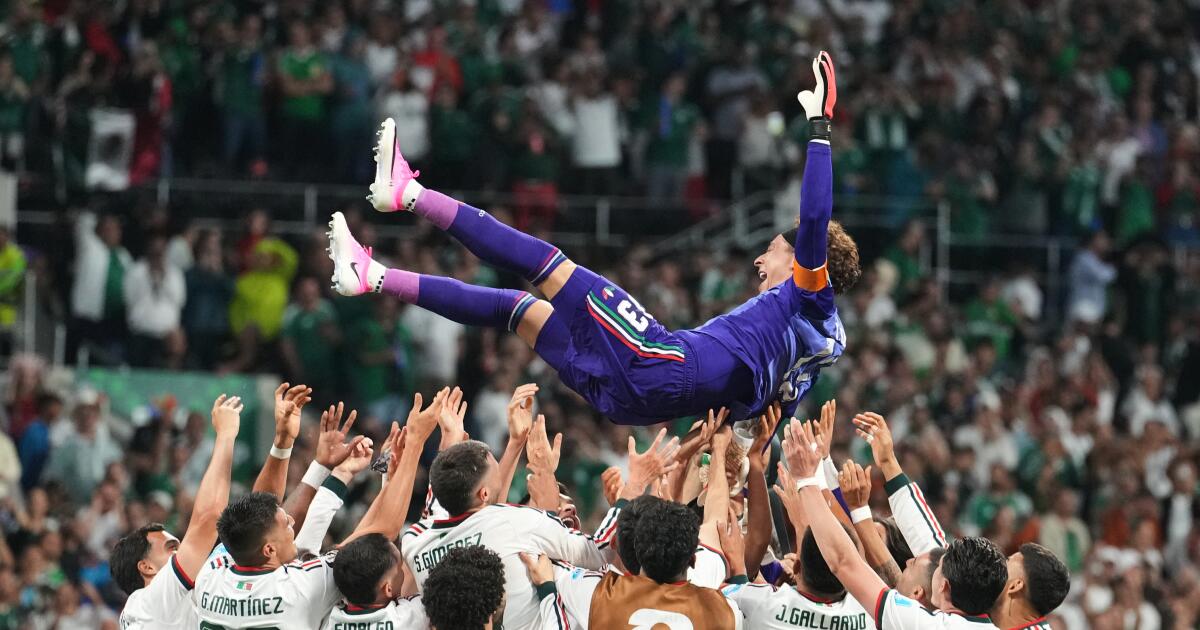
The celebration of Mexico’s 3-0 win Wednesday at Azteca Stadium turned into a tribute to legendary goalkeeper Guillermo Ochoa, who entered the game in the final minutes to receive a standing ovation unlike any other for a Mexican player in the history of the tournament.

Czechia was eliminated after failing to earn more than one point in the tournament. In the other group match, South Africa defeated South Korea 1-0 in Monterrey and advanced in second place. South Korea will have to wait to find out whether it advances as one of the eight best third-place teams.

Czechia put up a strong performance during the first 45 minutes, while Mexico showed little offensive clarity, mainly because of a lack of control in midfield.

Everything changed in a matter of six minutes during the second half, when El Tri figured out Czechia and secured its best victory in the group stage.

Continue reading here

World Cup recap: South Africa beats South Korea, advances to play at SoFi Stadum

Click here for complete TV schedule, groups and players to watch

Full World Cup coverage

Go beyond the scoreboard

Get the latest on L.A.’s teams in the daily Sports Report newsletter.

Wednesday’s World Cup results

Group A
Mexcio 3, Czechia 0
South Africa 1, South Korea 0

Group B
Bosnia-Herzegovina 3, Qatar 2
Switzerland 2, Canada 2

Group C
Morocco 4, Haiti 2
Brazil 3, Scotland 0

Today’s World Cup TV schedule

All times Pacific
1 p.m., Curacao vs. Ivory Coast, FS1, Telemundo
1 p.m., Ecuador vs. Germany, Fox, Telemundo
4 p.m., Japan vs. Sweden, FS1, Telemundo
4 p.m., Tunisia vs. Netherlands, Fox, Telemundo
7 p.m., Paraguay vs. Australia, FS1, Universo
7 p.m., Turkiye vs. U.S., Fox, Telemundo

World Cup Group standings

Group A
Country, W-D-L, Goal Differential, Points
x-Mexico, 3-0-0, +6, 9
x-South Africa, 1-1-1, -1, 4
South Korea, 1-0-2, -1, 3
y-Czechia, 0-1-2, -4, 1

Group B
x-Switzerland, 2-1-0, +4, 7
x-Canada, 1-1-1, +5, 4
Bosnia-Herzegovina, 1-1-1, -1, 4
y-Qatar, 0-1-2, -8, 1

Group C
x-Brazil, 2-1-0, +6, 7
x-Morocco, 2-1-0, +3, 7
Scotland, 1-0-2, -3, 3
y-Haiti, 0-0-3, -6, 0

Group D
x-United States, 2-0-0, +5, 6
Australia, 1-0-1, 0, 3
Paraguay, 1-0-1, -2, 3
y-Turkiye, 0-0-2, -3, 0

Group E
x-Germany, 2-0-0, +7, 6
Ivory Coast, 1-0-1, 0, 3
Ecuador, 0-1-1, -1, 1
Curacao, 0-1-1, -6, 1

Group F
Netherlands, 1-1-0, +4, 4
Japan, 1-1-0, +4, 4
Sweden, 1-0-1, 0, 3
y-Tunisia, 0-0-2, -8, 0

Group G
Egypt, 1-1-0, +2, 4
Iran, 0-2-0, 0, 2
Belgium, 0-2-0, 0, 2
New Zealand, 0-1-1, -2, 1

Group H
Spain, 1-1-0, +4, 4
Uruguay, 0-2-0, 0, 2
Cape Verde, 0-2-0, 0, 2
Saudi Arabia, 0-1-1, -4, 1

Group I
x-France, 2-0-0, +5, 6
x-Norway, 2-0-0, +4, 6
Senegal, 0-0-2, -3, 0
Iraq, 0-0-2, -6, 0

Group J
x-Argentina, 2-0-0, +5, 6
Austria, 1-0-1, 0, 3
Algeria, 1-0-1, -2, 3
y-Jordan, 0-0-2, -3, 0

Group K
x-Colombia, 2-0-0, +3, 6
Portugal, 1-1-0, +5, 4
Congo DR, 0-1-1, -1, 1
Uzbekistan, 0-0-2, -7, 0

Group L
England, 1-0-1, +2, 4
Ghana, 1-0-1, +1, 4
Croatia, 1-0-1, -1, 3
y-Panama, 0-0-2, -2, 0

x-clinched round of 32; y-eliminated

The top two teams in each group plus the next eight best third-place teams advance to the next round.

Note: The U.S. is locked into a July 1 knockout stage game against the third-place team from either Group B, E, F, I or J at Levi’s Stadium in Santa Clara.

Dodgers edge the Twins

From Maddie Lee: Shohei Ohtani was done trying to make the back-and-forth work.

He and catcher Dalton Rushing had struggled to get in sync for the first two innings Wednesday — from pitch-calling, to ABS challenges, to a crossup that cost the Dodgers a run. So, Ohtani took matters into his own hands.

“There’s really a couple ways of communicating,” Ohtani said through interpreter Will Ireton after the Dodgers’ 4-3 win against the Minnesota Twins. “One is by words, but the other way to be able to communicate is by example, and just taking the charge and showing Rush what kind of pitching style I’m capable of.”

After a three-run (two earned) second inning, Ohtani supplied his own run support with an RBI single that spurred the Dodgers’ game-winning rally, and then took over pitch-calling duties on the mound.

Ohtani didn’t allow another run, through the sixth.

“I didn’t do a great job from start to finish,” said Rushing, who returned to the lineup Wednesday after being removed from Monday’s game to rule out a concussion. “Pretty embarrassing. Thankfully he’s as good as he is and he can take control of the game.”

Continue reading here

Dodgers fulfill $1-million pledge in response to ICE raids, owners divest from prison group

Dodgers box score

MLB standings

Angels defeat the Orioles

Nolan Schanuel reached third on an error and Logan O’Hoppe drove him in on a check-swing tapper in the 10th inning as the Angels rallied to defeat the Baltimore Orioles 7-6 on Wednesday.

It was the 12th come-from-behind victory for the Angels (34-48) and sixth walk-off win.

Pinch-hitter Vaughn Grissom started the rally with an RBI single in the eighth, and Wade Meckler tied the game with a two-run single.

Continue reading here

Angels box score

MLB standings

Austin Reaves now has to prove he’s worth it

From Bill Plaschke: He’s no longer a cute little kid.

He’s a $185-million man.

He’s no longer a quintessential underdog routinely pardoned for his bad defense, his questionable durability and his tendency to tighten up in the playoffs.

He’s a big dog who needs to own it.

Austin Reaves, the most beloved Laker, became the most scrutinized Laker on Wednesday with the news that he agreed to a maximum four-year, $185-million contract to remain with the team.

Kudos to him for becoming the highest-paid undrafted player in league history.

Congrats to the Lakers for turning a homegrown talent into a budding superstar.

His everyman story resonates with the masses.

Except that story is finished. That book has been closed. A new volume has begun.

It’s called, “Is Austin Reaves Worth It?”

Thus far, the answer has been no.

Continue reading here

Lakers’ Austin Reaves opts out of contract, plans to re-sign for four years

Big second round of draft for Clippers

From Thuc Nhi Nguyen: They started their pro careers in Spain and now two Real Madrid prospects are taking on L.A. Baba Miller doesn’t have to look far for inspiration with Luka Doncic playing in the same city.

After admiring Doncic’s path from Real Madrid to the top of the NBA, Miller, the Clippers’ latest addition, hopes to carve his own path in L.A. after the Clippers drafted the late-blooming Cincinnati forward 36th overall in the NBA draft on Wednesday.

The versatile big man was just 6-2 when he was 14. Now a mature, 6-foot-11 22-year-old, Miller called that kid “chubby.” But once he started growing rapidly, Miller slimmed down. When he struggled to hold up against more physical players, his youth coach started playing him at the wing. The positional move, along with his developing body, set the stage for his creative style of play.

As a senior at Cincinnati, 208-pound Miller averaged 13 points, 10.3 rebounds, 3.7 assists and 1.2 blocks per game. Miller was just one of three players nationally to average at least 13 points, 10 rebounds and three assists this season. He was the first Bearcat to lead the team in points, rebounds and assists since Oscar Robertson in 1959-60.

Continue reading here

NBA draft 2026: Second-round pick-by-pick recap

‘Super blessed’: Karim López makes NBA history as first Mexican-born first-round draft pick

Kelsey Plum is out at least four weeks

From Marisa Ingemi: The Sparks are going to have to get through another stretch without Kelsey Plum.

Plum, who missed three games with a right ankle sprain earlier this season, is out with a lower left leg injury and will be reevaluated in four weeks, the team announced Wednesday morning. That means she will miss at least the next 10 games, taking the Sparks to the WNBA All-Star break.

It had seemed like Plum was out of the woods after she came back from her ankle injury. Plum scored 43 points in a game against the Phoenix Mercury on June 14 and didn’t miss a beat in her return. She is second in the WNBA in scoring with 23.9 points per game and sixth in the league with 6.4 assists per contest.

Continue reading here

Katelyn Ohashi returns to gymnastics

From Chuck Schilken: Katelyn Ohashi has gone viral for her gymnastics routines.

She has won two ESPY Awards.

She’s a former national champion and All-American who earned 11 perfect scores of 10 during her time at UCLA.

She once took first place in the all-around at an elite national competition, with the now-legendary Simone Biles finishing as runner-up.

But Ohashi apparently has some unfinished business in the sport, as the 29-year-old athlete announced her return to elite gymnastics Tuesday on Instagram.

Continue reading here

This day in sports history

1921 — Jock Hutchinson is the first American to win the British Open, a nine-stroke victory over Roger Wethered in a playoff.

1926 — Bobby Jones becomes the first amateur in 29 years to win the British Open. Jones finishes with a 291 total for a two-stroke victory over Al Watrous at Royal Lytham & St Annes Golf Club in Lytham St Annes, England.

1932 — Gene Sarazen wins the U.S. Open by shooting a 286, the lowest in 20 years.

1935 — Future world heavyweight boxing champion Joe Louis moves to 20-0 with 6th round KO of former champion Primo Carnera at Yankee Stadium.

1948 — Joe Louis knocks out Jersey Joe Walcott in the 11th round in New York to defend his world heavyweight title. Louis announces his retirement after the fight.

1952 — Jim Turnesa wins the PGA Championship with a 1-up victory over Chick Harbert in the final round.

1966 — Buckpasser sets a world record in the 1-mile Arlington Classic in 1:32 3-5 and becomes the first 3-year-old to win more than $1 million.

1969 — Pancho Gonzalez, 41, wins the longest tennis match in Wimbledon history by beating Charles Pasarell in a 112-game match, 22-24, 1-6, 16-14, 6-3, 11-9. The match is played over two days and lasts 5 hours, 12 minutes.

1978 — In Buenos Aires, Argentina wins the World Cup beating Netherlands 3-1 after extra time.

1981 — Sugar Ray Leonard wins the WBA junior middleweight title with a ninth-round knockout of Ayub Kalule in Houston.

1988 — UEFA European Championship Final, Olympiastadion, Munich, Germany: Ruud Gullet & Marco van Basten score as the Netherlands beats Soviet Union, 2-0.

1991 — Nine-time champion Martina Navratilova survives a first-round scare from Elna Reinach to win her record 100th singles match at Wimbledon.

1994 — FIFA World Cup: 1,500th goal in Cup history scored by Caceres of Argentina.

1997 — NBA Draft: Wake Forest power forward Tim Duncan first pick by San Antonio Spurs.

1997 — NHL approves franchises in Nashville, Atlanta, Columbus, and Minneapolis-St Paul.

1999 — San Antonio wins its first NBA championship, defeating the New York Knicks 78-77 in Game 5 of the Finals. The Spurs, keyed by finals MVP Tim Duncan’s 31 points, becomes the first former ABA team to win the championship.

2006 — Asafa Powell matches Wallace Spearmon’s world best in the 200 meters, winning the Jamaican national championships in 19.90 seconds.

2006 — Bernard Lagat becomes the first runner in the history of the U.S. track and field championships to sweep the 1,500 and 5,000 meters, after winning the shorter race.

2008 — NBA Draft: Oklahoma power forward Blake Griffin first pick by Clippers.

2015 — NBA Draft: Kentucky center Karl-Anthony Towns first pick by Minnesota Timberwolves.

2017 — Jordan Spieth needs an extra hole and an amazing final shot to finish off a wire-to-wire victory in the Travelers Championship. The two-time major champion holes out from 60 feet for birdie from a greenside bunker on the first hole of a playoff with Daniel Berger at TPC River Highlands.

2019 — NHL Draft: Barrie Colts (OHL) defenseman Aaron Ekblad first pick by Florida Panthers.

2020 — Liverpool FC clinches first EPL soccer title in 30 years with 7 games to spare as Chelsea beats second-placed Manchester City, 2-1 at Stamford Bridge.

Compiled by the Associated Press

This day in baseball history

1934 — Pitcher John Broaca tied a major league record by striking out five consecutive times but pitched the Yankees to an 11-2 victory over the Chicago White Sox. Lou Gehrig had better luck at the plate, hitting for the cycle.

1937 — Augie Galan of Chicago became the first National League switch-hitter to homer from both sides of the plate in the Cubs’ 11-2 victory over the Brooklyn Dodgers.

1950 — Chicago’s Hank Sauer hit two home runs and two doubles to send the Cubs past the Philadelphia Phillies 11-8.

1961 — Baltimore and the Angels used a major league record 16 pitchers, eight by each side, as the Orioles edged the Angels 9-8 on Ron Hansen’s 14th-inning homer.

1968 — Bobby Bonds, in his first major league game, hit a grand slam off John Purdin to help San Francisco to a 9-0 win over the Dodgers.

1988 — Cal Ripken Jr. plays in his 1,000th consecutive game.

1998 — Sammy Sosa broke the major league record for homers in a month, hitting his 19th of June leading off the seventh inning of the Cubs’ 6-4 loss to Detroit. Sosa passed the mark set by Detroit’s Rudy York in August 1937.

1999 — Jose Jimenez, a rookie right-hander, threw St. Louis’ first no-hitter in 16 seasons, outdueling Randy Johnson in a 1-0 victory over Arizona.

2002 — Luis Pujols of the Detroit Tigers and Tony Pena of the Kansas City Royals became the first Dominican-born managers to oppose each other in a major league game.

2007 — A fan charged at Bob Howry during the Cubs’ 10-9 win over Colorado after the reliever helped blow an 8-3 lead in the ninth inning. Howry gave up back-to-back RBI singles to Garrett Atkins and Brad Hawpe and a three-run homer to Troy Tulowitzki. The fan then jumped onto the field from the roof of the Rockies’ dugout and made it a few feet from the mound before security guards tackled him. Howry earned the victory when Alfonso Soriano hit a game-ending two-run single in the bottom of the inning.

2010 — Arizona’s Edwin Jackson pitched a 1-0 no-hitter against Tampa Bay at Tropicana Field.

2010 — The Cubs suspend pitcher Carlos Zambrano indefinitely after he throws a tantrum in the dugout after giving up four runs in the first inning of a 6-0 loss to the White Sox. “Big Z” blames first baseman Derrek Lee for letting a Juan Pierre ground ball past him for a double that starts the rally, although the hard-hit ball was hardly catchable. Tom Gorzelanny replaces Zambrano who is removed from the game by manager Lou Piniella.

2011 — Cleveland’s Tony Sipp balked home the only run with the bases loaded in the seventh inning of a 1-0 loss to San Francisco. Sipp slightly flinched his left arm before throwing a pitch to Emmanuel Burriss, allowing Miguel Tejada to score and sending San Francisco to its fourth straight win. There also were two errors in the inning by second baseman Cord Phelps that spoiled a strong start by Justin Masterson.

2013 — Eric Filia drove in a career-high five runs, Nick Vander Tuig limited Mississippi State to five hits in eight innings, and UCLA won 8-0 for its first national baseball championship.

2014 — Tim Lincecum pitched his second no-hitter against the San Diego Padres in less than a year, allowing only one runner and leading the San Francisco Giants to a 4-0 win.

2015 — The San Francisco Giants hit four triples in a game for the first time in 55 years, including a pair by Brandon Belt in a 13-8 win over the San Diego Padres. Brandon Crawford and Matt Duffy also tripled for San Francisco, which had not tripled four times in a game since Sept. 15, 1960, when Willie Mays hit three and Eddie Bressoud one at Philadelphia.

2018 — The St. Louis Cardinals record the 10,000th win in team history with a 4-0 defeat of the Cleveland Indians. They are the sixth major league team to do so.

2019 — The New York Yankees set a new major league record by homering in their 28th consecutive game.

2021 — Philadelphia Phillies pitcher Aaron Nola ties Tom Seaver’s 51-Year old MLB record of ten consecutive strikeouts in a 2-1 loss to the Mew York Mets.

2022 — Three Astros pitchers combine to no-hit the Yankees, 3-0.

2023 — George Springer leads off the bottom of the 1st for the Blue Jays against the Athletics with a homer off Luis Medina. The 55th leadoff home run of his career gives him sole possession of second place on the all-time list, behind only Rickey Henderson. The Blue Jays win handily, 12-1.

Compiled by the Associated Press

Until next time…

That concludes today’s newsletter. If you have any feedback, ideas for improvement or things you’d like to see, email me at houston.mitchell@latimes.com. To get this newsletter in your inbox, click here.


Source link

Mexico celebrates magical World Cup victory over Czechia

The Mexican national team overcame a lackluster first half to rout the Czechia thanks to a dream second half that allowed it to finish the group stage undefeated on a night that will be remembered as one of the greatest in Mexican World Cup history.

The celebration of Mexico’s 3-0 win Wednesday at Azteca Stadium turned into a tribute to legendary goalkeeper Guillermo Ochoa, who entered the game in the final minutes to receive a standing ovation unlike any other Mexican player has ever received in the history of the tournament.

With the loss, the Czechia was eliminated after failing to earn more than one point in the tournament. In the other group match, South Africa defeated South Korea 1-0 in Monterrey and advanced in second place. South Korea will have to wait to find out if it advances as one of the eight best third-place teams or it was eliminated.

Czechia put up a strong performance during the first 45 minutes, during which Mexico showed little offensive clarity, mainly due to a lack of control in midfield.

Everything changed in a matter of six minutes during the second half, when El Tri figured out Czechia and secured its best victory in the group stage.

Mateo Chávez, 22, opened the scoring in the 55th minute with the help of Mexico’s lethal counterattack. Luis Romo set up the goal by shaking off three Czechia players at midfield and pushing forward, passing to Chávez, who beat Czechia’s Michal Sadilek and buried a shot to the left side of goal.

Forward Julián Quiñones extended the lead in the 61st minute, exploiting Czechia’s defensive confusion in the penalty area.

Álvaro Fidalgo, who was a second-half substitute, capped the win with a stoppage time goal. The run on the final goal was set up by a booming Ochoa kick and triggered a raucous celebration by the goalkeeper and his teammates.

The match encapsulated both the present and the future of the Mexican national team.

Gilberto Mora, a 17-year-old midfielder from Tijuana and the team’s youngest player at the World Cup, was instrumental in the second half, setting up several of the plays that decided the outcome. With a 2-0 lead, one of the greatest moments for a goalkeeper in World Cup history unfolded. Ochoa replaced starting goalkeeper Raúl Rangel and was greeted with a standing ovation from a large portion of the 80,824 fans at Azteca Stadium.

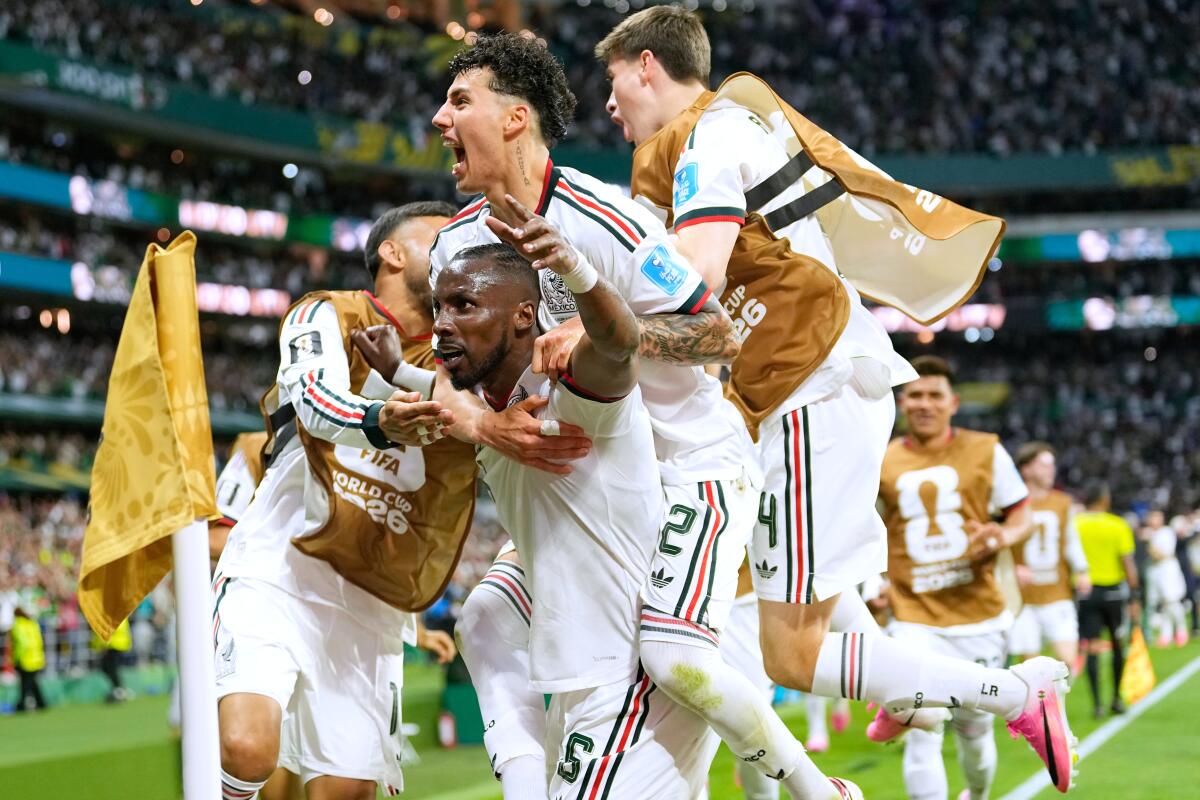
Mexico's Julian Quinones celebrates scoring his side's second goal against Czechia during a World Cup  match.

Mexico’s Julian Quinones celebrates scoring his side’s second goal against Czechia during a World Cup match in Mexico City on Wednesday.

(Silvia Izquierdo / Associated Press)

The fans chanted Ochoa’s name every time the goalkeeper touched the ball, honoring a player who has competed in six World Cups for Mexico.

Coach Javier Aguirre said that finishing first in the group was a “primary objective” for Mexico, which had already qualified for the next round. The team achieved a first for a Mexican national team by securing three consecutive wins without conceding a goal in the group stage of a World Cup. Mexico defeated South Africa 2-0 in the opening match and South Korea 1-0 in the second game.

The national team, which is co-hosting the tournament alongside Canada and the United States, will face its next opponent — one of the best third-place finishers — on Tuesday at Azteca Stadium.

The only sour note for Mexico came in the scoreless first half when the restless crowd unleashed a popular homophobic chant at least twice. FIFA has previously sanctioned the Mexican soccer federation in an effort to stop fans from saying the chant.

Source link

Mexico triumph 3-0 to eliminate Czechia and win all three World Cup matches | World Cup 2026

Mateo Chavez opened the scoring in the 55th minute, and Julian Quinones scored his second goal of the tournament in the 61st.

Mateo Chavez and Julian Quinones scored goals in the span of six minutes early in the second half, and Mexico beat Czechia 3-0 to win all three of its World Cup group-stage matches for the first time.

The 22-year-old Chavez, in his first World Cup, opened the scoring in the 55th minute, and Quinones scored his second goal of the tournament in the 61st. Alvaro Fidalgo added a goal in second-half stoppage time on Wednesday night.

Recommended Stories

list of 4 itemsend of list

Mexico’s previous best group-stage performance was two wins and one draw, achieved in 1986 and 2002, both featuring Javier Aguirre, the first as a midfielder and the second as El Tri’s coach.

Already the winner of Group A, Mexico will play again at Azteca Stadium on Tuesday in a round-of-32 match against an opponent to be determined.

Czechia were eliminated, finishing with one point in three games.

The match included nods to Mexico’s past and future. Gilberto Mora became the youngest Mexico player to start in a World Cup at age 17.

And 40-year-old goalkeeper Guillermo “Memo” Ochoa entered in the 77th minute, joining Argentina’s Lionel Messi and Portugal’s Cristiano Ronaldo as one of the only players to appear in six World Cups.

Mexico goalkeeper Guillermo Ochoa (13) is celebrated by his team after the World Cup Group A soccer match between Czechia and Mexico in Mexico City, Wednesday, June 24, 2026. (AP Photo/Natacha Pisarenko )
Mexico goalkeeper Guillermo Ochoa is celebrated by his team after the World Cup Group A match between Czechia and Mexico in Mexico City, June 24, 2026 [Natacha Pisarenko/AP]

Homophobic chant returns in Azteca Stadium

Fans at the game chanted a slur that has previously led to fines and other sanctions against Mexico’s Football Federation.

The slur, which literally means “male prostitute” in Spanish, could be heard at the Azteca Stadium towards the end of the first half when Czech goalkeeper Matej Kovar took a goal kick, according to The Associated Press news agency.

The chant has cost Mexico hundreds of thousands of dollars in fines levied by FIFA. It rose to popularity roughly 25 years ago and is used to intimidate goalkeepers when they take goal kicks.

It went viral in the 2014 World Cup in Brazil, and was heard again in Russia during the 2018 World Cup, and then again four years later in Qatar. It has persisted despite attempts by the Mexican Football Federation to stop it.

Source link

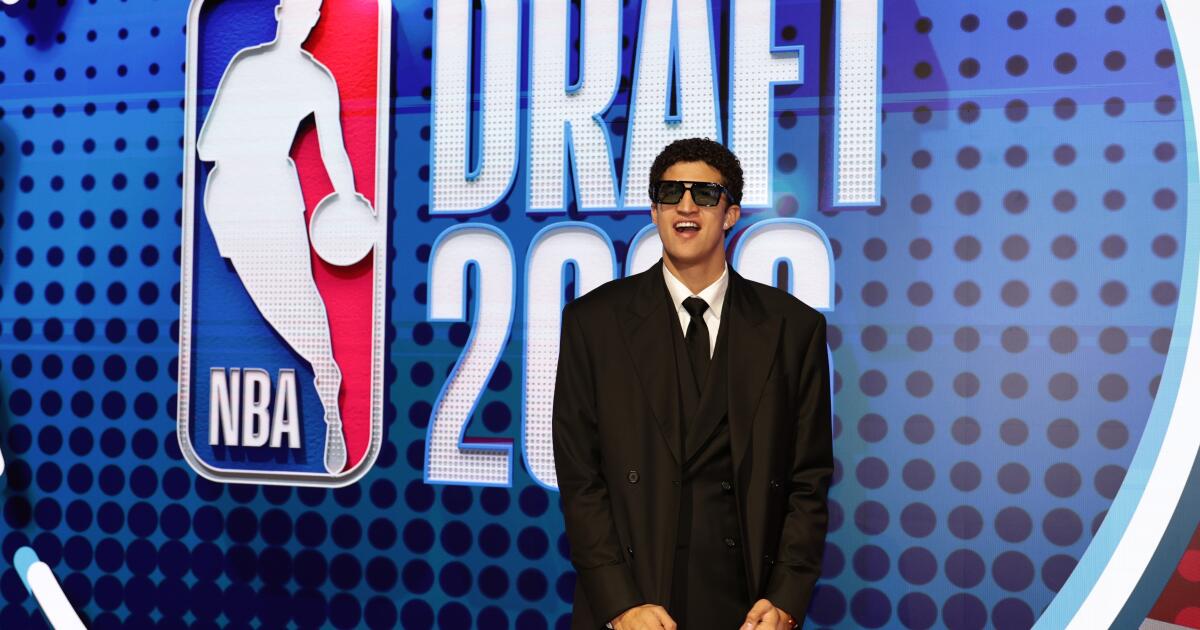
Karim López becomes first Mexican-born NBA first-round draft pick

Until Tuesday night, only one Mexican-born player had been an NBA draft pick. Eduardo Nájera was selected 38th overall in the second round by the Houston Rockets in 2000 and enjoyed a 12-year career as a backup forward with five teams.

Karim López joined him when the Detroit Pistons snapped him up at No. 21, making him the first Mexican-born first-round draft selection.

Lopez donned the Pistons’ cap handed to him by NBA commissioner Adam Silver, then was immediately traded to the Memphis Grizzlies.

López, a 19-year-old 6-foot-9 forward, became emotional when Silver announced the pick. He sobbed beneath the cap.

“It’s just super special,” he said. “I’m blessed. I mean, I have no words.”

Born in Hermosillo in the Mexican state of Sonora, López joined the prestigious Joventut Badalona youth academy in Badalona, Spain, at age 14 to accelerate his development. The academy counts former NBA players Ricky Rubio, Rudy Fernández and Raül López among its alumni.

During his post-draft television interview, he displayed a custom design inside his suit jacket: Mexico’s tricolor flag.

“I just wanted to represent my culture, represent where I’m from, represent my faith, and just represent myself, basically,” López said. “Show who I am.”

Memphis clearly targeted López while adroitly obtaining five second-round picks in the process. They received three picks from the Pistons and two from the Oklahoma City Thunder in return for moving back from the No. 16 draft position.

Whether López fulfills his potential and becomes the fifth Mexican-born player to take the court with an NBA team remains to be seen. Reviews are mixed.

Draft experts John Hollinger and Sam Vecenie of the Athletic differed in their evaluation, with Hollinger giving the pick a thumbs-up while Vecenie expressed reservations.

“I had Karim López rated quite a bit higher than [the No. 21 pick] and was surprised to see him slide this far,” Hollinger wrote, giving the pick an “A” grade partially because the Grizzlies also collected the five second-round picks.

Vecenie pointed out that López doesn’t shoot well and has defensive deficiencies, saying that his game might be better suited for European leagues than the NBA.

“I’m not sure how he gets on an NBA court early in his career,” he wrote. “I love his frame and physicality. I love that he rebounds and attacks with aggression. But I’m not sure he’s good enough without the ball to make an early impact in the NBA.”

Should López make the Grizzlies’ roster, he would join Horacio Llamas, Gustavo Ayón, Jorge Gutiérrez and Nájera as the only NBA players born in Mexico.

“It means a lot to me,” Lopez said. “It’s just a great opportunity for me and my country to have this platform and have this opportunity. So super blessed and definitely take it with a lot of pride.”

Noteworthy NBA players of Mexican descent born in the United States include former UCLA standout Jaime Jaquez Jr. and former Lakers reserve Juan Toscano-Anderson.

Jaquez averaged 15.4 points a game in 2025-2026, his third season with the Miami Heat. Toscano-Anderson played five seasons in the NBA — including winning a championship with the Golden State Warriors in 2022 — and now is with Pallacanestro Trieste of the top Italian league.
López is already a veteran of international basketball, having spent the last two seasons with the New Zealand Breakers in Australia’s top pro league. He averaged 11.9 points and 6.1 rebounds last season.

He will join No. 3 overall pick Cameron Boozer with the Grizzlies, who are rebuilding after finishing 25-57 and 13th in the Western Conference last season.

“A goal of mine is to hopefully reach young people in Mexico,” Lopez told ESPN in March when he declared for the draft. “Trying to grow the sport and inspire athletes and people in general to follow their dreams. Show people that it doesn’t matter where you’re from.”


Source link

Mexico has chance to test more of roster in group stage finale

With first place in Group A secured after two wins in two matches, the Mexican national team heads into its final group stage match against Czechia on Wednesday at 6 p.m. on Fox and Telemundo without pressure and is preparing to play some of its reserves.

The situation is quite different for Czechia, which has just one point after losing 2-1 to South Korea and drawing 1-1 with South Africa. The European team needs a win against Mexico at Azteca Stadium in Mexico City to advance to the next round — either as the group runner-up or as one of the best third-place finishers.

“The Czechs are incredibly tough; they’re a very physically demanding team,” Mexico coach Javier Aguirre said. “We watched them in their two matches against their group opponents, and it’s not going to be easy.”

Aguirre will have to strategize with an eye toward what lies ahead in the next round, which is a single-elimination format. Mexican American midfielder Brian Gutiérrez enters this final group stage match with an accumulated yellow card, so Aguirre likely will not play him to avoid risking suspension for the round of 32 game. FIFA rules clear all cards after the group stage ends.

The match could mark the return of César Montes, who was sent off against South Africa and missed the South Korea game.Goalkeeper Guillermo “Memo” Ochoa, in his sixth World Cup, could see some playing time as a sort of tribute to his career, but Raúl Rangel had an extraordinary performance against South Korea, so it remains to be seen whether Ochoa will get playing time.

“Obviously, it would be something extraordinary; it would be really cool for Memo. He’s a legend in Mexico and on the national team. He’s always been a player willing to give his all for the national team,” Mexico forward Alexis Vega said. “In the end, I think [Aguirre] will make the decision. I believe that all 26 of us here will give it our all if given the opportunity. Whoever gets the chance will do their best.”

Erik Lira, Johan Vásquez, Jesús Gallardo and Roberto Alvarado are the Mexican players who have covered the most ground for the national team in both matches, making them candidates for rest. Gallardo has a strong replacement available in young AZ Alkmaar player Mateo Chávez.

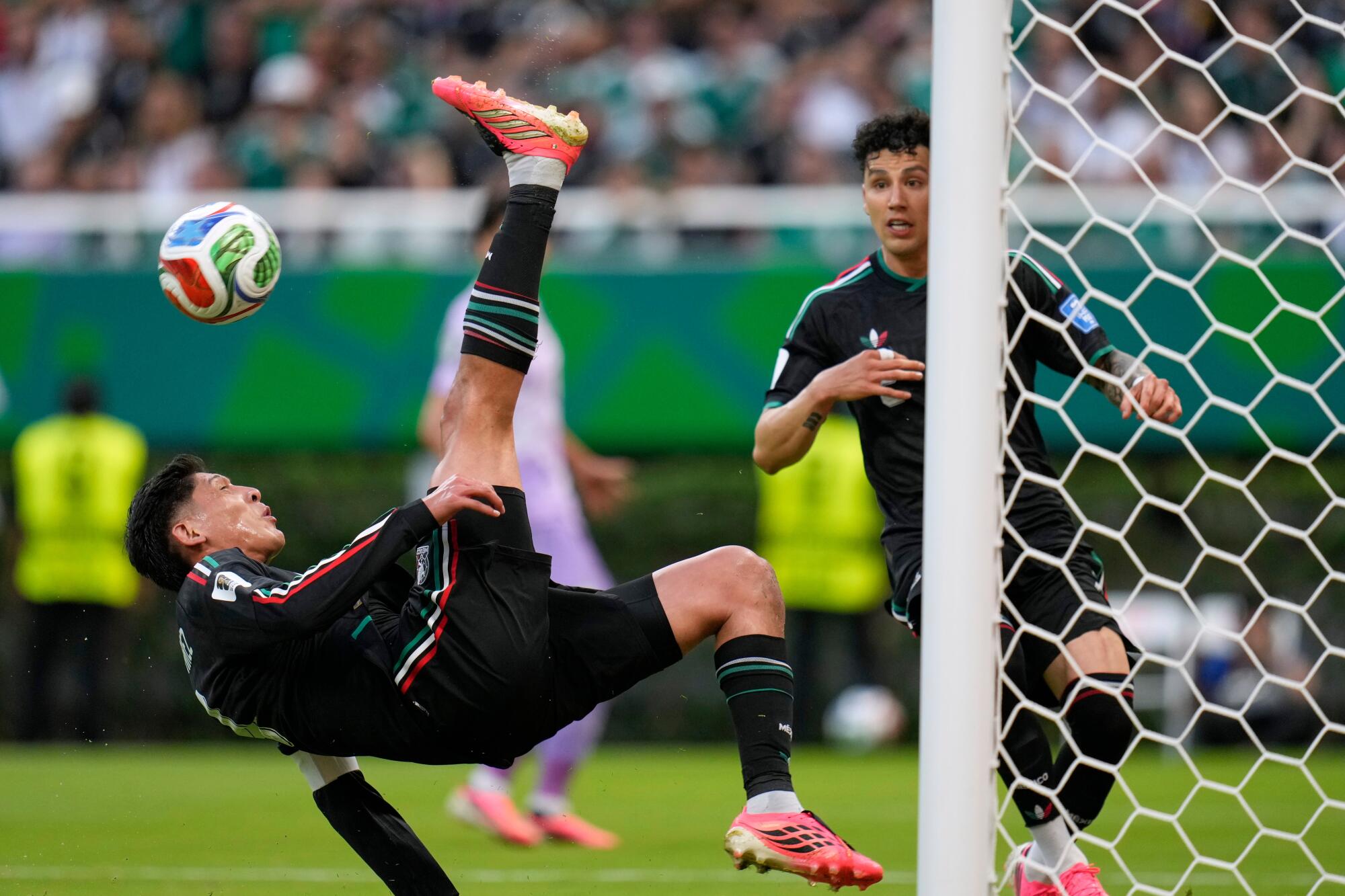
Mexico's Edson Álvarez clears the ball away from the goal during the first half against South Korea at the World Cup.

Mexico’s Edson Álvarez clears the ball away from the goal during the first half against South Korea during a World Cup match.

(Ricardo Mazalan / Ap Photo/ricardo Mazalan)

Edson Álvarez, who had a strong performance against South Korea, is likely to start again.

Another player who could see action is Santi Giménez, the AC Milan forward, who has been recovering from an injury and played only 10 minutes against South Korea. Gilberto Mora, Mexico’s youngest World Cup player at age 17, could start the game.

“We have to treat the game against [Czechia] like a final. We know [Czechia] needs this win, but we’re preparing ourselves. Getting used to winning goes a long way,” Giménez said in an interview on Wednesday with TV Azteca.

Mexico does not yet know its opponent in the next round, which will be one of the best third-place finishers. Its opponent will not be determined until the eight best third-place teams that advance to the round of 32 are identified.

On the Czech side, coach Miroslav Koubek favors a disciplined and physical approach, with Patrik Schick and Adam Hložek leading the counterattack that will seek to capitalize on any Mexico mistakes.

“We know that Mexico is one of the best teams in our group, and it will be tough for us on their home turf. But we believe we can get a good result and finish the group stage on a high note,” said Michal Sadilek, a midfielder for the Czech team.

Since Czechia needs a win to advance, that suggests the team will attack more aggressively, which will be dangerous for the Mexico defense but will also leave more space for the home team to exploit the counterattack. Czechia has shown this World Cup it is particularly dangerous on set pieces.

Fellow Group A teams South Korea and South Africa will face off at the same time as the Mexico-Czechia match — 6 p.m. Thursday — in Monterrey. The South Koreans, with three points, are looking to secure second place and a round-of-32 game at SoFi Stadium, while South Africa needs a win to compete for a spot as the second-place finisher or a berth among the best third-place teams. A South Korean loss combined with a Czech victory over Mexico would knock LAFC’s Son Heung-min and his South Korea teammates out of the tournament.

Source link

What to see, eat and do when traveling to Colima, Mexico

I sat down recently and counted — surprising myself — that I’ve notched visits to 24 of Mexico’s 32 states, for leisure or while reporting. Querétaro is a highland charmer. Nuevo León is the country’s muscular northern colossus. Campeche, a verdant beauty. Everywhere I go in this country, I find new wonders. Then I visited Colima, and it hit me that Mexico is an endless cornucopia that will never vanquish a traveler’s curiosity.

Never heard of button-sized Colima? Don’t fret. A lover of Mexico may be vaguely aware of its important port at Manzanillo, or the state’s spectacular volcano complex. Otherwise, Colima is not commonly on visitors’ radar. The tourism industry is consistently ranked among Mexico’s smallest.

Yet it is a refreshingly contained and relaxed culture, with foods that are only found here. The depth of its riches are laid out in an ambitious recent series of culinary guidebooks by a group called Colima Sabe.

Use these handy dining guides for all of your summer travel, near and far.

The state has international airports in Manzanillo and Colima, which you might call Burbank-sized, largely serviced by connecting flights from Mexico City. Weekend travelers also come in by road from Guadalajara. There is a smattering of mid-tier or boutique hotels in central Colima or the nearby village of Comala, and a few resort hotels in Manzanillo. If you go, here are a handful of to-do’s for a sure-to-be-surprising Colima journey.

  • Share via

Taste the tuba

Glass of tuba compuesta, a fermented drink made from the sap of the coconut palm.

Glass of tuba compuesta, a fermented drink made from the sap of the coconut palm.

(Daniel Hernandez/Los Angeles Times)

Colima’s traditional devotion to tuba, the coconut palm ferment imported from the Philippines hundreds of years ago, comes into focus as you traverse the region and notice vendors congregating on busy street corners or central plazas with gourds or jugs of a milky liquid. It is tart, crisp and infinitely cooling for tropical temperatures. Embrace the “compuesta” style: tuba poured over ice and adorned with crumbled nuts and ruddy red fruit chunks, turning the liquid pink. El Camellón de la Tuba, a well-known stand near central Colima, made the best that I tasted on my visit. Avoid tuba that looks too brown or tastes too vinegary. * El Camellon de la Tuba, Avenida Constitución 2008, Centro, 28017 Colima, @camellondelatubaoficial

Savor Nico Mejía’s restaurants in Manzanillo

Colima, Mexico - March 23,2025: The dish La Sal on Sunday, March 23, 2025

Ceviche colimense by chef Nico Mejía.

(Daniel Hernandez/Los Angeles Times)

La Sal, breezy and surprising in a former carport at his mother’s home in Manzanillo, launched the fame of chef Nico Mejía as a destination cook in 2020. Earlier this year, he moved La Sal (Colima’s coastal lagoons produce excellent salt) to a plot directly on a beach facing the Pacific. The restaurant makes refined regional favorites like ceviche colimense and his tostada de pozole seco, and mixes cocktails with tuba. The white-walled Casa Rangel is Mejía’s power-meeting magnet for internationally inspired local fare. Not too far away, Mejía’s partner Melissa Santamaria Mora runs an excellent bakery called Santamaria. These are restaurants on par with any you’d see in Guadalajara or Mexico City. * La Sal Playa, Avenida Lázaro Cárdenas 797, Playa Azul las Brisas, 28217 Manzanillo, @lasalplaya_

Sip the prizewinning beers of Cervecería de Colima

Colima, Mexico - March 22,2025: A Colima Cero on a table at a restaurant

Cervecería de Colima is one of Mexico’s most acclaimed breweries.

(Daniel Hernandez/Los Angeles Times)

Winner of the Copa Cerveza México 2025 for best large brewery, Cervecería de Colima has been my go-to for quality, consistency and innovation since I first tasted its pale ale, the Páramo. I’d hold it against any other in this style. Over the years, I’ve found that just about everything Cervecería de Colima brews is satisfying. I’ve enjoyed the session IPA called Piedra Lisa, the bright pilsner Colimita, and the brewery’s recent entrant in the nonalcoholic market, Colima Cero. The headquarters just outside Colima city offer tastings, and in February, co-founder Esteban Silva and his team opened a taproom in the city called Estación Colimita. When a restaurant anywhere in Mexico offers these beers, I know they know what they’re doing. * Estación Colimita, Avenida Constitución 1401-local 1, Jardines Vista Hermosa IV, 28017 Colima, @cerveceriadecolima

Take in coffee and casual dining in Comala and Colima

A cucumber and mezcal cocktail at a rooftop bar overlooking Colima's central square.

A cucumber and mezcal cocktail at a rooftop bar overlooking Colima’s central square.

(Daniel Hernandez/Los Angeles Times)

Comala is a postcard-ready pueblo a few miles north of Colima. Those familiar with Mexican literature will recognize the name matching the fictional town in Juan Rulfo’s 1955 novel “Pedro Páramo,” the groundbreaking book that Gabriel García Márquez said inspired his magical realism masterpieces. The connection is coincidental, yet a certain air of enchantment hangs over Comala’s cobbled streets and tiled rooftops. According to Silva, who lives near Comala, the restaurants worth noting here are Cuaxiote, De La Suerte, and Hacienda Pascual Nogueras with chef Alan Ramos. In Colima city for coffee and a nice meal, visitors should bookmark Puerto Café and Cumbre, a restaurant and bakery that stands out in a scene of growing maturity and ambition. * Cuaxiote, Degollado 81, Centro, 28450 Comala, @cuaxiote

Bite into Colima’s iconic pozole seco

Pozole seco is Colima's signature regional dish.

Pozole seco is Colima’s signature regional dish.

(Daniel Hernandez/Los Angeles Times)

It is Colima’s most famous regional specialty: all the ingredients and most of the preparation of a traditional white pozole, only without the liquid that makes it a stew. Its origins are uncertain, with one tale suggesting that a cook at Manzanillo’s mercado left a pot of pozole over fire and forgot it. When she returned to find the broth dried out, the lore is the cook slathered the remaining mass of meat and hominy on a tostada, and pozole seco was born. Find it at the local markets, cenadurías, comedores, and the sit-down restaurants that ring Colima city’s central plaza, such as Ramos’ new ¡Aquí Es Colima! * Aquí Es Colima! Portal Morelos 1, Centro, 28000 Colima, @aquiescolimaporgloriadedios

Explore Colima’s ancient history

A ceramic figurine of the extinct Mexican dog breed tlalchichi, which was native to Colima.

A ceramic figurine of the extinct Mexican dog breed tlalchichi, which was native to Colima.

(Daniel Hernandez/Los Angeles Times)

Colima’s major pre-Hispanic site is La Campana, a grid of streets and structural bases that is believed to have been settled as early as 1870 B.C. in Mexico’s Pre-Classic period. The archaeological zone sits right beside urbanized Colima. At the former hacienda community Nogueras near Comala, an impressive museum features historical and archaeological artifacts, and the restaurant Pascual mentioned above. The museum holds ceramics of a dog from ancient times that is native to Colima, similar to Mexico’s more well-known native hairless dog the xoloitzcuintle. Colima’s tlalchichi breed is similar, with shorter legs. Though now sadly it is extinct, the tlalchichi is the state’s unofficial mascot, incorporated in signage, marketing and touristy knickknacks. * Museo Universitario Alejandro Rangel Hidalgo Nogueras, Nogueras s/n, 28450 Nogueras, Comala, @alejandrorangel_udec


Source link

Best restaurants to try in Mexico City, according to an expert

Yes, you should visit Mexico City. Don’t overthink it and don’t delay. Despite excessive tourism and rising gentrification fears, the seething capital of Mexico — 25 million souls strong — remains a top-tier international destination for any committed food lover. And the intensity of its dining scene seems to be only growing.

Sure, a wave of privileged remote workers oozing dollars and euros may have dampened the vibe for Mexico City natives, leading to protests. The post-pandemic issues of housing displacement and rising costs for locals are serious challenges that political leaders must address. Yet time and again, on every visit, the resiliency and passion that original defeños have for their gastronomical paradise proves to be boundless.

Use these handy dining guides for all of your summer travel, near and far.

I have traveled to Mexico City regularly since 2002 and lived there for nearly a decade. I won’t feel slighted if you prefer the dining advice of current residents, or from any of the numerous local dining guides online. But one thing about me, I have an aversion to hype, and tend to avoid the city’s contemporaneous food magnets where the ratio of foreigners to locals is too out of whack. (No, the Michelin-starred taqueria was never extraordinarily better than any others in its bracket.) Where my native friends go, I go.

Here are highlights of my top, top, top recommendations from my L.A. Times restaurant guides on Mexico City, plus a few more favorites. My goal here is to distill down your options for a concentrated, food-centric visit, from nostalgic jewels beloved by hardscrabble chilangos to the celebrated shrines of high-end chefs reaping the bounties of the Valley of Mexico.

Source link

Guadalajara protesters accuse Hyundai of hiding behind World Cup

While Mexico defeated South Korea at Guadalajara Stadium on Thursday in front of an elated crowd, protesters outside expressed a very different view of the World Cup’s impact on the city.

Community leaders, climate advocates and workers took to the streets to protest what they describe as “greenwashing through sports” by one of the official sponsors of the World Cup amid allegations of irregularities in its supply chain.

The protest organizers argue that Hyundai-Kia should hold its supplier, Ternium, accountable and issue it a “red card.” Protesters accuse Ternium of human rights violations, including alleged links to the disappearance of two environmental activists.

The demonstrations began with a rally at 5 p.m. in Plaza de la Liberación. Participants sought to draw attention to cases of missing persons in Guadalajara, stating they went missing after protesting Ternium’s iron ore mining activities.

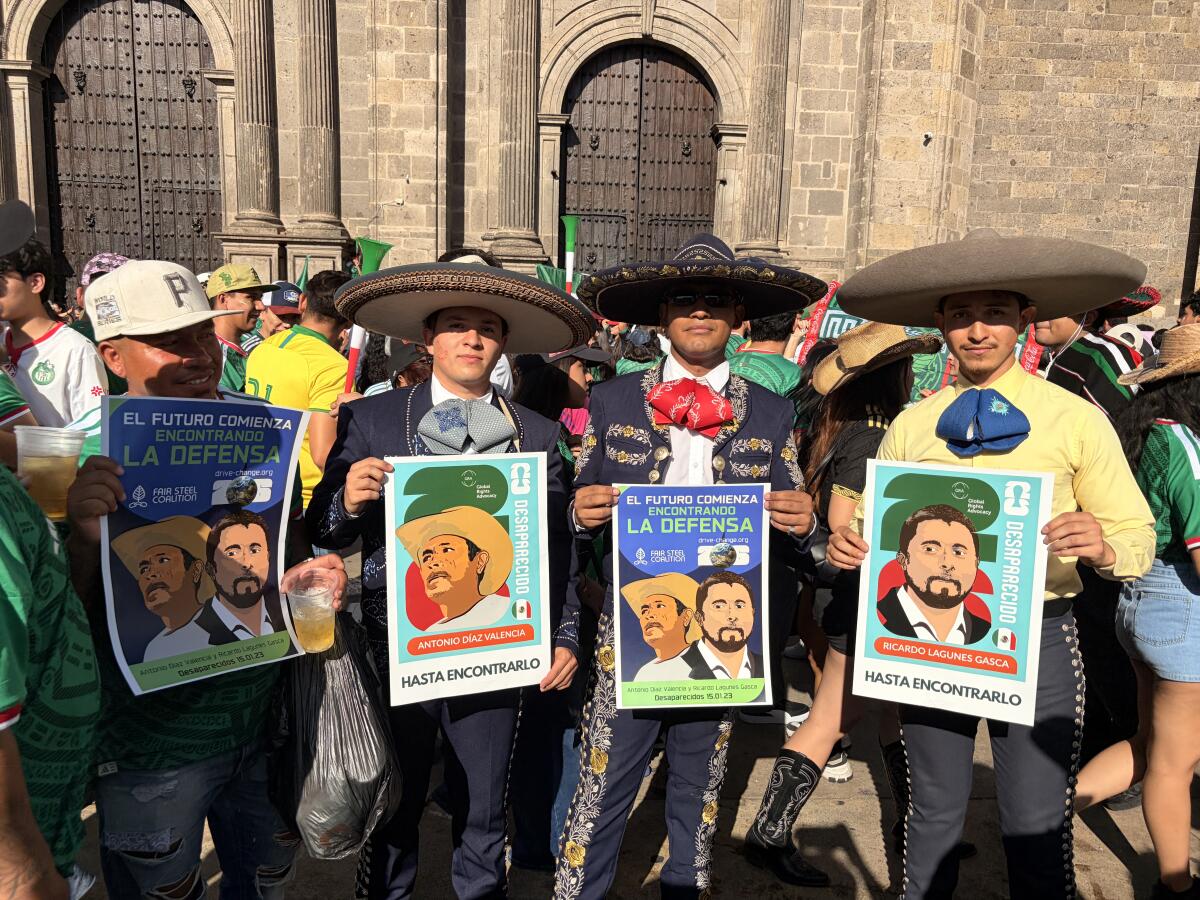
Mariachis hold posters commemorating the disappearance of two environmental activists in Guadalajara

Mariachis hold posters commemorating the disappearance of two environmental activists in Guadalajara: Ricardo Lagunes Gasca, a lawyer and human rights defender, and Antonio Díaz Valencia, a Nahua community leader and activist.

(Courtesy of Fair Steel Coalition)

A 2025 report by the environmental group Mighty Earth criticized Hyundai’s involvement in what it described as a “dirty steel supply chain,” as the South Korean automaker is one of Ternium’s main buyers of iron ore for use in steel production. Ternium has been the target of repeated criticism from activist groups for its alleged destructive environmental impact and corporate governance policies, as well as for the disappearance of activists Ricardo Lagunes Gasca and Antonio Díaz Valencia, which occurred three years ago in Mexico.

Ternium did not respond to the protesters’ allegations, while Hyundai did so in a statement.

“At Hyundai, we are committed to requiring our suppliers to meet the highest standards, and we enforce a strict Supplier Code of Conduct. Both we and our subsidiaries continue to conduct ongoing training, audits, and due diligence processes throughout the supply chain to identify and address potential issues across all our global operations,” said Michael Stewart, Hyundai’s director of communications.

Protesters carried signs bearing the names and photographs of environmentalists who disappeared.

More than 130,000 people have disappeared in Mexico in the past 20 years, according to the National Registry of Missing and Unlocated Persons. The kidnappings have been linked to run-ins with drug cartels and corrupt government officials, while there have also been cases involving young women who worked at the country’s many factories.

Protesters hold up signs featuring images of missing environmental activists ahead of Mexico's World Cup.

Protesters hold up signs featuring images of missing environmental activists ahead of Mexico’s World Cup match in Guadalajara.

(Fair Steel Coalition)

“[Hyundai] is trying to clean up its image through its sponsorship of the World Cup. But the facts are clear: Hyundai is linked to human rights and environmental abuses in Mexico, Brazil, the United States and other countries. By partnering with steel suppliers like Ternium, its slogan of ‘doing the right thing for humanity’ loses credibility,” said Diana Figueroa, a representative of the Fair Steel Coalition, one of the organizers of Thursday’s protests. She said the disappearance of a half dozen environmental activists in southern Mexico and deadly air pollution in Rio de Janeiro and Monterrey are attributed to Ternium.

The group plans to stage more protests throughout the World Cup.

On July 5, a symbolic soccer match and a concert will be held in Monterrey’s Fundidora Park to protest Ternium as one of the city’s most polluting companies.

On July 9, ahead of a World Cup quarterfinal match in Los Angeles, protests will focus on alleged human rights and labor rights violations in Hyundai’s supply chain, including reports of child labor, labor trafficking and documented prison labor.

Protesters also questioned Hyundai’s use of robots at World Cup venues and the tournament’s impact on local workers, including allegations of labor exploitation and rising housing costs in host cities. The organizations Public Citizen and Jobs to Move America demanded transparency from Hyundai regarding the type of data collected by the robots at World Cup stadiums.

Hyundai, in response to the allegations of data collection, said in a statement that it is focusing on the “Next Starts Now” campaign, in which it is “using mobility, robotics, technology, and engagement programs to connect people with the excitement of the event.”

Source link

Why parts of Latin America loves MAGA

Colombian presidential candidate Abelardo de la Espriella has vowed to crush criminal groups and slash government programs. He promises to bomb “narco-terrorist” camps and build sprawling mega prisons if he wins Sunday’s runoff election.

De la Espriella’s views have earned him the vociferous backing of President Trump, who has broken with White House tradition by publicly seeking to tip the scales in foreign elections — particularly in Latin America.

After Trump gave his “complete and total endorsement” to De la Espriella, whom he referred to by his nickname, “El Tigre,” the candidate posted an AI-generated image of a bald eagle and a tiger, with American and Colombian flags waving side by side.

“You have paved the way for the people to defeat the entrenched powers that have long held sway,” he wrote to Trump. “In Colombia, we have now begun to follow the same path.”

De la Espriella, a political newcomer who built his campaign around gym workout videos and vows to “disembowel” the left, is part of a new wave of far-right, MAGA-aligned politicians in Latin America openly borrowing from Trump’s playbook, presenting themselves as outsiders who will trim the government, curtail immigration and militarize law enforcement.

In a region that remains plagued by high crime and inequality after a decades-long period of leftist domination known as the “Pink Tide,” the playbook appears working.

More Latin Americans now identify with the right than at any time over the last two decades, according to polling firm Latinobarómetro. A series of conservatives have won presidential elections in recent years, giving Trump a slate of willing partners as he seeks to expand U.S. power in the region, combat drug cartels and counter growing Chinese influence.

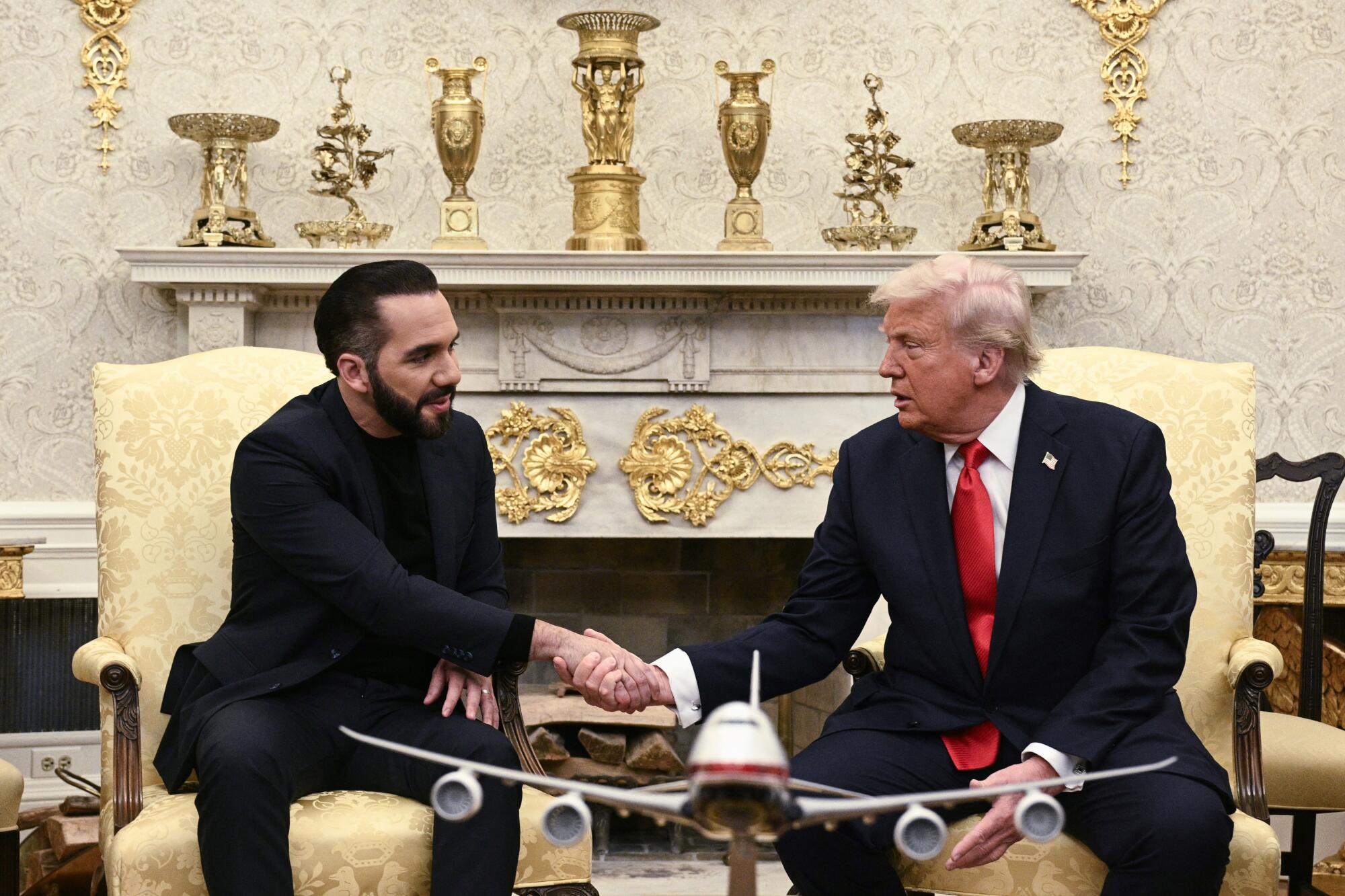
President Trump meets with El Salvador's president, Nayib Bukele, in the Oval Office of the White House on April 14, 2025.

President Trump meets with El Salvador’s president, Nayib Bukele, in the Oval Office of the White House on April 14, 2025.

(Brendan Smialowski / AFP via Getty Images)

Among Trump’s many allies are Argentina’s Javier Milei, a libertarian firebrand whose dramatic cuts to state services were a blueprint for Elon Musk’s so-called Department of Government Efficiency, known as DOGE; and El Salvador’s Nayib Bukele, a mano dura autocrat who housed U.S. deportees in his notorious prisons to assist Trump’s immigration crackdown.

Ecuador’s Daniel Noboa has welcomed U.S. Special Forces, who are attacking drug traffickers in his country, and Chile’s José Antonio Kast has pledged a border wall along his country’s frontier with Peru and Bolivia in his quest to “make Chile great again.”

Trump might soon gain another ideological bedfellow in Peru with the election of Keiko Fujimori, the daughter of late autocrat Alberto Fujimori. With ballots still being counted, Fujimori was on track for a narrow victory

In a sea of nations led by conservatives, the left now retains power in just three key countries: Mexico, Colombia and Brazil.

It faces serious challenges in two of them.

Ahead of October’s presidential election in Brazil, incumbent Luiz Inácio Lula da Silva, a leftist stalwart and one of the last vestiges of the Pink Tide, has been polling even with Flávio Bolsonaro, the son of former President Jair Bolsonaro, a Trump ally convicted of convening a Jan. 6-style insurrection.

President Trump and Brazil President Jair Bolsonaro in 2020.

Brazil’s President Jair Bolsonaro, right, with President Trump during a dinner at Trump’s Mar-a-Lago estate in Palm Beach, Fla., on March 7, 2020.

(Alan Santos / Associated Press)

And then there’s Colombia, where De la Espriella, a criminal defense attorney, surged ahead in the first round of voting and this weekend faces off against Sen. Iván Cepeda, an ally of leftist President Gustavo Petro.

Petro drew Trump’s ire by denouncing the U.S. military campaign to oust leftist President Nicolás Maduro of Venezuela and a spate of lethal U.S. attacks on alleged drug boats.

Petro slammed Trump’s endorsement of De la Espriella, calling on Colombians to “vote freely and not allow ourselves to become either slaves or anyone’s colony.”

Mexican President Claudia Sheinbaum also accused Trump of electoral interference after the U.S. announced drug trafficking charges against several members of her ruling Morena party and The Times revealed that two more sitting governors are under investigation.

“Is it truly a legitimate interest to combat organized crime?” Sheinbaum asked of the U.S. investigations. “Or are we perhaps witnessing how sectors of the American far right … intend to influence the 2027 election in our country?”

President Trump and Argentine President Javier Milei in 2024.

President Trump meets with Argentine President Javier Milei during the United Nations General Assembly on Sept. 23, 2025, in New York.

(Evan Vucci / Associated Press)

The White House has declined to comment on Sheinbaum’s criticism. But Trump earlier this month warned Mexico that his administration is “focused on coming in by land” to deter drug trafficking.

“President Trump has been clear that Mexico must do more to combat the drug cartels running rampant in their country,” a White House official told The Times when asked whether Trump is planning a military operation there.

Trump, who publicly backed Kast and President Nasry Asfura of Honduras, as well as Milei’s political party ahead of Argentina’s midterm elections last fall, has openly mused that he should charge money for endorsement of leaders in foreign countries.

Guillaume Long, who served as foreign minister in Ecuador under leftist President Rafael Correa and who is now a fellow at the Center for Economic and Policy Research, criticized Trump’s “unprecedented, unabashed interventionism in Latin American politics.”

“There are a number of taboos that have been broken,” he said.

Long added that Latin America is mirroring the United States in its political divisions. “I think we’re likely to see in the coming decades a very polarized politics,” he said. “And that doesn’t bode very well for political stability.”

Much of Trump’s activity in the region, including the deposing of Maduro, has been presented as part of a war on drug cartels, which the White House has formally declared terrorist organizations. Long described that rationale as a “pretext” for expanding U.S. political and economic influence in the region.

Nicolas Maduro and his wife, Cilia Flores.

Nicolás Maduro and his wife, Cilia Flores, are escorted by federal agents as they make their way to an armored car for a trip to a federal courthouse in Manhattan on Jan. 5.

(XNY/Star Max/GC Images)

He said he believed that focus on cartels had pushed some Latin American politicians to the right “because they think being security hawks will make them popular with the Trump administration.”

But James Bosworth, the founder of Hxagon, a company that provides political risk analysis in Latin America, said many leaders in the region have come to tough-on-crime policies on their own.

“I think that some of the hemisphere is willing to play along with it because the hemisphere has issues, including security issues, where the U.S. can be of assistance,” Bosworth said. “Many Latin Americans do want a greater military focus, so there’s certain alignment that’s occurred.”

Conversely, Mexican journalist Alex González Ormerod said he believes Trump has been influenced by Latin American leaders, including Bukele, who suspended civil liberties and began locking up alleged gang members en masse in 2021.

“I think there’s a lot of cross-pollination going on,” he said, crediting groups like the Conservative Political Action Conference, a gathering of right-wing activists and elected officials that has hosted events in Brazil and Argentina.

Many analysts cautioned that Latin America operates on a pendulum, swinging every few years between right and left.

“There’s a lot of evidence that voters are just unhappy and voting for the opposition, and then losing patience very quickly with whoever is in office,” said Benjamin Gedan, director of the Latin America Program at the Stimson Center.

Voters dissatisfied with the status quo so often vote out incumbents there is a phrase for it: voto castigo, or “the punishment vote.”

Ceballos reported from Washington and Linthicum from Mexico City.

Source link

Come inside Iran’s World Cup hotel in Tijuana, where fans turn up to cheer

About 150 miles from SoFi Stadium, south of the Mexican border, sits the hotel housing Iran’s World Cup team for its games at the Inglewood venue.

The entrance to the Marriott in Tijuana is barricaded, flanked by police and members of the Mexican National Guard, guns held close. No one enters without a hotel reservation or special pass.

Despite the tensions and challenges surrounding Iran’s participation in the World Cup, early Saturday morning finds the mood inside the four-star hotel relaxed, even jubilant. Several dozen fans mingle and bond over their shared excitement to see the squad’s players before they depart for their second group-stage match at SoFi.

“I wanted to come down to support Iranian soccer, and cheer for them when they exited the building and make them happy,” says Lucas Zarrabi, 13. The teen, who attended Monday’s 2-2 draw with New Zealand and has a ticket for Sunday’s match against Belgium, is one of several fans from Los Angeles who made the drive to stay with the team. Others flew in from San José and even Miami, turning up at the hotel not quite four miles from the U.S. border crossing.

Showing up is important, some said, because of what they describe as unfair conditions imposed on the team. After the outbreak of war, the Iranian team was forced to move its base camp from Tucson to Tijuana. Eleven team officials and staff members did not receive U.S. visas. The Trump administration has also denied Iran’s requests to arrive two days before matches — and mandated that the team must leave immediately after each game.

“Every little technicality is making it difficult for the team,” says Abbas Eftekhari, 65, who was born in Iran and has lived in the U.S. for more than 40 years. “I think this is going to drain them psychologically and also physically.”

Iran’s soccer federation has been vocal about the obstacles, saying it would lodge a complaint with FIFA.

“Football shouldn’t lose its power to politics,” Hedayat Mombeini, secretary-general of the Iran Football Federation, said Friday. He added that the restrictions “are certainly having a negative effect on us, but we are trying to overcome these problems with our Iranian pride.”

Since the team landed on June 7, Ali Eslami has visited the hotel gates nearly every day.

“It’s the best pleasure for me. I wished them the best luck. I told them it’s hard but they’re doing excellent things,” said Eslami, who splits his time between Southern California and Tijuana.

He was there again Friday, waiting for the players to return from afternoon training blocks away at the Estadio Caliente, home to the Liga MX’s Xolos.

“I have been in America for 50 years — this has been the most emotional thing, to see the team that I have not seen in 50 years,” he said.

Some Iran fans fear reprisal from fellow members of the diaspora for supporting the team, insisting they were in Tijuana for the love of soccer and the players, not politics. Eftekhari worries that the mood at Iran’s first match, where fans and protesters clashed, affected the players.

“As soon as they see that their countrymen have slogans against them, it also has a negative psychological effect on them. But, that’s how things are at this time,” Eftekhari says.

Just over 24 hours until Sunday’s noon kickoff, it’s not just Iranian fans contributing to the atmosphere. A group of flight attendants from China staying at the hotel embrace the excitement, donning jester hats and waving scarves colored red, white and green. And soccer fans from Tijuana are eager to show some local hospitality. Iran has diplomatic ties with Mexico, unlike with the U.S., and sought to move its group-stage matches to the country where it has an embassy.

“We love the Mexican people very much, and for us, the best situation is for our games to be held in Mexico,” Abolfazl Pasandideh, the Iranian ambassador to Mexico, said at the time.

Leonardo Ramirez Lopez, a 10-year-old soccer fanatic from Tijuana, clutches his autograph album in hopes he’ll get new signatures.

“It’s a new team that I don’t have experience with how they play,” he says. But Iran is already his third-favorite team, behind Colombia and Argentina.

After more than two hours of waiting, several dozen fans break into cheers as players finally file through the lobby. The squad smiles and waves, stopping for a few autographs. As each player leaves, he kisses a Quran, pressing his forehead against it before boarding the bus to Tijuana’s airport.

“Iran, Iran! Whoop, whoop!” fans cry, breaking into song.

Angueira writes for the Associated Press.

Source link

Mexico coach Javier Aguirre answers critics by advancing

Before the World Cup, critics and fans of the Mexican national team debated whether Javier Aguirre’s third stint as head coach was the right decision. Two games later, the coach has led Mexico to the tournament’s knockout round.

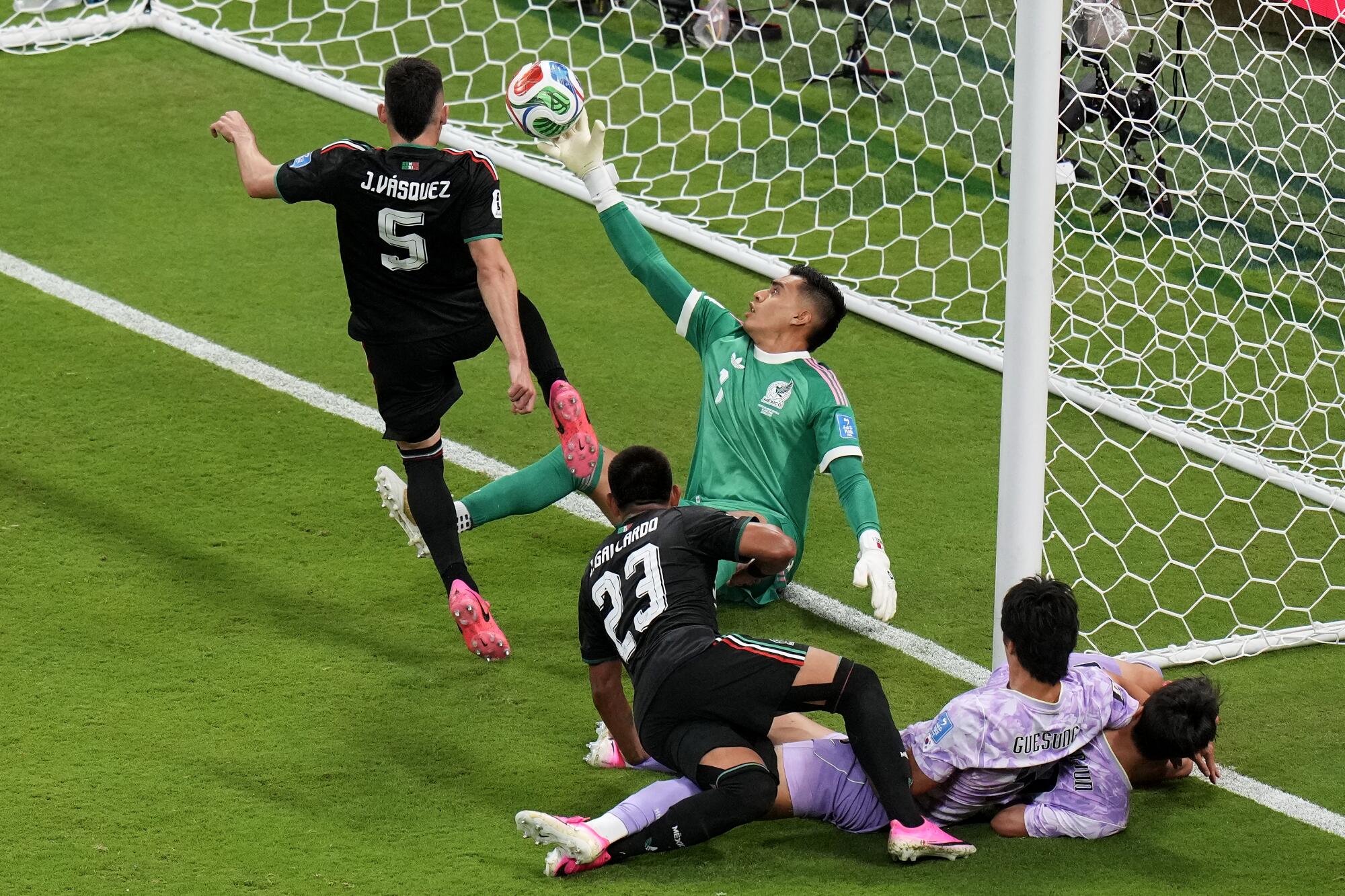
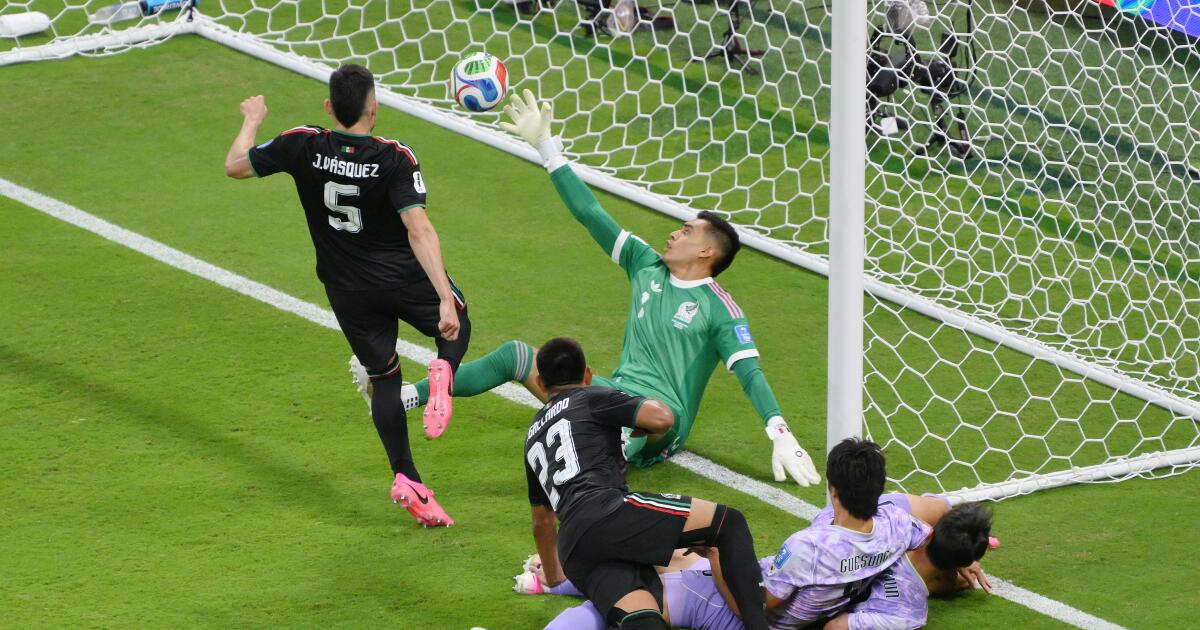
Thursday’s 1-0 victory over South Korea at Guadalajara Stadium made the World Cup co-host the first in the tournament to advance while also clinching the top spot in Group A with one group play game remaining. After South Korea’s goalkeeper fumbled a ball, Luis Romo scored the goal that gave the Mexicans six points and pushed them to the top of the standings.

El Tri will close out the first round against Czechia (6 p.m.) at Azteca Stadium on Wednesday.

During his post-match news conference, Aguirre spoke less about the result and more about the journey that led him to this moment. At 67 and having coached Mexico in three World Cups, he explained that his experience allowed him to approach a match he described as eminently tactical.

Mexico goalkeeper Raul Rangel reaches back to stop the ball from entering his goal during his team's 1-0 World Cup win.

Mexico goalkeeper Raul Rangel reaches back to stop the ball from entering his goal during his team’s 1-0 World Cup win over South Korea Thursday.

(Silvia Izquierdo / Associated Press)

“I’ve always tried to get my team to play well and to help the players and the national team develop,” Aguirre said.

For the coach, advancing to the knockout round represents the culmination of more than three decades of work on the sidelines and the support of a group of players who rose to the occasion under the most demanding circumstances.

The coach also acknowledged that advancing to the next round has eased the tension surrounding the team after the doubts that existed before the World Cup. Without mentioning personal vindication, he noted that soccer tends to judge solely based on the most recent result.

“If you win, you’re the best; if you lose, you’re the worst,” Aguirre said.

Aguirre said he remains calm because he believes his approach to coaching hasn’t changed and that the team was rewarded Thursday night against South Korea in a match marked by limited space and a high degree of tactical discipline.

With qualification secured, Aguirre said he will not alter his soccer philosophy during Mexico’s final group stage match even though it no longer faces the pressure of securing a spot in the next round.

He said Czechia will enter the game with a different competitive need and a drive to advance, while Mexico will work to maintain a high level of performance that allowed it to record two consecutive wins and keep two clean sheets at the start of the tournament.

On the South Korean side, coach Hong Myung-bo avoided making excuses and focused his analysis on the play that decided the match. Although he explained that he had not yet reviewed the goal sequence in detail, he knew the team made a series of small errors in an area of the field where he had previously warned that losing possession could prove decisive.

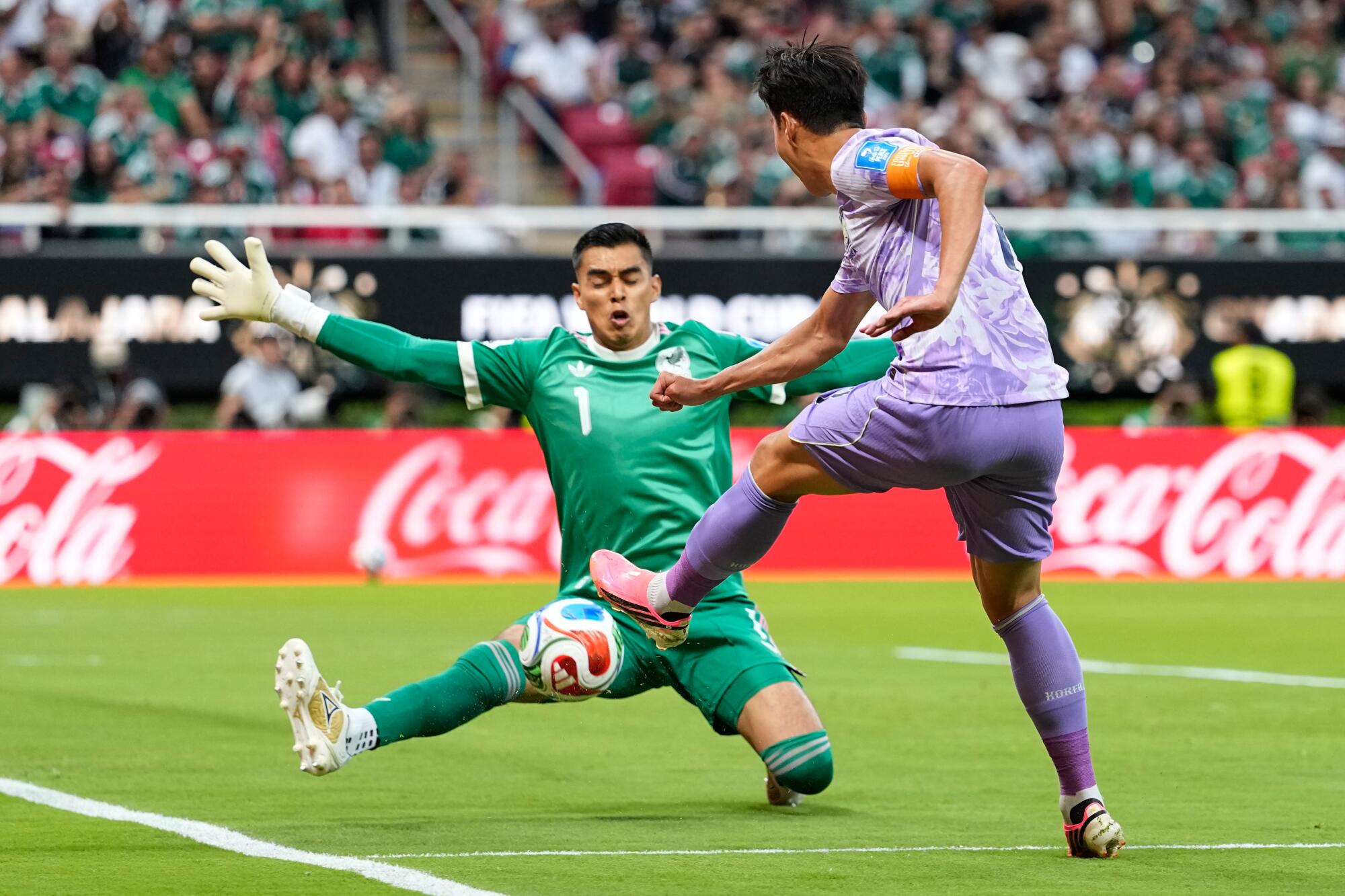
Mexico goalkeeper Raul Rangel blocks a shot by South Korea's Son Heung-min during the World Cup match on Thursday.

Mexico goalkeeper Raul Rangel blocks a shot by South Korea’s Son Heung-min during the World Cup match on Thursday.

(Natacha Pisarenko / Associated Press)

The coach said that one of the central focuses of their preparation had been avoiding turnovers near South Korea’s box in the face of Mexico’s high press.

Myung-bo said that during the pre-match talk, he emphasized that the first 20 minutes would be crucial and believed his players had executed that part of the plan. He said that as the minutes passed, South Korea managed to create chances and was gaining strength until its critical turnover.

“After the momentum of the match shifted in our favor … both in terms of overall pressure and the play itself, we were able to create many opportunities,” Myung-bo said. “Although it ended up being a very frustrating match and we’re left with a bitter taste in our mouths over the lost possession, there’s no time to dwell on it. We have one last match ahead of us, so we’ll prepare well.”

Source link

World Cup 2026: The sibling rivals lining up for different teams in the US, Canada and Mexico

It is the ultimate test for any parent.

Two sons playing on opposite teams in a match. Who are you rooting for?

But this is not a kickabout in the local park or a schools’ match. This is a game at the World Cup.

There are four sets of siblings playing for different nations on the biggest stage of all, including Desire and Guela Doue who could face one another this summer.

Born to a French mother and an Ivorian father in the French city of Angers, the brothers play for Paris St-Germain and Strasbourg respectively.

They have taken different paths in international football, with two-time Champions League winner Desire, 21, turning out for France and overlapping full-back Guela, 23, playing for Ivory Coast.

“We tell each other everything and have no secrets,” Desire told French football programme Telefoot about his relationship with his older brother.

“He’s such a massive support for me in my daily life.”

But could their close bond be tested in the United States?

Should France finish runners-up in Group I and Ivory Coast finish runners-up in Group E, the pair will face one another in the last-32 stage in Arlington, Texas, on 30 June.

When Ivory Coast defeated France 2-1 in a pre-World Cup friendly on 4 June, Guela sang both countries’ national anthems before the match.

Desire, who had won won the Champions League with PSG five days earlier, was an unused substitute.

“It’s a shame I didn’t get to play against [my brother], as this was our first France-Ivory Coast match, but I’m happy, and he isn’t too fed up,” said Guela afterwards.

There has been only one previous case of siblings squaring off against ⁠each other at the World Cup,, external and it happened in back-to-back tournaments.

Jerome Boateng of Germany faced older half-brother Kevin Prince of Ghana in Johannesburg in 2010. Germany won 1-0. Four years later, the pair were on opposite sides again in Brazil when ⁠the group game ended 2-2.

Desire and Guela could well be next.

So, who are the other brothers appearing at this World Cup?

Source link

Which teams have qualified for the World Cup 2026 knockouts, round of 32? | World Cup 2026 News

The 2026 FIFA World Cup knockout stage format, criteria and rules for qualification. Find out who’s in and who’s out.

The knockout bracket in the FIFA World Cup 2026 is starting to take shape.

It begins with the round of 32, which runs from June 28 to July 3.

Recommended Stories

list of 3 itemsend of list

What is the format and criteria for qualification, and which teams have progressed or been eliminated?

What is the format of the World Cup knockouts?

The top two teams in each of the 12 groups, along with the eight best third-place finishers, advance to knockouts.

The knockout phase begins with the round of 32, introduced for the first time at a World Cup after the expansion of the tournament from 32 to 48 teams.

Then comes the round of 16, followed by the quarterfinals, semifinals and a playoff for third place. The final is on July 19.

The stage-wise breakdown of the tournament’s schedule is:

  • Group stage: June 11 to June 27
  • Round of 32: June 28 to July 3
  • Round of 16: July 4-7
  • Quarterfinals: July 9-11
  • Semifinals: July 14-15
  • Bronze medal match: July 18
  • Final: July 19

What are the rules change for the tie-breaker criteria at the 2026 World Cup?

Fifa is using head-to-head records instead of goal difference as the primary tiebreaker for teams level on points for the first time at a World Cup.

Haiti and Turkiye have been eliminated because they are unable to catch the third-placed teams in their respective groups because of they lost to those teams.

Tie-breaker criteria for World Cup groups

According to FIFA’s rules for the tournament, if two or more teams in the same group are equal on points after the group stage ends, the following criteria, in the order below, will be applied to determine the ranking:

Step one

  • Greatest number of points gained in the group matches.
  • Superior goal difference in the group matches between the teams concerned (head-to-head).
  • Greatest number of goals scored in the group matches between the teams concerned (head-to-head).

If the teams are still tied, the criteria below applies:

Step two

  • Superior goal difference across all group matches.
  • Greatest number of goals scored across all group matches.
  • Highest team conduct score (players and team officials) relating to the number of yellow and red cards obtained.

If the teams somehow still cannot be separated, then the following criteria below applies:

Step three

  • The two or more teams still equal on points shall be ranked according to the most recent published edition of the FIFA world rankings.

The criteria for the eight best‑ranked teams

The eight best teams among those ranked third will be determined as follows:

  • Greatest number of points gained in all group matches.
  • Goal difference resulting from all group matches.
  • Greatest number of goals scored in all group matches.
  • Highest team conduct score (players and team officials) relating to the number of yellow and red cards obtained in all group matches.
  • The two or more teams still equal on points shall be ranked according to the most recent published edition of the FIFA world rankings.
FIFA World Cup trophy.
The FIFA World Cup trophy is displayed during a stop of the FIFA World Cup Trophy Tour at the American Museum of Natural History in New York City on June 2, 2026 [Timothy A Clary/AFP]

Which teams have reached the World Cup round of 32?

(As of June 20, 07:00 GMT)

⚽️ Mexico (Group A) 

The cohosts were the first to qualify for the knockouts, after taking top spot in Group A with a 1-0 win over South Korea on Thursday, June 18. The Mexicans started their campaign with a 2-0 win over South Africa in a chaotic tournament opener.

⚽️ USA (Group D)

The United States were the second team to punch their ticket to the knockouts, thanks to their 2-0 win over Australia in Group D on Friday, June 19. The USA thumped Paraguay 4-1 to kick off their campaign.

Which teams have been knocked out of the World Cup 2026?

⚽️ Haiti (Group C)

Haiti became the first team to be sent home packing from the World Cup after suffering a 3-0 loss to Brazil on Friday, June 19. Playing in their first tournament since 1974, they also lost 1-0 to Scotland in their first game.

⚽️ Turkiye (Group D)

Turkiye soon followed suit, bowing out of the tournament after a 1-0 defeat to 10-man Paraguay later on Friday. They also suffered a shock 2-0 defeat to Australia in the first group match – their first appearance at the tournament after 24 years.

Soccer Football - FIFA World Cup 2026 - Group D - Turkey v Paraguay - San Francisco Bay Area Stadium, Santa Clara, California, U.S. - June 19, 2026 Turkey's Can Uzun and Kenan Yildiz look dejected after the match REUTERS/Luisa Gonzalez
Turkiye’s Can Uzun, left, and Kenan Yildiz look dejected after the team was eliminated from the tournament [Luisa Gonzalez/Reuters]

Source link

Mexico City looks to rein in street drinking after massive World Cup party | World Cup 2026

Mexico ‌City’s government said it is considering measures to limit ⁠the sale ⁠of alcohol in public spaces, after more than 700,000 people gathered downtown to celebrate Mexico’s football team advancing to the knockout stage ⁠of the World Cup.

Mexico’s victory against South Korea saw massive street celebrations, with fans dressed in green El Tri jerseys or wearing colourful Lucha ⁠Libre masks and dancing in the rain, waving flags, singing anthems and blowing on vuvuzelas.

Recommended Stories

list of 4 itemsend of list

The next morning, Reforma Avenue — one of the city’s main arteries — was littered with rubbish, and many of its yellow cempasuchil flowers had been ‌trampled over. Authorities collected some 40 tonnes of waste around the historic centre.

Mexico City’s government secretary Cesar Cravioto told a news conference on Friday that part of the government’s duty of care during the massive football event is prevention, and this involves controlling illegal sales of alcohol on the streets.

Cravioto said the government would ask restaurants and bars in ⁠the area to prevent customers from taking alcoholic ⁠drinks off premises and that convenience stores nearby could be asked to stop selling alcohol in the hours before a big game.

The government said it was planning on setting up ⁠seven more large screens around the centre-in addition to the current 12 — to help disperse crowds, ⁠and that it would deploy more personnel ⁠to limit the sale of beer by street vendors.

“We will keep insisting that fans have fun but without excessive alcohol consumption,” Cravioto said.

In Boston, another World Cup host city, Scottish fans, ‌known as the “Tartan Army”, drank such vast quantities of beer after Scotland’s team beat Haiti 1-0 at the city stadium that several bars reported ‌running dry.

Mexico is set to face the Czech Republic in the group stage on Wednesday.

Source link

The joy of Mexico’s soccer triumph in the Trump era

Brenda Jaimes pushed her way through an ecstatic crowd in downtown Santa Ana Thursday night, stopping in the middle of Fourth Street and calling attention to herself by shouting, “Me! Me!”

An hour earlier, Mexico beat South Korea 1-0 in the World Cup. Jaimes, a 22-year-old Santa Ana resident, was one of thousands of people who crowded into the neighborhood’s many bars and restaurants to watch the thrilling victory then spilled onto the streets to party.

Fans blew horns and spun noisemakers, chanting “México!” and “¡Sí se puede!” They brandished the Mexican flag seemingly everywhere: on banners, painted on cheeks, emblazoned on Jaimes’ tube top. They stood on the back of trucks and boogied.

An Orange County Fire Authority truck flashed its sirens to cheers. A line of drivers cruised down Fourth Street — the historic cultural and economic heart of Latino Orange County — to high-five the crowd and let people shake their cars as if everyone was inside a bounce house.

Jaimes wanted something more dramatic.

She lay down in the arms of some men wearing green Mexico soccer jerseys. They counted to three, launched her a good 8 feet upward, then effortlessly caught the laughing Jaimes.

Scenes like this replicated themselves across Southern California after the match, from Koreatown to Boyle Heights to Pacoima to Huntington Park — really, anywhere with a big Latino population. It happens any time Mexico wins big in soccer. But the pachanga was even more pronounced in Santa Ana.

A year earlier, Fourth Street was empty. Federal immigration agents were seizing people across the city. The National Guard set up a roadblock complete with an armed Humvee for over a month, just a block away from where Jaimes and so many others celebrated.

One of the most Latino big cities in the country trembled in fear. On Thursday night, Santa Ana erupted in joy.

“This here is the antithesis of the raids last year,” said Sandra De Anda, who wore a Stetson and a Tigres Mexican soccer club jersey and waved a South Korea flag. She’s the director of policy and legal strategy at the Orange County Rapid Response Network.

Last June, the Santa Ana native joined thousands as they marched down Fourth Street for days demanding that ICE and the National Guard leave town. Through the rest of 2025, she and others in the Rapid Response Network fought la migra in courthouses and through fundraisers for immigrant detainees and their loved ones.

“They tried to take our community down, but they had no chance,” De Anda added as her boyfriend rushed off to join the celebration. “We Mexicans always get beat down, but we have pride. Tonight, you see how we stand up when we need to.”

Jaimes agreed.

“It’s so important to do this especially after last year,” she told me after her short turn as a Cirque du Soleil performer. “We don’t care what Trump can say about this. It was his birthday recently — who cares? This right here is real.”

Another young woman shrieked as she sailed above us. Jaimes pointed at her, then looked at me. “Throw yourself también [also], bro!”

I stuck to slapping the hoods and windows of so many cars that my hand turned black with soot.

Mexico soccer fans shake a car.

Mexico soccer fans shake a car cruising down Fourth Street in downtown Santa Ana after Mexico’s 1-0 World Cup win over South Korea on Thursday.

(Gustavo Arellano / Los Angeles Times)

Seeing Mexico become the first country to win its World Cup group would be thrilling any year. But in 2026, when Trump continues to meddle in Latin American affairs while his migra goons keep launching raids across the country, the satisfaction hits that much more.

Few things irk Trump and his followers more than Mexicans succeeding at anything. Eleven years ago this week, he announced his presidential campaign by stating that Mexico was “not sending its best” immigrants but instead, people he claimed were mostly rapists and drug dealers. Trump has spent his two terms obsessing over the U.S.-Mexico border, attacking anything that reeks of diversity and demeaning Mexican President Claudia Sheinbaum as if she were a junior executive at one of his many failed companies.

Conservatives and more than a few liberals always get furious when Mexican Americans wave the flag of their ancestral homeland — but rooting for Mexico’s soccer team especially brings out the venom. Fans far outnumber supporters of the U.S. soccer team during matches in this country, which brings on accusations of treason against Mexican Americans even though other diasporas do the same, with nowhere near the same opprobrium.

Haters don’t get why so many Mexican Americans root for El Tri. The team embodies what it means to be Mexican: They’re a good group of folks who always seem to get bad breaks and never seem to win against the powers that be — but never stop fighting for a better day, while having fun doing so.

That’s why Americans of all ethnicities should back Mexico along with the U.S. side in this World Cup, which Trump has already sullied. The U.S. Department of Homeland Security denied a Somali referee entry into this country because he allegedly was “talking to some very bad people,” per the White House World Cup task force. The Trump administration is forcing Iran’s squad to base its training camp in Tijuana, which means players have to fly to matches in Los Angeles and Seattle instead of taking every other team’s short bus trip.

Every Mexico victory should give solace to the underdogs of the world and affirm the belief that a communion of nations engaged in friendly rivalries is better than Trump’s proclivity for launching indiscriminate raids and bombings. To cheer for Mexico is about as American as you can get right now.

Sydney Tran took her turn at the Fourth Street procession in a Honda Civic packed with friends. The crowd shook her car with such vigor that the 23-year-old Westminster resident couldn’t turn up the music like people shouted at her to do.

“This is crazy!” yelled Tran, who wore a Mexico soccer jersey. “I’m Vietnamese, but this is wonderful to see my Mexican friends so happy. They deserve to be happy — it’s been rough for them. It’s been rough for all immigrants.”

Mexico fans celebrate a goal

Mexico fans celebrate a goal while watching a FIFA World Cup soccer Group A matchup between Mexico and South Korea in Boyle Heights on Thursday.

(Eric Thayer / Los Angeles Times)

The festivities were still going strong when I left. Restaurants that were usually closed by 10 p.m. had lines out the door. Dance parties sprouted on sidewalks. Rancheras, funk and oldies blasted everywhere. The police were nowhere to be seen, unlike last year, when they broke up the anti-ICE protests with rubber bullets and tear gas.

Cynicism shot through me for a second. Mexico, which won on a fluke goal and two miraculous saves, stands virtually no chance of beating soccer titans like France and Argentina once the knockout stage of the World Cup begins. Trump’s immigration team vows that more raids are forthcoming. And I can only hope that the overwhelmingly young crowd will take the passion they showed for Mexican soccer to the ballot box this November.

Then I chilled out.

Everyone around me got to breathe and scream and let out their frustrations about our nation in the most delightful way imaginable. Reality would return the next morning — but for one night, for a few hours, life was wonderful for Mexican Americans, and better days ahead seemed possible. Sí se puede, indeed.

Source link

Mexico gets important World Cup victory

World Cup: Mexico defeats South Korea

From Eduard Cauich: Three and a half years after its biggest failure on the World Cup stage in half a century, the Mexican national team needed only two games to advance to the knockout round of this year’s tournament as winner of Group A.

Mexico’s defense held off a spirited final push by South Korea, earning a 1-0 win on Thursday night at Guadalajara Stadium in front of a fiery announced sellout crowd of 45,522.

Goalkeeper Kim Seung-gyu made a mistake in the 50th minute, failing to stop what appeared to be a simple cross and bobbling the ball. That allowed Mexico’s Luis Romo to easily tap the ball into the net and claim a 1-0 lead.

South Korea put pressure on the Mexican team throughout the game. Late in the scoreless first half, Jae-sung Lee came close to giving South Korea the lead. Mexico coach Javier Aguirre hoped his team would shake off nerves following the emotional opener at Azteca Stadium and show more bite in its second game against South Korea, but his team didn’t have much power behind its attack during the game’s first 45 minutes.

The crowd in Guadalajara grew frustrated and began booing the Mexican national team’s performance at the end of the first half.

Mexico, however, won back their cheers when it capitalized on South Korea’s costly mistake and converted it into a goal.

El Tri earned a win without any other goals thanks, in part, to a great night by goalkeeper Raúl Rangel, who stopped a header by Cho Gue-sung in the 87th minute. Captain Edson Álvarez helped turn away South Korea’s attack late, holding up relatively well despite having left ankle surgery during the past year.

Continue reading here

Why this World Cup could do for Canada what 1994 did for soccer in the U.S.

Swanson: From poker pro to World Cup coach: Sergej Barbarez all in with Bosnia-Herzegovina

Click here for complete TV schedule, groups and players to watch

Go beyond the scoreboard

Get the latest on L.A.’s teams in the daily Sports Report newsletter.

Christian Pulisic uncertain for today’s game

From Kevin Baxter: Christian Pulisic’s status for the United States’ second World Cup match Friday in Seattle is uncertain a week after he aggravated a left calf injury.

“Tonight, we have a meeting with our medical staff. We will assess the whole group,” U.S. coach Mauricio Pochettino told reporters Thursday. “He’s evolving and much better from Friday. We will see.

“If [he’s] not available tomorrow, he’ll be back for Turkey.”

The U.S. faces Australia with a chance to lock down first in Group D with a win coupled with a loss or draw by Turkey in its game Friday with Paraguay. But that task will be much more difficult without Pulisic, who set up the first two goals in the Americans’ tournament-opening win over Paraguay last week.

Pulisic left that game at halftime after being kicked in his left calf. He said he had been hit in that same spot in training before the World Cup began. When Pulisic spoke with reporters after that game, he was walking without a limp and said he didn’t believe the injury was serious.

Continue reading here

Wednesday’s World Cup results

Group A
Mexico 1, South Korea 0
Czechia 1, South Africa 1

Group B
Switzerland 4, Bosnia-Herzegovina 1
Canada 6, Qatar 0

Today’s World Cup TV schedule

All times Pacific
Noon, U.S. vs. Australia, Fox, Telemundo
3 p.m., Scotland vs. Morocco, Fox, Telemundo
5:30 p.m., Brazil vs. Haiti, Fox, Telemundo
8 p.m., Turkiye vs. Paraguay, FS1, Telemundo

World Cup Group standings

Group A
Country, W-D-L, Goal Differential, Points
Mexico, 2-0-0, +3, 6
South Korea, 1-0-1, 0, 3
Czechia, 0-1-1, -1, 1
South Africa, 0-1-1, -2, 1

Group B
Canada, 1-1-0, +6, 4
Switzerland, 1-1-0, +3, 4
Bosnia-Herzegovina, 0-1-1, -3, 1
Qatar, 0-1-1, -6, 1

Group C
Scotland, 1-0-0, +1, 3
Morocco, 0-1-0, 0, 1
Brazil, 0-1-0, 0, 1
Haiti, 0-0-1, -1, 0

Group D
United States, 1-0-0, +3, 3
Australia, 1-0-0, +2, 3
Turkiye, 0-0-1, -2, 0
Paraguay, 0-0-1, -3, 0

Group E
Germany, 1-0-0, +6, 3
Ivory Coast, 1-0-0, +1, 3
Ecuador, 0-0-1, -1, 0
Curacao, 0-0-1, -6, 0

Group F
Sweden, 1-0-0. +4, 3
Japan, 0-1-0, 0, 1
Netherlands, 0-1-0, 0, 1
Tunisia, 0-0-1, -4, 0

Group G
Belgium, 0-1-0, 0, 1
Egypt, 0-1-0, 0, 1
Iran, 0-1-0, 0, 1
New Zealand, 0-1-0, 0, 1

Group H
Spain, 0-1-0, 0, 1
Cape Verde, 0-1-0, 0, 1
Saudi Arabia, 0-1-0, 0, 1
Uruguay, 0-1-0, 0, 1

Group I
Norway, 1-0-0, +3, 3
France, 1-0-0, +2, 3
Senegal, 0-0-1, -2, 0
Iraq, 0-0-1, -3, 0

Group J
Argentina, 1-0-0, +3, 3
Austria, 1-0-0, +2, 3
Jordan, 0-0-1, -2, 0
Algeria, 0-0-1, -3, 0

Group K
Colombia, 1-0-0, +2, 3
Portugal, 0-1-0, 0, 1
Congo DR, 0-1-0, 0, 1
Uzbekistan, 0-0-1, -2, 0

Group L
England, 1-0-0, +2, 3
Ghana, 1-0-0, +1, 3
Panama, 0-0-1, -1, 0
Croatia, 0-0-1, -2, 0

The top two teams in each group plus the next eight best third-place teams advance to the next round.

Angels put Mike Trout on IL, then lose

Angels outfielder Mike Trout is back on the injured list.

The team announced before Thursday night’s 5-0 loss to the Athletics that the 11-time All-Star was put on the 10-day IL due to a right hamstring strain. The Angels recalled infielder Christian Moore from Triple-A Salt Lake among a flurry of moves.

Injuries have hindered Trout for much of this decade. Since winning his third AL MVP award in 2019, Trout has played more than 82 games in a season just twice — 119 in 2022 and 130 in 2025.

The 34-year-old Trout had played in 74 of 75 games this year in a resurgent season. He’s batting .234 with an .866 OPS, 17 homers, 36 RBIs and seven steals.

He entered Thursday with an AL-leading 54 runs, a total that was tied for second in the majors behind Washington’s James Wood. Trout’s 66 walks also ranked second in the big leagues, behind the Athletics’ Nick Kurtz.

Continue reading here

Shaikin: An Anaheim vision: The Anaheim Angels in a new stadium, next to a youth sports complex

Angels box score

MLB standings

Ducks’ Troy Terry has hip surgery

Anaheim Ducks forward Troy Terry is expected to recover from hip surgery in five to six months, the team announced Thursday.

Terry had surgery on June 9 “to address hip impingement and a labral tear,” the Ducks said in a statement, and he has begun the rehabilitation process.

The 28-year-old Terry had 19 goals and 38 assists during the regular season before getting the first playoff experience of his nine-year NHL career last spring. He had three goals and eight assists in 12 games while Anaheim reached the second round, but the team announced after the season ended that Terry needed surgery for a chronic hip impingement.

Continue reading here

Angel City fires coach

Angel City FC fired coach Alex Straus on Wednesday after a little more than a year on the job.

Angel City opened the season 4-6-1 and is in 12th place in the National Women’s Soccer League standings. The NWSL is on a summer break for the men’s World Cup and resumes regular-season play July 3.

Angel City assistant coach Leif Gunnar Smerud will lead the club in the interim while a search is conducted for a new head coach.

Continue reading here

Sam Stevens has a bewitching first round to lead U.S. Open

Shinnecock Hills has never looked like this for a U.S. Open, not with such receptive greens and putting surfaces slow enough to keep shots from rolling off the edges and down the slopes.

About the only familiarity Thursday was the scoring, kept in check by a strong wind that finally shooed away the fog and gave Scottie Scheffler, Rory McIlroy and the rest all they could handle.

Sam Stevens overcame a double bogey to start his round — a hole that took him over two hours to play because of the fog — and strung together six birdies that carried him to a two-under-par 68, making him one of only six players from the early starters to beat par.

McIlroy saved par on a wild ride along the fourth hole, hit a pitching wedge within 12 feet of the pin on the downwind par-five fifth hole for eagle, closed with two bogeys and was more than happy with a 69, particularly considering it was 11 shots better than the start he had at Shinnecock in 2018.

Also at 69 were Ludvig Aberg, 2023 British Open champion Brian Harman, Max Greyserman and Ben James, the college star in his second week as a pro.

Continue reading here

U.S. Open leaderboard

This day in sports history

1867 — Ruthless, ridden by J. Gilpatrick, wins the inaugural Belmont Stakes at Jerome Park in the Bronx. The filly earns $1,850 for her victory.

1914 — Harry Vardon wins his sixth and final British Open by shooting a 306, three strokes ahead of J.H. Taylor at Prestwick Club.

1936 — German heavyweight boxer Max Schmeling knocks out previously unbeaten Joe Louis in the 12th round. Schmeling’s victory sets off a propaganda war between the Nazi regime and the United States on the eve of World War II.

1938 — FIFA World Cup Final, Stade Olympique de Colombes, Paris, France: Luigi Colausig & Silvio Piola each score 2 goals as Italy beats Hungary, 4-1.

1954 — Ed Furgol edges Gene Littler by one stroke to win the U.S. Open, the first golf tournament to be televised nationally.

1955 — Jack Fleck beats Ben Hogan by three strokes in a playoff round to win the U.S. Open.

1977 — Hubert Green wins the U.S. Open by one stroke over Lou Graham.

1986 — Len Bias, the second pick in the NBA draft made by the Boston Celtics two days before, dies of a heart attack induced by cocaine use.

1992 — Evander Holyfield wins a unanimous decision over Larry Holmes to remain unbeaten and retain the undisputed heavyweight title.

1992 — Charlie Whittingham becomes the second trainer in history, behind D. Wayne Lukas, to top $100 million in purse earnings when Little by Little finishes second in the sixth race at Hollywood Park.

1999 — Dallas wins its first Stanley Cup, as Brett Hull’s controversial goal at 14:51 of the third overtime gives the Stars a 2-1 victory over the Buffalo Sabres in Game 6.

2000 — NBA Finals: Lakers beat Indiana Pacers, 116-111 in Game 6 to win the franchise’s first title in 12 years; MVP: Shaquille O’Neal.

2005 — Michael Campbell answers every challenge Tiger Woods throws his way for a two-shot victory in the U.S. Open. Retief Goosen, the two-time U.S. Open champion, turns in a collapse that ranks among the greatest in major championship history. He loses his three-shot lead in three holes and closes with an 81 to tie for 11th at 8 over.

2006 — Cam Ward stops nearly everything giving the Carolina Hurricanes their first Stanley Cup title with a 3-1 victory over Edmonton in Game 7.

2011 — Rory McIlroy runs away with the U.S. Open title, winning by eight shots and breaking the tournament scoring record by a whopping four strokes. McIlroy shoots a 2-under 69 to close the four days at Congressional in Bethesda, Md., at 16-under 268.

2016 — Dustin Johnson atones for his past mishaps in the majors winning the U.S. Open by three shots. Shane Lowry, who began the final round with a four-shot lead, Jim Furyk and Scott Piercy finish tied for second.

2016 — LeBron James and his relentless Cavaliers pulls off an improbable NBA Finals comeback to give the city of Cleveland its first title since 1964. James delivers on a promise from two years ago to bring a championship to his native northeast Ohio, and he and the Cavs become the first team to rally from a 3-1 finals deficit by beating the defending champion Golden State Warriors 93-89.

Compiled by the Associated Press

This day in baseball history

1927 — Jack Scott of the Philadelphia Phillies pitched two complete games in a doubleheader. Scott beat the Cincinnati Reds 3-1 and lost 3-0 in the second game. Scott was the last pitcher in major league history to complete two games on the same day.

1938 — Cincinnati pitcher Johnny Vander Meer coming off two straight no-hitters, extended his string of hitless innings to 21 2/3 against the Boston Bees. Vander Meer gave up a single to Debs Garms in the fourth inning. The Reds won 14-1 behind Vander Meer’s four-hitter.

1941 — En route to 56, Joe DiMaggio hit in his 32nd consecutive game, going 3-for-3, including a home run, against the Chicago White Sox.

1942 — Paul Waner got hit number 3,000 — a single off Rip Sewell — but the Boston Braves lost to the Pittsburgh Pirates 7-6.

1952 — Brooklyn Dodger Carl Erskine pitched a 5-0 no-hitter against the Chicago Cubs at Ebbets Field.

1961 — Roger Maris’ ninth-inning homer off Kansas City’s Jim Archer was his 25th of the year, putting him seven games ahead of Babe Ruth’s pace in 1927.

1973 — Pete Rose of the Cincinnati Reds and Willie Davis of the Dodgers both collect their 2,000th hits. It is a single for Rose against the San Francisco Giants and a home run for Davis against the Atlanta Braves.

1974 — Steve Busby of the Kansas City Royals hurled his second no-hitter in 14 months and gave up just one walk in beating the Brewers 2-0 at Milwaukee.

1977 — The Boston Red Sox hit five home runs in an 11-1 triumph over the New York Yankees. The five homers gave the Red Sox a major league record 16 in three games. Boston hit six homers on the 17th and five on the 18th, also against the Yankees. In the series the Yankees had no homers.

1990 — Gary Carter plays in his 1,862nd career game as a catcher to break the National League mark set by Al Lopez.

1994 — John Smoltz became the 14th major league pitcher to give up four homers in an inning when he was tagged by Cincinnati. The Reds set a team record for home runs in an inning, connecting four times in the first inning. Hal Morris, Kevin Mitchell, Jeff Branson and Eddie Taubensee homered. Smoltz allowed 20 total bases in the first inning, the most given up in the NL since 1900.

2015 — Alex Rodriguez homered for his 3,000th career hit as the New York Yankees beat the Detroit Tigers 7-2.

2017 — Dodgers rookie Cody Bellinger launched two more home runs, setting a major league record with his powerful start, and Clayton Kershaw became the first 10-game winner in the National League despite giving up a career-high four long balls as Los Angeles held on for a 10-6 victory over the New York Mets. Bellinger reached 21 homers in 51 career games — faster than any other player in big league history.

2019 — One day after fouling a bunted ball in his face during batting practice and breaking his nose, Max Scherzer takes the mound for the Nationals against the Phillies sporting a prominent black eye. He still stymies the opposition with 7 scoreless innings in a 2-0 win. “Trust me, this thing looks a lot worse than it actually feels,” he explains to journalists.

Compiled by the Associated Press

Until next time…

That concludes today’s newsletter. If you have any feedback, ideas for improvement or things you’d like to see, email me at houston.mitchell@latimes.com. To get this newsletter in your inbox, click here.
Source link

Mexico keeper Raúl Rangel helps El Tri beat South Korea, advance

Three and a half years after its biggest failure on the World Cup stage in half a century, the Mexican national team needed only two games to advance to the knockout round of this year’s tournament as winner of Group A.

Mexico’s defense held off a spirited final push by South Korea, earning a 1-0 win on Thursday night at Guadalajara Stadium in front of a fiery announced sellout crowd of 45,522.

Goalkeeper Kim Seung-gyu made a mistake in the 50th minute, failing to stop what appeared to be a simple cross and bobbling the ball. That allowed Mexico’s Luis Romo to easily tap the ball into the net and claim a 1-0 lead.

South Korea put pressure on the Mexican team throughout the game. Late in the scoreless first half, Jae-sung Lee came close to giving South Korea the lead. Mexico coach Javier Aguirre hoped his team would shake off nerves following the emotional opener at Azteca Stadium and show more bite in its second game against South Korea, but his team didn’t have much power behind its attack during the game’s first 45 minutes.

Mexico goalkeeper Raúl Rangel blocks a shot from South Korea's Son Heung-min during their World Cup match.

Mexico goalkeeper Raúl Rangel blocks a shot from South Korea’s Son Heung-min during their World Cup match at Guadalajara Stadium on Thursday.

(Natacha Pisarenko / Ap Photo/natacha Pisarenko)

The crowd in Guadalajara grew frustrated and began booing the Mexican national team’s performance at the end of the first half.

Mexico, however, won back their cheers when it capitalized on South Korea’s costly mistake and converted it into a goal.

El Tri earned a win without any other goals thanks, in part, to a great night by goalkeeper Raúl Rangel, who stopped a header by Cho Gue-sung in the 87th minute. Captain Edson Álvarez helped turn away South Korea’s attack late, holding up relatively well despite having left ankle surgery during the past year.

LAFC star and South Korea captain Son Heung-min fired one shot over Mexico’s goalkeeper in the first half, but Álvarez cleared it off the line before the referee ruled Son was offsides.

South Korea finished controlling possession 58% of the time, but it only earned two shots on target.

Mexico was coming off a comfortable 2-0 victory over South Africa, while the South Koreans had defeated the Czech Republic 2-1, marking their first World Cup opening-match win since 2010.

During the 2022 World Cup in Qatar, Mexico was eliminated in the group stage for the first time since 1978, breaking a streak of seven consecutive appearances in the knockout rounds. However, playing on home soil, the team’s goal is to emulate El Tri’s achievements in 1970 and 1986, when they reached the quarterfinals — the country’s best World Cup finish.

Due to the new 48-team format, Mexico would need to win two knockout-round matches and reach a sixth game to realize its goals.

Mexico's Luis Romo celebrates with his teammates after scoring during a match against South Korea at Guadalajara Stadium

Mexico’s Luis Romo celebrates with his teammates after scoring during a match against South Korea at Guadalajara Stadium on Thursday.

(Natacha Pisarenko / Associated Press)

After the win over South Korea, Mexico will close out group play against Czechia at Azteca Stadium in Mexico City on Wednesday. El Tri will get to play the first two games of the knockout round — should it win the first one — at Azteca Stadium, a venue where it has never lost a World Cup game.

South Korea has four points and will be favored when it plays South Africa Wednesday in Monterrey. If South Korea wins the match, it would be the Group A runner-up and advance to play the Group B runner-up on June 28 at SoFi Stadium.

Source link