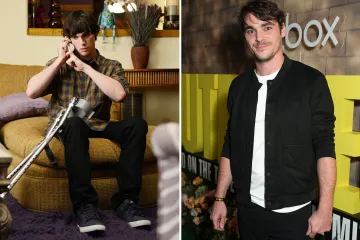
Aaron Paul shares heartbreaking vid of RJ Mitte speaking about mental health after Breaking Bad star’s death by suicide
AARON Paul has shared a gut-wrenching video of his Breaking Bad co-star, RJ Mitte, following his tragic death by suicide.
The actor best known for starring as Walter White Jr in the Emmy Award-winning show, died on Monday in Brownsville, Texas, aged just 34.
In an emotional tribute to his friend, Aaron said RJ’s strength and kindness was “blinding”.
Aaron shared a video of Mitte talking about the importance of taking care of one’s mental health.
The late actor lived with cerebral palsy and used his platform to raise awareness and champion people with disabilities.
RJ said in the video shared by Paul: “I hope y’all are doing well today in this time of uncertainty but I would like to talk to you a little about mental health.

“Its very important to take care of ones physical health but its equally as important to take care of one’s mental health.”
RJ said that “more often than not” people hide how they truly feel by saying “I’m fine” and “I’m good.”
He continued: “But its ok to not always be good.
“But its not ok to harbour that feeling, harbour those emotions.
Most read in Entertainment
“So I am hoping to inspire each and everyone that sees this video today.”
Aaron apologized for not realizing the pain his friend was experiencing.
He wrote: “I am so sorry you were hurting my friend. I wish we knew.”
“You constantly had a smile on your face and you took every single challenge that was given to you with such confidence and grace.
“I met you when you were a little boy and watched you grow into a beautiful young man.”
“What an absolute tragic loss.”
Aaron finished his post by encouraging anyone who is feeling lost, sad or uncertain about the future, to reach out for help.
He said: “We must suffocate the noise and focus on each other.”
The tribute from the star, best known for portraying Jesse Pinkman, followed the heartbreaking news that RJ was found dead by suicide at his home on Monday, as confirmed by his publicist.
RJ said in his final interview that he wanted to “keep living the dream” but added that “every dream could be a nightmare … just keep living it, just keep pushing forward”.
RJ’s on-screen dad, Bryan Cranston, 70, said he is in “deep despair” at the young actor’s death as he shared an emotional tribute.
Bryan said: “I met him when he was only 14 years old when he was cast as Walter White Jr., a part he played with such joy and enthusiasm.
“Born with Cerebral Palsy, he never – ever – allowed that challenge to be an excuse for anything. He met the demanding shooting schedule head on with great determination.”
The actor, like his character Walter Jr, had cerebral palsy and said his greatest achievement in life had been “giving back”.
He said: “That’s really the greatest thing that ‘Breaking Bad’ has given me, is to be able to lend my voice to causes that make a meaningful impact that changes people’s lives.
“I think that’s one of the greatest things that I have and it’s not the awards.
“It’s not all of these things people assume come with this. It’s literally being able to impact someone’s life in a meaningful way that without that, wouldn’t have it.”
If you or someone you know is affected by any of the issues raised in this story, call or text the 988 Suicide & Crisis Lifeline at 988, chat on 988lifeline.org, or text Crisis Text Line at 741741.
How to get help
EVERY 90 minutes in the UK a life is lost to suicide
It doesn’t discriminate, touching the lives of people in every corner of society – from the homeless and unemployed to builders and doctors, reality stars and footballers.
It’s the biggest killer of people under the age of 35, more deadly than cancer and car crashes.
And men are three times more likely to take their own life than women.
Yet it’s rarely spoken of, a taboo that threatens to continue its deadly rampage unless we all stop and take notice, now.
If you, or anyone you know, needs help dealing with mental health problems, the following organisations provide support:
CALM, www.thecalmzone.net, 0800 585 858
Heads Together,www.headstogether.org.uk
HUMEN www.wearehumen.org
Mind, www.mind.org.uk, 0300 123 3393
Papyrus, www.papyrus-uk.org, 0800 068 41 41