
Mental Health

‘I quit UK for France after commute left me in tears – people shouldn’t have to work 9-5’

A British man who moved to France has spoken about the emotional journey he went on before the making the life changing decision to leave the UK behind two years ago

Although there are now more barriers in place for Britons, the lure of living and working in Europe is still incredibly strong. As a result, every year there are stories of people leaving the UK to live and work in the European Union, sometimes temporarily, sometimes permanently.

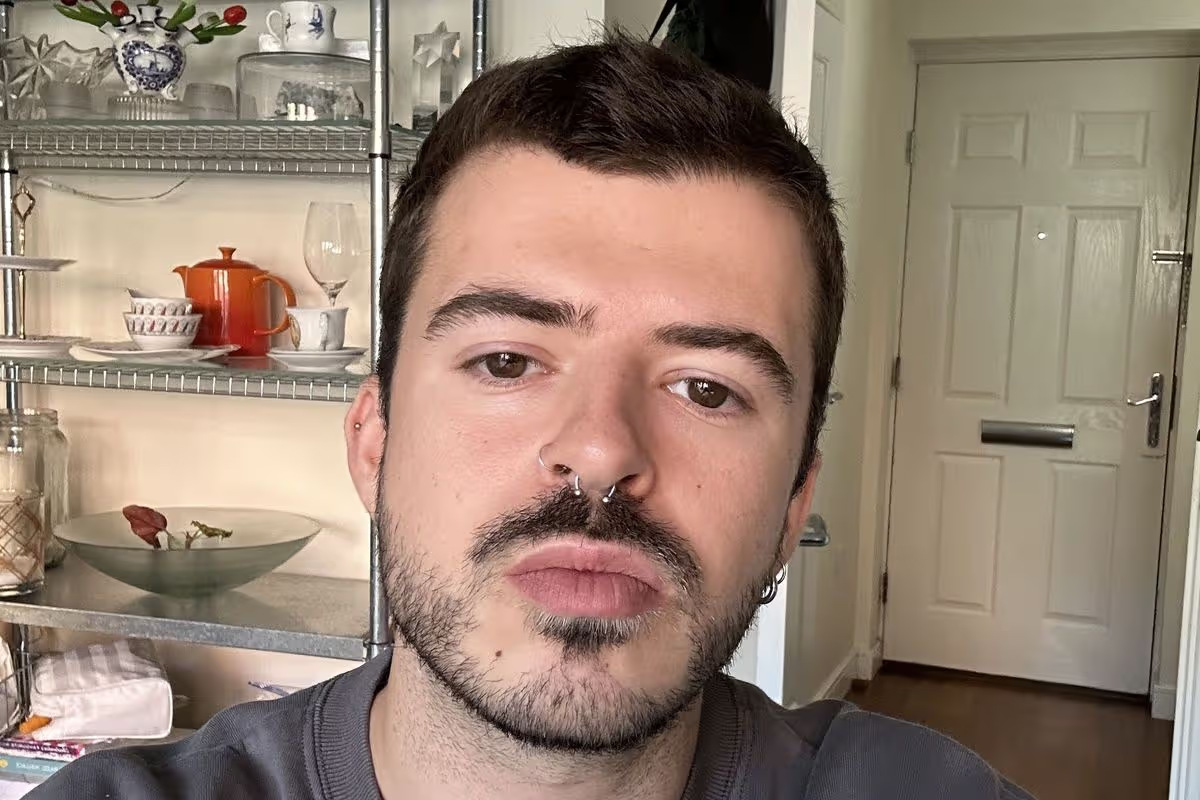
One man who moved to France from the UK has opened up about how the working culture in London led him to struggling with burnout. Liam Rondi, 30, and his husband Xavier Rondi, 33, eventually moved to Montpellier, France, in 2024.

Now, nearly two years on, Liam, a freelance copywriter, has talked about the anxiety and stress he experienced whilst living and working in central London.

Liam, originally from Medway in Kent, said: “I was watching the state of the country deteriorate in many different ways. I used to struggle a lot financially and I think the general mood of the country started to sour and I could really tell it started to wear on me.

“I was very anxious. In the mornings before work I would often be crying and be on the Tube bordering on a panic attack. I was exhausted and I couldn’t keep up with the work that was being set.”

Liam said that one of the turning points for him was when he visited his husband’s family in France and saw how people seemed “to be a lot friendlier and happier”. This, in turn, has shaped his opinion on how he views people working nine to five jobs in the UK and his belief that the “UK government is gaslighting people”.

He explained: “I think people in the UK pretend to be happy with the 9-5 lifestyle. I think a lot of people are very good at just keeping calm and carrying on – but for me that wasn’t a life that I wanted to live.”

Liam says he’s now decided to prioritise happiness over money, even if it has meant that the area he’s moved to has fewer career opportunities for him. He said: “The downside [to living in France] is I feel like the career opportunities aren’t as plentiful.

“I don’t think I’ll ever earn as much here as I could have done in the UK but I’ve realised over time that money isn’t the thing I’m most bothered about, it’s more happiness.”

Liam now encourages other people to at least consider moving somewhere else, even if it’s only to try it out, after saying he won’t return. He explained: “I can’t see myself ever moving back. France feels like home already because of the way of life. I definitely encourage people to consider it at least, just remember that it’s possible.”

Furthermore, Liam has also shared a video on TikTok detailing some of his experiences, one which has gone viral with around 294,000 views, likes, shares, and comments.

Liam’s story of experiencing burnout isn’t a new one, with data showing that more and more Britons are suffering from it.

Last year, a STADA Health Report showed that one group particularly affected was British women with 56 percent of women between the ages of 18 and 24 and 44 percent of those between the ages of 35 and 44 saying they had experienced the phenomenon.

Men were also shown to experience burnout with 43 percent of 18 to 24-year-olds and 36 percent of 35 to 44-year-olds experiencing symptoms.

Speaking about the matter to the Mirror, GP and TV doctor Dr Anisha Patel said: “I myself have suffered from burnout and as clinicians, we’re seeing more and more people at breaking point mentally, which can also impact their physical health and it’s clear that our mental health services need not only more investment, but cultural change.

“What’s striking is how stigma continues to hold us back. Despite widespread experiences of burnout, the UK still reports low levels of people taking sick leave for mental health reasons compared to other European countries.”

For emotional support, you can call the Samaritans 24-hour helpline on 116 123, email jo@samaritans.org, visit a Samaritans branch in person or go to the Samaritans website.
Source link

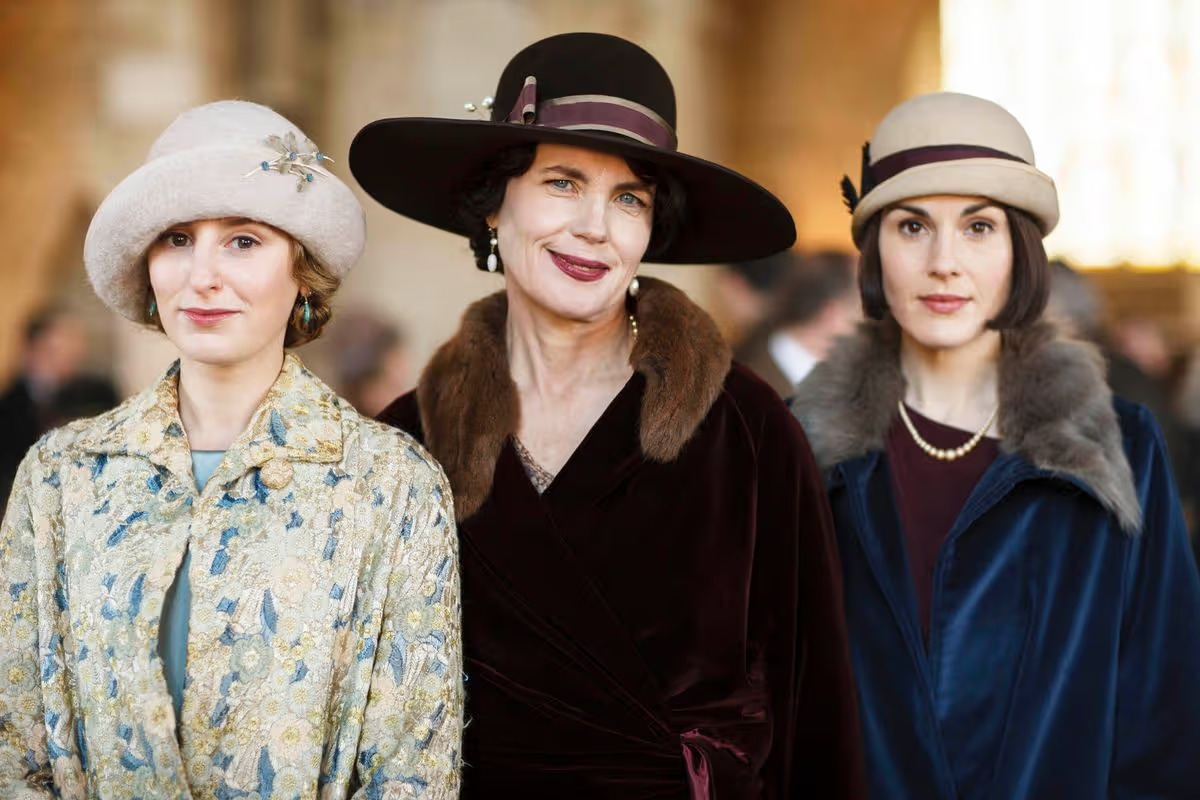
ITV period drama so good it’s ‘unquestionably’ better than Downton Abbey

Some would argue that Downton failed to steal the crown of this classic.

Some things are simply unbeatable. A classic period drama, one as critically acclaimed as it was popular, remains regarded as amongst the finest ever produced — Upstairs, Downstairs.

The family saga charted the lives of the aristocratic Bellamy family and their staff in the early 1900s. Spanning three decades, the programme’s narrative stretched both World Wars and the jazz age through to the Great Depression.

As the quintessential period drama of its era, comparisons between Upstairs, Downstairs and Downton Abbey are inevitable. The BAFTA-winning ITV series established the benchmark for costume dramas with storylines that mirror its successor.

Upstairs, Downstairs came before Downton Abbey by 50 years. Both programmes portray the lives of an aristocratic family and their servants against a backdrop of social and political upheaval in the early 20th century.

They diverge in some major ways though, with the most obvious being Downton Abbey’s production values. The 1970s show looks more understated, a quality that strikes viewers as either nostalgic of off-putting.

Downton’s location is fundamentally more grand. The Bellamy family inhabit a London townhouse, worlds apart from the Crawley family’s lavish country manor which became a character in its own right.

Whilst Downton was famed for its visual spectacle, a share of the audience felt the series occasionally strayed into the melodramatic. In contrast, Upstairs, Downstairs has been likened to theatre due to its more grounded visuals and plot lines.

Fans of both period dramas have invariably come together online to compare the shows and name their favourite.

One person sparked a debate on a Downton Abbey forum by asking: “If you have seen both shows, which show do you think is better?” to which one person simply responded: “Upstairs Downstairs without question.”

“The original Upstairs Downstairs is one of the finest TV programmes ever made,” argued another. “Downton Abbey is a jumped up soap opera.”

Of course it would be remiss not to mention the BBC’s reboot of Upstairs, Downstairs in the 2010s, but that’s a whole ‘nother debate.

Upstairs, Downstairs can be streamed on ITVX.

Source link

Former EastEnders star shares ‘little devil’ health battle that’d make her ‘sweat’

The TV star is sharing her own experiences as part of a new NHS campaign that aims to raise awareness

Shona McGarty, a former star from EastEnders, has shared her mental health experiences with something she describes as a ‘little devil on her shoulder’ and encourages others to get help. The actress and singer, famous for her role as Whitney Dean on the BBC soap and for participating in I’m A Celebrity last year, has opened up about dealing with social anxiety since she was a teenager.

She said: “I was always a chatty child, but as I got older, everything changed. Around 15, I suddenly became painfully self-aware. I started overthinking and struggling to hold conversations, even though talking was literally part of my job.

“My social anxiety would happen when meeting new people, with colleagues or even at family gatherings. My heart would race, my hands would sweat, and sometimes I thought I might faint. I sometimes pretend to receive a phone call just to leave a social situation. People would say, ‘Shona’s so shy,’ or ‘she’s so quiet,’ and it really hurt.”

Sharing how she copes with social anxiety now, she said: “I’m worlds away from that level of panic now, because I’ve learned how to deal with it when it shows up. One thing that helps is imagining a little devil on my shoulder. I acknowledge it, and then I answer back: Thank you, but you’re wrong. I’m in control. I’m safe. People aren’t judging me; they’re listening because they want to hear me speak.”

Shona said the biggest help of all has been talking about it. “Acknowledging social anxiety instead of fighting it,” she said. “You’d be amazed at how many people feel the same way. A problem shared really is a problem halved.”

The TV star has shared her personal experience of social anxiety disorder to help raise awareness and support the launch of a new NHS campaign. The campaign urges people with six common anxiety conditions – including post-traumatic stress disorder (PTSD), social anxiety and obsessive compulsive disorder (OCD) – to come forward for help by self-referring online at nhs.uk/talk.

The NHS England campaign is backed not only by Shona McGarty but also by The Only Way Is Essex’s Charlie King and former professional footballer and Professional Footballers’ Association chair Clarke Carlisle. Each is candidly sharing their own experiences to encourage others to come forward.

Dr Adrian James, NHS England’s National Medical Director for Mental Health and Neurodiversity said: “While it’s encouraging that thousands more people facing mental health conditions are accessing NHS support than before the pandemic, we know that millions more could benefit from vital NHS talking therapies. This landmark new campaign is a critical step to ensuring that everyone struggling with challenging but very common conditions like anxiety and PTSD knows that there is support available to help them get on with their lives again.

“Through proven treatment and support available for free on the NHS, these conditions can be overcome to help people return to work, regain confidence or feel back to their old selves in social situations. Our message is clear, if you’re struggling with your mental health, NHS talking therapies are here for you, and you can either self-refer or speak with your local GP practice.” You can find out more and refer yourself for NHS Talking Therapies at nhs.uk/talk.

What is social anxiety?

The NHS defines social anxiety disorder, also called social phobia, as a long-term and overwhelming fear of social situations. “It’s a common problem that usually starts during the teenage years. It can be very distressing and have a big impact on your life,” it says.

Dr Ravi Gill, a health psychologist and founder of Smart Mind Health, explains: “People that experience social anxiety know that the fear that they have around these certain situations is not OK, so their nervous system reacts in a way that sends them into a slight bit of panic.

“So, it’s not just nerves or a lack of confidence or not knowing how to navigate something, social anxiety is a lot more than that. There’s a genuine fear that something is going to happen and a fear of being seen and getting it wrong. It’s also linked quite closely with imposter syndrome, and the two often come up together.”

Social anxiety often occurs in performance and group situations in the workplace, he says. “Performance situations in the workplace, such as speaking up in meetings, doing a presentation or making a phone call can all add pressure and really heighten someone’s social anxiety.”

The health expert also says it affects social situations. He said: “Within a group of friends, the one that suffers with social anxiety will often just sit there and observe the conversation and won’t speak up and contribute. They may feel like they will say something wrong or feel that their opinion on something might be misconstrued or misinterpreted in some way.”

Source link

Jesy Nelson fans say they ‘can’t watch’ her Amazon Prime documentary for 1 reason

Jesy Nelson: Life After Little Mix, which is out on Amazon Prime, follows Jesy’s life after she left Little Mix back in 2020, including her reflections on fame, pressure, and her own personal truth about that period

Jesy Nelson’s Amazon Prime Video documentary, which is out today (Friday February 13) is a major new six-part series.

Jesy Nelson: Life After Little Mix follows Jesy’s life after she left Little Mix back in 2020, including her reflections on fame, pressure, and her own personal truth about that period. It’s her most candid account yet of why she departed the group and how she’s processed everything that happened. Another central focus of the documentary is Jesy’s pregnancy with her twin girls, Ocean Jade and Story. The cameras follow the 34-year-old Romford star through what became a high-risk pregnancy including complications like twin-to-twin transfusion syndrome and emergency medical moments.

After the birth is also covered, when Jesy’s daughters were diagnosed with Spinal Muscular Atrophy (SMA) Type 1 — a severe, progressive genetic condition that causes muscle weakness.

Jesy uses the documentary to share her family’s real-time experience with this diagnosis and to raise awareness about it, including campaigning for expanded newborn screening in the NHS.

Besides the physical journey, the Amazon Prime series also revisits her personal and emotional challenges, including struggles with the pressure of fame, mental health battles, and what it’s been like stepping back from one of the UK’s biggest pop acts.

Get Amazon’s Prime Video free for a month

This article contains affiliate links, we will receive a commission on any sales we generate from it. Learn more
Content Image

£8.99

£0

Amazon

Get Prime Video here

TV lovers can get 30 days’ free access to tantalising TV like The Boys, Reacher and Clarkson’s Farm by signing up to Amazon Prime. Just remember to cancel at the end and you won’t be charged.

Many fans have been excited to watch the documentary, however some have confessed online they ‘don’t think they can watch it’ for one reason – that it will leave them too emotional.

One person wrote: “I’m not gonna handle this well I’m already emotional about it.”

While another added: “My heart. I don’t even think I can watch this. I’m already crying.”

A third chimed in: “I’m gonna weep aren’t I,” while a fourth added: “She deserves to tell her side of the story after years of being silent.”

Jesy recently confessed that she considered leaving Little Mix after just two years as she struggled to cope with the pressure and the spotlight after winning The X Factor.

However, she went on to spend a decade in the band before quitting.

Jesy said: “That [leaving] presented itself far before I made that decision.

“There was a time where I was like ‘Oh, I want to leave’ and I remember sitting down with my family… and it was actually because of my brother that in the end I stayed.”

She added: “The first time I wanted to leave I remember I went home and we were kinda weighing up the [pros and cons]… and at that point we weren’t even like at our biggest.

“We were, it had only been like two years, but we were still big. Everyone still knew who Little Mix were so it was like ‘if you leave now, what are you going to do?’”

Speak on the Great Company with Jamie Laing podcast, Jesy also praised her brother for his advice that ultimately kept her in the band and for encouraging her to make as much money as she could off of Little Mix‘s fame.

“My brother was like ‘you are so much stronger than you give yourself credit for and I think you can stick this out for another few years,” she explained.

Source link

Canada’s PM Carney to visit Tumbler Ridge after mass school shooting | Crime News

Police say 18-year-old Jesse Van Rootselaar killed her mother and stepbrother before carrying out mass shooting in BC.

Canadian Prime Minister Mark Carney has said he will shortly visit the remote British Columbia town of Tumbler Ridge, where nine people died in one of the country’s worst mass shootings, according to his office.

Police say 18-year-old Jesse Van Rootselaar, who had suffered mental health problems, killed her mother and stepbrother on Tuesday before shooting a teacher and five young students at the local school.

Recommended Stories

list of 2 itemsend of list

Van Rootselaar, who police say was born a male but began identifying as a woman six years ago, then died by suicide.

“The Prime Minister will be visiting Tumbler Ridge shortly in support of the community … [we are] working closely with the community and local authorities to finalise details based on their own immediate needs,” Carney’s office said on Thursday in a brief statement, which gave no details.

Across Tumbler Ridge, a town of about 2,400 in the Canadian Rockies, flowers and stuffed animals could be seen at unofficial public memorials.

“Hold your kids tight, tell them you love them every day. You never know,” a tearful Lance Young, father of 12-year-old victim Kylie Smith, told reporters on Wednesday.

Carney announced on Wednesday that Canadian flags will be flown at half-staff for seven days on federal buildings following the mass school shooting.

Honouring the victims

Police, who say they still do not have a motive, held a meeting with provincial officials late on Wednesday.

“They are working very hard – they recognise the public does need to hear information to fill that vacuum,” local provincial legislator Larry Neufeld told CBC News on Thursday.

Police said they had visited Van Rootselaar’s house on several occasions to address mental health issues and had twice taken her away for formal assessments.

British Columbia Premier David Eby said on Wednesday he had reached out to local health officials to ask for more details of the interactions.

At one point, police seized guns from the house but returned them after the owner, whose identity they did not disclose, successfully appealed the decision.

British Columbia on Thursday observed an official day of mourning. Provincial Lieutenant-Governor Wendy Cocchia, the personal representative of King Charles, Canada’s head of state, is scheduled to deliver a speech in the legislature to honour the victims.

In Toronto, the iconic CN Tower went dark at the top of every hour on Wednesday to honour the victims of the tragedy.

“Tonight the #CNTower will dim for 5 minutes at the top of each hour in honour of the victims of the attack in Tumbler Ridge, British Columbia,” the CN Tower’s official social media account posted on Wednesday.

Source link

Landmark cases on social media’s impact on children begin this week in US | Social Media News

Two lawsuits accusing the world’s largest social media companies of harming children begin this week, marking the first legal efforts to hold companies like Meta responsible for the effects their products have on young users.

Opening arguments began today in a case brought by New Mexico’s attorney general’s office, which alleges that Meta failed to protect children from sexually explicit material. A separate case in Los Angeles, which accuses Meta and the Google-owned YouTube of deliberately designing their platforms to be addictive for children, is set to begin later this week.

Recommended Stories

list of 4 itemsend of list

TikTok and Snap were also named in the original California lawsuit but later settled under undisclosed terms.

The New Mexico and California lawsuits are the first of a wave of 40 lawsuits filed by state attorneys general around the US against Meta, specifically, that allege that the social media giant is harming the mental health of young Americans.

New Mexico case

In the opening argument in the New Mexico case, which was first filed in 2023, prosecutors told jurors on Monday that Meta – Facebook and Instagram’s parent company – had failed to disclose its platforms’ harmful effects on kids.

“The theme throughout this trial is going to be that Meta put profits over safety,” said lawyer Donald Migliori, who is representing the state of New Mexico against Meta.

“Meta clearly knew that youth safety was not its corporate priority… that youth safety was less important than growth and engagement.”

Prosecutors say they will provide evidence and testimony that Meta’s algorithms and account features not only enticed young people and made them addicted to social media, but also fostered a “breeding ground” for predators who target children for sexual exploitation.

Late last month, in the process of discovery, the New Mexico attorney general’s office said the company did not put in safeguards to protect children from accessing sexualised chatbots on Facebook and Instagram.

In emails obtained by the court, some of Meta’s safety staff had expressed objections that the company was building chatbots geared for companionship, including sexual and romantic interactions with users, according to the Reuters news agency.

The artificial intelligence chatbots were released in early 2024. The documents cited in the state’s filing do not include messages or memos authored by Meta CEO Mark Zuckerberg. In October 2025, Meta added parental controls to the chatbots.

California case

The California case is more wide-reaching and alleges that Meta and YouTube, which is a unit of Alphabet-owned Google, used deliberate design choices that sought to make their platforms more addictive to children to boost profits.

The case centres around a 19-year-old identified only by the initials KGM. The case could determine how thousands of other, similar lawsuits against social media companies will play out.

KGM claims that her use of social media from an early age made her addicted to the technology and exacerbated her depression and suicidal thoughts.

“Borrowing heavily from the behavioral and neurobiological techniques used by slot machines and exploited by the cigarette industry, Defendants deliberately embedded in their products an array of design features aimed at maximizing youth engagement to drive advertising revenue,” the lawsuit says.

Executives, including Zuckerberg, are expected to testify at the trial, which will last six to eight weeks. It is unclear if they will attend the New Mexico case.

The tech companies dispute the claims that their products deliberately harm children, citing a bevvy of safeguards they have added over the years and arguing that they are not liable for content posted on their sites by third parties.

“Recently, a number of lawsuits have attempted to place the blame for teen mental health struggles squarely on social media companies,” Meta said in a recent blog post. “But this oversimplifies a serious issue. Clinicians and researchers find that mental health is a deeply complex and multifaceted issue, and trends regarding teens’ well-being aren’t clear-cut or universal.

Narrowing the challenges faced by teens to a single factor ignores the scientific research and the many stressors impacting young people today, like academic pressure, school safety, socio-economic challenges and substance abuse.”

A Meta spokesperson said in a recent statement that the company strongly disagrees with the allegations outlined in the lawsuit and that it is “confident the evidence will show our longstanding commitment to supporting young people”.

Jose Castaneda, a Google spokesperson, said the allegations against YouTube are “simply not true”.

“Providing young people with a safer, healthier experience has always been core to our work,” he said in a statement.

High stakes

The outcome of the cases could shape the future of social media.

“In my mind, an existential question for social media services is whether they’re liable for harm suffered by users from using the services. If so, the damages could be more money than the defendants have, Eric Goldman, a professor at the Santa Clara University School of Law, told Al Jazeera.

“We’re talking about massive financial stakes, and we’re also talking about the ability of the plaintiffs to veto or potentially override editorial decisions by the services about what’s in the best interests of their audiences,” he said.

“It’s essentially taking away power from the services to decide and handing it to plaintiffs’ lawyers. So, not only could there be existential damages, but there could also be a massive loss of editorial control over their services. The stakes could not be higher for social media services or the internet.”

Goldman said this was because the same argument could be used to shape claims against video game makers and generative AI, which refers to AI that can create original content, including text and video.

“If these theories work against social media, they might also work against video games, against generative AI, and who knows what else. That’s why I said the stakes are so high for the internet,” he added.

There are already lawsuits that claim that interactions with OpenAI’s ChatGPT led to instances of suicide and murder-suicide.

On Wall Street, Meta stock is trending up by more than 3 percent in midday trading.

Source link